If I had remained completely true to my existential, celebrate-the-mundane self, this piece might be entitled “Halstead Town versus Swaffham Town match postponed due to a frozen pitch” and would be a description of how I came to follow Halstead Town football club on Twitter and discovered that the match I had intended to watch this afternoon would not take place. It would not have been a long piece and I might even have just written it. But games get postponed and life goes on and so I looked for another game to watch and the nearest one to my home address is in West Street, Coggeshall, also known as ‘The Crops’, although I will be disappointed to discover that the sign announcing that no longer adorns the side of the changing rooms.
It is a cold, still December day; not bitterly cold, more penetratingly cold, although my hearty optimism and excitement at the thought of going to a match easily quench the thought of getting a little chilly as I set out on the three mile drive from my house. Diving off the A120 into Coggeshall I motor past the Co-op where later I will buy some corned beef, milk, beer, Muscovado sugar and dairy free chocolate, the latter being for my dairy intolerant spouse. In the centre of town a bus is turning right to head past the ground on its way to Braintree; a pang of guilt hits me; I could have used public transport, there is a bus stop at the bottom of my garden; but then I couldn’t have popped into the Co-op. Emerging from down-town Coggeshall and its fine collection of timber-framed buildings, the football ground is on the left and I park up at the front of the site taking care not to back my Citroen C3 into an Audi behind me, despite my dislike of ostentatious automobiles.
There seem to be few if any people heading towards Coggeshall Town football ground this afternoon, although it is barely twenty to three, and entering the ship-lap clad wooden turnstile block is a lonely experience. But the turnstile operator is a cheery fellow and greets me like a long lost friend, almost to the extent that I want to ask, “Do I know you?”, but that would seem a bit rude and to be honest I have a very poor memory for faces. I join in with the bonhomie therefore and then offer a fresh ten pound note for the admission and a programme (£1). “Are you, are you…….er, normal?” asks my new friend clearly struggling desperately for the right words to ask if I might qualify for the concessionary price. “Yes, I‘m normal” I say hopefully, understanding that he means I pay the full price (£6). He apologises, explaining that some people get upset if you ask them for the full price when they qualify for the concession because they are old bastards. I reply that I understand, and I do. The bloke at the turnstile goes on to tell me that the clubhouse is open and so is the tea bar at the side; he is not just a turnstile operator he’s a concierge.
Having paid my entrance money I linger just beyond the turnstile taking in the view of the pitch and countryside beyond from the concrete path that leads to the club house. It’s a beautiful sight. I move on and recovering from the disappointment that ‘The Crops’ sign is no longer on the side of the changing rooms I find that the clubhouse has been renovated since I was last here, the exterior having been covered in modish cladding and there are glass doors adorned with the club crest; the interior is updated in similar fashionable materials, there is also an area of decking outside; it all seems a bit like a holiday village rather than a football ground, but then I grew up in the 1960’s and fondly recall pubs having outside toilets, as did my grandmother’s council house. Stepping outside again I explore the low stand behind the goal and look at the pitch side


advertisement hoardings; it seems that everywhere I go an undertaker sponsors the local club. I am also impressed that there is an advertisement for a maker of sash windows; no doubt a busy man given Coggeshall’s many old buildings. I then meet my next door neighbour’s son Sam who is here with a bunch of mates from school; he tells me his dad his here too and he’s not having me on. Paul my neighbour is enjoying a hot drink and after watching the teams file down on to the pitch and saying hello to a man called James, who plays guitar and used to work for Crouch Vale brewery, I join him as we wait for the first half to begin. As the teams line up and the coaches occupy their benches, he tells me that one of the track-suited blokes in the dug-out is Ollie Murs, who I understand is a singer, popular with modern day teeny boppers. I’m sure he is no Johnny Hallyday nevertheless. Repose en paix Johnny.
Coggeshall kick off the game in the general direction of Braintree, wearing red and black striped shirts with back shorts whilst their guests from faraway Fakenham wear white shirts and blue shorts and have the name Macron above the numbers on the backs, sadly not because they all share the surname of the French president but because the shirts are manufactured by a company called Macron. Coggeshall look very much like the home team, by which I mean they dominate the attacking play, which is no surprise given that they are second in the league table and Fakenham fourth from bottom. My neighbour tells me that Coggeshall’s star striker gets £300 a week and £50 a goal; I have no way of knowing if this is true, but if it is it doesn’t seem right or fair in a league in which most clubs struggle to attract an average crowd of one-hundred; but apparently he‘s not playing today anyway.
The early part of the game is not brilliant to watch and I am as interested by the sky, the trees, an old man poking his head into the tea bar and the lads lined up behind the Fakenham goal as I am by what happens on the pitch; my neighbour refers to the lads behind the goal as ‘herberts’, doubtless because his son is amongst them, although his son’s name is Sam. Coggeshall ought to score because they clearly have the better players, but at about twenty minutes past three a cross drops at the far post and the ball is side-footed high into the Coggeshall goal net to give ‘The Ghosts’, for that is their nickname, an unexpected lead. Predictably perhaps the goal shames Coggeshall into action and within five minutes they equalise; an unchallenged header drifting past the static goalkeeper and inside the post. Thereafter Coggeshall dominate and play some pretty passing football, but ultimately a lack of true team play prevents them from registering the goals their superior ability suggests they should score. I take a walk around the pitch seeking a different perspective. Fakenham move forward and from behind the Coggeshall goal I overhear a conversation between Coggeshall’s number two, a big man with blond highlights in his already blond hair and the goalkeeper: “ I nearly put it out for a fucking corner” says the full-back “ I Know, fuck me” Says the goal keeper. Half-time arrives and the score is 1-1.
I head to the tea-bar and buy a pounds worth of tea in the hope that it will fortify me against the deepening chill. Where I have not worn my gloves in order to snap photos, my hands now feel like pins are being driven beneath my finger nails. The cold has recognised that my thermal socks are a worthy opponent and has by-passed them to go up my trouser leg beyond the top of the socks to penetrate my shin bones. My neighbour eats an enormous sausage roll (£3.50) that Captain Scott would have coveted and the tea possibly saves my life or at least prevents frost-bite. I check the half-time scores and am disappointed by the news from Middlesbrough that Ipswich are losing 1-0, although the fact that the Danish, former Toulouse striker Martin Braithwaite scored the goal, softens the blow because I spotted him as a talent a few years ago,
Half-time over, I take up a seat in the low main stand because my back is aching and also because, frankly, I sometimes enjoy my own company. To my right five blokes in their late sixties or seventies discuss the score. One of them, a jowly man wearing a bobble hat is adamant that the score is 2-1and the others don’t seem confident enough in the memory of their own observations to tell him he is wrong. Eventually, a young woman wearing large glasses confirms that the score is 1-1 and I back her up. Oddly, within seconds, Coggeshall score a second goal to really make the score 2-1 and then quickly add a third as Fakenham fail to successfully make the transition from the dressing room to the pitch.
With not an hour gone, the game is as good as won for Coggeshall, nickname The Seedgrowers, which gives the opportunity to appreciate the beauty of the disappearing daylight. A bank of cloud on the horizon denies us a spectacular sunset but instead gives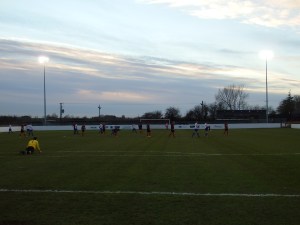 the appearance of a mountain range looming up in the distance like the Pyrenees over Languedoc. Whilst waiting for a fourth Coggeshall goal the old blokes behind me discuss the imminent changes to the fifth and sixth steps of the non-league pyramid and I ponder the fact that Coggeshall’s number eleven appears to have one white leg and one black leg. This is no doubt due to a knee brace, but it leads me to imagine the implications of mixed race people literally being half black and half white. The number eleven is a busy, energetic little player but embarrasses himself by finding space on the flank and calling to a team mate with the ball “Feed me, feed me”. I am reminded of the plant in the ”Little Shop of Horrors”, but the number eleven has the good grace to glance into the crowd looking a little embarrassed.
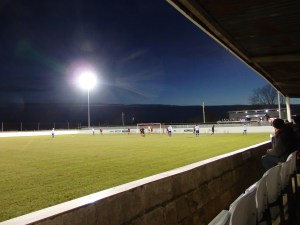 Above the glow of the floodlights the sky is midnight blue, but It’s only just gone twenty past four. Coggeshall add a fourth goal, and then at four-thirty the Seedgrowers’ number ten scores the best goal of the game as he lofts the ball in a graceful arc over the goalkeeper from just outside the penalty area. Fakenham respond with some substitutions and bring on a large bald man who looks like a Turkish wrestler and two much slimmer and younger players, one of whom looks like his shirt number is the same as his age, fourteen. Despite there being no doubt about the eventual result, the match remains competitive, which manifests itself in sustained shouts and calls amongst the players which ring out coarsely in the cold winter air. There are also some very entertaining tackles, which the frighteningly clean-cut referee Mr Farmer rewards with yellow cards, but they give the crowd and players something to bray about. It’s now five minutes to five and everyone is thinking about going home as a low cross finds the Coggeshall number ten Ross Wall free at the far post and the ball is slammed low into the net, thumping the board behind the goal with the hollow thud more usually heard when the ball misses the goal and hits the advertising hoardings; I find it slightly disorientating, but heck, it’s 6-1 and Ross Wall has a hat-trick.
Mr Farmer soon blows his whistle for the last time today and a sated crowd of 108 disperse into the club house or out into the car park and the early evening. Having zig-zagged my way through the emptying seats of the stand I pause and speak again with Jimmy who is now with his wife, and then head for the Co-op.


 trying to hide behind the metal gates. The search dog is here searching for whatever it is that ‘the authorities’ fear people might smuggle into a mid-table, second division football fixture. There is a cameraman filming people who are just standing about, waiting.
 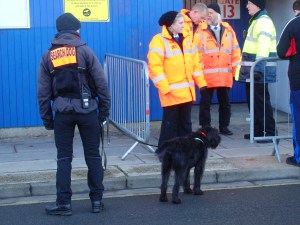 My accomplice heads for the ticket office to ‘upgrade’ his tickets. Because his partner’s father is over 65 the bundle of tickets he bought turn out to be for an over 65 too, but my accomplice, who I will call Roly because I always liked that poodle in Eastenders and it is his name, is only forty. Predictably upgrading the tickets is not simple and ‘the system’ won’t allow it today. A complimentary ticket is issued for today’s game but the guy in the ticket office takes the other five tickets and tells Roly to phone on Monday to sort it out. Like a fool Roly agrees to this and doesn’t even get a receipt. Roly has a bad feeling about this.
 were to shout abuse at him he would probably hear me, but of course I don’t, even though he looks more like a baby’s soft toy than a mascot to rally the people of Ipswich into raucous support of their team.





 is sat with the engine running; it’s a long trip to Morecambe so may be the driver is hoping for a quick getaway. There isn’t much going on outside the stadium so I head for the turnstile. Once inside I feel compelled to visit the toilet. Feeling more comfortable I meet another man called Martin who I used to work with; he has a season ticket like the other Martin, but isn’t retired. Martin is compelled to visit the toilet just like I was and so I take up my seat; there is no one sat either side of me, there aren’t many people here today, I later learn that I am one of just 2,872. It’s the smallest crowd for a Saturday league game at “Layer Road” this season.
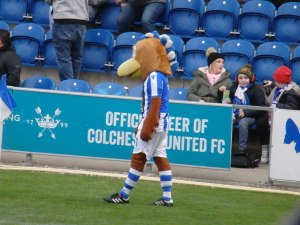 Colchester wear their ‘traditional’ blue and white striped shirts and white shorts with blue and white hooped socks. I like hooped socks; I wish Ipswich Town would wear them. Morecambe wear the archetypal away kit, an insipid all pale yellow number which is bland and annoying. It’s as if no one at Morecambe could be bothered to come up with anything distinctive. I can forgive clubs for a lack of ambition, especially on home gates of less than two-thousand, but please look like you care. It is unclear why Morecambe even need to wear their away kit today because their first choice colours are red shirts with white shorts.


 ‘indoors’ and make my way back to my seat, warming my hands around my paper cup of tea.

 ‘Come on Morecambe’ from the half a pint or so of Shrimp fans searching for one another in the corner of the ground. Some of the Colchester supporters are getting restless; there are some more chants of “Come on Col U, Come on Col U” and angry groans when passes fail to find Colchester players.
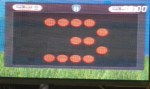 announced a big number 3 appears on the scoreboard and there is a dash for the exits, as if another three minutes of this will be just too much to bear.
 on a dull afternoon and the intensity of this dull experience has been deepened by the fact that there weren’t many of us here to witness it. Up in the stand a board advertises the ‘Matchday Experience’ and gives a local telephone number, as if you could just phone up to experience what we’ve all just been through. I head off towards the bus stops, numbed but nevertheless enriched by the glumness of the occasion. Such awful games are what it’s all about; pain and missed opportunities. That’s life. Good, innit.
