AS St Etienne 2 Stade Rennais 2

Ever since 4th March 1981, when Ipswich Town produced what is probably the club’s greatest ever performance, winning 4-1 in St Etienne, I have wanted to see a game at the Stade Geoffroy-Guichard; it would be a pilgrimage to the scene of Ipswich Town’s finest hour. St Etienne is famous for its fanatical supporters and seeing and hearing them on the television since just added to the draw of the Stade Geoffroy-Guichard.
Today, thirty-six and a half years on I have stopped off on my way back from the south of France. Our hotel is close to the centre of town opposite the wonderful brick and metal-framed St Etienne-Châteaucreux railway station.

From there it is 1.40 euro tram ride on Ligne 1 to the Stade Geoffroy-Guichard. It is a little after one o’clock and there are several green-shirted St Etienne supporters on the modern, green tramOLYMPUS DIGITAL CAMERA which glides through narrow central streets into broad squares of fountains, trees and majestic buildings. Why are French provincial cities so much more attractive and inviting than our own? St Etienne isn’t even that big, with a population of the town itself being about 150,000; vistas of the green hills outside the town are visible along some city streets. It’s an industrial town built up on coal mines and manufacturing like Sunderland or Salford but that’s where the comparison ends.
At the tram stop on Rue Bergsson, conveniently named Stade Geoffroy-Guichard, we alight and make the walk along Boulevard Roger Rocher towards the corner of the stadium which looms in the distance like a sleek grey box. We approach through car parking shaded by plane trees and past stalls selling club shirts, food and beer. There are several approaches to the stadium each with its own collection of food stalls.

People stand about in the sunshine, talking, eating, drinking, being French. I buy a hot dog for 3 euros, it’s one of those where the frankfurter is slotted into a hole in the centre of a baguette; I have mustard with it.
A man gives out 24 page, A4 sized, colour programmes named “100% St Etienne”, they are absolutely free; there are more advertisements for restaurants (eight) within its pages than for any other type of business. The club shop is close by the stadium and I take a look inside; it’s very, very big and very busy with a huge range of St Etienne branded goods which includes watering cans, locally brewed beer in 33cl and what look like 3 litre bottles, and wine.

Last year the club celebrated the fortieth anniversary of its one European Cup Final appearance, when the team containing Jacques Santini and Dominic Rocheteau lost in Glasgow by a single goal to the Bayern Munich of Beckenbauer, Sepp Maier, Gerd Muller and Uli Hoeness; a book commemorating the event is on sale for 25 euros; I don’t buy it.
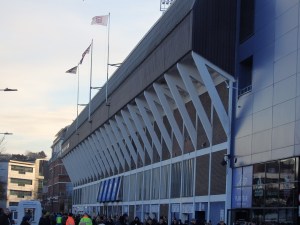
Back outside I join a short queue through one of the many automated turnstiles and after a cursory patting down by a very smiley gentleman I enter the ‘Chaudron’ (Cauldron) as it is known. Our seats are way, way, way up in the stand and the succession of flights of stairs seems to go on and on forever. Eventually I find my seat in the very back row of the third tier. The view is spectacular, but it’s a long way from the pitch and a massive steel girder obscures any view of a good half of the stand at the far end of the ground, although that’s okay if you’re just here to look at the football and not the architecture.37430129191_f59c952158_o But even with an interrupted view, it is a mightily impressive stadium; fundamentally it is a traditional arrangement of four individual stands around the pitch, but they have been unified by the placing of a massive steel box over the top of them with irregularly shaped cut outs in the faces of the box. It is a simple idea and it works brilliantly, creating an imposing building, the outside of which doesn’t give a clue as to what the inside is like; it could easily be a factory viewed from the outside, which is wholly appropriate for St Etienne. The retention of the traditional four stands on each side of pitch successfully avoids the risk of this being a bland, anonymous bowl of a stadium.

This slideshow requires JavaScript.


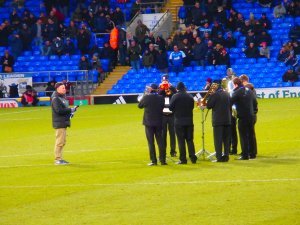
The Stade Geoffroy-Guichard is a stage and the supporters behind each goal are every bit as much performers as the players. Already there are thousands inside the stadium and from high up at the back of the stand I look down upon those still yet to enter. Across the open space below me a crocodile of fans stride towards the turnstiles; they seem to be all part of a single group. The ultras beneath us in the stand two tiers below sing “Na na na na, Na na na na, Hey Hey Hey, St Etienne”; very 1970’s. The teams will soon be on the pitch but there is a strange looking man with long silver hair in the centre circle, he is accompanied by four young women in short skirts or hot pants.

He has a radio microphone and he is going to sing. A truly bizarre couple of minutes ensues in which the silver haired man struts about, the women dance and everyone seems to have a great time joining in with a truly awful Eurovision style song that would have been considered a bit naff even forty years ago. I recall having seen a picture of a man with the fashion sense of Jimmy Savile in the club shop, but I had dismissed it as something I’d rather not know about. Well you would wouldn’t you?
Fortunately the teams now enter the field to great fanfare with banners and anthems and hullabaloo and the memory of the poor man’s Johnny Halliday is soon lost beneath more pleasant sensations as the game begins, St Etienne (les Verts) wearing their distinctive green shirts and socks with white shorts, whilst Rennes sport all-red. St Etienne start well and is it any wonder with a crowd of 31,000 roaring them on. It’s a warm day and at the far end of the stadium virtually a whole stand of ultras is shirtless.OLYMPUS DIGITAL CAMERA Below, the ultras are urged on and orchestrated by blokes with megaphones. At most French grounds I have been to there might be two blokes sharing one megaphone; today at one time I see as many as five each stood up high facing the supporters with his own megaphone. There seem to be parties going on down there with36760026263_953ec16ac1_o outbreaks of frenzied pogoing in the centre, but in general just expressing a great communal support for their team. The ultras at each end of the stadium call to one another in song, it’s like some sort of very noisy religious service and it’s haunting, beautiful even. But then, French is the language of song. A young bloke in the seat but one next to me clearly longs to be down amongst the ultras as he bawls and shouts fiercely and joins in with songs which turn into solos, because he is so far from the main congregation. Children turn round to look at him and his girlfriend seems quite proud. Much of the crowd noise is independent of events on the pitch, it just happens constantly, an avant garde soundtrack of incidental drums and chants. Nevertheless, the stream of sound wobbles from time to time as referee Monsieur Miguelgorry does something like booking Assane Dioussé after four minutes Kevin Theophile-Catherine after thirty-one and Saidy Janko three minutes later.
As all the bookings might suggest, it’s an entertaining game on the pitch as well as off, and St Etienne are giving us all something to shout about, but they haven’t scored and it’s nearly half-time. The Rennes players seem unable to stand up when a St Etienne player is near and this explains the bookings and, typically for cheating bastards, it is Rennes who score therefore. Les Verts’ Ola Selnaes is far too easily knocked off the ball just outside his own penalty area and Rennes’ Benjamin Bourigeaud insolently chips the ball over the wonderfully, stereotypically gallic goalkeeper Stephane Ruffier and into the net.OLYMPUS DIGITAL CAMERAOLYMPUS DIGITAL CAMERA Forty odd Rennes fans are filled with a belief that it was worth travelling the best part of 750 kilometres to be here.
The St Etienne supporters telepathically share their disappointment so they don’t have to stop urging their team on vocally. The game heads on into the four minutes time added on by Monsieur Miguelgorry because of all the recumbent Rennes players lying prone on the turf. Justice is served however as in the second minute of this additional time a corner to St Etienne is headed across goal by captain Loic Perrin and Gabriel Silva hooks a splendid, athletic volley into the roof of the Rennes net. The ultras surge to the front of the stand and we are all consumed in the extreme, noisy, joyfulness of the moment. It somehow feels like St Etienne have scored twice in one go.
Half-time comes and I look around a bit. I am impressed by the signs for the toilets which37316187401_916131cef9_o feature a very stylish, well dressed and attractive looking couple; after they’ve emptied their bladders I’d be happy to spend time with either of them.
The second half begins and the ultras sing something containing the words ‘Ally Ally O’ and it reminds me of Rita Tushingham and Dora Bryan in A Taste of Honey and a time when Britain made films as artful as the French. But my reverie is disturbed eight minutes in to the new half as a cross and a perceived shove sees another Rennes player in a crumpled mess and a penalty kick later Rennes lead 2-1 through Wahbi Khazri. Monsieur Miguelgarry bought it again. How we boo those Breton bastards and their superior acting skills. But life and football and the match carry on and St Etienne and their fans continue to excite and eventually their pressure pays off as the Stade Rennais goalkeeper Tomas Koubek appears to snatch at the ankles of Lois Diony and Jonathan Bamba equalises with another penalty kick. The noise of drums and chants doesn’t let up and although Stephane Ruffier has to make a brilliant diving reaction save, pushing the ball away off a post, St Etienne continue to dominate. With less than ten minutes to go Kevin Monnet-Paquet’s header is clawed away from the top corner by Tomas Koubek sailing across his goal like a runaway kite in shorts and football shirt. In the final minute Monsieur Miguelgarry cements his place in the hearts of the St Etienne fans as a grosse merde as he sends off Gabriel Silva whilst another Oscar deserving Breton lies prostrate on the grass.
The game ends in a draw and it has been bloody marvellous, even though I had wanted St Etienne to win. I have fulfilled my wish to see St Etienne play a match at Stade Geoffroy-Guichard and now I can’t wait to come back and see another one. This was a real football match, better than anything I have ever witnessed in England; the football wasn’t of the highest quality, although good enough, and these aren’t the world’s best players, but the supporters are the very, very best. I will return. Allez les Verts!

This slideshow requires JavaScript.

Montpellier Hérault SC 0 Paris St Germain 0

Having arrived on holiday in Languedoc on Monday, on Tuesday tickets for this match went on general sale. With no secure internet connection acquiring tickets required a forty-five minute drive to Montpellier, to the Odysseum complex just off the A9 motorway where Montpellier Hérault SC has its’ club shop. Joining the queue outside in the blazing sun at about 12:15 we emerged from the shop clutching a pair of 35 euro tickets at about 13:45. By the time we had reached the front of the queue the only tickets left had been in the upper tiers of the stands behind each goal. We chose seats in the Tribune Petite Camargue above the Montpellier Ultras at the opposite end of the Stade de la Mosson to the Paris St Germain supporters.
Two weeks and four days later we park up in the dedicated football car park near the37399307972_eb9bb2373d_o park and ride tram station in Mosson, or La Paillade as it is colloquially known. It costs just 2 euros to park. It’s early, not much after 3 o’clock and the game won’t kick off until 5 pm. We dawdle out of the car park towards the stadium enjoying the warm afternoon sun. I am supporting Montpellier today because like a lot of football supporters I despise clubs like Chelsea, Billericay Town and Salford City that are bankrolled by people with too much money. But also I first saw Montpellier in 2011 against PSG (they lost 0-3) and followed their results for the rest of that season, in which they ended up winning the Ligue 1 title. I like their navy blue and orange kit too and added to which Montpellier is a very attractive and exciting city. The upshot is today I am wearing a Montpellier Hérault SC t-shirt, and as we cross the car park I exchange glances with a PSG fan who is stood with two women under the shade of a tree enjoying a snack and a drink. He rolls his eyes at my T-shirt and smiles and so I decide to stop and try and talk with him. Happily neither his English nor my French are so inadequate that we can’t make ourselves understood to one another. I tell him that I really support Ipswich Town and he rolls his eyes again, although he agrees that they had a good team a long time ago; he believes that Chelsea and Liverpool are okay, but then I’d expect as much from the sort of person who supports France’s most hated club. My wife tells him her team is Portsmouth, which he doesn’t understand until she pronounces it ‘Ports-moose’. He is in his fifties, a scruffy looking bloke in a denim jacket with a beard and long hair; he and his wife and daughter live in Béziers but he is a PSG ultra; he grew up in Paris and his dad took him to watch PSG at the Parc des Princes as a boy. Having both shared our deep disappointment over Brexit (every German, Belgian and Frenchman I have spoken to seems as upset as me) and probably exhausted our respective vocabularies in each other’s language we wish one another well and my wife and I carry on towards the stadium.
There is a lot of hanging about going on because the road to the stadium is closed off. But there are a number of gazebos selling food and beer to help while away the wait.OLYMPUS DIGITAL CAMERA A blacked out Mercedes minivan is guided through the road block behind two police motor cycles and an army of policemen look on, some in full Kevlar riot gear, one or two with sub-machine guns, including one who looks a bit like the late John Le Mesurier.37397661451_31eb220131_o Later we learn that former president Nicolas Sarkozy was at the game and it is likely it was him in the Mercedes.
Eventually, having enjoyed a beer in the shade of some trees we are allowed through the barriers and approach Stade de la Mosson at about twenty to four. Unusually perhaps for a stadium that was used in the 1998 World Cup, Stade Mosson is not particularly spectacular looking; in fact it is a fairly basic cantilever roofed design, which forms an angular horseshoe around three sides of the pitch. The steel stanchions from which the roof hangs are painted in the club colours of orange and blue. It does have one striking looking stand however,

a triple decker with a massive top tier but no roof, supported on streamlined, sloping concrete legs. Bizarrely however, the top tier is closed; something to do with the club’s average attendances and its licence from the French Football Federation, which is explained on the website, but I don’t quite follow.
There is a mobile club shop out in the road and a bar run by one of the ultra groups is built into the back of a stand by the roadside. After the usual pat down we enter the stadium and entering the stand pick up one of the glossy, A5 size, 28 page and free match day programmes entitled ‘L’Echo de la Mosson’, which are left in cardboard boxes at the top of the stairs. I buy another beer (4.50 euros but this price includes a club–branded reusable plastic 500ml ‘glass’).37399326532_c0479ae95c_o The guy who serves me at the buvette instantly detects that I am not French but sees my Montpellier T-shirt and so I explain that I dislike PSG; not as much as he does he replies.
It’s a good view from our backless plastic seats and we watch the players warm up. The PSG players are roundly booed as they come onto the field. We watch the stands fill up and are interested by the eclectic mix of spectators. Montpellierians tend to be keener on rugby than football and the average attendance at Stade de la Mosson last season was only 12,356, although the team were mostly struggling, finishing fifteenth out of twenty in Ligue 1. It is inevitable that there are a lot of people here today who probably rarely come to Mosson; many will have been drawn by the anticipated presence of Neymar, the world’s most ludicrously expensive footballer. Fortunately for the club, the tickets sold out long before PSG announced their squad would be minus Neymar. There are many families here but also a group of four young women who seem to be dressed more for a night out rather than a football match; they perhaps want to look their best for PSG and its millionaires. A happy looking man works hard up and down the aisles and staircases selling packets of cacahuètes andOLYMPUS DIGITAL CAMERA crisps from a tray; I buy a packet of the locally made crisps (2 euros) which are in a plain bag which carries no branding whatsoever, very good they are too.
Before the teams come on to the field there is a display of flag waving and then with much fanfare and the playing of the Ligue 1 theme music the teams take to the field led by Monsieur Clément Turpin possibly Europe’s finest current referee.

Montpellier wear an all navy blue kit with orange names and numbers on the back; oddly but fashionably the shoulders are a different colour too, a sort of burgundy. Paris St Germain wear an all yellow kit and they remind me of Leeds United of the 1970’s, not just because of the kit but because of how obvious it is that everybody in the ground except their own supporters loathes them. Like in most countries there is much antipathy between the regions and the capital in France, but Montpellier is deep in the south of the country just a few kilometres from the Mediterranean coast and that dislike of all things Parisian is even greater down here.

OLYMPUS DIGITAL CAMERA
The game begins, Montpellier kicking towards the Tribune Petite Camargue, and predictably PSG don’t let go of the ball; they pass it around effortlessly and endlessly but Montpellier are not going to be a pushover, they chase and they tackle and every success is cheered wildly by the fiercely partisan home crowd. A couple of bangers are let off to our right somewhere and a fire cracker burns in the PSG goalmouth down in front of us. PSG’s Brazilian defender Marquinos is booked after just twelve minutes and the home supporters cheer like a goal has been scored; to please them that bit more PSG’s Italian hard-man Thiago Motta has a free-kick awarded against him and seems to hurt himself in the process of committing the foul.OLYMPUS DIGITAL CAMERA
There is a lot of football being played in this game, PSG are great to watch. There is the incredible speed and quickness of thought of Kylian MbappéOLYMPUS DIGITAL CAMERA, the sheer presence of the rugged Edinson CavaniOLYMPUS DIGITAL CAMERA and the elegance of Adrien Rabiot with his pre-Raphaelite looks.OLYMPUS DIGITAL CAMERA The atmosphere is intoxicating with constant noise from both sets of ultras; the PSG fans ceaselessly waving flags and banners at the far end;OLYMPUS DIGITAL CAMERA a short while before half-time the PSG fans together raise their scarves aloft as English fans once did. The perpetual threat of a possible goal from PSG at any time is its own form of excitement, enhanced by the tension of 20,000 of us willing it not to happen. But as PSG go on longer without scoring, Montpellier get more into the game and come forward; there is a belief that they could grab a goal themselves which only adds to the churn of emotions, hopes and fears.
Half-time brings respite and a visit to the ‘toilette’, which is a bit dark and a little grim but there’s no queue, unlike for ‘the ladies where as is often the case there just aren’t enough cubicles. The bars are busy so I return to my seat to enjoy the scene and the warmth of this beautiful bright, late September afternoon. Looking out across the pitch it is plain to see that it isn’t in a very good condition; it is almost bare in places and if they don’t win PSG can always use that as an excuse.
As the second half begins the Tribune Minervois behind the far goal now casts a shadow over the penalty area at that end. The same pattern of play resumes with PSG dominating possession of the ball. The Montpellier defence is playing brilliantly however, and their captain, 40 year old Brazilian, Vittorino Hilton,OLYMPUS DIGITAL CAMERA a veteran of the 2012 title winning side is outstanding. At different times both Mbappé and Cavani look sure to score but don’t, but now Montpellier also get the opportunity to spurn chances. As much as most of us in the ground would love Montpellier to score, it is enough that PSG do not. For the impartial, if that is possible in this atmosphere, or for journalists, this game is probably not the best and indeed the following week’s France Football magazine will only give it 8 marks out of 20 in its summary of matches, although no match will get a mark higher than 14. But football matches are not just about the football. On 74 minutes the whole crowd breaks out into applause for Louis Nicollin the wealthy industrialist and former chairman of Montpellier Hérault SC who died on his 74th birthday during the summer. Nicollin was a legend in Montpellier and across France having led the club from the regional amateur leagues in the early 1970’s to Ligue 1 in the space of just eight years. Nicollin was affectionately known as ‘Loulou’ and this name adorns the team shirts this season and that plastic cup that I drank my beer from before the game. Despite the divisions between the ultras of Montpellier and PSG, Loulou succeeds in uniting them.
By now the shadow of the Tribune Minervois has lengthened to shroud the whole pitch and the four minutes of added on time are a final test, creating a terminal tension which explodes with joy and relief and pride with Monsieur Turpin’s final whistle. This has been a fantastic afternoon, a classic example of the underdog winning through, one of the very best things in football. As much as people love to hate clubs like PSG the pantomime villain has his place and if he didn’t exist he would need to be invented…as indeed he has been.


OLYMPUS DIGITAL CAMERA

AS Béziers 1 Red Star 0

My return to the Stade de Sauclières in Béziers is an important one because of the toilets.

After the Dunkerque match I had e-mailed AS Béziers about the state of them. The club secretary replied telling me that the Ville de Béziers, the Borough Council, was responsible for this because it was their stadium and my e-mail had been forwarded on to them. I then received an e-mail from Monsieur Pintavy in the sports department of the mayor’s office telling me that they would do the necessary work before the next fixture.
So it is with a mission in mind that we arrive at the semi-rural setting of the Stade de Sauclières a little more than an hour before kick-off; but whereas on our previous visit it had been possible to park almost in front of the guichets, tonight there is a traffic jam outside the stadium, with cars parked all along the road and on the dusty, untended pitch that is behind one end of the stadium. Children and youths of both sexes in blue and white track suits are everywhere, along with their mums and dads who are wearing ordinary clothes. Parking our car on the roadside verge a good 250 metres up the road we make our way back to the stadium gates through the chatty, happy but mostly dawdling young French people. Fortunately, everyone has complimentary tickets so we don’t have to queue to pay our 10 Euros each at the guichets; only to be patted down on our way into the stadium. It is a cooler evening than when we were last here a fortnight ago and I am therefore wearing trousers instead of shorts and so never find out if it really is the local security policy to pat down bare legs. I don’t see the young man who had done this a fortnight ago; perhaps someone had complained. It wasn’t me, I only e-mailed about the toilets.
Once inside the stadium precincts we round the corner beneath a floodlight pylon and approach the toilets towards the rear of the main stand; now within a few metres of the door the fresh smell of pine toilet duck wafts alluringly towards us, the now opened door reveals the gleam of bright, white porcelain. Monsieur Pontavy and “Béziers Borough Council” sports department are true to their word, the system works, as I’m sure would the cistern if there was one. Vive La France!
I hang around outside the toilet whilst my wife uses it; this is because although the toilet is clean, the lock on the door doesn’t work. We then prepare to go up into the stand, but not before I notice that the stadium backs on to the River Orb

; there is a large white sign with red letters on the bank that spells danger. The Canal du Midi is over the road opposite the guichets and so it turns out the Stade de Sauclières is actually on an island or at least an isthmus. We go up into the stand and observe that all those French children in blue and white tracksuits are now sat on the terrace behind the goal by the entrance. Meanwhile, I wonder to myself if there is a club shop because I have developed a desire for a souvenir. In faltering French I ask a bloke in a hi-vis tabard who tells me there is one under the stand, but it’s not open now. I ask if it is open at “mi-temp” and quickly and smilingly he says his first words to me in English “Half-time? No”. It seems these are the only English words he knows; how odd. I return to my seat, but then decide to go and see for myself and it turns out that souvenirs are on sale at the buvette, although not all the staff, even in the buvette, seem to know this. Eventually, I come away with a petit fanion (pennant) for the somewhat inflated price of 7 euros (bloody Brexit!), but it’ll look nice hanging with the others in the spare toilet at home.
Flushed with success I return to my wife and my seat to await the start of the match. The track-suited children are now in the centre of the pitch and are lining up for a photograph. It turns out AS Béziers have organised a special night for all their youth and children’s teams of which there seem to be quite a number.

Clearly, AS Béziers has a firm place in the community of the town and tonight they are celebrating it. Why have I never witnessed such a thing at an English Football League club? Perhaps I haven’t been anywhere on the right day.
I have been looking forward to this match for several weeks because Bezier’s opponents tonight are Red Star, an almost legendary French club. Red Star is France’s second oldest club, founded in 1897 by none other than Monsieur Jules Rimet himself, the man after whom the World Cup trophy was named. The club is from the Paris suburb of Saint Ouen, the former docks area of the French capital. The club has a rich heritage and is known for its politically left-wing support, which has a strong anti-fascist stance. The club also has a really good badge; a red star inside a green circle.

Imagine my horror therefore when the Red Star players walk out onto the pitch wearing yellow shirts and green shorts, the colours of Norwich City. Happily, the kit isn’t theirs, but is a spare AS Béziers kit; although it isn’t clear why they needed to wear it as their usual green shirts and white shorts would not clash with AS Béziers’ all blue kit. Would they?
A cocktail of smells assaults our nostrils as the stand fills up; a mixture of Gitanes, perfumes and salt and vinegar. The game begins and referee Monsieur Cedric Dos Santos is soon explaining to Béziers’ number 21 that fouls are wrong, although the first player to be booked is Red Star’s number 12. Things then only get worse as a punt forward bypasses the Red Star defenders and Beziers’ number 17 pokes the ball past the only player in a Red Star shirt, albeit a day-glo orange one,

from a spot close to the one called penalty. The Bezier’s supporters at the other end of the stand sing something to the tune of Yellow Submarine, the last three words of which are Allez, Allez, Allez.
There are only five or six Red Star supporters here tonight but two of them are very vocal with shouts of “Allez Red Star” and plenty of clapping too; they have a small banner which proclaims “Gang Green” one of the Red Star ultras groups.
After going behind, Red Star increasingly look the better team, they have more skill and they win a remarkable succession of free-kicks all down the left flank. But the Red Star goalkeeper does also make one spectacular flying catch, a replica of one I saw Ipswich Town’s David Best make in about 1973 and which has stayed with me all these years.
Half-time comes and goes and Red Star get even better in the second half, but they don’t score. Some of their players are displaying wonderful levels of skill for a semi-professional team, everywhere there are flicks and dinks; the number eleven crosses the ball beautifully with the outside of his right foot. But they don’t defend as well and as AS Béziers’ number 17 chases a punt forward, the Red Star 29 chases him and sort of rolls into him. Monsieur Dos Santos awards a free-kick and cautions 29 for a second time resulting in his being sent-off. I usually like to see players in yellow and green sent off, but not tonight.
The imbalance in player numbers makes the task harder for Red Star but they continue to be the far more skilful team, whilst AS Béziers are big and physical and play on the break and by falling over when tackled. The Gang Green retain their faith with chants of “Come On l’etoile, Come On l’etoile” to the tune of Auld’s Lang Syne, adding Scottish into the strangely random mix of English and French that characterises their club.
In odd moments where the action stops as players play dead and Monsieur Dos Santos waves his yellow card about I notice that there are some massive insects fluttering about in the beams of the floodlights tonight, although it is also possible that there are some very small bats; but I’m not Chris Packham.
Red Star’s number 2 makes a brilliant run down the left and pulls the ball back only for the goalkeeper to make a spectacular save and then the Red Star ‘keeper pushes away a header, diving down low to his right in equally thrilling fashion. But it doesn’t look like Red Star will equalise, although they probably deserve to win. A second booking for AS Béziers’ number 29 comes too late to even things up sufficiently in terms of player numbers and despite a clearance off the line in time added-on the home team claim the points; their trainer jabs the air in front of him in that odd way football people do as if they can’t quite work out the difference between happiness and anger.
I feel quite deflated. This is Red Star’s first defeat of the season and I had hoped to see them win, but instead I’ve seen them play in yellow and green, have a player sent off and lose. Football, like the sea, is a cruel mistress. The Gang Green pack up their banner and move down to the steel fence around the pitch to applaud their team and we head off up the Chemin Moulin Neuf and back to our car, disappointed but pleased to have had good value for the meagre 10 Euro admission fee and to have seen French local government in action.

Olympique Nimes 3 AJ Auxerre 0

Nimes in the Occitanie region of southern France is a wonderful and ancient city with a plethora of Roman remains including a virtually complete amphitheatre and temple (La Maison Carre), which frankly make most of the Roman remains in England look like random heaps of rubble and barely worth bothering about.
History notwithstanding, tonight we are in Nimes for the match between Olympique Nimes and AJ Auxerre, two football clubs that have in the past both played at the top level of French football, Auxerre having even won the Ligue 1 title. Today however, both are in the under-hyped Ligue 2, the second of France’s two professional leagues. Despite France’s reputation for haute cuisine, Ligue 2 is sponsored by Domino’s Pizza.
We bought our tickets36417703784_710e709552_o at the Stade des Costières stadium earlier in the day to avoid any queue, although we did have to wait a short while because the sign in the window of the guichet read ‘back in five minutes’. Tickets for the main stand cost 14 euros, whilst those for the identical stand opposite are 9 euros and a ticket behind the goal costs 4 euros. We buy 9 euro tickets in the Tribune Sud (South stand). There are acres of free car parking all around the Stade des Costières and arriving a little more than an hour before kick-off it’s easy to park up near the exit for a quick getaway after the match. Nevertheless, there are plenty of people here already, buying tickets, standing about, socialising and heading to bars for a pre-match aperitif.36850917370_8ee635af66_o
The stadium itself isn’t open yet, but we file in a minute or two after seven o’clock and the now standard frisking and bag inspection. The Stade des Costières was opened in 1990 and designed by Vittorio Gregotti and Marc Chausse; Gregotti was also architect of the Stadio Communale Luigi Ferraris in Genoa, one of the venues for the 1990 World Cup. Although the stadium does now look a little run down in places, it is nevertheless a fine building and a great place to watch football. There are two broad sweeps of grey seating on either side with roofs suspended from exposed steelwork.

This slideshow requires JavaScript.

The ends are open and each corner of the ground is a white concrete block containing the accesses, buvettes and toilets and on the main-stand side, club offices. Inside these blocks the ramps and staircases read more like an art gallery than a football stadium and from the ramps there are views across the seats through sculpted openings. The stands behind the goals with their bench seats and classical-style structures at the back, which whilst looking a bit naff somehow also look alright in this context, make me think of the arène (amphitheatre) in the centre of town; I hear a far of voice of a hawker “ Otter lips, Badger spleen!”.
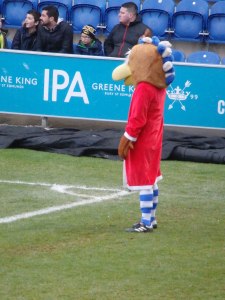
The sun is setting spectacularly behind the Tribune Ouest casting soft shadows on the white concrete of the Stade, the clouds that have made it a grey day are dispersing, the floodlights are on and the teams are warming up. There is a wonderful air of expectancy and relaxed sociability as the Stade fills up and people throng by the pitch and on the broad concourse behind the seats. Some men drink beer; some stuff their faces with baguettes from the buvette, whilst other have brought food from home, carefully wrapped in tin foil. Bags of a locally produced brand of ‘artisan’ potato crisp are much in evidence. 36505980753_7419e799c4_oNimes’ crocodile mascot does his rounds as people, mostly children, pose for selfies with him; I am very tempted but my wife gives me a look. With the teams’ and Ligue 2 banners on the pitch a man with a radio mike gees up the crowd as the teams enter from the corner of the ground. There are ultras both behind the goal and beside the pitch, waving flags, standing clapping and jumping about. The chant is “Allez-Nimois, Allez-Nimois”. I join in. Why the hell isn’t it like this at Ipswich? The crowd is less than half the size of that at Portman Road (6,771 tonight) but three, four, five, a hundred times more involved. There are just a handful of stewards in the stand; I don’t feel like I am here to be policed, but to enjoy the match.


The game begins; Nimes kicking off towards the Tribune Est in their red shirts with white shorts and red socks, Auxerre in white shirts with blue shorts and white socks. After only eight minutes a poor punch by the Nimes ‘keeper Marillat requires a second punch but the effort is too much and he falls to the ground clutching his knee. Both the physio and club doctor attend to him and Marillat carries on, but for less than fifteen minutes before he has to be substituted. Nimes lose a second player to injury in Valdivia who had previously been fouled by Auxerre’s Phillipoteaux, who is the first player to be cautioned by referee Monsieur Aurelien Petit. How witty of the LFP to send a referee to Nimes who shares his first name with a Roman Emperor. Nimes are attacking more than Auxerre or in greater numbers, but are creating no more or better chances. It doesn’t look much like anyone will score.
In the stand a large man in a white polo shirt, which barely conceals the presence of flabby breasts, is exhorting his fellow supporters with the use of a megaphone. At first he is ignored but he doesn’t give up and begins to sing softly, but then with increasing strength before he signals to a drummer besides him who breaks out a rhythm and people to start to jump and clap and sing and have a helluva of a time, before going quiet and the whole performance is repeated. It’s like a flash-mob version of Bjork’s “It’s oh so quiet” in which the main lyrics are “Allez-Nimois”. It’s a lot of fun.
Four minutes of added time for injuries precede half-time in which there is a shoot-out between two teams of what are probably under-tens. The goalkeepers are somewhat dwarfed by the goals and the shoot-out takes a long time because the boys have to run from the half way line; there is one girl in the two teams and her goal receives the biggest cheer. How might radical feminists view that? As positive discrimination or as patronising? Discuss. Meanwhile an advertisement hoarding encourages spectators to travel to the match on the “Trambus”, which is really just an articulated bus with fared in wheels and a dedicated bus lane, but it’s good to see the football club and local authority combining to promote public transport in spite of all the free parking spaces.
Within thirty seconds of the re-start Nimes have a corner after a good dribble, but poor shot from Thioub. From the corner the ball is partly cleared and Auxerre’s wonderfully named 36 year old Guadeloupian, Mickael Tacalfred tries to clear the ball further but collides with Nimes’ Bozok and Monsieur Aurelien Petit awards a penalty and instantly brandishes his red card in the direction of Tacalfred for dangerous play (a high boot or “coup de pied haut”). Both the award of a penalty and the sending off seem somewhat harsh. The game is delayed as the matter is discussed at length by the Auxerrois but eventually Savannier puts Nimes ahead. “B-u-u-u-u-u-t! ” shouts the announcer through the public address system before calling out the goal-scorer’s first name to which the crowd give his surname in response.
More drama ensues as Auxerre’s Arcus collides with the replacement Nimes ‘keeper Sourzac. Arcus had already been booked in the first half so quickly leaves the scene of the incident as Sourzac stays down clutching his chest, but is of course okay really and later he easily saves Auxerre’s only shot on target.
Sixty-three minutes have passed and now there is a free-kick to Nimes and a booking for Auxerre’s Yattara who had been whining all game. Nimes’ Moroccan forward Alioui does a little shuffle, as if to take a rugby-style kick, before running up and arrowing a shot over the defensive wall and into the top left hand corner of the Auxerre goal. A brilliant shot which predictably is met with a great deal of noise and excitement, all of it justified. At the front of the stand, fans pogo whilst chanting an extract from Bizet’s Carmen.
Nimes are exultant, Auxerre vanquished but it isn’t over yet. Alioui keels over to earn another free kick to Nimes in roughly the same place as he took the first. Whilst he repeats the earlier performance with a missile of a shot that Kim Jong-un might covet, Auxerre’s ‘keeper Boucher dives to save the shot, only for the Nimes captain Briançon to score from the rebound. Joy abounds amongst les Nimois.
The final fifteen minutes sees the best football of the match as both teams relax, knowing the inevitable result and not wanting to add to the tally of yellow and red cards. Nimes ultimately deserve their win, but have had a big helping hand from the referee Monsieur Aurelien Petit along the way. Nevertheless, overall it’s been a blast; I have had a lot of fun on a fine evening, in a beautiful stadium in a fine city with excellent supporters, even if the France Football correspondent later only marks the match as 8 out of 20. Allez Nimois!

36411508234_eeb03c1537_o

Balaruc 0 Clermontaise 2

Paris St Germain are the current holders of the Coupe de France, the French equivalent of the FA Cup, but they have an easy ride into the final as they only have to play six matches to get there, the first of which is in January. Like the FA Cup, the Coupe de France really begins in the summer and eight rounds are played before the likes of PSG deign to make an appearance. In fact there is also an overseas section that begins as early as May because clubs in the French territories such as Martinique and Guadeloupe are also eligible to enter the competition. Today is the troisième tour (third round) of the Coupe de France and Mrs Brooks and I are in the seaside spa town of Balaruc les Bains at the Stade Municipal20170910_144644.jpg to see the tie with Clermontaise, who are from the town of Clermont l’Herault, some thirty kilometres to the north west.

Balaruc les Bains sits at the north end of a salt water lagoon, the Bassin de Thau, a kilometre or so across the water from Sète. There is a huge spa (les thermes) in Balaruc, which is something to behold. A massive, sleek, white building like an ocean going liner; from its commodious foyer, two escalators slowly ascend like conveyor belts, carrying mostly elderly, bronzed, French people, some in towelling robes, up to experience various health giving treatments.  I found it creepy, it made me think of Logan’s Run and Soylent Green.

The Stade Municipal is in total contrast to les thermes; it’s scruffy and dusty and will soon be full of young life, although like many French small town stadia it’s largely just a football pitch surrounded by a high metal fence.20170910_142429.jpg

There is one stand, a concrete platform with three rows of plastic seats bolted onto metal frames. 20170910_141746.jpgIt looks like the original roof has been replaced with new metal sheeting on another metal frame, which obscures the row of the pitch from the front row of seats. We enter the stadium through a wide opening in the back wall and find ourselves in the players tunnel; it’s an entrance that is closed soon afterwards, but it’s not quite two -thirty yet and the game doesn’t kick off until three. A wonky sign points roughly in the direction of the buvette,20170910_143307.jpg which is a portakabin style structure with a counter even more wonky than the sign. To the other side of the stand is a dark room with high-up shelves of trophies on two walls and a bar counter;

it smells of stale tobacco. A poster lying on a table shows what’s healthy to eat and what’s not and a timetable shows what time the number three bus leaves on matchdays for the Stade Mosson in Montpellier, the local home of top flight French football.

As the teams and referees warm up on the pitch we wander about seeking the best vantage point from which to watch the match; there doesnt seem to be one. The lowest part of the metal fence is quite closely meshed and there are few places where it is possible to see over it. It’s a bright, warm day, but its also extremely windy; with the wind howling off the Bassin just a couple of hundred metres behind us, we can smell the brine and taste the salt in the air. A group of elderly men have claimed a good spot on a bench in the lee of a high hedge on a small slope; one of them has brought his own folding chair. You can’t beat the experience that comes with age. Behind each goal there is a small outcrop of terracing,

which looks like archaeology; the concrete is even gently patterned like mosaic but it doesn’t really help see over the fence.

Eventually we settle on some rocks strewn about in front of the buvette 20170910_142610.jpgand the teams line up on the pitch. Balaruc wear an unattractive all-black kit with green trim, which displays no team badge or sponsor’s names. Clermontaise and Balaruc are in the same regional league (Poule A of the Languedoc-Rousillon section of the Occitanie region’s Division Honneur 2 – the seventh level of French football), but Clermontaise look much smarter and ‘professional’ in their all blue kit with badge. The McDonald’s golden arch logo is on the Clermontaise shorts; they can’t have read the poster on the table in the trophy room.

La Clermontaise kick off the match with the Mediterranean Sea at their backs, but proceedings are soon interrupted as the young looking referee Monsieur Yohan Beker is concerned that the strong wind has laid flat the corner flagsIMG_20170910_182517_939.jpg at the Mediterranean end of the ground.  A bloke in a t-shirt and trakkie bottoms is called on to sort them out and once he has done so the game carries on. Early on Clermontaise look the better team, but it might just be because they’re wearing a nicer kit.  Just before twenty past three it looks like they have scored, but I can’t tell if it was  offside or the shot was missed. There are flattened practice goals either side of the real one and from my rock it’s hard to tell which is which.

La Clermontaise’s number five is the first player to receive what will become a litany of cautions as he appears to knock out the Balaruc number nine, who stays down still, but eventually gets up seemingly none the worse for wear. But any violence on the pitch is as nothing to that developing in front of me as two small girls poke sticks at the dirt between the rocks we are sat upon and end up flicking it at one another with angry stares and increasing ferocity. It is worrying that humans are so unpleasant to one another from such a young age. Balaruc then have a rare attack, but just as the ball is crossed a massive gust of wind blows and carries it off to the far side of the ground.

The Stade Municipal is closely overlooked by four-storey blocks of flats all along one side and partly at both ends; they make quite a dramatic backdrop being so close to the pitch. At one end of the ground small gardens are visible through the boundary fence and I can see one has an interesting collection of gnomes. 37010937752_0f2b1b1e4c_oThere are a number of people, mostly men in their sixties and seventies, sat at windows and balconies looking down on the game. I envy them their home comforts, it has to be better than perching like a lizard on a rock in the sun. Dissatisfied with my view sat on the rock, I watch the remainder of the first half standing up.

Just about half an hour has passed since the game began and La Clermontaise are awarded a free kick a little more than twenty metres from goal. The ball is lofted to the near post where the visiting number nine cleverly twists and heads it into the net. La Clermontaise have taken the lead and, better kit or not they deserve to have done so because they look a tad classier than the home team. That touch of extra class is further illustrated as Balaruc respond with a series of petulant fouls. Firstly their number seven hurls himself into a misjudged tackle resulting in a melee of virtually every one on the pitch. At first Monsieur Beker steps in to separate the aggrieved parties, but then he steps back to seemingly allow the teams to sort the matter out for themselves. I have seen a few such incidents in French amateur games and whilst there is usually much fierce debate among the players there is never any real violence; once everyone has had their say Monsieur Beker returns to caution the number seven, award a free kick to La Clermontaise and play on.

Annoyingly the rough approach from Balaruc seems to work and they now have the initiative as the attacking team. A corner is punched away by the orange clad Clermontaise keeper, but the return is instant from the edge of the box as the Balaruc number eleven volleys the ball solidly against the crossbar. The half ends with more brutality as the Clermontaise number six shoves the Balaruc number six and also receives a caution from Monsieur Beker.

The search for a better viewing point resumes at half time with added vigour because the strong wind and warm sun really are taking their toll on our soft, southern English sensibilities. Eventually we find a place at the back of the main stand, leaning on the rear wall against a steel stanchion.37010978392_d5a2d9a778_o It proves to be a good choice and our enjoyment of the second half is much increased by our new location, which is shaded, out of the wind and high enough to see over the fence, with the added bonus of atmosphere as the stand is full; spectating nirvana.

The new half begins with Balaruc  on the attack again and their number nine shoots over the crossbar before his opposite number fouls the Balaruc number five, who bawls and stays down on the ground twitching, but eventually gets up and hops away; he was only stunned. Balaruc soon earn a corner, which is quite skillfully worked across the penalty area and fed back to their number nine who curls a shot into the top corner of one of the practice goals squashed up behind the real goal.

Quite a few people seem to have changed their spectating position for the second half and like giant birds on a telephone wire, a row of young lads have perched themselves on the high pink wall behind the Clermontaise keeper and are hanging over the crossbar of one of the practice goals. Other lads sit on a bench, their motorcycle helmets stacked together in front of them like deformed, painted skulls in an ossuary. Some of the people watching from the windows of the flats are no longer there.

It’s a quarter past four and Balaruc’s number four is shown the yellow card for plunging feet first through Clermontaise’s number eleven. A wit in the stand entertains his fellow spectators with what sound like caustic comments about the refereeing; people laugh anyway, which only encourages him. Balaruc might be said to be enjoying most of the possession, but it’s not doing them any good; they are also now ‘enjoying’ most of the bookings too as their eleven hurls himself at his opposite number, who stays down on the ground, as does Balaruc’ s number nine who has fallen down in a separate incident that Monsieur Beker sensibly ignored. Balaruc’s nine looks frustrated and tetchy. At half past four there is a drinks break.

Players are now being substituted freely, keeping the grey-haired, kindly faced and besuited  délègue principal37182734275_6954af6a9c_o Monsieur Gerard Blanchet busy in front of us. Clermontaise’s number twelve confirms his presence by boldly attempting a shot from a thirty metre free kick; of course he misses, but not embarrassingly so. The Balaruc bookings continue and five blatantly kicks the Clermontaise twelve as he dribbles past him and three knocks over his opposite number as they run side by side. All afternoon tbere is a pleasing symmetry with many of the fouls and bookings as players with the same shirt number go for each other.

There are only five minutes left now and whilst Balaruc have been nimble and passed the ball well, they have also been overly physical and not succeeded in making many goal scoring chances at all. Clermontaise have not had much of the ball, but it doesn’t seem to have worried them unduly and I think to myself that they might now just score again and finish the game off. A  Balaruc goal kick ends up with the Clermontaise number twelve some thirty plus metres from goal; he runs past a couple of opponents and to the edge of the penalty area; another stride, a check on where the goal is and he strikes the ball across the goalkeeper into the far side of the net.

La Clermontaise go through to the quatrième tour of the Coupe de France. Allez les bleus!

Due to random problems loading – more pictures to follow.