My return to the Stade de Sauclières in Béziers is an important one because of the toilets.

After the Dunkerque match I had e-mailed AS Béziers about the state of them. The club secretary replied telling me that the Ville de Béziers, the Borough Council, was responsible for this because it was their stadium and my e-mail had been forwarded on to them. I then received an e-mail from Monsieur Pintavy in the sports department of the mayor’s office telling me that they would do the necessary work before the next fixture.
So it is with a mission in mind that we arrive at the semi-rural setting of the Stade de Sauclières a little more than an hour before kick-off; but whereas on our previous visit it had been possible to park almost in front of the guichets, tonight there is a traffic jam outside the stadium, with cars parked all along the road and on the dusty, untended pitch that is behind one end of the stadium. Children and youths of both sexes in blue and white track suits are everywhere, along with their mums and dads who are wearing ordinary clothes. Parking our car on the roadside verge a good 250 metres up the road we make our way back to the stadium gates through the chatty, happy but mostly dawdling young French people. Fortunately, everyone has complimentary tickets so we don’t have to queue to pay our 10 Euros each at the guichets; only to be patted down on our way into the stadium. It is a cooler evening than when we were last here a fortnight ago and I am therefore wearing trousers instead of shorts and so never find out if it really is the local security policy to pat down bare legs. I don’t see the young man who had done this a fortnight ago; perhaps someone had complained. It wasn’t me, I only e-mailed about the toilets.
Once inside the stadium precincts we round the corner beneath a floodlight pylon and approach the toilets towards the rear of the main stand; now within a few metres of the door the fresh smell of pine toilet duck wafts alluringly towards us, the now opened door reveals the gleam of bright, white porcelain. Monsieur Pontavy and “Béziers Borough Council” sports department are true to their word, the system works, as I’m sure would the cistern if there was one. Vive La France!
I hang around outside the toilet whilst my wife uses it; this is because although the toilet is clean, the lock on the door doesn’t work. We then prepare to go up into the stand, but not before I notice that the stadium backs on to the River Orb

; there is a large white sign with red letters on the bank that spells danger. The Canal du Midi is over the road opposite the guichets and so it turns out the Stade de Sauclières is actually on an island or at least an isthmus. We go up into the stand and observe that all those French children in blue and white tracksuits are now sat on the terrace behind the goal by the entrance. Meanwhile, I wonder to myself if there is a club shop because I have developed a desire for a souvenir. In faltering French I ask a bloke in a hi-vis tabard who tells me there is one under the stand, but it’s not open now. I ask if it is open at “mi-temp” and quickly and smilingly he says his first words to me in English “Half-time? No”. It seems these are the only English words he knows; how odd. I return to my seat, but then decide to go and see for myself and it turns out that souvenirs are on sale at the buvette, although not all the staff, even in the buvette, seem to know this. Eventually, I come away with a petit fanion (pennant) for the somewhat inflated price of 7 euros (bloody Brexit!), but it’ll look nice hanging with the others in the spare toilet at home.
Flushed with success I return to my wife and my seat to await the start of the match. The track-suited children are now in the centre of the pitch and are lining up for a photograph. It turns out AS Béziers have organised a special night for all their youth and children’s teams of which there seem to be quite a number.

Clearly, AS Béziers has a firm place in the community of the town and tonight they are celebrating it. Why have I never witnessed such a thing at an English Football League club? Perhaps I haven’t been anywhere on the right day.
I have been looking forward to this match for several weeks because Bezier’s opponents tonight are Red Star, an almost legendary French club. Red Star is France’s second oldest club, founded in 1897 by none other than Monsieur Jules Rimet himself, the man after whom the World Cup trophy was named. The club is from the Paris suburb of Saint Ouen, the former docks area of the French capital. The club has a rich heritage and is known for its politically left-wing support, which has a strong anti-fascist stance. The club also has a really good badge; a red star inside a green circle.

Imagine my horror therefore when the Red Star players walk out onto the pitch wearing yellow shirts and green shorts, the colours of Norwich City. Happily, the kit isn’t theirs, but is a spare AS Béziers kit; although it isn’t clear why they needed to wear it as their usual green shirts and white shorts would not clash with AS Béziers’ all blue kit. Would they?
A cocktail of smells assaults our nostrils as the stand fills up; a mixture of Gitanes, perfumes and salt and vinegar. The game begins and referee Monsieur Cedric Dos Santos is soon explaining to Béziers’ number 21 that fouls are wrong, although the first player to be booked is Red Star’s number 12. Things then only get worse as a punt forward bypasses the Red Star defenders and Beziers’ number 17 pokes the ball past the only player in a Red Star shirt, albeit a day-glo orange one,

from a spot close to the one called penalty. The Bezier’s supporters at the other end of the stand sing something to the tune of Yellow Submarine, the last three words of which are Allez, Allez, Allez.
There are only five or six Red Star supporters here tonight but two of them are very vocal with shouts of “Allez Red Star” and plenty of clapping too; they have a small banner which proclaims “Gang Green” one of the Red Star ultras groups. 

After going behind, Red Star increasingly look the better team, they have more skill and they win a remarkable succession of free-kicks all down the left flank. But the Red Star goalkeeper does also make one spectacular flying catch, a replica of one I saw Ipswich Town’s David Best make in about 1973 and which has stayed with me all these years.
Half-time comes and goes and Red Star get even better in the second half, but they don’t score. Some of their players are displaying wonderful levels of skill for a semi-professional team, everywhere there are flicks and dinks; the number eleven crosses the ball beautifully with the outside of his right foot. But they don’t defend as well and as AS Béziers’ number 17 chases a punt forward, the Red Star 29 chases him and sort of rolls into him. Monsieur Dos Santos awards a free-kick and cautions 29 for a second time resulting in his being sent-off. I usually like to see players in yellow and green sent off, but not tonight.
The imbalance in player numbers makes the task harder for Red Star but they continue to be the far more skilful team, whilst AS Béziers are big and physical and play on the break and by falling over when tackled. The Gang Green retain their faith with chants of “Come On l’etoile, Come On l’etoile” to the tune of Auld’s Lang Syne, adding Scottish into the strangely random mix of English and French that characterises their club.
In odd moments where the action stops as players play dead and Monsieur Dos Santos waves his yellow card about I notice that there are some massive insects fluttering about in the beams of the floodlights tonight, although it is also possible that there are some very small bats; but I’m not Chris Packham.
Red Star’s number 2 makes a brilliant run down the left and pulls the ball back only for the goalkeeper to make a spectacular save and then the Red Star ‘keeper pushes away a header, diving down low to his right in equally thrilling fashion. But it doesn’t look like Red Star will equalise, although they probably deserve to win. A second booking for AS Béziers’ number 29 comes too late to even things up sufficiently in terms of player numbers and despite a clearance off the line in time added-on the home team claim the points; their trainer jabs the air in front of him in that odd way football people do as if they can’t quite work out the difference between happiness and anger.
I feel quite deflated. This is Red Star’s first defeat of the season and I had hoped to see them win, but instead I’ve seen them play in yellow and green, have a player sent off and lose. Football, like the sea, is a cruel mistress. The Gang Green pack up their banner and move down to the steel fence around the pitch to applaud their team and we head off up the Chemin Moulin Neuf and back to our car, disappointed but pleased to have had good value for the meagre 10 Euro admission fee and to have seen French local government in action.

After the Dunkerque match I had e-mailed AS Béziers about the state of them. The club secretary replied telling me that the Ville de Béziers, the Borough Council, was responsible for this because it was their stadium and my e-mail had been forwarded on to them. I then received an e-mail from Monsieur Pintavy in the sports department of the mayor’s office telling me that they would do the necessary work before the next fixture.
So it is with a mission in mind that we arrive at the semi-rural setting of the Stade de Sauclières a little more than an hour before kick-off; but whereas on our previous visit it had been possible to park almost in front of the guichets, tonight there is a traffic jam outside the stadium, with cars parked all along the road and on the dusty, untended pitch that is behind one end of the stadium. Children and youths of both sexes in blue and white track suits are everywhere, along with their mums and dads who are wearing ordinary clothes. Parking our car on the roadside verge a good 250 metres up the road we make our way back to the stadium gates through the chatty, happy but mostly dawdling young French people. Fortunately, everyone has complimentary tickets so we don’t have to queue to pay our 10 Euros each at the guichets; only to be patted down on our way into the stadium. It is a cooler evening than when we were last here a fortnight ago and I am therefore wearing trousers instead of shorts and so never find out if it really is the local security policy to pat down bare legs. I don’t see the young man who had done this a fortnight ago; perhaps someone had complained. It wasn’t me, I only e-mailed about the toilets.
Once inside the stadium precincts we round the corner beneath a floodlight pylon and approach the toilets towards the rear of the main stand; now within a few metres of the door the fresh smell of pine toilet duck wafts alluringly towards us, the now opened door reveals the gleam of bright, white porcelain. Monsieur Pontavy and “Béziers Borough Council” sports department are true to their word, the system works, as I’m sure would the cistern if there was one. Vive La France!
I hang around outside the toilet whilst my wife uses it; this is because although the toilet is clean, the lock on the door doesn’t work. We then prepare to go up into the stand, but not before I notice that the stadium backs on to the River Orb

; there is a large white sign with red letters on the bank that spells danger. The Canal du Midi is over the road opposite the guichets and so it turns out the Stade de Sauclières is actually on an island or at least an isthmus. We go up into the stand and observe that all those French children in blue and white tracksuits are now sat on the terrace behind the goal by the entrance. Meanwhile, I wonder to myself if there is a club shop because I have developed a desire for a souvenir. In faltering French I ask a bloke in a hi-vis tabard who tells me there is one under the stand, but it’s not open now. I ask if it is open at “mi-temp” and quickly and smilingly he says his first words to me in English “Half-time? No”. It seems these are the only English words he knows; how odd. I return to my seat, but then decide to go and see for myself and it turns out that souvenirs are on sale at the buvette, although not all the staff, even in the buvette, seem to know this. Eventually, I come away with a petit fanion (pennant) for the somewhat inflated price of 7 euros (bloody Brexit!), but it’ll look nice hanging with the others in the spare toilet at home.
Flushed with success I return to my wife and my seat to await the start of the match. The track-suited children are now in the centre of the pitch and are lining up for a photograph. It turns out AS Béziers have organised a special night for all their youth and children’s teams of which there seem to be quite a number.

Clearly, AS Béziers has a firm place in the community of the town and tonight they are celebrating it. Why have I never witnessed such a thing at an English Football League club? Perhaps I haven’t been anywhere on the right day.
I have been looking forward to this match for several weeks because Bezier’s opponents tonight are Red Star, an almost legendary French club. Red Star is France’s second oldest club, founded in 1897 by none other than Monsieur Jules Rimet himself, the man after whom the World Cup trophy was named. The club is from the Paris suburb of Saint Ouen, the former docks area of the French capital. The club has a rich heritage and is known for its politically left-wing support, which has a strong anti-fascist stance. The club also has a really good badge; a red star inside a green circle.

Imagine my horror therefore when the Red Star players walk out onto the pitch wearing yellow shirts and green shorts, the colours of Norwich City. Happily, the kit isn’t theirs, but is a spare AS Béziers kit; although it isn’t clear why they needed to wear it as their usual green shirts and white shorts would not clash with AS Béziers’ all blue kit. Would they?
A cocktail of smells assaults our nostrils as the stand fills up; a mixture of Gitanes, perfumes and salt and vinegar. The game begins and referee Monsieur Cedric Dos Santos is soon explaining to Béziers’ number 21 that fouls are wrong, although the first player to be booked is Red Star’s number 12. Things then only get worse as a punt forward bypasses the Red Star defenders and Beziers’ number 17 pokes the ball past the only player in a Red Star shirt, albeit a day-glo orange one,

from a spot close to the one called penalty. The Bezier’s supporters at the other end of the stand sing something to the tune of Yellow Submarine, the last three words of which are Allez, Allez, Allez.
There are only five or six Red Star supporters here tonight but two of them are very vocal with shouts of “Allez Red Star” and plenty of clapping too; they have a small banner which proclaims “Gang Green” one of the Red Star ultras groups.
OLYMPUS DIGITAL CAMERA
After going behind, Red Star increasingly look the better team, they have more skill and they win a remarkable succession of free-kicks all down the left flank. But the Red Star goalkeeper does also make one spectacular flying catch, a replica of one I saw Ipswich Town’s David Best make in about 1973 and which has stayed with me all these years.
Half-time comes and goes and Red Star get even better in the second half, but they don’t score. Some of their players are displaying wonderful levels of skill for a semi-professional team, everywhere there are flicks and dinks; the number eleven crosses the ball beautifully with the outside of his right foot. But they don’t defend as well and as AS Béziers’ number 17 chases a punt forward, the Red Star 29 chases him and sort of rolls into him. Monsieur Dos Santos awards a free-kick and cautions 29 for a second time resulting in his being sent-off. I usually like to see players in yellow and green sent off, but not tonight.
The imbalance in player numbers makes the task harder for Red Star but they continue to be the far more skilful team, whilst AS Béziers are big and physical and play on the break and by falling over when tackled. The Gang Green retain their faith with chants of “Come On l’etoile, Come On l’etoile” to the tune of Auld’s Lang Syne, adding Scottish into the strangely random mix of English and French that characterises their club.
In odd moments where the action stops as players play dead and Monsieur Dos Santos waves his yellow card about I notice that there are some massive insects fluttering about in the beams of the floodlights tonight, although it is also possible that there are some very small bats; but I’m not Chris Packham.
Red Star’s number 2 makes a brilliant run down the left and pulls the ball back only for the goalkeeper to make a spectacular save and then the Red Star ‘keeper pushes away a header, diving down low to his right in equally thrilling fashion. But it doesn’t look like Red Star will equalise, although they probably deserve to win. A second booking for AS Béziers’ number 29 comes too late to even things up sufficiently in terms of player numbers and despite a clearance off the line in time added-on the home team claim the points; their trainer jabs the air in front of him in that odd way football people do as if they can’t quite work out the difference between happiness and anger.
I feel quite deflated. This is Red Star’s first defeat of the season and I had hoped to see them win, but instead I’ve seen them play in yellow and green, have a player sent off and lose. Football, like the sea, is a cruel mistress. The Gang Green pack up their banner and move down to the steel fence around the pitch to applaud their team and we head off up the Chemin Moulin Neuf and back to our car, disappointed but pleased to have had good value for the meagre 10 Euro admission fee and to have seen French local government in action.
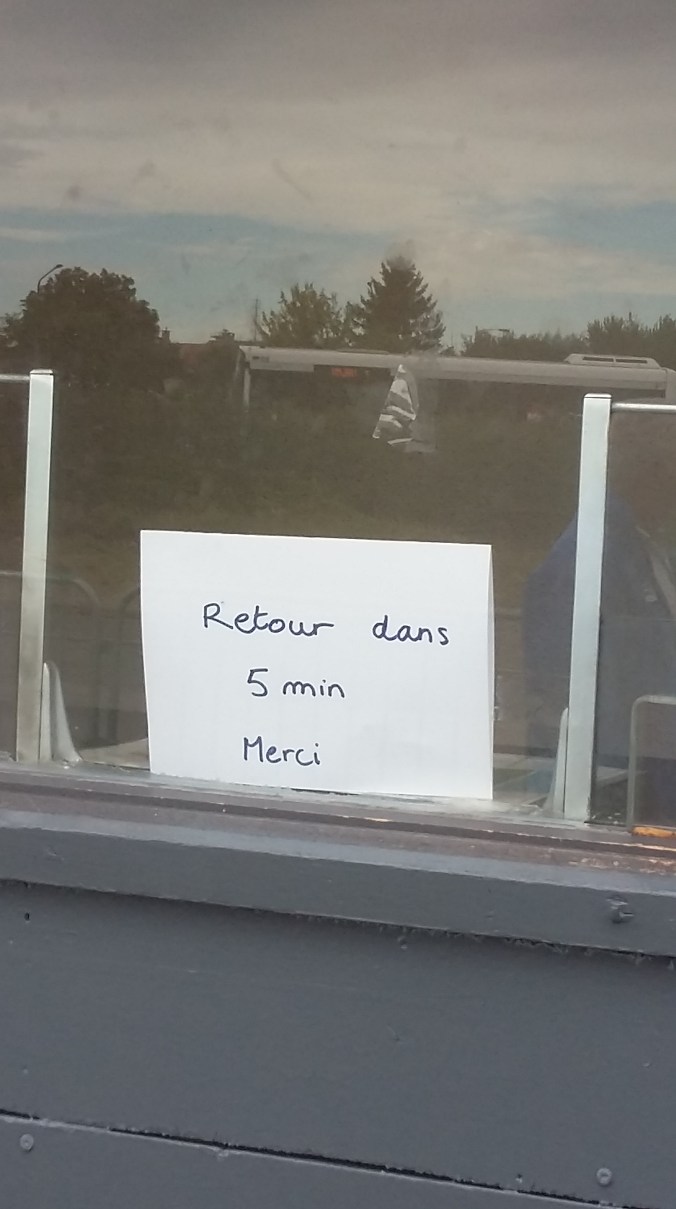
 at the Stade des Costières stadium earlier in the day to avoid any queue, although we did have to wait a short while because the sign in the window of the guichet read ‘back in five minutes’. Tickets for the main stand cost 14 euros, whilst those for the identical stand opposite are 9 euros and a ticket behind the goal costs 4 euros. We buy 9 euro tickets in the Tribune Sud (South stand). There are acres of free car parking all around the Stade des Costières and arriving a little more than an hour before kick-off it’s easy to park up near the exit for a quick getaway after the match. Nevertheless, there are plenty of people here already, buying tickets, standing about, socialising and heading to bars for a pre-match aperitif.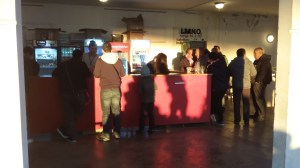
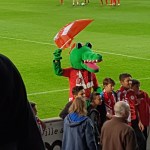 Nimes’ crocodile mascot does his rounds as people, mostly children, pose for selfies with him; I am very tempted but my wife gives me a look. With the teams’ and Ligue 2 banners on the pitch a man with a radio mike gees up the crowd as the teams enter from the corner of the ground. There are ultras both behind the goal and beside the pitch, waving flags, standing clapping and jumping about. The chant is “Allez-Nimois, Allez-Nimois”. I join in. Why the hell isn’t it like this at Ipswich? The crowd is less than half the size of that at Portman Road (6,771 tonight) but three, four, five, a hundred times more involved. There are just a handful of stewards in the stand; I don’t feel like I am here to be policed, but to enjoy the match.

 to see the tie with Clermontaise, who are from the town of Clermont l’Herault, some thirty kilometres to the north west.
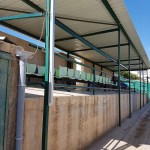 It looks like the original roof has been replaced with new metal sheeting on another metal frame, which obscures the row of the pitch from the front row of seats. We enter the stadium through a wide opening in the back wall and find ourselves in the players tunnel; it’s an entrance that is closed soon afterwards, but it’s not quite two -thirty yet and the game doesn’t kick off until three. A wonky sign points roughly in the direction of the buvette,
 which is a portakabin style structure with a counter even more wonky than the sign. To the other side of the stand is a dark room with high-up shelves of trophies on two walls and a bar counter;


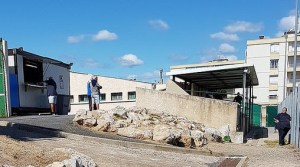 and the teams line up on the pitch. Balaruc wear an unattractive all-black kit with green trim, which displays no team badge or sponsor’s names. Clermontaise and Balaruc are in the same regional league (Poule A of the Languedoc-Rousillon section of the Occitanie region’s Division Honneur 2 – the seventh level of French football), but Clermontaise look much smarter and ‘professional’ in their all blue kit with badge. The McDonald’s golden arch logo is on the Clermontaise shorts; they can’t have read the poster on the table in the trophy room.
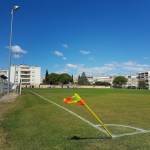 at the Mediterranean end of the ground. A bloke in a t-shirt and trakkie bottoms is called on to sort them out and once he has done so the game carries on. Early on Clermontaise look the better team, but it might just be because they’re wearing a nicer kit. Just before twenty past three it looks like they have scored, but I can’t tell if it was offside or the shot was missed. There are flattened practice goals either side of the real one and from my rock it’s hard to tell which is which.
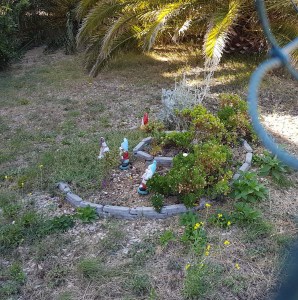 There are a number of people, mostly men in their sixties and seventies, sat at windows and balconies looking down on the game. I envy them their home comforts, it has to be better than perching like a lizard on a rock in the sun. Dissatisfied with my view sat on the rock, I watch the remainder of the first half standing up.
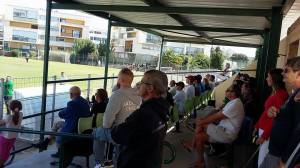 It proves to be a good choice and our enjoyment of the second half is much increased by our new location, which is shaded, out of the wind and high enough to see over the fence, with the added bonus of atmosphere as the stand is full; spectating nirvana.
 Monsieur Gerard Blanchet busy in front of us. Clermontaise’s number twelve confirms his presence by boldly attempting a shot from a thirty metre free kick; of course he misses, but not embarrassingly so. The Balaruc bookings continue and five blatantly kicks the Clermontaise twelve as he dribbles past him and three knocks over his opposite number as they run side by side. All afternoon tbere is a pleasing symmetry with many of the fouls and bookings as players with the same shirt number go for each other.
 near the Atlantic coast, some 380 kilometres away by road; they have won one and lost two of their four games so far. Kick-off is at six pm and we arrive about a half an hour beforehand, parking in the spacious gravel topped car park at the side of the Stade Louis Michel, although other spectators prefer to park in the road outside. Entry to the stadium costs €6 and we buy our tickets from the aptly porthole-shaped guichets
  outside the one gate into the ground. Just inside the gate a cardboard box propped on a chair provides a supply of the free eight-page, A4 sized programme ‘La Journal des Verts et Blancs’. Also today there is a separate team photo and fixture list on offer.
 the brutal angular concrete of the main stand, the Tribune Presidentielle, could be from the 1960’s or 1970’s, channeling the inspiration perhaps of Auguste Perret or even Le Corbusier. The concrete panels on the back of the stand are lightly decorated and sit above wide windows; a pair of curving staircases run up to the first floor around the main entrance,
  above which is a fret-cut dolphin, the symbol of the town and the club. The stand runs perhaps half the length of the pitch either side of the halfway line and holds about twelve hundred spectators, as well as club offices and changing rooms. Opposite the main stand a large bank of open,
  ‘temporary’ seating runs the length of the pitch, it is built up on an intricate lattice
  of steel supports. Behind both goals are well tended grass banks; there is a scoreboard at the end that backs onto the carpark.
 Sète in green and white hooped shirts with black shorts and socks, Stade Bordelais with black shirts with white shorts and socks. There is a ‘ceremonial’ kick-off before the real one, taken by a youmg woman with a green and white scarf draped around her shoulders. Eventually, referree Monsieur Guillaume Janin gives the signal for the game to start in earnest.
 man mountain with a wide shock of bleached hair on the top of his head, and thighs the size of other men’s waists.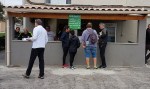
 which is close by at the corner of the stand where we are sat. The reason for my eagerness is that Sète is the home of the tielle, a small, spicy, calamari and tomato pie, with a bread like case. I love a tielle, and I love that they are specific to Sete, and are served at the football ground as a half-time snack. I only wish there were English clubs that served local delicacies. Middlesbrough has its parmo, but I can’t think of any others. Do Southend United serve jellied eels or plates of winkles? Do West Ham United serve pie and mash? Do Newcastle United serve stotties? Did the McDonald’s in Anfield’s Kop serve lobscouse in a bun? I need to know. Sadly, I don’t think my town Ipswich even has a local dish. Many English clubs don’t even serve a local beer; Greene King doesn’t count because it is a national chain with all the blandness that entails.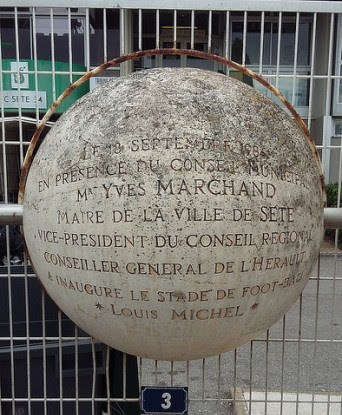
 minus crenellations. I swing the car round to park at an angle between the road and the high grey wall. We walk in the road past the ends of other parked cars to the main entrance to the stadium. There’s no one much about, just a few Dunkerque fans waiting around outside and they are outnumbered by the security people; hefty blokes in navy blue uniforms and one blonde and not at all hefty woman. The guichets (ticket booths), which look like arrows might be fired from them, are not open yet, but soon one does open and once the bearded man inside has finished his conversation with someone who remains invisible to us from the outside, I hand over €20 for two tickets, children are admitted free, but we haven’t brought any of those with us.
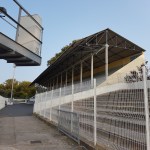 is the only stand, a tall steel and concrete structure with a steep pitched roof. There are eighteen stanchions (I counted them) evenly spaced along the stand supporting a network of struts that in turn support the roof. The other three sides of the ground consist of wide sweeping terraces

 who turn and face the stand and wait a good five minutes for the teams to appear. Meanwhile the pitch sprinklers briefly come on, first in one half, then in the other, making the boys squirm and laugh as they get wet. The public address system stutters into life as the teams are announced in the style of a French Freddie ‘Parrot Face’ Davies. The small band of ultras, the Kop Biterrois
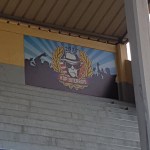 , whose logo seems to be a monkey in a hat and sunglasses, are at the end of the stand and one of them beats a drum. After a minute’s silence the referee Monsieur Benjamin Lepaysant begins the match and AS Béziers kick -off towards the Cameron’s factory end of the ground. Straight from the kick- off we are treated to a cameo of how the match will pan out as Béziers indelicately boot the ball toward the Dunkerque goal, where the visiting full-back heads it weakly back to his goalkeeper, but it spins out comically for a corner to Béziers.
 she has ever had the misfortune to visit. Worse than the North Stand toilets at Fratton Park back in the early 1970’s apparently, and no wash basin. A French girl refused to enter one cubicle. I hear the half-time scores from the other Ligue National matches over the echoing tannoy and I might be wrong, but it sounds like they are all nil-nil. I like to think they are.
 where a man is sitting at a desk. I can only assume that this is the location for the Délègue Principal for this game, Monsieur Roger Lefebvre;
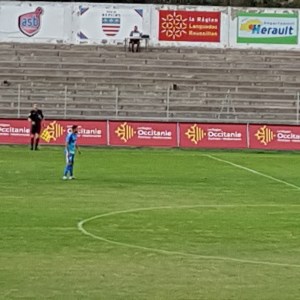 nevertheless, I cannot help imagining my vision zooming in on him whereupon he looks up and says “…and now for something completely different”.
 trippingovertheball