Although I do want to see Col U play Salford City, it is against my will that I am driving to the Colchester Park and Ride car park because, scandalously, there is no public transport to the out in the middle of nowhere Community Stadium, and the one bus service (Shuttle S1) that is within a twenty minute walk might require leaving before the end of the match to get back to the railway station in time for the last train home. When Col U first moved from lovely, ramshackle Layer Road to remote, windswept, Cuckoo Farm there were buses laid on from all points of the compass and from across the road to the Bricklayers Arms, a five-minute walk from the railway station. Despite a lot of talk about being green and saving the planet, no one really cares do they? I’d advise everyone to stop having children now because we’re surely condemning them to a horrible future and probably a lingering death.
But what the heck, ‘tis the eve of the eve of Christmas Eve and Col U are about to play Salford City, the only current members of the Football League that I haven’t seen at some time or other. As I tell Gary, who I had arranged to meet in the Park & Ride car park, I’ve not been to what I still like to call “Layer Road” since October last year, when Col U played Harrogate Town, another Football League club I hadn’t previously seen play. The Colchester Park and Ride car park is a bleak, desolate place and Gary and I walk as swiftly as we can along the barely lit path towards the bridge over the A12. The lighting either side of the path is phenomenally ineffective, illuminating nothing more than a tiny circle around each light and casting no light whatsoever over the path itself, it’s so useless it could have been designed by any or all the UK’s last five Tory Prime Ministers.
The Community Stadium floodlights shine like a beacon along with the neon signs of the nearby McDonald’s and like moths around a flame Colcestrians are drawn to both. Gary and I head for the turnstiles, and I hand him my mobile phone on which there is an e-mail with a ticket and QR code. Waving the phone about in front of something works, and Gary is in; he hands the phone back to me as the turnstile clicks. The e-mail says I would be sent two e-mails, but only one ever arrived. However, it doesn’t matter, there is a second ticket and I wave it about and a green light comes on, I’m in too. Before heading for our seats I pause to collect a free programme for each of us from three neat piles, a woman eyes me suspiciously as if I’m about to set fire to them or steal hers. Despite my misgivings about the location of this football ground and its accessibility, the free programme is a sign of true civilisation, it’s like being in France.
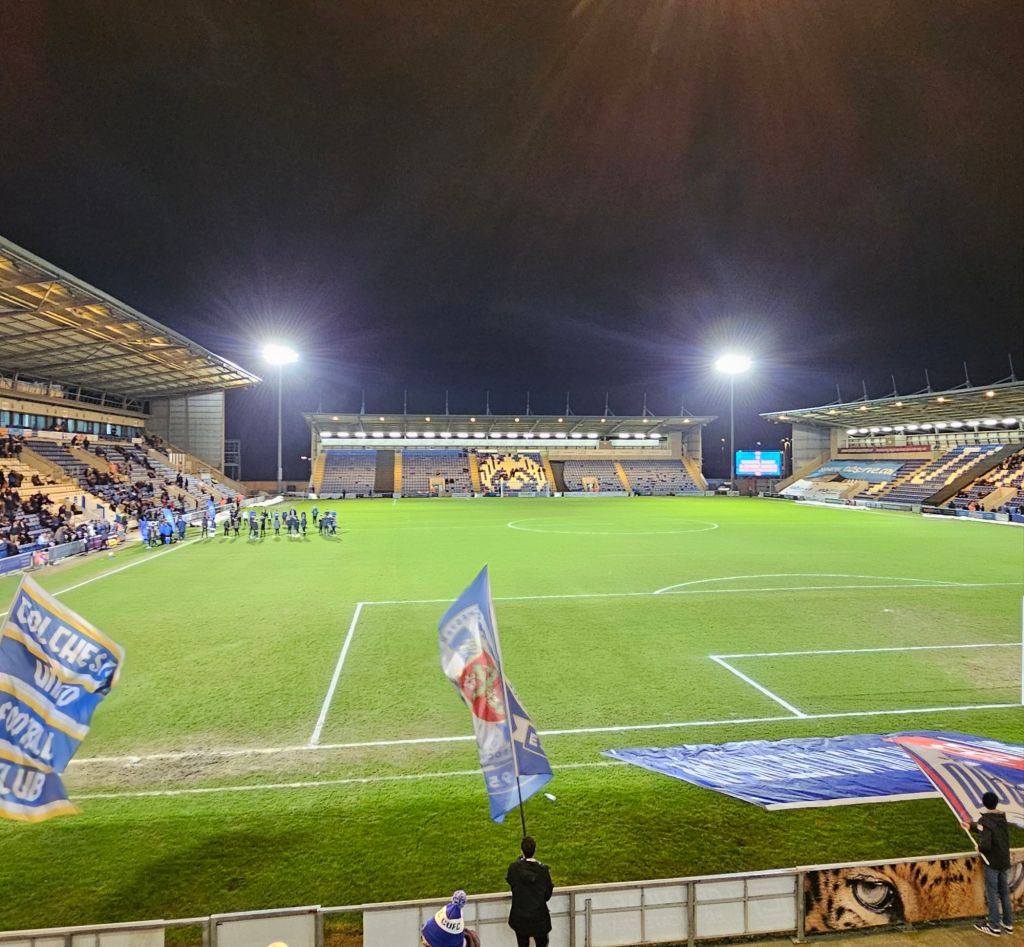
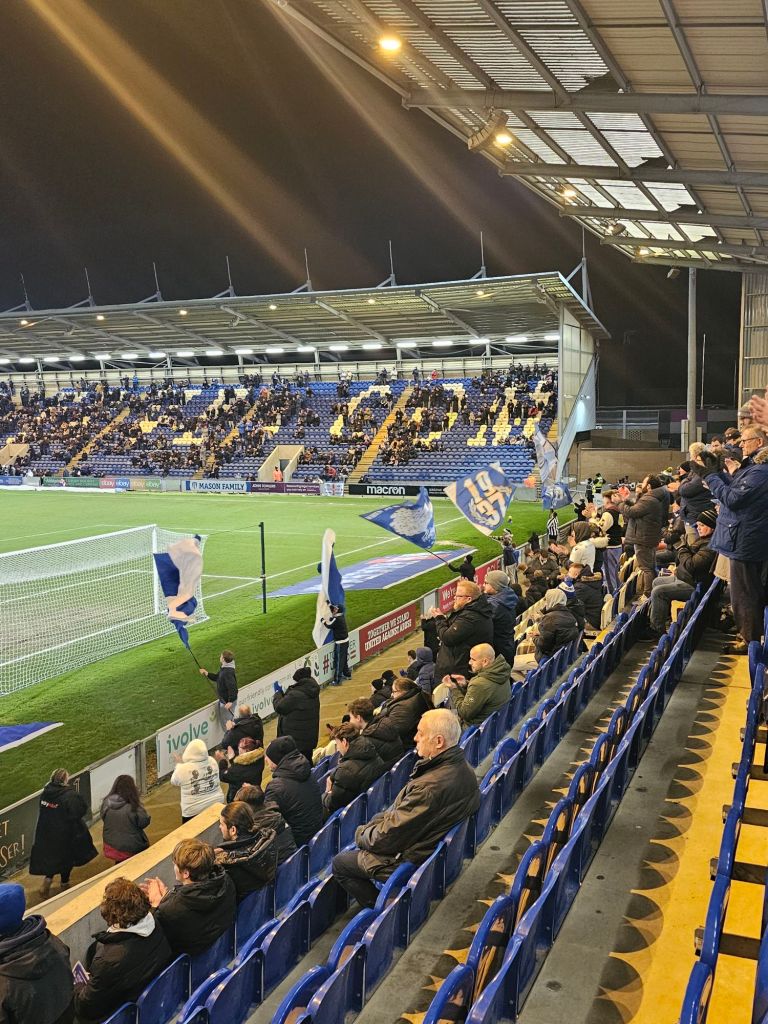
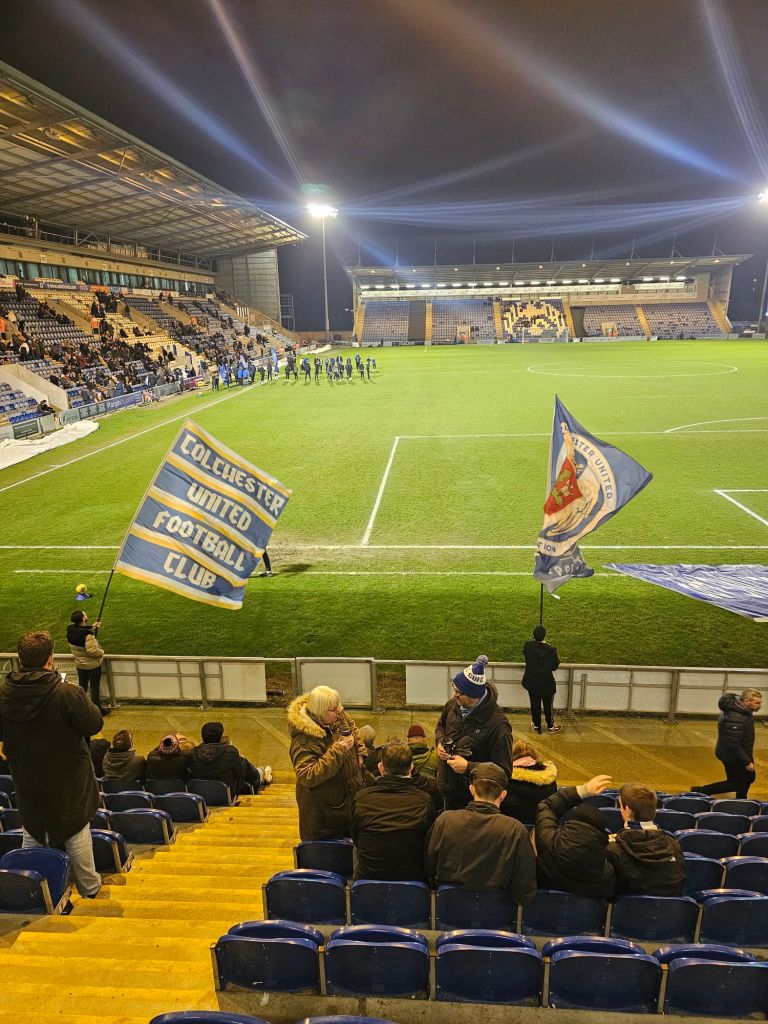
“The teams are in the tunnel” announces the electronic scoreboard, as if this might be an exciting development. “Make some noise” entreats the stadium announcer and from the loudspeakers up in the eaves comes the sound of the splendid “Post horn galop”, which Wikipedia tells us was composed in 1844 by German cornet player Hermann Koenig. Flags are waved in the South Stand and a drum beats to chants of Ole, Ole, Ole, sung in a style that sounds to my admittedly, slightly blocked up ears, like Olde English folk music. The evening is off to a good start.
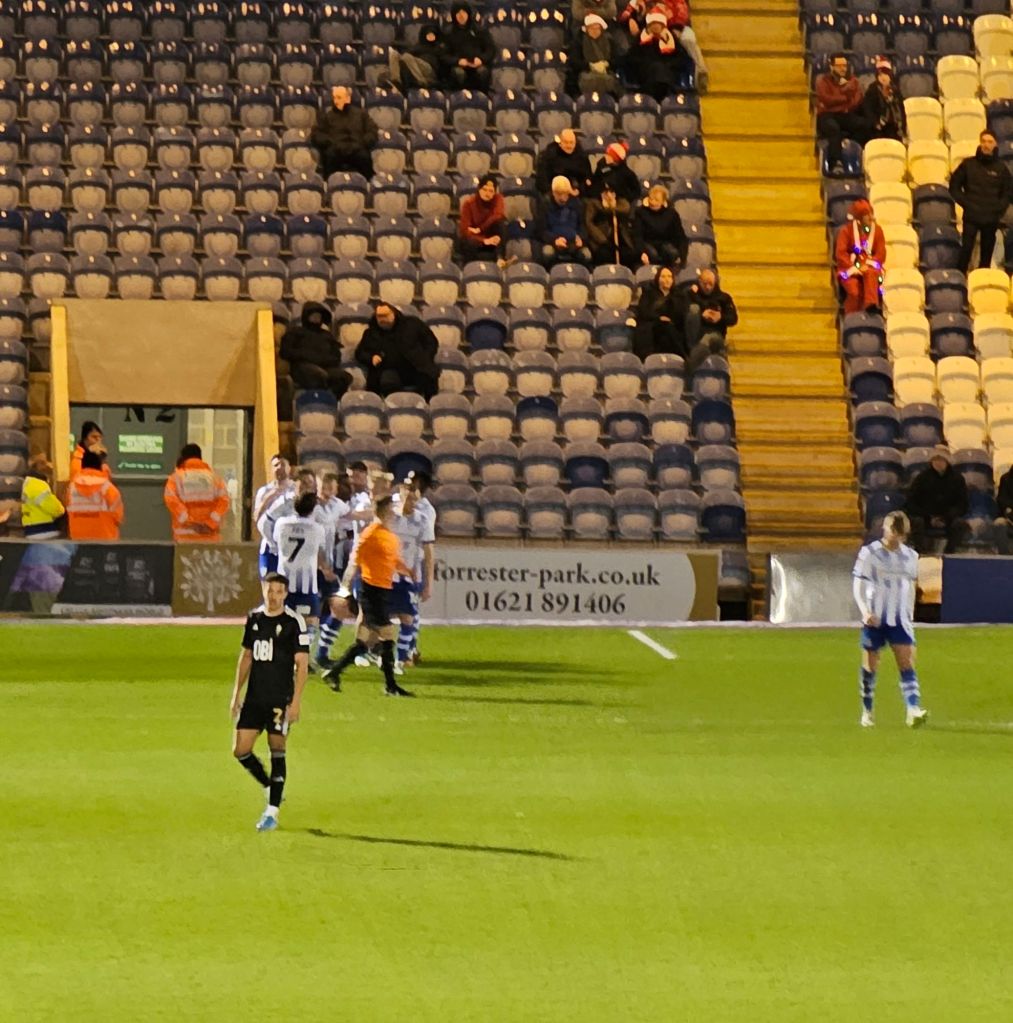
With the teams lined up it is Col U who get first go with the ball, which they are hoping to put in the goal at the far end of the ground which backs picturesquely onto the A12. Salford are kitted out uninspiringly in all-black, as if they couldn’t be bothered to come up with an original away kit, which they don’t need tonight any way because Salford’s club colours are red and red. The latest incarnation of Col U’s kit is probably one of the worst, with the normally blue stripes of the shirts faded to a washed out grey like they’ve been put on too hot a wash. The pale green goalkeeper’s kit looks similarly carelessly laundered. From their kits alone it’s easy to see why Col U are languishing in 22nd place in the twenty-four team fourth division and Salford are 20th
A couple of elderly latecomers arrive and we have to stand to let them past. One brandishes a plastic bag “Been Christmas shopping have we?” I ask, insolently, implying that’s why I have been inconvenienced. Four minutes gone and Salford win the game’s first corner. The drums are still beating. The scoreboard tells us that tonight’s match is sponsored by the Colchester and East Essex Cricket Club. The first player who has come to my notice is the Col U number 7, a small bloke with floppy hair who seems to fall over a lot. I don’t think he’s diving, he’s just little and not very steady on his legs when a big northerner comes up behind him. “Too easy, too easy” exclaims the bloke behind me as Salford string two passes together and threaten to undo the Col U defence; a timely tackle saves the day. An empty crisp packet blows across the pitch and I notice a possible redeeming feature of Col U’s kit, hooped socks. “ If only we had a target man” says the bloke behind me longingly, adding an unexpected frisson of homo-eroticism to the evening.
After fifteen minutes we witness the first shot on target, the Salford number seven is guilty however of failing to place it anywhere either side of the Col U goalkeeper who promptly catches it without having to move. Two minutes later and referee, the suspiciously neat Mr Finnie, airs his yellow card for the first time, his victim being Col U’s Arthur Read, a man who in my opinion has the best name of anyone on the pitch; it’s as if he has travelled to us through time and he makes me think of Arthur Seaton in Alan Sillitoe’s novel ‘Saturday Night and Sunday Morning’. Arthur Seaton would definitely have been first into the book too.
Salford win a free-kick and tension mounts as we wait for it to be taken, but we needn’t have worried as once again it goes straight to the goalkeeper. There follows warm applause, not because of good play, but merely relief. Arthur Read has a shot and earns a corner. “Well done lino” says a voice bizarrely as Col U quickly win another corner. “Where’s Tom Eastman when you need him?” asks the bloke behind me. “Enjoying life at Dagenham” says the bloke next to him, suggesting another side to Dagenham I hadn’t previously imagined. This a strange game, neither side is very good, but they are both trying to play decent football and they are evenly matched, which between the poor passes and lack of a plan makes for quite an absorbing encounter. Col U’s Connor Hall is booked for possibly the least subtle shove off the ball of an opposition player I have ever seen; is this what being ‘an honest professional’ means I wonder?
The game rolls on towards half-time and Salford create the best chance so far as a clever series of no more than two passes puts McAleny through with just the goalkeeper to beat, but he doesn’t. Salford earn their first booking, but only after Mr Finnie walks back and forth a bit as if forensically examining the scene of the foul, whilst also possibly listening to the advice of the home crowd. Col U win another corner; the Salford goalkeeper pats the ball down in a sudden panic and somebody clears it or deflects it high over the goal, possibly Curtis Tilt, whose surname is ideal in a match where action in the penalty area resembles that on a pinball table.
Three minutes remain until half-time when a run down the wing, a low cross, and a half-hearted, indecisive looking nudge-on precede the ball running to Joe Taylor and he shoots with ease past the Salford goalkeeper. Col U lead 1-0 and the final three minutes of the half plus minute of added on time are much more exciting as both teams decide to get a bit of a sweat up before half-time.



With the half-time whistle, Gary and I opt for a change of scenery and retreat beneath the stand, for no reason in particular. I ask Gary if he’d like anything from the catering facilities, but he’s not keen, and nor am I. Fizzy beer and fatty snacks are not enticing and it’s not a particularly cold evening, so hot drinks aren’t needed either. We stand, and talk, and reminisce about Friday evenings at Layer Road in the dim and distant past of Roy McDonagh and Tony Adcock and the Barside. I ask him if he’s ever been to any of the events that are held up here, such as the comedy nights. “I’ve been to Slimming World” he says.
We time our return to our seats to perfection and as we sit down the teams reappear on the pitch. The game is now wonderfully scrappy. Col U’s number seven seems to fall over even more than he did in the first half. We both agree that the far end of the ground is somewhat dingy and it’s not always easy to follow the path of the ball even though it is bright yellow. The scrappiness of the game matches the acoustics of the stadium, hollow shouts and guttural moans echoing off the steel roof, plastic seats, concrete and empty spaces. It might not sound it, but it’s pretty enjoyable, this is what fourth division football is all about, especially when the teams in twenty-second and twentieth positions meet.
Col U make a double substitution; not to be out done so do Salford, for whom Matty Lund replaces Liam Humbles. Lean, 33-year old Lund is described on Wikipedia as a “real good passer of the ball” and he cuts a dash with his grey hair, like a fourth division Zinedine Zidane. Col U earn a corner after a decent shot from the exotic sounding Jayden Fevrier and then a foul by a Salford player provokes chants of “You dirty Northern bastard” from the South Stand, and my evening is almost complete.
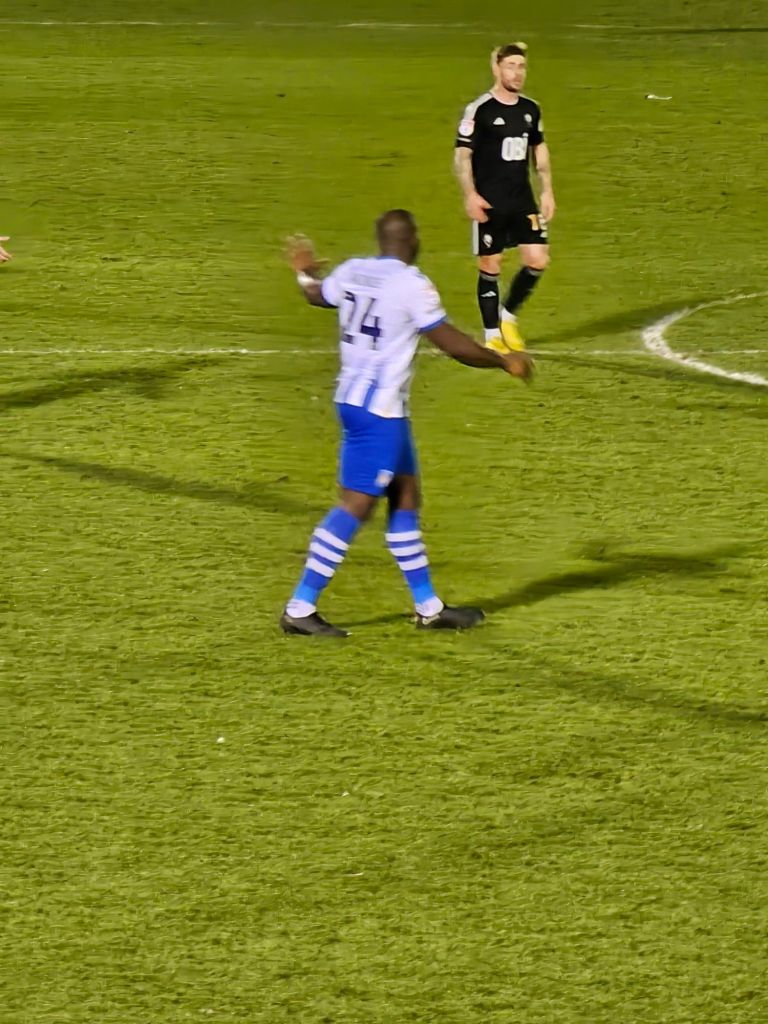
More substitutions follow for Col U with about twenty minutes still left to enjoy and endure. Goalscorer Taylor is replaced by John Akinde, an enormous man with no hair who stirs memories of former Wycombe Wanderer Ade Akinbiyi, and is so popular with the crowd that he only has to boot the ball off the pitch for people to cheer. Col U have been the better team in the second half without making the chances to prove it, but full-time is approaching and the anxiety of holding onto the win elicits chants of “Come on Col U, Come on Col U”. An eighty seventh minute Curtis Tilt cross and a powerful header over the cross-bar by Matt Smith don’t help, but then unexpectedly Akinde delivers a precise through ball, Chay Cooper is away beyond the Salford defence and passes the ball beyond Cairns the Salford ‘keeper. Col U lead 2-0 and if anyone wants to leave early for that stupidly early last bus, they probably can.
But the modern game produces things like six minutes of added on time, even in the fourth division and within a minute Salford are back in the game as McAleny turns and produces an instant shot into the top corner of the Col U goal from over 20 metres out. It’s a spectacular goal, the sort that people prone to exaggeration might say was worth the entrance money alone. The remaining minutes are tense. Akinde is the fifth and final Col U player to be booked by the overly neat Mr Finnie and a final substitution of Will Greenidge for Fevrier is made. “Fuck off Greenidge” shouts a committed fan, and one of the possible reasons why Col U are struggling becomes apparent. But the final minutes are played out and all that happens is that I notice the Salford number three has the name John on the back of his shirt, I wonder for a moment if he is a Brazilian like Fred and Oscar, but the back of the programme tells me he is Welsh, and his first name is Declan, which oddly sounds Irish.
The final whistle brings a rare victory for Col U and applause from the crowd. As we head back to our cars I confess to Gary that I quite enjoyed the match and I think he did too. “But was it worth £21.00?” I ask him. “No” says Gary without hesitation and in the context of what we used to pay to see at Layer Road forty years ago I don’t suppose it was.





 makes me laugh out loud as I recall his Texan accent from a trailer I saw for his new BT TV epic serial; but with his bushy grey beard he just looks a bit of a twat too.
 This bus soon fills up and then we’re off and then we’re there; it’s not far. A young lad in the seat behind me is incredulous as the bus draws up outside the stadium and he sees the car park and crowds beyond. “Cor! That’s really good for League Two” he says with the enthusiasm of youth. “Yeah, but it’s all glory hunters today innit” replies his slightly older and more worldly wise friend and indeed the older boy is right. Having struggled by on gates on three thousand for most of the season , there are more than twice as many here today (6,565 is the official figure) as Colchester have a chance of making the play-offs, along with about half the other teams in the division.
 four long queues into the South Stand, standing behind a fat man with a very growly voice. At the back of the stand on the way from the bus stops a man in uniform with a little green Land Rover is recruiting for the Army. It seems a bit unfair to try and recruit from Col U fans who it seems are already an endangered species without actively putting them in harm’s way. I don’t suppose we will be hearing “Billy don’t be a hero” played over the public address system this evening.
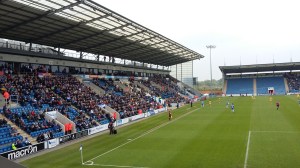 people unfamiliar with the etiquette that demands you sound off at football. It’s not a bad game though and Col U are looking the better team and with a half hour gone that provokes one spectator, presumably anxious about a play-off place and therefore frustrated that the U’s haven’t scored yet, to break ranks and shout critically “we’re going backwards”. In England the concept of just keeping possession of the ball is still one that a lot of people struggle with.
 “Layer Road” is all of a quiver now and a few people are on their feet whilst the stewards gather at one end of the stand to quell any over-excitement.
  Fifteen minutes later and the voice from the public address system still sounds unfeasibly excited as he announces that the fourth official has indicated there will be at least 2 minutes of added on time to be played before it’s time for a cuppa.
 it’s good to know that we’re not supporting that dreadful Le Pen woman in tomorrow’s French presidential election.
 leaving a row of empty seats in front of me along with a pile of empty sweet wrappers but taking with them the promise of tooth decay, obesity and type two diabetes.