After a wet, drizzly afternoon enjoying an exhibition of marionettes at the Hospice Comtesse,
a rather groovy establishment called ‘The Beerstro’ and then the birthplace of Charles de Gaulle, the Grand Finale is an eight o’clock kick-off at the Stade Pierre Mauroy where LOSC Lille meet Montpellier Hérault in the 29th Journee of Ligue 1. Montpellier sit in 6th position in the twenty-team French league, whilst Lille flounder uncharacteristically just one place off the bottom, battling against relegation. I am with my wife Paulene and after a relaxed, light meal we head for the Gambetta Metro station. It’s a little after six o’clock and as the streets begin to dry with warm air up moving up from the south, so the Lillois are venturing out to drink, to dine and to watch football. At Gambetta station the escalator is out of action and at the foot of the stairs a ticket man greets us; somehow he instantly detects that we are English and calls out over his shoulder “Alain! Ils sont Anglais”. A smiling, balding man in glasses walks over to us “Awright?” he says and we shake hands. He continues to talk to us in English with a strange hint of an estuarine accent; he must have learnt English in Dartford or Thurrock. He explains the system of rechargeable tickets and although the ticket itself costs 0.20E he lets us have one for free and on to this one ticket we add four journeys for the trip to the stadium and back (6.40E). Alain even validates our tickets for us before we thank him and bid “Au revoir” and descend down onto the platform. What a lovely bloke. The driverless trains on the Lille Metro are frequent and one soon draws up alongside the automatic doors at the edge of the platform. We step on and sit at the front of the carriage, a siren sounds, the doors close and we’re soon hurtling along through concrete tunnels beneath the city

above. The stadium is the twelfth stop on our mostly subterranean journey, although it is possible to alight at any of the four stops from Villeneuve d’Ascq onwards and the stadium is still easily walkable. People board and leave the train along the route at Republique Beaux-Arts, Gare Lille-Flandres, Caulier, Fives and Marbrerie, some sport red and navy blue knitwear betraying their support for the local team. Before the end of the line at 4 Cantons


Stade Pierre Mauroy, the train rises out of the ground on to an elevated section and just like the last time I made this journey I am for a minute or two Guy Montag and my wife is Clarisse (Julie Christie) in Francois Truffaut’s film of Ray Bradbury’s book Fahrenheit 451. But it soon passes. From the Metro station it’s a ten minute walk to the stadium through a university campus and science park, past the student accommodation called residence Albert Camus; a much cooler name than Essex House, where I lived in my first year at university. It’s dusk and the stadium and its great neon name is visible through

the black branches of the trees that line our route. The path then opens out onto a wide bridge across Lille’s peripherique motorway and Stade Pierre Mauroy is directly in front of us. To the left a broad concrete piazza is filled with French football fans, and the smell of chips and hot oil. The sun sets behind the stadium to the left, turning the clouds a blurry red and casting ruddy reflections in the puddles; adding some late colour to what has been a grey day.


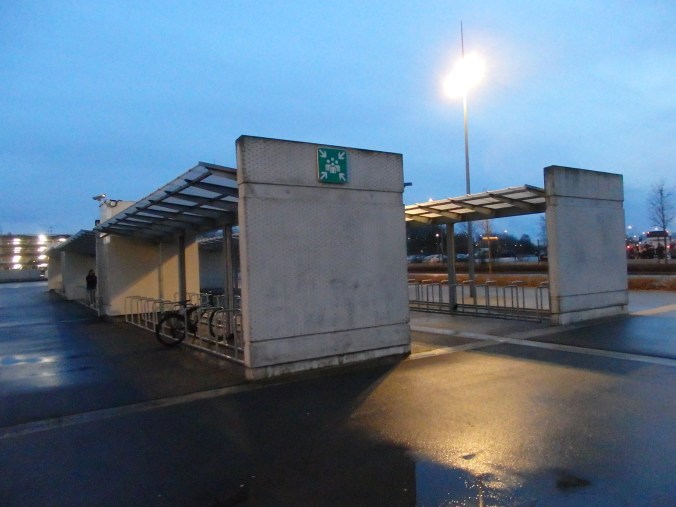
It’s northern France; Belgium with added je ne sais crois, but similar quantities of frites and beer. Low buildings face the stadium across the piazza, a parade of fast food outlets and bars. Further on the crowds diminish and we pass a large area set aside for cycle parking. Although the stadium is some way from central Lille, next to the motorway and has masses of covered car parking beneath and around it, the French planners were clearly optimistic for sustainable travel and there are two concrete canopied blocks of covered cycle racks in which I sadly count just two bikes and a bloke having a smoke.
At gate M my wife chooses to go inside, get comfortable and watch the warm ups before the match, but I want to wander about a bit and so we part. I walk around to the ‘front’ of the stadium where it faces the road and the retail park opposite. There is a trailer here from which more chips are being dispensed, the queue of ‘diners’ snakes out of the descending darkness and into the bright light spilling out from above the deep fat fryers.


I walk on, following four members of the Police National, who bristle with shields and kevlar armour. A neon display advertises a future event at the stadium, a concert by the Pink Floyd pensioner, Roger Waters; its title ‘Us and Them’ will seem fateful by the end of the evening. At the ‘corner’ of the stadium is the club shop, red letters spelling out LOSC glow in the windows and fans walking past are silhouetted in its light. Inside the shop, the colour of the club shirt, red, is overwhelming; the colour red is everywhere it seems,


WW2 night-time bomber pilots could have spent time in here to improve their night vision. But to me there is more than a hint of the subcutaneous, of viscera; this is the sort of place to give a sensitive person like me nightmares. Feeling queasy I head back outside for the fresh air and then re-trace my steps back to gate M where after the customary patting down I pass through the automatic, bar-code operated turnstile, pick up my free programme and head for my seat. Re-united with Mrs Brooks I study the sixteen-page A5 size glossy programme, which contains just three advertisements not directly related to the club. The programme is small and necessarily concise and all the more excellent for that, with everything you need to know, which is really just the squads, the league table and details of the next match. If you crave extraneous information such as forward Anwar El Ghazi’s recipe for lentil soup then there is a fortnightly club paper available in the club shop, ‘LOSC in the City’, which is also free. As I read, a superannuated looking band perform live from the side of the pitch. I think they’re playing the Sex Pistol’s ‘Problems’ but Paulene tells me it’s Jumpin’ Jack Flash. I’m a bit disappointed to be honest and their rocked-up version of The Beatles’ ‘Come Together’ doesn’t please me either , but to my possible shame in these modern times, they’re next number, Hendrix’s Foxy Lady, makes me smile. My reading and musical reverie however, is disturbed by a large bang and some chanting from outside the ground; I had seen on the local TV station that there was to be demonstration by supporters before the game because of the poor performance of the team this season, and this must be it. I walk out to the back of the stand to witness through the mesh wall and some acrid smoke a couple of hundred fans following a bloke holding aloft a red flare; more firecrackers go off and there is some chanting. Excitement over, I return to my seat. Many of the other seats in the stadium are still unoccupied, particularly those on the Virage Est (East Stand) that the Lille Ultras occupy. It is soon evident however, that the ultras were the protestors as the Virage Est sees a torrent of flag waving humanity flood towards the back of the goal.
Meanwhile a female announcer gees up the crowd with some disco music and a dance-cam
shows supporters boogeying insanely on the big screen above the Virage Est. People seem to be enjoying themselves at a football match which hasn’t even started yet. On the pitch everything is being set up for the grand entry of the teams. Ball boys in orange shirts are camped across the centre circle, the Ligue 1 logo is carried out and put into place along with the sponsor’s logo (Conforama – a furniture retailer) and the match ball is placed on a plinth.


Banners featuring the club badges flank the ball and plinth and another banner displaying the Ligue 1 logo and then more banners are marched on to the field, these are red and bear the squad numbers and a photos of the players in tonight’s Lille team. As if all these banners aren’t enough a short film is played on the big screen which follows a journey around the city of Lille and shows images of LOSC players projected onto its most notable sites and buildings, culminating in all the players being projected on to the Stade Pierre Mauroy. It is a mightily impressive little film and conveys brilliantly the ideal of the club and the city and its people as one, I am not a little moved by all it all and wish for a day when I see something like it in Ipswich. We shouldn’t be leaving the EU, we should be saying can we forget about ‘being English’ and instead be French, or German, or Italian or even Belgian. The final act of the pre-match rituals is the singing of the club song, to the tune of Amazing Grace.
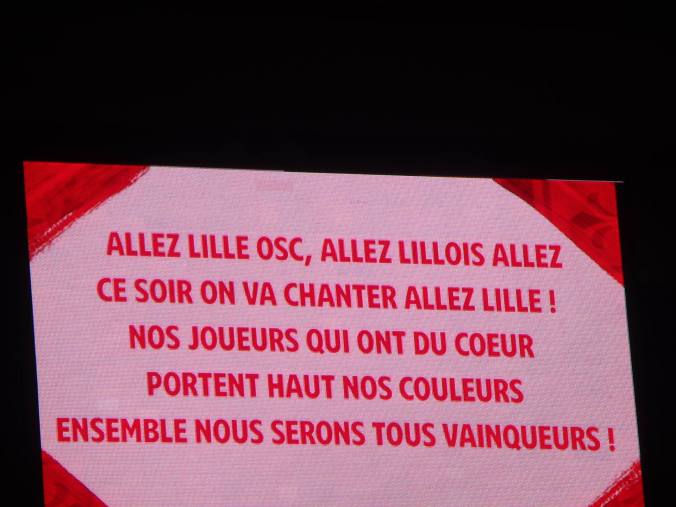
The words appear on the giant screen and the singing hasn’t finished before referee Monsieur Sebastien Moreira, a stocky bald man, signals the start of the game. Montpellier in all white with pale orange shoulders have the first kick, in the direction of the Virage Est but it’s as if they are mesmerised by the club song, they pass the ball about and then as the song melts away immediately lose possession. That strange, musically accompanied start aside, it’s an exciting start to the game, with both teams dashing towards their opponent’s goal at every opportunity. Montpellier’s 19 year old Jonathan Ikone, a loanee from Paris St Germain, leads the charge and his team dominate the early possession, understandably believing that against the team second from bottom in the league, they are bound to score if they keep pressing. A Montpellier shot is soon saved by Mike Maignan, Lille’s goalkeeper. Montpellier are good to watch, they’re fast and direct even if most attacks break down before anyone has a shot. Lille burst forward when they can, particularly through Algerian Yassine Benzia who has the facial hair of a swarthy Mr Pickwick and his arms look unusually long; he is also the first player to be cautioned by referee Monsieur Moreira. Montpellier’s Ellyes Shkiri is injured and replaced by Saloman Sambia, but their forty year old Brazilian captain

Vittorino Hilton
Vittorino Hilton, a veteran even six years ago when Montpellier won Ligue 1, plays on. Although the early excitement dies down a little as defences settle into their roles, the Ultras behind both goals never waver and give constant support, their beating drums being the beating heart and rhythm of the match. Each end sings their own songs, and then call to one another down the pitch. It sounds marvellous, even though the Ultras make up no more than five thousand in a crowd of 28,609 in a stadium that holds nearly twice that number . With less than five minutes until half-time, Yassine Benzia surges forward again for Lille, running at the centre of the Montpellier defence. Leaving two, then three Montpellierians in his wake Benzia pushes the ball forward into the path of Nicholas Pepe who is sprinting into the penalty area. Pepe takes a touch and then sweeps the ball past Benjamin Lecomte in the Montpellier goal. A fast, incisive if slightly unexpected goal. Pepe runs to the corner of the pitch and salutes no one in particular in the way that players like to do nowadays, but then he’s only a young lad of twenty-two. Half-time comes and two teams of boys, one in all white and one in all black, take to the field to participate in something called the Orange Football Challenge; it’s a shoot-out which at first is a non-event as none of the boys is capable of scoring , but eventually one team wins, I think. Both teams get their photo taken in the centre circle before another competition takes place in the far goal as three blokes try to hit the cross-bar with a single kick of the ball from 20 metres. The first contestant steps up and casually succeeds, winning 500 Euros in cash as a result. Predictably the next bloke doesn’t hit the cross-bar, although he’s not too far off, whilst the third slips over and shanks his shot along the grounds six metres wide of the goal. He may never be able to watch or participate in football ever again. As the players return to the field for the second half a camera man sets up in front of us to film people in the crowd who will then appear on the giant screen; as if being at the match isn’t enough you have to be able to see yourself and be seen at the match by other people at the match, although they have actually only come to watch the match; Jean Baudrillard might have something to say about it or may be Michel Foucault. Montpellier run at the Lille defence from the start, with chunky Jerome Roussillon attacking down the left and Paul Lasne down the right. It’s about twenty minutes past eight and Roussillon receives the ball some 20 metres or more from goal; he reacts instantly and dispatches a hard, low shot between the outstretched arm of Mike Maignan and the right hand post of the goal. Montpellier have a deserved equaliser, which their small knot of fans high up in the corner of the stadium
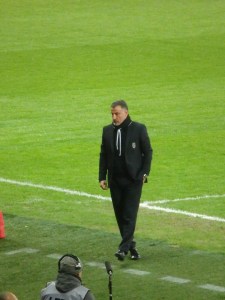
also deserve for having made the 972 kilometre road trip; it’s no wonder there aren’t many of them, but equally a wonder there are as many as there are. No one boos, despite the dire loss of a winning position and behind the goals the Ultras maintain their support. On the touchline the Montpellier coach Michel Der Zakarian looks thoughtful, stroking his chin in his skinny legged tracky bottoms and shapeless black coat. The Lille coach Christophe Galtier moves between his seat in the stand and the technical area, he wears shiny shoes and a dark suit; he steps out of the technical area and onto the pitch at one point when play has stopped for an injured player and is admonished by the fourth official. Galtier waves his arms about in frustration and as he turns to go back to his seat gestures at the official as if to say ‘fuck you’. My wife likes Christophe Galtier; he’s very French.
There are three minutes added on time in which both sides press forward seeking the winning goal, but neither finds it. Monsieur Moreira blows the final whistle and almost instantly supporters from the Virage Est begin to run onto the pitch and towards the players tunnel and the seats where the directors and officials are sat. More and more supporters pour onto the field; one or two approach Lille players with a look of complaint. The referee and his assistants are the first down the tunnel. A large crowd has gathered but a cordon of stewards has quickly formed creating a semi-circle around the mouth of the tunnel. Whilst most of the people on the pitch are facing the main stand and chanting something like “ If the club goes down , then you go down” at the club officials, there are a few who are taking selfies with the handful of Montpellier players stranded on the pitch as they went over to applaud their supporters. Scenes like this always look uglier than they are and whilst there are a few kicks and scuffles as stewards feel the need to man-handle some people, the cordon of stewards around the tunnel has controlled the situation. For a football tourist like me local difficulties like this just add to the entertainment, but I do wonder what the point is of these demonstrations. The supporters didn’t complain when the new regime at the club installed previously well-respected Argentinian coach Marcelo Bielsa and backed him with an overhaul of the squad. Bielsa had been a fabled legend at Marseille but his short tenure at Lille was a disaster and he was first suspended and then sacked as the newly assembled team failed to perform with Lille slumping into the relegation places from early in the season. Watching people stood on the pitch not playing football is only entertaining for a short while and not wanting boredom to spoil what had been an entertaining evening we decide to head back to the Metro of Montag, Julie Christie and Alain.



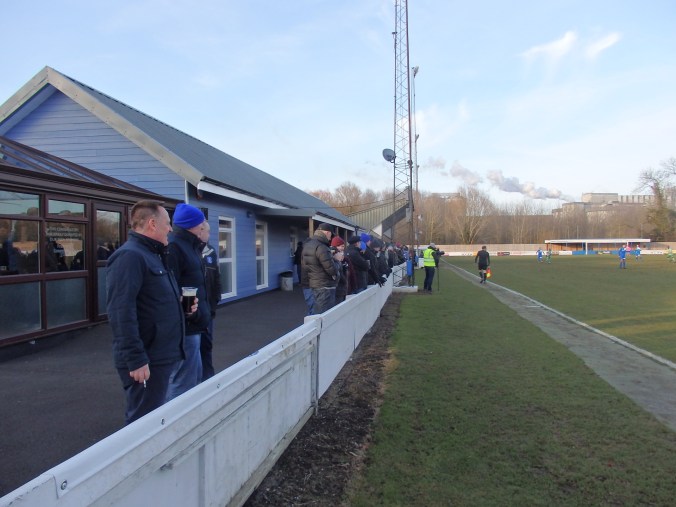



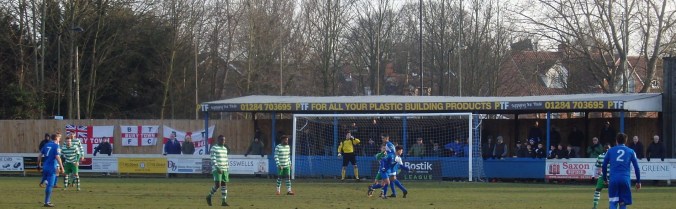
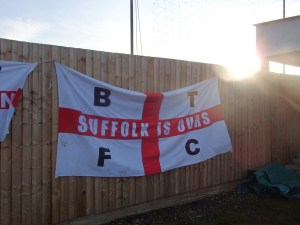
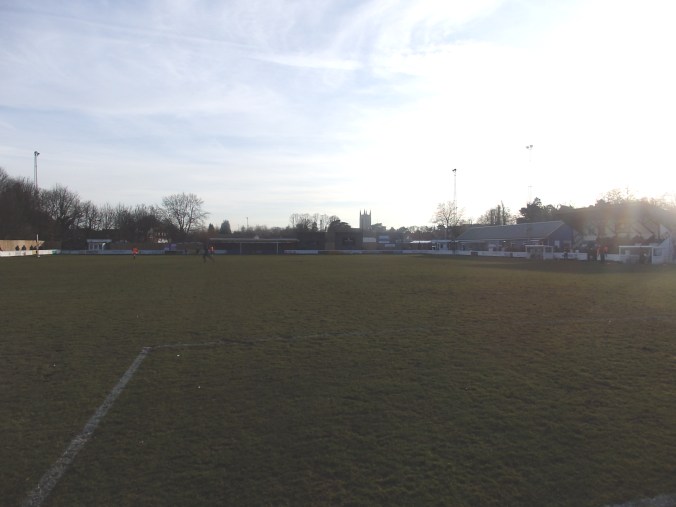

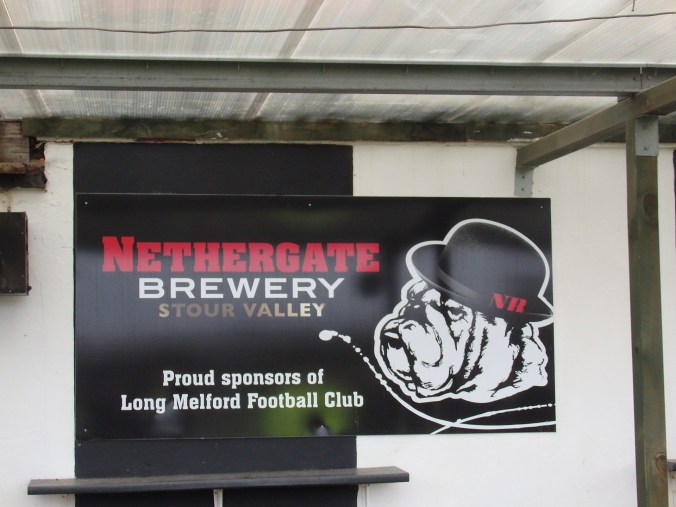

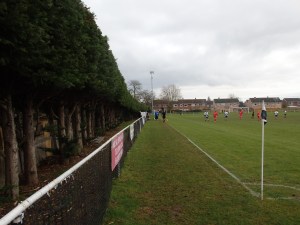 and neatly cut into a modernist architectural shape; behind the hedge a close-board wooden fence is in places nailed to its thick trunks. In its neatness the hedge is only matched by the Newmarket goalkeeper’s haircut, but is less contrived. There is more noise on this side of the pitch as the coaches of both team teams shout and urge their teams on.
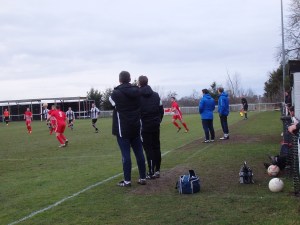 the touchline are visibly tense. The Melford number ten Scott Sloots is hurt and is substituted; as he hobbles off the pitch one or two of his own players seem to be complaining that he is taking his time. “Come on ref, make him get off quicker” I hear. I hadn’t previously realised that there was a point where team togetherness and the will to win would clash. But nevertheless, Melford continue to push forward and in the final minute of injury time there is a run down the left, the ball’s in the box, a shot is blocked and Hassan Ally is in the right place to score from the rebound. Rarely have I seen such elation from a team sixteenth in the league to a winning goal; both coaches burst onto the pitch to celebrate with the team as if this was a most crucial victory. I’m all in favour of making your own fun but this seems to be going a bit far.




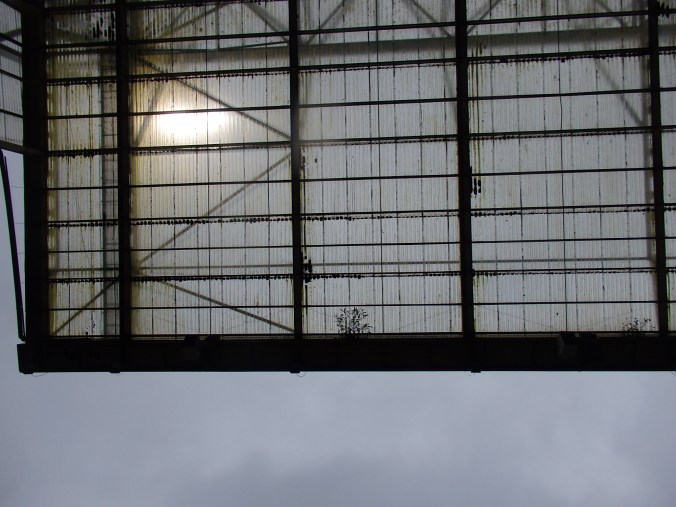


 Portman Road is its usual Saturday afternoon self as I walk along it. The turnstiles are not yet open and people who must have very little else to do indeed, queue by them.
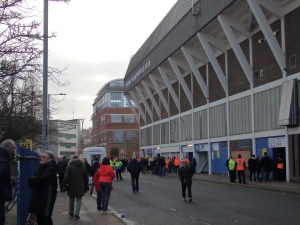 Burgers and buns are eaten, programmes are bought, blokes with strange ‘North meets the Midlands’ accents talk of the “Station Hotel or summat” where, as visitors to Ipswich they might be allowed to buy a drink.
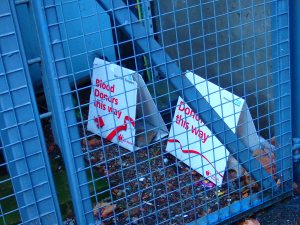 blood donors. Season ticket prices won’t be going up this year, but supporters will be required to donate a pint of blood each. I need to urinate and so visit the toilets. I wash my hands and use the blow dryer, which breathes warmly across my wet hands with the force of a chronic asthmatic. I take my seat and to the strains of Frank Sinatra singing ‘My Way’ the teams take to the field. ‘My Way’ was apparently Bobby Robson’s favourite song, but amusingly it could equally be the theme tune of current manager Mick McCarthy or the elusive and seemingly parsimonious club owner Marcus Evans. Is the club having a laugh at our expense?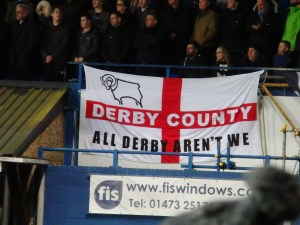
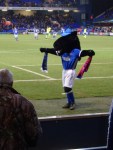 cheap enough. Crazee the edgy, urban Suffolk Punch mascot struts his stuff in front us; if he’s trying to rally the supporters he’s almost literally flogging a dead horse. I think of a disturbing scene in Fyodor Dostoevsky’s Crime and Punishment in which a peasant flogs his feeble old horse to death in the street and onlookers join in. Crazee can add masochism to his list of edgy behaviours, which really only amount to wearing sunglasses and a hat which is on back to front.
