Paris FC 2 FC Metz 1

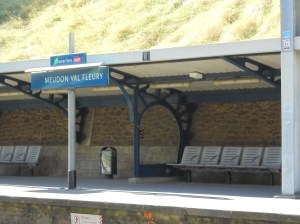
DSC00331It is a cloudy, autumn Saturday afternoon as my wife Paulene and I board the RER suburban, electric, double-decker train at Meudon Val Fleury for the short journey (2.05 euros each) to Pont du Garigliano from where it is a further twenty-five minute tram ride (1.90 euros each) down busy, tree-lined boulevards to Stade Charlety, the current home ground of Paris FC. Today at 3 o’clock Paris FC will play FC Metz in Domino’s Pizza Ligue 2. If you plan your journey on the website of RATP, the Parisian transport company, several options are listed according to whether you want the quickest journey, the one with fewest changes, the one with least walking or one which provides disabled access. But with every route the website tells you the amount of CO2 emissions for your journey, our journey ‘cost’ 29 grams compared to a colossal 1758 grams by car; it’s Martin & Paulene 1 Global Warming 0 and the match hasn’t even started.DSC00220
It may be a grey day, but this is Paris, City of Lights and perhaps appropriately therefore the stadium floodlights are already shining as the tram draws up at the stop. On the next street, the Boulevard Jourdan is lined with the white vans of the Police Nationale and on the opposite corner the Le Gentilly bar and restaurant is surrounded by dark uniformed

police with riot shields and helmets. The Le Gentilly appears to be the chosen pre-match meeting place for the fans of today’s visiting team FC Metz who are top of Ligue 2 having won all of their seven games so far this season. In 2016 the Metz v Lyon game was abandoned after Metz supporters threw firecrackers at the Lyon goalkeeper, so they have ‘previous’. But the police presence still looks like overkill for what is a Second Division match at a club whose home crowds do not often exceed 3,000.
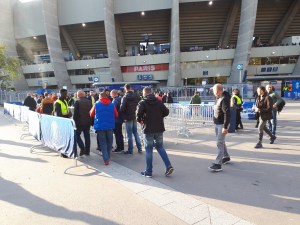
We hadn’t got around to buying tickets on-line so we pay a bit more and buy our tickets (15 euros each) at the guichets at the entrance to the stadium. We take a wander around, making a circuit of the stadium; spotting the respective team buses, Metz fans queuing


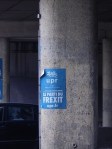
for tickets (only 8 Euros in the away ‘end’) and even more ‘tooled-up’ police. On a concrete support beneath the Peripherique is a poster for the Union PopulaireDSC00221 Republicain, a sort of French UKIP who peddle the somewhat stupid sounding ‘Frexit’, not that it’s any more or less stupid than ‘Brexit’.
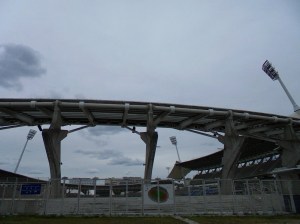
Stade Charlety is named after the French historian and academic Sebastien Charlety who was associated with the nearby Cite Universite de Paris. Naming a sports stadium after an intellectual is pretty much unimaginable in England; just think of West Ham United not playing at the London Stadium but at the AJP Taylor Stadium or Tottenham at the Simon Schama Stadium. Stade Charlety dates originally from 1938 but was re-built in 1994, the architects being Henri Gaudin and his son Bruno, and a damn fine job they did too. The stadium is oval in shape, a segmented concrete bowl, partly single and partly two-tiered, sitting beneath a sweeping, curving, rising and falling roof floating on steel supports, with four floodlight towers each leaning and raking forward as if to peer over the roof at the pitch. The stadium has 20,000 seats and conveys the drama, excitement and sense of occasion that a stadium should.DSC00209
Keen now to experience the stadium from the inside we walk through the turnstiles and our tickets are scanned by hand held devices before we are patted down and wished “Bon match” in the habitual way of French football. In a corner at the back of a stand is a very talented and entertaining band of five brass players and a drummer providing a soundtrack to the pre-match build-up. We both pick up copies of the free eight pageDSC00223 colour match programme (only one page is an advertisement) and are each given a free Paris FC flag. I reflect on how I have been a season ticket holder at Portman Road for 35 years and as ‘thanks’ for my loyalty and thousands of pounds all the club has ever given me is a baseball hat, a metal badge and a car sticker; I’ve been here less than five minutes and on the strength of just one 15 euros ticket Paris FC have already given me a programme and a flag. I like that the programme is called ‘Le Petit Parisian’ making a virtue of Paris FC’s ‘small club’ credentials, a poignant contrast no doubt to the behemoth that is Paris St Germain. According to Planete Foot magazine, Paris FC drew average crowds of just 3,070 last season and this season have a budget of 11 million euros compared to PSG’s budget of about 560 million euros; this against a background of PSG having evolved out of Paris FC as a ‘breakaway’ club in 1972.
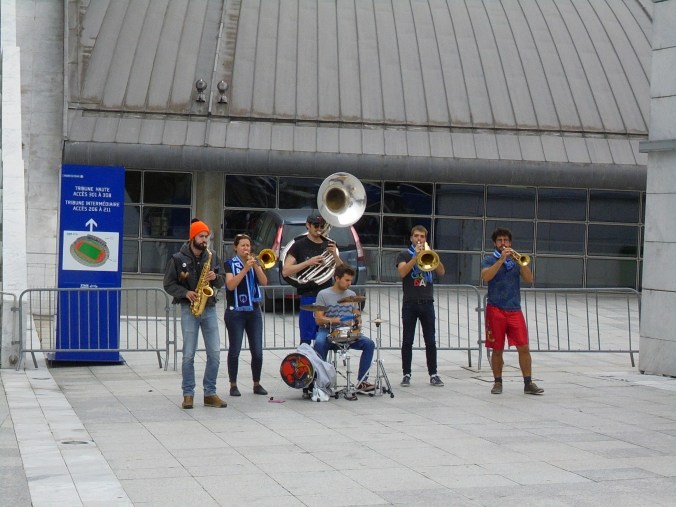
Bowled over by Gallic generosity and with hearts lifted by the music of the little band we head for gangway 109 off which we can sit where we choose. Seats chosen I head back into the concourse and to the buvette to buy a bag of crisps (2 euros) and plastic cups of mineral water and Orangina (5 euros for the two, including the re-usable Paris FC branded cups). Paris FC has no club shop as you might find at an English league club or at the larger French clubs, but there is a hatch between the buvettes from which two young Franco-African women are selling replica shirts, scarves and assorted merchandise. Unable to resist a souvenir I buy a pennant or petit fanion (5 euros) which, when I get back to Blighty I shall hang it in the toilet with all the others.
Back at our seats the quarter of the stadium behind the dug-outs is filling up with flag toting Parisians and a sprinkling of Metz fans, who probably live in Paris. The Metz fans who have made the 330km journey from Alsace are all corralled on the other side of the stadium in a section of the upper tier, with a battalion of stewards and police seemingly watching their every move. As three o’clock approaches the public address system begins to play a sort of minimalist electronica with hints of John Barry, which gathers pace, building as the teams walk side by side onto the pitch to shake hands before a back drop of huge banners showing the club crests and the Domino’s Pizza Ligue 2 logo. A man in aDSC00234 suit, Paris FC scarf and pointy shoes, who looks a bit like the late Keith Chegwin parades before us with a radio mike as he announces the teams.
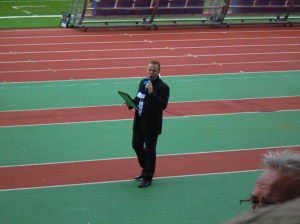
The teams line up with Metz in a change kit of all white and Paris FC in all navy blue. FC Metz kick-off playing in the direction of the tram stop, and generally north towards the Pompidou Centre far beyond, whilst Paris FC play towards Orly airport. From the start Metz are neat and energetic, passing well and closing Paris FC down quickly whenever they win the ball. In front of us and to our right a group of thirty or forty Ultras (possibly the ‘Old Clan’ group) are rallied by a young bloke with a small white megaphone which looks 44906431821_ffcf83e1cb_olike it is only a toy. He faces his colleagues and misses virtually the whole game. The Ultras stand and clap and sing without pause and one of them bangs a drum. “P -F -C, P-F-C” they chant, for that is how Paris FC are commonly known. One guy has a beer in his hand meaning he can’t clap, so he just slaps his head with his free hand, taking a second to tidy his hair when he’s finished.
Despite Metz looking the more accomplished team they don’t test the Paris goalkeeper and it is the home team who manage the first decent shot at goal from number twenty-six Dylan Saint-Louis, which Metz goalkeeper Alexandre Oukidja dives low to his right to save. Metz continue to look confidant and strong but PFC are matching them. It’s only just gone ten past three and PFC left-back, number eighteen Romain Perraud strides forward, he rides a block tackle stumbling over a leg but taking the ball with him and looks to go for goal. He is over twenty metres from Oukidja the man between the Metz goal posts and I don’t expect to see the ball go flying in to the far top corner of the net and dropping to the grass inside the goal, but it does. It is a spectacular goal, easily the best I have seen so far this season. A goal behind, Metz have further troubles as they have to make a substitution and Senegalese Opa Nguette is replaced by Malian Adama Traore due to injury.
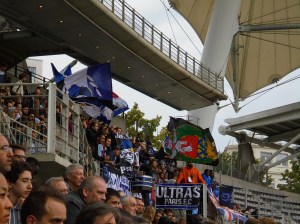
Conceding the goal has not dampened the Metz fans’ spirits however, as they continue to wave their own flags and banners. Behind us to our left another group of PFC Ultras DSC00254(possibly the ‘Ultras Lutetia’ group) have their own somewhat bigger drum and bigger flags but no megaphone, well not as far as I can see anyway. A fine drizzle is falling now and the stadium announcer who strutted about in pointy, shiny shoes before kick-off shelters beneath an umbrella. Rain drops run down the back of the transparent covers to the dugouts and it feels every bit like a quintessential autumn afternoon at the football. It’s marvellous and not only because this is Paris.
At last, after over twenty minutes of play Metz manage a shot on target, but it’s an easy save for Vincent Demarconnay the ‘keeper for PFC. Despite Metz’s failings in front of goal they still look a good team and this is an entertaining game, well worthy of the live TV coverage it is receiving this afternoon; the large cameras at the side of each goal look oddly old-fashioned however and conjure memories for me of Grandstand and Sportsnight with Coleman. It’s just gone half past three and Metz win a corner on the far side of the pitch from which their Zambian number thirteen Stoppila Sunzu sends a powerful header down towards the goal line; for a split second it looks like it must be the equaliser but the ball meets the boot of Romain Perraud and skews off his foot for a throw. Perraud has effectively scored twice for Paris now, without him they might be a goal down, rather than a goal up.
Half-time is less than ten minutes away and although they are the underdogs Paris FC are playing well and deserve their lead, then what seems like disaster strikes, compounded by it being a gross injustice. In an incident similar to the sending off of Ipswich Town’s Toto N’Siala at Sheffield Wednesday earlier this season, PFC’s Julian Lopez slides along the wet turf to get the ball, which he does, a moment later however

and Metz’s Thomas Delaine arrives and falls over Lopez‘s leg, twisting as he falls. The referee Monsieur Pierre Gaillouste, who has an annoying and unnecessary habit of running quickly up to players whenever a foul occurs, does so again and shows Lopez the red card. We are all outraged. It was not a foul, if anything Delaine fouled Lopez. As a neutral this should be pure theatre to me, but the injustice is intolerable and I decide that Paris FC must win.
The sending off has distorted the match and I cannot really see that Paris can hold on, but in injury time they win a corner which Metz forget to defend and the wonderfully named Cameroonian defender Frederic Bong heads the ball into the middle of the Metz goal to double PFC’s lead. I leap from my seat and stick it to Monsieur Gaillouste and his inept refereeing. Half-time soon arrives and I can enjoy it. I return to the buvette with the thought of a celebratory beer but the queue is too long.
The game begins again and within a minute Habib Diallo scores for Metz with a header from a cross by Thomas Delaine. I fear the worst for PFC now but Metz fail to capitalise and PFC defend brilliantly. Metz show growing frustration, Traore looks to the heavens as he sends a low, bobbling shot bouncing weakly past a post and Marvin Gakpa is booked after following through with a challenge on the PFC goalkeeper. The Metz coach Frederic Antonetti, a balding, solid man who wears what I would describe as a Marks & Spencer jumper patrols the area in front of his team’s dugout, shaking his head and looking displeased. I think I can smell a cannabis cigarette, but it’s not from Monsieur Antonetti. On the other side of the ground the incidence of flag waving has definitely reduced. Now Renaud Cohade, who I thought was the main force in the Metz midfield is replaced by the Algerian Farid Boulaya and as the electronic substitution board is held aloft Paulene casually asks how many double A batteries I think it takes.
Paris FC are restricted to defending in depth but they are succeeding and cannot expect to do too much else with only ten players against probably the best team in the league. There are still twenty minutes left as PFC’s Ivorian Edmond Akichi, billed in the programme in his own words as a midfield battler goes down and a stretcher is needed to carry him off. Number six Romenique Koumane replaces Akichi but suddenly Akichi is up on his feet again appearing to say he wants to play on, only for him to even more suddenly double-up in pain up clutching his knee before being helped away.
There are less than ten minutes to go and PFC are holding out well and even almost score a third goal as Souleymane Karamoko breaks down the right and into the penalty area; the ball goes out and he goes down. “Penalty!” I cry, because anything has been shown to be possible with this referee, but it’s a corner which number twenty-seven Jonathan Pitroipa, who is from Burkina Faso, heads very wide. There are four minutes of added time to endure, but PFC survive them whilst all Metz do is to collect another booking, this time for Emmanuel Riviere as he flicks a passing foot at the PFC goalkeeper, or at least that’s what the referee thought.
The final whistle brings unbridled joy, something I don’t often experience at football matches any more. This has been an excellent match, one the best of the ten or so I have seen in Ligue 2. I hadn’t expected a lot from a crowd of just a few thousand (the attendance will later be reported as 5,097) in a 20,000 capacity stadium with a running track around the pitch, but I was wrong. Despite swathes of empty seats there has been a really good atmosphere in the small part of the stadium that is open and with minimal stewarding it has felt a bit like an English non-league game. I have loved seeing so many African players, it’s been like a mini African Cup of Nations and Paris FC have played superbly well to beat a good, but on the day ineffective Metz team, who nevertheless remain one of the favourites for promotion. I have nothing in particular against Metz, but it was great to witness their first defeat after seven straight victories. If only my team Ipswich Town could now get their first win.

Paris St Germain 6 Red Star Belgrade 1

A bit after 5 o’clock on another sunny, early autumn afternoon in Ile de France my wife Paulene and I arrive at Meudon Val Fleury station to find that the suburban RER train service is suspended for at least two hours because someone has unfortunately been hit by a train at Champ de Mars station. The Paris St Germain versus Red Star Belgrade match in Group C of the European Champions League kicks-off at six fifty-five, which is a bit of an odd hour, and it means that a different mode of transport will be required to get to the game on time. Seasoned travellers that we are, we don’t panic, but stroll round to the front of the station and across the forecourt to the bus stop where a No 289 bus is conveniently just drawing up. In just twenty minutes this bus will take us to Porte de St Cloud, which is more or less just over the road from Parc des Princes. Our carbon footprint will be bigger courtesy of the Iveco diesel engine, but what can you do? We board the bus and validate our tickets (1.49 euros each if bought as a carnet of ten).
It’s a fun ride through the streets of western Paris and we have a driver who likes to use his horn; at one stage he leans out of his cab window to converse with the driver of a

45092035431_3e911401fd_o

Peugeot who has pulled across in front of him. With car drivers cowering, the bus pulls onto the cobbled surface of the Porte de St Cloud bus station and, along with a handful of blokes sporting various Paris St Germain branded attire, we alight and make the short walk to Parc des Princes. Our tickets tonight (48 euros each) are in the Paris tribune, the stand which has its back to the centre of Paris. It is a dramatic approach to the stadium as we cross a bridge over the

45092036911_0ff19c18d1_o

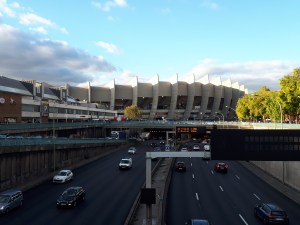
périphérique, Paris’s inner ring road, which actually passes underneath the corner of the Paris tribune. Of all those ‘you can see the stadium from here’ moments that you get on car and rail journeys, this has to be the best. We walk past the PSG supporters’ shop (most definitely not the official club shop) with its delightful “Fuck Marseille” scarves. It’s not much past six o’clock and it’s still light, and the concrete ‘fins’ that define the silhouette of the stadium look fantastic; Parc des Princes may be over forty years old but it’s a marvellous sight, a far more exciting looking building than any stadium in Britain.
Security arrangements mean some queuing to get in, with everybody patted down by

44180984635_6f060b44f6_o

people wearing what look like knitted gloves; it’s a matter of luck how quick or thorough your ‘patter’ is. My ‘patter’ is slow and thorough; Paulene’s patter may be no quicker, but as she only has to deal with women in a crowd of mostly men the queue to be patted down is shorter. This means that by the time I get to the turnstile itself, Paulene is already in the stadium. We have tickets that were sent by e-mail to Paulene and she then sent my ticket to my mobile phone, so ‘all’ I should have to do is pass the black and white patterned thingy in the e-mail beneath the electronic reader at the turnstile. But the reader doesn’t like what I place under it; it seems it needs to read the original rather than the one Paulene forwarded to me. It takes a steward to explain this to me of course and I send two desperate texts to Paulene: “I can’t get in”, “Come to the turnstiles” I plead. As my wife and carer, Paulene immediately understands and answers my call; the reader reads the ticket from her phone and I get inside the stadium. Technology and I are sworn enemies, but everything has worked out fine, until the next time.
Out of gratitude and because she asked me to I treat Paulene to a bottle of Coca Cola (2.50

44371980404_8bb98469c4_o

euros), but I decide to go thirsty because I object to buying a bottle of drink from which the cap is confiscated. I am a 58 year old adult and can be trusted with a plastic bottle top, so “shove your Coca-Cola and other topless bottled drinks where the sun doesn’t shine” is my message to PSG. I later buy a coffee (2 euros) to keep me alert against other possible infringements of my human rights. The spirit of Mai ’68 lives on.
PSG has e-mailed Paulene earlier in the day to warn that trouble was a possibility at tonight’s game from followers of Red Star Belgrade (FK Crvena Zvezda in Serbian), who might have dodged any efforts to segregate supporters. It seems like an admission that PSG have failed to properly control ticket sales and they also advise away supporters not to wear club colours, which surely increases the possibility for trouble by making them impossible to spot. We had heard lots of Balkan voices as we approached the stadium, but there was no sign of any antagonism between French and Serbs. Inside the stadium we find ourselves sat behind a row of blokes in their thirties or early forties who are clearly Belgrade supporters but they seem a bit like the sort of ‘youngish professionals’ you might find at a rugby match in England or in the Greyhound pub in Ipswich; two of them wear Mercedes Benz lanyards which suggests they may have wangled a trip to Paris on the back of the current motor show at Porte de Versaille.
Our seats are close to the front of the stand and in a corner, close to where the Paris

45043601722_1f79f55979_o

tribune ends and the Boulogne tribune begins. A wedge of Belgrade supporters are nearby to our left, behind a large net which hangs from the roof of the stadium, and a moat. More Serbians fill a batch of seats in the upper tier of the stadium, away to our right. The Auteuil end of the stadium where the bulk of the Paris Ultras are usually accommodated is completely empty tonight, presumably a sanction by UEFA for some previous transgression by the Ultras, probably the use of flares. The noise level is reduced as a result, but there is still a decent atmosphere inside the ground, but then there are still over 39,000 people here.


Pre-match entertainment includes the players’ warm-ups to a soundtrack of tunes from the ‘legendary’ Charles Aznavour, who sadly died earlier this week, and some serious watering of the pitch, which reminds me of the spectacular fountains at the gardens of the palace of Versaille. I am a little surprised that PSG haven’t considered choreographing the sprinklers to a musical accompaniment. At last the overblown Champions League anthem, that rip-off of 45092131931_858bdc0502_oHandel’s ‘Zadok the Priest’, strikes up and the teams line up on the pitch whilst some young people stand in a circle and shake a big circular thing; it looks to me like they are shaking the crumbs off a massive table cloth, possibly one used by UEFA officials in some lavish pre-match banquet; the comparisons with Versaille continue. Tonight PSG are wearing an all-black strip, whilst Red Star Belgrade wear red and white, looking like Stoke City from the front and Fleetwood Town from the back.
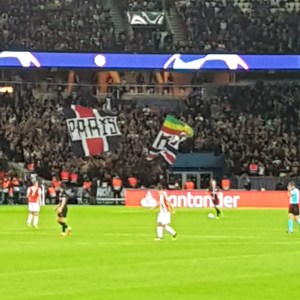
The game begins with PSG having first go with the ball and aiming in the direction of the banks of empty seats at the Auteuil end of the ground; Belgrade shoot towards the Boulogne-Billancourt end. Predictably, the first free-kick of the game, and the second, is awarded for a foul on Neymar. Backed by chants of “Red Star, Red Star” the Serbians have the first shot on goal however, as a poor header from Presnel Kimpembe is half-volleyed into the beautiful blue evening sky by Goran Causic. Belgrade look keen but translate this into committing lots of fouls. The likes of Kylian Mbappe, Neymar and Angel Di Maria are a bit too quick for them. The Belgrade number thirty-one El Fardou Ben from the Comoros Islands is very chunky, a sort of scaled down Ade Akinbayi. To begin with he looks like he might be a handful for the PSG defence, but he’s not and in the pantheon of chunky players is probably no better than former Ipswich Town superstar Martyn Waghorn.
Having weathered the early Red Star enthusiasm, Paris St Germain settle down into totally dominating possession, as is their habit. With twenty-minutes gone a free-kick is granted to PSG in a position from which it is almost inevitable Neymar will score, and he does. Two minutes later he performs a brilliant high-speed one-two with Kylian Mbappe and scores again. Mbappe is set up by Neymar but the Belgrade goal keeper Milan Borjan saves at his near post and then saves a header from Edinson Cavani. Marco Verratti is magnificent in midfield, winning the ball back almost instantly every time a move breaks down. Edinson Cavani scores the third goal just after half-past seven before a Thomas Meunier cross, or possibly even a pass, is delicately flicked in by Angel Di Maria four minutes before half-time. Paris St Germain are magnificent and I’ve seldom if ever seen the like of it before.
At half-time we feel we need a rest, not just because our collective breaths have been taken away by the sumptuous football, but also because the Serbian blokes in front of us have been stood up throughout the first-half and we need a bit of a sit-down. Whilst they go off to pay 7 euros for non-alcoholic beer in PSG branded plastic cups we can rest in relative comfort and gaze upon the green of the pitch without having to look over their neatly cut heads of hair.
The second half is soon underway however, and the Serbians return looking suspiciously at their beers. Paulene now stands by a free seat further back across the gangway because the Serbs have played musical chairs and a tall one and a shorter one have swapped places so her view is obstructed. The second-half proves even more exciting as Mbappe attacks down the left and we get to witness his remarkable speed at close quarters from which he looks even faster. But the PSG forwards and attacking midfield are so free, interchangeable and flowing that anyone can pop-up anywhere. Mbappe pops up regularly but misses every time and by the time he does score Belgrade have even had a couple of shots on target of their own. In the far corner of the ground some Paris Ultras have begun to wave banners, one says Paris, whilst a second is clearly aimed at winding up the Serbs and reads ‘Kosovo’, a part of the country that has declared independence from Serbia; although Serbia recognises the government it sees Kosovo as its own province.44171686915_83e7470fae_o
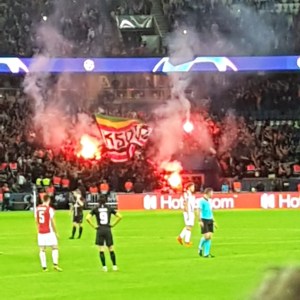
Belgrade’s Filip Stojkovic is the first player to be booked by Portuguese referee Artur Dias Soares, when he tugs at Neymar’s shirt; Stojkovic just couldn’t wait until the end of the match to claim his souvenir. Mbappe’s eventual goal is scored two minutes later with 70 minutes played, it’s a relative tap-in from a bamboozling passing move instigated by Neymar that should have resulted in a goal sooner, but previous shots were blocked. The only surprise is that it’s taken so long for the fifth goal to be scored, but any sense of shock is eclipsed four minutes later as Milan Miran scores with a fine shot for Belgrade. The Serbian fans are ecstatic and make the most of their only opportunity to celebrate this evening, which is a lesson to all football supporters of losing teams, Ipswich Town fans please take note. But not to be outdone the Paris Ultras also light four or five flares on the opposite side of the ground where the flags were, for which the club will no doubt be punished in some way by UEFA.43269643400_d3ee064df0_o
A man in a dark suit appears from the back of the stand to ask everyone to sit down as people behind can’t see. He has some success but it’s a bit late for this now and within ten minutes everyone is stood up again anyway. But we see the last ten minutes with an unobstructed view because the Serbs in front can’t take any more and leave. All that remains is for Neymar to complete his hat-trick with a second perfect free-kick over the defensive wall into the top left hand corner of Milan Borjan’s goal.
This has been the fourth time I have seen PSG at Parc des Princes and I can’t but help feeling a little disconnected from these matches, because PSG are the French version of Manchester United or Bayern Munich, and are the club who everyone except their own supporters loathes. I can’t help disliking them too because their un-earned wealth distorts and compromises the French league and Cup competitions. But I have to admit that tonight PSG have played brilliantly and produced possibly the best football I have ever seen, better even than Ipswich Town’s during the 1980-81 season. English commentators will no doubt debunk the win by saying that Red Star Belgrade are a weak side, but the brilliance of Neymar, Mbappe, Cavani, Rabiot, Di Maria, Meunier and Verratti just cannot be denied. This has been a fantastic evening’s football.

Meudon AS 0 St Ouen L’Aumone AS 2

Today is the last day of September, my wife Paulene and are staying in Meudon on the edge of Paris, and having enjoyed both professional Ligue 1 and Ligue 2 football in the past week and a bit, watching both Paris FC and Paris St Germain, this afternoon we are getting down with the French equivalent of ‘non-league’. Not much more than ten minutes away by car at the Stade Georges Millandy in Meudon Le Foret (twenty minutes by bus service No 289) is a Coupe de France fourth round tie between Meudon AS of the Ile de Paris regional league Division 3 and St Ouen L’Aumone AS of the Ile de Paris regional league Division 1. These leagues are the 6th and 8th levels of the French football league ladder, although probably not directly comparable to those levels in the English non-league ‘pyramid’.
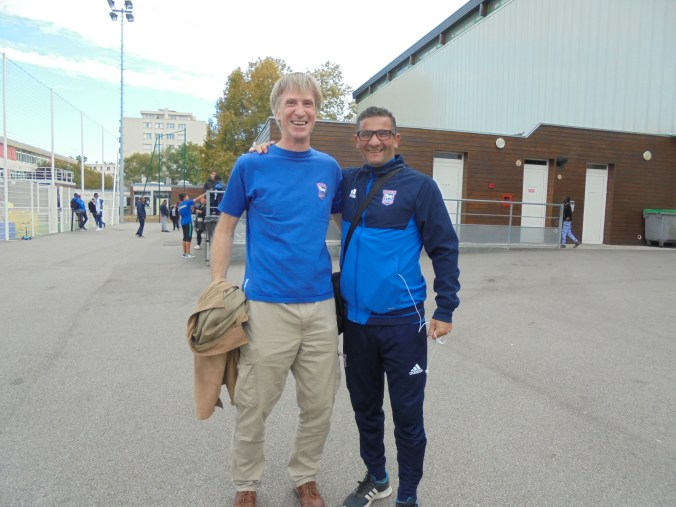
The parking at the local community sports centre, where the match is to take place is full, so we park our trusty Citroen C3 around the corner in Rue Georges Millandy between large blocks of modern apartments. We are not sure exactly where we are going, but the Federation Football Francais (FFF, the French Football Association) website says this is the where the match is taking place and having walked through a corridor in a sports hall we find ourselves next to an artificial football pitch. There is no turnstile and watching this match is free. A bunch of blokes in tracksuits sit outside a portacabin eating baguettes and drinking coffee. In my exquisite school boy French I ask if this is this is where the Coupe de France game is taking place at 2.30; I am relieved to learn that it is, and flattered that the man I speak to recognises the Ipswich Town crest on my T-shirt. I explain that I am a fan and not from the club itself, but we both quickly make the connection that Ipswich’s Under 18 player Idris El Mazouni is from Meudon. I will later discover that I have been talking to Idris’s dad.
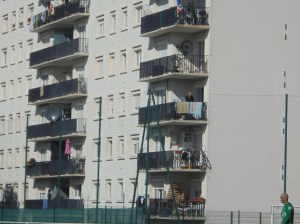
The Stade Georges Millandy is not a stadium as we might understand it in Britain, because it has no stands; it’s just a 3G synthetic pitch with dugouts and a metal fence, overlooked by five or six large, shiny white apartment blocks.

This slideshow requires JavaScript.

It wouldn’t make the grade for the Thurlow Nunn Eastern Counties League, although in truth the playing facilities are better than at most clubs in that league. It seems quite new, is in good condition and is the sort of installation that a town the size of Ipswich should probably have at least ten of. Given that these pitches are not cheap to install it is doubly impressive that the surface extends beyond the actual pitch to the area around it, with a mini pitch and goals in the space behind one goal. A game (possibly Under 15s) is

just finishing with a penalty shoot-out and I return to the portacabin, which is a sort of club house and buvette, to get two cups of green tea and a Kit-Kat (all 1 euro each); the tea is poured from a huge pot. On one wall is a large array of trophies won by all age groups within the club.

Paulene and I wander around the pitch as we drink our tea and I scoff a Kit-Kat trying to remember why Nestle products were boycotted and if they still should be; too late now, I have become complicit in their multi-national nastiness. It is a beautiful, bright sunny

45013661531_f3c54472c1_o

afternoon beneath a clear blue sky and the gaze of those shiny apartment blocks, which cast no shadows on one another or the pitch; this has to be how Le Corbusier imagined La Ville Radieuse.

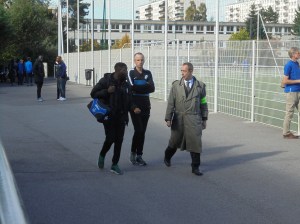
A man in a loosely belted gabardine raincoat appears; if he was wearing a trilby hat he could have stepped from a 1940’s film. He sports a bright arm band which adds to the look, but in a slightly sinister manner; he is however the délègue principal, the FFF official who

43201967200_10152fe2e5_o

will oversee this afternoon’s game from the side lines. Out of the blue one of the spectators walks up to me and shakes my hand. In due course the two teams emerge from their respective changing rooms and walk through the metal gate onto the pitch before lining up side by side, then in a line before shaking hands. Introductions between the referee and players and délègue principal are made all-round, before the game kicks off about five minutes late (it was advertised as a 14:30 kick–off) with St Ouen having first go with the ball, aiming at the goal in front of the buvette. Meudon kick in the general direction of far off Stade Charlety and the 13th Arrondissement. St Ouen wear an all-green kit, whilst Meudon are all in red; neither club has its club crest on its shirts but instead bear the logo of the FFF with its cockerel.

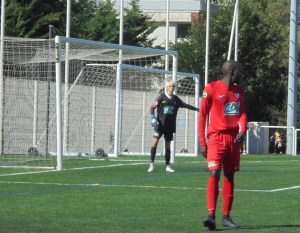
St Ouen quickly win a free-kick as their tricky number nine goes down under a challenge; he gets up to send a neat free-kick over the red wall of Meudon, but into the arms of the very young looking Meudon goalkeeper, who strangely is one of the smallest players on the pitch, a sort of French Laurie Sivell. It is also St Ouen who have the second serious goal attempt, again a free-kick, but this time firmly hit from a wide position by their number ten. Once again the goalkeeper, whose blond hair may not be its original

30077406907_10dcb243ea_o(1)

colour, saves, batting the ball away for the first of five corners that St Ouen will win this half. Most of these corners are either poorly taken or all the St Ouen players are waiting for the ball in the wrong places.
Meudon are very competitive and the game is played at a fast pace with the emphasis on passing rather than just getting the ball forward by the fastest route. Meudon come close to scoring a bit before three o’clock as their huge number eleven breaks through on the left. The St Ouen goalkeeper, who incidentally reminds me of St Etienne ‘keeper Stephane Ruffier on account of his designer stubble and very short dark hair, and is possibly the second smallest on the pitch, dives at his feet. The ball rebounds to the Meudon number seven whose goal-bound shot is headed away at improbably close range.
Meudon seem to be growing in confidence and their number ten does a few feints and jinks over the ball like a footballing Michael Jackson (Bubbles’ friend, not the one who played for Tranmere and Shrewsbury) might have done. There are a few jeers and within the next twenty seconds his ankles are swept away from beneath him by the St Ouen number three as he goes to dribble down the right touchline. It’s one of those situations that some people would try to excuse by saying that number ten had been ‘disrespectful’, but that’s just a modern buzzword, a sort of false political correctness and it is tosh; I blame Eastenders. Football is a game of skill, and dumping someone on their bum shows little ‘respect’ itself. Referee Monsieur Charly Legendre doesn’t see fit to book anyone either way.
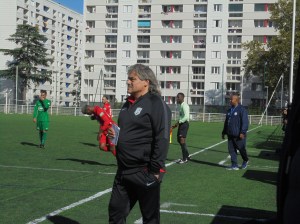
The coaches on the side lines are animated, “Parlez –vous” one calls urging his players to talk to one another. The St Ouen coach, a portly man in his fifties sports a fine mullet and

43201968530_160c2105a2_o

has the look of Maradona about him. The Meudon coach becomes involved in a prolonged discussion with the linesman Mefa Bakayoko about an offside or a free-kick which has been and gone and so no longer matters. On the field, the St Ouen number ten sends a free-kick solidly over the cross bar whilst Meudon’s number six comes as close as anyone else with a long range shot that goes wide. St Ouen’s number nine is proving industrious and creates a couple of shots for himself, one of which is well saved and Meudon replace their number three with substitute number thirteen. Half-time arrives and Paulene and I look back on a good but slightly frustrating forty-five minutes, which was too tight to be really entertaining. I head for the buvette to get a bottle of water (1 euro).
During the half-time break we stand about and as a man walks by he shouts “Ipswich!”. We could do with that sort of enthusiasm at Portman Road. As I stand I enjoy the

44294420204_39f8378ac4_o

contents of the many balconies that overlook the pitch from the surrounding apartments. Bikes, mattresses, plants and drying clothes decorate the bright white buildings and on one corner is a tricolour, perhaps left over from the summer’s World Cup win. As the afternoon wears on more people seem to arrive to watch the game and by the end I estimate that at least one-hundred people are here.
The délègue principal oversees the away team leaving their dressing room by a side door to the sports centre building and heads back to the pitch still wearing his gabardine raincoat, although it’s a warm afternoon; he is perhaps the anti-thesis of the banker in The Beatles’ Penny Lane and also feels as if he’s in a play, or a British TV sitcom. The bearded referee begins the game again and St Ouen soon win their sixth and seventh corners of the game, although in between their number eleven also shoots over the cross bar. At about four o’clock the St Ouen number eleven breaks forward through the middle, stretching the Meudon defence before playing a through ball to number ten who slips the ball inside the near post past the ‘blonde’ goalkeeper; St Ouen lead 1-0.
They may be losing and disappointed to be doing so, but Meudon still pose a threat and a good run and cross from number eleven meets the thigh of number seven just a few yards out, but he can’t direct the ball past the goal keeper. The first booking of the game goes to Meudon’s number two and the game enters a tetchy stage where it seems it could flare up at any moment. As at most French football matches I have seen where this happens however, there are only outbreaks of animated discussion between the players, but the referee stands back and let’s this carry on. It’s a civilised approach which may reflect the character of a country that has produced far more philosophers than England has produced ‘World Class’ footballers.
St Ouen are buoyed by their goal and their bearded number three controls a ball beautifully on his chest before advancing down the flank. The lads watching near us jeer at his skill and nickname him Fekir, and they’re right to do so because he does vaguely resemble the French international. But Meudon are not beaten yet and the large number eleven strides past a couple of St Ouen players before playing a through ball to number twelve who either wasn’t paying attention or the pass wasn’t as good as it looked. Paulene and I belatedly realise that the number twelve has replaced the number seven, who we had thought was Meudon’s best player.
St Ouen almost score a second goal as their number nine diverts a cross from ‘Fekir’ the wrong side of the post from close range, but the game is becoming more scrappy and there are more fouls. The Meudon number ten spends more time than most not being upright. St Ouen win an eighth corner and as a passage of play ends Monsieur Legendre calls over Meudon’s number nine and ‘Fekir’ and books them for a mystery offence that neither Paulene or I saw. It is now gone half past four and we are witnessing time added on as St Ouen’s number eight runs down the right and then pulls the ball back across the penalty area for substitute number fourteen to side foot beyond the small, blond goalkeeper into the far corner of the goal. St Ouen L’Aumone AS is the name that will go into the draw for the 5th round of the Coupe de France.
It’s been a reasonable game although not an exciting one in terms of goalmouth action. We turn to leave and Paulene notices a man with an Ipswich Town crest on his coat; I speak to him and it turns out he is the father of a second player from Meudon AS who is now in Ipswich Town’s Under 18 squad, Lounes Fodil.

44294397894_dca5642a04_o

Lounes’s dad, who is called Mustapha (apologies if the spelling is wrong) is a lovely bloke and is genuinely pleased to meet us and invites us for a coffee in the buvette. Our conversation probably isn’t the best as neither our French nor Mustapha’s English are fully fluent, but Mustapha gets across his philosophy of football; it’s a game of skill and intelligence not brute strength. He’s been to Portman Road and has noticed the glum atmosphere, which he attributes to the dull football. Whilst we are at the buvette some of the players come in for post-match drinks and snacks, one of them (I think it might have been the big number eleven or the captain) tells me Lounes is a good player. I tell him that’s good news because Ipswich Town really needs some good players; before he leaves he shakes my hand. The man who I first spoke to when we arrived comes to the bar counter and gets out his mobile phone before showing us a montage of clips of Idris El Mizouni playing for the Under 18’s, this is when I discover that this is Idris’s dad.
After a good half an hour or more we have to leave and walk from the ground with Mustapha who leaves us his phone number and invites us round to eat; sadly Paulene’s food intolerances and allergies will make that too complicated. We thank Mustapha and say how good it has been to meet him. Hopefully we will see him again.

This slideshow requires JavaScript.

Ipswich Town 1 Norwich City 1

I received a text at a quarter past six this morning from my friend Mick who was at work but, in what was presumably an idle moment, had decided to let me know that he was watching assorted vehicles setting off from Suffolk Police headquarters heading, he assumed, for the match at Portman Road today. He asked me to give Town a shout on his behalf and predicted a draw. I tried to sleep on for another hour or so after reading the text but with only partial success. Thanks Mick.
Today should be one of the highlights of the football season, one of the most exciting games, the game with the biggest crowd and the best atmosphere; the one most like a professional football match should be. But the portents are not good; there are no trains from Colchester direction, only replacement buses. Far worse than that it’s Sunday and kick-off is at twelve o’clock, noon. The relevant authorities and ‘stakeholders’ have made a ‘risk assessment’ and decreed that there is a risk of football supporters enjoying the event too much if it takes place on a Saturday afternoon at 3 pm when football matches should be played and so Sunday lunchtime has been chosen as the time when the game should take place. That last time Ipswich played Norwich on a Saturday afternoon was probably in the last century; I tried to look it up on the interweb, but gave up and may be the records have been deleted to deter dissenters and give the impression things have always been like this; but I remember the 1970’s so they won’t silence me!
Moving on, I drive to Ipswich because life is too short to consider rail replacement bus services an option and I park up on Chantry, that spaciously laid out estate of public housing from the time when it wasn’t seditious to place need above profit. It’s a pleasant walk down through Gippeswyk Park beneath a blue sky as I strive to find pleasure in otherwise desperate circumstances. In Ranelagh Road I pass two drunken Norwich City supporters.


I cross the Sir Bobby Robson bridge for which the planners of Ipswich Borough Council must be congratulated, for it was they who got it built by the developers of the old Reavell’s factory site, which incidentally provided some of the locations for the 1960 film the Angry Silence starring Richard Attenborough. From the bridge I can see four cormorants which are basking on the concrete weir. I imagine them as the lucky four cormorants of Ipswich, harbingers of doom to those from north of the River Waveney. In Constantine Road I find evidence of horses having littered the road and wonder why dog owners have to clear up their animal’s excrement but horse owners don’t. I have never seen a police dog defecate in the street but wonder if their handlers nevertheless carry little plastic bags, just in case.

Perturbed, turn into the Fanzone just for something to fill the time until it is time for the game to begin. There is a band playing out of the side of a shipping container in the Fanzone, they are playing some decent tunes including an ITFC version of the Ramones’ Blitzkreig Bop. People may be listening but they are not moving to the music, which is a shame. I feel an urge to show them what to do, but heck I’m fifty-eight and wouldn’t want to listen to the game on the radio in the back of an ambulance.

In the Fanzone I meet ‘Mac’ a woman who will not thank me for saying she is really called Maxine. She played for Ipswich Town Women’s Football Club back in the 1990’s, in the days before Ipswich Town took much of an interest in women’s football. Mac, who incidentally is a triplet, lives in Needham Market; she loves football and Ipswich Town, she is a lifelong fan and she tells me how the club told her she had to give a week’s notice if she wanted to watch the team train and then when she wrote and asked they said no. I often don’t like Ipswich Town Football Club much.
It’s beautifully warm, even hot lounging on the plastic turf of the Fanzone, but I resist any temptation to buy a drink because all that is on offer is Greene King East Coast IPA, which whilst fashionably hoppy will be fizzy, chilled and will make me belch like a dyspeptic Sperm whale. At length I leave the Fanzone thinking “Hey ho, let’s go” to myself and so that I can avoid seeing any more Norwich supporters until inside the stadium I head for the turnstiles at the west end of the Sir Alf Ramsey stand, where appropriately I find

turnstiles 59 and 60 as well as turnstiles 61 and 62, recalling the seasons in which Sir Alf managed Town to consecutive Division Two and League Championship titles. I enter through turnstile 62. By the Constantine Road gates I meet Ray and his wife Ros who are waiting for their son and grandson, who are held up in traffic.
Inside, the ground looks close to full with the only vacant seats largely being to the back of the stands, mostly those from which the view is partly obscured by steel stanchions. As usual, this ‘derby’ match is not a sell-out; I expect all those Ipswich puritans have had to go to church. It is nevertheless strange to find the seats all around mine to be occupied and I wonder what these people usually do on Saturdays when Town are at home; I’m sure they’re not all watching local non-league games; perhaps they are Jewish.
At last the teams trail on to the pitch to much rousing applause, cheering and infantile posturing and I once again realise why I simultaneously love and loathe this fixture. Town kick off towards me, ever-present Phil who never misses a game, Pat from Clacton and the many unfamiliar faces all around us. Norwich City, the Canaries are wearing their usual unsightly yellow shirts and green shorts, but this season their shoulders are flecked with what from a distance looks, most appropriately like guano. Very quickly Town win a free-kick just outside the Norwich penalty area; it’s an opportunity for a direct shot at goal if anyone has the requisite skills; they don’t and new loan signing Jordan Graham, whose name makes me think of breakfast cereal (Jordan’s Country Crisp and Nestlés Golden Grahams) blazes the ball high over the Norwich cross-bar, dashing the hopes of 20,000 Town fans in a split second. “Oh Christ” says the old boy next to me with sad resignation.
Five minutes pass and the away fans break into a chorus of “On The Ball City”, the sort of archaic football song that could only survive in a remote corner of the country where

incest is rife. On the touchline, young, “hungry” Ipswich manager Paul Hurst looks the part in his small size tracksuit. Beyond ‘Hursty’, Norwich manager Daniel Farke looks like a groundhopper, dressed as he is in a sort of grey anorak. It may be a heresy to say so, but I can’t help liking Daniel Farke, I think it’s because he’s German, but I’d also like to know where he bought that anorak.
On the pitch Town’s early effort on goal is a fading memory as Norwich start to look the stronger team, both physically and in terms of skill. It’s a bit before twelve-thirty and Town captain Luke Chambers is booked by referee Robert Jones. With three debutants in the side, Town at times look as if they don’t know whether they’re at a football match or a coming-out ball. Norwich hit a post with a shot and Ipswich do the same, but better. Town’s Jordan Graham is booked for cheating by falling over in the penalty area unassisted, although I like to think a small part of the booking was also for his hopeless free-kick at the start of the match. It’s a scrappy and overly physical match punctuated by several injuries to players of both teams and six minutes of injury time are to be added at the end of the half,

or they will be once Town’s Cole Skuse is scraped off the pitch and loaded onto the electric truck and carted away. As ever-present Phil points out, it’s not often the first half hasn’t ended by the time the second half is due to start. Today’s attendance is announced as 25,690 and the Norwich congregation, appropriately on a Sunday spontaneously break into a rendition of the hymn Cwm Rhondda, but cast doubt on their faith by singing “You’re support is fucking shit” rather than the more traditional “Be though still my strength and shield”, but each to his own.
Half-time arrives eventually at close on one o’clock and it’s time for lunch. Only a few hours ago I ate a vast breakfast of bacon, toast, tomatoes, poached eggs and croissants with honey to stave off hunger, but all around me tin foil and Tupperware are opened up to reveal all manner of packed meals;

it’s like the teddy bear’s picnic, but without the teddy bears. Ros has cooked sausage rolls, and kind and generous man that he is Ray delivers one to me on his way to the toilet. People are lovely, I don’t deserve this, but I eat

it all the same. I had been looking forward to a Pawelek Advocaat and fondant ‘filled’ plain chocolate bar (reduced to 30p in the Sainsbury’s World Foods aisle) as a half-time treat, but it has melted somewhat in my pocket, so

disappointed I leave it unwrapped and uneaten. To raise my spirits I look at the match programme (£3) and seek amusement in the names of the Norwich City squad; at number four they have Mr Godfrey (“Do you think I may be excused?”) and number six Zimmerman reminds me that the Clapton FC have a player called Dylan, but I wouldn’t say it made me laugh.
Fortunately, the footballers return, although Daniel Farke’s anorak doesn’t, and play resumes but not before the old dear next but one from me says to the old boy next to me “Mmmm, smell the grass”. She is so right, you sometimes just have to simply smell the grass. Returning from my moment of quiet contemplation it’s evident Trevoh Chalobah has replaced Cole Skuse and he soon smacks a half volley over the Norwich cross bar as Ipswich start to dominate in a frantic fifteen minute spell of excitement and increasing volume of support from the Town fans. Nine minutes into the half and Kayden Jackson has what I reckon is Town’s first goal attempt on target as he accurately re-directs a Jon Walters’ cross. Three minutes later Jon Walters heads back to Gwion Edwards and his shot deflects off a guano-dappled shirt and into the far corner of the Norwich goal and a roar erupts from the Portman Road crowd the like of which I have not heard in a very long time. Apparently it is the first occasion on which Town have opened the scoring in a match versus Norwich at Portman Road since 1998, when incidentally, Town won by five, yes five goals to nil, which again incidentally Town also did in 1977 and also in 1946.
I begin to dare to believe Ipswich might win this game, but our dominance doesn’t last and Norwich grow stronger again as Town are unable to maintain the righteous onslaught. Norwich have a spell of pressure similar to the one Ipswich had and a nasty habit of letting the ball run to Norwich players at the edge of the penalty area culminates in Moritz Leitner striking a firm low shot just inside Dean Gerken’s left hand post; it is a shot I have a disturbingly perfect in-line view of, all the way from the German’s boot to the net. Bugger.
The Town support falls silent having previously made the sort of noise normally only heard in places like Portsmouth or Marseille. The Norwich support are right to ask if this is a library. The belief in a win has evaporated in a flash. When Jordan Graham is substituted the old boy next to me asks “Who’s coming on?” When he‘s told it’s Grant Ward he glumly remarks “Well, he’s not bad” as if to leave unspoken the fact that he’s not going to win the game though. The last minutes are eked out, Norwich come close, Gerken makes a couple of good saves, Town break up field and a corner and free-kick raise hopes and voices, but all too briefly before Mr Roberts calls time.
It’s not been much of a game really, but it has been bloody exciting nonetheless. If the crowd is passionate enough, even relatively poor quality football matches can be enjoyable, because as we were told by Mary Poppins “a spoonful of sugar helps the medicine go down”; although it was the 1960’s when she sang that and some sugar was known to be laced with LSD and some with the polio vaccine.

This slideshow requires JavaScript.

Coggeshall Town 0 Witham Town 0

It’s a Friday evening in late August and in Coggeshall history is being made as the local football club, established in October 1878, will play its first ever FA Cup tie after almost 140 years of non-involvement in what used to be, until the Premier League ruined everything, England’s most thrilling and most-loved football competition.
It’s been a blustery day, but the afternoon has been quite warm. My wife Paulene and I have had our tea early (bangers and mash) and are making the short drive to Coggeshall; a large crowd is predicted tonight for what is a local ‘derby’ against Witham Town, so we thought we would get in early, park up and have a drink before the rush. Driving along West Street towards ‘The Crops’ we follow a large Audi car with the registration M1 LTS, the personalised number plate of former Ipswich Town player Simon Milton; I wonder to myself if footballers are more likely to have personalised number plates than ‘normal’ people. I think perhaps they are. As we follow I tell Paulene about how hack sportswriter Dave Allard would nearly always refer to Simon Milton in the back pages of the Ipswich Evening Star as “… the former paint sprayer and van driver from Thetford”. Paulene thinks this was rather rude of him. The Audi brakes suddenly as it reaches the turning into the Coggeshall Town car park; “Milts” is evidently not a regular at the Crops. We turn in after him and wait whilst he backs his transport into a space close to the entrance.
There are a good number of cars here already but there is no queue at the turnstile and we soon pay our entrance money (£9 each) and buy a programme (£1.50). At the bar I order a pint of Adnams Ghostship (sadly keg and not real ale) for me and a Campari and soda for Paulene. “A what?” says the young woman behind the bar .
“Campari and soda” I reply.
“What’s that?” She asks.
“It’s Campari topped up with soda”
“What, like lime and soda?”
“Yes, but with Campari instead of the lime, but still with the soda”
“I don’t know if we’ve got that”
“Yes, you have, the Campari is on the top shelf”. The barmaid turns to look at the shelves behind the bar. “Which one is it?”
“The bottle in the middle with the word ‘Campari’ on it”. Paulene is served her Campari and soda (£7.70 with the pint of Ghostship) and explains to the woman stood next to her (who had asked) how she cannot have grain-based drinks due to a food intolerance and so has to stick to wine-based ones like Campari, Martini and Noilly Prat. The woman’s husband tells me how he has a bottle of Campari in a cupboard at home, but has never opened it. Plastic cups of drink in hand we stand outside on the deck and watch what’s occurring whilst playing “Spot the Groundhopper”. We speak with ‘Migz’ who we know from his having played at Wivenhoe Town; he has just joined Witham, his younger brother Tristan plays for Ipswich Town. It’s rather lovely sat out here, with the neat, well-tended pitch before us and the grey leaves of the riverside trees beyond the fields behind the ground blowing in the breeze. But it’s getting a bit chilly and I put my coat on. On the pitch the Coggeshall coach is interviewed in front of a video camera, apparently BT will be showing the match in a highlights programme. Good luck with finding it on BT’s poorly advertised schedules.


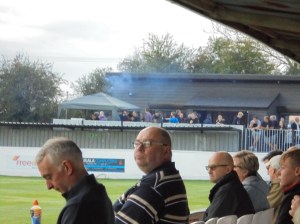
Drinks drunk we move to the low seated stand at the side of the pitch and pick a spot at the back, in the middle, saving a seat for Paul who normally videos the match but has given over his gantry to BT tonight.

The BT people said they will let him have a copy of their recording, which is nice of them and much better than the service you get as one of their paying subscribers. The ground is filling up; a large man in front of says to his wife “The barbecue is up and burning, do you want anyfink?” He leaves and returns with burgers and paper napkins; the burgers don’t look burnt despite what he said. The referee and his assistants warm up in front of us, the referee who has scrupulously short hair setting out a series of flattened cones to run between, although he begins by running with his chums to the goal line and back. I thought I saw one of his assistant smirk as the cones were laid out, but it might have been me. They don’t really need these flattened cone things, perhaps they were a Christmas present and he feels obliged to use them or may be just setting them all out and picking them up again is part of the warm up.


The light is fading as cloud builds and the floodlights come on before kick-off. Barbecuedsc00074_30406466408_o smoke drifts in to the air and teases our nostrils as Witham Town in yellow shirts and blue shorts have first kick at the ball playing towards the town, with its fabulous medieval tithe barn and Tudor, double jettied, Paycocke’s house. Coggeshall sport their usual black and red striped shirts with black shorts and socks.
An early free-kick to Coggeshall and their number six and captain Luke Wilson heads the ball over the goal. The game is fast and frantic. “Well in son” shouts a shiny headed man standing near to us and then “Well up son” to another player, showing a touching fatherliness towards the Coggeshall team. At the open end of the ground a lone voice bellows “You’re supposed to be at home” single-handedly trying to create the big match, local derby, cup-tie atmosphere that I hope for at every game.
After just six minutes the Coggeshall captain is substituted due to injury and then there is a flash. I thought the floodlights flickered, but the rumble of thunder that follows

confirms that it was lightning. If the crowd isn’t creating much of a ‘cup-tie’ atmosphere the weather seems to be making an effort and soon it begins to rain. Coggeshall win the first corner of the match as a swarm of raindrops swirl within the beam of the floodlights above. The referee speaks with Witham’s number eleven and two grumpy looking men in suits and ties enter the stand to shelter from the rain, they are wearing dsc00089_30406410328_ohuge black coats plastered with the logos of Mitre and Bostik, they must be League or FA officials. It’s another thing I love about non-league football; officials all dressed up and made to sit in a tin shack. Perhaps that’s why they look so grumpy, but at least they’ll get free sandwiches at half-time.
It’s not quite a quarter past eight and Witham’s number three claims the first booking of the evening for acting the playground bully as he unsubtly shoves a Coggeshall player in the back. I’d like to say that he stares wild-eyed up through the rain at the yellow card as it is illuminated by a flash of lightning, but it didn’t really happen like that. The rain gets harder and a dark bank of cloud forms the back drop to the floodlit pitch, which sparkles with rain drops. The thunder and lightning passes over, it’s nearly twenty past eight and Witham win their first corner with what could be their first attempt on goal. Coggeshall have been dominating this game but without troubling the Witham goalkeeper who has a stockade of four big blokes in front of him who block every way through to goal. Coggeshall are nimble and quick but small and Witham are big and solid. A hoofed clearance disappears above the roof line of the stand and I wait for it to fall like someone in 1944 who has just heard a doodlebug engine cut out. After a silent pause the ball noisily clatters the corrugated iron above us. There’s time for Coggeshall to win another corner, which is cleared and then it’s half time.
It’s still raining so we stay where we are, a cup of tea might be in order usually, but there are over 300 people here tonight (309 to be precise) and I don’t want to queue in the rain. I flick through the programme and Paul leaves and returns with a burger. The large man at the front of the stand goes to get a burger, but returns empty-handed, put off by the queue.
The second half brings the football back and Witham’s number ten is soon cautioned for a tackle which the shiny headed man says was two-footed. From the resultant free-kick, Coggeshall’s number ten Ross Wall (a moniker which I randomly notice combines the names of two frozen food manufacturers) sends a flying header goal-wards, but the Witham goalkeeper is equally air worthy and hurls himself to his right to push the ball onto the post and away, drawing excited but frustrated “Ooooohs” from the crowd, including me.
It’s still raining as Coggeshall’s number ten is booked, seemingly because several Witham players surrounded the referee appealing for his censure. But Coggeshall remain the better team, or at least the more attack-minded and entertaining team and soon a throw on the right reaches number seven who turns smartly to send in a rising shot, which the Witham ‘keeper again touches on to the cross bar in spectacular fashion. An hour of the game has passed and another Coggeshall player, number fourteen is booked for sliding into an opponent across the wet turf.
dsc00069_43555980904_oThe game remains physical and frantic and wet. A free-kick for Coggeshall almost sneaks under the cross bar and a corner is won after number eleven Nnamdi Nwachuk produces some nifty footwork and tries several times to tee up a shot on his right foot. Coggeshall’s number fifteen replaces number seven and Witham’s number four joins those already booked by the very neat Mr Michael Robertson – Tant the referee. It’s been a game of several free-kicks and much falling over and a special prize should go to Witham number nine, a huge man who several times falls to the ground heavily and lies perfectly still as if mortally wounded. He has clearly learned from watching the World Cup that rolling over and over and over is not convincing; he is the anti-Neymar and amusing with it.
Nnamdi Nwachuk stays down on the turf “Get up , we need you” bawls a team mate. A Witham player goes down and seeks attention “Come on ref, he’s a pansy” shouts the shiny headed man. Coggeshall win more corners, the ball is cleared, is headed over and Nwachuk’s shot is deflected away as everyone struggles to control it on the greasy, wet grass. Nwachuk cannot carry on and is replaced by number eighteen. Witham’s number four is replaced by number fourteen, a curly haired, bearded man who looks like a history teacher who taught me back in 1976. Frustration grows but the pattern of the game doesn’t , Coggeshall press and Witham hold out. The shiny headed man develops a rising, piercing falsetto voice as Witham’s nine fails to get booked “Why doesn’t he book him? He’s taking the piss. It’s ridiculous”. Moments later nine is booked for childishly withholding the ball before a Coggeshall free-kick. The shiny-headed man is apoplectic and with the game ebbing away he turns to religion. “Jesus Christ!” he spits as a searching through ball is played much too long and rolls harmlessly off the pitch. The good word spreads to the woman next to me who on being told there wouldn’t be extra-time if the game is drawn says “Thank God, I don’t think I could take it”.
Entering time added on, the Witham players have taken to complaining heavily when fouled; they earn a free kick which is cleared to the edge of the penalty area where the history teacher clubs it on the volley just past the Coggeshall ‘keeper’s right hand post. It’s the last notable action of the game. The rain has stopped and the smell of cooking meat returns as a pall of barbecue smoke hangs over the pitch. After four minutes of added time it’s all over and we emerge from our shelter into the damp night to say our goodbyes. It’s disappointing not to have seen any goals and ultimately effort and strength have beaten skill but the thunder, lightning and lashing rain beneath the floodlights have made it a memorable evening.

This slideshow requires JavaScript.