Halesworth Town 3 Haverhill Rovers 1

Between March 2017 and April 2019, I watched matches at each one of Suffolk’s then twenty-four senior football clubs and recounted my experiences in this here blog.  Since then, Debenham Leisure Centre and Whitton United have sadly dropped out of senior football but this season the Eastern Counties League First Division North has welcomed two more Suffolk clubs into the fold in the shape of Kings Park Rangers, who are from Great Cornard but seemingly too shy to admit it, and Halesworth Town, who are proudly, clearly from Halesworth. 

Today, with Ipswich Town playing far too far away in deepest Wales to trouble me to even think of getting a ticket, even if I had enough ‘points,’ I am travelling up to Halesworth in part one of my plan to restore my record of having seen all of Suffolk’s senior teams on their home turf.  Fortuitously, today’s fixture is also an all-Suffolk cup-tie against Haverhill Rovers of the Eastern Counties Premier League, and the first time Halesworth Town have ever reached the second round of the FA Vase.   To add to the adventure even more, despite the additional twenty minutes each way that it will take me, I am responsibly reducing congestion on the roads by eschewing making the 88-kilometre journey from my home by planet saving Citroen e-C4 in favour of taking the train (£18.10 return with senior railcard). It also means I can get plastered if I choose to.

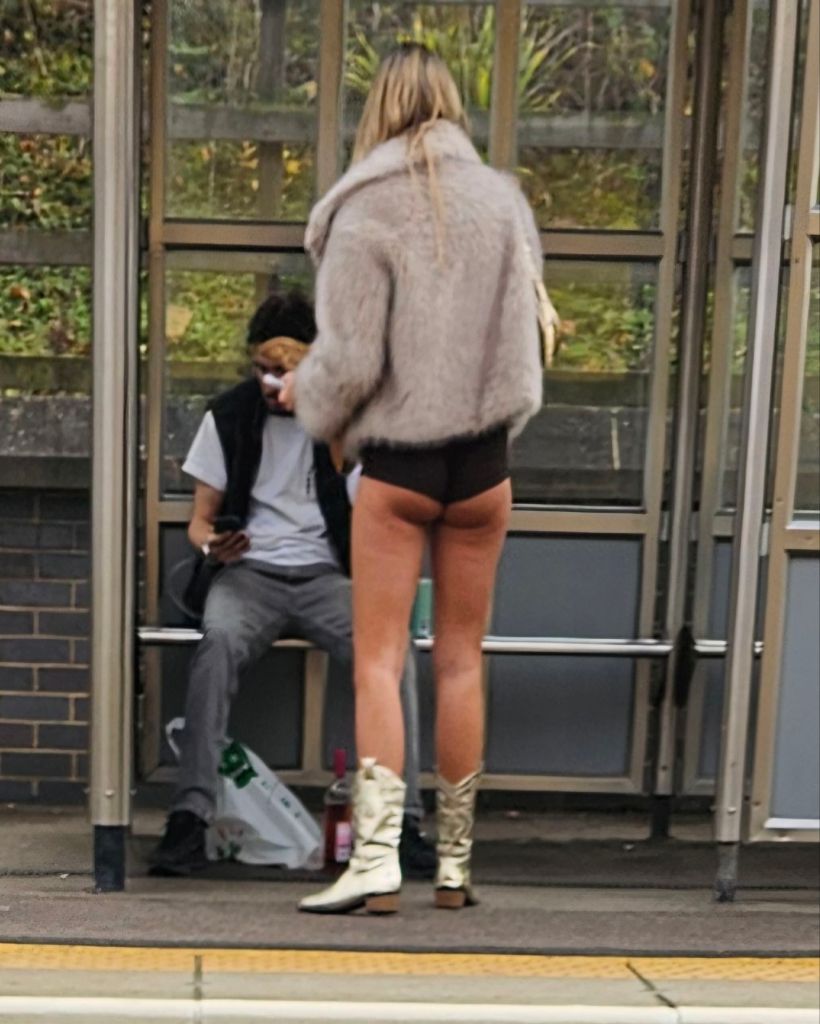
It’s an intermittently cloudy but mild November day as I set off for Halesworth, but I am nevertheless surprised as I wait for the train that one of my fellow travellers appears to have forgotten to put on any trousers or a skirt.  Once on the train, the infinite variety of human life continues to reveal itself as a small man of pensionable age repeats the names of the station stops as they are heard over the public address system; every now and then he delves headfirst into a large carrier bag as if checking on the wellbeing of a small animal or perhaps a baby.  When the woman sitting opposite me goes to the buffet car, she asks me to mind her belongings. I of course agree but tell her she needs to be back before we get to Ipswich.   When she returns, I tell her I had to fight off a couple of people who looked interested in her jacket but otherwise everything has been fine.  Fortunately, she laughs, but the man of east Asian origin next to me looks at me askance and when she begins to struggle to open a bottle of drink, he very quickly offers to help so that she doesn’t have to deal with the looney opposite her again.  The woman soon begins to chew on a large sandwich and a younger man on the other side of the aisle between the seats does the same thing, but takes much bigger bites, happily from a different sandwich, although with every bite he looks like he might lose a finger.

I change trains at Ipswich, boarding the 13:16 to Lowestoft, which departs a good twelve seconds early.  I like the East Suffolk line, to me it feels like a one-hundred- and seventy-year-old umbilical cord connecting the outside world to rural Suffolk with its rustic sounding stations such as Campsea Ashe and Darsham and their Victorian architecture.  Between the stations are Suffolk landscapes of river and marsh, Oak and Broom, sheep and pigs, outwash sands and boulder clay and gaunt, grey, flint church towers.  As the guard checks passengers’ tickets, he helpfully advises those alighting at Halesworth not to use the doors in the front carriage, because the Halesworth station platform is not that long.  There seem to be quite a few of us alighting at Halesworth.

The train arrives on time in Halesworth, where the sun shines from a pale blue autumn sky. A helpful sign points and tells pedestrians that it’s a seven-minute walk to the town centre and a minute’s walk to local bus stops on Norwich Road. Sadly however, no sign points helpfully towards Halesworth Town football ground, although having previously consulted the interweb I happen to know it is very close indeed, perhaps no more than a hefty goal-kick away.   I walk up an alley between the railway lines and Halesworth Police station, a huge four-storey block of a building, which although it probably dates from the1960’s makes me think of a Norman castle keep, built to keep the locals in check.  At the top of the alley, I turn right over a bridge above the railway and then right again down another alley the other side of the tracks, and down to the Ipswich bound railway platform. From here it is no more than 150 metres up Dairy Hill to the football ground, making it a toss-up between Halesworth and Newmarket as to which senior Suffolk football ground is most easily accessible by rail, my money’s on Halesworth.

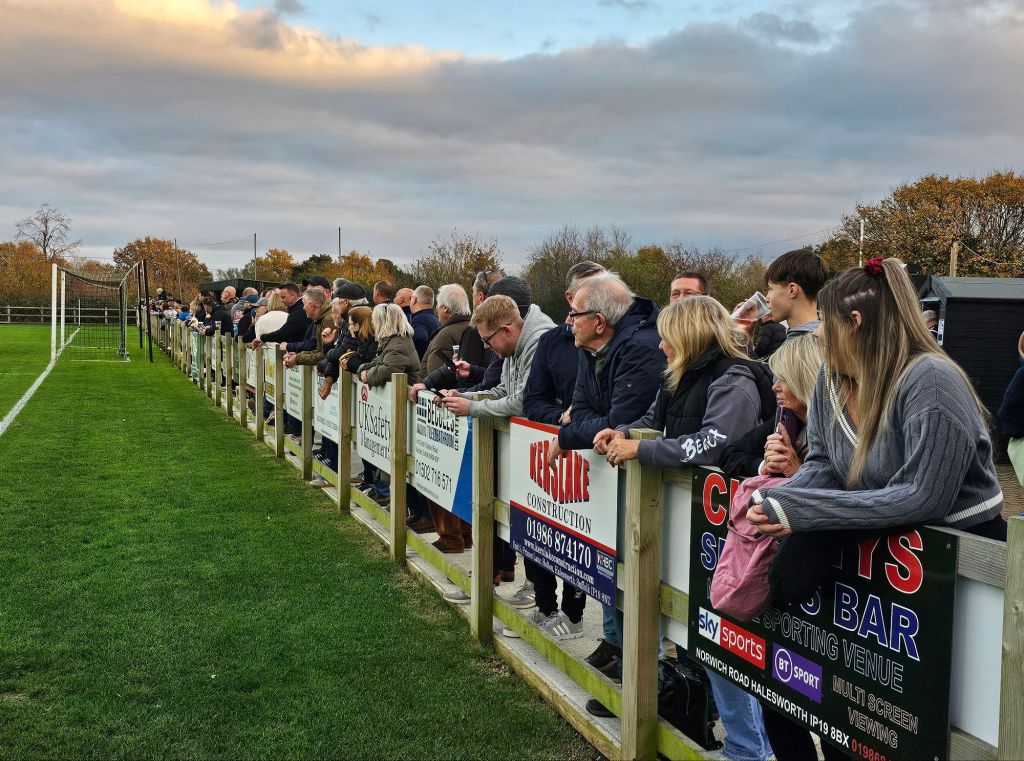
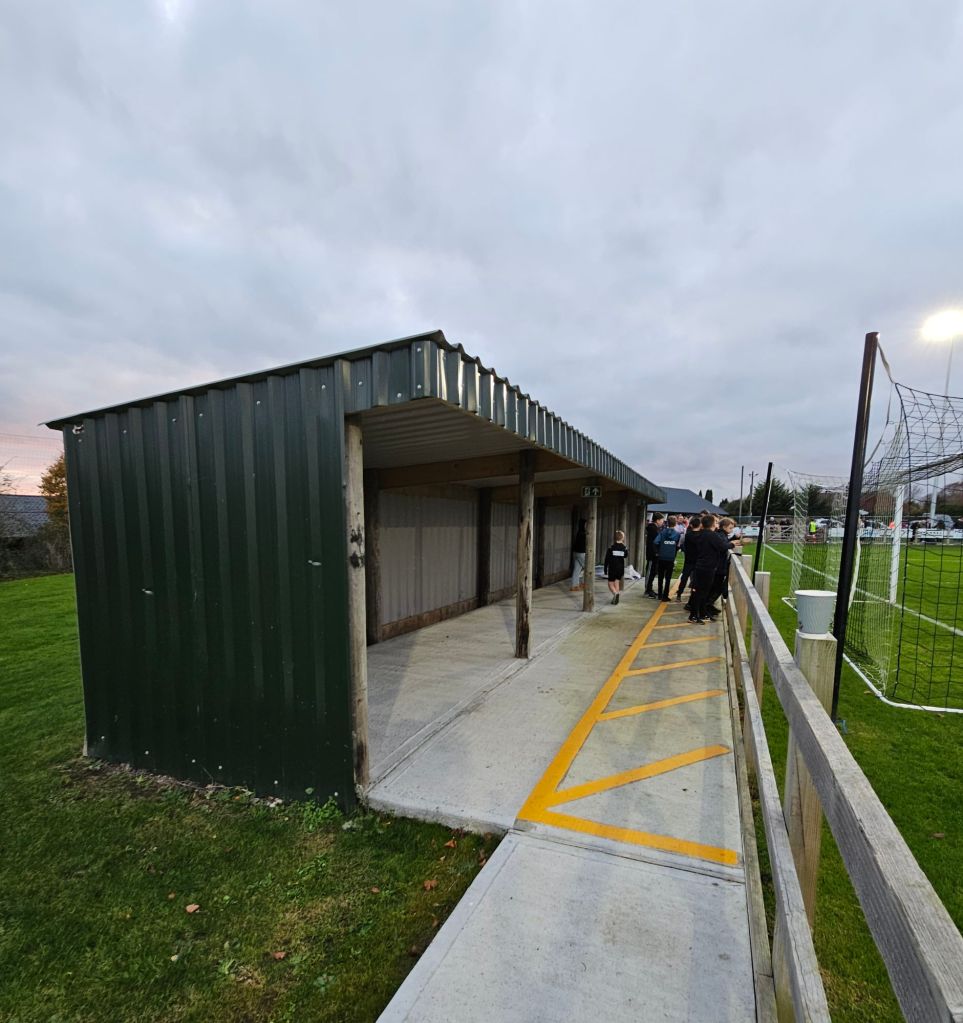
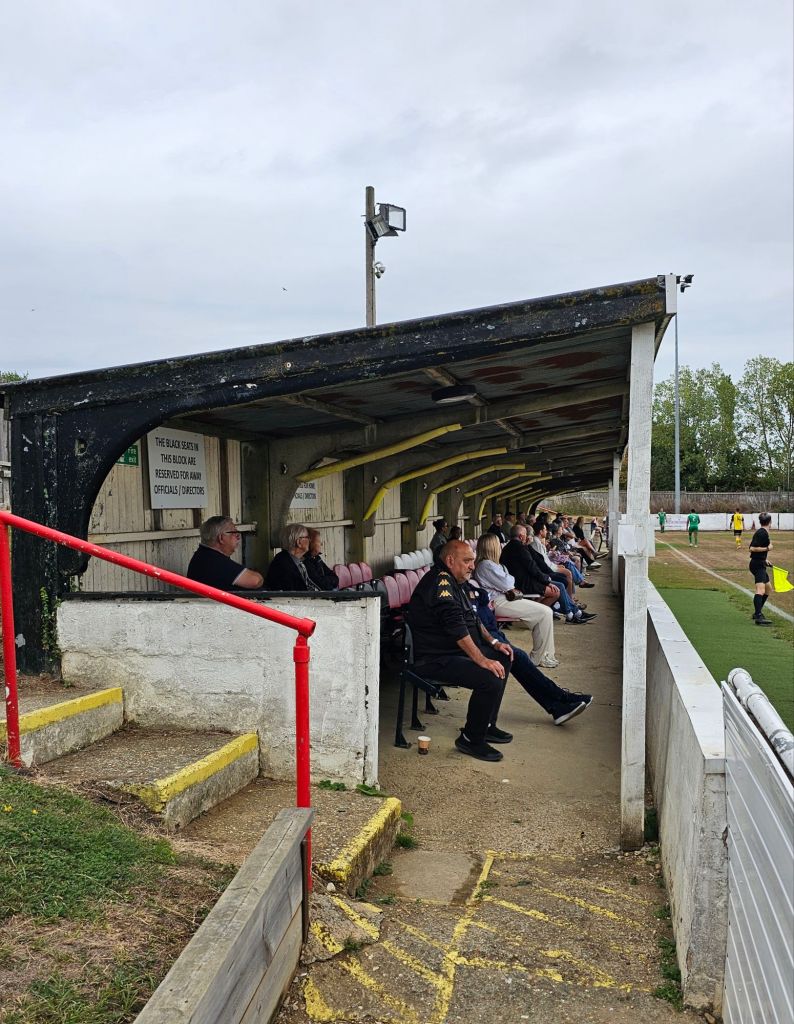
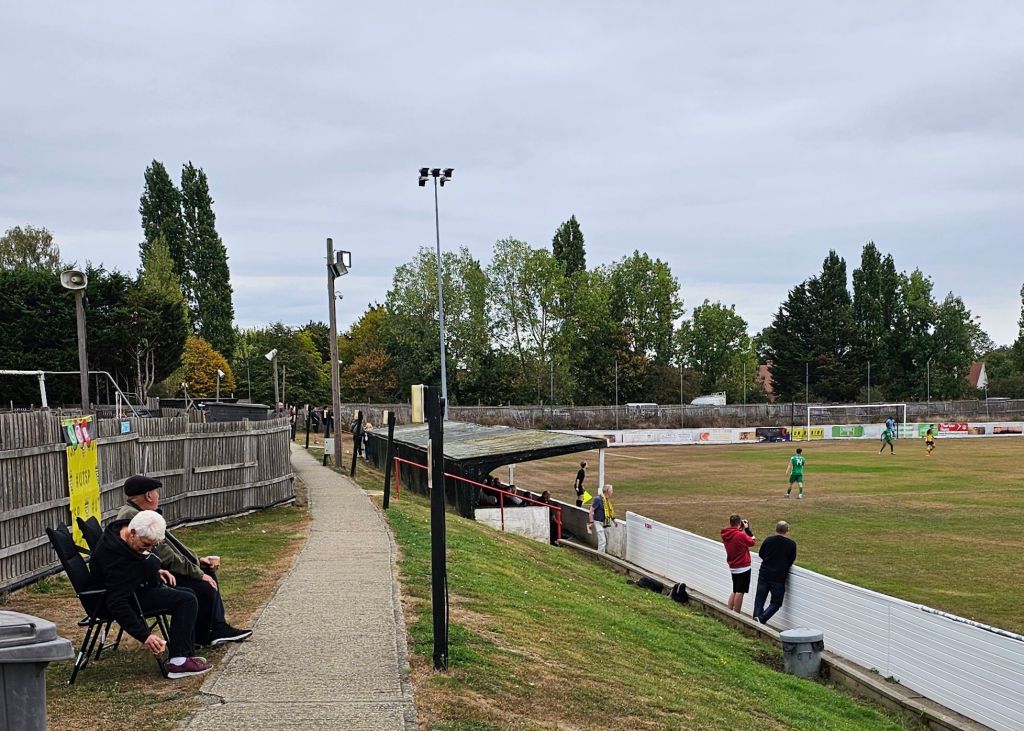
Despite its attractive name, Dairy Hill is just an uninspiring street of modest modern houses; from the top I make my way across the stony club car park and along the back of the club house to the ground entrance.  For a mere seven pounds I gain a programme (£1.00) and entry to the match as an over sixty-five, all that is missing is the click of a turnstile.  The ground itself is underwhelming, but it does boast a decent looking pitch with a smart timber fence all around and a small stand at the end nearest the clubhouse, which according to ground grading rules needs to be big enough to accommodate fifty spectators, although I’m not sure if FA rules say how large or small the spectators need to be.  The height of Halesworth’s stand suggests they should not be significantly taller than about 1.8 metres unless wearing crash helmets.
I head for the club house where the bar offers the usual array of fizzy lagers and cider and a pump which intriguingly bears the name ‘Wainwright’ written in biro on a plain white sticky label.  The barman generously allows me a sampler of the ‘Wainwright’ and seeing as there’s nothing-else I might like I order a pint (£4.60) before heading outside again to visit the food trailer, where a tall man with tattooed arms, who looks like men in food trailers often do serves me chilli, chips and cheese for a modest six pounds, less than half what I paid for much the same thing in an Ipswich pub earlier this week. 

I return to the club house to eat my chips and drink my beer, not being someone who likes to eat or drink standing up.  The club house looks like there might be an older timber building, which has had a new roof and supporting structure placed over the top of it, it smells a little like that too, having a faint musty odour which isn’t uncommon in old village halls and clubhouses.  The black and white interior décor and monochrome photos of old teams on the walls remind me a little of the Long Melford club house before it was re-built.

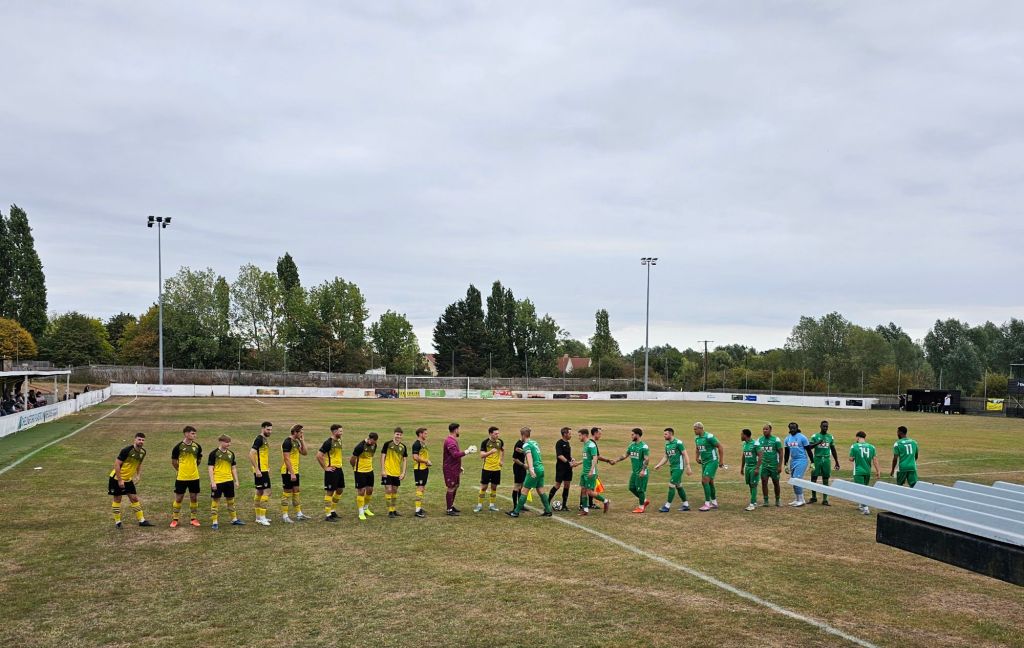
With chips eaten and beer drunk, I wait outside for kick-off, observing the growing crowd and the queue to get in at the gate, before standing closer to where the two teams will line up before the procession on to the pitch to shake hands and then observe the minute’s silence for remembrance day, a silence  which whilst well observed around the pitch plays out to a back ground of chatter from inside the bar and clubhouse, where life continues as usual, oblivious to the  silence outside.
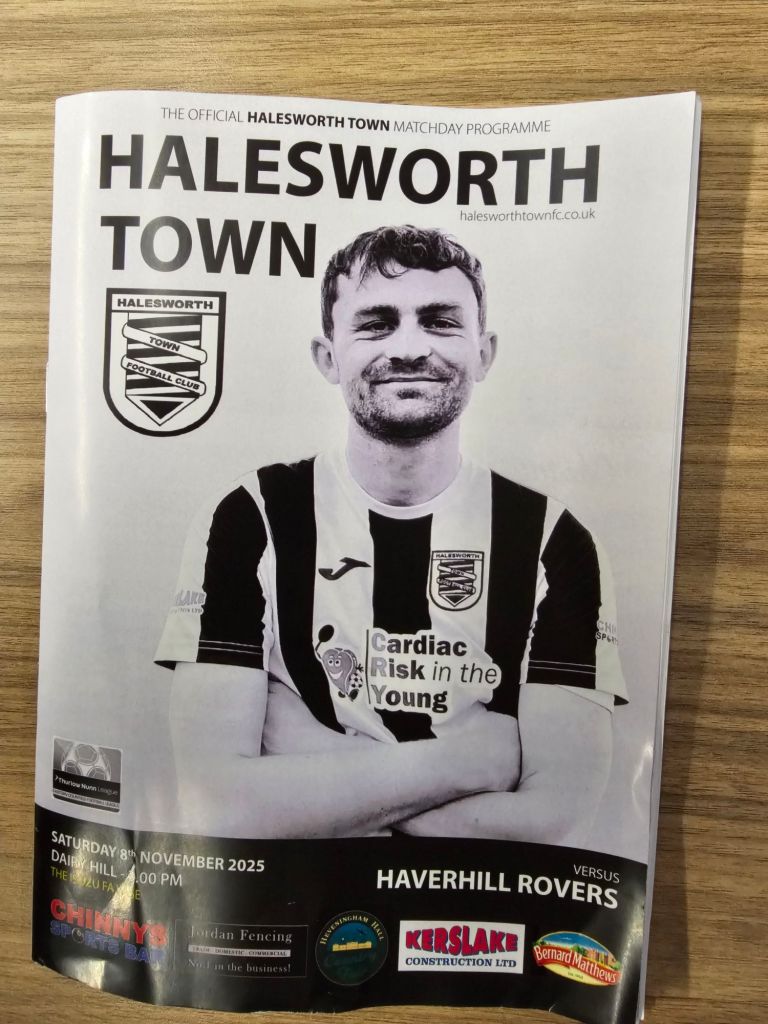
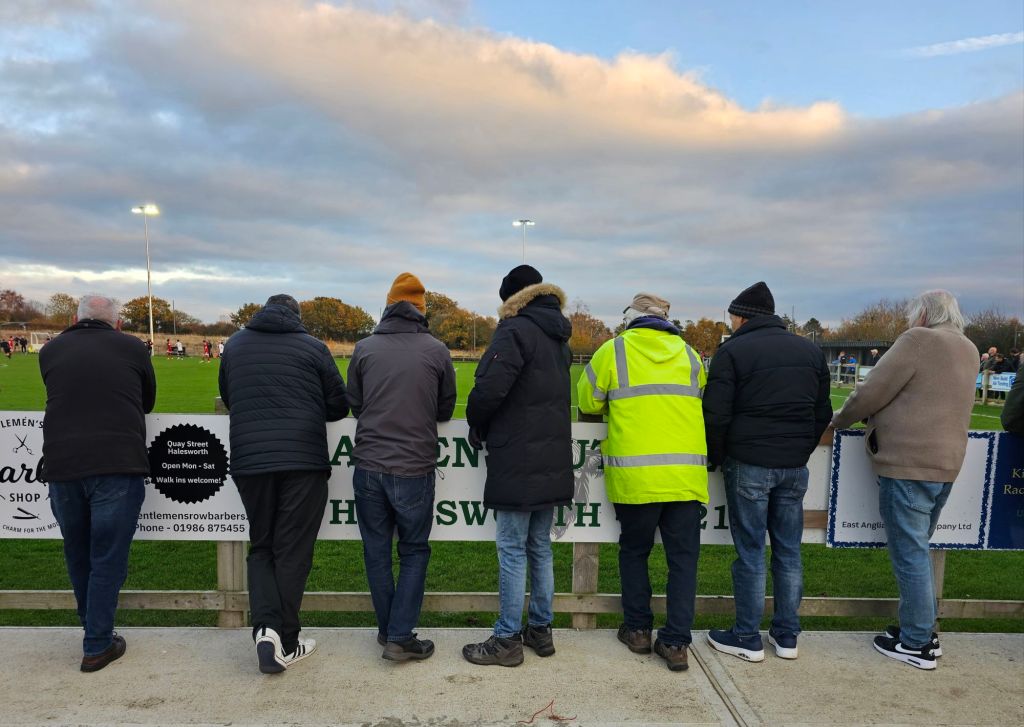
Eventually, it is Haverhill Rovers who begin the game, by getting first go with the ball, which they quickly hoof forward in the general direction of the stand, the railway station and town centre beyond, before it is booted into touch by a Halesworth defender, not unreasonably practicing safety first.  It’s good to see both teams wearing their signature kits, Rovers in a rich shade of all red, whilst Halesworth sport black and white stripes with black shorts. In front of the only stand, a youth bangs the sort of drum I wouldn’t bet against him having been given as a present for his sixth birthday, probably about six years ago.  The bulk of the crowd are lined up behind the post and rail fence along the touchline opposite the dug outs and when Halesworth win the ball they emit an encouraging rustic roar.

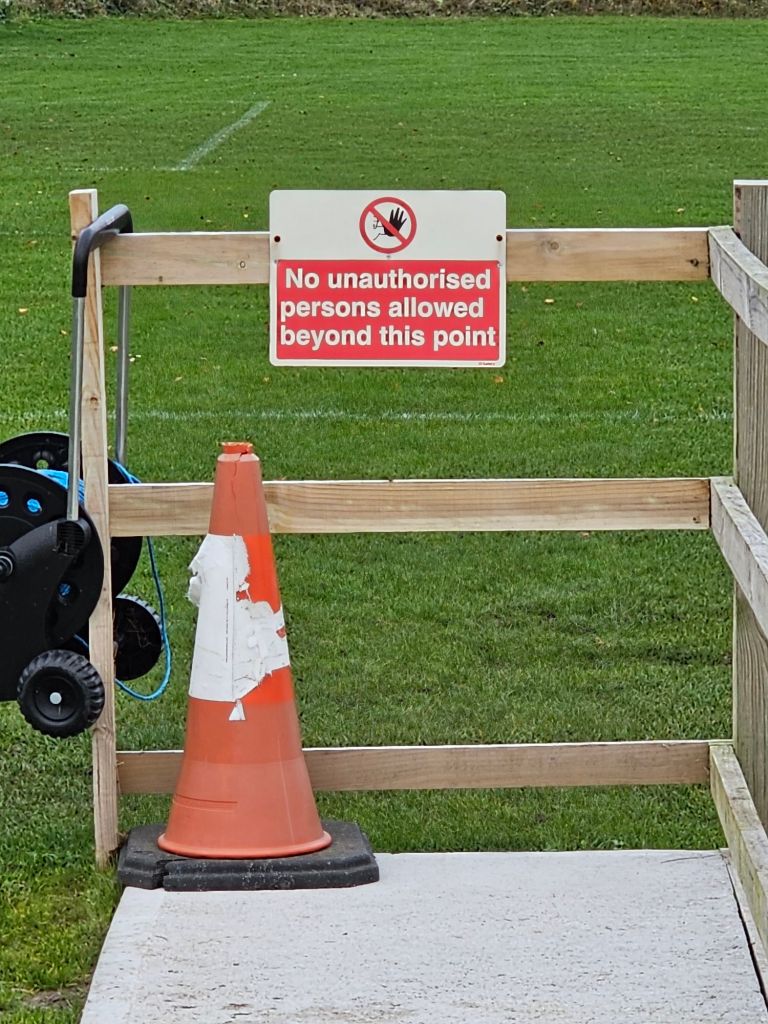
Seven minutes have passed and it’s Rovers who are the team kicking the ball most of the time; their number seven Prince Mutswunguma performs a neat turn and a decent cross which is headed over the Halesworth cross bar.  The pattern of the game is generally one where the long ball is favoured over short passes and two minutes later Mutswunguma blazes the ball high above the Halesworth cross bar.  I stroll along the front of the empty stand between it and the pre-pubescent ultras but remain nervous of hitting my head on the low roof.  I stop close to the corner flag, halted by a sign forbidding further progress and disappointingly preventing me from walking round to watch the game from behind or between the dugouts, where the angst and frequent bad language of the managers and coaches is often as entertaining as the match.   I am nevertheless now in a good position to see Rovers’ desperate claims for a penalty as Mutswunguma tumbles under a challenge from number 6, Ollie Allen and then two more players fall over. “Fucking disgraceful” opines a gruff voice from somewhere, either on the pitch or in the dugouts, but I’m not sure if he means not giving a penalty or having the temerity to appeal for one.

Keen to see the game from as many angles as possible I move again, this time to near the corner flag diagonally opposite the one I have been standing by.  I settle near a man in late middle age who sports a Stranglers t-shirt and beanie hat bearing the name of The Rezillos, the excellent late 1970’s Scottish ‘punk’ band fronted by Faye Fife and Eugene Reynolds.  He is on his mobile phone and seems to be arranging a claim on his motor insurance having hit something when parking his car in the club car park.  In my new position I also benefit from a good view of an increasing number of unsuccessful Halesworth breakaways as the home team gain in confidence from repelling all Rovers’ attempts to score.

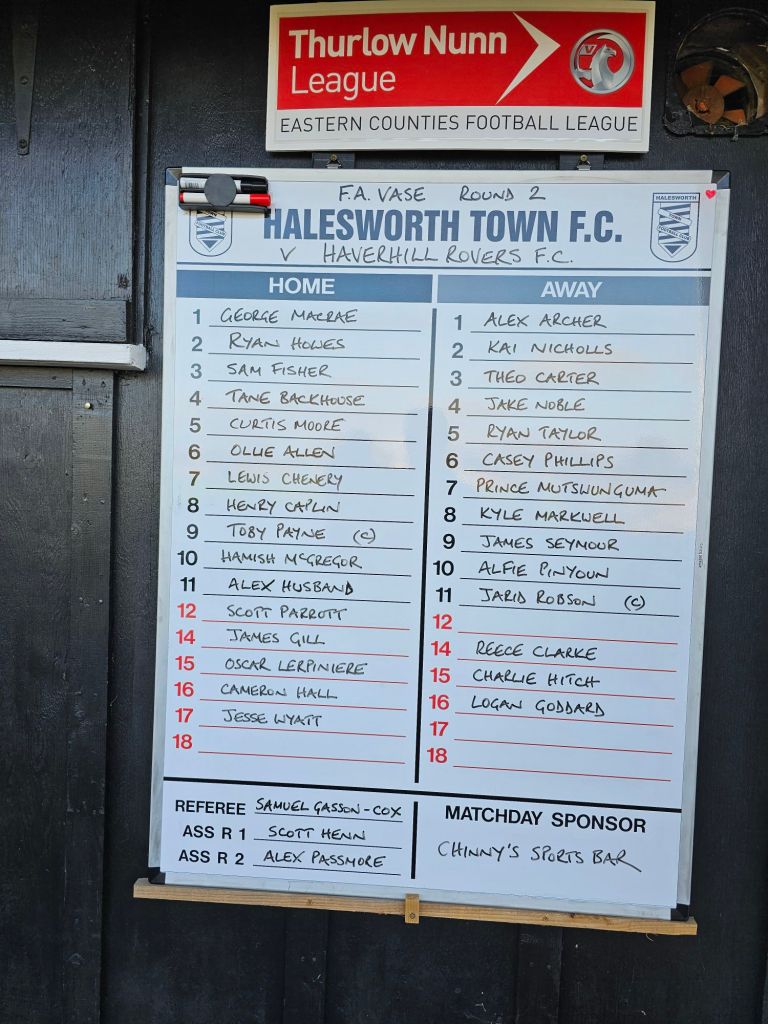
In goal for Halesworth, George Macrae has made a string of fine saves as Rovers win a succession of corners.  Rovers’ best effort is a shot from Kyle Markwell, whose surname gives a clue to the opposition as to how to treat him, that whistles past a post.  A half an hour is lost to history and Halesworth fashion another breakaway as captain Toby Payne receives a diagonal pass out on the left.  “He’s on!  He’s on! Well, he’s not off” shouts a young man to my left with rising excitement as Rovers’ offside trap is sprung. Payne advances into the penalty box, shapes up to shoot but then side foots weakly too close to the goalkeeper Alex Archer, who doesn’t have to stretch far to prevent a goal.  Two minutes later however Halesworth break again down the left and this time the ball is pulled back from the by-line for Lewis Chenery to score easily into the middle of the Rovers’ goal from no more than 8 metres out and it’s 1-0 to Halesworth Town.

The remaining dozen minutes of the half repeat the established pattern of the previous thirty-three, and another Rovers’ corner is headed wide, which I view from back near the clubhouse as I prepare to be ahead of the queues for the toilet and the tea bar when the referee, the extravagantly monikered Mr Gasson-Cox sounds the half-time whistle.  Having invested in a pound’s worth of tea I take-up a position for the second half just to the right of the stand, but not before I overhear a club official talking to the man on the gate and learn that the attendance today is a stonking two-hundred and fifty-eight.    As the new half begins and the light fades, the lovely smell of the turf rises up from the pitch. A woman standing next to me tells me we will see the goals at this end in the second half and I agree, telling her that with the goal being scored at the other end in the first half, it figures that this is the end where the goals will be scored this half.  We talk a little more and after I reveal I have an Ipswich Town season ticket, she admits to being a Norwich City supporter, but sympathetically I tell her someone has to be.
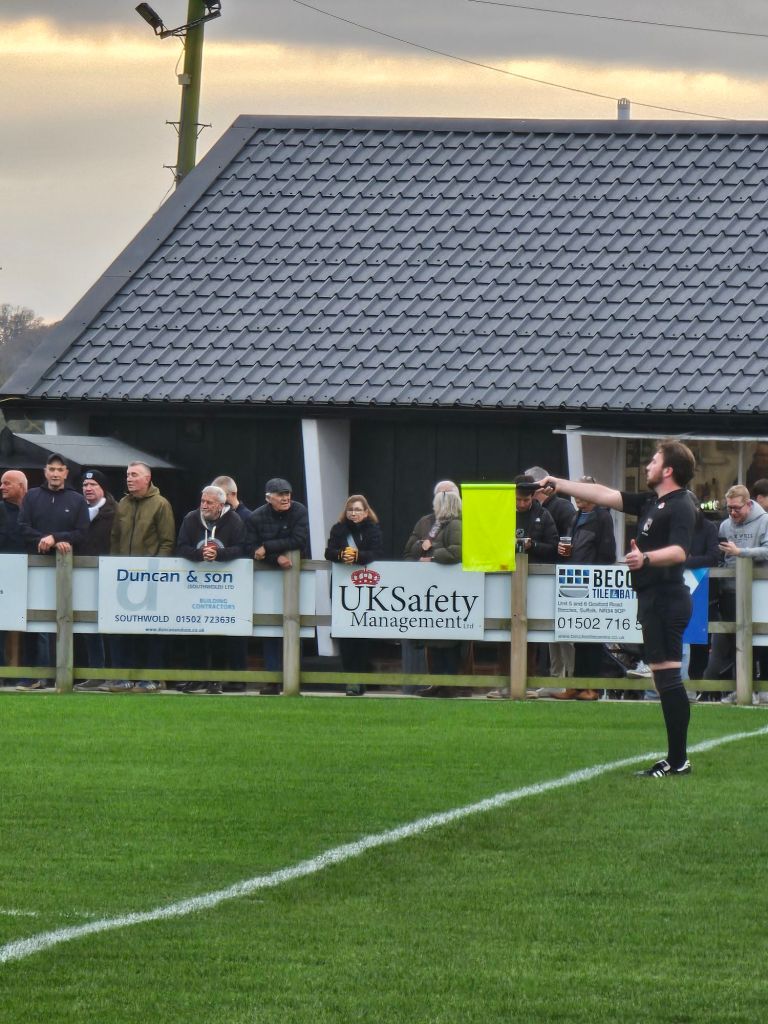
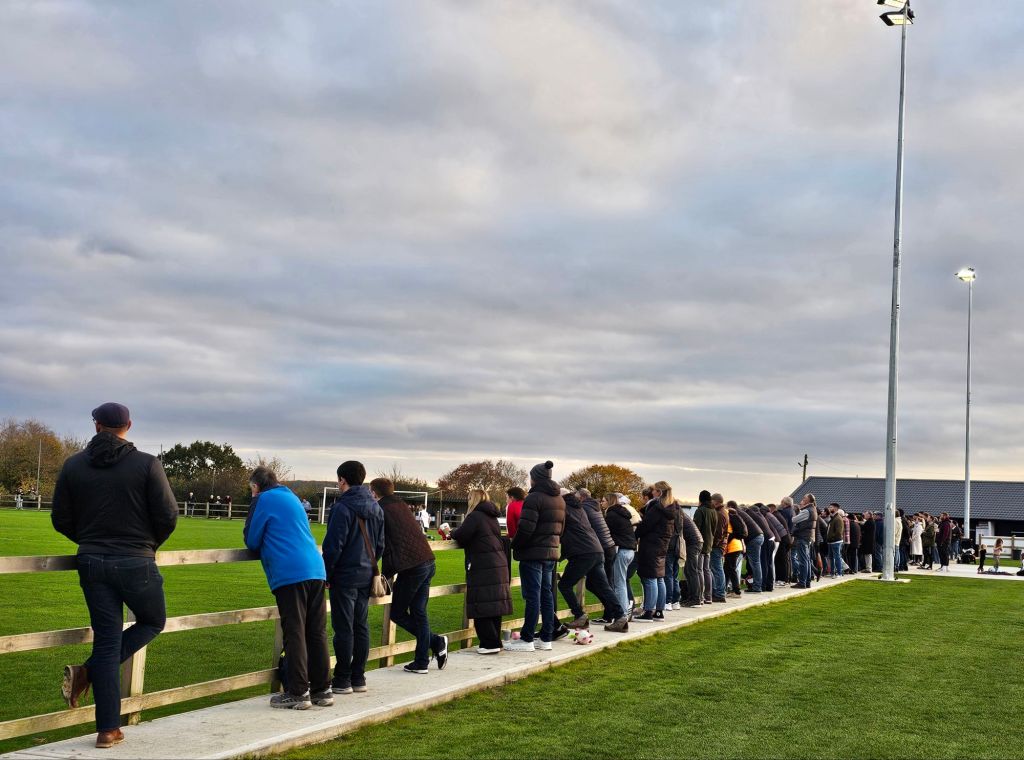
With the start of the second half at three minutes past four Halesworth seem to have lost a little of the confidence they showed by the end of the first half, perhaps because they realise they have to go through another forty-five minutes similar to the first, and indeed they do. But with twenty minutes gone and no further score it is Rovers who first feel the need to make substitutions.  “Who are ya?” chant the pre-pubescent ultras, as well they might as the new players emerge from the dugout.  Five minutes later and Halesworth’s Tane Backhouse is the first player to see the yellow one of Mr Gasson-Cox’s two cards, although as I become increasingly biased in favour of the home team and their superb goalkeeper, I can’t really figure out why.  Two minutes later and I’m cheering as another characteristic break down the right sees Toby Payne run to the edge of the Rovers penalty area, cut across a little towards the middle and then shoot unerringly inside the far post and Halesworth lead 2-0.  “Oh when the Town go marching in” sing the mini ultras, as do a number of people old enough to know better, but understandably carried away by the moment.

Things get no better for Rovers as after  an innocuous looking foul Mr Gasson-Cox nevertheless seems annoyed with Prince Mutswunguma and standing his ground, summons him over before showing him the yellow card.  “Wemberley, Wemberley” sing the Halesworth fans who should know better but are now too happy to care, but as they do so Rovers, perhaps realising their desperate position with only ten minutes left embark on a final push.   It’s twenty to five as George Macrae makes another fine save, this time diving low to his left. “Two-nil down on your big day out” sing the pre-pubescents, not helping the situation with their cruel taunts and Rovers win another corner.  The corner is cleared but moments later the ball is crossed low from the right and Rovers’ number eleven and captain Jarid Robson half volleys it high into the centre of the goal from a narrow angle and the score is a nerve-wracking 2-1.

It’s now eleven minutes to five, the match is a minute into added on time and Rovers are besieging the Halesworth goal like local Saxons or Danes outside the Norman police station.  A cross comes in from the left, and a Rovers head goes up diverting the ball goalwards but once again George Macrae appears, seemingly from nowhere to save the day again by cleanly catching the ball.  “Six more minutes Haverhill” I hear a voice call, perhaps from the Rovers’ dugout, or perhaps it was Mr Gasson-Cox or someone just mucking about. Six minutes seems an awfully long time given that neither I nor the lady next to me can recall anyone really being injured.  Another Rovers corner goes straight to the arms of Macrae but then Halesworth break away again, bearing down on goal on the right and then switching the ball across the edge of the penalty box before number eleven Alex Husband shoots from a narrow angle and the ball strikes a Rovers defender and arcs up over Archer the goalkeeper and into the goal off the far post.  It’s 3-1 to Halesworth! The game is surely won and the knot of Halesworth players hugging by the corner flag and the under12’s ultras who have run along behind us hoping to celebrate with them clearly think so.

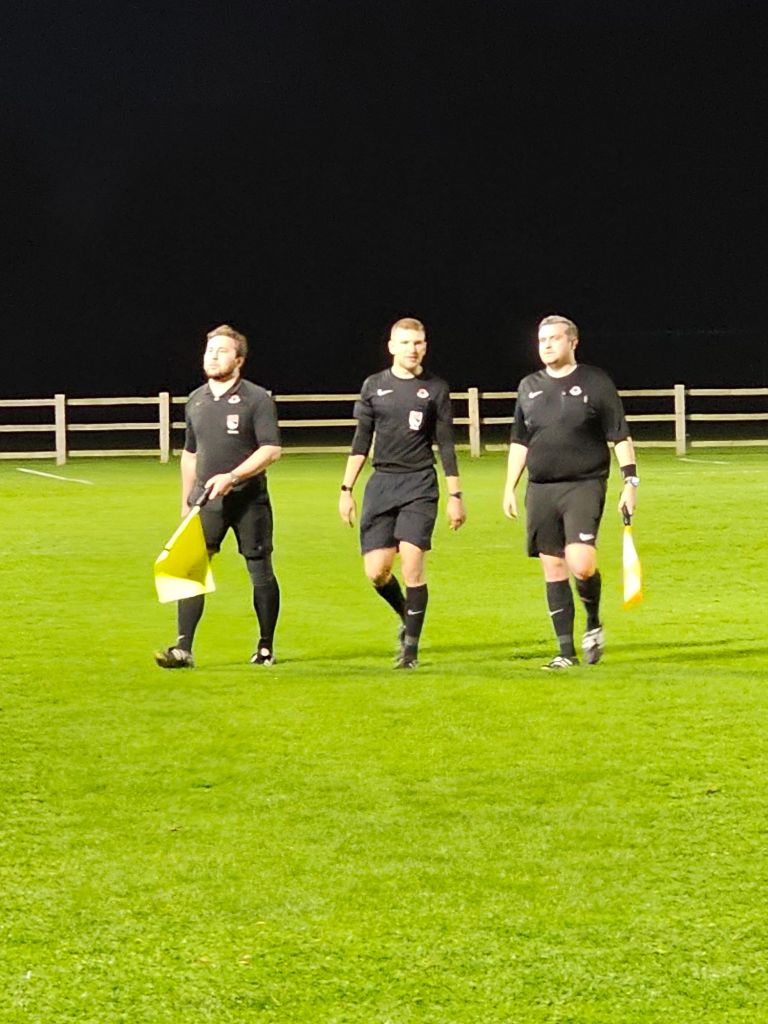
Very soon however, it’s three minutes to five and finally Mr Gasson-Cox parps his whistle for the last time today and Halesworth are into the third round of the FA Vase. Most people wait to cheer and applaud the team as they leave the pitch, but not before they applaud Mr Gasson-Cox the referee and his assistants, which is something you don’t see every day, and then the Haverhill players too.  It’s been a wonderful afternoon, an exciting cup-tie played in front of a large and appreciative crowd, and everyone’s had a lovely time.  As I leave the ground and make my way back across the stony car park and down Dairy Hill to the station I reflect on what a fine little town Halesworth is and how one day I really should return. All hail Halesworth!

Stanway Pegasus 0 Haringey Borough 2

Pegasus, Wikipedia tells us was a Greek mythological winged stallion, the offspring of Poseidon and Medusa who sprang from the Medusa’s blood when in an everyday incident for the characters of Greek mythology she had her head chopped off by Perseus.  After time spent carrying lightning bolts for Zeus, being ridden about by Bellophron and then as a constellation of stars, having been killed by Zeus who presumably then had to carry his own lightning bolts, between 1948 and 1963 Pegasus more prosaically became the name of an amateur football team made up of Oxford and Cambridge graduates obviously keen to mix football with their classical education.   Even more prosaically, the name of Pegasus then became that of a youth and then Sunday football team in Colchester and most recently that club has aspired to men’s senior football and for reasons unknown has attached the name Pegasus to Stanway, a suburb of Colchester that some of its residents still think is a village and which already had one senior football team in the shape of Stanway Rovers.

Today, Stanway Pegasus who are now in the snappily titled Thurlow Nunn Eastern Counties League South play Haringey Borough of the only slightly less snappily titled Spartan South Midlands Football League in the first qualifying round of the FA Vase, a competition which, to my shame, I have not witnessed a game in for over ten years.  It is for this reason, and it being the closest game to where I live, that today I choose to ignore the ’Town’ -centric draw of Braintree Town v Yeovil Town in the National League and the charming alliteration of Chelmsford v Chippenham in the National League South, and make my way to ‘The Crops’ in West Street Coggeshall home of Coggeshall Town but where Stanway Pegasus currently play their home games too.

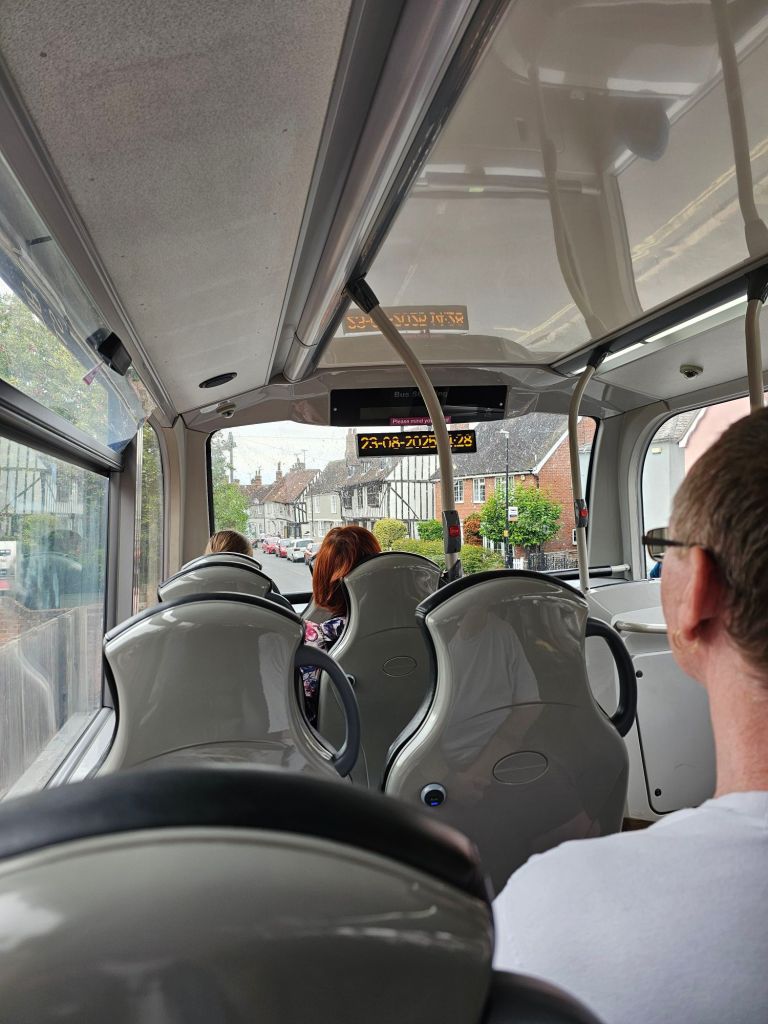
After a morning breathing in noxious fumes from the white gloss paint I am applying to the banisters, skirting boards and miscellaneous surrounding woodwork of a domestic staircase, standing at a bus stop on the A120 under a grey late August sky feels like suddenly being on holiday.  The X20 bus to Stansted Airport via Coggeshall, Braintree and Great Dunmow turns up more or less on time and I cheerily tender the correct fare (£3) in coins to the driver, who wears a peaked cap in the style of the late Sir Francis Chichester.  The driver, who does not speak looks at me inscrutably from beneath the peak of his hat as if weighing up this passenger’s likely back story.  I look back at him in the same way, imagining I too am wearing a hat, before climbing the stairs to the top deck where I sit behind a man sporting short hair and an earring.  Behind us, a girl evidently lacking all sense of self-awareness talks loudly on her mobile phone, broadcasting the other half of the conversation on speaker phone.   Leaving the A120, the bus (fleet number 34423) wends its way through Coggeshall’s narrow medieval streets before I alight at the stop called ‘Nursery’ just a couple of hundred yards away from ‘The Crops’.

Arriving at the turnstile I’m not surprised to find there is no queue but am delighted to see a small pile of glossy programmes, which I had not expected.   I ask if I should pay by cash or card. “Cash if you’ve got it, please” says the turnstile operator “I’ve started to run out”.  This is the first time I have paid on the turnstile at a match since I turned sixty-five, and paying in cash adds something to this auspicious occasion as I tender a five pound note for my concessionary entry fee and a two pound coin for the programme.

Once through the turnstile I head for the bar at the far end of the ground; it is virtually empty,  and not liking the look of the fizzy draught beer on offer I warily request a bottle of Adnams Southwold Bitter (£6) from the fridge. Much to my surprise the beer is merely cool not chilled and therefore very drinkable.  I step outside to await kick-off amongst a good following of Haringey supporters identifiable from their club colours but also as the only people obviously in the throes of enjoying a day out.  Two of them wear pork pie hats and I wonder if they play the saxophone.  Except for an old couple sat in foldable chairs the home supporters are rather anonymous.  In the corner of the pitch by what passes as the players’ tunnel but looks a bit like a stockade stands a plinth on top of which sits the match ball.  The Haringey fans eye the plinth both jealously and with a degree of amusement discussing what design of plinth they might have if they were to have one of their own, they seem keen on something more sculptural. 

“Sing if you’re Haringey, Sing if your happy that way” chant the Haringey fans imaginatively to the tune of the Tom Robinson Band’s 1978 hit “Glad to be gay” as the team emerge from the stockade and the plinth fulfils its job of relieving the referee of having to remember to bring the ball with him from the dressing room.   The match kicks off at five minutes to three with Stanway Pegasus getting first go with the ball and sending it in the direction of the bus stop from whence I arrived and Coggeshall beyond. “You on a promise Ref?” bawls a Haringey supporter “It’s only five to three”.  “That’s close to being abusive, that is” says another Haringeyite.  “No it’s not, it’s just a question” continues the first supporter.  “A very personal one” is the response. “Alright, do you have something nice waiting for you when you get home, Ref?” Comes the re-phrased enquiry.

Pegasus are wearing a kit of yellow shirts with black trim and black shorts, which weirdly are also the colours of Stanway Rovers.  Haringey meanwhile sport a change kit of all over green as their supporters expand on their theme of chants based on ‘new wave’ hits of the late 1970’s and sing the praises of their team’s Matty Young to the tune of “To much too young” by The Specials and then sample the  oeuvre of Sham69 with chants of “Come On, Come On, Come on Haringey Come On, We’re going down the pub”.

Back on the pitch, one of the linesmen is attracting a lot of attention to himself both with his offside decisions and his insistence on explaining them to the players.  As if that isn’t enough, he is very bouncy on his feet and, because he sports a poorly shaped goatee beard and has grey highlights in his swept back hair I am reminded of the match between Arsenal and Liverpool in September1972 when one of the linesmen was injured and Jimmy Hill emerged from the stands to run the line.

At three minutes past three Haringey Borough take the lead with a neat shot into the corner of the goal from somewhere near the edge of the penalty area.  The goal scorer, I think, is the aforementioned Matty Young  who evidently continues to strive to allow people to look back and say he did a lot in his youth.   “We’re the Borough, The Mighty Borough, We always sing away, We sing away, we sing away, we sing away, we sing away” chant the Haringey fans in response to the goal, channelling Tight Fit’s  cheesy cover version of “The Lion Sleeps Tonight” from 1982.

The Jimmy Hill lookalike linesman continues to grab attention as he rules a Haringey player onside and then proceeds to explain that the Pegasus number five had played him onside. “Don’t tell them lino, they can learn for themselves” shouts an exasperated Haringey fan. The Haringey support delve into their ‘new wave’ singles collection once more, impressively getting “We’re Haringey, We’re Haringey” into The Jam’s “Going Underground”.

Haringey are clearly the stronger team, as their higher league status implied before kick-off and the majority of play is at the club house end of the ground, although in a rare breakaway the Pegasus number four , Harry Morton is free in the centre of penalty area, has the ball pulled back to him perfectly, but then contrives to hit a truly, spectacularly terrible shot as high and as wide as anyone not under the influence of mind expanding drugs could imagine; in some circles it might be called ‘a worldy’.   Morton might be excused however for blaming the pitch, very little of which is any shade of green except in a few ‘fairy circles’, and when more than a handful of players are in the penalty area a cloud of dust is kicked up which lingers momentarily over the pitch like a swarm of tiny insects.

I am stood to one side of the suitably bucolic looking main stand and every now and then I receive a whiff of pungent and rather cloying body spray or scent.  At first, I think it must be from the occupants of the stand, but to be honest they don’t look the sort to be familiar with anything more than an occasional dab of Old Spice or bit of talc.  I eventually realise, when he bouncily stops near me to signal another offside, that the culprit is Jimmy Hill, the unique styling of whose hair is challenged, but not matched only by the Pegasus number sixteen, Tom Lewis who has a neat blond bob.

The game is being played in a good spirit with unusually little, if any audible swearing from the players, or the management on the benches.  Pegasus’s number nine Callum Griffith is booked however, just as the first third of the game rolls into the second third when twice in quick succession he fails to give space for a free-kick to be taken.  As thoughts of half-time refreshment begin to form Pegasus win a couple of corners and then almost unexpectedly there is a second goal as a poorly cleared low cross reaches Haringey’s number fourteen who firmly and concisely despatches it into the opposite bottom corner to the first goal, and Haringey lead 2-0.

Due to judicious manoeuvring in the approach to half-time, I am first in the queue at the refreshment hatch where I invest in £1.50’s worth of tea in large paper cup.  I read the half-time ‘results’ as I wait for my tea to cool and then for the teams to re-emerge.  My mood is barely affected by the news that Ipswich are losing at Preston; it’s not a place we often do well at; “a difficult place to go” is probably the accepted wisdom, despite the M6.   At four minutes to four the football resumes and I move to the other end of the main stand expecting most of the action to again take place in the half of the pitch that Haringey are attacking.

The first half was adequately entertaining if not exactly a pulsating cup-tie.  Sadly, the second half does not live up to what we didn’t know at the time was the comparatively high standard of its predecessor.  The Haringey supporters nevertheless continue to enjoy themselves as they repeatedly dip into the back catalogues of Sham69, The Jam and with somewhat less ‘street credibility’, but plenty of irony, Tight Fit.  My highlight of the half is when I realise that Derek Asamoah is playing as number forty-four for Haringey.  He is a player who I probably last saw playing on the telly for Ghana in the African Cup of Nations. I should have really worked out he was playing when the Haringey fans chanted his name in the first half, but I was probably too busy wondering which Buzzcocks, The Clash or The Damned single it was they were singing to.

With the final whistle there is justified applause for everyone’s efforts and I leave The Crops to the sound of the Haringey fans singing “Bus stop in Tottenham, we’re just a bus stop in Tottenham” because wonderfully, as anyone who has travelled the W3 through north London will know, they really are and as far as I’m concerned that’s just as interesting as Greek mythology.

Plymouth Argyle 1 Ipswich Town 2

I am a little ashamed to admit it, but I have only ever been to Home Park, the sensibly named home of Plymouth Argyle, twice.  The first occasion was in August 1987 for an evening fixture, when after a seemingly interminable coach journey from Portman Road I witnessed a goalless draw.   Then, at the start of 2005 I returned, this time by car, to enjoy a 2-1 victory courtesy of Darren Currie as Town went top of the league but, as ever, ultimately failed to achieve promotion.  My memories of Plymouth therefore are on the whole not disagreeable, although if the city has memories of me they might not all be as positive. My very first visit to the city of Plymouth was in the summer of 1966 when on a family holiday. My father was in the Royal Navy and serving on HMS Tiger at the time and the ship happened to be in Plymouth dockyard; he took us aboard and I vomited on the wardroom carpet.  Given that the eleven thousand ton cruiser was in harbour I can’t blame sea sickness, it was more a surfeit of free peanuts from what I remember.

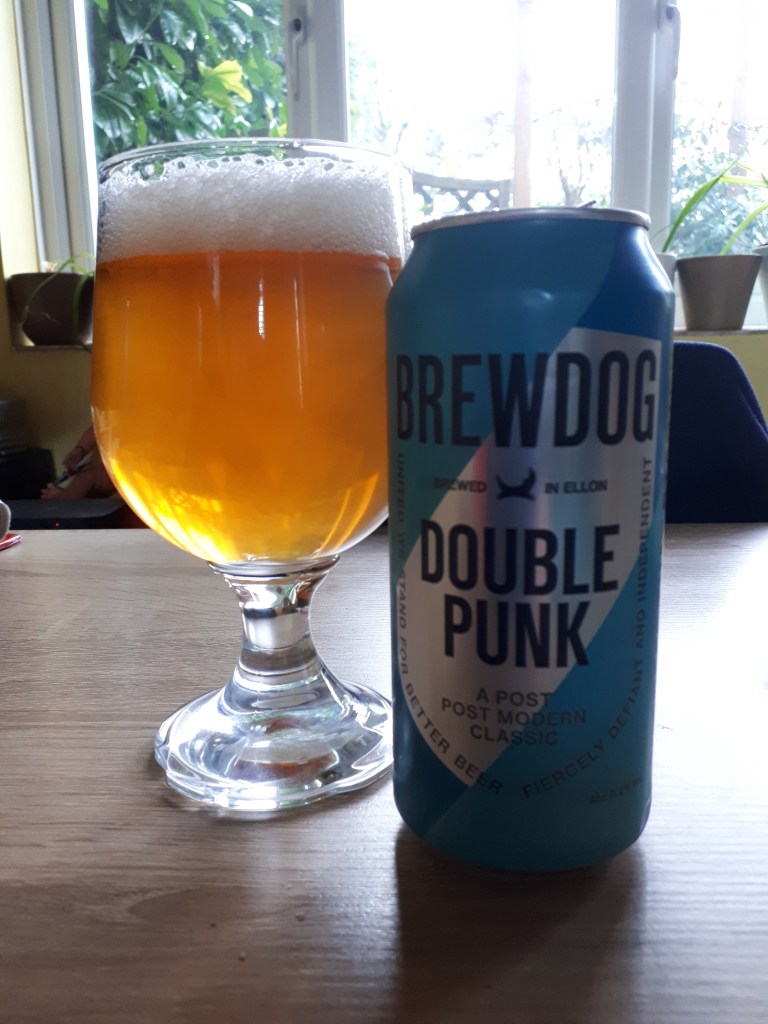
Today, I have not eaten any peanuts but for a pre-match snack enjoy a handful of Nairn’s ‘naturally nutritious’ rough oatcakes with some Cheddar and Port Salut cheese. My pre-match ‘pint’ is a 440 ml can of Brewdog Double Punk, today’s offering from my beer advent calendar; a different beer every day until Christmas.  Feeling sociable, perhaps because the beer has alcohol by volume of 8.2%, and having half an eye on Troyes v Paris FC in French Ligue 2, which my wife Paulene is watching on tv using an Amazon Firestick, I settle down on the two-seater blue leather sofa in the living room.  With a plastic earpiece in place I tune into Radio Suffolk on my Sony 310 transistor radio in time to hear the tail end of a pre-match summary of this afternoon’s encounter between Stowmarket Town and Eynesbury in the FA Vase.  My attention is grabbed by the fact that former Ipswich Town starlet and Bermudan international Reggie Lambe is appearing for Stowmarket.  Reggie Lambe has always retained a high profile in my football memory, possibly not because of his on-field exploits so much as the fact that he sounds like he could also be a cuddly character from an undiscovered episode of Watch with Mother.

The reportage from Home Park begins with a replay of commentary from 2008 in which commentator Brenner Woolley became very excited about two goals from Owen Garvan and one from Kevin Lisbie; as well he might.  After reference to the 976 kilometre round trip from Ipswich, although Brenner archaically quotes the distance in miles, we are introduced to the glorious West Country burr of this afternoon’s co-commentator Marcus Stewart; in the week that David Prowse died it seems a fitting tribute.  Brenner sarcastically speaks of the receding sound of the ‘loudest PA system in the country’ as Town’s goalkeeper, who he refers to as “Dai” Cornell, leads the Town team on to the pitch.  Marcus Stewart meanwhile says that it is time for everyone to “get onside and support the club and get behind the club”.  I will admit that I did not know that as well as being closer to the opponent’s goal line than both the ball and the second-last opponent, it is also possible to be offside by not being behind the club.

Very quickly Marcus tells us that he is going to put his “head on the block” as he predicts that there will be goals in this game.  I can’t help feeling that he is sounding hopeful when he suggests that if he is wrong it might be the last time he is asked to ‘appear’ on Radio Suffolk.  The opening minutes of the game sound entertaining as Brenner relays to us that there is “Good play from Town”, that Home Park is “sunny but blowy” and that “Woolfenden seems to have had a haircut”.   “Wrong decision” says Marcus in the assertive style of tv’s Kirtan Mucklowe as an Argyle player picks the wrong pass.  The commentary briefly takes the form of a conversation “Very open, Marcus” says Brenner. “End to end” replies Marcus, who a short while later provides some interesting tactical analysis about full-backs having more time on the ball when playing against a 4-3-3 formation, and being able to push forward.    Brenner meanwhile talks up the promise of goals for Town against Plymouth. “Only Swindon and Burton have conceded more goals” he says.  It’s a fact that shows Brenner has been assiduous in his research again, but personally I just love to hear the names of un-related English provincial towns in the same sentence; it makes me think of railway lines and town halls, local papers and building societies.

The thirteenth minute passes and seemingly out of not very much Plymouth score through Luke Jephcott.  “Good finish in terms of build-up play” says Marcus a little confusingly “ Plymouth again pinging the ball around” he adds.  Disappointed that what had sounded like a reasonable start to the game has taken the familiar wrong turn I take a mouthful of my beer, which because of its alcoholic strength has lived beyond it’s original ‘pre-match pint’ billing.  “Mmmm” I say to Paulene “This is a very fruity beer”.  What sort of fruit?” she asks.  Caught off guard by this question I make up something   “Oh, just a generic sort of fruit” I say, but she demands more detail. “Pineapple, banana?” She asks. “Yes” I reply “and apple, pear, mango, raspberry, kiwi fruit, lychee”.  “What about grapes, cherries and star fruit?” asks Paulene. “Yes”, I say “and strawberry, tomato, orange”.  “Melon, plum, papaya?” asks Paulene, “Yeah, and cranberry, blackberry, damson, even a hint of brazil nut.” 

Our listing of the world’s fruits is interrupted as I hear Brenner say “any fixture at the moment seems to be tricky for Ipswich” before mentioning “mitigating factors”.   Then all of a sudden Kayden Jackson is through on goal. “No excuses, should be 1-1” says Brenner as Kayden is tackled “We’ll be looking back on that through very painful eyes” continues Brenner, all too easily imagining the scenario in which Town fail to score and adding un-diagnosed medical problems to the mix for good measure.  “Just as he cocked his leg to take the shot – good defending” adds Marcus trying to describe what happened, but making Jackson sound a bit like a dog beneath a lamp post.

Despite the current score line I remain optimistic.  “Ward invited to come forward” says Brenner of Town’s left-back , creating an image in my head of Plymouth players ushering Ward along or handing him little cards with RSVP on the bottom.   Brenner soon engages Marcus in conversation again, “Jephcott’s a strong boy isn’t he Marcus?”  “Like a little bulldog” replies Marcus clearly still trying to develop his canine analogies.  Despite a lull in play around half past three which forces Brenner into telling us that there is very little happening, the consensus between the two commentators seems to be that it’s an entertaining game.  “ Town don’t look like a team short on confidence” says Brenner before unleashing a combination of stats upon the listeners about how many wins Town have had in the past five games (one) and how many points they’ve taken from the past ten games (nine).   The criticism remains implied, but Brenner is careful to explain that this is a “…very young Ipswich Town side” and “needs must at the moment”.

Half-time arrives at fourteen minutes to four and Marcus repeats that “There is goals in this game” which he has found “thoroughly entertaining”.  It’s left to Brenner to encourage me to return for the second half, “This game could be anything.  There could be a comeback for Ipswich Town, or it could be 3-0 to Plymouth”.  As insightful summaries go it fits well into either of the “Hedging one’s bets” or the “Why the hell are you asking me?” categories.

I enjoy a half-time of putting the kettle on, shutting and locking the garage door, drawing the blinds and closing the curtains.  Troyes have beaten Paris FC 2-1 with Paris having a spectacular volleyed ‘goal’ in the seventh minute of time added-on disallowed for dangerous play (jeu dangereux).  Troyes replace Paris FC at the top of Ligue 2 on goal difference and Paulene re-tunes the Amazon Firestick for the Ligue 1 game at Parc Roazhon between Stade Rennais and Racing Club de Lens.  I reflect that Home Park is only 402 kilometres from Rennes by sea and road, which is almost 90 kilometres closer than it is to Portman Road. 

Carelessly, I miss the re-start at Home Park and re-join the game just as little Alan Judge makes a “suicidal pass”, which almost gives Luke Jephcott a second goal.  Brenner moves on to speak of Newport County, Cheltenham Town and Exeter City all doing well in the fourth division this season and the prospect of further trips west next season,  clearly suggesting he has already given up on hopes of Town being promoted. “Cambridge would be a nice short trip” he adds, adopting the outlook of the Radio Suffolk accountant.

It doesn’t sound like Town are having many shots on goal ,but the game remains open and Brenner is moved to tell us that “ There is still no way of knowing what the full-time score will be”, which is frankly somewhat obvious unless he has access to some sort of Old Mother Woolley figure who has a crystal ball.  “Strong young lads” says Brenner of Jephcott and McGuinness, introducing an unexpected frisson of homo-eroticism as the game enters its final 25 minutes.  Jack Lankester and Brett McGavin are replaced by the weirdly named Keanan Bennetts,  and Oliver Hawkins.

It’s the seventieth minute and I am told that Plymouth’s Danny Mayor has “kicked the feet away” from Town’s Armando Dobra, a player who is Albanian and whose name incidentally rhymes with Enver Hoxha the former Communist leader of Albania.  Mayor is booked for a second time in the match and is therefore sent off.  Quickly following on, former Town player Frank Nouble is booked also, but only for the first time; “Getting a yellow card for verbals” says Brenner , incorrectly using the word ‘verbals’, which actually refers to different forms of verbs rather than bad language; we should expect the BBC’s broadcasters to know this sort of thing.  Marcus or Brenner, I’m not sure which, now tells us that against ten men we are going to have a lot of the ball, we just have to do something with it.   Seconds later, Paulene cheers as over in France Lens take the lead through eighteen year old Arnaud Kalimuendo Muinga and then in what is turning out to be a very busy three minutes Town take those words about doing something with the ball to heart and equalise. “Nolan shoots, he scores says Brenner succinctly.  “A great volley” confirms Marcus.  Within a minute I am hearing Brenner say “Hawkins chests it down and Jackson scores” and Town lead 2-1.  “Yay” I shout from my reclining position on the blue leather sofa.  This is the most fun I’ve had since last February.

To add to my enjoyment Brenner tells me that the 1800 Plymouth fans who have been allowed into the ground are “really aggravated” and in the background I hear them bawling and moaning in a real life version of people in supporters groups on the interweb.  The final fifteen minutes and injury time pass in a parade of observations from Brenner and Marcus.  “ … keep playing forward like they ‘ave been doing” is Marcus’s recipe for success as he turns up his West Countryness a notch . “ Ill-discipline from Watts” says Brenner revelling in another booking for a Plymouth player. “Fans getting disgruntled” adds Marcus picking up Brenner’s theme before sounding a note of caution with “Dangerous times now”.   Marcus’s voice is becoming increasingly gravelly, as if he’s been chain smoking Woodbines and slugging whisky all afternoon; he sounds like a Somerset Jimmy Durante.

It is evident that Plymouth are succeeding in getting back into the game. “Decent effort on goal from Hardy” says Brenner before ramping up the tension and pessimism with “This‘ll be a massive disappointment if Town draw this one”.   He carries on in similar vein by validating those listeners surprised that Town aren’t losing with “Town ahead; if you lost faith earlier in the game and thought here we go again”.   It doesn’t get any better; “Plymouth close – over the bar” and “Not pleasant viewing at the moment” before Brenner perhaps tries to lighten the mood with “Two players with similar pinkie-orange footwear on the far side” as full-time approaches.  The pretty-much statutory four minutes of additional time will be added.  The four minutes pass and Town win.

I am elated. After foolishly depressing myself by reading the ‘opinions’ of people on social media in the wake of two recent defeats and a draw, I am now ecstatic that Town have won and this afternoon I feel like I have travelled to Plymouth and back, played the match and wilfully thrown up on the wardroom carpet of every warship in Plymouth harbour.

Perhaps Town will lose again next Saturday, perhaps they won’t, but that’s what football teams do, they win, they lose and they draw and the margins between those three outcomes are small.  This season Ipswich Town have won more than we have lost, today we won, life is sweet.

Bristol Rovers 0 Ipswich Town 2

The infection rate for Covid-19 is on the rise again and I am staying home, even though it’s Saturday and the prospect of either AFC Sudbury v Coggeshall Town in the Isthmian League or Ipswich Wanderers v Brantham Athletic in the qualifying round of the FA Vase is deeply enticing.  But my wife Paulene is in the extremely vulnerable category due to chronic asthma and given many people’s apparent inability to comprehend social distancing or the wearing of a mask I’m not taking any chances.  

After six months I have got used to this and my reality now is that football is a game witnessed on the television or followed on the radio, which sadly means non-league games are just results and all the footballers I get to watch are overpaid professionals.  But I can still follow the mighty Ipswich Town home and away, and because I would resent being charged ten quid for watching an hour and a half’s telly, I shall be listening to today’s match on the wireless, as I like to call it.

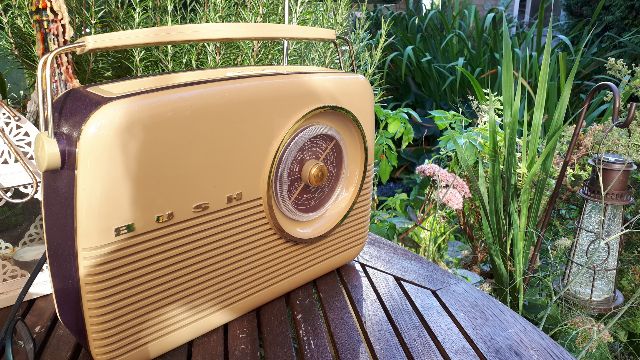
Today, the ritual of the pre-match pint is partly a reward for a morning of productive pottering in the garden, although it’s actually a pre-match 440 millilitres in the form of a can of Adnams Ghostship (four for £5.25 from Waitrose). It’s such a beautiful afternoon that I decide to take advantage of the weather and listen to the game outside whilst bathed in soft September sunlight. Tuning into Radio Suffolk doesn’t prove as easy as I had expected and by the time I have made fine adjustments to the dial and the physical position of the radio itself in order to shut out brash, ill-mannered Radio Essex and its impending commentary on Colchester United v Bolton Wanderers, the game is about to begin.  I feel like I am twelve years old again, trying to find Radio Caroline and Radio North Sea International on my tiny Vesta V70 transistor radio (about £2 from Woolworth’s) in the early 1970’s.

As ever, Radio Suffolk’s Brenner Woolley is the man (it’s never been a woman) to relay his commentary to an eager county of football fans.  But by way of a change Brenner is assisted today, not by the regular, dependable, steady Mick Mills, but by one of Town’s few 21st century heroes, Marcus Stewart, a man almost as famous for his goals as his gloves, a replica pair of which I am proud to still own, despite their being pretty much unwearable.  I first take notice of the commentary as an early Gwion Edwards header is easily saved by Bristol Rovers’ Finnish ‘keeper Anssi Jaakola. “What about that chance Marcus?” asks Brenner; he receives no response, it’s as if Marcus just isn’t listening or has drifted off into a world of his own; perhaps he’s bored already.  “He should have done better shouldn’t he, Marcus?” adds Brenner sounding a tiny bit anxious.  Fortunately for Brenner, Marcus returns from wherever he’s been and gives some answer or other; I have drifted off a bit myself now and am listening to the chimes of a passing ice cream van, “Boys and girls come out to play” is the jangly, distorted tune that the loudspeakers are blaring out.  I love ice cream van chimes, they make me think of Ray Bradbury’s novel “Something wicked this way comes”.

In the absence of any decent football to commentate on, Brenner tells us that the Town have had to change for the match today in the supporters’ club bar, which is something that would have been far too risky to have allowed back in the seventies or eighties if the reputations of some former players are to be believed.  Brenner continues by commenting on Paul Lambert having adopted what he calls a “Tony Pulis look”, by which he means his blue baseball cap, not a sour facial expression, although he can do that as well.

Some football happens and Brenner describes the player with the ball as “running into traffic”, which sounds a little bizarre and suggests Bristol Rovers need a new stadium more than most.  It’s now just after half past three and there is a drinks break which sounds as exciting as the game.  With everyone refreshed nothing seems to improve however, but Marcus raises his game making reference to “big Devon White”, the towering centre forward who scored twice for Bristol Rovers in a 3-3 draw with Town back in August 1991.  On his debut, Marcus scored the other goal for Rovers in that match, but seems reassuringly modest about his career, allowing the modern players credit and telling us how difficult many skills are to perfect, and it sounds like the two teams are demonstrating the proof of that today.

Half-time looms and Marcus tells us that “Both teams are not fluid”.  “They’re not, are they” says Brenner as if he really means “No, they’re crap aren’t they”.

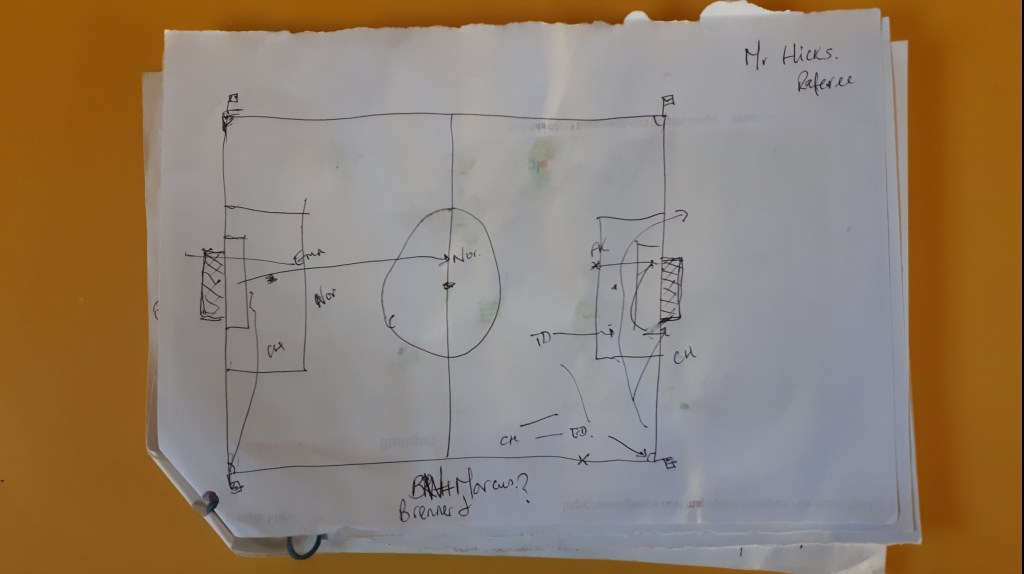
I use the half-time break to talk to my wife Paulene who is watching the Tour de France on the telly in the kitchen, it beats flitting down the steps to the gents underneath the Sir Alf Ramsey stand and staring up at the half-time scores on the screens in the under croft of the stand.  The respite from the game is all too brief and I’m soon sat at the garden table once again and Brenner reveals that Thomas Holy is “off to our right”.  In the first half I had drawn a little sketch plan of the pitch which I tried to use to keep track of where the ball was, but my plan was scuppered because I realised I didn’t know towards which end Town were kicking.  Interestingly, (perhaps) the very first BBC radio commentary for a match (Arsenal v Sheffield United in Division One on 22nd January 1927) used a system whereby the pitch was divided up into eight squares and the commentator Henry Blythe Thornhill Wakelam described the game whilst a co-commentator said which square the ball was in; a diagram showing the football pitch divided up into squares was printed in that week’s Radio Times.  I think Mick Mills has the perfect delivery for telling us what square the ball is in.

It’s five minutes past four and Brenner carefully describes the two teams’ kits as the second half gets underway; it’s a job well done and all Ipswich Town nerds will quickly realise that the red and blue ‘third kit’ has now been used three seasons running.  Nine minutes later and Brenner is perhaps more excited than he should be as he reveals that Norwood should have scored, although it would have been disallowed.  Marcus by contrast remains calm, I can only think he spotted the offside flag before Brenner.

Town seem to be on top now and at four- twenty two Brenner’s voice suddenly becomes louder and his words get closer together. “Edwards with a great chance!” he says, followed by silence.  I guess that he didn’t score.  Freddie Sears is replaced by Jack Lankester and a procession of Town players’ names follows over the airwaves as they take it in turns to get caught offside.

Time has moved on to half-past four and Brenner’s voice rises again in pitch and in volume. Nolan has a shot we are told and for a moment I think it’s a goal, it sounded like it must be, but no, it’s a corner.  A minute later and “Edwards goes round the goalkeeper!”, again I think we’ve scored, but no, it’s blocked on the line and Paulene sits down next to me to eat some crisps and Parma ham because she hasn’t eaten any lunch. 

Time is moving on apace; this is a good half for Town and Brenner’s voice is up and down in tempo and volume as he tries to convey what would be the waves of excitement if there was a crowd watching this game. It’s nearly twenty to five and Gwion Edwards shoots for goal again and then a minute later there’s a cross from Jack Lankester; a moment’s doubt from Brenner “It might be an own goal?” and indeed it transpires that Rovers’ German centre-half Max Ehmer has scored in his own team’s net, which is nice.   Marcus Stewart immediately starts a philosophical argument in my mind as he relates that the goal had been coming for the past twenty minutes.  I muse that had he been watching the game or listening on the wireless like me, the sixteenth century French theologian John Calvin might well have argued that it had been coming since the dawn of time, with all our fates being pre-ordained by God.  It’s not something Marcus picks up on and Brenner merely adds that after some earlier ‘last ditch defending’ from Bristol Rovers, this time it’s a goal.

There’s an interlude of sorts as Marcus Stewart expounds a theory that Jack Lankester should be awarded the goal if his cross was heading into the goal before Ehmer headed it; it’s not a wholly unreasonable proposition except that no one suggested Lankester’s cross was going towards the goal and the whole incident implies that once again Marcus may not have been paying full attention.  It’s a quarter to five and thirty years ago the game would have been over by now, but today there’s still time for the boy Dozzell to elicit the words “Lovely ball”  from the mouth of Brenner, and for Town substitute Ollie Hawkins to miss the goal, before quite suddenly I hear “ Here come Town;  Nolan, shoots, and finds the corner of the net”.  It sounds like it’s 2-0 to Town.  Brenner sounds less excited than he did when all those shots went wide earlier in the game, but eventually confirms that Town have “…strung together back to back victories”.

The referee Mr Hicks who thankfully has barely featured in Brenner and Marcus’s commentary calls time and the game is over.  I quickly turn off the radio to avoid being subjected to the stupidity of the post-match phone-in.  I have enjoyed my afternoon in my back garden in the sunshine and feel a curious ‘simpatico’ with my dead father, who would listen to cricket test matches on the radio on similar sunny afternoons.  Thinking back over the past hour and fifty minutes or so of radio commentary I have been consumed by the thoughts and descriptions from Brenner Woolley and Marcus Stewart, my one reservation being the illogical and groundless worry that every time Brenner Woolley said the name Marcus he was addressing Marcus Evans.

Coggeshall Town 5 Stanway Rovers 1

It’s the first day of August and with indecent haste the football season has started again. But in the Thurlow Nunn Eastern Counties League Premier Division it needs to because the league has now been expanded to twenty four clubs and somehow between now and next May the teams have to fit in forty-six league fixtures, the FA Cup, FA Vase, League Cup and County Senior Cup and in some cases some other pointless trophy or other awarded in memory of a long dead official of the league or county FA. But it’ll be okay, as long as they take one game at a time.
It is about 7.15 and the car park is filling up steadily as I turn into Coggeshall’s West Street ground. But it is to be expected, for tonight is the first home League game of the season and it’s a local derby against Stanway Rovers. Walking from my car with my step son’s wife’s stepfather (what a tangled web we weave) to the turnstiles I sneer disapprovingly at how poorly some people have parked; you could get a bus in the space that Peugeot 205 is taking up. I pay my £6 entry fee or rather my fellow step-father does; it’s his treat because I drove and spent £1.50 on a programme, which is a bit steep, but it’s very thick paper. Inside the ground I pause to admire the view and the big sign which leaves no doubt about the direction to go for refreshments.36291481676_eb3fb0a23a_z We follow the arrow and I enjoy a pounds worth of pre-match tea; black because the milk is UHT.
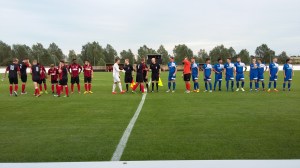
The first game of the season is apparently, eagerly anticipated and I suppose I wouldn’t be here if I didn’t want to be. There is a certain thrill at seeing the pitch in pristine condition, glowing green beneath the brightening flood lights. “It’s the greenest I’ve ever seen it” I hear a bloke behind say slightly incredulously to his friend. Meanwhile a pair of middle-aged blokes carefully copy the team line-ups down into note books; I delude myself that I make them feel antediluvian by taking a photo of the team sheet on my phone.36199259661_651e29bc89_o
Minutes later we’ve chosen our seats in the low, black tin-roofed stand and the teams are lined up on the steps that lead down from the changing rooms to the pitch. We wait, and wait a bit more, I get the feeling they are making a bit too much out of this eager anticipation of the first game of the season, but eventually the teams stream on. Coggeshall look groovy in their customary red and black stripes with black shorts whilst Stanway wear all blue with a white shoulder and hoop around one leg of their shorts; asymmetry agogo. As the crocodiles of players cross the halfway line the Coggeshall captain gets a bit motivational and hunches his back and claps his hands, bawling something about getting going and getting there as if crossing the half way line is what they’re all about. His team mates either don’t hear him or are wrapped up in their own pre-match thoughts, they remain impassive.36335636925_095215e6c7_o

With sporting handshakes out of the way, Stanway kick off the match towards the rough car park behind the goal to my left and Coggeshall town itself. A nerdy sounding man sat at the back of the stands says how he can’t have been here since the 1980’s, adding “Goodness me” at the end of his sentence as if he has surprised himself; another obvious groundhopper tells how he caught the train to Kelvedon and walked across the fields to get here. The nerd says how he hadn’t thought of doing that. Saving us from the boredom of this overheard, statement-rich conversation Coggeshall’s number 11 scores a rather good goal. Barely 10 minutes have passed.
Stanway Rovers have a barrel chested centre forward who, according to Wikipedia “…enjoyed a six-year career with Colchester United..” Coggeshall’s number ten has a crowning hank of obviously dyed blond hair, which makes him look like a wannabe League footballer, but he has no reason to envy the Stanway man tonight, as dyed hair or not the number ten scores a second goal for the Seedgrowers after Stanway fail to clear a corner. We haven’t even been here for twenty five minutes yet.
The ball is pumped forward a bit too far for a Coggeshall forward to get a shot on the goal and someone shouts “Recycle”, which is good advice for everyone. Nearly a half hour has passed and a nifty little shimmy on the edge of the penalty area earns the space for Coggeshall’s number 9 to score his team’s third goal. Blimey. The crowd applaud politely but sadly don’t seem overly thrilled by the unfolding spectacle before them although the Stanway contingent are probably squirming, particularly the committee members in their blazers and club ties. Coggeshall’s dominance doesn’t convince the un-smiling nerd at the rear of the stand though, who two or three times speaks of Coggeshall being “unconvincing at the back” or some such “footballese” phrase. “A goal for Stanway now would put a very different complexion on the game” he opines whinily like someone wanting to be confused with John Motson. Stanway do “come on strong” towards the end of the half and have a shot that hits a goal post, but the colour and texture of the game’s skin remains unaltered.
Half-time brings applause and a stroll to the club house to buy a coffee for my accomplice and a bottle of a beer I wouldn’t normally drink (Greene King IPA) for me; £4.50 for the pair. My accomplice is very complimentary about the coffee which he thinks might not be instant but made with real coffee. For my part I wonder if the club shouldn’t source some locally brewed beer (Red Fox or Nethergate or Colchester Brewery perhaps?). 36199208221_d1a402470a_oThere is a summer fete feel to the refreshments tonight with the clubhouse shut, but drinks served from behind a table in the doorway and burgers dished up from inside a stripy gazebo.
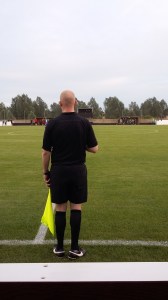
The flood lights are now fully on as daylight recedes and shadows envelop the surrounding fields. A combine harvester that had flashed a yellow revolving light and thrown up dust away behind the Stanway goal in the first half has gone home to the farmyard. I flick through the programme. The title “Our History in Brief” heads a densely packed page of print; the next page in equally dense print is headed “Our History in Brief Continued”. This theme of failed brevity is repeated a page or two further on as the title “Our Club Honours at A Glance” sits above a list of 38 entries dating back to 1898. I find the programme’s half-time quiz easy; question two is “In what year was the first World Cup held?” whilst question five asks “ Which is the only club to have played in every World Cup since it started in 1930?. All ten answers are laid out in a 3-3-1-3 formation at the foot of the page with a front line of 8. Kilmarnock 9. Stanley Matthews in 1965 10. Inverness and 7. Juventus playing “in the hole” behind the strikers.
Having sated my thirst for historical facts I watch the second half, occasionally pausing to sip beer. This is the life. Ten minutes of football later Stanway concede a fourth goal as Coggeshall’s number nine turns a low cross into the Stanway goal net. Within not very long at all the Seedgrowers “go knap” as the number ten with the blond coiffure treats another low cross in the same manner. Eventually, and oddly within just a minute of scoring their fifth goal Coggeshall revert to type and show their famed inability to defend as a free-kick is met with a looping header from the barrel chested man who enjoyed a six year career at Colchester.
The remainder of the match passes in a blur of red, black, blue and green with white bits. We discuss why there no great works of art about football; I don’t think Lowry’s “Going to the match” or Peter Terson’s play “Zigger Zagger” really cut the mustard. Meanwhile the floodlights reflect off the bald head of the linesman who late on in the game makes no attempt to stifle a yawn. 36199206801_514070f9c6_oMay be it was through fatigue, or perhaps he too has overheard the nerdy groundhopper’s tale of congestion on the A312. It’s academic however as at about twenty five to ten the referee Mr Andrew Gray, who the programme entreats us to respect, and we do, calls time through the medium of his whistle.
It’s been a grand evening of fine football from all the Coggeshall Town team who are worthy winners. The addition of tea, beer and coffee have just added to the fun and I will be back another day for more of the same. The season has just begun!