Balaruc 0 Clermontaise 2

Paris St Germain are the current holders of the Coupe de France, the French equivalent of the FA Cup, but they have an easy ride into the final as they only have to play six matches to get there, the first of which is in January. Like the FA Cup, the Coupe de France really begins in the summer and eight rounds are played before the likes of PSG deign to make an appearance. In fact there is also an overseas section that begins as early as May because clubs in the French territories such as Martinique and Guadeloupe are also eligible to enter the competition. Today is the troisième tour (third round) of the Coupe de France and Mrs Brooks and I are in the seaside spa town of Balaruc les Bains at the Stade Municipal20170910_144644.jpg to see the tie with Clermontaise, who are from the town of Clermont l’Herault, some thirty kilometres to the north west.

Balaruc les Bains sits at the north end of a salt water lagoon, the Bassin de Thau, a kilometre or so across the water from Sète. There is a huge spa (les thermes) in Balaruc, which is something to behold. A massive, sleek, white building like an ocean going liner; from its commodious foyer, two escalators slowly ascend like conveyor belts, carrying mostly elderly, bronzed, French people, some in towelling robes, up to experience various health giving treatments.  I found it creepy, it made me think of Logan’s Run and Soylent Green.

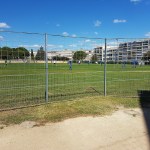
The Stade Municipal is in total contrast to les thermes; it’s scruffy and dusty and will soon be full of young life, although like many French small town stadia it’s largely just a football pitch surrounded by a high metal fence.20170910_142429.jpg
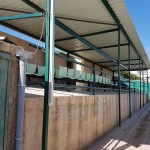
There is one stand, a concrete platform with three rows of plastic seats bolted onto metal frames. 20170910_141746.jpgIt looks like the original roof has been replaced with new metal sheeting on another metal frame, which obscures the row of the pitch from the front row of seats. We enter the stadium through a wide opening in the back wall and find ourselves in the players tunnel; it’s an entrance that is closed soon afterwards, but it’s not quite two -thirty yet and the game doesn’t kick off until three. A wonky sign points roughly in the direction of the buvette,20170910_143307.jpg which is a portakabin style structure with a counter even more wonky than the sign. To the other side of the stand is a dark room with high-up shelves of trophies on two walls and a bar counter;
it smells of stale tobacco. A poster lying on a table shows what’s healthy to eat and what’s not and a timetable shows what time the number three bus leaves on matchdays for the Stade Mosson in Montpellier, the local home of top flight French football.

As the teams and referees warm up on the pitch we wander about seeking the best vantage point from which to watch the match; there doesnt seem to be one. The lowest part of the metal fence is quite closely meshed and there are few places where it is possible to see over it. It’s a bright, warm day, but its also extremely windy; with the wind howling off the Bassin just a couple of hundred metres behind us, we can smell the brine and taste the salt in the air. A group of elderly men have claimed a good spot on a bench in the lee of a high hedge on a small slope; one of them has brought his own folding chair. You can’t beat the experience that comes with age. Behind each goal there is a small outcrop of terracing,

which looks like archaeology; the concrete is even gently patterned like mosaic but it doesn’t really help see over the fence.

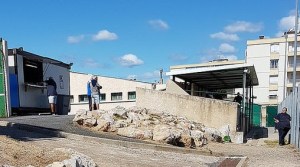
Eventually we settle on some rocks strewn about in front of the buvette 20170910_142610.jpgand the teams line up on the pitch. Balaruc wear an unattractive all-black kit with green trim, which displays no team badge or sponsor’s names. Clermontaise and Balaruc are in the same regional league (Poule A of the Languedoc-Rousillon section of the Occitanie region’s Division Honneur 2 – the seventh level of French football), but Clermontaise look much smarter and ‘professional’ in their all blue kit with badge. The McDonald’s golden arch logo is on the Clermontaise shorts; they can’t have read the poster on the table in the trophy room.
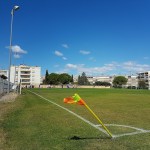
La Clermontaise kick off the match with the Mediterranean Sea at their backs, but proceedings are soon interrupted as the young looking referee Monsieur Yohan Beker is concerned that the strong wind has laid flat the corner flagsIMG_20170910_182517_939.jpg at the Mediterranean end of the ground.  A bloke in a t-shirt and trakkie bottoms is called on to sort them out and once he has done so the game carries on. Early on Clermontaise look the better team, but it might just be because they’re wearing a nicer kit.  Just before twenty past three it looks like they have scored, but I can’t tell if it was  offside or the shot was missed. There are flattened practice goals either side of the real one and from my rock it’s hard to tell which is which.
La Clermontaise’s number five is the first player to receive what will become a litany of cautions as he appears to knock out the Balaruc number nine, who stays down still, but eventually gets up seemingly none the worse for wear. But any violence on the pitch is as nothing to that developing in front of me as two small girls poke sticks at the dirt between the rocks we are sat upon and end up flicking it at one another with angry stares and increasing ferocity. It is worrying that humans are so unpleasant to one another from such a young age. Balaruc then have a rare attack, but just as the ball is crossed a massive gust of wind blows and carries it off to the far side of the ground.

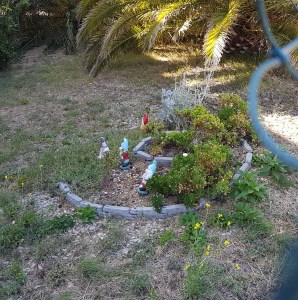
The Stade Municipal is closely overlooked by four-storey blocks of flats all along one side and partly at both ends; they make quite a dramatic backdrop being so close to the pitch. At one end of the ground small gardens are visible through the boundary fence and I can see one has an interesting collection of gnomes. 37010937752_0f2b1b1e4c_oThere are a number of people, mostly men in their sixties and seventies, sat at windows and balconies looking down on the game. I envy them their home comforts, it has to be better than perching like a lizard on a rock in the sun. Dissatisfied with my view sat on the rock, I watch the remainder of the first half standing up.
Just about half an hour has passed since the game began and La Clermontaise are awarded a free kick a little more than twenty metres from goal. The ball is lofted to the near post where the visiting number nine cleverly twists and heads it into the net. La Clermontaise have taken the lead and, better kit or not they deserve to have done so because they look a tad classier than the home team. That touch of extra class is further illustrated as Balaruc respond with a series of petulant fouls. Firstly their number seven hurls himself into a misjudged tackle resulting in a melee of virtually every one on the pitch. At first Monsieur Beker steps in to separate the aggrieved parties, but then he steps back to seemingly allow the teams to sort the matter out for themselves. I have seen a few such incidents in French amateur games and whilst there is usually much fierce debate among the players there is never any real violence; once everyone has had their say Monsieur Beker returns to caution the number seven, award a free kick to La Clermontaise and play on.

Annoyingly the rough approach from Balaruc seems to work and they now have the initiative as the attacking team. A corner is punched away by the orange clad Clermontaise keeper, but the return is instant from the edge of the box as the Balaruc number eleven volleys the ball solidly against the crossbar. The half ends with more brutality as the Clermontaise number six shoves the Balaruc number six and also receives a caution from Monsieur Beker.

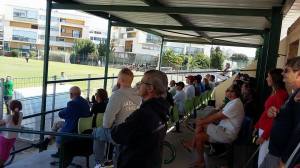
The search for a better viewing point resumes at half time with added vigour because the strong wind and warm sun really are taking their toll on our soft, southern English sensibilities. Eventually we find a place at the back of the main stand, leaning on the rear wall against a steel stanchion.37010978392_d5a2d9a778_o It proves to be a good choice and our enjoyment of the second half is much increased by our new location, which is shaded, out of the wind and high enough to see over the fence, with the added bonus of atmosphere as the stand is full; spectating nirvana.
The new half begins with Balaruc  on the attack again and their number nine shoots over the crossbar before his opposite number fouls the Balaruc number five, who bawls and stays down on the ground twitching, but eventually gets up and hops away; he was only stunned. Balaruc soon earn a corner, which is quite skillfully worked across the penalty area and fed back to their number nine who curls a shot into the top corner of one of the practice goals squashed up behind the real goal.

Quite a few people seem to have changed their spectating position for the second half and like giant birds on a telephone wire, a row of young lads have perched themselves on the high pink wall behind the Clermontaise keeper and are hanging over the crossbar of one of the practice goals. Other lads sit on a bench, their motorcycle helmets stacked together in front of them like deformed, painted skulls in an ossuary. Some of the people watching from the windows of the flats are no longer there.

It’s a quarter past four and Balaruc’s number four is shown the yellow card for plunging feet first through Clermontaise’s number eleven. A wit in the stand entertains his fellow spectators with what sound like caustic comments about the refereeing; people laugh anyway, which only encourages him. Balaruc might be said to be enjoying most of the possession, but it’s not doing them any good; they are also now ‘enjoying’ most of the bookings too as their eleven hurls himself at his opposite number, who stays down on the ground, as does Balaruc’ s number nine who has fallen down in a separate incident that Monsieur Beker sensibly ignored. Balaruc’s nine looks frustrated and tetchy. At half past four there is a drinks break.

Players are now being substituted freely, keeping the grey-haired, kindly faced and besuited  délègue principal37182734275_6954af6a9c_o Monsieur Gerard Blanchet busy in front of us. Clermontaise’s number twelve confirms his presence by boldly attempting a shot from a thirty metre free kick; of course he misses, but not embarrassingly so. The Balaruc bookings continue and five blatantly kicks the Clermontaise twelve as he dribbles past him and three knocks over his opposite number as they run side by side. All afternoon tbere is a pleasing symmetry with many of the fouls and bookings as players with the same shirt number go for each other.

There are only five minutes left now and whilst Balaruc have been nimble and passed the ball well, they have also been overly physical and not succeeded in making many goal scoring chances at all. Clermontaise have not had much of the ball, but it doesn’t seem to have worried them unduly and I think to myself that they might now just score again and finish the game off. A  Balaruc goal kick ends up with the Clermontaise number twelve some thirty plus metres from goal; he runs past a couple of opponents and to the edge of the penalty area; another stride, a check on where the goal is and he strikes the ball across the goalkeeper into the far side of the net.

La Clermontaise go through to the quatrième tour of the Coupe de France. Allez les bleus!

Due to random problems loading – more pictures to follow.


Coggeshall Town 5 Stanway Rovers 1

It’s the first day of August and with indecent haste the football season has started again. But in the Thurlow Nunn Eastern Counties League Premier Division it needs to because the league has now been expanded to twenty four clubs and somehow between now and next May the teams have to fit in forty-six league fixtures, the FA Cup, FA Vase, League Cup and County Senior Cup and in some cases some other pointless trophy or other awarded in memory of a long dead official of the league or county FA. But it’ll be okay, as long as they take one game at a time.
It is about 7.15 and the car park is filling up steadily as I turn into Coggeshall’s West Street ground. But it is to be expected, for tonight is the first home League game of the season and it’s a local derby against Stanway Rovers. Walking from my car with my step son’s wife’s stepfather (what a tangled web we weave) to the turnstiles I sneer disapprovingly at how poorly some people have parked; you could get a bus in the space that Peugeot 205 is taking up. I pay my £6 entry fee or rather my fellow step-father does; it’s his treat because I drove and spent £1.50 on a programme, which is a bit steep, but it’s very thick paper. Inside the ground I pause to admire the view and the big sign which leaves no doubt about the direction to go for refreshments.36291481676_eb3fb0a23a_z We follow the arrow and I enjoy a pounds worth of pre-match tea; black because the milk is UHT.
The first game of the season is apparently, eagerly anticipated and I suppose I wouldn’t be here if I didn’t want to be. There is a certain thrill at seeing the pitch in pristine condition, glowing green beneath the brightening flood lights. “It’s the greenest I’ve ever seen it” I hear a bloke behind say slightly incredulously to his friend. Meanwhile a pair of middle-aged blokes carefully copy the team line-ups down into note books; I delude myself that I make them feel antediluvian by taking a photo of the team sheet on my phone.36199259661_651e29bc89_o
Minutes later we’ve chosen our seats in the low, black tin-roofed stand and the teams are lined up on the steps that lead down from the changing rooms to the pitch. We wait, and wait a bit more, I get the feeling they are making a bit too much out of this eager anticipation of the first game of the season, but eventually the teams stream on. Coggeshall look groovy in their customary red and black stripes with black shorts whilst Stanway wear all blue with a white shoulder and hoop around one leg of their shorts; asymmetry agogo. As the crocodiles of players cross the halfway line the Coggeshall captain gets a bit motivational and hunches his back and claps his hands, bawling something about getting going and getting there as if crossing the half way line is what they’re all about. His team mates either don’t hear him or are wrapped up in their own pre-match thoughts, they remain impassive.36335636925_095215e6c7_o

With sporting handshakes out of the way, Stanway kick off the match towards the rough car park behind the goal to my left and Coggeshall town itself. A nerdy sounding man sat at the back of the stands says how he can’t have been here since the 1980’s, adding “Goodness me” at the end of his sentence as if he has surprised himself; another obvious groundhopper tells how he caught the train to Kelvedon and walked across the fields to get here. The nerd says how he hadn’t thought of doing that. Saving us from the boredom of this overheard, statement-rich conversation Coggeshall’s number 11 scores a rather good goal. Barely 10 minutes have passed.
Stanway Rovers have a barrel chested centre forward who, according to Wikipedia “…enjoyed a six-year career with Colchester United..” Coggeshall’s number ten has a crowning hank of obviously dyed blond hair, which makes him look like a wannabe League footballer, but he has no reason to envy the Stanway man tonight, as dyed hair or not the number ten scores a second goal for the Seedgrowers after Stanway fail to clear a corner. We haven’t even been here for twenty five minutes yet.
The ball is pumped forward a bit too far for a Coggeshall forward to get a shot on the goal and someone shouts “Recycle”, which is good advice for everyone. Nearly a half hour has passed and a nifty little shimmy on the edge of the penalty area earns the space for Coggeshall’s number 9 to score his team’s third goal. Blimey. The crowd applaud politely but sadly don’t seem overly thrilled by the unfolding spectacle before them although the Stanway contingent are probably squirming, particularly the committee members in their blazers and club ties. Coggeshall’s dominance doesn’t convince the un-smiling nerd at the rear of the stand though, who two or three times speaks of Coggeshall being “unconvincing at the back” or some such “footballese” phrase. “A goal for Stanway now would put a very different complexion on the game” he opines whinily like someone wanting to be confused with John Motson. Stanway do “come on strong” towards the end of the half and have a shot that hits a goal post, but the colour and texture of the game’s skin remains unaltered.
Half-time brings applause and a stroll to the club house to buy a coffee for my accomplice and a bottle of a beer I wouldn’t normally drink (Greene King IPA) for me; £4.50 for the pair. My accomplice is very complimentary about the coffee which he thinks might not be instant but made with real coffee. For my part I wonder if the club shouldn’t source some locally brewed beer (Red Fox or Nethergate or Colchester Brewery perhaps?). 36199208221_d1a402470a_oThere is a summer fete feel to the refreshments tonight with the clubhouse shut, but drinks served from behind a table in the doorway and burgers dished up from inside a stripy gazebo.
The flood lights are now fully on as daylight recedes and shadows envelop the surrounding fields. A combine harvester that had flashed a yellow revolving light and thrown up dust away behind the Stanway goal in the first half has gone home to the farmyard. I flick through the programme. The title “Our History in Brief” heads a densely packed page of print; the next page in equally dense print is headed “Our History in Brief Continued”. This theme of failed brevity is repeated a page or two further on as the title “Our Club Honours at A Glance” sits above a list of 38 entries dating back to 1898. I find the programme’s half-time quiz easy; question two is “In what year was the first World Cup held?” whilst question five asks “ Which is the only club to have played in every World Cup since it started in 1930?. All ten answers are laid out in a 3-3-1-3 formation at the foot of the page with a front line of 8. Kilmarnock 9. Stanley Matthews in 1965 10. Inverness and 7. Juventus playing “in the hole” behind the strikers.
Having sated my thirst for historical facts I watch the second half, occasionally pausing to sip beer. This is the life. Ten minutes of football later Stanway concede a fourth goal as Coggeshall’s number nine turns a low cross into the Stanway goal net. Within not very long at all the Seedgrowers “go knap” as the number ten with the blond coiffure treats another low cross in the same manner. Eventually, and oddly within just a minute of scoring their fifth goal Coggeshall revert to type and show their famed inability to defend as a free-kick is met with a looping header from the barrel chested man who enjoyed a six year career at Colchester.
The remainder of the match passes in a blur of red, black, blue and green with white bits. We discuss why there no great works of art about football; I don’t think Lowry’s “Going to the match” or Peter Terson’s play “Zigger Zagger” really cut the mustard. Meanwhile the floodlights reflect off the bald head of the linesman who late on in the game makes no attempt to stifle a yawn. 36199206801_514070f9c6_oMay be it was through fatigue, or perhaps he too has overheard the nerdy groundhopper’s tale of congestion on the A312. It’s academic however as at about twenty five to ten the referee Mr Andrew Gray, who the programme entreats us to respect, and we do, calls time through the medium of his whistle.
It’s been a grand evening of fine football from all the Coggeshall Town team who are worthy winners. The addition of tea, beer and coffee have just added to the fun and I will be back another day for more of the same. The season has just begun!

Whitton United 5 Coggeshall Town 4

The Eastern Counties First Division is the tenth tier of English football, just a few seats, some floodlights and a half-time plate of sandwiches for the opposition committee separates it  from the clubs that play on a piece of waste ground and use jumpers for goalposts, well  almost.  But that doesn’t mean clubs at this level don’t have history; Whitton United have been going since 1926 and Coggeshall Town since 1878, the same year as mighty, illustrious Ipswich Town, former League Champions, FA Cup, UEFA Cup and Texaco Cup winners.

It says in the match programme that a Whitton team existed in the late 1800’s, back when Whitton was a small village a mile or more outside Ipswich.  But between the World Wars Ipswich Corporation, as it was then, began to build the Whitton estate providing much needed,  good quality, rented housing for working class people.  Whitton is now a part of Ipswich, and if supporters in the Eastern Counties league did sing (with the notable exception of Wivenhoe Town’s they tend not to) they could chant “Small club in Ipswich, You’re just a small club in Ipswich” without fear of contradiction.

Whitton United is a rare thing in the Eastern Counties League, a team representing a truly urban area, and more than that it might be said to represent a large council estate.  The contrast with Coggeshall therefore is on the face of it quite stark.  Coggeshall, with its National Trust owned medieval buildings and its vineyard and ley lines is positively poncey by comparison.  The other big difference is that Coggeshall Town are being bankrolled; there are stories of players attracted from beyond Essex on the promise of big appearance money.  The realisation of this is shown in their relative league positions with Coggeshall currently top of the table, where they have been virtually all season, whilst Whitton are merely near the top of the bottom half of the table, albeit on a roll of five consecutive victories.

The King George V Fields ground is outside the Whitton estate next to the main road out of town towards the A14 and Stowmarket.   A third of the pitch is overlooked by a large heap of rubble that was once the concrete floor of the Tooks bakery (aka bread factory), formerly the club’s neighbour. Behind one goal there is no accommodation for spectators whatsoever, just a stretch of grass from the goal net to a very big fence, with the road beyond.   There is a stand on each of the other three sides; two of them resembling country bus shelters, one of which is labelled ‘The Shed’; whilst downhill, behind the other goal is a pre- fabricated, metal stand containing the requisite number of seats for the club to play in the Eastern Counties Premier League. should the need arise.  The changing rooms have a wonderful green and white striped tin roof.

It’s a grey, blustery afternoon with a constant threat of rain, but the two teams in their striped kits, Whitton in green and white and Coggeshall in red and black stand out through the gloom and offer the promise of excitement.  I wander around the perimeter rail before the game kicks off and a bloke on his way to one of those ‘bus shelters’ and carrying a couple of pints of beer says hello; “ We need a good result today after last week” he says.  I have no idea what either team did last week, but I agree because it would be churlish and a bit weird not to do so and I’m not one to start an argument with someone I don’t really know.  To begin with, the promise of a good game is all there  as the ball bounces awkwardly on the soft pitch and is buffeted by the wind, producing a scrappy match with neither team looking much good.  Despite kicking up the not inconsiderable slope and against the wind however, Coggeshall gradually start to look the stronger team.

I walk round the back of the dugouts and towards the end of the ground where the only spectators are those in passing cars and buses who are probably surprised to find themselves watching a football match, albeit for a few fleeting seconds only.  One or two beep their car horns as they drive by.  Coggeshall are kicking towards the goal at this end and it doesn’t take long before they score, a close range tap-in from Scarlett, despite claims of offside from Whitton.  Somewhat bizarrely Coggeshall’s number four is booked in the aftermath and from what I can make of what referee Mr Pope seems to be saying, it is because he egged on the Whitton players in their offside protests. ‘You started it’ I think I hear the Pope say as if scolding Martin Luther.  The same player is then spoken to again by his holiness and told to concentrate just on the football by the Coggeshall coach; “I only said bad luck baldy” the player opines after Whitton’s follicly challenged centre-half concedes a free-kick on the edge of his own penalty area.

I drift back towards the Whitton bench having had enough of the Essex club’s manager’s questioning of Mr Pope and decide to briefly compare and contrast him with the Whitton manager.  I conclude that the Whitton man mostly complains to himself and to the bench in a sort of audible internal dialogue.  The results of the comparison fit with my own pre-conceived ideas of Ipswich and Essex people.  Happily for Whitton however, my move into their half coincides with a couple of attacks down the left, one of which results in a free-kick and ends with an unexpected, but not completely undeserved equaliser from Bell.

Half-time arrives with scores all square and I indulge in a pounds worth of tea and a warm in the clubhouse, although I have to be let in because the door only seems to open from the inside.  I return to pitch side too late for the re-start, but haven’t missed anything and take up a spot in the seats behind the goal.  It starts to rain.

With the wind at their backs and playing down the slope it seems like it might be easier for Coggeshall in the second half and gradually, as in the first half they begin to dominate the attacking play, but without really making any decent chances to score; then, a break down the left, a through ball and a goal for Whitton by Percy (sadly his surname not his first name).   It’s a bit of a surprise but the game returns to its previous pattern and with about fifteen minutes left, after some more Coggeshall domination the ball is crossed low, blocked and partly cleared before the Coggeshall substitute Guthmy coolly places the ball in the middle of the goal to equalise.  Now it really looks like Coggeshall will go on to win and that’s what the bloke behind me tells his children when they ask.

The good thing about football however is that is totally unpredictable, which is why all these ‘sports betting companies’ (bookies) advertise relentlessly to part mugs with their money.  Proof of football’s unpredictably arrived within just a minute or two as a deep cross from a corner was headed in at the far post by Griggs to put Whitton ahead again and then within minutes of that a through ball saw  Cheetham brought down in the box resulting in a penalty which gave Whitton a 4-2 lead. The rain had now eased and I stepped out of the stand so that I didn’t have to peer through a goal net and another bigger net placed across the front of the stand to protect inattentive spectators from stray footballs that might inadvertently smack them in the chops when they were looking at their mobile phones rather than the game; serves ‘em right I say.  Barely had I done this and with about six minutes left Whitton scored yet again with Cheetham ‘converting’ a cross by the beautifully named Franco Mallardo.

Surely that was it, 5-2 with just five minutes left? But no, Coggeshall rightly decided that the game wasn’t over until his holiness Mr Pope says so, and just as I would never leave a game before the final whistle, so the ‘Seedgrowers’ , for that is what their nickname is, continued to try and win the match.  And it was a good job they did or this report would be over already.  First, continuing the ecclesiastical surname theme started by the referee, Monk made it 5-3 with a fine half volley from the edge of the penalty area,  and a short while later he then crossed the ball for Nwachuku to smack a fourth goal high in to the Whitton United net.  There was still enough time for a free kick on the edge of the penalty area to be sent over the Whitton cross bar, but finally Mr Pope whistled Amen and the game was over.

It had been a most entertaining game, even if some of the defending had at times been hard to spot, and in difficult conditions on an awkward slopey pitch the players of both teams had given their all.  I was surprised therefore and disappointed that at the end no one clapped or cheered as the two teams left the pitch; but no one booed either, so it was one up on Portman Road I guess.   The 5-4 score line alone deserved some appreciation, but there was nothing, not a cough, not a wheeze, not even a tiny chortle. Everyone just filed away into the car park.   To an extent, at this level of football the result doesn’t matter as much as the fact that the two clubs are still there each week to play; this is perhaps true more for a real community club like Whitton United than a club like Coggeshall Town which has been adopted by someone with spare cash like a mini Roman Abramovich.

There was apparently only a crowd of 57 at this match, which is disappointing for a Saturday when Ipswich Town are not playing, and looking about there were very few people under thirty there.  A football match where you can drink in sight of the pitch should be a massive draw and at £6.00 entrance fee it provides good value for money compared to the £40 Norwich City wanted from IpswichTown fans to get into Carrow Road the following day.

Eastern Counties League Football should be the model for sustainable football, so I urge you, support your local team, it’s friendly, it’s funny, it’s fun, it is well worth it.  I had a lovely time.  Thank you Whitton United.

Ipswich Town 1 Leeds United 1

If this was 1973, what a fixture this would be, and it was, but Leeds won back then, nil to three, in front of a crowd of 27,513.

Dirty Leeds.   Northern bastards.   Tetley bittermen.  They never won anything fairly said Brian Clough; cheats the lot of ‘em. They should have put their medals in the bin.    And this is why you have to love a fixture against Leeds United today.  The weight of such history can’t be lifted and why would you want it to be.

Everybody hated Leeds United in 1973 and, if we have an opinion, a lot of us still do.  In these times of image and branding, Leeds United still retains a strong hold on the minds of supporters because of what they were forty years ago.  That all white home kit, that so 1970’s curvy LU badge, the garters on the socks and those players, Bremner, Lorimer, Norman ‘bite ya legs’ Hunter, ‘Sniffer’ Clarke , Gray, Madeley, Jones, Reaney and Cooper.  That Leeds United defines a time and place, the nasty early 1970’s of IRA bombs, the three day week, power cuts, industrial unrest, Baader Meinhof,  tank tops, platform shoes, Chicory Tip and the Wombles.  Leeds United with all their nastiness were a reflection of the age; a footballcentric Clockwork Orange.   In their stark white kit they were the ruthless professionals who replaced the likes of the homely Matthews and Finney; Leeds United was the monolithic new Arndale Centre that swept away the Victorian streets, and the teased coiffure and the feather cut that usurped the plastered down Brylcreemed pates of the 1950’s for ever.   Efficient, impressive, modern, but ugly and lacking a soul.

Of course in Ipswich we never had an Arndale Centre; we had the Greyfriars Shopping Centre but the locals ignored it and didn’t go there, and only moaned about it, so a bit like Ipswich Town today really.

And then there were the Leeds supporters; how the Sunday papers loved the stories of smashed up trains and pubs and bovver booted rampages through the streets, but Manchester United and Chelsea and West Ham supporters were no different, they were all a bit lairy back then, that was the fan culture before ‘fan culture’ existed, before it was labelled, sanitised, branded by TV as the theme for betting adverts and the larky back drop to Super Sundays.  Leeds supporters have a bad reputation still, their coaches were parked right outside the away stand today so they could befoul as few as possible of the streets of Ipswich with their short vowels and bile and phlegm.   Because they sing continuously whatever the score, Leeds United fans are an oddity in Ipswich, the locals don’t understand and stare cow-eyed, mouths agape.  Ipswich Town is a football club where most of the crowd have forgotten or have simply never known how to support their team.  In Ipswich people don’t seem to know that showing support by shouting and singing is actually what they should be doing.  They think they should just sit quietly, not cause a fuss.  It makes a difference.  How else are the players going to know if anyone really cares about the result, there’s got to be more to the beautiful  game played well than just a win bonus, especially when your ordinary weekly wage is so bloody vast in the first place.

In Ipswich, the club’s fan base was built up in the 1970’s, probably reaching its zenith in 1975 as Town epically overcame Leeds United in a third replay to reach their first ever FA Cup semi-final.  (None of this penalty shoot-out bollocks back then; it’s like the FA just wants to get the whole thing over and done with now, roll on the close season.) Courtesy of Bobby Robson the team was ridiculously good for a small provincial town.  Ever since Robson departed in 1982 the Town have at best been middling, and when Roy Keane became manager they became virtually unwatchable.  Those fans from the 1970’s have stayed loyal to the Town however, but people don’t age disgracefully in Ipswich and the silent silver-haired majority in Churchman’s now look on impassively, saving themselves in case they have to boo at the end.  The young fans have no role model to follow and like when they see monkeys shagging at the zoo, pre-pubescent boys turn to their dads and ask what the Leeds fans are doing.  “Just watch the game son” is the likely reply.

Misunderstanding their past Leeds United wore white shorts and yellow jerseys today and there was no stylised LU to be seen on the club crest, or garters on their socks.  But to be fair, it is no longer 1973; thank the time space continuum for that, but I imagined how it was and I think the Leeds fans did too.  Pantomime villains they may be, but it would be a crappy pantomime without Leeds United, as it sadly often is at Portman Road when your best days are Behind You!

Footnote : Had Bobby Robson not died in 2009, the day of this Leeds game would have been his 84th birthday.  Consequently, in the 84th minute of the match there was a minute’s applause for Sir Bobby; a sort of birthday greeting sent out by Town fans to beyond the grave; the idea apparently of local radio person Mark Murphy see tweet @MarkGlennMurphy.   An awkwardly sentimental idea, because people don’t really have birthdays once they’re dead, it is also flawed because, as my wife pointed out to me, if it is to be repeated after Saturday 18th February 2023, games will have to routinely start going into extra-time; I’m not sure the Football League would agree to that, but you never know.    If anyone thought Sir Alf Ramsey was deserving of the same sort of post mortem birthday greeting then I regret to tell you that  that particular funeral barge has already sailed because he was born in 1920 and so would already require at best Manchester United style time added-on but more probably, that hard-to-sanction extra time.

Oh, and finally, if you are at all intrigued by the Leeds United of the 1970’s and haven’t already read it then be sure to buy, borrow or steal (depending on lifestyle choice) a copy of ‘The Damned Utd’ by David Peace, it is an excellent novel and one of the very best books about football.