Having arrived on holiday in Languedoc on Monday, on Tuesday tickets for this match went on general sale. With no secure internet connection acquiring tickets required a forty-five minute drive to Montpellier, to the Odysseum complex just off the A9 motorway where Montpellier Hérault SC has its’ club shop. Joining the queue outside in the blazing sun at about 12:15 we emerged from the shop clutching a pair of 35 euro tickets at about 13:45. By the time we had reached the front of the queue the only tickets left had been in the upper tiers of the stands behind each goal. We chose seats in the Tribune Petite Camargue above the Montpellier Ultras at the opposite end of the Stade de la Mosson to the Paris St Germain supporters.
Two weeks and four days later we park up in the dedicated football car park near the park and ride tram station in Mosson, or La Paillade as it is colloquially known. It costs just 2 euros to park. It’s early, not much after 3 o’clock and the game won’t kick off until 5 pm. We dawdle out of the car park towards the stadium enjoying the warm afternoon sun. I am supporting Montpellier today because like a lot of football supporters I despise clubs like Chelsea, Billericay Town and Salford City that are bankrolled by people with too much money. But also I first saw Montpellier in 2011 against PSG (they lost 0-3) and followed their results for the rest of that season, in which they ended up winning the Ligue 1 title. I like their navy blue and orange kit too and added to which Montpellier is a very attractive and exciting city. The upshot is today I am wearing a Montpellier Hérault SC t-shirt, and as we cross the car park I exchange glances with a PSG fan who is stood with two women under the shade of a tree enjoying a snack and a drink. He rolls his eyes at my T-shirt and smiles and so I decide to stop and try and talk with him. Happily neither his English nor my French are so inadequate that we can’t make ourselves understood to one another. I tell him that I really support Ipswich Town and he rolls his eyes again, although he agrees that they had a good team a long time ago; he believes that Chelsea and Liverpool are okay, but then I’d expect as much from the sort of person who supports France’s most hated club. My wife tells him her team is Portsmouth, which he doesn’t understand until she pronounces it ‘Ports-moose’. He is in his fifties, a scruffy looking bloke in a denim jacket with a beard and long hair; he and his wife and daughter live in Béziers but he is a PSG ultra; he grew up in Paris and his dad took him to watch PSG at the Parc des Princes as a boy. Having both shared our deep disappointment over Brexit (every German, Belgian and Frenchman I have spoken to seems as upset as me) and probably exhausted our respective vocabularies in each other’s language we wish one another well and my wife and I carry on towards the stadium.
There is a lot of hanging about going on because the road to the stadium is closed off. But there are a number of gazebos selling food and beer to help while away the wait.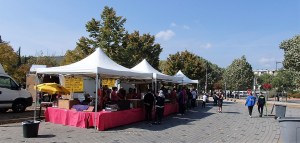 A blacked out Mercedes minivan is guided through the road block behind two police motor cycles and an army of policemen look on, some in full Kevlar riot gear, one or two with sub-machine guns, including one who looks a bit like the late John Le Mesurier.
 Later we learn that former president Nicolas Sarkozy was at the game and it is likely it was him in the Mercedes.
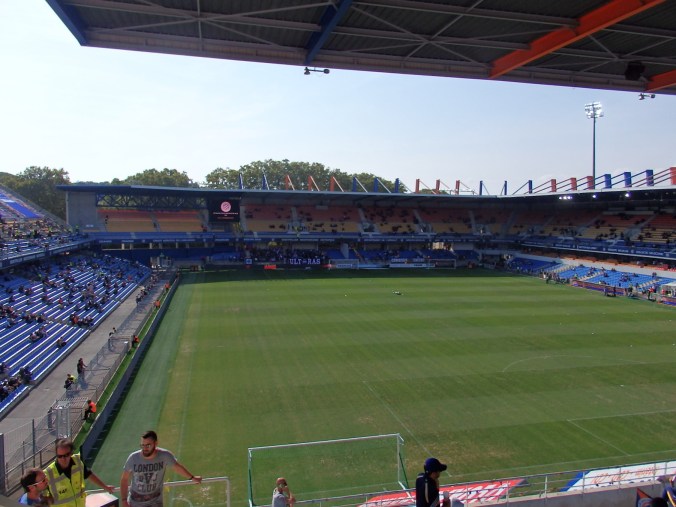
Eventually, having enjoyed a beer in the shade of some trees we are allowed through the barriers and approach Stade de la Mosson at about twenty to four. Unusually perhaps for a stadium that was used in the 1998 World Cup, Stade Mosson is not particularly spectacular looking; in fact it is a fairly basic cantilever roofed design, which forms an angular horseshoe around three sides of the pitch. The steel stanchions from which the roof hangs are painted in the club colours of orange and blue. It does have one striking looking stand however,


a triple decker with a massive top tier but no roof, supported on streamlined, sloping concrete legs. Bizarrely however, the top tier is closed; something to do with the club’s average attendances and its licence from the French Football Federation, which is explained on the website, but I don’t quite follow.
There is a mobile club shop out in the road and a bar run by one of the ultra groups is built into the back of a stand by the roadside. After the usual pat down we enter the stadium and entering the stand pick up one of the glossy, A5 size, 28 page and free match day programmes entitled ‘L’Echo de la Mosson’, which are left in cardboard boxes at the top of the stairs. I buy another beer (4.50 euros but this price includes a club–branded reusable plastic 500ml ‘glass’).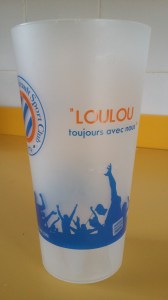 The guy who serves me at the buvette instantly detects that I am not French but sees my Montpellier T-shirt and so I explain that I dislike PSG; not as much as he does he replies.
It’s a good view from our backless plastic seats and we watch the players warm up. The PSG players are roundly booed as they come onto the field. We watch the stands fill up and are interested by the eclectic mix of spectators. Montpellierians tend to be keener on rugby than football and the average attendance at Stade de la Mosson last season was only 12,356, although the team were mostly struggling, finishing fifteenth out of twenty in Ligue 1. It is inevitable that there are a lot of people here today who probably rarely come to Mosson; many will have been drawn by the anticipated presence of Neymar, the world’s most ludicrously expensive footballer. Fortunately for the club, the tickets sold out long before PSG announced their squad would be minus Neymar. There are many families here but also a group of four young women who seem to be dressed more for a night out rather than a football match; they perhaps want to look their best for PSG and its millionaires. A happy looking man works hard up and down the aisles and staircases selling packets of cacahuètes and crisps from a tray; I buy a packet of the locally made crisps (2 euros) which are in a plain bag which carries no branding whatsoever, very good they are too.
Before the teams come on to the field there is a display of flag waving and then with much fanfare and the playing of the Ligue 1 theme music the teams take to the field led by Monsieur Clément Turpin possibly Europe’s finest current referee.


Montpellier wear an all navy blue kit with orange names and numbers on the back; oddly but fashionably the shoulders are a different colour too, a sort of burgundy. Paris St Germain wear an all yellow kit and they remind me of Leeds United of the 1970’s, not just because of the kit but because of how obvious it is that everybody in the ground except their own supporters loathes them. Like in most countries there is much antipathy between the regions and the capital in France, but Montpellier is deep in the south of the country just a few kilometres from the Mediterranean coast and that dislike of all things Parisian is even greater down here.
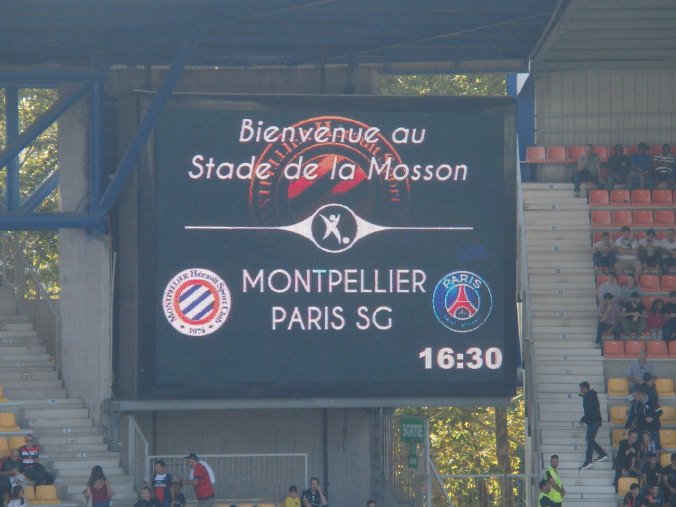
The game begins, Montpellier kicking towards the Tribune Petite Camargue, and predictably PSG don’t let go of the ball; they pass it around effortlessly and endlessly but Montpellier are not going to be a pushover, they chase and they tackle and every success is cheered wildly by the fiercely partisan home crowd. A couple of bangers are let off to our right somewhere and a fire cracker burns in the PSG goalmouth down in front of us. PSG’s Brazilian defender Marquinos is booked after just twelve minutes and the home supporters cheer like a goal has been scored; to please them that bit more PSG’s Italian hard-man Thiago Motta has a free-kick awarded against him and seems to hurt himself in the process of committing the foul.
There is a lot of football being played in this game, PSG are great to watch. There is the incredible speed and quickness of thought of Kylian Mbappé , the sheer presence of the rugged Edinson Cavani
 and the elegance of Adrien Rabiot with his pre-Raphaelite looks.
 The atmosphere is intoxicating with constant noise from both sets of ultras; the PSG fans ceaselessly waving flags and banners at the far end;
 a short while before half-time the PSG fans together raise their scarves aloft as English fans once did. The perpetual threat of a possible goal from PSG at any time is its own form of excitement, enhanced by the tension of 20,000 of us willing it not to happen. But as PSG go on longer without scoring, Montpellier get more into the game and come forward; there is a belief that they could grab a goal themselves which only adds to the churn of emotions, hopes and fears.
Half-time brings respite and a visit to the ‘toilette’, which is a bit dark and a little grim but there’s no queue, unlike for ‘the ladies where as is often the case there just aren’t enough cubicles. The bars are busy so I return to my seat to enjoy the scene and the warmth of this beautiful bright, late September afternoon. Looking out across the pitch it is plain to see that it isn’t in a very good condition; it is almost bare in places and if they don’t win PSG can always use that as an excuse.
As the second half begins the Tribune Minervois behind the far goal now casts a shadow over the penalty area at that end. The same pattern of play resumes with PSG dominating possession of the ball. The Montpellier defence is playing brilliantly however, and their captain, 40 year old Brazilian, Vittorino Hilton, a veteran of the 2012 title winning side is outstanding. At different times both Mbappé and Cavani look sure to score but don’t, but now Montpellier also get the opportunity to spurn chances. As much as most of us in the ground would love Montpellier to score, it is enough that PSG do not. For the impartial, if that is possible in this atmosphere, or for journalists, this game is probably not the best and indeed the following week’s France Football magazine will only give it 8 marks out of 20 in its summary of matches, although no match will get a mark higher than 14. But football matches are not just about the football. On 74 minutes the whole crowd breaks out into applause for Louis Nicollin the wealthy industrialist and former chairman of Montpellier Hérault SC who died on his 74th birthday during the summer. Nicollin was a legend in Montpellier and across France having led the club from the regional amateur leagues in the early 1970’s to Ligue 1 in the space of just eight years. Nicollin was affectionately known as ‘Loulou’ and this name adorns the team shirts this season and that plastic cup that I drank my beer from before the game. Despite the divisions between the ultras of Montpellier and PSG, Loulou succeeds in uniting them.
By now the shadow of the Tribune Minervois has lengthened to shroud the whole pitch and the four minutes of added on time are a final test, creating a terminal tension which explodes with joy and relief and pride with Monsieur Turpin’s final whistle. This has been a fantastic afternoon, a classic example of the underdog winning through, one of the very best things in football. As much as people love to hate clubs like PSG the pantomime villain has his place and if he didn’t exist he would need to be invented…as indeed he has been.


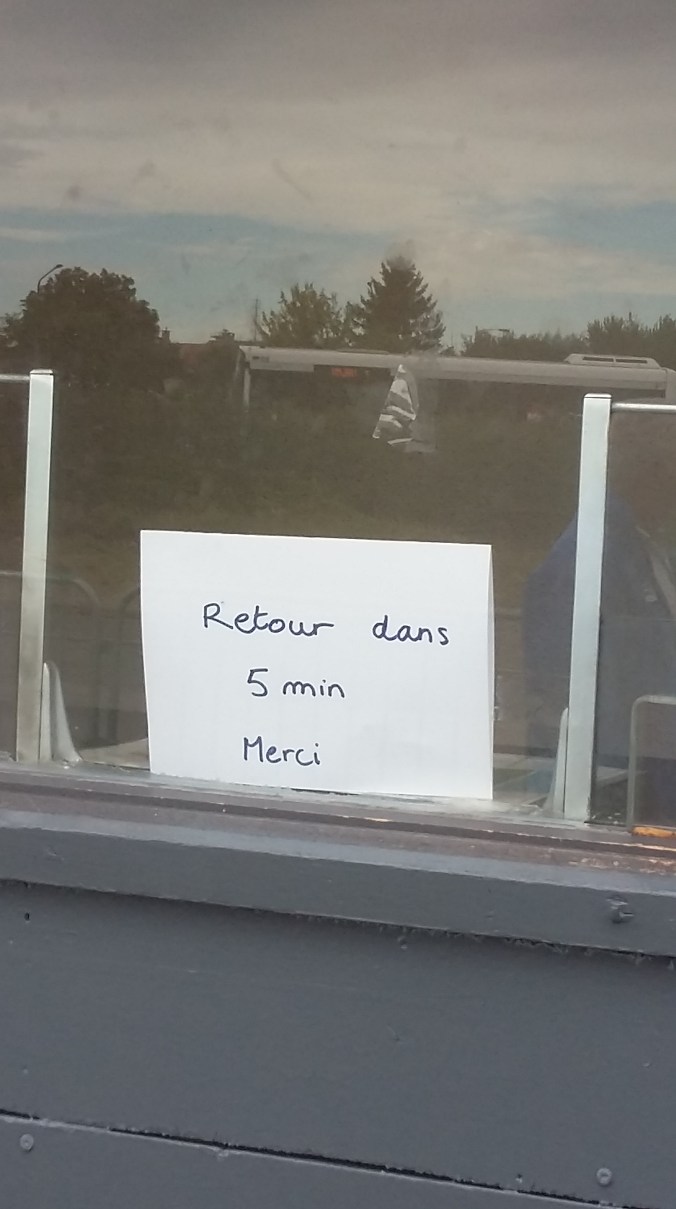
 at the Stade des Costières stadium earlier in the day to avoid any queue, although we did have to wait a short while because the sign in the window of the guichet read ‘back in five minutes’. Tickets for the main stand cost 14 euros, whilst those for the identical stand opposite are 9 euros and a ticket behind the goal costs 4 euros. We buy 9 euro tickets in the Tribune Sud (South stand). There are acres of free car parking all around the Stade des Costières and arriving a little more than an hour before kick-off it’s easy to park up near the exit for a quick getaway after the match. Nevertheless, there are plenty of people here already, buying tickets, standing about, socialising and heading to bars for a pre-match aperitif.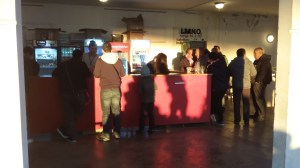
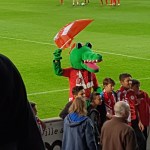 Nimes’ crocodile mascot does his rounds as people, mostly children, pose for selfies with him; I am very tempted but my wife gives me a look. With the teams’ and Ligue 2 banners on the pitch a man with a radio mike gees up the crowd as the teams enter from the corner of the ground. There are ultras both behind the goal and beside the pitch, waving flags, standing clapping and jumping about. The chant is “Allez-Nimois, Allez-Nimois”. I join in. Why the hell isn’t it like this at Ipswich? The crowd is less than half the size of that at Portman Road (6,771 tonight) but three, four, five, a hundred times more involved. There are just a handful of stewards in the stand; I don’t feel like I am here to be policed, but to enjoy the match.

 to see the tie with Clermontaise, who are from the town of Clermont l’Herault, some thirty kilometres to the north west.
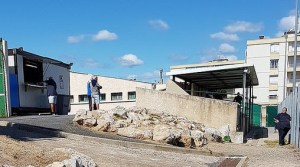
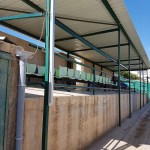 It looks like the original roof has been replaced with new metal sheeting on another metal frame, which obscures the row of the pitch from the front row of seats. We enter the stadium through a wide opening in the back wall and find ourselves in the players tunnel; it’s an entrance that is closed soon afterwards, but it’s not quite two -thirty yet and the game doesn’t kick off until three. A wonky sign points roughly in the direction of the buvette,
 which is a portakabin style structure with a counter even more wonky than the sign. To the other side of the stand is a dark room with high-up shelves of trophies on two walls and a bar counter;


 and the teams line up on the pitch. Balaruc wear an unattractive all-black kit with green trim, which displays no team badge or sponsor’s names. Clermontaise and Balaruc are in the same regional league (Poule A of the Languedoc-Rousillon section of the Occitanie region’s Division Honneur 2 – the seventh level of French football), but Clermontaise look much smarter and ‘professional’ in their all blue kit with badge. The McDonald’s golden arch logo is on the Clermontaise shorts; they can’t have read the poster on the table in the trophy room.
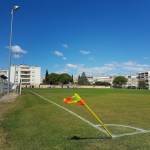 at the Mediterranean end of the ground. A bloke in a t-shirt and trakkie bottoms is called on to sort them out and once he has done so the game carries on. Early on Clermontaise look the better team, but it might just be because they’re wearing a nicer kit. Just before twenty past three it looks like they have scored, but I can’t tell if it was offside or the shot was missed. There are flattened practice goals either side of the real one and from my rock it’s hard to tell which is which.
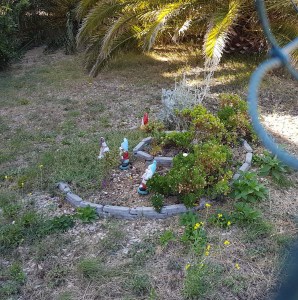 There are a number of people, mostly men in their sixties and seventies, sat at windows and balconies looking down on the game. I envy them their home comforts, it has to be better than perching like a lizard on a rock in the sun. Dissatisfied with my view sat on the rock, I watch the remainder of the first half standing up.
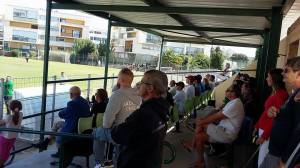 It proves to be a good choice and our enjoyment of the second half is much increased by our new location, which is shaded, out of the wind and high enough to see over the fence, with the added bonus of atmosphere as the stand is full; spectating nirvana.
 Monsieur Gerard Blanchet busy in front of us. Clermontaise’s number twelve confirms his presence by boldly attempting a shot from a thirty metre free kick; of course he misses, but not embarrassingly so. The Balaruc bookings continue and five blatantly kicks the Clermontaise twelve as he dribbles past him and three knocks over his opposite number as they run side by side. All afternoon tbere is a pleasing symmetry with many of the fouls and bookings as players with the same shirt number go for each other.
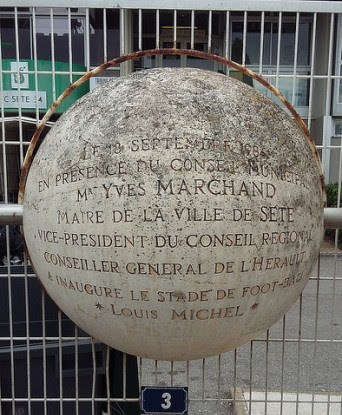
 near the Atlantic coast, some 380 kilometres away by road; they have won one and lost two of their four games so far. Kick-off is at six pm and we arrive about a half an hour beforehand, parking in the spacious gravel topped car park at the side of the Stade Louis Michel, although other spectators prefer to park in the road outside. Entry to the stadium costs €6 and we buy our tickets from the aptly porthole-shaped guichets
  outside the one gate into the ground. Just inside the gate a cardboard box propped on a chair provides a supply of the free eight-page, A4 sized programme ‘La Journal des Verts et Blancs’. Also today there is a separate team photo and fixture list on offer.
 the brutal angular concrete of the main stand, the Tribune Presidentielle, could be from the 1960’s or 1970’s, channeling the inspiration perhaps of Auguste Perret or even Le Corbusier. The concrete panels on the back of the stand are lightly decorated and sit above wide windows; a pair of curving staircases run up to the first floor around the main entrance,
  above which is a fret-cut dolphin, the symbol of the town and the club. The stand runs perhaps half the length of the pitch either side of the halfway line and holds about twelve hundred spectators, as well as club offices and changing rooms. Opposite the main stand a large bank of open,
  ‘temporary’ seating runs the length of the pitch, it is built up on an intricate lattice
  of steel supports. Behind both goals are well tended grass banks; there is a scoreboard at the end that backs onto the carpark.
 Sète in green and white hooped shirts with black shorts and socks, Stade Bordelais with black shirts with white shorts and socks. There is a ‘ceremonial’ kick-off before the real one, taken by a youmg woman with a green and white scarf draped around her shoulders. Eventually, referree Monsieur Guillaume Janin gives the signal for the game to start in earnest.
 man mountain with a wide shock of bleached hair on the top of his head, and thighs the size of other men’s waists.
 which is close by at the corner of the stand where we are sat. The reason for my eagerness is that Sète is the home of the tielle, a small, spicy, calamari and tomato pie, with a bread like case. I love a tielle, and I love that they are specific to Sete, and are served at the football ground as a half-time snack. I only wish there were English clubs that served local delicacies. Middlesbrough has its parmo, but I can’t think of any others. Do Southend United serve jellied eels or plates of winkles? Do West Ham United serve pie and mash? Do Newcastle United serve stotties? Did the McDonald’s in Anfield’s Kop serve lobscouse in a bun? I need to know. Sadly, I don’t think my town Ipswich even has a local dish. Many English clubs don’t even serve a local beer; Greene King doesn’t count because it is a national chain with all the blandness that entails.