Ipswich Town and Preston North End are arguably two of the least interesting teams in whatever it is that Football League Division Two is now called. Preston, despite being the original ‘Invincibles’ have not played in the top flight of English football since 1960 and now, almost famously, Ipswich have been becalmed, marooned, stuck in English football’s second tier for 15 years and nobody really expects either club to do much more than finish in mid-table. Ipswich manager Mick McCarthy said as much in his pre-match press conference; he is nothing if not truthful is our Mick. These two ‘small-town’ provincial clubs have both enjoyed a level of success in the past that far exceeds what might be expected of them and for that reason they are both very special.
It is a grey, wet, blustery, thoroughly autumnal day as I set out for the train station and the bright floodlights of Ipswich. The largely infrequent, but nevertheless large plops of rain are enough to warrant the carrying of an umbrella, which the wind blows inside out. A Colchester United fan boards the train with me, blissfully unaware that his team are destined to lose at home to non-league Oxford City later this afternoon in the first round of the FA Cup. A Town fan in a wheelchair sits by the sliding doors. Leaves swirl horizontally past the train window. Pulling out of Colchester the serried ranks of suburban homes look at their best on such a drab day; the wet tarmac of the estate road shining in front of them like a snail trail under torchlight. Opposite me a mother and daughter sit, each with the same long, blond/mousey hair and Roman nose. One is doing her best to look much younger, the other trying hard to look holder. It makes me feel guilty to be a man. At Manningtree the grey clouds and subdued colours of the trees in Dedham Vale are just right to keep John Constable at his easel and away from Portman Road this afternoon, but four other blokes get on and share their mild, blokey humour with one another. I look down out of the window and see a tomato plant on the track and three plump green tomatoes that will never be fried or ripen to be eaten in a Salade Nicoise.
The train arrives on time in Ipswich and the man in the wheelchair asks me to find a guard to get him off the train; happily, the first one I meet is on her way to get him.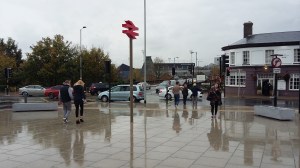 Outside, Ipswich is beautiful in a grey, wet and shiny sort of a way. I head down Princes Street then down and up Portman Road to St Matthews Street and St Jude’ s Tavern. In Portman Road the turnstiles are already open, stewards fiddle with their metal detectors and the sniffer dog and his handler peer up the street. I think about buying a match programme as I approach the kiosk and read ‘Here to help’ on the back of the seller’s jacket. I am tempted to test the boast by asking if the programme is worth the £3 I would be expected to pay for it.


I chicken out and walk on, saving my cash to spend just two-thirds of it on a pint of Nethergate IPA at St Jude’s; it’s cheap because it is today’s Match Day Special! It is so good  I have another and then, to avoid feeling like a complete skinflint I pay full price (£3.40) for a pint of Bearstown Polar Eclipse, a dark beer which is exceedingly good. At the table next to me in the pub are a group of five Preston North End fans; I tell them I have heard good things of their bus station and they smile, sort of. It transpires that none of them now lives in Preston. One of them tells me they are literally ‘exiles’; I don’t ask. I chat off and on with them and one confides that Ipswich are still the best team he has ever seen play against Preston; in an FA Cup third round match in 1979 which Town won 3-0. It is one of those “aw shucks” moments to hear my team complimented so. Another one of the group tells me how amazed they are that St Jude’s is so close Portman Road, is such a good pub and yet isn’t rammed to the gills. I confide that Ipswich fans don’t seem to ‘get’ real ale and it reminds me of how in Hunter Davies’ book ‘The Glory Game’ a Spurs skinhead says how Ipswich is his favourite place to visit, “More cunt” he says “They ain’t got no supporters. All the geezers up there don’t know what it’s for. We always stay the night there and chase their birds’. That was in 1972; that skinhead later became Defence Minister, allegedly……
I bid farewell to the good Prestonians, wishing them a happy season as they leave for the match before I visit the lavatory and then set off for Portman Road myself, remembering to return my empty glass to the bar before I leave. As I turn into Portman Road I notice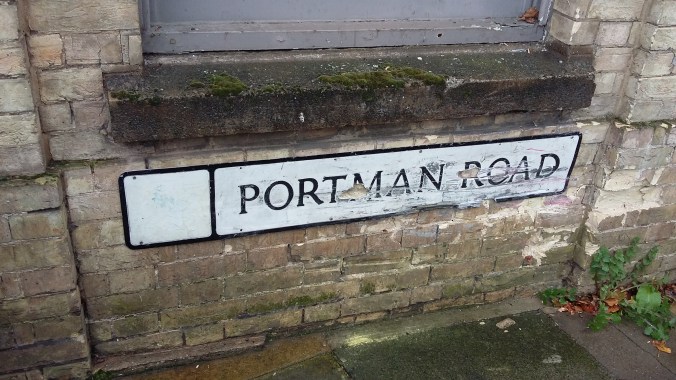 the poor state of the street name plate, which looks like someone has got at it with an angle grinder. Slightly upset that anyone could do this to something that signifies an Ipswich icon, I nevertheless continue on my way. The weather has cleared up and


although the floodlights are on, the lowering sun is still to be seen over the silver roof of the north stand, or Sir Bobby Robson stand as it is now known. I pass on down Portman Road and the statue of Sir Bobby seems to point me on my way, which is unnecessarily helpful of him. I glance up at the Cobbold Stand admiring the rhythm of its concrete stanchions, although no doubt it fails to impress the Preston fans, spoiled by their fabulous Grade II listed, Brutalist, bus station. There is no queue at the turnstile and no security check to ensure I am not a suicide bomber or concealing a musical instrument about my person, which would be a serious breach of ground regulations.
Before today’s match there is a minute’s silence because this is the closest day to Armistice Day on which Town have a home match and apparently the club wants to pay its respects. It is weird, in all those years when there were most people still alive who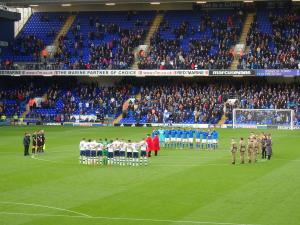 fought in the two greatest conflicts ever, the two World Wars, a minute’s silence only took place at 11 am on the 11th of November and on Remembrance Sunday; nowadays it’s best to tread softly at this time of year when entering a football stadium in case you inadvertently interrupt one. There are eight paratroopers in the centre circle and a lone bugler who plays the last post. The bugler is miked up and relayed through the PA system, but unfortunately because the PA system is so loud there is feedback or reverb and a simultaneous ‘farted’ rendition of the last post is heard through the loudspeakers. According to Wikipaedia, Le Pétomane, Joseph Pujol the French ‘flatulist’ retired from the stage because he was so horrified by the inhumanity of the First World War.
The paratroopers march off and around the pitch as people applaud and into the lower tier of the Sir Alf Ramsey stand where they break ranks and begin to fumble in their  tunic pockets for their match tickets, looking a bit confused as to where they are supposed to sit. The game begins. It’s awful. Perhaps one of the worst forty five minutes of ‘football’ I have ever seen. Nothing of any genuine sporting interest happens. Preston players fall over a lot, but the Ipswich trainer is also called on to attend to the fallen and all that really happens is that added-on time is racked up. Even Crazee the Ipswich Town mascot looks to have given up all hope today as he
 hangs his head despairingly, standing at the top of the stairs. Mick MCarthy adopts various poses, showing himself off to good effect in his nylon tracksuit. I spend a little time looking at the Preston supporters to see if I can spot the blokes I was in the pub with; in a following of about 430 it’s not that difficult and I pick them out all sat in a row. I wonder what they are making of the game.
 My attention is then caught by the Preston number four Ben Pearson because his hair is longer than that of the other players; watching it flow and flop and bounce as he runs about is more entertaining than the game and I am reminded of Adrian Rabiot of Paris St Germain, as I often am by my wife who is besotted with him. But Pearson is no Rabiot and he needs more work on his hair.
As ever, the Portman Road crowd (14,390 today) is very quiet; there is a momentary rumble of drums at the start of the match and some muffled chants but they soon lose interest in getting behind the team. I chant and clap “Ipswich! Ipswich! Ipswich!” when a corner is won, but am ignored in the same way that people would put their heads down and pass quickly on past a drunken derelict shouting at passing cars. The first and only ripple of anything like enthusiasm manifests itself on 23 minutes when the crowd cheer the booking of Preston’s Jorgan Hugill; that’s what they thrive on in Ipswich, Schadenfreude. Incidentally, Hugill is a man who, with his World War One conscript style hair cut looks from a distance a bit like Terry Hall formerly of The Specials and Fun Boy Three. Preston have many injured players who cannot play today and with a weakened team it seems that they are banking on ensuring no football is played, in the belief or hope that twenty two blokes just running around and occasionally falling over will result in a goalless draw. Sadly Ipswich don’t have the wit or guile to prevent this and have a bit of a record of adopting a similar tactic in recent seasons, relying on randomly won free-kicks and corners to create goalmouth confusion and hopefully goals, albeit scrappy ones. All goes well for Preston until Ipswich’s Martyn Waghorn wins a free-kick some 25 metres from goal. It’s a chance to by-pass the awkward footballing bit of the game and just kick the ball over the assembled human wall of Preston players and straight at the goal. This is what Martyn Waghorn proceeds to do, sweeping the ball majestically over that Maginot Line and into the goal as Preston’s goalkeeper Chris Maxwell helpfully throws himself out of the way. Within five minutes added-on time there is a moment in which Preston’s dreadlocked Daniel Johnson launches the ball on to the top of the Ipswich cross-bar with a flash of inspiration, but then it’s half time. The crowd applaud as Town leave the field, forgetting the first forty-four minutes of the match and only recalling the last five in which Town took the lead. But I have mentioned it, lest we forget.
I seek out a former work colleague at half-time who I had spoken to on the phone the day before; he sits with his grandson who has cerebral palsy. I then meet another friend Phil, who is famous as a man who has seen over a thousand consecutive competitive Town

Phil (bottom right)
games home and away; he gets featured in articles and stuff, not just blogs that very few people read. Phil is a proper supporter, whose love for Ipswich Town is unconditional. He doesn’t whine when Town lose, or hurl abuse at Mick McCarthy, he’s too busy worrying if he might miss the next game.
Within three minutes of the resumption of play Town are 2-0 up as David McGoldrick rises at the far post to head in a right wing cross. Phil jumps up much more enthusiastically than I do, but then he is a good ten years younger than me. People around me are happier now, but even before the goal they seem generally lighter of mood in this little bit of the Sir Alf Ramsey Stand than they do where I usually sit. It’s as if the first half was July 28th to December 24th 1914 and now it’s Christmas Day and a football match has spontaneously broken out.
Things get better still as a move down the right sees Ipswich’s Kosovan loanee Bursant Celina forge his way into the penalty area and surprise everyone by suddenly booting the ball into the goal past the goalkeeper, who is inevitably by now hapless. Phil and I chant “Ohhh, Bursant Celina” to the tune of Seven Nation Army by the White Stripes. No one else joins in. Preston are now forced to seriously alter their game plan and Ipswich are therefore required to defend more, so we don’t see any more goals today. Ipswich fans are happy and smiling and there are even some chants at the other end of the ground. The North standers, their confidence boosted by the three goal cushion, remember that the Preston manager was previously the Norwich City manager; “Alex Neal; what a wanker” they sing.
Those seeking out the familiar territory of disappointment can do so by reflecting that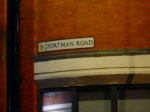 Ipswich haven’t scored four or five goals today, but to be fair to the team they have achieved a very respectable victory by playing just half a game. With the final whistle I applaud the team and then file away with everyone else into Saturday evening. At the southern end of Portman Road the street nameplate which sits at first floor level on the Archant building looks pristine in contrast to that at the northern end.
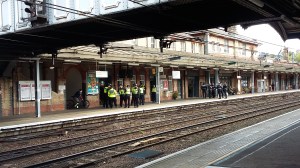 who wait by the foot of the pedestrian bridge. Outside there are more police, and more, and more, and more. There are white police vans with mesh grilles to cover the windows, motor bikes, dogs, horses, Kevlar, helmets and batons. I thought I was travelling to a football match, but I appear to have arrived in Paris in May 1968, or Brixton in the summer of 1981.
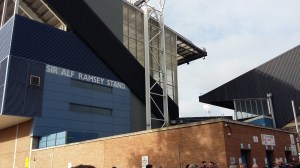 by which I quickly surmise he means is my seat in the Sir Alf Ramsey stand, but not before I laugh and it crosses my mind to say “No I’m not, and I don’t think you’ll find him here today, he died in 1999.” I think there is a flicker of recognition across the policeman’s face that his question was a bit daft or at best poorly framed, but I’m not completely sure. I don’t know why he picked out me to ask. Perhaps I looked a bit lost, I feel it. There are metal barriers along Portman Road to usher the Norwich people into their area of the Cobbold Stand and tables are stood before the turnstiles where bags are being searched, but no one is being patted down, so it would be possible to smuggle in a flare or smoke canister or firecracker under your coat, if that was your thing.
 it doesn’t look that impressive and would look better if some bands of seats had been given white cards to hold up; at least the club has tried however. I am confident of an Ipswich win today based on the law of averages: Town having not recorded a victory in any of the last eight matches between the clubs it’s about time they did.
 likely that standing to pee is as much as many of the regulars can manage. But the front of the Alf Ramsey Stand is close to the seats where the Norwich people are accommodated and therefore if you like nothing more than spending an afternoon making masturbatory gestures, gurning and telling people they are ‘scum’ and should ‘fuck off’, it’s the only place to be. There are a few chants from Ipswich supporters but very few from the Sir Alf Ramsey stand lower tier, which is more full than usual, but seemingly no more likely to burst into song in support of the team, despite its newly acquired standing contingent.
 Back up in the stand one of Town’s more senior supporters tucks into a ham sandwich that he brought to the match wrapped in tin foil.
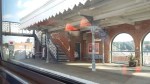 and Melton past Westerfield and through disused Bealings station. On into the Suffolk countryside the ride becomes more and more rural. It’s a journey for geographers, biologists and historians as we pass through sands and boulder clays, marshes and broads, passing cows and horses, pigs and sheep, an albino pheasant, partridges, ash and oak, gorse and broom, flint churches, a World War 2 pill box and thatched cottages. Football fans who know what they’re looking for can spot the floodlights of Woodbridge Town Football Club, and further up the line College Meadow, where Beccles Town are destined to lose 0-3 at home to Debenham in the Suffolk Senior Cup later this afternoon, is right next to the station.
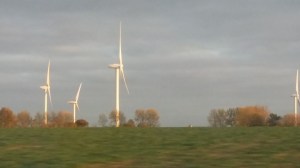 under towering pylons marching two by two from Sizewell nuclear power station whose dome is visible in the distance over the tops of trees; there’s a windmill and wind turbines. This is a wonderful journey on a beautiful, bright autumn day.


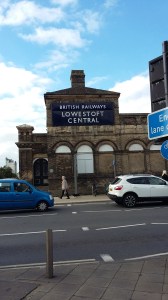 the bottom of the High Street. It’s the end of the line and it looks it, a handsome Victorian building that’s too big for the two lines that host the buses on rails that rattle in through wonderful East Anglian landscapes from both Ipswich and Norwich. It’s a town that has undoubtedly seen better days, it expanded in the late nineteenth century on the back of industrial scale fishing, an unsustainable activity like coal mining and as that industry declined so the town lost its raison d’etre. It had other industries such as bus body building (Eastern Coachworks) but with the de-nationalisation of bus travel that closed too.
 The streets are of terraced houses and even a couple of back street boozers, an alleyway runs down the back of the main stand; this is a proper football ground with a vista of chimney pots and residential roof tops. You can see where the supporters live here, not where they buy their weekly groceries, or go bowling and to the cinema. Lowestoft Town have been at Crown Meadow since 1894.
 talking occasionally but also reading and another three, one of whom sports a Kingstonian shirt, sit at a table by the door. One of the Kingstonian group looks at least 70 and surprises me by suddenly mentioning Depeche Mode, although he seems to think David Sylvian was lead singer and is quickly corrected by the wearer of the shirt. I bemoan to myself that the conversation between the sort of blokes who frequent real-ale pubs often sounds like they are just waiting for the pub-quiz to start.

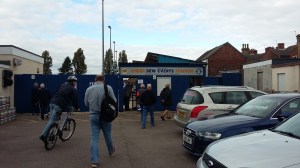 Amber Dew Events Stadium”; it should say that it’s real and lasting name is Crown Meadow but it doesn’t. “What is it? A tenner?” I ask of the lady turnstile operator. “Eleven” she says, adding “If you’re an adult, are you?” I laugh, “Nooo, I’m not an adult” I say perhaps a little too sarcastically, but later I think maybe she thought I’m a pensioner. I reckon £11 to watch non-league, part-time football is a bit steep, and although it’s no more than other clubs charge at this level, in France it cost less (9 Euros) to watch a fully professional match (Nimes v Auxerre) in Ligue 2. C’est la vie. Just inside the turnstile programmes are sold from a table for £2, I buy one.
 Inside the kiosk a middle aged man attends the deep fat fryer and a young woman takes the money, whilst surreally a second older man is asleep on a chair.
 From the usual football food menu I opt for the ‘hot dog’ (£3.50), which consists of two very ordinary sausages with onions (optional), in what turns out to be a very crumbly
 girlie depending on your point of view, but also because he is very involved in the game and hits a decent long pass. It is probably a good thing that men are once again comfortable wearing a pony tail, but I’m glad that a rubber band or scrunchy did not deny me the sight of the flowing locks of Mario Kempes, Kevin Beattie and Gunter Netzer back in the 1970’s. For Lowestoft, their number eleven Cruise Nyadzyo seems keen to get the ball forward, but too often his crosses pick out no one in particular. I multi-task by walking around the ground and watching the match at the same time. A steward eyes me suspiciously. There is a country bus shelter type structure behind the far goal which sports on its back wall a trawler-shaped memorial plaque to one Ted Lightfoot.


 I want to tell them to relax, grow their hair, wear shades and a beret; they surely only dress like they do so people know that they are the club officials. I smile to myself. The main stand is a lovely, low, gloomy structure with a deep, grey fascia beneath the roof and glass screens at either end. Inside the stand there are no plastic seats like those found at most grounds; here they have the original cast iron frames with beautifully mellowed, curved wooden backs and wooden tip up seats. The stand has no stanchions to block your view suggesting it might be of a cantilever design, in which case it was an early one. Despite lashings of blue paint, it’s dull and utilitarian; but it’s beautiful and a candidate for local listing by Waveney District Council. Club officials in de-mob suits, brogues and fedoras, and smoking pipes would not look out of place in this stand.
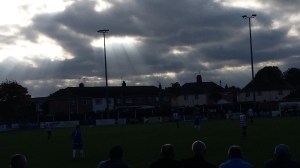 the burst of sunlight that breaks through the mass of cloud that started to hang low over Lowestoft this afternoon whilst I was in the Triangle Tavern. For all its beauty, this stand is on the wrong side of the pitch and a hundred or more people squint in unison. There are more shouts of “Come On You Blues” as people sense victory is possible, but this seems to make some older supporters sat behind me a bit tetchy too. Mr Quick the referee receives some mild abuse for one or two of his decisions and there is clearly a belief that the world and in particular Mr Quick is against Lowestoft. But according to Wikipedia, this is a town with three UKIP councillors, so fear and a lack of logic are common currency.
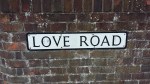
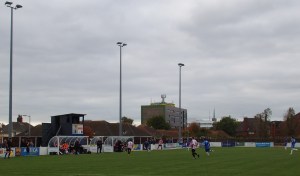 Oblivious of medieval flintwork the commentary continues from from behind me, particularly when Cruise Nyadzyo is substituted; it’s not a popular decision. The view seems to be that he was the best player on the pitch. Things don’t get any better in the eyes of the mainstanders as Kingstonian’s Thomas Derry strikes the cross-bar with a header from a corner. But taking the best player off seems to have no lasting effect, perhaps it makes the other players work harder, and soon afterwards a low right-wing cross from Lowestoft’s number eight Sam Borrer is easily kicked into the Kingstonian net from close range by Jake Reed and Lowestoft lead 2-0. Going further behind seems to be just what Kingstonian needed to do however, in order to raise their game and they eventually score a goal too, from a free-kick off the head of number five Michell Gough. The remainder of the game involves Kingstonian trying to equalise and Lowestoft trying not to concede. I leave my seat to stand closer to the exit because when the final whistle blows it won’t leave long to get to the railway station for the 17:07 train. Eventually at 16:58 Mr Quick calls time and I sprint off down Love Road leaving the victorious Trawlerboys behind me; I make it onto the train with nearly three minutes to spare.


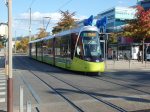 which glides through narrow central streets into broad squares of fountains, trees and majestic buildings. Why are French provincial cities so much more attractive and inviting than our own? St Etienne isn’t even that big, with a population of the town itself being about 150,000; vistas of the green hills outside the town are visible along some city streets. It’s an industrial town built up on coal mines and manufacturing like Sunderland or Salford but that’s where the comparison ends.


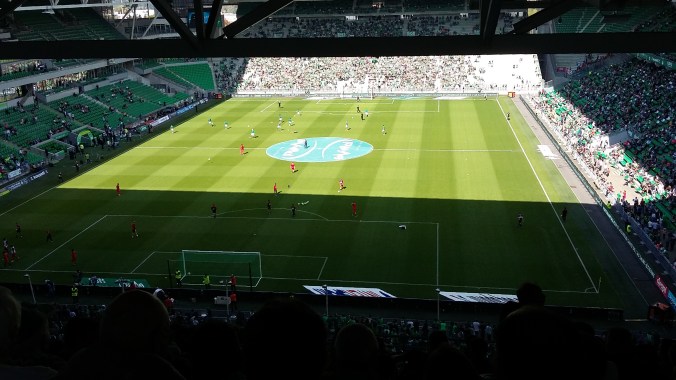 But even with an interrupted view, it is a mightily impressive stadium; fundamentally it is a traditional arrangement of four individual stands around the pitch, but they have been unified by the placing of a massive steel box over the top of them with irregularly shaped cut outs in the faces of the box. It is a simple idea and it works brilliantly, creating an imposing building, the outside of which doesn’t give a clue as to what the inside is like; it could easily be a factory viewed from the outside, which is wholly appropriate for St Etienne. The retention of the traditional four stands on each side of pitch successfully avoids the risk of this being a bland, anonymous bowl of a stadium.

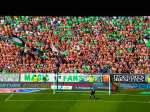 Below, the ultras are urged on and orchestrated by blokes with megaphones. At most French grounds I have been to there might be two blokes sharing one megaphone; today at one time I see as many as five each stood up high facing the supporters with his own megaphone. There seem to be parties going on down there with
 outbreaks of frenzied pogoing in the centre, but in general just expressing a great communal support for their team. The ultras at each end of the stadium call to one another in song, it’s like some sort of very noisy religious service and it’s haunting, beautiful even. But then, French is the language of song. A young bloke in the seat but one next to me clearly longs to be down amongst the ultras as he bawls and shouts fiercely and joins in with songs which turn into solos, because he is so far from the main congregation. Children turn round to look at him and his girlfriend seems quite proud. Much of the crowd noise is independent of events on the pitch, it just happens constantly, an avant garde soundtrack of incidental drums and chants. Nevertheless, the stream of sound wobbles from time to time as referee Monsieur Miguelgorry does something like booking Assane Dioussé after four minutes Kevin Theophile-Catherine after thirty-one and Saidy Janko three minutes later.
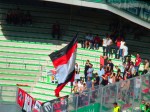 Forty odd Rennes fans are filled with a belief that it was worth travelling the best part of 750 kilometres to be here.
 feature a very stylish, well dressed and attractive looking couple; after they’ve emptied their bladders I’d be happy to spend time with either of them.
 park and ride tram station in Mosson, or La Paillade as it is colloquially known. It costs just 2 euros to park. It’s early, not much after 3 o’clock and the game won’t kick off until 5 pm. We dawdle out of the car park towards the stadium enjoying the warm afternoon sun. I am supporting Montpellier today because like a lot of football supporters I despise clubs like Chelsea, Billericay Town and Salford City that are bankrolled by people with too much money. But also I first saw Montpellier in 2011 against PSG (they lost 0-3) and followed their results for the rest of that season, in which they ended up winning the Ligue 1 title. I like their navy blue and orange kit too and added to which Montpellier is a very attractive and exciting city. The upshot is today I am wearing a Montpellier Hérault SC t-shirt, and as we cross the car park I exchange glances with a PSG fan who is stood with two women under the shade of a tree enjoying a snack and a drink. He rolls his eyes at my T-shirt and smiles and so I decide to stop and try and talk with him. Happily neither his English nor my French are so inadequate that we can’t make ourselves understood to one another. I tell him that I really support Ipswich Town and he rolls his eyes again, although he agrees that they had a good team a long time ago; he believes that Chelsea and Liverpool are okay, but then I’d expect as much from the sort of person who supports France’s most hated club. My wife tells him her team is Portsmouth, which he doesn’t understand until she pronounces it ‘Ports-moose’. He is in his fifties, a scruffy looking bloke in a denim jacket with a beard and long hair; he and his wife and daughter live in Béziers but he is a PSG ultra; he grew up in Paris and his dad took him to watch PSG at the Parc des Princes as a boy. Having both shared our deep disappointment over Brexit (every German, Belgian and Frenchman I have spoken to seems as upset as me) and probably exhausted our respective vocabularies in each other’s language we wish one another well and my wife and I carry on towards the stadium.
 A blacked out Mercedes minivan is guided through the road block behind two police motor cycles and an army of policemen look on, some in full Kevlar riot gear, one or two with sub-machine guns, including one who looks a bit like the late John Le Mesurier.
 Later we learn that former president Nicolas Sarkozy was at the game and it is likely it was him in the Mercedes.

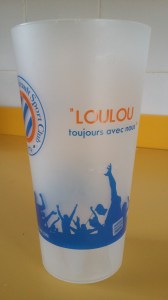 The guy who serves me at the buvette instantly detects that I am not French but sees my Montpellier T-shirt and so I explain that I dislike PSG; not as much as he does he replies.
 crisps from a tray; I buy a packet of the locally made crisps (2 euros) which are in a plain bag which carries no branding whatsoever, very good they are too.

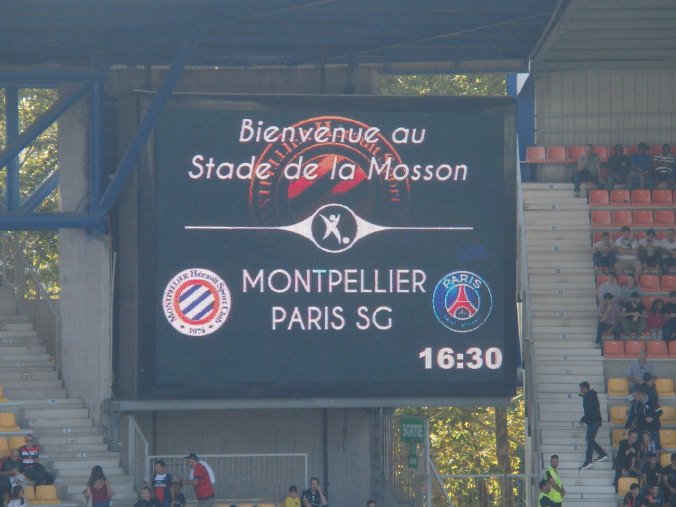

 , the sheer presence of the rugged Edinson Cavani
 and the elegance of Adrien Rabiot with his pre-Raphaelite looks.
 The atmosphere is intoxicating with constant noise from both sets of ultras; the PSG fans ceaselessly waving flags and banners at the far end;
 a short while before half-time the PSG fans together raise their scarves aloft as English fans once did. The perpetual threat of a possible goal from PSG at any time is its own form of excitement, enhanced by the tension of 20,000 of us willing it not to happen. But as PSG go on longer without scoring, Montpellier get more into the game and come forward; there is a belief that they could grab a goal themselves which only adds to the churn of emotions, hopes and fears.
 a veteran of the 2012 title winning side is outstanding. At different times both Mbappé and Cavani look sure to score but don’t, but now Montpellier also get the opportunity to spurn chances. As much as most of us in the ground would love Montpellier to score, it is enough that PSG do not. For the impartial, if that is possible in this atmosphere, or for journalists, this game is probably not the best and indeed the following week’s France Football magazine will only give it 8 marks out of 20 in its summary of matches, although no match will get a mark higher than 14. But football matches are not just about the football. On 74 minutes the whole crowd breaks out into applause for Louis Nicollin the wealthy industrialist and former chairman of Montpellier Hérault SC who died on his 74th birthday during the summer. Nicollin was a legend in Montpellier and across France having led the club from the regional amateur leagues in the early 1970’s to Ligue 1 in the space of just eight years. Nicollin was affectionately known as ‘Loulou’ and this name adorns the team shirts this season and that plastic cup that I drank my beer from before the game. Despite the divisions between the ultras of Montpellier and PSG, Loulou succeeds in uniting them.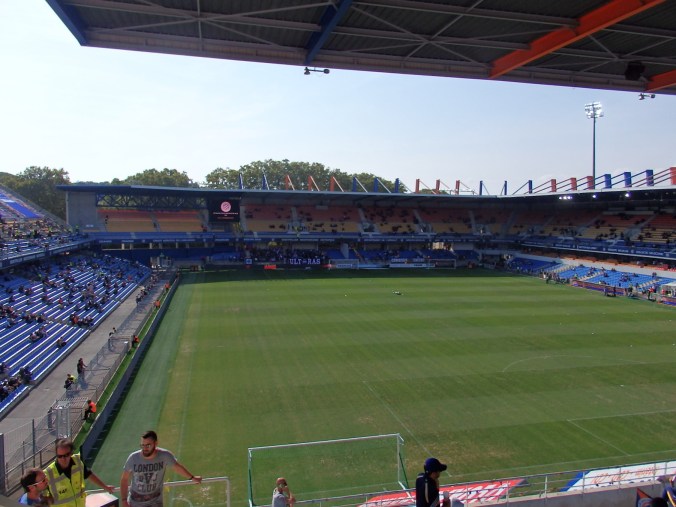
 trippingovertheball