It’s a cool, almost cold, still, grey autumn day. As I walk down through Gippeswyk Park a leaden pillow of cloud hangs over the town and Portman Road. I march on through the gathering crowds, past people perched on car park railings folding foamy bread, heavy with sauce-laden sausage into their gaping mouths. I stop only briefly to buy a programme (£3.50) and to put a coin in a collection box for an NHS charity, although I thought that’s what we paid our taxes for; I guess we’re being asked to make up the shortfall for the very wealthy and those companies like Amazon who could pay more, but choose not to because how else is their owner expected to be the richest man in the world and launch ageing actors who once played fictional astronauts into space.
At the Arbor House (formerly the Arboretum), Mick is already sat at a table enjoying a pint of Mauldon’s Suffolk Pride. I toy with the thought of copying him but opt for a pint of Mauldon’s Phantom (£3.90), it occurs to me that the beer seems to increase in price by 10 pence every time I come here. I join Mick to discuss how we’ve passed our respective weeks and other assorted issues of our times, including driving a hearse on the M25, cycling in Belgium, the Kray twins and East Suffolk County Council police houses. At twenty minutes to three we depart for Portman Road, as do the three people sat at an adjacent table, we follow them down High Street.
Mick and I bid our adieus near the turnstiles close to the corner of Sir Alf Ramsey Way and Constantine Road, Mick’s seat is in the upper tier of what is now called the Magnus Group stand; I’m in the cheap seats at the bottom of the Sir Alf Ramsey Stand. Having vouched for my being double-jabbed I enter the ground through turnstile sixty-one, which I select over turnstiles fifty-nine and sixty because 1961 was when we won the Second Division for the first time. I make my way through the undercroft of the stand having put on my face mask, although few others have the decency to do likewise, and Ipswich has the country’s highest Covid infection rates.
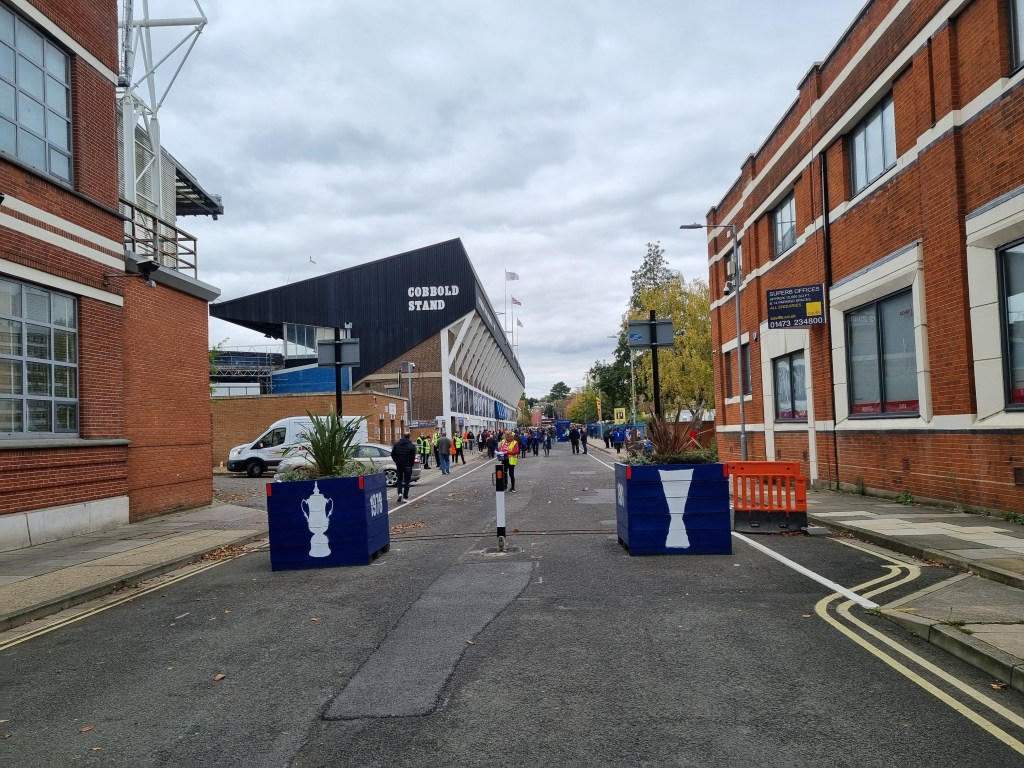
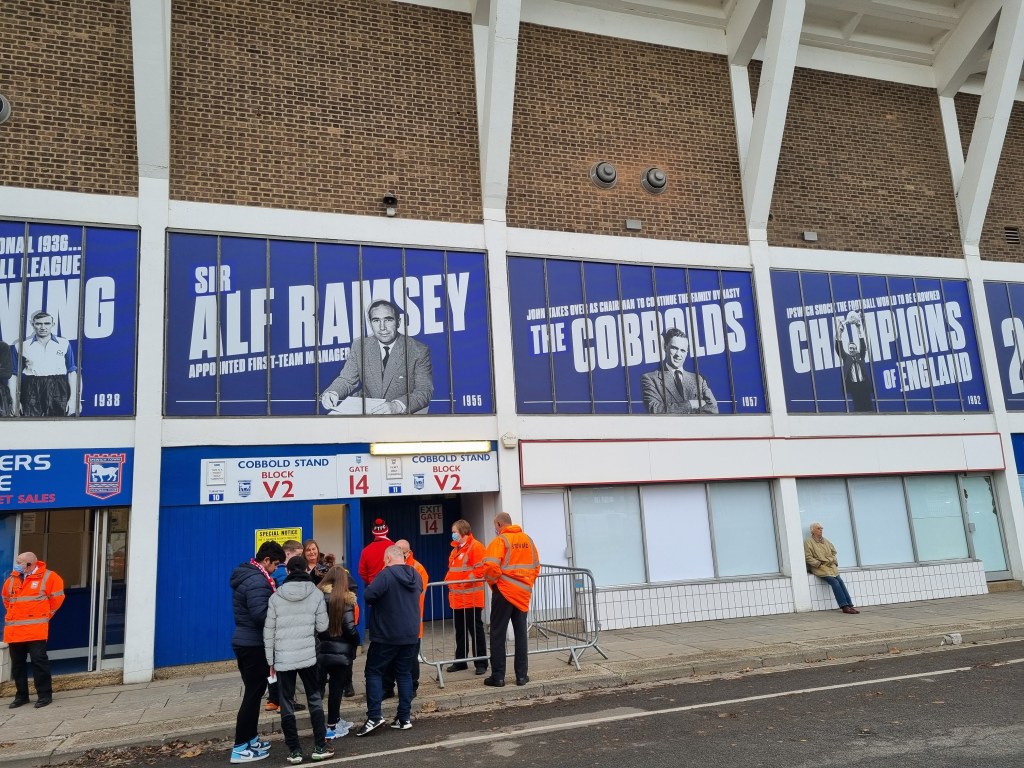

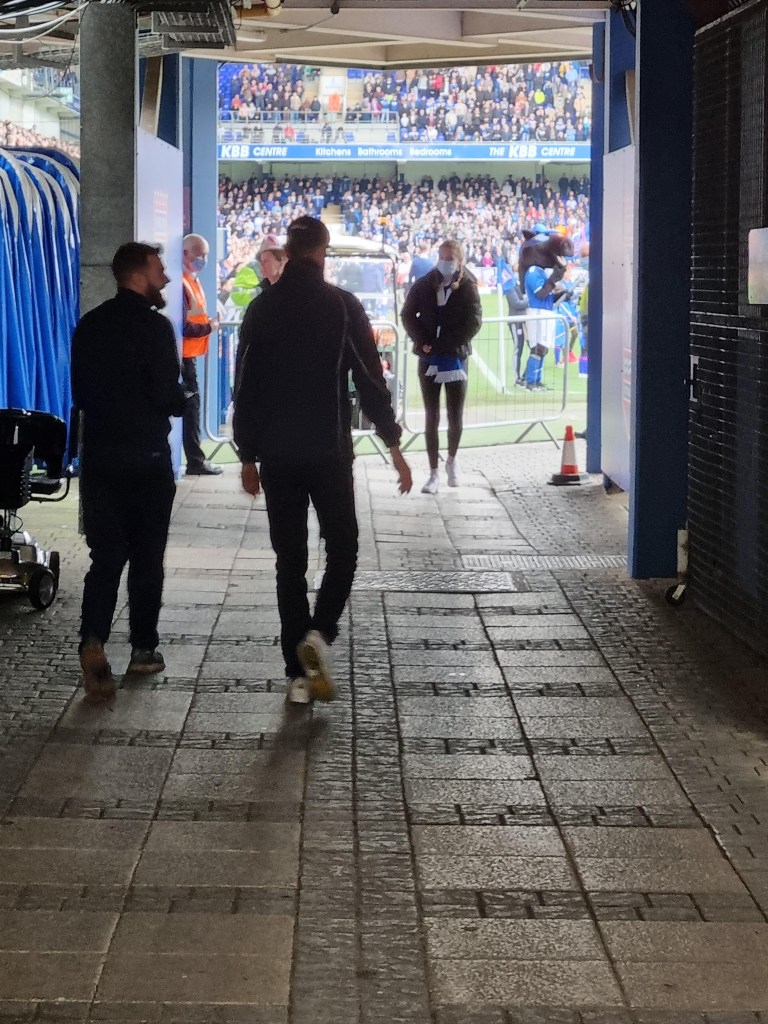
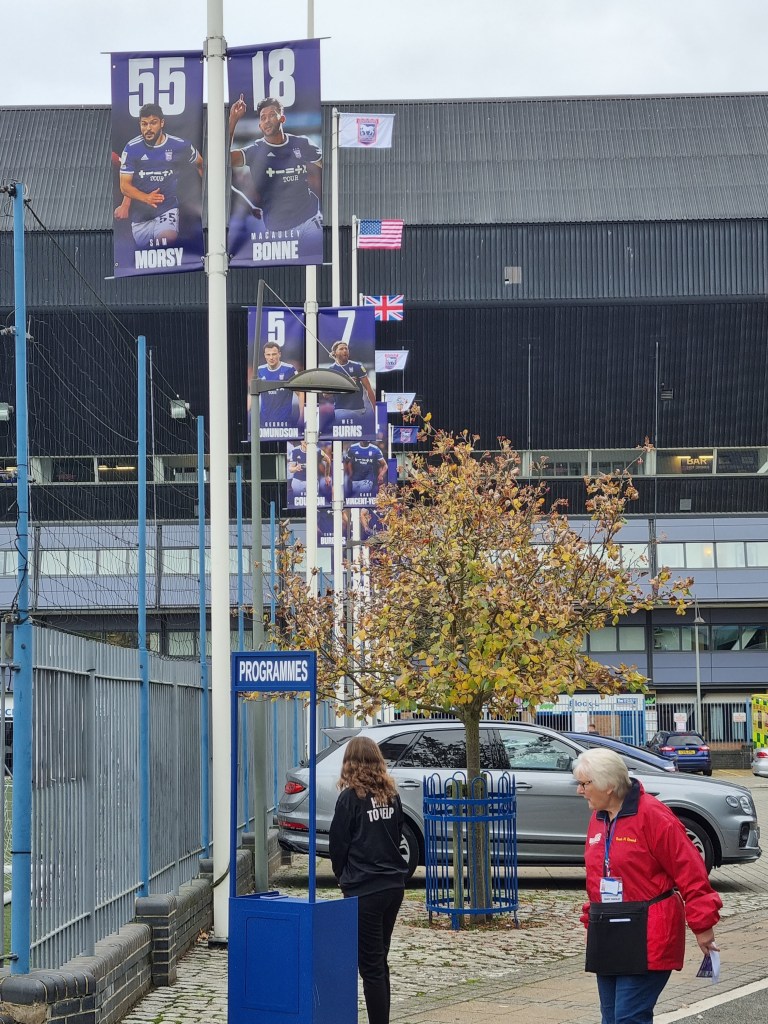
The teams are walking out on to the pitch as I shuffle past Pat from Clacton and Fiona to my seat. “We were getting worried about you” says Pat as I sit down, and in dipping my head my glasses fly off. “You’ve every reason to be” I reply. The Beatles ‘Hey Jude’ plays and people join in with the na-na-nas. The floodlights are already on and with knees taken and applauded, at a minute past three the game begins. Town are attempting to put the ball in the goal just in front of me, Pat from Clacton, Fiona, ever-present Phil who never misses a game and his son Elwood. In their red shirts with white sleeves Fleetwood look like a bargain basement Arsenal, and it’s good to see a team not change their kit unnecessarily just because they’re playing away from home; both teams are even wearing white shorts!
Just a minute of the game has passed and already the Sir Bobby Robson stand are singing “Hark now hear the Ipswich sing, the Norwich ran away, and we will fight for evermore because of Boxing Day” as if to reiterate the often made point that Christmas seems to get earlier every year. Town win a corner. “Come on you Blues” I bellow hopefully. “Is that Martin?” says Phil, turning round to Pat to ask a question to which he already knows the answer.
It’s early, the game is still settling down and the crowd are getting accustomed to what they are seeing before them. The referee Sam Allison is black; a voice behind me says “Uriah Rennie, innit”, a comment which unfortunately is unthinkingly racist, although I have no doubt it was not intended as such, but at least it does highlight the scarcity of black football referees despite there being a lot of black footballers.
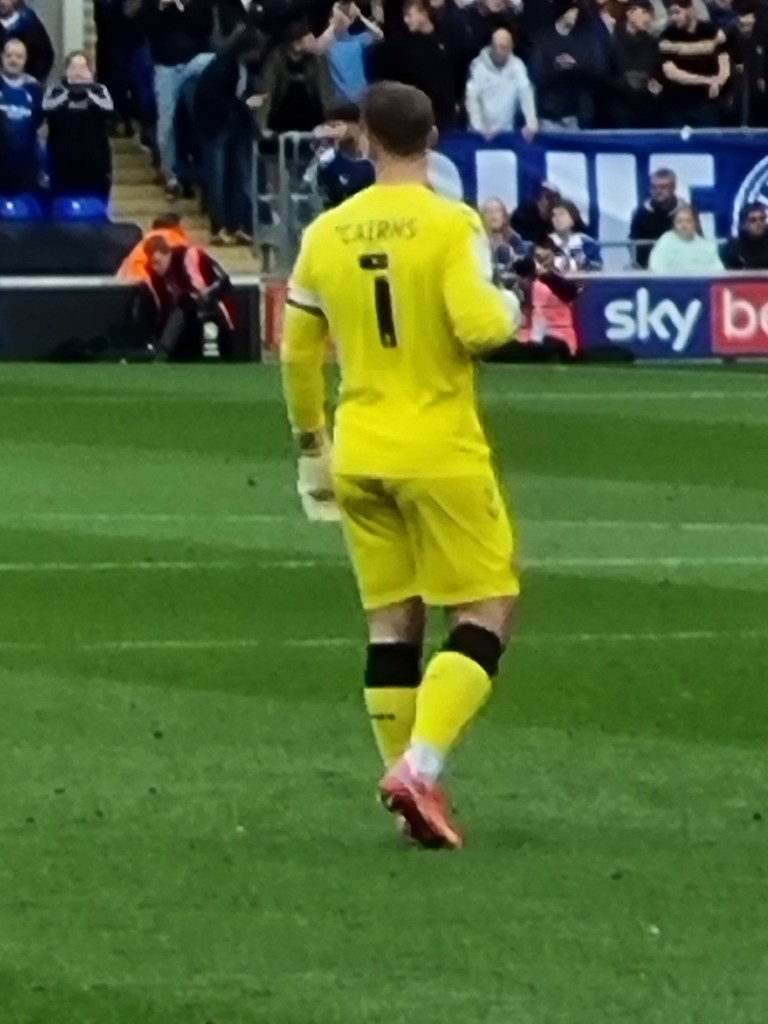
Ten minutes pass and it looks as if Fleetwood almost score; Gerard Garner appearing from my low down, distant view to beat three players before having a shot blocked. Four minutes later and Town have a goal disallowed as the oddly named Macauley Bonne heads in a free-kick, but is considered by the assistant referee to be have been offside. Another five minutes later and Bonne directs a free header at the Fleetwood goalkeeper Alex Cairns, a large man who has made the double fashion faux-pas of wearing dark pants beneath his yellow shorts and displaying a distinct VPL. Cairns is however one of the few footballers to share a surname with the name of a northern Australian city.
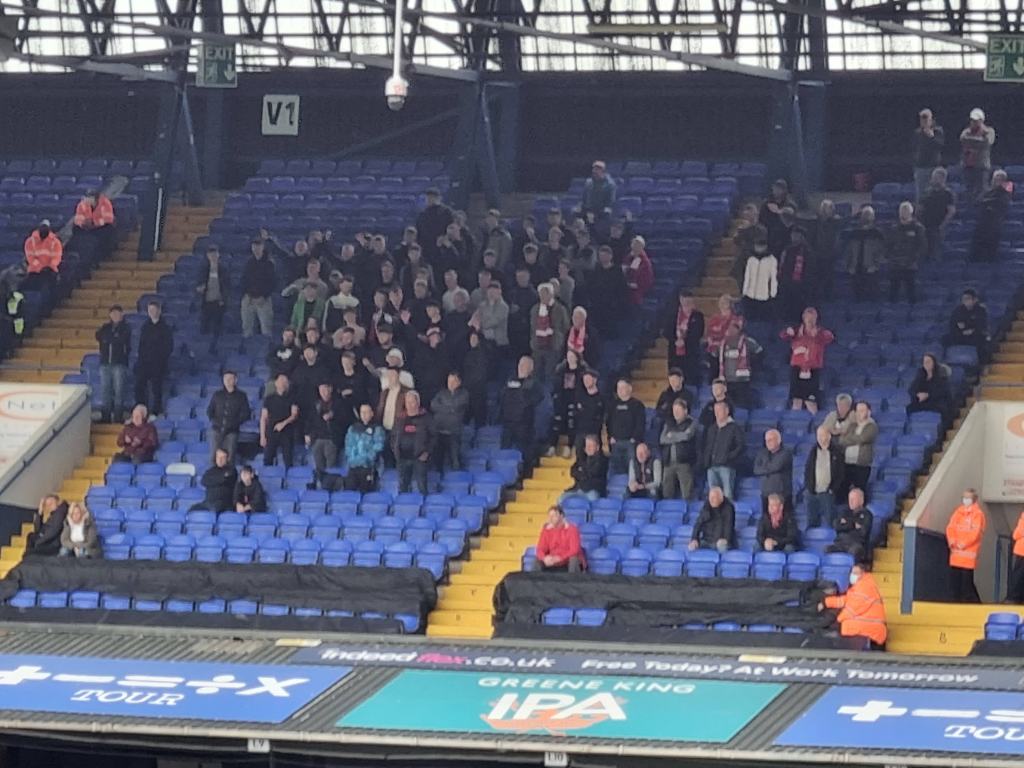
The game has settled into a somewhat disappointing pattern of Town passing the ball about quite a bit, but not having any decent attempts at scoring a goal. It’s nearly half past three and Paul Cook is gesticulating wildly from the touch line like someone directing traffic having dropped a few amphetamines. Janoi Donacien wins Town a corner. “Come On You Blues! Come On You Blues!” tumbles from the Sir Bobby Robson stand and a handful of people in the Sir Alf Ramsey stand join in, including me. Toto Nsiala heads the corner kick over the cross bar from a position so close to the goal that it looked easier to score.
It’s gone half-past three and after Fleetwood’s James Hill fouls Conor Chaplin, his name becomes the first to enter Mr Allison’s notebook. I like to think of Mr Allison amusing himself childishly by stroking his chin as if in deep thought and then writing down Hill’s first name as Jimmy. Ten minutes until half-time and Sone Aluko has Town’s first decent shot at goal, but it goes past the post. Finally, as the half peters out Sam Morsy becomes embroiled in a contretemps with Fleetwood’s Jay Matete, as they literally wrestle each other for the ball; Morsy is clearly at fault and Matete is awarded a free-kick. A bit like the weather, the half has been rather dull.

My half-time snack of a Nature Valley chocolate and peanut protein bar is the highlight of the afternoon since leaving the pub and Ray offers the opinion that Town haven’t done very much so far as he stops by to chat on his way to use the facilities beneath the stand.
The game resumes at four minutes past four and the lower tier of the Sir Bobby Robson are soon singing “You’re fucking shit, You’re fucking shit, You’re fucking shit you’re fucking shit, You’re fucking shit,” which strikes me as being not very polite. From the comments of the man next to me I think their “song” is directed at the Fleetwood goalkeeper Alex Cairns, and I can only think that they too have spotted that you can see his pants through his yellow shorts, although I think it would probably have been more helpful to sing “Don’t wear dark pants, Don’t wear dark pants, Don’t wear dark pants with yellow shorts, Don’t wear dark pants.”

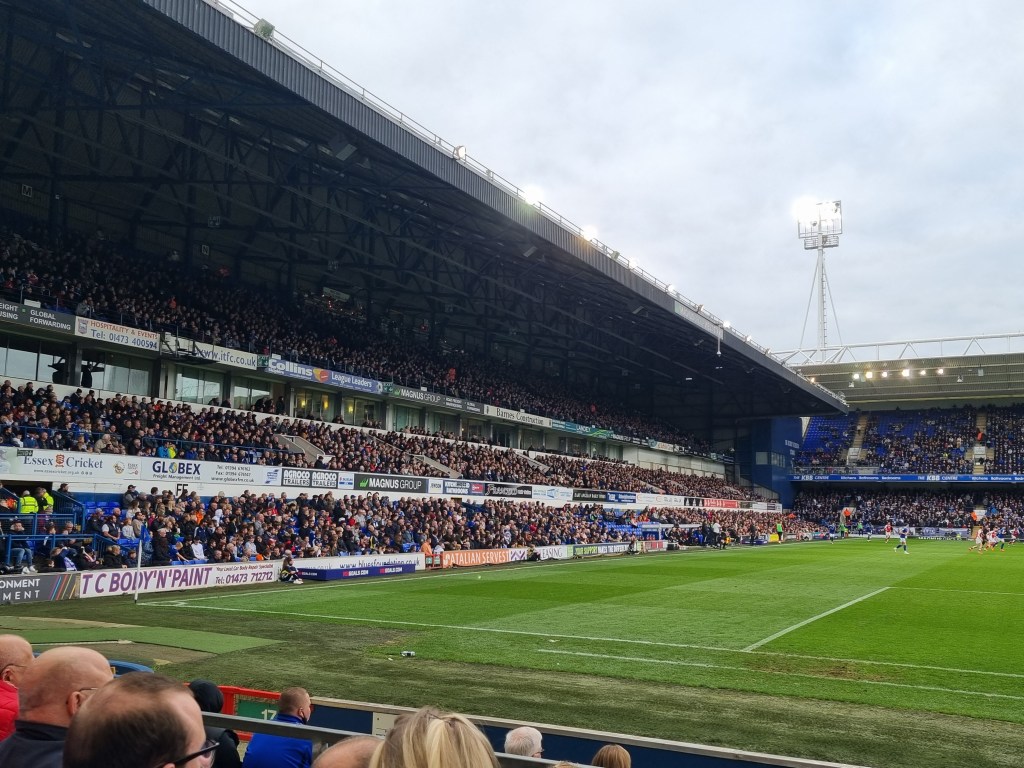
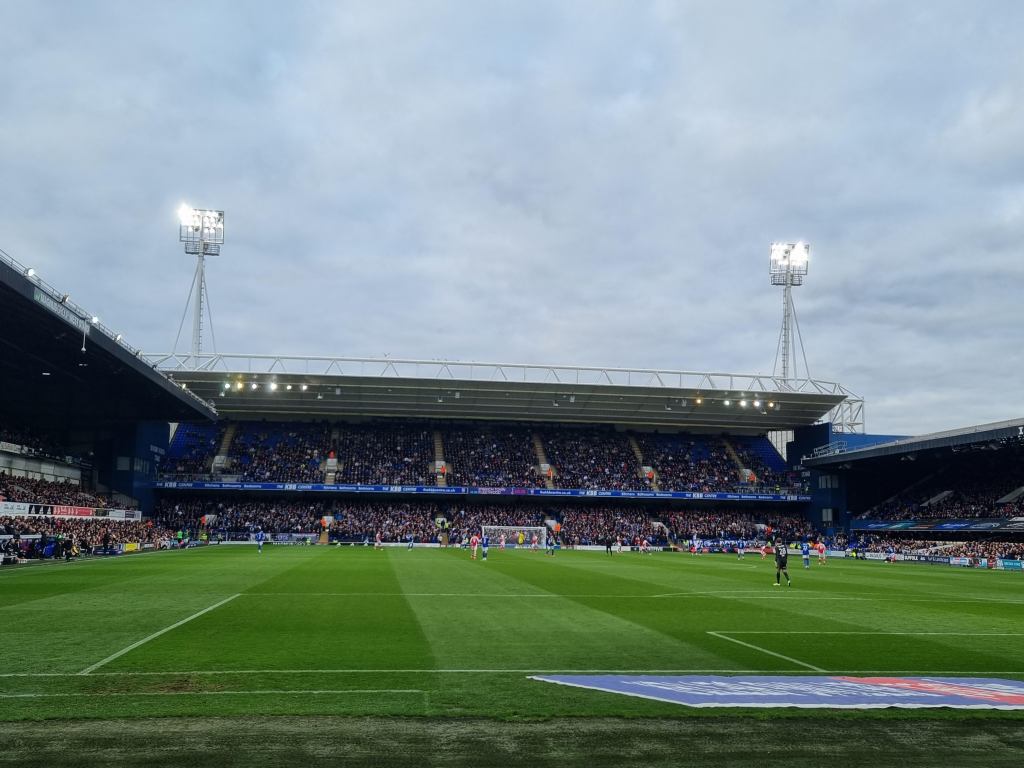
Cairns’ misdemeanor is soon punished however and with just four minutes played of the new half, Conor Chaplin turns outside the penalty area and sends a firm shot into the corner of the goal with, as the man next to me says, the goalkeeper “stranded”. Clearly getting nostalgic for former glories, the Sir Bobby Robson stand erupt into a chorus of “1-0 to the Tractor Boys” to the tune of Village People’s 1979 hit ‘Go West’. Feeling elated by taking the lead I risk sensory overload as I breathe in the smell of the damp turf. This afternoon’s attendance is announced as 20,099 with 133 of that number being from Fleetwood. Pat from Clacton thinks she might have won the guess the crowd competition on the Clacton supporters’ coach and passes me the sheet containing everyone’s guesses. Sadly, I have to break the news that her guess of 20,069 is not closer than someone else’s guess of 20,103, although to be fair to Pat her number looks a lot more like 20,099 than 20,103 does and she got five of the digits right; there has to be a field of experimental maths where what the numbers look like matters.
Back on the pitch and Wes Burns replaces Sone Aluko who is wiping his nose and has presumably either suddenly developed a heavy cold or has a nosebleed. Meanwhile, back in the Sir Alf Ramsey Stand Pat from Clacton tells us that she will be having a Marks & Spencer prawn salad for tea.
It’s nearly half past four and Christian Walton makes a save from Ged Garner who had been allowed to dribble far too close to the goal. From the resultant corner the ball is hit into the crowd where a man over the other side of the gangway from me calmly stands up and heads it back onto the pitch. The last time I did that I tell Fiona and Pat from Clacton, my glasses flew off (Woodbridge Town, September 2018, FA Cup extra-preliminary round v Clapton).
Fleetwood’s Jay Matete is booked for a foul on Sam Morsy and meanwhile I count twenty-one seagulls on the cross girder above the roof of the Sir Bobby Robson stand. Fifteen minutes of normal time remain and Town miss two chances in quick succession as first the oddly named Macauley Bonne has a shot saved by the bloke in the dark underpants and then Conor Chaplin sends a shot above the crossbar. Attempting to create a diversion, Fleetwood replace Ged Garner with someone called Paddy Lane; it’s Penny’s brother I tell Fiona, although of course I do know that Penny Lane is really a street in Liverpool, and Paddy Lane is round the back of the Roman Catholic cathedral.
Town miss another opportunity as Wes Burns billows the net with a shot to make half the ground think he had scored, only to realise the ball had gone behind the post. Sam Morsy is eventually booked for persistent fouling with Mr Allison offering a fine mime, pointing in different directions to indicate that Morsy had committed fouls here, there, and everywhere. Whilst Morsy receives his punishment from Mr Allison I am struck by the long shins of Fleetwood’s number nine, Callum Morton, a youth who the app on my phone says is English, although his stroppy demeanour, ginger hair and surname shared with a Greenock football club imply he is Scottish. I have a premonition that he will score, which is based on the fact that he looks like he has the capacity to annoy.


Something happens across the other side of the Sir Alf Ramsey stand and from up in the Cobbold stand comes a chorus of “We forgot, We forgot, We forgot that you were here” and I think to myself “Who said that?”. Back on the grass and Fleetwood’s Johnson fouls Celina and is booked before Fleetwood string together an alarming number of passes prior to Town eventually clearing the ball. Less than ten minutes of normal time remain, and Lee Evans concedes a free-kick. The Liverpudlian back street crosses the ball and the annoying youth with long shins heads the ball into the Town goal from unfeasibly close range. What had felt like a comfortable one-nil lead isn’t any longer,j but as I said to Fiona, we hadn’t conceded a goal for almost two whole games, so it was unlikely we’d hold on much longer. We would probably have conceded sooner or later even if we had to score it ourselves.

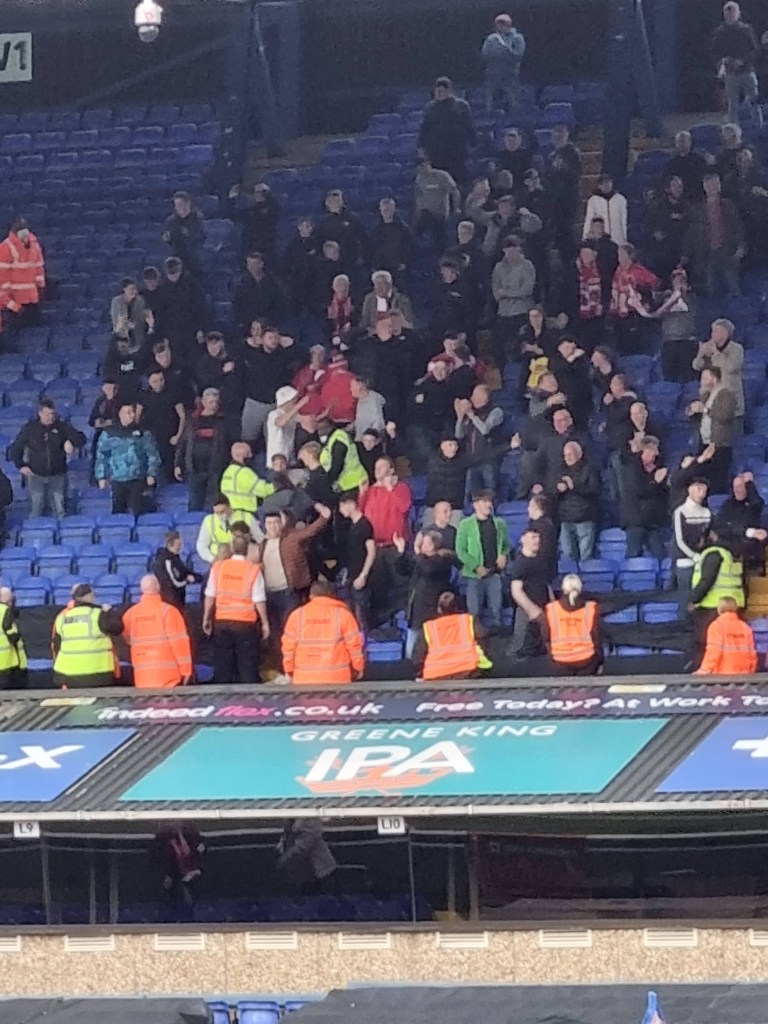
To the credit of the Town supporters, we don’t become over-anxious and we even raise a few chants of “Come on Ipswich, Come On Ipswich” and indulge in some rhythmic clapping. On the pitch, Town remain patient, passing the ball back and forth waiting to prise an opening rather than just hitting and hoping or ‘getting it in the mixer’. In the eighty-eighth minute a deep cross from Lee Evans is headed across the goal by the oddly named Macauley Bonne, it’s a decent chance; and then the game enters five minutes of added on time. A draw wouldn’t be unexpected, but hope remains that we can win; this is a team that has scored twenty-eight times in thirteen games, an average of more than two goals a game, so we’re due another one.
It’s the ninety third minute; Fiona has had to leave early to catch a train because she’s going out this evening. The excellent Janoi Donacien runs all the way to the goal line to knock back a deep, cross field ball; his flicked pass falls to Bersant Celina who sweeps it imperiously past the man in the dark underpants to give Town victory. It’s the best ending to a match at Portman Road in years, possibly since Pablo Counago scored almost directly from the kick-off after Coventry had equalised in 2010. Town did manage a near last minute win against Shrewsbury last November, but that doesn’t count because last season only happened on ifollow.
What started as a grey, dull, cold day has ended in a blaze of glory, the embers of which will glow all week long and at least until we lose again, which hopefully won’t be for ages; and just to add a barely needed coat of varnish, Norwich have lost 7-0 too. Some days are definitely better than others.











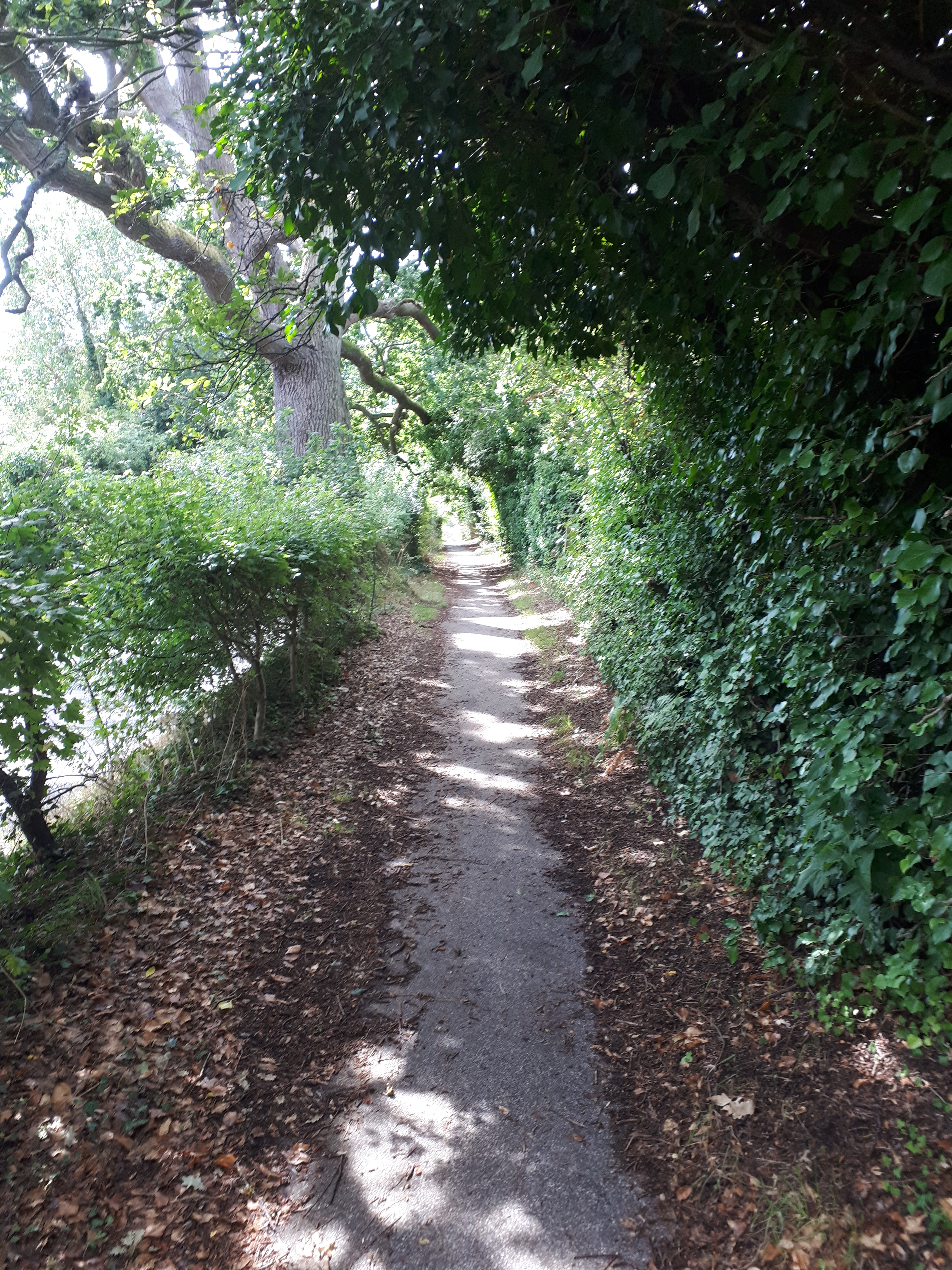





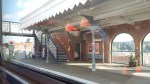 and Melton past Westerfield and through disused Bealings station. On into the Suffolk countryside the ride becomes more and more rural. It’s a journey for geographers, biologists and historians as we pass through sands and boulder clays, marshes and broads, passing cows and horses, pigs and sheep, an albino pheasant, partridges, ash and oak, gorse and broom, flint churches, a World War 2 pill box and thatched cottages. Football fans who know what they’re looking for can spot the floodlights of Woodbridge Town Football Club, and further up the line College Meadow, where Beccles Town are destined to lose 0-3 at home to Debenham in the Suffolk Senior Cup later this afternoon, is right next to the station.
 under towering pylons marching two by two from Sizewell nuclear power station whose dome is visible in the distance over the tops of trees; there’s a windmill and wind turbines. This is a wonderful journey on a beautiful, bright autumn day.


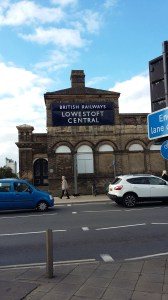 the bottom of the High Street. It’s the end of the line and it looks it, a handsome Victorian building that’s too big for the two lines that host the buses on rails that rattle in through wonderful East Anglian landscapes from both Ipswich and Norwich. It’s a town that has undoubtedly seen better days, it expanded in the late nineteenth century on the back of industrial scale fishing, an unsustainable activity like coal mining and as that industry declined so the town lost its raison d’etre. It had other industries such as bus body building (Eastern Coachworks) but with the de-nationalisation of bus travel that closed too.
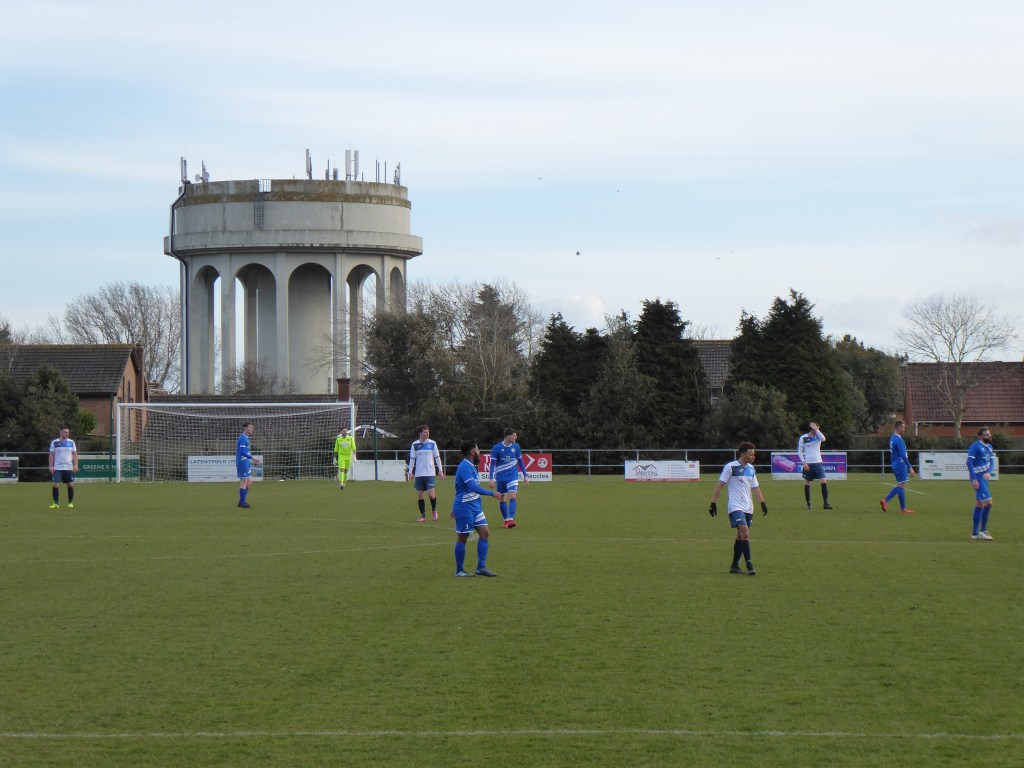
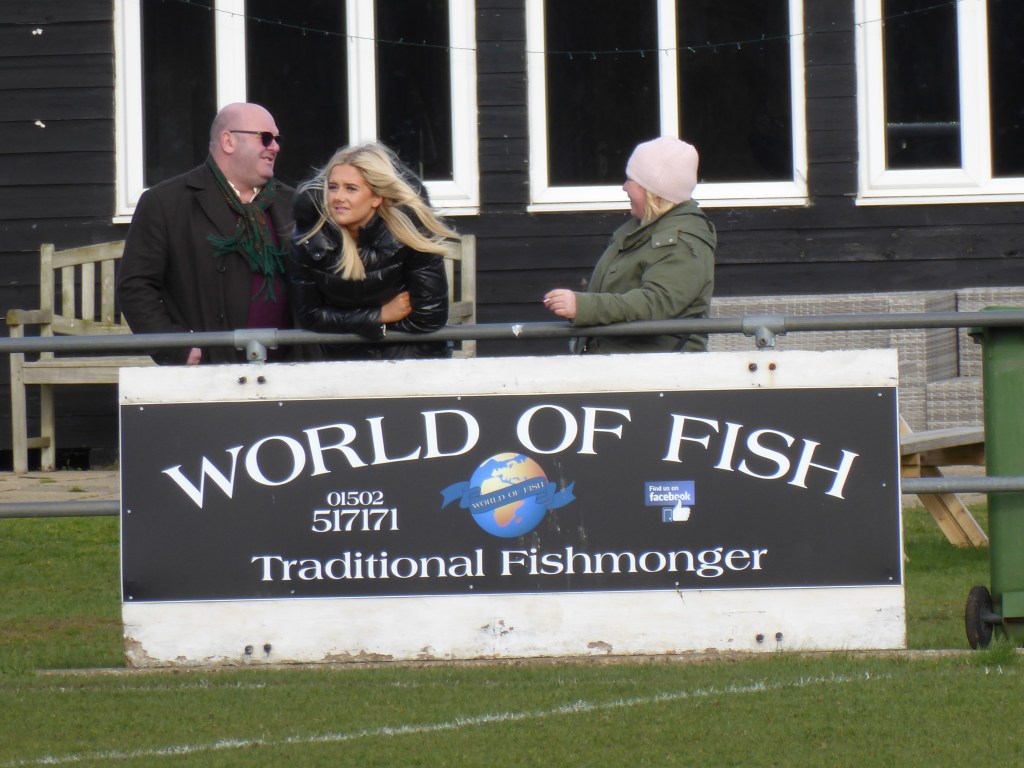
 The streets are of terraced houses and even a couple of back street boozers, an alleyway runs down the back of the main stand; this is a proper football ground with a vista of chimney pots and residential roof tops. You can see where the supporters live here, not where they buy their weekly groceries, or go bowling and to the cinema. Lowestoft Town have been at Crown Meadow since 1894.
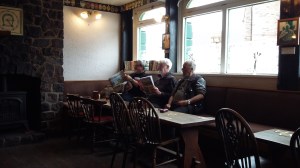 talking occasionally but also reading and another three, one of whom sports a Kingstonian shirt, sit at a table by the door. One of the Kingstonian group looks at least 70 and surprises me by suddenly mentioning Depeche Mode, although he seems to think David Sylvian was lead singer and is quickly corrected by the wearer of the shirt. I bemoan to myself that the conversation between the sort of blokes who frequent real-ale pubs often sounds like they are just waiting for the pub-quiz to start.

 Amber Dew Events Stadium”; it should say that it’s real and lasting name is Crown Meadow but it doesn’t. “What is it? A tenner?” I ask of the lady turnstile operator. “Eleven” she says, adding “If you’re an adult, are you?” I laugh, “Nooo, I’m not an adult” I say perhaps a little too sarcastically, but later I think maybe she thought I’m a pensioner. I reckon £11 to watch non-league, part-time football is a bit steep, and although it’s no more than other clubs charge at this level, in France it cost less (9 Euros) to watch a fully professional match (Nimes v Auxerre) in Ligue 2. C’est la vie. Just inside the turnstile programmes are sold from a table for £2, I buy one.
 Inside the kiosk a middle aged man attends the deep fat fryer and a young woman takes the money, whilst surreally a second older man is asleep on a chair.
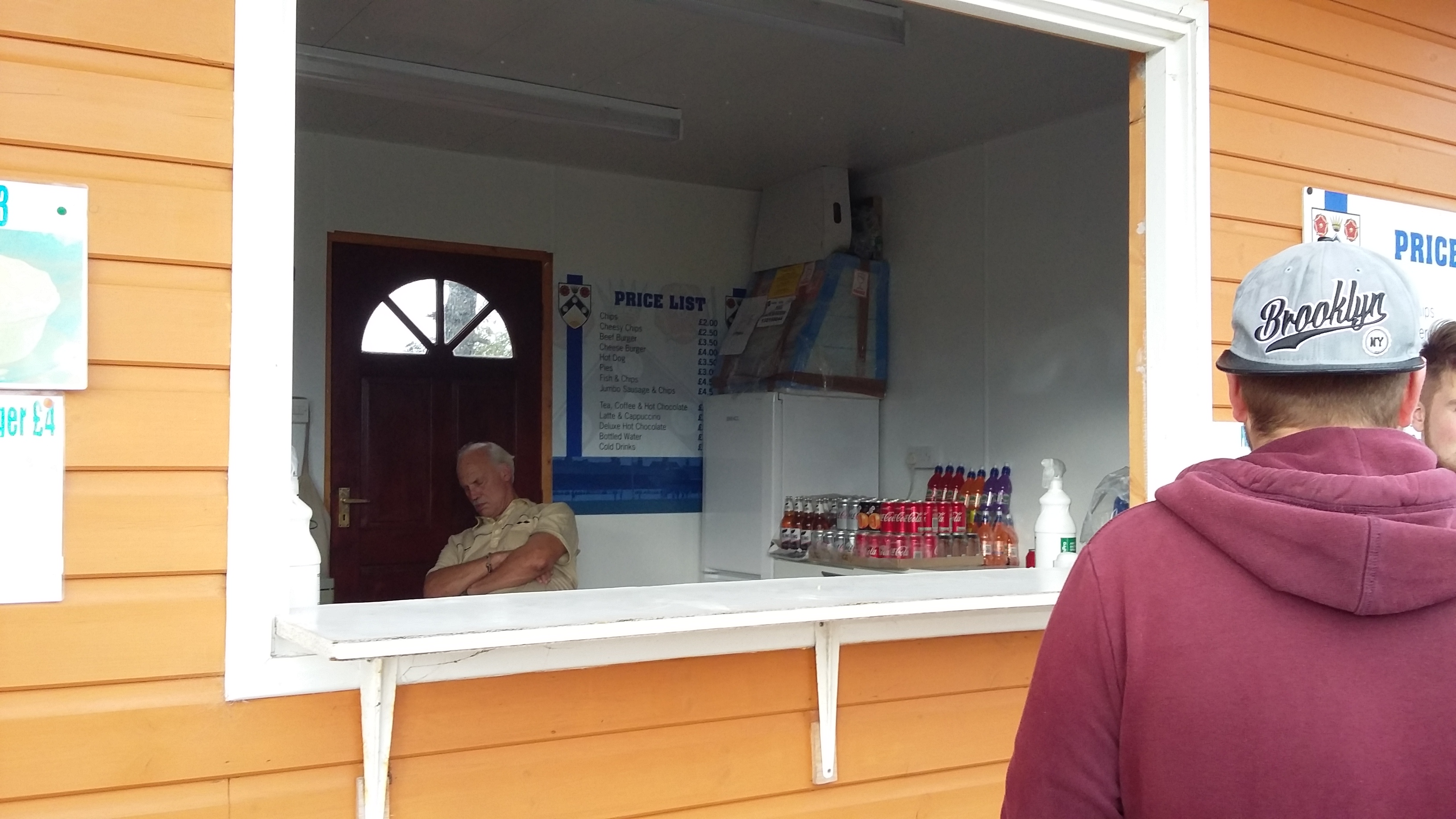 From the usual football food menu I opt for the ‘hot dog’ (£3.50), which consists of two very ordinary sausages with onions (optional), in what turns out to be a very crumbly
 girlie depending on your point of view, but also because he is very involved in the game and hits a decent long pass. It is probably a good thing that men are once again comfortable wearing a pony tail, but I’m glad that a rubber band or scrunchy did not deny me the sight of the flowing locks of Mario Kempes, Kevin Beattie and Gunter Netzer back in the 1970’s. For Lowestoft, their number eleven Cruise Nyadzyo seems keen to get the ball forward, but too often his crosses pick out no one in particular. I multi-task by walking around the ground and watching the match at the same time. A steward eyes me suspiciously. There is a country bus shelter type structure behind the far goal which sports on its back wall a trawler-shaped memorial plaque to one Ted Lightfoot.


 I want to tell them to relax, grow their hair, wear shades and a beret; they surely only dress like they do so people know that they are the club officials. I smile to myself. The main stand is a lovely, low, gloomy structure with a deep, grey fascia beneath the roof and glass screens at either end. Inside the stand there are no plastic seats like those found at most grounds; here they have the original cast iron frames with beautifully mellowed, curved wooden backs and wooden tip up seats. The stand has no stanchions to block your view suggesting it might be of a cantilever design, in which case it was an early one. Despite lashings of blue paint, it’s dull and utilitarian; but it’s beautiful and a candidate for local listing by Waveney District Council. Club officials in de-mob suits, brogues and fedoras, and smoking pipes would not look out of place in this stand.
 the burst of sunlight that breaks through the mass of cloud that started to hang low over Lowestoft this afternoon whilst I was in the Triangle Tavern. For all its beauty, this stand is on the wrong side of the pitch and a hundred or more people squint in unison. There are more shouts of “Come On You Blues” as people sense victory is possible, but this seems to make some older supporters sat behind me a bit tetchy too. Mr Quick the referee receives some mild abuse for one or two of his decisions and there is clearly a belief that the world and in particular Mr Quick is against Lowestoft. But according to Wikipedia, this is a town with three UKIP councillors, so fear and a lack of logic are common currency.
 Oblivious of medieval flintwork the commentary continues from from behind me, particularly when Cruise Nyadzyo is substituted; it’s not a popular decision. The view seems to be that he was the best player on the pitch. Things don’t get any better in the eyes of the mainstanders as Kingstonian’s Thomas Derry strikes the cross-bar with a header from a corner. But taking the best player off seems to have no lasting effect, perhaps it makes the other players work harder, and soon afterwards a low right-wing cross from Lowestoft’s number eight Sam Borrer is easily kicked into the Kingstonian net from close range by Jake Reed and Lowestoft lead 2-0. Going further behind seems to be just what Kingstonian needed to do however, in order to raise their game and they eventually score a goal too, from a free-kick off the head of number five Michell Gough. The remainder of the game involves Kingstonian trying to equalise and Lowestoft trying not to concede. I leave my seat to stand closer to the exit because when the final whistle blows it won’t leave long to get to the railway station for the 17:07 train. Eventually at 16:58 Mr Quick calls time and I sprint off down Love Road leaving the victorious Trawlerboys behind me; I make it onto the train with nearly three minutes to spare.


 trippingovertheball