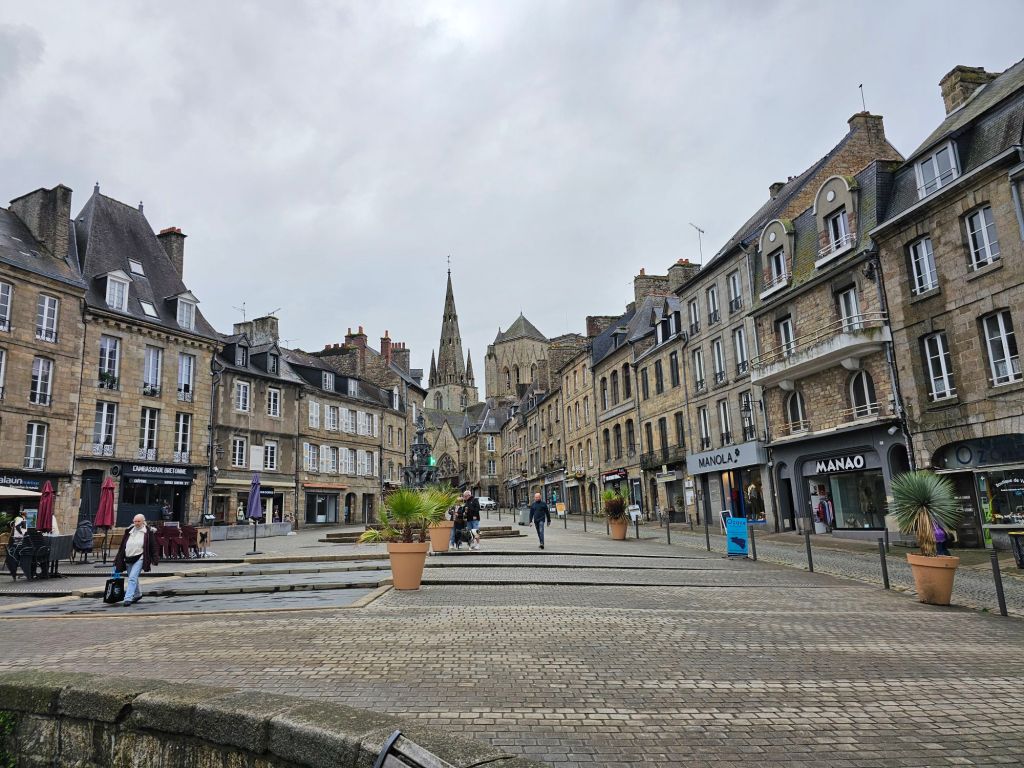
Guingamp (Gwengamp in the local Breton language, and pronounced gangomp) is a small town of only seven or eight thousand people, which sits on a rocky escarpment above the River Trieux in the heavily agricultural north-west corner of France. For thirteen seasons since 1995, this tiny rural town with a population smaller than Beccles, Mildenhall or Woodbridge had a team in the top division of French football, and also won the French FA Cup (the Coupe de France) twice in that time. But more than that, the name ‘Guingamp’ is just beautiful to the ears, the club plays at the wonderfully named Stade de Roudourou and when Guingamp reached the final of the Coupe de France in Paris, some fans travelled there by tractor. For these reasons, I am fulfilling an ambition today in making a 160-kilometre pilgrimage from where my wife Paulene and I are staying on holiday in Carnac in the south-west of Brittany.
Our journey is elongated a bit by a stopping off north of the topographically scintillating town of Morlaix, 60 km west of Guingamp to visit the huge six-thousand year old Neolitihic cairn at Barnenez, but we eventually rock up in good time in Guingamp to buy two tickets for the match (26.00 euros each) at the club ‘boutik’ in the town, along with a petit fanion (pennant) and fridge magnet (6.50 euros for the two) for my respective pointless collections. Disappointingly, the T-shirts showing a representation of the town of Guingamp through its most prominent buildings such as the basilica and hotel de ville is only available in bizarrely small or large sizes, and whilst I’d like a mug that displays the same design, it would probably just sit on a shelf above the petit fanions overlooking the fridge magnet, and with a little thought I could surely spend that 12 euros doing good. More happily, the very pretty shop assistant, whose name, I think, from what it says on our tickets may be Angelique compliments me on my French, although after initial exchanges we mainly speak in English.
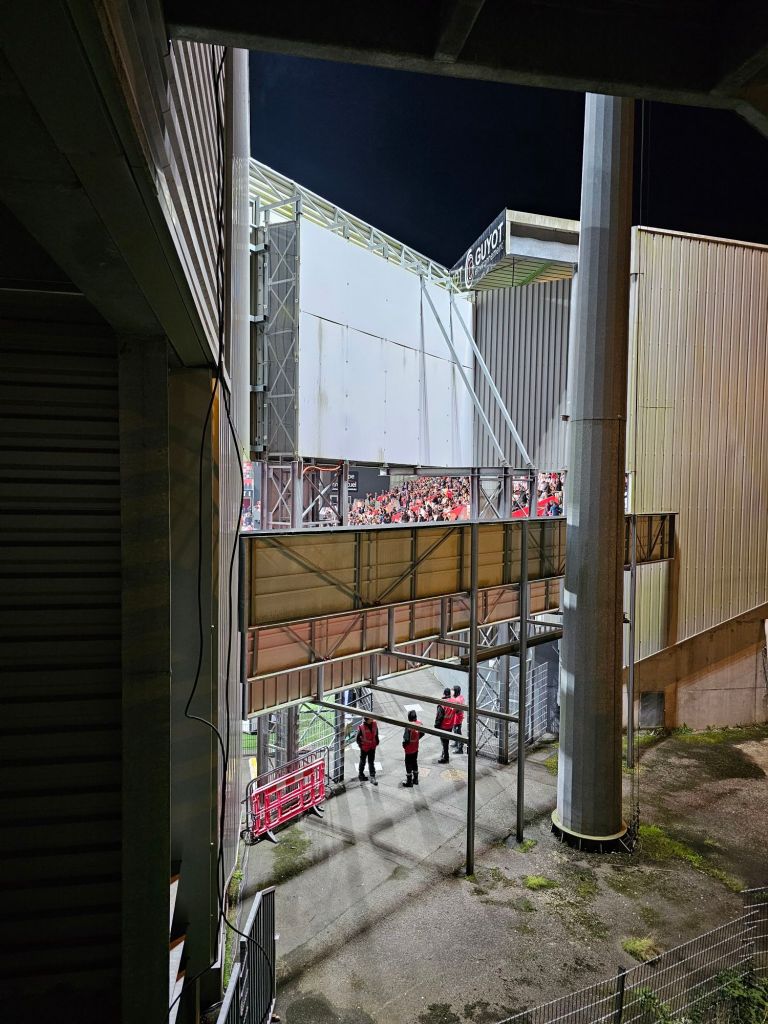
Our hotel room for the night is in a grand nineteenth century house not far from the town centre, but it is a half an hour’s walk from Stade Roudourou and Paulene’s asthma will not stand that once the cold night air surrounds us after 10:30 when the match will probably finish. Sadly, there is no ‘navette’ (shuttle bus service) to the stadium, but on the advice of the two very helpful ladies in the local Tourist Information Office we make a short car journey across town to the Place St Saveur where we park up our planet saving Citroen e-C4 at no cost. Remarkably nearly all car parking in Guingamp seems to be free. From the car park, we can see the floodlights of the stadium, and the walk to the Stade Roudourou takes us only a few minutes over the shallow looking, gurgling River Trieux and down a few closed off streets. The stadium is situated in a residential area which has the appearance of one of the banlieus of a much larger town and is enclosed behind iron fences as if fortified against the outside world, an impression further strengthened by the harsh steel and concrete architecture of the stadium, which is in some ways is at odds with the stone buildings of the town but is perhaps also a modern and cost effective version of them.

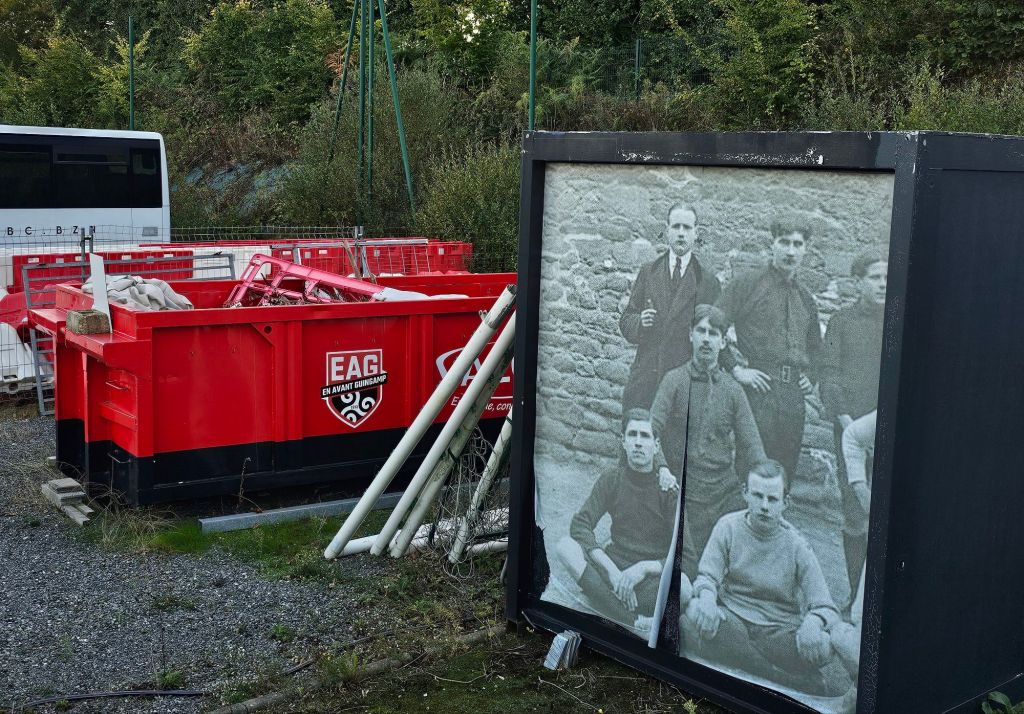

The walk to our seats in the Tribune France Barnums (presumably named after a sponsor) takes us around the back of the main stand (the Tribune Cotes d’Amour) past a small wooden hut from which two middle-aged women are selling club souvenirs. I ask if they have any T-shirts like the ones I saw in the shop in the town; they don’t, but nevertheless they laugh either at my description of the very large and very small sizes available in the shop in the town, or just at my French, I’m not sure which. Paulene and I walk on past a skip decorated in club colours and the back of the Kop Rouge where the local Ultras will later gather.
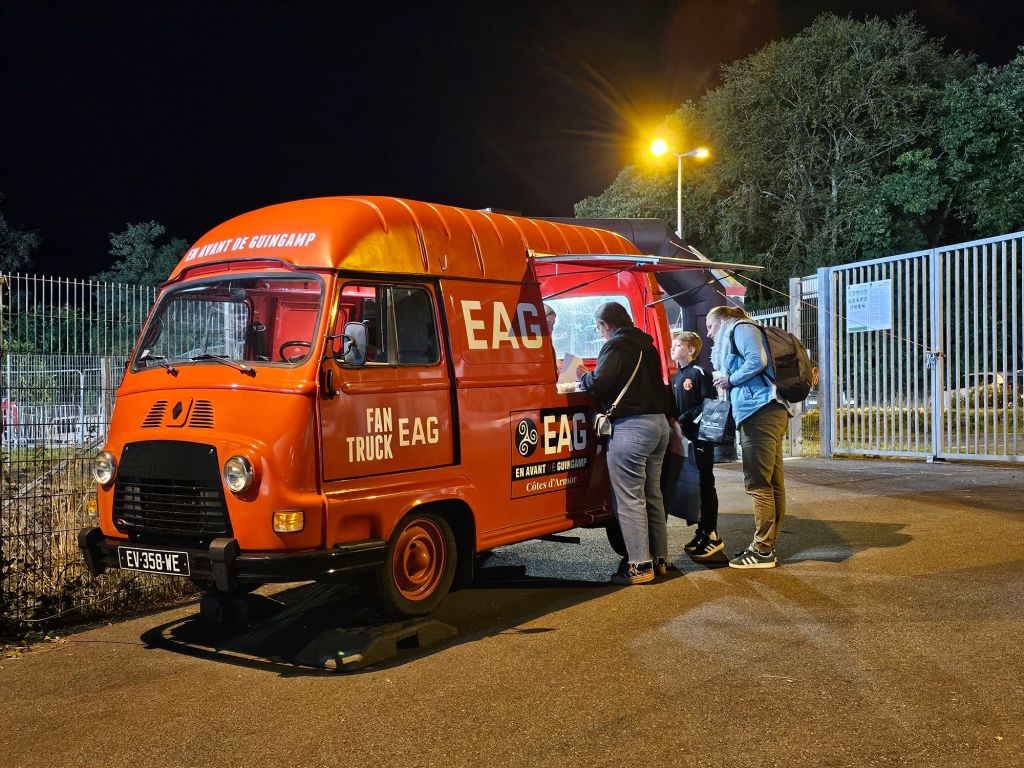
The back of the Tribune Frace Barnums is the least attractive of the four sides of the Stade Roudourou, consisting mostly of sheet metal, but undeterred I make my way in past a smiling member of security staff who frisks me and wishes me ‘Bon match’ under the somewhat glaring eye of another member of security staff whose demeanour suggests she does not approve of such bonhomie. With our tickets duly validated by barcode technology we walk on towards our seats past a classic Renault Estafette van painted in Guingamp colours, from which Angelique of club ‘boutik’ fame is selling hats and scarves and shirts; she confirms that she has no stock of the cherished T-shirts stashed away in the Estafette.
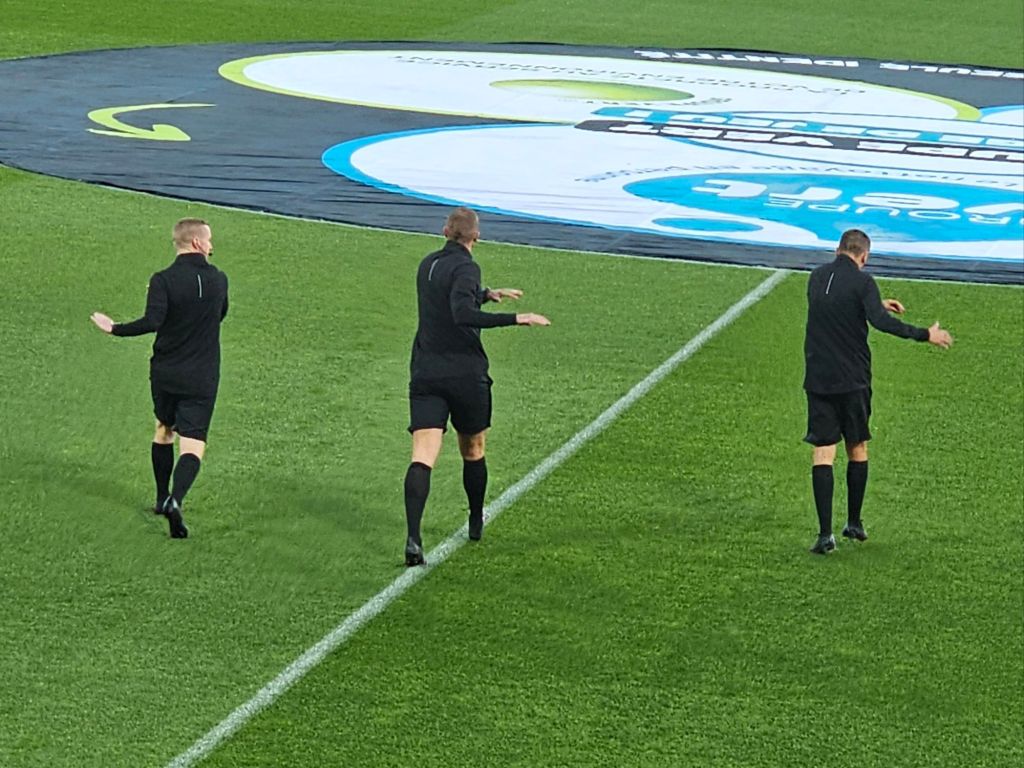
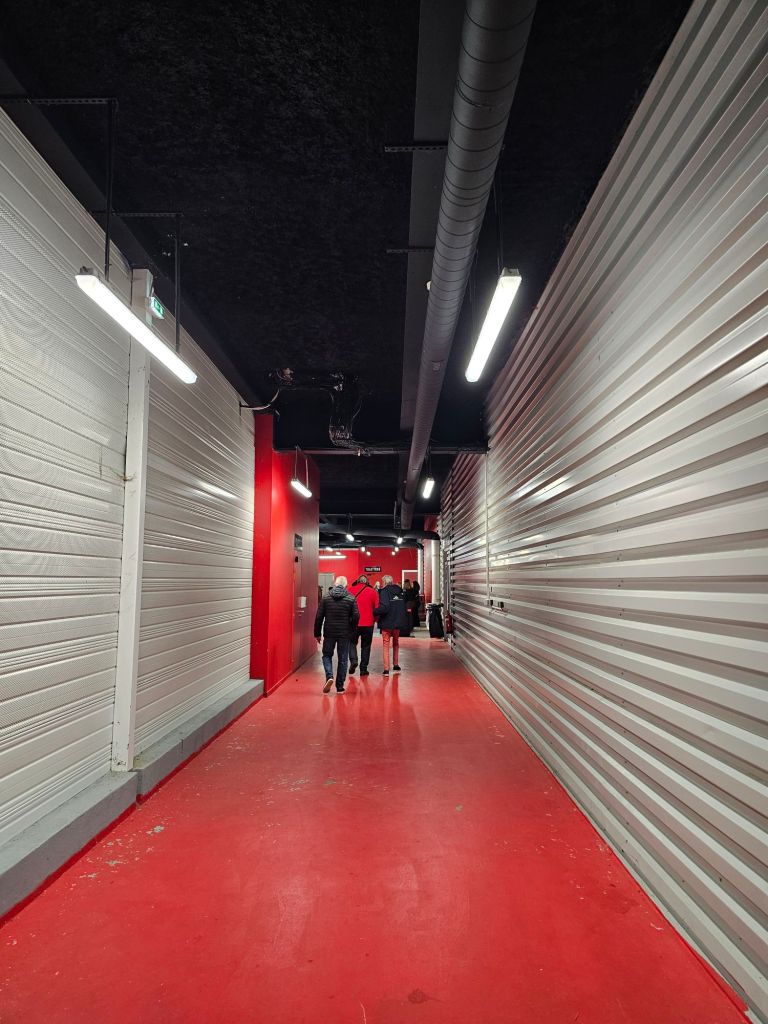
Our entrance to the stand itself, along a corridor, reminds me of the inside of one of carriages on Le Shuttle. Up an external staircase, I am tempted by the ‘pub Lancelot’, only for two teenage doormen and the smell of sandwiches and nibbles wafting out to disappointingly confirm that it is a room reserved for those paying for hospitality. Back downstairs I buy a small plastic cup of beer and a similar cup of the local Breizh Cola (8 euros for the two), which Paulene much prefers to the over-hyped American stuff. We find our seats cosily situated at the back of the lower tier of the stand almost level with the halfway line and next to a galvanised tubular stanchion, which handily ensures people will not be able to edge past us to get to their seats. We pass the time before kick-off making up the life stories of the referee and his assistants, who are warming up in front of us and keeping us amused with their co-ordinated exercises, which with some appropriate music could enable them to pass themselves off as a small all-male dance troupe. One of the assistants we decide looks slightly ill however, and has dark shadows under his eyes. The referee, Monsieur Landry meanwhile, is a tall man with a long body but capable of a neat heel turn, chasse and pirouette.

As kick-off (coupe d’envoi) approaches, the stand fills up with people bearing baguettes stuffed with chips, whilst a row or two in front of us a family unpack homemade sandwiches which appear to be of white sliced bread that has had the crusts cut off, which is not something I ever expected to see in France. Meanwhile, the pitch fills up with youths waving banners with varying degrees of enthusiasm but then, when the teams are read out by the stadium announcer I am shocked, amazed and I have to admit, disturbed to find that unlike everywhere else I’ve ever been in France, the home supporters do not bellow out the surnames of their players as they appear on the big screen in the corner of the ground; they just clap politely. I can’t quite believe it. Being in Brittany I had also expected bagpipe music as the teams trudged out, but It seems these Bretons aren’t like other French or Breton people at all. I am a little disappointed; they don’t even have a cuddly mascot.
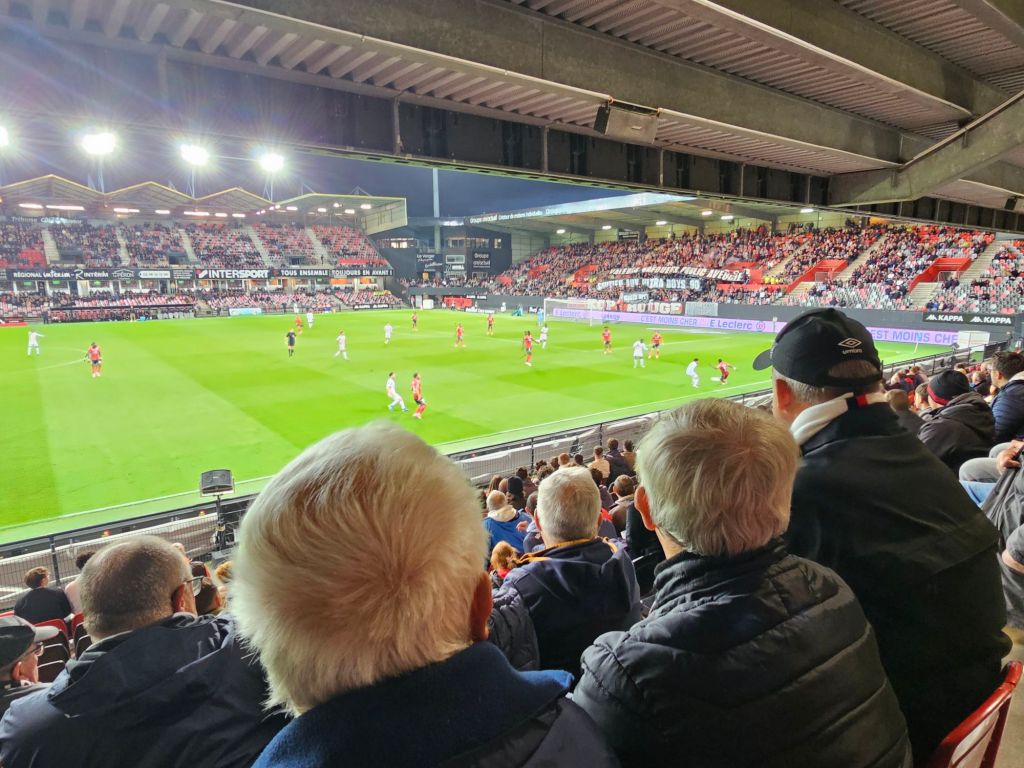
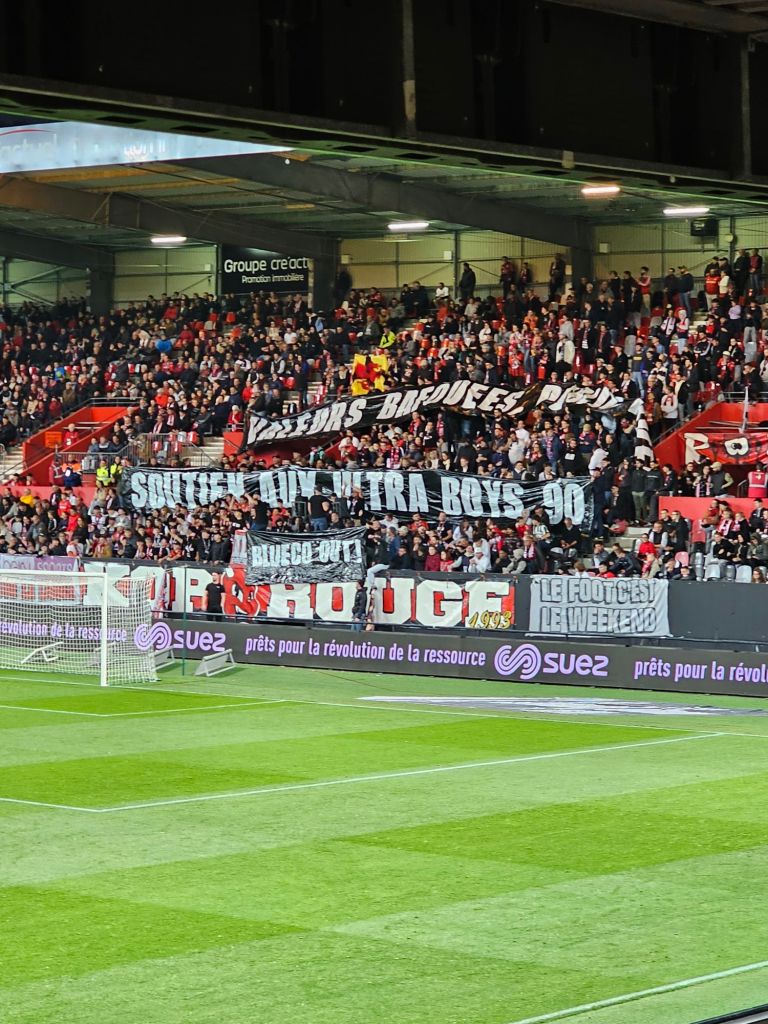
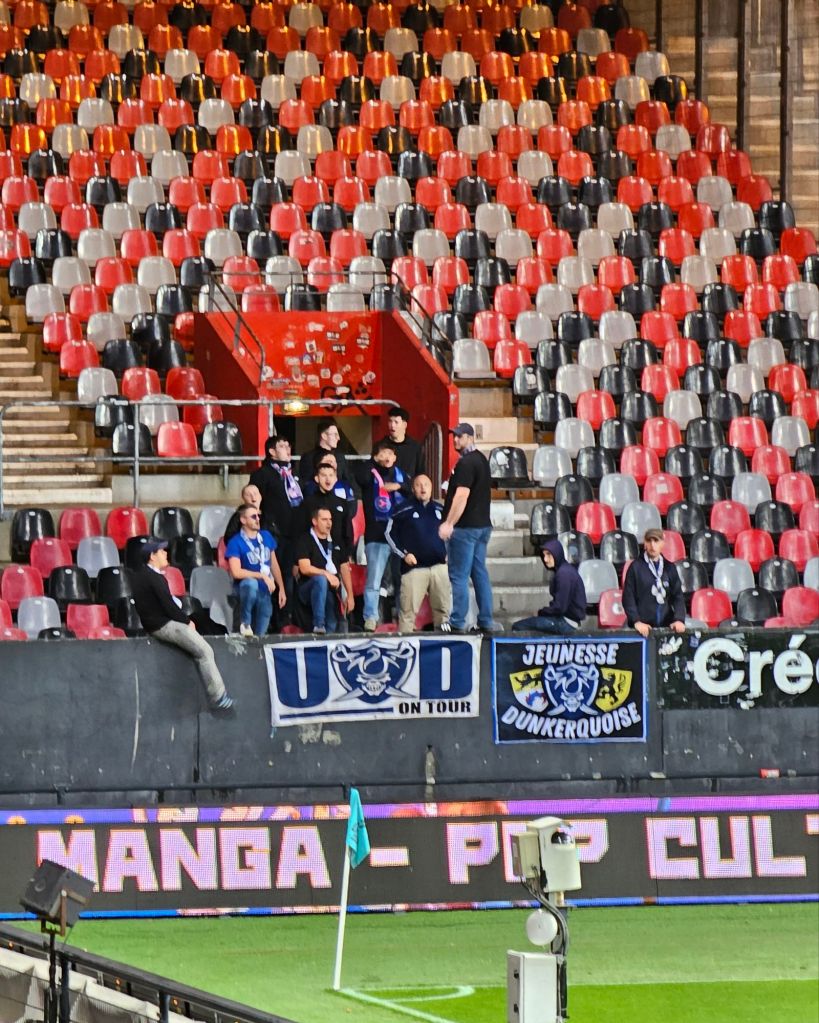
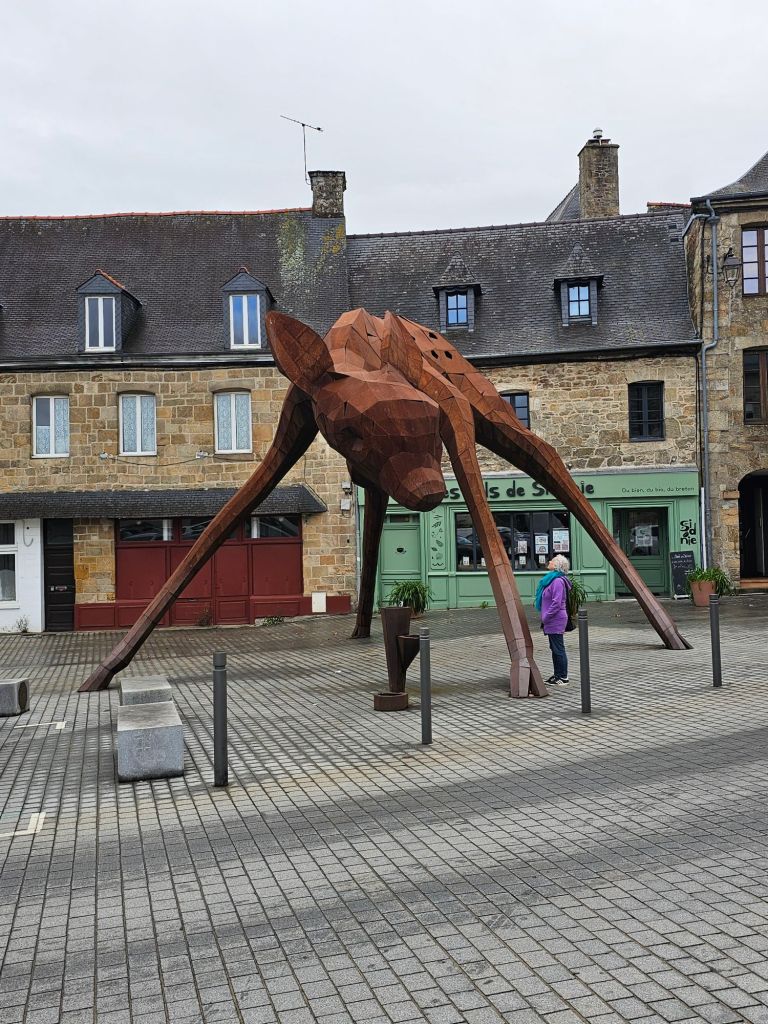
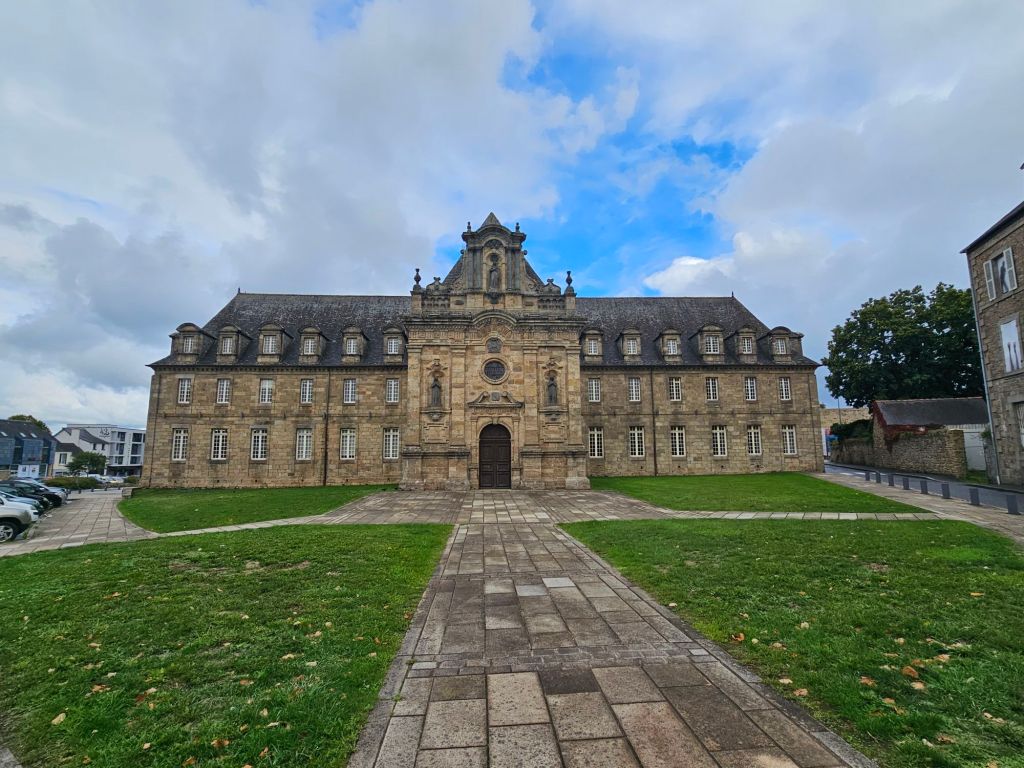
When the match eventually begins at half past eight, it is visiting Dunkerque who get first go with the ball, which they generally kick in the direction of the Kop Rouge and far off Morlaix, whilst Guingamp are aiming just to the north of the town centre with its Basilica, castle ruins and huge metal statue of Bambi. Guingamp sport their handsome signature kit of red and black striped shirts with black shorts whilst Dunkerque wear all white with golden squiggles down the shirt front. Despite my disappointment before kick-off, the stadium has now come to life, with a flood of chip and beer quaffing latecomers finding their seats and the Kop Rouge now in full voice with chants of “Allez, Allez, Allez, Guingampaises”. I count thirteen Dunkerque supporters, who I could hear chanting before kick-off, but now they are drowned out by the Guingampaise voices and drums.
The opening play from both teams is fast and slick on the well-watered pitch but Guingamp appear slightly more direct and with only four minutes having passed into history a smart through ball and a low cross from the right lead to the ball being placed past the Dunkerque goalkeeper from about six metres out by Freddy Mbemba, who the interweb tells me is on loan to Guingamp from Charleroi in Belgium. “Buuut” announces the giant screen in the corner in large letters, and when the stadium announcer says “Freddy” the home supporters bellow “Mbemba” and when the announcer says “Freddy” again and the crowd shout “Mbemba” again, and then wonderfully the same thing happens again. It feels like a weight has been lifted from my shoulders. “Mbemba!” I shout on cue after the final “Freddy”.
The game continues at pace with Guingamp looking sharper but Dunkerque not appearing to be slouches either. Standing out for Guingamp, mainly but not entirely because he is two metres tall is their number eight, Kalidou Sidibe, whilst I am also impressed by the tangled mop of hair sprouting from behind the black headband of Guingamp’s number thirty-six, Albin Demouchy who often wins headers and elegantly ‘plays-out’ from the back. On the electronic boards around the pitch there are advertisements for John Deere tractors and Husqvarna mini tractors as well as the supermarket E Leclerc, who if they had shops in Britain would surely employ the tv sitcom ‘Allo, ‘Allo in their advertising.
After fourteen minutes Dunkerque win their first corner; Guingamp have already had two however and as if to prove that this matters Guingamp’s Amine Hemia soon beats the square but not square enough Dunkerque defence on the right, bears down on goal and scores into the far corner off the goalkeeper’s out-stretched palm, and Guingamp lead two-nil. “Amine” calls the stadium announcer, “Hemia” bawls the crowd. “Amine” calls the stadium announcer, “Hemia” bawls the crowd. “Amine” calls the stadium announcer, “Hemia” bawls the crowd, and the scoreboard silently but colourfully shouts “Buuut!” as well.
The row of seats in front of us consists mainly of men with grey hair whilst off to our left a younger bearded man looks a bit like Bob Ferris from the 1970’s sitcom The Likely Lads (actor Rodney Bewes). Behind us there is a gathering of men and women in day-glo tabards; if they’re not orchestrating a “gillets jaune” style protest I guess they must be the first aiders and stewards watching the match. At the front of the stand clouds of smoke billow up from teenage vapers and then dissipate into the night air. I notice that Bob Ferris has quite girlish looking hands.
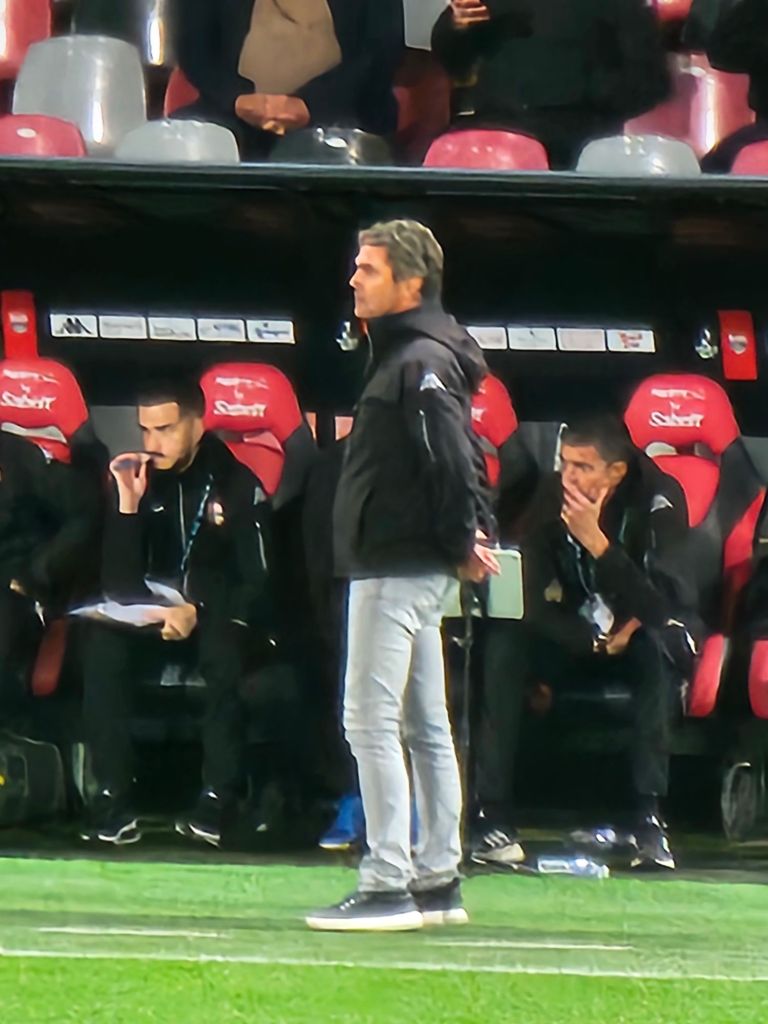
There are now less than ten minutes of the first half remaining; Dunkerque’s number twenty shoots from the edge of the penalty area and the impressively agile and wonderfully named Guingamp goalkeeper Teddy Bartouche tips the shot over the cross bar spectacularly. Two minutes later and yet another move down the right for Guingamp leaves Louis Mafouta with a seemingly open goal, but with the co-ordination of someone whose foot has ‘gone to sleep’ and who has both arms strapped to his sides, he heads the resulting cross hopelessly and clumsily past the far post. On the touchline, Guingamp manager Sylvain Ripoll, who incidentally once said ‘Bonjour’ to me and Paulene in the lift of a Paris hotel (the Mercure near Parc des Princes) looks frustrated in his pale trousers and zip-up jacket.
The last action of the half seems likely to be the substitution of the Dunkerque goalkeeper, who unexpectedly and mysteriously has hurt himself but then a quick pass in from the Dunkerque right finds Enzo Bartelli inside the ‘D’ outside the Guingamp penalty box. Almost in slow motion Bartelli gently passes the ball beyond agile Teddy in the Guingamp goal and Dunkerque, as they say on the telly, are “back in the game”, although of course as long as Monsieur Landry hadn’t terminally parped his whistle, they were never out of it. Five minutes of added on time fail to alter the score any further.
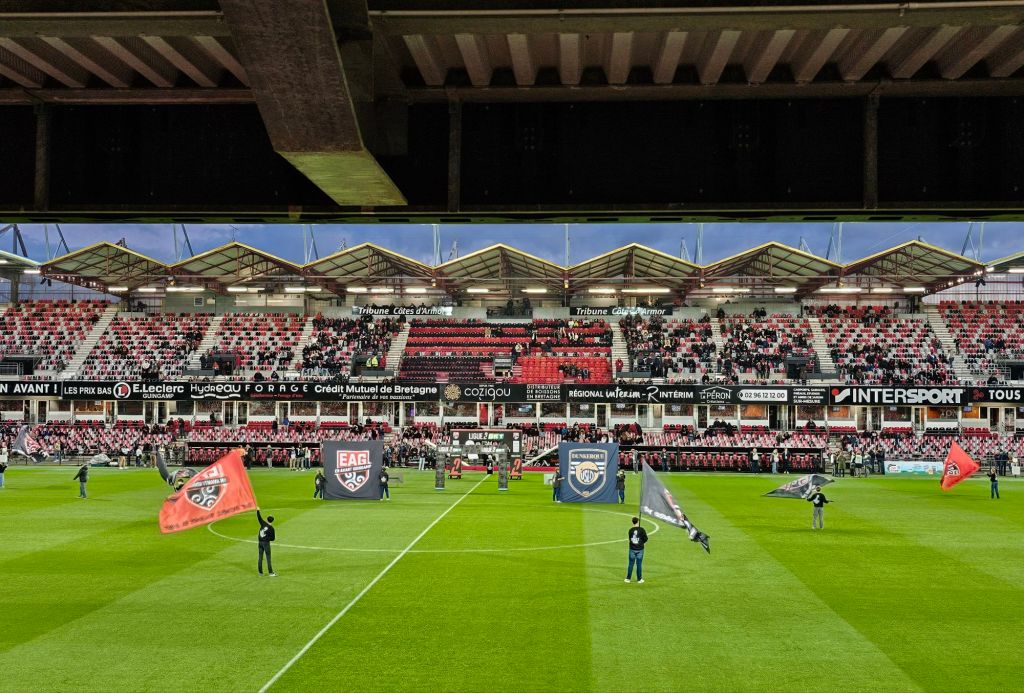
Half-time is the usual melange of children on the pitch, but as before the start, with added flag waving of varying enthusiasm. The match resumes at twenty-four minutes to ten and the Kop Rouge quickly dive back into endless chants of “Allez, Allez, Allez”. I soon decide that for a man taller than your average back garden fence panel, Sidibe has quite a delicate touch and then within ten minutes Monsieur Landry airs his yellow card for the first time this evening after Dunkerque’s Inigo Eguaras fouls Mbemba.
It is Dunkerque who are now selfishly dominating possession, a situation which Guingamp are contributing to by quickly giving the ball back to them whenever they lose it. On the Kop Rouge, the ultras are swirling their scarves in the style of 1970’s Leeds United fans, whilst the big screen in the corner is showing pictures of real estate as if anyone interested in buying a house would pay more attention to the screen than the match. As the people in the ground with least interest in buying property in Guingamp, surprise transfer moves notwithstanding, the Dunkerque players fashion an intricate passing move down the left only for Eddy Silvestre to shoot narrowly over the cross bar. With the game now two-thirds over, Dunkerque blink first and make two substitutions.
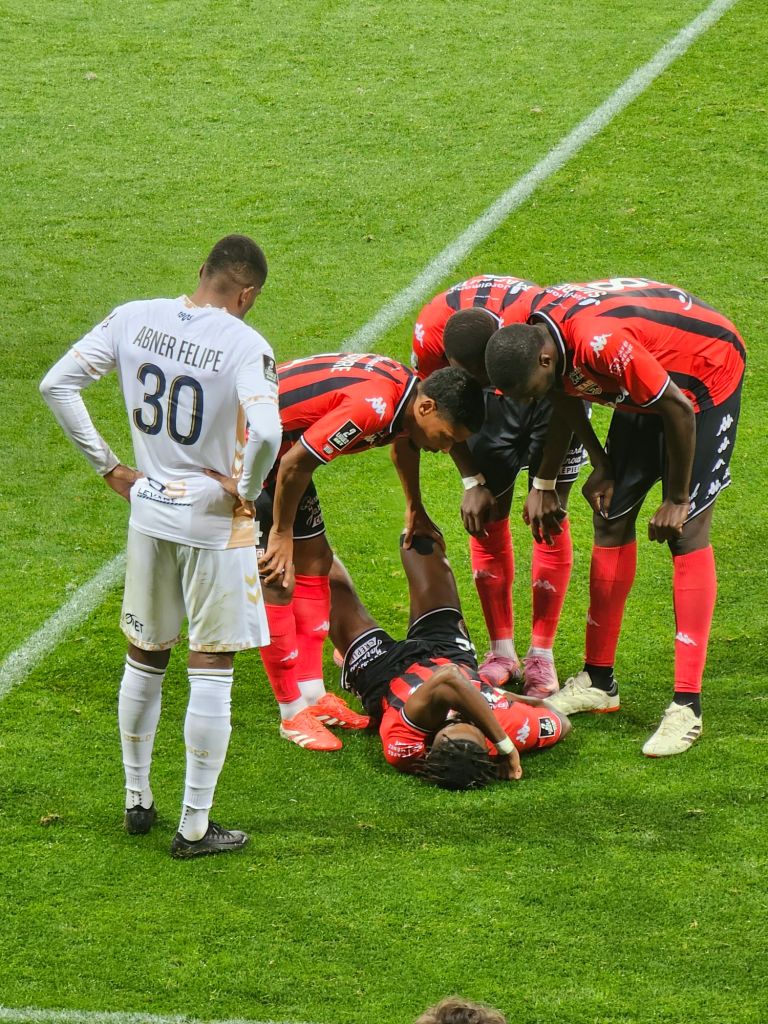
The slick passing of the first half has been replaced with increased niggle and Paulene and I discuss the colour of the shorts worn by Dunkerque’s Brazilian number thirty, Abner. They look more yellow than other Dunkerque players’ shorts, which Paulene attributes to his frequent falling over on the wet grass, whilst I suggest, a little unpleasantly perhaps, that maybe he ‘forgot to go’ before he left the dressing room. Twenty minutes remain and Eddy Silvestre shoots over the bar again for Dunkerque whilst the Kop Rouge sways with a sea of banners and the towering Kalidou Sidibe is replaced by a man with hair reminiscent of the late Tina Turner, Tanguy Ahile.
Somewhat annoyingly, the final ten minutes of normal time dissolve into something like chaos and nothing like football as players of both teams proceed to fall to the ground with alarming frequency. If all the players who go down have genuine injuries, both clubs will need to be trawling the job centres of Brittany and Pas de Calais in the morning for additional physiotherapists. Monsieur Landry, meanwhile, is rushed off his feet, airing his yellow card four more times and showing his red card to someone in the Dunkerque dugout. Six minutes of added time are not so much played out, as acted out, and the final whistle comes as a blessed relief to all. The result lifts Guingamp to eighth in the Ligue 2 table, a point outside the barrage (play-off) places, whilst Dunkerque slide down to fourth from bottom, one above the relegation places.
Despite the weirdness of the last ten minutes, and the unexpected pre-match disappointments over T-shirts, bagpipes and the reading out of the players’ names, overall, the match has been a good one and everything has worked out fine; well except for the T-shirt and the bagpipes, but you can’t have everything. We therefore make our way back to our planet saving Citroen in good spirits, like all but thirteen of the 6,562 strong crowd, but who knows, they probably enjoyed it too.





 and Melton past Westerfield and through disused Bealings station. On into the Suffolk countryside the ride becomes more and more rural. It’s a journey for geographers, biologists and historians as we pass through sands and boulder clays, marshes and broads, passing cows and horses, pigs and sheep, an albino pheasant, partridges, ash and oak, gorse and broom, flint churches, a World War 2 pill box and thatched cottages. Football fans who know what they’re looking for can spot the floodlights of Woodbridge Town Football Club, and further up the line College Meadow, where Beccles Town are destined to lose 0-3 at home to Debenham in the Suffolk Senior Cup later this afternoon, is right next to the station.
 under towering pylons marching two by two from Sizewell nuclear power station whose dome is visible in the distance over the tops of trees; there’s a windmill and wind turbines. This is a wonderful journey on a beautiful, bright autumn day.


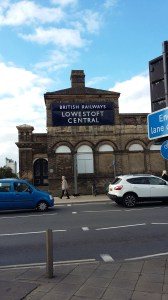 the bottom of the High Street. It’s the end of the line and it looks it, a handsome Victorian building that’s too big for the two lines that host the buses on rails that rattle in through wonderful East Anglian landscapes from both Ipswich and Norwich. It’s a town that has undoubtedly seen better days, it expanded in the late nineteenth century on the back of industrial scale fishing, an unsustainable activity like coal mining and as that industry declined so the town lost its raison d’etre. It had other industries such as bus body building (Eastern Coachworks) but with the de-nationalisation of bus travel that closed too.
 The streets are of terraced houses and even a couple of back street boozers, an alleyway runs down the back of the main stand; this is a proper football ground with a vista of chimney pots and residential roof tops. You can see where the supporters live here, not where they buy their weekly groceries, or go bowling and to the cinema. Lowestoft Town have been at Crown Meadow since 1894.
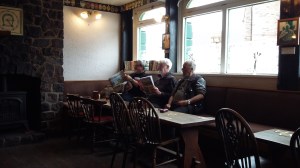 talking occasionally but also reading and another three, one of whom sports a Kingstonian shirt, sit at a table by the door. One of the Kingstonian group looks at least 70 and surprises me by suddenly mentioning Depeche Mode, although he seems to think David Sylvian was lead singer and is quickly corrected by the wearer of the shirt. I bemoan to myself that the conversation between the sort of blokes who frequent real-ale pubs often sounds like they are just waiting for the pub-quiz to start.

 Amber Dew Events Stadium”; it should say that it’s real and lasting name is Crown Meadow but it doesn’t. “What is it? A tenner?” I ask of the lady turnstile operator. “Eleven” she says, adding “If you’re an adult, are you?” I laugh, “Nooo, I’m not an adult” I say perhaps a little too sarcastically, but later I think maybe she thought I’m a pensioner. I reckon £11 to watch non-league, part-time football is a bit steep, and although it’s no more than other clubs charge at this level, in France it cost less (9 Euros) to watch a fully professional match (Nimes v Auxerre) in Ligue 2. C’est la vie. Just inside the turnstile programmes are sold from a table for £2, I buy one.
 Inside the kiosk a middle aged man attends the deep fat fryer and a young woman takes the money, whilst surreally a second older man is asleep on a chair.
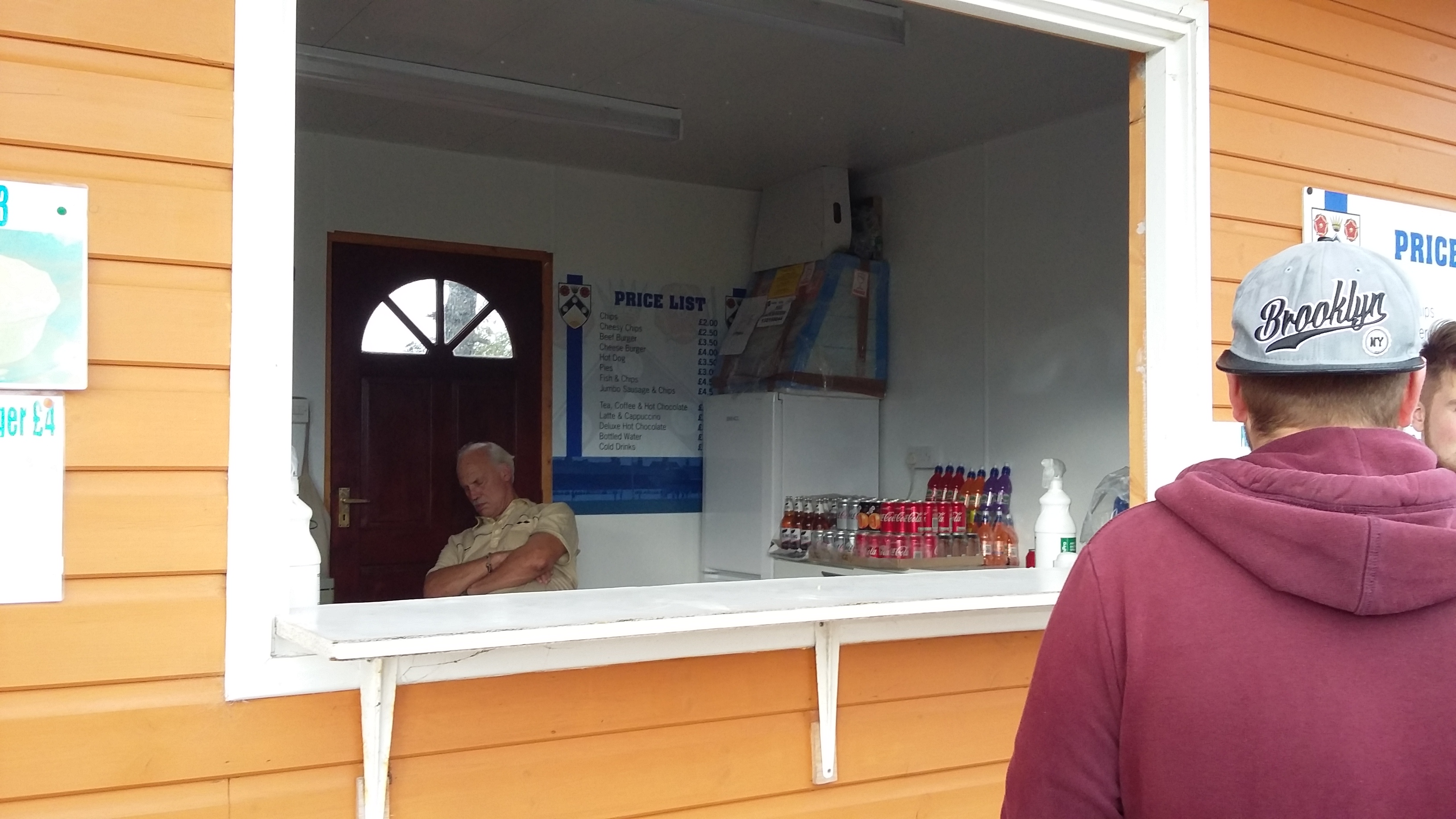 From the usual football food menu I opt for the ‘hot dog’ (£3.50), which consists of two very ordinary sausages with onions (optional), in what turns out to be a very crumbly
 girlie depending on your point of view, but also because he is very involved in the game and hits a decent long pass. It is probably a good thing that men are once again comfortable wearing a pony tail, but I’m glad that a rubber band or scrunchy did not deny me the sight of the flowing locks of Mario Kempes, Kevin Beattie and Gunter Netzer back in the 1970’s. For Lowestoft, their number eleven Cruise Nyadzyo seems keen to get the ball forward, but too often his crosses pick out no one in particular. I multi-task by walking around the ground and watching the match at the same time. A steward eyes me suspiciously. There is a country bus shelter type structure behind the far goal which sports on its back wall a trawler-shaped memorial plaque to one Ted Lightfoot.


 I want to tell them to relax, grow their hair, wear shades and a beret; they surely only dress like they do so people know that they are the club officials. I smile to myself. The main stand is a lovely, low, gloomy structure with a deep, grey fascia beneath the roof and glass screens at either end. Inside the stand there are no plastic seats like those found at most grounds; here they have the original cast iron frames with beautifully mellowed, curved wooden backs and wooden tip up seats. The stand has no stanchions to block your view suggesting it might be of a cantilever design, in which case it was an early one. Despite lashings of blue paint, it’s dull and utilitarian; but it’s beautiful and a candidate for local listing by Waveney District Council. Club officials in de-mob suits, brogues and fedoras, and smoking pipes would not look out of place in this stand.
 the burst of sunlight that breaks through the mass of cloud that started to hang low over Lowestoft this afternoon whilst I was in the Triangle Tavern. For all its beauty, this stand is on the wrong side of the pitch and a hundred or more people squint in unison. There are more shouts of “Come On You Blues” as people sense victory is possible, but this seems to make some older supporters sat behind me a bit tetchy too. Mr Quick the referee receives some mild abuse for one or two of his decisions and there is clearly a belief that the world and in particular Mr Quick is against Lowestoft. But according to Wikipedia, this is a town with three UKIP councillors, so fear and a lack of logic are common currency.
 Oblivious of medieval flintwork the commentary continues from from behind me, particularly when Cruise Nyadzyo is substituted; it’s not a popular decision. The view seems to be that he was the best player on the pitch. Things don’t get any better in the eyes of the mainstanders as Kingstonian’s Thomas Derry strikes the cross-bar with a header from a corner. But taking the best player off seems to have no lasting effect, perhaps it makes the other players work harder, and soon afterwards a low right-wing cross from Lowestoft’s number eight Sam Borrer is easily kicked into the Kingstonian net from close range by Jake Reed and Lowestoft lead 2-0. Going further behind seems to be just what Kingstonian needed to do however, in order to raise their game and they eventually score a goal too, from a free-kick off the head of number five Michell Gough. The remainder of the game involves Kingstonian trying to equalise and Lowestoft trying not to concede. I leave my seat to stand closer to the exit because when the final whistle blows it won’t leave long to get to the railway station for the 17:07 train. Eventually at 16:58 Mr Quick calls time and I sprint off down Love Road leaving the victorious Trawlerboys behind me; I make it onto the train with nearly three minutes to spare.


 trippingovertheball