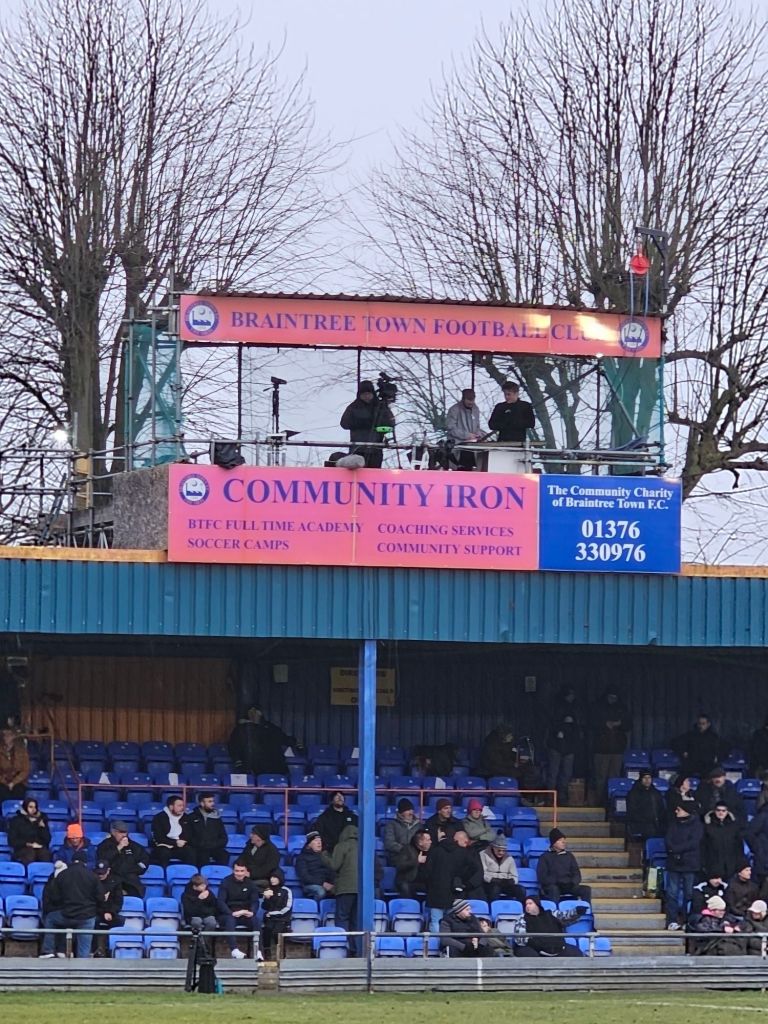
Braintree Town 2 Forest Green Rovers 0

It is roughly seven years and three months ago that I last made the 14.5 kilometre journey from my house to Braintree to watch Braintree Town play.  That mild, blowy November evening in 2017 Braintree Town, or ‘The Irons’ as they are known to their friends, played out a one-all draw against Truro City and as on all the previous seven times I had been to see Braintree Town, I travelled by car.  Today, having dismissed the idea of driving the 27.9 kilometres to Long Melford in my planet saving Citroen e-C4 to see ‘The Villagers’, as they are known to their friends, play Soham Town Rangers, I am going to return to Braintree.  As a responsible adult however, I am keen to do things Donald Trump wouldn’t do, and to reduce the double scourge of traffic congestion and on-street parking I have therefore decided to take the X20 bus to Braintree, where most appropriately Braintree Town are to play probably England’s greenest football club, Forest Green Rovers, in the Vanarama National League.  What is more, Forest Green Rovers are also supported by the Grateful Dead. As it used say on the sides of buses back in the 1960’s, “It’s better by bus”.

The X20 bus stop is only 200 metres from my front door and although the bus is about five minutes late, I am soon passing two one pound coins and two fifty pence pieces through the gap beneath the Perspex screen that separates me from the cheerful, bearded bus driver, who, although not old enough, looks a bit like he might once have been, or should have been in the Incredible String Band.  Fortunately, the bus is a double-decker so I can safely sit upstairs; the leather high-backed seats are comfortable, the bus is warm, and the windows aren’t steamed up, so I look out on the gloriously grey Essex countryside as it alternately sweeps and judders by as the bus passes along the pot-holed roads.  Behind me, younger, more self-centred people than myself either noisily watch ‘content’ or hold loud, vacuous conversations on their mobile phones.  When I was young, old people would often sit next to me on buses and want to talk.

The timetable that I looked at on-line when planning my journey indicated that it would take twenty-three minutes, and the big blue bus is soon arriving on the outskirts of Braintree, something that is announced with its cathedral, a Tesco supermarket.  From Tesco’s, Braintree unfolds as lines of dull looking houses of decreasing size. I am due to get off at the stop identified as “Braintree o/s King’s Head” and recognising the approach to the junction with Cressing Road where the King’s Head is situated and seeing a bus stop flag, I press the bell, but too soon and the bus draws up at a stop called “Dallwood Way”.  Whilst stupidly unable not to think of Virginia Woolf, I nevertheless manage to say to the bus driver “Oh, I wanted the next stop . “He offers to drive on, because obviously he’s going to anyway, but I tell him it (Cressing Road) is only round the corner, and as things work out the bus is held by a red light at the junction and I get round the corner in to Cressing Road before I would have done if I’d got off at my intended stop.  Across Cressing Road I can see that what was once the King’s Head pub is now a Tesco ‘local’.

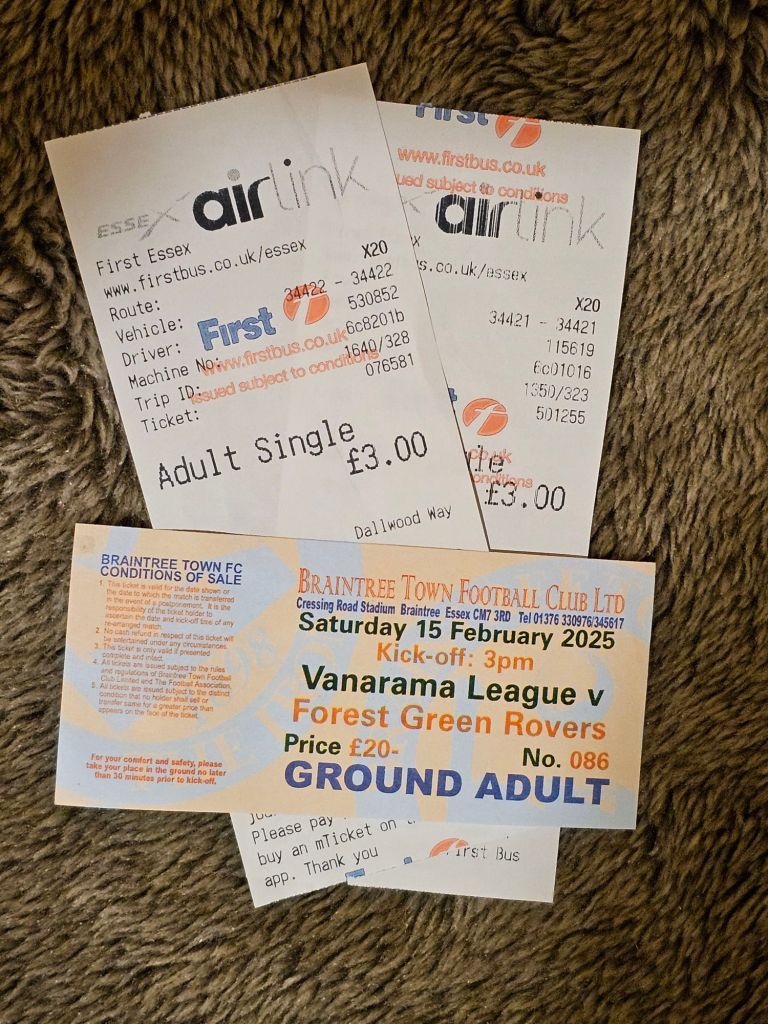
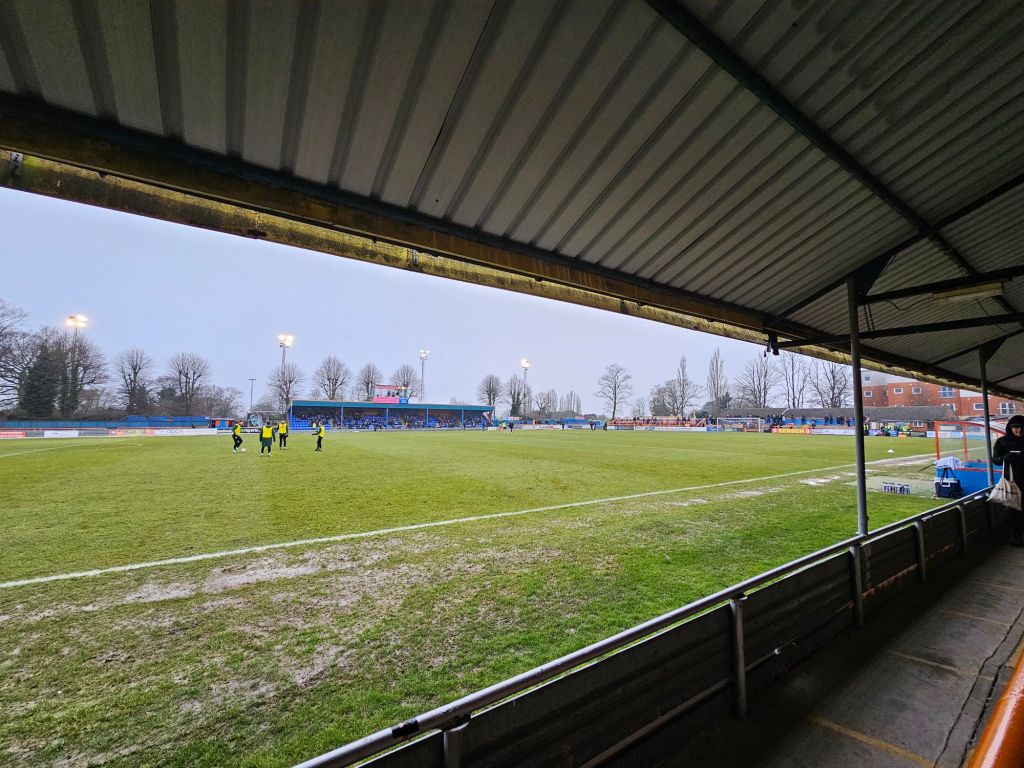
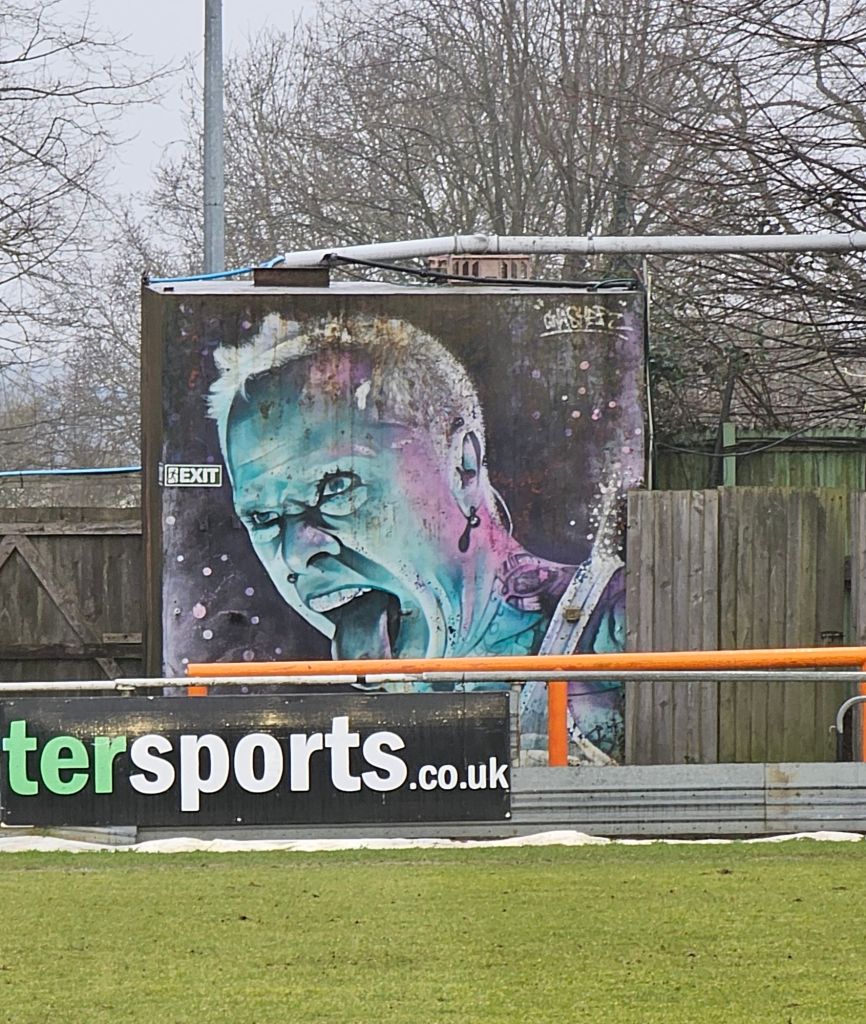
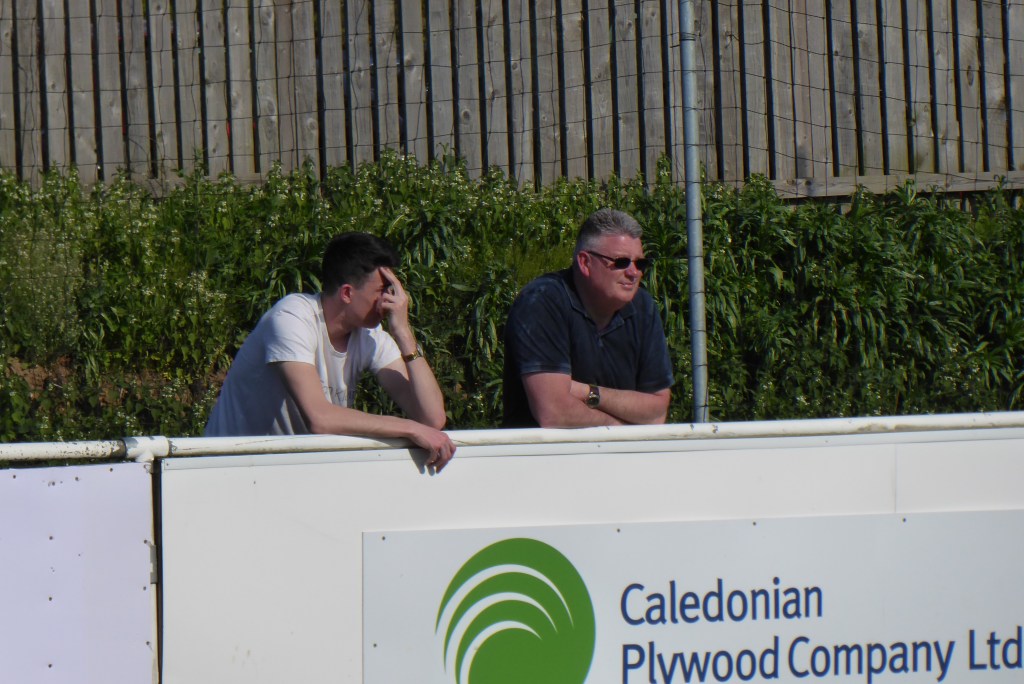
It has started to rain, and weighed down with the responsibility of not wasting the valuable seconds I have gained by getting off the bus early, I step out on the ten-minute walk up Cressing Road and along Clockhouse Way to what was called the Ironmongery Direct stadium the last time I was here, but now rejoices under the name of The Rare Breed Meat Co Stadium.  Being the world’s first vegan football club, I’m surprised Forest Green Rovers haven’t refused to play here, and there are so few people walking up Clockhouse Way with me I do begin to wonder if the game hasn’t been postponed.  But the sight of a man in a day-glo coat, a full club car park, a man in an orange football club hat and three other people obviously dressed for an afternoon of spectating allays my fears and I head for the turnstile labelled “card only” where the wonder of modern technology takes £20 from my bank account with the mere tap of a piece of plastic.  Satisfyingly, I am given a small, printed ticket in exchange, it’s number 86.
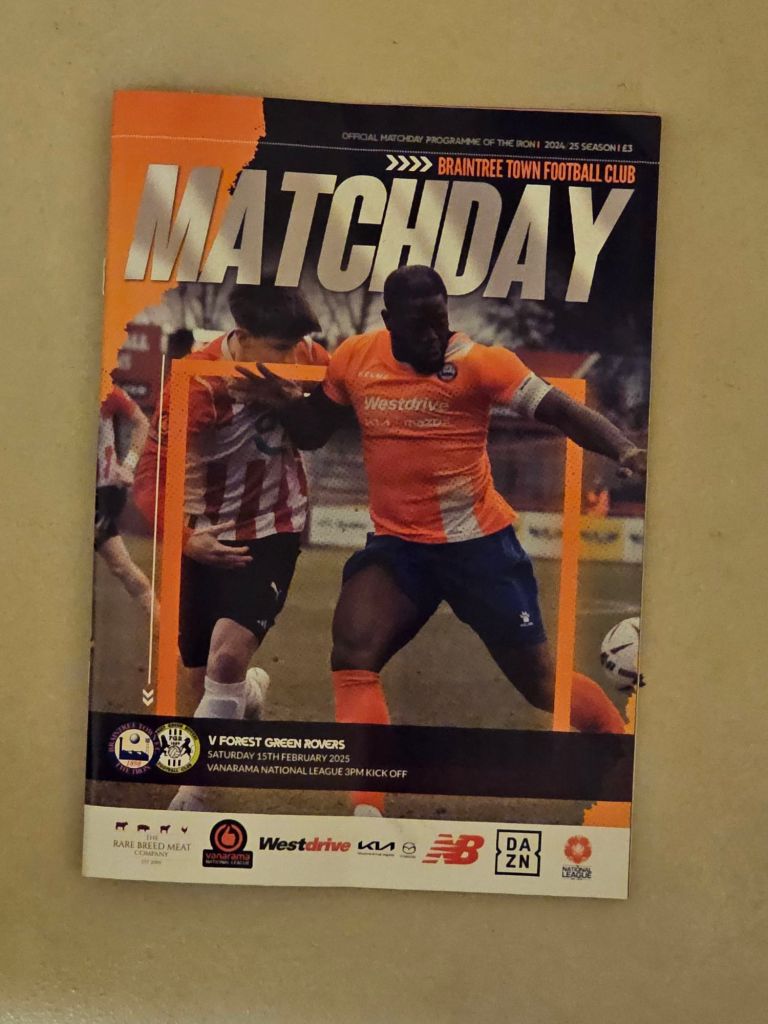
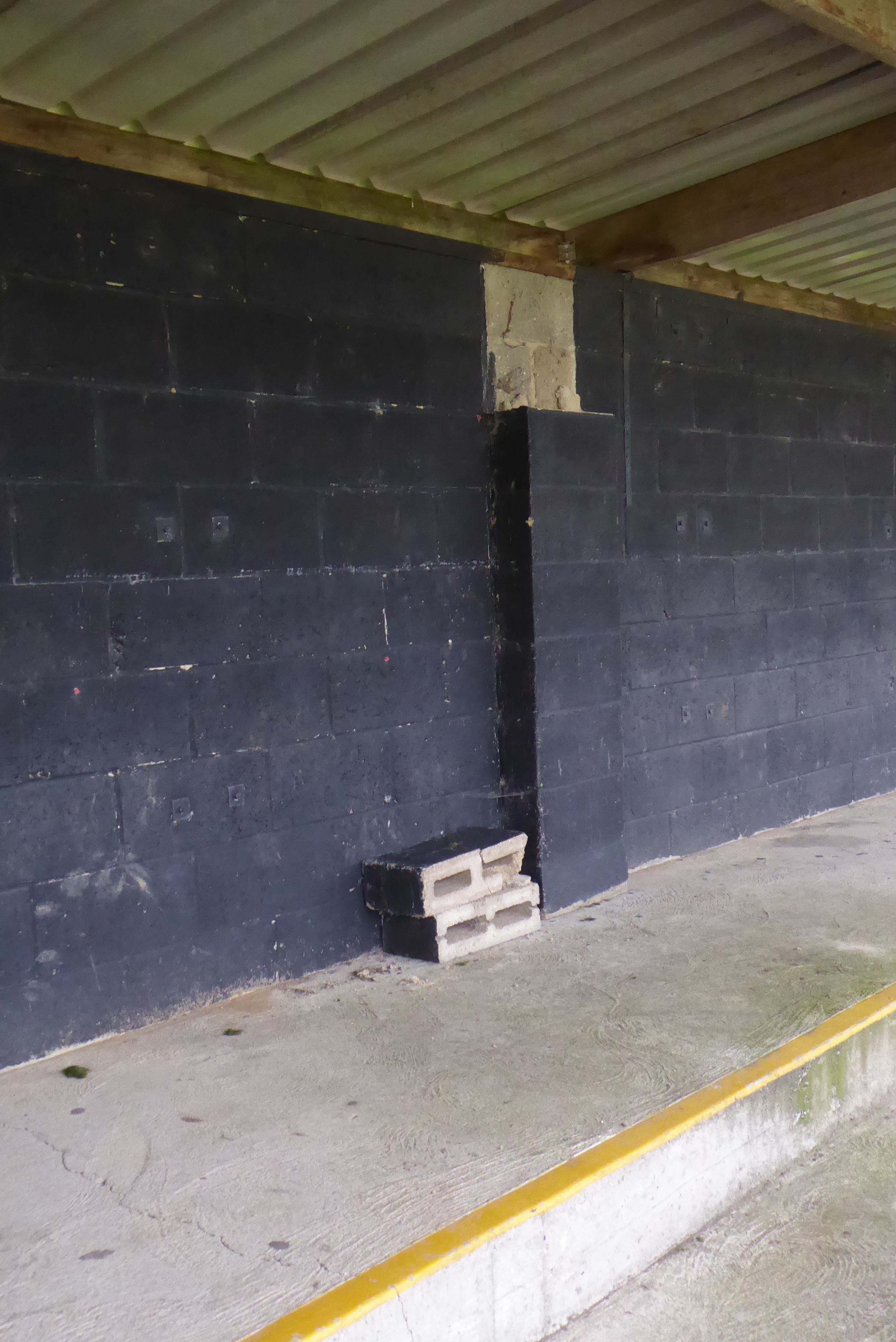
To buy a programme (£3.00) I make for the club shop, a cornucopia of old programmes, club badges and general football fan bric-a-brac in a portacabin; every club should have one, but fewer and fewer do. A radio in the club shop is tuned to Radio Essex and a time check tells me that it is six minutes to three, so I head out and onto the open terrace behind the goal to select a spot against the back wall, level with the eaves of the club house just behind.

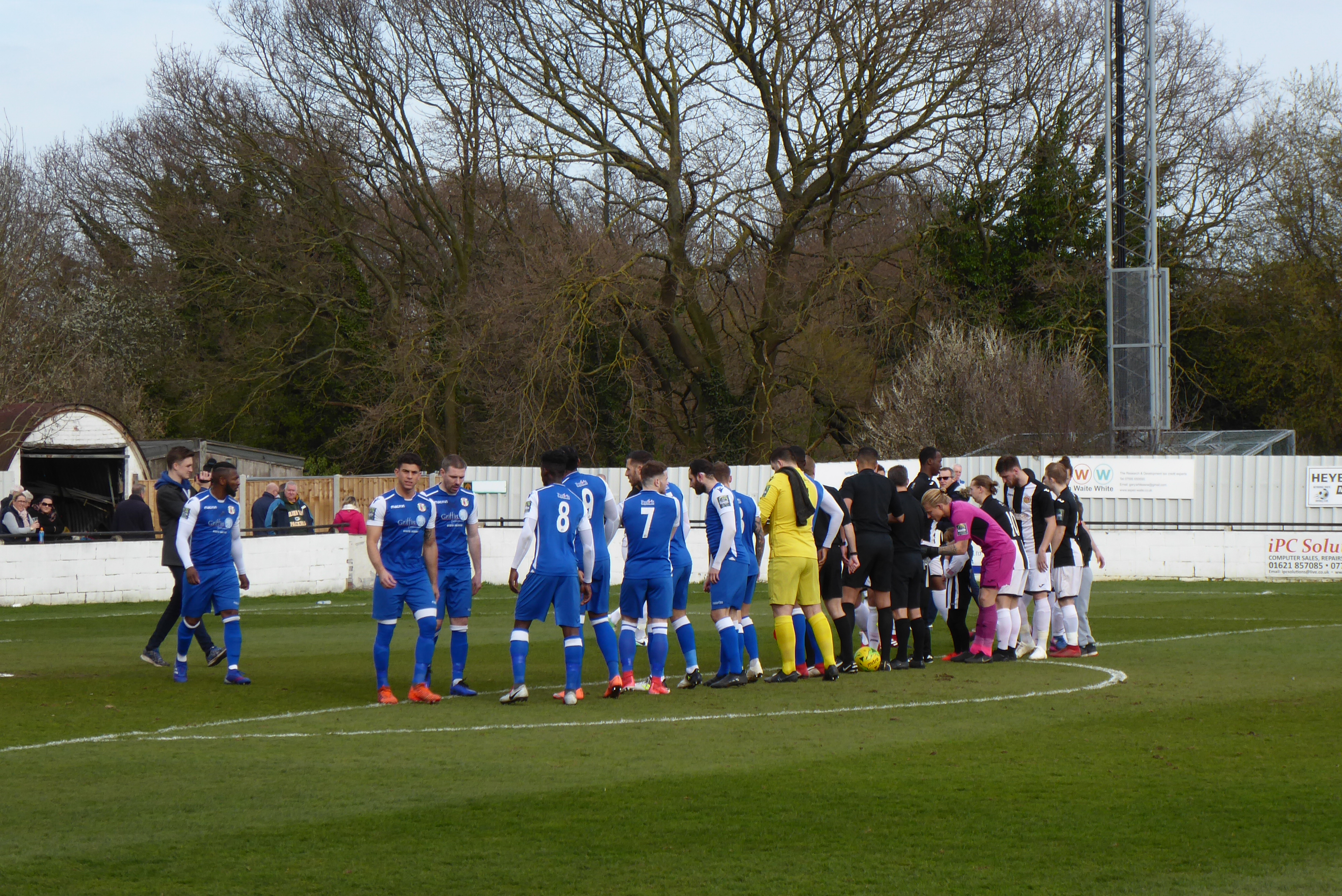
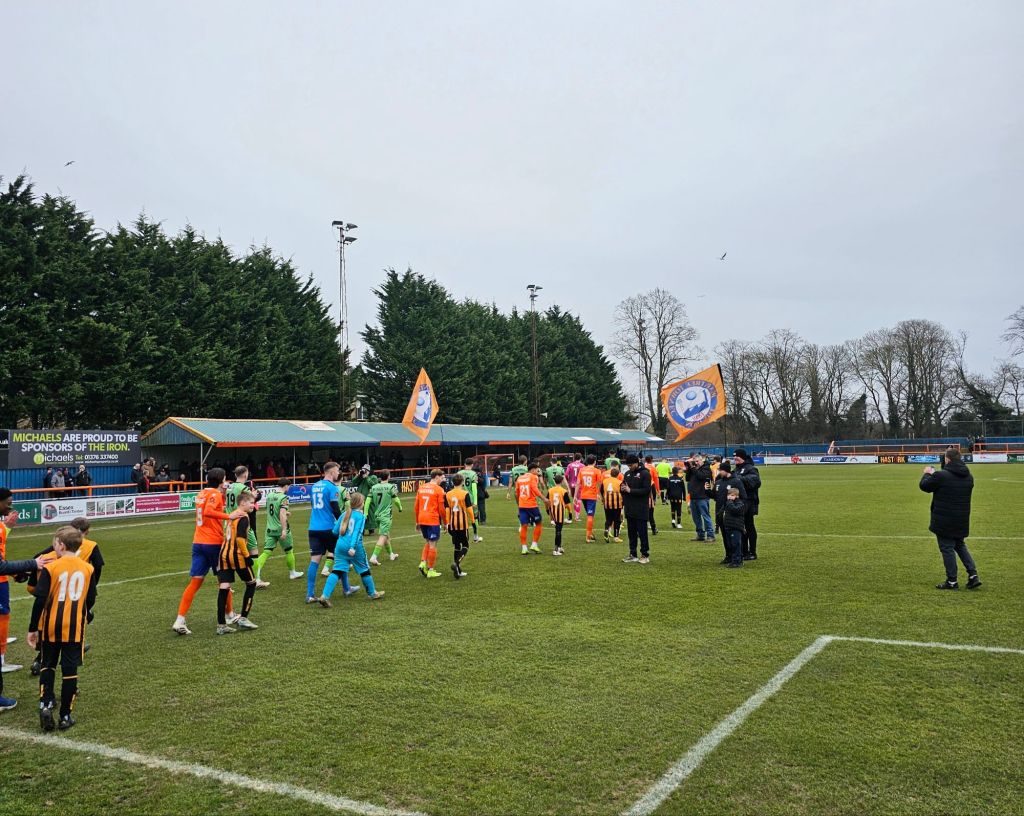
The teams process onto the pitch to the strains of “Firestarter” by ‘electronic punk’ or ‘rave’ band The Prodigy,  who are or were Braintree’s modern claim to fame. There is a minute’s silence before the kick-off for a recently deceased former player.  It’s a silence that is at first disturbed by shouts of ‘Rovers’ from somewhere off to my right.  Once achieved, the silence seems a long one as if the referee in schoolteacher mode had decided that we were just going to have to wait to begin until everyone was quiet.

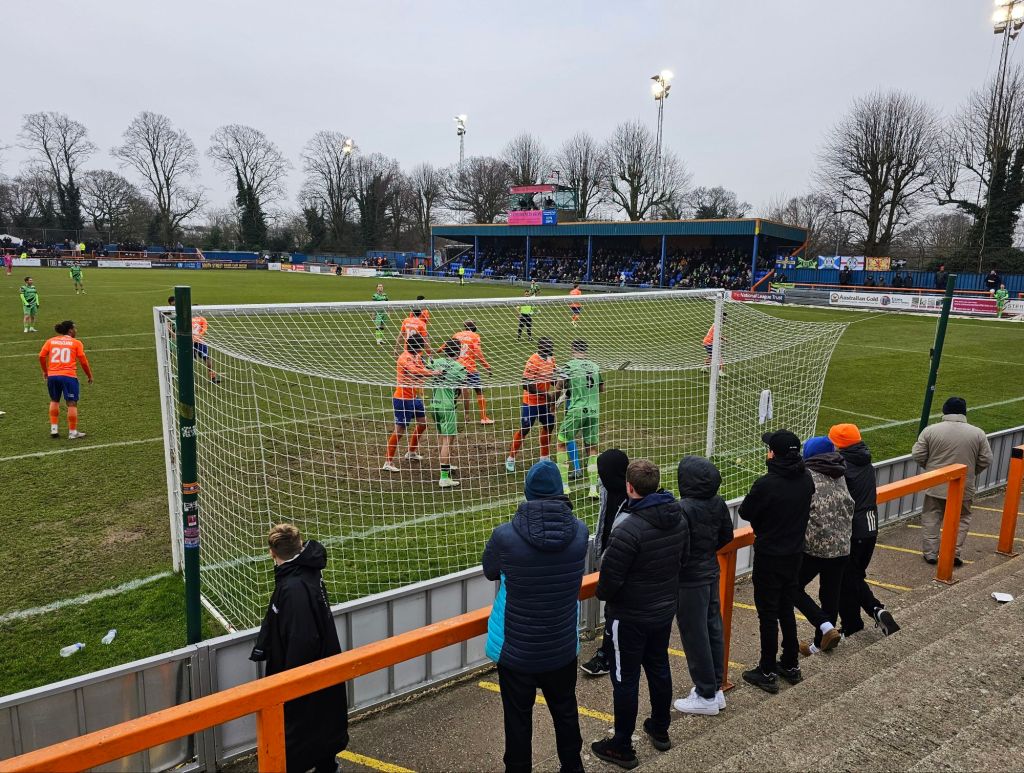
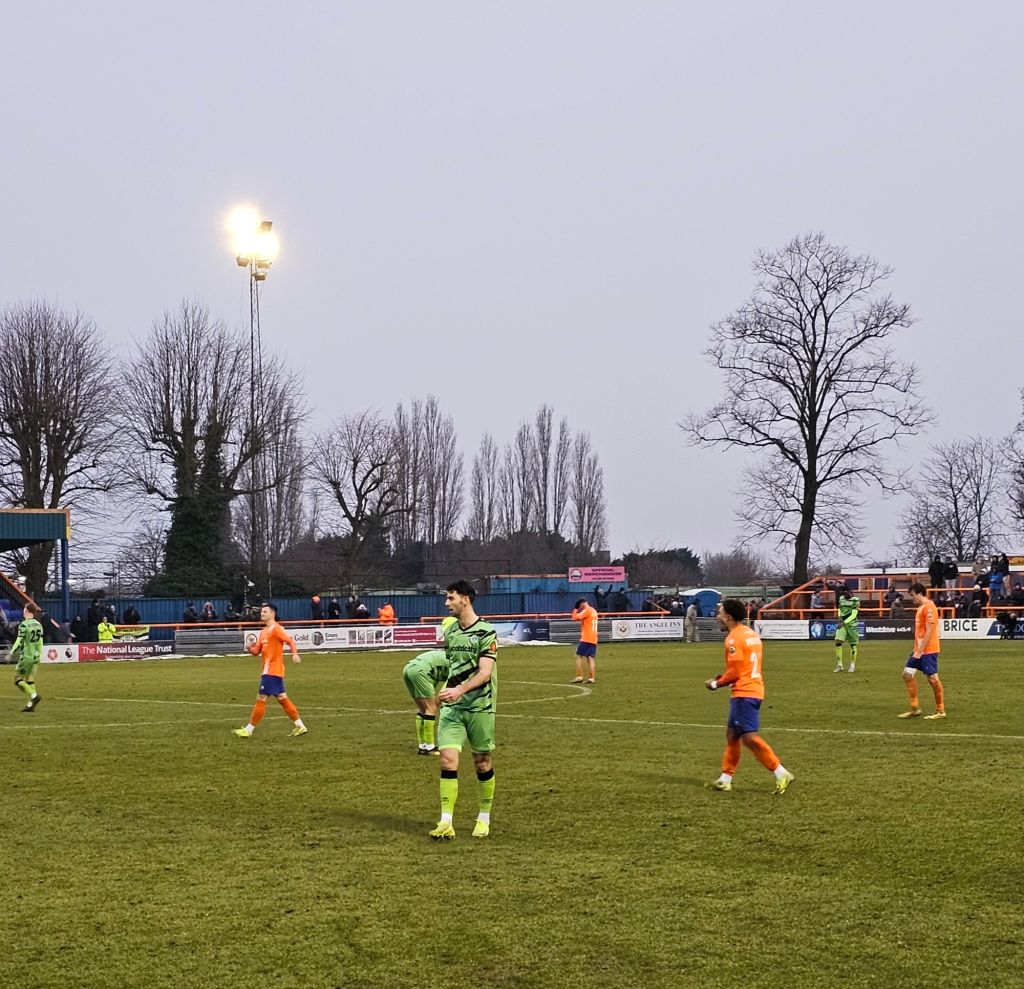
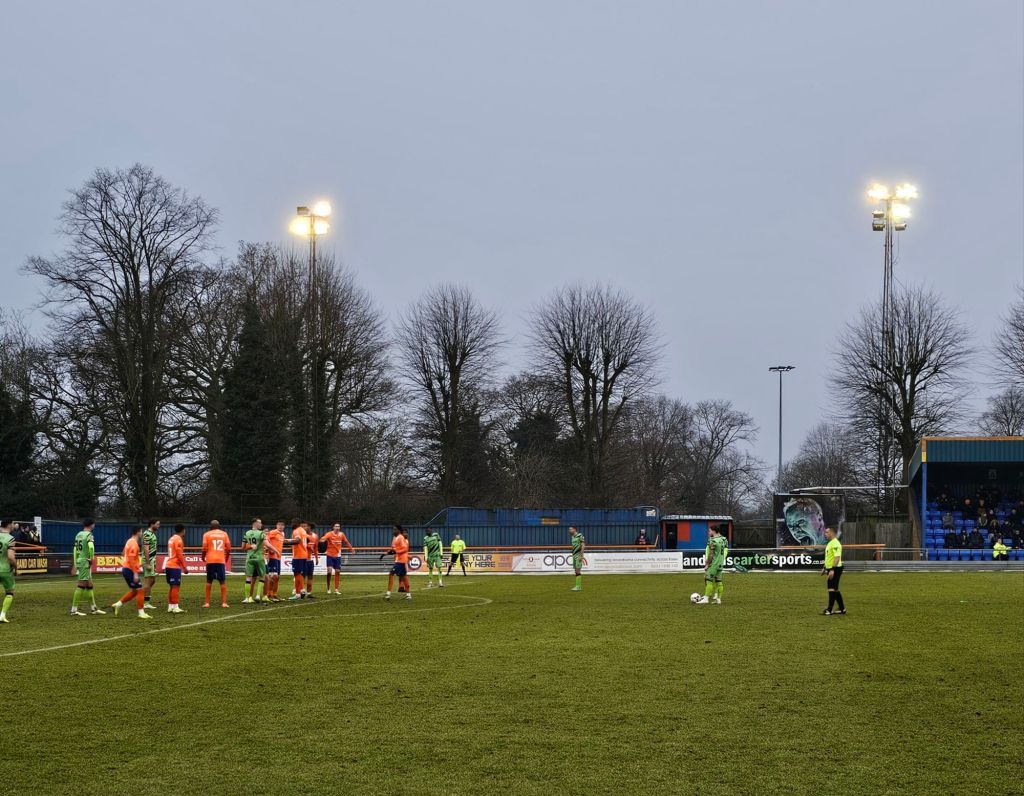
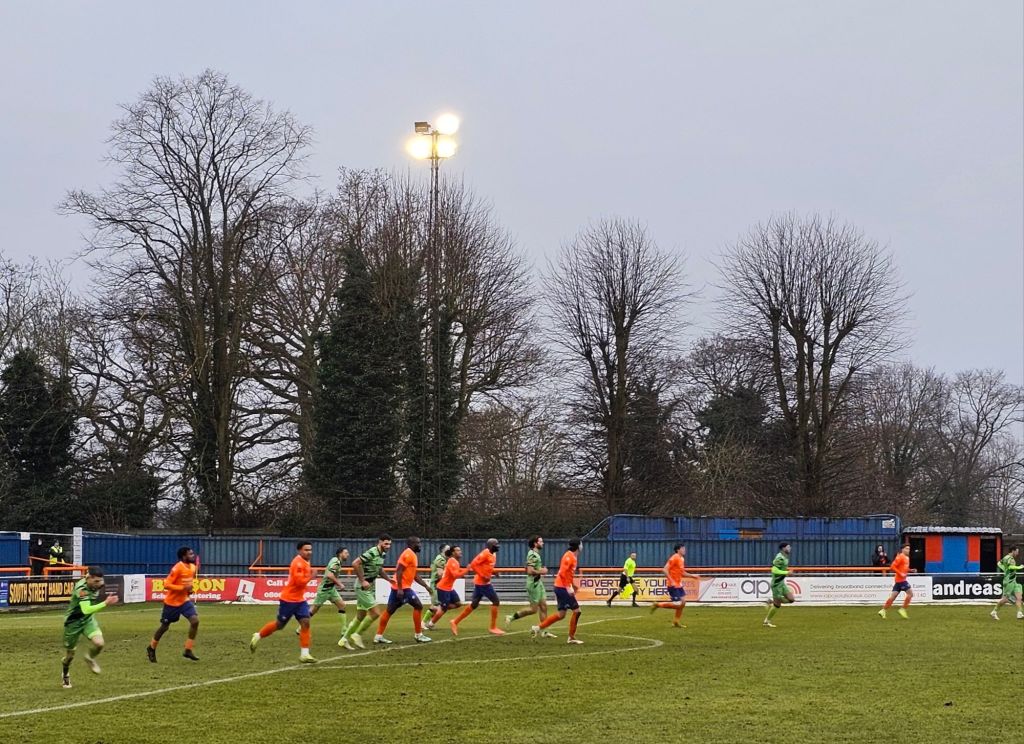
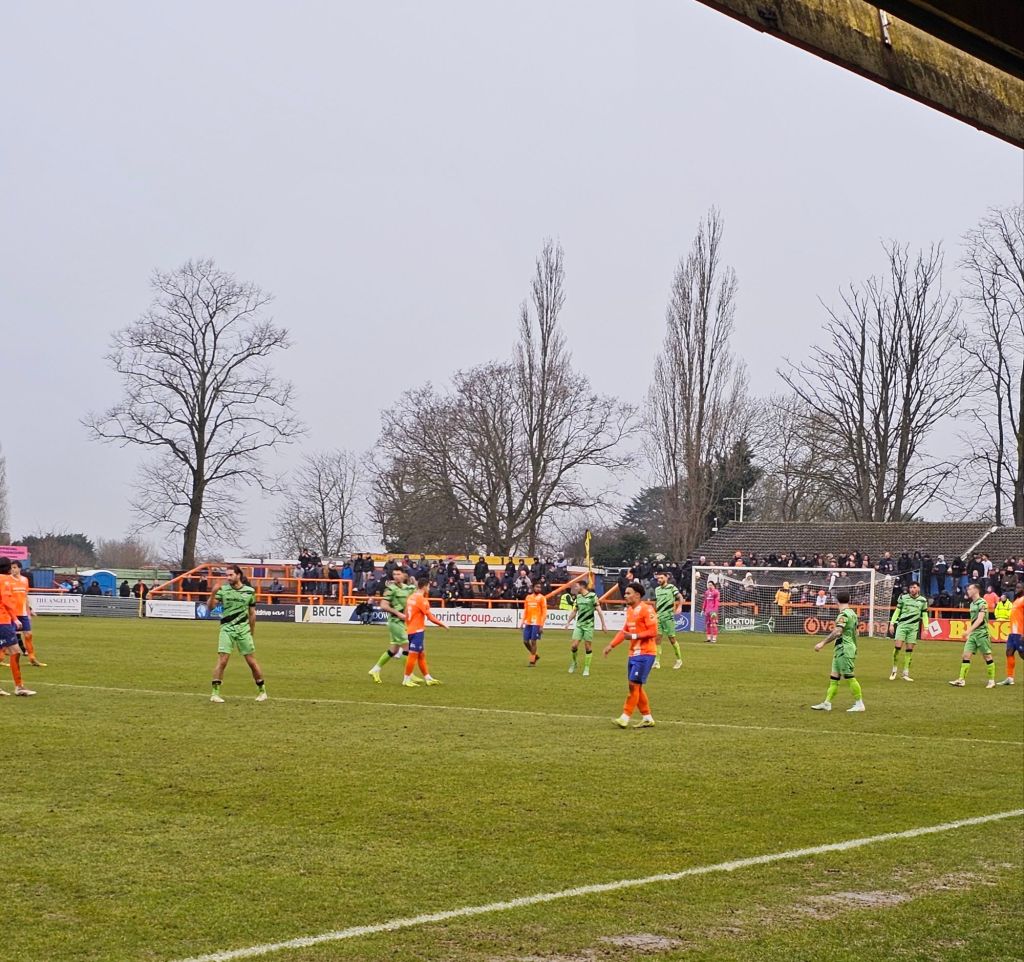
When the match eventually begins, it is Braintree who get first go with the ball, sending it mostly away from where I am standing, and in a south easterly direction towards the village of Tye Green and far off Witham, where this afternoon Witham Town are going to lose heavily to Bury Town in the Isthmian League.  Braintree wear a gloriously colourful kit of orange shirts and blue shorts, a brighter version of Montpellier HSC of French Ligue 1.  Forest Green Rovers by contrast are in a disappointingly dull, faded looking shade of all-over green, but with black slashes on the front of their shirts as if they had originally been intended for use by a safari park eleven.

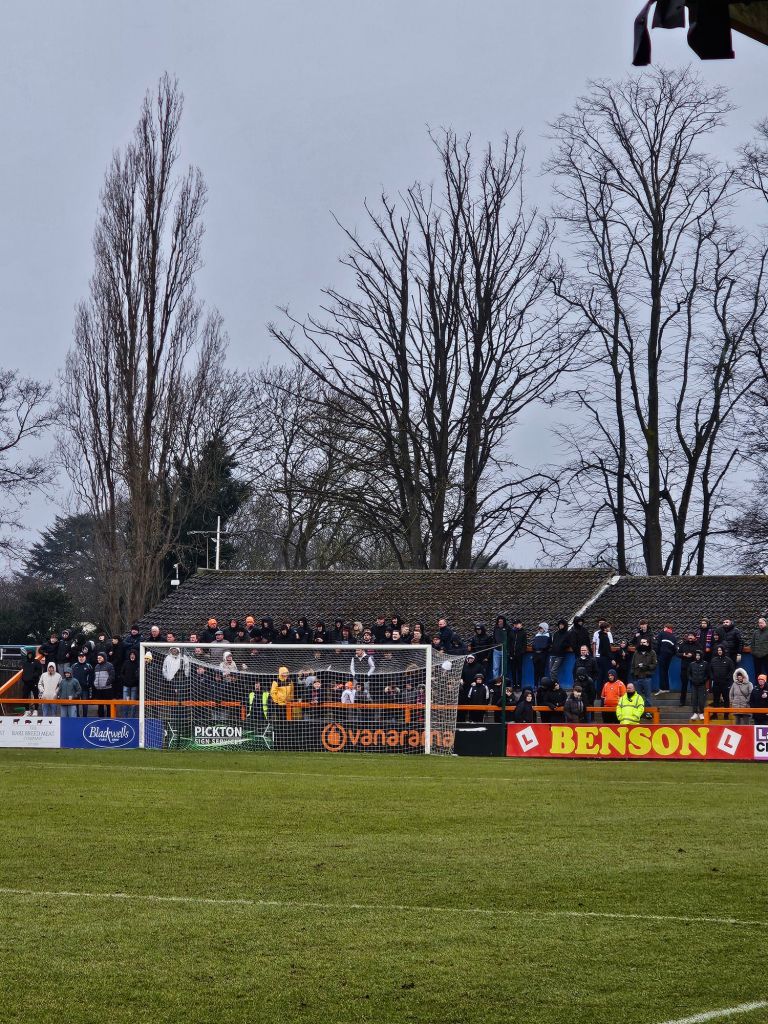
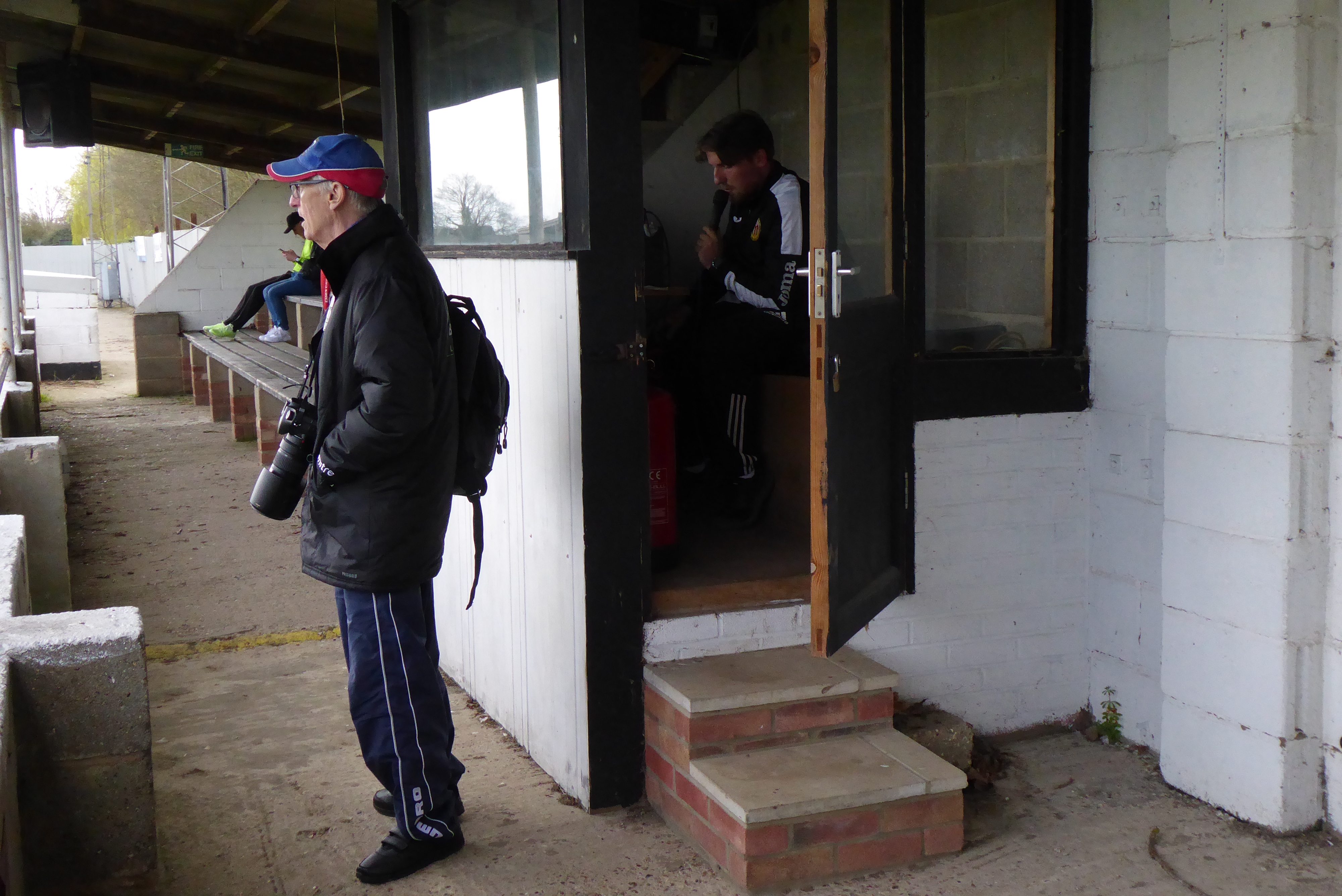
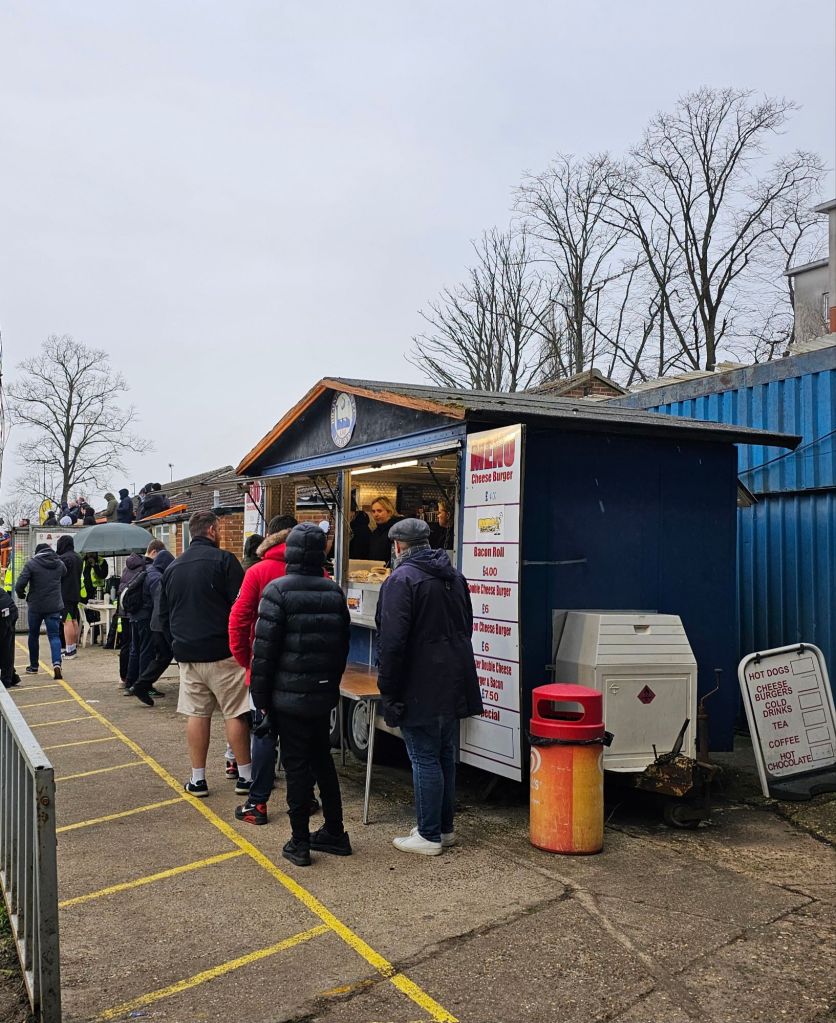
Braintree dominate the start of the game and all the action is at the far end where it looks compressed into a few yards.  A few feet along from me a middle-aged man twitches and flexes as he wills Braintree to score with a quiet commentary of encouragement to himself. “Oooooh” he suddenly exclaims as an early cross eludes the straining head of an orange shirted player at the far post.  The rain has started to feel like sleet.  Along the walkway at the foot of the terrace, a procession of hungry-looking ten and eleven-year-olds ferry polystyrene trays stacked with chips and burgers, which may or may not be from the meat of slaughtered rare breeds.  “Your support is fucking shit” comes the chant from beneath the low roof of the terrace on the east side of the ground.  “Come on” continues the bloke a few feet away from me, quietly to himself as Braintree win another early corner.

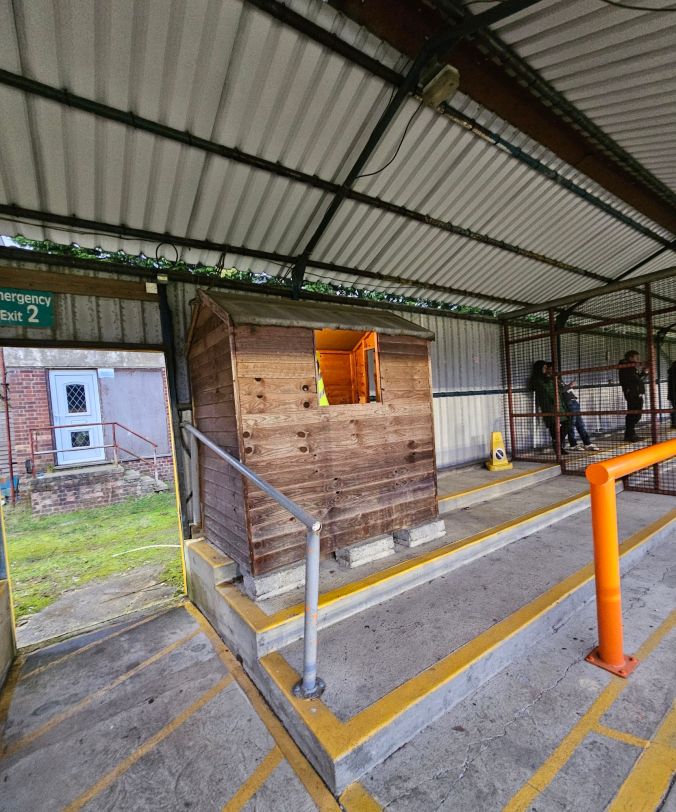
It is eleven minutes past three and Braintree score. A low shot from wide on the left into the far side of the Forest Green goal. “Goal scorer for…” says the stadium announcer from his garden shed inside the low-roofed terrace.  He stops mid announcement but then continues to tell us that the goal scorer is what sounds to me like “Cairo Lisbie”.  “Goal scorer today” he repeats as if he thinks it’s unlikely anyone else will score, “Cairo Lisbie”.  In fact, of course, he is saying Kyrell Lisbie.

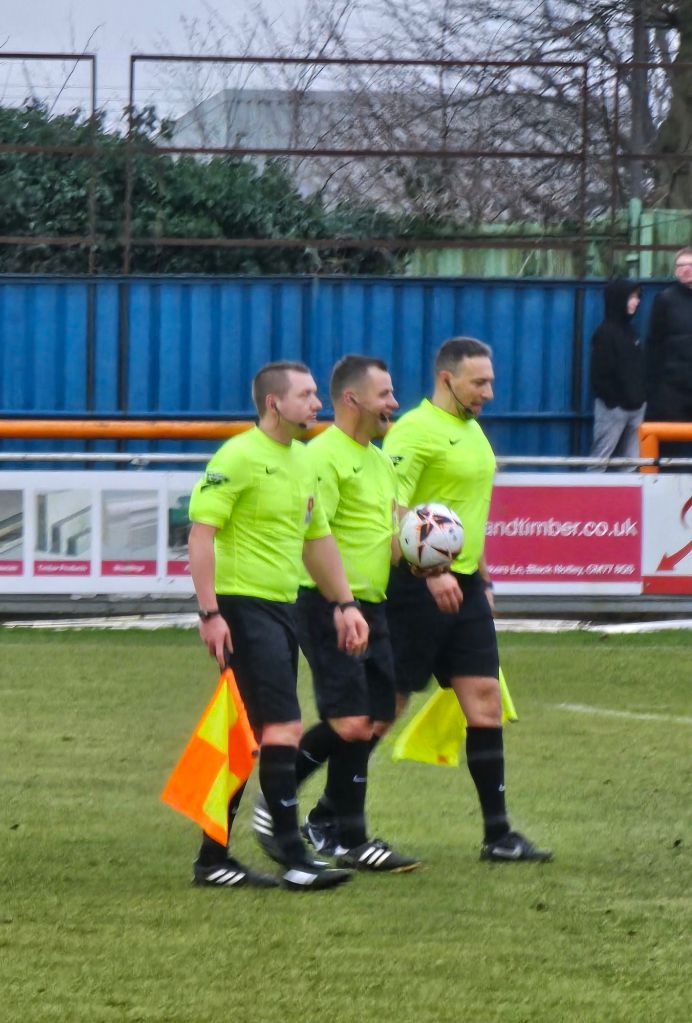
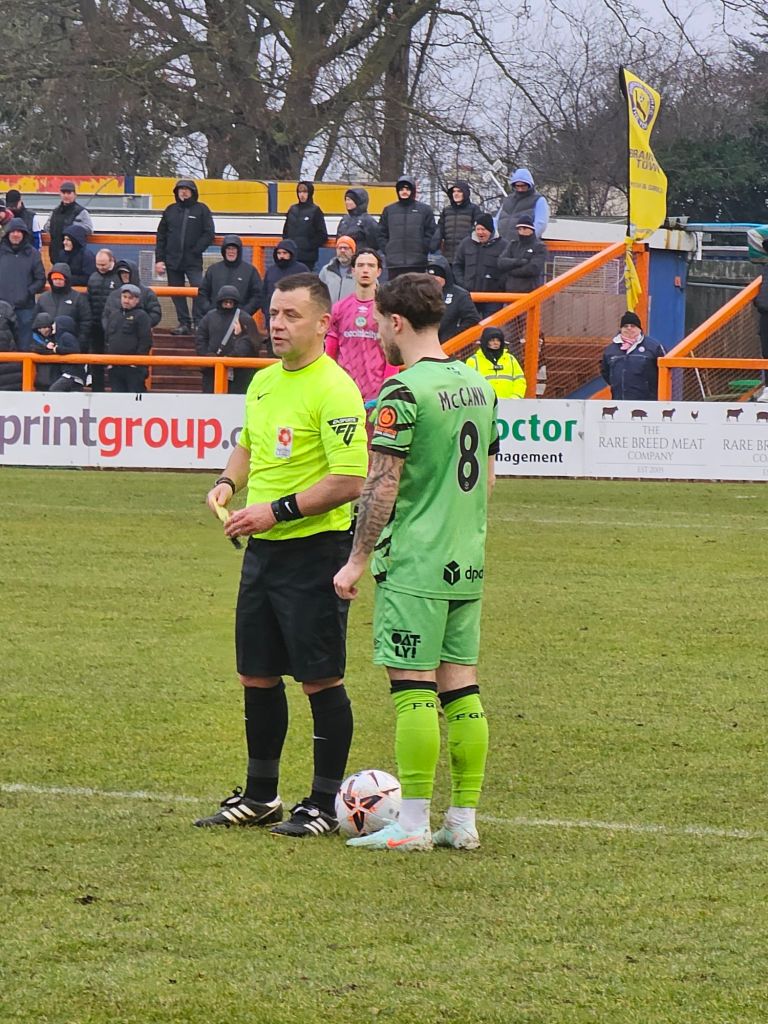
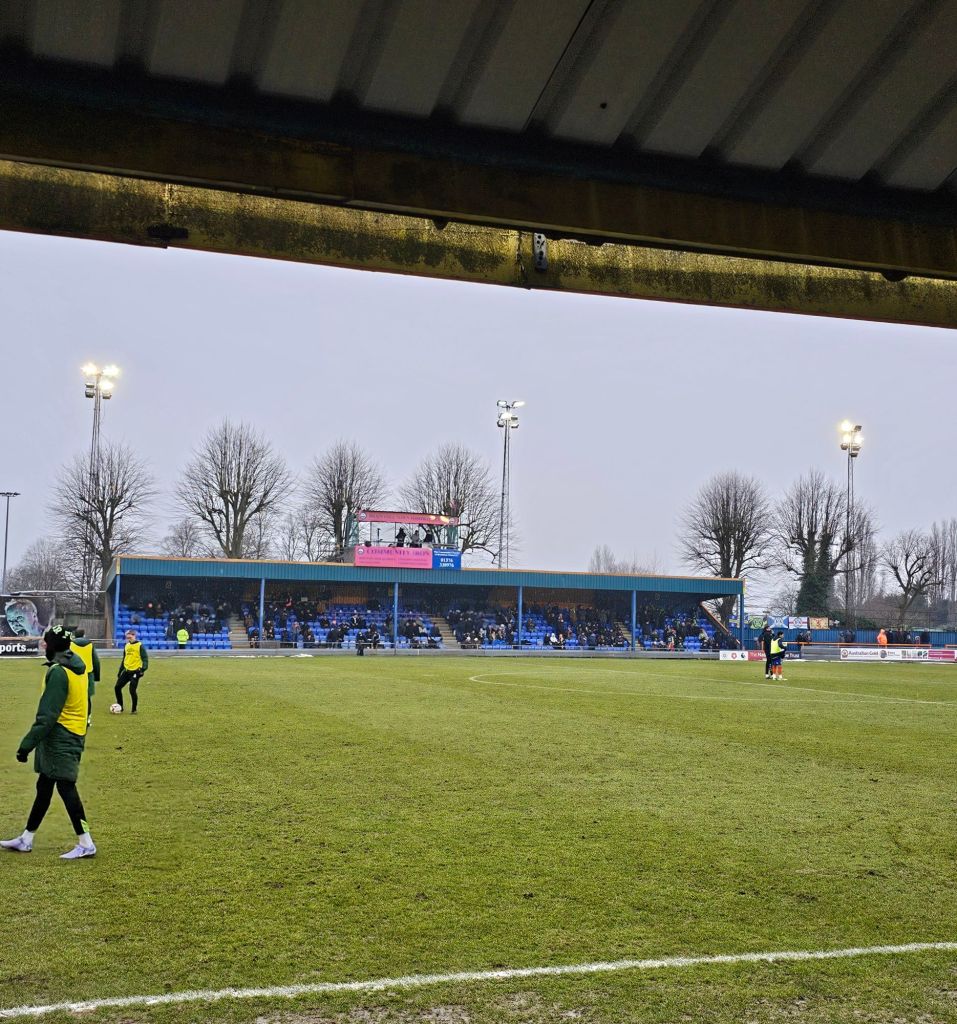
“No noise from the Vegan boys” is the chant from beneath the low roof of the side terrace, as if to rub it in that we’re in the “Rare Breeds Meat Co stadium”, and I decide that the drizzle is now too cold and heavy and so I make for the covered terrace beneath the low roof.  “When’s the Southend game?” I hear a bloke say as I walk by.  “I’ve got a feeling it’s next month” says his interlocutor evidently preferring to rely on sensations rather than the actual fixture list, which confirms that the fixture is on April 18th.  In my new location on the covered terrace with the low roof I have a new set of neighbours. “Yellow there ref, yellow, that is a yellow, thank you” says a bloke nearby as Forest Green’s Adam May becomes the first player to be booked by referee Gareth Rhodes, whose name is similar to that of a once popular, but now deceased tv chef.

A high cross field ball from a Forest Green player is greeted with a derisory jeer from the home crowd and then a collective, disappointed ‘Oh’ as it drops perfectly onto the bounce-free turf at the feet of Rovers’ wide player.  Around me the locals continue to take umbrage at Mr Rhodes’ failure to book any more Rovers players.  “Should of (sic) got booked earlier” shouts someone, “How many more times?” enquires someone else, before shouting it again, and then again, making me wonder how many more times he would shout it. “Cynical!” calls a short bespectacled youth next to me, and then “I’m watching you ten”, as if this matters.

At twenty-seven minutes to three Braintree score a second goal; one very much like the first, but this time with a shot from wide on the right into the far corner of the goal by number seven, Tom Blackwell.  After three minutes of added on time, half-time arrives and the public address system returns us to 1979 with the sound of ‘A message to you Rudy’ by the Specials. I eat a Polish Grzeski chocolate-coated wafer bar from the Sainsbury’s World Foods aisle and reflect on all the other delicious European foodstuffs that could have been so much more freely available had Britain not left the European Union.
Today’s attendance is announced as being 860 and the football resumes at five past four.  I walk to the far end of the low-roofed terrace where I find myself amongst mostly Forest Green Rovers supporters, and I feel happier amongst the sounds of their west country burr than amongst the aggressive rants and growls of the voices of the displaced Londoners who now live in Essex.

Rovers begin the half with purpose, and in the first few minutes spend as much time in the Braintree penalty area as they did in the whole of the first half.   But then Braintree breakaway and hit the post or the bar with a shot. “Come on Rovers” call the people around me from beneath their green and black knitted headwear.   “We’re winning” says a young bloke nearby and it seems from subsequent mention of Liam Delap that he and his friends are either Ipswich Town supporters watching Forest Green, or Forest Green supporters who follow Ipswich.

I’m seeing Forest Green at closer quarters this half and soon establish that their team is ‘set up’ in the traditional formation of a couple of big blokes at the back, a big bloke up front with smaller blokes all around, especially on the wings.  Braintree would seem to be similar and with a blend of youth and experience which includes the venerable thirty-five year olds John Akinde, a man in the mould of the legendary Adie Akinbiyi, but obviously not as big,  and defender Jamal Fyfield.  Despite more possession this half, Forest Green are not making any decent chances.  “Shoot” plead the people around me. “Bring on a fuckin’ strikerr” says another, more directly and rolling his ‘r’s like a comedy pirate in the process.  It’s nearly twenty to five when Forest Green have a shot good enough to force the Braintree goalkeeper into making a save and by then they have replaced half their outfield with substitutes, including one Harvey Bunker, who I like to think has a brother called Cole.

The second half is one of frustration for away supporters and tension for home fans, only occasionally relieved by a wet, slippery, muddy pitch which induces a sprinkling of pratfalls and mis-kicks for added comedic effect.  Eventually, after the initial ninety minutes are played out, Mr Rhodes adds another six for good measure and halfway through these the Braintree fans feel sufficiently confident of victory to begin chanting “We are staying up”.  Their optimism is well placed as not surprisingly, given what has happened since three o’clock, Forest Green fail to produce a miraculous come-back .

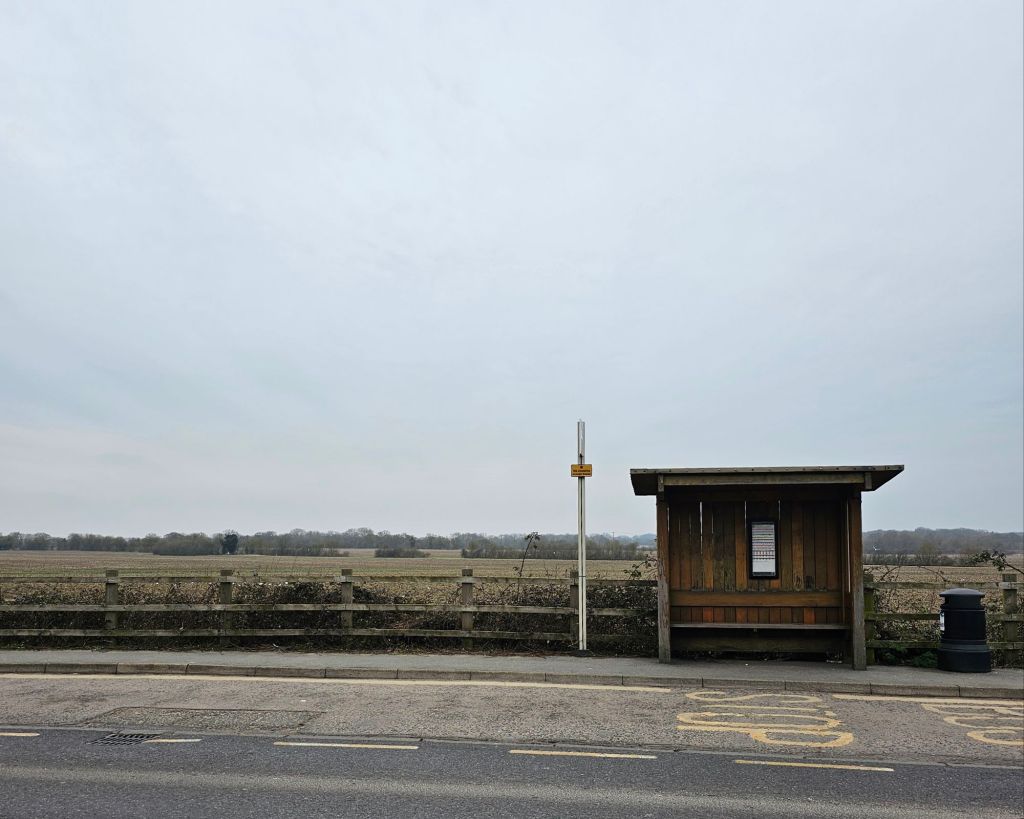
With the final whistle, a mostly happy crowd slips away into the receding dusky light whilst a few Forest Green fans hang about to berate their players by way of encouraging better in the future.  I too drift away, past the interesting 1930’s modernist workers houses beyond the club car park and back down Clockhouse Way and Cressing Road to the bus stop.  The bus will be late again, the stop has no shelter and it starts to rain again, but as the win to the local team proves, it’s better by bus.

AFC Wimbledon 1 Ipswich Town 3

With the end of Christmas, the return to the drudgery of work, the promise of more short, dark days, miserable weather and stale mince pies, the start of January needs something to lift the spirits.  Christians have Epiphany, and those football fans whose teams weren’t knocked out in the preceding rounds have the third round of the FA Cup; Christian football fans get both and no doubt count themselves blessed.

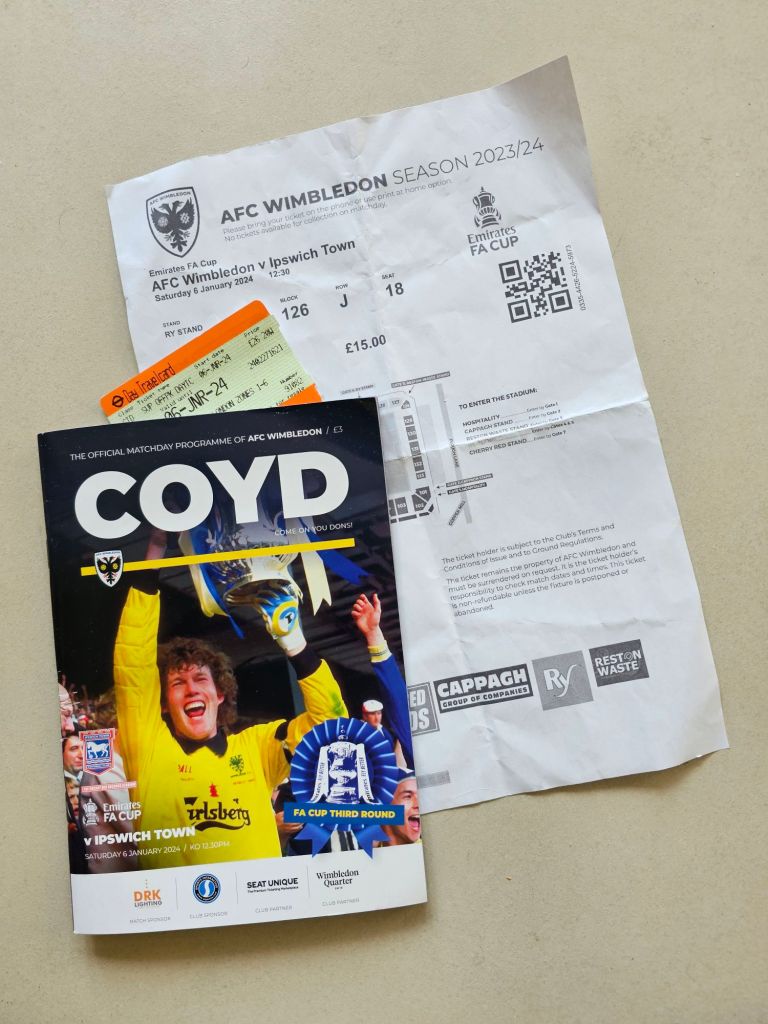
Having returned to the Second Division, Ipswich Town have this season avoided the first and second rounds of the Cup, and something like The Jam’s 1980 single ‘Going Underground’, which went ‘straight-in’ at No1 in the popular music chart, have gone ‘straight-in’ to the third round and a tie with fourth division AFC Wimbledon, who got here the hard way thanks to ‘going knap’ twice with  victories over Cheltenham Town and Ramsgate.  The joy of this third round tie is further enhanced by the fact that I haven’t previously visited to Wimbledon’s new ground at Plough Lane and they will become the first club I have seen play at five different ‘home’ venues. Take that ‘I-spy’ book of English Football League grounds.

But life is never simple, and the journey to Wimbledon is paved with rail-replacement buses, added to the fact that the year has started badly as I have broken my glasses and cannot see well enough without them to drive; safely anyway.  Just to add an extra layer of inconvenience to that, the match kicks off at the ungodly hour of 12:30pm in order that the good people of Aruba, Bolivia, the Central African Republic, Djibouti, Equatorial Guinea, Myanmar, Norway, Rwanda, Sudan and Venezuela, amongst many others may share in our joy via the medium of satellite television on such channels as Star+, SuperSportGOtv LaLiga, DStvNow, NovaSport3, ESPNPlay Caribbean and SportKlub5 Serbia.

As I leave home a little before 8am, my wife Paulene is only just stirring from her slumbers, but I think she understands when I kiss her goodbye and tell her the cup of tea I made her is probably nearly cold. I collect my train ticket (£26.60 with over 60s railcard) from the automatic ticket machine at the railway station. The train is on time and travels through long, broken shadows as the sun rises spectacularly in the East through bands of grey cloud. I look on in wonder through the carriage window, glad I don’t need my glasses to see the glory of this.   “Welcome to this service for Witham, we will be calling at Witham” says the soothing female voice of the train announcement as we depart Kelvedon, and then after a short pause “Next stop, Witham”.  In no doubt that this journey involves going to Witham, I am not surprised when I arrive there and then switch to a smart, bright blue double-decker bus with high backed seats and leg-room that would be uncomfortable even for Douglas Bader.  In the seats behind me are three generations of a family. The grandmother and daughter talk of people they know who died over Christmas, but how they won’t be going to the funerals.  The daughter says everything twice and her mother repeats it; the granddaughter just occasionally squeals.  The bus speeds along down the A12, and the bit of the window beside me that opens shakes in the breeze, causing a draft, but at least it helps to stop the window steaming up.

The bus takes us to Ingatestone where we wait on platform 2 for a train and I talk to a fellow Town fan also on his way to Wimbledon.  We share the glory of Ipswich Town in 2023 and agree that whatever happens, it has been, and still is wonderful, and it is up to everyone to just enjoy it.  He’s had a season ticket since 2007; I don’t tell him I’ve had one since 1983, but hope he still has one in 2048.  The train arrives at Liverpool Street and I take the Elizabeth Line one stop to Farringdon, where I arrive a half an hour earlier than expected and soon board a Thameslink train destined for Sutton, although I will alight at Haydons⁹ Road.  It’s a marvellous ride over the river at Blackfriars and then on through the city’s ripped backside. I peer down into scruffy back gardens, amazed at the prevalence of plastic lawns. Rows of double-decker buses stand idle outside a depot. Vicious looking spikes deter trespassers on roofs and messy graffiti adorns crumbling walls and corrugated iron fences.

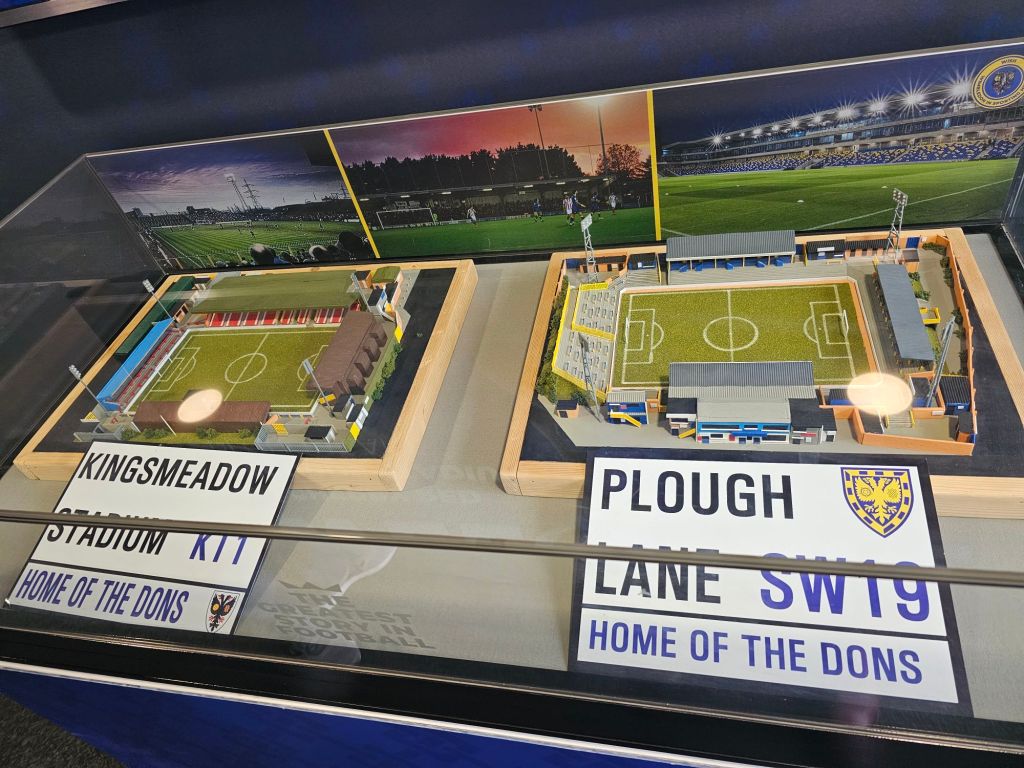
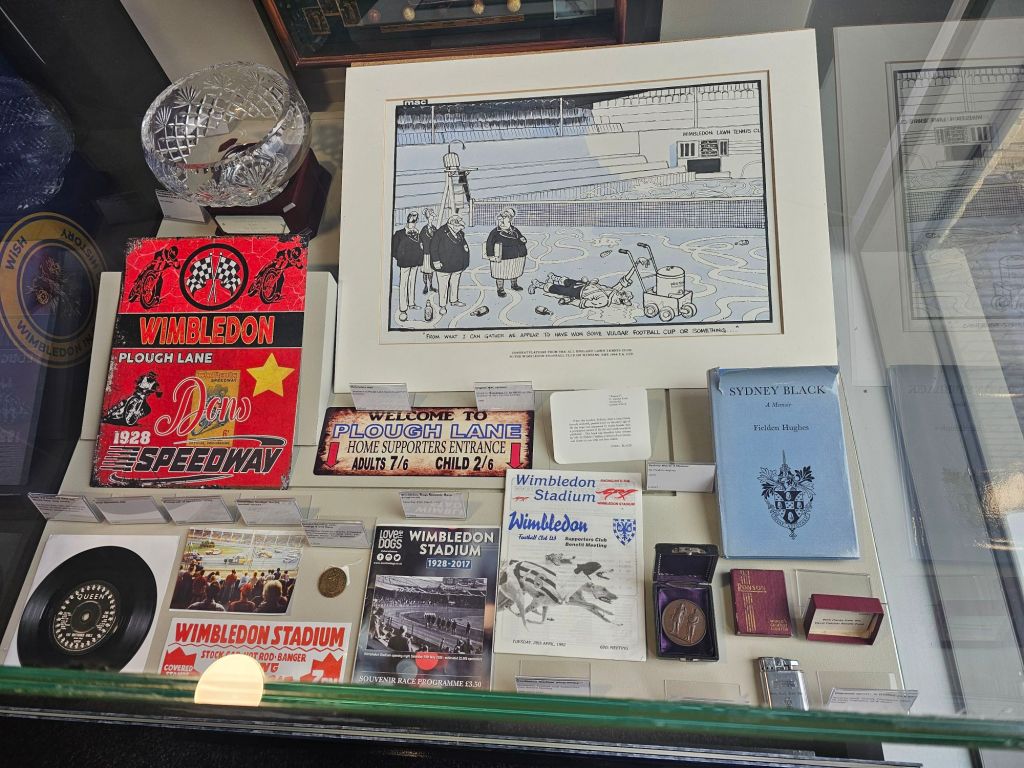
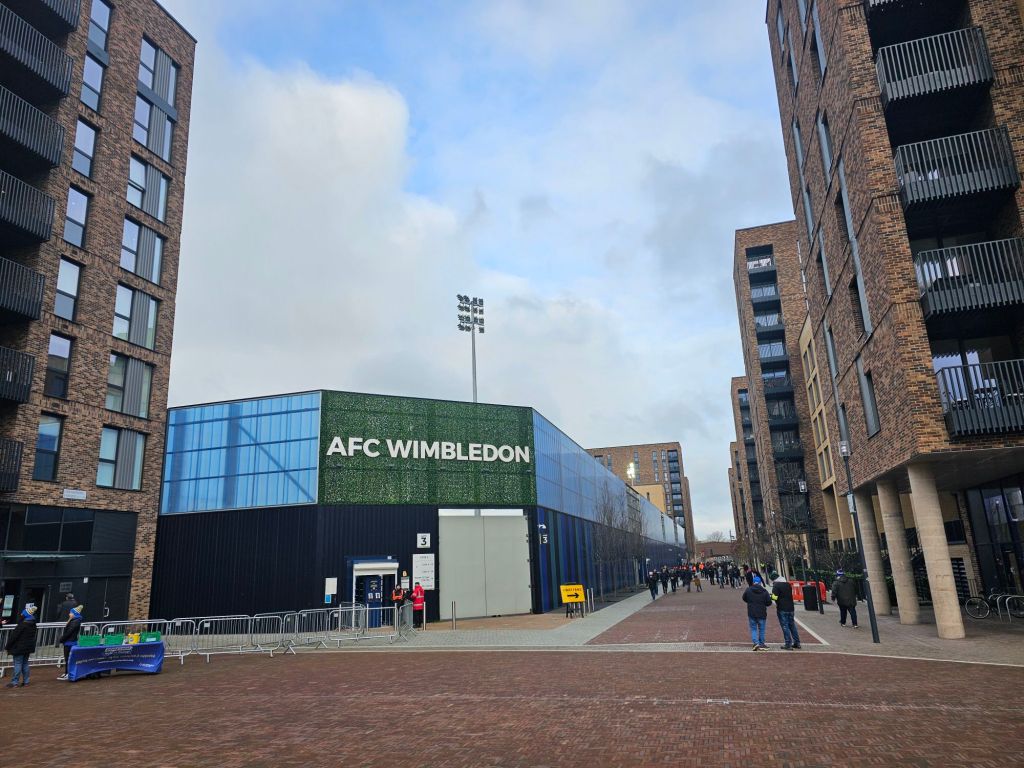
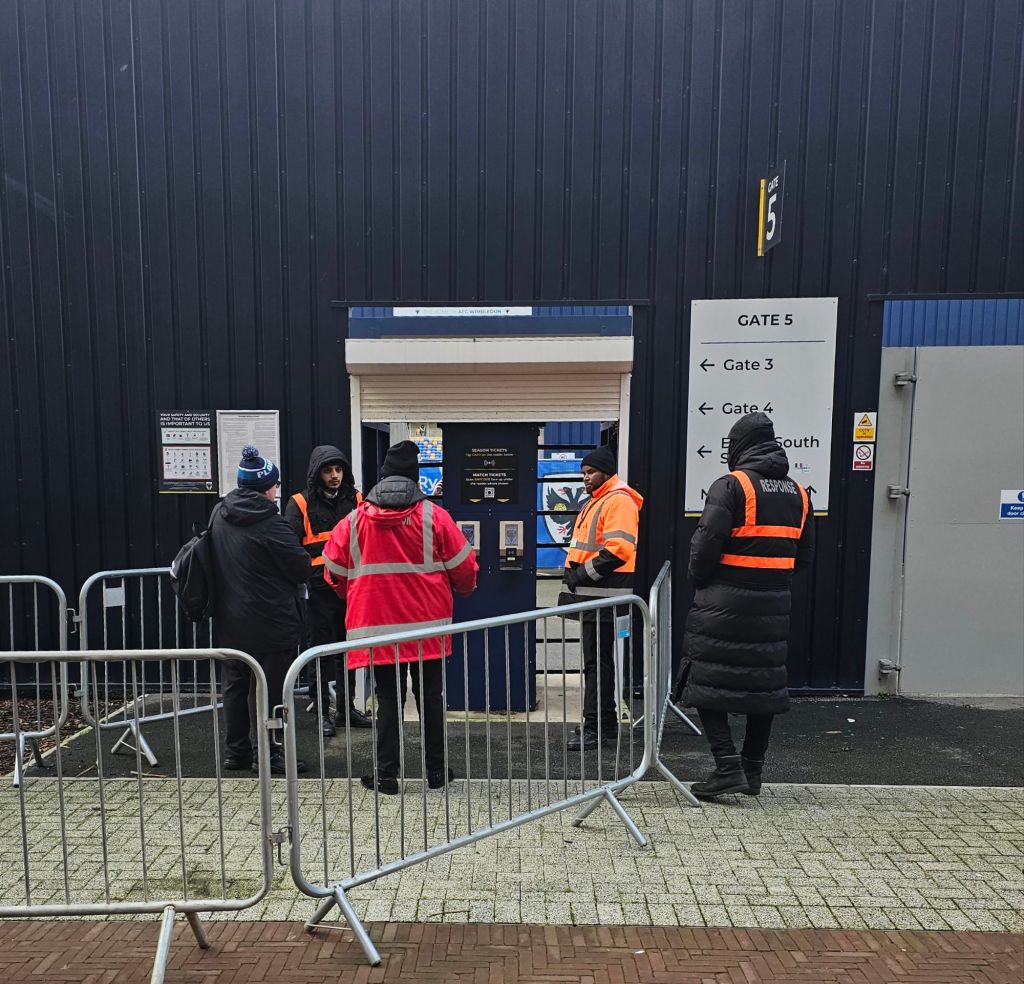
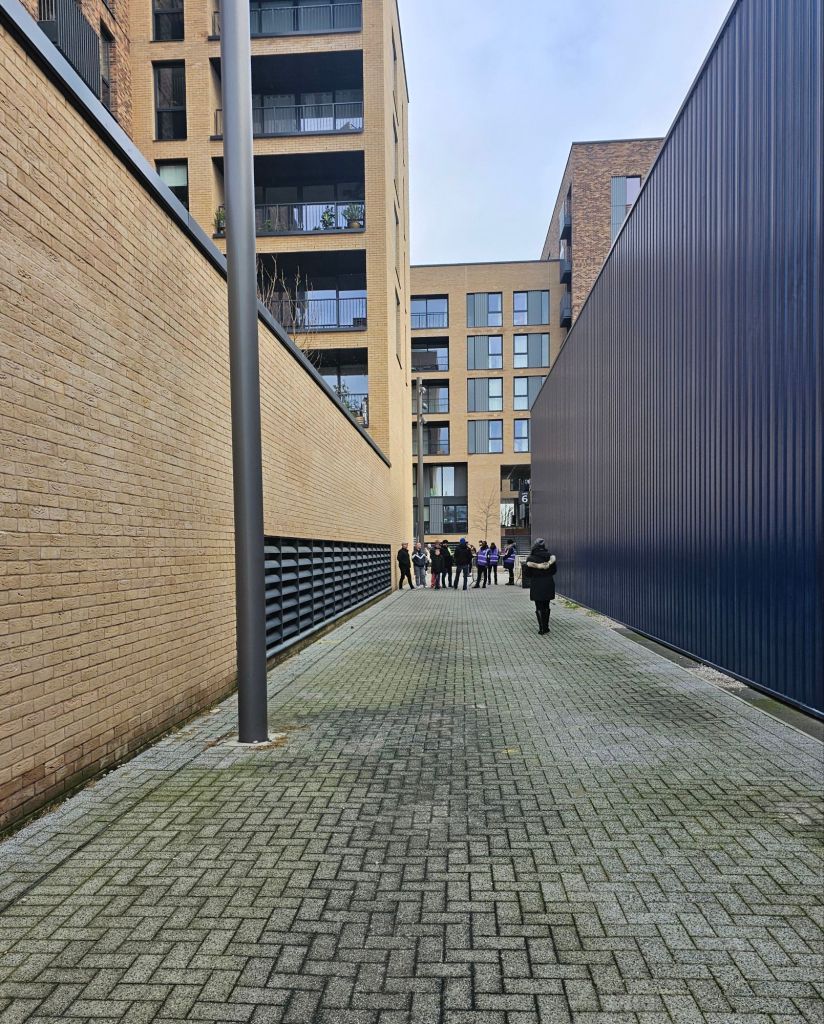
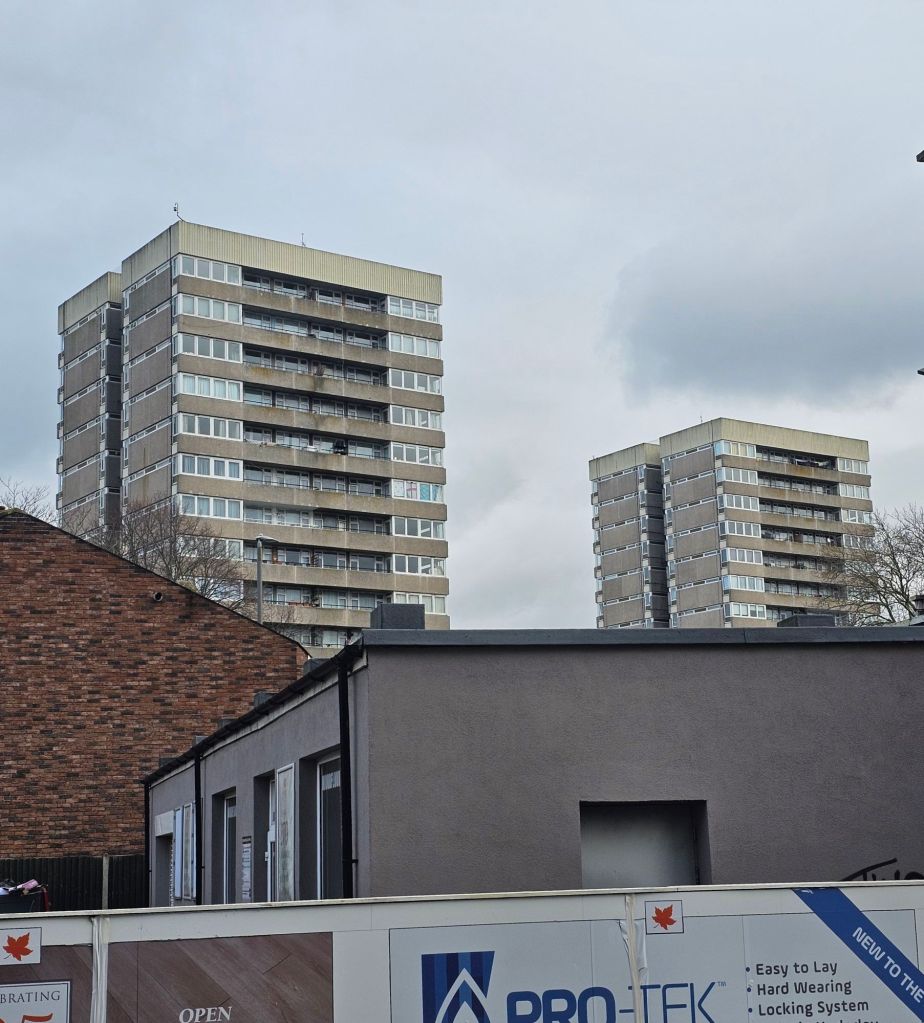
Haydons Road is a miserable little railway station, two scruffy, open platforms either side of two sets of rails; this is suburbia and it’s ugly, but mainly because of the roads and the traffic; if trees and grass replaced tarmac and cars it would probably be lovely.  It’s cold and there are spits of something in the air, but it’s only a five minute walk along Plough Lane to the football ground, which is mostly hidden behind mixed-use development of plain appearance, but with attractive brickwork, which is preferable to render and cladding.  I buy a programme and the woman selling the programmes seems to recognise me, almost as if I’m a regular at Plough Lane.  I wonder for a moment if I have a doppelganger living an alternative life in suburban London, then I head into the club shop to admire the exhibits, which include bears, but not Wombles. Outside the shop are two display cases showing models of the previous Plough Lane ground and the Kingstonian ground plus other sacred artefacts.

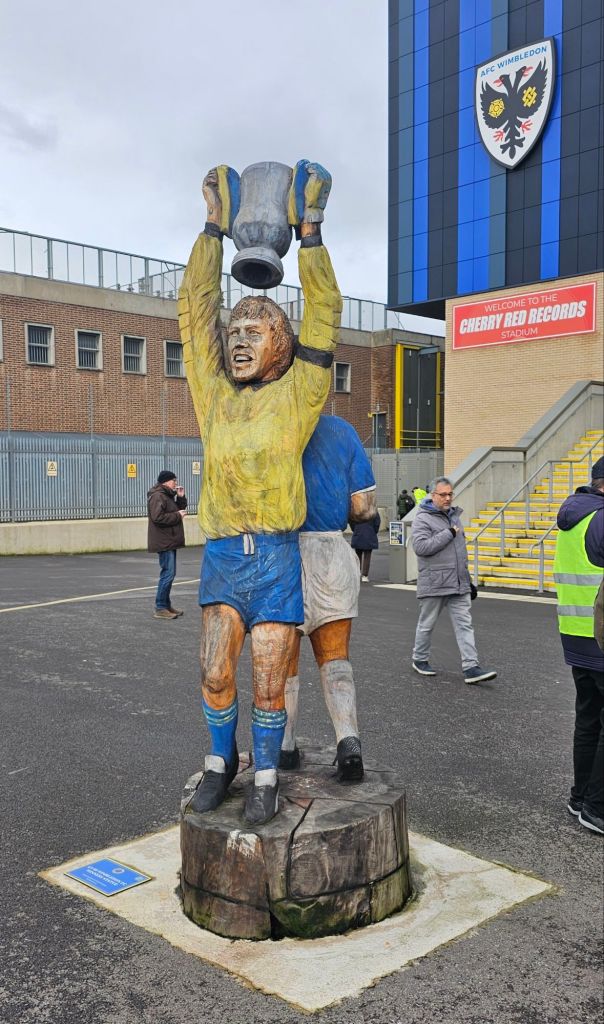
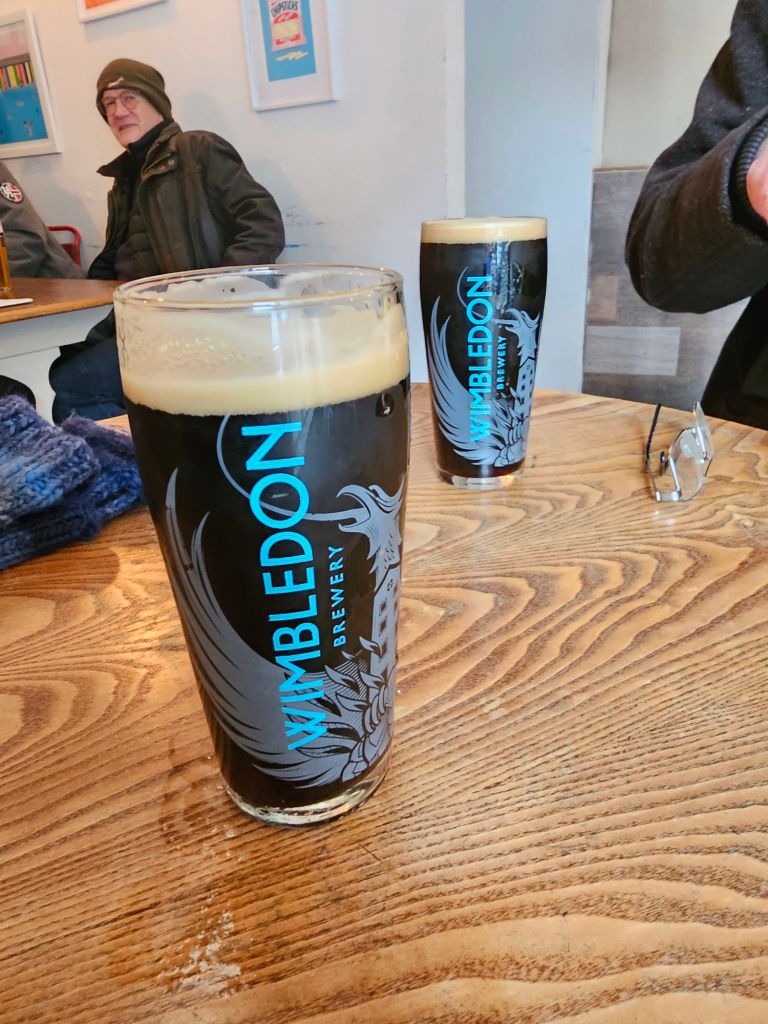
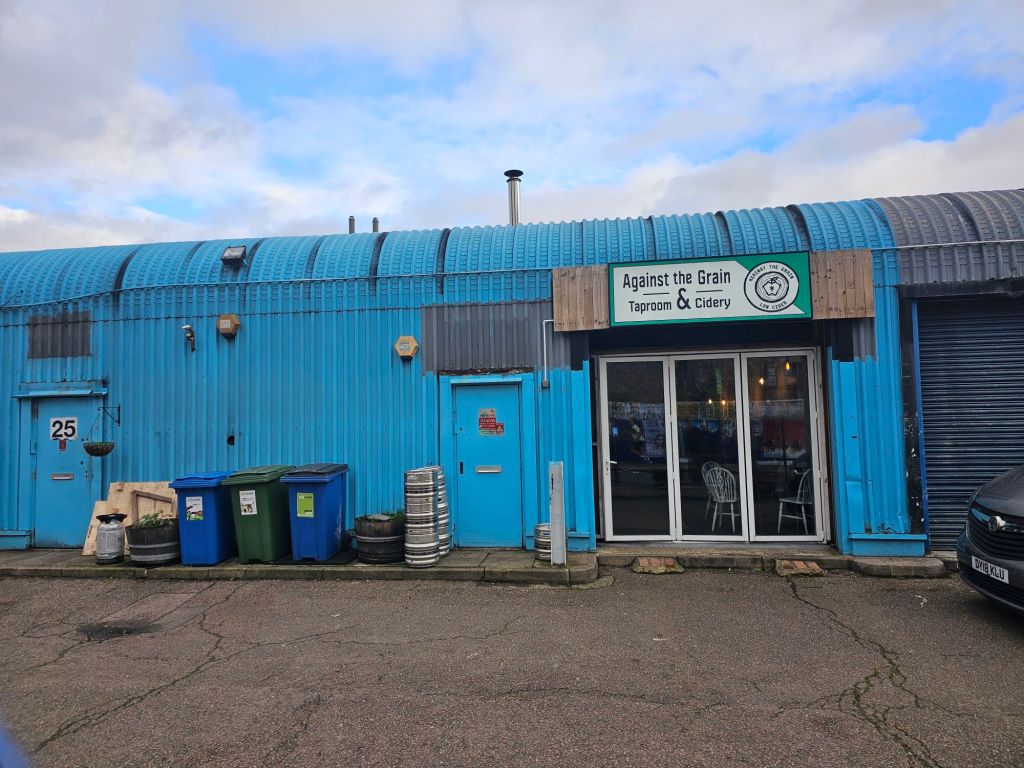
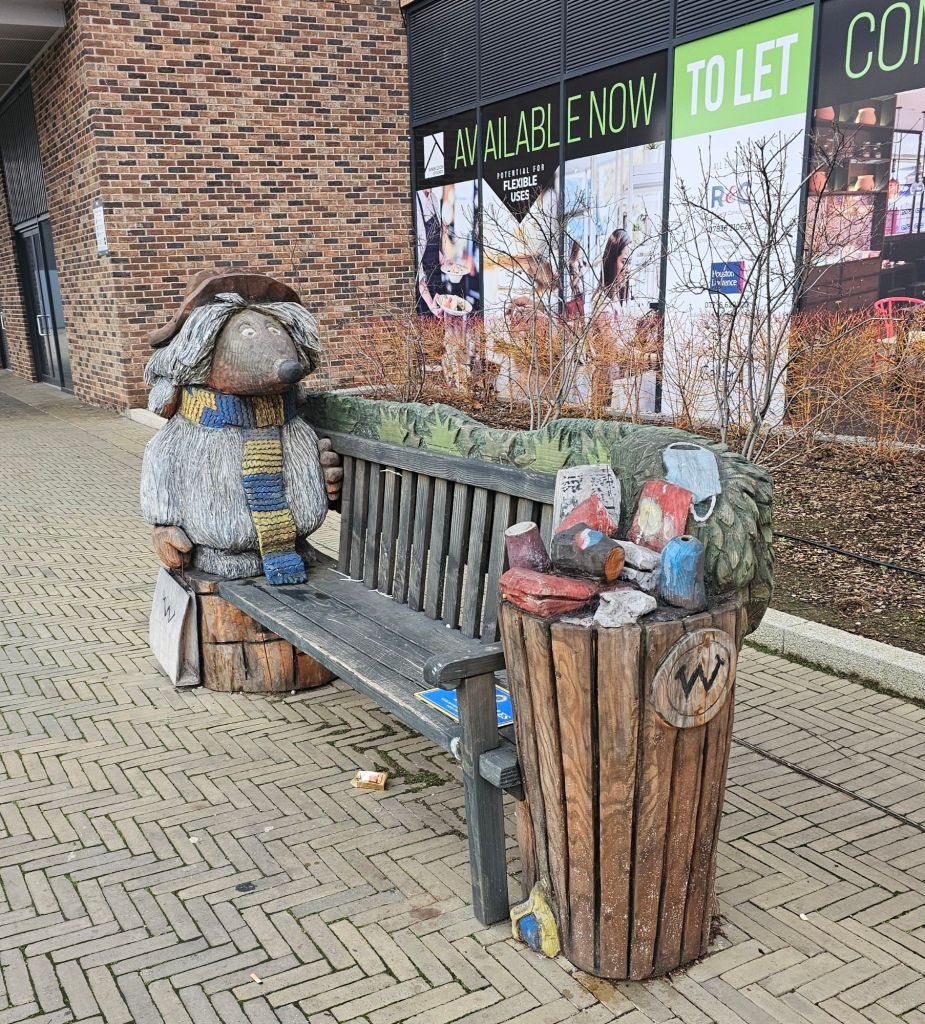
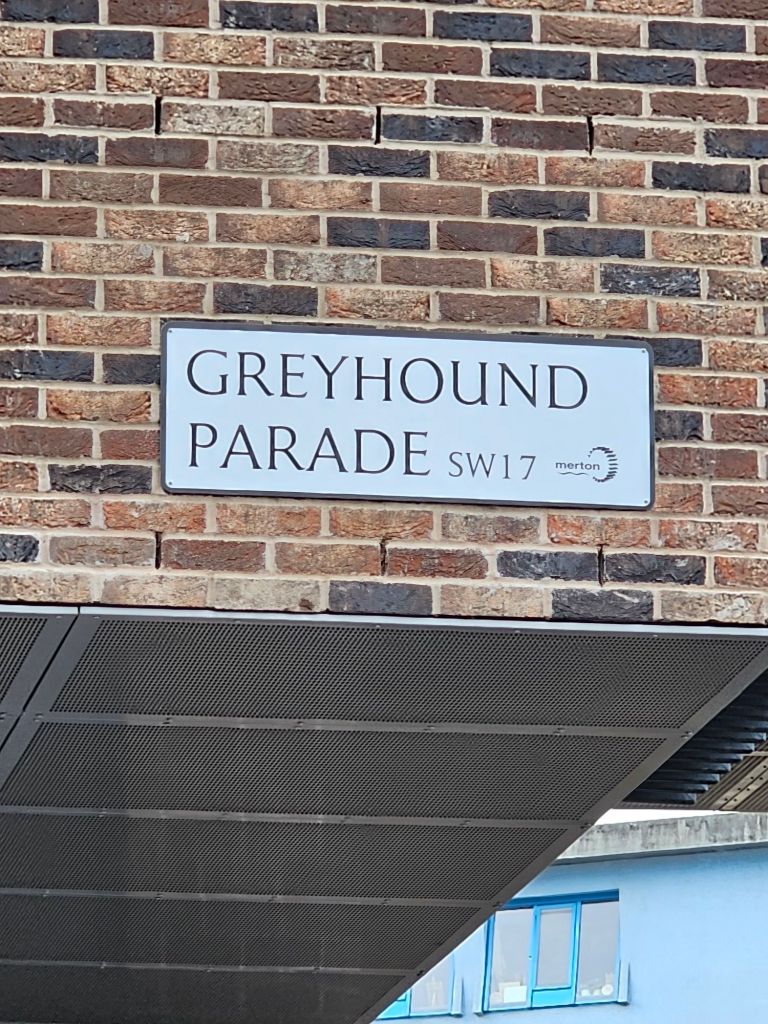
As someone who has broken the habit of never missing a game home or away, I had no chance whatsoever of getting a ticket (£15) as an away supporter for today’s match.  I have therefore employed guile and cunning to get an old friend, Chris, known as ‘Jah’ because of his knowledge and love of Reggae, who lives in relatively nearby Kingston, to acquire tickets, just as he did when Town played Wimbledon shortly before lock down in 2020.  I had arranged to meet Jah at Haydons Road station, but my earlier than anticipated arrival has messed things up a bit and he was still in the shower when I texted him from Farringdon.  But I get time to explore and enjoy the delights of a sculpture carved from a tree trunk,  a bench that features Orinoco the Womble and an overflowing rubbish bin, the delightful street name ‘Greyhound Parade’, a featureless but clean alleyway behind the away end and a grotty looking pub called the ‘Corner Pin’.  When we finally meet, Jah reveals that he has spotted a bar and cidery nearby which also looked enticingly grotty and we head there to find that it is in fact rather marvellous, being a small bar attached to a cidery inside a rundown looking industrial unit.  It reminds me a little bit of a similar establishment called La Cave du Kraken, which is on the outskirts of Bruay-la-Buissiere in northern France.  I order two pints of an unidentified Porter and a packet of Piper’s Jalapeno and Dill crisps (£13.50). Unfortunately, I couldn’t read the pump label without my glasses. We are soon joined by a friend of Jah, introduced initially only as Mr Lynch, who is also a Town fan and who now also lives in Kingston, but was originally from Tattingstone.  Back in this same bar after the match, I will learn that at school he was taught geography by a man whose daughter I went out with in 1979.

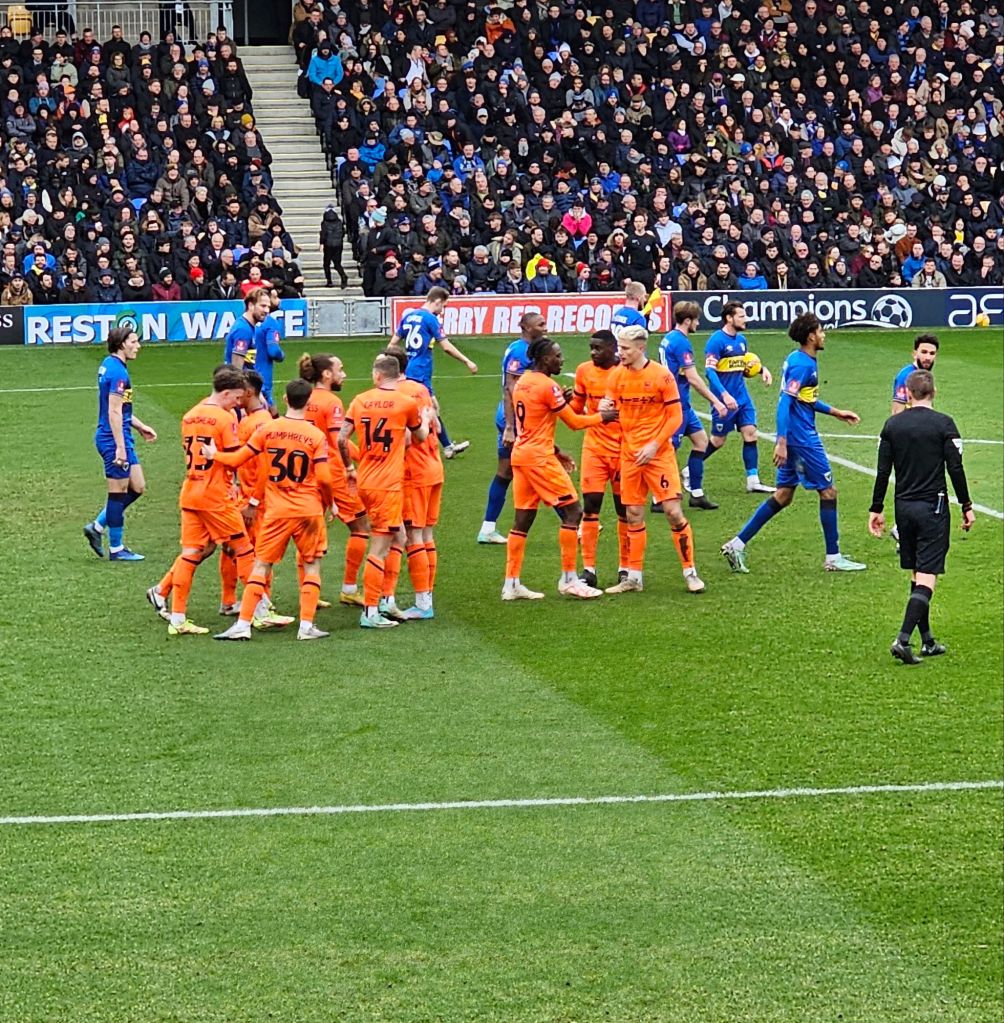
The bar is only small and has perhaps eight or nine tables, so it is odd, given that is no more than 150 metres from the football ground that it is not full. Odder still, it is only ten past twelve and people are already supping up their beer and leaving.  When we eventually depart, about twelve or thirteen minutes later, we discover why, as there are long queues at the four turnstiles to the economically named Ry stand.  We miss the first six minutes of the match. Once we find our seats, Jah, who is a Newcastle United supporter, asks me who he should look out for in the Ipswich team.  Town have a corner.  I tell him Nathan Broadhead and no sooner have the words left my lips than Nathan hits a shot from the edge of the penalty area which he skilfully deflects off the heels of one and then a second Wimbledon player and into the corner of the goal. Town lead one-nil and having just sat down and advised Jah to look out for the Nathan Broadhead I claim some of the responsibility.  The bloke next to me curses the Wimbledon defence with tsks and sighs for their failure to stop the goal.

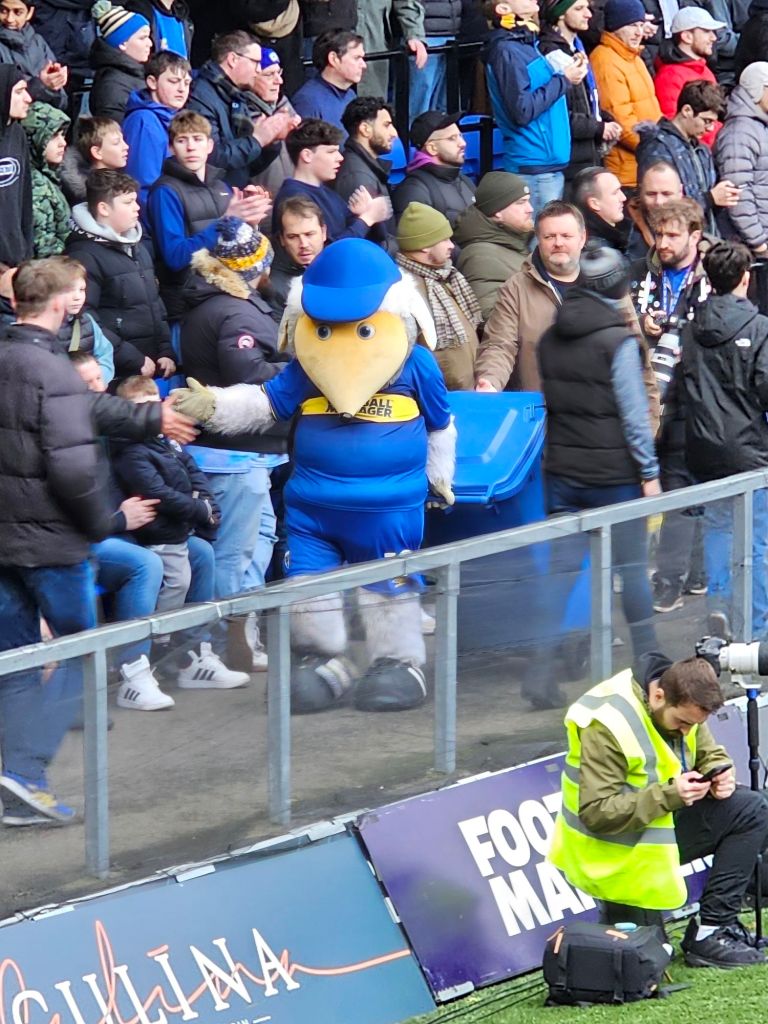
Wimbledon wear all blue with a yellow band across their chests, whilst Town look like Walls Calippos in all over orange, and clash somewhat with goalkeeper Christian Walton who is in pink, or as Jah suggests, ‘rose’.   In front of us, a large Womble trails a blue wheelie bin behind him and occasionally stops to rhythmically bang the lid as a prelude to the crowd shouting “Wombles”.  We join in because it’s fun, and already not being in with the Town fans has worked out quite well.  I haven’t long enjoyed the sight of a large electricity sub-station in the corner near the away end, when Wimbledon are awarded a penalty, I’m not sure why, even with the aid of the glasses Jah kindly lent me when we were in the pub. “That’s what you need” says the bloke sat next to me, and Wimbledon equalise less than ten minutes after Ipswich went ahead.

The goal inevitably excites the home crowd who begin to celebrate the smallest victories all across the pitch; throw-ins, the easiest of tackles and any small failures by Town players are either cheered or jeered  enthusiastically as if instead of the Town shirts bearing the Ed Sheeran logo thing, they bear the words “We are mighty Ipswich and we’re loads better than you, you snivelling little menials and we are gonna stuff you at least 10-0”.  Sadly however, I think there are some supporters who would like this printed on the Town shirts.

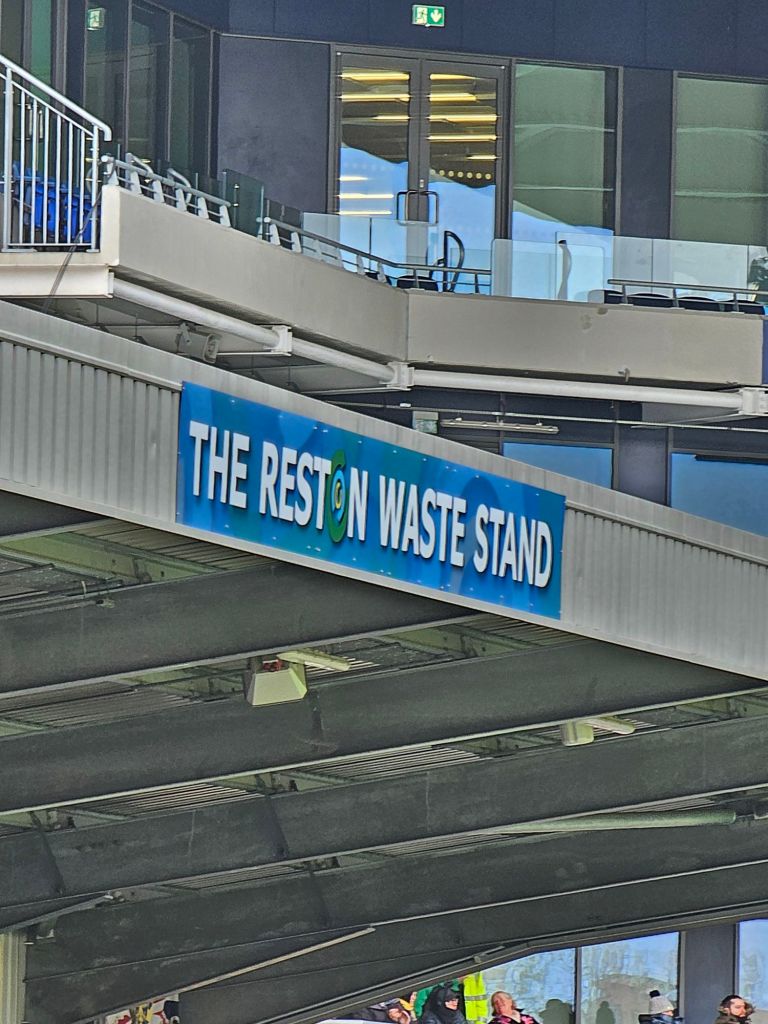
Town win a corner and a chant of “Come You Blues” drifts up the pitch.  The corner comes to nothing, as they often do, but being camped in the opposition half is always nice, even if fleetingly.  Their defensive successive inspires more rhythmic clapping and chants of “Wombles” from the inhabitants of the quaintly named Reston Waste Stand to our left behind the goal that Town are attacking.  Taking the home supporters’ lead of cheering their team,  the Town fans shout “Ole”  as one Town pass follows another, but may be they had hoped for more consecutive passes.  Oddly, Town are giving the ball away more cheaply than usual.  It’s just gone one o’clock and Nathan Broadhead displays excellent dribbling skills to set himself up for a shot for which he displays not quite so excellent shooting skills; both the words ‘high’ and ‘wide’ are unfortunately accurate descriptions. “Championship,  You’re ‘avin’ a laugh” sing the home fans to the tune of “Tom Hark” by Elias and his Zig Zag Ji-Flutes and later The Piranhas.

Marcus Harness is the first Town player to see the referee’s yellow card following a foul but not before referee Mr Donohue first bends down to speak to the prostrate victim, as if to ask him “Would you like me to book him for you?”.  Town haven’t done very much of note since Wimbledon scored, and with Town fans rarely ones to help their team in adversity, ⁹the home fans ask the question “Can you hear the Ipswich sing?” before slightly annoyingly telling us the answer, “No-oo, No-oo”,  but then admitting this is because they are all profoundly deaf, singing “ I can’t hear a fucking thing”.  It is to be hoped however that it’s due to nothing more than a build-up of excess earwax.   

Half-time will be here in less than ten minutes and Freddie Ladapo gets in a shot, but it is weak and easily saved by the Wimbledon goalkeeper Alex Bass, a player who shares his surname with a very tasty type of fish.  Another superb piece of foot-based trickery from Nathan Broadhead then earns Town another corner from which Axel Tuanzebe stretches to head the ball into the Wimbledon goal and Town are back in the lead.    The goal excites the crowd again and the home fans once more clap rhythmically and shout “Wombles” and it’s too silly and too much fun not to join in.  “You ‘af to win that, he’s a foot taller than the other geezer” says the bloke beside me as some Wimbledon player loses out in a struggle to head the ball before we learn that the first half is going to last forty-nine minutes instead of forty-five.  It’s a four minutes in which Omari Hutchinson has a run and shot, the bloke next to me says that at least Wimbledon have got good full-backs, Freddie Ladapo shoots over the cross-bar, Town fans sing “Addy, Addy, Addy-O” and the home fans respond with “Come On Wombles” and “Ole, Ole, Ole, Wombles, Wombles” despite not having heard the Ipswich fans singing.

With the half-time whistle Jah and I drain off some excess Porter and then tour the street food vendors which line the perimeter wall of the stadium offering a wide range of foods.  We look for the shortest queue and separately join queues for crispy pancakes and pies to see who gets served first.  The queue for pies moves much more quickly and I buy us each a sausage roll (£7.00 for two), although the pies have sold out.  When we get back to our seats the game has re-started and I will never know which team kicked off first; not unless I ask someone who knows.  I enjoy my sausage roll and Jah enjoys his too as Wimbledon earn a corner and their number eight, Harry Pell, glances a header into the arms of Christian Walton.  Ten minutes later and Pell is booked for a second time this afternoon and is sent off, we’re not sure why. “It looked like a head butt” says Jah, “But it didn’t seem that bad” he adds, revealing a worrying indifference to casual violence.

This is a reasonable game of football, with both teams mostly playing nicely and just trying to win, rather than not lose.  It’s what used to make Cup matches more of an attraction than dull, same old same old league games, but times change and people seem more serious and earnest nowadays.  Ipswich mostly dominate possession, but every now and then Wimbledon get the ball and quickly put in a cross to see what happens.  For Ipswich, Marcus Harness shoots weakly at the end of a flowing move and Walton makes a decent save from the interestingly named Armani Little after Axel Tuanzebe gives the ball away in the penalty area having earlier been booked.  With fifteen minutes to go Luke Woolfenden has a goal disallowed following a corner and Sone Aluko and Wes Burns replace Omari Hutchinson and Marcus Harness. I tell Jah that Wes Burns is another player to watch and I realise I forgot to tell him about captain Sam Morsy.

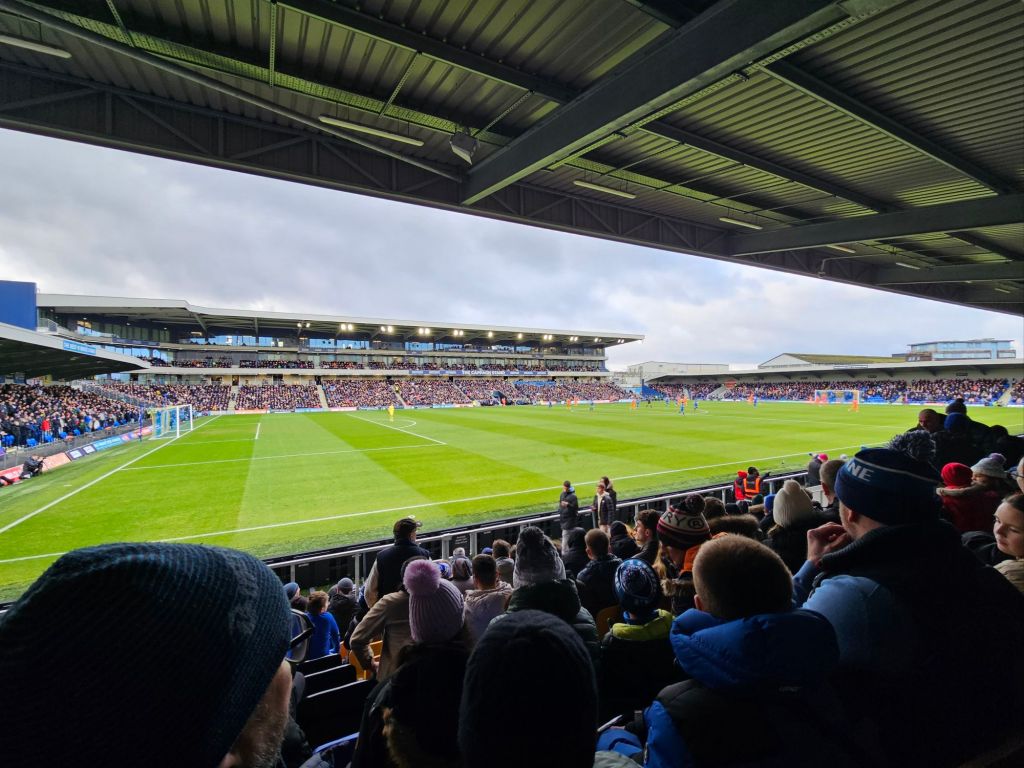
I decide I like Plough Lane football ground, it’s very much what a football stadium should be like in a big city, pressed up close against neighbouring buildings, but somehow quite spacious too.  The main stand (The Cappagh Stand) is quite impressive even if it does look a bit like it’s been transplanted from a racecourse and  Jah and I debate how it should be pronounced; is it Capparff as in laugh, or Cappa as in Fermanagh or perhaps Capparrrrrr as in some made-up, more amusing pronunciation.  Either way it gets us through to late chants of “Come On Wombles” and an almost frighteningly inaccurate Sone Aluko shot before Wes Burns runs, crosses and Jack Taylor taps the ball in from close range and Ipswich have won 3-1.  The attendance is announced as 8,595 with 1,390 from Ipswich, although the latter figure is actually at least 1,393 if you count me, Mr Lynch and the bloke sat next to him who Mr Lynch later tells us is  Mick Stockwell’s cousin. Four minutes of added time make no difference except to our ages, but then not much.

It’s a lovely feeling winning a Cup tie, especially away from home when there is no need to rush back, and instead we adjourn to the Against the Grain cidery just round the corner, and Jah is elated too because Newcastle have thrashed Sunderland  three-nil.  After leaving the cidery and Mr Lynch, Jah and I will head ‘into town’ for we have unlimited travel of tfl services and we will talk of all manner of things long into the evening, or at least until about ten past seven when I reckon I ought to be getting home.  We’ve had a lovely day, which is probably pretty much what the Magi said when they turned in for bed 2024 years ago.  

AFC Wimbledon 0 Ipswich Town 0

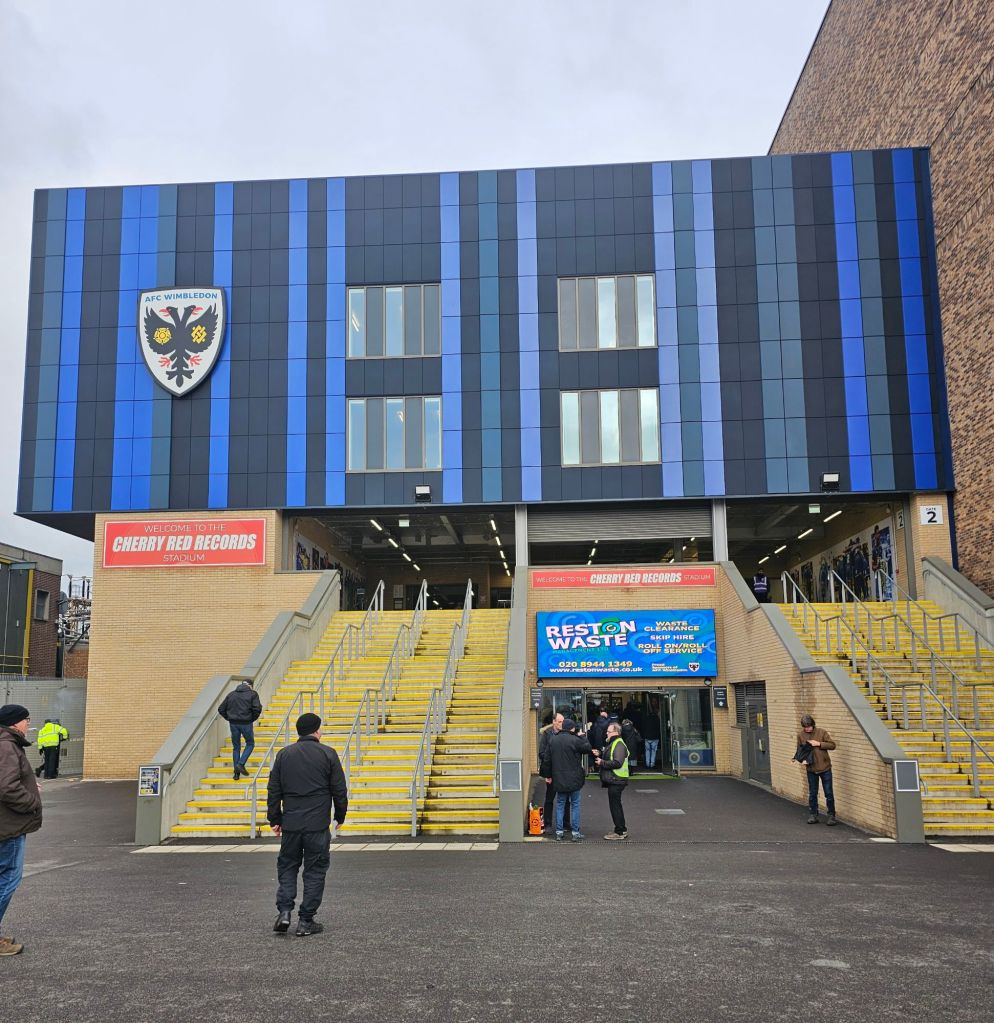
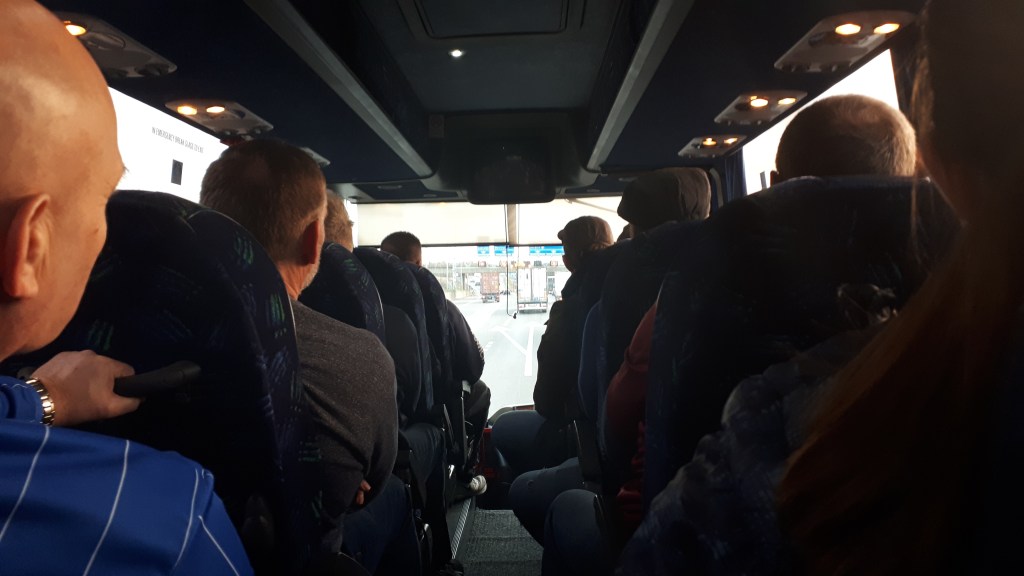
After six months off-work due to illness, today is my first day back, albeit for a shortened day of just six hours toil.  Keen to prove to the world and myself that this really marks a return to normal life, I am going for broke and also making my first away trip of the season, catching one of three supporters’ buses from Portman Road (£21, but half price with my Season Ticket holder’s voucher) to Kingsmeadow (aka the Cherry Red Records Stadium), Kingston, current home of AFC Wimbledon.  At the start of the season I drew up a list of six third division football grounds, of which Kingsmeadow was one, that I would be able to visit for the first time following the Town; four of those away fixtures have already passed with me in no fit state to attend, so for someone who is blissfully transported by the sight of unfamiliar arrangements of floodlight pylons, coloured polyurethane seats, corrugated sheet metal and concrete steps tonight is an opportunity not to be missed.

Leaving my office at 3pm I make the short walk to Portman Road and approach the back of the short line of three buses. I am booked on Coach Two, which as logic demands is helpfully parked in front of Coach Three and behind Coach One.   I prepare to board but stood by the door and subtly blocking my path is a stern, un-smiling woman with a clipboard and passenger list; “Surname” she says and a subversive voice in my head says “Don’t tell her Pike!”. There was a time not long ago when it was possible to travel on these supporters’ buses anonymously, but times change and football clubs seem to have become ever more controlling and paranoid. In a spirit of mild rebellion and in an attempt to inject the friendly face of humanity I give her my first name also, she eyes me suspiciously as I mount the steps into the bus acknowledging the driver with a nod and muffled greeting as I climb.

The bus is almost full with the usual misfits that travel like this and most pairs of seats are occupied by at least one person; after checking that it is not taken I settle down on the first vacant single seat I come to next to a balding, grey haired and bearded man in a blue polyester football shirt.  Within not many minutes the buses set off one by one to make the left turn onto Handford Road and the highways beyond.  As the bus slows at the Tesco roundabout at the edge of town I check my watch; we’ve been on the road for ten minutes, it seems like hours.  I know I have to take my copy of “Soccer Empire The World Cup and the Future of France” (Laurent Dubois, University of California Press 2010) from my blue cloth bag decorated with the stars of the EU flag (a 2 Euro purchase from the gift shop at the EU Parliament in Brussels )and begin to read to pass the time.

Whilst I learn of Jules Rimet, Guadeloupe and Felix Eboue the buses speed beyond the Suffolk border and on past Colchester with its football ground sitting remote and detached from the town by the A12, past dull Witham and bland Chelmsford towards the M25.  The buses bear the name Suffolk Norse on their flanks, it’s a curious moniker for a fleet of coaches, but then I see the vision of us all lined up in pairs side by side down the length of the bus and I see a longship full of Vikings, of Norsemen, albeit Vikings and Norsemen who have lost their oars. The fleet name makes sense; we are a collection of middle aged blokes led by one severe woman setting off to metaphorically rape and pillage a small corner of metropolitan Surrey. 

Darkness falls somewhere in Kent and crawling through the endless pre-war Tudorbethan suburbia of Chessington, Tolworth and New Malden, two hours and fifty minutes after leaving Ipswich, we eventually spy the floodlights of Kingsmeadow, which shine like beacons to these weary, but in my case well-read travellers.  The buses draw up in front of a parade of suburban shops and I alight as fast as good manners will allow, turning back towards the entrance to the ground where I  have arranged to meet a longstanding friend who is known as Jah on account of his love of reggae music.  Jah lives nearby in Kingston (Surrey not Jamaica) and has sourced our tickets for tonight’s game.  With handshakes and greetings out of the way I buy a match programme (£3) and we head for what is not by any means the nearest public house; however, knowledgeable of my loathing of ‘rubbish beer’ Jah has selected a pub called The Norbiton where he says the beer is ‘decent’. It’s a 15 minute walk through anonymous residential streets to The Norbiton which appears gloriously out of the gloom, light spilling from its tall Edwardian windows and beckoning us in.  Inside we meet Jeremy a friend of Jah who already nurses a pint of what looks suspiciously like lager; he buys me a pint of an Espresso Stout the exact name of which I forget, whilst Jah has a pint of Sambrooke Junction Bitter.   Jeremy is kindly providing one of our tickets.  We talk of our past, our age, of my health, of politics, of women’s football and of Jeremy’s unusually small Toyota IQ car in which we will soon travel back to Kingsmeadow. Jeremy is impressed that I have travelled all the way down from Ipswich for tonight’s game.  Part way through our conversation I realise that although I paid for my programme back at the ground and took my change (four fifty pence pieces) I never actually took the programme.  Bugger.  After Jah treats me to a second pint, this time the Junction Bitter, and has a half himself, it is about twenty-five minutes past seven and time to head for the match. I fold myself into the back of the tiny Toyota whilst Jah, who for a man who is not yet sixty years old is very inflexible, clambers into the front passenger seat.  Jeremy tells us that he usually parks the Toyota directly outside the ground, but tonight the kerbs of Kingston Road are tightly packed and no spaces can be found, and kick off is fast approaching. We drive around the block again and praise be,  in a side road just opposite the ground we find a couple of metres of tarmac between a Vauxhall and a dropped kerb into which the Toyota will fit.

It’s a matter of yards across the street to Kingsmeadow; we enter through the main entrance beneath a high metal arch that announces the name “Kingsmeadow” and spotting the programme sellers beneath  I explain how I didn’t take my programme earlier; he must have realised too as he straightaway hands me one. Around the corner on Jack Goodchild Way we meet a man called Jonathan who incidentally has a Mexican wife, but more importantly the other ‘spare’ ticket and he also hands us each a programme; together we head for the entrance to the main stand.  Entering the stadium is like walking into a social club and it is self-evident that this is very much a non-league stadium. There are no turnstiles as such but we form two orderly queues and pass our bar coded tickets beneath a scanner; looking ahead through a short tunnel beneath the stand I can see the players are already on the pitch, it’s like a snatched glimpse into another world through a magic portal.  A few steps on and we are into the stand and stood at the side of the pitch; our seats are a little to the left beyond the players tunnel which we cross in front of, in the front row behind a thickly painted blue metal crush barrier.

The illuminated scoreboard in the corner of the ground shows that we have missed the first two minutes of the match but it also confirms that we haven’t missed any goals; no real surprise there.  Our seats are within a couple of metres of the pitch and it feels like we are truly part of the game, as indeed the crowd should be.  The atmosphere in this small stand is sociable and happy, clearly everyone here is a regular; club officials, coaches and players mingle in the stand and plainly know some of the supporters, this is like being at a non-league match.  Behind me a man who shouts to the referee that he’s a muppet sounds just like a man who shouts the same thing at Coggeshall Town.

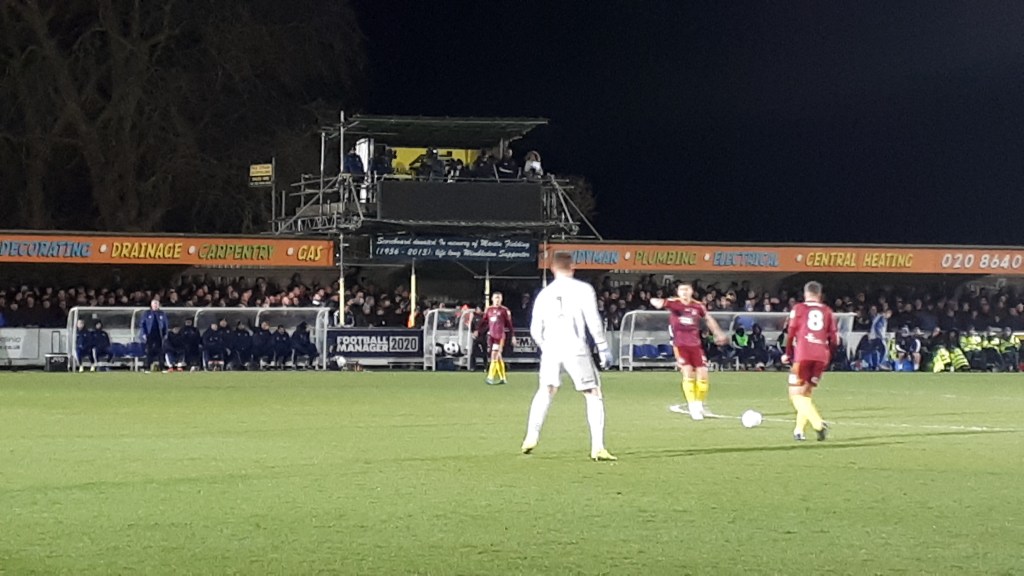
The football is unexceptional.  Ipswich, playing in red and blue with pale yellow socks towards the beautifully and exotically named Chemflow Stand, also known less interestingly as the Athletics End, pass the ball about a bit and if this was a competition to see who could pass the most and most accurately they would win, but inaccurate hoofs and hopeful punts play their part in ensuring that incisive moves are kept to the barest minimum.  The Wimbledon supporters whose team is in all blue get their kicks where they can and cheer with more enthusiasm than perhaps the players’ abilities deserve.  Architecturally Kingsmeadow is a dull little arena, but beneath the floodlights with the backdrop of a few gaunt, grey, leafless trees it springs to life.

Jah and I point and chuckle and guffaw as play after play come to naught. We observe that the referee Mr Craig Hicks has very, very neat hair and Jah mentions the recently aired TV programme Inside Number Nine.   I admit to Jah that I have often wondered about referees’ sexuality.   Mr Hicks may just be light on his feet as he tiptoes away from a tete-a-tete with an errant player and then flicks his wrist theatrically for a free-kick, after which Jah and I spontaneously raise our arms to mimic his slightly camp wrist action whilst the people behind us probably wonder about our sexuality.

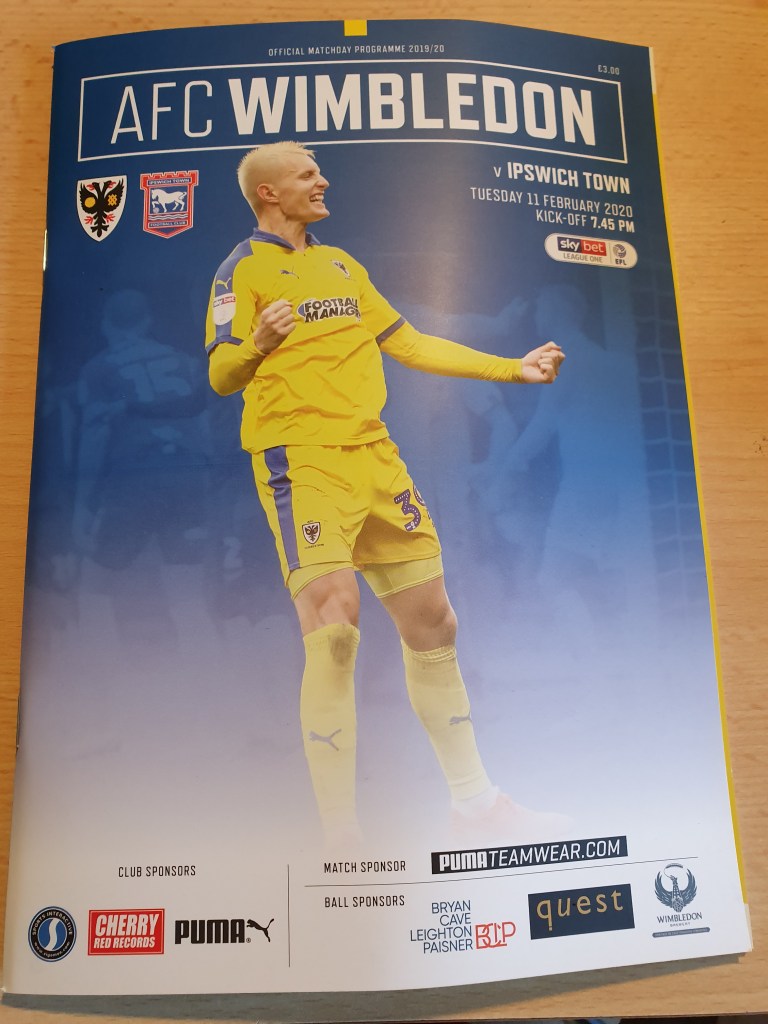
“Go on Piggy” shouts Jeremy at Wimbledon number thirty-nine Joe Pigott and I tell him how much I envy Wimbledon supporters having a player they can call Piggy.  Jeremy adds to my jealousy, telling me that they also shout “Feed the Pig”.   Joe Pigott is featured on the front of the match programme. Jonathan asks if I was at the 1978 FA Cup final and seems impressed when I tell him I was.  There are very few sustained songs or chants coming from either set of supporters and Jah and I lament the loss of the great tunes of Gary Glitter and the Glitter Band which are no longer socially acceptable.  When I returned to work this morning I would have very much liked to have sung to my colleagues “Did you miss me when I was away, did you hang my picture on your wall? Did you miss me every single day? I bet you didn’t miss me at all, at all, I bet you didn’t miss me at all. Hello, Hello. It’s good to be back. It’s good to be back.”

Ipswich hit the cross bar in a moment of madness and half-time arrives, and I am in great need of a visit to the small toilet beneath the stand; it’s a cold night and those two pints are trying to get out, but first we must wait for the players to leave the pitch and the blue polythene players’ tunnel to be retracted.  This stadium is the antithesis of the theatre of dreams and it’s great because it is full of the inconveniences that reflect real life.

Relieved we return to our seats for the second half.  If the first half was unexceptional the second is exceptional for being even more unexceptional. It’s as if the players have become frustrated or bored by their inability to do anything much very successfully and have given up.  Weirdly however, it’s not the sort of game that people boo because it retains a kind of competitive tension, either side could score because they are both so inept that either one could just hand victory to the other at any moment.  Hope remains but of course our hopes are foolish.  The absence of appreciable football does at least let me appreciate the fine oak tree that stands and spreads itself behind the covered terrace opposite in which the Ipswich supporters are stood. Jah and I also enjoy the mask worn by Town’s on-loan number three Josh Earl who inspires a conversation about the TV series “My name is Earl”.  When Earl is substituted a man behind us, possibly the “You’re a Muppet ref” man attempts to riff on the problem of a masked player taking off his mask when substituted and then coming back on to the field unrecognised. If anyone laughs, they do so quietly.  Meanwhile a small knot of Ipswich supporters try to scuff-up the bonhomie that has existed for most of the match with a chant of “Who the fucking hell are you?” but it is in no way clear to whom they are addressing their song and no one seems to care.

My hands are cold but I remember I have gloves in my pocket and I put them on, but warmer hands don’t make up for the poor standard of football in the second half, nor does a half volley by Town’s Will Keane which is spectacularly kept out of the goal net by Wimbledon goalkeeper Joe Day, a name which is impressive in its economic use of syllables.  Keane’s attempt is as close as Ipswich come to scoring and the game ends with Wimbledon pretending to be the attacking team as they win a couple of corners and generally mill about threateningly in the Ipswich penalty area.  The final whistle comes as a relief to all and Wimbledon’s supporters, again displaying the pragmatism of the lower leagues, seem happy with claiming a point, realising it’s better than not existing at all.

The evening is over so quickly and I bid Jeremy, Jah and Jonathan good night before heading back to my six-wheeled golden long ship and the voyage home. I’ve had a lovely time and look forward to coming back next season.

Coggeshall Town 2 Felixstowe & Walton United 1


It’s Easter and it is unseasonably warm. The mercury hit 23 degrees in my back garden yesterday and today could be warmer. In holiday mood and beneath a clear blue sky my wife Paulene and I set off in our trusty Citroen C3 on the short journey to Coggeshall to watch Coggeshall Town play Felixstowe & Walton United in the Bostik League, Division One North. We are taking the scenic route today in order to drop off Easter eggs for the grandsons; I feel like the Easter Bunny.

On arrival at their house, their father Colin is slouched watching Tottenham Hotspur on the telly, he responds mono- syllabically to our attempts at conversation. Tottenham are losing, I quietly hope that they continue to do so. Grandson Harvey is as loquacious as his father, but does let Paulene know as economically as possible that it’s the same type of Easter egg we bought him last year.

With Easter eggs delivered we obligingly pop to the Co-op as their advertisements tell us to, so that I can draw some cash and Paulene can buy chocolate of her own; non-dairy chocolate, white vanilla by i-choc; Paulene is dairy intolerant. Leaving the treasures of the Co-op behind us we complete the third leg of our journey, heading along West Street before turning left in to the bouncy car park of what was once known colourfully as ‘The Crops’, but has boringly been re-christened the West
Street Ground; how dull. Our Citroen C3 wishes it was a 2CV. A steward directs me to pull up close “to that one over there” a large Vauxhall. We disembark and a car load of Felixstowe followers park up next to us in another, smaller Vauxhall. At the turnstile I hand over two ten pound notes and receive £3.50 is change (Adult £10, Pensioner £5, programme £1.50). “Enjoy the match” says the turnstile operator “You too” I tell him “If you get to see it”. Oddly, the cost of entry has gone up a pound since I last was here for the FA Cup tie versus Witham in August last year, maybe FA Cup ties are just cheaper

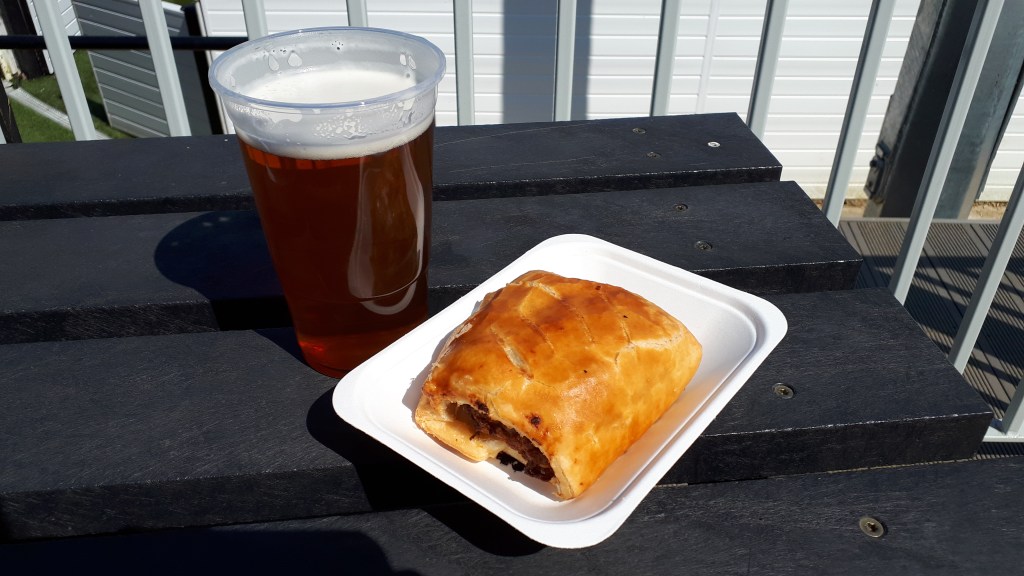
We walk along the concrete path to the clubhouse, looking down upon the pitch on to which water sprinklers gently play. The path along the ‘top of the ground’, behind the main stand is one of the things I like best about “The Crops”. In the clubhouse Tottenham are still on the telly and they’re still losing. To celebrate I order a glass of Rose and a pint of Adnams Ghostship (£7.90 for the two); disappointingly the Ghostship is of the fizzy variety, but at least it’s not Greene King.

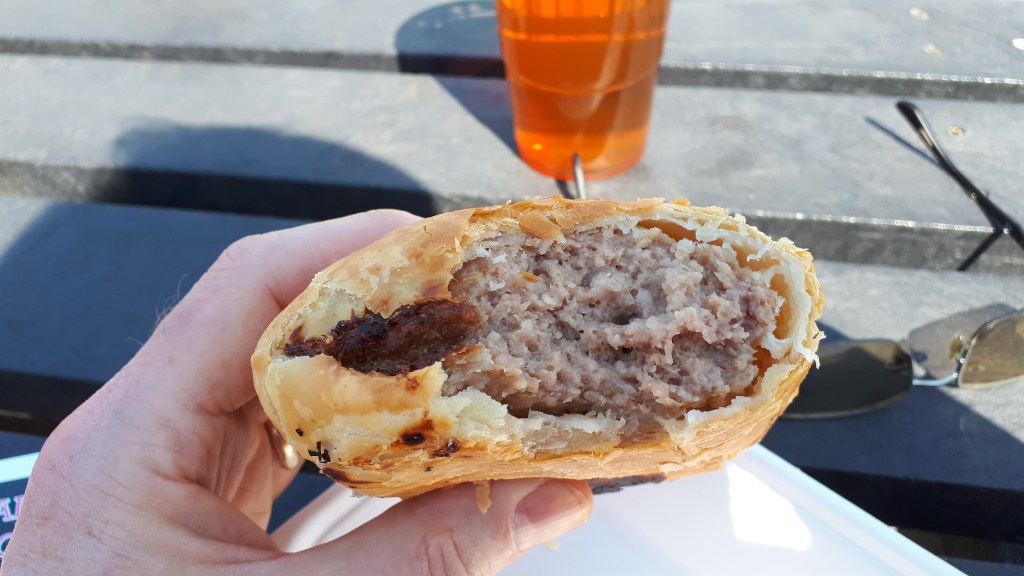
Drinks in hands we step back outside and sit at a “Yogi Bear–style picnic table”, I order a sausage roll (£3.50) from the ‘tea-hatch’. £3.50 might seem a lot for a sausage roll but there is more sausage meat in this sausage roll than in all the sausage rolls ever sold by Greggs put together; and this is real sausage meat, not a weird pink paste. I exaggerate perhaps, but not much. In truth, there is perhaps so much sausage meat that I would recommend bringing a small selection of pickles to help it down and add further to your enjoyment.

A steady stream of locals and visiting Felixstowe supporters make their way to the clubhouse from the turnstile and car park beyond, along the concrete path. Eventually I finish my sausage roll and we decide to take shelter from the sun in the shade of the main stand, which the Coggeshall Town website tells us was erected in 1964. We find seats near the middle of the stand at the very back, two seats behind Keith and Jim, who are in the front row and kindly share their team sheets with us.

Keith and Jim went to watch Colchester United play Grimsby Town yesterday; Keith nearly fell asleep he tells us. A friend of Keith and Jim arrives and hands out bars of chocolate, explaining that he won’t be at the game next week.
The teams are announced over one of the clearest sounding PA systems I have ever heard at a football ground and the teams line-up for the ritual shaking of hands; “See, home team on the left, away team on the right” points out Paulene, giving closure to a conversation we had over dinner a few days ago. It’s something I had never noticed, perhaps because I don’t care enough.

Coggeshall kick-off in the direction of the clubhouse and Braintree far beyond, wearing their red and black striped shirts with black shorts and red socks; it’s a fine looking kit. Sartorially however, Felixstowe do their best to match them with an attractive away ensemble of pale blue and white striped shirts with white shorts; if the two-teams swapped shorts and Coggeshall bleached their socks it would look like AC Milan v Argentina. Felixstowe, known as The Seasiders, aim in the direction of the car park and downtown Coggeshall, with its clock tower and the Co-op. Coggeshall, or The Seedgrowers as they are known informally are swift going forward and dominate the early stages.

Felixstowe don’t look much good. The play is rough and the Felixstowe No3, Henry Barley goes down two or three times, much to the disgust of some of the home crowd. “Pussy” shouts one, “Watch him, he doesn’t fancy it anymore” says the man next to me, “It’s a man’s game” calls another. “Erm no, Aussie Rules is a man’s game” says Paulene as a quiet aside, just to me. So far the game has mostly been Coggeshall’s Nnamdi Nwachuku and Michael Gyasi harrying the Felixstowe defence with their speed and nifty footwork. Seventeen minutes pass, Coggeshall piece together a few passes down the right and a cross finds No8 Tevan Allen; he is on his own at the near post. With time on his hands Tevan kicks the ball up in the air and then, as it drops back down to head height, executes a spectacular overhead kick sending it into the far corner of the goal. It is a remarkable goal, even more so if the initial kick up in the air was intended rather than being a case of not quite controlling the ball, but the latter sadly seems more likely. Tevan celebrates appropriately.

With the breakthrough made, Coggeshall will surely go on score more. But no, with the breakthrough made Felixstowe improve and begin to get forward themselves, often on ‘the break’ with their No9, the heftily built Liam Hillyard, a sort of non-league version of former Ipswich Town player Martyn Waghorn, making the runs into the penalty area. The game stagnates a bit as it becomes more even, with neither side playing particuarly well. The referee Mr Karl Sear makes himself unpopular with the home supporters because he doesn’t book any Felixstowe players, only talks to them, whilst also awarding Felixstowe several free-kicks, seemingly for not much at all.

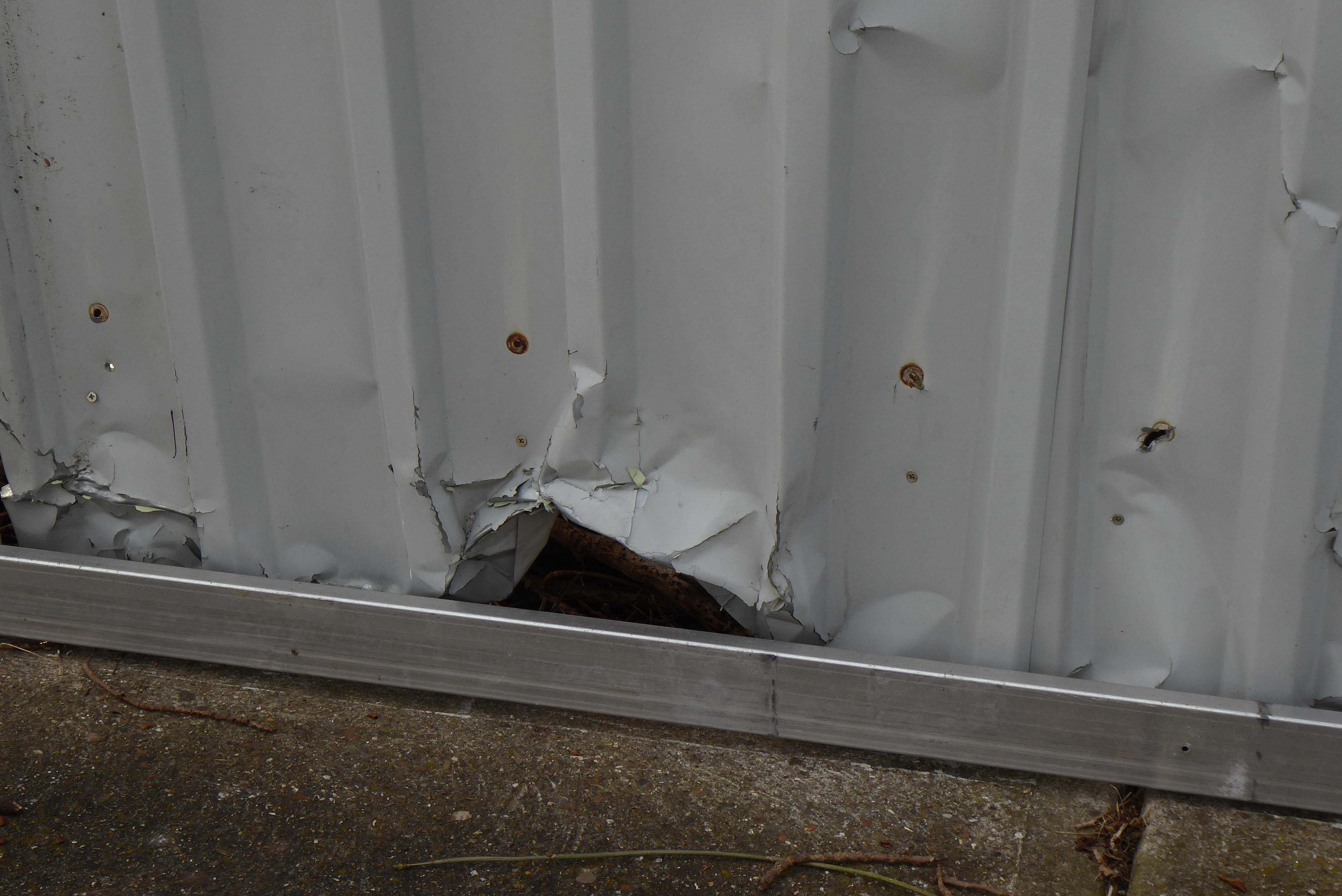
My attention wanders and I admire a rusty hole in the corrugated iron roof of the stand; ventilation is just what’s needed on a warm day like today.
With a fraction more than five minutes until half-time, Liam Hillyard breaks down the right for Felixstowe, he confuses the Coggeshall defenders sufficiently to pass the ball across the penalty area to Henry Barley who looks to have taken the ball too close to goal before booting it high into the net from an acute angle. After the comments made towards him earlier, Henry Barley might allow himself a wry smile (geddit?).

Things look bleak for Coggeshall; having failed to make the most of their advantage they have now lost it. But football as a game apart from being old is nothing if not funny and soon The Seedgrowers win a free kick. The ball is struck hopefully into the penalty area, players jump and the ball hits random body parts, boots are swung in the direction of the moving ball but none makes proper contact, a Felixstowe player sends the ball towards his own goalkeeper, two Felixstowe defenders go to aim a kick but politely leave it to one another; tired and bemused by its long journey across the penalty area the ball gives itself up to a surprised Nnamdi Nwachuku who happily scores a close-range goal as ropey as the Seedgrowers’ first goal was spectacular. The goal is greeted almost with jeers and laughter, but it still counts and it makes Nnamdi and this little corner of Coggeshall very happy.
Half-time soon follows and we leave our seats; Paulene to use the facilities, me to take our coats back to the car, we really won’t need them today. “Are you leaving?” asks Keith. I reassure him that
I’ll be back for the second half.

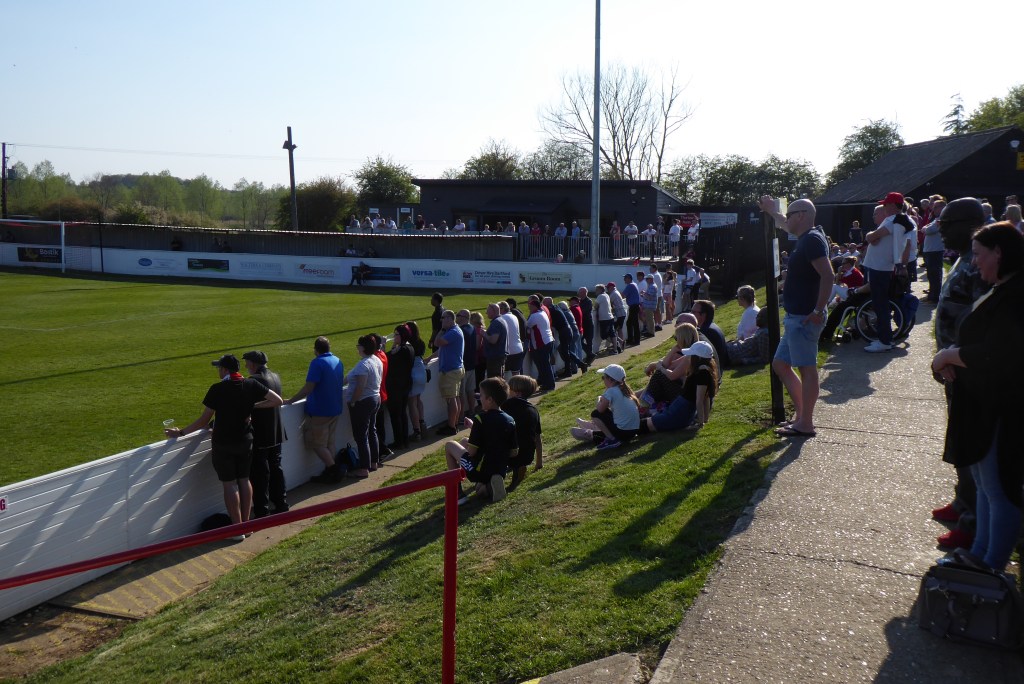
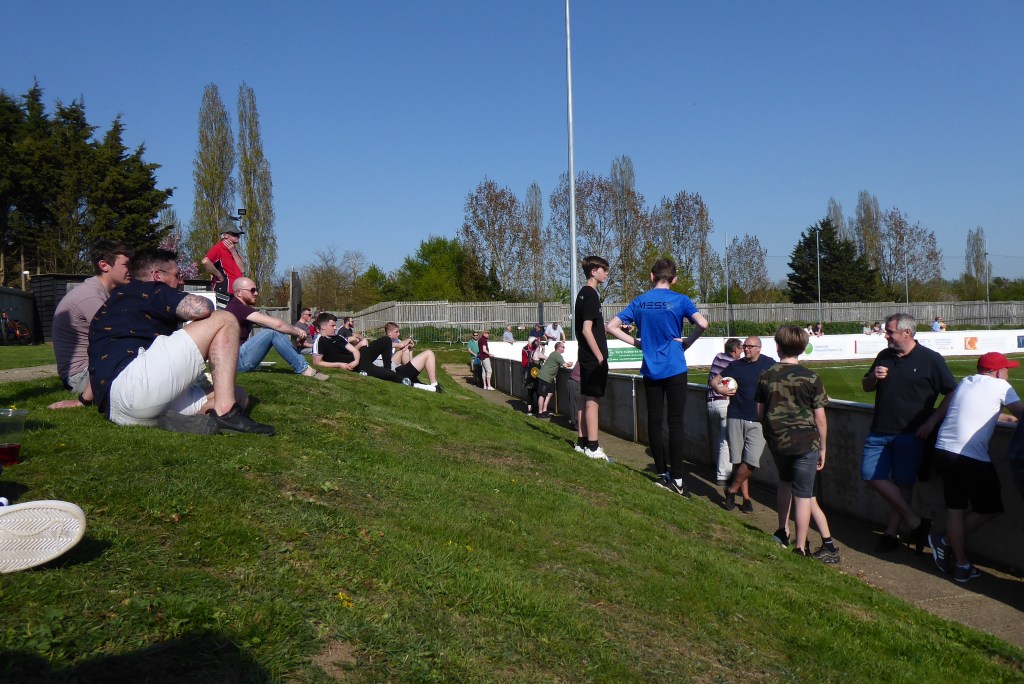
Returning from the Citroen I meet my next door neighbour Paul and his eldest son Matthew on the concrete path as they head to the car park end that Coggeshall will be attacking in the second half. Paul has captured the glory of Coggeshall’s second goal on his mobile phone, I think the best bit is where the two Felixstowe defenders let each other boot the ball and neither does. On the grass bank below the concrete path is Colin with his wife Tessa and grandson Harvey and Paulene; I join them in the sunshine and eat a coconut based flapjack that I bought at the Co-op and on which the chocolate has melted. I get just four out of ten in the “Seedgrowers’ half-time quiz” in the programme; how is any one supposed to know that Jamie Carragher has the middle names Lee and Duncan? The second half begins.

The expectation amongst those around me is that Coggeshall will score a third goal, but it doesn’t happen. The game becomes niggly and fractious with lots of swear words; Coggeshall Town is the place to come for sweary football. I kick back and stretch out on the grass enjoying the warmth of the Spring sunshine and the stillness of the afternoon, the peacefulness only punctuated by angry curses from players and supporters and frantic scribbling in his notebook by referee Mr Sear who books six players, three from each team including both Coggeshall goalscorers. Some decent chances to score are missed by both teams and Felixstowe perhaps have the best ones, but if you’d never been to a football match before and had come along because you’d heard about “the beautiful game”, you’d think Pele was a liar. The final act sees Felixstowe’s Callum Bennet sent off by Mr Sears for a poorly thought-out tackle, although conveniently for Bennett he didn’t have far to go because he committed the foul quite close to the corner of the field and the steps to the changing room; so it wasn’t all bad.

With the final whistle I reflect upon what has been a beautiful afternoon in the sun before we head back to the clubhouse for another drink; it’s that kind of a day. I look out for Jim and Keith as the ground empties but don’t see them, I worry that Keith thinks I didn’t return for the second half, which would make me no better than Pele.

Heybridge Swifts 2 Grays Athletic 1


It’s a Spring-like Saturday in late March and there is just a week to go until the clocks go forward; there are tiny buds on the trees and although the sky is overcast the air smells fresh and clear.  Frogs are mating in my garden pond and frisky Collared Doves are settling on my satellite dish and messing up the signal.  It’s a beautiful day to make the twenty-odd kilometre trip by Citroen C3, past Feering to Tiptree and on through Great and Little Totham to Heybridge, a village of about 8,000 people on the north side of the River Blackwater from Maldon.  Until September 1964 it would have been possible to catch a train from Witham to Maldon East and Heybridge station, but the evil Dr Richard Beeching put an end to that and thoughtlessly condemned this corner of Essex to a future of increased traffic and air pollution.

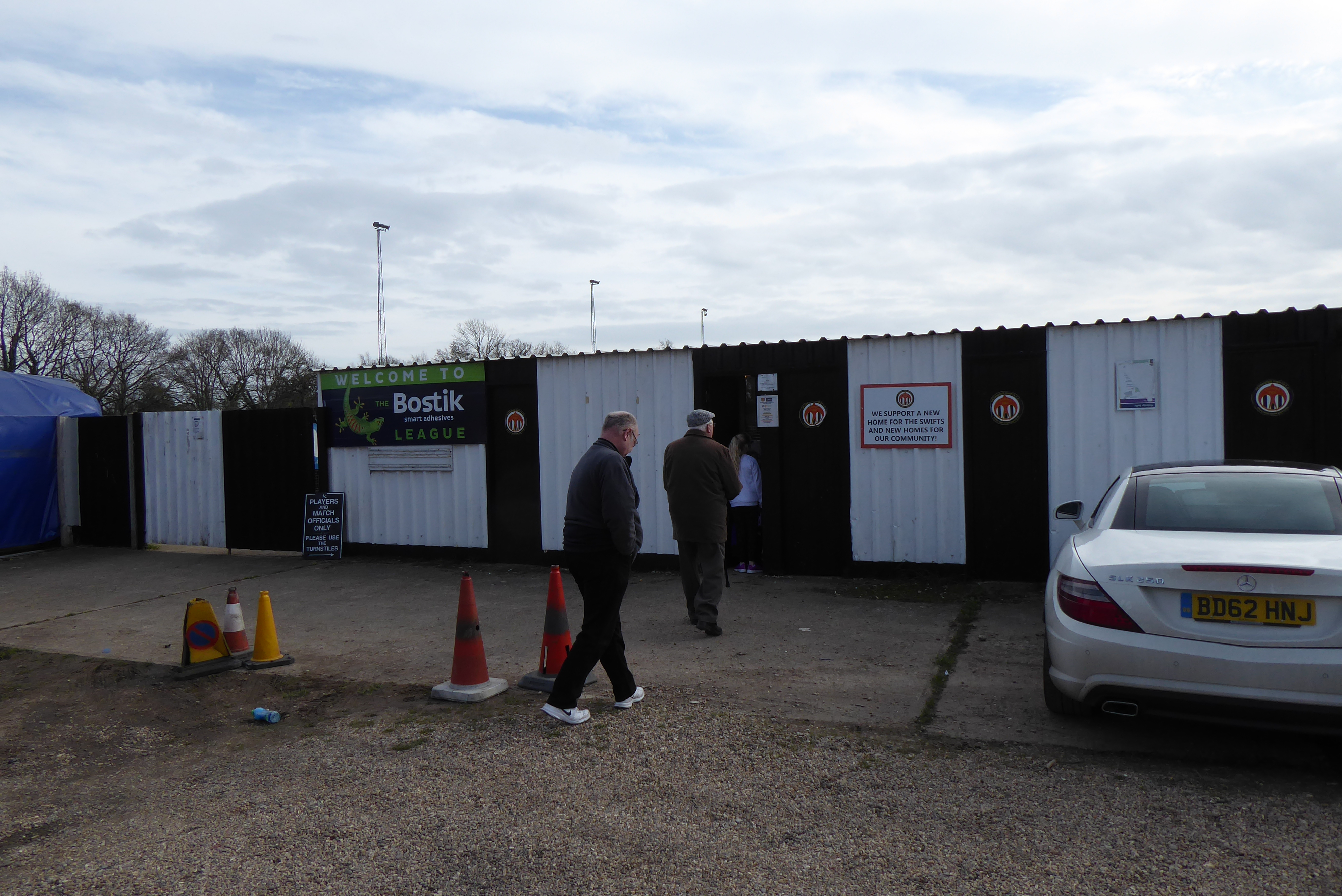
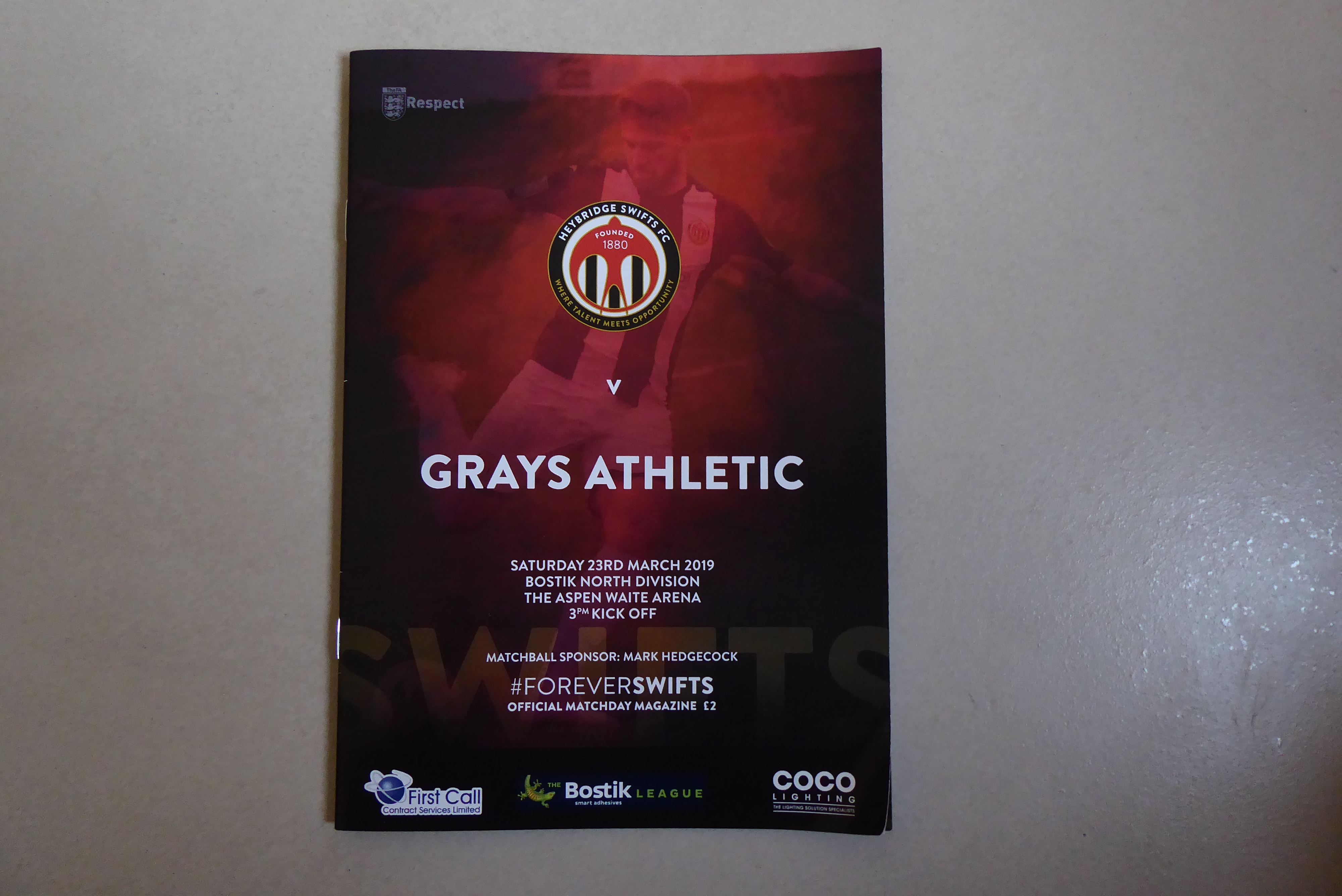
Leaving the B1022 I turn left into Scraley Road, home of Heybridge Swifts Football Club.  Scraley Road is not an attractive name, it sounds a bit like Scaley Road and conjures up images of an unfortunate skin condition.  It’s only about two-thirty but the rough, unsurfaced car park is already full; happily there is an overflow car park about 50 metres along on the right, although for some people that’s too far and they have chosen to park at the side of the road.  The overflow car park is just a muddy track to the local rugby club but it’ll do and I pull up out of the mud and puddles onto a patch of lush grass to park the Citroen.   I walk back to football ground which, as a large sign tells me, is now known as the Aspen Waite Arena, which sounds extremely posh.  When did football grounds become arenas I wonder to myself; probably about the same time that ‘naming rights’ became ‘a thing’ I reply, but silently so as not to appear weird.   I cross the main car park to the black and white painted metal turnstile block avoiding more puddles and form a fledgling queue behind one other person, although I have to walk around two others who seem to be having difficulty finding their money.  Entry costs £10 for an adult and I ask for a programme too (£2).  “There you are dear” says the friendly lady turnstile operator, handing me a glossy programme and a small amber cloakroom ticket with the word ‘Adult’ on, which I soon lose.

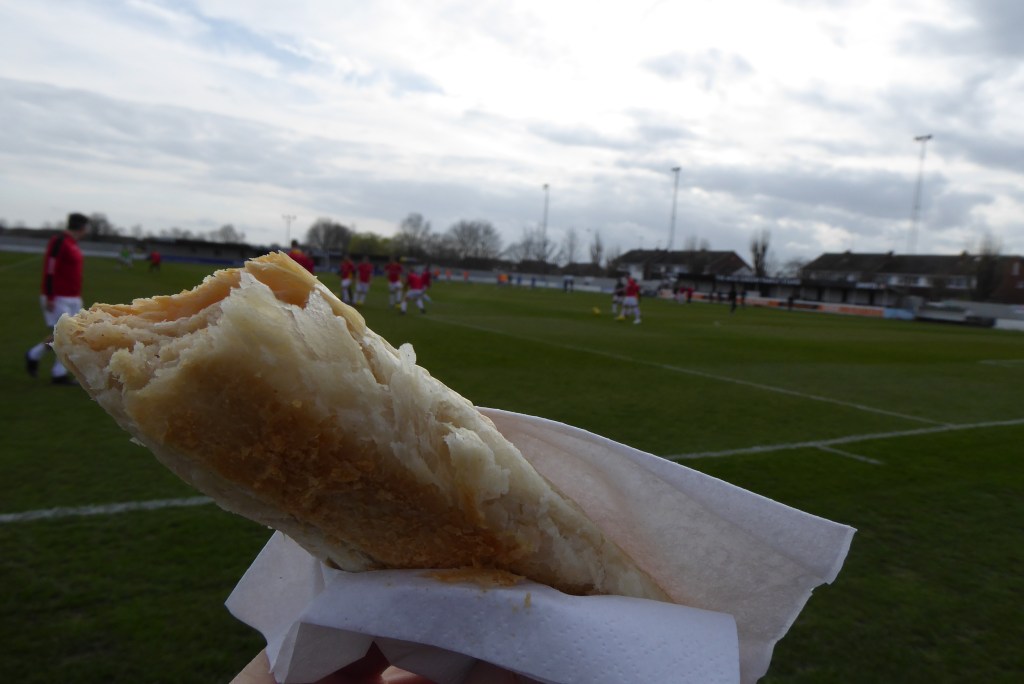
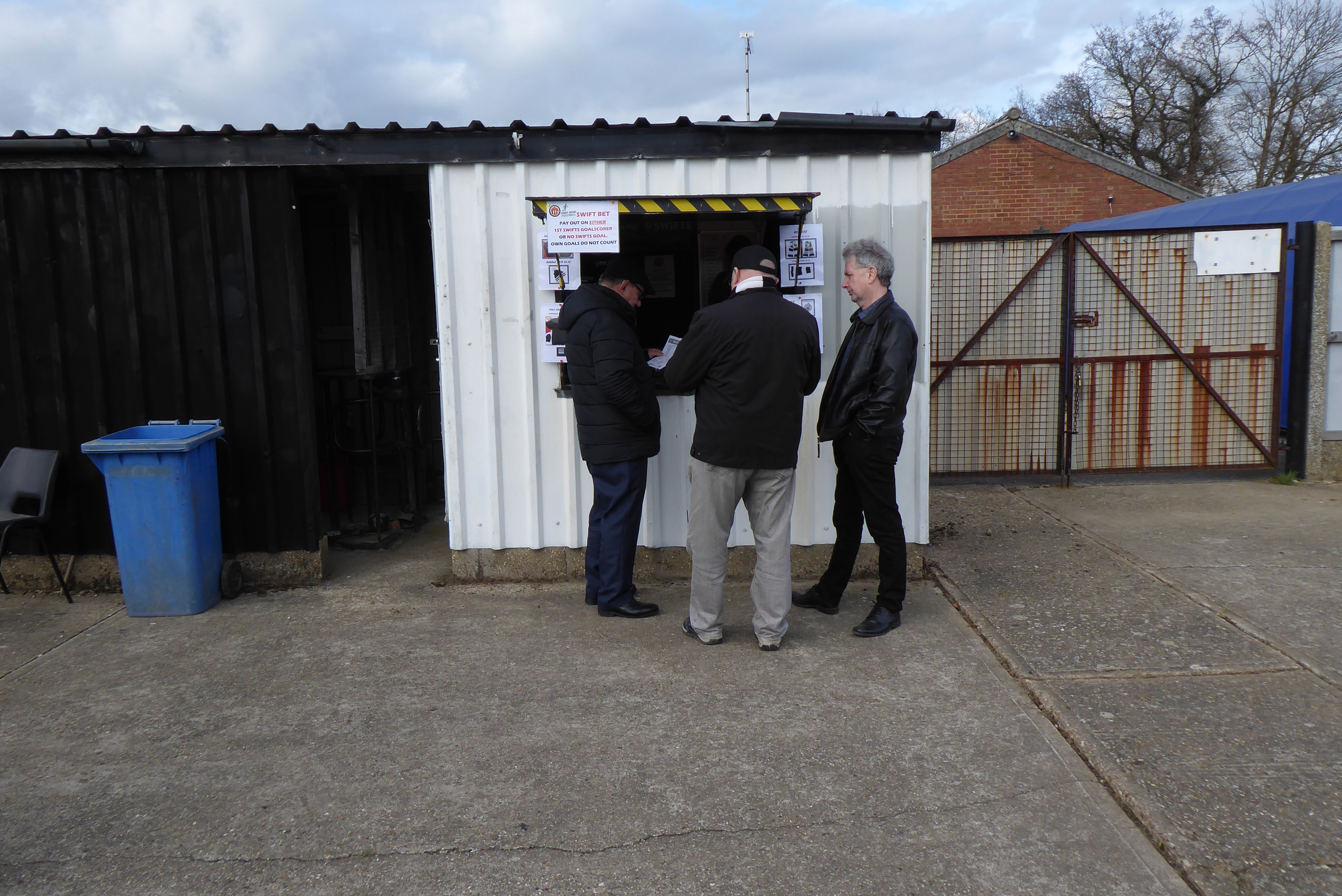
From the turnstile I emerge directly into an open space behind one of the goals; to my left a blue polythene tunnel doesn’t quite make it from the changing rooms to the perimeter of the pitch, beyond that is a well populated open patch of grass behind which sit the clubhouse/bar and the tea bar.  I step inside the busy clubhouse but there’s no real ale on the bar, just the usual bland, mass-produced, heavily advertised fizzy stuff, so I head back outside to the tea bar to join a queue of one.  With the previous customer gone away clutching a burger and cup of tea I ask the smiley-faced young woman behind the counter if there are any sausage rolls.  There are and having found his oven gloves the ‘chef’, a more serious-faced, grey-haired man, takes a baking tray from the oven and prises a row of half a dozen sausage rolls from it with a spatula.  I pay the young woman (£1.50) and smiling she hands me one of the ‘released’ sausage rolls in a white paper napkin.   The sausage roll tastes much better for that smile but otherwise compares to one from Greggs, although not as greasy, which is a good thing.

I have time to wander around the ground and take in the architecture before the teams emerge from the blue polythene tunnel and line-up to say “hello” to one another;  as they do so the theme from ‘Z Cars’ plays over the public address system.  The music ends abruptly and the teams are announced very rapidly by a man inside a glass box in the middle of the Mick Gibson Family Stand.  This afternoon’s opponents are Grays Athletic.  As I drove here listening to BBC Radio Essex, the match was described as a ‘derby’ by a young-sounding presenter called Victoria. But given that all but six of the twenty teams in the Bostik Football League North Division there are from Essex there are rather a lot of ‘derbys’. 

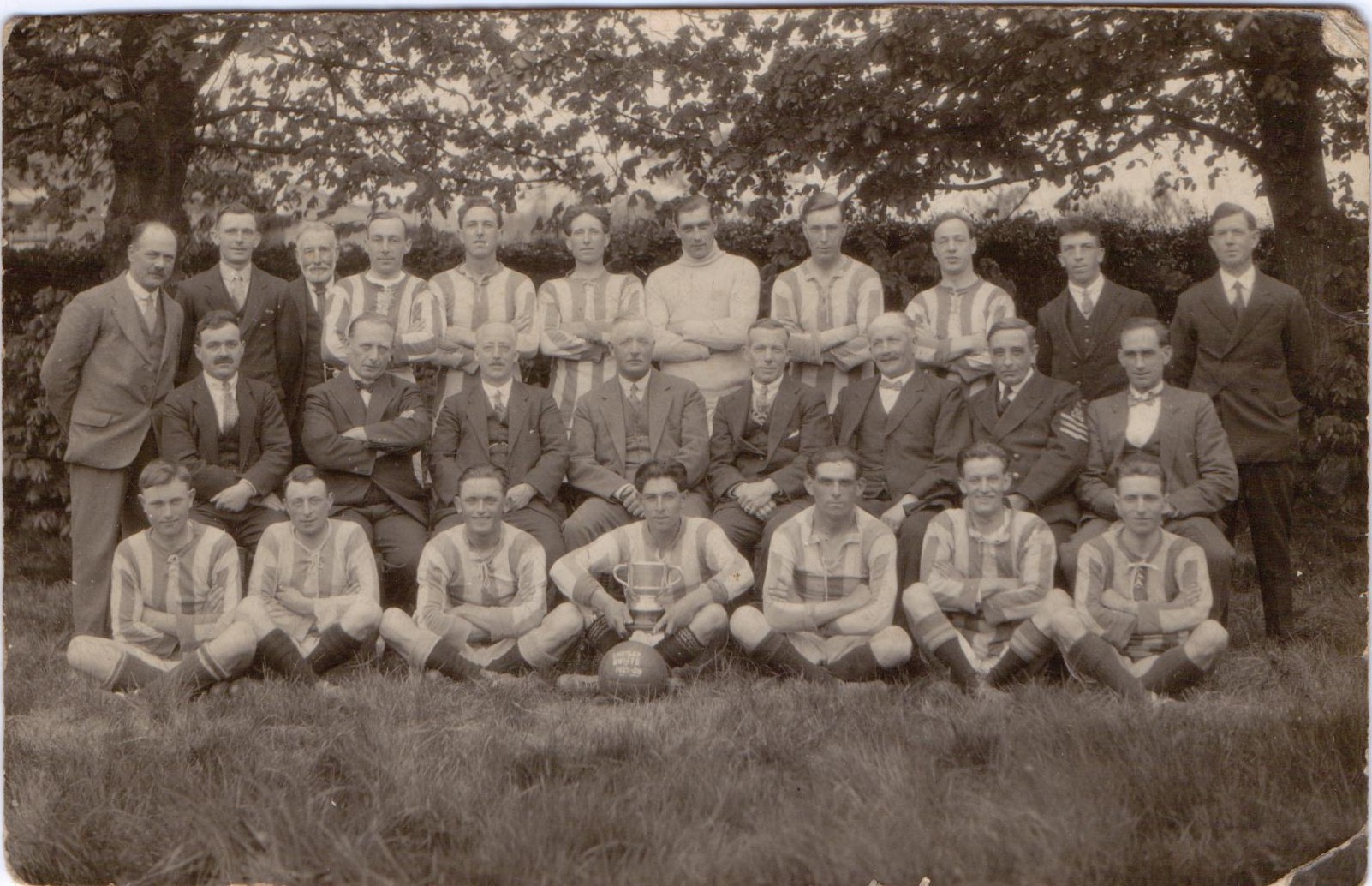
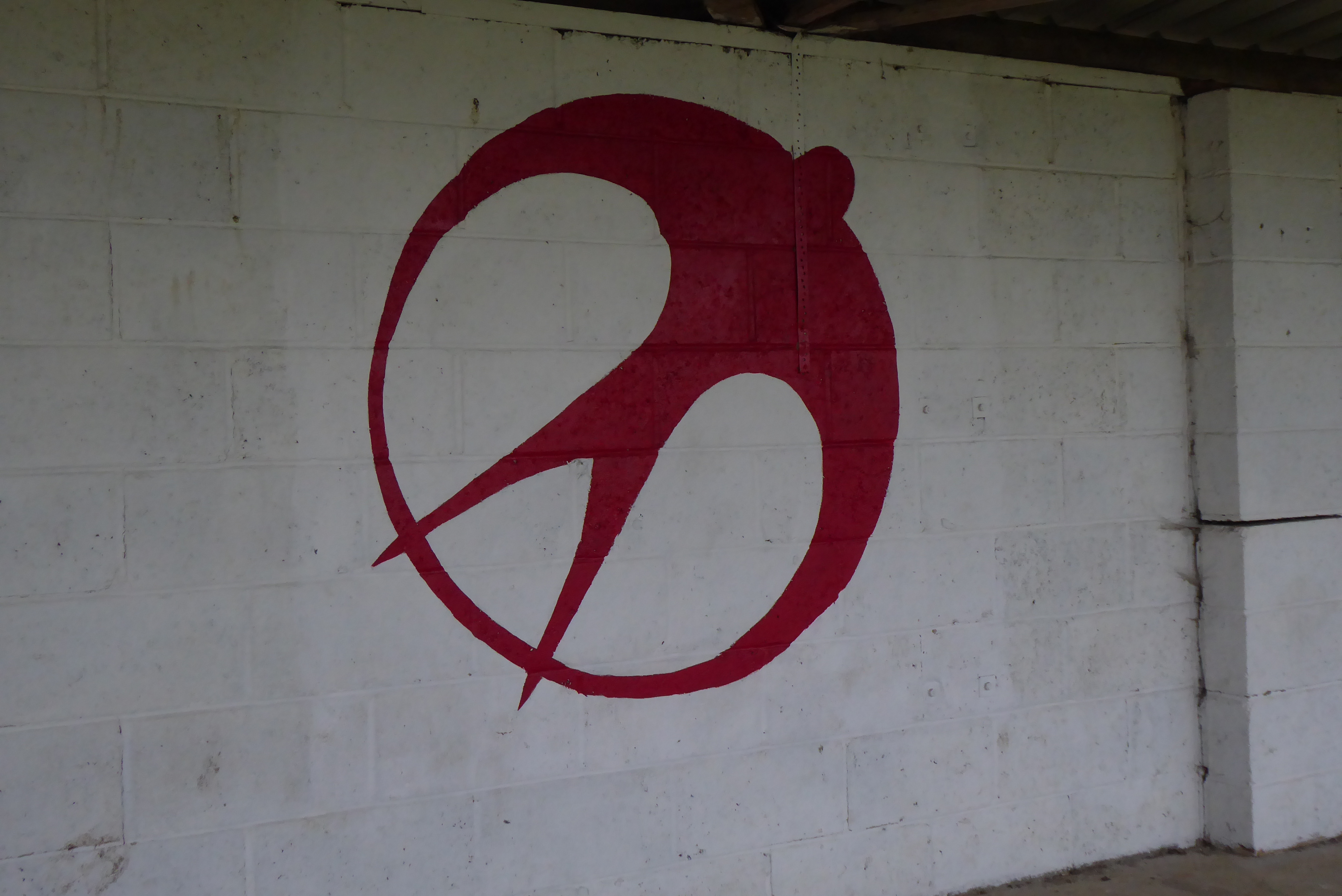
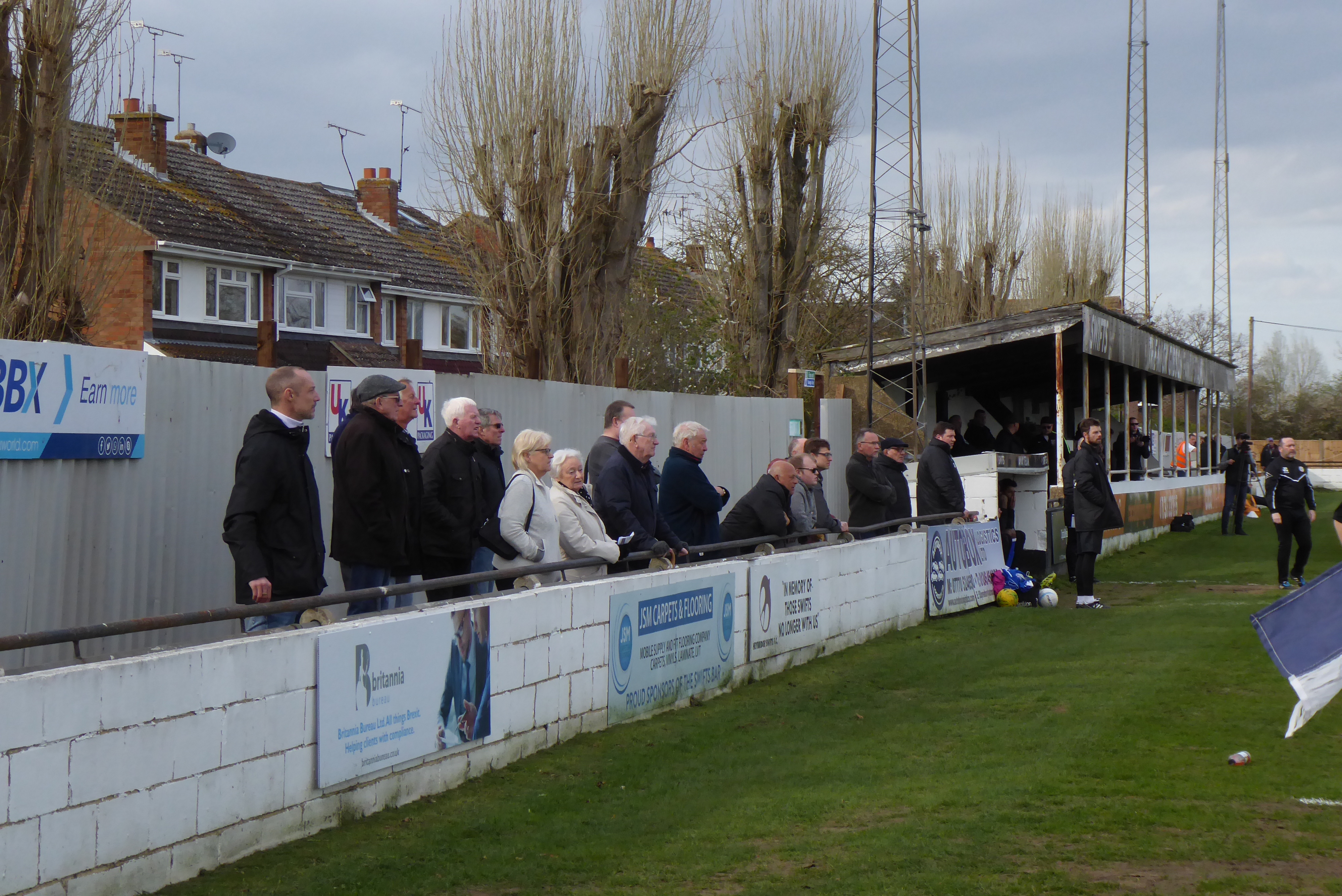
The Swifts kick-off towards the First Call Community Stand and the River Blackwater and Maldon beyond; they wear black and white striped shirts with white shorts and socks, a colour scheme no doubt inspired by the colours of Apus Apus, the Swift, although seen up close Swifts are actually dark brown.   Grays Athletic meanwhile are in all blue with white sleeves and look a bit like Ipswich Town playing away to a team that wears white shorts; they are playing in the direction of the club house and Tiptree.   As much as  Grays might look like my team Ipswich Town and even though the legendary Fabian Wilnis played for them (33 times in 2008-09 season) I decide to support Heybridge Swifts today;  Swifts are my favourite birds because they remind me of warm summer evenings, and Swifts is such a great if disappointingly rare name for a football club.  I grew up in Shotley  in Suffolk where the village team, now known as Shotley Rose after the village pub, were originally the Shotley Swifts; in the 1920’s my grandfather was on the committee and  I have a much-prized photo of him with the team posing with a trophy.

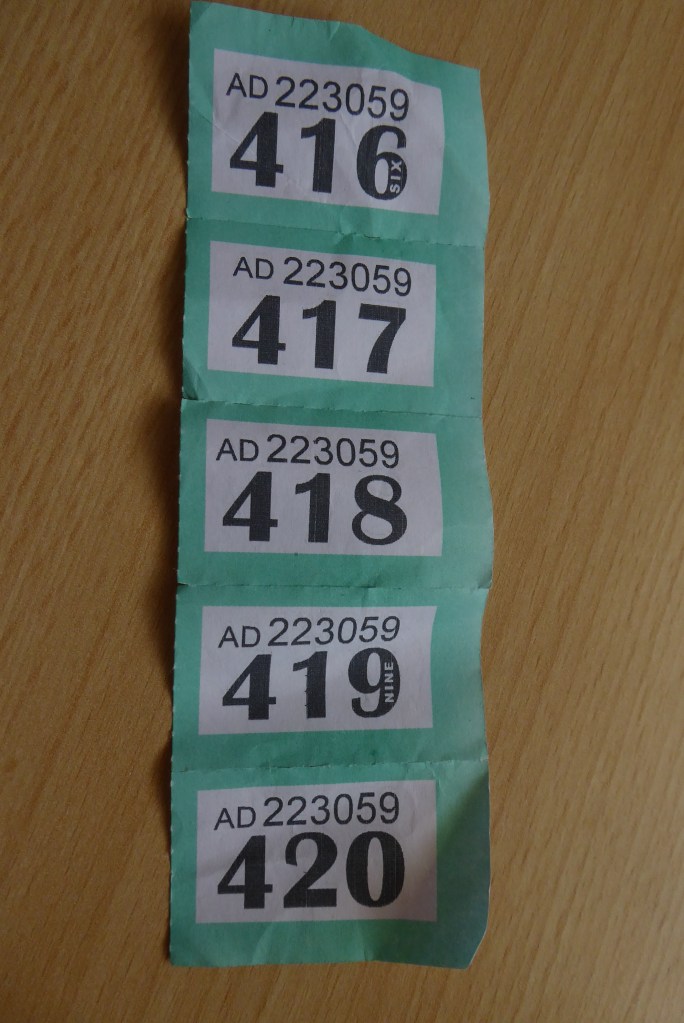
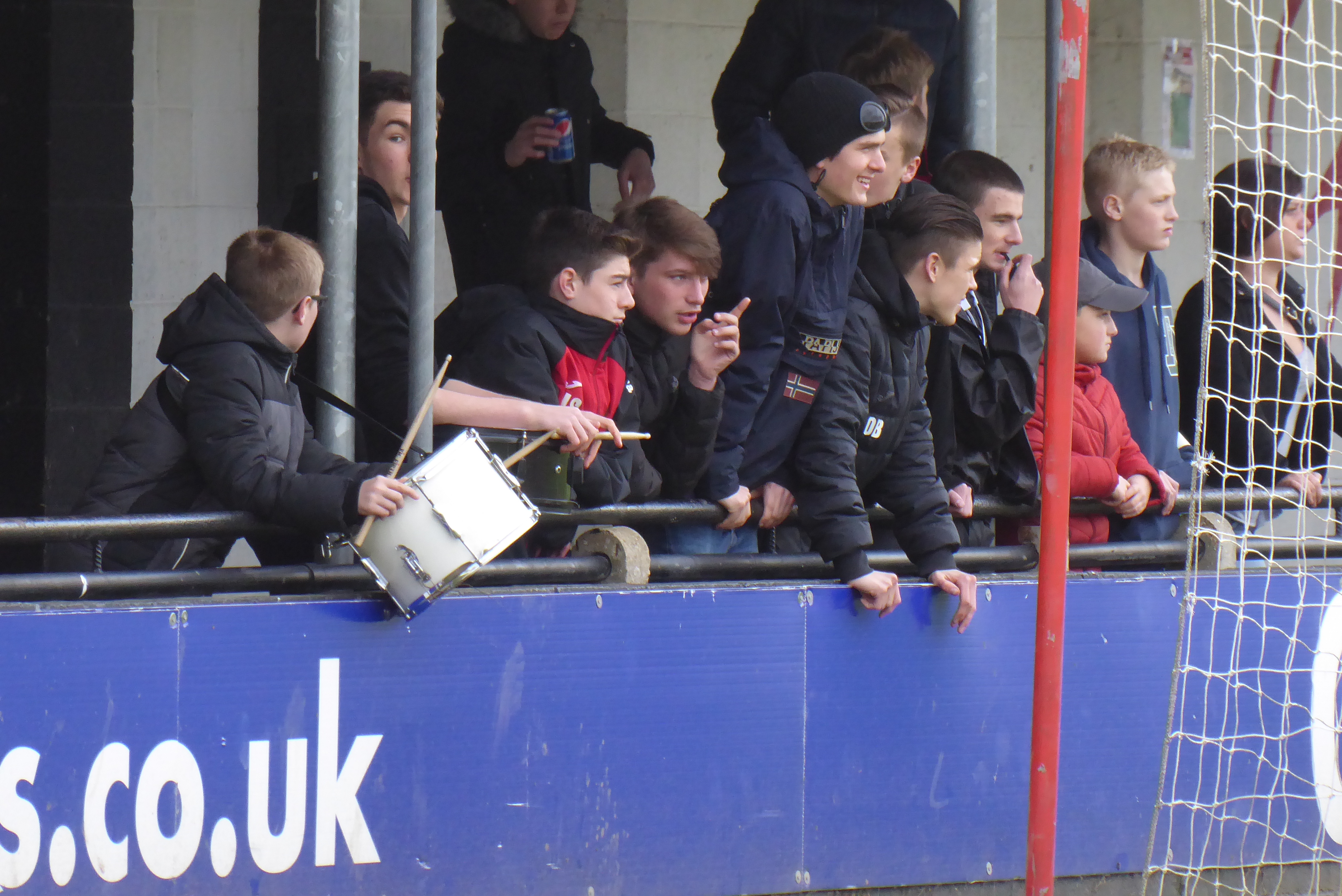
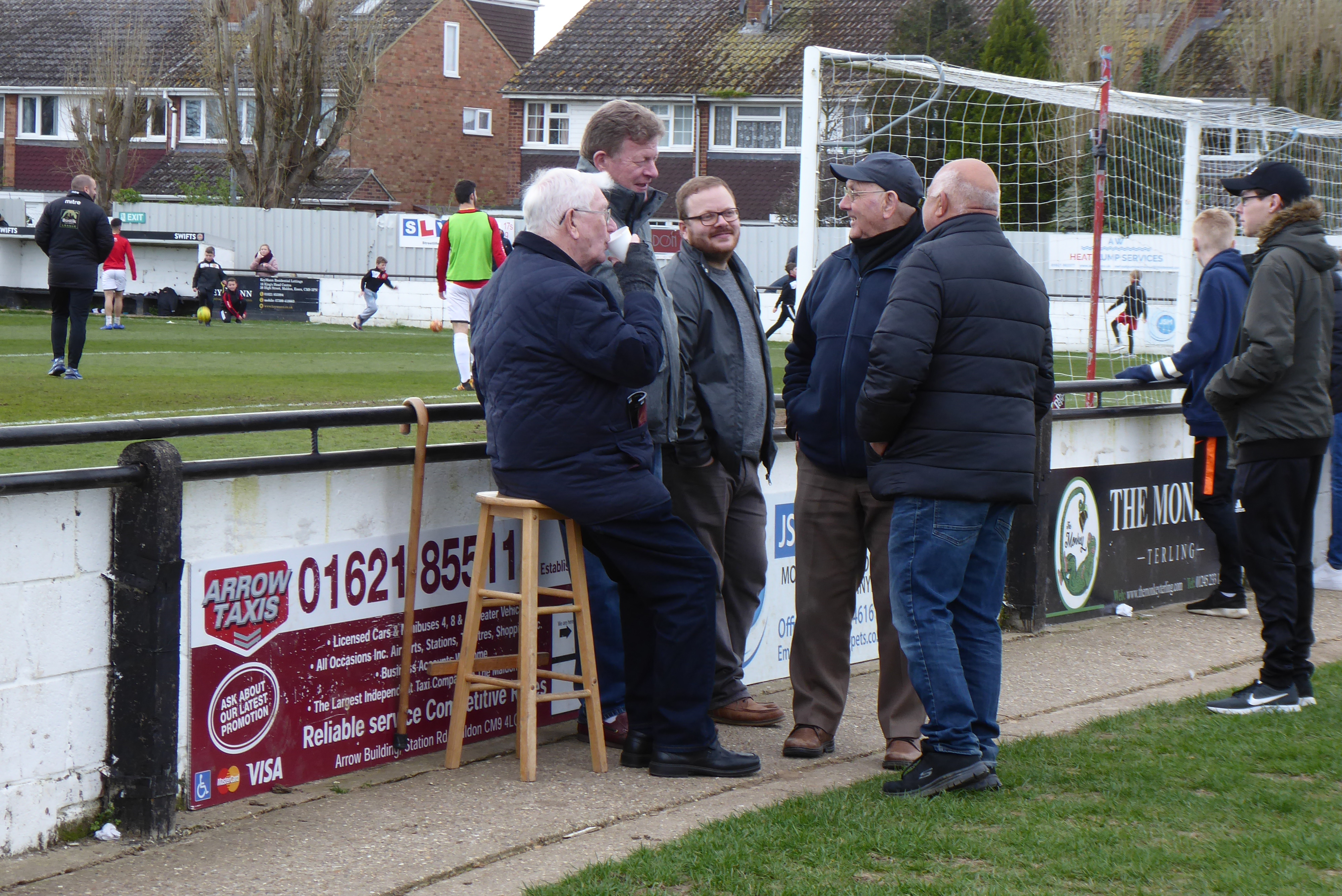
A long line of home supporters file from the clubhouse to the far end of the ground to stand behind the goal into which the Swifts are hoping to score.  The home team dominate the opening stages and have the first shot as the ball rebounds to their number seven, the top-notch wearing Elliott Ronto, whose shot is well saved by the Grays ‘keeper, the beautifully named Clark Bogard.   Although he sounds like a matinee idol, Clark is a large man who clearly does not possess a ‘six-pack’ and from a distance his all yellow kit would, for a short-sighted person, perhaps give the impression of a naked Homer Simpson.  Predictably the ‘wit’ of the home supporters is soon in evidence. “Come on Fatty” shouts an estuarine voice as Bogard lingers over a goal kick.  There is a rowdy atmosphere on the shallow, covered terrace and two lads self-consciously bang a couple of drums, but not enough to really annoy anyone.  “ E’s only ‘ere for the after match meal” shouts someone else at the ‘keeper. “The food’s good here” responds Clark with a greedy expression, admirably entering into the fun.  “Ello princess” shouts a pre-pubescent lad following a strangely different tack.   A man in his sixties shuffles through the stand selling half-time draw tickets. “Afternoon Steve, Bob” he says to a couple of regulars.  I buy a strip of tickets, numbers 416 to 420 for a pound, I am not destined to win.

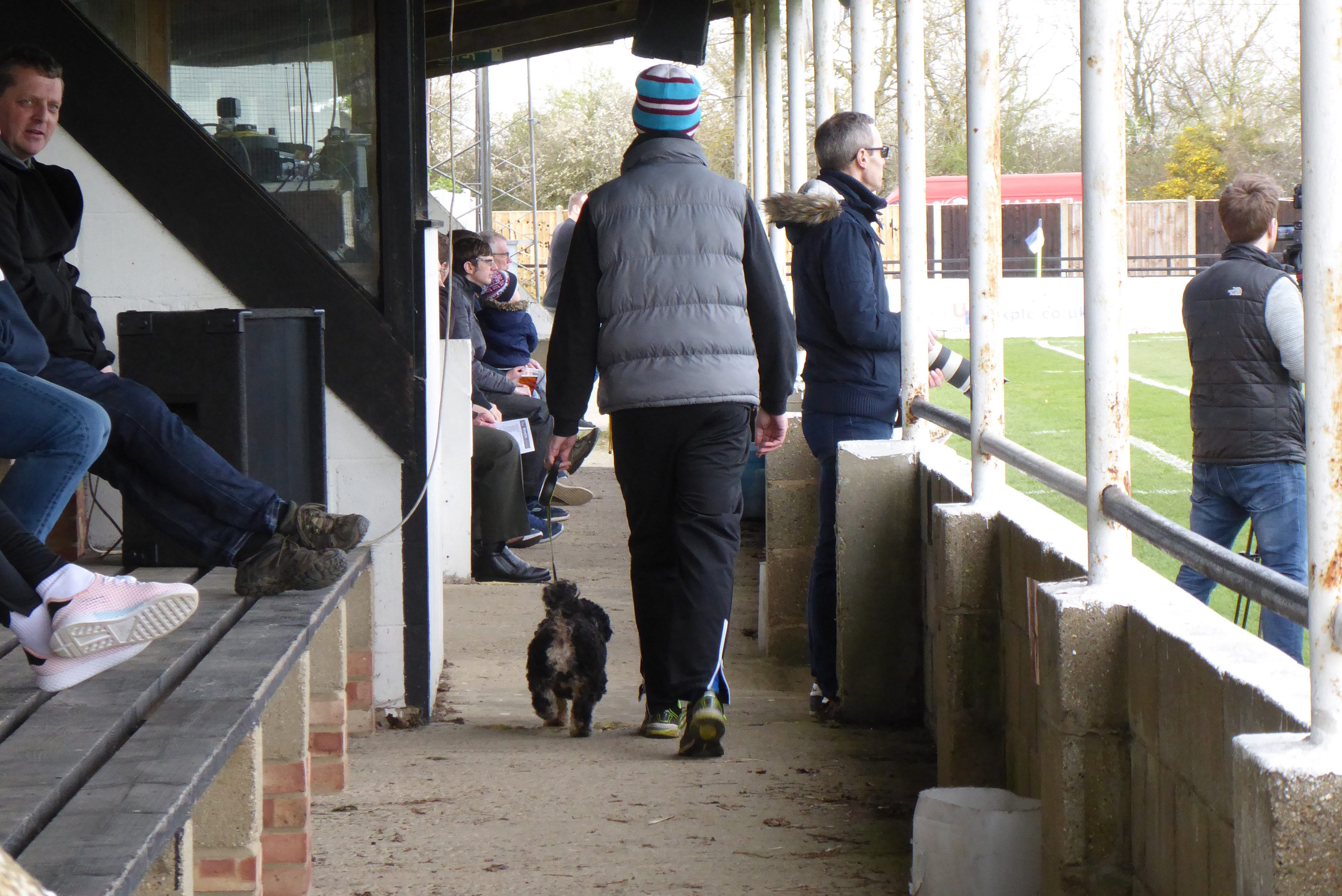
The name of Swifts’ Toib Adeyemi is an early entry in the notebook of the tall, elegant referee Mr Farai Hallam, but Swifts continue to get closer to the Grays’ goal than vice versa.  It’s a bit after a quarter past three and Grays number 11 Joao Carlos surges past the Swifts’ left-back and crosses the ball, it ends up in the Heybridge net and Grays are winning; it’s an own goal and is attributed to Swifts’ number nine Daniel Walker. “Come on you Swifts” is the not-downhearted response from the terrace of the First Call Community Stand.  A black-headed gull wheels above the pitch and disappears over the stand; I move from behind the goal to sit in the main stand, a structure with a row of tubular stanchions along its front, behind which the blue plastic seats have a shallow rake; it’s a classic non-league football stand in a classic non-league ground, a bit home-made looking and scruffy in places, but therein lies its character.  A German Shepherd and two other dogs that look like poodles but aren’t look on, although it’s doubtful they brought themselves here on their own. As the half wears on I move again, closer to the tea bar this time, and am now amongst the Grays Athletic supporters.  Grays are now doing better in terms of possession of the ball and are enjoying a few breakaways.  Number eleven Joao Carlos is a threat down the left, “Go on Carlos” and “Get in the fuckin’ box” shout the Grays fans, before Carlos is booked by Mr Hallam for diving. 

Half-time arrives a little late because of a few stoppages for injuries and I make the short walk to the tea bar but have to join a slow moving queue.  Behind me two men, a West Ham supporter and an Orient supporter talk about the Orient; the football club, not the far East.  The Hammers fan has a habit of finishing the O’s fan’s sentences, like in that sketch by The Two Ronnies, but not as funny. They agree that West Ham isn’t proper football anymore; this (Heybridge Swifts) is proper football.  Eventually my turn comes and I ask the smiley-faced young woman for a tea (£1); she’s still smiling and her smile can’t help but raise the spirits of Swifts fans unhappy that their team is losing.

I drink my polystyrene cup of tea as I take a look through the programme.   I read the thoughts of Swifts’ manager Julian Dicks which are plain and straightforward except for one sentence which reads “Then we gave away a free kick and no one stood on the ball and they popped the ball out and their forward hit a worldy.  He wont hit a ball like that again down hill with the wind behind and Chris had no chance”.  Sheer poetry.

It is five past four and with the start of the second-half I take up a place on one of the two rows of wooden benches in the Mick Gibson Family Stand.  There don’t seem to be any families in the stand although the rest of the ground is well peopled with mums and dads and children of all ages.  I wonder who Mick Gibson is or was and if the stand is just for his family.  The Swifts seem re-invigorated by their half-time tea and the words of Julian Dicks.  Firstly Manny Osei-Owusi gets wide and plays the ball back only for number four Nicholas Brown to skew his shot embarrassingly wide. But minutes later a corner is won, the ball is sent towards goal and repulsed, but only as far as  Toib Adeyemi who is on hand to send it into the goal from close range and the scores are level at one each.  The crowd cheers, although not as much as I thought they would, but then lunchtime and afternoon drinking does make you feel a little sluggish.

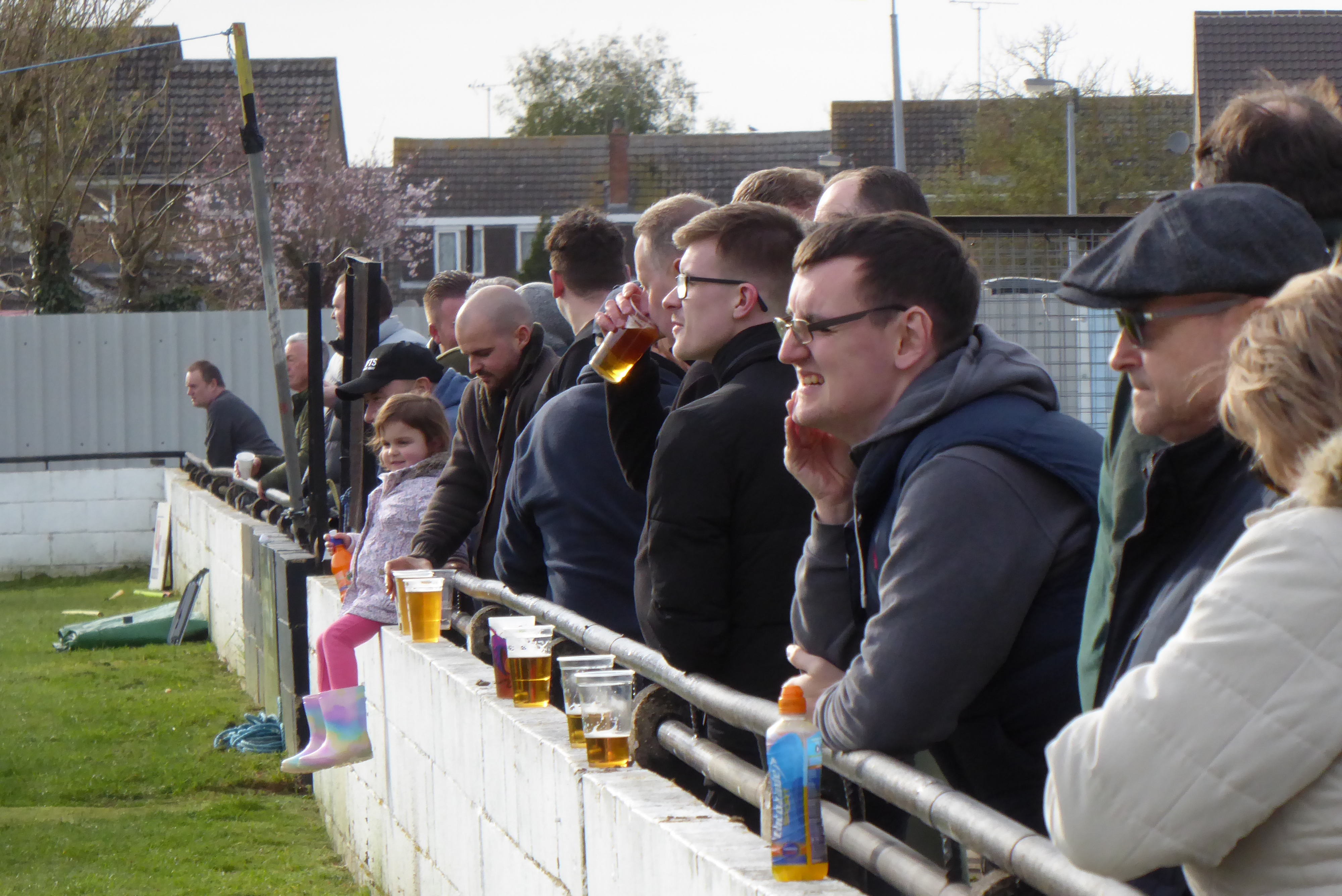
I make the same circuit of the ground that I made in the first-half enjoying the different back drops to the action on the field; bare trees on one side, 1960’s suburban houses on the other and blue skies and wispy cloud above.  The sun is now shining through the cloud and shadows of trees and the Mick Gibson Family Stand play across the pitch.  On the opposite side of the ground spectators shadows play against the corrugated metal boundary fence; it’s beautiful in a way that a football match inside a large stadium never can be.

I sit again in the main stand and catch half a conversation behind me as a man explains to his friend about a holiday or short-break he’s been on.  “They’re good hotels too, they suit me, know what I mean?” he says. I don’t know what he means, but then he wasn’t talking to me.  It’s about twenty five past four and the Swifts win a free-kick and rather unexpectedly their number eight, the ostentatiously named Jack Adlington-Pile scores with what might be termed a Jack Adlington-Pile driver, a thundering direct shot worthy of winning any game.   Unavoidably there is a bit more of a reaction to this goal as people voice a collective “Cor!”.   Grays are marshalled well by their imposing captain Stanley Muguo but they can’t get back in to the game and it’s the Swifts who come closest to scoring again as another free-kick, this time from number four Nicholas Brown defies the laws of physics by hitting the inside of a post and re-bounding out.  

As the match heads towards its conclusion Adlington-Pile and Luke Wilson get to see Mr Hallam’s yellow card, as disappointingly they attempt to hang on to the lead by foul means as well as fair.  Whilst the match remains interesting, Grays are just not good enough to score again and the fact that although only four places separate the teams in the league table, Swifts have nineteen, and now twenty-two more points tells a story.

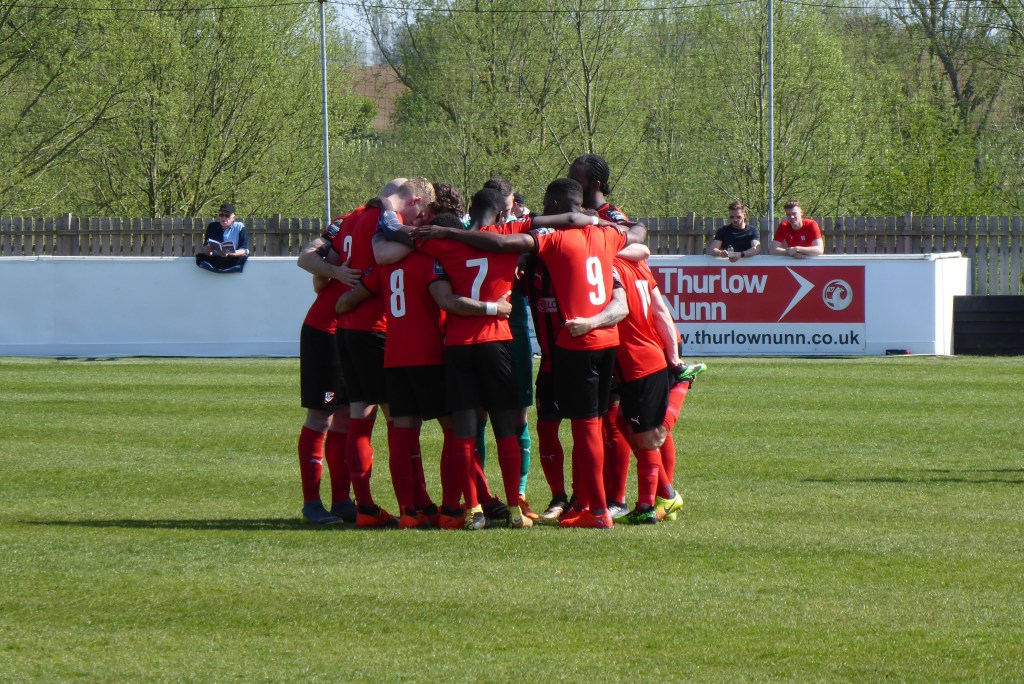
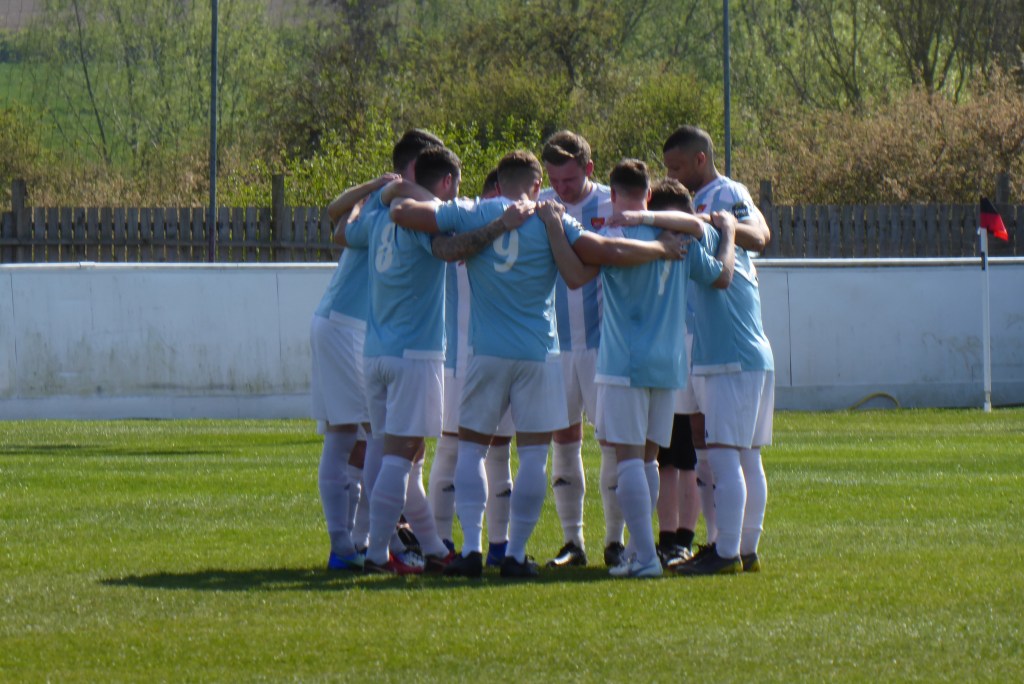
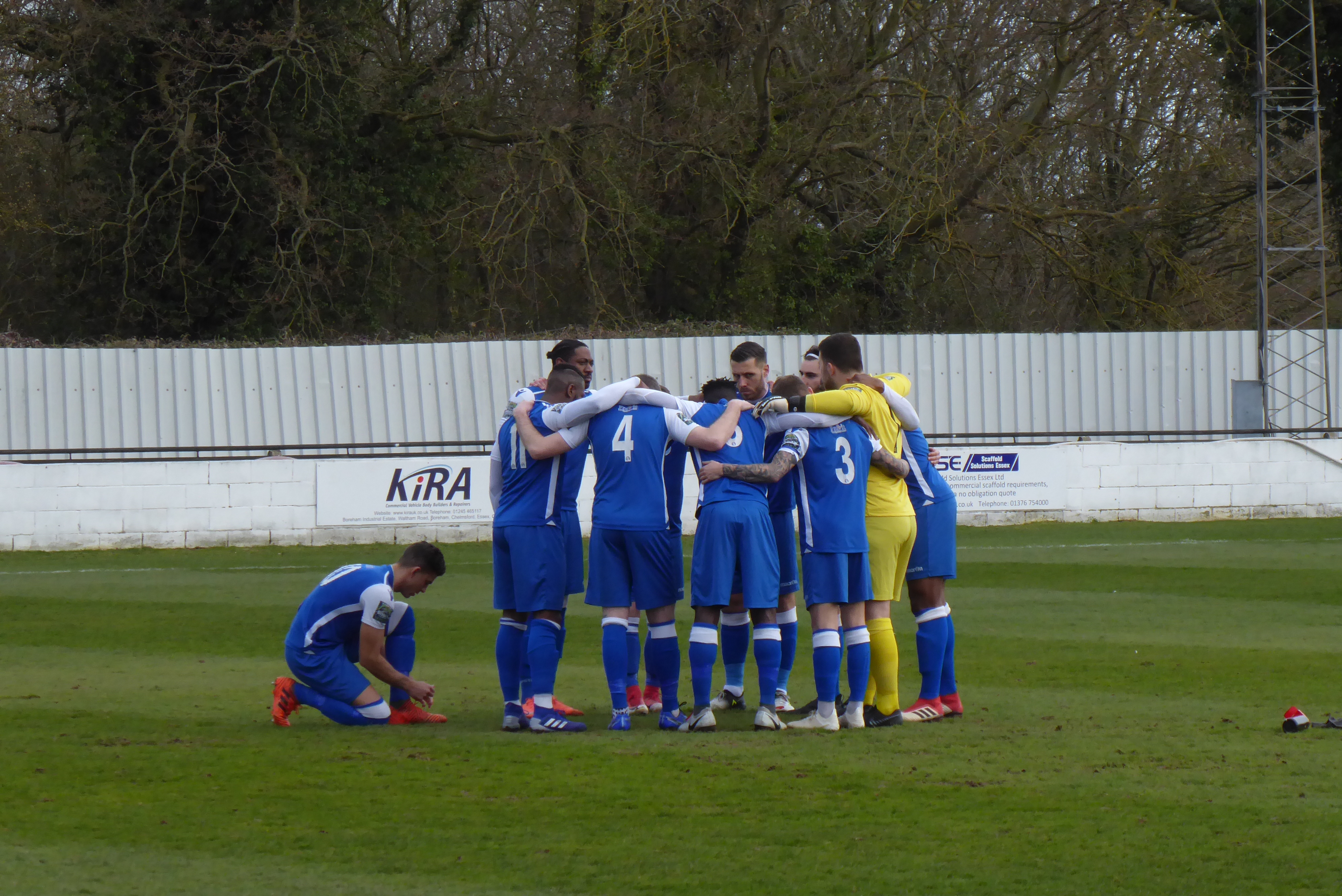
With the final whistle the Grays Athletic players form a post-match huddle, perhaps to stem recriminations, whilst the Swifts enjoy a bit of a love-in with their justifiably appreciative supporters.  It’s been a good match, and arguably going a goal behind and coming back to win is the best sort of win there is.  Scraley Road, or the Aspen Waite Arena as it is known until someone makes a better offer, is a fine non-league ground even if they don’t serve proper beer and like Swifts on summer evenings I look forward to a return.