It’s rare that I finish work and take a trip to the seaside but this evening, having ‘logged out’ and put away the tools of my trade for another day, I find myself heading for the 16:58 from Ipswich stopping at all stations to Felixstowe, which means Westerfield, Derby Road and Trimley St Mary. It’s a bright, breezy evening as the single carriage box on rails roars into life and departs the platform ten seconds early. The frantic diesel engine growls and then subsides as if the driver is searching through a crash gearbox and struggling to double de-clutch. We pass over the bridges of Bramford Road and Norwich Road and I look along those streets to down town Ipswich with its chunky, if not gleaming towers and the Portman Road football ground, which looks massive beyond the low, humble rooftops of Ipswich’s residential streets. On a bright Spring evening Ipswich shows off its trees; it’s a fine town.
The train is fairly full of people heading home from work. Opposite me a simian looking man in a grey anorak; behind him a tall man with a crew cut wearing a red Adidas tracksuit top; he looks like a Russian cosmonaut. On the other side of the train to him is a luxuriantly bearded man with long hair hanging over bristly temples, he is wearing an infantile coat decorated with a gaudy cartoon character; the woman with him could surely do better than that. “Hello Mum, how are you doin?” says another man answering his mobile phone. The cheery conductor asks to see my ticket (£3.05 for a single with a Goldcard) and scribbles on it in biro. He hasn’t singled me out, he looks at other people’s tickets too. I only bought a single because it is impossible to get back from Felixstowe to most intermediate stations between Colchester and London after 9.25pm. I shall be cadging a lift home with two Coggeshall regulars Keith and Jim.
The journey takes about 25 minutes and is well worth the £3.05 fare, with its tour of the cuttings, embankments, bridges and viaduct of Ipswich and then the open countryside towards Trimley with its glimpses of the tops of dockside cranes. The track runs parallel to the road for some way and as we hurtle along and overtake a bus I am reminded of the Titfield Thunderbolt; Greater Anglia should have a bar on this commuter run.


Felixstowe station has a beautiful canopy and concourse which are Grade II listed, it’s just a shame a the platform is now divided in two by a surface car park. The fate of the railway station is that of Felixstowe in microcosm, one of faded, compromised Edwardian grace and occasional grandeur. Felixstowe could be posh like Southwold and Frinton and in places it is, but it has an unfortunate underbelly like most of divided Britain; on Hamilton Road a man sits on a bench wrapped in a sleeping bag. I do a spot of sightseeing, walking down to the cliff top get a glimpse of the sea and then back along Grosvenor Road, stopping off for a pint of Sharp’s Doom Bar (£3.35) in the Grosvenor Arms, a typical Greene King pub, weirdly decorated like a cross between an hotel lounge and a small town museum.
It’s just gone six o’clock and I amble back towards the railway station and cross over the road into Beatrice Avenue, a clichéd, leafy, suburban street of detached houses with Tudorbethan gables. I half expect to see a Reggie Perrin. The ‘Goldstar Ground’ and Dellwood Avenue, home of Felixstowe & Walton United, runs off Beatrice Avenue and is much the same, but it’s got bungalows too. There are two stewards in day-glo waistcoats at the entrance to the club car park, clearly tonight’s game is a big one. I crunch my way across the beach-like car park, past the old club house which stands forgotten, forlorn and falling apart; there are tiles missing from its roof and the paint is peeling from its weather boarded walls. It could look good if restored as a cricket pavilion, but as it is it looks like it might soon be offering up spare parts for allotment sheds.
The turnstiles have only been open a few minutes and there is no queue, only an array of signs, one of which refers to ‘Spectator Balls’ and would seem to be purely for comedic effect. I pay my £6 entry fee and collect a programme (£1.50) from a man sat at a foldaway table. I head towards the swish new club house, a low brick building with black timber cladding, which only opened at the start of the season; it sits behind a tarmac area in the shade of a row of small trees like a French town square. I make for the snack bar and order a chip buttie (£2 – ticket no 57) and very good it is too, with lots of crinkle cut chips served in a little cardboard box. I sit and eat at a Yogi bear-style picnic table and gain amusement from the pre-match music play list; Dancing Queen (Abba) ; Since You’ve Been Gone (Rainbow) Don’t Stop Me Now (Queen); The Boys Are Back In Town (Thin Lizzie) and so on. It’s no surprise when the stadium announcer sounds like Mike Smash, drawing out the final syllables of every sentence. Someone needs to tell him it’s no longer 1980.
Finding Keith, my driver for the night, already ensconced in the stand with his sidekick Jim, I offer to get them a drink; two coffees (£1 each) and I pop into the bar, a plain but

durable looking room, for a pint of Guinness (£3.50), but am very, very disappointed that there is no real ale, not even Greene King IPA. I return to Keith and Jim and settle down in a seat for the evening as the crowds begin to roll in, gathering mostly in the area in front of the bar, but fanning out all around the perimeter fence too. Both Felixstowe and Coggeshall have already secured promotion to Bostik Division One North, but if Coggeshall win tonight they will be Champions; if Felixstowe win they will go top of the league and could clinch the Championship on Saturday. The excitement is palpable and clearly worth six quid of several people’s money. The eventual crowd will eventually be announced as 1,541, easily the biggest attendance in the Eastern Counties League this season and possibly since the 1960’s and nearly 700 more than watched Morecambe play Colchester United earlier this season in the fourth division.
Kick-off is delayed for five minutes because there are still queues at the turnstiles but referee Mr Aaron Farmer seems keen to get on as the teams appear on time to go through all that handshaking malarkey. The teams are announced over the PA in the style of a bingo caller. “On his o-w-n, Numb-e-r One, Dann–y Cruuuuump”, except he didn’t say “On his o-w-n”, sadly. Felixstowe & Walton United being “The Seasiders”, it is entirely possible that their stadium announcer’s day-job is on the pier. The teams line up and we wait about as the swirly, impatient sounds of Fat Boy Slim’s “Right Here, Right Now” build the sense of occasion; I always think that that tune should be played at bus stops and on station platforms in the minutes leading up to arrival and departure.
Eventually, Coggeshall Town kick off in the direction of Woodbridge wearing a change kit of all blue with white sleeves, which makes them look rather fetchingly like the mighty Ipswich Town, a good omen for them surely. Felixstowe & Walton United meanwhile model their customary Signal toothpaste inspired design of red and white striped shirts with red shorts and socks; they are kicking towards the town and the North Sea. Fat Boy Slim breaks off abruptly, but not before the game has started.


Coggeshall start well and quickly have a shot on goal, the Felixstowe goalkeeper Danny Crump making a diving save from Coggeshall’s number ten Ross Wall and the Seedgrowers win an early corner. Coggeshall get forward well, particularly down the left wing with Aaron Cosgrove, but gradually Felixstowe edge back, although their play is more about just getting the ball into the box. There are a few chants of “Sea-Sea-Seasiders” mostly from the area in front of the bar, but not as many as you might expect from a crowd of this size. Behind the goal at the ’Woodbridge end’ a loan voice occasionally bellows support for Felixstowe.
Coggeshall are looking the better team, but it still surprises me when Jamie Shaw heads Coggeshall into the lead from a Curtis Haynes Brown cross; the ball is seemingly cleared off the goal line but the linesman signals that the ball had crossed the line. This LAR (Linesman Assisted Referee) system really works. Then Coggeshall score again, Aaron Cosgrove displaying the sort of skill that on the night is setting Coggeshall apart from their rivals. Barely twenty minutes have been played, the night is young, it isn’t even dark yet.
The goals dampen the home crowd’s ardour, but the game is played at a furious pace so there is still excitement aplenty as muscular tackles and thundering hoofs are punctuated by occasional flashes of pace and skill and a booking for each team. Felixstowe spectacularly hit the Coggeshall bar with a shot from Boardley and then a cross into the box from a free-kick is swept in from close range by Felixstowe captain Rhys Barber. It’s 2-1 to Coggeshall as everyone breaks ranks for half-time and many of us discover that the two urinals and one toilet in the clubhouse aren’t enough tonight. I take a walk around the ground to take in the sights as daylight rapidly fades and is swapped for floodlight and the unique atmosphere of the night match. Such a big crowd stood on the grass beneath the trees, it feels more like Bonfire Night.
Returning to my seat just in time for the re-start, the ground is now transformed by the floodlights. The grass seems to glow beneath the dark blue sky and backdrop of lofty trees. The score line is finely poised. It’s five to nine and once again Coggeshall’s Aaron Cosgrove runs at speed at the Felixstowe defence, this time at its very heart. Cosgrove is tripped by Dan Davis who is booked for his efforts and Conor Hubble arcs a glorious free-kick over the defensive wall in to the top left hand corner of the Felixstowe goal. Not long later Cosgrove is tripped again, this time in the penalty area, and Coggeshall captain Luke Wilson makes the score 4-1 from the spot.
Felixstowe substitute Jamal Wiggins still manages to get a second goal for Felixstowe from close range and then the game changes into a lower gear. Half chances come and go but Coggeshall are largely in control. In the stand some of the spectators betray their loss of hope, appealing desperately and randomly to players, the referee and anyone in earshot. “Keep the ball!”, “Put it up there!” “What’s he doing now? Booking the ball?” More players of both teams are booked and the referee becomes equally unpopular with both sets of supporters, as is only right. One voice has given up on goals and just wants Coggeshall players booked for swearing; has he never been to a football match before I wonder. The best of the game has passed, but it remains exciting nevertheless and Keith and I speculate about the damaged greenhouses and cold frames in the gardens of the detached houses beyond the far touch line, as numerous balls are booted out of the ground.
The crowd thins out as it becomes evident that Felixstowe will not win, and they don’t. Coggeshall Town are champions of the Thurlow Nunn Eastern Counties Premier League and the game ends in a burst of deserved and prolonged applause for both teams.
It’s novel to see a team win something, it’s not something that as an Ipswich Town supporter I have witnessed lately and I have had to experience the joy of winning trophies vicariously through other clubs. Tonight has been memorable.
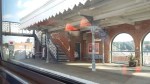 and Melton past Westerfield and through disused Bealings station. On into the Suffolk countryside the ride becomes more and more rural. It’s a journey for geographers, biologists and historians as we pass through sands and boulder clays, marshes and broads, passing cows and horses, pigs and sheep, an albino pheasant, partridges, ash and oak, gorse and broom, flint churches, a World War 2 pill box and thatched cottages. Football fans who know what they’re looking for can spot the floodlights of Woodbridge Town Football Club, and further up the line College Meadow, where Beccles Town are destined to lose 0-3 at home to Debenham in the Suffolk Senior Cup later this afternoon, is right next to the station.
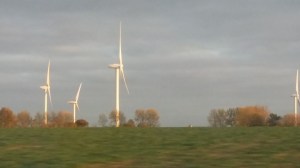 under towering pylons marching two by two from Sizewell nuclear power station whose dome is visible in the distance over the tops of trees; there’s a windmill and wind turbines. This is a wonderful journey on a beautiful, bright autumn day.


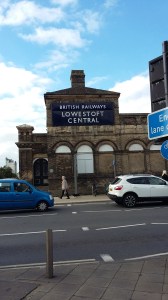 the bottom of the High Street. It’s the end of the line and it looks it, a handsome Victorian building that’s too big for the two lines that host the buses on rails that rattle in through wonderful East Anglian landscapes from both Ipswich and Norwich. It’s a town that has undoubtedly seen better days, it expanded in the late nineteenth century on the back of industrial scale fishing, an unsustainable activity like coal mining and as that industry declined so the town lost its raison d’etre. It had other industries such as bus body building (Eastern Coachworks) but with the de-nationalisation of bus travel that closed too.
 The streets are of terraced houses and even a couple of back street boozers, an alleyway runs down the back of the main stand; this is a proper football ground with a vista of chimney pots and residential roof tops. You can see where the supporters live here, not where they buy their weekly groceries, or go bowling and to the cinema. Lowestoft Town have been at Crown Meadow since 1894.
 talking occasionally but also reading and another three, one of whom sports a Kingstonian shirt, sit at a table by the door. One of the Kingstonian group looks at least 70 and surprises me by suddenly mentioning Depeche Mode, although he seems to think David Sylvian was lead singer and is quickly corrected by the wearer of the shirt. I bemoan to myself that the conversation between the sort of blokes who frequent real-ale pubs often sounds like they are just waiting for the pub-quiz to start.

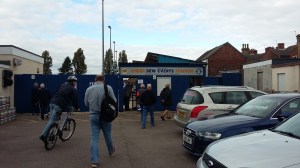 Amber Dew Events Stadium”; it should say that it’s real and lasting name is Crown Meadow but it doesn’t. “What is it? A tenner?” I ask of the lady turnstile operator. “Eleven” she says, adding “If you’re an adult, are you?” I laugh, “Nooo, I’m not an adult” I say perhaps a little too sarcastically, but later I think maybe she thought I’m a pensioner. I reckon £11 to watch non-league, part-time football is a bit steep, and although it’s no more than other clubs charge at this level, in France it cost less (9 Euros) to watch a fully professional match (Nimes v Auxerre) in Ligue 2. C’est la vie. Just inside the turnstile programmes are sold from a table for £2, I buy one.
 Inside the kiosk a middle aged man attends the deep fat fryer and a young woman takes the money, whilst surreally a second older man is asleep on a chair.
 From the usual football food menu I opt for the ‘hot dog’ (£3.50), which consists of two very ordinary sausages with onions (optional), in what turns out to be a very crumbly
 girlie depending on your point of view, but also because he is very involved in the game and hits a decent long pass. It is probably a good thing that men are once again comfortable wearing a pony tail, but I’m glad that a rubber band or scrunchy did not deny me the sight of the flowing locks of Mario Kempes, Kevin Beattie and Gunter Netzer back in the 1970’s. For Lowestoft, their number eleven Cruise Nyadzyo seems keen to get the ball forward, but too often his crosses pick out no one in particular. I multi-task by walking around the ground and watching the match at the same time. A steward eyes me suspiciously. There is a country bus shelter type structure behind the far goal which sports on its back wall a trawler-shaped memorial plaque to one Ted Lightfoot.


 I want to tell them to relax, grow their hair, wear shades and a beret; they surely only dress like they do so people know that they are the club officials. I smile to myself. The main stand is a lovely, low, gloomy structure with a deep, grey fascia beneath the roof and glass screens at either end. Inside the stand there are no plastic seats like those found at most grounds; here they have the original cast iron frames with beautifully mellowed, curved wooden backs and wooden tip up seats. The stand has no stanchions to block your view suggesting it might be of a cantilever design, in which case it was an early one. Despite lashings of blue paint, it’s dull and utilitarian; but it’s beautiful and a candidate for local listing by Waveney District Council. Club officials in de-mob suits, brogues and fedoras, and smoking pipes would not look out of place in this stand.
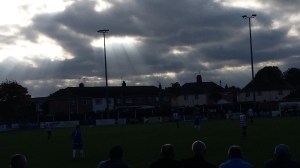 the burst of sunlight that breaks through the mass of cloud that started to hang low over Lowestoft this afternoon whilst I was in the Triangle Tavern. For all its beauty, this stand is on the wrong side of the pitch and a hundred or more people squint in unison. There are more shouts of “Come On You Blues” as people sense victory is possible, but this seems to make some older supporters sat behind me a bit tetchy too. Mr Quick the referee receives some mild abuse for one or two of his decisions and there is clearly a belief that the world and in particular Mr Quick is against Lowestoft. But according to Wikipedia, this is a town with three UKIP councillors, so fear and a lack of logic are common currency.
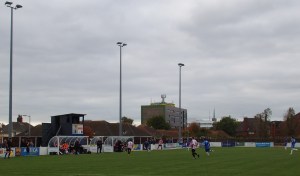 Oblivious of medieval flintwork the commentary continues from from behind me, particularly when Cruise Nyadzyo is substituted; it’s not a popular decision. The view seems to be that he was the best player on the pitch. Things don’t get any better in the eyes of the mainstanders as Kingstonian’s Thomas Derry strikes the cross-bar with a header from a corner. But taking the best player off seems to have no lasting effect, perhaps it makes the other players work harder, and soon afterwards a low right-wing cross from Lowestoft’s number eight Sam Borrer is easily kicked into the Kingstonian net from close range by Jake Reed and Lowestoft lead 2-0. Going further behind seems to be just what Kingstonian needed to do however, in order to raise their game and they eventually score a goal too, from a free-kick off the head of number five Michell Gough. The remainder of the game involves Kingstonian trying to equalise and Lowestoft trying not to concede. I leave my seat to stand closer to the exit because when the final whistle blows it won’t leave long to get to the railway station for the 17:07 train. Eventually at 16:58 Mr Quick calls time and I sprint off down Love Road leaving the victorious Trawlerboys behind me; I make it onto the train with nearly three minutes to spare.


 trippingovertheball