Ipswich Town 1 Oldham Athletic 1

One of the many wonderful things about supporting a football team that is in the third division is that the FA Cup begins at the beginning of November.  None of this inexorable waiting about for Advent, Christmas and then New Year to come and go. No siree, the joy of knockout football comes early to the meek who do more than just inherit the Earth, they get to chase the glory that is knockout competition football.  Of course, we have already missed out on six rounds of extra-preliminary, preliminary, and qualifying rounds, but we can’t have everything and being meek we wouldn’t want it.

Today, the transparent plastic tub that serves as the 21st century’s replacement for the Football Association’s velvet bag has paired Ipswich Town with fourth division Oldham Athletic.  This is a pairing to rival some of the worst failures ever, like a race between a Ford Edsel and a Sinclair C5, or a competition between the Enron bank and ITV digital.   Ipswich Town and Oldham Athletic, I have been told, are the least successful clubs in English professional football in the past twenty years, being the only two who have either not been promoted or not made it to any sort of match at the new Wembley Stadium.  The good thing is that this has saved us supporters a considerable amount of money on grossly over-priced tickets, match day programmes and catering, for which we should be grateful.

It’s a blustery, cloudy day and fallen leaves scuttle along the footpath as I make my way through Gippeswyk Park; the autumnal scene reminds me of some of the opening sequences of the film The Exorcist. Portman Road is very quiet, stewards in huge fluorescent orange coats, and sniffer dogs easily out number supporters outside the away fans’ entrance.  The display on the windows at the back of the Cobbold Stand tell of former FA Cup glories and the day in March 1975 when a record crowd of 38,010 filled Portman Road to see the sixth-round tie versus Leeds United. I look at my watch, it’s a quarter to two; I had already been inside the ground nearly twenty minutes by now on that day forty-six and a half years ago. I buy a programme for a knockdown price (£2.00), and  confirm to myself that I prefer this 32 page programme to the usual 68 page one, even though it costs more per page; I live in hope of an eight or twelve page edition for less than a pound.

At the Arboretum pub (currently known as the Arbour House), I choose a pint of Nethergate Augustinian Amber Ale (£3.80).  The bar is unusually full, so my pint and I decant to the safety of the beer garden, which is reassuringly more like a backyard with tables and chairs. I text Mick to tell him “Je suis dans le jardin”.  It’s not long before he joins me with a pint of beer and a cup of dry roasted peanuts.  We talk of Ipswich Town, of property development and pension funds, catching the TGV to Marseille, the buildings of Le Corbusier, the colour theory of Wassily Kandinsky and the Bauhaus, and electric cars.  A little after twenty-five to three we leave for Portman Road, bidding the barmaid goodbye as Mick places our empty glasses and the cup that no longer contains peanuts on the bar.

Our tickets today (£10 for me, £5 for Mick plus £1.50 each unavoidable donation to some parasitic organisation called Seatgeek) are for Block Y of what is now known as the Magnus Group Stand, but used to be the plain old West Stand, named simply after the compass point rather than a commercial concern called West that had paid for the privilege.  Flight upon flight of stairs take us to the dimly lit upper tier of the stand where we edge past a line of sour-faced males of indeterminate age, but over fifty, to our seats.  My guess is there won’t be much banging of drums, lighting of flares or even vocal encouragement from these people, who look more like Jesuit priests than football supporters.

Although Remembrance Sunday isn’t until next week, and there will be a minute’s silence before the game versus Oxford United next Saturday, bizarrely we have another pre-match minute’s silence today.  Stadium announcer Stephen Foster tells us it is because we are in the ‘Remembrance period’ but it feels like football just likes minutes silences.  As ever the silence is strangely followed by applause, and then the game begins.  For the first forty-five minutes Town will be mostly trying to send the ball in the direction of the goal in front of the Sir Alf Ramsey stand (previously known as Churchman’s end) where in the lower tier I can make out ever-present Phil who never misses a game and Pat from Clacton.  Later, Mick will ask me if “the lady from Essex” still comes to the games, and I will point her out to him, locating her using gangways and rows of seats like co-ordinates in a game of Battleships.   Mick spots her and Pat from Clacton is sunk. Oldham Athletic are wearing a fetching ensemble of orange shirts and black shorts with orange socks; it’s a kit that stirs memories of Town’s fifth round tie away at Bristol Rovers in the snow of February 1978; or it would if, as is the modern fashion, Oldham’s shirts didn’t look like they’d had something spilled down the front of them.

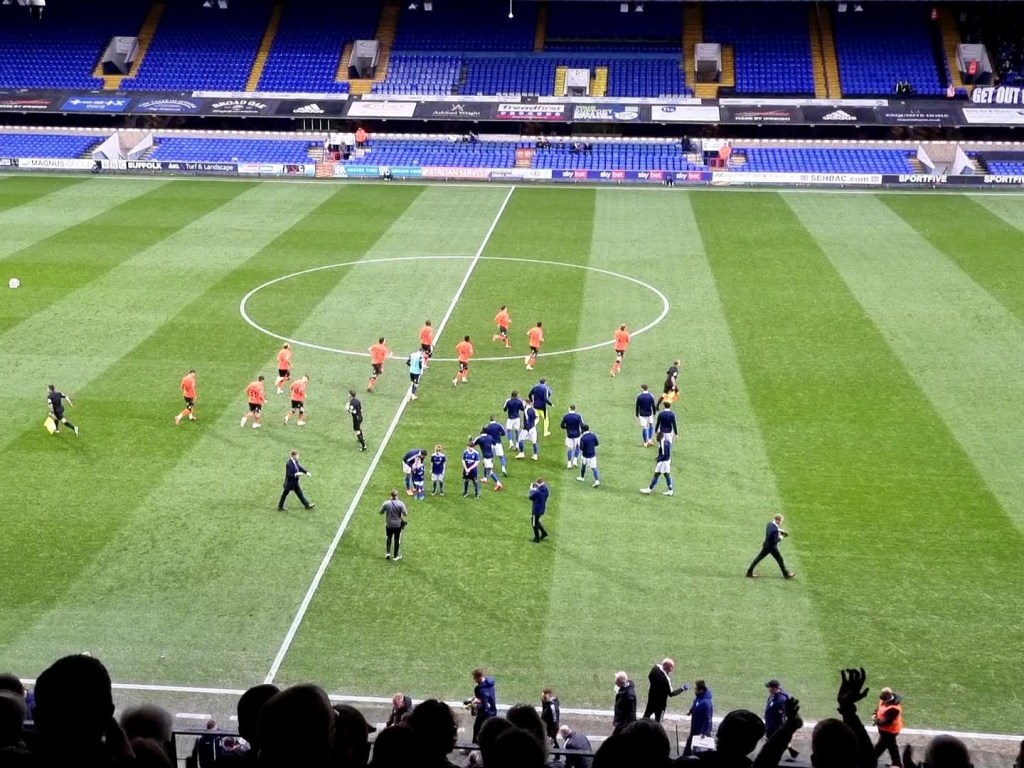
Town start the game well with Oldham’s interestingly named Dylan Fage conceding a corner within the first minute before the oddly named Macauley Bonne heads a cross directly at goalkeeper Jayson Leutwiler.  Within eight minutes Town lead as the oddly named Macauley Bonne’s cross sees Wes Burns do an impression of the shopkeeper in Mr Benn as suddenly, as if by magic he appears to score from very close range.  This is just the start we need; we will now surely go on to win by three or four goals to nil because Oldham Athletic are third from bottom of the fourth division and Town won 4-1 at Wycombe Wanderers on Tuesday, what more convincing evidence predicting our inevitable victory could there be?  Indeed, Town continue to look the better team as the oddly named Macauley Bonne and Wes Burns both have shots blocked, but then the shots become fewer to be replaced by scores of passes back and forwards across the pitch.

Bersant Celina tries a little flick pass with the outside of his right foot, which doesn’t succeed. “You’ve got to earn the right to do that sort of thing” announces the joyless sounding man beside me to the World, presumably unaware that he is talking rubbish; you just need to get it right.  Oldham break forward and are a pass away from a shot on goal on a couple of occasions. “We’re leaving the door open” continues the joyless man, seemingly happy to be miserable.

Despite the 1-0 lead, the Portman Road crowd, which will later be announced as consisting of 437 Oldham supporters within a paltry total of 8,845, is quiet.  Where are the other 29,165 who were here in 1975?  A good number are probably no longer alive, I guess.  “Your support, your support, your support is fucking shit”  chant the Oldham supporters in the Cobbold stand with predictable coarseness.  I feel like telling them that’s because some of us are dead.  Despite high hopes the FA Cup seems to have lost a little of its sparkle and it’s only twenty -five past three.  I realise that over the Cobbold Stand and across the roof tops beyond I can see the top of the Buttermarket shopping centre.  It’s the twenty seventh minute and Oldham’s number nine, the optimistic sounding Hallam Hope heads the ball just wide of the Town goal. 

Seven more unremarkable minutes pass and the sometimes not very controlled Sam Morsy is booked by referee Mr Hair, who it is to be hoped will one day referee in the Bundesliga.  Stupidly, having dropped to the ground under a challenge, Morsy grabs hold of the ball as if to award himself a free-kick.  Rightfully, Herr Hair books him for hand ball and the pointlessness of the incident mirrors the drifting aimlessness of the Town performance and its quiet backdrop; this isn’t what Cup football is meant to be like. 

After a couple of further failed goal attempts from Oldham, with four minutes left until half-time they score. Latics’ number ten, Davis Keillor-Dunn, who sounds like he could have been friends with Lytton Strachey and Virginia Woolf, sends a fine shot into the corner of the Town goal from about 20 metres after Toto Nsiala initially fails to deal with a ball that had been booted forward.  “How shit must you be we’re drawing 1-1” sing the Oldham supporters to the tune of Sloop John B, coincidentally showing the majestic timelessness of the Beach Boys’ 1966 album, Pet Sounds.

With half-time fast approaching Kane Vincent-Young tugs an Oldham shirt to concede a free-kick. “Stupid boy” says a man who sounds even more joyless than the man next to me but nothing like Captain Mainwaring in Dad’s Army.  I suggest to Mick that players should have their hands bound with tape to prevent them from pulling each other’s shirts; ever reasonable and practical Mick suggests they simply wear mittens.  Following a corner to Oldham, the half ends and with the exception of one man, the occupants of Row J rise and then descend the stairs to use the toilets and the catering,  or to just stand about.

As Mick and I wait for the queue to the toilet to shorten we talk of exorcism, the disappointment of the first half, the architectural splendour of the Corporation tram shed and power station in Constantine Road, and how my wife Paulene has a degree in theology.  I decide I can wait until after the game for a pee and whilst Mick joins the queue and disappears into the toilet, I am impressed by the long hair of a man standing a few metres away from me,  but die a little inside when I read in the programme that when he grows up one of today’s mascots wants to be a policeman.  More happily, the other two mascots want to be a footballer and a superhero.

Back in our seats the second half begins with the unusual replacement of both Ipswich full-backs as Janoi Donacien and Steve Penney replace Kane Vincent-Young and Cameron Burgess.  It’s a change that brings almost immediate results as a mittenless Janoi Donacien tugs an orange shirt and Herr Hair awards a penalty to Oldham.  The otherwise impressive Dylan Bahamboula steps up for Oldham to see his penalty kick saved by Christian Walton and a sudden roar fills Portman Road which belies the small number of people present.  For a few minutes the home crowd is energised and it physically feels as if we care as much we think do.  Wes Burns dashes down the wing, urged on by the crowd, but the sudden excitement is evidently too much and he propels his cross way beyond the far post and away for a goal kick.   “How much more waking up do we need?” asks the joyless soul next to me.

To an extent Town’s performance in the second half is better than that of the first.  The full-backs now on the pitch are an improvement on those they replaced and Oldham produce fewer decent chances to score.   When Connor Chaplin replaces the ineffective Kyle Edwards the link between Morsy and the front players is strengthened and another dimension is added to our attacking play, but somehow it’s still not enough.  As I tell Mick, all our players look like they got home at four o’clock this morning.

As Town’s failure to score grows roots and blossoms, the Oldham supporters gain in confidence. “Come on Oldham, Come on Oldham” they chant, giving a clue to the home fans as to what they might be doing, but we don’t twig.  The upshot with ten minutes to go is a reprise of that old favourite “Your support, your support, your support is fucking shit” and who can argue, it’s no longer 1975.  Despite Oldham encouraging Town with a misplaced pass out of defence, we are unable to capitalise and the Oldham supporters are the only ones singing as they ask “Shall we sing, shall we sing, shall we sing a song for you?” Predictably no one dares break our vow of silence to answer their question.
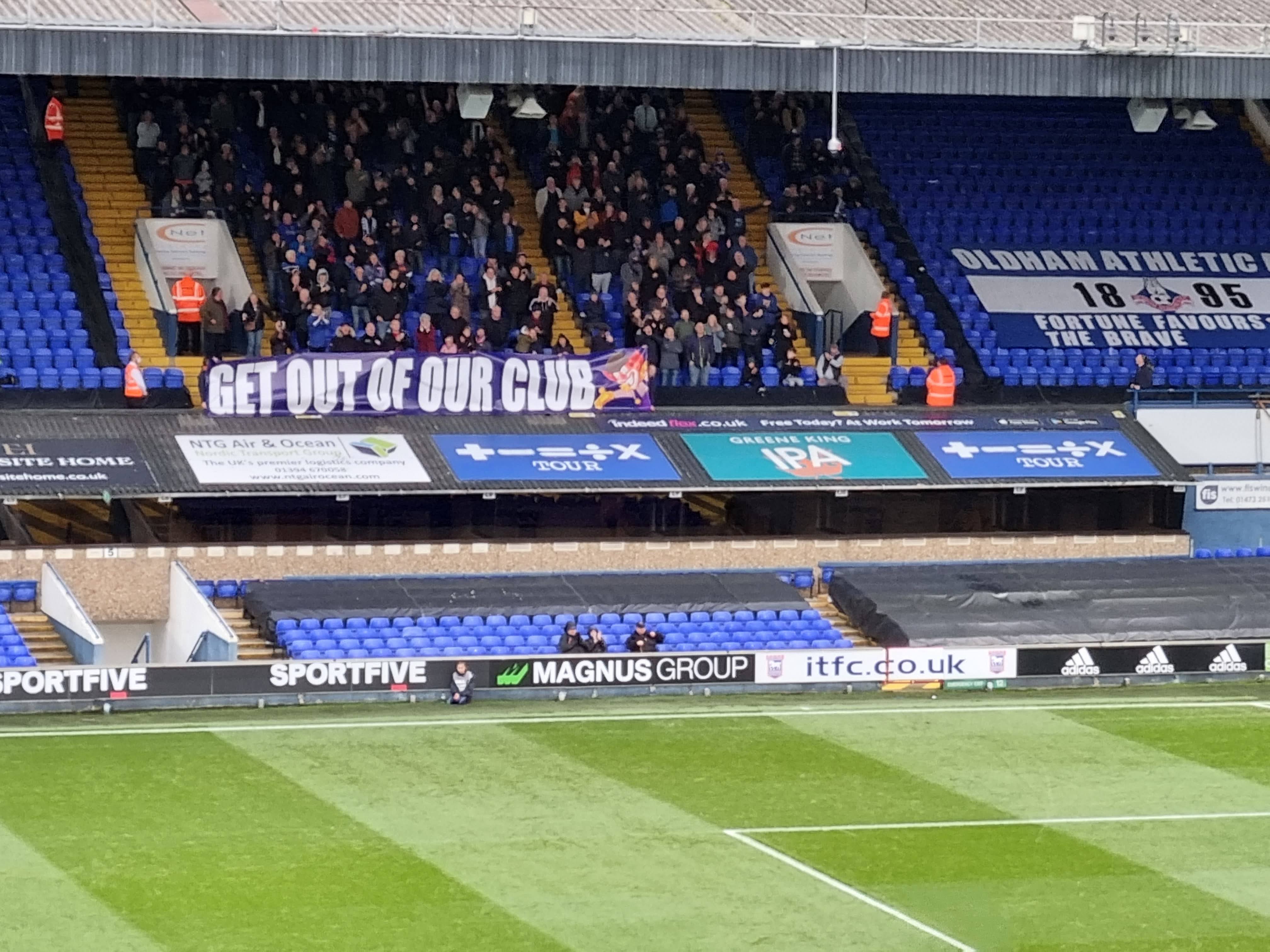
As the game enters its final minutes Sone Aluko replaces our best player, Wes Burns, and Rekeem Harper replaces Lee Evans.  Encouragingly Oldham replace their best player, Dylan Bahamboula with Harry Vaughan, but nothing works and five minutes of added on time only raises hopes, but does not fulfil them.

The final whistle is blown by Herr Hair and the crowd get up from their seats showing the same level of emotion that they might if they were all on a bus and it had just reached their stop, turning away from the pitch and averting their gaze like you would if trying to avoid eye contact with a drunk.  It has been a very disappointing afternoon of FA Cup football,  and has failed on every level to live up to what the competition is supposed to be about. 

On the bright side, at least we are still in the draw for the Second Round and until we lose, the promise of glory still remains.  It’s not every year we do as well as this.
Ipswich Town 1 Plymouth Argyle 0

Ipswich Town ended a sequence of defeats and general under achievement with victory at Home Park, Plymouth on 6th December last year, just three months and a week ago.  It doesn’t seem a quarter of a year ago, let alone a third of a football season since that victory, but oddly it seems that time has simultaneously both speeded up and slowed down since the start of the pandemic and the lockdowns.  The experience finds me in reflective mood this morning and I dull the pain by steam cleaning the shower, ‘hoovering’ the kitchen and filling a  five year old hole in the kitchen ceiling, which was created when a new light fitting was installed. 

Yesterday evening I signed up to witness the third game of the Paul Cook era at Portman Road on the ifollow, and without crossing the threshold of my semi-detached suburban home, my Saturday afternoon is consequently mapped out for me, as every Saturday afternoon has been since some time back in August.  Not being a particular fan of television since the demise of Quiz Ball in December of 1972, I was surprised to find that at first I quite enjoyed the novelty of seeing the Town courtesy of the cathode ray tube in the corner of the living room, or it’s flattened, somewhat swollen, wall-mounted, modern equivalent.  Town had never been regular performers on the telly, even back when we was fab in the 1970’s and early 1980’s, but now all of a sudden we are; it’s just a shame we are no longer worth watching as entertainment but only as an exercise in eternal optimism, although that’s not necessarily a bad thing.    Today therefore it now feels like mere habit that makes me log on to my lap top as three o’clock approaches.

By way of a change today I shall be watching the match against Plymouth in the kitchen.  It has been agreed that the living room is the room in the house that is most like Wembley Stadium, and therefore best suited to my wife Paulene watching her team Portsmouth play Salford City in last season’s final of what used to be the Associate Members Cup, but is now merely an occasional playground for the youth of the Premier League clubs and a vehicle for the peddling of takeaway pizza.  By Paulene’s own admission it is a particularly pointless fixture because whoever wins the enormous slice of tin-plated pizza or whatever the trophy now is, will get to keep it for just twenty-four hours because this season’s final between Sunderland and Tranmere Rovers is to be played the very next day.

As the ifollow transports me to Portman Road, the quality of the transmission is at first poor and creates the impression that the sound engineer, if there is one, is a devotee of the late Norman Collier. Happily the technical fault is only temporary and the airwaves are crystal clear as I hear BBC Radio Suffolk’s Brenner Woolley ask Mick Mills how he assesses Ipswich Town’s play-off ambitions.  Reassuringly Mick presents the argument that it’s best to finish sixth in the league table.   “If you hit sixth spot anything can happen from that position” says Mick raising the possibility that sixth position in League One is some sort of portal to another world where Luke Chambers captains England to the third-place play-off in the World Cup, Paul Cook has a head of hair to rival that of Carlos Valderrama, Marcus Evans offers Lionel Messi whatever he wants to see out his playing career at Portman Road and the Football Association is run by a race of highly intelligent squirrels.

The game begins and in making a minor adjustment to the position of my lap top I accidentally press the off button.  Quickly turning the lap-top back on the picture returns sans commentary just as an Alan Judge free-kick whistles over the Plymouth cross bar.  The resultant corner kick is cleared and sound is restored just as Brenner speaks poetically of a throw-in being awarded against a Plymouth player as the “ ..ball skims over the laces of his right shoe”.   Brenner has many quirks which make his commentary satisfyingly unique and his insistence that the players are wearing shoes and not football boots is just one of them.   Down on the touchline meanwhile, we are told that Plymouth manager Ryan Lowe is “…barking out instructions”, although there is no word from Brenner about his footwear, but we can guess he’s not wearing Hush Puppies.

It is only the fourth minute of the game and Town score courtesy of an ill-advised back pass by Adam Lewis. “Troy Parrott couldn’t believe his good fortune” says Brenner, obviously not really having any idea what Mr Parrott does or doesn’t believe but making something up which he thinks sounds plausible. “That is a dream start” says Mick, giving us an insight into how retired professional footballers still think about the game even in their sleep.

Without warning ,the ifollow pictures stutter and I imagine living rooms and kitchens across Suffolk in which Tractor Boys and Girls point at their lap-tops and TV screens as one and chant “ You’re not very good, you’re not very good, you’re not very, you’re not very, you’re not very good”  to the tune of Knees Up Mother Brown.  Back at Portman Road, Plymouth’s Panutche Camara does something to inspire Brenner to say “Camara, a bit of a live wire customer”.  Unusually for a player not from Britain, Brenner makes no reference to Camara’s nationality ; Camara  is from Guinea-Bissau; I can only guess that he can’t decide whether someone from Guinea-Bissau is a Guinean or a Guinea-Bissauan.

Plymouth Argyle are poor, their play consisting mostly of mistakes and passing to Ipswich players.  Sympathetically, Myles Kenlock makes a couple of mistakes of his own, which is thoughtful of him. Andre Dozzell is “…trying to pull the strings in midfield” Brenner tells us just as Dozzell turns attack into defence with an incisive 20 yard pass back across the half-way line to  centre-half James Wilson .  It’s the tenth minute and Kayden Jackson is clean through on goal, he must score!  He doesn’t.  “That was a real chance for Kayden Jackson” says Brenner “Was it” says Mick using a little heard affirming intonation   “Totally dominant, Ipswich Town – can’t remember the last time I said that in a game” says Brenner, and no one else can remember either, although if they can they should send their answer on a postcard to BBC Radio Suffolk or text 81333 and as Brenner would tell you, start the message with the letters SFK.

In an idle moment Brenner tells us of when Plymouth last won at Portman Road; it was eleven years ago and Paul Mariner was their manager and he gave his coat to someone in the crowd as a memento but left his glasses in the pocket and had to contact the club to get them back.  Remembering the story too, Mick tells it again but with more words and added superfluous detail.  When Mick has finished the story Brenner tells us that he remembers it too, almost as if he wasn’t the one to tell us about it in the first place and that we wouldn’t remember that.    A short while later Brenner once again tells us again that Andre Dozzell is trying to pull the strings in midfield.

The match is unusually enjoyable and Town’s attacking play gives Brenner the opportunity to try out some football-speak seldom heard in his recent commentaries.  “Trying to get Jackson on his bike” says Brenner as a long ball up the wing drops off the end of the pitch.  Another similar attempted pass on the opposite side of the pitch has little Alan Judge not getting to the ball either , “ …his legs weren’t going to get him there” says Brenner, perhaps implying that he should have borrowed Kayden Jackson’s bike.

A quarter of the way through the game and with Town still “…by far the better side, completely on top” Brenner looks ahead to the forthcoming Town games at Portsmouth and Wigan, which he rather weirdly refers to as “Paul Cook derbies” on the basis that Paul Cook previously managed both clubs; it’s a disturbing insight into how the mind of a football commentator works.  Mick Mills meanwhile keeps his commentating firmly based in reality and rather than indulging in such nonsense he tells us how twice Myles Kenlock has saved Town by dealing with crosses in central positions that a mysteriously absent   James Wilson should really have cleared.  “Myles Kenlock has dealt with them really, really well” says Mick delivering praise which would smack of nothing more than solidarity amongst left-backs if spoken by any lesser man.

Almost a third of the game has passed and Plymouth win their first corner, which is played deep to what Brenner rather indelicately and peculiarly describes as “the backside of the box” .  The sun comes out in Ipswich and it sounds like Brenner refers to Troy Parrott as Troy Carrot, but it might be my hearing or the poor quality speakers on my Sharp Aquos television set,  which is connected to my Lenovo lap-top by an HDMI lead – or so I’m told.

After a flowing Ipswich move almost results in a second goal, Flynn Downes goes down injured. In the ensuing hiatus in play Brenner asks Mick what are his thoughts on Ipswich Town’s season.  “Ipswich?  This season?  Says Mick,  sounding somewhat incredulous.  Mick is about to take us on a footballing journey back to last August, but it quickly It transpires that Brenner hadn’t meant to ask about the whole season, only about this game.  “Oh goodness” says Brenner with a note of panic in his voice “Don’t start re-capping this season”.  It’s a moment that perhaps reveals that Brenner thinks Mick could have talked for England as well as playing football for them.  Flynn Downes goes off to be replaced by Teddy Bishop. “Downes looks really down” says Brenner  possibly but probably not making a mildly tasteless pun.

Three minutes of added on time are to be played, Brenner tells us that Plymouth are in white; it seems a bit late to be  telling his BBC Radio listeners that; without Brenner’s guidance they have probably all been imagining Plymouth in a range of materials, colours and designs from puce-coloured chintz to flesh-toned gingham taffeta.  It seems that Plymouth have also worked out which colour shirts they  are wearing and according to Brenner “ You wouldn’t rule out an equaliser”.  But they’ve left it too late and Mick’s half-time verdict is that “Yes” Town deserve their lead because of the length of time that they dominated the game.

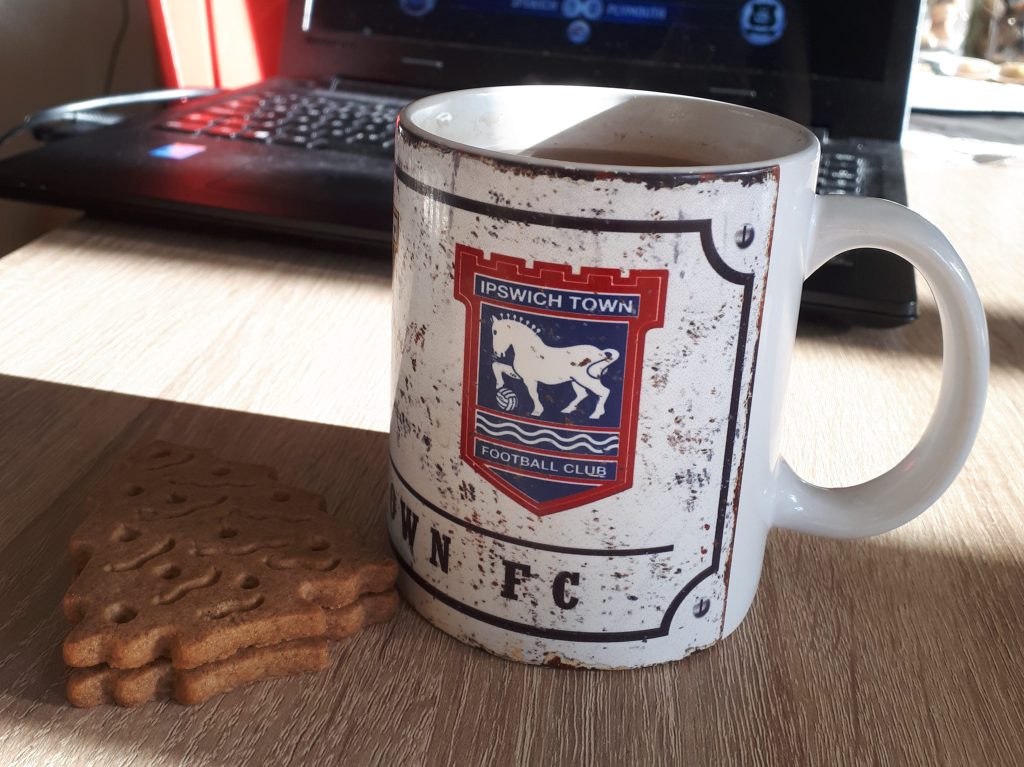
Half-time tea and ginger Christmas tree biscuits follow.  Paulene appears looking sad and dejected; the Portsmouth versus Salford game is absolutely awful and she has had to turn the sound down to avoid the terrible commentary with its constant hackneyed, fawning references to the former Manchester United players who are bankrolling Salford City. For Paulene the weekend will only get worse with Pompey destined to lose a penalty shoot-out and their hamster-like manager Kenny Jackett resigning in a fit of self-loathing.

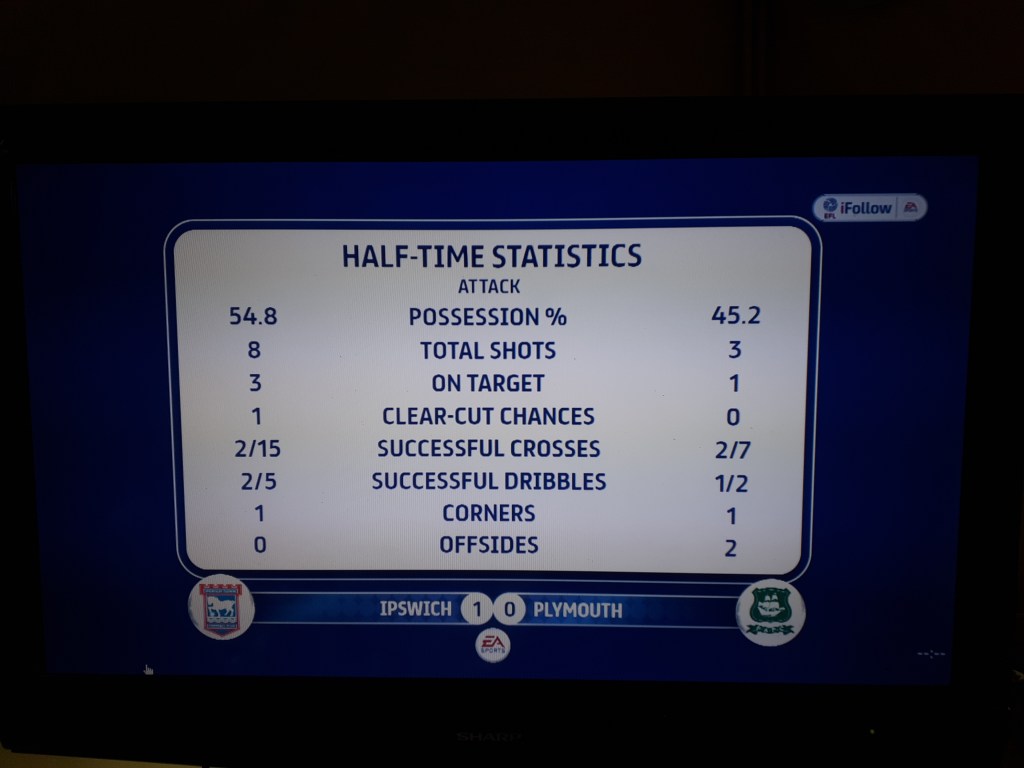
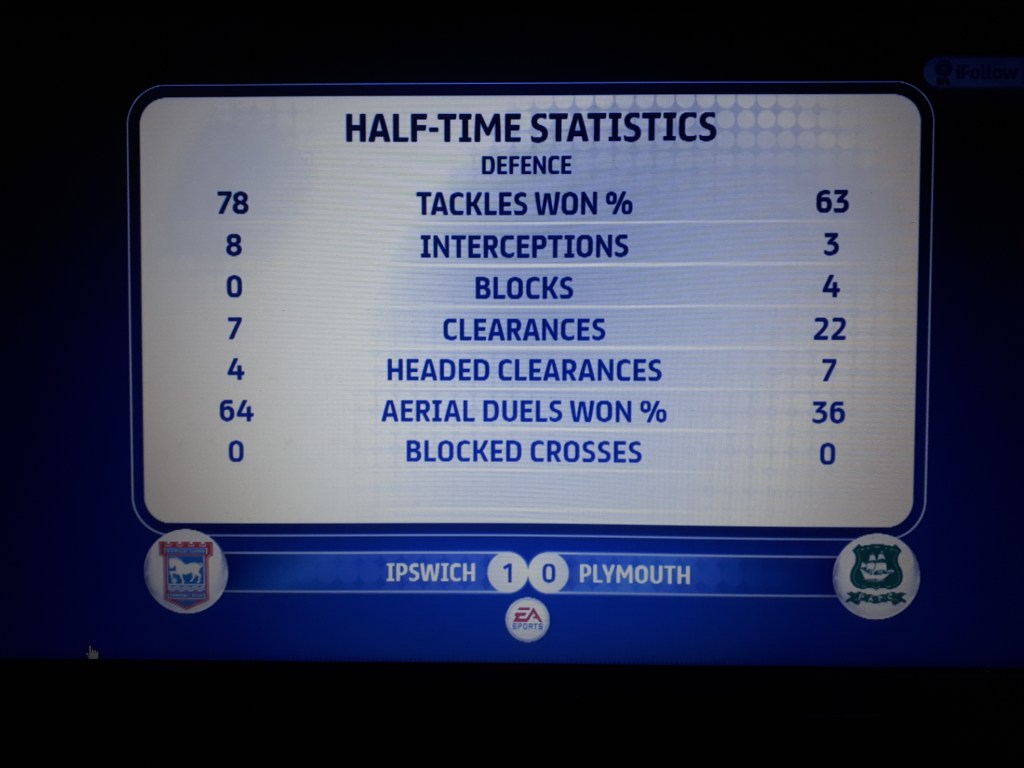
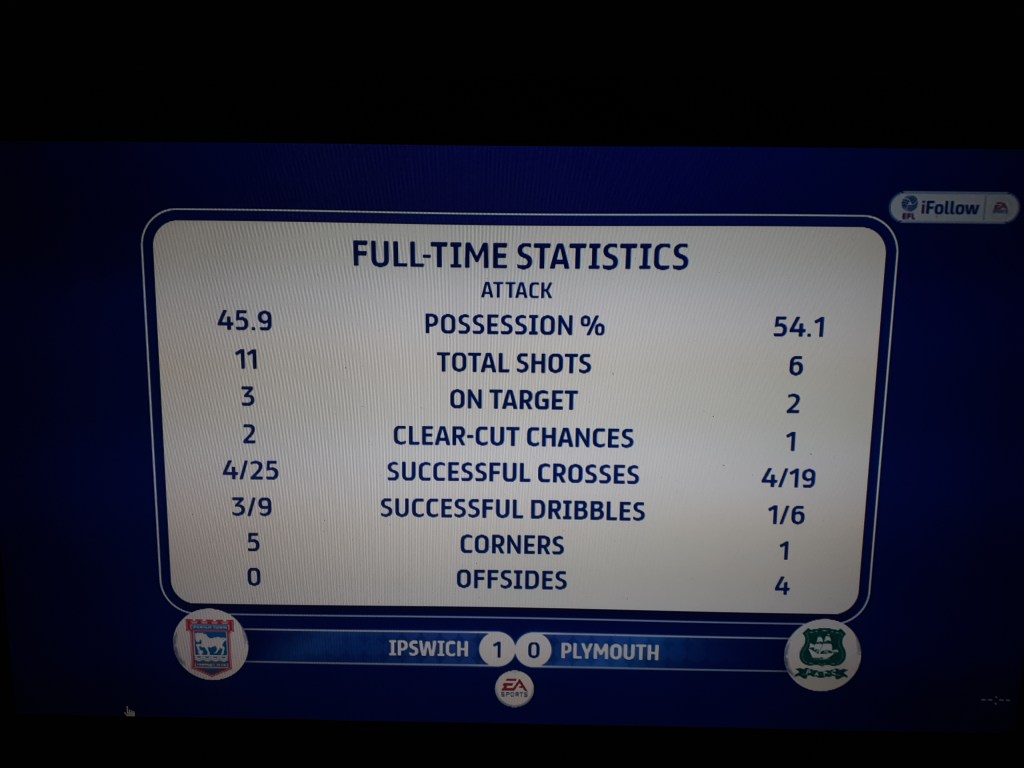
After scrutinising the half-time match statistics and enduring an advertisement for the ifollow which, if it were true, would make you wonder why anyone ever went to a real game because watching football on a lap-top or tv screen is clearly far, far superior, the game begins anew.  Kayden Jackson is soon hurt and is according to Brenner, “ on all fours”, it’s a pose that he seems to like to report whenever he can.  Mick then embarks on an extremely lengthy description of a cross-cum-shot from Myles Kenlock; Mick’s eventual conclusion is that Myles didn’t know what he was trying to do.

After seven minutes of the second half Town should be 2-0 up, but Kayden Jackson’s pass from the by-line is met with a simply awful attempt at a shot from little Alan Judge who is about 10 metres from the goal.  Six minutes later and completely out of character Brenner refers to a Plymouth player (Conor Grant) as wearing a boot, not a shoe.  Plymouth’s Niall Ennis is replaced by Luke Jephcott . “ Strong boy,  he knows where the back of the net is” says Brenner, now heavily into  ‘Ron Manager’ mode.

Amazingly, neither Mick, nor Brenner says it but the match gives every impression of being a game of two halves.  “Plymouth….are in charge of this game” says Mick.  Substitutions are made.  Hardie for Lewis for Plymouth; Skuse and Drinan for Parrott and Jackson for Ipswich.  “ Positive move by Plymouth, sensible move by Ipswich” is Mick’s well considered opinion.  Brenner asks Mick what he thinks of Cole Skuse.  “ I like Cole Skuse, I like Cole Skuse” says Mick repeating himself for emphasis and possibly because all he could think of to say was the same thing twice; but no one will notice, he’s on BBC Radio Suffolk, not Radio 4’s Today programme.  Mick speaks of the criticism that Cole Skuse receives from some sections of Suffolk’s football watching public.  “ I don’t understand; I do understand it”  he says, succinctly summing up the mind boggling complexities of the situation.

As Mick takes a rest Brenner tells us what Paul Cook is wearing, “ a hooded coat zipped up to just below his chin”, he’s also wearing a beanie hat . I feel reassured to know that our new manager is suitably dressed for a windy March afternoon  in which there have been occasional heavy showers.

Plymouth are dominating possession. “ Watts along the deck” says Brenner describing a pass along the ground in a manner appropriate to a team from the city that contains Western Europe’s largest naval dockyard.  Plymouth’s McCloud hits a half volley from 20 odd metres having received a pass form Town’s Luke Chambers; it’s an easy catch for Tomas Holy.  “ Wind and hail” says Brenner as the weather takes a turn for the worse.

Town win a corner after a passing move started by Cole Skuse.  “ Skuse read it lovely” says Mick like a true footballer as he describes Cole’s interception which pre-empted the passing move.  “ I do worry about Plymouth getting themselves level in this game” says Brenner showing uncharacteristic bias to the home team.  Plymouth still dominate possession but Ipswich are winning corners on the break.  Camara is unmarked and heads wide of the far post for Plymouth.  “That was a let off for Ipswich Town” says Brenner ,not telling a word of a lie.  The oddly named Keanan Bennetts replaces little Alan Judge and Jack Lankester replaces Gwion Edwards.  Reeves and Lowe replace McCloud and grant for Plymouth. Twelve minutes of normal time remain.

Town win a further corner which is played short. “Strange corner” says Mick as the ball is passed around the box and crossed in from the opposite side.   Town continue to play ‘on the break’. “It’s a strange way for a home team to play “ says Mick, sounding a little baffled.   The game enters the four minutes of time added on for assorted stoppages and the substitution of nine of the twenty out field players. The oddly named Keanan Bennetts gets the chance to run at the Plymouth defence but concludes what is not much more than a gentle trot with a limp cross to no one in particular.  “ He just completely wasted it for me” says Mick sounding a little hurt.  “ Town in the top six as things stand” says Brenner triumphantly, before revealing a previously unknown interest in and implied knowledge of the larynx  “Paul Cook shouting, not doing his voice any good at whatsoever”.

With Town in possession of the ball the game ends and victory is confirmed. “It’s been a fabulous day for Ipswich “ says Brenner getting a completely carried away.  A more cautious Mick Mills is “Happy with the result, but not the performance” and questions why Teddy Bishop “doesn’t do things in the game”.    It’s a good question and one which might be asked of nearly all Town’s midfield players and forwards.   We haven’t finished sixth yet.

Ipswich Town 1 Arsenal 0 – Our Blue Heaven

It’s Saturday May 6th 1978, I will be eighteen in about seven weeks’ time and today I am going to the FA Cup final. I am going with my dad; we were two of the 24,207 who saw Town beat Hartlepool United in the fourth round of the FA Cup and the 29,532 who witnessed the 3-0 win in the fifth round replay against Bristol Rovers; we went to the semi-final at Highbury on a supporters’ coach from Shotley. We saw Landskrona Bois, Las Palmas and Barcelona at Portman Road back in the autumn and have seen about a dozen league games on top of that, so we had the requisite vouchers to get tickets for the final. But this morning my father has woken up feeling unwell; he doesn’t think he’ll be up to going to Wembley and so for my friend Tim who lives five doors away, it’s his lucky day. I walk along the street, knock on his front door and ask if he wants to come to the FA Cup final; he does. Tim’s dad Charlie will this evening deliver a bottle of sherry by way of a thank you.
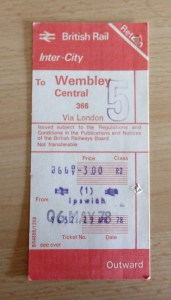
I listen to a few selected tracks from Blondie’s first album ‘Blondie’ (released in December 1976 )as I get ready to go; ‘Look good in Blue’ seems apposite this bright morning as does ‘In the sun’ with its lyric “In the sun , we’re gonna have some fun”. We get to Ipswich railway station somehow; on the 202 bus, or does someone give us a lift? Ticket to WembleyFrom Ipswich we are on a special chartered train that turns right at Stratford and plots a course through north London round to Wembley Central. In Wembley Stadium the terrace steps at the tunnel end are much bigger and steeper than those in Churchman’s or in front of the East Stand, blue and white abounds. The sun shines and Arsenal, wearing yellow and blue, kick off with Ipswich playing towards that blue and white tunnel end. Paul Mariner hits the cross bar, John Wark twice shoots against a post, Pat Jennings saves acrobatically from George Burley, Paul Mariner misses, bigmouth Malcolm McDonald is rubbish, Clive Woods is brilliant, David Geddes crosses, Willie Young is a lumbering donkey, Roger Osborne scores, we cheer, we sing, Roger Osborne is substituted for Mick Lambert, Town win and Mick Mills lifts the FA Cup and turns to show it to us.
Back at Wembley Central railway station after the match a half-brick or a stone bounces off the window of our train as we wait to depart back to Ipswich. Arriving back in Ipswich, Tim and I celebrate with a couple of pints of Tolly Cobbold bitter in the Railway Tavern on Burrell Road as we wait for a lift home in Tim’s dad’s green Morris Minor 1000.

OLYMPUS DIGITAL CAMERA
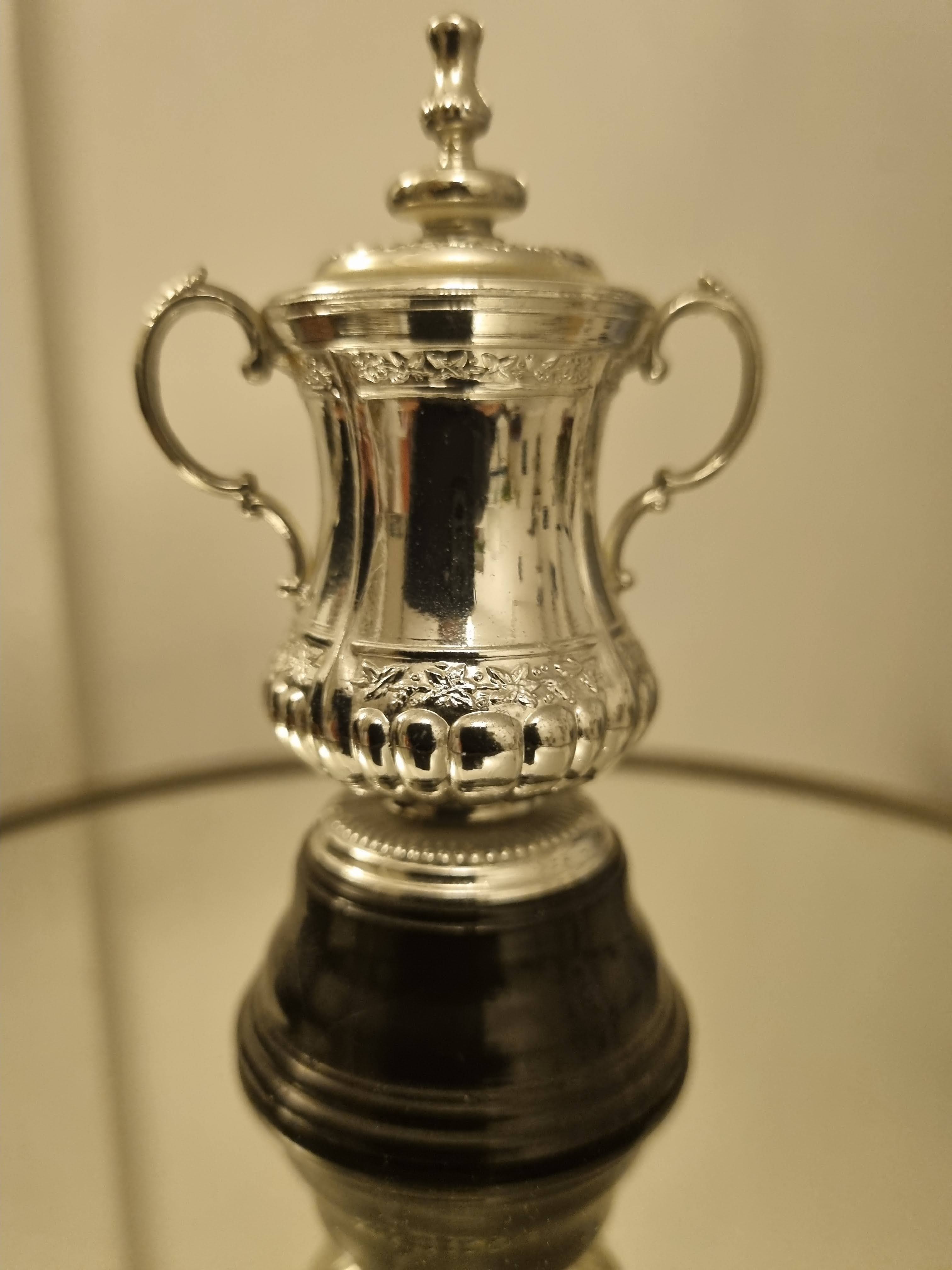
Forty years and eighteen days later it’s a dank evening in Ipswich, I have been to work, visited my mum, parked up in Portman Road and arrived at the New Wolsey theatre, which didn’t exist in 1978, although there was repertory theatre in Tower Street. I am with my wife Paulene. My father has been dead for nine years, happily his cause of death was unrelated to his illness of 6th May 1978, he enjoyed almost 21 years of good health subsequent to that and made it to the UEFA Cup final second leg in Amsterdam. Tim now lives in Weymouth and oddly he still only gets to see the Town when I get him a ticket (this season we went to Brentford). The Railway Tavern has been demolished; the green Morris Minor was scrapped long ago. But the name of Ipswich Town is still inscribed on the plinth of the FA Cup.
My seat at the Wolsey theatre tonight is in the front row of the auditorium, my wife Paulene is sat in the row behind; she sat behind to give me more legroom. The production is so popular we couldn’t get two seats together. We are the first people in the auditorium, Paulene’s asthma means she needs time to acclimatise. I read the programme (£4) and think “Cup final prices”. The stage is just a metre in front of me, the ‘boards’ are under a green covering patterned to look like turf. At the back of the stage a pair of blue doors look like the doors at the back of the old North Stand, above them is a projection of the type of corrugated cladding also redolent of the old North Stand. But there was never a sign that said ‘Welcome to Portman Road’ back then, there isn’t now. Also part of the projection is the old Ipswich Town crest, the slightly imperfect yellow and blue one, which should be restored out of respect to the past and to John Gammage who won the competition to design a distinct crest for the club back in 1972.41429848635_33f2609053_o
I watch the ‘crowd’ as the auditorium fills up to the sounds of assorted 1970’s pop hits, nostalgic but mostly awful. The majority of people here seem to be my age or older, old enough to have witnessed the 1978 Cup final. A few people are sporting blue and white scarves; one man wears a bright red blazer as if he’s just got here from Butlins. In the front row are three young lads, pre-teens, one of them wears a parka which lends an unexpected layer of 1970’s authenticity. Paulene says she feels cold, I say if I’d known she was going to I would have brought a blue and white bobble hat for her.
The lights dim and tonight’s performance of ‘Our Blue Heaven’ begins with Blondie’s “Hanging on the telephone” played live as the soundtrack to a domestic scene in which a young couple, Mel and Scott arrange their wedding for Saturday 6th May 1978, and then the draw for the third round of the FA Cup is announced. I resist the temptation to put my hand up to point that Blondie’s Parallel Lines album, from which ‘Hanging on the telephone’ was taken as a single would not be released until September 1978. I am not really a pedant and whilst I may not always like it, I do understand the concept of artistic licence and have been known to use it myself; I deny all accusations that it was merely lying.
Mel’s sister Sue is a dedicated and faithful Town fan and from the start foresees that she will want to be at Wembley on May 6th. Meanwhile, in a parallel story Smudger and Ange are awaiting their first child, with Ange’s ‘expected date of confinement’ surprisingly enough being 6th May, although the nurse at the hospital, who happens to be Mel and Sue’s mum Sheila tells them that babies never arrive on time. Smudger is as committed a Town fan as Sue and is predictably torn between his love for the Town and supporting his wife.
The simple domesticity portrayed is all a bit ‘Play for Today’, particularly when it transpires that Mel and Sue’s dad Paul is a striking fireman, whilst Scott’s dad Brian is a Thatcherite policeman; and that just adds to the authenticity and feel that it is 1978. I am transported back in time on a wave of Nostalgia (from the Buzzcocks Love Bites album and like Blondie’s Parallel Lines, also not released until September 1978, but also sadly not in the show).
Scenes from the two families’ stories are spliced with Town’s progress through each round of the FA Cup introduced by popular songs of the time, Bowie’s ‘Heroes’, Patti Smith’s ‘Because the night’, something or other by the Bee Gees. For the sixth round trip to Millwall the band plays the Clash’s London Calling, at which point I really do want to put my hand up because the Clash’s album was not released until December1979, a whole 20 months later. I only hold back when London Calling runs into White Riot, which is much more temporally authentic having been released as a single in March 1977, and a cracking tune to boot.
For each match a group of male and female dancers act out the crucial on-pitch events to the background of the songs and a BBC radio style commentary. My friend Gary texted me before the performance to tell me there was just one thing he did not like about the production and later he will tell me that it was the football sequences. Re-creating football well is notoriously difficult to do, as proven by awful films such as Yesterday’s Hero, in which incidentally the football sequences were filmed at half-time during a game at Portman Road; this is why I don’t consider that the director really bothered to do so. The dancers don’t look like footballers and they are only dancing, creating an impression through movement; they could have been supporters recreating the goals, children doing so in the school playground, and that is authentic. So Gary, you are wrong and need to brush up on your critiquing skills.
The intertwined stories of the families and the FA Cup run are good ones, there is drama, pathos, human emotion aplenty, humour and of course a happy ending. But the thread that runs through the production is the character of Bobby Robson who intermittently comes on to the stage like some sort of visiting angel wearing a series of 1970’s style suits and coats, imparting words of wisdom and assorted homilies about football and the wider experience of our lives beyond. As if this isn’t enough, the actor playing him, Peter Peverley does so brilliantly, better even than Michael Sheen’s rendering of Brian Clough in The Damned United. Peverley has the accent which is easy enough, and he has perfected the mannerisms too, but more than that he has captured the slight hoarseness in the voice, it’s almost uncanny. He wears a pretty bad wig though.
The finale to the production has the marriage, the birth and the FA Cup final taking place on stage simultaneously following the singing of Abide With Me, the Cup final hymn since 1927; a maudlin little number but a cracker nevertheless because it is the Cup final hymn and has been marinated in 90 years of Cup final history. Being sat right at the front, my view is now partly obscured by some of the on stage props, so I watch the audience. People who know the words sing along with Abide With Me, whilst others hold their scarves aloft. It is likely that many of the people here, like me were at the Cup final in May 1978 and are part of the story, but this makes people feel involved all over again, it’s nostalgia with knobs on, re-enacting the past, albeit part fictional, but this is somehow how it felt.
The story ends and it truly feels like Town have won the FA Cup all over again, and then Roger Osborne, the personification of the day because he scored the winning goal enters the stage, inevitably to a standing ovation. The ultimate finale however, comes with the cast all assembled on stage with Bobby Robson leading us in a sing-song, some Cup final community singing of our own; a rousing rendition of Edward Ebenezer Jeremiah Brown. It’s bloody marvellous and everything that matches at Portman Road no longer seem to be, utterly joyous. I give it my all.
I have had a most marvellous evening and for much of it I am not ashamed to admit I have had a tear in my eye. I have been taken back in time, but don’t know if I’m tearful for my lost youth and the passing of the days when Ipswich Town was such a wonderful football club and team, and when the FA Cup was something that really mattered, or if these are tears of joy and happiness, for a love of my team and a sense of belonging that has been re-kindled.
Nostalgia is warm and cosy, but it’s not a healthy thing, because we cannot go back and we have to live in the present; but tonight after watching Our Blue Heaven I genuinely feel uplifted.
My name is Edward Ebenezer Jeremiah Brown
I’m a football supporter of Ipswich Town
Wherever they play, you’ll find me
I haven’t missed a game since I was three
With me scarf and me rattle and me big rosette
Singing where was the goalie when the ball went in the net
Follow the Town
Up or Down
I’m Edward Ebenezer Jeremiah Brown but everybody calls me Ted.

Football, Football,
Whose the greatest of them all,
Let’s put it to the test
Come to Portman Road on a Saturday and you’ll see the best
Oi!
Ipswich! Ipswich! Come On The Town!

My name is Edward Ebenezer Jeremiah Brown
I’m a football supporter of Ipswich Town
Wherever they play, you’ll find me
I haven’t missed a game since I was three
With me scarf and me rattle and me big rosette
Singing where was the goalie when the ball went in the net
Follow the Town
Up or Down
I’m Edward Ebenezer Jeremiah Brown but everybody calls me Ted.

2-4-6-8 who de we appreciate?
It isn’t hard to tell
Just you take a closer look at me
And you’ll know darn well
Oi
Ipswich! Ipswich! Come On The Town!

La la la
La lala la lala lalala
Lala lalala la lala lalala
La lalala lalala, and lots more lalalaing, you get the picture ?