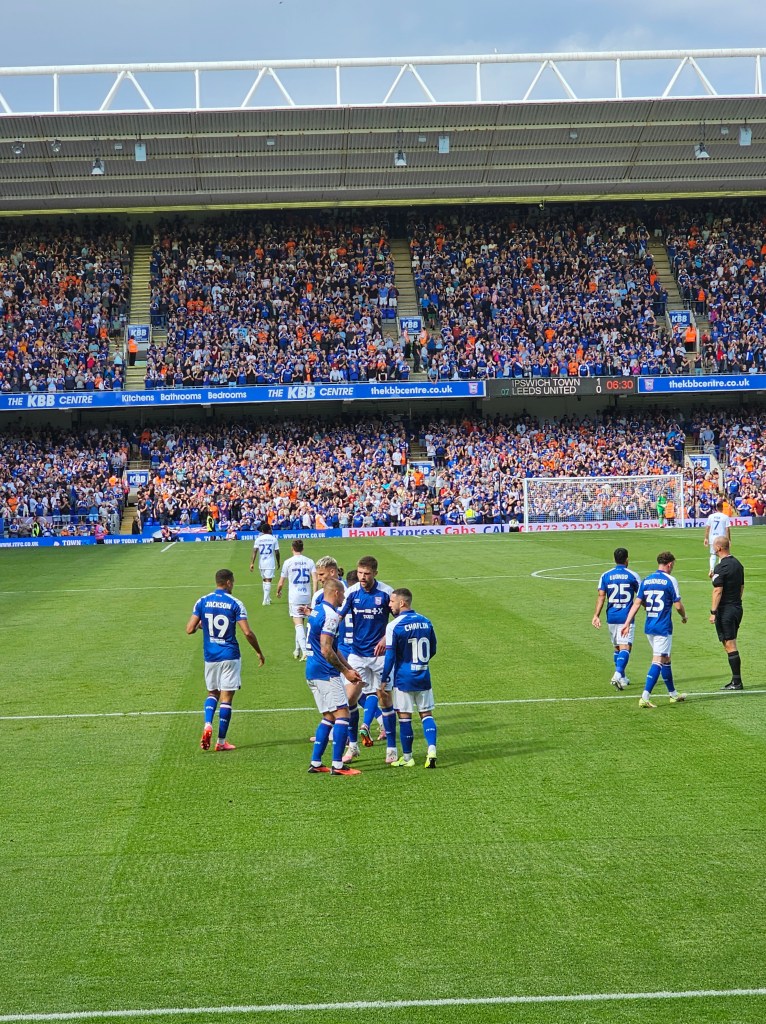
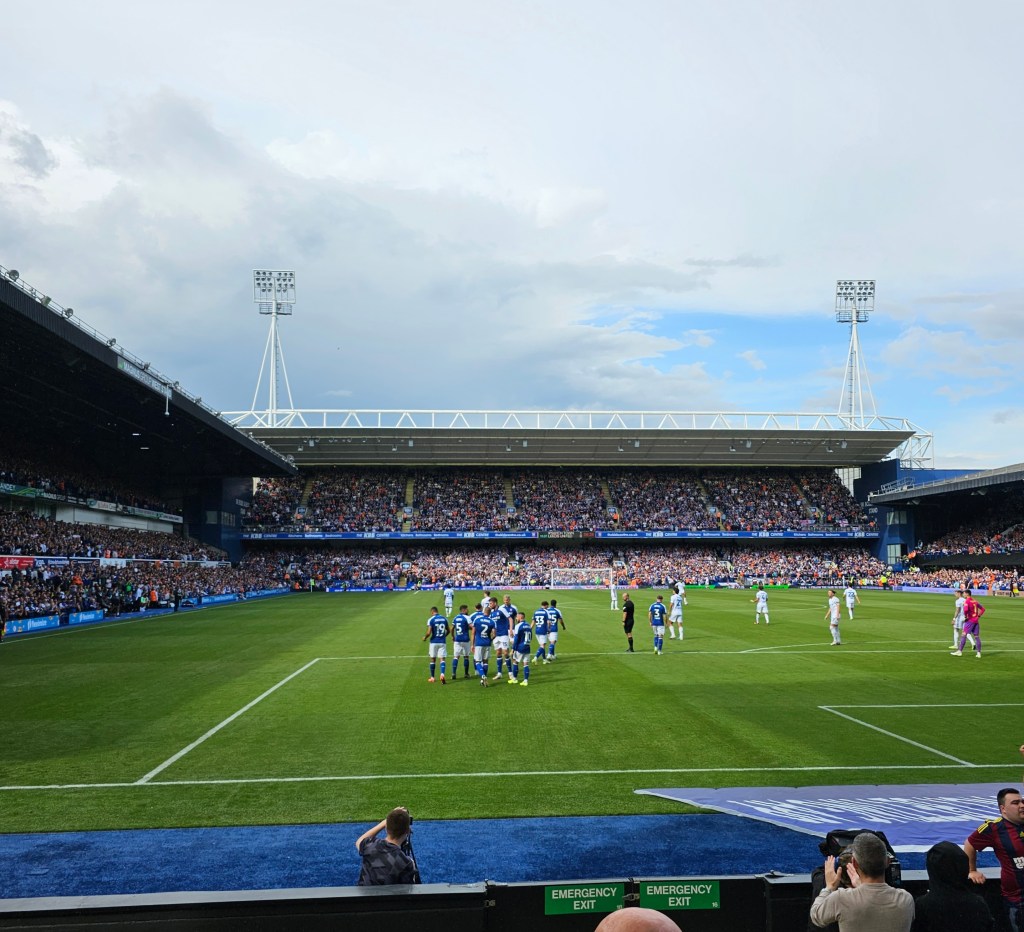
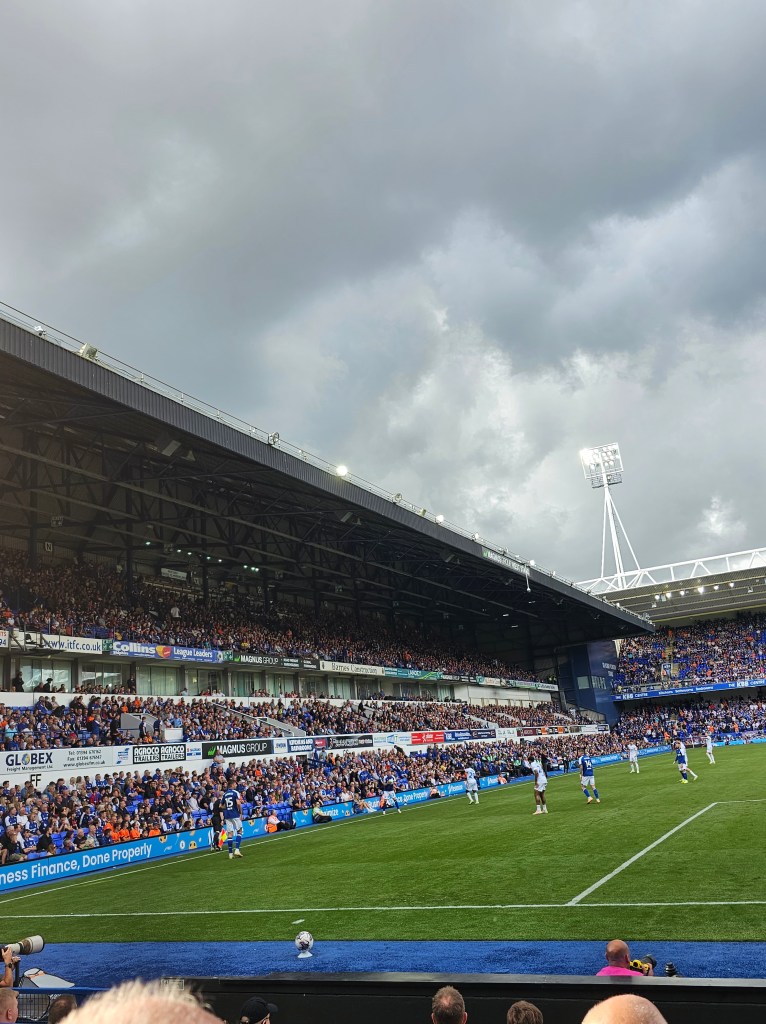
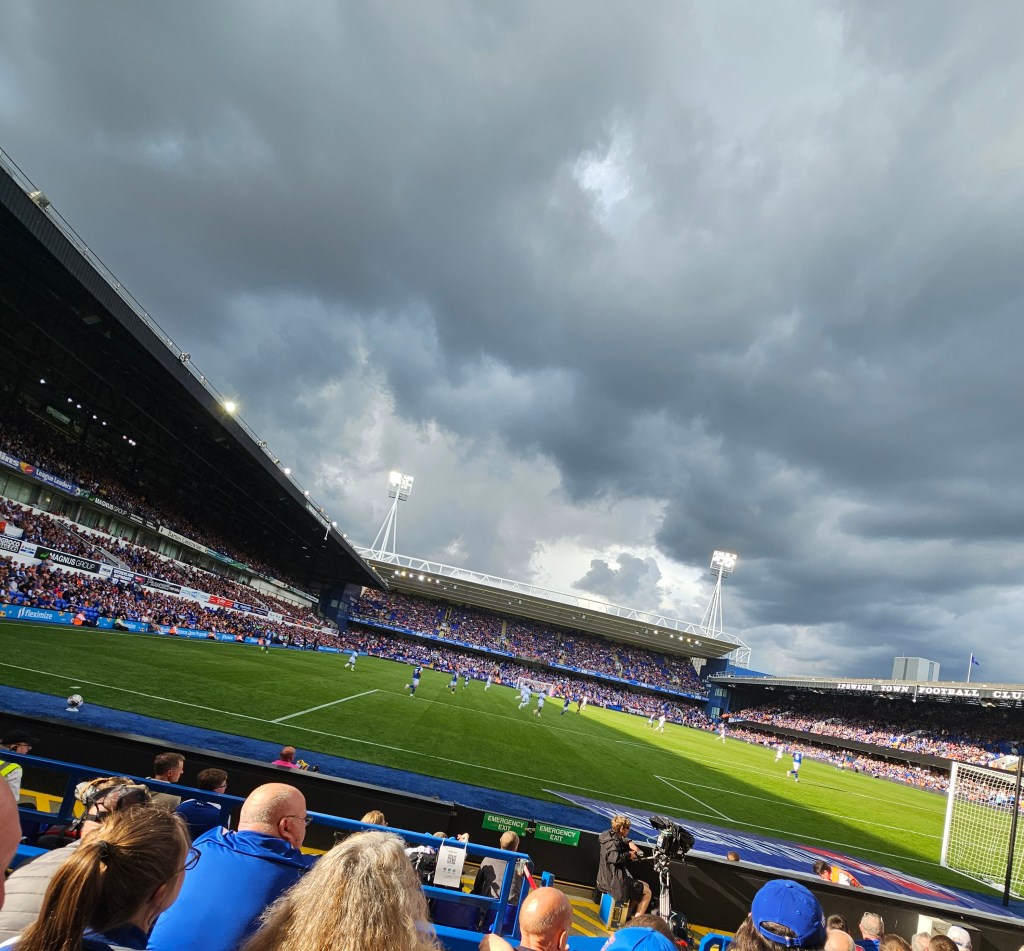
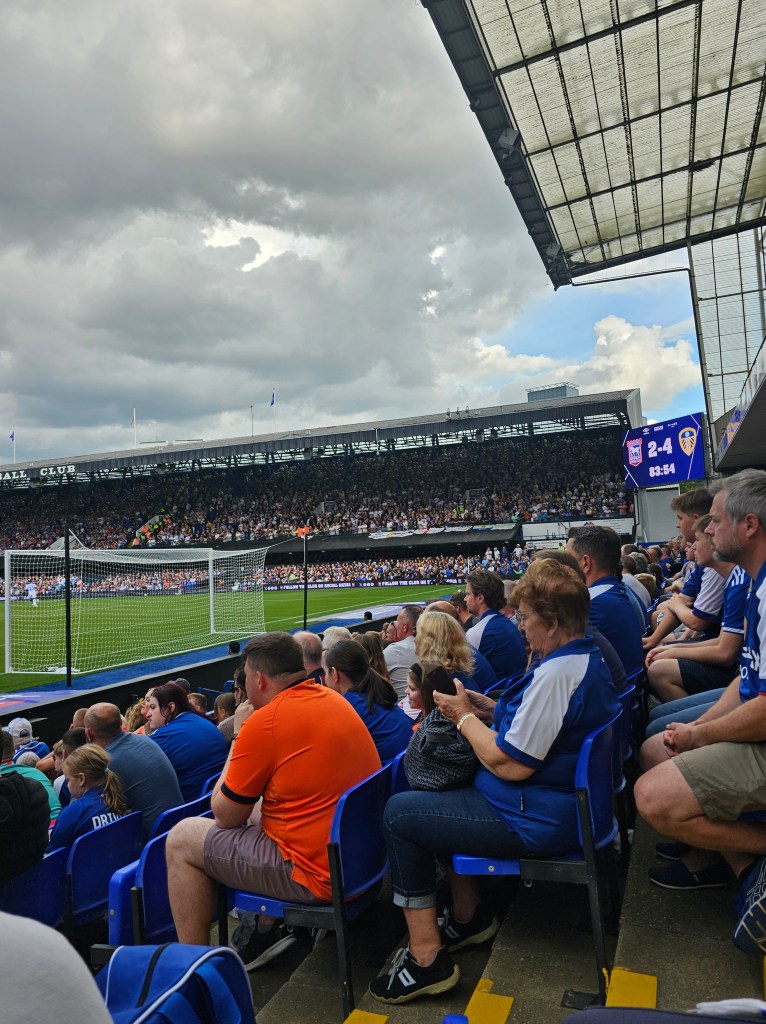
Ipswich Town 3 Leeds United 4

Leeds United form part of my earliest football memories; they were the dirty, losing 1970 FA Cup finalists; I watched them draw the first game with Chelsea at Wembley on the TV on a May afternoon at my grandparent’s house on the Isle of Sheppey.  Before that, I don’t remember any games, only World Cup Willie.  After that, there were the Esso World Cup coins featuring Madeley, Reaney, Hunter, Charlton, Cooper, Jones and Clarke in 1970, then the centenary FA Cup final victory in 1972, the fondly remembered defeat to Sunderland the following year and then their long unbeaten run in the First Division the season after, when Ipswich were the first team to beat them, albeit in the piffling League Cup. Added to that, I travelled on the bus to school every day with a boy called Andy and he supported them, although he had a good excuse, his whole family were extras on Emmerdale Farm, and whilst that is a lie, they really were from Yorkshire, some people are apparently.  Despite a wonky eye (we called him Cyclops), Andy was quite a tidy footballer, much better than me, and he wore blakey’s on his shoes, which clicked and sparked when we played at lunchtimes on the tarmac school tennis court.  Everyone who grew up in the 1970’s must have memories of Leeds United; they helped the whole country lose its innocence.  I almost feel sorry for the younger Generation X’ers and their successors who have missed out on experiencing 1970’s Leeds United first hand.

Playing Leeds again is therefore a good thing, and I am light of heart as I head for the railway station beneath a sky decorated with fluffy clouds which recede in layers, off into the distance. On the train there is a Leeds fan sat behind me, he’s talking boringly about some player getting “regular game time”.  The train smells of toilet cleaner, which I suppose is a good thing too, but then there is a whiff of cloying body spray; it smells a bit like Brut and I’m back in the 1970’s again.

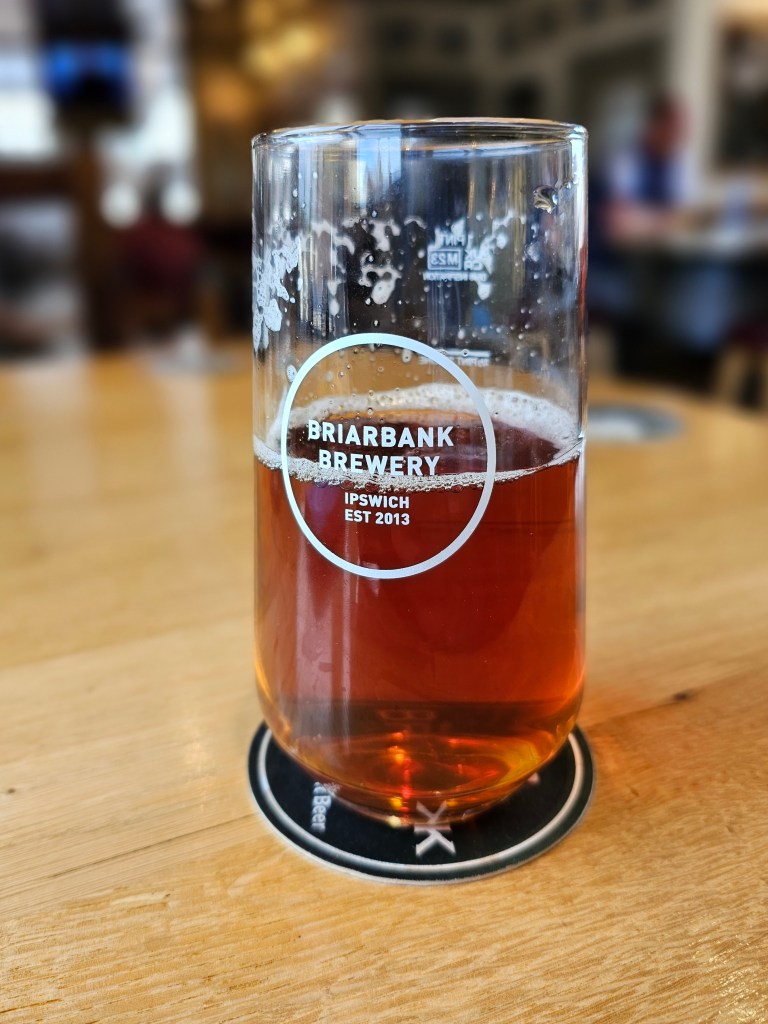
Coming out of Ipswich railway station, by way of a change I turn right along Burrell Road towards what were the docks, but is now the waterfront, and the Briarbank Brewery where there is a beer festival today and bouncers at the door; it’s home fans only.  My wife Paulene has encouraged me to do something different and not stick with the routine of going to the ‘Arb’; she says it will be good for my brain, but that’s from the woman who tried to make coffee this morning without putting any coffee in the coffee machine.  I follow a bloke in a Town shirt with the name Counago on his back, but I don’t think it’s him.  At the Briarbank, I eschew the ‘Yogi Bear’ picnic tables in the yard and head upstairs to what I think is one of my favourite bars anywhere in terms of décor.  The wood panels have me in mind of being on a ship, but it also reminds me of the pub next to the high- level bridge in Newcastle, although I haven’t actually been in that pub for about forty years.  I order a pint of Briarbank Bitter (£4.20) and take a seat by the window looking out on the Lord Nelson pub opposite and St Clement’s church, it makes me think of Sir Thomas Slade, architect of HMS Victory who is buried in the church and after whom nearby Slade Street is named.  I also can’t help thinking of Noddy Holder and Dave Hill.

A bloke stood at the bar with another bloke says “The trouble is I can’t ignore social media all day” and I read the Summer edition of the local Camra magazine ‘Last Orders’.   The pint of Briarbank Bitter is so good I finish it and buy another, and watch the cars pass by in the street below, I am struck by how most of them are grey, black or white, it seems a pity.  Time runs down like the beer in my oddly shaped glass and after a comfort break in which I discover mats in the urinals which look like slices of melon, I thank the bar maids and leave for Portman Road. I am proud to be the last person to leave and the kindly bouncers bid be farewell and tell me to ‘take care’, which makes me feel like someone with ill intent might be looking for me; I do wish people wouldn’t say that.

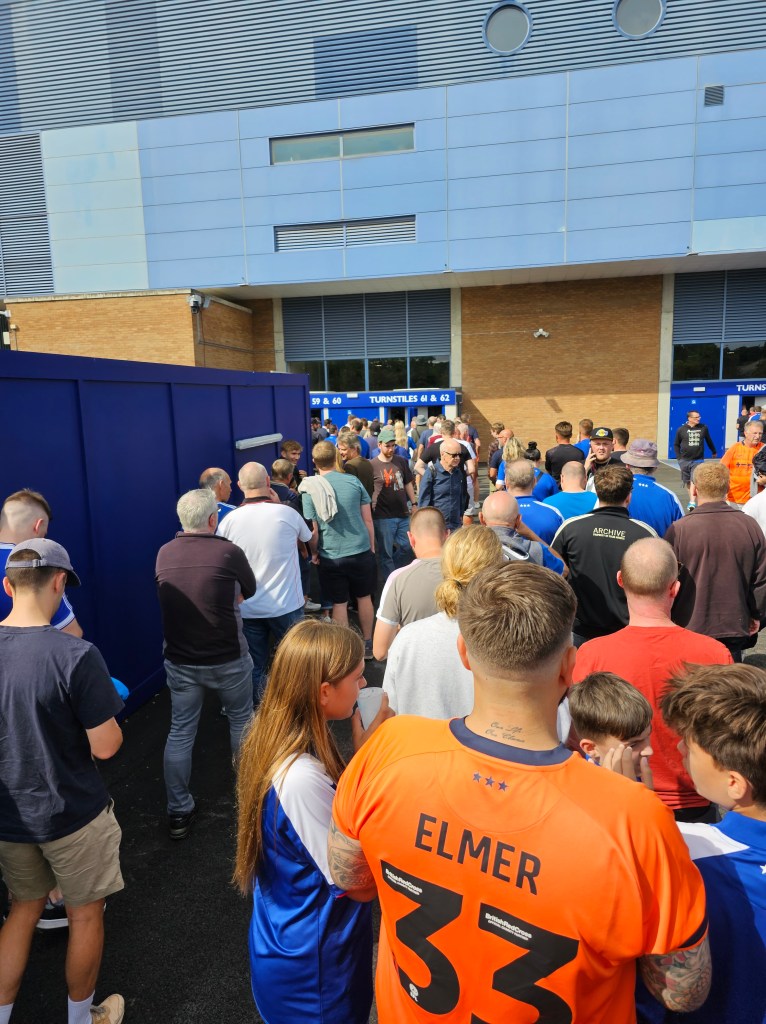
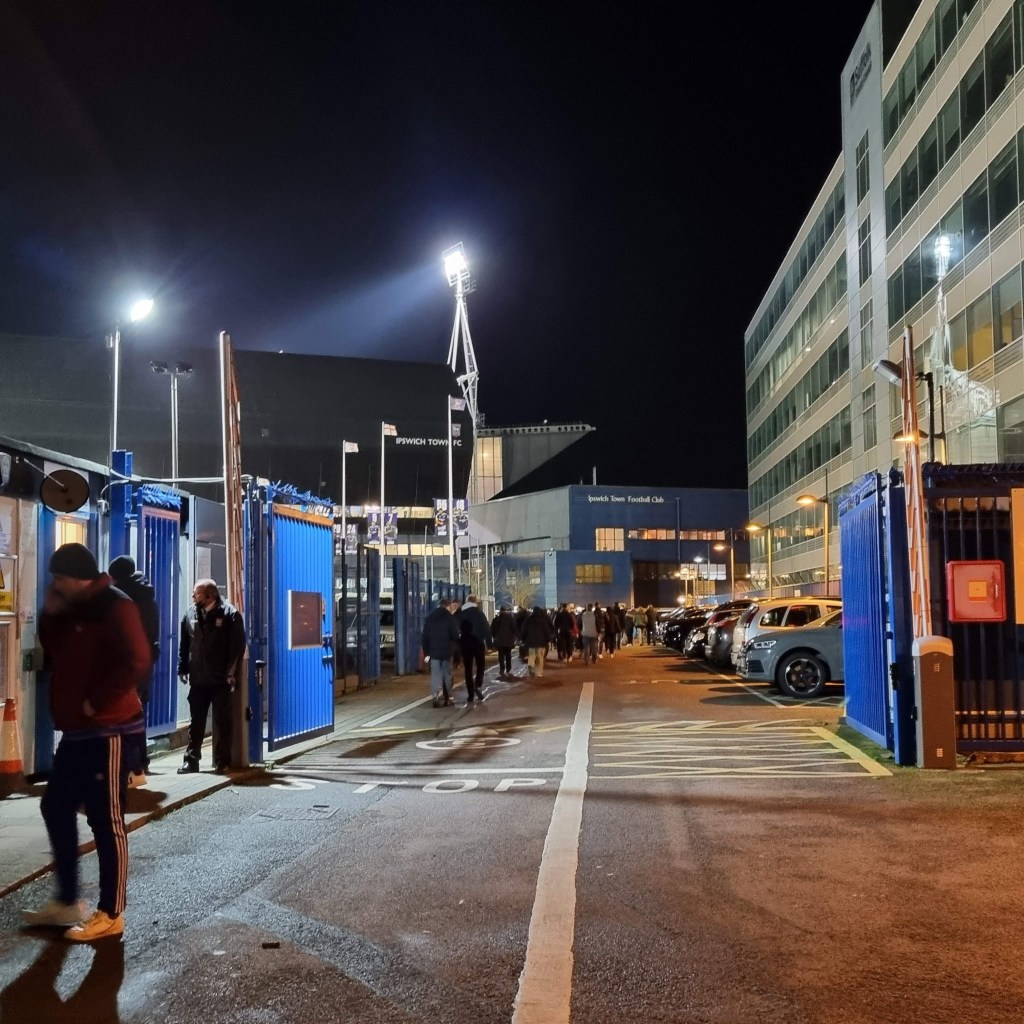
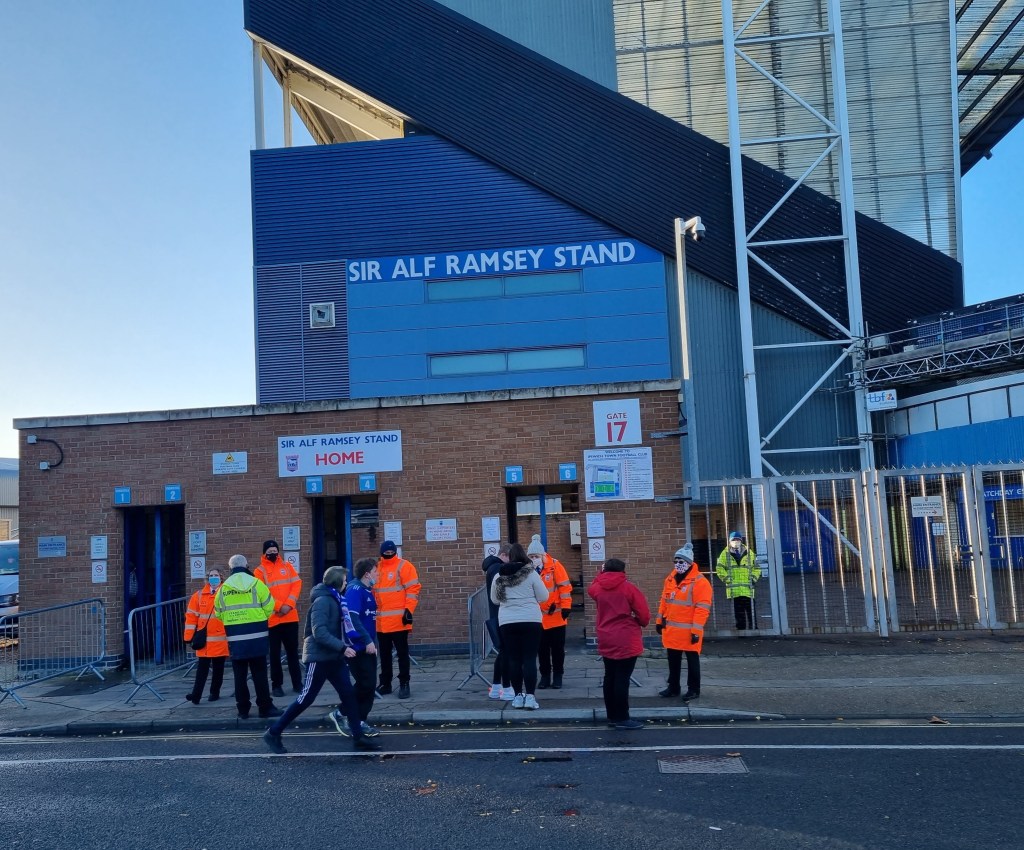
There are long queues outside the Sir Alf Ramsey Stand, which I blame on all these bar codes and QR codes and the average Alf Ramsey stander being over sixty.  Getting through the turnstile just as Murphy the stadium announcer is reading out the Leeds team, I decide to syphon off more Briarbank Bitter to avoid accidents in moments of extreme excitement.  I am stood in front of the steel trough as the Town players are announced and tempted as I am to bellow out their surnames in the manner of a French football crowd, I remain politely silent.  Up in the stand, my seat is alone in being vacant as I shuffle past Pat from Clacton and Fiona towards the man from Stowmarket; two rows in front, ever-present Phil who never misses a game, and his young son Elwood are already here too, but then the game is about to begin.

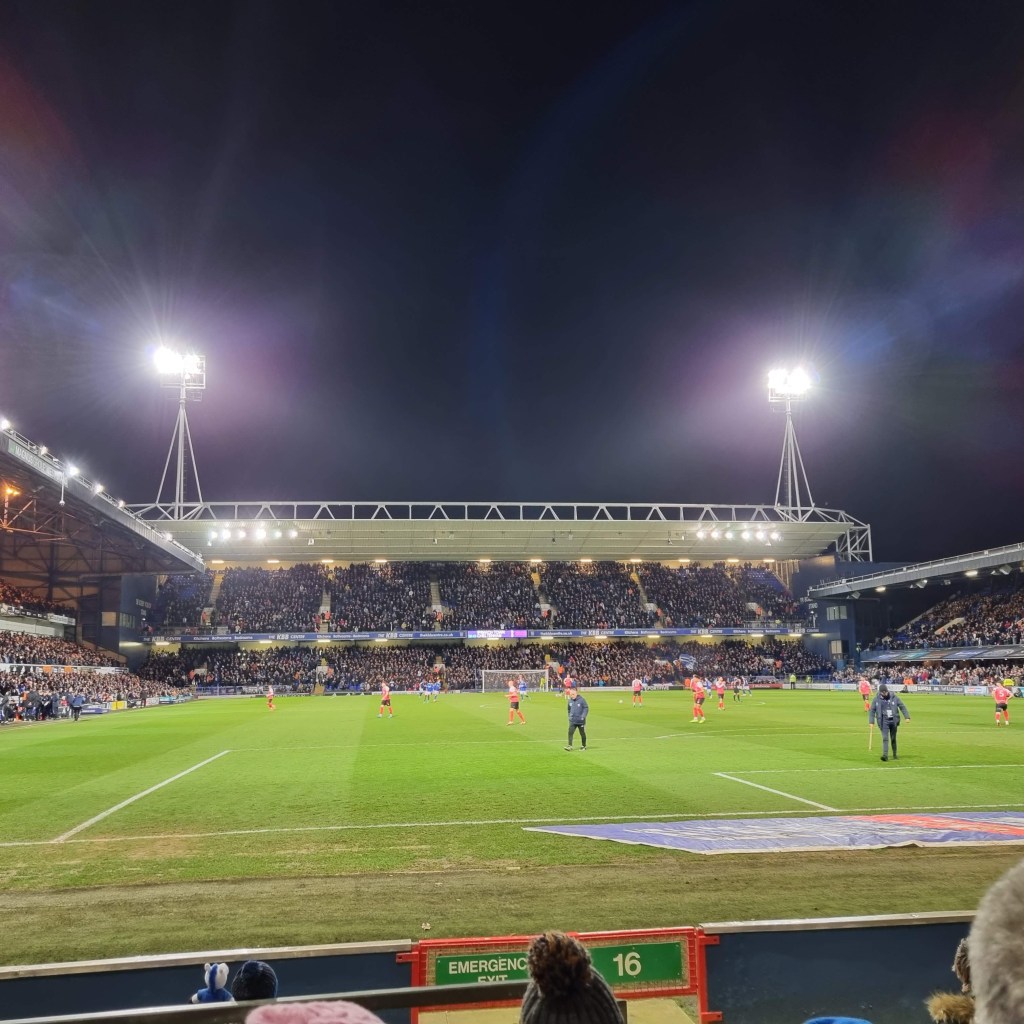
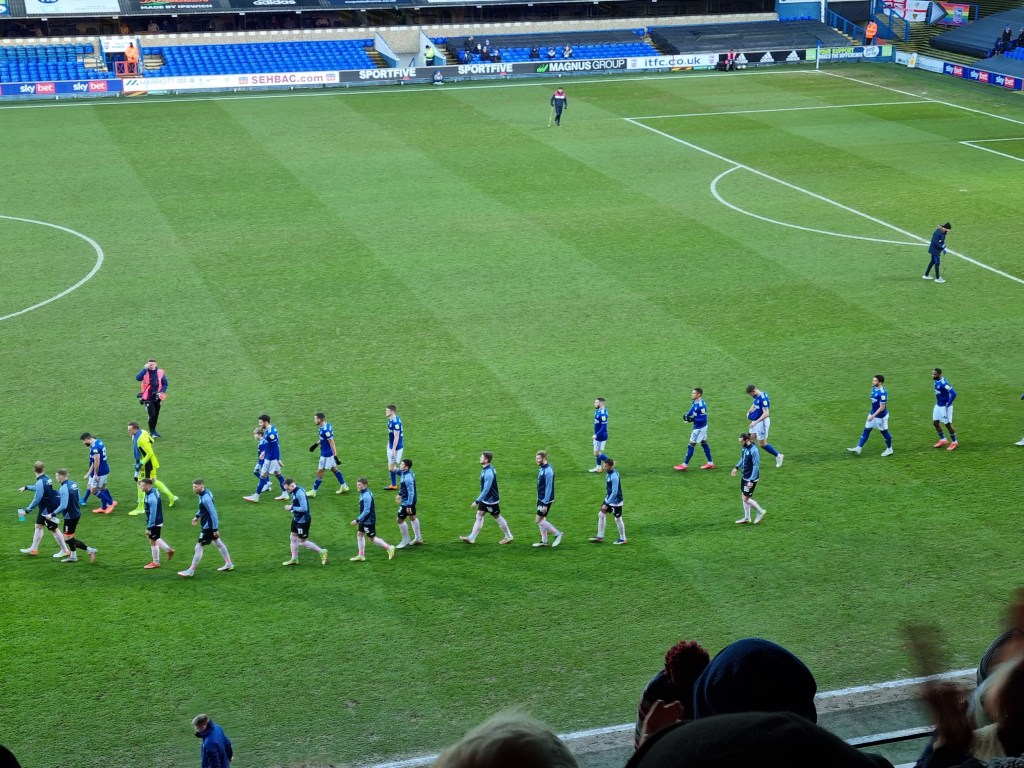
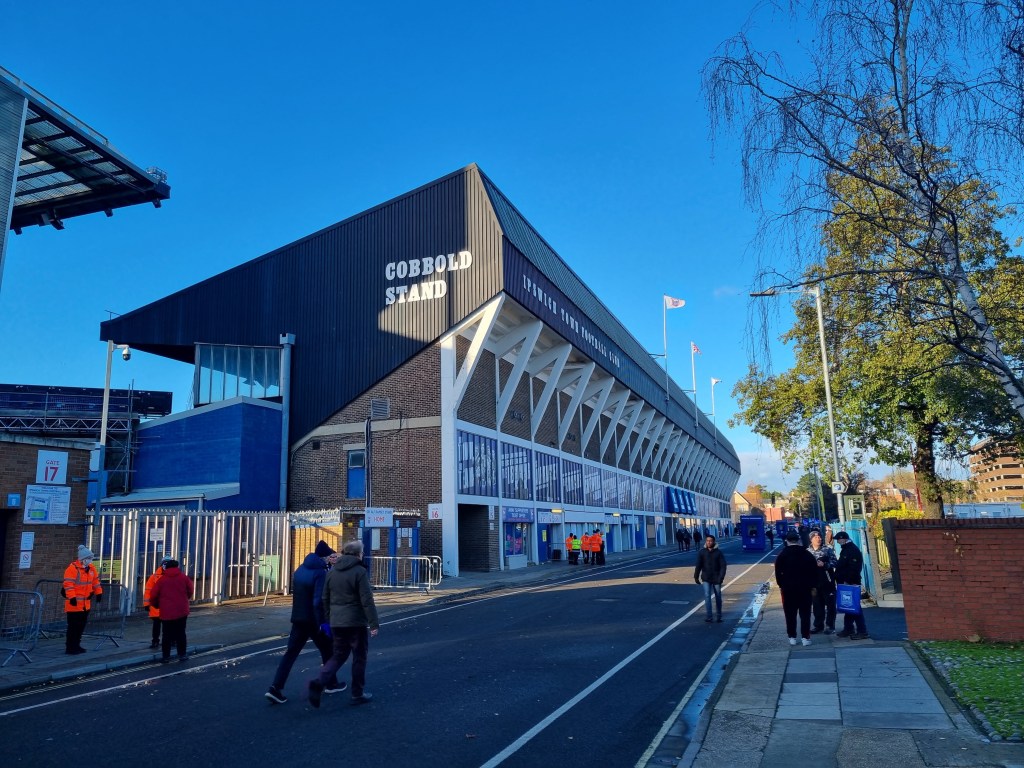
It’s Leeds United who get first go with the ball and they wear all white, with pale blue and yellow stripes along the tops of their shoulders and down the sleeves, disappointingly they don’t have garters on their socks. Town as ever are in blue shirts and socks and white shorts.  “Marching altogether” sing the Leeds fans in the Cobbold Stand “…and that’s the way we like it , Wo-oh, Oh, Oh” chant the Town fans in the Sir Bobby Robson Stand. Suddenly Kayden Jackson is bearing down on the Leeds goal in front of us, but perhaps through lack of confidence he squares it hopefully to no one in particular and what looked like a chance dissipates into the mass of legs and turf before us.  Then Leeds are through on goal, but the shot is wildly off target and whoever it was, was offside anyway, so all the Town fans jeer derisively. It’s a good start.

“Hark now hear the Ipswich sing” chant the Sir Bobby Robson stand, reviving a 1970’s Christmas song from when 1970’s Leeds United were well past their best. The seventh minute and Kayden Jackson races off down the left again and crosses the ball.  There’s no Town player to get on the end of this cross but there does not need to be as the ball hits Leeds defender Joe Ridon and rides on onto the net.  “Ipswich Town, one-nil up this afternoon, an own goal” announces announcer Murphy and I reflect on how many players have names that are nearly the same as those of American presidents.  “What a player, we should sign that centre-back and put him up front.” Says the bloke behind me.  Minutes later and Wes Burns has a shot saved and Town have their first corner.  “And it’s Ipswich Town, Ipswich Town FC, they’re by far the greatest team, the world has ever seen” sing the Sir Bobby Robson stand to the tune of the Irish Rover, but then sixty-seconds on and a bloke with the unlikely name of Georginio Rutter sort of pirouettes and wriggles and turns between two or three Town defenders before placing the ball in the Town net to equalise.  Rutter is from Brittany, so his surname doesn’t sound so incongruous if you roll those r’s.  “We all love Leeds” chant the people who all love Leeds.

This is an unexpected set-back, but another corner goes to Town soon after and a couple of shots go wide to give us hope, but then a cross from the Leeds left perplexes the Town defence and Willy Gnonto is left to score from very close range and Town are losing.  Far behind us at the back the stand,  a Leeds supporter or supporters celebrate as one does when one’s team takes the lead and a few uppity Town fans are mortally offended and begin to rail and moan and whine  and generally behave as if someone has murdered their children and eaten them along with their pet dog, garnished with their favourite houseplants. In the Cobbold stand meanwhile, the Leeds fans who are as far as we know innocent of infanticide sing “Top of the league, You’re ‘aving a laff”, treating us to their short vowels and wit all in one fell swoop.

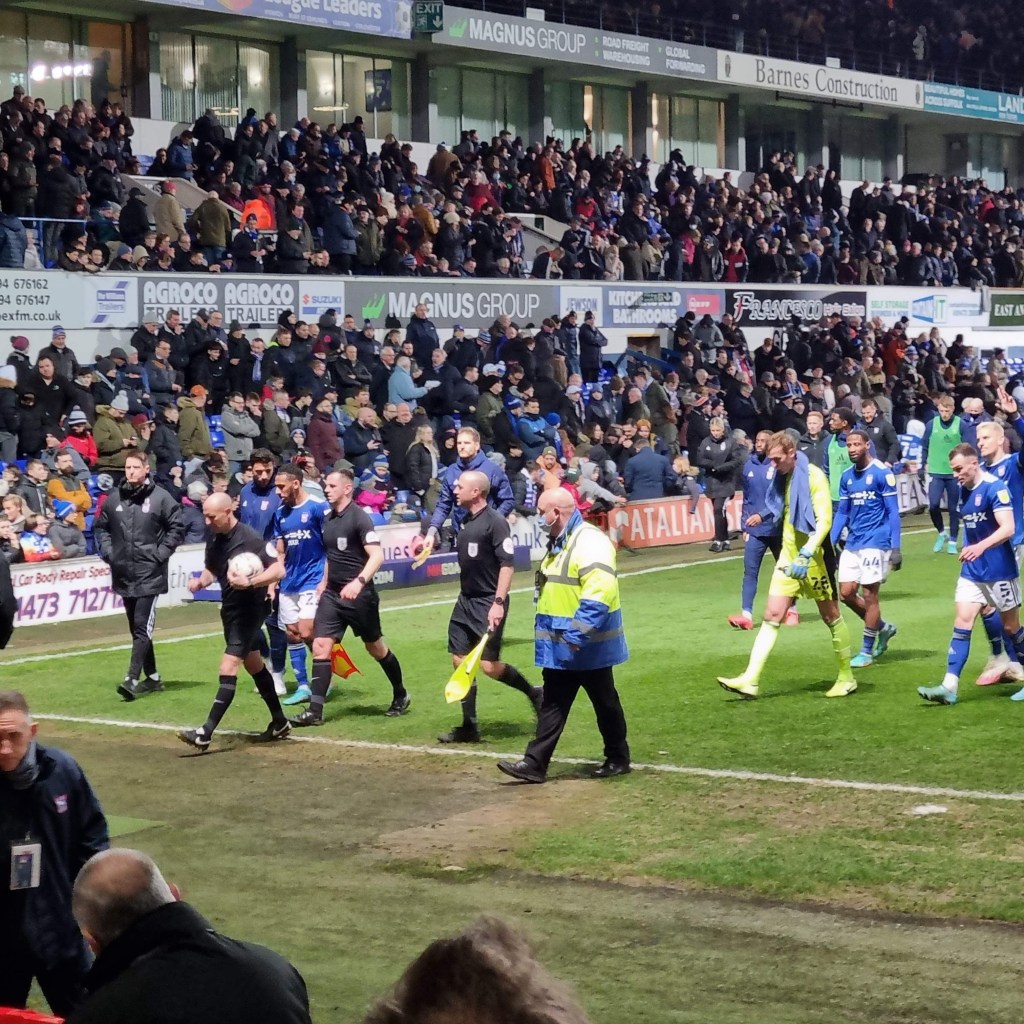
Just four minutes later, as the home crowd begin sixty-seconds applause for a supporter who has died, Leeds break down the left, the ball is crossed and after a first shot is blocked, another close-range finish, this time from Joel Piroe, puts Leeds into a 3-1 lead.  It hardly seems possible, we’d got used to always being the ones in the lead and not conceding goals, and the applause just adds to the surreal nature of it all.  The Leeds goals have been scored by a Frenchman, an Italian and a Dutchman.

Town settle down and still look capable of scoring and a Wes Burns cross elicits a Kayden Jackson backheel which produces another corner.  The Leeds fans of course remain horribly  buoyant, to the extent that like people on an 18-30 holiday they lose all self-respect and  sing “Agadoo” by Black Lace (1984) as well as “Rocking All Over the World “ by Status Quo (1977).  If only Stephen Foster had still been stadium announcer, he’d have played the originals I’m sure.

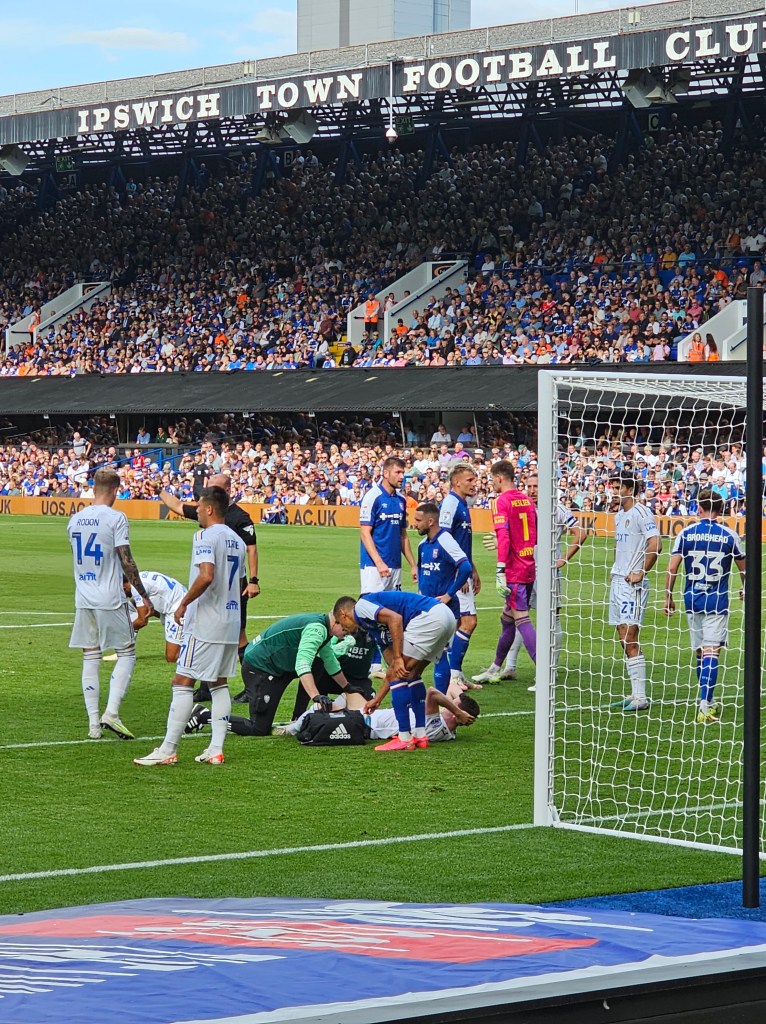
“Get a bit fucking tighter” bawls a bloke a few rows back as Leeds go forward again and the bloke behind me is similarly afflicted with doubt as he says to his neighbour  “He always fuckin’ loses it don’t he?” as Massimo Luongo is surrounded by Leeds players who he doesn’t manage to dribble between.   Another man, possibly the one who was so enraged by the Leeds supporter in the ‘home end’, shouts out something about Jimmy Savile and the Leeds fans sing a song which alludes to people with six fingers. On the pitch, Wes Burns is through on goal again but delays his shot, and a defender slides across to block it just as his foot makes contact with the ball. “De-de-de, Football in a library” chant the Leeds fans, possibly planning what they’re going to do with their time next week.  Half- time looms as Nathan Broadhead shoots wide, and Wes Burns shoots over.  There will be six minutes of additional time and Sinistrerra blazes a shot over the bar with spectacular aplomb for Leeds, Sam Morsy is booked and finally Kayden Jackson robs the ball off the toe of a defender and pulls it back from the goal line to Nathan Broadhead who makes the half-time score 2-3.   
I go down to the front of the stand to chat with Ray and his grandson Harrison, who enjoyed the Robyn Hitchcock CD (Life After Infinity) which I gave him at the Stoke game.  Ray thinks Town are not quite as quick as Leeds, he might be right.

With all the goals and shot of the first half I feel as if I’ve already seen a whole match, so it’s almost a shock when the second half begins and Leeds begin by substituting the substitute who they brought on just twenty odd minutes ago.   I think we can take a lot of positives from this says the bloke behind me,” sounding like someone who has watched too many football managers being interviewed on TV.  The Sir Bobby Robson stand reprise “Hark now hear the Ipswich sing, the Norwich ran away” as Town begin to dominate possession and push for an equalising goal.  Massimo Luongo is booked, and I opine to Fiona that it’s his first foul. “But it was a good one” she says, referring euphemistically to its severity as ‘good,’ and I can’t really disagree.

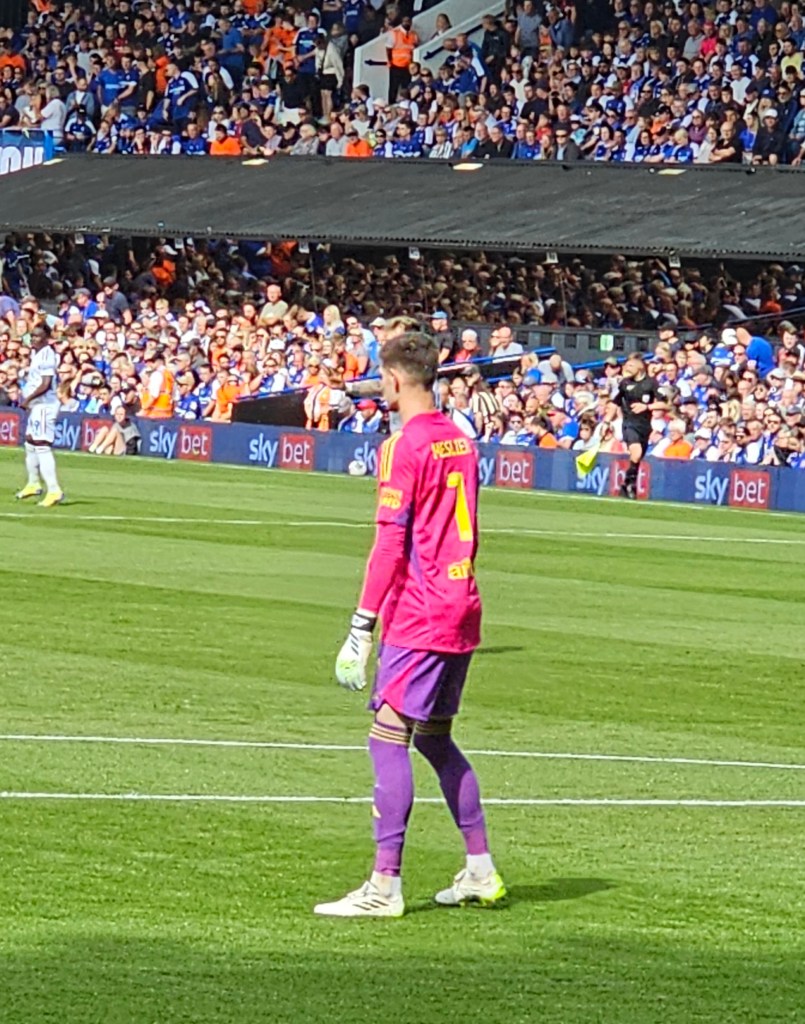
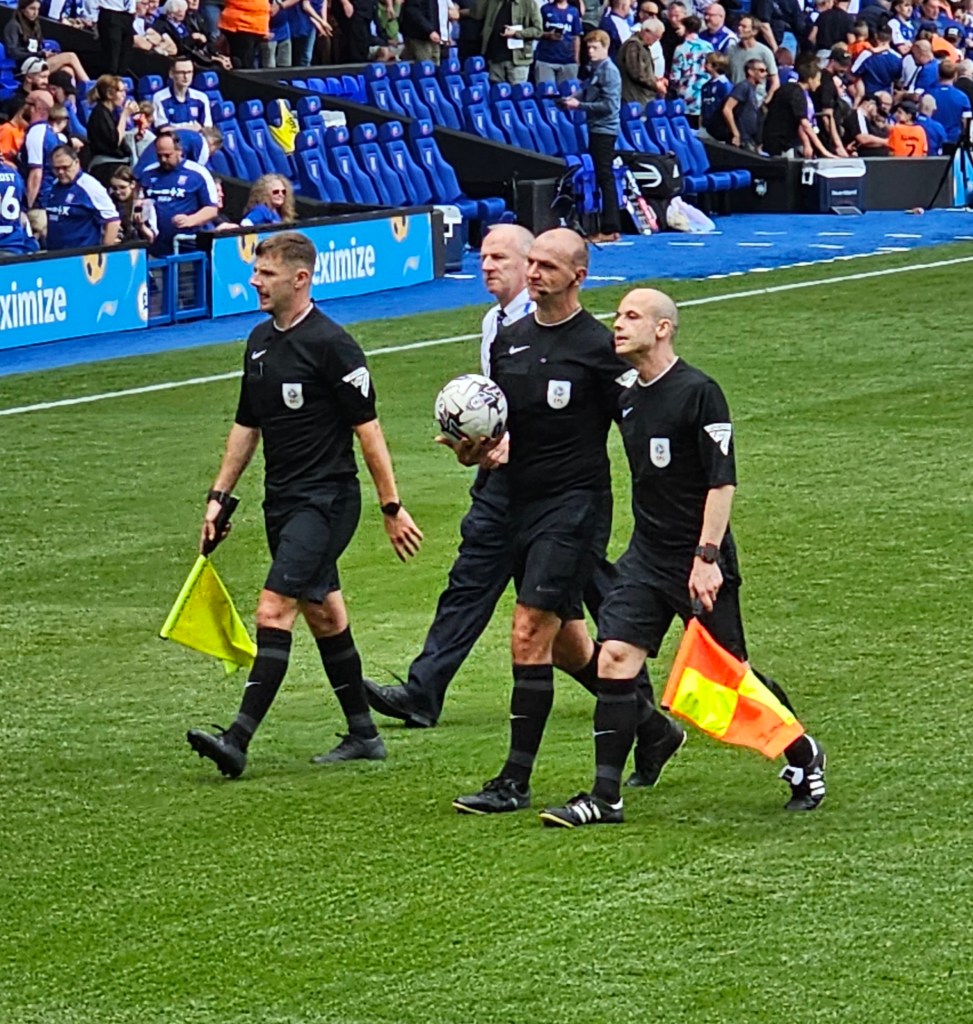
Leeds full back Ayling emerges as this afternoon’s pantomime villain as he collapses under a challenge from Leif Davis, but the referee Robert Madley and his assistant aren’t fooled and give a free-kick to Town. “Ayling wasn’t ailing” I tell Pat from Clacton, who says she might have to get ‘Monkey’, the Cambodian masturbating monkey charm out of her bag if we don’t score soon.    Then Vaclav Hladky makes a good save; Fiona had thought it was going to be a goal and with about twenty minutes of normal time left Town make mass (three) substitutions with Nathan Broadhead, Harry Clark and Kayden Jackson swapping places with Omari Hutchinson, Bradley Williams and Freddie Ladapo.  It’s a change which brings almost immediate results as five minutes later Williams fails to prevent the appropriately named Sinisterra running down the left, cutting into the penalty and shooting beyond Hladky to put Leeds 4-2 ahead.

Behind us, at the back of the stand the Leeds fan or fans show their pleasure again and the grey-haired man who got so upset before becomes apoplectic with rage, as do several others.   He’s running up the steps of the stand demanding that the Leeds fan is evicted from the ground.  I think he might be a Nazi.   “Who cares?” I ask the bloke behind me rhetorically. “I expect there are people in the crowd who vote Tory, but I don’t want them chucked out, live and let live, surely?”  There’s enough hate and intolerance in the world without people getting weird just because someone cheers for another football team, or worships another God.  Happily, I think it is the Nazi who gets removed from the ground.

With the uproar over, we return to contemplating defeat. “We can’t win ’em all” says Pat from Clacton philosophically. “Yes, but we had started to”, I reply.    The fourth goal has made a comeback unlikely, but we continue to live in hope and Town are dominating the game.  More substitutions are made in the absence of the ability to perform ‘fresh leg’ transplants and the search for at least two goals continues. Pat tells me that she’s having chicken drumsticks and salad for tea, she bought them from the new ‘out of town’ Marks & Spencer store in Clacton. After a couple of corners,  five minutes of added on time is eventually all that holds our slender hopes of avoiding defeat.  The stands start to empty out as those of little faith and others who never stay until the end because of a morbid fear of queuing traffic, or because they ‘must get home’ bugger off. The game is nearly over when Conor Chaplin scores; a typical shot into the corner, and hopes, though slender, suddenly fatten up.  The re-start after the goal is greeted with slightly tired encouragement from the crowd and for a moment, Town surge forward, but only for a moment, and then time inevitably runs out.  We’ve lost.

It’s been a great game, very entertaining and Town have played well despite losing.  The analysis will perhaps suggest both team’s defenders were outplayed by their opponents’ forwards, but the Leeds forwards outplayed Town’s defence just a little bit more than Town’s forwards outplayed the Leeds defence.  Either way, as Pat from Clacton rightfully said, we can’t win ‘em all.
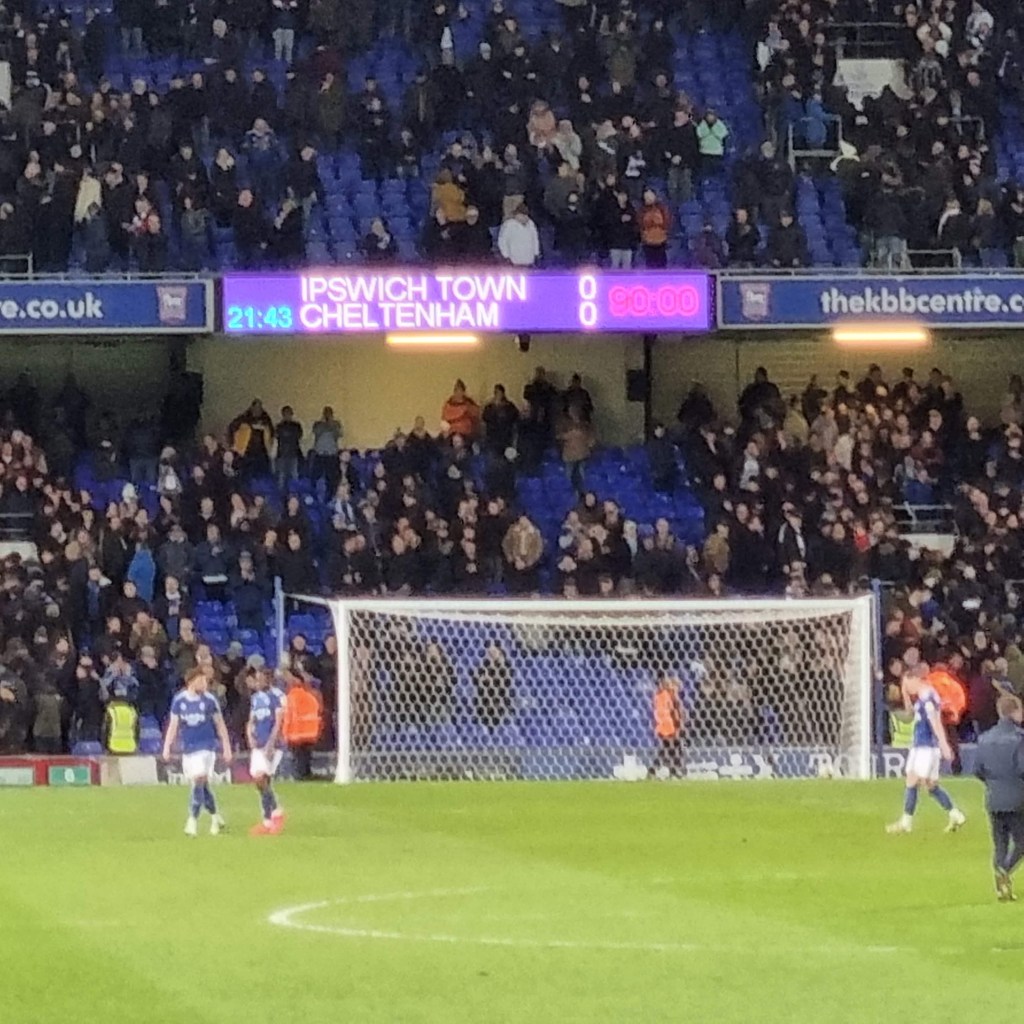
Ipswich Town 0 Cheltenham Town 0

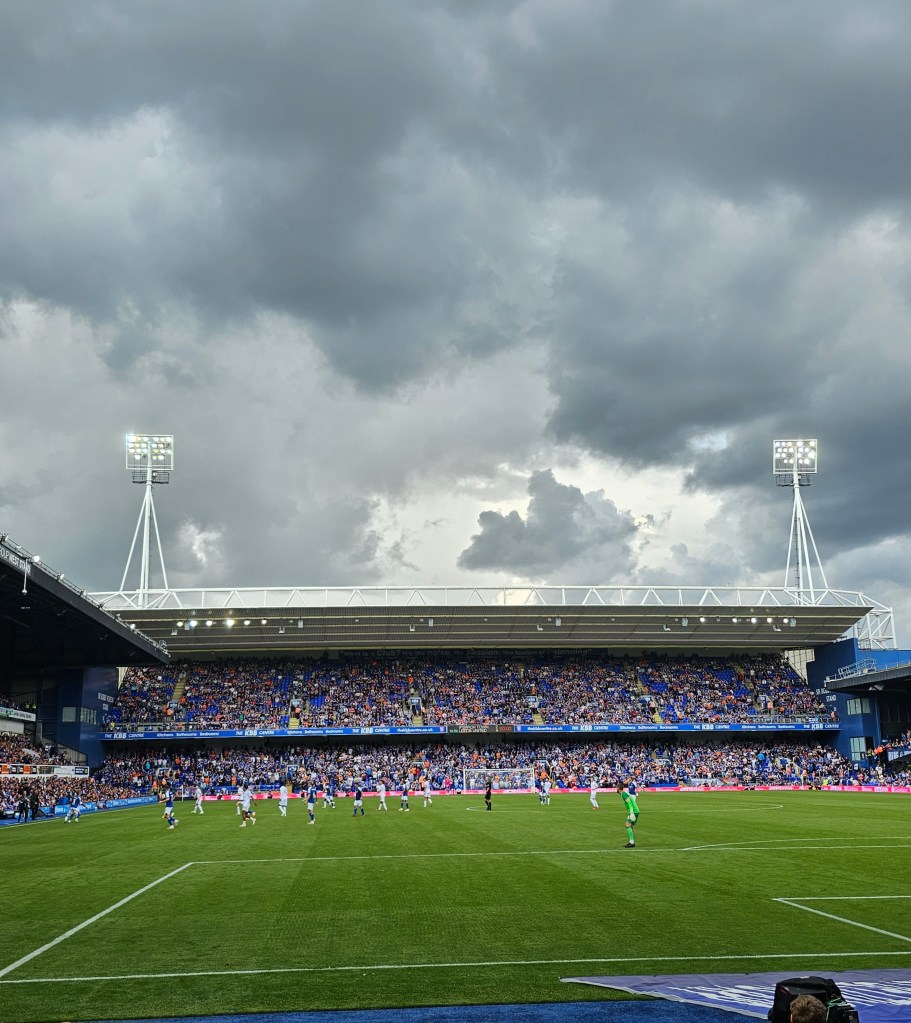
It’s been a while since I’ve been to watch the Town at Portman Road, having forgone the last six matches thanks to the pandemic.  But it’s been a lot longer since I last saw Cheltenham Town play (7th September 2002 at Layer Road, Colchester to be precise), and it’s a lot longer still since Cheltenham Town played at Portman Road (19th March 1938 in the Southern League).  Add to the weight of history the fact that because I am not in my nineties, I have never seen Ipswich Town play Cheltenham Town at Portman Road, and you have the recipe for an evening of excitement to rival that of the last match I saw live, Town versus Barrow in the FA Cup, a truly awful goalless draw as I recall.  On days like this I don’t miss the Championship one little bit.  What’s being in the third division for if it’s not for playing the likes of Cheltenham Town?  Live for the moment and breathe as deep as you dare.

Rocking up on Anglesea Road at twenty-seven minutes to seven, I park my trusty Citroen C3 on a single yellow line and head for what I call the Arboretum pub, but the current occupiers label the Arbor House.  Eight minutes later I have hurried as quickly as I could through the bar, pausing only to mumble a request for a pint of Lacon’s ‘Jack Valentine’ (£3.80) through my face mask, and now I sit in the peace, solitude and creeping cold of the softly lit beer garden.  Amusing myself with the wonders accessible on my mobile phone I sip my beer and get into the funky groove of the righteous soul music climbing out of the plastic speaker in the corner of the garden shelter in which I’m sat. If I didn’t know I was in Ipswich I’d think I was in 1970’s Harlem as the sounds of Sir Joe Quatermain and Free Soul ((I got) so much trouble in my mind (1973)); Smokey Robinson (Baby that’s backatcha (1975)) and the Bobby “Blue” Band (Ain’t no love in the heart of the city (1974)) move my feet and my boogie body.  Beginning to feel like I’ve stepped back in time and looking forward to seeing the likes of Ian Collard, David Johnson and Colin Harper at Portman Road tonight I suddenly return to the now with the realisation that for £3.80 I could probably have bought everyone in the pub a drink or may be two in 1973, although I would have been a tad underage to have done so.

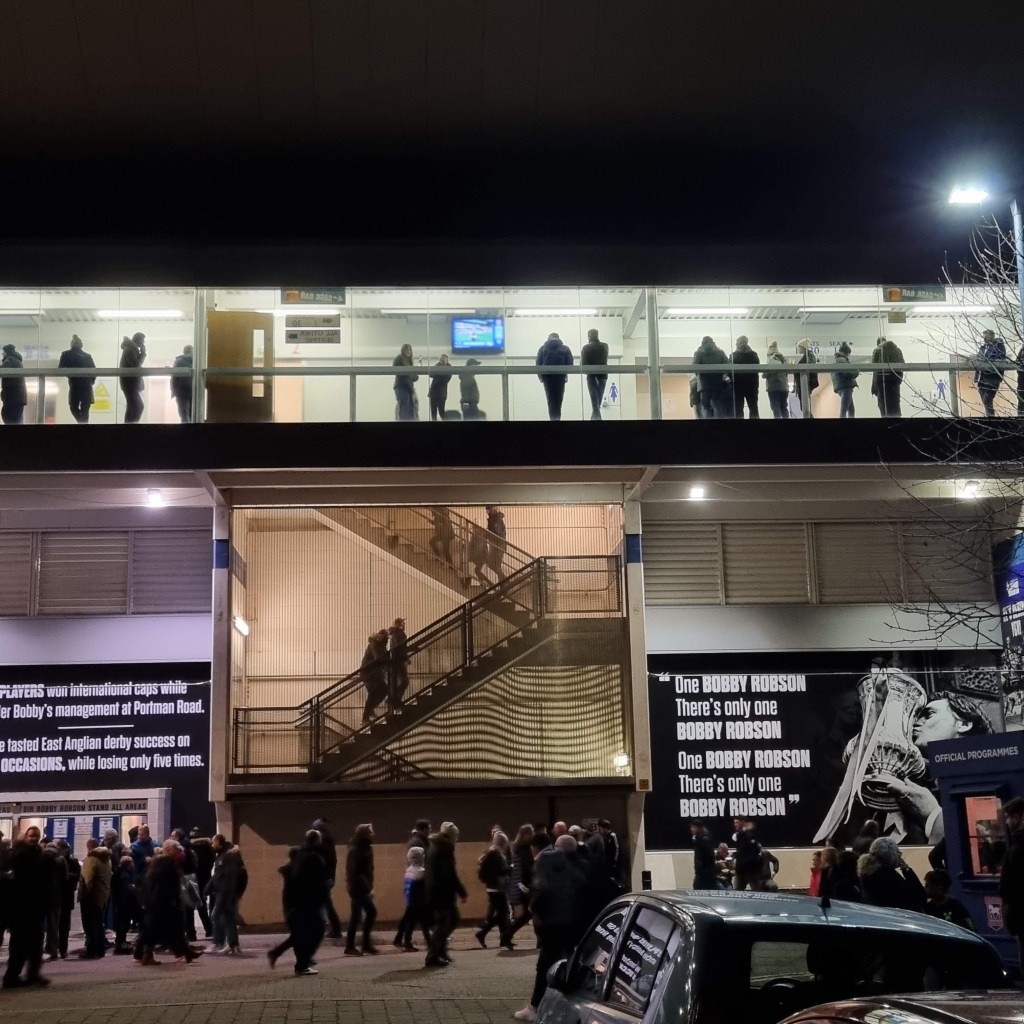
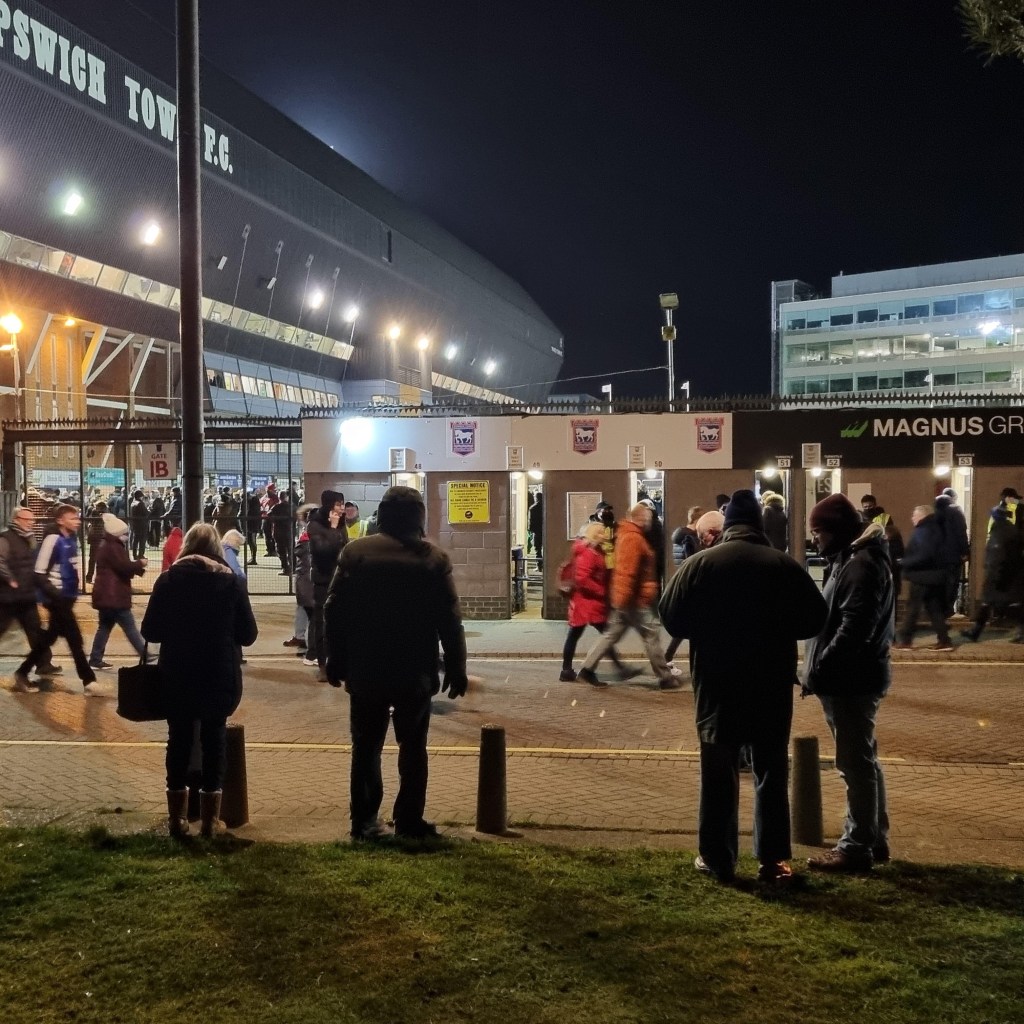
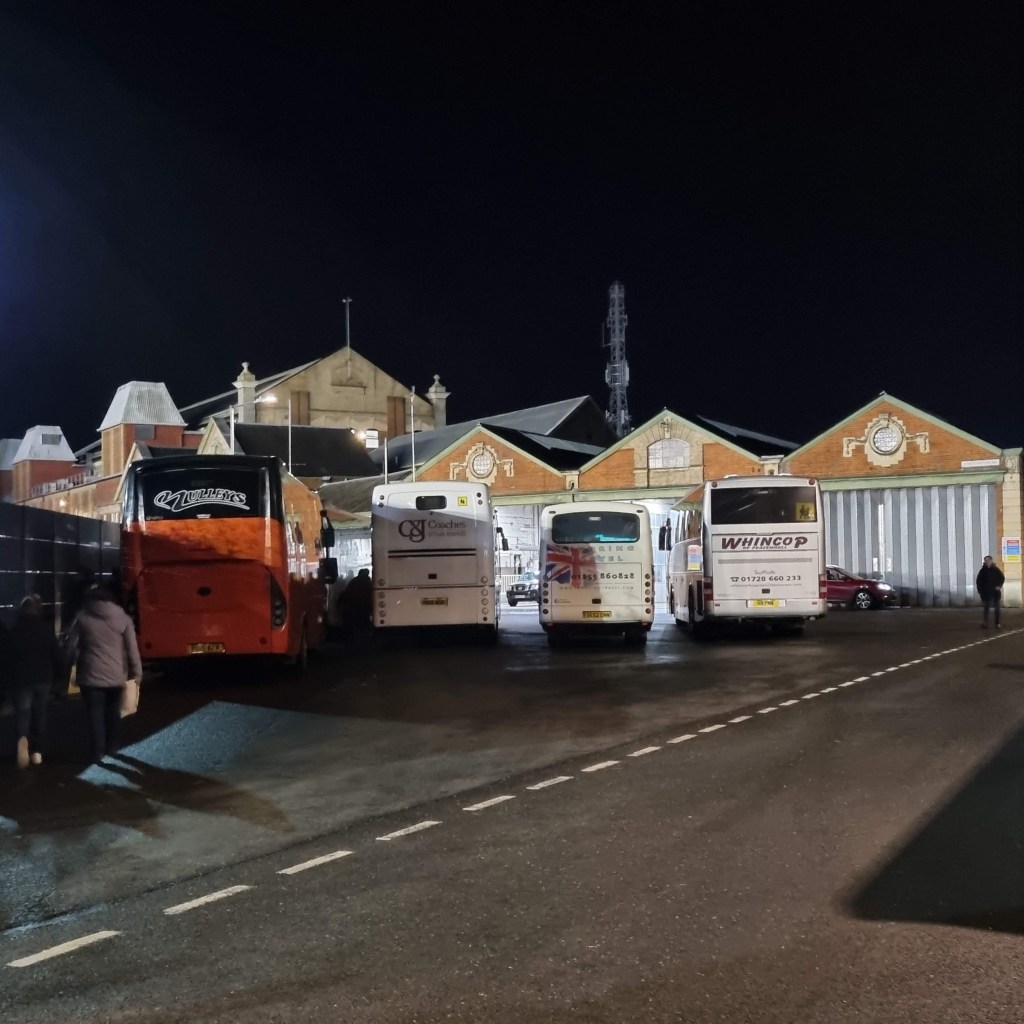
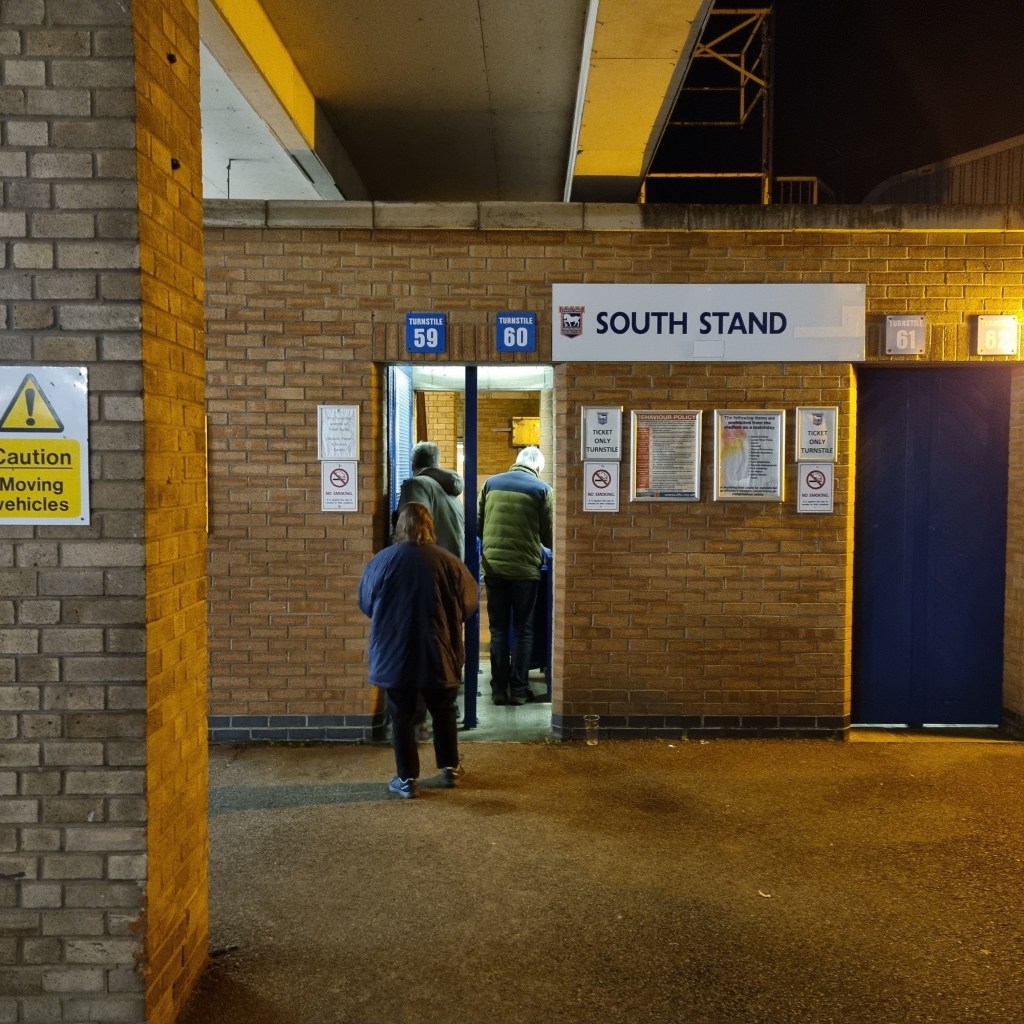
Leaving my reverie in the pub garden I head for Portman Road, my heart leaping a little as I catch a first glimpse of the glare of the floodlights in the night sky.  I approach the ground along Alderman Road to manufacture that ‘going to the match’ down terraced streets feel.  In the back of the Sir Bobby Robson (North) stand supporters already in the ground appears as silhouettes on the stairs and through the plate glass windows of the concourse.  Having purchased nothing with coins of the realm for over a month I recklessly buy both a programme (£3.50) and a Turnstile Blue fanzine (£1). I walk between the rows of fumy supporters’ buses lined up opposite the old tram depot and approach the Sir Alf Ramsey stand from the Constantine Road gate, eventually returning to Portman Road through turnstile number 60. I’m back.

In the stand I reacquaint myself with Pat from Clacton and ever-present Phil who never missed a game until he caught Covid; they’ve missed me, or at least that’s what they tell me; they’re nice like that. With seconds to go before kick-off Fiona arrives too and I say hello to the man who sits to my right, who I always imagine is older than me, but possibly isn’t.  The game begins; Town getting first go with the ball, but I am quickly struck by how disappointed I am by Cheltenham’s kit. In my mind’s eye, a phrase that reminds me of my favourite Small Faces song, I see Cheltenham Town in red and white stripes, but tonight they sport a sort of knock-off Arsenal shirt with pinstripes and a Raglan sleeve.  The Raglan sleeve incidentally is the least desirable of all the sleeves for use on a football shirt.

Aside from the shirts, the football is fast and frantic, with Wes Burns uncontrollably shooting over the cross bar from close range after five minutes, and Bersant Celina making a weaving run before dipping the ball over the cross bar not five minutes later as Town confidently dominate their sartorial inferiors. The ostentatiously bald-headed referee, Mr Andy Davies, unexpectedly makes me think of the similarly hairless, on-loan St Etienne goalkeeper Paul Bernadoni, before a man behind me with a slightly Northern or Midlands accent annoys with a laugh that sounds like Disney’s Goofy.  “Unlucky, unlucky, unlucky; keep going, keep going, keep going” says an oddly repetitive woman from behind as another Town attack comes to nought and the Sir Bobby Robson Stand show signs of life, breaking into Boney M’s “Mary’s Boy Child”, to sing as ever of ceaseless fighting despite Norwich having run away, and all apparently and mysteriously because of Boxing Day.   High up in the Cobbold Stand the Cheltenham followers reveal a lack of originality matched only by their lack of memory as they chant “We forgot, we forgot we forgot that you were here” to the tune of Cwm Rhondda. With my attention back on the pitch, I can’t help but guffaw as Cheltenham’s  Reece Hutchinson hurls himself headlong to the ground in a wonderfully unconvincing attempt to cheat his way to a free-kick.  What was I thinking, staying away to avoid Covid when I could have been a part of this rich tapestry?

Ipswich’s dominance is total and is such that two of our three defenders, Janoi Donacien and Luke Woolfenden are seen exchanging forward passes within twenty-five metres of the Cheltenham goal.  Then a deep, angled Tommy Carroll cross is met with a diving header from Conor Chaplin, only for Cheltenham goalkeeper Owen Evans to palm the ball away in front of Bersant Celina, who is taken too much by surprise to attempt to kick the ball back at the goal.  I’m just thinking how we haven’t been able to exploit Kayden Jackson’s ability to run very fast, when he suddenly breaks down the left, but when he comes to cross the ball he seems to have become over excited and at the far post the ball skids off the forehead of Conor Chaplin at such speed that it must have caused a friction burn.  It somehow feels as if everyone is just a bit too eager,  but out of the blue at the North Stand end Christian Walton fails to clear the ball successfully and his scuffed effort falls to a Cheltenham’s theatrically named Elliott Bonds, but fortunately Bonds’ left footed shot sails hopelessly high above the goal.

Town’s onslaught resumes and Cheltenham show the first sign of resorting to non-footballing tactics to relieve the pressure. “Oh, get up you wanker” says a polite sounding woman behind me as a red-shirted defender lays prostrate on the turf following a gentle collision with another bloke in a football shirt.  “Shall we sing, shall we sing, shall we sing a song for you?” chant the Cheltonians predictably in a quiet moment, and equally predictably no one responds.  Kayden Jackson delivers a slightly limp shot into the arms of Owen Evans and with the first half half-over, Town win their first corner, from which Tommy Carroll shoots impressively wide to the extent that the ball arcs away from the goal and stays on the pitch; Bersant Celina spots the unlikely trajectory and crosses the ball back into the ‘mixer’ but there’s no happy end to the incident.

 The second half of the first half plays out in a succession of Town corners and missed goal attempts.  Much of the first half football has been as exciting as it’s ever been at Portman Road in the past twenty years, but the plain truth is there has been no one to put the ball in the net.  As the half draws to a close Wes Burns turns to lash the ball back into the area in front of the goal from the by-line, but the ball strikes Hutchinson’s outstretched arm or possibly arms; VAR would doubtless have recorded the crime but instead Town are awarded another corner from which Luke Woolfenden deftly diverts a graceful header very precisely over the cross bar.

With the half-time whistle the Cheltenham players jog hastily and as one from the pitch, as if someone had just said “last one back in the changing room’s a sissy”.   By contrast Town’s players seem either less enthused, or just less sensitive to childish name calling.  It seems more likely they are lost in thought, grappling to understand how they are not two or three goals up. Forgetting about football for a bit I pop down to the front of the stand to talk to Ray, his grandson Harrison and Harrison’s dad.  Behind us stadium announcer and former BBC Radio Suffolk presenter Stephen Foster hands over his microphone to comedian and TV personality Omid Djalili, but sadly his words are completely scrambled by the hopeless public address system. Meanwhile Harrison’s dad offers me what the Tim Horton’s website enticingly describes as a ‘mini donut style cake ball’.  I am warned that it will probably taste of maple syrup; but contrarily it tastes of cinnamon. Whilst not ungrateful, and happy to ingest either cinnamon or maple syrup flavoured foodstuffs I am happy not to be offered another.

Cheltenham Town kick-off the second half by lumping the ball down field in the traditional manner.  Town soon get back to winning corners, but with much less frequency than before and somehow the speed and excitement of the first half has departed, leaving in its place mis-directed passes and an unsporting belief amongst the Cheltenham team that they could break away and score a goal of their own.   I remain full of hope, but either Town have lost their mojo or Cheltenham have worked us out.  The game descends into more of a battle with half an hour to go as Cheltenham’s Charlie Colcutt becomes the first player to enter Mr Davies’ address book for a heinous foul on Wes Burns and then the substitutions begin with Kane Vincent-Young replacing Dominic Thompson and the oddly named Macauley Bonne appearing in lieu of Kayden Jackson.  Cheltenham stopper Lewis Freestone is next to have his name etched in copper plate in baldy-Davies’s book as ten minutes later the Cheltenham number six ruthlessly chops down Conor Chaplin.

One bright spot in the second half is the announcement of the night’s attendance of 21,318, of whom 251 are supporting Cheltenham.  Pat from Clacton announces to Fiona and I that the winner of the Clacton supporters’ coach guess the crowd competition is the squirrel that steals the food from the bird table in her garden. I explain to Fiona that squirrels are very clever animals, but I didn’t know they enjoyed coach travel.

Following speed, excitement and accurate passing, enjoyment now leaves the game as Callum Wright of Cheltenham hangs about too long in a prone position on the turf and draws the vitriol of the Sir Bobby Robson stand for his trouble.  “Wanker, Wanker!” roar the lower tier to Wright’s bemusement as he is soon substituted with Aaron Ramsey.  “How could they tell?” he must be wondering to himself as he looks for hairs on the palms of his hands.  Time is running out and in desperation a chant of “Come On You Blues!” is sent out into the ever more chilly night air.  But the chant is only repeated twice more, almost as if everybody feels a bit self-conscious about shouting for any longer than that.  

The final ten minutes are miserable as Cheltenham players spend an unusual amount of time apparently suffering from cramp, something that I thought only happened in extra time in Wembley Cup finals.  Sadly, the ever-unresourceful Town fans can only think of chanting “Boring Boring, Cheltenham” rather than urging on their own team to victory by turning Portman Road into a frightening cauldron of noise.  Cheltenham do waste time, but what professional football team doesn’t when they are close to claiming a hoped for but not necessarily expected away point?  

“Come on Ipswich, score in the final second” I say to creation as the sixth minute of added on time ebbs away. But the final whistle blows, and it feels a bit like we’ve lost.  That’s the trouble with expectation, especially when you’ve not had any for a while.  Not to worry, I think I’ll still be back again next time.

Ipswich Town 0 Barrow 0

When I first became interested in football at the tender age of ten, Barrow were in Division Four and had been in the Football League since 1921, when they were elected as original members of Division Three North.  In my Observer’s Book of Football, the one that has a picture of Bobby Charlton on the dust jacket, it states “Honours have always been elusive for Barrow” and it goes on to say that Barrow had just “one season of triumph”, in 1967 when they finished third in Division Four. Sadly for Barrow, by the time I first saw them play, at Layer Road, Colchester in 1990, they had been replaced in the Football League by Hereford United and were not yet half way through a forty-eight year stint in non-league football.  Thirty years on and today, through the wonder of the 2nd round of the FA Cup, Ipswich Town and Barrow meet for the first time ever. I’ve been looking forward to today’s game to some extent since 1971, but more tangibly since the Cup draw was made, and in reality since Idris El Mizouni’s cracking goal ensured Oldham Athletic wouldn’t be making an unexpected run to Wembley.

As befits an FA Cup Day, the sun is shining gloriously, although with little impact on the outdoor temperature as I stroll across Gippeswyk Park and up Portman Road beneath clear azure skies.     Portman Road is notable this afternoon for the atypical absence from the car park behind Sir Alf Ramsey’s statue of some of the usual vendors of chips and other grease-based foods sold inside spongy ‘bread’ products.  There is also a corresponding shortage of human beings in Portman Road today compared to other match days, and whilst you might infer from this that people only come for the grease-based foods, the sadder truth is that the FA Cup simply doesn’t attract football fans like it once did.  I can recall paying full-price to watch Town play fourth division Halifax Town and Hartlepool United in the company of about 24,000 other souls back in the late 1970’s, and now find it hard to understand why with reduced ticket prices the lure of Cup glory against such Northern exotics is no longer an attraction.  In this age of instant gratification and tv reality game shows, Cup football should be more popular than ever with its promise of advancement to the next round and the jeopardy of defeat and expulsion from the competition after just ninety minutes; Death or Glory as The Clash sang just a year after Town lifted the FA Cup. The tyranny of Sky tv and the Premier League is clearly to blame.

Having purchased a match day programme (£2), I head on to what was The Arboretum pub back in the days when 24,000 turned up to see Hartlepool United and Halifax Town at Portman Road,  but is now The Arbor House.  With a pint of Mauldon’s Suffolk Pride (£3.80) in my cold right hand I sit and wait for Mick in the garden.  Mick soon arrives with a pint of Mauldon’s Molecatcher, a packet of Fairfields Farm cheese and onion crisps and a cup of dry-roasted peanuts.  Mick explains that Molecatcher is brewed to the same recipe as Suffolk Pride but is less alcoholic; I can’t really see the advantage of that at the moment, but our conversation explores various avenues from last night’s Have I Got News For You tv programme to nuns before it is time to walk down the hill past Ipswich Museum to Portman Road.

Today, taking advantage of the reduced flat rate ticket price (£10 for adults and £5 for concessions plus £1.50 each for the pleasure of buying them, which goes to a parasitic organisation called Seatgeek) we are in the top tier of what was the West Stand, but is now the Magnus Group Stand. We are in Block Y where the seats are brown in colour, not because of any sort of unpleasant staining but merely because I imagine brown looked ‘classy’ in 1982 when the top tier was opened; the seats are also padded.  I bought our tickets soon after they went on sale and we benefit from being close to the stairway or vomitorium, and just two seats in from the gangway, so only two old men must rise from their seats for us to access ours.  With everyone in their winter coats it’s a tight squeeze nevertheless.

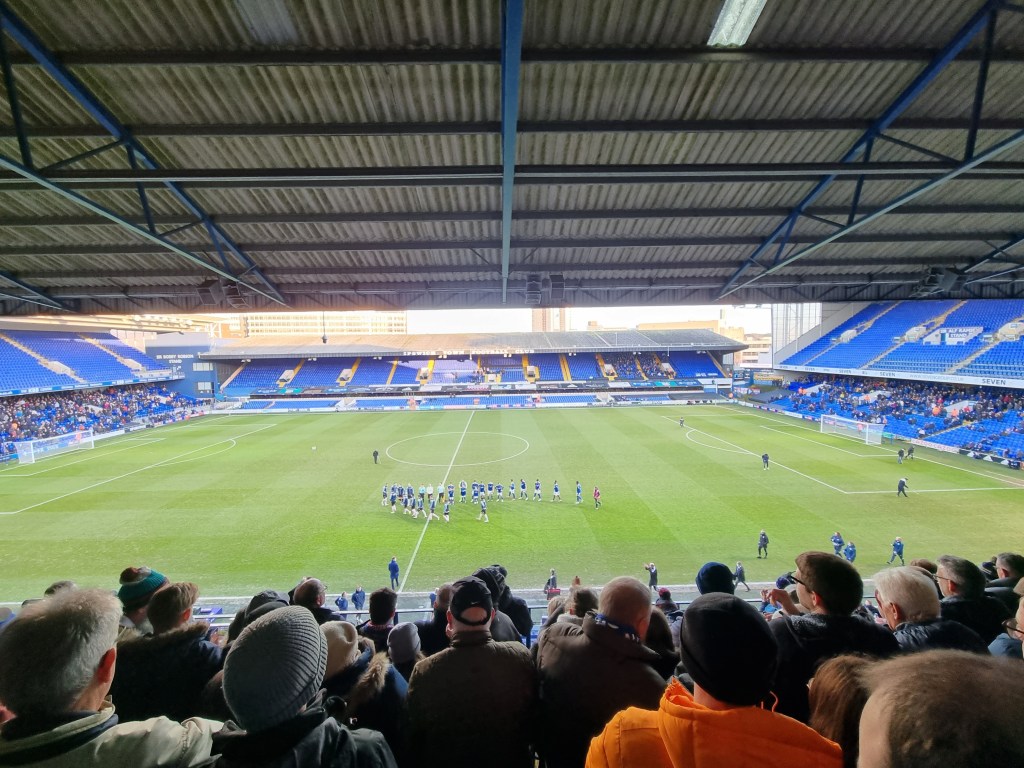
The teams appear to an introduction from stadium announcer Stephen Foster worthy of the occasion and with knees taken and duly applauded the game begins;  a strong Town team getting first go with the ball and kicking towards the Sir Alf Ramsey stand, formerly plain old Churchman’s.  Town are wearing their traditional blue shirts and socks and white shorts whilst Barrow are in an unexpectedly stylish pale pink shirt and socks with black shorts, vaguely reminiscent of Sicily’s Palermo or the now defunct Evian Thonon Gaillard, briefly of French Ligue 1.   The largely empty stadium is filled with a sense of expectation as the game starts and the murmur of a nascent chant can be detected from the Sir Bobby Robson stand.  Within a minute of kick-off however silence reigns.

From the start Town look as hesitant and short of ideas as their supporters are of rousing supportive chants. It is Barrow who show the first serious attacking intent as several players in pink break forward “They’re all offside, nine of ‘em; except him” says a man with a loud and annoying voice a couple of rows behind me as Barrow’s number eleven Josh Kay bears down on goal beneath the shade of the Magnus Group Stand.  The same voice is all too audible a short while later as Barrow break forward again. “Toto, Toto, leave him alone Toto” he calls as Toto Nsiala tracks a Barrow player into the Town penalty area and makes a tackle before he can fashion a shot on goal.  Had Toto Nsiala followed the spectator’s advice it is likely Barrow would have scored or at least had a shot on target. It’s not a good start by Town or their supporters.  But as a consolation the low winter sun is reflecting a sparkling yellow light back off the windows of the Guardian Royal Exchange office block on Civic Drive, so although the football isn’t, the backdrop is gently inspiring.

Over twenty minutes pass and Barrow earn two free-kicks in quick succession in the Town half and then win the game’s first corner.  Barrow come close to scoring twice as one free header hits a post and then one from Mark Ellis is saved by Christian Walton.  Barrow’s Josh Kay shoots and his shot is tipped over the bar by Christian Walton. “Come on Lambert, sort it out” bawls the ruddy-faced old boy sat in the seat next but one from mine.   Nobody reacts in the seats around me; I fear some of my fellow supporters might have died. I turn to Mick and dare him to shout “Robson Out”.

 It takes Town over half an hour to have a shot on goal worthy of the name as Scott Fraser eventually launches a shot over the cross-bar from outside the penalty box.  I remark to Mick that with the number eleven on the back of his shirt and his short brown hair, from this distance Fraser sometimes makes me think of Mick Lambert.  “I can’t think what Mick Lambert looks like” says Mick. “Well I expect he looks a bit different now” I respond.   Idris El-Mizouni is booked for a foul, a little harshly in my opinion and I wonder to myself whether referee Mr Sam Purkiss is a closet French nationalist in the thrall of Marine Le Pen.  As half-time approaches a rare moment of hope sees Conor Chaplin break away and from a low cross earn a second corner for Town, and then the oddly named Macauley Bonne strides forward to unleash an appallingly bad shot which results in a throw-in to Barrow. “What the fuck, what the fuck, what the fuckin’ ‘ell was that?” sing the Barrovians up in the Cobbold stand in the time honoured fashion. “Good question” mutters the old boy next to me to himself.

Half-time comes as a welcome relief and whilst Mick gains further relief using the facilities, I remain in the stand alongside the two old boys. The match resumes at three minutes past four as dusk descends to shroud Suffolk’s County town in chilly December darkness.

Half-time has brought change and Joe Pigott has replaced Idris El-Mizouni who hadn’t looked sure where he was meant to be playing, with Sam Morsy seemingly competing with him for the ball in midfield.  Within three minutes Joe Pigott has found space and strikes a post with a firm shot.  Pigott’s presence continues to make a difference as he seeks space behind the Barrow defence and controls and lays the ball off in a manner which the oddly named Macauley Bonne has so far appeared incapable of doing.  Things are looking up and the Sir Bobby Robson stand feels moved to sing a song which has quite a lot of words, few of which I am able to decipher, but then Kay scoops a shot over the bar for Barrow when it was certainly no more difficult to get his shot on target.

This is a much better half for Town and I sense a glimmer of optimism amongst the Town followers in the meagre crowd of 6,425, of whom a respectable 205 are from Barrow.  The mood hasn’t affected the loud man behind me however, who continues to provide a mainly sarcastic commentary, which sounds both smug and moronic in its delivery.  He clearly doesn’t like Toto Nsiala and bewilderingly urges him to chip the ball over Christian Walton as Toto turns it back towards goal, before saying “He was tempted”.  This man has the sort of voice that would make a more violent person than myself want to punch him in the throat.

Town now dominate possession and whilst still a little slow on the ball they are getting players down both flanks to put in crosses, an approach that is helped by bringing on the exciting Sone Aluko.  The Town  support has corresponding moments of enthusiasm and sing another song with plenty of hard to fathom words, but a simple chorus of “Addy, Addy, Addy – O”, which is the sort of thing heard sung by children in one of those black and white films from the early 1960’s such as A Taste Of Honey, and I half want to see Rita Tushingham and Dora Bryan warming up on the touchline.

As the match winds down into its final fifteen minutes the support wanes, and as we enter six minutes of normal time the ground is once again silent.  As ever, there is a late flurry of goal attempts as the realisation dawns on the players that their failure to score a goal can only result in an evening in Barrow-In-Furness.   Corners are won but no booming chants of “Come of You Blues” or  intimidatingly repetitive calls of “ Ipswich, Ipswich, Ipswich” materialise from the stands;  even the score board seems apathetic as each corner kick is met, not with an entreaty to shout support for the team, but instead a message about how the Ipswich Mortgage Centre “corners all your home improvement and mortgage needs”.    The old boys beside me leave with a couple of minutes to go.  Sam Morsy shoots over the cross bar from close range and substitute Cameron Humphreys heads against it , but Town don’t score and the breath saved by not shouting in support of the Town is expended in a chorus of sadly predictable boos and jeers.

Later this evening I will learn that the Town manager has been sacked and briefly I wonder to myself if the old boy sat next but one to me had been right; Paul Lambert had never actually left the club he’d just shaved the top of his head and swopped his Scottish accent for a Scouse one, but after nearly a season’s worth of games he’d finally been found out.   It’s certainly never dull being a Town fan, well except for the actual games that is. Try stopping me going through it all again in a fortnight’s time though. No, please, try.

Ipswich Town 1 Nostalgia 1

On a damp May evening three years ago, I recall thinking to myself that it feels like 1978 and Ipswich Town have won the FA Cup all over again.  With my Portsmouth supporting wife Paulene, I had gone to see the Wolsey Theatre’s production of ‘Our Blue Heaven’, the music-backed play that celebrated the fortieth anniversary of Town’s FA Cup win. I can honestly say it was the most enjoyable Ipswich Town related evening I had had in nearly twenty years, since that season in the sun at the start of the third millennium when Town did things like beating Liverpool and Manchester City at their own grounds, having finally managed the previous May, to win a play-off semi-final and victoriously tread the turf at the old Wembley stadium for the last time. 

Fast forward to October 9th 2021, and in the spirit of celebration of Town’s winning the UEFA Cup forty years and five months before, which the club itself has seen fit to mark with the sale of a wallet, luxury boxed badge, and travel mug, the New Wolsey Theatre is staging the final performance of its production ‘Never Lost at Home’, the story of the 1980-81 season, but mainly the winning of the UEFA Cup, something no ordinarily lovable, small town football club will probably ever do again.  Not keen on spending an evening in an enclosed space with about 400 other people, most of whom will probably not be wearing a face mask, I have opted to cough up the £20 to watch the two- and a-bit hour performance on-line from the safety of my living room.

Forty and a bit years ago in May of 1981, I had just finished my final exam at the University of Sussex and I was now just wasting my time, until the lease on my shared student house was up, by playing football, going on pub crawls, walking on the Downs, visiting friends at the other end of the country and taking days out in an aged, bright orange, Dutch registered, left-hand drive Fiat 600 which my friend Chris (mainly known as ‘Jah’ due to his love of Reggae) had borrowed from a woman on his Social Anthropology course.  A lack of available cash and the demands of academia had sadly meant that in Town’s run to the final of the 1981 UEFA Cup final, I had only seen two home games, those against Aris Salonika and FC Koln.  Of the other games, I mostly remember the nervous anticipation of waiting for the result on the radio or television news.  The away matches I recall most are those at St Etienne and Koln.  I remember learning that Town were a goal down in St Etienne and was very chuffed to hear they had equalised as I headed off to the Student Union bar that March evening.  When I discovered Town had won 4-1, I could hardly believe it, and indeed it was a performance that has gone down in history as one of the best-ever by a British club in Europe and possibly Ipswich Town’s greatest performance ever.  As for the game in Koln, I remember that my friend Stephen went to the game on a supporters’ coach from Shotley and I remember seeing Terry Butcher’s winning goal on television, having been fearful that the one goal lead from the first leg would not be enough.

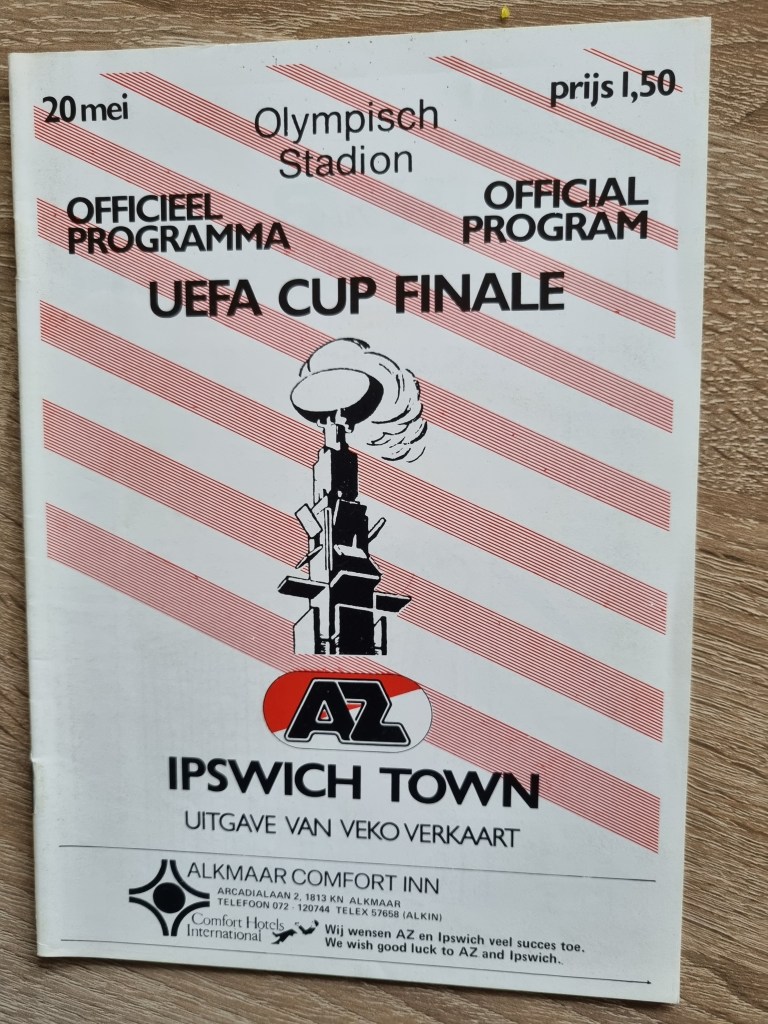
On the morning of 20th May 1981 my sister dropped me and my father off at Ipswich railway station where we caught a chartered train to Parkeston Quay and a chartered ferry to the Hook of Holland before boarding a chartered coach to Amsterdam.  Everyone travelled with the Ipswich Town Supporters Club and Anglia Tours back then, and I still have the pennant to prove it.  I wouldn’t enter Holland again for another 35 years, until I drove through a small corner of it on my way to Dusseldorf for a pre-season game in 2016, but I recall it being very neat.  In Amsterdam my father and I spent the time before the game in a small bar where we drank Amstel, a beer rarely seen in Britain back then, thankfully.  My father had encountered it before in foreign ports when in the Royal Navy and had warned me that it was gnats’; he was right, but it was all there was, they didn’t have any Tolly Cobbold Original.    Amsterdam was beautifully warm that May evening, which was just as well because terraces of the Olympic Stadium were open to the elements, which given that it was built for the 1928 Olympics isn’t that surprising; stadium builders weren’t always big on rooves back then.  In 1987 the Dutch government designated the Olympic Stadium as a National Monument, obviously because Town won the UEFA Cup there, but also because of the fine brick architecture by Jan Wils, an exponent of the Amsterdamse School.  It’s good to know that there is a corner of the Dutch capital that will forever be imbued with the memory of the presence of 7,500 Town fans.

My memory of the match that night in Amsterdam is one of anxiety and tension, despite taking an early lead that put us 4-0 up on aggregate and then gaining a second away goal.  AZ 67 Alkmaar were a bloody good team, but happily not quite good enough, despite Town being visibly knackered at the end of a colossal sixty-six game season. Forty years is a long time, and I’m not sure now what I remember from being there and what I remember from having seen various tv clips since.  I think I remember being frustrated that in the second half we couldn’t keep the ball away from Alkmaar, but I know I do recall wishing away the last twenty minutes of the game, and constantly checking my watch; willing Alkmaar not to score again and the Town defence to hold firm.  I remember nothing of the journey home, although I think my father might have invested in the luxury of a two-berth cabin in the hope of a couple of hours of sleep.

Tonight, “Never Lost at Home” picks up the story of the fictional Coombes family who followed Town to Wembley in “Our Blue Heaven”, and the story very much has the feel of being a sequel, which of course it is.  This time the tale begins with the family vowing to have someone at every game for what promises to be the greatest season in the club’s history as it vies to win an unprecedented treble.  Once again, the story is set against the background of the events of the times, in particular the high rates of unemployment resulting from the Thatcher government’s monetarist policies and indeed Scott loses his job to create some jeopardy in the story as it inevitably hinders his ability to get to games. Once again also, the story and the season unfold to a soundtrack of popular tunes of the time, although just like in ‘Our Blue Heaven’ it doesn’t, because several of the songs are from as much a four years later, which rankles somewhat because songs such as Tears for Fears ‘Everybody wants to rule the world’ (1985) were actually the soundtrack to avoiding relegation, not seeking glory.

Despite the failure to use the actual music of 1980 and 1981 (what a pity we never played Rapid Vienna or IK Start), rather than just generic 1980’s hits, there is nevertheless an authentic feeling of nostalgia for a time and a place.  I can’t fully explain why, but I had tears in my eyes in the first part of this production.  It might have been because I was reminded of how awful some of the music of the 1980’s was; I always hated ‘Eye of The Tiger’ (1982) and have consequently never seen any of the ‘Rocky’ films, but more likely I was mourning my lost youth and my lost football team, both of which seemed to go missing at much the same time.

 One major departure from the mostly repeated formula of “Our Blue Heaven” is the introduction in “Never Lost at Home” of one of the players as a recurring character, that player being the now legendary Arnold Muhren.  The choice of Arnold was, if not inspired, then obvious, because perhaps more than any other player, even his fellow Dutchman Frans Thijssen, Arnold somehow personifies that 1980-81 team, despite having actually joined Town three years before in September of 1978.  Again, the story employs a little artistic license as it almost implies that Arnold and Frans joined for the 80-81 season, but that is easily forgiven and does add to the mythology of that remarkable season.  I can only think that in casting actor Dan Bottomley as Arnold Muhren, one of the main considerations must have been his legs, because these have the same straight up and down shape of Arnold’s.  Not for Arnold the meaty thighs of Mick Mills or Paul Mariner; Arnold was a sinewy thoroughbred, built for the measured pass, the clever change of pace and direction in a single stride, the sort of footballer who simply danced through midfield and no longer exists in a game where speed, strength and bulk has usurped grace and subtlety.

The greatest triumph of ‘Never Lost at Home’, as it was of ‘Our Blue Heaven’, is the performance of Peter Peverley as Bobby Robson.   Not only does Peverley, with his gently hoarse County Durham accent, and perfectly observed Robson-esque mannerisms create a wholly believable vision of the Town manager, but he also delivers the great man’s words as he sends his team out in search of glory.  So stirring and convincing are Peverley’s words it might be an idea if the current Town management employed him to give Paul Cook’s team talks.

Oddly perhaps, ‘Never Lost at Home’ tails off towards the end, in contrast to the prequel which had something of a grand finale as the stories of the characters all came together on 6th May with a birth, a marriage and the Cup Final itself.  This time the characters don’t have their own stories to be resolved other than what happens to them as they travel across Europe in the rounds leading up to the final. We all know the ending, and although Town ultimately win the UEFA Cup, sadly mine and a lot of people’s memories of 1980-81 are probably tinged with a feeling of ‘what should have been’ with the loss of the FA Cup semi-final to the hugely inferior Manchester City and the loss of the ever-elusive League Championship to Aston Villa, a team we beat no less than three times over the course of the season.  But as one of the characters in the play points out, we had already won the Cup and the League before, so if it was to be only one out of three, best that it was the UEFA Cup.   Reassuringly however, it’s good to know that we only lost out in the Cup and the League because none of the characters in the play could get to the Cup semi-final or the penultimate League game of the season at Middlesbrough.

In truth, ‘Never Lost at Home’ wasn’t quite as good as ‘My Blue Heaven’, although my seeing it through the television screen rather than in the flesh is doubtless a factor in that. The story doesn’t have the drama of its predecessor and by drifting further into 1980’s the music is not so much ‘not as good’, as ‘worse’. Nevertheless, it was still massively enjoyable all the same, bringing back those memories of what genuinely was a marvelous time to be a Town supporter and which seems even more so given all that’s happened since. I can only hope that both ‘Our Blue Heaven’ and ‘Never Lost at Home’ are both resurrected in ten years time, not only to celebrate the fiftieth anniversaries of the FA Cup and UEFA Cup wins, but also their own 10th anniversaries; or perhaps we could have a musical about going to a musical about winning the FA Cup and UEFA Cup; I’d watch it.

Ipswich Town 1 Arsenal 0 – Our Blue Heaven

It’s Saturday May 6th 1978, I will be eighteen in about seven weeks’ time and today I am going to the FA Cup final. I am going with my dad; we were two of the 24,207 who saw Town beat Hartlepool United in the fourth round of the FA Cup and the 29,532 who witnessed the 3-0 win in the fifth round replay against Bristol Rovers; we went to the semi-final at Highbury on a supporters’ coach from Shotley. We saw Landskrona Bois, Las Palmas and Barcelona at Portman Road back in the autumn and have seen about a dozen league games on top of that, so we had the requisite vouchers to get tickets for the final. But this morning my father has woken up feeling unwell; he doesn’t think he’ll be up to going to Wembley and so for my friend Tim who lives five doors away, it’s his lucky day. I walk along the street, knock on his front door and ask if he wants to come to the FA Cup final; he does. Tim’s dad Charlie will this evening deliver a bottle of sherry by way of a thank you.
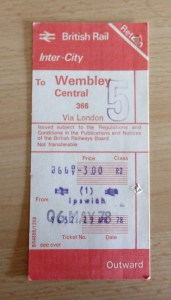
I listen to a few selected tracks from Blondie’s first album ‘Blondie’ (released in December 1976 )as I get ready to go; ‘Look good in Blue’ seems apposite this bright morning as does ‘In the sun’ with its lyric “In the sun , we’re gonna have some fun”. We get to Ipswich railway station somehow; on the 202 bus, or does someone give us a lift? Ticket to WembleyFrom Ipswich we are on a special chartered train that turns right at Stratford and plots a course through north London round to Wembley Central. In Wembley Stadium the terrace steps at the tunnel end are much bigger and steeper than those in Churchman’s or in front of the East Stand, blue and white abounds. The sun shines and Arsenal, wearing yellow and blue, kick off with Ipswich playing towards that blue and white tunnel end. Paul Mariner hits the cross bar, John Wark twice shoots against a post, Pat Jennings saves acrobatically from George Burley, Paul Mariner misses, bigmouth Malcolm McDonald is rubbish, Clive Woods is brilliant, David Geddes crosses, Willie Young is a lumbering donkey, Roger Osborne scores, we cheer, we sing, Roger Osborne is substituted for Mick Lambert, Town win and Mick Mills lifts the FA Cup and turns to show it to us.
Back at Wembley Central railway station after the match a half-brick or a stone bounces off the window of our train as we wait to depart back to Ipswich. Arriving back in Ipswich, Tim and I celebrate with a couple of pints of Tolly Cobbold bitter in the Railway Tavern on Burrell Road as we wait for a lift home in Tim’s dad’s green Morris Minor 1000.

OLYMPUS DIGITAL CAMERA
Forty years and eighteen days later it’s a dank evening in Ipswich, I have been to work, visited my mum, parked up in Portman Road and arrived at the New Wolsey theatre, which didn’t exist in 1978, although there was repertory theatre in Tower Street. I am with my wife Paulene. My father has been dead for nine years, happily his cause of death was unrelated to his illness of 6th May 1978, he enjoyed almost 21 years of good health subsequent to that and made it to the UEFA Cup final second leg in Amsterdam. Tim now lives in Weymouth and oddly he still only gets to see the Town when I get him a ticket (this season we went to Brentford). The Railway Tavern has been demolished; the green Morris Minor was scrapped long ago. But the name of Ipswich Town is still inscribed on the plinth of the FA Cup.
My seat at the Wolsey theatre tonight is in the front row of the auditorium, my wife Paulene is sat in the row behind; she sat behind to give me more legroom. The production is so popular we couldn’t get two seats together. We are the first people in the auditorium, Paulene’s asthma means she needs time to acclimatise. I read the programme (£4) and think “Cup final prices”. The stage is just a metre in front of me, the ‘boards’ are under a green covering patterned to look like turf. At the back of the stage a pair of blue doors look like the doors at the back of the old North Stand, above them is a projection of the type of corrugated cladding also redolent of the old North Stand. But there was never a sign that said ‘Welcome to Portman Road’ back then, there isn’t now. Also part of the projection is the old Ipswich Town crest, the slightly imperfect yellow and blue one, which should be restored out of respect to the past and to John Gammage who won the competition to design a distinct crest for the club back in 1972.41429848635_33f2609053_o
I watch the ‘crowd’ as the auditorium fills up to the sounds of assorted 1970’s pop hits, nostalgic but mostly awful. The majority of people here seem to be my age or older, old enough to have witnessed the 1978 Cup final. A few people are sporting blue and white scarves; one man wears a bright red blazer as if he’s just got here from Butlins. In the front row are three young lads, pre-teens, one of them wears a parka which lends an unexpected layer of 1970’s authenticity. Paulene says she feels cold, I say if I’d known she was going to I would have brought a blue and white bobble hat for her.
The lights dim and tonight’s performance of ‘Our Blue Heaven’ begins with Blondie’s “Hanging on the telephone” played live as the soundtrack to a domestic scene in which a young couple, Mel and Scott arrange their wedding for Saturday 6th May 1978, and then the draw for the third round of the FA Cup is announced. I resist the temptation to put my hand up to point that Blondie’s Parallel Lines album, from which ‘Hanging on the telephone’ was taken as a single would not be released until September 1978. I am not really a pedant and whilst I may not always like it, I do understand the concept of artistic licence and have been known to use it myself; I deny all accusations that it was merely lying.
Mel’s sister Sue is a dedicated and faithful Town fan and from the start foresees that she will want to be at Wembley on May 6th. Meanwhile, in a parallel story Smudger and Ange are awaiting their first child, with Ange’s ‘expected date of confinement’ surprisingly enough being 6th May, although the nurse at the hospital, who happens to be Mel and Sue’s mum Sheila tells them that babies never arrive on time. Smudger is as committed a Town fan as Sue and is predictably torn between his love for the Town and supporting his wife.
The simple domesticity portrayed is all a bit ‘Play for Today’, particularly when it transpires that Mel and Sue’s dad Paul is a striking fireman, whilst Scott’s dad Brian is a Thatcherite policeman; and that just adds to the authenticity and feel that it is 1978. I am transported back in time on a wave of Nostalgia (from the Buzzcocks Love Bites album and like Blondie’s Parallel Lines, also not released until September 1978, but also sadly not in the show).
Scenes from the two families’ stories are spliced with Town’s progress through each round of the FA Cup introduced by popular songs of the time, Bowie’s ‘Heroes’, Patti Smith’s ‘Because the night’, something or other by the Bee Gees. For the sixth round trip to Millwall the band plays the Clash’s London Calling, at which point I really do want to put my hand up because the Clash’s album was not released until December1979, a whole 20 months later. I only hold back when London Calling runs into White Riot, which is much more temporally authentic having been released as a single in March 1977, and a cracking tune to boot.
For each match a group of male and female dancers act out the crucial on-pitch events to the background of the songs and a BBC radio style commentary. My friend Gary texted me before the performance to tell me there was just one thing he did not like about the production and later he will tell me that it was the football sequences. Re-creating football well is notoriously difficult to do, as proven by awful films such as Yesterday’s Hero, in which incidentally the football sequences were filmed at half-time during a game at Portman Road; this is why I don’t consider that the director really bothered to do so. The dancers don’t look like footballers and they are only dancing, creating an impression through movement; they could have been supporters recreating the goals, children doing so in the school playground, and that is authentic. So Gary, you are wrong and need to brush up on your critiquing skills.
The intertwined stories of the families and the FA Cup run are good ones, there is drama, pathos, human emotion aplenty, humour and of course a happy ending. But the thread that runs through the production is the character of Bobby Robson who intermittently comes on to the stage like some sort of visiting angel wearing a series of 1970’s style suits and coats, imparting words of wisdom and assorted homilies about football and the wider experience of our lives beyond. As if this isn’t enough, the actor playing him, Peter Peverley does so brilliantly, better even than Michael Sheen’s rendering of Brian Clough in The Damned United. Peverley has the accent which is easy enough, and he has perfected the mannerisms too, but more than that he has captured the slight hoarseness in the voice, it’s almost uncanny. He wears a pretty bad wig though.
The finale to the production has the marriage, the birth and the FA Cup final taking place on stage simultaneously following the singing of Abide With Me, the Cup final hymn since 1927; a maudlin little number but a cracker nevertheless because it is the Cup final hymn and has been marinated in 90 years of Cup final history. Being sat right at the front, my view is now partly obscured by some of the on stage props, so I watch the audience. People who know the words sing along with Abide With Me, whilst others hold their scarves aloft. It is likely that many of the people here, like me were at the Cup final in May 1978 and are part of the story, but this makes people feel involved all over again, it’s nostalgia with knobs on, re-enacting the past, albeit part fictional, but this is somehow how it felt.
The story ends and it truly feels like Town have won the FA Cup all over again, and then Roger Osborne, the personification of the day because he scored the winning goal enters the stage, inevitably to a standing ovation. The ultimate finale however, comes with the cast all assembled on stage with Bobby Robson leading us in a sing-song, some Cup final community singing of our own; a rousing rendition of Edward Ebenezer Jeremiah Brown. It’s bloody marvellous and everything that matches at Portman Road no longer seem to be, utterly joyous. I give it my all.
I have had a most marvellous evening and for much of it I am not ashamed to admit I have had a tear in my eye. I have been taken back in time, but don’t know if I’m tearful for my lost youth and the passing of the days when Ipswich Town was such a wonderful football club and team, and when the FA Cup was something that really mattered, or if these are tears of joy and happiness, for a love of my team and a sense of belonging that has been re-kindled.
Nostalgia is warm and cosy, but it’s not a healthy thing, because we cannot go back and we have to live in the present; but tonight after watching Our Blue Heaven I genuinely feel uplifted.
My name is Edward Ebenezer Jeremiah Brown
I’m a football supporter of Ipswich Town
Wherever they play, you’ll find me
I haven’t missed a game since I was three
With me scarf and me rattle and me big rosette
Singing where was the goalie when the ball went in the net
Follow the Town
Up or Down
I’m Edward Ebenezer Jeremiah Brown but everybody calls me Ted.

Football, Football,
Whose the greatest of them all,
Let’s put it to the test
Come to Portman Road on a Saturday and you’ll see the best
Oi!
Ipswich! Ipswich! Come On The Town!

My name is Edward Ebenezer Jeremiah Brown
I’m a football supporter of Ipswich Town
Wherever they play, you’ll find me
I haven’t missed a game since I was three
With me scarf and me rattle and me big rosette
Singing where was the goalie when the ball went in the net
Follow the Town
Up or Down
I’m Edward Ebenezer Jeremiah Brown but everybody calls me Ted.

2-4-6-8 who de we appreciate?
It isn’t hard to tell
Just you take a closer look at me
And you’ll know darn well
Oi
Ipswich! Ipswich! Come On The Town!

La la la
La lala la lala lalala
Lala lalala la lala lalala
La lalala lalala, and lots more lalalaing, you get the picture ?