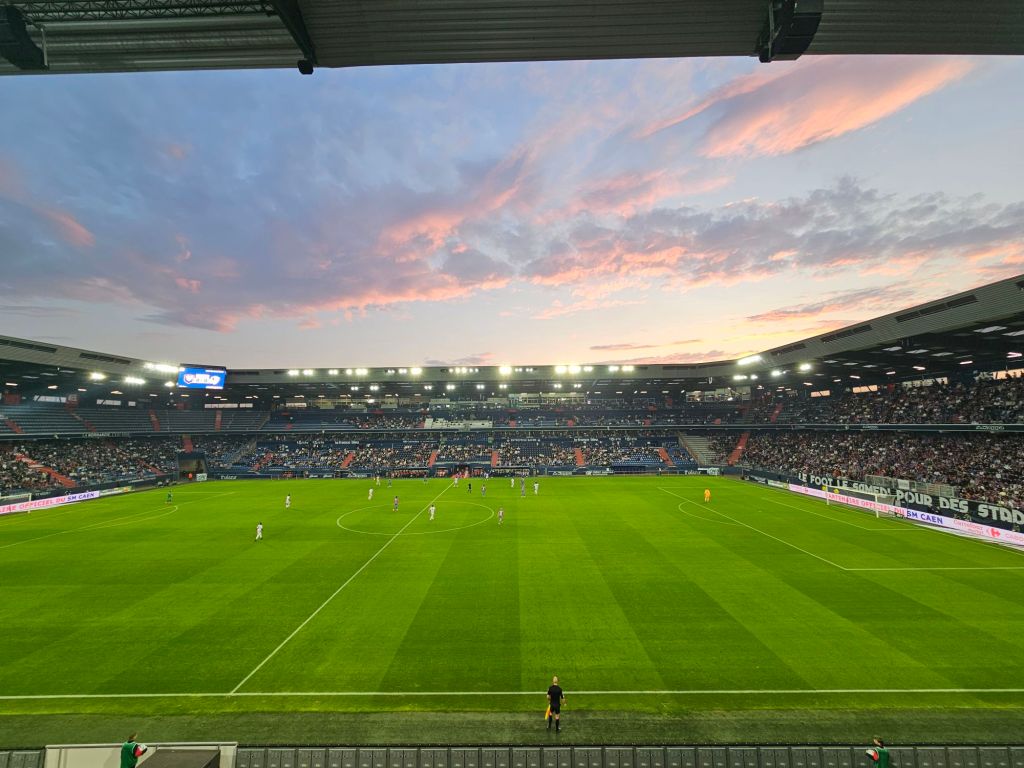
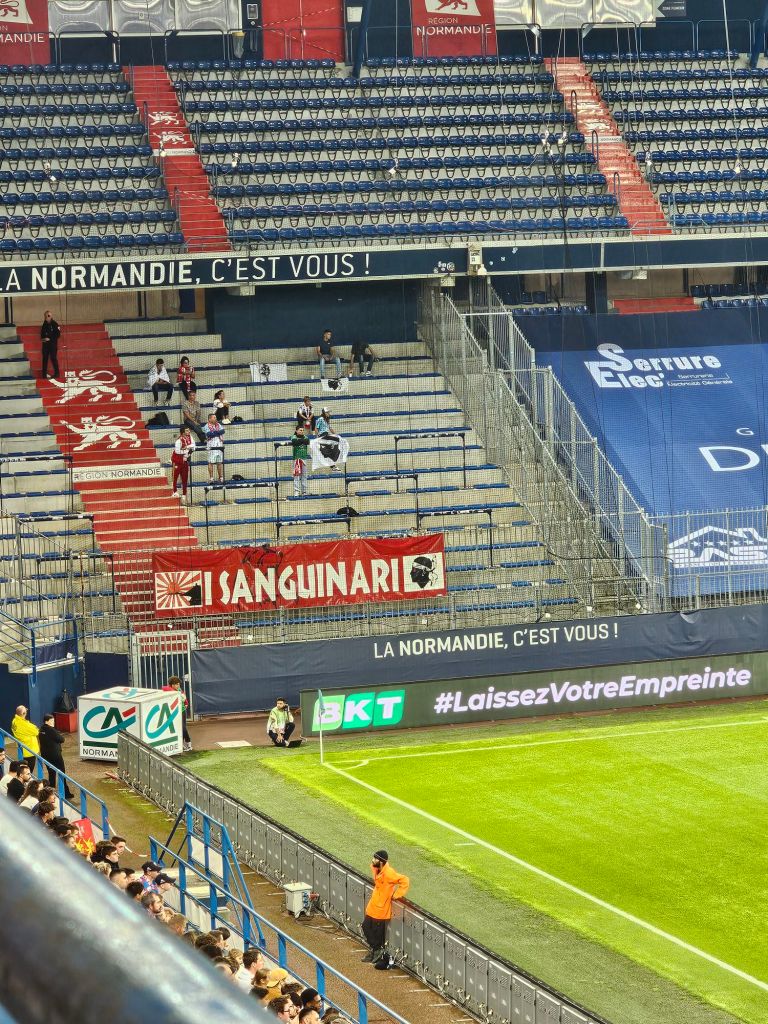
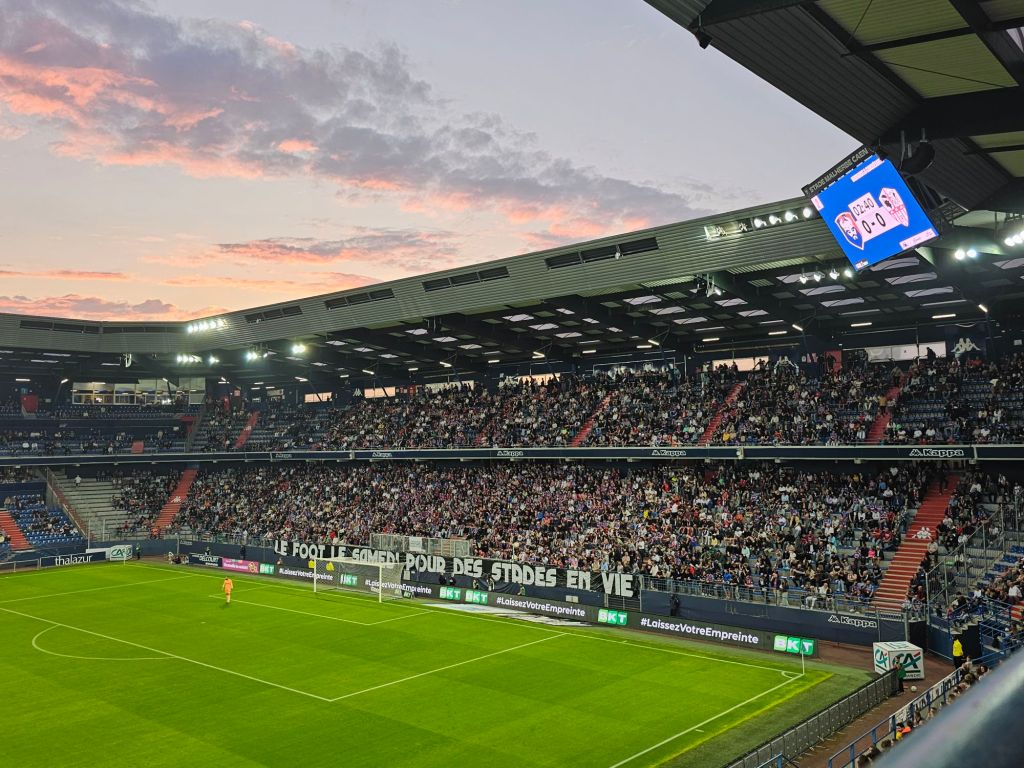
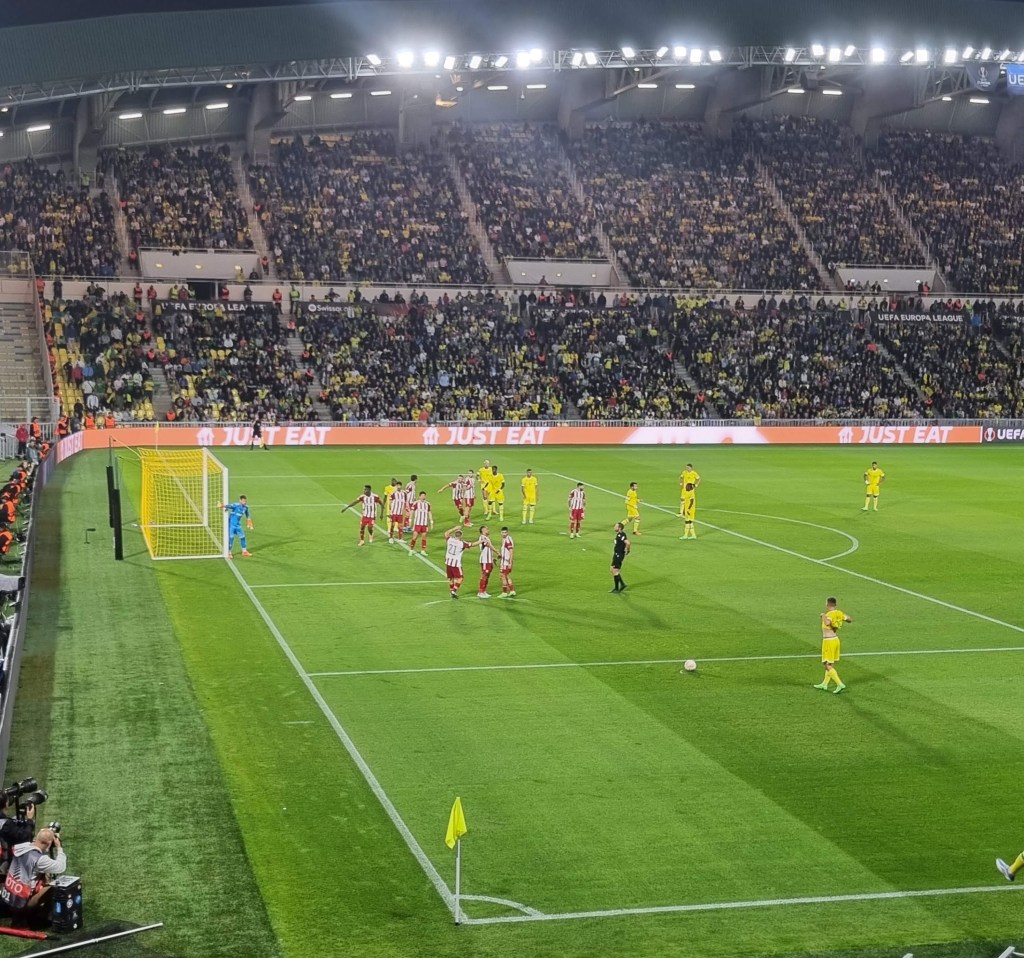
Stade Malherbe Caen 1 AC Ajaccio 0

When travelling, in no real hurry, the 670 kilometres from Calais to Carnac in Brittany, the fine city of Caen is the perfect place to break the journey in two, particularly if SM Caen are playing at home.  So it is that I find myself with my wife Paulene on a Friday evening stood at the Bellivet bus stop in the centre of Caen, waiting for the free shuttle bus (navette) out to the Stade Michel d’Ornano in the suburbs of the city.  The bus is due at seven o’clock, but it’s barely six forty-five yet; we weren’t sure how long it would take to walk from our hotel on the Quai de Plaisance, not long it turns out.

We stand on the pavement outside the bus shelter, which is well populated with people who don’t look like they’re going to a football match, but then, the stop is served by several other bus routes. A man in his early thirties turns to us and asks if this is the stop for the navette (I think he must have deduced from the Ipswich Town badge on my T-shirt that we are football fans).  We tell him that’s what it says on the football club website, and we believe it.   The man is from Caen but has never used the navette before; he is going to the match with a friend who is also Caennais, but has lived in Paris and has never even been to any game before; they are taking the bus so they can have a drink before and after the game., which seems to be the main point of the exercise. The man who has lived in Paris reveals that when he was a teenager, he stayed in Ipswich on a student exchange scheme; they were good times he says, even though he never made it to Portman Road.

Time passes.  Seven o’clock passes. Several buses stop, passengers alight and others get on.  A ramp slides out from under one bus and a woman in a powered wheelchair backs along it onto the pavement.  “Oi Ipswich, my friend here is a Norwich fan” says a rich Welsh voice. “No I’m not, I’m from Cardiff” says the tall grey-haired man standing next to me.  “Have you got your match tickets?” asks the first Welshman.  “Yes” I tell him “But I don’t reckon you’ll need them for the bus, the driver isn’t going to want to check everyone has got one.”  The first Welshman asks if we had been to the ground earlier to buy them, but we tell him we bought them on-line.  “See, I told you we could have got them on-line” says Welshman number two to Welshman number one. “Well, I looked” says Welshman number one, “But it was all in French.”

We talk some more and tell the Welshmen how we were in Cardiff last year to see Haverfordwest (Hwlfordd in Welsh) play their two European Conference League qualifiers. They ask why, and I tell them I was born in Haverfordwest. “You’re Welsh then” they say.  Welshman number two then tells us he’s obsessed with going to new football grounds and after asking us to guess how many he’s been to, he reveals that he’s visited over seven-hundred.   It’s about a quarter past seven now, and an articulated single-deck bus hoves into view bearing the destination “Allez le SM Caen”, At last, it’s the navette, and about forty of us pile on before the bus lurches and twists off up the street, past William the Conqueror’s castle and on past the eleventh century l’Abbeye aux hommes, the Hotel de ville, and the palais de justice all of which miraculously survived allied bombing in World War Two.  On the bus ploughs, on a stop start journey past the more recently built palais des sports, and through the heavy traffic heading for the Caen international fair (Foire International de Caen), which begins tonight.

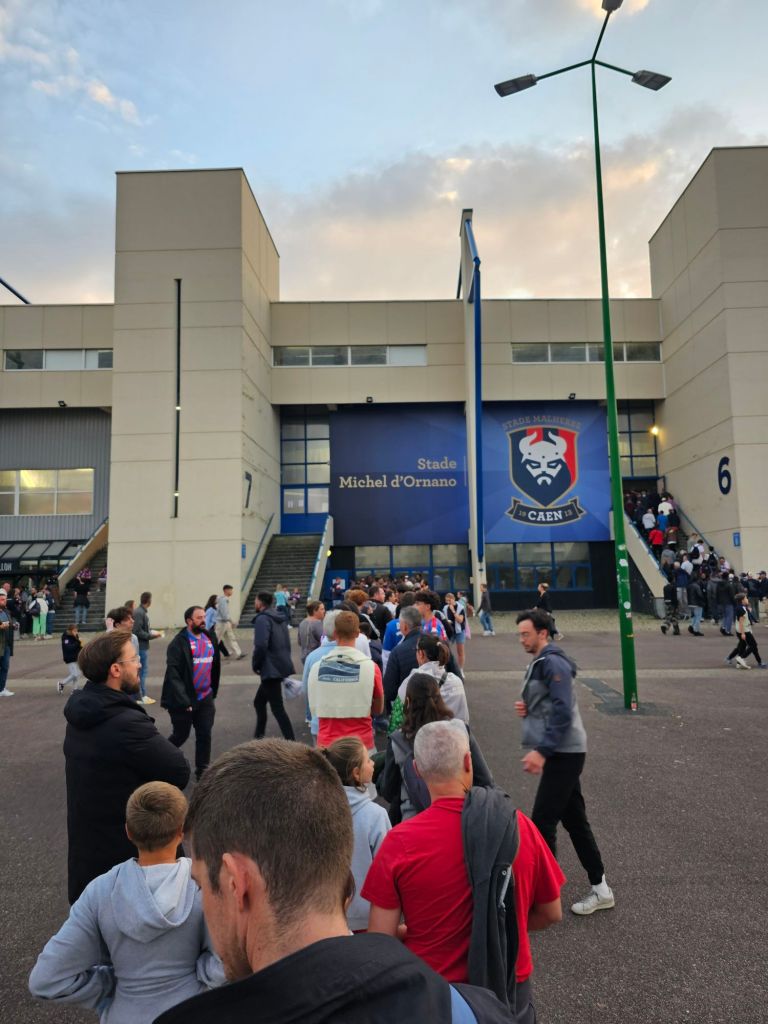
It’s gone twenty to eight by the time the bus disgorges its load at the oddly named  ‘Silicon Valley’ bus stop, directly opposite the Stade d’Onano, and Paulene and I head for the club shop to add to the pointless collections of cuddly club mascots, fridge magnets and T-shirts that clutter up our home back in blighty, although I do wear the T-shirts.   After then joining a queue for Gate 7, six flights of stairs take us to the top of the Tribune Caen from where we have to descend the steep gangway to our seats (24 euros each) in the front row of the top tier of the stand.  Within moments of our sitting down the game begins, tonight’s visiting team AC Ajaccio from Corsica getting first go with the ball, which they succeed in keeping to themselves for much of the first minute of the game. Ajaccio are wearing red and white striped shirts with white shorts, reminiscent of Stoke City and Signal toothpaste.  Caen meanwhile are kitted out in blue shorts and blue and red striped shirts, but the stripes are wavy, reminding me of the sleeve of the Cosmic Roughriders LP ‘Enjoy the Melodic Sunshine’.  Caen are kicking from right to left, back towards the city centre, whilst Ajaccio are aiming more in the direction of the Bayeux tapestry.

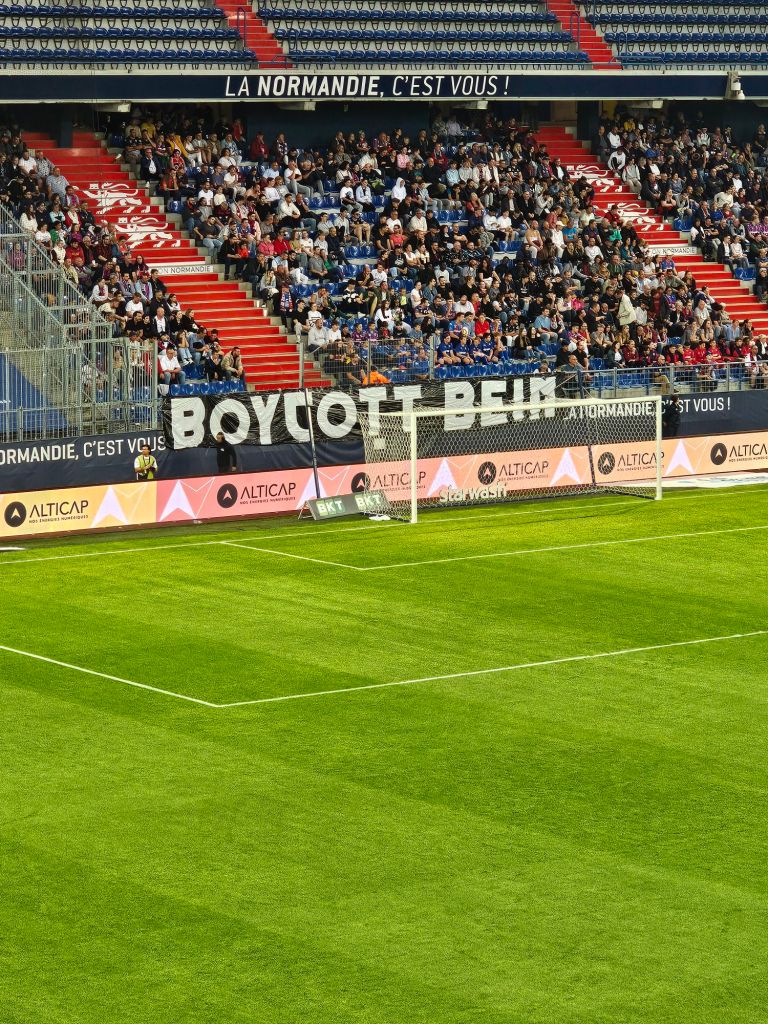
Unexpectedly, the ground seems very quiet as the game begins, possibly because in four matches in Ligue 2 so far this season, Caen have not won, only succeeding in losing three times.  Whenever a Caen player crosses into the opposition half however, I think I can hear a muffled murmurs of “Allez, allez, allez” all around me, and when Caen win an early corner rhythmic clapping breaks out.  With not much happening I take the opportunity to visit the buvette back at the top of the stand where I buy a bottle of water (2 euros) and a merguez sandwich (6 euros).  I return to my seat in time to witness a twelfth minute shot from a Caen player strike the Ajaccio cross bar. Before three minutes later a blizzard of paper planes rain down on to the pitch from behind the Ajaccio goal, possibly as part of the ongoing protest against Ligue 2 matches being moved to Friday nights this season at the behest of Bein Sports tv.  Banners behind the goals read “Le foot le Samedi pour des stades en vie” (Football on Saturdays for lively stadiums) and “Boycott Bein”.

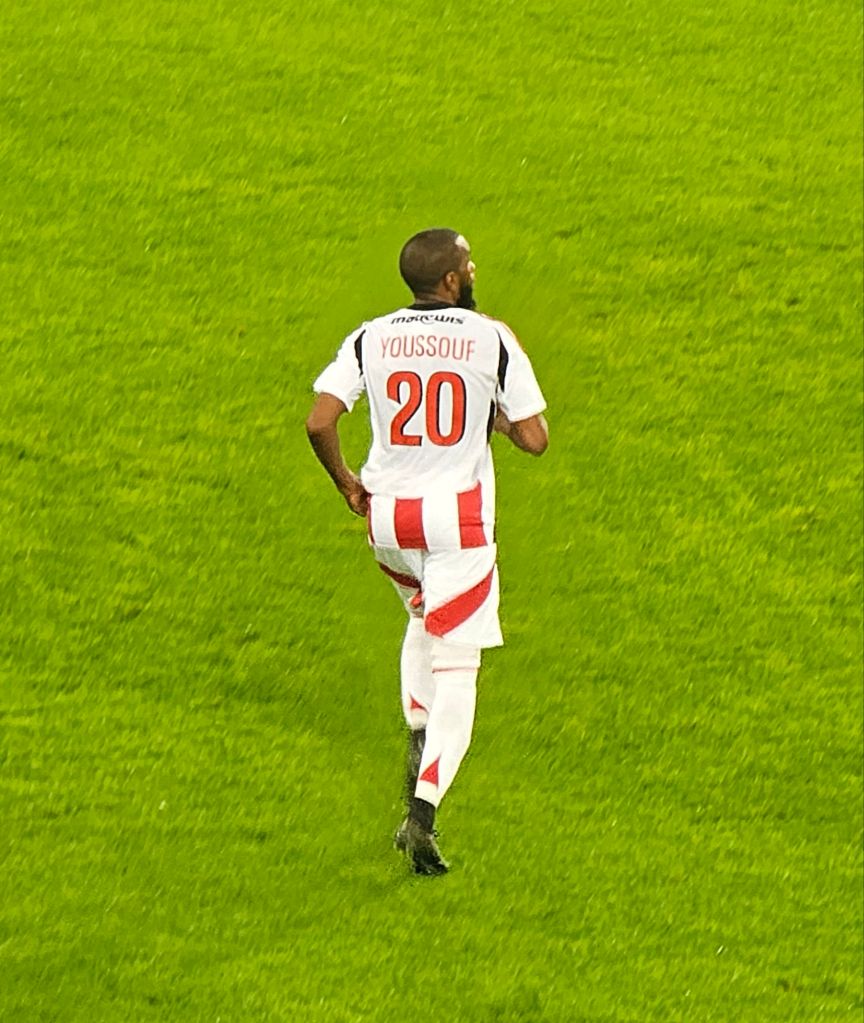
To our left, I count thirteen Ajaccio supporters in their enclosure behind the goal and I think of the Last Supper, before noticing that the Ajaccio number twenty Mohamed Youssef is so short that his socks meet his shorts, creating the effect that he is wearing puttees.  The first half is half over as Caen build a move down the left before wasting all the effort with a shot over the crossbar.  Nine minutes later Caen’s number seven flicks the ball up inside the penalty area before crashing a spectacular volley directly at the Ajaccio goalkeeper, who is in two shades of green.

The game is one-sided with Caen monopolising possession and attempts on goal until six minutes before half-time when Ajaccio have their first shot at goal, a curling effort from number 99, which nevertheless curls straight into the arms of the Caen goalkeeper who admittedly is not easy to miss because he is all in orange.  The first booking of the game follows soon afterwards when Ajaccio’s number thirty-one chooses to tug at the Caen number nineteen’s shoulder rather than attempt to tackle him in the conventional manner.  Two minutes of added on time are added on, to little effect, and at half-time the score remains blank. In a sense therefore, Ajaccio are winning.

Paulene and I move seat during the break because I have been having to duck my head whenever the ball has been in the Caen half due to a large, blue, metal safety rail at the foot of the steps, which extends in front of my seat.  The half-time break passes with people trying to kick a ball into a box for money, and two teams of children in red and blue kit taking a shoot-out competition. The red children all seem about twice the size of the blues and predictably they win, although the only girl in the competition is a blue and she scores her goal.

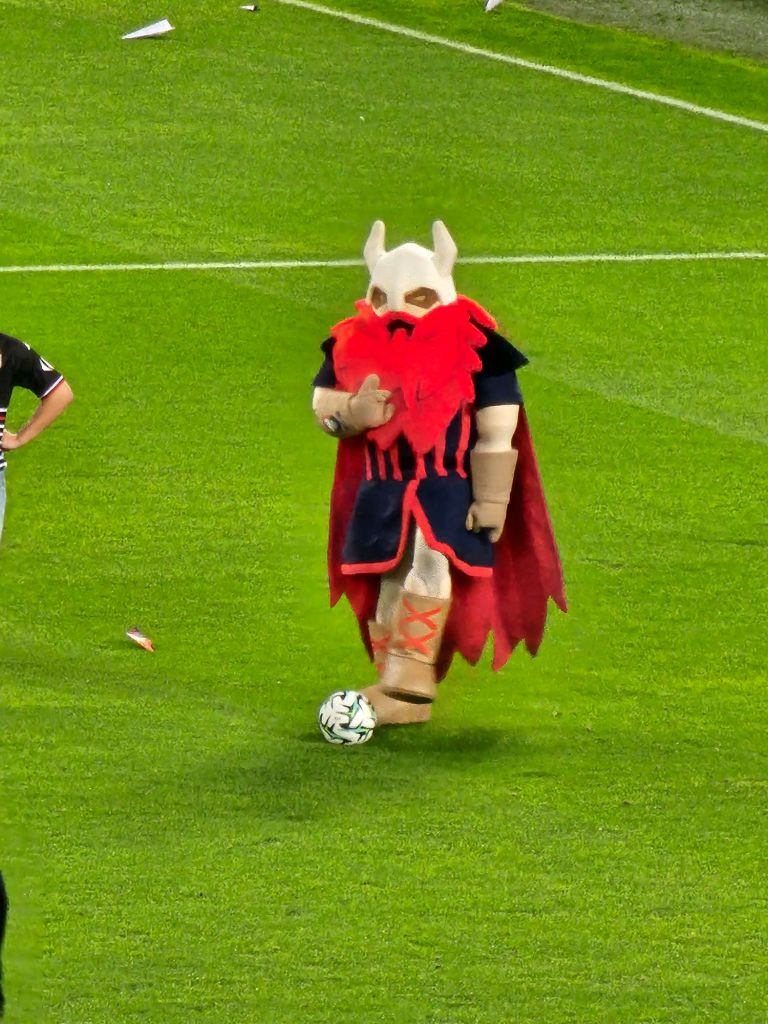
Now, with a clear view of the whole pitch we see the game re-start at nine o’clock and suddenly the stadium is full of enthusiasm and chanting. For no apparent reason the home supporters are singing “Allez, Allez, Allez” to Verdi’s Triumphal March from his opera Aida.  The effect is almost instantaneous as a ball into the box results in claims for a penalty, albeit somewhat specious ones. But a corner satisfies the more realistic supporters, which leads to a shot and another corner and more urging chants of “Allez, Allez, Allez” as the Caen fans loudly live up to what one would expect of their mascot, Vik the Viking.

Only five minutes of the half have gone and now number seventeen Kyheremeh is shooting straight at the Ajaccio goalkeeper before number nineteen heads over the cross bar from a corner.  Sadly however, the score remains blank and for a while the game descends into a Keystone Cops style knockabout with players falling over and colliding with abandon.  Paulene and I begin to notice the advertisements around the ground for the likes of Entreprise Bacon, Calvados the departement or County, as opposed to Calvados the apple brandy, and the interestingly named Twisto, the local transport company who brought us here this evening in one of their articulated buses.  Off to our left, I can only count eleven Ajaccio fans now and wonder if two have had to leave early to catch a ferry, or whether they just gave up hope.

Only twenty-five minutes remain as Caen’s Kyeremeh is through on goal, but he chooses to run wide and cross low to the near post where the ball is saved at the expense of a corner.  “Allez, Allez, Allez” sing the home fans again, but this time to the tune of the Beatles’ Yellow Submarine, not Verdi.  Thirteen minutes remains and Caen’s number four has come on as a substitute only to quickly get booked as he struggles to influence the game.   Three minutes later however, comes the decisive moment. Caen’s number ten, Bilal Brahimi, who has been neat but nothing more for most of the game, suddenly has space outside the Ajaccio penalty area from where he unexpectedly launches a shot into the top right-hand corner of the Corsican goal; Caen lead one-nil.  “Bilal, Bilal” chant the Caen fans as his picture appears on the scoreboard and the stadium announcer tells us who scored.

Ajaccio have made little effort to score themselves and now they might have left it too late.  Ajaccio substitute number twenty-one Ivane Chegra is brought on to add flair by the look of his Marc Bolan style coiffure, and number twenty-two Moussa Soumano succeeds only in getting booked as the match rolls on into five minutes of added on time.  The added-on time is of no consequence however, and with the final whistle the relief for Caen’s supporters having won their first match of the season is plain to see.

With a bus to catch we don’t linger to join the ensuing love-in, and that bus is almost full and ready to leave as we board it.  Down the streets beyond stadium vivid, sudden flashes of light appear and soon there are spots of rain on the windows of the bus as it weaves its way through the post-match traffic.  By the time we reach the city centre a heavy downpour is drumming against the roof of the bus and the streets are awash.  With the bus windows steamed up and streaked with rain I have to ask a fellow passenger to tell me when we’re back at Bellivet bus stop.  It’s a dramatic end to the evening and an uncomfortably wet walk back to the hotel, but I don’t think we’ll forget our night in Caen.
Ipswich Town 1 Cheltenham Town 1

In the final scenes of Lindsay Anderson’s 1968 film ‘If’, the central character Mick Travis, played by Malcolm McDowell, and his nameless girlfriend launch a machine gun attack on the parents, teachers and governors at a school speech day.  The scene was filmed at Cheltenham College and it’s one of my favourite scenes in one of my favourite films; Wikipedia tells us that ‘If’ won the Palme d’Or at Cannes in 1969 and in 1999 the British Film Institute ranked it as the 12th greatest British film of all time.  As if that association with such a great film is not enough kudos for Cheltenham, it also has a football team that has never lost to Ipswich Town. Today Ipswich Town and Cheltenham Town meet at Portman Road for only the second time in recorded history.  I don’t know it yet, but later today I’m going to feel like Mick Travis.

In north Essex it has been a stupendously dull morning, both still and depressingly grey, like November days should be. It’s only when I approach Ipswich that a diffuse yellow light begins to filter through the grimness and then bright sunshine bursts from a clear blue sky like a metaphor for the end of the working week and the arrival of Saturday, heralding a match at Portman Road.  Before the game I visit my mother and we reminisce about all manner of things from years ago and she tells me how her grandfather, Sam Scarff, an agricultural labourer from Needham Market, enrolled with a friend for evening classes, joined the police and rose to the rank of inspector in the Met’ before retiring to become a game-keeper in Shotley; his friend became a police commissioner, and I thought social mobility was a 1960’s thing.

Leaving my mother with her memories, I drive across town and park up on Chantry. The streets are busy with people in football-supporting attire. I walk across the wet grass of Gippeswyk Park and marvel at how lush and green the turf now is compared to how dried up, brown and withered it was on the first day of the football season three months ago.  In Sir Alf Ramsey way I attempt to buy a programme (£3.50) in the modern cashless manner, but the technology isn’t working today.  I laugh and hand over a five pound note to the somewhat miserable and overweight looking youth in the programme booth.  The Arbor House, formerly known as The Arboretum, is busy with pre-match drinkers, but I am served quite quickly and order a pint of Nethergate Complete Howler (£4.00). I head for the garden where Mick is already sat at a table with a pint of a dark beer from the Grain brewery which he’s not very keen on, I take a sip and agree that it’s not exactly moreish, but then the Grain brewery is located in Norfolk, albeit with an IP postcode.  Before long Roly joins us and proceeds to dominate the conversation, mainly because he seems to have the ability to talk without drawing breath, which means a polite person like me can’t get a word in edgeways, not that I have much to say.  We, by which I mean mostly Roly, talk of local council chief executives, Roly’s five-year-old daughter Lottie, primary schools on the Essex Suffolk border and the performances of Town player Dom Ball.  Between twenty-five and twenty to three we leave via the back gate of the beer garden and head for Portman Road.  I bid Mick and Roly farewell by the turnstiles to the Magnus Stand, formerly known as the West Stand.  We speak briefly of when we will next meet; it will be for the five o’clock kick off v Buxton in the FA Cup on Sunday 26th November.   I won’t be going to the mid-week game versus Portsmouth as I am boycotting the Papa John’s EFL Trophy, not because I have anything against oily, takeaway pizza, but because I think the competition has been debased by the inclusion of Evil Premier League under-21 teams.  I am particularly looking forward to not going to Wembley should Town make it to the final, when I will blow a metaphorical raspberry to all those people who believe that anyone boycotting the competition will automatically abandon their principles if Town get to the final.  Such beliefs help explain why we have a Tory government.

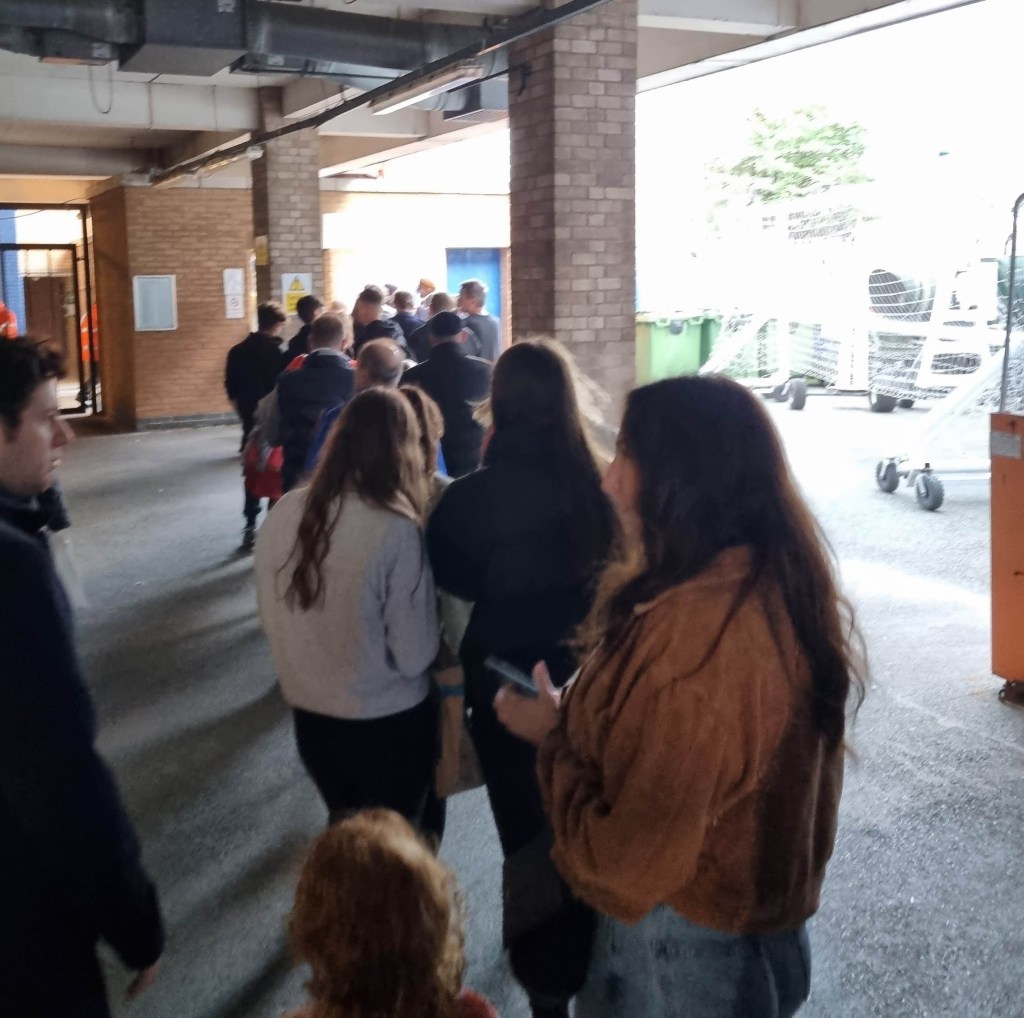
Most unusually, today there is a queue at the turnstiles for the Sir Alf Ramsey Stand which are accessed from Constantine Road, but quite soon an extra turnstile opens up (No61) and a cheerful man presents bar codes to a screen and I pass through the portal to another world.  That pint of beer has already found its way to the exit and from the gents beneath the stand I hear stadium announcer Stephen Foster reading the team line-ups from the scoreboard in his best local radio DJ voice.  I arrive at my seat just as a minute’s silence begins for Armistice day, although that was actually yesterday.  Oddly, the Football Association have decided not to cancel the fixtures today as they did when they felt they couldn’t trust football crowds to observe a minute’s silence for the death of Queen Elizabeth back in September.  The minute’s silence is of course observed perfectly. Stephen Foster reads from Laurence Binyon’s 1914 poem ‘For the Fallen’ and the last post is played exquisitely, even if it does slightly spoil the solemnity and dignity of the moment to then be told by Stephen Foster that Jon Holden who played it is a member of the Co-op East of England Brass Band.  It’s probably just me, but I can’t help sniggering a little at any mention of the Co-op.

After a fly-past by a couple of Army helicopters, and a brief burst of ‘Hey Jude’, the game begins with Town getting first go with the ball and kicking towards me , Pat from Clacton, ever-present Phil who never misses a game, Fiona and the man from Stowmarket.  Town are thankfully back to wearing their blue shirts and white shorts after the all-black aberration against Derby, whilst Cheltenham Town are wearing red shirts and shorts with their ruddiness off-set by white socks and a white pin-stripe on their shirt fronts.  Quickly, Portman Road sounds in good voice as the altered version of ‘Mary’s Boy Child’ in which she eternally fights Norwich on Boxing Day rings around the ground.  On the touchline, Town manager Kieran McKenna is looking stylish, if a little drab in a black jacket and trousers with a plain jumper, which I at first think is beige but then think is grey; perhaps it’s taupe?

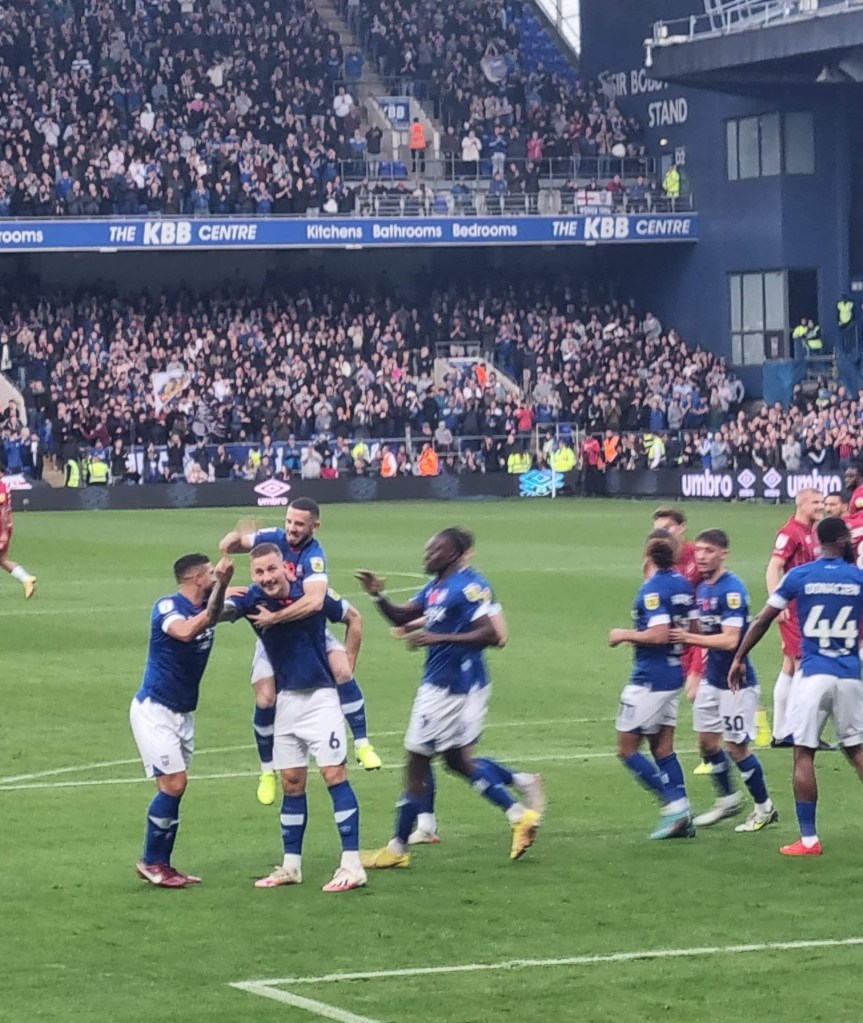
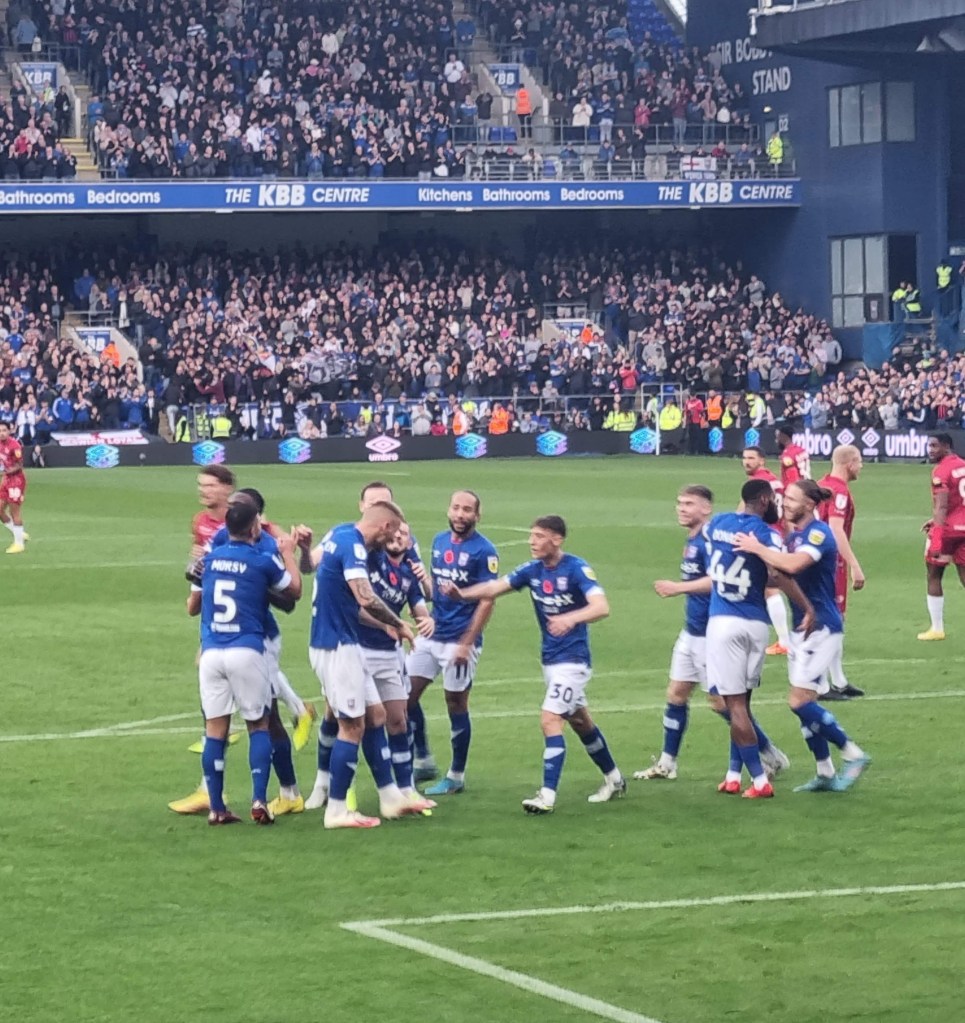
From the start Ipswich dominate and it feels as if everyone, from the supporters to the players really wants to win this match. We all remember the life-denying, spirit crushing goalless draw against Cheltenham from last season and that’s our inspiration to see Town give these upstarts, better known for their poncey Regency spa a sound thrashing.   Crosses rain into the Cheltenham penalty area and although one from Conor Chaplin goes a bit off course and strikes Wes Burns in the throat Sam Morsy soon has the first shot on goal and then from a corner Luke Woolfenden hooks the ball into the goal from close range and Town lead 1-0.  Woolfenden runs off sucking his thumb with the ball up his jumper and ever-present Phil mentions something about the birth of wolf cubs; I suggest he has simply discovered the joy of sucking his thumb. 

More corners and crosses follow and I chant “Come On You Blues” and so does Phil, but no one else does.  “Two of you singing, there’s only two of you singing” announces Pat from Clacton, sort of singing herself, which is ironic.  Janoi Donacien strides forward into a rare bit of space and pulls the ball back to Marcus Harness; the Cheltenham defence is rent open like a tin of corned beef on which the key has broken half-way round and it’s been necessary to open both ends with a tin-opener to get the meat out. Harness must score, but somehow the ball strikes the under-side of the cross bar as if deflected away from the goal net by some invisible force…either that or Harness made a hash of it.

There are more corners to Ipswich, loads of them, and Phil and I keep chanting “Come On You Blues” vainly hoping someone will join in with us. We change to the simpler “Come on Ipswich, Come on Ipswich” but the occupants of the Sir Alf Ramsey stand aren’t moved.  I think to myself that I might as well be singing in French and so I do “Allez les Bleus, Allez les Bleus” I chant; Fiona says I’ve gone too far. On the pitch Janoi Donacien is hurt and is replaced by Kane Vincent-Young and the ball skims off the top of Cheltenham number six Lewis Freestone’s head as if he was a man who had applied too much brylcreem to his hair.  Another cross and Leif Davis precisely places a carefully controlled header over the Cheltenham cross bar.  Within a minute, Cheltenham equalise as Ryan Broom sweeps forward and shoots at Christian Walton, who somehow cannot stop the ball squirming around, or under,or through him into the goal.  It might have been the brylcreem on the ball.  It will prove to be Cheltenham’s only real shot of the game and up in the Cobbold stand a knot of about twenty excited youths jump around and wave their arms about like bookies on a race course, or idiots trying to fly.

Disappointing as that equaliser is, Town press on, although not quite as well as before.  When the Cheltenham goalkeeper parries a low Marcus Harness cross out to Cameron Humphreys, somehow the ball comes straight back to him.  Two minutes of added on time are announced very noisily by Stephen Foster, as if he’d turned the PA system up to eleven. “Speak Up” says Pat from Clacton.   I applaud Town off the field with the half-time whistle and go and talk with Ray, his son Michael and grandson Harrison.  I ask Harrison if he has got the new Robyn Hitchcock album ‘Shufflemania’ yet, he says he may get it for Christmas as he looks at his dad.

The match resumes at six minutes past four and a chorus of ‘Blue and White Army’ briefly rolls around the stands, not exactly like thunder. On the stroke of the 53rd minute the crowd rises for a minute’s applause in memory of Supporters’ Club Chairman Martin Swallow who died at the end of October.  A lone seagull floats above the pitch; no doubt someone would think it poignant. 

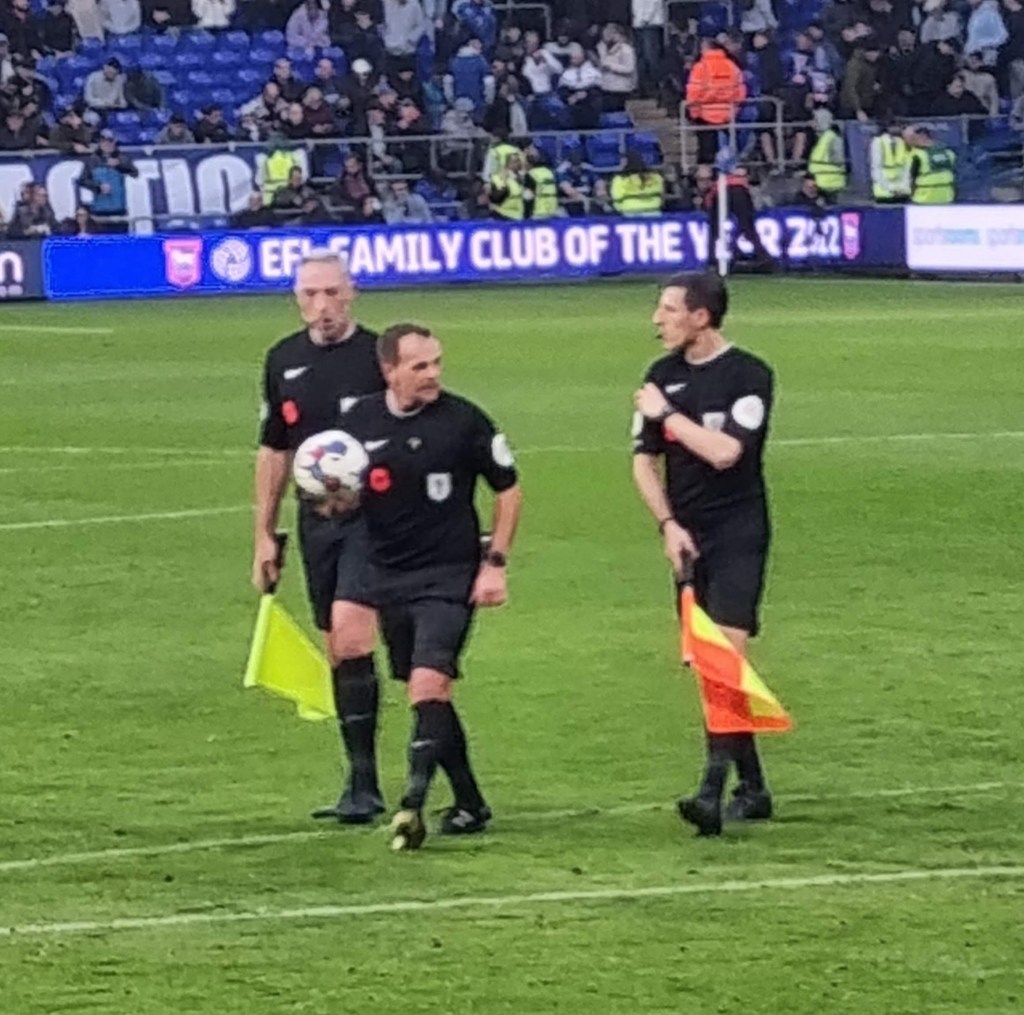
With Cheltenham confined to their half of the pitch due to constant Ipswich possession, this is the sort of game where every moment lost through a Cheltenham player sitting on the grass or receiving treatment is going to be attributed to time-wasting, and so it proves. Referee Mr Eltringham, a man with ‘ten to two’ feet, books the Cheltenham goalkeeper as a warning shot to his team-mates in this regard and in all fairness, they do not break the game up as much as they did in the goalless game last season, but it’s not enough to stop the bloke behind me from saying “He’s gotta be one of the worst fuckin’ refs we’ve ‘ad down here”.   When Cheltenham players do receive treatment their physio runs on with a huge bag and what looks like a small surf board; with a blonde wig and high cut one piece swim suit he could have doubled for Pamela Anderson in Baywatch. 

“Over and in” says Pat from Clacton in the time-honoured fashion, but it never happens. Marcus Harness heads carefully past the post in the same way Leif Davis headed over the bar in the first half, Wes Burns and Marcus Harness are replaced by Kayden Jackson and Kyle Edwards, but it makes little difference.  Chances come and inevitably go as if there is no possible way to get a ball across the line between the two goalposts.  The crowd is announced as 25,400 including 175 from Cheltenham; it’s the smallest away following at any Ipswich match this season; so more credit to those who did bother.  “Here for Cheltenham, you’re only here for the Cheltenham” they sing which I guess they are, and on the Clacton supporters coach Chris wins the prize with his guess of 25,444; Pat is disappointed that so few pet animals have been attributed guesses this week.

With time slipping away, the gloom of the late autumn evening descends along with a seasonal mist which softly shrouds the floodlights. “There’s nothing wrong with you, there’s nothing wrong with you” chant the North Stand appropriating some Verdi opera as another Cheltenham player takes a breather by sitting on the turf.  The final minute arrives and Panutche Camara replaces Conor Chaplin. There will be at least seven minutes of additional time, which is time enough for Camara to strike a shot against the inside of a goal post; again, the ball of course stays out of the goal rather than deflecting into it. All too soon the final whistle is blown and for a second time this year Cheltenham Town have clung on to a point at Portman Road with resolute defending and huge dollops of luck.  With defending like this and the ball having such an aversion to crossing their goal line, it seems odd that Cheltenham Town have ever lost any match.

“Frustrating” says the man from Stowmarket as he edges past me to the exit “Yes, but we’ve seen it all before, just a few weeks ago” I reply, re-living the pain of the match versus Lincoln.  But my comment hides my disappointment and beneath my reasonable exterior irrational thoughts and questions swirl in a maelstrom of post-match angst and anger; how can Ipswich Town be so much better than the opposition but still not beat them? Is Ipswich Town somehow cursed?  Where is there a high roof from which a sniper could shoot freely and indiscriminately?

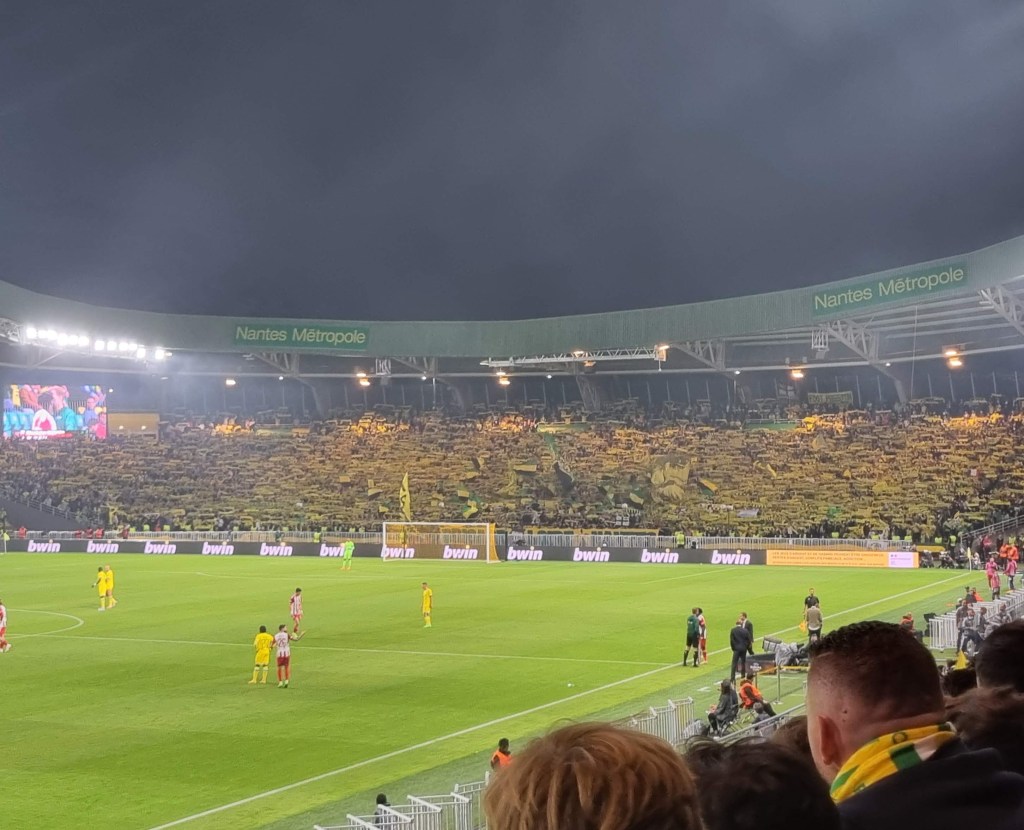
FC Nantes 2 Olimpiakos 1

The Stade de la Beaujoire in Nantes is a stadium I have long wanted to visit because on the telly it looks a bit different to your run of the mill English footie ground and certainly a cut above the diet of Portman and Layer Roads I grew up on, as lovely as Portman Road still is and the much-lamented Layer Road was.   Having missed out on tickets to see FC Nantes at home to Paris St Germain due to cost and lack of decisiveness, the opportunity to see the Breton club at home in the Europa League to Olimpiakos just five days later was not to be passed up.  To add further to the mix, historically FC Nantes is one of France’s most successful football clubs, with eight league titles and four Coupes de France to their name.  But until Nantes won the Coupe de France this year (1-0 versus Nice) they hadn’t won either of the major French trophies since 2001, which co-incidentally was the last time I was in Brittany.  Nantes’ return to European football and mine to Brittany seems serendipitous therefore.

Tickets for concerts and large sports events across France can usually be bought at the larger supermarkets but having had no luck at a branch of Super U on Monday, that evening my wife Paulene went on-line and acquired a couple of the last few tickets available from the club website.  Feeling flush after a recent cash windfall we also booked a hotel for the night, although we are actually staying at a campsite about an hour and a half’s drive north of Nantes.  Not surprisingly, being on holiday we don’t have a printer with us, but the hotel has kindly printed our tickets off for us.  Our hotel is just a ten or fifteen-minute walk from the Stade de la Beaujoire across a small municipal park.  The stadium and hotel are also conveniently situated at the end of Ligne 1 of the city’s tram network and the twenty-minute trip into town is a bargain at one euro seventy.

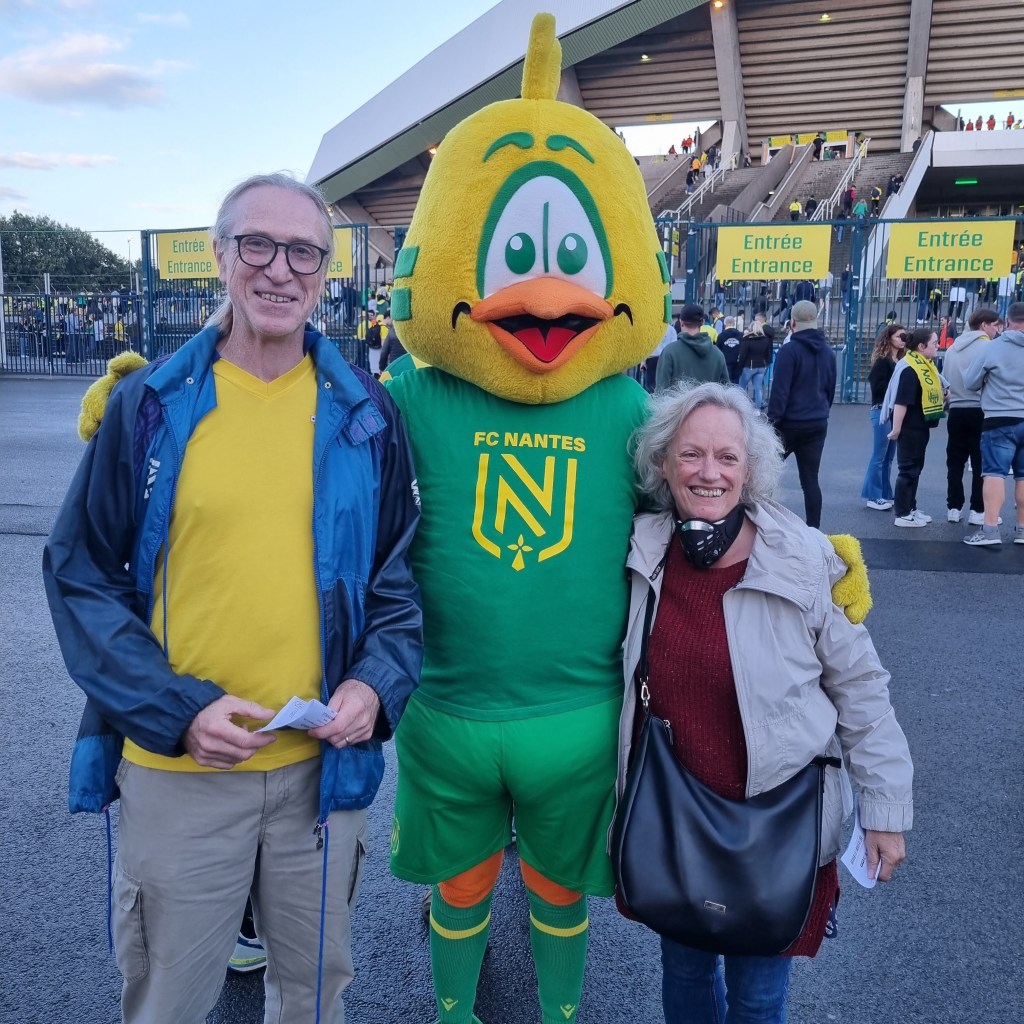
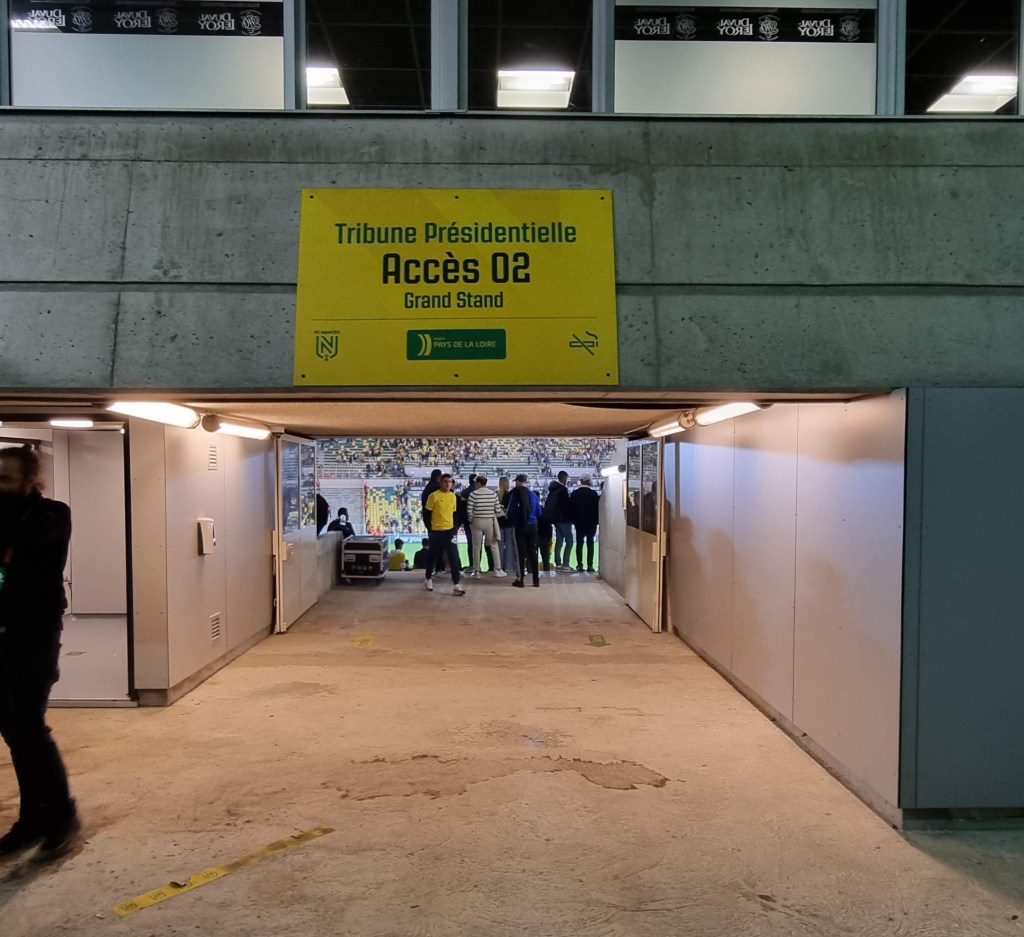
It’s been a warm but cloudy day with an ever-present threat of heavy showers, but thankfully we’ve avoided those and as had happened a week ago at Rennes, I had been in the club shop adding to my collection of petits fanions (pennants) and fridge magnets when the heavens had opened.  Now, at a bit after seven-thirty we queue to be patted down before entering the stadium.  I can’t help feeling that the security guy checking me out has decided I don’t look much of a threat and having tapped me about the arms a bit he looks bored and lets me through; it’s either that or my excited smile made him think I might enjoy a more thorough search a bit too much.  Either way, he wishes me ‘bon match’ and Paulene and I head for Access 02 of the Tribune Presidentielle, but not before we have met Riri the Nantes club mascot.  Nantes play in all yellow and are known as the Canaries, so as an Ipswich Town supporter it requires mental strength to be photographed with their mascot, but overcome with the spirit of liberte, egalite and fraternite I throw myself into the occasion and feel all the better for it.  But I am protected by my yellow 1970’s Town away shirt.

Like most of the bigger stadiums in France, Stade Beaujoire is a genuine piece of architecture, not just a feat of engineering, a box or a collection of individual stands clad in sheet metal.  Set into a gentle slope, its undulating roof arching above the two-tiered lateral stands and the two single tier ends, Beaujoire is an elegant essay in concrete and steel which seems bigger inside than out.  Our seats are at the side of the pitch but behind the goal line, nevertheless the view is excellent, aided by the stadium’s bowl-shaped floor plan.

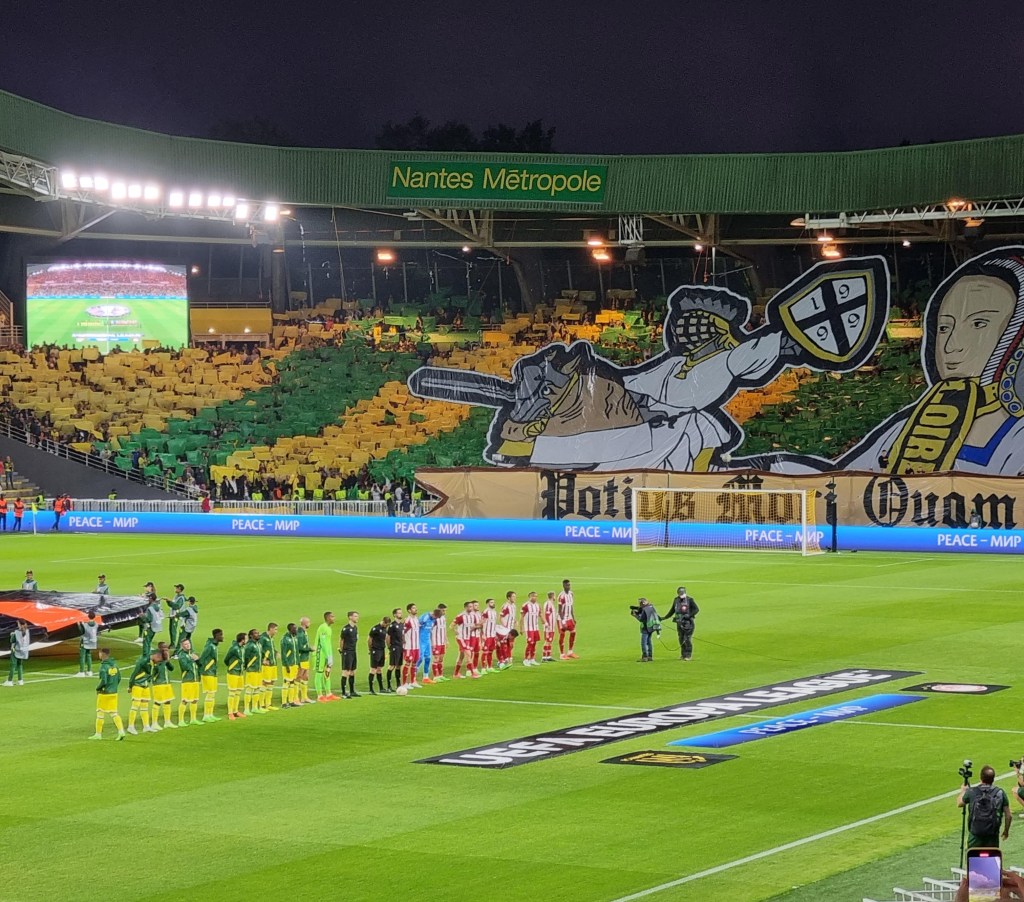
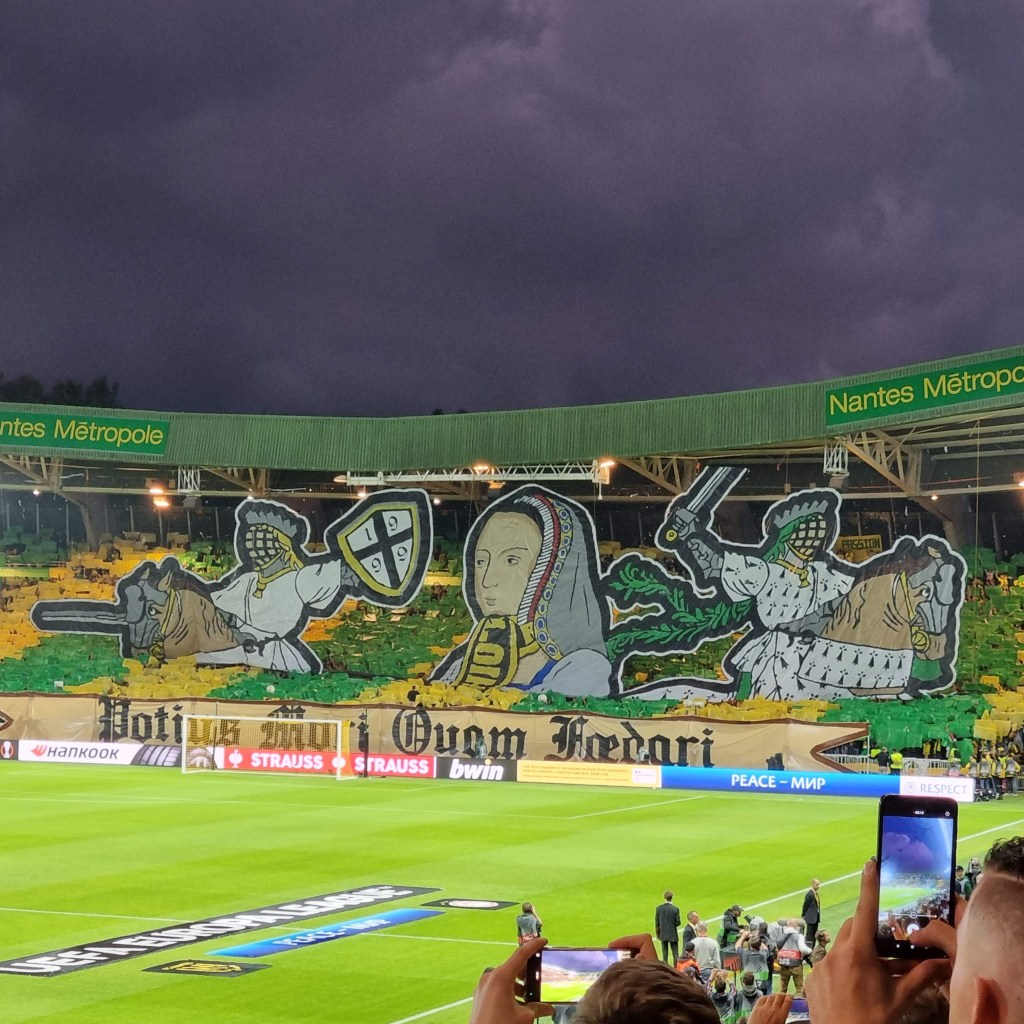
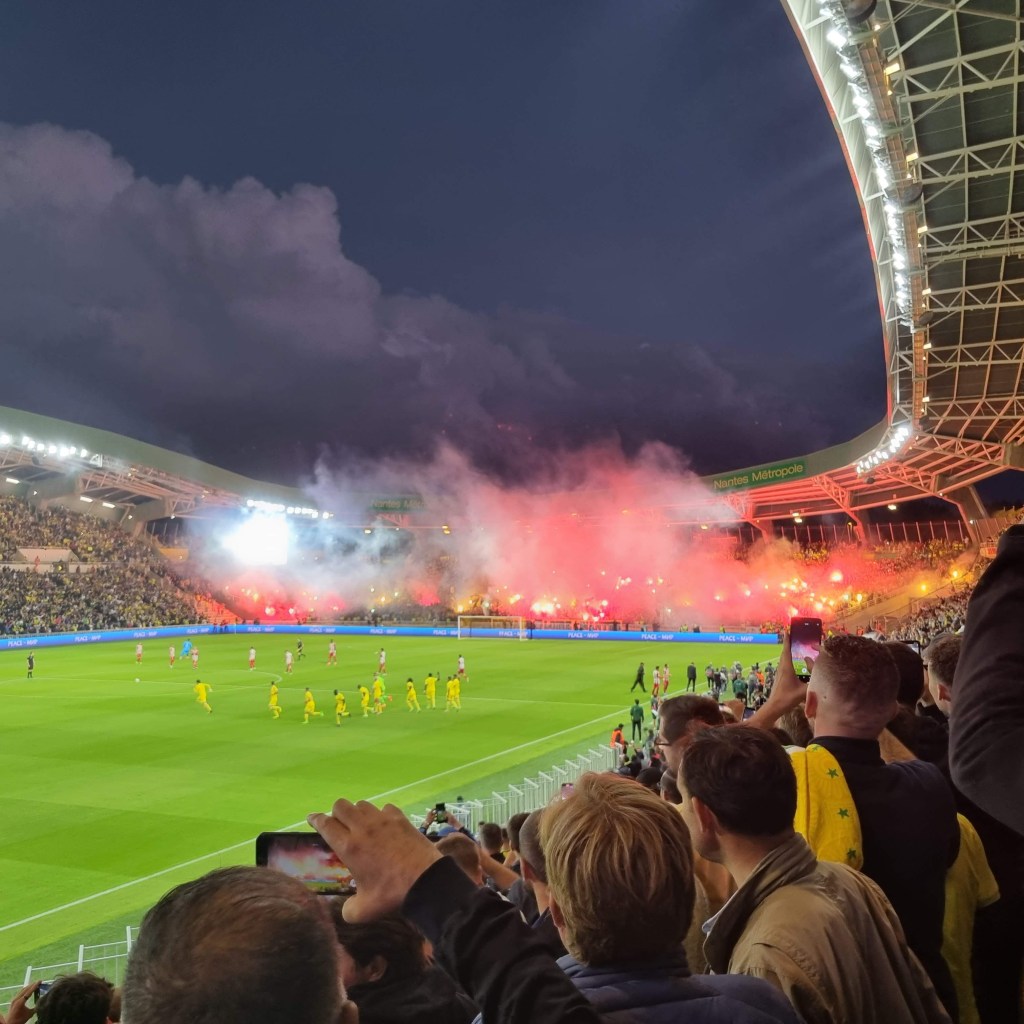
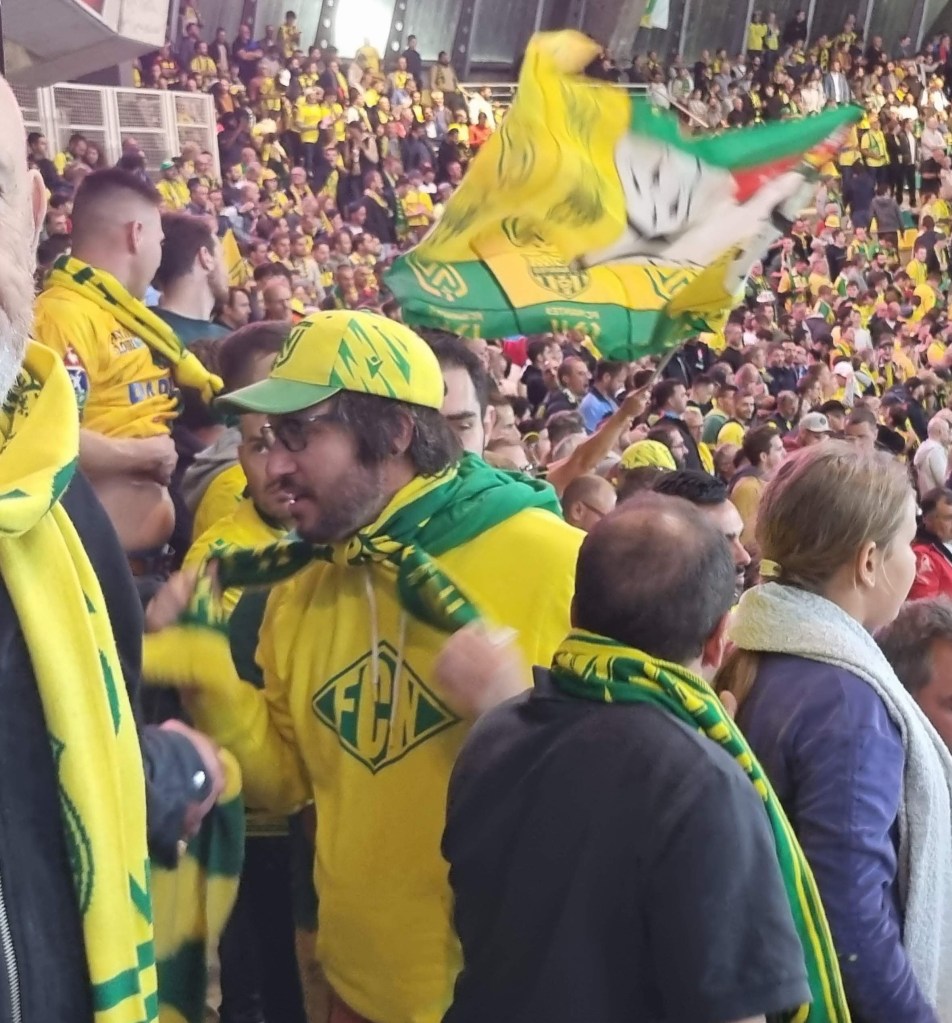
People get to big matches early in France and make use of the many stalls providing food and drink that surround the stadium.  Equally, the stadium is full before the nine o’clock Coupe d’envoi (kick-off) and with good reason because the prelude to the match includes a stirring anthem, which supporters sing whilst twirling their scarves a la Leeds United fans of the 1970’s; I had wondered, given that it is a warm September evening, why the club shop was doing such a roaring trade in scarves.  Most impressive however, and possibly the most impressive thing I have ever seen at a football match is the raising of a huge tifo at the Tribune Loire end of the ground depicting Anne the fifteenth century Duchess of Britanny (a local heroine for resisting Brittany’s annexation by France) wearing a Nantes scarf and flanked by a pair of jousting knights. Beneath the tifo in Gothic script and in Latin it reads “It is better to die than to be disgraced”, which seems to be going a bit far, even for a Europa League fixture.

Less than an hour before kick-off the death of Queen Elizabeth II had been announced and most of the ground observes a minutes’ silence, although at the Tribune Loire end of the stadium there was never any likelihood of this happening given the levels of excitement, as witnessed by the ceaseless noise, flag waving and glow of flares.  I am sure many would say “Bloody French ‘ooligans”, but I don’t.

As the match begins it is Nantes who get first go with ball, aiming it at the goal through the drifting smoke at the Tribune Loire end of the stadium. Nantes are in all yellow whilst Olimpiakos wear red and white striped shirts with red shorts and socks. “Lo-lo, lo-lo-lo, lo-lo, Allez les Jaunes” (Come On  Yellows) sings the crowd and then the Tribune Loire calls out “Allez Nantaises” and the Tribune Erdes at the far end of the ground echoes the shout.  Nantes have started at a fast pace and with the first promising looking attack it seems that everyone in the ground but for the couple of hundred Olimpiakos fans, is up on their feet and bawling encouragement.  Everywhere is just noise, it is absolutely thrilling. “Allez, Allez, Allez” rings out to the tune of The Beatles’ Yellow Submarine.

On the field, Nantes are in truth struggling to get through the Greek defence.  In midfield Pedro Chirivalla is busy, but most attacks go through Ludovic Blas and Evann Guessand on the right, although the tactic of getting crosses into the lone forward Mustapha Mohamed isn’t coming close to creating a goal, only corners. Blas is set up twice, only to blast the ball hopelessly high and wide. Whilst the football isn’t always the best, the spectacle however is; but a little over half-way through the first half even the Tribune Loire has started to quieten down just a little. In front of us, a lone drummer with a massive bass drum tries to raise the crowd in the Tribune Erde and Tribune Presidentielle once more; he is wearing a Nantes kit over the top of what looks like silk pyjama bottoms; his face is smeared with green face paint and on his head he is wearing a lurid, long green wig.   Between rhythmic drum beats he claps his hands and sings “Allez Nantes”.  A middle-aged man to our right answers the call with a mad passion which belies his age, but mostly people just clap along almost out of politeness. 

The flame of really noisy support is rekindled however, just before the half-hour Nantes win a free-kick on the right. “Lo-lo, lo-lo-lo, lo-lo, Allez les Jaunes” is the theme once more and although the free-kick comes to nought the momentum is retained and four minutes later Blas’s through ball confounds the Greek defence and Mustapha Mohamed runs on to place the ball coolly and firmly into the far corner of the goal beyond the Olimpiakos goalkeeper Tomas Vaclik.  The roar from the crowd is immense and Nantes lead 1-0.

Only a second Nantes goal can feed the desire of the home crowd, but it is Olimpiakos who now get to have their first shot on goal as a neat passing move ends with an overlap on the right and a shot that goes both high and wide of the Nantes goal from only about 10 metres out.  The be-wigged drummer makes a second tour of the area at the front of the stand, but the first half soon ends, unusually with no additional time being played.

Over half-time Paulene and I stay in our seats whilst many in the crowd drift out to the buvettes for food and drink. We reflect on the first half and agree that this is possibly the most fantastic atmosphere we have ever experienced at a football match and that on tonight’s showing the Nantes supporters are probably even more passionate than those of Marseille or St Etienne.

The game resumes at a minute past ten as the moon rises above the Tribune Oceane opposite. “Na-Na-Na, Na-Na-Nantaises” sings the crowd to the tune of The Beatles’ Hey Jude. Olimpiakos appear either to have been given a stiff talking to at half-time or they have simply decided to attack rather than just defend. Five minutes in and the Greeks win their first corner of the match.  The ball arcs across to the far post and Nantes ‘keeper Alban Lafont moves to punch the ball away but completely misses it, instead the ball strikes defender Samuel Moutassamy and drops feebly and apologetically into the goal net.  It is such a poor goal no one seems to believe it, not even the Olimpiakos players who can barely bring themselves to celebrate, making do with a few mutual pats on the back. Over in the corner of the stadium between the Erdre and Oceane Tribunes the travelling supporters are doing more than enough cheering and dancing for everyone.

The Olimpiakos goal gives them a lift and the balance of play evens out in the second half, but Olimpiakos are also much more combative and to prove the point Panagiotis Retsos is the first player to be booked, for a foul on Nantes’ Ignatius Ganago.  From the resultant free-kick on the right, Ludovic Blas is set up for a third time, but he boots his shot hopelessly high and wide again.  With a third of the match gone Nantes win a corner from which Andrei Girotto flashes a header just wide of the goal. Minutes later Olimpiakos win a corner, but Alban Lafont succeeds this time in punching the ball away.

With twenty minutes left, Nantes make a couple of substitutions and quickly win a corner after a cross from Moses Simon, who has replaced Ganago, is met with a header from the other substitute Moussa Sissoko which Vaclik tips over the cross bar. “Nantes Allez, Nantes Allez, Nantes Allez” sing the crowd to the Triumphal March form Verdi’s Aida as they hold their scarves aloft all around the ground, a spectacle sadly no longer seen in England.  The sense of the crowd willing the team to score is palpable, but Nantes are not significantly threatening the Olimpiakos goal.  When Nicolas Pallois strides forward in the eightieth minute to launch a shot from at least 30 metres, which travels a respectably small distance over the bar, it is as if he had simply got fed up with his team-mates’ patient passing and had decided to take matters into his own hands.

A minute after Pallois’ effort, Nantes at last break speedily down their right and the ball is crossed low before being laid back to the incoming Guessand who strikes a spectacular rising shot into the roof of the goal net.  It looks the perfect goal, the sort worthy of winning any match. The Nantes players celebrate wildly as does the whole stadium, with the exception of one tiny quadrant in the corner where the Greek fans sit.  The scoreboard registers the second Nantes goal, and the players walk back to kick-off again, but the Olimpiakos players are whinging to the referee who has a hand to his ear. We wait.  The referee then draws a square in the air and points to patch of grass level with the Olimpiakos penalty box and the scoreboard confirms that VAR says the goal is annulled for an earlier hors-jeu (offside).

The feeling of disappointment subsides surprisingly quickly and soon we are distracted by some pushing and shoving on the touchline. The ball has gone out of play and runs to the Olimpiakos coach who seems to hold it out for Nicolas Pallois to take, but then turns away; Pallois gives him a little shove for his trouble and then anyone nearby joins in with the melee and those further away catch a tram to come and join in.  The referee possibly cautions Pallois and the Olimpiakos coach, but it’s hard to say for sure.  Sadly, it’s the last real action of the half and all hope is to be squashed into four minutes of time added on or the more poetic sounding time additionelle

Additional time begins, two minutes in and Blas and Oleg Reabciuk are both booked after the former fouls the latter and the latter gets upset.   A minute remains of added time; Nantes again attack down the right, Ludovic Blas crosses the ball and the sizeable figure of Evann Guessand  hurls himself at the ball. Spectacularly, Guessand scores with what is arguably the best type of goal, a diving header.  The rest is near mayhem, with Stade de La Beaujoire erupting into scenes of unbridled joy and pride in the team and being Nantoises.  All around me people are just deliriously happy, whilst some have a look on their faces of vindication, as if to say it’s taken nearly twenty years, but Nantes are back like they knew they would be.

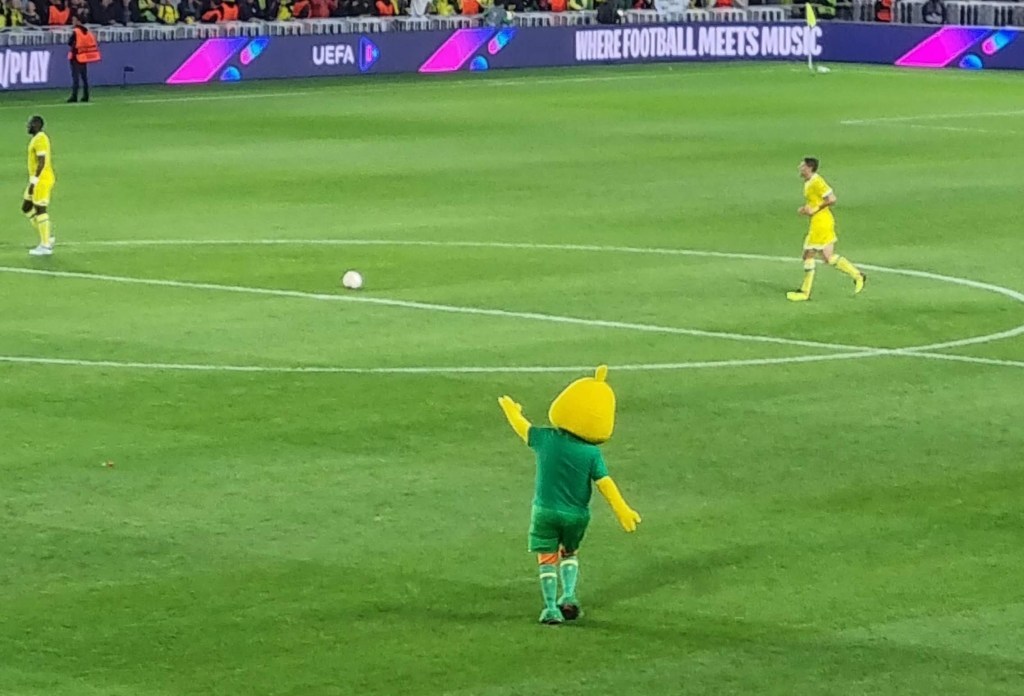
With the final whistle no one wants to leave. I don’t think I have ever been to a game where so few people, if any, have left before the end. The Nantes players gather in front of the Tribune Loire to salute and commune with the Ultras groups who have ceaselessly chanted, sung, shouted and waved their banners and flags throughout the match.  Riri the canary mascot runs across the pitch arms outstretched as if trying to take off and joins in with the players’ celebrations.  We, along with everyone else, wait for the players to break away from their love-in with the ultras and do a lap of honour to the rest of the stadium. As the players head back towards the tunnel we leave, joining the flood tide of happy, smiling people.  This has been a truly fantastic night.

Ipswich Town 0 Sheffield United 1

The ‘hectic Christmas schedule’ is over and today is the first Saturday of the new year and is therefore the day of the FA Cup third round, once one of the most auspicious dates in the English football calendar. The evil Premier League and the Football Association itself have together destroyed the glory of the FA Cup, but those of us who remember it as it was can stir our memories and pretend, shutting out the horrid reality to enjoy what should be a season highlight. Forty-four years ago I recall, Ipswich played Sheffield United in the FA Cup third round, it was the first FA Cup tie I ever saw and we won 3-2 having been 2-1 down. The wonderfully named Geoff Salmons and the brilliant Tony Currie scored for Sheffield United; ‘magic’ Kevin Beattie won the game with two goals in two minutes just before half-time and super Brian Hamilton got the other one for Town; marvellous. We went on to beat Manchester United at Old Trafford in the next round.
The draw has in one way been good to Ipswich, giving us a home tie, but sadly it is against a team in the same Division as us, so there is no chance of a ‘Cup upset’ and no road-trip to some far off exotic, provincial town like Fleetwood or Rochdale that Town have never graced.
It is nevertheless with a spring in my step that I set off for the railway station under a pale winter sun, wrapped up against the bitter cold.OLYMPUS DIGITAL CAMERA The train is three minutes late and I board it along with a bearded man in a khaki hat and camouflage jacket and a teenage boy and girl who are carrying skateboards. In the far corner of the carriage a bearded hippy in a leather jacket drinks from a tin one of those peculiar ‘ciders’ that contain fruit other than apples. The man in the camouflage jacket huddles into another corner as if trying not to be seen, but he clashes horribly with the blue moquette of the train seats.
At Colchester all these passengers leave the train except for the hippy, who once the train OLYMPUS DIGITAL CAMERAleaves the station inexplicably moves to the other end of the carriage leaving me alone with my winter clothing and enthusiasm for the FA Cup. Arriving in Ipswich the afternoon is not as bright, there is a pall of grey cloud. Football supporters spill out of the station and across the bridge opposite, there are three swans swimming in the river below; the tide is high and all is quiet, almost serene.


As usual Portman Road is a curious, greasy street cafe peopled with stewards in shapeless coats policing nothing in particular. The search dog looks happy and a man searches amongst the sauce bottles by one of the hot food stands. Programmes are only £2 today, so I buy one and a man on a bike weaves past me.


In St Jude’s Tavern the usual bunch of ageing Town fans sit and discuss football whilst I buy a pint of the Match Day Special (Yeovil Brewery Company’s Star Gazer – £2) and very good it is. I am soon joined by Mick who will be accompanying me to the game. We talk about travelling through Italy, Welsh counties, Donald Trump, Andrew Graham-Dixon and football. Mick gives me the £10 he owes me for the match ticket. After another pint of Star Gazer we head down Portman Road at about twenty minutes to three and into Sir Alf Ramsey Way. There is a short queue at the turnstile for the stand formerly known as the West Stand and once inside Mick remarks on the picturesque coffee stand, painted somewhat bizarrely to look like it’s built of stone.
In the stand we use the facilities and are both amused by the sign on the hand dryers which reads ‘Danger Electricity’. OLYMPUS DIGITAL CAMERAFearless as we are, and confident in our general familiarity with modern electrical appliances we use the dryers nevertheless, despite the jolting, tingling sensation it gives us. It is two minutes to three by the scoreboard clock as we take our seats, but the teams are already lined up and ready to kick-off. Town are of course wearing their traditional blue shirts and white shorts with blue socks, but I am bitterly disappointed, mortified even to see that Sheffield United are not wearing their distinctive red and white stripes with black shorts. Instead, the visiting team sport plain white shirts with black shorts, like some sort of pathetic imitation of Port Vale or Germany. What is wrong with these people? They just keep finding new ways to ruin the game.
The game begins and Ipswich, fielding a more or less full strength team, given that most of the first choice midfield is injured, start quite well. They pass the ball to one another and approach the opposition penalty area. Sadly Sheffield begin to play a little as well and after about ten minutes and it becomes apparent that Town won’t be able to just dismissively swat away their challenge, which is a pity. The game evens up and Ipswich’s early bravado dissipates a little, but it’s okay, we’re playing better than usual because we have the ball as much as the opposition do. Then, at about twenty five past three a bloke called Nathan Thomas shoots from way out into the top corner of the Ipswich net and we’re losing. Crap.
The 1,100 odd Sheffield supporters who have been shouting and singing support for theirOLYMPUS DIGITAL CAMERA team during the preceding minutes now do so with added joy and vigour. The 10,957 odd home supporters haven’t made much noise up until now and still don’t, although their team really needs some encouragement right now. The game dribbles on to half-time as depression sets in with the majority of those in attendance. Mick and I are sat in Block Y which is in the centre of the top tier of the West Stand; normally these are the most expensive seats in the ground, they are padded and they’re brown, not blue. But the people who sit in them are as quiet and miserable as the people I usually sit with in the more modestly appointed Sir Alf Ramsey Stand, they just look better fed and sound more pleased with themselves. A Sheffield player goes down injured and requires treatment, or at least that’s what we’re led to believe. I remark to Mick how back in 1974 the North Stand would have been braying “Dig a hole and fuckin’ bury him”, but now they just grumble a bit to each other. People knew how to make their own entertainment back then.
The top tiers of both the North Stand (Sir Bobby Robson Stand) and Churchman’s (Sir Alf Ramsey Stand) are closed to supporters today because of the reduced crowd due to it not

being another bloody boring League match, but an exciting FA Cup game. The club has nevertheless placed stewards amongst the rows of empty North Stand seats, and all around the ground there seem to be a lot of stewards in parts of the ground where they are the only people there. It all helps add to Portman Road’s unique atmosphere.
At half-time I use a different toilet where the hand dryers don’t carry health warnings,

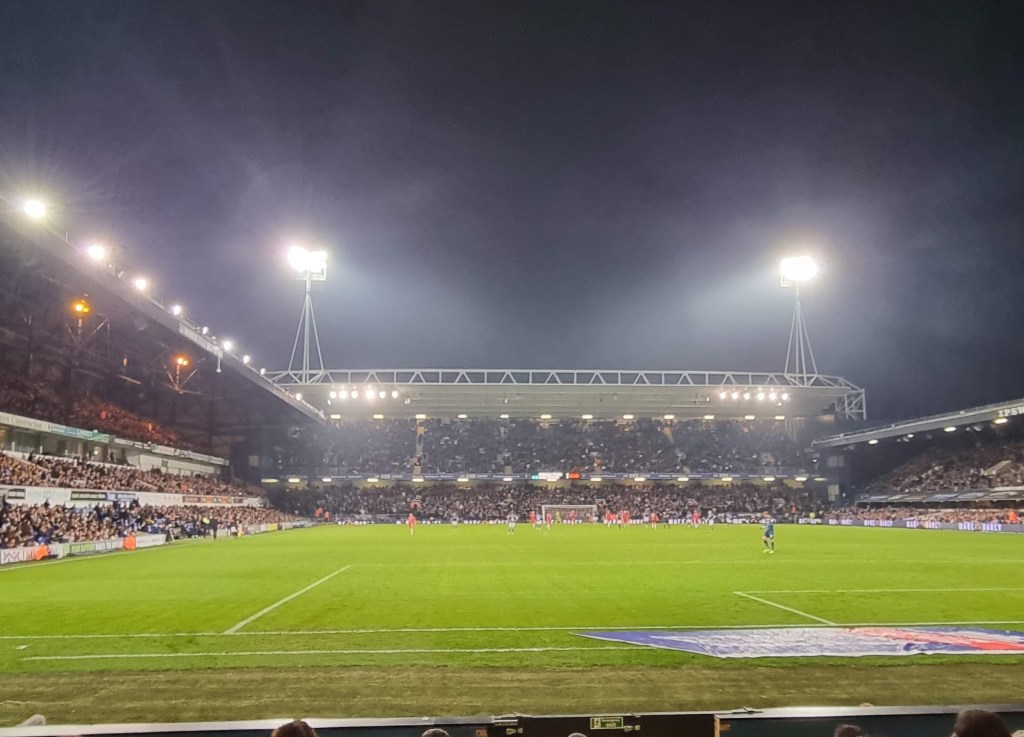
before Mick and I gaze out across the practice pitch beyond a red Citroen H van towards the former municipal power station and tram shed. We marvel that local authorities once built and provided these fabulous things, but don’t comment on the Citroen. The sun is steadily setting behind the cloud and when we return to our seats the pitch is glowing gloriously from the illumination of the floodlights.
The second half begins with some rare vocal encouragement for Town from the North Stand and I realise that the Sheffield United fans must be the first away supporters this season to have witnessed a whole first half without singing “Is this a library?” I can only think they don’t have opera in Sheffield or if they do they don’t much care for Verdi. Perhaps it is a hangover from the Thatcher era when Sheffield was the People’s Republic of South Yorkshire and opera is just too patrician. But full marks to these Blades fans for being more interested in supporting their own team than berating the opposition.
The heady early minutes of the second half fade away like the taste of the half-time beers, snacks and hot beverages and the game descends into dullness. Ipswich don’t exactly play badly, they just don’t create any attempts on goal, which suggests they have misunderstood the point of the game. Sheffield on the other hand do fashion some chances but spurn them. Ipswich captain and centre-half Luke Chambers and goalkeeper Bart Bialkowski seemingly attempt to settle the result with the sorts of misjudgements that one would only expect from the most inept of youths in full-time education, but the Blades are not sharp enough to take advantage.
Apart from the noise from the Sheffielders the game is conducted in near silence, with swathes of seats completely empty it feels like a reserve game. As the contest spirals down towards its miserable conclusion the North Stand at last find a song in their dark hearts, “ We want a shot”, they chant. Having inspired themselves with their own wit they proceed to trawl through their back catalogue of scatological old favourites: “ We’re fucking shit, we’re fucking shit; we’re fucking shit” and “You’re football is shit, you’re football is shit, Mick McCarthy you’re football is shit”. It doesn’t help lighten the mood or motivate the players to do better, I can’t think why.
Oddly, the announcement of four minutes of added on time is greeted with a rare growl of enthusiasm from the crowd, but it makes no difference and there is a sense that people are just clearing their throats for the inevitable booing that greets the final whistle. Ipswich Town are once again out of the FA Cup and after the long descent from the top of the stand Mick and I bid each other farewell. Mick thanks me for getting him a ticket and he means it; he doesn’t see Town play often and although it was a poor game he has enjoyed it. Mick is a very rational man. We go our separate ways and I depart through the club car park and its array of obscenely expensive Ferraris, Mercedes Benz, Audis and Range Rovers. Humming the Buzzcocks’ ‘Fast cars’ I look back on the stadium, the dark shapes of the stands silhouetted in the beams of the floodlights; such beautiful sadness.