My mother was born and grew up in Shotley at the mouth of the River Stour. As a child she hardly ever went to Ipswich, and Saturday afternoon shopping would mean a boat trip with her mum across the estuary to Harwich and to Dovercourt. Her father was a mild-mannered man, but if someone did manage to annoy him he would not tell them to “Go to hell” but instead to “Go to Harwich”, by which I think he meant to go and jump in the river rather than any slur on the gateway to the Continent. My childhood memories from thirty odd years later were of going to Harwich by car, an ice cream cornet outside the town hall, Dovercourt Woolworth’s and having shrimps for tea.
With these fond family memories in mind I guide my Citroen C3 along the winding, undulating B1352 from Manningtree to Harwich, through Mistley, Bradfield, Wrabness and Ramsey. My wife Paulene and I have been to Ipswich to visit some of the historic buildings open to the public for the Heritage Open Days, but were a bit miffed to find two of the three buildings we wanted to view, which were advertised as open in the leaflet, were shut and only open next weekend. But arriving in Harwich our fortunes have improved, it is warm and it’s not raining, even if it is a bit cloudy and the Royal Oak


ground is open for this afternoon’s fixture in the tortuously titled Thurlow Nunn Eastern Counties First Division South. We park up in the car park at the side of the stadium and cross the lane to the turnstile by the main stand. Entry costs £4 each and the-grey haired man operating the turnstile helpfully verbalises the mental arithmetic of £4 plus £4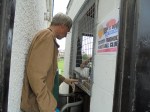 making a total of £8 and the addition of the glossy and groovily typefaced, 16 page programme “Black and White” (£1) making a total of £9. A few steps inside the ground an old boy in a flat cap relieves me of the final tenth of the ten pound note I proffered at the turnstile, in exchange for a strip of draw tickets (Nos 61 to 65).
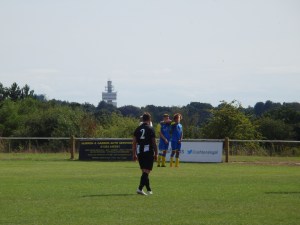
The Royal Oak Ground , where Harwich & Parkeston have played since 1898 stretches out before us , a green panorama, the broad pitch sloping away across its width, down towards Harwich town itself. Beyond the far side of the pitch a terrace of 1950’s houses, one with a hideous loft extension overlook the pitch. To the left behind one goal a steep but shallow concrete stand with a rusting tin roof and faded red steel stanchions, a sort of truncated barn backing on to Main Road, where the Royal Oak pub stands, and which leads into Dovercourt High Street; to the right and set back some way beyond the other goal, the changing rooms in a building with gabled dormer windows and a small clock on the roof, like a 1980’s pastiche of a village cricket pavilion. Behind us the main stand is short in length but disproportionately tall with a steep, corrugated, pitched roof; a typical football stand from the 1950’s, sadly its top half is now closed off.
It’s about twenty past two and the Harwich team are appearing from the changing rooms to warm up; we walk to that end of the ground to perhaps catch a word with their coach Michael, who we know from our previous mutual involvement at Wivenhoe Town.
Appropriately, page five of the programme has a small feature on Michael, from which we learn amongst other things that he drives a Citroen C4, his favourite food is curry and his favourite holiday resort is Acapulco. There is a photo of Michael stood with arms folded and looking quite butch, if a little overweight. After the game Michael will tell me that he likes to read this Blog whilst sat on the toilet.
“Well he should have some fresh milk, I put some in there on Tuesday, er no Thursday” we hear a man in a white shirt and black and white striped tie say to another man. At the corner of the ground a man with a Scottish accent asks us if we are from Benfleet, because, he explains, he didn’t recognise us. We tell him we are not but, are partly here to see Michael the coach, but also to just enjoy a Saturday afternoon at ‘the football’. Whilst Paulene watches the warm up, the Scottish man tells me how the club owns the ground and is debt-free. Harwich & Parkeston are playing at a lower level than they once did, but I am told that the club trustees saw that the need to simply keep the club alive was more important than trying to compete unsustainably in a higher league. The Scottish man bemoans the rise of ‘village teams’ into the semi-professional ranks, which he feels has fragmented local football and he’d like to see a league of clubs just from the main East Anglian towns. It’s a somewhat Stalinist approach, but I can see the attraction. The population of Harwich is about 18,000.
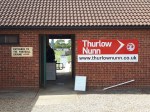
Kick-off is approaching and I buy two teas (£1 each) from the tea hut, a neat brick building probably dating from the 1950’s or 1960’s, which wouldn’t look out of place on a seafront esplanade. In the tea hut a woman is incredulous that an official has come from Norwich to referee a match in Harwich, she thought the point of the league re-structure was to cut travelling costs. “You can bet your arse that in Yarmouth they’ve got a referee from London” she says, and she’s probably right, although I’m not sure Ladbrokes would be interested in her or anyone else’s bottom as a wager. “There’s not many here today” she adds.
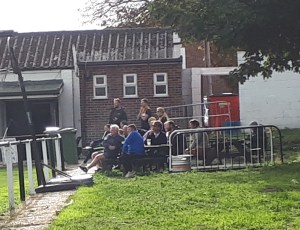 As the game begins we take up a spot at a Yogi Bear–style picnic table in the corner of the ground by the bar and backing onto Main Road. Harwich kick off towards us, the River Stour and Shotley beyond. Harwich are wearing black and white striped shirts with black shorts and socks, completing a hat-trick of clubs along with Newcastle United and Grimsby Town that span the length of the east coast and wear black and white stripes. Benfleet are in a rather boring all red kit, although their home kit is a much more interesting light blue shirt with dark blue shorts.
From kick-off the ball is almost instantly hoofed into touch and early action sees the Benfleet number five take out both the Harwich number nine and one of his own team mates with a lunging tackle. The free-kick produces nothing of note but at least the tackle made me laugh. The football is scrappy but the passes that do get strung together are mostly strung together by Harwich or ‘The Shrimpers’ as they are known, a nickname which no doubt has to do with what I had for tea as a child. The neighbouring picnic tables are occupied too and on one of them some young women, possibly ‘wags’, talk about an away game they went to recently. “There was no bar” one of them says “Just a bottle of Blossom Hill in the fridge”. At another table a middle aged woman calls out “Come on ‘arridge”.
Despite Harwich’s dominance, at about twenty past three they almost fall behind as the centre-half misses the ball and Benfleet’s number nine Ben Foord is gifted a clear run at goal; he runs, looks up and shoots, but the Harwich ‘keeper Sam Felgate makes a fine diving save to his left. Stung by that near miss Harwich soon produce the best move of the match so far as number three Jake Kioussis overlaps into the penalty area, but loses his composure and blazes the ball high over the goal and onto the vegetation covered bank in the corner of the ground. Distraught at his failure to do better, Jake appears to try and garrotte himself in the netting behind the goal. Michael the Harwich coach leaves his post in front of the dug-outs to fetch the ball. The entertainment is improving and Benfleet win a corner but hit the ball straight to an unopposed Sam Felgate.
Just before half past three The Shrimpers take the lead as Sean Gunn dinks the ball into the net from close range as three Benfleet defenders look on admiringly; it’s what Harwich deserve in what has so far been quite a one-sided game. Paulene and I decide to get a different perspective on the match and wander further round behind the goal


enjoying the cascade of greenery in the corner of the stand and an abandoned roller. Non-league football just wouldn’t be the same without the atmosphere of decay and the implied memories of better days long ago; the Royal Oak has that beautiful faded glory in spades.
All of sudden a bit of ill-temper erupts on the pitch and the Benfleet number four squares up to the Harwich number two and shoves him backwards, not just once but three times. A melee ensues and Michael is on the pitch to help break it up. The referee Mr Harvey looks uncertain about what has happened and he consults his version of the VAR, the linesman Mr Arnot.  Unusually both linesman are called Arnot, although if they are related the relationship looks like grandfather and grandson, with one being stocky and totally bald and the other lanky and very youthful. The referee consults Mr Arnot senior, who talks to Mr Harvey with his hand over his mouth, like players do on the telly. I’m not certain why he does this; even if Mr Arnot has a strange paranoia about lip-readers what can he possibly be saying that is such a big secret? The result is a free-kick to Benfleet and bookings for both players, although I’ve seen players sent off for shoving before. A short while later the match breaks down again into confrontation as Benfleet’s number five tackles horizontally at knee height and a Shrimper hits the turf clutching a leg. This time Mr Harvey sorts it out on his own, but again appears lenient as he doesn’t even show a yellow card. Happily, half-time soon arrives and everyone can go for a lie down.
Paulene and I continue our wander around the ground and I picture how the bank behind the dug- outs was perhaps once a grassy ‘terrace’. Beneath the vegetation a path can be discerned which runs up to a large pair of metal gates onto Main Road, I feel like some sort of football archaeologist, and as I look across at the terrace of 1950’s houses that overlook the ground I am struck with a sense of deja-vous. The layout of the Royal Oak with the houses on one side, the rickety main stand opposite and the club house up the corner is a lot like that of the Stade Municipal in Balaruc-les -Bains in southern France, where Paulene and I watched a Coupe de France (French FA Cup) game last September (see the archive section of this blog for an account of our visit and the match) . I buy two more teas (£2) and am served at the tea hut by the Scottish man who is helping out with the half-time rush. Paulene and I take a look in the club house where a display on the wall recalls Harwich & Parkeston’s appearance in the 1953 FA Amateur Cup final before a crowd of 100,000; The Shrimpers lost 6-0 to Pegasus (a combined Oxford & Cambridge University team) and it was probably Pegasus that drew the crowd rather than The Shrimpers, but it’s still an impressive piece of history nonetheless.
The game begins again and Benfleet are playing a bit better, although Harwich still get opportunities to score again. But at just gone twenty past four the Harwich defence recreates the error they made an hour ago. Harwich’s number five mis-reads the flight of the ball and fails to play it back to the goalkeeper who is a long way off his goal line; they are both left helpless as Benfleet’s number ten Rob Lacey nips in to lob the ball over Sam Felgate and into the goal to equalise. Quickly some of the Harwich players turn on one another to apportion blame. One of them stands with arms outstretched and says “If are going to make mistakes…” but sadly I don’t catch the end of the sentence. For a little while Benfleet are the better team and they seem to have broken up the link between the Harwich midfield and forwards. Benfleet’s blond-haired number six Martin Lacey has moved to left back and snuffed out the Harwich attacks down this flank; added to which his haircut has a hint of the 1960’s Mod about it.
Benfleet now look the more likely team to score again and we walk round behind the goal that they are attacking. We arrive in time to see the game again erupt into an unseemly mess as a Harwich player scrambles about on the ground and then a scrum of pushing and shoving and angry faces develops from seemingly nothing. Michael again appears to break things up. I don’t have a clue what happened or who was involved and sadly it seems neither does referee Mr Harvey who once again consults the human VAR Mr Arnot senior. The decision from Mr Harvey is to send off Harwich’s number five Ben Hammond and Benfleet’s number two Lewis Hunt and to book Harwich’s number four Shaun Kioussis and Benfleet substitute, number twenty Stephan Adeyemi , who hasn’t even come on to the pitch yet. Lewis Hunt and his team mates, manager and coaches protest his innocence and he certainly didn’t appear to be involved in the ruckus. Lewis heads for the dressing room and walks past us, I ask him what happened. He didn’t know but said he didn’t do anything, he tried to separate people and got hit in the mouth and then stepped away. He seems like a really nice bloke, which is what the Benfleet team were telling Mr Harvey. During the mayhem the Harwich ‘keeper takes to time to relax and have a lie down, adopting the pose of a gentleman-player in one of those photographs of a Victorian football team.
The break in play seems to have affected Benfleet more than Harwich, possibly because of the sense of injustice that Lewis Hunt has been wrongly sent off; perhaps whoever was guilty, and someone was, should have owned up and said “Send me off Ref, Lewis is innocent”. Never before has my wearing of my Albert Camus philosophy football T-shirt been so poignant, with its slogan “All that I know most surely know about morality and obligations I owe to football”. Benfleet have lost concentration and at a bit past four thirty The Shrimpers number eleven Sean Gunn breaks through the middle and places a low shot wide of Florent Gislette in the Benfleet goal. Understandably after all that has happened the Harwich team celebrate somewhat.
The final fifteen minutes play out without too much sense that there will be any more goals, although Shrimpers substitute Nicky Palmer sends a shot out towards the North Sea when nicely set up by number ten Michael Hammond, who had passed up on a chance to have a shot of his own. Hammond also becomes the eighth player to be booked before Mr Harvey eventually closes proceedings and the crowd of 160 give appreciative applause for what has been a thoroughly entertaining afternoon of football and brawling, but mostly football.
Paulene and I retire to the bar for a pint of Greene King Abbot Ale (easily Greene King’s best beer) and a Bacardi with Soda (£5.25) and a chance to reflect on a very enjoyable (and cheap) afternoon. We might have been disappointed not to sample the Heritage of Ipswich earlier today, but the sporting heritage of Harwich and Parkestone’s Royal Oak ground has more than made up for it. We’ll be back.





 trippingovertheball