Leiston is about 35 kilometres northeast of Ipswich and when my mother was a child she was taken there on the train to visit her grandfather who lived in nearby Aldringham. Remarkably perhaps, for a town of just five and half thousand inhabitants tucked away in a corner of rural Suffolk it is still possible to get to Leiston by rail today, but only if you’re the engine driver of the train collecting radioactive waste from Sizewell nuclear power station, a few kilometres east. Passenger services to Leiston ceased in 1966; the evil Dr Beeching saw to that, but on a Saturday afternoon the No 521 bus leaves Saxmundham railway station at 14:04, about ten minutes after the 13:17 train from Ipswich arrives there and it will get you to Leiston in time for a three o’clock kick-off at Victory Road, home of Leiston FC. Incredibly, there is also a bus back from Leiston to Saxmundham, at 1740. But with meticulous mis-timing however, the bus arrives in Sax’ three minutes after the 17:57 train back to Ipswich has left, giving you a fifty seven minute wait for the next one.
My excuse for not using public transport today is not because we are apparently being discouraged by poor timetabling from doing so, but rather because what goes around comes around and it’s now my mother’s turn to be visited, by me. Filial duty carried out, I proceed up the A12 on what is a beautiful, bright autumn afternoon. Letting the throttle out on the largely deserted dual carriageway between Ufford and Marlesford my Citroen C3 must feel like its back on the péage heading for Lyon, not Leiston. But Leiston it is and after skirting Snape and Friston, and passing pigs and pill-boxes outside Knodishall my 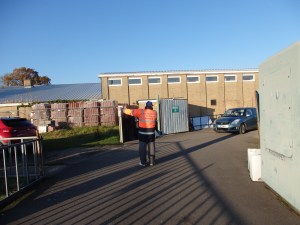 Citroen and I roll into Victory Road at about twenty past two, where it is already so busy we are ushered into overflow car parking. I drive across the grass behind one goal and onto a field behind the pitch. Once out of my car a steward explains that entry today is through a side gate in order to keep pedestrians from slipping over where the cars have churned up the grass; health and safety eh? Entry costs £11, but I keep the gateman happy by tendering the right money. My wife Paulene has refused to join me today because she maintains that £11 is too much to pay to watch ‘local football’, and she makes a fair point, although today’s opponents aren’t exactly local, Rushall being about 285 kilometres away near Walsall in the West Midlands. In France it is possible to watch a fully professional second division match in a modern stadium for not much more than I have paid today, and sometimes for a bit less.
There is plenty of time before kick-off so I have a look about and visit the club shop where I witness its first ever ‘card transaction’. The middle-aged lady serving seems genuinely excited and I suggest she should be giving her customer some sort of commemorative certificate to mark the occasion. Sadly, I cannot lay claim to becoming the second ever card-paying customer of the Leiston club shop, as I all too easily resist the temptation of a teddy bear (£12), mug (£5) or red, white and blue painted football rattle (£2), although I do try the rattle to see if it works; it does but it’s quite small and the action is a bit stiff. 
Leaving the shop I realise I don’t have a programme and I see if there is one available at the main turnstile, where a very apologetic man explains that due to printing costs and not selling all the programmes it’s no longer financially viable to produce one; he hands me a slip of paper which puts his words into print. I quite like the idea that the slip of paper could be distributed as a substitute programme if it was stamped with today’s date and name of the opposition.
Programme-less and therefore slightly crestfallen, I turn back from the turnstile but must wait as a steward ushers past a car towards the overflow car park, I tell the steward he needs a lollipop-man’s uniform or at least his lollipop, he doesn’t seem that keen. Still depressed at the state of modern football I head for the bar where a hand pump bears pump clips for both Adnam’s Ghostship and something called Garrett’s Ale. When I ask, the balding barman explains that Garrett’s is made in a micro-brewery down the road in the Long Shop museum, but then he says it’s not and he made it up. He says it’s brewed by Greene King, and he made the name up and then he says it’s actually Ruddle’s. Confused, I buy a pint (£3.20); it’s okay, but I wish I’d bought a pint of Ghostship.
I find a spot to drink my beer and speak briefly to a man who recognises me from matches at Portman Road; he is apparently originally from Aldeburgh and today is a guest of the match sponsors. Having drained my glass I head back outside to await the teams and in due course they emerge from a concertinaed tunnel, which is wheeled across the concourse from the side of the red-brick clubhouse.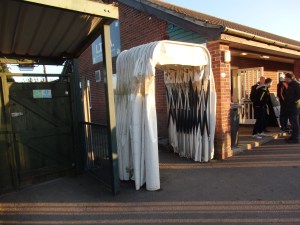
Victory Road is not really an attractive or interesting ground; the clubhouse looks like a massive Council bungalow, there is a small metal terrace stand at one end and opposite the bungalow a row of low metal prefabricated stands join together to create the Leiston Press Stand, in the middle of which sits a large glazed press box. Between the clubhouse and the main turnstile is a ten or fifteen metre terrace which misleadingly looks like a good place to wait for a bus. The setting is altogether a little dull.
The two teams’ arrival on the pitch brightens things up a bit however, with Leiston all in blue and Rushall Olympic in black and yellow stripes with black shorts and socks, although from behind they’re kit is all-black, so they look like numbered referees. To make matters worse the referee Mr Hancock is also wearing all black, the first of a number of poor decisions he will make this afternoon.
With the multiple handshaking malarkey out of the way, Rushall kick-off in the direction of Aldringham and the metal terrace, the front of which is adorned appropriately with a large advert that reads Screwbolt Fixings. The early stages of the game are rough and shouty with plenty of strength and running on show but not the necessary guile to score a goal. It’s entertaining enough, but is more like all-in wrestling than the working man’s ballet. I stand behind the goal close to four blokes in their sixties; one wears a deerstalker, another wears a ‘Vote Leave’ badge and swears a lot whilst complaining that people don’t know how lucky they are that a little club like Leiston is playing at such a high level, and he’s right because he can’t be wrong about everything. A Rushall player sends a shot high over the cross bar and off towards Aldringham. Everybody jeers, “Three points to Wigan” shouts a grey-haired man.
The game is a struggle, Leiston are having the better of it but neither goalkeeper is exactly rushed off their feet with save-making. The wannabe coaches in the crowd offer their advice “Simple balls man, simple” calls one as the ball is lofted forward hopefully. “Keep it on the deck” shouts another. “Go on Seb” shouts someone else, taking a more  one to one approach. As half time nears I head back round towards the giant bungalow so that I can be handily placed for the tea bar when the whistle blows. As I watch on from behind the Leiston bench their number two Matt Rutterford commits a fairly innocuous foul, sidling up behind a Rushall player. Sadly for Leiston, Mr Hancock doesn’t consider that the foul is that innocuous and proceeds to whip out his yellow card in the direction of the unfortunate full-back, who having already seen the card once earlier in the game gets to see Mr Hancock’s red card also. Much wailing and gnashing of teeth ensues and there is a strong feeling that Leiston cannot now possibly win and Mr Hancock has ruined the game more than a few fouls ever could.
As the sun sinks towards the horizon everyone on the bungalow side of the ground has


to shield their eyes. Half-time can’t come soon enough. “How long to go lino?” asks the Rushall manager as the clock ticks past ten to four. “How long would you like?” says a voice from the crowd. With the half-time whistle I go indoors for a pounds worth of tea. Behind me in the queue is a man with white flowing hair and small beard, he looks like Buffalo Bill, but is wearing an Ipswich Town branded coat. “Don’t I know you from Portman Road or from a holiday in Majorca?” asks another man of Bill. “No I don’t think so, I haven’t been on holiday since I was thirty” says Bill. I tell him that his coat is a bit of a giveaway that he might have been to Portman Road. Tea in hand I seek the fresh air outside, and it is fresh. There has been a stingy east wind all afternoon and with the sun going down it’s getting even colder. Happily my tea is warm, but it’s also a bit weak and I suspect Leiston FC are cutting costs on tea bags as well as programmes, but I’m not surprised given the distances they have to travel to games in this very silly league, which stretches from Lowestoft in the east to Stourbridge in the west, a distance of over 330 kilometres.
At six minutes past four Mr Hancock begins the second half and the Screwbolt Fixings terrace is now occupied by about a dozen men, half of whom unexpectedly begin to sing. They go through a variety of chants and tunes including ‘Tom Hark’ and also Neil Diamond’s ‘Sweet Caroline’, betraying that they too may have been to Portman Road. What I like best about the Screwbolt choir is that they are all over forty and half of them are probably over fifty, something they confirm later when substitute Harry Knights comes on and they break into a chorus of Sham 69’s ‘Hurry Up Harry’.
Over by the main stand is a line of Rushall supporters some of whom sport black and gold scarves, like Wolverhampton Wanderers supporters on a day off. I sit for a while at the front of the stand. A Rushall shot hits the cross-bar at the Theberton end of the ground. Mr Hancock makes another dubious decision. “This referee’s from another planet” says a thick West Midland’s accent. Behind us the sky glows a violent red, but nobody panics because Sizewell nuclear power station is in the opposite direction. A man in the stand shouts “Come on Leiston” very enthusiastically; he’s the reporter from BBC Radio Suffolk. A Rushall player goes down “Get up you worm” shouts someone else, not very charitably.
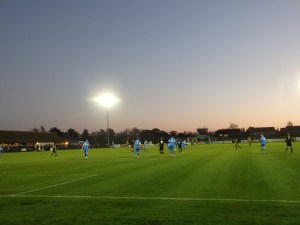 As darkness shrouds the ground it loses its plainness and takes on a new atmosphere. The long shadows have gone to be replaced by the glow of the floodlights. On the pitch Rushall push forward and Leiston defend; their goalkeeper Marcus Garnham makes a couple of smart saves. Leiston try to catch Rushall on the break with quick, astute passes and diagonal punts but it doesn’t feel as though Leiston or their supporters expect to win, and holding on for the goalless draw will be victory enough, of a sort. The story is a simple one; Leiston must keep Rushall at bay. But there have been injuries and delays and time added on at the end seems interminable. It’s the ninety fifth minute and Marcus Garnham makes a spectacular reaction save, followed quickly by another but before we have time to applaud the ball runs to Rushall substitute Keiron Berry stood just three yards from the open goal, a prod is all that’s needed.
Back behind the goal the Leiston supporter who owns the flag that hangs over the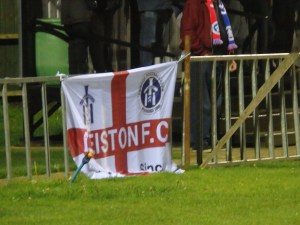 pitchside rail says he’s “had it” with the referee and he’s going home, he starts to untie his flag. Another group of young lads head off too. “Fucking Toby’s fault” says a lad with long curly hair like Marc Bolan “it’s the same every time we come here with him”. The despondent occupants of the Screwbolt Fixings stand shuffle off with Mr Hancock’s final whistle whilst jeering at the Rushall goalkeeper Joseph Slinn, “Cheats” they shout, rather un-sportingly. In return the ‘keeper tells them how much he enjoyed their Neil Diamond song, but such is their disappointment they’re not listening and he was only trying to be friendly.
I head back to my Citroen C3 and catch a glimpse of the Rushall players enjoying a post-match cuddle through the side gate. The result leaves Leiston in fourth place in the Evo-stik Central Premier League, five points behind Kettering Town who are top and six-points ahead of Rushall Olympic. The last time I came to watch Leiston, they lost 3-1 to Gloucester in the FA Cup, I begin to wonder if I’m not a bit like Toby.






 trippingovertheball