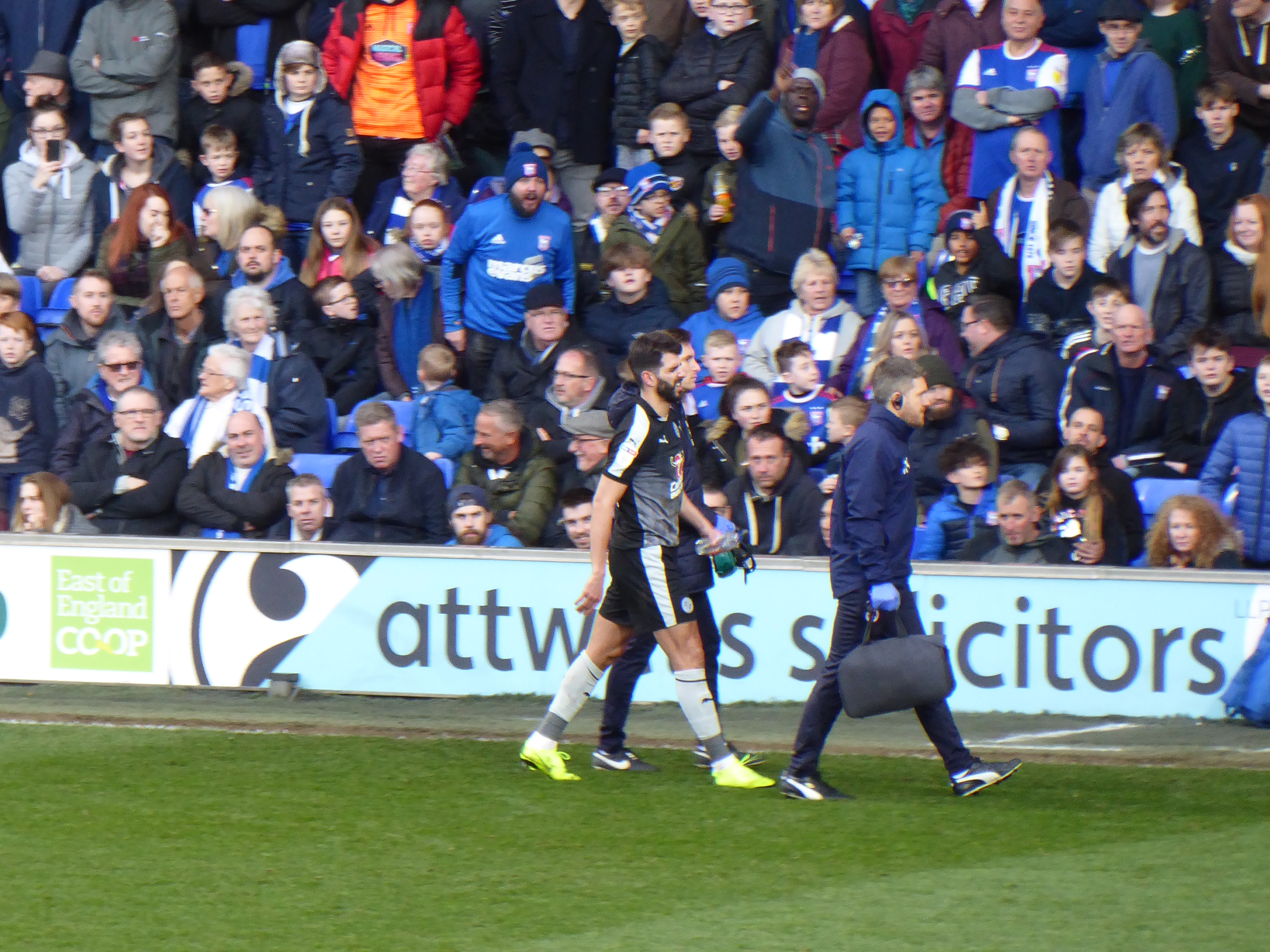
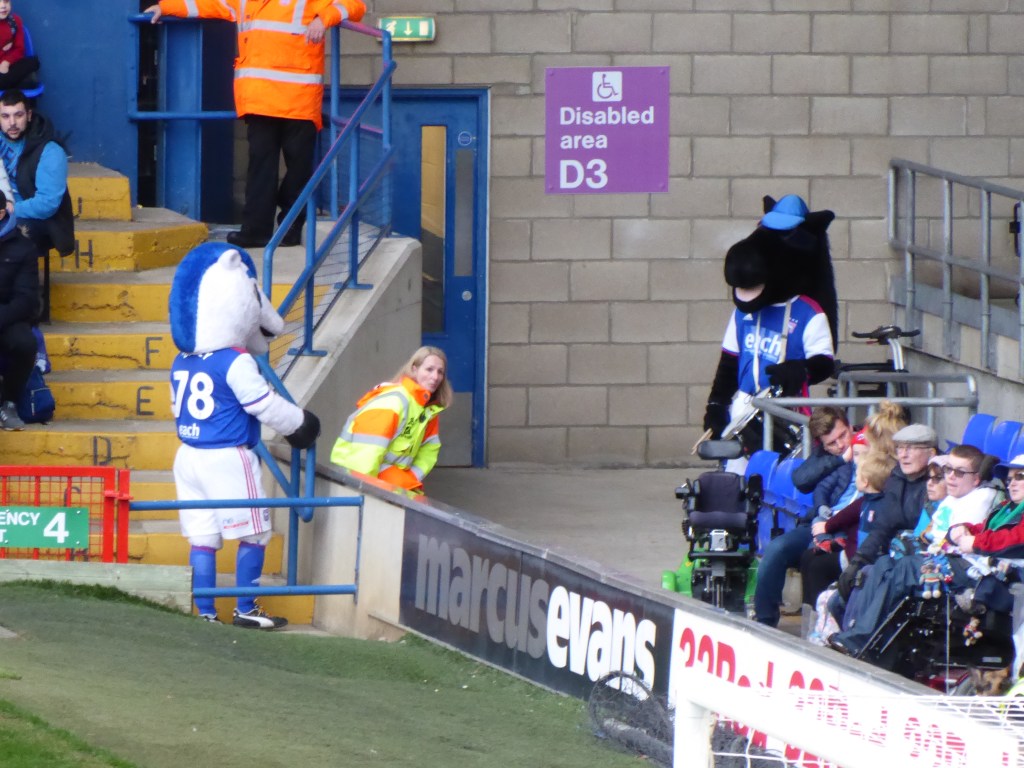
Ipswich Town 1 Nottingham Forest 1


Thirty-eight years ago today, give or take ten days, Ipswich Town played Nottingham Forest in the sixth round of the FA Cup.  I travelled up to Nottingham for the game, taking the train from Brighton where I was at university and then, having met up with three other Town fans in London, by Morris Minor 1000 up the M1.  We spent the night in Nottingham after the match, ate mushy peas and chips, drank large quantities of Home Ales bitter, slept on a floor of someone we knew at Nottingham University and drove back down south the next day.  Nottingham Forest were the reigning European Cup holders and in two months’ time Ipswich Town would win the UEFA Cup.  They were happy times.
Today, both clubs languish in the second division, Town awaiting inevitable relegation whilst Forest struggle in vain for a play-off place; but they meet in the day’s only match between the former winners of European cup competitions. It is a dull, blustery, mid-March day and layers of grey cloud are stacked up overhead as I walk to the railway station.  Blossom from the trees is blown into the gutter.  I pass by a newspaper recycling bin and feel perplexed that it is considered necessary to paint a sign on it advising people not to climb inside.  At the railway station I meet Roly; the train is on time.  Roly shows me a short video on his mobile phone of his eighteen month old daughter kicking a ball. Roly is nothing if not a very proud father.

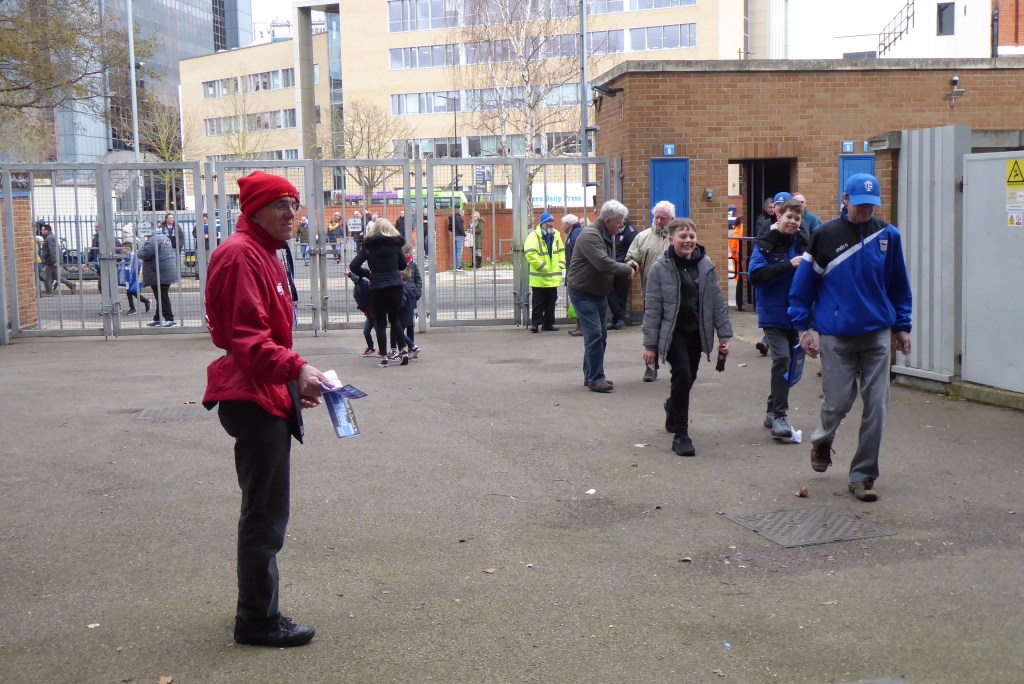
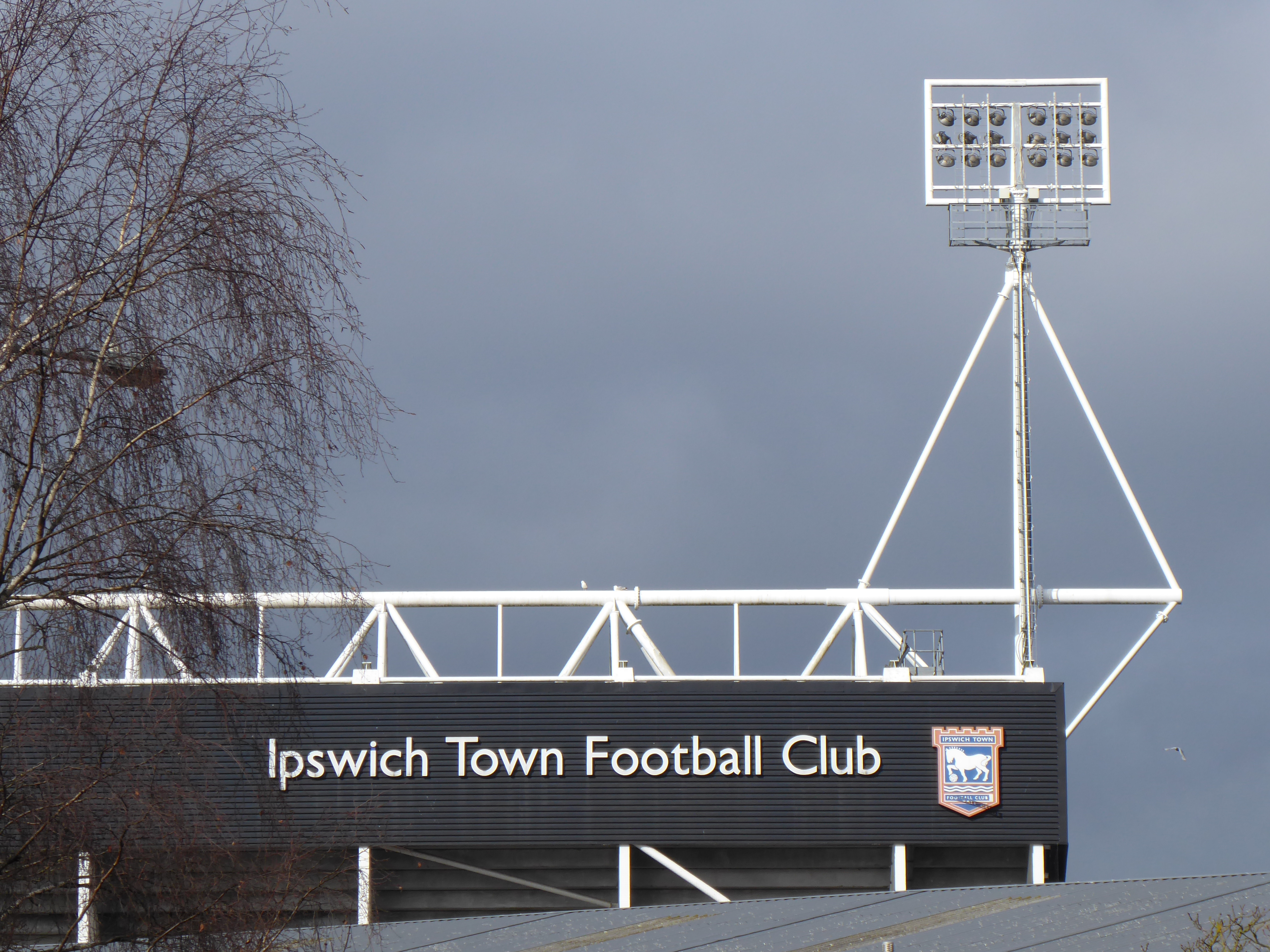
Arriving in Ipswich the weather hasn’t changed; Roly gets some cash from an ATM whilst a group of Ipswich supporters struggle to get a car park ticket from an automatic machine. We head down Princes Street towards Portman Road and on to St Jude’s Tavern.  As usual people mill about aimlessly in Portman Road waiting for the turnstiles to open, they must retain the hope that one week they will open early, otherwise why get here early week after week after week?  There is always hope.

At St Jude’s Tavern Roly has a pint of Nethergate Bulldog (£2.50) and I have a similar quantity of the Match Day Special, which once again is St Jude’s own attractively named Goblin’s Piss (£2.50), a name that St Jude’s should really offer to Greene King for their IPA.  We sit at a table next to the usual retirees who meet here pre-match. We talk football.  Another clutch of retirees arrives, “What do you recommend” one asks looking at the beer list, “That you clear off somewhere else” is the response. Statler and Waldorf live. Not entirely satisfied by the ‘tired’ condition of our first pints, Roly and I switch to Nethergate Venture (£3.40) for our second; it’s okay but a bit too ‘floral’ for my tastes.

Jackson

At about twenty to three the pub begins to empty out and Roly and I leave too.  He doesn’t admit it but I suspect Roly wants time to get something to eat, that’s the kind of guy he is.  With fifteen minutes until kick-off Portman Road is busy but the club shop isn’t and I pop in, much as I might pop to the Co-op, and buy a programme, redeeming the 115 loyalty points I have accrued from previous purchases in the process.  In the past week I have now enjoyed two free programmes (at Kirkley & Pakefield and Colchester United) and a cut-price one, I am feeling blessed and if this carries on I will soon have saved enough to retire; hopefully Brexit won’t happen and I can go and live in the south of France, although if it does happen that is probably all the more reason to move to the south of France, or anywhere.
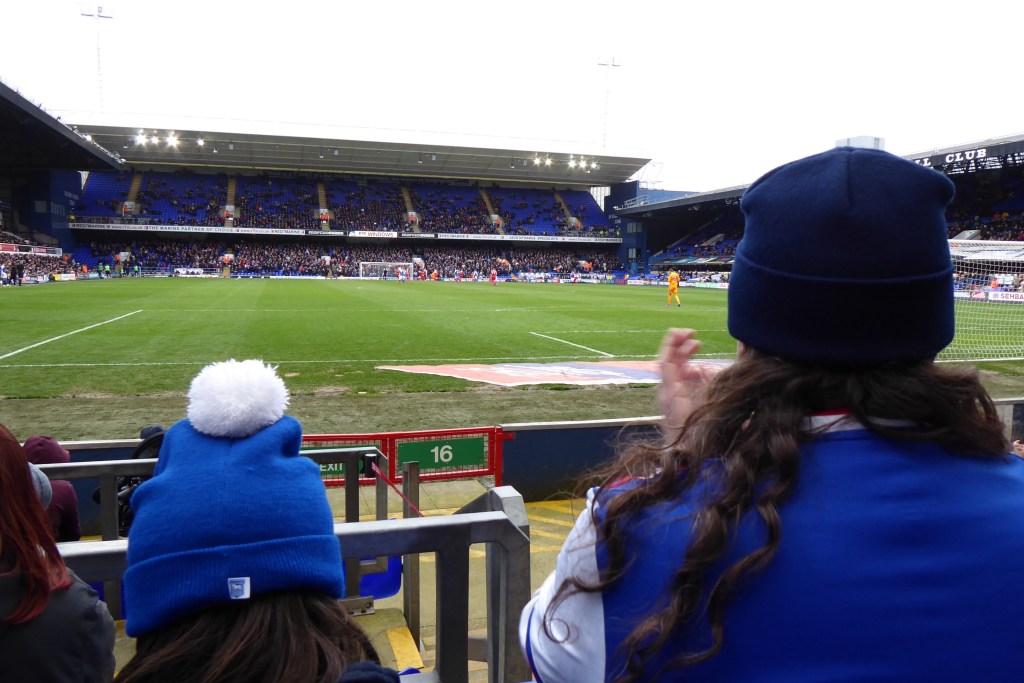
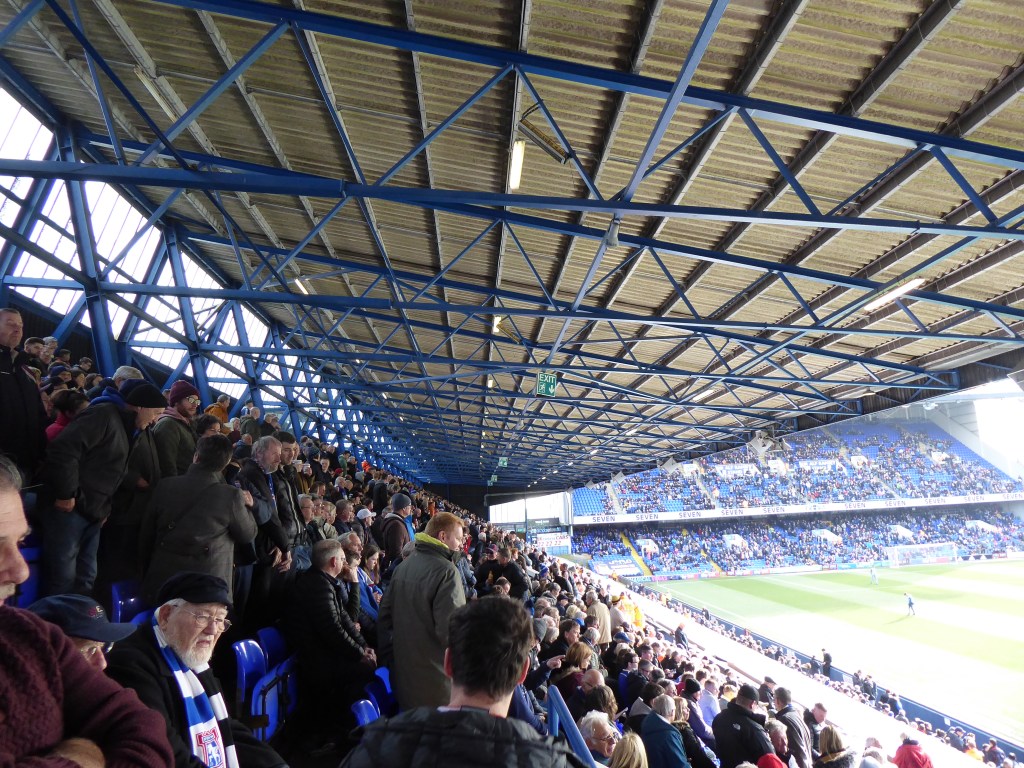
There is no queue at the turnstiles, I smile and thank the moustachioed turnstile operator as I pass through.   After a brief conversation with Dave the steward, a former work colleague, I use the toilet facilities and then take up my place alongside Pat from Clacton, ever-present Phil who never misses a game and his young son Elwood.  There are a lot of Nottingham Forest supporters here today (the score board will tell us during the second-half that there are 1,691 in a crowd of 16,709) and Phil recounts how he visited his mum in Newmarket this morning and as he left he even saw one heading for Newmarket railway station.  The teams enter the field and my view is through the net of a practice goal which hadn’t been wheeled away before the concertina-like players’ tunnel was extended out to the corner of the pitch. 

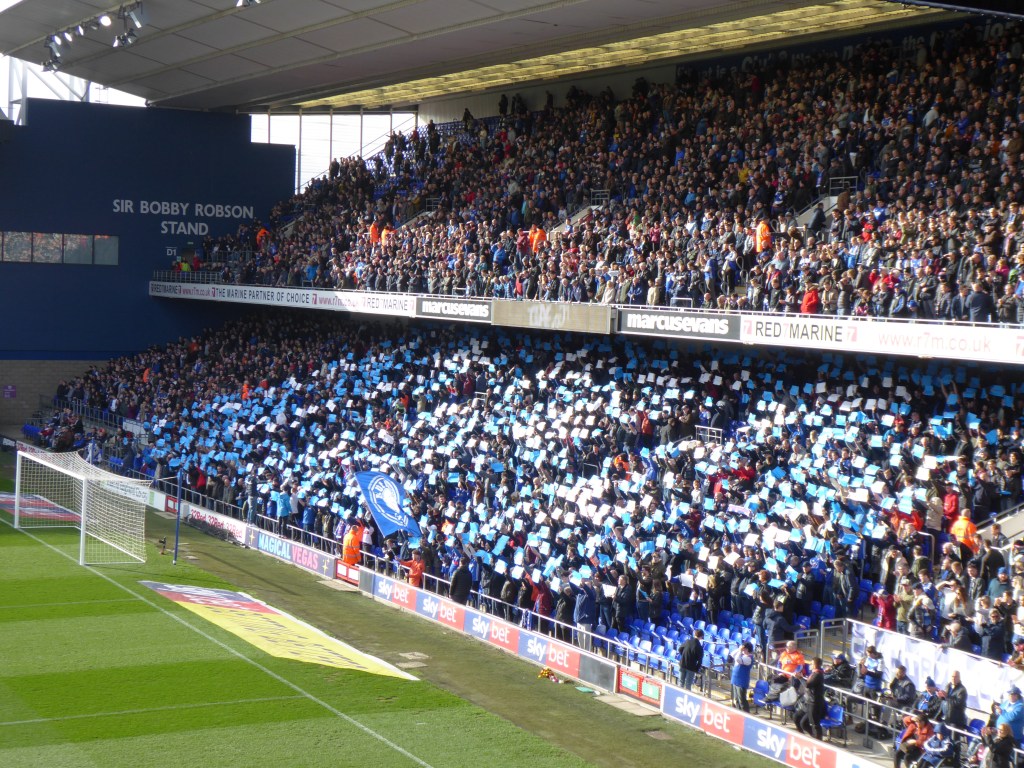
The game begins with Nottingham Forest getting first go with the ball and playing towards the Sir Bobby Robson Stand and Alderman Road rec’, they are wearing red shirts, shorts and socks.  Town are in their customary blue and white kit, despoiled by an ugly advert for an on-line scamming organisation, a likely contributor to this season’s eventual relegation; they are aiming in the direction of me, Pat, Phil and Elwood, but hopefully a bit to our right.   The Nottingham supporters are in very good voice regaling us with a lyrically altered version of Land of Hope & Glory that tells of how they hate a number of other clubs but love Nottingham Forest, it’s an old favourite and takes me back to the 1970’s; the old ones are the best I think, sounding like my late father and his father and probably his father before that.  Enjoy your youth while you can Elwood, because one day you will be an old git too.

Barely five minutes pass and Town produce a quick move of short passes in front of the East of England Co-operative Stand and the lifeless souls that populate it; Gwion Edwards gets behind the Nottingham defence, delivers a low cross and like a magical genie the hard to hide Collin Quaner appears from nowhere to deftly stroke the ball into the goal to give Ipswich the lead.  It was a most beautiful goal.  I have heard so-called supporters say rude things about Collin Quaner but I like him, he’s German, he has the distinctive, exotic look of an Easter Island statue (minus the big ears), but most of all he plays for Ipswich Town and therefore he’s alright.

The goal gets the home crowd going for a short while, “Allez, Allez-Allez-Allez” some of us sing, enjoying the linguistic abilities that a meeting of two former European competition winners bring.  The noise of the crowd rises and swirls around in the strongly gusting breeze. But by and by the enthusiasm recedes and that goal is one of the last exciting things that happens at my end of the pitch as Nottingham Forest go on to un-sportingly monopolise the remainder of the first half winning four corners to Town’s none and having eight shot to our two.   It’s not long before the home crowd is quiet once again and the Nottingham Forest supporters can begin their goading. “One-nil, and you still don’t sing” they chant to the tune of the Village People’s “Go West”, but without the manly bravura of the original version.  Exasperated perhaps by the lack of a reaction the Forest fans invoke the Beach Boys’ Sloop John B to sing “We’ll sing on our own, we’ll sing on own”, which is probably the sensible thing to do in the circumstances, before their attention then turns to an obese Town supporter to whom they sing “Fatty, Fatty, give us a song”.  After enquiring through the medium of song if he has ever seen his own genitals they entreat him to “Get your tits out for the lads”, he duly obliges.  It’s hard to say if ‘Fatty’ enjoys his five minutes or fame, but he doesn’t return to his seat after half-time.   

The game carries on and Ipswich are denied what looked like a corner “That was literally in front of you, you Muppet” shouts a woman from behind me at the linesman.  Would that we could really have Muppet linesman I think to myself; the FA and The Jim Henson Company should forge closer links.  I note how many foreign players Nottingham’s are fielding and am impressed by the performance of Pele at number 28 which is remarkable for a man in his seventies, but I am surprised to learn from the tiny little Guinea-Bissau flag against his name on the back of the programme that he is no longer Brazilian.  My attention is also drawn to Forest’s number 29, Tunisian Yohan Benalouane who, with his completely bald head and pale complexion makes me think of Nosferatu; I don’t get a look at his finger nails.

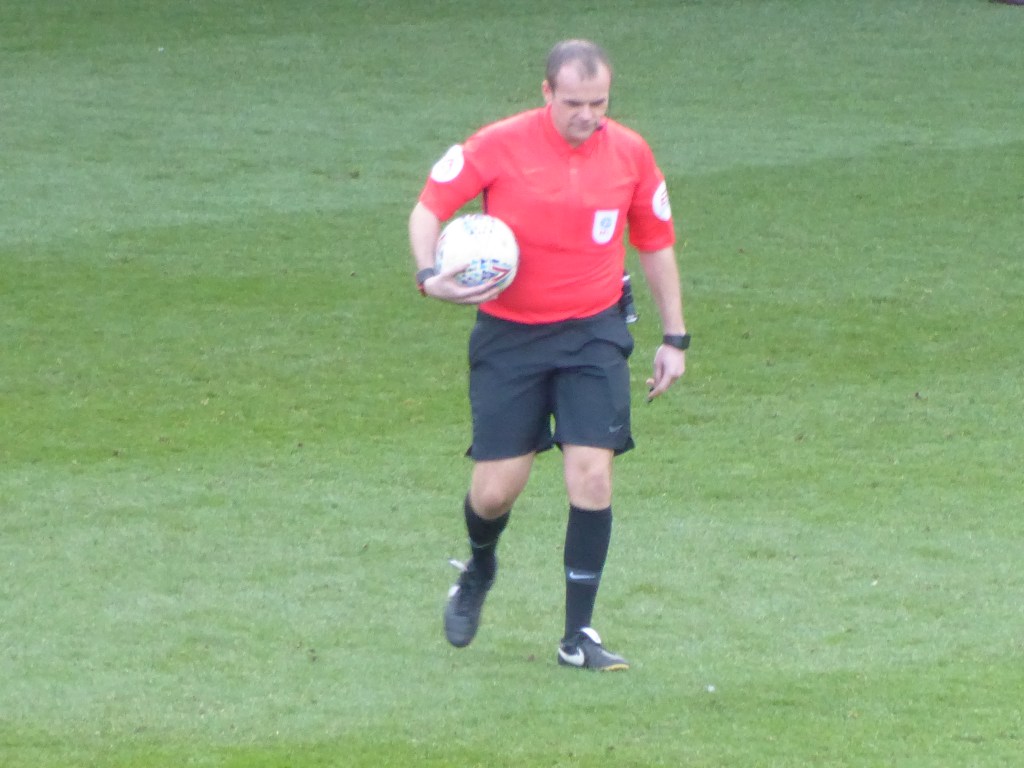
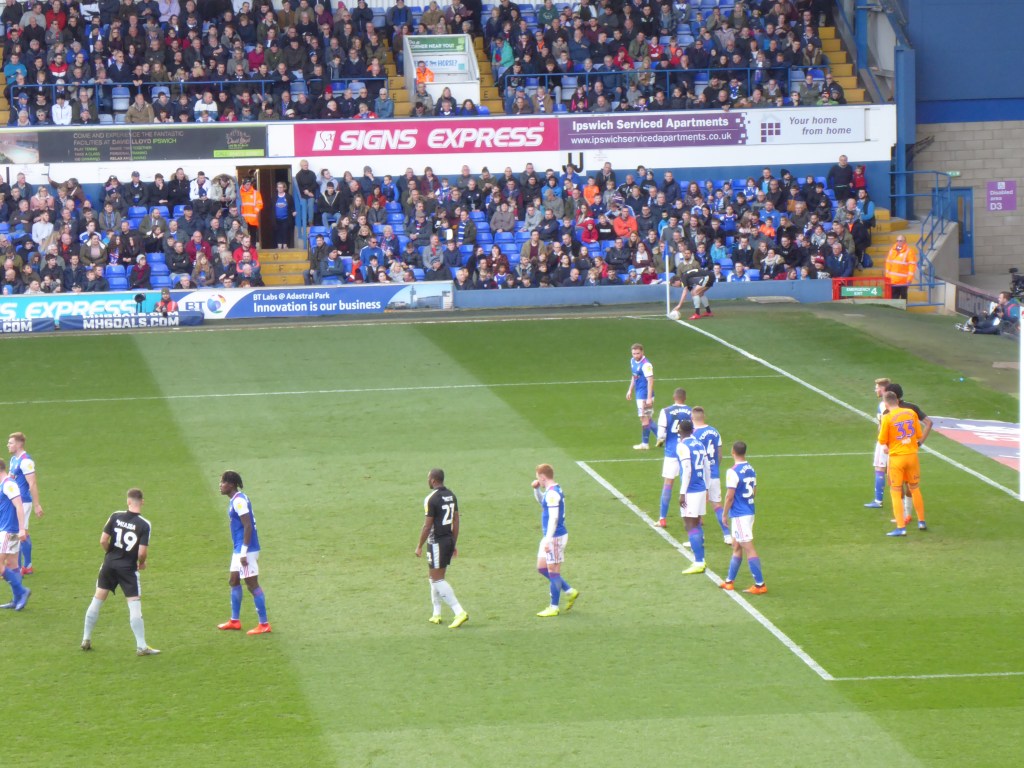
It’s just gone half-past three and Nottingham Forest win a corner, the ball is directed towards goal, Bartosz Bialkowski dives to his left, Nottingham players raise their arms and the diminutive referee Mr Keith Stroud signals a goal, which the scoreboard attributes to the Malian number 13 Molla Wague, although it will later be said to be a Jon Nolan own-goal.  It’s a shame for Town, for Molla Wague and for Jon Nolan and given that the goal has brought so much disappointment I am surprised it is allowed to stand.   “Que Sera Sera, Whatever will be will be, You’re going to Shrewsbury, Que Sera Sera” sing the gloating Nottinghamians, revealing a hitherto unexpected admiration for Doris Day, although the earlier Go West song was perhaps a clue as to their preferences.

Half-time arrives and briefly Portman Road is once again back in the long lost 1970’s as the PA system provides an aural treat in the sound of Bachman Turner Overdrive’s  “You ain’t seen nothing yet”, a song which makes me want to laugh and cry at the same time. I visit the facilities beneath the stand to drain off some more of that Goblin’s Piss; at the urinal I stand next to a man who is simultaneously either texting or checking the half-time scores on his mobile phone.  I find the scene rather disconcerting and leave as quickly as nature allows before consuming a Panda brand liquorice stick as a tasty half-time snack and to help me forget.

The second half begins and Trevoh Chalobah replaces Cole Skuse.  At ten past four Trev’ unleashes a spectacular shot that whistles just centimetres outside the right hand post of the Nottingham goal.  Sometimes such a narrow miss is more thrilling than a goal, particularly an opposition one.  The second half turns out to be much better than the first for Ipswich and Town dominate the attacking play, although admittedly without making too many clear cut chances to score.  Chants of “Come on You Blues, Come on Blues” burst from stands on all sides of the ground and with increasing frequency. The referee Keith Stroud, who ‘has previous’ as far as Town fans are concerned adds to his record of failure and bias by not awarding Town free-kicks whilst giving undeserved favour to Nottingham, whose fans are now largely quiet.  “Short refs, we only get short refs” sing Phil and I to the tune of Blue Moon. On the touchline Paul Lambert, as ever in his black v-neck jumper and black trousers, swings his arms about encouraging his team and the crowd.  Little Alan Judge crosses the ball and Jon Nolan heads wide of an open goal.

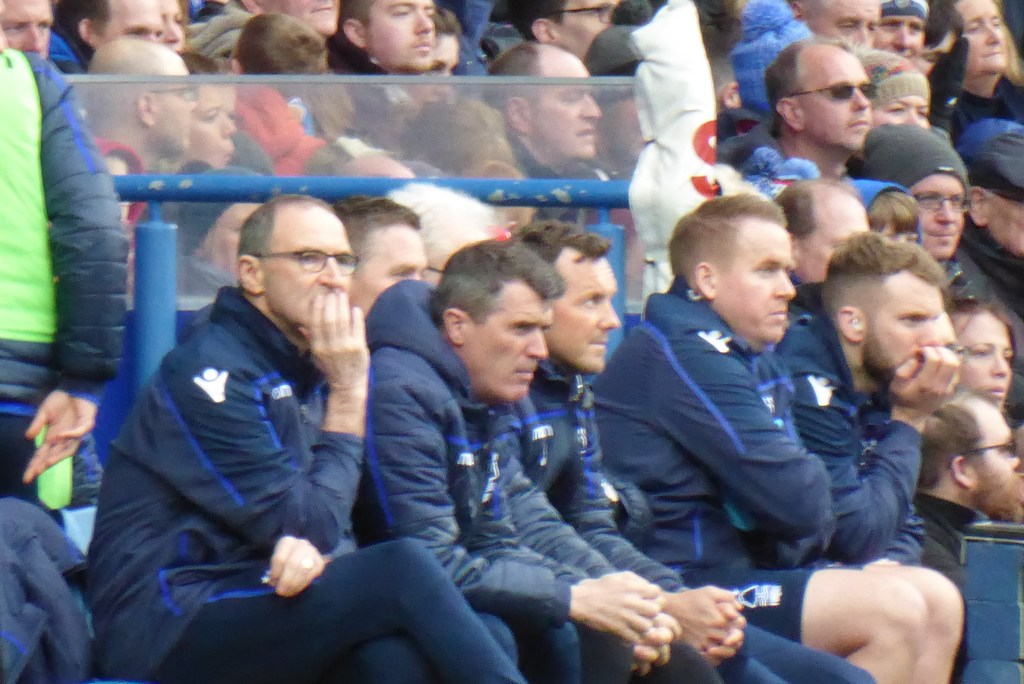
On the Nottingham bench Roy Keane at first looks his usual sullen self, but as Town dominate more and more and the game moves into its last ten minutes he stands in the technical area gesticulating, looking annoyed and filled with murderous intent.  The combination of the ‘enigmatic’ Martin O’Neil and psychopathic Roy Keane as a sort of latter day Celtic incarnation of the Clough/Taylor partnership can surely only end badly, but it could be fun to watch. I ensure that when the game is over I stay on long enough to boo Keane from the field for what he did to Ipswich Town.  I offered to my friend Mick to boo Keane on his behalf as he could not be here today, he said to feel free and he was happy for me to spit for him too if I wanted. I thought that was going a bit far, although I imagine it is the sort of protest Keane might respect as he would then feel justified in meeting it with extreme violence.

Ipswich deserve to score again but don’t and the result is yet another one-all draw.  This has arguably been the best game of the season at Portman Road and curiously despite being bottom of the league by several points for several months, with very little or no hope of staying up and only two home wins since August it has been the most enjoyable season for several years.  What is more, the crowd are at last getting behind the team; if this is what it takes perhaps Town should just go for relegation every year.

To the tune of Auld Lang Syne….all together now…

We’ve won the League, we’ve won the Cup

We’ve won in Europe too

Now every week we draw one-all

There’s f-all else to do.

Ipswich Town 1 Reading 2


In 1974 the BBC broadcast one of the first ever fly-on–the-wall documentary series; a precursor of modern ‘reality television’ it was called The Family and followed the lives of the Wilkins.  I remember the series had a haunting, wistful theme tune played mostly on a flute (I think) over family photos and stills of a murky urban landscape; at the end of the tune a voice seemed to sing “Ha,ha,ha” very slowly, which was quite appropriate because sat watching the programme with my own family, I found it very funny, we all did.  I recall that Mrs Wilkins was quite a domineering woman, Mr Wilkins was a bus driver with brylcreemed hair, they had four children and a grandchild and all lived together in a house in Reading.  I don’t recall Reading Football Club featuring in the programme.

Back in 1974 Reading FC was a top-six team in Football League Division Four and Ipswich Town qualified for the UEFA Cup.  Today, forty-five years on and Ipswich Town and Reading meet in Division Two, both with the longer term aim of avoiding relegation to the third division.  As I walk to the railway station I speculate on whether any descendants of the now deceased Terry and Margaret Wilkins will also be travelling to the game.  I always think of The Family when Town play Reading.

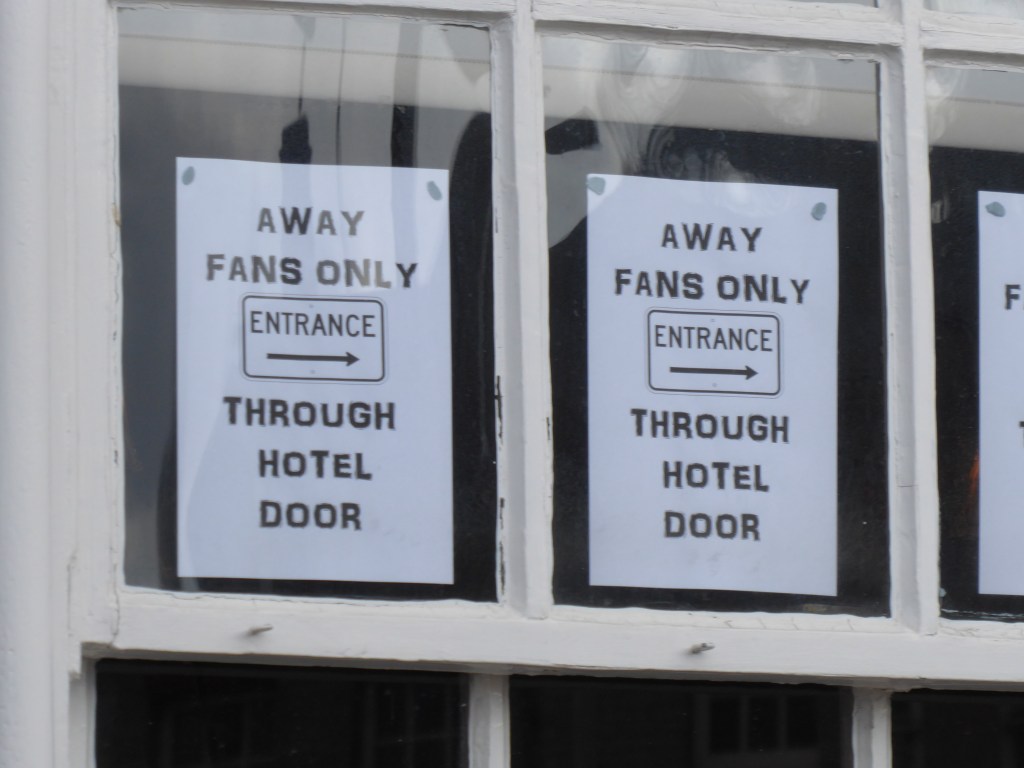
It’s been a grey, dank morning; dull, leaden cloud hanging in the air sullenly.  It was a perfect day for football but as I leave the railway station I am disappointed to see that it appears to be brightening up.  I proceed nevertheless, past the Station Hotel with its multiple signs in the window advising that it is a pub for away supporters only. I hear strains of Neil Diamond’s Sweet Caroline emanating from the bar; another set of provincial football supporters striving to be ‘interesting’. I overhear two Reading fans as I cross the bridge over the river “It was dead boring in there”, “Yeah, but they’ve started singing now”. 

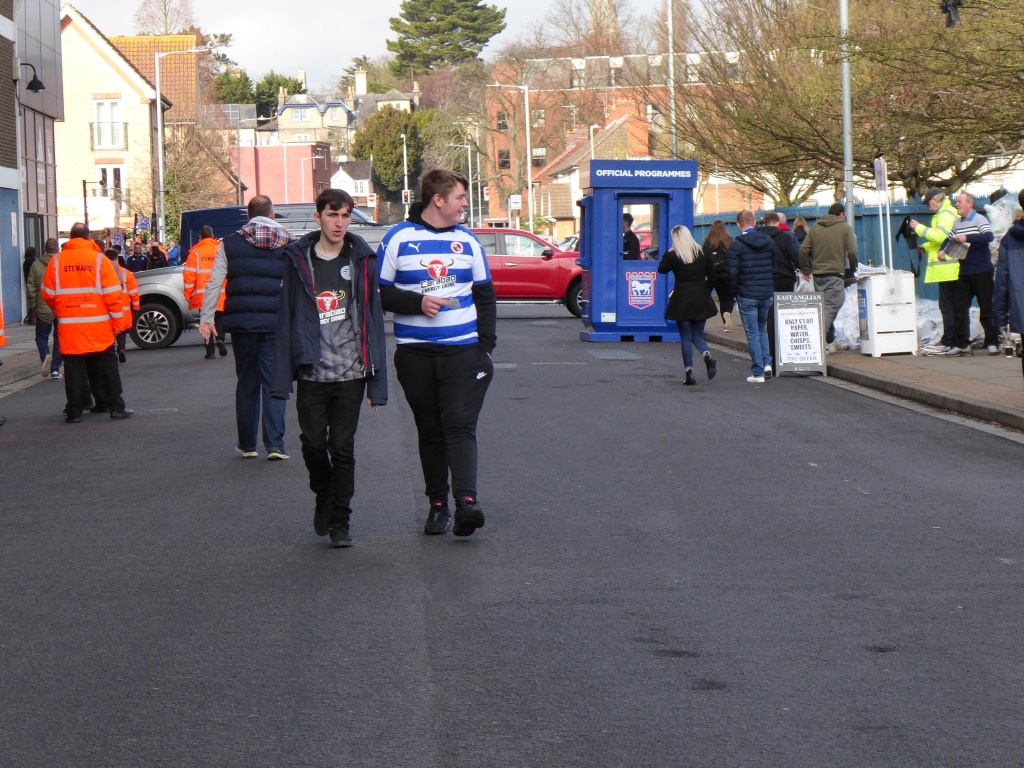
I walk on up Portman Road with its burgers, poor quality bread rolls and more than the usual number of people seemingly desperate to get into the stadium as early as possible. I don’t buy a programme because £3 is a lot to pay for something which will spoil the line of my overcoat and from which I will probably derive very little if any pleasure, except to deride it in all its glossy vacuity.  By the time I reach St Jude’s Tavern I am feeling warm and curse my jumper and overcoat, I feel over dressed for what seems to have become a Spring day.  In St Jude’s Tavern I ask the barmaid what the Match Day Special is. “Goblin’s Piss” she replies.   Understanding that this is not her way of telling me I am not welcome in this hostelry but is the name of the beer I ask for a pint; after all, it only costs £2.50.   I find a seat next to the usual bunch of grey-haired Town supporters who frequent this pub and Portman Road out of sheer habit.  After five or ten minutes Mick arrives; I am pleased to see that he is wearing a well-insulated looking parka and so I will not sweat alone; Mick has a pint of Hoppy Jude’s (£3.20), largely I think because the name “Goblins’ Piss” does not appeal and it does smack of a brewery asking a thirteen year old boy to come up with names for its beers.

Mick and I talk of the expressiveness and eloquence of the French, of funerals and the weird names that people give their children ‘nowadays’, and the even weirder spellings.  Mick tells how his daughter had wanted to call her child Maverick if it was a boy.  Mick considered it was his duty to dissuade her with the argument that Maverick is a crap name; fortunately Mick now has a grand-daughter.   I like to think however that had the baby been a boy he would have grown up to become an accountant.

First drinks drunk, Mick buys me a pint of Hoppy Jude’s, although I had asked him to get me a pint of Nethergate Old Growler, and he has a Speyside Malt Whisky, because there was no Glenmorangie.  Imperfection seems to be the theme of the day.  The pub clears early, probably because a large crowd is expected and a little after twenty five to three we make our way too.  Outside, the gloom of the morning has completely gone and we comment on how Spring-like it is.  As we descend Portman Road a police van and car pass us with blue lights flashing; we speculate as to whether there’s “trouble”, which would be unexpected from Reading, a club like Ipswich with no reputation for it.  “You might see some gore” says Mick optimistically.  We catch up with the blue lights which have parked near Sir Alf Ramsey’s statue but there is nothing to see here, just one policeman talking into his radio and looking slightly puzzled.

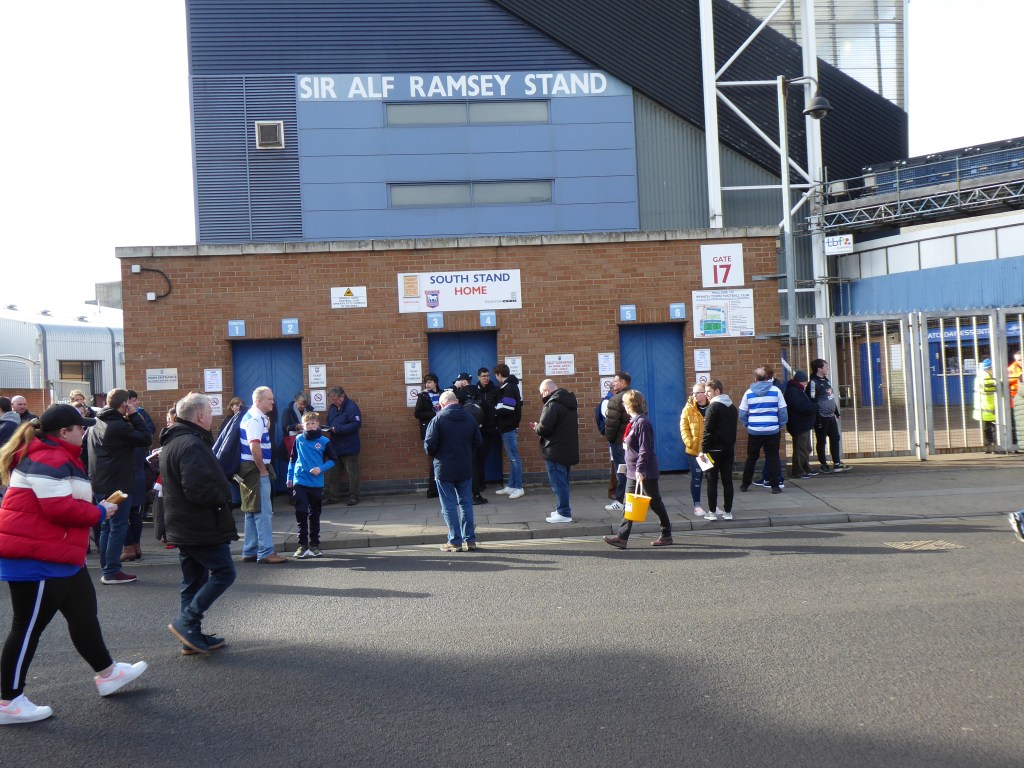
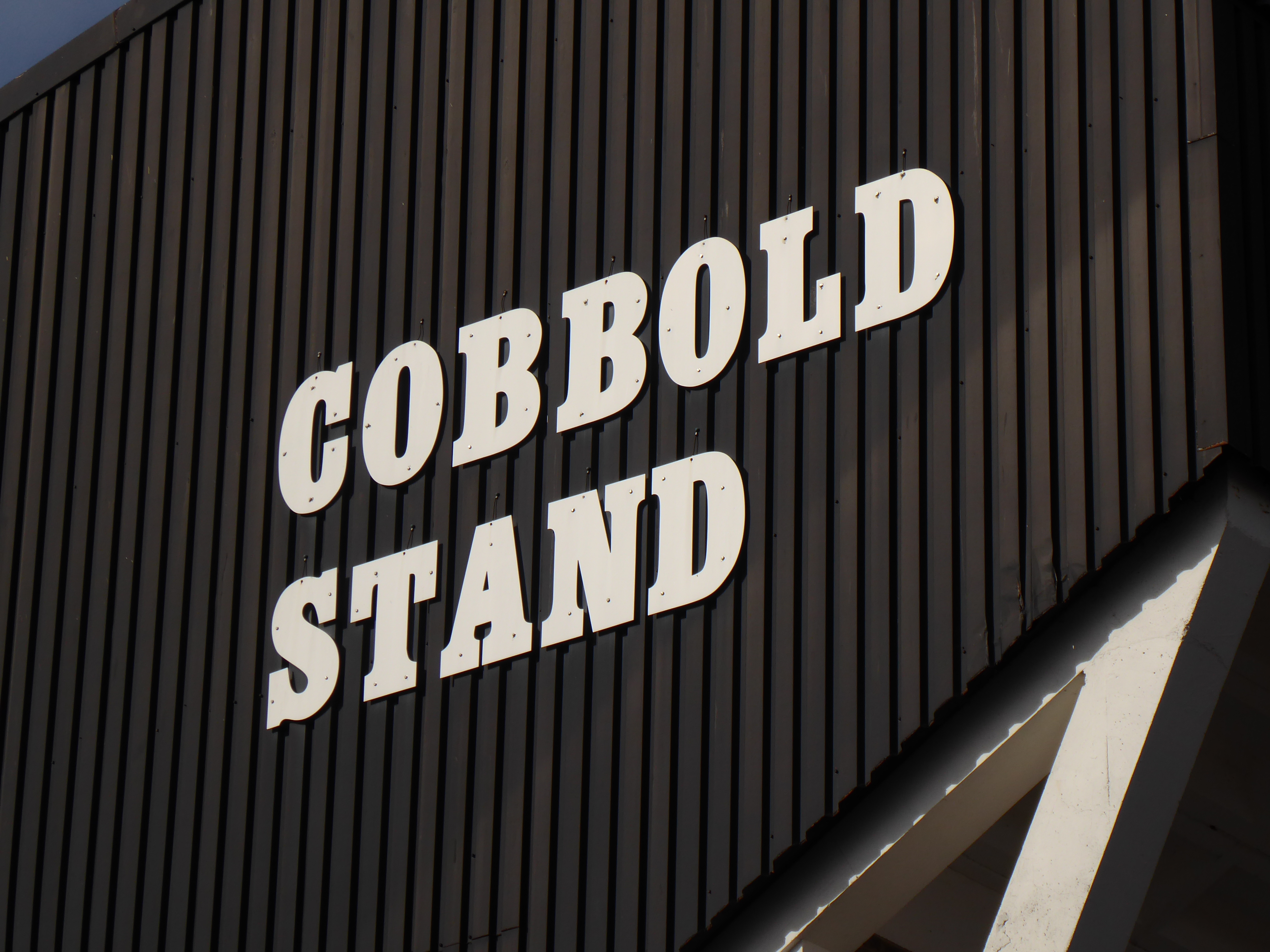
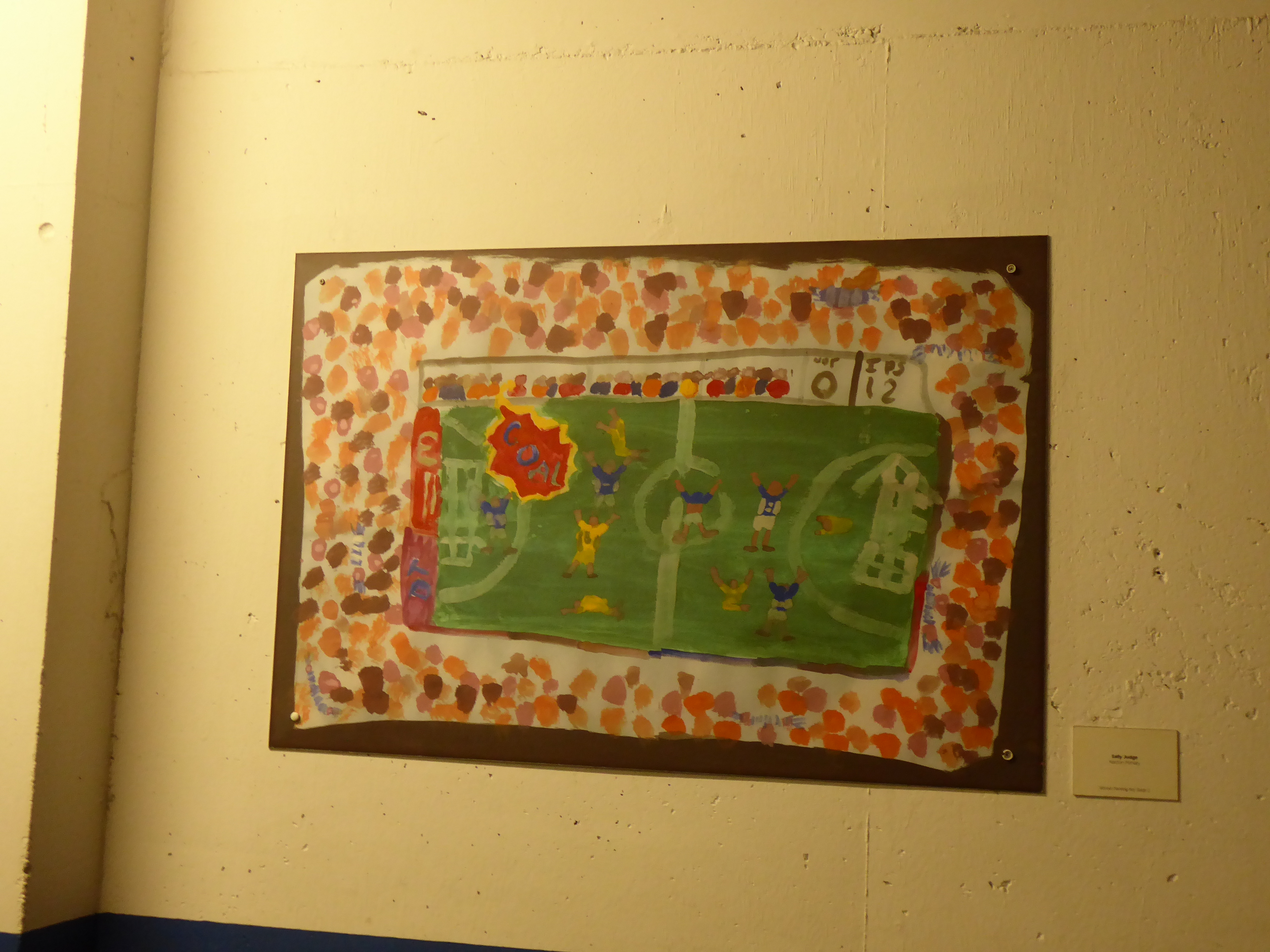
By way of a change, today I have seats in the upper tier of the Cobbold Stand, our tickets giving entry through turnstiles 19 and 20.  We join the queue for turnstile 19 because although the two queues are directly side by side, it is much the shorter of the two.  I suggest this is because some people have an inherent fear of prime numbers.   I like the area beneath the Cobbold Stand with its unfathomable layout of cramped passages and 1970’s painted concrete and there are even pictures on the walls, albeit ones painted by primary school children;  it’s very different to the cavernous, drafty, emptiness that I am used to beneath the Sir Alf Ramsey Stand where I have my season ticket.

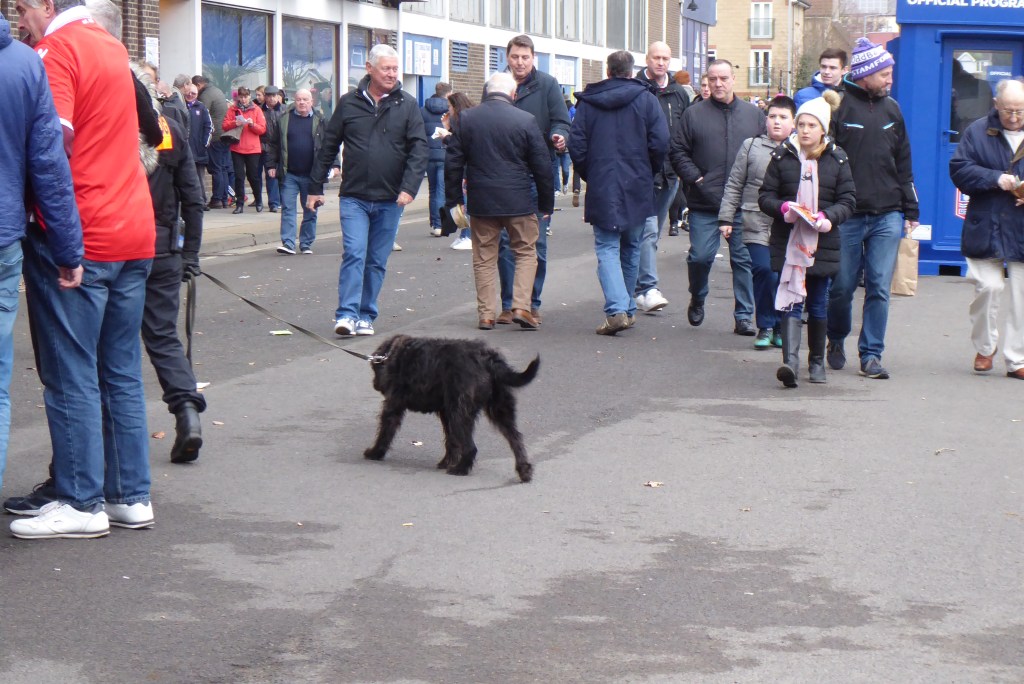
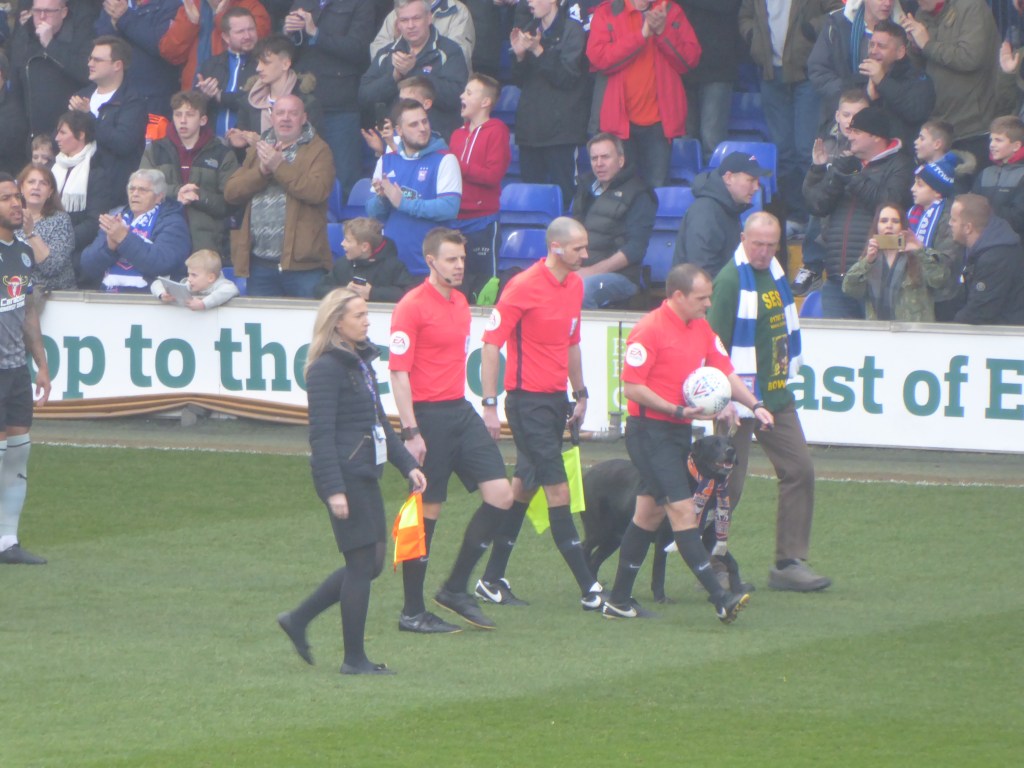
Today the two teams are led onto the pitch by a dog called Bowza.  Every month Ipswich Town nominates a Community Champion and this month Bowza is that champion after he helped save the life of a sick woman by keeping her warm whilst she waited for medical help.   There should be more dogs at football matches, but I don’t suppose they can afford the ticket prices. However, the @nonleaguedogs twitter account suggests this isn’t necessarily so outside the Football League or ‘EFL’ as it is now dubbed because TV or the interweb has made people’s attention spans too short to deal with whole words anymore.

Bowza’s appearance will prove to be a highlight of the afternoon.  Ipswich kick-off playing towards Pat from Clacton and ever-present Phil who never misses a game, who I can just make out in their usual seats in the lower tier of the Sir Alf Ramsey Stand.  Town are as ever in blue and white with a nasty logo across their chests entreating on-line fools to part with their money.  Reading, whose hooped blue and white home kit is likeable wear an awful all-black affair which fades to grey over their stomachs; it’s hideous and looks nothing like a football kit.

 Soon, with Bowza just a fading memory Town and Reading begin to show why they are both haunted by relegation.  This is not to say that I am not entertained however, although I am not a big fan of pantomime.  Everyone loves to hate a pantomime villain however and in Nelson Oliviera Reading have one of the best ever seen at Portman Road.  Not only is Oliviera on-loan to Reading from Norwich City but just to make it clear that he is the embodiment of evil today he is also wearing a black mask. All he is missing is a tall black hat.  Oliviera quickly gets into his stride with an audacious and obvious dive in the penalty area as Bartosz Bialkowski comes to collect a typically over-hit forward pass.  But referee Mr Geoff Eltringham is wise to him, it would be difficult not to be, and lets him have a personal viewing of his yellow card.  “Wanker, Wanker” shout the Sir Bobby Robson Stand at Oliviera to everyone’s approval.  Evil genius Oliviera ain’t.

Ipswich look particularly clueless in much of the first half of this game and this may be because they have unexpectedly switched to a complicated looking 3-5-1-1 formation which no one comprehends.  With eighteen minutes having passed all three players in Ipswich’s defence run towards Reading‘s weirdly spelt Garath McCleary as he runs to the left edge of the penalty area.  With no defenders in the middle of the penalty area, even a forward not good enough to play for Norwich City understands that it is a good place to be and Oliviera moves in, receives the inevitable pass from McCleary and has the time to light a cigar and feed his cat before choosing whereabouts in the goal to put the ball.  He shoots, he scores and heads off on a slightly bandy legged run to taunt the Ipswich supporters in the Sir Bobby Robson Stand.   Had Geoff the ref not already booked him once his offensive gloating would surely have led to a caution from a referee who will eventually show his yellow card to seven players during the course of the afternoon, some of them for some hilariously bad and extremely entertaining attempts at tackles.

The remainder of the half passes with Ipswich often looking not as good as Reading; which is a worry.  Town create one very good opportunity to score with Jon Nolan appearing unmarked much as Oliviera did, but he shoots where the Reading goalkeeper Damian Martinez, who sounds as evil as Oliviera is, can save it instead of where he can’t.With the half-time whistle Mick and I descend beneath the stand to the gents and then to the crowded bar to catch up on the half-time scores.  Like some sort of conceptual art installation the TV set is showing the view from the stand of the empty pitch.  Mick heads back to the stairs to ask the steward if there is another TV, there isn’t but the steward says he can come and change the channel for us, “Yes please” says Mick and he does and we catch up on the half-time scores, which aren’t as interesting as we’d hoped. I don’t think we realised who was playing who and had hoped to see a score somewhere where Ipswich were winning.   We return to our seats which are roughly level with the penalty area at the Sir Bobby Robson Stand end of the ground.  “At least we’ll get a good view of all the goals this half” I say to Mick “Yes” he replies, throwing back his head slightly as if to laugh loudly, but then not doing so.

The second half begins.  The bald man in front of me smells unpleasantly ‘pine fresh’; it must be his aftershave or body spray, either that or he’s been cleaning out toilets all morning.  If my wife Paulene were here she would surely have an asthma attack.  Ipswich now have all three substitutes on the field, an admission perhaps that the 3-5-1-1 formation was not a success, although the injury to central defender James Collins before half-time had doubtless messed it up further.  Collins is joining that long line of much vaunted crocks from Kevin Beattie, through Tony Humes to Johnny Williams and David McGoldrick who have, due to injury, seemingly missed as many games as they’ve played.

Ipswich improve, but not sufficiently; that will sadly prove beyond them.   The crowd get behind the team, a bit; there is a will even if there isn’t a way.  But not everyone is supportive.

“Get off Quaner” shouts a bloke behind me at the gangly German.  He shouts it again, but happily Quaner can’t hear him and to voluntarily go down to ten men seems like bad advice.  “He’s fucking, shit” moans the bloke behind me refusing to let up, but I’ve already decided he doesn’t know what he’s talking about and block out his whining with  higher thoughts; it’s not difficult.

Disappointingly Oliviera is substituted in the second-half but not before he makes one final scene as clutching the back of his leg he then throws himself down flat on his back having undergone a miraculous transition from evil nemesis to flouncy drama queen in just under an hour.  He’s been a lot of fun but if asked I would say that a post-playing career in Hollywood does not await the bandy Portuguese.   

As Jon Nolan is booked for one of those hilarious attempted tackles, players of both teams square up to one another childishly and completely ignore the crumpled Reading player writhing about to show how hurt he is. Meanwhile I contemplate how Geoff the ref is the most barrel-like of all referees I have seen this season; he is so wide he appears to have a leg at each corner.  I am biased but Ipswich are worth a goal and there is mounting excitement as the clock counts down towards ten to five.  ‘Pine-fresh’ man in front of me keeps jumping up from his seat whenever the ball nears the Reading goal, which is rather annoying, but with full-time approaching it is all quite exciting even if the Reading goalkeeper’s best save ends up being from one of his own players; but it’s that sort of a game, no one is fully in control of their faculties.  Then, with 83 minutes having passed into history Gwion Edwards scores, lashing the ball in at the far post; at first I think he must have missed, but he hasn’t.  Town will surely go onto win now, although being happy with a draw is the story of the season.  Instead, as injury time approaches Reading break away and although Town’s goal looks defendable with three defenders and Bartosz Bialkowski against two strikers, it doesn’t prove so and Gambian Modou Barrow rolls the ball past Bartosz to win the game for Reading.  In my head I hear a  plaintiff voice sing “Ha-ha-haaaaa”.

Ipswich Town 1 Arsenal 0 – Our Blue Heaven

It’s Saturday May 6th 1978, I will be eighteen in about seven weeks’ time and today I am going to the FA Cup final. I am going with my dad; we were two of the 24,207 who saw Town beat Hartlepool United in the fourth round of the FA Cup and the 29,532 who witnessed the 3-0 win in the fifth round replay against Bristol Rovers; we went to the semi-final at Highbury on a supporters’ coach from Shotley. We saw Landskrona Bois, Las Palmas and Barcelona at Portman Road back in the autumn and have seen about a dozen league games on top of that, so we had the requisite vouchers to get tickets for the final. But this morning my father has woken up feeling unwell; he doesn’t think he’ll be up to going to Wembley and so for my friend Tim who lives five doors away, it’s his lucky day. I walk along the street, knock on his front door and ask if he wants to come to the FA Cup final; he does. Tim’s dad Charlie will this evening deliver a bottle of sherry by way of a thank you.
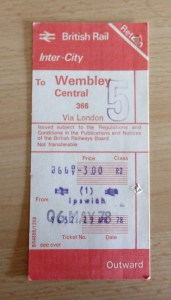
I listen to a few selected tracks from Blondie’s first album ‘Blondie’ (released in December 1976 )as I get ready to go; ‘Look good in Blue’ seems apposite this bright morning as does ‘In the sun’ with its lyric “In the sun , we’re gonna have some fun”. We get to Ipswich railway station somehow; on the 202 bus, or does someone give us a lift? Ticket to WembleyFrom Ipswich we are on a special chartered train that turns right at Stratford and plots a course through north London round to Wembley Central. In Wembley Stadium the terrace steps at the tunnel end are much bigger and steeper than those in Churchman’s or in front of the East Stand, blue and white abounds. The sun shines and Arsenal, wearing yellow and blue, kick off with Ipswich playing towards that blue and white tunnel end. Paul Mariner hits the cross bar, John Wark twice shoots against a post, Pat Jennings saves acrobatically from George Burley, Paul Mariner misses, bigmouth Malcolm McDonald is rubbish, Clive Woods is brilliant, David Geddes crosses, Willie Young is a lumbering donkey, Roger Osborne scores, we cheer, we sing, Roger Osborne is substituted for Mick Lambert, Town win and Mick Mills lifts the FA Cup and turns to show it to us.
Back at Wembley Central railway station after the match a half-brick or a stone bounces off the window of our train as we wait to depart back to Ipswich. Arriving back in Ipswich, Tim and I celebrate with a couple of pints of Tolly Cobbold bitter in the Railway Tavern on Burrell Road as we wait for a lift home in Tim’s dad’s green Morris Minor 1000.

OLYMPUS DIGITAL CAMERA
Forty years and eighteen days later it’s a dank evening in Ipswich, I have been to work, visited my mum, parked up in Portman Road and arrived at the New Wolsey theatre, which didn’t exist in 1978, although there was repertory theatre in Tower Street. I am with my wife Paulene. My father has been dead for nine years, happily his cause of death was unrelated to his illness of 6th May 1978, he enjoyed almost 21 years of good health subsequent to that and made it to the UEFA Cup final second leg in Amsterdam. Tim now lives in Weymouth and oddly he still only gets to see the Town when I get him a ticket (this season we went to Brentford). The Railway Tavern has been demolished; the green Morris Minor was scrapped long ago. But the name of Ipswich Town is still inscribed on the plinth of the FA Cup.
My seat at the Wolsey theatre tonight is in the front row of the auditorium, my wife Paulene is sat in the row behind; she sat behind to give me more legroom. The production is so popular we couldn’t get two seats together. We are the first people in the auditorium, Paulene’s asthma means she needs time to acclimatise. I read the programme (£4) and think “Cup final prices”. The stage is just a metre in front of me, the ‘boards’ are under a green covering patterned to look like turf. At the back of the stage a pair of blue doors look like the doors at the back of the old North Stand, above them is a projection of the type of corrugated cladding also redolent of the old North Stand. But there was never a sign that said ‘Welcome to Portman Road’ back then, there isn’t now. Also part of the projection is the old Ipswich Town crest, the slightly imperfect yellow and blue one, which should be restored out of respect to the past and to John Gammage who won the competition to design a distinct crest for the club back in 1972.41429848635_33f2609053_o
I watch the ‘crowd’ as the auditorium fills up to the sounds of assorted 1970’s pop hits, nostalgic but mostly awful. The majority of people here seem to be my age or older, old enough to have witnessed the 1978 Cup final. A few people are sporting blue and white scarves; one man wears a bright red blazer as if he’s just got here from Butlins. In the front row are three young lads, pre-teens, one of them wears a parka which lends an unexpected layer of 1970’s authenticity. Paulene says she feels cold, I say if I’d known she was going to I would have brought a blue and white bobble hat for her.
The lights dim and tonight’s performance of ‘Our Blue Heaven’ begins with Blondie’s “Hanging on the telephone” played live as the soundtrack to a domestic scene in which a young couple, Mel and Scott arrange their wedding for Saturday 6th May 1978, and then the draw for the third round of the FA Cup is announced. I resist the temptation to put my hand up to point that Blondie’s Parallel Lines album, from which ‘Hanging on the telephone’ was taken as a single would not be released until September 1978. I am not really a pedant and whilst I may not always like it, I do understand the concept of artistic licence and have been known to use it myself; I deny all accusations that it was merely lying.
Mel’s sister Sue is a dedicated and faithful Town fan and from the start foresees that she will want to be at Wembley on May 6th. Meanwhile, in a parallel story Smudger and Ange are awaiting their first child, with Ange’s ‘expected date of confinement’ surprisingly enough being 6th May, although the nurse at the hospital, who happens to be Mel and Sue’s mum Sheila tells them that babies never arrive on time. Smudger is as committed a Town fan as Sue and is predictably torn between his love for the Town and supporting his wife.
The simple domesticity portrayed is all a bit ‘Play for Today’, particularly when it transpires that Mel and Sue’s dad Paul is a striking fireman, whilst Scott’s dad Brian is a Thatcherite policeman; and that just adds to the authenticity and feel that it is 1978. I am transported back in time on a wave of Nostalgia (from the Buzzcocks Love Bites album and like Blondie’s Parallel Lines, also not released until September 1978, but also sadly not in the show).
Scenes from the two families’ stories are spliced with Town’s progress through each round of the FA Cup introduced by popular songs of the time, Bowie’s ‘Heroes’, Patti Smith’s ‘Because the night’, something or other by the Bee Gees. For the sixth round trip to Millwall the band plays the Clash’s London Calling, at which point I really do want to put my hand up because the Clash’s album was not released until December1979, a whole 20 months later. I only hold back when London Calling runs into White Riot, which is much more temporally authentic having been released as a single in March 1977, and a cracking tune to boot.
For each match a group of male and female dancers act out the crucial on-pitch events to the background of the songs and a BBC radio style commentary. My friend Gary texted me before the performance to tell me there was just one thing he did not like about the production and later he will tell me that it was the football sequences. Re-creating football well is notoriously difficult to do, as proven by awful films such as Yesterday’s Hero, in which incidentally the football sequences were filmed at half-time during a game at Portman Road; this is why I don’t consider that the director really bothered to do so. The dancers don’t look like footballers and they are only dancing, creating an impression through movement; they could have been supporters recreating the goals, children doing so in the school playground, and that is authentic. So Gary, you are wrong and need to brush up on your critiquing skills.
The intertwined stories of the families and the FA Cup run are good ones, there is drama, pathos, human emotion aplenty, humour and of course a happy ending. But the thread that runs through the production is the character of Bobby Robson who intermittently comes on to the stage like some sort of visiting angel wearing a series of 1970’s style suits and coats, imparting words of wisdom and assorted homilies about football and the wider experience of our lives beyond. As if this isn’t enough, the actor playing him, Peter Peverley does so brilliantly, better even than Michael Sheen’s rendering of Brian Clough in The Damned United. Peverley has the accent which is easy enough, and he has perfected the mannerisms too, but more than that he has captured the slight hoarseness in the voice, it’s almost uncanny. He wears a pretty bad wig though.
The finale to the production has the marriage, the birth and the FA Cup final taking place on stage simultaneously following the singing of Abide With Me, the Cup final hymn since 1927; a maudlin little number but a cracker nevertheless because it is the Cup final hymn and has been marinated in 90 years of Cup final history. Being sat right at the front, my view is now partly obscured by some of the on stage props, so I watch the audience. People who know the words sing along with Abide With Me, whilst others hold their scarves aloft. It is likely that many of the people here, like me were at the Cup final in May 1978 and are part of the story, but this makes people feel involved all over again, it’s nostalgia with knobs on, re-enacting the past, albeit part fictional, but this is somehow how it felt.
The story ends and it truly feels like Town have won the FA Cup all over again, and then Roger Osborne, the personification of the day because he scored the winning goal enters the stage, inevitably to a standing ovation. The ultimate finale however, comes with the cast all assembled on stage with Bobby Robson leading us in a sing-song, some Cup final community singing of our own; a rousing rendition of Edward Ebenezer Jeremiah Brown. It’s bloody marvellous and everything that matches at Portman Road no longer seem to be, utterly joyous. I give it my all.
I have had a most marvellous evening and for much of it I am not ashamed to admit I have had a tear in my eye. I have been taken back in time, but don’t know if I’m tearful for my lost youth and the passing of the days when Ipswich Town was such a wonderful football club and team, and when the FA Cup was something that really mattered, or if these are tears of joy and happiness, for a love of my team and a sense of belonging that has been re-kindled.
Nostalgia is warm and cosy, but it’s not a healthy thing, because we cannot go back and we have to live in the present; but tonight after watching Our Blue Heaven I genuinely feel uplifted.
My name is Edward Ebenezer Jeremiah Brown
I’m a football supporter of Ipswich Town
Wherever they play, you’ll find me
I haven’t missed a game since I was three
With me scarf and me rattle and me big rosette
Singing where was the goalie when the ball went in the net
Follow the Town
Up or Down
I’m Edward Ebenezer Jeremiah Brown but everybody calls me Ted.

Football, Football,
Whose the greatest of them all,
Let’s put it to the test
Come to Portman Road on a Saturday and you’ll see the best
Oi!
Ipswich! Ipswich! Come On The Town!

My name is Edward Ebenezer Jeremiah Brown
I’m a football supporter of Ipswich Town
Wherever they play, you’ll find me
I haven’t missed a game since I was three
With me scarf and me rattle and me big rosette
Singing where was the goalie when the ball went in the net
Follow the Town
Up or Down
I’m Edward Ebenezer Jeremiah Brown but everybody calls me Ted.

2-4-6-8 who de we appreciate?
It isn’t hard to tell
Just you take a closer look at me
And you’ll know darn well
Oi
Ipswich! Ipswich! Come On The Town!

La la la
La lala la lala lalala
Lala lalala la lala lalala
La lalala lalala, and lots more lalalaing, you get the picture ?


Whitton United 5 Coggeshall Town 4

The Eastern Counties First Division is the tenth tier of English football, just a few seats, some floodlights and a half-time plate of sandwiches for the opposition committee separates it  from the clubs that play on a piece of waste ground and use jumpers for goalposts, well  almost.  But that doesn’t mean clubs at this level don’t have history; Whitton United have been going since 1926 and Coggeshall Town since 1878, the same year as mighty, illustrious Ipswich Town, former League Champions, FA Cup, UEFA Cup and Texaco Cup winners.

It says in the match programme that a Whitton team existed in the late 1800’s, back when Whitton was a small village a mile or more outside Ipswich.  But between the World Wars Ipswich Corporation, as it was then, began to build the Whitton estate providing much needed,  good quality, rented housing for working class people.  Whitton is now a part of Ipswich, and if supporters in the Eastern Counties league did sing (with the notable exception of Wivenhoe Town’s they tend not to) they could chant “Small club in Ipswich, You’re just a small club in Ipswich” without fear of contradiction.

Whitton United is a rare thing in the Eastern Counties League, a team representing a truly urban area, and more than that it might be said to represent a large council estate.  The contrast with Coggeshall therefore is on the face of it quite stark.  Coggeshall, with its National Trust owned medieval buildings and its vineyard and ley lines is positively poncey by comparison.  The other big difference is that Coggeshall Town are being bankrolled; there are stories of players attracted from beyond Essex on the promise of big appearance money.  The realisation of this is shown in their relative league positions with Coggeshall currently top of the table, where they have been virtually all season, whilst Whitton are merely near the top of the bottom half of the table, albeit on a roll of five consecutive victories.

The King George V Fields ground is outside the Whitton estate next to the main road out of town towards the A14 and Stowmarket.   A third of the pitch is overlooked by a large heap of rubble that was once the concrete floor of the Tooks bakery (aka bread factory), formerly the club’s neighbour. Behind one goal there is no accommodation for spectators whatsoever, just a stretch of grass from the goal net to a very big fence, with the road beyond.   There is a stand on each of the other three sides; two of them resembling country bus shelters, one of which is labelled ‘The Shed’; whilst downhill, behind the other goal is a pre- fabricated, metal stand containing the requisite number of seats for the club to play in the Eastern Counties Premier League. should the need arise.  The changing rooms have a wonderful green and white striped tin roof.

It’s a grey, blustery afternoon with a constant threat of rain, but the two teams in their striped kits, Whitton in green and white and Coggeshall in red and black stand out through the gloom and offer the promise of excitement.  I wander around the perimeter rail before the game kicks off and a bloke on his way to one of those ‘bus shelters’ and carrying a couple of pints of beer says hello; “ We need a good result today after last week” he says.  I have no idea what either team did last week, but I agree because it would be churlish and a bit weird not to do so and I’m not one to start an argument with someone I don’t really know.  To begin with, the promise of a good game is all there  as the ball bounces awkwardly on the soft pitch and is buffeted by the wind, producing a scrappy match with neither team looking much good.  Despite kicking up the not inconsiderable slope and against the wind however, Coggeshall gradually start to look the stronger team.

I walk round the back of the dugouts and towards the end of the ground where the only spectators are those in passing cars and buses who are probably surprised to find themselves watching a football match, albeit for a few fleeting seconds only.  One or two beep their car horns as they drive by.  Coggeshall are kicking towards the goal at this end and it doesn’t take long before they score, a close range tap-in from Scarlett, despite claims of offside from Whitton.  Somewhat bizarrely Coggeshall’s number four is booked in the aftermath and from what I can make of what referee Mr Pope seems to be saying, it is because he egged on the Whitton players in their offside protests. ‘You started it’ I think I hear the Pope say as if scolding Martin Luther.  The same player is then spoken to again by his holiness and told to concentrate just on the football by the Coggeshall coach; “I only said bad luck baldy” the player opines after Whitton’s follicly challenged centre-half concedes a free-kick on the edge of his own penalty area.

I drift back towards the Whitton bench having had enough of the Essex club’s manager’s questioning of Mr Pope and decide to briefly compare and contrast him with the Whitton manager.  I conclude that the Whitton man mostly complains to himself and to the bench in a sort of audible internal dialogue.  The results of the comparison fit with my own pre-conceived ideas of Ipswich and Essex people.  Happily for Whitton however, my move into their half coincides with a couple of attacks down the left, one of which results in a free-kick and ends with an unexpected, but not completely undeserved equaliser from Bell.

Half-time arrives with scores all square and I indulge in a pounds worth of tea and a warm in the clubhouse, although I have to be let in because the door only seems to open from the inside.  I return to pitch side too late for the re-start, but haven’t missed anything and take up a spot in the seats behind the goal.  It starts to rain.

With the wind at their backs and playing down the slope it seems like it might be easier for Coggeshall in the second half and gradually, as in the first half they begin to dominate the attacking play, but without really making any decent chances to score; then, a break down the left, a through ball and a goal for Whitton by Percy (sadly his surname not his first name).   It’s a bit of a surprise but the game returns to its previous pattern and with about fifteen minutes left, after some more Coggeshall domination the ball is crossed low, blocked and partly cleared before the Coggeshall substitute Guthmy coolly places the ball in the middle of the goal to equalise.  Now it really looks like Coggeshall will go on to win and that’s what the bloke behind me tells his children when they ask.

The good thing about football however is that is totally unpredictable, which is why all these ‘sports betting companies’ (bookies) advertise relentlessly to part mugs with their money.  Proof of football’s unpredictably arrived within just a minute or two as a deep cross from a corner was headed in at the far post by Griggs to put Whitton ahead again and then within minutes of that a through ball saw  Cheetham brought down in the box resulting in a penalty which gave Whitton a 4-2 lead. The rain had now eased and I stepped out of the stand so that I didn’t have to peer through a goal net and another bigger net placed across the front of the stand to protect inattentive spectators from stray footballs that might inadvertently smack them in the chops when they were looking at their mobile phones rather than the game; serves ‘em right I say.  Barely had I done this and with about six minutes left Whitton scored yet again with Cheetham ‘converting’ a cross by the beautifully named Franco Mallardo.

Surely that was it, 5-2 with just five minutes left? But no, Coggeshall rightly decided that the game wasn’t over until his holiness Mr Pope says so, and just as I would never leave a game before the final whistle, so the ‘Seedgrowers’ , for that is what their nickname is, continued to try and win the match.  And it was a good job they did or this report would be over already.  First, continuing the ecclesiastical surname theme started by the referee, Monk made it 5-3 with a fine half volley from the edge of the penalty area,  and a short while later he then crossed the ball for Nwachuku to smack a fourth goal high in to the Whitton United net.  There was still enough time for a free kick on the edge of the penalty area to be sent over the Whitton cross bar, but finally Mr Pope whistled Amen and the game was over.

It had been a most entertaining game, even if some of the defending had at times been hard to spot, and in difficult conditions on an awkward slopey pitch the players of both teams had given their all.  I was surprised therefore and disappointed that at the end no one clapped or cheered as the two teams left the pitch; but no one booed either, so it was one up on Portman Road I guess.   The 5-4 score line alone deserved some appreciation, but there was nothing, not a cough, not a wheeze, not even a tiny chortle. Everyone just filed away into the car park.   To an extent, at this level of football the result doesn’t matter as much as the fact that the two clubs are still there each week to play; this is perhaps true more for a real community club like Whitton United than a club like Coggeshall Town which has been adopted by someone with spare cash like a mini Roman Abramovich.

There was apparently only a crowd of 57 at this match, which is disappointing for a Saturday when Ipswich Town are not playing, and looking about there were very few people under thirty there.  A football match where you can drink in sight of the pitch should be a massive draw and at £6.00 entrance fee it provides good value for money compared to the £40 Norwich City wanted from IpswichTown fans to get into Carrow Road the following day.

Eastern Counties League Football should be the model for sustainable football, so I urge you, support your local team, it’s friendly, it’s funny, it’s fun, it is well worth it.  I had a lovely time.  Thank you Whitton United.