Matches against Stoke City always remind me of a bloke I knew when I was at university in the late 1970’s called Tony. Tony was from Wolverhampton and had a thick West Midlands accent but supported Stoke City, or “Stowke” as his accent forced him to call them. Tony, however, was what many people might term “a bit of an oik” and as well liking to boast that he had “shagged the Chief Constable’s daughter”, (Staffordshire’s or West Midlands’ I assumed), he also once defecated into a milk bottle and regularly claimed that he only went to Stoke City matches for the violence, or “vorlence” as his accent called it. Oddly, however, he was also a really nice bloke.
Also a really nice bloke is my friend Gary, although he has no discernible accent and as far as I know has never been carnally involved with any relative of a senior police officer. I must remember to ask him one day what he does with his empty milk bottles. Gary joins me on the train to Ipswich, which a text from Greater Anglia has told me is running a little late this evening. Unperturbed, we talk of the World Cup and Gary tells me how the city of Seattle, which has been nominated as one of the venues for World Cup matches, had decided to combine one of its match days with a Gay Pride Day. The Gay Pride Day was chosen before the World Cup draw took place and when the draw was made last Friday Seattle discovered that on its Gay Pride Day it would be hosting Iran versus Egypt. I laugh out loud as does the woman opposite us.
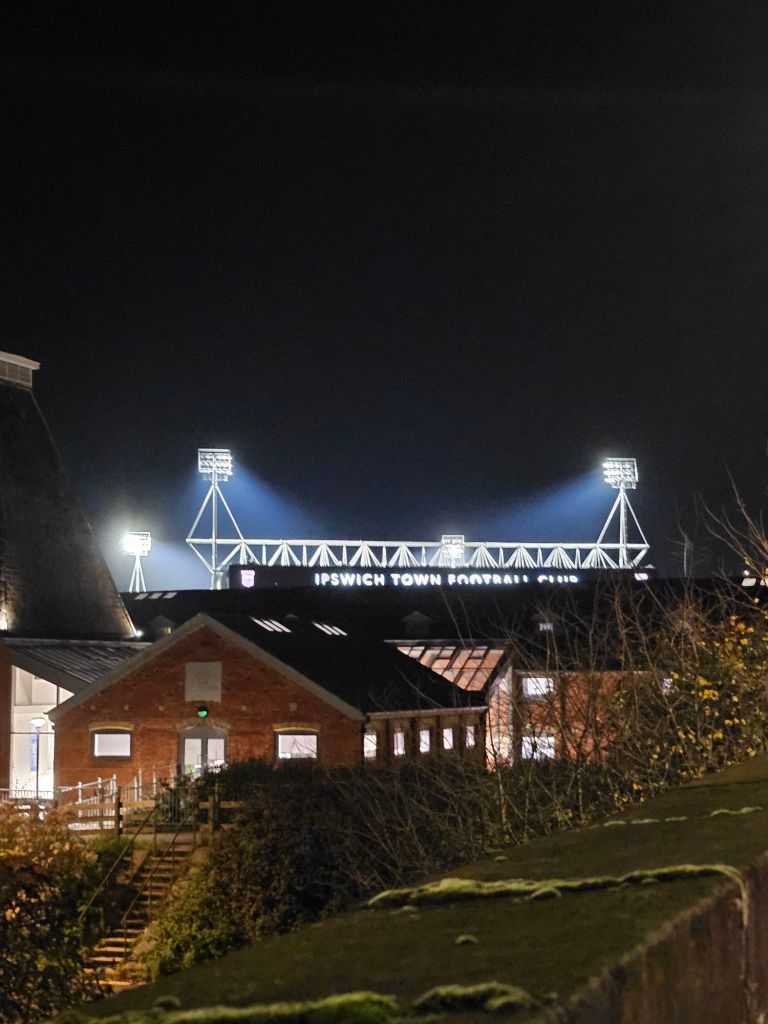
We arrive in Ipswich more than two hours before kick-off, but the floodlights of Portman Road are already shining, and Ipswich is aglow with electric light from lamp posts, buses, traffic signs, headlights and windows. The sky is a deepening dark blue and the tarmac of the roads shiny black. The red and white stripes of a Stoke City shirt peak out from beneath a jumper. Gary and I hasten as best we can to ‘the Arb’, which isn’t quite as busy as usual, probably because it is mid-week. First to the bar, I buy a pint of Lager 43 for Gary and a pint of Mauldon’s Suffolk Pride and, impressed by Mick’s lunchtime snack on Saturday order a Falafel Scotch egg for myself, before we retire to the beer garden to drink, eat and wait for Mick.
Mick arrives just as Gary returns from the bar with more Lager43 and more Mauldon’s Suffolk Pride; at my suggestion he also has a pint of Suffolk Pride for the previously imminent Mick. We talk of relatives’ funerals, Gary’s grandfather, who was a member of the Communist Party, and I tell of how I was watching Toulouse v Strasbourg on tv at the weekend and how when Strasbourg replaced Diego Moreira with substitute Martial Godo I remarked that I had been waiting for him to come on. In fact, however, I had been waiting for some club or other to sign a player called Godot, or Godo as it turned out, so I could make that joke.
The beer garden begins to empty out as other drinkers fold and head for Portman Road, but like the carefree over-sixties that we are Mick gets another round in; rather curiously a gin and tonic for Gary this time, but I have another pint of Suffolk Pride and Mick, eager for alcohol has a pint of Leffe. Gary then tells us about a friend of his who went to Ireland and wanted to buy a newspaper in a village shop, but all the newspapers were dated the day before. When he asked if they had any of today’s newspapers, the shopkeeper told him yes, but he’ll need to come back tomorrow. We continue to laugh and drink and enjoy living before I suddenly notice that it’s twenty-six minutes past seven and we probably ought to go.
Once again, down in Portman Road where I can already hear the excitable young stadium announcer excitedly announcing the Town team, there are no queues at the entrances to the Sir Alf Ramsey Stand and I breeze through, throwing my aeroplane pose as I’m cleared of carrying any weapons by a man in dark clothing and a hi-vis jacket with a hand-held scanner. Another similarly attired man tries to scan me again as I reach the famous turnstile 62 but rather than tell him I’ve already been scanned I just say “Oooh, I’m gonna be scanned twice”, which perhaps oddly, perhaps not, seems enough to deter him.
After venting spent Suffolk Pride, I arrive in the strangely sulphurous smelling stand to edge past Pat from Clacton and Fiona to my seat just as everyone bursts into respectful, appreciative applause for former Town goalkeeper David Best, who has died this week at the age of eighty-two. I don’t know why, but I always think of David Best in the context of the night Town beat Real Madrid, but also wearing a red goalkeeper’s jersey, flying horizontally across the face of the goal in front of the North Stand to perfectly catch a shot and, when he spoke to me as he autographed my Texaco Cup final programme, having the sort of Dorset accent that I imagined belonged in the fictional creations of Thomas Hardy . Incidentally, David Best was for a while manager of Dorchester Town (Casterbridge) where Hardy had lived.
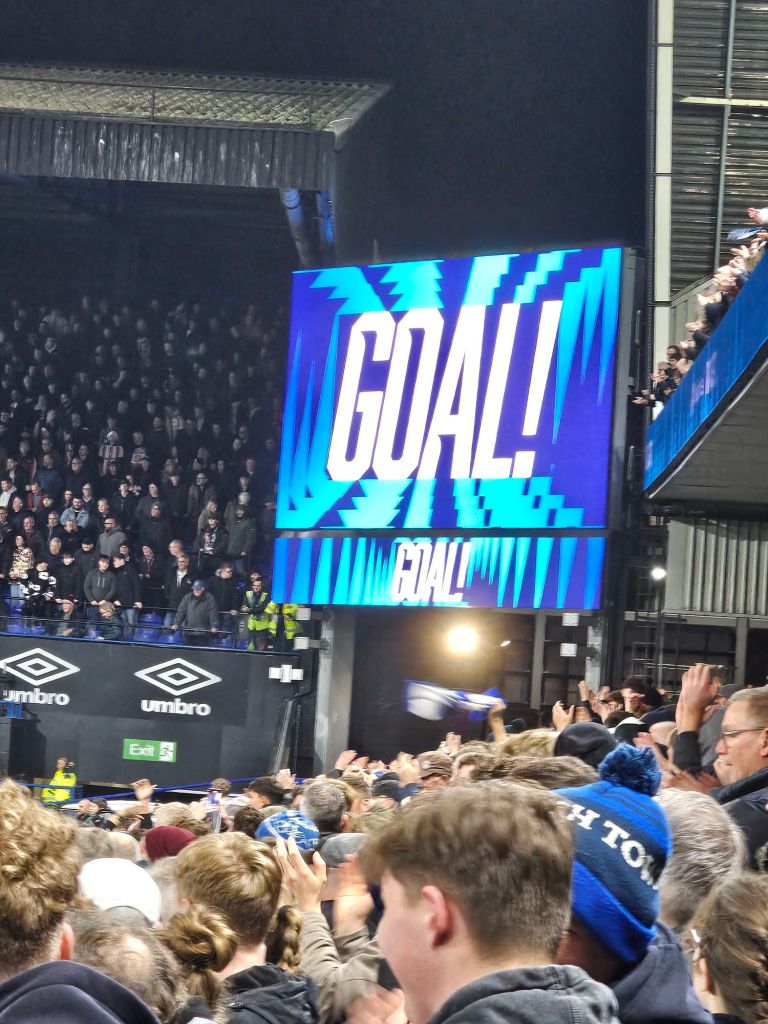
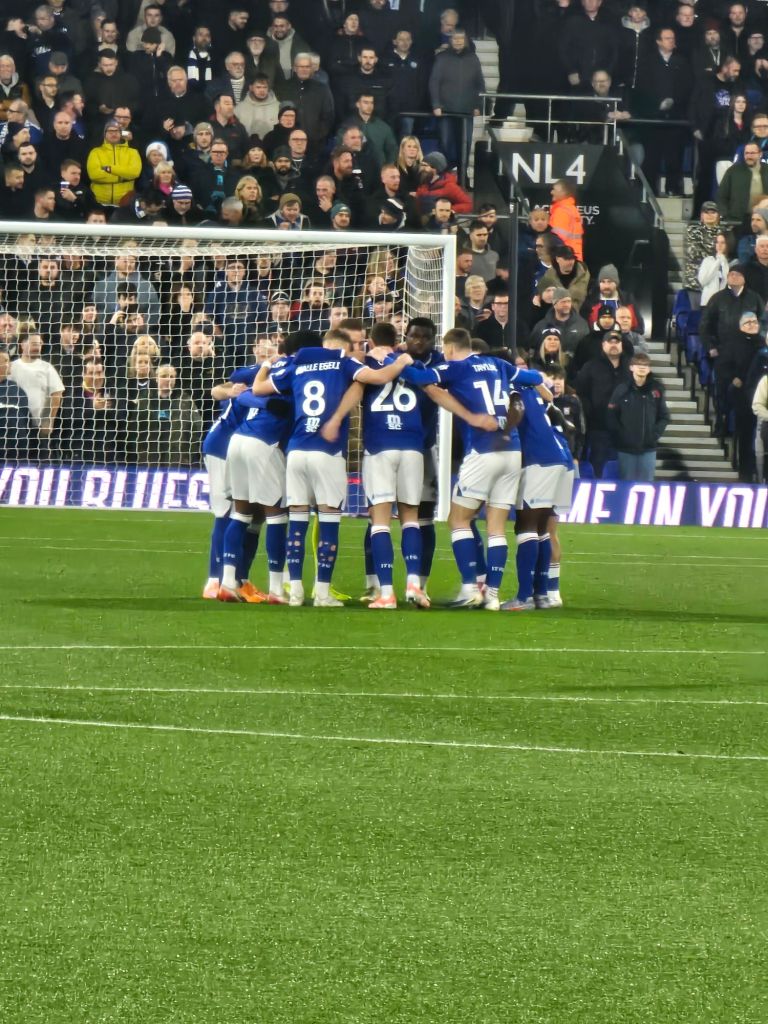
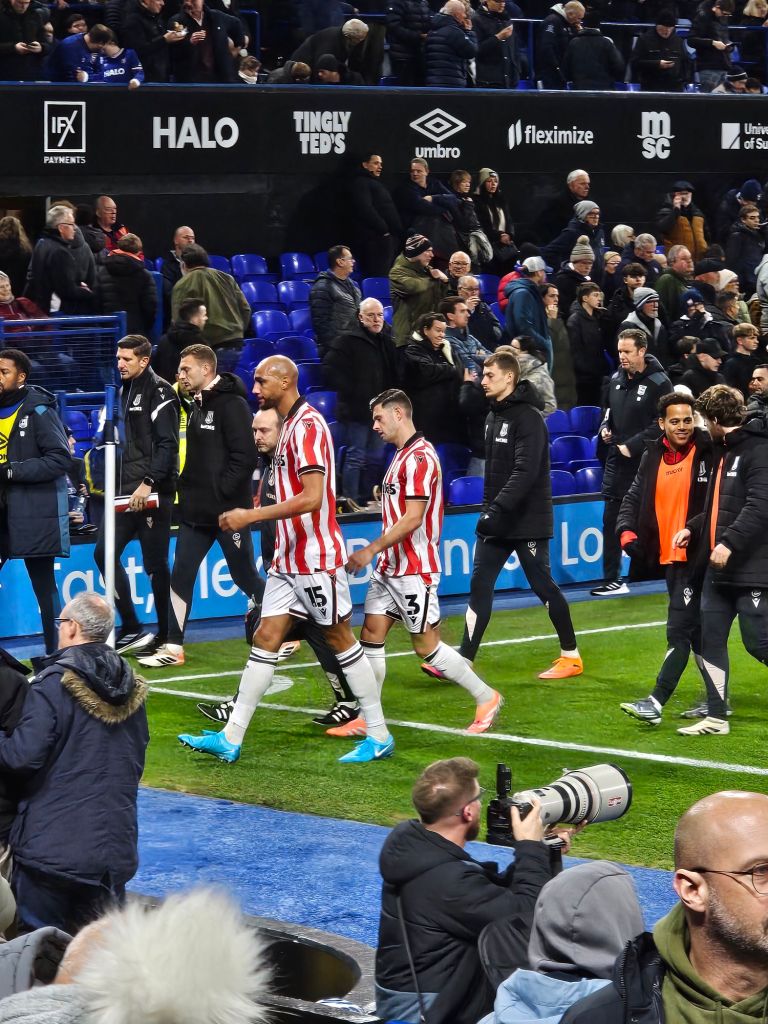
There’s barely time after the minute’s applause for Fiona and ever-present Phil who never misses a game to each hand me a Christmas card before the match begins. It’s Stoke City who get first go with the ball, which they propel in the general direction of the Brewer’s Arms on Orford Street and the former Spiritualist church on Anglesea Road, whilst sporting their handsome traditional kit of red and white striped shirts and white shorts. I will later notice however that the red stripes are all a bit wavy as if the kit designer had spent a long lunch hour in the Brewer’s Arms or was trying to convey the sort of weird ghostly aura normally accompanied by the made-up word “Woo-oooh”. Happily, Town are in their standard blue and white and perhaps as a direct result of this soon have possession of the ball, are advancing down the left, exchanging a couple of passes and Jaden Philogene is cutting inside at the edge of the penalty area to curl the ball inside the far post of the Stoke City goal. Town lead one-nil, and the game is barely two minutes old. Every match should be like this I tell Fiona.

Two minutes later however, and Stoke have a corner, and three minutes after that their supporters are singing “Football in a library” and then “Your support is fucking shit” as they embark on a desperate attempt to make us feel bad about ourselves. Stoke also start to dominate possession. Behind me a bloke has his scarf wrapped over the top his head. “Dress rehearsal for your nativity play?” asks the bloke next to him. Sixteen more minutes of winning one-nil elapse and Town dismantle the Stoke City defence again, only for Ivor Azon to shoot high and wide from a metre or so inside the penalty area with Stoke defenders scattered like shards of broken pottery. The bloke behind me thinks he sees Nunez chuckling.
“One of you singing, there’s only one of you singing” chant the Stoke fans to an oblivious audience, and Jack Taylor generously allows time for the whole Stoke team to receive remedial coaching on the touchline as he receives treatment from a Town physio for some ailment or other. “Who’s the Stoke manager?” asks Fiona, but I tell her I don’t know and all Fiona can come up with is Tony Pulis. Later on, I will remember the name Tony Waddington, but Wikipedia will tell me he died in 1994.
The game re-starts and Stoke still keep the ball most of the time, but without ever looking like scoring. I realise I recognise Stoke’s Nzonzi, having seen him play previously on the telly for Rennes and then I realise he even came on as a substitute for France in the 2018 World Cup final. “Addy, Addy, Addy-O” sing the Sir Bobby Robson standers out of the blue, perhaps to celebrate the twenty-sixth minute but possibly in an attempt to encourage Town to keep possession of the ball a bit more often. The chanting of “Come-On Ipswich”, a few minutes later, which sounds more like pleading, betrays our anxiety despite still being a goal ahead. But gradually the chanting and pleading starts to work, and Town dominate the final ten minutes of the half, even inspiring more confident sounding but boringly repetitive chants of “Blue Army”, whilst Nunez and Philogene both shoot on target but at the Stoke goalkeeper, and Nunez also shoots wide.


Three minutes of added on time are added on and then it’s time to leak more spent Suffolk Pride before speaking with Ray, his son Michael and grandson Harrison. When asked by Ray for my thoughts on the game so far, I tell him that despite seemingly never having the ball, Ipswich look like the only team likely to score. The football comes back at nine minutes to nine and Town soon have their first corner of the game in what will become a better half for the Town in which Stoke look even less like scoring than they did in the first half; although Pat from Clacton woke up with a blood-shot left eye this morning and so even if we did score again, it would be a bit blurry to her.
Five minutes pass and it’s about now that I notice that the stripes on the Stoke shirts are not straight but a bit wiggly, and not for the first time when watching a team in red and white stripes I am reminded of Signal toothpaste. Signal co-incidentally and appropriately, given tonight’s opponents, also being the name of the fictional local newspaper in Arnold Bennett’s passingly football-related, 1910, Potteries located novel ‘The Card’. More Town corners ensue. “Your support is fucking shit” opine the travelling “Stokies” as they ironically become the first set of away fans in well over two years to fail to fill at least half of the away section. Not surprisingly, their chants are greeted with disinterested silence, which is followed later by confirmation that tonight’s attendance is a meagre 27,008, the lowest of the season so far. The drop in attendance and therefore income is large enough to mean that at least one player won’t be getting paid this week.
Only fifteen minutes of normal time remain by now and later than usual Keiran McKenna dives into the world of multiple substitutions as Eggy, Azon and Taylor go for a sit down and Clarke, Cajuste and Akpom get to run around for a bit. Ten minutes left and Azor Matusiwa becomes the first player to be booked tonight by the referee, Mr Adam Herczeg, who is a sucker for giving a free-kick when anyone falls over. Meanwhile, Pat from Clacton won’t be having a baked potato when she gets in tonight, but she will have something cheesy from Marks & Spencer with a latte and she won’t be go to bed until midnight. As for me, I wish my bed was just the other side of my front door so I could step straight into it when I get indoors.
The final ten minutes ebbs and flows a bit more than has been the pattern up to now but it’s Ipswich who should score and don’t. Behind me a bloke complains that if he’d only known there would be no more goals he could have gone home after two minutes. The game soon ends in the second and final minute of the unexpectedly brief period of added on time following a Stoke City corner, which doubtless has legions of pessimistic Ipswich fans anticipating going home disappointed. With the final whistle, Pat from Clacton and Fiona disappear like water vapour, although Fiona does turn to say good-bye, which water vapour never does. I applaud briefly and then, conscious that I have perhaps nine minutes in which to catch my train make a bolt for the exits.
It’s been a decent game again tonight, mainly because Ipswich have won again, but despite Stoke dominating possession by a reported 57% to 43%, Town have apparently had twice as many shots at goal (16) and six times as many shots on target. Statistics are however famously boring and do nothing for one’s personal safety. On my way back to the railway station therefore I instead keep a look out for any angry looking Stoke fans brandishing milk bottles.


 trippingovertheball