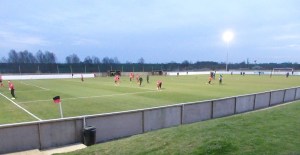
Kings Park Rangers 2 Stanway Pegasus 0

The snappily titled Thurlow Nunn Eastern Counties League Division One South has in the last year been shorn of two Suffolk clubs in the shape of Whitton United and Debenham Leisure Centre, who voluntarily dropped into the Suffolk and Ipswich League.  But as if by magic, two replacements have immediately filled the gaps left, one in the shape of the venerable Halesworth Town (founded 1887) and the other in the form of the altogether less venerable King’s Park Rangers,  who sprang suddenly from the Essex and Suffolk Border League after a brief two-season gestation, a bit like The Alien did from John Hurt’s stomach.

It is the final chapter of my two-part quest to be able to boast idly that I have seen every senior team in Suffolk play a home game.  Today I am making the brief 19.2-kilometre road trip across the border from Essex to Backhouse Lane, Little Cornard where I hope to see King’s Park Rangers play another team of recent graduates from the Border League, Stanway Pegasus.  If I was a younger man for whom the concept of time on this planet running out was less of an immediate concern, I might have caught the train to Colchester, or from Marks Tey to Bures, and then the number 44 bus to Great Cornard, but in truth I couldn’t really be bothered with the palaver, and in any case I have an electric car, so I am doing my bit to save the planet and reduce global warming.  It is therefore a little after two o’clock when I set off from my front drive towards Sudbury.

Being in Little Cornard, it is no surprise that Backhouse Lane is the longstanding home of Cornard United, but more intriguing is why is it now also the home of Kings Park Rangers, who are they, why are they, and where is Kings Park?   These questions have been niggling me all week in my idle moments, and fancifully I had postulated that they are perhaps a team from Kings Park, Suffolk County, Long Island, New York,  a team of South African ex-pats who have named their club after Kings Park Stadium in Durban, or even that they are an incel’s bitter and twisted response to the existence of Queens Park Rangers.  Eventually, there was nothing for it but to consult the interweb and hope I could find some information that was believable and not merely ‘content’ designed to enrage, influence or peddle consumer goods.   It turns out, so it seems, that Kings Park Rangers are a sort of works team for Kings Park Fulfilment Ltd of Pebmarsh, Essex, a company that works for Amazon, aiding Jeff Bezos’s bid for world domination.  According to ‘Suffolk News’, the club was set up in 2023 by “former Cornard resident” Josh Pollard “…as a way of connecting his family- including famous cousin Olly Murs – and work colleagues through their shared love of football.”  I can’t decide if this is philanthropy, megalomania or just weird but it probably makes Kings Park Rangers a Pebmarsh team, an Essex team, that just plays in Suffolk.

Looking out from the drizzle flecked windows of my planet saving Citroen e-C4 it’s a miserable, depressingly grey November day, the aftermath of an even more depressingly miserable, wet, November day, the day before.  The only thing to raise one’s spirits a little is the fact that today the moisture in the air is just occasional fine drizzle, not the persistent rain and occasional monsoon that hit yesterday.  Nevertheless, there’s no denying that the dripping trees, puddles, mud and soggy leaves are all rather glorious in their own way and provide a characterful backdrop to the twisting, turning, undulating B1508 as it makes its way along the north bank of the River Stour from Bures towards Sudbury.

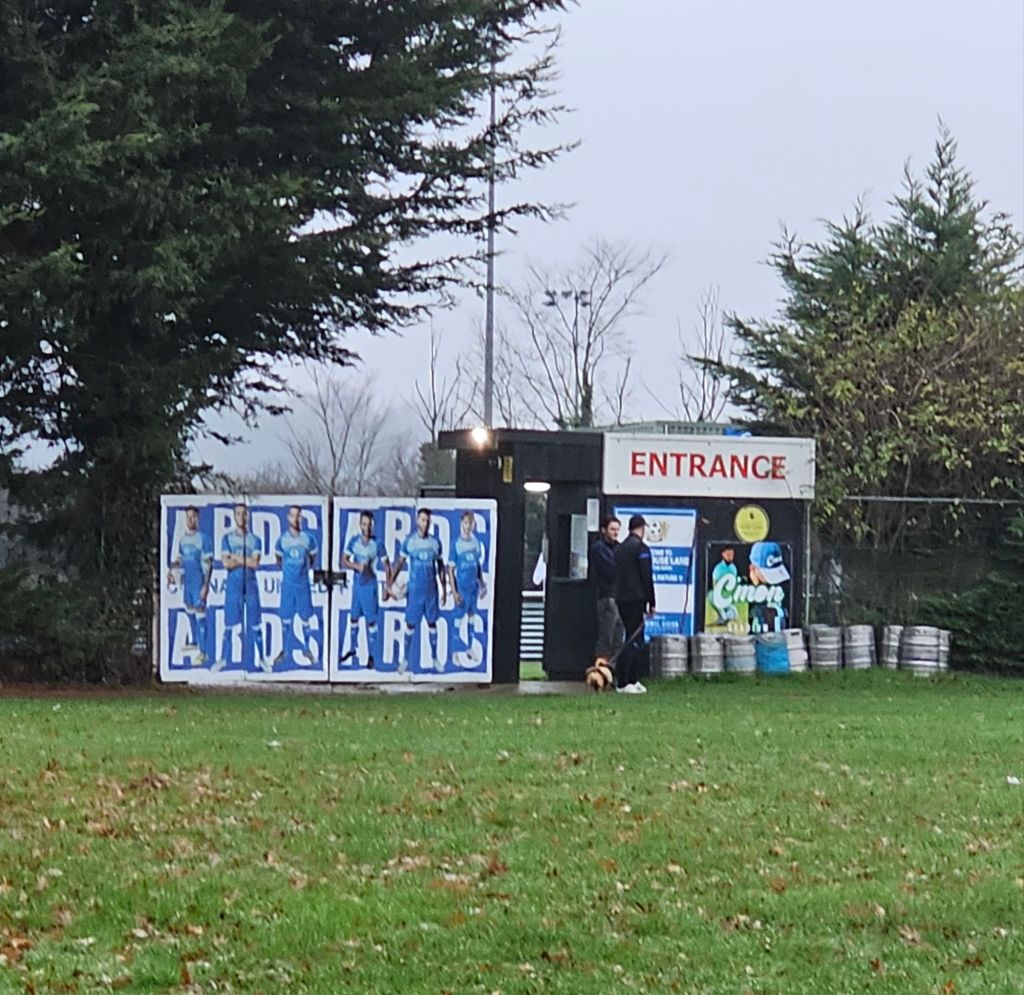
Suddenly, out of the gloom I reach Great Cornard and quickly identify the need to brake and turn right into Backhouse Lane, a very narrow road which in places has a deep water-filled ditch on one side; it is not wide enough for two cars to pass.  Fortunately, I meet only one car coming in the opposite direction and that is at one of the few passing places.  I am therefore soon parking up my planet saving Citroen in the mostly full car park, next to a white Ford Transit van.  The entrance to the football ground is off to my right, through the mist and back towards the B1508 along a concrete path strewn with fallen, brown leaves that have the consistency of wet papier mache.  Two men stand talking each other by the entrance, which seems to marked by a collection of beer kegs, and as I approach they end their conversation and one of them nips into the turnstile booth.  When I last came to Cornard, back in January 2019, the ‘turnstile’ was just a wooden hut but at some time in the intervening six years and ten months this has been replaced by a very neat structure that looks something like a cross between a very small domestic conservatory and one of the old toll booths at the Dartford tunnel.  I tender my £5 concessionary entry fee by means of my bank card.  There is no printed programme, but the window of the toll booth displays a QR code for a programme which is free.  Pretending to be completely familiar with QR codes I point my mobile phone at it, because I think I know that is what you do.  I have succeeded in accessing on-line programmes in the past, but not today, but at least I will have a nice photo of a QR code.  The young man at the turnstile then strangely tells me that there are plenty of people in the club house, perhaps he thinks I look lonely.

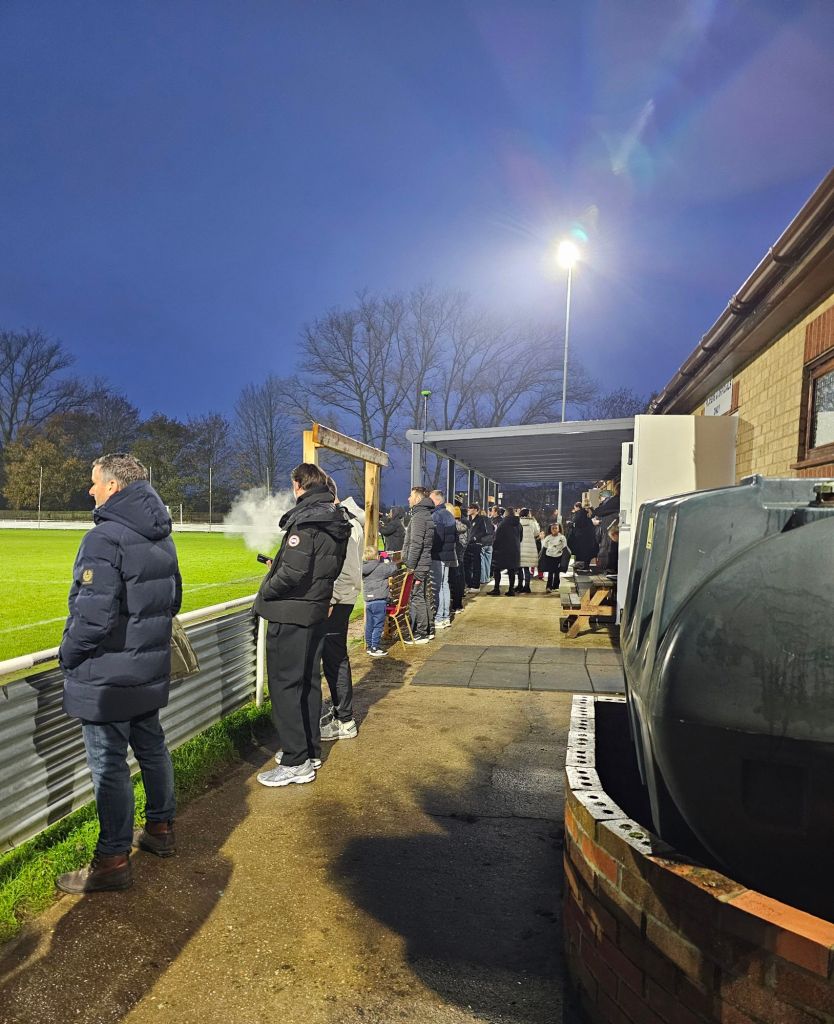
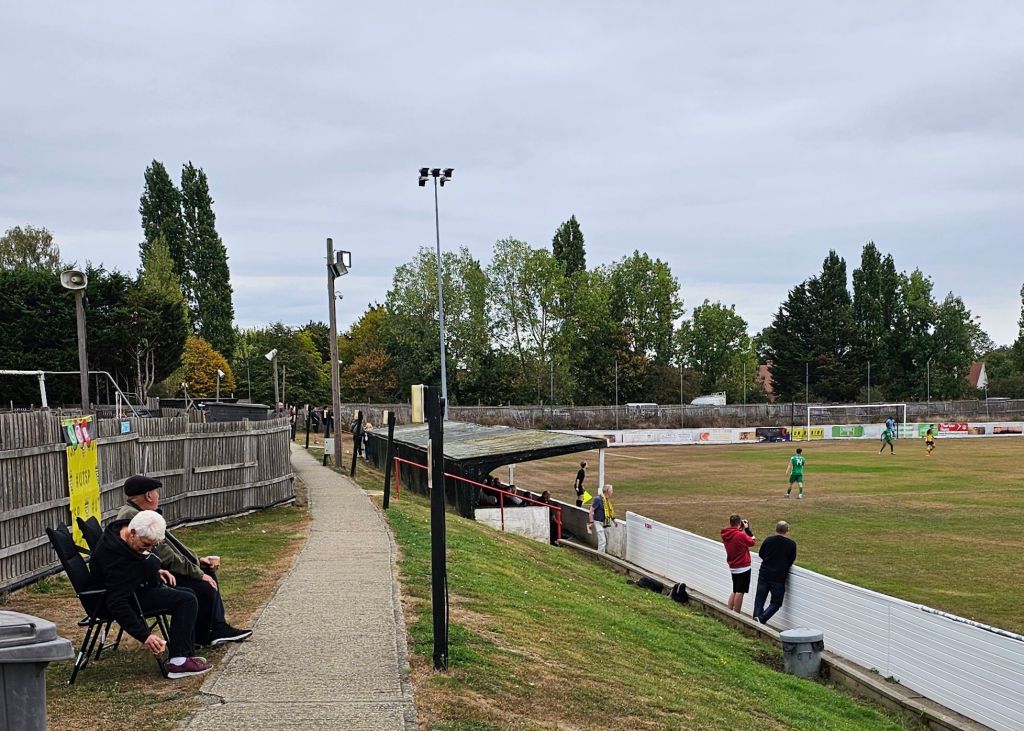
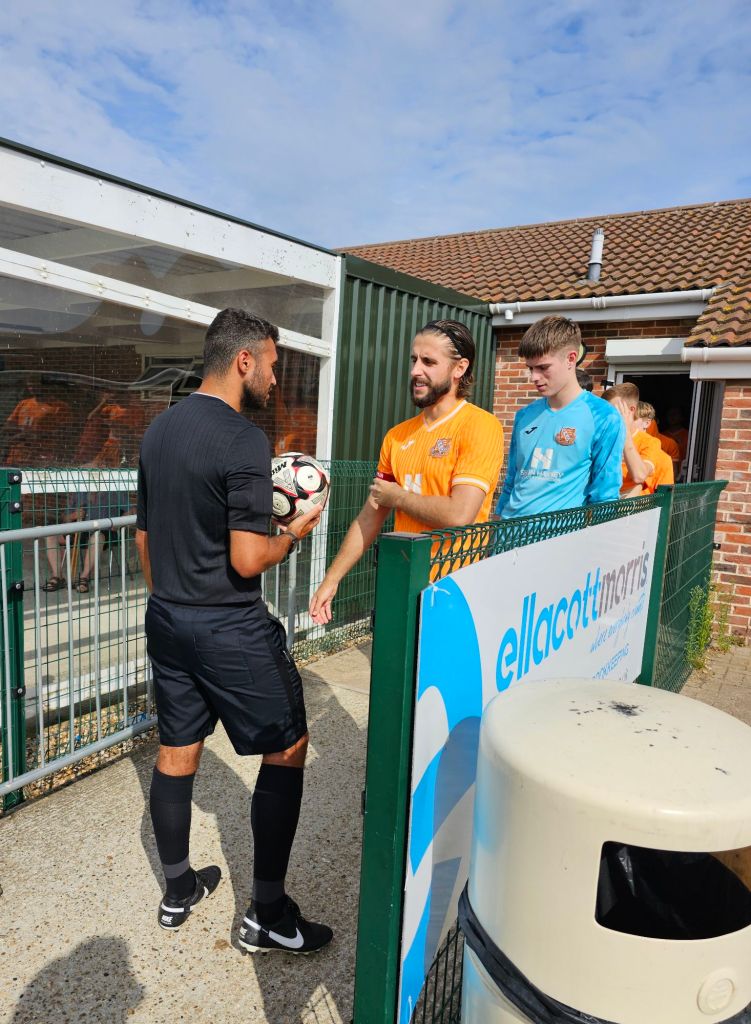
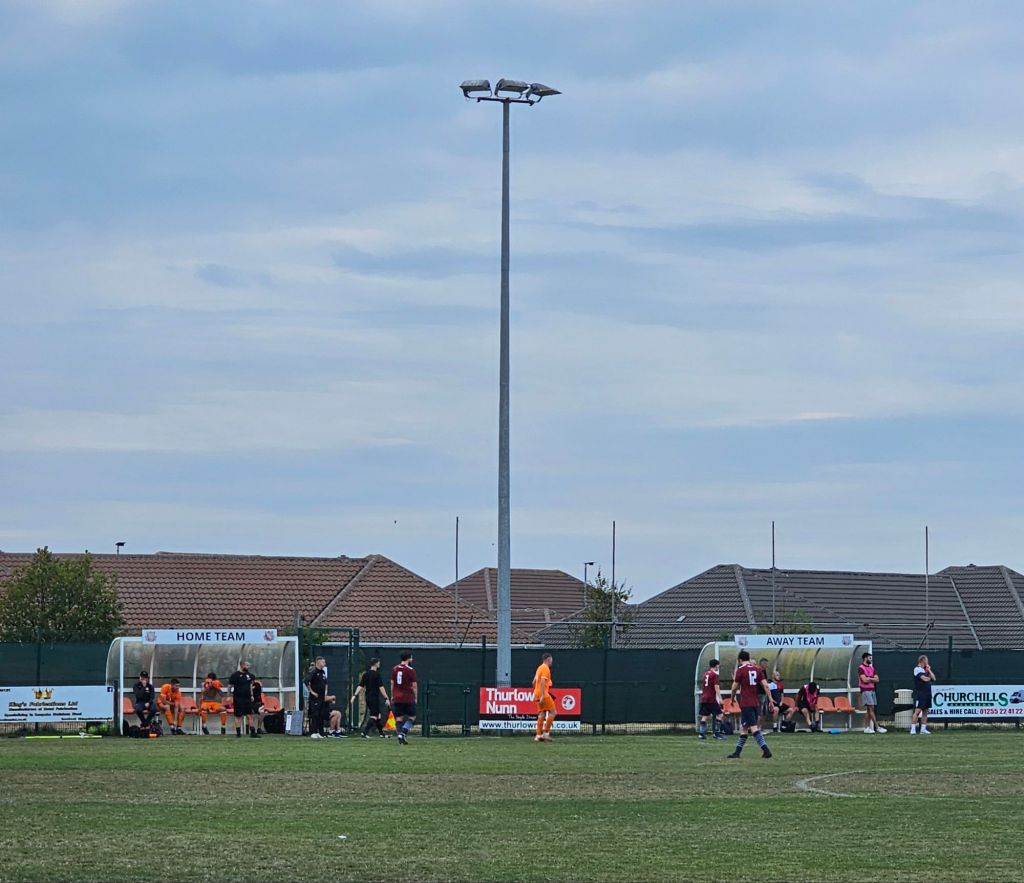
There are indeed plenty of people in the clubhouse as the young man in the toll booth said, but I only talk to the barman who, when I ask if there is a bitter available, tells me there isn’t the call for it nowadays but helpfully adds that a pub nearby wins awards for its beer.  Sadly, there’s no danger of that here and I settle for a bottle of alcohol-free St Austell Brewery Proper Job (£4.90).  The barman apologises for not letting me have the bottle to pour the beer myself and explains that whilst he doesn’t think I look like I would cause any trouble, he’s not allowed to.  Avoiding eye-contact with anyone else in the bar, I worry a little for my safety and take my beer outside where I watch the players, the referee and his assistants warm up, and a player in a track suit top walks a small brown dog. I notice that the two dugouts are almost at opposite ends of the pitch, when I was here in 2019, they were next to one another.

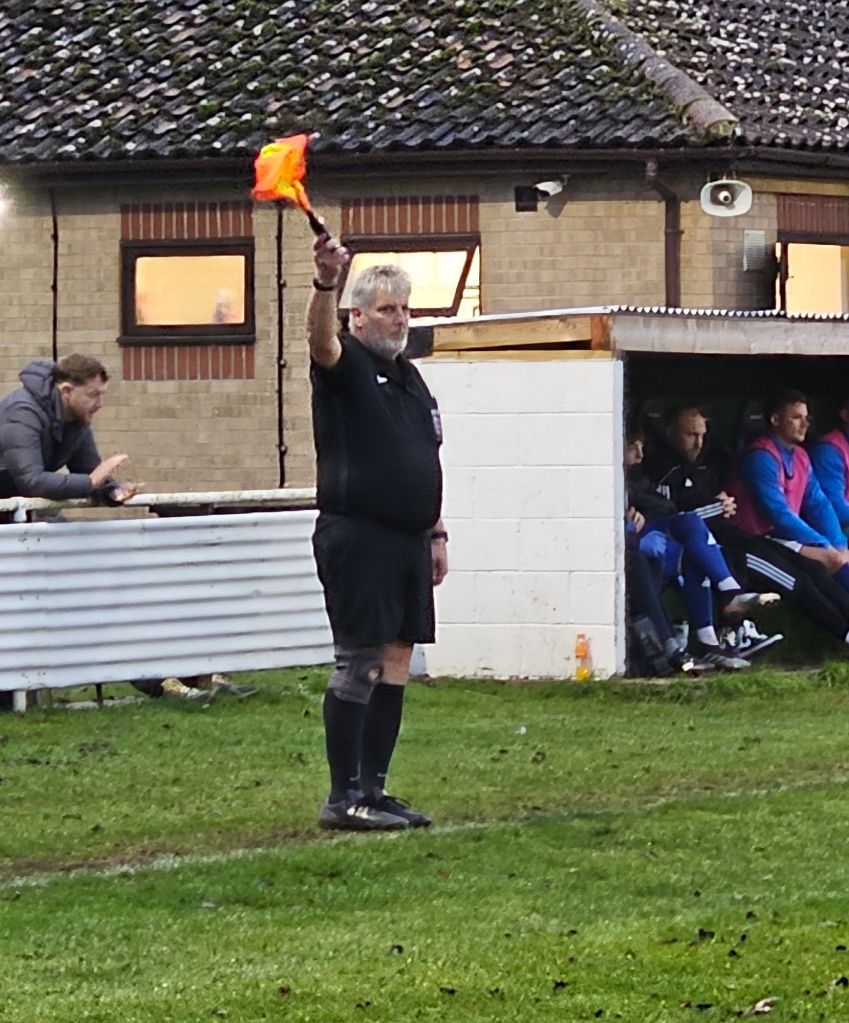
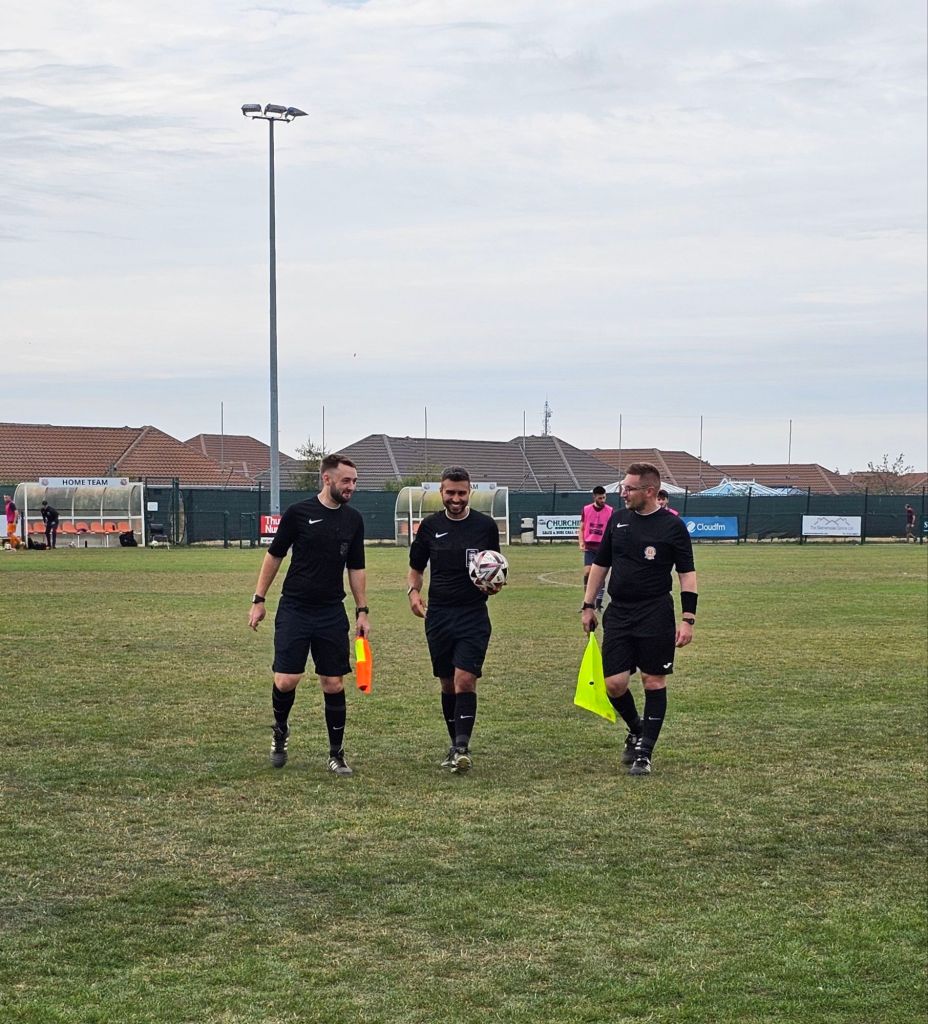
 The referee is a young man with impossibly short hair who looks very keen and serious as he turns and sprints along the touchline and then does the same again. His assistants, two much older men, follow him for all of a few seconds, by which time he is almost out of sight.  “Five minutes.  Do your stretches”, says the referee and one of the assistants a portly, grey-haired man wearing an open knee support stretches down to his knee once or twice and the expression on his face says “that’ll do”.

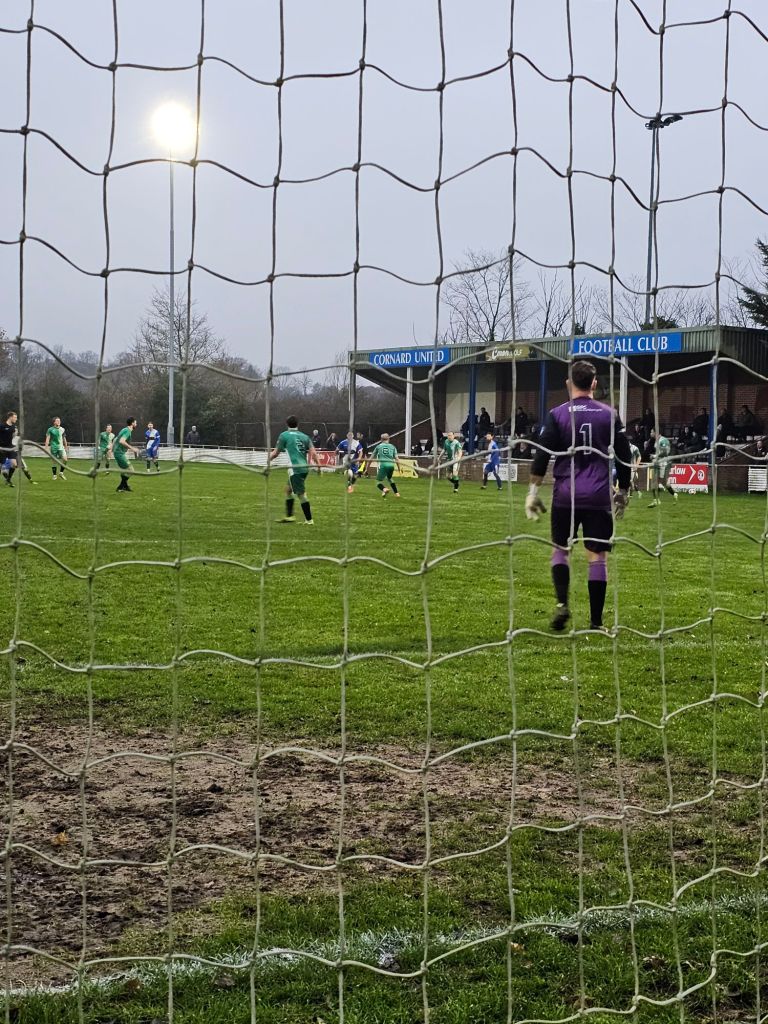
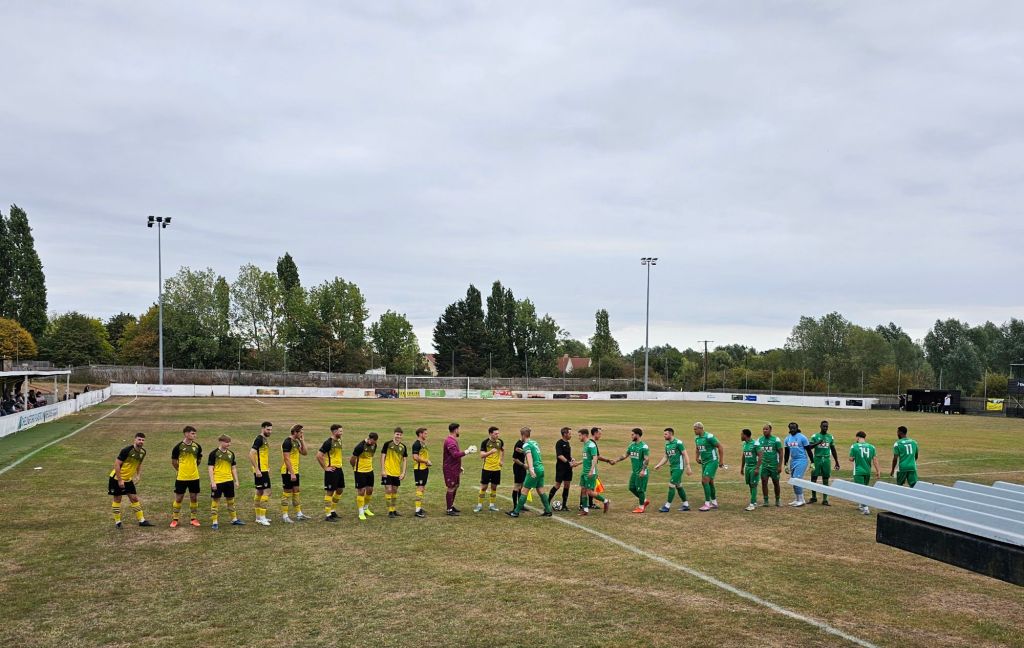
The game begins at a minute past three and it’s Kings Park who get first go with ball, which they rapidly boot towards Sudbury and the Thomas Gainsborough school, which is just over the fence from the ground.  Kings Park sport an all-blue kit with a wide, white, slightly blurry diagonal stripe across the front, and I think to myself what kit would I choose if I was inventing my own football club, probably not this one.   Stanway Pegasus meanwhile are in all-green with a blurry white stripe down their left side and black socks, like an unhappy man’s Plymouth Argyle.
The most notable thing about this game from the start is the shouting on the pitch and from the dugouts. “You gotta work”, “Chase”, come the early, more polite commands extolling effort over skill.  “Away” shouts the Kings Park goalkeeper and for some reason I think of the Teletubbies. Kings Park win an early corner.  “Seconds, seconds” is another shout, appropriately twice. On the pitch, both teams seem wound up already and the Pegasus number nine screams at the referee’s assistant as he strides towards him intimidatingly over the trivial matter of a throw in.  “Mental” he says to himself after being told to calm down by referee Mr Glasson-Cox, who coincidentally also refereed the match I saw at Halesworth last week.

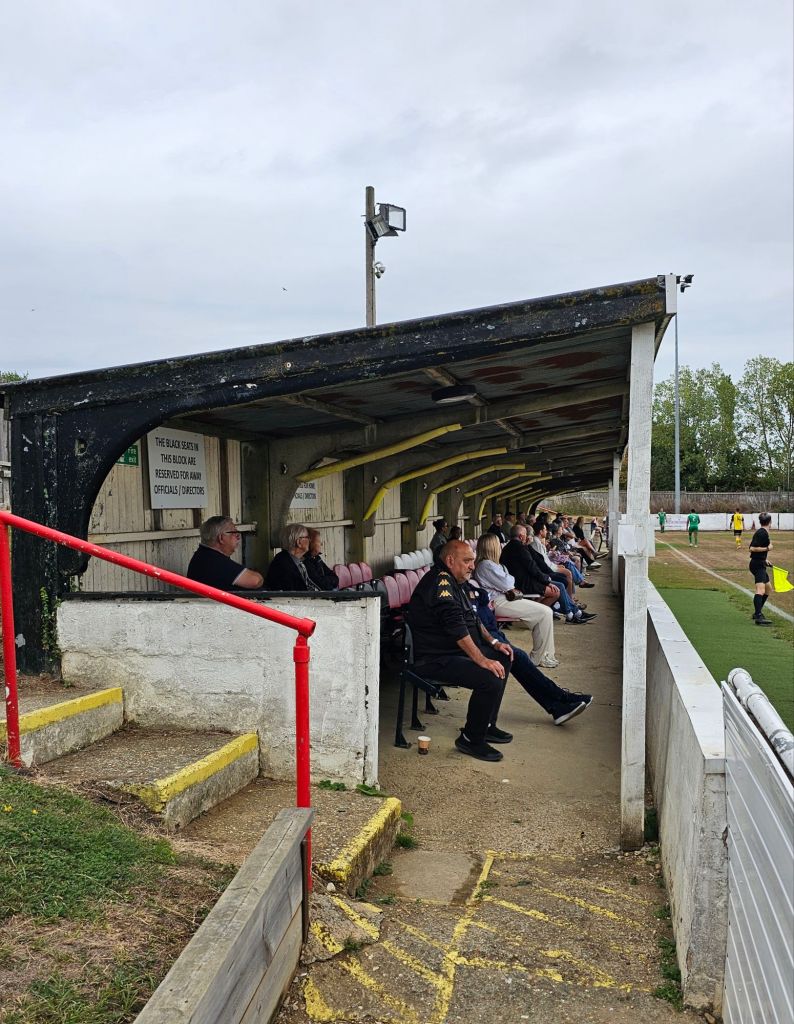
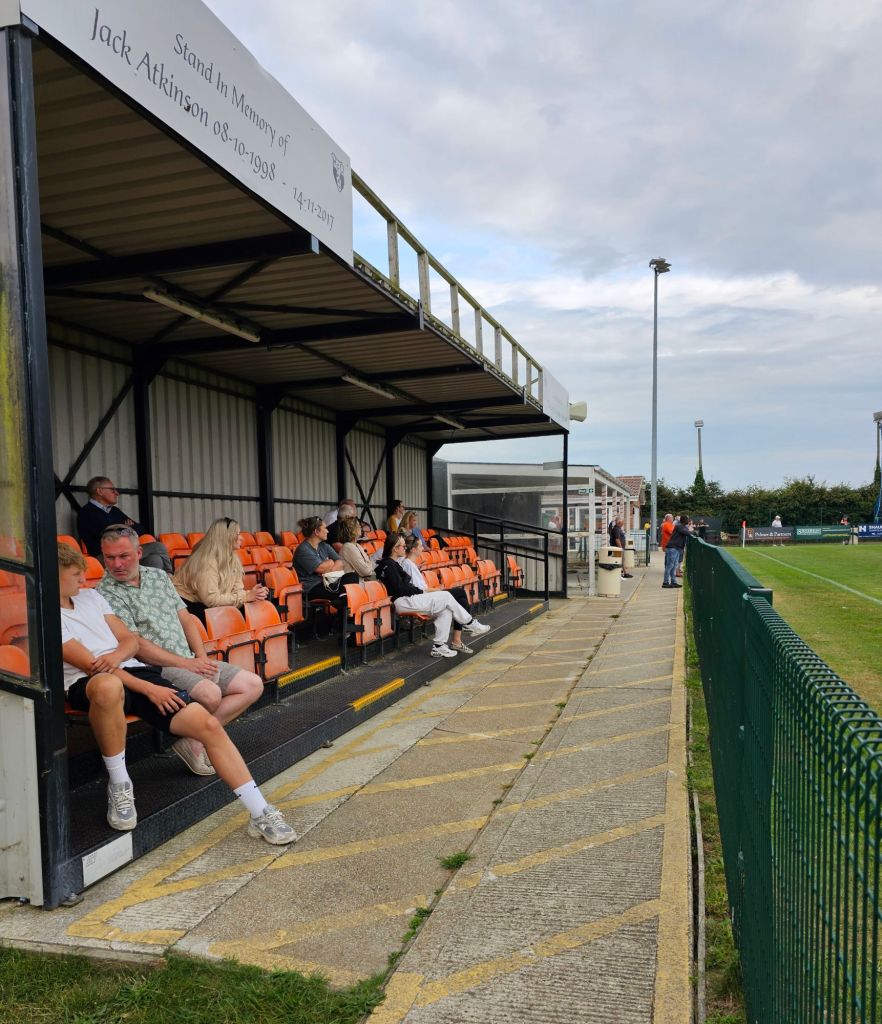
The half is half over. “Fuckin’ ‘ell ref” says someone about possibly anything but soon the initial intensity of the match seems to have thankfully subsided a bit.  I move into the main stand, a utilitarian, boxy looking structure but with a bit more character than most of the prefabricated metal stands erected nowadays.   In a quiet moment I reflect upon the referee’s assistant stood in front of me, a wiry man with a large beard, which he looks as if he might have grown having been told by his doctor that he needs to put on a bit of weight.  Between me and the referee’s assistant raindrops cling to the white painted rail around the pitch.   The slightly calmer mood continues into a short delay in which the referee speaks to his assistant on the far side, the portly, grey-haired one with the dodgy knee who it seems has noticed that following a goal mouth scramble the goal at the Sudbury end of the ground, which is on wheels, has moved a little.  Mr Gasson-Cox takes a look and gives the goal a little shove.

After the calm, there follows a short storm as Kings Park’s number eight and captain Noah Collard scythes down an unidentified Pegasus player who proceeds to writhe on the ground screaming.  Once the Pegasus player has cried wolf for long enough Collard becomes the first player to see Mr Gasson-Cox’s yellow card, but discussion in the crowd is more about the girlish screaming than the booking.  “Does he have to go off with the screaming?” asks a spectator not unreasonably.   But as if to quickly even things up, a Pegasus player also gets to view the yellow card before half-time, although there is no further screaming from either side and the half ends goalless.

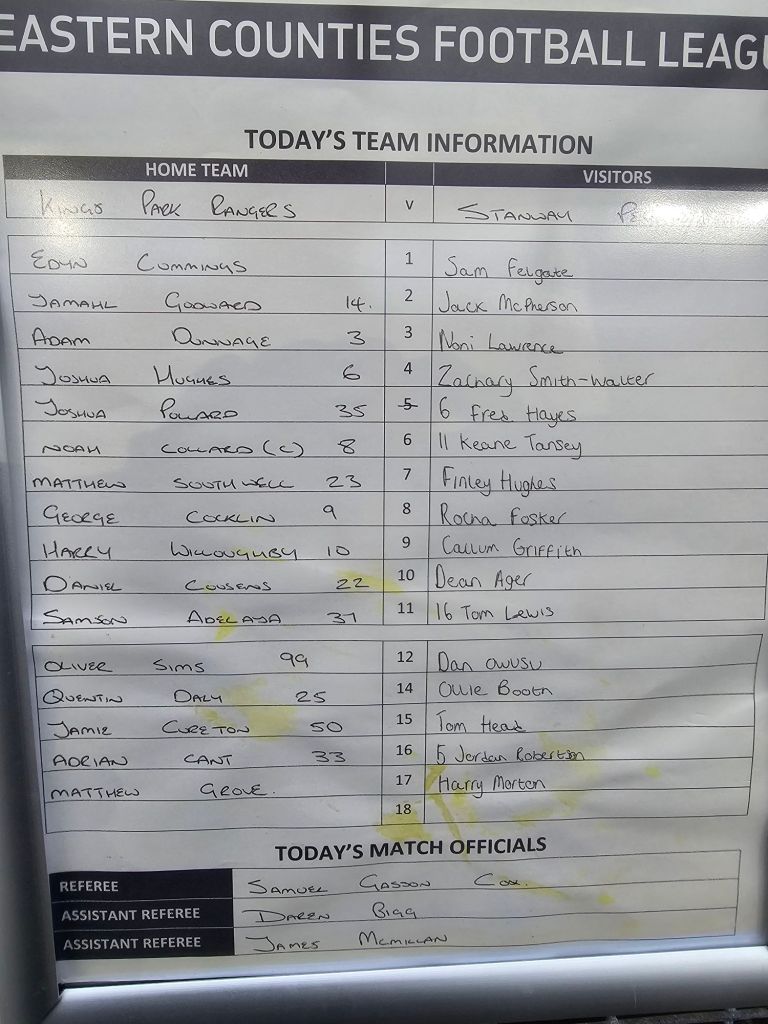
With half-time I drain-off some of the Proper Job and eat a Polish Grzeski chocolate bar from the World food aisle in Sainsbury’s.  I peer through the window of the club house where a man and a woman, presumably club officials from Stanway Pegasus, and two men in large black coats featuring the crest of the Suffolk County Football Association drink tea with an array of what look like shop bought sausage rolls and homemade bread pudding wrapped in tin foil laid out before them.  Only the man from Stanway Pegasus seems to be eating anything.  I wonder to myself where the Battenburg and Swiss Roll are.  Outside, next to the window I look at today’s team sheet, which looks like whoever wrote it might have been eating an orange at the same time.  Beyond the club house the small brown dog is being walked by a different man, possibly a player, who is evidently not playing today; I hear him say he doesn’t know the dog’s name.  “Come on you” he says.  Two other small dogs are present in the crowd today too, one in a coat and one not. 

At three minutes past four the match resumes and the Kings Park coach is immediately barking instructions to Georgie, Zammo and Hughsie as if his very existence depended on it, whilst also sounding like the games teacher from tv’s Grange Hill, but only because he said ‘Zammo’.   His shouting works however and six minutes later a ball from left to right finds number twenty-two Daniel Cousens inside the penalty area.  Cousens calmly places the ball wide of the Pegasus goalkeeper, and Kings Park lead one-nil.

Ten minutes later and Kings Park lead two-nil when a low cross from the right travels across the face of the goal, past the flailing limbs of a couple of Pegasus players until it reaches Kings Park number ten Harry Willoughby, who bundles it into the goal from close range before running off madly.  “Whatever ‘appens, don’t let ‘em fucking score again” bawls a rough voice, presumably of a Pegasus supporter. 

It’s getting on for half past four and the game seems over. Pegasus don’t offer much else but for a goal mouth scramble which leaves the Pegasus coach feeling hard done by and asking rhetorically “ ‘ow’s your luck?”  and then asking it again.  For Kings Park the goalscorer Willoughby is substituted for the 50-year-old former Norwich City, Colchester United, Reading, Queens Park Rangers, Swindon Town, Shrewsbury Town, Bristol Rovers, Leyton Orient, Bournemouth, Barnsley and umpteen other clubs’ player Jamie Cureton. As Willoughby heads for the changing room, he emits a sort of howl.

Back on the pitch, Pegasus number five Jordan Robertson is booked after Kings Park’s number ninety-nine Oliver Sims is not given offside, and Robertson seemingly exorcises his disappointment by hacking Sims down.  “Fucking embarrassing” says the Pegasus coach, but only about the presumed offside. Time runs down, on into the ninetieth minute.  Pegasus can’t decide whether to just boot the ball forward as quickly as possible or pass it. “Just kick the fuckin’ thing” shouts an elderly spectator summarising a century and a half of tactics from the country that apparently invented the game.  “Darren, time” shouts a player. “Darren, man on” shouts the same player a moment later. The final action sees another booking for Kings Park. “Fuck me, it’s getting boring now” say the Pegasus coach and happily at 16:52 Mr Gasson-Cox, who I think has had a good game calls time.

I wait as the players leave the field to no applause, just the blokey clasping of fists with a few spectators and shouts from inside the changing rooms.  It’s been a good game in terms of the ability shown, but it’s not been a particularly enjoyable one. There’s been too much trying to pressure the referee, too much needless swearing and too much of a sense of needing to win above all else. I think I’ll just try to remember the afternoon for the miserable weather, the soggy leaves and the small dogs.

Stanway Pegasus 0 Haringey Borough 2

Pegasus, Wikipedia tells us was a Greek mythological winged stallion, the offspring of Poseidon and Medusa who sprang from the Medusa’s blood when in an everyday incident for the characters of Greek mythology she had her head chopped off by Perseus.  After time spent carrying lightning bolts for Zeus, being ridden about by Bellophron and then as a constellation of stars, having been killed by Zeus who presumably then had to carry his own lightning bolts, between 1948 and 1963 Pegasus more prosaically became the name of an amateur football team made up of Oxford and Cambridge graduates obviously keen to mix football with their classical education.   Even more prosaically, the name of Pegasus then became that of a youth and then Sunday football team in Colchester and most recently that club has aspired to men’s senior football and for reasons unknown has attached the name Pegasus to Stanway, a suburb of Colchester that some of its residents still think is a village and which already had one senior football team in the shape of Stanway Rovers.

Today, Stanway Pegasus who are now in the snappily titled Thurlow Nunn Eastern Counties League South play Haringey Borough of the only slightly less snappily titled Spartan South Midlands Football League in the first qualifying round of the FA Vase, a competition which, to my shame, I have not witnessed a game in for over ten years.  It is for this reason, and it being the closest game to where I live, that today I choose to ignore the ’Town’ -centric draw of Braintree Town v Yeovil Town in the National League and the charming alliteration of Chelmsford v Chippenham in the National League South, and make my way to ‘The Crops’ in West Street Coggeshall home of Coggeshall Town but where Stanway Pegasus currently play their home games too.

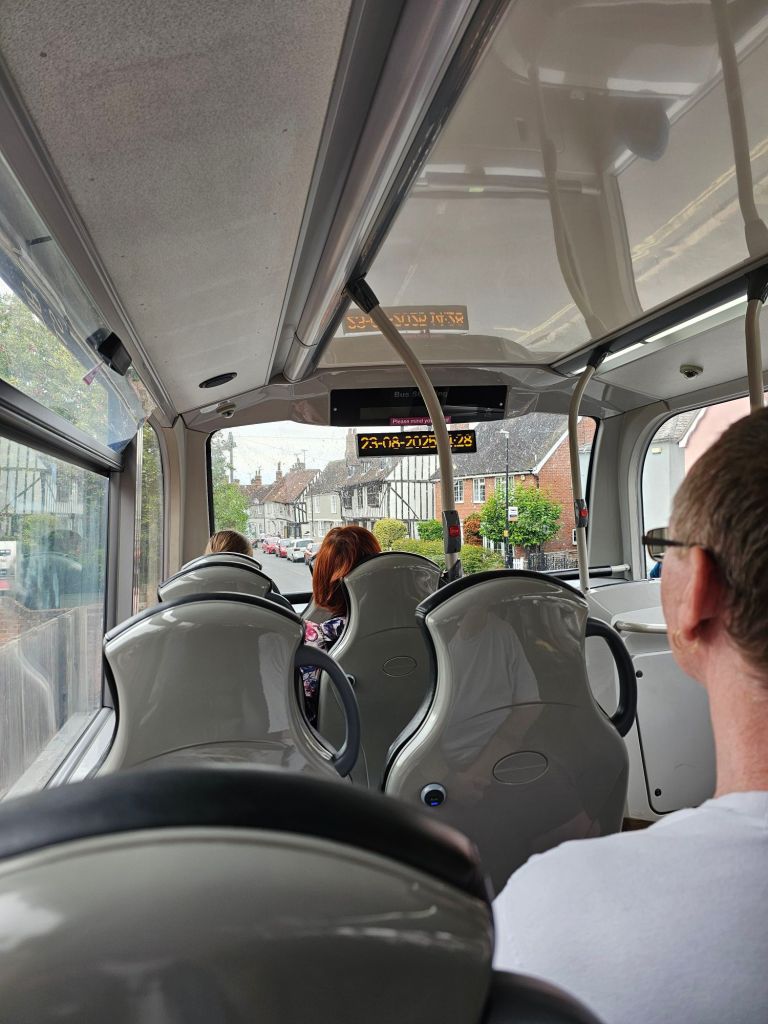
After a morning breathing in noxious fumes from the white gloss paint I am applying to the banisters, skirting boards and miscellaneous surrounding woodwork of a domestic staircase, standing at a bus stop on the A120 under a grey late August sky feels like suddenly being on holiday.  The X20 bus to Stansted Airport via Coggeshall, Braintree and Great Dunmow turns up more or less on time and I cheerily tender the correct fare (£3) in coins to the driver, who wears a peaked cap in the style of the late Sir Francis Chichester.  The driver, who does not speak looks at me inscrutably from beneath the peak of his hat as if weighing up this passenger’s likely back story.  I look back at him in the same way, imagining I too am wearing a hat, before climbing the stairs to the top deck where I sit behind a man sporting short hair and an earring.  Behind us, a girl evidently lacking all sense of self-awareness talks loudly on her mobile phone, broadcasting the other half of the conversation on speaker phone.   Leaving the A120, the bus (fleet number 34423) wends its way through Coggeshall’s narrow medieval streets before I alight at the stop called ‘Nursery’ just a couple of hundred yards away from ‘The Crops’.

Arriving at the turnstile I’m not surprised to find there is no queue but am delighted to see a small pile of glossy programmes, which I had not expected.   I ask if I should pay by cash or card. “Cash if you’ve got it, please” says the turnstile operator “I’ve started to run out”.  This is the first time I have paid on the turnstile at a match since I turned sixty-five, and paying in cash adds something to this auspicious occasion as I tender a five pound note for my concessionary entry fee and a two pound coin for the programme.

Once through the turnstile I head for the bar at the far end of the ground; it is virtually empty,  and not liking the look of the fizzy draught beer on offer I warily request a bottle of Adnams Southwold Bitter (£6) from the fridge. Much to my surprise the beer is merely cool not chilled and therefore very drinkable.  I step outside to await kick-off amongst a good following of Haringey supporters identifiable from their club colours but also as the only people obviously in the throes of enjoying a day out.  Two of them wear pork pie hats and I wonder if they play the saxophone.  Except for an old couple sat in foldable chairs the home supporters are rather anonymous.  In the corner of the pitch by what passes as the players’ tunnel but looks a bit like a stockade stands a plinth on top of which sits the match ball.  The Haringey fans eye the plinth both jealously and with a degree of amusement discussing what design of plinth they might have if they were to have one of their own, they seem keen on something more sculptural. 

“Sing if you’re Haringey, Sing if your happy that way” chant the Haringey fans imaginatively to the tune of the Tom Robinson Band’s 1978 hit “Glad to be gay” as the team emerge from the stockade and the plinth fulfils its job of relieving the referee of having to remember to bring the ball with him from the dressing room.   The match kicks off at five minutes to three with Stanway Pegasus getting first go with the ball and sending it in the direction of the bus stop from whence I arrived and Coggeshall beyond. “You on a promise Ref?” bawls a Haringey supporter “It’s only five to three”.  “That’s close to being abusive, that is” says another Haringeyite.  “No it’s not, it’s just a question” continues the first supporter.  “A very personal one” is the response. “Alright, do you have something nice waiting for you when you get home, Ref?” Comes the re-phrased enquiry.

Pegasus are wearing a kit of yellow shirts with black trim and black shorts, which weirdly are also the colours of Stanway Rovers.  Haringey meanwhile sport a change kit of all over green as their supporters expand on their theme of chants based on ‘new wave’ hits of the late 1970’s and sing the praises of their team’s Matty Young to the tune of “To much too young” by The Specials and then sample the  oeuvre of Sham69 with chants of “Come On, Come On, Come on Haringey Come On, We’re going down the pub”.

Back on the pitch, one of the linesmen is attracting a lot of attention to himself both with his offside decisions and his insistence on explaining them to the players.  As if that isn’t enough, he is very bouncy on his feet and, because he sports a poorly shaped goatee beard and has grey highlights in his swept back hair I am reminded of the match between Arsenal and Liverpool in September1972 when one of the linesmen was injured and Jimmy Hill emerged from the stands to run the line.

At three minutes past three Haringey Borough take the lead with a neat shot into the corner of the goal from somewhere near the edge of the penalty area.  The goal scorer, I think, is the aforementioned Matty Young  who evidently continues to strive to allow people to look back and say he did a lot in his youth.   “We’re the Borough, The Mighty Borough, We always sing away, We sing away, we sing away, we sing away, we sing away” chant the Haringey fans in response to the goal, channelling Tight Fit’s  cheesy cover version of “The Lion Sleeps Tonight” from 1982.

The Jimmy Hill lookalike linesman continues to grab attention as he rules a Haringey player onside and then proceeds to explain that the Pegasus number five had played him onside. “Don’t tell them lino, they can learn for themselves” shouts an exasperated Haringey fan. The Haringey support delve into their ‘new wave’ singles collection once more, impressively getting “We’re Haringey, We’re Haringey” into The Jam’s “Going Underground”.

Haringey are clearly the stronger team, as their higher league status implied before kick-off and the majority of play is at the club house end of the ground, although in a rare breakaway the Pegasus number four , Harry Morton is free in the centre of penalty area, has the ball pulled back to him perfectly, but then contrives to hit a truly, spectacularly terrible shot as high and as wide as anyone not under the influence of mind expanding drugs could imagine; in some circles it might be called ‘a worldy’.   Morton might be excused however for blaming the pitch, very little of which is any shade of green except in a few ‘fairy circles’, and when more than a handful of players are in the penalty area a cloud of dust is kicked up which lingers momentarily over the pitch like a swarm of tiny insects.

I am stood to one side of the suitably bucolic looking main stand and every now and then I receive a whiff of pungent and rather cloying body spray or scent.  At first, I think it must be from the occupants of the stand, but to be honest they don’t look the sort to be familiar with anything more than an occasional dab of Old Spice or bit of talc.  I eventually realise, when he bouncily stops near me to signal another offside, that the culprit is Jimmy Hill, the unique styling of whose hair is challenged, but not matched only by the Pegasus number sixteen, Tom Lewis who has a neat blond bob.

The game is being played in a good spirit with unusually little, if any audible swearing from the players, or the management on the benches.  Pegasus’s number nine Callum Griffith is booked however, just as the first third of the game rolls into the second third when twice in quick succession he fails to give space for a free-kick to be taken.  As thoughts of half-time refreshment begin to form Pegasus win a couple of corners and then almost unexpectedly there is a second goal as a poorly cleared low cross reaches Haringey’s number fourteen who firmly and concisely despatches it into the opposite bottom corner to the first goal, and Haringey lead 2-0.

Due to judicious manoeuvring in the approach to half-time, I am first in the queue at the refreshment hatch where I invest in £1.50’s worth of tea in large paper cup.  I read the half-time ‘results’ as I wait for my tea to cool and then for the teams to re-emerge.  My mood is barely affected by the news that Ipswich are losing at Preston; it’s not a place we often do well at; “a difficult place to go” is probably the accepted wisdom, despite the M6.   At four minutes to four the football resumes and I move to the other end of the main stand expecting most of the action to again take place in the half of the pitch that Haringey are attacking.

The first half was adequately entertaining if not exactly a pulsating cup-tie.  Sadly, the second half does not live up to what we didn’t know at the time was the comparatively high standard of its predecessor.  The Haringey supporters nevertheless continue to enjoy themselves as they repeatedly dip into the back catalogues of Sham69, The Jam and with somewhat less ‘street credibility’, but plenty of irony, Tight Fit.  My highlight of the half is when I realise that Derek Asamoah is playing as number forty-four for Haringey.  He is a player who I probably last saw playing on the telly for Ghana in the African Cup of Nations. I should have really worked out he was playing when the Haringey fans chanted his name in the first half, but I was probably too busy wondering which Buzzcocks, The Clash or The Damned single it was they were singing to.

With the final whistle there is justified applause for everyone’s efforts and I leave The Crops to the sound of the Haringey fans singing “Bus stop in Tottenham, we’re just a bus stop in Tottenham” because wonderfully, as anyone who has travelled the W3 through north London will know, they really are and as far as I’m concerned that’s just as interesting as Greek mythology.

Holland 2  Dussindale & Hellesdon Rovers 1

Holland-On-Sea, Wikipedia tells us, is a suburb of Clacton-On-Sea and was known as Little Holland until the early twentieth century; it also has a football club called Holland FC.  What Wikipedia doesn’t tell us however is that Holland is just a 30 minute, thirty-eight-and-a-half-kilometre drive from my house, although Google maps does.  Stanway Rovers, Halstead Town, Coggeshall Town, Cornard United, Wivenhoe Town and Hadleigh United football clubs are all playing at home today and are probably all closer to home, but none of them are “On-Sea” and I’ve been to all of their home grounds in the last twelve years, which isn’t true of Holland FC’s Dulwich Road, where I am given to understand that the pitch, as if by some freakish movement of tectonic plates, has moved through ninety degrees in that time, throwing up a metal fence all around itself and a smart new clubhouse.  Therefore, with the promise of sea air and the prospect of a geologically formed football ground, it is on a warm but cloudy Saturday afternoon in early September that I set off in my planet saving Citroen eC4 for Holland-On-Sea.  I had contemplated catching the train to Clacton and making the half hour walk to Dulwich Road, but with only one train an hour I wouldn’t have got home until seven o’clock, and I have a wife whose heart I risk breaking if I stay out too long.

It’s an uneventful journey down the A133 and I arrive in relaxed mood in the Holland FC car park, where I have a wide choice of parking spaces; I draw up next to a modest silver-coloured family saloon, which had turned into the pebbly, beach-like car park shortly before my I and my Citroen did.  It’s not half past two yet , so I decide to take a look at the sea before entering the ground; the cliff top and sandy beach below are only 200 metres away across the grassy expanse of the Eastcliff Recreation Ground and Marine Parade.  From the cliff top, Clacton Pier is visible through the haze at the end of the beach, and out to sea sit the ranks of wind turbines that I like to think made the electricity that powered my car and brought me here.  A West Indian man of pensionable age and riding a low-slung tricycle asks me if I’m local and if I know where the Kings Cliff Hotel is.  I tell him I’m not and I don’t know where the hotel is, but I do know he is heading towards Kings Parade.  I think to myself that the ‘King’ in King’s Parade fame was probably either King Edward the Seventh or some egotistical Tendring District councillor with the surname King.

I walk back inland to the football ground up Lyndhurst Road, a typically suburban, tree-lined street of inter-war bungalows, all of which are almost frighteningly neat and well maintained. Just past a public toilet is a hedge which is teeming with bees and butterflies, mostly Red Admirals.  I am not sure I’ve ever seen so many butterflies in one place, but start to worry that wealthy local MP Nigel Farage might be having them specially bred so that he can pull their wings off or place them in his reptile-like mouth before washing them down with a pint of beer.  But then again, I don’t suppose he ever comes here; he probably gets his butterflies in Florida.

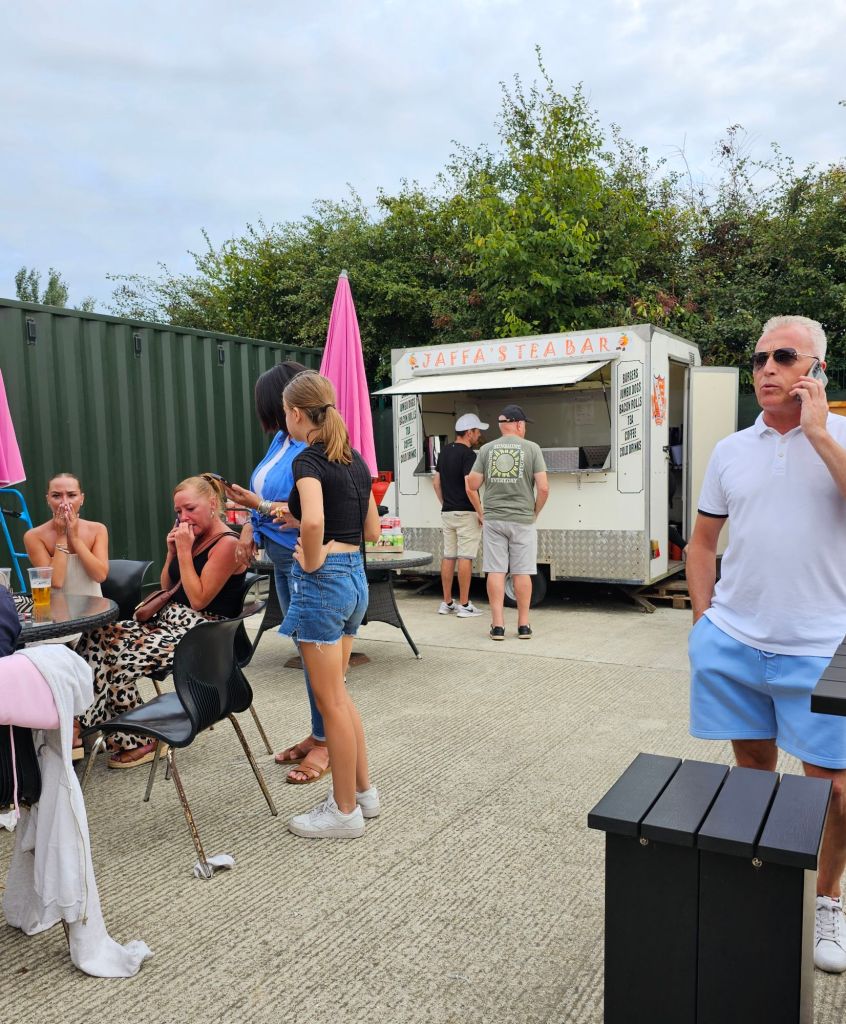
Back at the football ground, the friendly, cheery but visibly overweight man at the gate tells me that the concessionary entry fee of £5.00 applies to over sixties; I tender a twenty-pound note and receive fifteen pounds change.  After I ask if there is a programme today, I am told that the club does produce a match programme, but hasn’t done so today, which to me seems a bit lazy of them.  With the two pounds I saved at the gate by being old, I buy £1.50’s worth of tea from Jaffa’s Tea Bar.  I don’t know who Jaffa is, but his or her (it was a woman who served me) tea is pretty good, even if it is just a tea bag in a paper cup with some added water and milk.    I suspect however that the name of the tea bar is derived from the club nickname, “The Jaffas” and so the apostrophe is in the wrong place, this is Essex after all.  I wander inside the clubhouse which, although bright and new and with a display of trophies on one wall, seems a little soulless due to its grey floor, plain walls and vaulted ceiling; the only pumps on the bar are for Stella Artois, San Miguel and Carlsberg. I am pleased I bought tea and enjoy the irony that in Farage’s constituency all the ‘beers’ are, nominally at least, foreign brands.  Most of the drinkers are sat outside at an array of tables and look like they are settled in for the afternoon. 

“Are you sat here for the music?” I ask two old boys sat on stackable chairs in a covered area outside the home dressing room,  through the window of which can be heard the typical, pumped-up, high volume musical selection of the millennial footballer.  “Is that what it is?” Says one of the old boys.  I wonder to myself if Stanley Matthews, Len Shackleton and Tommy Lawton would get themselves ready for kick-off by cranking up the volume on the latest 78’s from Glenn Miller,  Al Bowlly and Bing Crosby.  With the music turned off we can hear the team talk. “It’s a long journey from Norwich or wherever they come from” says the coach encouragingly to the Holland players.

It’s not long before the teams are lining up to parade onto the pitch with the players of today’s opponents Dussindale and Hellesdon Rovers, looking suitably jet lagged.  Dussindale and Hellesdon are two suburban areas on opposite sides of Norwich, but their clubs amalgamated a few years ago and have made it into the snappily titled Thurlow Nunn Eastern Counties League First Division North and now play in Horsford, which is at least next to Hellesdon and close to Norwich airport, which is handy for away games.   After all the usual handshaking and hand-gripping malarkey, it is Dussindale and Hellesdon who kick-off towards the sea in burgundy shirts and navy-blue shorts. It’s a tasteful, if slightly dull kit and doesn’t compare with Holland’s vivid all orange ensemble.  Wikipedia tells us that the nickname of Holland FC is The Tangerines, no doubt due to the colour of their kit, but Holland’s own website refers to them as The Jaffas, although it doesn’t appear to have been updated since last May.  I wonder if there has perhaps been a referendum during the close season on what type of orange best represents the club, with members choosing to reject Satsumas, Mandarins, Clementines, Navels, Cara Caras and Easy peelers.   

The early exchanges on the pitch are typically noisy with the ball frequently flying high into the afternoon sky as an optimistic through pass for someone to chase is booted away.  “Go wide, hit the channel, good chap” bawls the Rovers’ goalkeeper revealing a hint of a Norwich accent as the ball sails in to touch.  Holland have the classic two big blokes at the back, numbers 5 and 12.  Number 12 has the sort of build which, if this were a professional game, would no doubt leave him open to chants from opposing supporters of “You fat bastard”, but he is a ‘rock’ at the back for Holland. 

I walk round the pitch to stand between the team dugouts. Holland win two early corners.  More Norfolk accents are detected on the away team bench.  Holland seem to lack club volunteers, with there being no programme today and no team sheet posted on a wall anywhere either.  The on-pitch commentary from the players however reveals that the Rovers number three is called Eggy and the number four Martin; other players have names too.

A poor back pass lets in the Holland number eleven,  who crosses in a low ball which a Rovers centre-back clears over the cross bar for corner.  It’s the first real opportunity, even if it was entirely manufactured by one team for the other.  The game is full of endeavour, but no one is capable of providing a pass that will lead to a goal. It’s a game of just shouts at the moment.  “Get out”, “First and second ball”, “What we talked about”, “Jump early”, “Ref that was blatant”, the usual anxious nonsense that the players hear every week and must get sick of.  On the Rovers’ bench the coaches are simply willing their team to do better; “Get the ball” urges one, going back to basics.  Then Rovers break down the right; number eleven scampering into the penalty area and crossing the ball low to where somebody should be to tap it in but isn’t.

“That’s the first chance of the game, and it’s to us” says a Rovers coach moments before the Holland number nine heads the ball against the Rovers cross bar from what looked like inside the six-yard box.  Fortunately, he can’t hear the cursing on the Holland bench.  It was the sort of incident that explains why the Rovers number five displays a constantly slightly worried look on his face, in contrast however to the number four playing in front of him, who is calmness personified and always has unhurried time on the ball. “Go on Matt, Dylan” shouts another coach, and I think of a parallel world where a film director working with Jack Nicholson and Charlton Heston might say “Go On, Jack, Charlton.”

 “It’s a great run again” says a Holland coach sounding like a radio commentator as Holland move forward again down the right.   The pattern of the first half has now been established and Holland are the dominant team, but with Rovers are a constant threat on the break. In midfield for Holland, number eight has a beard, and hair swept back with an alice band; it makes him look a bit like a bargain basement Alessandro Pirlo, which would explain why he is captain.  “Keep on side” shouts someone as Rovers’ number eleven breaks forward again, but he’s too late, the linesman’s flag is raised, if only that advice had been shouted sooner.

Unusually, in the final twenty minutes of the first half there are three substitutions, with Holland’s number three, who has been looking physically uncomfortable, being usurped by number seventeen, who is soon having a shot on goal well saved.  For Rovers, numbers seven and eight leave the pitch to be replaced with numbers fourteen and fifteen, like the start of a mathematical puzzle.  Just as unusual is the smell of deep-frying fish and chips that is wafting around when at half past three in the afternoon people should surely be having no more than an afternoon cup of tea and a biscuit.

The thought of tea sends me further round the pitch, back towards Jaffa’s tea bar and when I pass behind the linesmen he warns “Nothing silly” as opposing players chase another hopeful punt forward for Rovers.  The ball is soon returned to the other end of the pitch however, where Holland’s number nine shoots weakly at the goalkeeper as he redirects a square pass.  But the disappointment is short-lived as number ten finds himself in much the same position, but crucially manages to shoot past the goalkeeper and high into the net to give Holland a more or less deserved lead.

 Half-time arrives soon afterwards and teas and beers taste better than they would have if Holland had not scored, although I don’t think everyone sat drinking outside the bar noticed the goal or any of the first-half come to that.  For the second-half I decide to take up a seat in the main and only stand, selecting a spot in the middle of the second row where I can easily see most of the pitch above the metal mesh fence.   From here I can also see the sea of hipped bungalow roofs with ugly concrete tiles and the white UPVC conservatories that squat beyond the surrounding boundary fence and off into the distance.  A seagull stands and squawks from on top of a ridge tile.

The football resumes at two minutes past three and Rovers are soon seeing more of the ball than previously; they’re not playing so deep into their own half, but like Holland before the half-time break, they’re not creating many chances to score.  Suddenly, out of the blue, it all gets a bit too much for Rovers’ number nine who bawls in frustration “Fuckin’ell, fuckin’ play!”.  Moments later, as if to say “Alright, alright, keep your hair on”, his team-mates fashion a corner kick and then number fourteen becomes the first player to be booked as he fouls Holland’s number eleven.   In contrast to the increased excitement on the pitch the afternoon now feels quite still; the sky has clouded over and it’s cooler than it was. 

Despite both number nine and ten having decent shots on goal for Rovers, Holland are holding on fairly comfortably, but it must nevertheless come as a relief to them when around half past four  Rovers’ number five swings a foot to clear the ball and misses it, letting Holland’s number eight take it to the edge of the box, check inside and send a gently curling shot beyond the goalkeeper and inside the far post. Holland lead 2-0.

It’s the sort of a goal that commentators tell us will ‘wrap the game up’ and ‘put it to bed’; it’s just what Holland have been waiting for.  Two minutes later and it hasn’t, as Rover’s number ten has a shot parried by the Holland goalkeeper and number nine sweeps the rebound into the goal.  The score is 2-1 and anxiety takes hold.  It’s been a game of very few fouls, but someone cries “Late every time” when there is an accidental collision of boot and ankle, and I begin to wonder if all referees shouldn’t also be primary school teachers.

It is seven minutes to five when the game ends, and before returning to my trusty planet saving Citroen for the drive home, I pause to applaud and reflect on what has been a very good game. As I say to one of the old boys as he gathers up his sticks to toddle off home, we’ve had a decent five pounds worth of entertainment.   But shuddering slightly, I nevertheless can’t help wondering how all these people voted at the last general election.

Hadleigh United 1 Gorleston 4

It’s not been possible to travel by passenger train to Hadleigh since 1932, but today the number 91 bus will get you there from Ipswich, although it only does so every 90 minutes. The 15 kilometre bus journey takes about half an hour. To catch the number 91 bus I would first have to board the train to Ipswich and in half the time it would take me to do that and then catch the bus I could have driven to Hadleigh, parked my Citroen C3, had a cup of tea, bought and read the programme and probably done a few other things too.


Today therefore, despite the carbon emissions, I shall drive to see Hadleigh United play Gorleston in the Thurlow Nunn Eastern Counties League Premier Division. Consequently I am thankful to Andre-Gustave Citroen, founder of the Citroen car company and am pleased that I metaphorically doffed my cap to what is left of his mortal remains in Montparnasse cemetery when in Paris last month.
Having left the A12, it’s a pleasant drive on a bright autumn afternoon through Holton St Mary and Raydon along the twisting and rolling B1070 into Hadleigh. Wikipedia tells us that Hadleigh has over 200 listed buildings and arriving in the town into Benton Street there are a good number of them as the jettied timbers, steep gables and leaded windows evidence. On into High Street and left into Duke Street, across the remarkable fourteenth century, three arched Toppesfield Bridge (Grade II* listed) and then left into Tinkers Lane, Hadleigh United’s ground ‘The Millfield’ is at the end.
Although it’s only just gone two-thirty, the car park is already full and I am ushered ‘off-road’ through a gate and across the turf behind one of the goals to join a row of cars lined up at the edge of the practice pitch. Leaving my trusty Citroen, I walk back behind the goal and ask the man who directed me through the gate if I need to go back out and

come back in through the turnstile. Apparently I don’t; today is Hadleigh United ‘Community Mascot Day’ and it’s ‘pay what you want’. There is no turnstile at Hadleigh, which is a shame, but I find a man guarding the collecting bucket. I fish a fiver from my wallet and a pound coin from my pocket and give it to him because six quid is about the going rate for Thurlow Nunn Eastern Counties Premier League Football I reckon. I don’t want to do them down, but equally I’m not about to make a charitable donation. I ask how much a programme is and the man with the bucket says I have already paid, but I give him a quid anyway because that’s what it would normally cost. I don’t really understand the rationale behind a ‘pay what you want’ day, do the club hope everyone will just hand over a tenner? Nevertheless, I live for the day that Ipswich Town have one, although I suspect I will have to live a bloody long time.
There’s still some time to go before kick-off so I pop into the clubhouse and bar to admire the old black and white pictures of bygone teams , I am impressed by a photo of Hadleigh Juniors, which the caption says were winners of the Chelsworth ‘Boys’ Cup, despite that fact that all the players look about forty-five.

I consider buying a drink, but it doesn’t look like there is any real ale on offer so I go outside and make do with a pounds worth of tea instead. The area outside the club house is busy with people buying and scoffing chips, burgers and hot dogs and watching hordes of 3 to 9 year olds enjoying what is called Diddy’s and Mini’s football. Mums and Dads look on.

As I walk around to the main (only) stand the pitch is cleared of small children, presumably by some sort of Pied Piper figure. With the sun already quite low in the sky, and shining on the browns and yellows of the autumn trees there is a beautiful golden glow to the afternoon , but a blustery wind is blowing from the north east and out of the sun it is cold. The Millfield is at the edge of the town backing onto the slow moving, weed covered River Brett, the existence of which is hinted at by the presence of a bright orange life buoy propped against the fence. From a distance I can see letters printed on the life belt and I speculate hopefully that they might read MV Marie Celeste or SS Titanic, but sadly they only read BDC, Babergh District Council. At the other end of the ground open, rolling fields skirted with trees rise gently up away from the river in the direction of Layham. As I arrive at the main stand Fat Boy Slim’s “Right Here Right Now” can be heard from the set of Aiwa speakers beneath the roof of the terrace opposite; it’s a sound that seems slightly incongruous in this rustic setting.

I lounge on the second of three steps of cold, grey, wooden benches that run the length of the main stand. The teams emerge from the tin clad building that houses the club house and dressing rooms but looks like a light industrial unit where a bloke in overalls will MOT your car; the players line up on the far side for the ritual handshaking before dispersing for kick off. Behind me one Gorleston supporter asks another how good his burger was; six out of ten is the verdict. “Come On Greens!”, “Come on Gorleston!” shout the Gorleston supporters as the teams prepare for kick-off. “How do you think we’ll do today?” asks one, expectantly. “Who knows” replies the other, cautiously.

It is Hadleigh United, known as the Brettsiders because of their location next to the river, who get first go with the ball, kicking in the direction of said river. Hadleigh wear an all navy blue kit, which would be fine if it didn’t also have white shoulders, giving the players the appearance of wearing small ermine capes, like some sort of House of Lords eleven. Gorleston’s kit by contrast is all green and completely plain, although sadly it’s a rather nasty ‘plastic’ shade of green. My advice to Gorleston when choosing a green kit would be to look at what the French clubs AS Saint-Etienne and Red Star FC are currently wearing in Ligue 1 Conforama and Domino’s Ligue2.
As referee Mr Quick wastes no time in blowing his whistle to begin the match, the bells
of the mostly fifteenth century parish church of St Mary the Virgin (Grade 1 listed) ring out across the town to tell everyone that it is three o’clock. Hadleigh might have had the first kick of the ball but it’s Gorleston who are having most kicks thereafter. Gorleston’s eleven Dan Camish is having a lot of fun scampering down the left wing and their number seven Connor Ingram has the first chance to score but heads over the cross bar. Gorleston seem to have a plan to get the ball behind the full-back and then into the middle. Hadleigh however, seem un-certain what to do. This perhaps explains why Gorleston have won their last three matches and are tenth in the league table, whilst Hadleigh languish, seventeenth in the twenty team division. Hadleigh’s number ten Daniel Thrower stands out as their best player however, although their number two Charlie Howlett has made most effort with his hair; his head has the look of an inverted Oreo with pale skin beneath a short back and sides and a bleached top sandwiching a band of natural brown colour. The splendidly named Romario Dunne runs Howlett a not too close second with his hair tied back into a small bun; a style which nevertheless suits his name and makes him look a bit like Stade Malherbe Caen’s Enzo Crivelli, or, less flatteringly perhaps, like one of the women in Grant Wood’s painting Daughters of Revolution.
It’s a reasonably entertaining game, even if neither team is having many shots on goal,
but the fact that it’s a sunny afternoon probably helps and peels of bells from St Mary The Virgin delight the ears too, drifting in and out on the gusty breeze; the spire of the church is visible over the roof tops beyond the car park. Suddenly,there is a loud bang on the back of the stand as a stray ball from an impromptu Diddies and Minis kickabout strikes corrugated tin. It wakes the spectators in the stand from their reverie but not the Hadleigh team who just before half past three fall behind to a goal from Dan Camish who dashes past Howlett’s haircut into the penalty area and flicks the ball past the orange-clad figure of Nick Punter the Hadleigh goalkeeper.

The main stand is in the shade and feels damp and cold so I decide to alter my perspective on the game by moving behind the Hadleigh goal to bask in the autumn sun. Five minutes later Gorleston score again; another break down the left by Camish and number nine, Ross Gilfedder slides in to prod the ball over the line a split second before Camish’s shot would have crossed the ball of its own free will. As he picks himself up off the turf Gilfedder appears to glance guiltily towards Camish, hoping perhaps that he doesn’t realise he nicked ‘his goal’. Perplexed Hadleigh players look at one another with arms outstretched and palms open, but seem to accept they are all at fault.
I move on again, this time to the side of the pitch so I haven’t got so far to go for my half-time tea. I stand next to two men just in time to over hear the end of a funny story about a funeral. From what I could make out the story teller went to the funeral of someone who he had been told had died, but it turned out that the funeral was for someone else with the same name and his acquaintance wasn’t dead at all. The punch line was something like “Well if he dies again I int going to his funeral ‘cos the cunt never turned up to his first one”. Amusing story over, the conversation switches to football and how the standard of the Thurlow Nunn Eastern Counties League First Division probably isn’t any better than the Touchline Suffolk and Ipswich League Senior Division. Meanwhile, Gorleston win a free-kick near the half way line which is taken by their number five Dave ShadePeter Lamber who is a giant of a man. Lambert boots the ball far over the goal and straight out for a goal kick. “Everything that bloke kicks goes out” says the man the other side of me from the man who went to the funeral. I tell him that I think the problem is he has been built to the wrong scale.
Half-time is almost here and my thoughts have turned to a polystyrene cup of hot tea, but I am going to have to wait. Gorleston’s Mitch Mckay runs onto a through ball and into the penalty area, as he controls the ball Nick Punter, which is an apt name for a goalkeeper, dives at his feet and McKay falls to the ground. Mr Quick, doesn’t hesitate to award a penalty from which Connor Ingram creates the half-time score of 3-0, although not before Hadleigh captain Kris Rose rather angrily and threateningly berates the linesman Mr Pope.
Half-time sees the hordes of Diddies and Minis return to the pitch to take penalties


against a large dog in a blue checked hat and coat and a lion that is wearing a T-shirt and possibly a thong. I give the lion the benefit of the doubt and don’t phone Social Services, preferring to warm my hands around a pounds worth of tea whilst I read the programme.
The first action of the second-half sees Hadleigh’s captain Kris Rose very unnecessarily and somewhat viciously scythe down Gorleston’s number ten Jordan Stanton, who is by no means the toughest looking member of the Gorleston team. Rose struts and swaggers away from the scene of the crime advertising his lack of remorse. Pleasingly Mr Quick does not delay in making him the first player to be shown the yellow card. It would seem that Rose has not yet got over his anger from the penalty at the end of the first half. In the programme Rose’s own team mate Michael Barwick outs Rose as the team ‘hardman’, but also the vainest player at the club.
The game carries on and the winners of a prize draw are announced. Ticket number 887 wins a meal for two at the Swan Inn at Lavenham. Another prize involves what sounded like a body wash or scrub, perhaps both. Hadleigh meanwhile, are playing better than they did in the first half and deservedly win a penalty at about a quarter past four from which Dan Thrower scores. Then a little later George Crowe hits a post with a shot and Thrower hits the bar. “Come on Hadleigh, you’re all over them” shouts a man from the stand, not unreasonably. Gorleston are looking worried and a certain tension is evident amongst the players despite their two goal lead. A Gorleston player goes down under a challenge from Charlie Howlett, who is immediately booked by Mr Quick. There is a hiatus as the player receives treatment or counselling and a small boy, probably a Diddy, asks me what happened. I tell him the Gorleston player looks to have been accidentally smacked in the mouth. “Oh yeah, I’ve done that” says the small boy. I don’t know if he means he’s smacked someone else in the mouth or if he’s been smacked, but I don’t get the opportunity to ask as he’s already run off.
Despite being a bright afternoon, there has always been a lot of cloud and now a few spots of rain have appeared on my coat; my fingers are growing increasingly numb and the shadows of the trees at the Layham end of the ground have reached the far end of the pitch. It’s ten to five and Gorleston substitute Ryan Fuller plays in fellow substitute Joel Watts who takes the ball around the on rushing Punter before kicking the ball firmly into the net.
The goal confirms the result beyond all doubt and pushes Hadleigh into the relegation places in the league table. With the final whistle I head back to my Citroen across the practice pitch, dodging the few remaining Diddies and Minis who are knocking footballs about behind the main stand. It’s been a decent afternoon’s entertainment even if Toppesfield Bridge and the bells of St Mary the Virgin will always possibly be the stars.

This slideshow requires JavaScript.

Coggeshall Town 1 Stowmarket Town 2

An evening in late March and a chill breeze blows along the valley of the River Blackwater. Individuals and people in small groups stride purposefully in the diminishing light through the quiet streets of Coggeshall and across open meadows. At the edge of the town along West Street, the floodlit turf of ‘The Crops’ football ground, draws them in.

OLYMPUS DIGITAL CAMERA

Tonight is a big night in the Thurlow Nunn Eastern Counties League First Division. Tonight Coggeshall Town (3rd in the league table) play Stowmarket Town (top of the league) in a re-match after their initial encounter was controversially abandoned well into the second half as one of the linesman complained of not being able to keep his footing on the frosty pitch; Coggeshall had been 2-0 up at the time.

The Crops is a great name for a football ground, particularly for one in a small country town like Coggeshall (pop. 4,727 in the 2011 census), with its half-timbered houses and fully-timbered medieval tithe barn. Just to over-do the bucolic-ness of it all the football team are nicknamed the Seed Growers too. OLYMPUS DIGITAL CAMERAThe Crops is dug into the side of a field that slopes down from West Street towards the winding narrow river. The path from the turnstiles to the club house and changing rooms runs behind and above the low main stand with its four rows of seats, characterful uneven fascia and dark corrugated iron roof. OLYMPUS DIGITAL CAMERAAt the front of the stand a large sign reads ‘Chelmsford Plastic Warehouse’; I like to think this is an actual thing, like plastic flowers or the Plastic Ono Band. Either side of the stand a steep-ish grassy slope runs down to the pitch-side. The changing rooms occupy a dark wooden building with steps leading down to onto a corner of the pitch. Dug into the ground behind the goal at the clubhouse end is a long low covered terraced with a corrugated tin roof like a utilitarian municipal tram shelter. You can stand behind this ‘tram shelter’, rest your beer on the roof and get a good view of most of the pitch, though you can’t see the near goal-line or a large part of the goal come to that.
For an evening match it’s possible to get to Coggeshall on the number 70 bus from Colchester, but it’s not possible to get back again. Coggeshall has no train station and never has done, so with no lights on my bike, tonight I must make use of the large car park at the side of the ground;OLYMPUS DIGITAL CAMERA it’s almost completely full but could be fuller if people had smaller cars or didn’t indulge in ‘greed parking’, taking up more space than they need. According to Parking News (genuine trade paper of the parking industry) this has become more prevalent due to increased levels of obesity. Fat bastards. Entry to the ground is a bargain £4 tonight, the admission reduced because over 200 people had already paid to the see the first match on 21st January, which was never completed. The small but colourful and glossy programme costs £1.00.
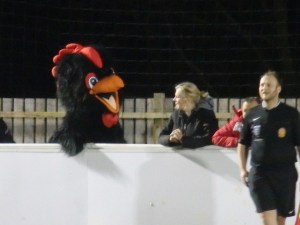
The teams take the field, Coggeshall in red and black stripes like AC Milan, Stowmarket in yellow shirts so pale they are almost beige, and red shorts, like a washed out Watford. The Stowmarket shirts bear the Nike logo, but with their insipid colour they look like they’re from Primark. Both teams are clearly tense and the game begins with fouls and squabbles, protests and pleas, and the referee quickly needs to take control. The confident Stowmarket No5 sneers at Coggeshall’s diminutive No8 and insults him, “What’s up midget-boy?” he asks. Rude. These are two well organised and committed sides and what develops is an opera of constant shouts and calls, curses and oaths combined with a ballet of runs and leaps and turns. Under the floodlights it’s a sporting son et lumiere, but with a hint of surreal comedy as a giant cartoon cockerel watches impassively from the sidelines; OLYMPUS DIGITAL CAMERAit’s Rocky the Rooster, the Coggeshall mascot.

Goalless at half-time, in the second half the match becomes a drama as with an hour gone Stowmarket score a penalty; but Coggeshall quickly equalise with a goal of beautiful simplicity, grace and speed. Their fleet of foot No 7, frizzy hair buffeted by the breeze, runs at the defence then threads through a perfect pass for the number 9 to chase and poke past the Stowmarket guardian. Coggeshall hopes are reborn, but the drama builds as with the game entering its final ten minutes hesitancy in the Coggeshall defence allows Stowmarket to score again. All the time this drama is played out before a tiny chorus, the Stowmarket six, a group of visiting supporters who chant and shout from within the tram shelter, their cat calls amplified by its tinny echo. “He’s got his IQ on his shirt, He’s got his IQ on his shirt” they sing to or about someone, it’s not obvious who. As Coggeshall strive to equalise a final twist turns the play into a tragedy as a poor tackle fells the Seed Growers’ Matt Southall; he’s too badly hurt to move immediately and there is a ten minute hiatus as a host of people in big coats run on and off the pitch and concern mounts. Some of the 310 strong crowd leave. Eventually Matt leaves the field to applause, but on a stretcher; his ankle is damaged and a long evening in A & E awaits.

The remaining five minutes produce half chances at both ends, the netting behind the goals does its job in catching stray shots and Stowmarket use up the time doing nothing whenever they can. But this tale has run its course and the game ends to scenes of gay abandon amongst the Stowmarket camp who may well win the league championship now, whilst Coggeshall’s disappointment is tangible, it’s clear this game mattered a bit more than most of the others.