Braintree Town 1 Truro City 1

It’s a mild and blowy Tuesday night in November and there’s a ‘top of the table clash’ just eight miles down the road from my house as Braintree Town play Truro City in the Vanarama National League South. It might not be far from my house, but Braintree is a bloody long way from Truro, 343 miles apparently and as far as any club has ever travelled to play a league match against Braintree Town. In awe of such a statistic I am inexorably drawn to witness the occasion.
I could get to Braintree by train, but I’d have to change at Witham and I don’t want to do that. So I take the easy option, which is to drive. Parking up near the end of Clockhouse Way at about ten past seven, the streets are quiet, with no one heading for the match,
OLYMPUS DIGITAL CAMERA

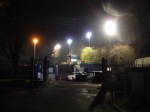
drawn by the eerie glow of the floodlights through the now mostly skeletal boughs of the trees. L S Lowry would never have made much of his painting ‘Going to the match’ if he’d lived and painted in Braintree. Entering the car park of the Ironmongery Direct Stadium (formerly and more prosaically known as Cressing Road) I stop to snap a photo for this blog. “How many pictures of grounds have you got then?” asks a man heading for the turnstile. He thinks I’m a ground hopper. I am a bit embarrassed, but say “Oooh, not many, a couple of hundred”.
The admission price this season at Braintree has very sportingly been reduced from £16 to £14 following relegation and similarly the programme is 50p cheaper too, although it’s no longer glossy, I like it all the more for that. I enter the stadium to the strains of Amen Corner: “If paradise is half as nice as being here with you…” which makes me feel wanted. Sadly the welcoming choice of music does not last until kick-off as the two teams enter the field to Emerson Lake & Palmer’s “Fanfare for the common man”. I say Emerson, Lake & Palmer’s; but it was only their arrangement of a piece written by American composer Aaron Copland, which your common man might possibly not know. It’s no less appropriate for work-a-day Braintree but it’s a bit naff too. But there’s nothing very exotic about the Vanarama National League South,

OLYMPUS DIGITAL CAMERA

as its name perhaps suggests; like a lot of non-league football it is the haunt of builders and ‘White Van Man’, which is possibly why Vanarama, purveyors of commercial vehicles, thought it worth their while to sponsor it.
I take up a position at the end of the low metal roofed terrace on the east side of the ground, known as The Shed. Three Truro fans are attaching flags to the back wall of the stand, one of which refers to Truro being the Tin Men.

There is a larger group of Truro fans stood behind the goal at the end of the ground that the teams appeared from; they have a big Cornish flag. Truro City kick-off the game towards those supporters, wearing all blue, whilst Braintree make it a colourful spectacle by wearing all orange. The three Truro fans immediately make one helluva racket repeating “Truro, Truro, Truro” over and over and over again to the tune of Amazing Grace. A larger bunch of Braintree fans stood just a few yards away look on slightly bemused or perhaps impressed; eventually they respond with some chants of “Iron, Iron, Iron” , but not any old iron, the Iron that is Braintree Town’s nickname. They soon give up in the face of Truro’s Amazing Grace however, which eventually ends abruptly with a little cough. The Truro fans then start to sing ”Come on Truro, come on Truro” to the tune of Auld Lang Syne which is predictably answered with “Fuck off Truro, fuck off Truro” to the same tune; the concept of terrace wit is grossly exaggerated.
Meanwhile, jet airliners from Stanstead soar overhead, the noise of their engines blotted out by three blokes from Cornwall under an echoing tin roof. On the pitch, Braintree look sharp from the start with their diminutive number seven darting about on the wing just in front of me and the Cornishmen. Both teams seem to be made up of three or four enormous blokes; at least two at the back and one up front. The remainder of the team look tiny by comparison, it’s as if the Vanarama National League South imposes some sort of combined height quota on its teams; the aggregate height of the team not being allowed to exceed the length of seven Transit vans placed end to end. Truro’s number four is possibly the most enormous man on the pitch, he sports a beard and although he is absolutely massive he doesn’t really deserve the ‘fat bastard’ epithet the Braintree supporters inevitably award him.
The three Cornishmen embark on an acapello rendition of “Come On Truro” in what is rapidly becoming an evening of K-tel’s greatest hits from the terraces . The Truro supporters behind the goal break into a rare song and the vocal threesome sing “We forgot that you were here” to Bread of Heaven. Intrigued by this I ask one of the Cornishmen why they aren’t they with the others behind the goal. He tells me it’s because they wanted to be under the roof. I ask if there isn’t some split between Truro supporters, “Don’t ask” he says, so I don’t. One of their flags is for the Truro City Independent Supporters Club so I just speculate that may be there is some sort of great Cornish schism much like the one that afflicted the Christian Church in the middle of the eleventh century. (1054).
Meanwhile it’s not a bad match, the blend of big blokes and smaller ones is an even one and the teams are well matched, but to the extent that the ball is rarely in danger of hitting either goal net. I am conscious that a man in a hi-vis jacket has been stood next to me for several seconds and I turn slightly to my right to face him. He’s a steward, and it’s as if he’s been waiting for me to acknowledge him, “Could you stand behind there please sir” he says, gesturing towards the chunky orange crush barrier. “Okay” I say cheerily, not wishing to cause a scene, although I had been quite happy where I was. The Beatles “Hey Jude” is now the vehicle for the latest chants of “Truro” whilst Braintree supporters weirdly and somewhat mournfully appropriate “Sloop John B” to chant “We know who we are, We know who we are, There’s one team in Essex, We know who we are”.
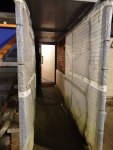
It’s about twenty past eight and suddenly the Braintree Town defence mysteriously melts away allowing Truro’s number ten Cody Cooke to run through and score a goal. The Truro fans are very pleased and inevitably have a song to celebrate the occasion as they tell us “ Cody Cooke is one of us, he loves Truro” although I thought it sounded like he loves Jesus, which of course he might. Half-past eight arrives and brings with it half-time and I move to the terrace by the players tunnel.
OLYMPUS DIGITAL CAMERA

The tannoy treats us to a rarely heard hit from 1970, Blackfoot Sue’s “Standing In The Road”; tonight at Cressing Road is proving to be a musical wonderland.
The second half begins and Braintree quickly hit their first decent shot on target and then they score as Roman Michael-Purcell easily turns in a cross from Phil Roberts who had made an exciting run forward. Restless as I am I am now sat in the box like main stand. Behind me a man who probably has a mental illness provides an occasional commentary announcing players names and incidents. His voice reminds me a little of the late John Arlot; he has a slight burr which lengthens the players’ names. He seems to have a love for the sounds of the names and is familiar with them all; he repeats some of them often such as Marcel Barrington and Christian Frimpong, who he calls Ping Pong. His ‘commentary’ is in in the style of John Motson as he announces substitutions for both teams but then Truro’s Andrew Neal flattens Frimpong in full flight. “Refereee, refereeee!” our commentator calls and then adds “Fucking cunt” . Then, to close this episode he says “Yellow card, Andrew Neal, the cheeky little fellow”.
The wind is getting stronger and swirls of willow leaves spiral down in front of the stand onto the edge of the pitch. More substitutions are announced behind me as is the fact that Matt Baxter does not come off the bench for Braintree, “ Not Matt Baxter, not Matt Baxter” is the refrain. The game remains tight and interesting as both teams play to win but don’t really come that close to getting a second goal. Truro substitute Tyler Harvey likes to run at the Braintree defence and creates a couple of half-chances and with his long tied back hair he looks like he might be found surfing on Newquay beach when not turning out on a Tuesday night for Truro City. I like to think there is a VW campervan somewhere in the club car park.
The match draws to a close with both sides going for goal unsuccessfully. It was tight at the top of the Vanarama National League South table when this game began and now when it ends at a bit after half past nine, it still is; a point for each team alters nothing. The home crowd are perhaps more disappointed not to have won than the travellers from Cornwall who have at least had a road trip and a jolly sing-song; and me, I’ve had a lovely time.

Whitton United 5 Coggeshall Town 4

The Eastern Counties First Division is the tenth tier of English football, just a few seats, some floodlights and a half-time plate of sandwiches for the opposition committee separates it  from the clubs that play on a piece of waste ground and use jumpers for goalposts, well  almost.  But that doesn’t mean clubs at this level don’t have history; Whitton United have been going since 1926 and Coggeshall Town since 1878, the same year as mighty, illustrious Ipswich Town, former League Champions, FA Cup, UEFA Cup and Texaco Cup winners.

It says in the match programme that a Whitton team existed in the late 1800’s, back when Whitton was a small village a mile or more outside Ipswich.  But between the World Wars Ipswich Corporation, as it was then, began to build the Whitton estate providing much needed,  good quality, rented housing for working class people.  Whitton is now a part of Ipswich, and if supporters in the Eastern Counties league did sing (with the notable exception of Wivenhoe Town’s they tend not to) they could chant “Small club in Ipswich, You’re just a small club in Ipswich” without fear of contradiction.

Whitton United is a rare thing in the Eastern Counties League, a team representing a truly urban area, and more than that it might be said to represent a large council estate.  The contrast with Coggeshall therefore is on the face of it quite stark.  Coggeshall, with its National Trust owned medieval buildings and its vineyard and ley lines is positively poncey by comparison.  The other big difference is that Coggeshall Town are being bankrolled; there are stories of players attracted from beyond Essex on the promise of big appearance money.  The realisation of this is shown in their relative league positions with Coggeshall currently top of the table, where they have been virtually all season, whilst Whitton are merely near the top of the bottom half of the table, albeit on a roll of five consecutive victories.

The King George V Fields ground is outside the Whitton estate next to the main road out of town towards the A14 and Stowmarket.   A third of the pitch is overlooked by a large heap of rubble that was once the concrete floor of the Tooks bakery (aka bread factory), formerly the club’s neighbour. Behind one goal there is no accommodation for spectators whatsoever, just a stretch of grass from the goal net to a very big fence, with the road beyond.   There is a stand on each of the other three sides; two of them resembling country bus shelters, one of which is labelled ‘The Shed’; whilst downhill, behind the other goal is a pre- fabricated, metal stand containing the requisite number of seats for the club to play in the Eastern Counties Premier League. should the need arise.  The changing rooms have a wonderful green and white striped tin roof.

It’s a grey, blustery afternoon with a constant threat of rain, but the two teams in their striped kits, Whitton in green and white and Coggeshall in red and black stand out through the gloom and offer the promise of excitement.  I wander around the perimeter rail before the game kicks off and a bloke on his way to one of those ‘bus shelters’ and carrying a couple of pints of beer says hello; “ We need a good result today after last week” he says.  I have no idea what either team did last week, but I agree because it would be churlish and a bit weird not to do so and I’m not one to start an argument with someone I don’t really know.  To begin with, the promise of a good game is all there  as the ball bounces awkwardly on the soft pitch and is buffeted by the wind, producing a scrappy match with neither team looking much good.  Despite kicking up the not inconsiderable slope and against the wind however, Coggeshall gradually start to look the stronger team.

I walk round the back of the dugouts and towards the end of the ground where the only spectators are those in passing cars and buses who are probably surprised to find themselves watching a football match, albeit for a few fleeting seconds only.  One or two beep their car horns as they drive by.  Coggeshall are kicking towards the goal at this end and it doesn’t take long before they score, a close range tap-in from Scarlett, despite claims of offside from Whitton.  Somewhat bizarrely Coggeshall’s number four is booked in the aftermath and from what I can make of what referee Mr Pope seems to be saying, it is because he egged on the Whitton players in their offside protests. ‘You started it’ I think I hear the Pope say as if scolding Martin Luther.  The same player is then spoken to again by his holiness and told to concentrate just on the football by the Coggeshall coach; “I only said bad luck baldy” the player opines after Whitton’s follicly challenged centre-half concedes a free-kick on the edge of his own penalty area.

I drift back towards the Whitton bench having had enough of the Essex club’s manager’s questioning of Mr Pope and decide to briefly compare and contrast him with the Whitton manager.  I conclude that the Whitton man mostly complains to himself and to the bench in a sort of audible internal dialogue.  The results of the comparison fit with my own pre-conceived ideas of Ipswich and Essex people.  Happily for Whitton however, my move into their half coincides with a couple of attacks down the left, one of which results in a free-kick and ends with an unexpected, but not completely undeserved equaliser from Bell.

Half-time arrives with scores all square and I indulge in a pounds worth of tea and a warm in the clubhouse, although I have to be let in because the door only seems to open from the inside.  I return to pitch side too late for the re-start, but haven’t missed anything and take up a spot in the seats behind the goal.  It starts to rain.

With the wind at their backs and playing down the slope it seems like it might be easier for Coggeshall in the second half and gradually, as in the first half they begin to dominate the attacking play, but without really making any decent chances to score; then, a break down the left, a through ball and a goal for Whitton by Percy (sadly his surname not his first name).   It’s a bit of a surprise but the game returns to its previous pattern and with about fifteen minutes left, after some more Coggeshall domination the ball is crossed low, blocked and partly cleared before the Coggeshall substitute Guthmy coolly places the ball in the middle of the goal to equalise.  Now it really looks like Coggeshall will go on to win and that’s what the bloke behind me tells his children when they ask.

The good thing about football however is that is totally unpredictable, which is why all these ‘sports betting companies’ (bookies) advertise relentlessly to part mugs with their money.  Proof of football’s unpredictably arrived within just a minute or two as a deep cross from a corner was headed in at the far post by Griggs to put Whitton ahead again and then within minutes of that a through ball saw  Cheetham brought down in the box resulting in a penalty which gave Whitton a 4-2 lead. The rain had now eased and I stepped out of the stand so that I didn’t have to peer through a goal net and another bigger net placed across the front of the stand to protect inattentive spectators from stray footballs that might inadvertently smack them in the chops when they were looking at their mobile phones rather than the game; serves ‘em right I say.  Barely had I done this and with about six minutes left Whitton scored yet again with Cheetham ‘converting’ a cross by the beautifully named Franco Mallardo.

Surely that was it, 5-2 with just five minutes left? But no, Coggeshall rightly decided that the game wasn’t over until his holiness Mr Pope says so, and just as I would never leave a game before the final whistle, so the ‘Seedgrowers’ , for that is what their nickname is, continued to try and win the match.  And it was a good job they did or this report would be over already.  First, continuing the ecclesiastical surname theme started by the referee, Monk made it 5-3 with a fine half volley from the edge of the penalty area,  and a short while later he then crossed the ball for Nwachuku to smack a fourth goal high in to the Whitton United net.  There was still enough time for a free kick on the edge of the penalty area to be sent over the Whitton cross bar, but finally Mr Pope whistled Amen and the game was over.

It had been a most entertaining game, even if some of the defending had at times been hard to spot, and in difficult conditions on an awkward slopey pitch the players of both teams had given their all.  I was surprised therefore and disappointed that at the end no one clapped or cheered as the two teams left the pitch; but no one booed either, so it was one up on Portman Road I guess.   The 5-4 score line alone deserved some appreciation, but there was nothing, not a cough, not a wheeze, not even a tiny chortle. Everyone just filed away into the car park.   To an extent, at this level of football the result doesn’t matter as much as the fact that the two clubs are still there each week to play; this is perhaps true more for a real community club like Whitton United than a club like Coggeshall Town which has been adopted by someone with spare cash like a mini Roman Abramovich.

There was apparently only a crowd of 57 at this match, which is disappointing for a Saturday when Ipswich Town are not playing, and looking about there were very few people under thirty there.  A football match where you can drink in sight of the pitch should be a massive draw and at £6.00 entrance fee it provides good value for money compared to the £40 Norwich City wanted from IpswichTown fans to get into Carrow Road the following day.

Eastern Counties League Football should be the model for sustainable football, so I urge you, support your local team, it’s friendly, it’s funny, it’s fun, it is well worth it.  I had a lovely time.  Thank you Whitton United.