When I first became interested in football at the tender age of ten, Barrow were in Division Four and had been in the Football League since 1921, when they were elected as original members of Division Three North. In my Observer’s Book of Football, the one that has a picture of Bobby Charlton on the dust jacket, it states “Honours have always been elusive for Barrow” and it goes on to say that Barrow had just “one season of triumph”, in 1967 when they finished third in Division Four. Sadly for Barrow, by the time I first saw them play, at Layer Road, Colchester in 1990, they had been replaced in the Football League by Hereford United and were not yet half way through a forty-eight year stint in non-league football. Thirty years on and today, through the wonder of the 2nd round of the FA Cup, Ipswich Town and Barrow meet for the first time ever. I’ve been looking forward to today’s game to some extent since 1971, but more tangibly since the Cup draw was made, and in reality since Idris El Mizouni’s cracking goal ensured Oldham Athletic wouldn’t be making an unexpected run to Wembley.
As befits an FA Cup Day, the sun is shining gloriously, although with little impact on the outdoor temperature as I stroll across Gippeswyk Park and up Portman Road beneath clear azure skies. Portman Road is notable this afternoon for the atypical absence from the car park behind Sir Alf Ramsey’s statue of some of the usual vendors of chips and other grease-based foods sold inside spongy ‘bread’ products. There is also a corresponding shortage of human beings in Portman Road today compared to other match days, and whilst you might infer from this that people only come for the grease-based foods, the sadder truth is that the FA Cup simply doesn’t attract football fans like it once did. I can recall paying full-price to watch Town play fourth division Halifax Town and Hartlepool United in the company of about 24,000 other souls back in the late 1970’s, and now find it hard to understand why with reduced ticket prices the lure of Cup glory against such Northern exotics is no longer an attraction. In this age of instant gratification and tv reality game shows, Cup football should be more popular than ever with its promise of advancement to the next round and the jeopardy of defeat and expulsion from the competition after just ninety minutes; Death or Glory as The Clash sang just a year after Town lifted the FA Cup. The tyranny of Sky tv and the Premier League is clearly to blame.
Having purchased a match day programme (£2), I head on to what was The Arboretum pub back in the days when 24,000 turned up to see Hartlepool United and Halifax Town at Portman Road, but is now The Arbor House. With a pint of Mauldon’s Suffolk Pride (£3.80) in my cold right hand I sit and wait for Mick in the garden. Mick soon arrives with a pint of Mauldon’s Molecatcher, a packet of Fairfields Farm cheese and onion crisps and a cup of dry-roasted peanuts. Mick explains that Molecatcher is brewed to the same recipe as Suffolk Pride but is less alcoholic; I can’t really see the advantage of that at the moment, but our conversation explores various avenues from last night’s Have I Got News For You tv programme to nuns before it is time to walk down the hill past Ipswich Museum to Portman Road.


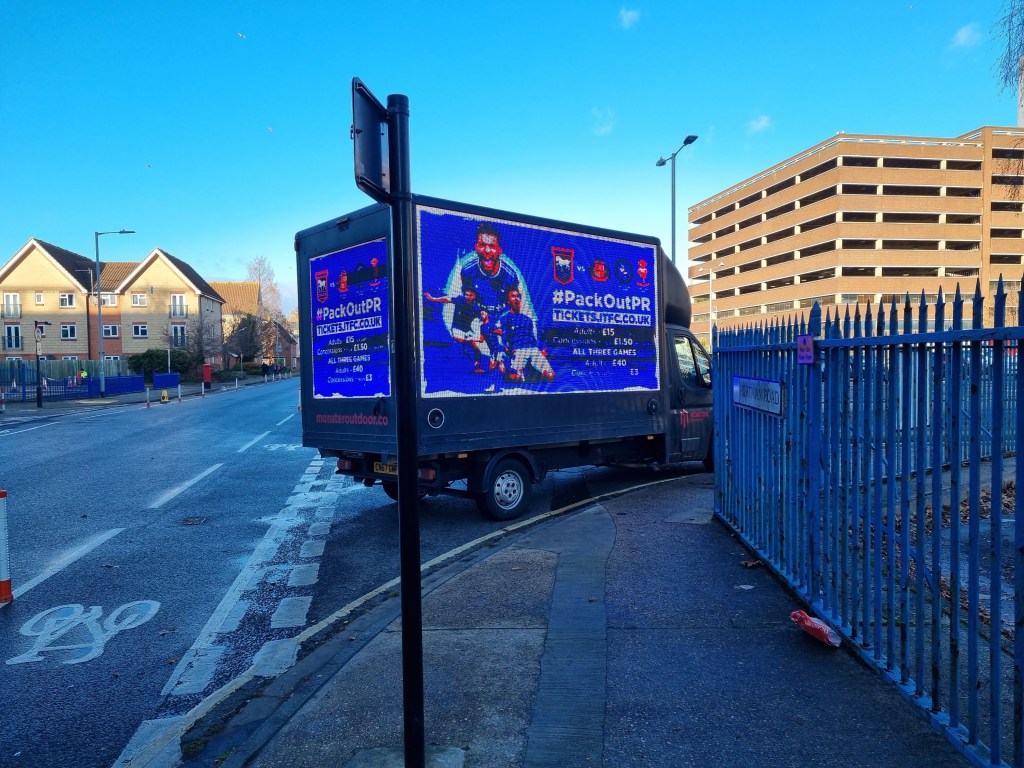
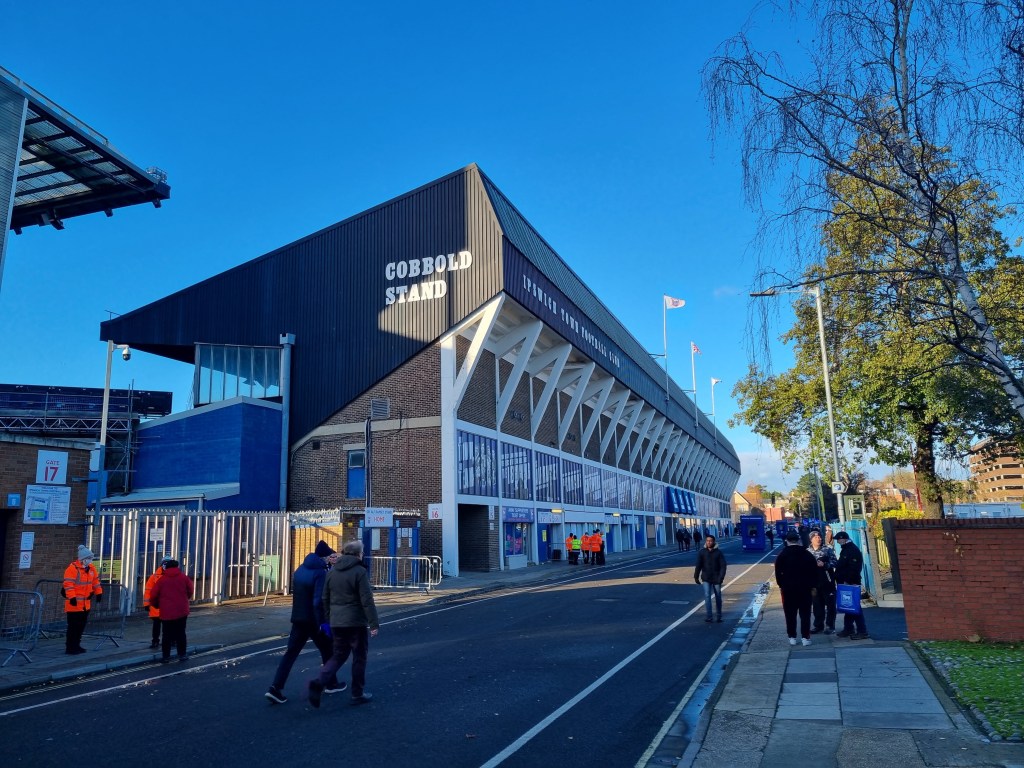
Today, taking advantage of the reduced flat rate ticket price (£10 for adults and £5 for concessions plus £1.50 each for the pleasure of buying them, which goes to a parasitic organisation called Seatgeek) we are in the top tier of what was the West Stand, but is now the Magnus Group Stand. We are in Block Y where the seats are brown in colour, not because of any sort of unpleasant staining but merely because I imagine brown looked ‘classy’ in 1982 when the top tier was opened; the seats are also padded. I bought our tickets soon after they went on sale and we benefit from being close to the stairway or vomitorium, and just two seats in from the gangway, so only two old men must rise from their seats for us to access ours. With everyone in their winter coats it’s a tight squeeze nevertheless.
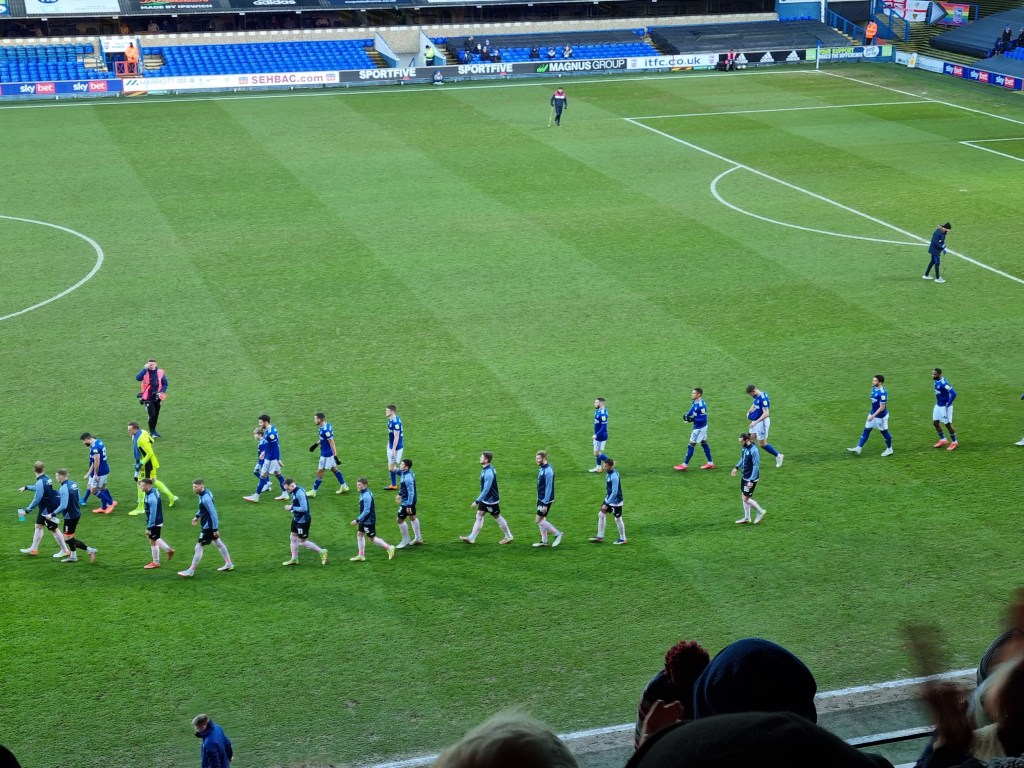
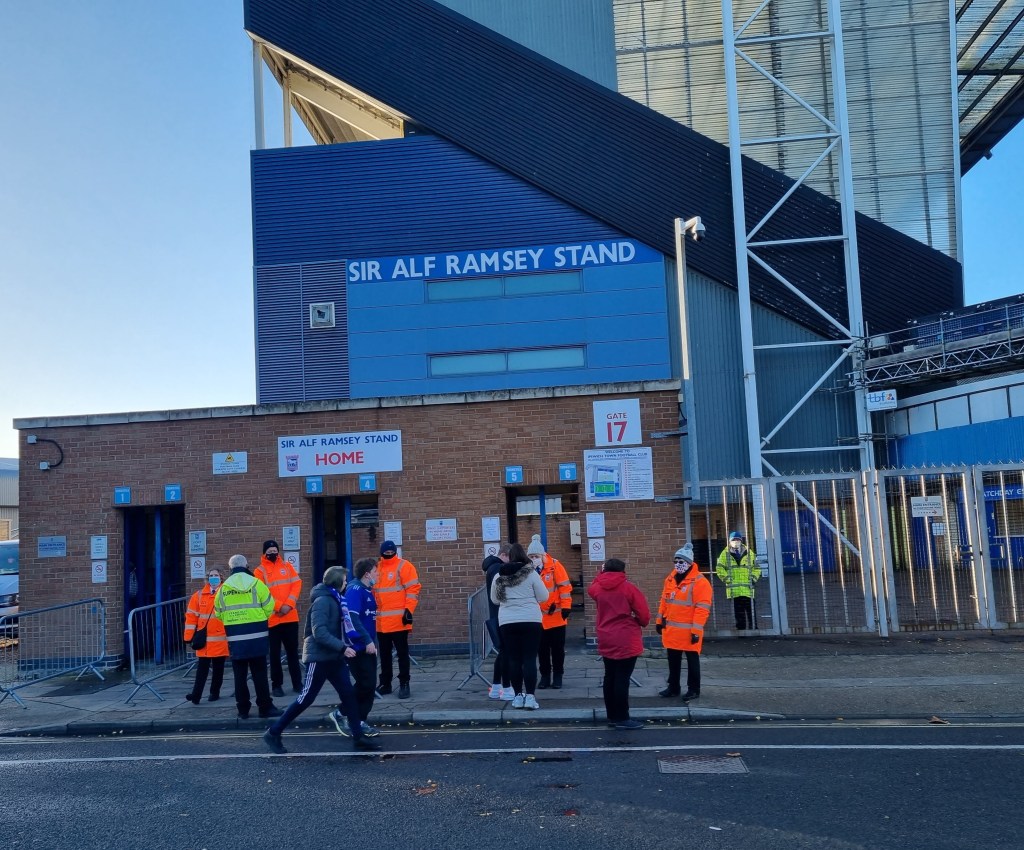
The teams appear to an introduction from stadium announcer Stephen Foster worthy of the occasion and with knees taken and duly applauded the game begins; a strong Town team getting first go with the ball and kicking towards the Sir Alf Ramsey stand, formerly plain old Churchman’s. Town are wearing their traditional blue shirts and socks and white shorts whilst Barrow are in an unexpectedly stylish pale pink shirt and socks with black shorts, vaguely reminiscent of Sicily’s Palermo or the now defunct Evian Thonon Gaillard, briefly of French Ligue 1. The largely empty stadium is filled with a sense of expectation as the game starts and the murmur of a nascent chant can be detected from the Sir Bobby Robson stand. Within a minute of kick-off however silence reigns.
From the start Town look as hesitant and short of ideas as their supporters are of rousing supportive chants. It is Barrow who show the first serious attacking intent as several players in pink break forward “They’re all offside, nine of ‘em; except him” says a man with a loud and annoying voice a couple of rows behind me as Barrow’s number eleven Josh Kay bears down on goal beneath the shade of the Magnus Group Stand. The same voice is all too audible a short while later as Barrow break forward again. “Toto, Toto, leave him alone Toto” he calls as Toto Nsiala tracks a Barrow player into the Town penalty area and makes a tackle before he can fashion a shot on goal. Had Toto Nsiala followed the spectator’s advice it is likely Barrow would have scored or at least had a shot on target. It’s not a good start by Town or their supporters. But as a consolation the low winter sun is reflecting a sparkling yellow light back off the windows of the Guardian Royal Exchange office block on Civic Drive, so although the football isn’t, the backdrop is gently inspiring.
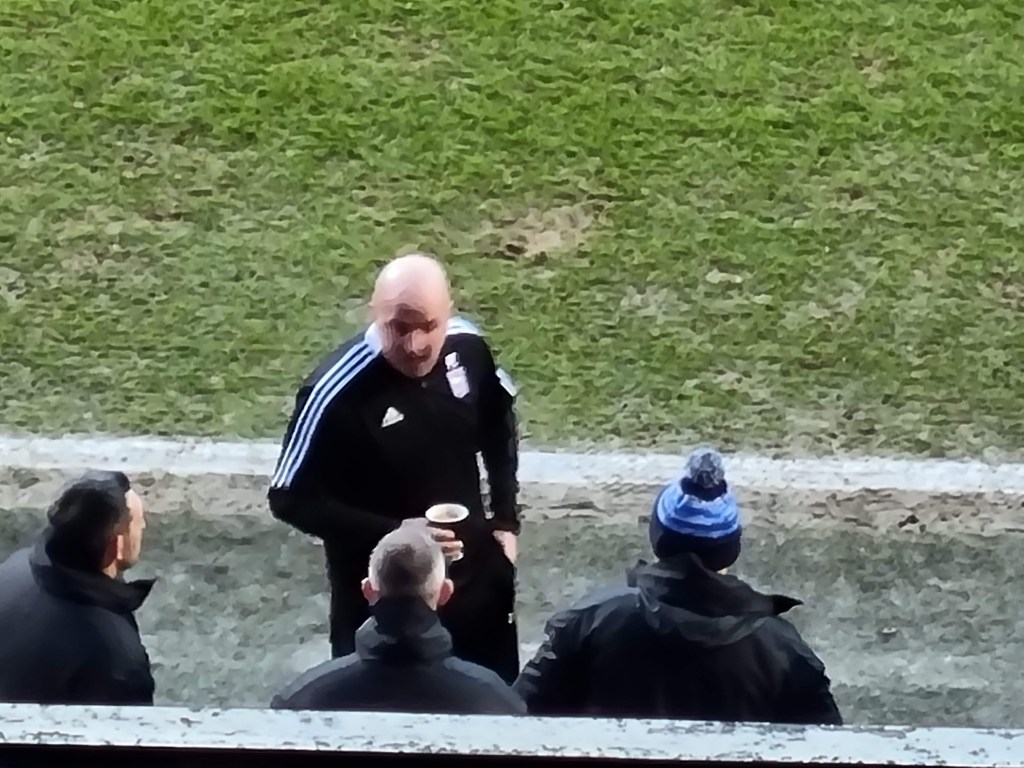
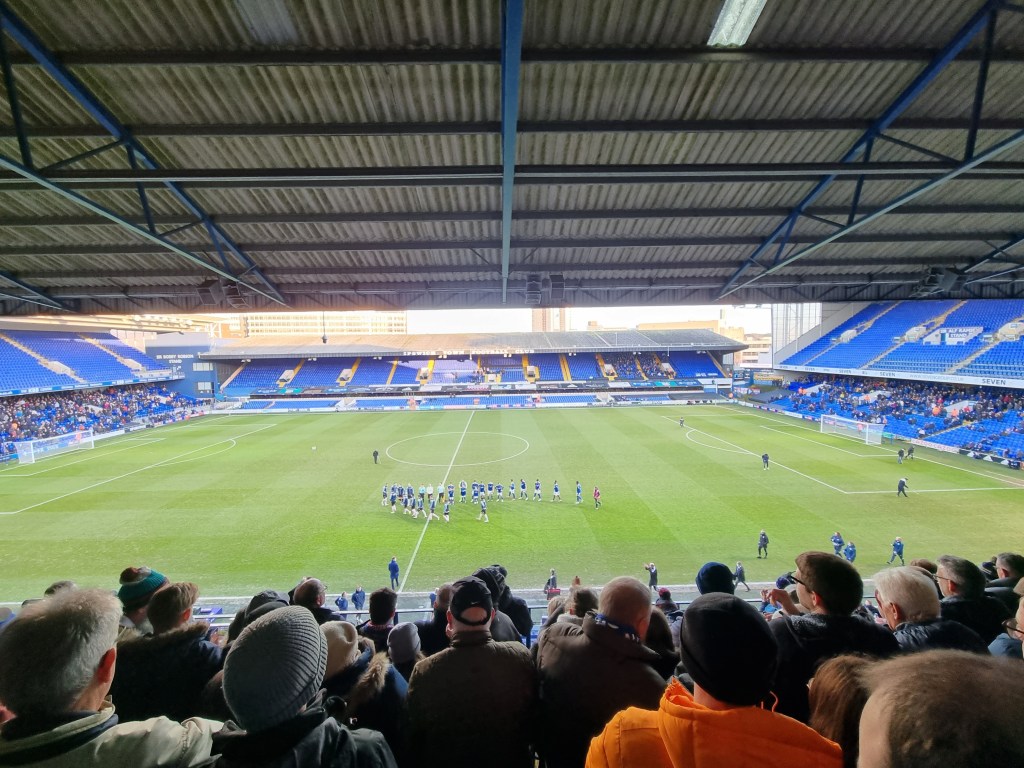

Over twenty minutes pass and Barrow earn two free-kicks in quick succession in the Town half and then win the game’s first corner. Barrow come close to scoring twice as one free header hits a post and then one from Mark Ellis is saved by Christian Walton. Barrow’s Josh Kay shoots and his shot is tipped over the bar by Christian Walton. “Come on Lambert, sort it out” bawls the ruddy-faced old boy sat in the seat next but one from mine. Nobody reacts in the seats around me; I fear some of my fellow supporters might have died. I turn to Mick and dare him to shout “Robson Out”.
It takes Town over half an hour to have a shot on goal worthy of the name as Scott Fraser eventually launches a shot over the cross-bar from outside the penalty box. I remark to Mick that with the number eleven on the back of his shirt and his short brown hair, from this distance Fraser sometimes makes me think of Mick Lambert. “I can’t think what Mick Lambert looks like” says Mick. “Well I expect he looks a bit different now” I respond. Idris El-Mizouni is booked for a foul, a little harshly in my opinion and I wonder to myself whether referee Mr Sam Purkiss is a closet French nationalist in the thrall of Marine Le Pen. As half-time approaches a rare moment of hope sees Conor Chaplin break away and from a low cross earn a second corner for Town, and then the oddly named Macauley Bonne strides forward to unleash an appallingly bad shot which results in a throw-in to Barrow. “What the fuck, what the fuck, what the fuckin’ ‘ell was that?” sing the Barrovians up in the Cobbold stand in the time honoured fashion. “Good question” mutters the old boy next to me to himself.
Half-time comes as a welcome relief and whilst Mick gains further relief using the facilities, I remain in the stand alongside the two old boys. The match resumes at three minutes past four as dusk descends to shroud Suffolk’s County town in chilly December darkness.
Half-time has brought change and Joe Pigott has replaced Idris El-Mizouni who hadn’t looked sure where he was meant to be playing, with Sam Morsy seemingly competing with him for the ball in midfield. Within three minutes Joe Pigott has found space and strikes a post with a firm shot. Pigott’s presence continues to make a difference as he seeks space behind the Barrow defence and controls and lays the ball off in a manner which the oddly named Macauley Bonne has so far appeared incapable of doing. Things are looking up and the Sir Bobby Robson stand feels moved to sing a song which has quite a lot of words, few of which I am able to decipher, but then Kay scoops a shot over the bar for Barrow when it was certainly no more difficult to get his shot on target.
This is a much better half for Town and I sense a glimmer of optimism amongst the Town followers in the meagre crowd of 6,425, of whom a respectable 205 are from Barrow. The mood hasn’t affected the loud man behind me however, who continues to provide a mainly sarcastic commentary, which sounds both smug and moronic in its delivery. He clearly doesn’t like Toto Nsiala and bewilderingly urges him to chip the ball over Christian Walton as Toto turns it back towards goal, before saying “He was tempted”. This man has the sort of voice that would make a more violent person than myself want to punch him in the throat.
Town now dominate possession and whilst still a little slow on the ball they are getting players down both flanks to put in crosses, an approach that is helped by bringing on the exciting Sone Aluko. The Town support has corresponding moments of enthusiasm and sing another song with plenty of hard to fathom words, but a simple chorus of “Addy, Addy, Addy – O”, which is the sort of thing heard sung by children in one of those black and white films from the early 1960’s such as A Taste Of Honey, and I half want to see Rita Tushingham and Dora Bryan warming up on the touchline.
As the match winds down into its final fifteen minutes the support wanes, and as we enter six minutes of normal time the ground is once again silent. As ever, there is a late flurry of goal attempts as the realisation dawns on the players that their failure to score a goal can only result in an evening in Barrow-In-Furness. Corners are won but no booming chants of “Come of You Blues” or intimidatingly repetitive calls of “ Ipswich, Ipswich, Ipswich” materialise from the stands; even the score board seems apathetic as each corner kick is met, not with an entreaty to shout support for the team, but instead a message about how the Ipswich Mortgage Centre “corners all your home improvement and mortgage needs”. The old boys beside me leave with a couple of minutes to go. Sam Morsy shoots over the cross bar from close range and substitute Cameron Humphreys heads against it , but Town don’t score and the breath saved by not shouting in support of the Town is expended in a chorus of sadly predictable boos and jeers.
Later this evening I will learn that the Town manager has been sacked and briefly I wonder to myself if the old boy sat next but one to me had been right; Paul Lambert had never actually left the club he’d just shaved the top of his head and swopped his Scottish accent for a Scouse one, but after nearly a season’s worth of games he’d finally been found out. It’s certainly never dull being a Town fan, well except for the actual games that is. Try stopping me going through it all again in a fortnight’s time though. No, please, try.



 From Ipswich we are on a special chartered train that turns right at Stratford and plots a course through north London round to Wembley Central. In Wembley Stadium the terrace steps at the tunnel end are much bigger and steeper than those in Churchman’s or in front of the East Stand, blue and white abounds. The sun shines and Arsenal, wearing yellow and blue, kick off with Ipswich playing towards that blue and white tunnel end. Paul Mariner hits the cross bar, John Wark twice shoots against a post, Pat Jennings saves acrobatically from George Burley, Paul Mariner misses, bigmouth Malcolm McDonald is rubbish, Clive Woods is brilliant, David Geddes crosses, Willie Young is a lumbering donkey, Roger Osborne scores, we cheer, we sing, Roger Osborne is substituted for Mick Lambert, Town win and Mick Mills lifts the FA Cup and turns to show it to us.


 trippingovertheball