Meudon AS 0 St Ouen L’Aumone AS 2

Today is the last day of September, my wife Paulene and are staying in Meudon on the edge of Paris, and having enjoyed both professional Ligue 1 and Ligue 2 football in the past week and a bit, watching both Paris FC and Paris St Germain, this afternoon we are getting down with the French equivalent of ‘non-league’. Not much more than ten minutes away by car at the Stade Georges Millandy in Meudon Le Foret (twenty minutes by bus service No 289) is a Coupe de France fourth round tie between Meudon AS of the Ile de Paris regional league Division 3 and St Ouen L’Aumone AS of the Ile de Paris regional league Division 1. These leagues are the 6th and 8th levels of the French football league ladder, although probably not directly comparable to those levels in the English non-league ‘pyramid’.
The parking at the local community sports centre, where the match is to take place is full, so we park our trusty Citroen C3 around the corner in Rue Georges Millandy between large blocks of modern apartments. We are not sure exactly where we are going, but the Federation Football Francais (FFF, the French Football Association) website says this is the where the match is taking place and having walked through a corridor in a sports hall we find ourselves next to an artificial football pitch. There is no turnstile and watching this match is free. A bunch of blokes in tracksuits sit outside a portacabin eating baguettes and drinking coffee. In my exquisite school boy French I ask if this is this is where the Coupe de France game is taking place at 2.30; I am relieved to learn that it is, and flattered that the man I speak to recognises the Ipswich Town crest on my T-shirt. I explain that I am a fan and not from the club itself, but we both quickly make the connection that Ipswich’s Under 18 player Idris El Mazouni is from Meudon. I will later discover that I have been talking to Idris’s dad.
The Stade Georges Millandy is not a stadium as we might understand it in Britain, because it has no stands; it’s just a 3G synthetic pitch with dugouts and a metal fence, overlooked by five or six large, shiny white apartment blocks.

This slideshow requires JavaScript.

It wouldn’t make the grade for the Thurlow Nunn Eastern Counties League, although in truth the playing facilities are better than at most clubs in that league. It seems quite new, is in good condition and is the sort of installation that a town the size of Ipswich should probably have at least ten of. Given that these pitches are not cheap to install it is doubly impressive that the surface extends beyond the actual pitch to the area around it, with a mini pitch and goals in the space behind one goal. A game (possibly Under 15s) is

just finishing with a penalty shoot-out and I return to the portacabin, which is a sort of club house and buvette, to get two cups of green tea and a Kit-Kat (all 1 euro each); the tea is poured from a huge pot. On one wall is a large array of trophies won by all age groups within the club.

Paulene and I wander around the pitch as we drink our tea and I scoff a Kit-Kat trying to remember why Nestle products were boycotted and if they still should be; too late now, I have become complicit in their multi-national nastiness. It is a beautiful, bright sunny

45013661531_f3c54472c1_o

afternoon beneath a clear blue sky and the gaze of those shiny apartment blocks, which cast no shadows on one another or the pitch; this has to be how Le Corbusier imagined La Ville Radieuse.

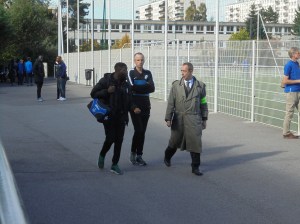
A man in a loosely belted gabardine raincoat appears; if he was wearing a trilby hat he could have stepped from a 1940’s film. He sports a bright arm band which adds to the look, but in a slightly sinister manner; he is however the délègue principal, the FFF official who
43201967200_10152fe2e5_o

will oversee this afternoon’s game from the side lines. Out of the blue one of the spectators walks up to me and shakes my hand. In due course the two teams emerge from their respective changing rooms and walk through the metal gate onto the pitch before lining up side by side, then in a line before shaking hands. Introductions between the referee and players and délègue principal are made all-round, before the game kicks off about five minutes late (it was advertised as a 14:30 kick–off) with St Ouen having first go with the ball, aiming at the goal in front of the buvette. Meudon kick in the general direction of far off Stade Charlety and the 13th Arrondissement. St Ouen wear an all-green kit, whilst Meudon are all in red; neither club has its club crest on its shirts but instead bear the logo of the FFF with its cockerel.

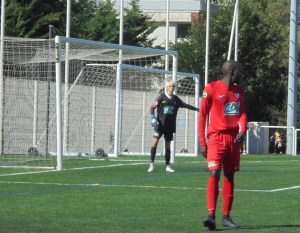
St Ouen quickly win a free-kick as their tricky number nine goes down under a challenge; he gets up to send a neat free-kick over the red wall of Meudon, but into the arms of the very young looking Meudon goalkeeper, who strangely is one of the smallest players on the pitch, a sort of French Laurie Sivell. It is also St Ouen who have the second serious goal attempt, again a free-kick, but this time firmly hit from a wide position by their number ten. Once again the goalkeeper, whose blond hair may not be its original
30077406907_10dcb243ea_o(1)

colour, saves, batting the ball away for the first of five corners that St Ouen will win this half. Most of these corners are either poorly taken or all the St Ouen players are waiting for the ball in the wrong places.
Meudon are very competitive and the game is played at a fast pace with the emphasis on passing rather than just getting the ball forward by the fastest route. Meudon come close to scoring a bit before three o’clock as their huge number eleven breaks through on the left. The St Ouen goalkeeper, who incidentally reminds me of St Etienne ‘keeper Stephane Ruffier on account of his designer stubble and very short dark hair, and is possibly the second smallest on the pitch, dives at his feet. The ball rebounds to the Meudon number seven whose goal-bound shot is headed away at improbably close range.
Meudon seem to be growing in confidence and their number ten does a few feints and jinks over the ball like a footballing Michael Jackson (Bubbles’ friend, not the one who played for Tranmere and Shrewsbury) might have done. There are a few jeers and within the next twenty seconds his ankles are swept away from beneath him by the St Ouen number three as he goes to dribble down the right touchline. It’s one of those situations that some people would try to excuse by saying that number ten had been ‘disrespectful’, but that’s just a modern buzzword, a sort of false political correctness and it is tosh; I blame Eastenders. Football is a game of skill, and dumping someone on their bum shows little ‘respect’ itself. Referee Monsieur Charly Legendre doesn’t see fit to book anyone either way.
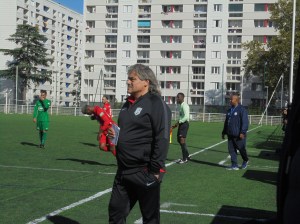
The coaches on the side lines are animated, “Parlez –vous” one calls urging his players to talk to one another. The St Ouen coach, a portly man in his fifties sports a fine mullet and
43201968530_160c2105a2_o

has the look of Maradona about him. The Meudon coach becomes involved in a prolonged discussion with the linesman Mefa Bakayoko about an offside or a free-kick which has been and gone and so no longer matters. On the field, the St Ouen number ten sends a free-kick solidly over the cross bar whilst Meudon’s number six comes as close as anyone else with a long range shot that goes wide. St Ouen’s number nine is proving industrious and creates a couple of shots for himself, one of which is well saved and Meudon replace their number three with substitute number thirteen. Half-time arrives and Paulene and I look back on a good but slightly frustrating forty-five minutes, which was too tight to be really entertaining. I head for the buvette to get a bottle of water (1 euro).
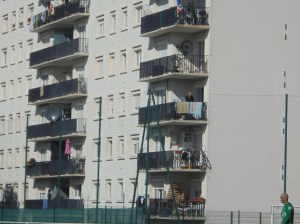
During the half-time break we stand about and as a man walks by he shouts “Ipswich!”. We could do with that sort of enthusiasm at Portman Road. As I stand I enjoy the
44294420204_39f8378ac4_o

contents of the many balconies that overlook the pitch from the surrounding apartments. Bikes, mattresses, plants and drying clothes decorate the bright white buildings and on one corner is a tricolour, perhaps left over from the summer’s World Cup win. As the afternoon wears on more people seem to arrive to watch the game and by the end I estimate that at least one-hundred people are here.
The délègue principal oversees the away team leaving their dressing room by a side door to the sports centre building and heads back to the pitch still wearing his gabardine raincoat, although it’s a warm afternoon; he is perhaps the anti-thesis of the banker in The Beatles’ Penny Lane and also feels as if he’s in a play, or a British TV sitcom. The bearded referee begins the game again and St Ouen soon win their sixth and seventh corners of the game, although in between their number eleven also shoots over the cross bar. At about four o’clock the St Ouen number eleven breaks forward through the middle, stretching the Meudon defence before playing a through ball to number ten who slips the ball inside the near post past the ‘blonde’ goalkeeper; St Ouen lead 1-0.
They may be losing and disappointed to be doing so, but Meudon still pose a threat and a good run and cross from number eleven meets the thigh of number seven just a few yards out, but he can’t direct the ball past the goal keeper. The first booking of the game goes to Meudon’s number two and the game enters a tetchy stage where it seems it could flare up at any moment. As at most French football matches I have seen where this happens however, there are only outbreaks of animated discussion between the players, but the referee stands back and let’s this carry on. It’s a civilised approach which may reflect the character of a country that has produced far more philosophers than England has produced ‘World Class’ footballers.
St Ouen are buoyed by their goal and their bearded number three controls a ball beautifully on his chest before advancing down the flank. The lads watching near us jeer at his skill and nickname him Fekir, and they’re right to do so because he does vaguely resemble the French international. But Meudon are not beaten yet and the large number eleven strides past a couple of St Ouen players before playing a through ball to number twelve who either wasn’t paying attention or the pass wasn’t as good as it looked. Paulene and I belatedly realise that the number twelve has replaced the number seven, who we had thought was Meudon’s best player.
St Ouen almost score a second goal as their number nine diverts a cross from ‘Fekir’ the wrong side of the post from close range, but the game is becoming more scrappy and there are more fouls. The Meudon number ten spends more time than most not being upright. St Ouen win an eighth corner and as a passage of play ends Monsieur Legendre calls over Meudon’s number nine and ‘Fekir’ and books them for a mystery offence that neither Paulene or I saw. It is now gone half past four and we are witnessing time added on as St Ouen’s number eight runs down the right and then pulls the ball back across the penalty area for substitute number fourteen to side foot beyond the small, blond goalkeeper into the far corner of the goal. St Ouen L’Aumone AS is the name that will go into the draw for the 5th round of the Coupe de France.
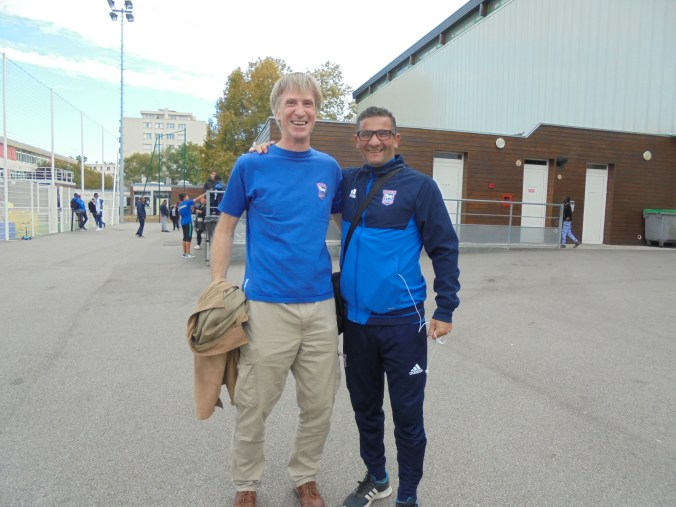
It’s been a reasonable game although not an exciting one in terms of goalmouth action. We turn to leave and Paulene notices a man with an Ipswich Town crest on his coat; I speak to him and it turns out he is the father of a second player from Meudon AS who is now in Ipswich Town’s Under 18 squad, Lounes Fodil.
44294397894_dca5642a04_o

Lounes’s dad, who is called Mustapha (apologies if the spelling is wrong) is a lovely bloke and is genuinely pleased to meet us and invites us for a coffee in the buvette. Our conversation probably isn’t the best as neither our French nor Mustapha’s English are fully fluent, but Mustapha gets across his philosophy of football; it’s a game of skill and intelligence not brute strength. He’s been to Portman Road and has noticed the glum atmosphere, which he attributes to the dull football. Whilst we are at the buvette some of the players come in for post-match drinks and snacks, one of them (I think it might have been the big number eleven or the captain) tells me Lounes is a good player. I tell him that’s good news because Ipswich Town really needs some good players; before he leaves he shakes my hand. The man who I first spoke to when we arrived comes to the bar counter and gets out his mobile phone before showing us a montage of clips of Idris El Mizouni playing for the Under 18’s, this is when I discover that this is Idris’s dad.
After a good half an hour or more we have to leave and walk from the ground with Mustapha who leaves us his phone number and invites us round to eat; sadly Paulene’s food intolerances and allergies will make that too complicated. We thank Mustapha and say how good it has been to meet him. Hopefully we will see him again.

This slideshow requires JavaScript.

LOSC Lille 1 Montpellier HSC 1

After a wet, drizzly afternoon enjoying an exhibition of marionettes at the Hospice Comtesse,

This slideshow requires JavaScript.

a rather groovy establishment called ‘The Beerstro’ and then the birthplace of Charles de Gaulle, the Grand Finale is an eight o’clock kick-off at the Stade Pierre Mauroy where LOSC Lille meet Montpellier Hérault in the 29th Journee of Ligue 1. Montpellier sit in 6th position in the twenty-team French league, whilst Lille flounder uncharacteristically just one place off the bottom, battling against relegation. I am with my wife Paulene and after a relaxed, light meal we head for the Gambetta Metro station. It’s a little after six o’clock and as the streets begin to dry with warm air up moving up from the south, so the Lillois are venturing out to drink, to dine and to watch football. At Gambetta station the escalator is out of action and at the foot of the stairs a ticket man greets us; somehow he instantly detects that we are English and calls out over his shoulder “Alain! Ils sont Anglais”. A smiling, balding man in glasses walks over to us “Awright?” he says and we shake hands. He continues to talk to us in English with a strange hint of an estuarine accent; he must have learnt English in Dartford or Thurrock. He explains the system of rechargeable tickets and although the ticket itself costs 0.20E he lets us have one for free and on to this one ticket we add four journeys for the trip to the stadium and back (6.40E). Alain even validates our tickets for us before we thank him and bid “Au revoir” and descend down onto the platform. What a lovely bloke. The driverless trains on the Lille Metro are frequent and one soon draws up alongside the automatic doors at the edge of the platform. We step on and sit at the front of the carriage, a siren sounds, the doors close and we’re soon hurtling along through concrete tunnels beneath the city

OLYMPUS DIGITAL CAMERA

above. The stadium is the twelfth stop on our mostly subterranean journey, although it is possible to alight at any of the four stops from Villeneuve d’Ascq onwards and the stadium is still easily walkable. People board and leave the train along the route at Republique Beaux-Arts, Gare Lille-Flandres, Caulier, Fives and Marbrerie, some sport red and navy blue knitwear betraying their support for the local team. Before the end of the line at 4 Cantons

Stade Pierre Mauroy, the train rises out of the ground on to an elevated section and just like the last time I made this journey I am for a minute or two Guy Montag and my wife is Clarisse (Julie Christie) in Francois Truffaut’s film of Ray Bradbury’s book Fahrenheit 451. But it soon passes. From the Metro station it’s a ten minute walk to the stadium through a university campus and science park, past the student accommodation called residence Albert Camus; a much cooler name than Essex House, where I lived in my first year at university. It’s dusk and the stadium and its great neon name is visible through

OLYMPUS DIGITAL CAMERA

the black branches of the trees that line our route. The path then opens out onto a wide bridge across Lille’s peripherique motorway and Stade Pierre Mauroy is directly in front of us. To the left a broad concrete piazza is filled with French football fans, and the smell of chips and hot oil. The sun sets behind the stadium to the left, turning the clouds a blurry red and casting ruddy reflections in the puddles; adding some late colour to what has been a grey day.

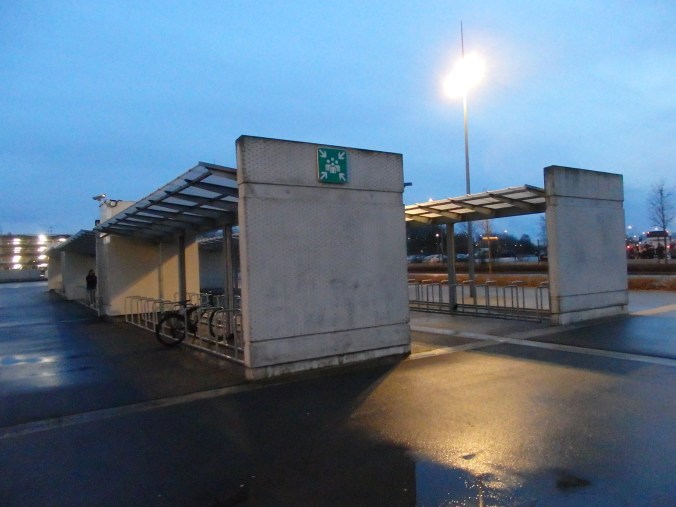
It’s northern France; Belgium with added je ne sais crois, but similar quantities of frites and beer. Low buildings face the stadium across the piazza, a parade of fast food outlets and bars. Further on the crowds diminish and we pass a large area set aside for cycle parking. Although the stadium is some way from central Lille, next to the motorway and has masses of covered car parking beneath and around it, the French planners were clearly optimistic for sustainable travel and there are two concrete canopied blocks of covered cycle racks in which I sadly count just two bikes and a bloke having a smoke.

OLYMPUS DIGITAL CAMERA

At gate M my wife chooses to go inside, get comfortable and watch the warm ups before the match, but I want to wander about a bit and so we part. I walk around to the ‘front’ of the stadium where it faces the road and the retail park opposite. There is a trailer here from which more chips are being dispensed, the queue of ‘diners’ snakes out of the descending darkness and into the bright light spilling out from above the deep fat fryers.

I walk on, following four members of the Police National, who bristle with shields and kevlar armour. A neon display advertises a future event at the stadium, a concert by the Pink Floyd pensioner, Roger Waters; its title ‘Us and Them’ will seem fateful by the end of the evening. At the ‘corner’ of the stadium is the club shop, red letters spelling out LOSC glow in the windows and fans walking past are silhouetted in its light. Inside the shop, the colour of the club shirt, red, is overwhelming; the colour red is everywhere it seems,

WW2 night-time bomber pilots could have spent time in here to improve their night vision. But to me there is more than a hint of the subcutaneous, of viscera; this is the sort of place to give a sensitive person like me nightmares. Feeling queasy I head back outside for the fresh air and then re-trace my steps back to gate M where after the customary patting down I pass through the automatic, bar-code operated turnstile, pick up my free programme and head for my seat. Re-united with Mrs Brooks I study the sixteen-page A5 size glossy programme, which contains just three advertisements not directly related to the club. The programme is small and necessarily concise and all the more excellent for that, with everything you need to know, which is really just the squads, the league table and details of the next match. If you crave extraneous information such as forward Anwar El Ghazi’s recipe for lentil soup then there is a fortnightly club paper available in the club shop, ‘LOSC in the City’, which is also free. As I read, a superannuated looking band perform live from the side of the pitch. I think they’re playing the Sex Pistol’s ‘Problems’ but Paulene tells me it’s Jumpin’ Jack Flash. I’m a bit disappointed to be honest and their rocked-up version of The Beatles’ ‘Come Together’ doesn’t please me either , but to my possible shame in these modern times, they’re next number, Hendrix’s Foxy Lady, makes me smile. My reading and musical reverie however, is disturbed by a large bang and some chanting from outside the ground; I had seen on the local TV station that there was to be demonstration by supporters before the game because of the poor performance of the team this season, and this must be it. I walk out to the back of the stand to witness through the mesh wall and some acrid smoke a couple of hundred fans following a bloke holding aloft a red flare; more firecrackers go off and there is some chanting. Excitement over, I return to my seat. Many of the other seats in the stadium are still unoccupied, particularly those on the Virage Est (East Stand) that the Lille Ultras occupy. It is soon evident however, that the ultras were the protestors as the Virage Est sees a torrent of flag waving humanity flood towards the back of the goal.

This slideshow requires JavaScript.

Meanwhile a female announcer gees up the crowd with some disco music and a dance-cam

OLYMPUS DIGITAL CAMERA

shows supporters boogeying insanely on the big screen above the Virage Est. People seem to be enjoying themselves at a football match which hasn’t even started yet. On the pitch everything is being set up for the grand entry of the teams. Ball boys in orange shirts are camped across the centre circle, the Ligue 1 logo is carried out and put into place along with the sponsor’s logo (Conforama – a furniture retailer) and the match ball is placed on a plinth.

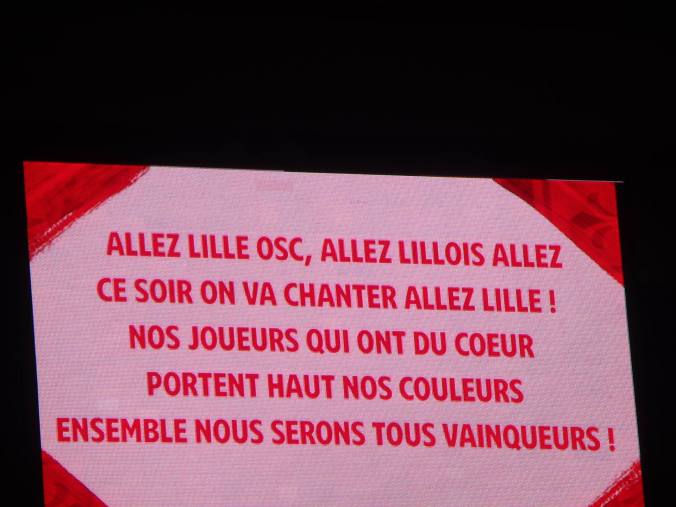
Banners featuring the club badges flank the ball and plinth and another banner displaying the Ligue 1 logo and then more banners are marched on to the field, these are red and bear the squad numbers and a photos of the players in tonight’s Lille team. As if all these banners aren’t enough a short film is played on the big screen which follows a journey around the city of Lille and shows images of LOSC players projected onto its most notable sites and buildings, culminating in all the players being projected on to the Stade Pierre Mauroy. It is a mightily impressive little film and conveys brilliantly the ideal of the club and the city and its people as one, I am not a little moved by all it all and wish for a day when I see something like it in Ipswich. We shouldn’t be leaving the EU, we should be saying can we forget about ‘being English’ and instead be French, or German, or Italian or even Belgian. The final act of the pre-match rituals is the singing of the club song, to the tune of Amazing Grace.

OLYMPUS DIGITAL CAMERA

The words appear on the giant screen and the singing hasn’t finished before referee Monsieur Sebastien Moreira, a stocky bald man, signals the start of the game. Montpellier in all white with pale orange shoulders have the first kick, in the direction of the Virage Est but it’s as if they are mesmerised by the club song, they pass the ball about and then as the song melts away immediately lose possession. That strange, musically accompanied start aside, it’s an exciting start to the game, with both teams dashing towards their opponent’s goal at every opportunity. Montpellier’s 19 year old Jonathan Ikone, a loanee from Paris St Germain, leads the charge and his team dominate the early possession, understandably believing that against the team second from bottom in the league, they are bound to score if they keep pressing. A Montpellier shot is soon saved by Mike Maignan, Lille’s goalkeeper. Montpellier are good to watch, they’re fast and direct even if most attacks break down before anyone has a shot. Lille burst forward when they can, particularly through Algerian Yassine Benzia who has the facial hair of a swarthy Mr Pickwick and his arms look unusually long; he is also the first player to be cautioned by referee Monsieur Moreira. Montpellier’s Ellyes Shkiri is injured and replaced by Saloman Sambia, but their forty year old Brazilian captain

OLYMPUS DIGITAL CAMERA

Vittorino Hilton

Vittorino Hilton, a veteran even six years ago when Montpellier won Ligue 1, plays on. Although the early excitement dies down a little as defences settle into their roles, the Ultras behind both goals never waver and give constant support, their beating drums being the beating heart and rhythm of the match. Each end sings their own songs, and then call to one another down the pitch. It sounds marvellous, even though the Ultras make up no more than five thousand in a crowd of 28,609 in a stadium that holds nearly twice that number . With less than five minutes until half-time, Yassine Benzia surges forward again for Lille, running at the centre of the Montpellier defence. Leaving two, then three Montpellierians in his wake Benzia pushes the ball forward into the path of Nicholas Pepe who is sprinting into the penalty area. Pepe takes a touch and then sweeps the ball past Benjamin Lecomte in the Montpellier goal. A fast, incisive if slightly unexpected goal. Pepe runs to the corner of the pitch and salutes no one in particular in the way that players like to do nowadays, but then he’s only a young lad of twenty-two. Half-time comes and two teams of boys, one in all white and one in all black, take to the field to participate in something called the Orange Football Challenge; it’s a shoot-out which at first is a non-event as none of the boys is capable of scoring , but eventually one team wins, I think. Both teams get their photo taken in the centre circle before another competition takes place in the far goal as three blokes try to hit the cross-bar with a single kick of the ball from 20 metres. The first contestant steps up and casually succeeds, winning 500 Euros in cash as a result. Predictably the next bloke doesn’t hit the cross-bar, although he’s not too far off, whilst the third slips over and shanks his shot along the grounds six metres wide of the goal. He may never be able to watch or participate in football ever again. As the players return to the field for the second half a camera man sets up in front of us to film people in the crowd who will then appear on the giant screen; as if being at the match isn’t enough you have to be able to see yourself and be seen at the match by other people at the match, although they have actually only come to watch the match; Jean Baudrillard might have something to say about it or may be Michel Foucault. Montpellier run at the Lille defence from the start, with chunky Jerome Roussillon attacking down the left and Paul Lasne down the right. It’s about twenty minutes past eight and Roussillon receives the ball some 20 metres or more from goal; he reacts instantly and dispatches a hard, low shot between the outstretched arm of Mike Maignan and the right hand post of the goal. Montpellier have a deserved equaliser, which their small knot of fans high up in the corner of the stadium

OLYMPUS DIGITAL CAMERA

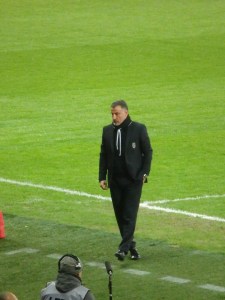
also deserve for having made the 972 kilometre road trip; it’s no wonder there aren’t many of them, but equally a wonder there are as many as there are. No one boos, despite the dire loss of a winning position and behind the goals the Ultras maintain their support. On the touchline the Montpellier coach Michel Der Zakarian looks thoughtful, stroking his chin in his skinny legged tracky bottoms and shapeless black coat. The Lille coach Christophe Galtier moves between his seat in the stand and the technical area, he wears shiny shoes and a dark suit; he steps out of the technical area and onto the pitch at one point when play has stopped for an injured player and is admonished by the fourth official. Galtier waves his arms about in frustration and as he turns to go back to his seat gestures at the official as if to say ‘fuck you’. My wife likes Christophe Galtier; he’s very French.

OLYMPUS DIGITAL CAMERA

There are three minutes added on time in which both sides press forward seeking the winning goal, but neither finds it. Monsieur Moreira blows the final whistle and almost instantly supporters from the Virage Est begin to run onto the pitch and towards the players tunnel and the seats where the directors and officials are sat. More and more supporters pour onto the field; one or two approach Lille players with a look of complaint. The referee and his assistants are the first down the tunnel. A large crowd has gathered but a cordon of stewards has quickly formed creating a semi-circle around the mouth of the tunnel. Whilst most of the people on the pitch are facing the main stand and chanting something like “ If the club goes down , then you go down” at the club officials, there are a few who are taking selfies with the handful of Montpellier players stranded on the pitch as they went over to applaud their supporters. Scenes like this always look uglier than they are and whilst there are a few kicks and scuffles as stewards feel the need to man-handle some people, the cordon of stewards around the tunnel has controlled the situation. For a football tourist like me local difficulties like this just add to the entertainment, but I do wonder what the point is of these demonstrations. The supporters didn’t complain when the new regime at the club installed previously well-respected Argentinian coach Marcelo Bielsa and backed him with an overhaul of the squad. Bielsa had been a fabled legend at Marseille but his short tenure at Lille was a disaster and he was first suspended and then sacked as the newly assembled team failed to perform with Lille slumping into the relegation places from early in the season. Watching people stood on the pitch not playing football is only entertaining for a short while and not wanting boredom to spoil what had been an entertaining evening we decide to head back to the Metro of Montag, Julie Christie and Alain.

This slideshow requires JavaScript.

Braintree Town 1 Truro City 1

It’s a mild and blowy Tuesday night in November and there’s a ‘top of the table clash’ just eight miles down the road from my house as Braintree Town play Truro City in the Vanarama National League South. It might not be far from my house, but Braintree is a bloody long way from Truro, 343 miles apparently and as far as any club has ever travelled to play a league match against Braintree Town. In awe of such a statistic I am inexorably drawn to witness the occasion.
I could get to Braintree by train, but I’d have to change at Witham and I don’t want to do that. So I take the easy option, which is to drive. Parking up near the end of Clockhouse Way at about ten past seven, the streets are quiet, with no one heading for the match,

OLYMPUS DIGITAL CAMERA

drawn by the eerie glow of the floodlights through the now mostly skeletal boughs of the trees. L S Lowry would never have made much of his painting ‘Going to the match’ if he’d lived and painted in Braintree. Entering the car park of the Ironmongery Direct Stadium (formerly and more prosaically known as Cressing Road) I stop to snap a photo for this blog. “How many pictures of grounds have you got then?” asks a man heading for the turnstile. He thinks I’m a ground hopper. I am a bit embarrassed, but say “Oooh, not many, a couple of hundred”.
The admission price this season at Braintree has very sportingly been reduced from £16 to £14 following relegation and similarly the programme is 50p cheaper too, although it’s no longer glossy, I like it all the more for that. I enter the stadium to the strains of Amen Corner: “If paradise is half as nice as being here with you…” which makes me feel wanted. Sadly the welcoming choice of music does not last until kick-off as the two teams enter the field to Emerson Lake & Palmer’s “Fanfare for the common man”. I say Emerson, Lake & Palmer’s; but it was only their arrangement of a piece written by American composer Aaron Copland, which your common man might possibly not know. It’s no less appropriate for work-a-day Braintree but it’s a bit naff too. But there’s nothing very exotic about the Vanarama National League South,

OLYMPUS DIGITAL CAMERA

as its name perhaps suggests; like a lot of non-league football it is the haunt of builders and ‘White Van Man’, which is possibly why Vanarama, purveyors of commercial vehicles, thought it worth their while to sponsor it.
I take up a position at the end of the low metal roofed terrace on the east side of the ground, known as The Shed. Three Truro fans are attaching flags to the back wall of the stand, one of which refers to Truro being the Tin Men.

There is a larger group of Truro fans stood behind the goal at the end of the ground that the teams appeared from; they have a big Cornish flag. Truro City kick-off the game towards those supporters, wearing all blue, whilst Braintree make it a colourful spectacle by wearing all orange. The three Truro fans immediately make one helluva racket repeating “Truro, Truro, Truro” over and over and over again to the tune of Amazing Grace. A larger bunch of Braintree fans stood just a few yards away look on slightly bemused or perhaps impressed; eventually they respond with some chants of “Iron, Iron, Iron” , but not any old iron, the Iron that is Braintree Town’s nickname. They soon give up in the face of Truro’s Amazing Grace however, which eventually ends abruptly with a little cough. The Truro fans then start to sing ”Come on Truro, come on Truro” to the tune of Auld Lang Syne which is predictably answered with “Fuck off Truro, fuck off Truro” to the same tune; the concept of terrace wit is grossly exaggerated.
Meanwhile, jet airliners from Stanstead soar overhead, the noise of their engines blotted out by three blokes from Cornwall under an echoing tin roof. On the pitch, Braintree look sharp from the start with their diminutive number seven darting about on the wing just in front of me and the Cornishmen. Both teams seem to be made up of three or four enormous blokes; at least two at the back and one up front. The remainder of the team look tiny by comparison, it’s as if the Vanarama National League South imposes some sort of combined height quota on its teams; the aggregate height of the team not being allowed to exceed the length of seven Transit vans placed end to end. Truro’s number four is possibly the most enormous man on the pitch, he sports a beard and although he is absolutely massive he doesn’t really deserve the ‘fat bastard’ epithet the Braintree supporters inevitably award him.
The three Cornishmen embark on an acapello rendition of “Come On Truro” in what is rapidly becoming an evening of K-tel’s greatest hits from the terraces . The Truro supporters behind the goal break into a rare song and the vocal threesome sing “We forgot that you were here” to Bread of Heaven. Intrigued by this I ask one of the Cornishmen why they aren’t they with the others behind the goal. He tells me it’s because they wanted to be under the roof. I ask if there isn’t some split between Truro supporters, “Don’t ask” he says, so I don’t. One of their flags is for the Truro City Independent Supporters Club so I just speculate that may be there is some sort of great Cornish schism much like the one that afflicted the Christian Church in the middle of the eleventh century. (1054).
Meanwhile it’s not a bad match, the blend of big blokes and smaller ones is an even one and the teams are well matched, but to the extent that the ball is rarely in danger of hitting either goal net. I am conscious that a man in a hi-vis jacket has been stood next to me for several seconds and I turn slightly to my right to face him. He’s a steward, and it’s as if he’s been waiting for me to acknowledge him, “Could you stand behind there please sir” he says, gesturing towards the chunky orange crush barrier. “Okay” I say cheerily, not wishing to cause a scene, although I had been quite happy where I was. The Beatles “Hey Jude” is now the vehicle for the latest chants of “Truro” whilst Braintree supporters weirdly and somewhat mournfully appropriate “Sloop John B” to chant “We know who we are, We know who we are, There’s one team in Essex, We know who we are”.
It’s about twenty past eight and suddenly the Braintree Town defence mysteriously melts away allowing Truro’s number ten Cody Cooke to run through and score a goal. The Truro fans are very pleased and inevitably have a song to celebrate the occasion as they tell us “ Cody Cooke is one of us, he loves Truro” although I thought it sounded like he loves Jesus, which of course he might. Half-past eight arrives and brings with it half-time and I move to the terrace by the players tunnel.

OLYMPUS DIGITAL CAMERA

The tannoy treats us to a rarely heard hit from 1970, Blackfoot Sue’s “Standing In The Road”; tonight at Cressing Road is proving to be a musical wonderland.
The second half begins and Braintree quickly hit their first decent shot on target and then they score as Roman Michael-Purcell easily turns in a cross from Phil Roberts who had made an exciting run forward. Restless as I am I am now sat in the box like main stand. Behind me a man who probably has a mental illness provides an occasional commentary announcing players names and incidents. His voice reminds me a little of the late John Arlot; he has a slight burr which lengthens the players’ names. He seems to have a love for the sounds of the names and is familiar with them all; he repeats some of them often such as Marcel Barrington and Christian Frimpong, who he calls Ping Pong. His ‘commentary’ is in in the style of John Motson as he announces substitutions for both teams but then Truro’s Andrew Neal flattens Frimpong in full flight. “Refereee, refereeee!” our commentator calls and then adds “Fucking cunt” . Then, to close this episode he says “Yellow card, Andrew Neal, the cheeky little fellow”.
The wind is getting stronger and swirls of willow leaves spiral down in front of the stand onto the edge of the pitch. More substitutions are announced behind me as is the fact that Matt Baxter does not come off the bench for Braintree, “ Not Matt Baxter, not Matt Baxter” is the refrain. The game remains tight and interesting as both teams play to win but don’t really come that close to getting a second goal. Truro substitute Tyler Harvey likes to run at the Braintree defence and creates a couple of half-chances and with his long tied back hair he looks like he might be found surfing on Newquay beach when not turning out on a Tuesday night for Truro City. I like to think there is a VW campervan somewhere in the club car park.
The match draws to a close with both sides going for goal unsuccessfully. It was tight at the top of the Vanarama National League South table when this game began and now when it ends at a bit after half past nine, it still is; a point for each team alters nothing. The home crowd are perhaps more disappointed not to have won than the travellers from Cornwall who have at least had a road trip and a jolly sing-song; and me, I’ve had a lovely time.