Ipswich Town 4 Preston North End 2

I first saw Preston North End, or “P’nee” as my wife Paulene likes to call them, back in April 1986, shortly before a part of my world fell down and Ipswich Town were relegated from what is now the Premier League for the first time since before I started school, but a while after the Lady Chatterly ban and the Beatles first LP.   The Preston North End I saw back then were rivals of Colchester United, but not equals, the U’s thrashed them by four goals to nil. Since then, I have seen nineteen matches featuring the once but no longer invincible Preston North End, first ever Premier League champions in 1888 and double winners to boot, but of those nineteen games they’ve only won two.  As an Ipswich Town fan, it is with an optimistic frame of mind therefore, that having bade farewell to Paulene and kissed her goodbye, I step out of my front door and head for my local railway station and the afternoon of delights that await me in that not far off Ipswich.  It is warm, but I carry a light coat because when I sat in the shade in my garden this morning drinking a coffee I thought I detected a cool breeze. ­­­

The railway station is busy with would be travellers, the majority wearing Ipswich Town branded shirts, although three young women drenched in perfume and stood at the foot of the bridge are surely displaying far too much cleavage and sparkly bare flesh to be going to the match.  The train arrives on time, and I find a pair of seats next to a window on the sunny side of the carriage.  The carriage is a noisy place full of chatter and people watching videos on mobile phones. At the first stop the three young women alight and a man boards, he sports a tattoo of a diamond on his neck, he has the demeanour of someone who is probably a ‘diamond geezer’.  He nods furtively at a pair of vacant seats and says to a friend that they could sit there, but he’s got to go to the loo first; they both walk on and never return.  The display above the gangway tells me that the carriage doesn’t contain a toilet, but I can still smell one.

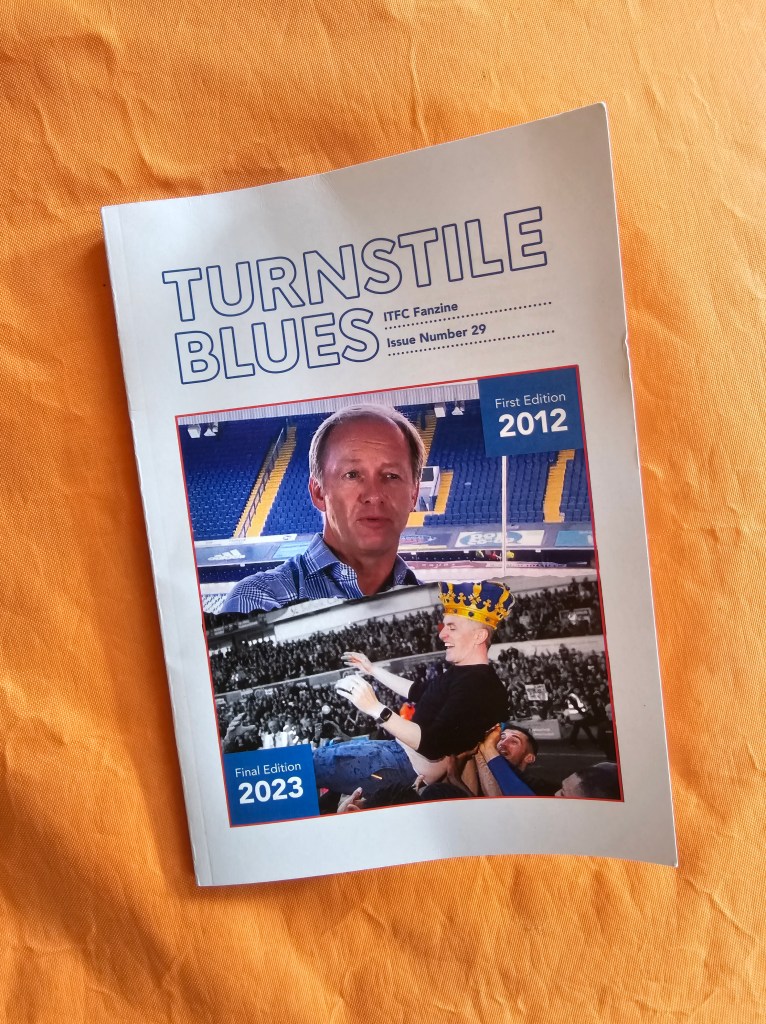
Arriving in Ipswich, I quickly cross the tracks and leave the railway station, pausing only to find my e-ticket on my mobile phone, which I flash at the ticket collector.  I head on to Portman Road. This morning, I found some coins in my bedside table and had thought to use them to buy a programme, but as I queue at one of the blue programme booths from which I think the club should also serve ice creams, I learn that even these no longer take cash.  I could pay by card, but that hadn’t been my plan, so I don’t bother and walk on.  Fate, however, is a curious thing and on the corner of Portman Road and Sir Alf Ramsey an Ipswich Borough councillor and former fanzine editor is selling copies of what is billed as the last edition of the Turnstile Blue fanzine.   “For old times sake” I say as I hand over one of my pound coins to him before continuing on to ‘The Arb’, where the doors are wide open and naturally, I walk in.
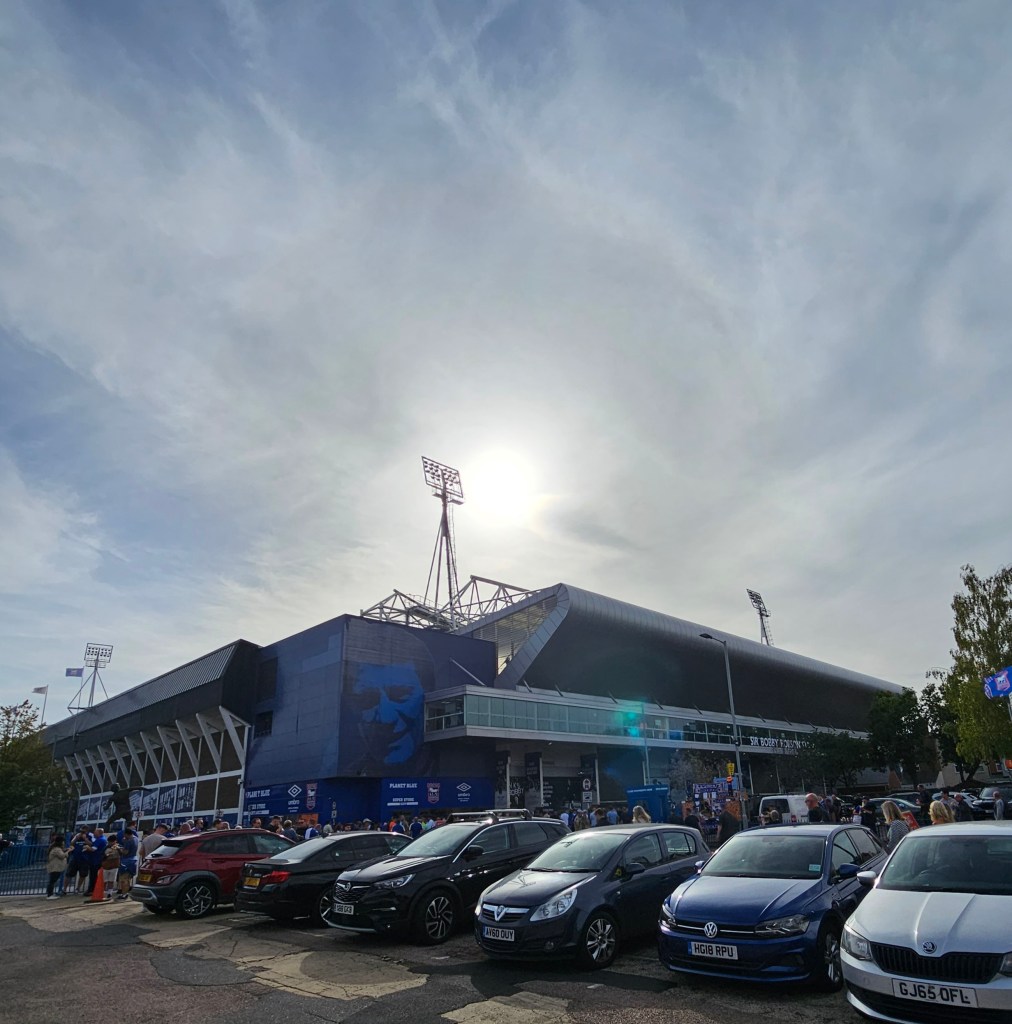
 Having purchased a pint of Mauldon’s Suffolk Pride (£3.60 with 10% Camra discount), I make for the beer garden and share a table with a young man and a woman having first asked if it is okay to do so, it is.  At the next table a man talks a lot and wears an Ipswich Town polo shirt featuring the Powergen logo, a reminder perhaps of the many Town fans now returning to Portman Road after twenty odd years of absence. Today, I am drinking alone because having contacted Mick he called me back to say that he was meeting a friend from London whom he hadn’t seen in a while. I understand, and pass my time reading Turnstile Blue, Ipswich’s most earnest fanzine, which today contains a particularly amusing piece about vloggers and an excellent article about Scott Duncan, the last manager Ipswich Town ‘poached’ from Manchester United before Kieran McKenna.  Sadly, as the last issue it is perhaps one of the best.  The Suffolk Pride is particularly good today and I am soon forced to buy another, and I ask the young man and woman at my table to keep an eye on my coat, fanzine and glasses whilst I’m at the bar.  Upon my return, with a fresh pint in my hand, I am happy to see my possessions where I left them. “I see my stuff’s still here, thanks” I say to the man and woman. “Yeah, a couple of people tried to get it, but I kept them off” says the man, pleasingly getting the joke.

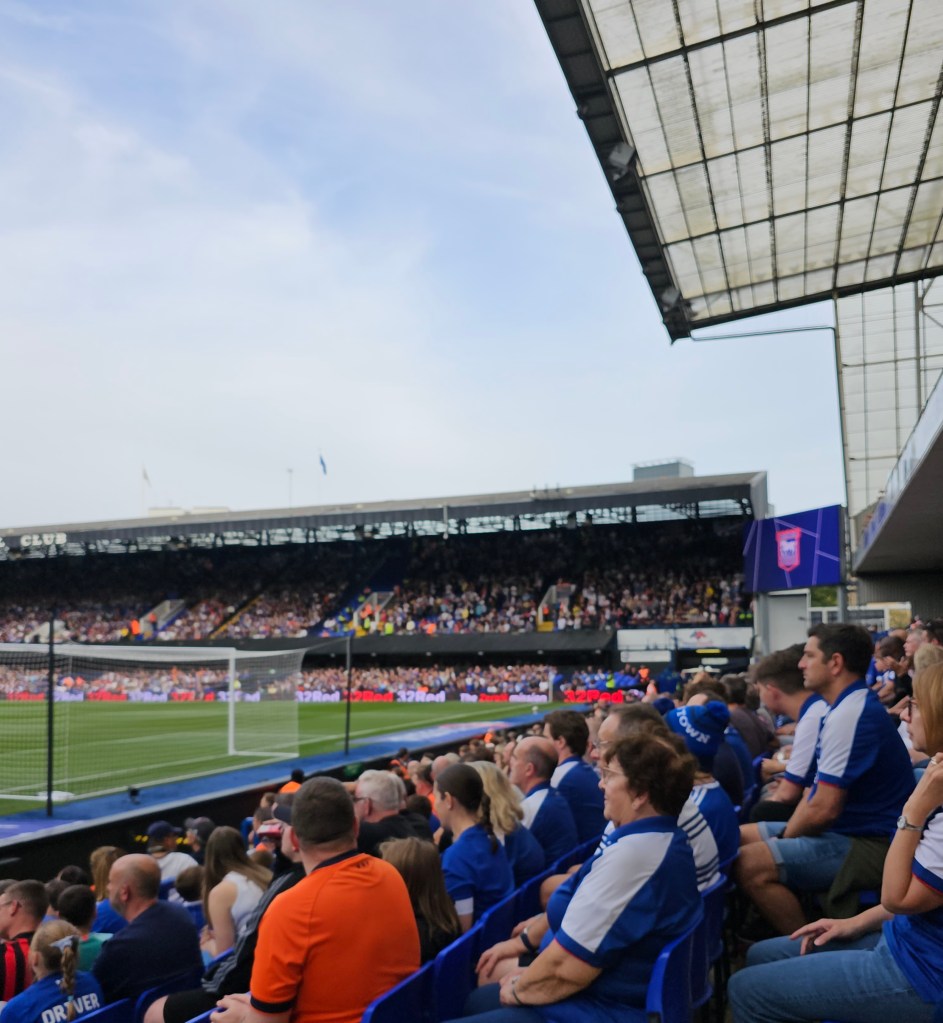
At about twenty to three I depart for Portman Road moments after the last of my fellow drinkingTown fans, who I then overtake outside the museum.  There are queues in Portman Road and behind the Sir Alf Ramsey Stand with less than ten minutes to go until kick-off, an indication that the electronic entry system is still much slower than the old human being based one. I join the comparatively short queue for turnstile 62 behind former BBC Radio Suffolk presenter and usurped stadium announcer Stephen Foster.  Inside the stand, after a quick stop to drain off superfluous Suffolk Pride, I make it to my seat as the teams appear in the corner of the pitch. Ever-present Phil who never misses a game, his young son Elwood, Pat from Clacton, Fiona and the man from Stowmarket who is probably actually from Stowupland, are all here already as I would expect. Pat from Clacton kindly tells me that they’ve missed me whilst I’ve been away in France.  I join ever-present Phil in shouting out the Town players’ surnames as the stadium announcer reads them out.  Phil will reveal to me at half time that he had had a word with today’s announcer, who is standing in for the usual Murphy who is indisposed, to tell him not to run the players first names into their surnames; I think he has taken heed.

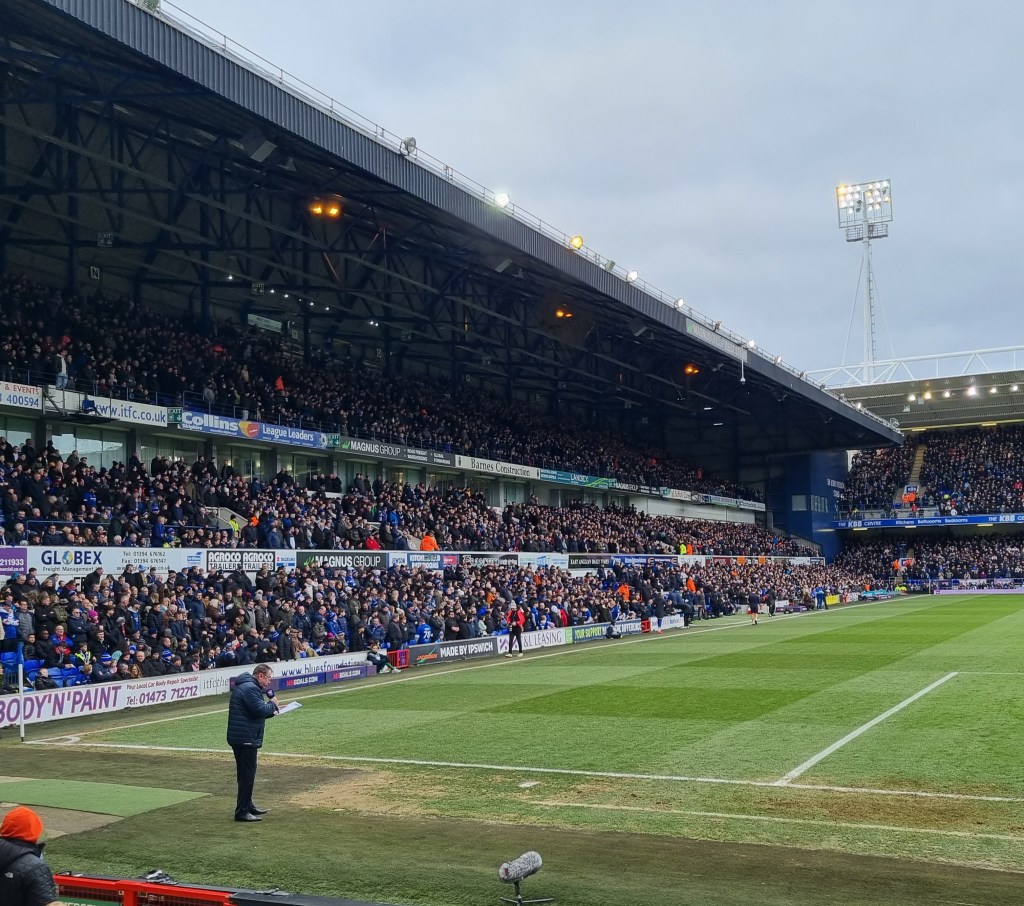
It is Ipswich who get first go with the ball which they mostly send in the direction of the goal in front of the Sir Bobby Robson stand; they wear the traditional blue and white.  Preston sport a kit which some might describe as an insipid all pale yellow, with a navy blue oblong below their navels, but I prefer to think of it as being primrose in colour.  The game begins at pace with lots of industrious running about from both teams and slick passing of the ball.  Town’s Brandon Williams is soon clattered by a Preston player and then before the referee gets a chance to blow his whistle he is clattered again; Williams is simply moving too quickly for anyone to keep up with him. “You dirty northern bastards” sing the Sir Bobby Robson stand and I join in, thinking how much I dislike short vowels, soot, mushy peas and talk of ginnels and Northern powerhouses.

Pat tells me she’s going to miss the next two games.  I quickly ask if that’s because she’ll be on her annual whist playing holiday in Great Yarmouth.  But no, she tells me, she’s going to Mauritius. “To play whist?” I ask, but no she’s going to her niece’s wedding.  Along with Fiona we agree it’s a long way to go to get married, or to play whist.  I tell them I just had a day off work when I got married.  Eleven minutes have gone and Wes Burns has a shot blocked almost as soon as it leaves his boot.  “Yellows, Yellows” chant the P’nee fans, unable to admit they’re actually playing in primrose, which considering their club’s nickname is “The Lilywhites” is a little surprising.

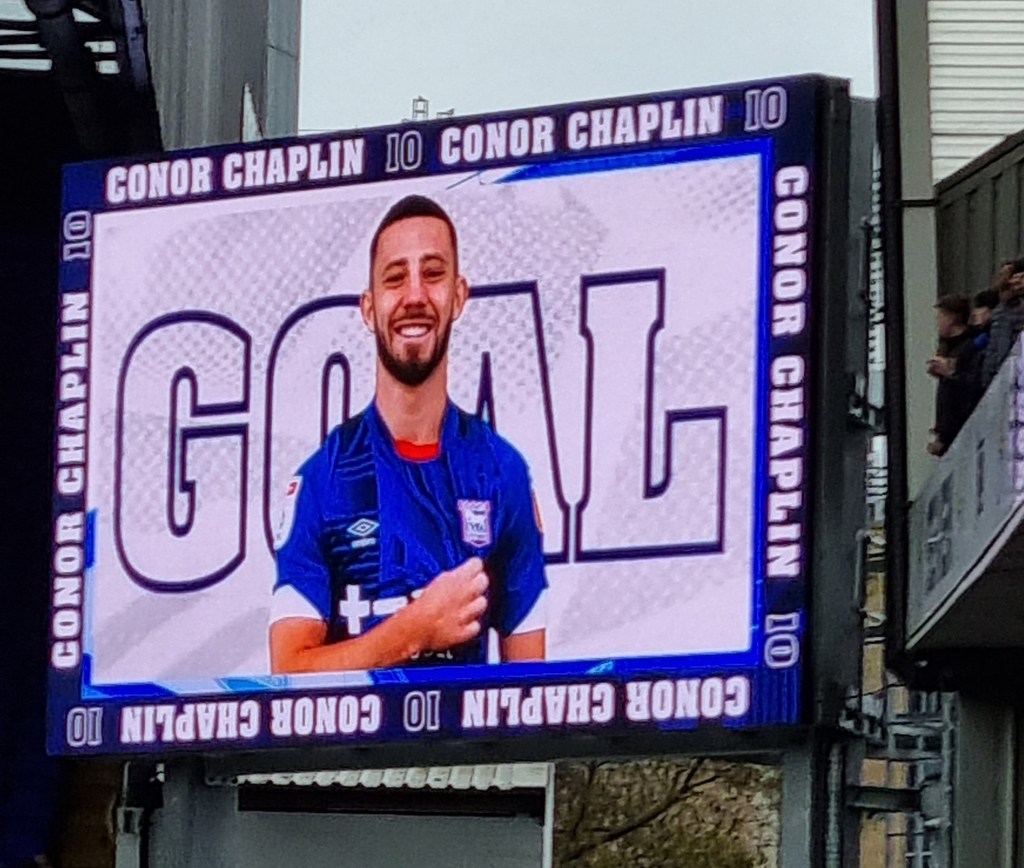
Town are dominating possession, but Preston are keeping us at bay. “Set up defensively well” says the bloke behind me sounding oddly serious considering the order in which he has placed the words in his sentence.  The seventeenth minute, Town have a corner, Leif Davis takes it. He strikes the ball low. “What?” I’m about to say, thinking that’s not a very good corner, when Conor Chaplin half volleys the ball just inside the post from about 12metres out, and Town lead 1-0, it’s a cracking goal.  “We’ve got super Kieran McKenna, he knows exactly what we need” chants pretty much everyone, in my imagination anyway.  The Preston fans sing something too, and are in good voice, but I can’t understand their accents.  The woman sat between me and the man from Stowmarket wears a Town shirt but is very quiet, and didn’t leap up excitedly when we scored.

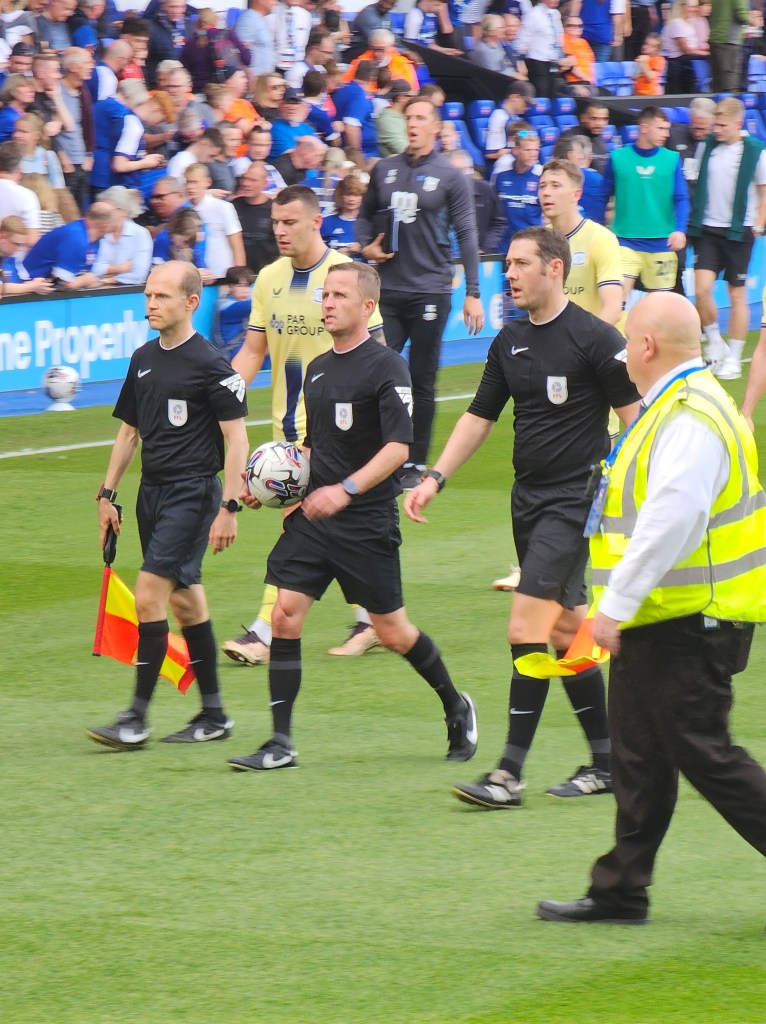
Nearly half of the half has disappeared forever, except on recorded highlights. Nathan Broadhead narrowly misses the goal with an audacious lob from long distance and Brandon Williams surges off down the touchline only to be clattered again spectacularly, and the perpetrator is booked by referee Mr David Webb. A drinks break and an early substitution for P’nee follow and then an up and under drops nastily outside the Town penalty area,  the ball studiously avoids Ipswich feet but presents itself  to Mads Frojaer-Jensen who un-sportingly boots it into the Ipswich goal and Preston have as many goals as the Town do.

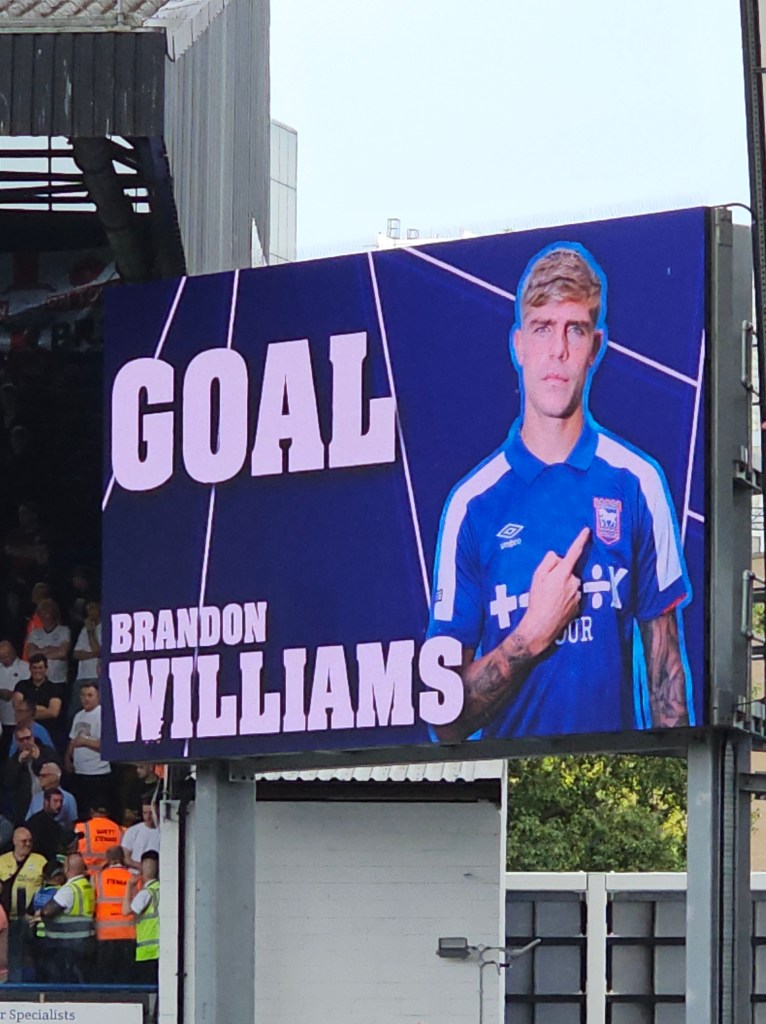
It proves to be a set-back for Town, but that’s all.  Two minutes later we think we have scored but we haven’t and shortly after that Mr Webb books a third Preston player, but Nathan Broadhead sends the resultant free-kick shamefully high and wide.  Town are sure to score sooner or later and with ten minutes until half-time Brandon Williams wins the ball off a Preston player, stands up straight and just runs from within the Town half at the Preston goal; he’s a marvellous sight as he charges away with his socks not reaching half way up his calves and his arms punching the air; he reaches the edge of the Preston penalty area and sends the ball towards the far post where it bounces off and into the goal and Town’s lead is restored.  It’s a fabulous goal.

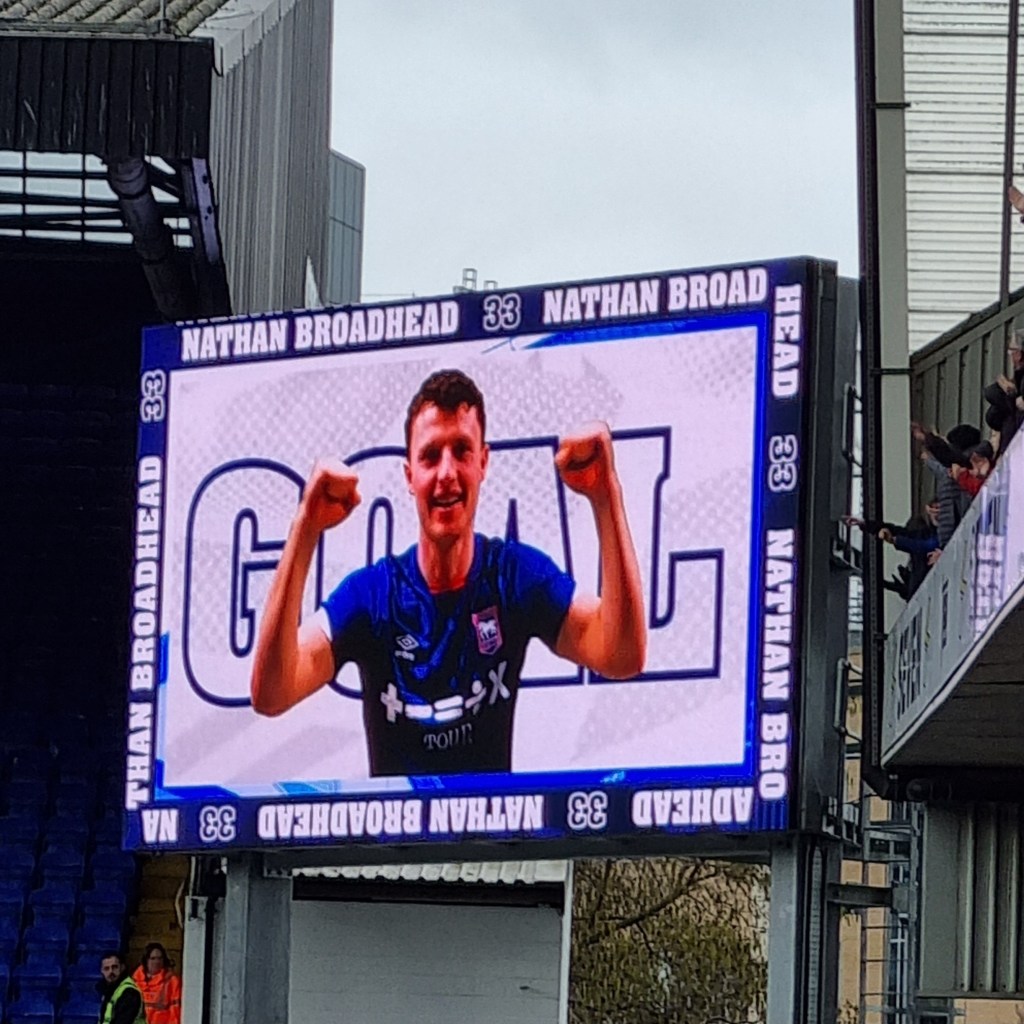
Preston seek parity again and Osmajic shoots wide following a confusingly unorthodox free-kick routine, and Mr Webb inspires the home crowd to chant “You don’t know what you’re doing” as Conor Chaplin is penalised for falling backwards. Five minutes of added on time follow and Town win a corner which is cleared only for the ball to be crossed back to the far post, headed across the goal and then headed back again by a selfless George Hirst for Nathan Broadhead to knock over the goal line from minimal range.  It’s another fine goal, and following the still recent disappointment of the Preston goal,  it brings a certain sense of relief that Town are now two goals ahead.  The Sir Bobby Robson stand sing a Depeche Mode song from forty-two years ago and that tuneless chant about being on our way to the Premier League and not knowing how we’re going to get there; the woman next to me remains seated and just claps one hand against a knee, hers, not mine.  I turn to her and trying to convey incredulous curiosity say “You’re very calm”; she just smiles demurely.  Perhaps she doesn’t speak English or can’t understand my accent.

With the half-time whistle I decant more Suffolk Pride, speak with a steward with whom I used to work called Dave, and then visit Harrison down at the front of the stand, although his grandfather Ray is sat elsewhere today. Harrison asks how was the Robyn Hitchcock concert at St Stephen’s Church three weeks ago, and I tell him it was brilliant, because it was.  I return to my seat in time to see the names of people on the scoreboard who are attending their first game at Portman Road today; one of whom is called Huckleberry, and I think of the blue cartoon dog from the early 1960’s who Wikipedia tells us was the first TV animation to win an Emmy. 
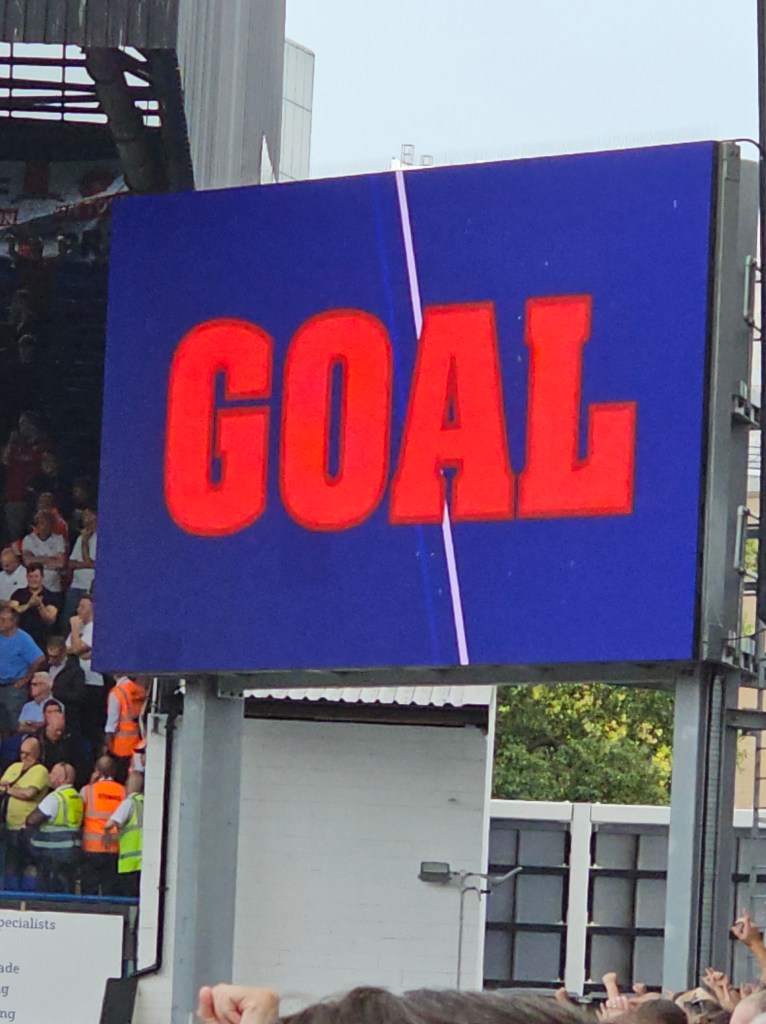
The match resumes at eight minutes past four and the blokes behind me are late returning from the bar.  Preston are sharper this half, and are keeping the ball most of the time, it’s as if the Town players had mistakenly thought having a nap at half time would be a good idea and they haven’t properly woken up.  Preston win a free-kick, the ball is only half cleared and Benjamin Whiteman strikes the ball in off the far post for a second Preston goal, and all while I’d been hoping for a fourth Town goal.  “Making it a bit more exciting though, innit” says the bloke behind me before carrying on to say  “Them scoring might not be a bad thing… well it is… but it ain’t”.  Fiona and I exchange glances and smirk. “Yeah but, no but” I think to myself.

Preston continue to have the better of the half but whilst neat and methodical lack the vision, flair and inspiration of Ipswich, so they don’t score again.  Nevertheless, Kieran McKenna presumably thinks change is required and the attacking trio of Chaplin, Burns and Broadhead take a rest in favour of Harness, Jackson and Hutchinson, but not necessarily in that order.  The crowd is quieter than it has been all game and it feels like may be we’ll just have to see this one out.  Today’s attendance is announced as being 29,018 with 826 of that number being sat up the corner in the Cobbold stand supporting the away team, which is a respectable number because it’s a mighty long way down a dusty trail from Preston. People applaud themselves for their existence here this afternoon.

The game continues without reaching the heights of the first half and with fiteen minutes of normal time remaining, final substitutions are made by Kieran McKenna, with George Hirst and Massimo Luongo retiring in favour of Freddie Ladapo and Jack Taylor. Three minutes later the game is won as Jack Taylor breaks forward on the left, feeds the ball to Omari Hutchinson and he squares it to a lonely Kayden Jackson who quickly gains over 28,000 friends as he strokes the ball into the Preston goal beyond the despairing, purple clad Freddie Woodman.  Everyone is up on their feet with the exception of the woman sat next to me who slaps her knee gently as if tapping along to a popular song by the likes of Petula Clark or Ed Sheeran.  “I-pswich Town, I-pswich Town FC, They’re by far the greatest team the world has ever seen” sing lots of other people.

Time closes in on the final whistle and Town’s victory seems assured.  “You’ve seen the Ipswich, now fuck off home” chant the Sir Bobby Robson stand unpleasantly and uncharitably in an outbreak of nastiness reminiscent of Suella Braverman.  But still Town come close to a fifth goal as a Jack Taylor shot is parried away by Woodman who also saves a Freddie Ladapo attempt.  Preston have a shot too; “Fucking donkey” says the bloke behind me as Preston’s Ben Woodburn shoots impressively wide.  It’s time to celebrate another win “Brandon Williams, he’s a Blue, He hates Norwich” sing the Sir Bobby Robson stand exultantly.  Four minutes of added on time are added on, and the game ends. Ipswich win again.

If I kept a diary I would record another Saturday afternoon well spent, drinking good beer and watching excellent football beneath warm October skies in which the sun now sits so low that I need autumn sunglasses, my only grouse perhaps would be that I didn’t need that light coat after all.

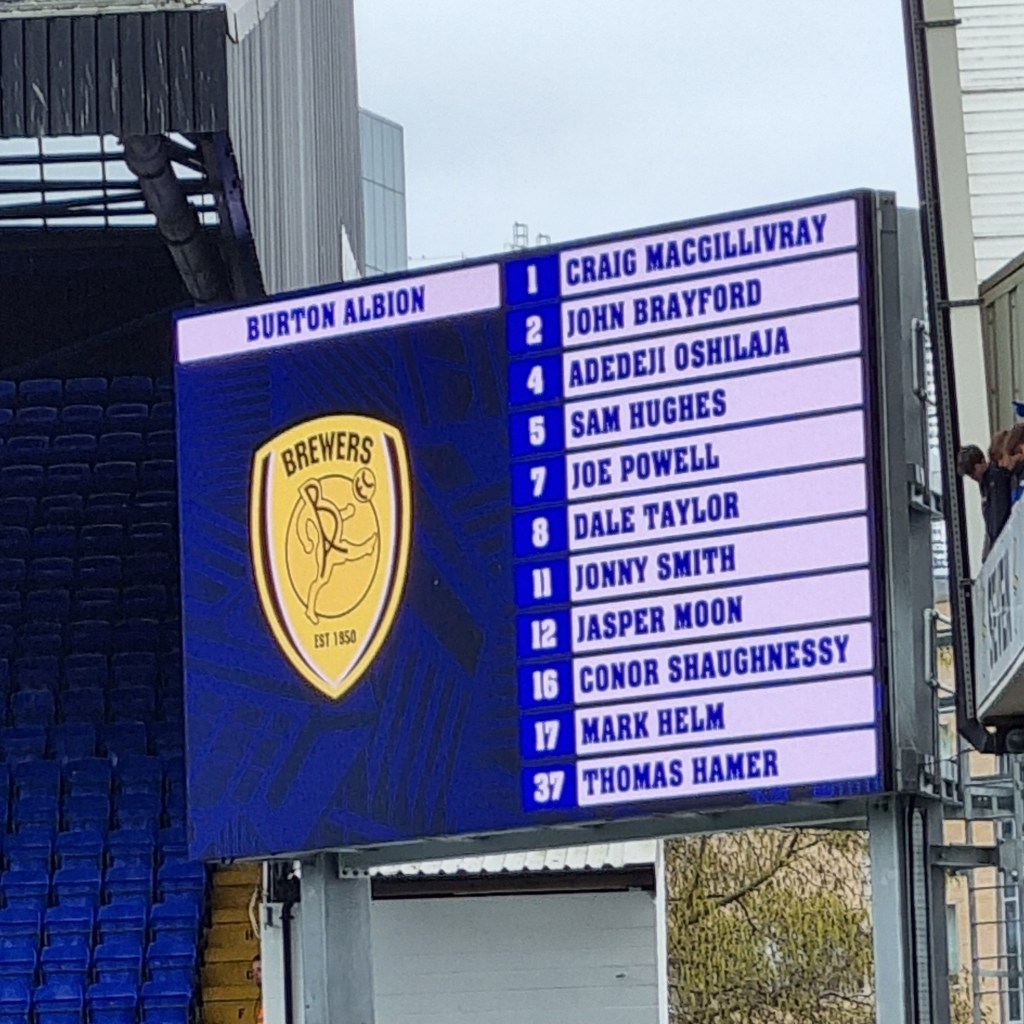
Ipswich Town 4 Burton Albion 0

Another Saturday, another football match at the end of another week, another few hours from which to extract fleeting pleasure, one hopes.  That is the nature of life, it’s what makes it bearable unless of course you are lucky enough to be constantly in awe and wonder of everything around you and struggle not to stand with mouth agape at the multitude of different arrangements of atoms and molecules before us and of which we are of course just a tiny part.  All this, and football too.

The vanquishing of Burton Albion is the source of today’s hopeful pleasure for many; it’s a fixture that reminds us of life’s elixir, beer.  Historically, Burton-On-Trent was Britain’s beer brewing capital and it would be nice to think that in the same way that Grimsby Town once made gifts of boxes of fish to their opponents, so Burton Albion donate crates of beer to the needy wherever they go.  Perhaps in the past, when Burton was the epicentre of responsible drinking they did, it would perhaps help to explain the demise of Burton Albion’s predecessors Burton Swifts and Burton United.  Burton Swifts were members of the inaugural Football League Division Two back in 1892 when Ipswich Town were still mucking about playing nothing but friendlies when not getting knocked out of the Suffolk Senior Cup and the FA Cup respectively by the public schoolboys of Framlingham College and Old Westminsters.  The beautifully named Swifts lasted until 1901, when due to failing finances they merged with Burton Wanderers to become the boringly but accurately named Burton United. The new club lasted in the Football League until 1907 when they finished bottom of the table and were voted out. It would take well over a century for Burton Albion to get the town back into the Football League, although they didn’t start trying until 1950.

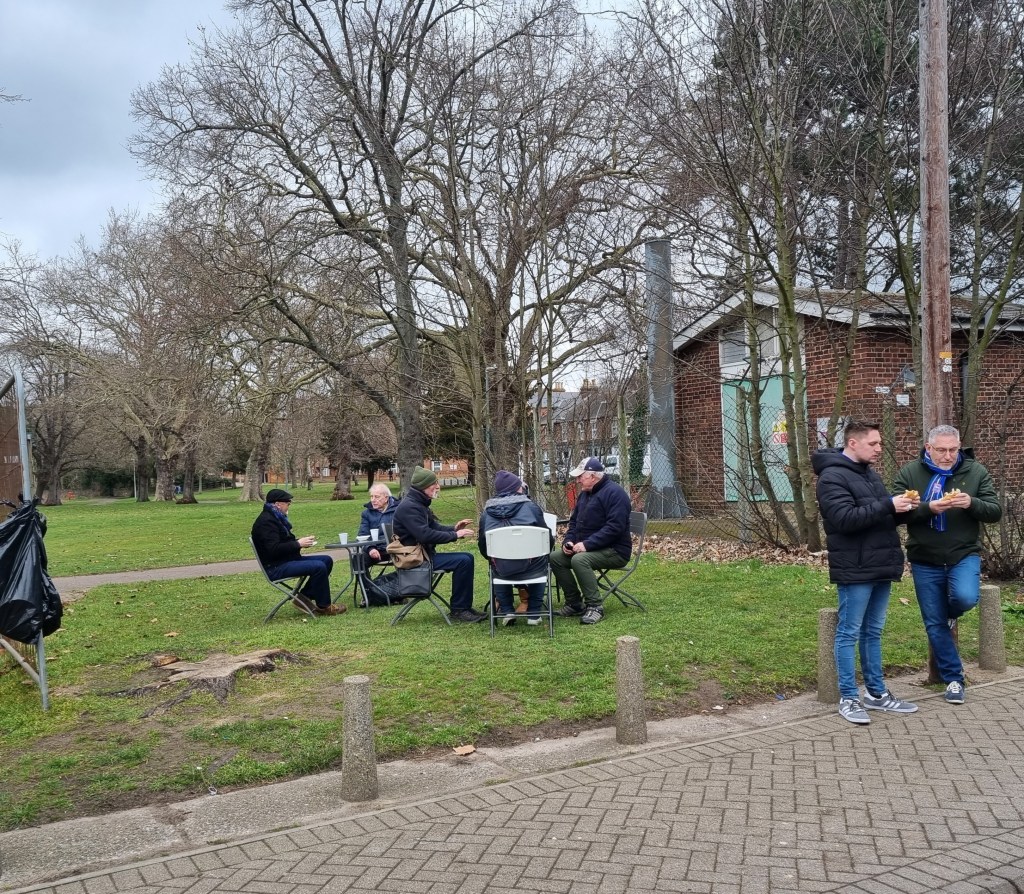
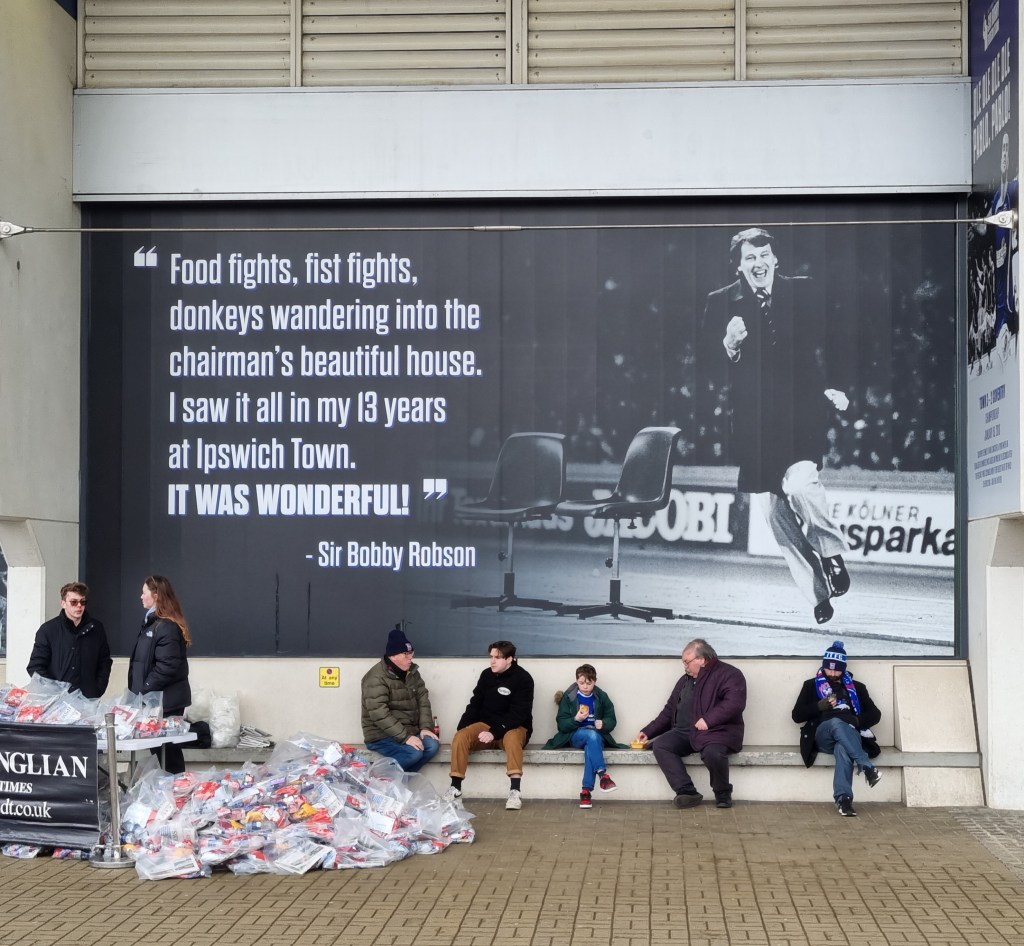
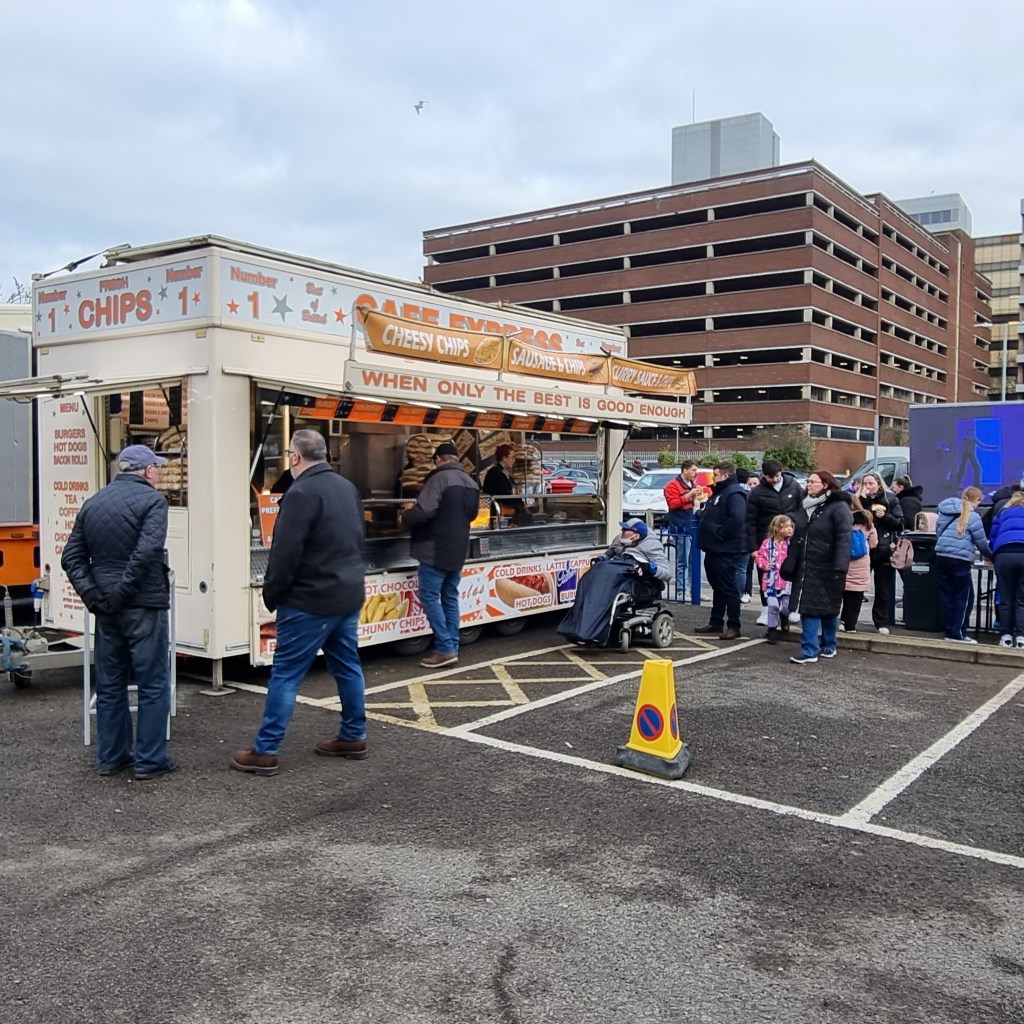
My mind teeming with thoughts of football history, the nature of existence and beer, I park up my planet saving Citroen e-C4 and step out across Gippeswyk Park towards Portman Road football ground.  The streets around the ground are quieter than they have been before recent games, but there are still people sitting out in the cold enjoying grilled meat products and leaning on Sir Alf Ramsey’s plinth to eat chips. I stop at one of the blue booths where I dream of one day of buying an ice cream as well as a programme.  Today, I must make do with just the programme (£3.50), which I pay for in the modern cashless way.  I carry on to ‘the Arb’ past the spiral car park, which I would like to see become one of Ipswich’s many listed buildings.  On the steps nearby I overtake a man and a woman who possess two of the largest heads of hair I ever seen in Ipswich; the style is hippie rather than beehive, although either makes a good match with the 1960’s car park. 

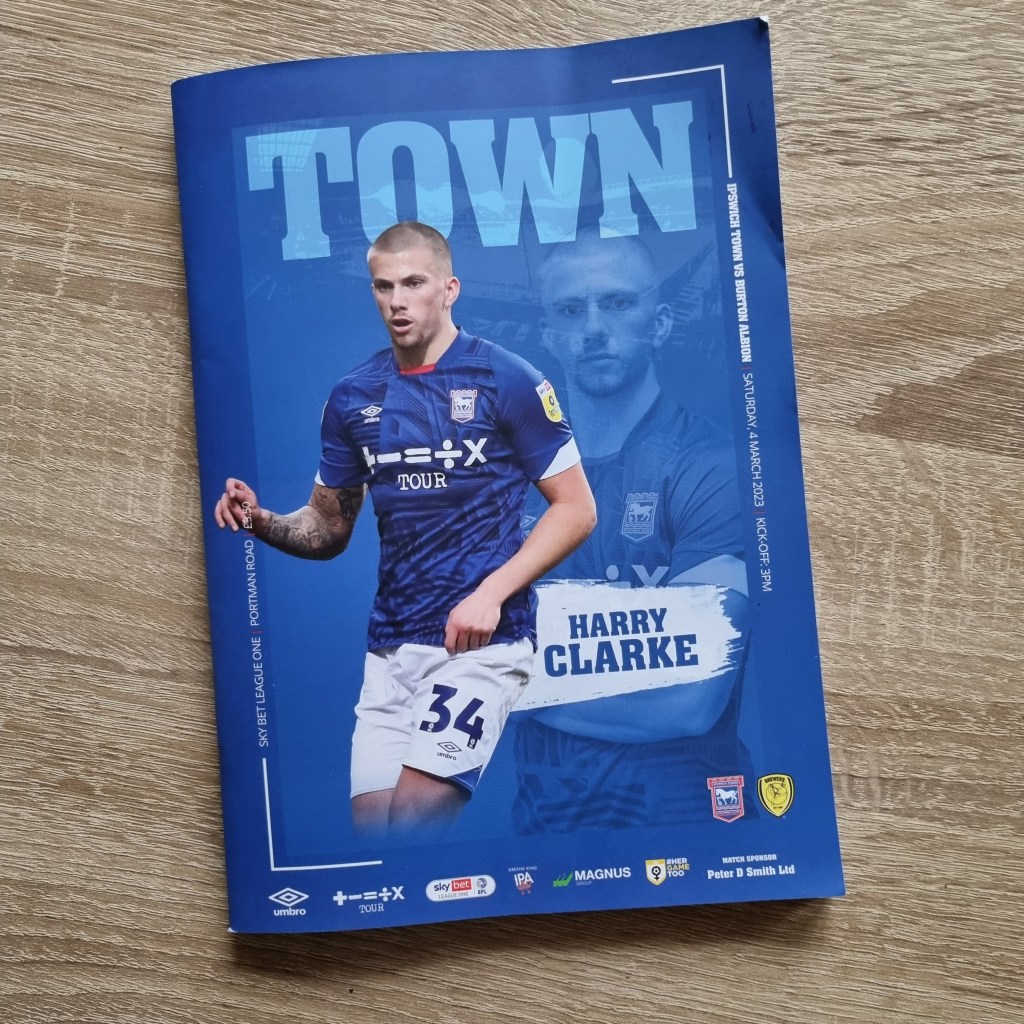
At ‘the Arb’ I invest in a pint of Lacon’s Encore (£3.59 with 10% Camra discount), but only because the Mauldon’s Suffolk Pride has reached the end of the barrel.  I retire to the beer garden and sit in the shelter between a man reading a book whilst eating from a piece of slate, and a family of three.  I sip my beer and read the programme, intrigued that Lincoln City have only lost seven games  but are fourteenth in the table. I begin to read a five page interview with Harry Clarke, but to my shame lose interest at the end of page three; in my defence however, I have read “Remembrance of Things Past” by Marcel Proust.  Mick rescues me from the pages of the programme and after collecting a pint from a new barrel of Suffolk Pride, he joins me.  Barely has our conversation got on to the usual subject of death before Gary unexpectedly arrives carrying a pint of lager.  We continue to talk of death, sciatica, terminal illness, TV programmes we always watch (I always record Sgorio on S4C), and a friend of Mick’s who has a lifelong collection of football and speedway programmes, which he keeps in a shed.  When his friend dies, says Mick, he expects his wife will just throw them all away.  None of us consider that his wife might die first.  Filled with bonhomie by the joy of pre-match conversation, I return to the bar to buy a half of Lager 43 for Gary, a single blended whisky for Mick and a pint of Suffolk Pride for myself; I casually pay for the drinks having no idea of the cost. 

At some time around twenty to three we depart for the ground, going our separate ways in what used to be Portman Walk.  The portentous turnstile 62 sees me safely into the ground and once in the stand I edge past Pat from Clacton and Fiona to my seat next but one to the man from Stowmarket and a couple of rows behind ever-present Phil who never misses a game, although his young son Elwood isn’t here today.   As former BBC Radio Suffolk presenter Stephen Foster reads out the Town team, Phil and I shout out their surnames like a French football crowd would and hope everyone else will join in, but they don’t.  Phil remains optimistic that everyone will have ‘got with the programme’ by the time of the play-off final at Wembley.

After some boisterous “Na-na-nas” and re-wording of The Beatles ‘Hey Jude,’ the game begins, and Town get first go with the ball , heading for the goal at the far end of the ground from me and my band of crazy Ultras.  Town are as ever wearing blue shirts and white shorts, but sadly Burton have decided to forego their proper kit of yellow and black and have instead opted to appear disguised as every other dull, anonymous team that ever played an away match,  and they wear all-black; it feels like they’re not really interested in being Burton Albion, they might as well give us the points now.  In their yellow shirts and black shorts the referee and his assistants look more like Burton Albion than Burton Albion do.

It takes a while for any football to break out and it’s the team in black who win the first corner of the game, neither with nor against the run of play, but following a poor kick by Christian Walton. “Blue Army, Blue Army” shout the home crowd after the corner leads to Town breaking away with Conor Chaplin whose deep cross is easily claimed by the goalkeeper. “Pushing high, in’t they” says the bloke behind me of the away team, and he’s right, they are putting Town players under pressure as they attempt to pass the ball about at the back; this should be creating gaps in the middle of the pitch for Town to exploit, but mysteriously the gaps are  not appearing.  Ten minutes have disappeared into the past and whoever this away team are, they win another corner.

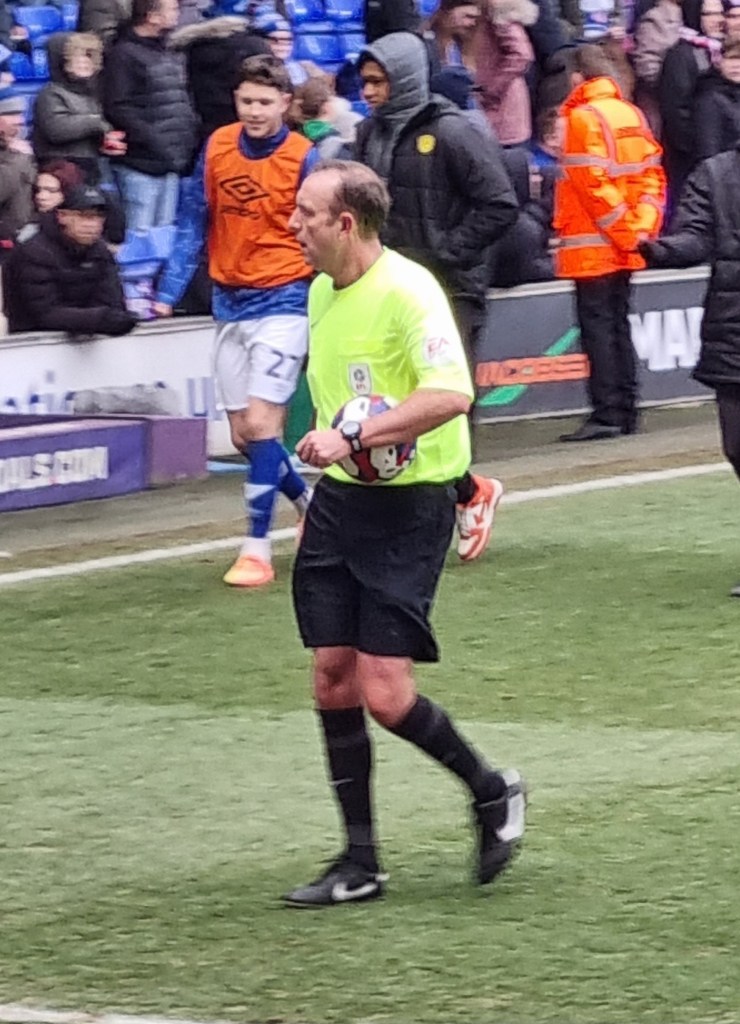
The twelfth minute, and Freddie Ladapo impersonates Pele. The ball is played high towards him, he’s going to jump for it, but then doesn’t and instead turns and chases it as it sails over his marker’s head. It’s a piece of inventiveness that’s worth a goal, but the referee, Mr Boyeson, has no soul and soon awards a spurious free-kick to the opposition.  To celebrate the first sixth of the game passing Harry Clarke gets booked. “If you can’t get the ball get the player, it’s what they’re taught” says the bloke behind me and Harry Clarke holds up his hands as if to say “It’s a fair cop guv’nor” .  It’s a booking that underlines the fact that the away team, whoever they might be in their mysterious all-black kit, has so far had the best of the game, although they have not once come close to even threatening to score a goal.

If Clarke’s booking was a meaningless 1-0 to the opposition, then Town quickly equalise, as two minutes later Nathan Broadhead is scythed down by Jasper Moon, who sounds as if he has escaped from a novel.  “ He can’t get it out quick enough” says the bloke behind me excitedly as Mr Boyeson reaches for his yellow card and indeed the referee would appear to enjoy this part of his Saturday job. A minute later Mr Boyeson is at it again and it’s as much as he can do not to smile widely as Freddie Ladapo is tripped by John Brayford whose swept back receding hair has me asking myself whether he looks most like Ray Reardon or Jack Nicholson.

The match is almost imperceptibly swinging Town’s way and Freddie Ladapo produces Town’s first shot on goal sending the ball beyond the far post.  “ Ole, Ole, Ole” chant what used to be the North Stand and spits of swirling drizzle are being blown into the Sir Alf Ramsey Stand. Town win their first corner which is sent straight into touch as if we didn’t really want it. Twenty-seven minutes are up and Wes Burns shoots over the cross bar.  Four minutes later and Conor Chaplin turns, shoots and scores as he so often does, despite Town apparently not having a 20-goal-a-season striker, and Town lead 1-0.  That’s a relief.

The bloke behind me says something about the game changing now Town have scored, and clearly he is on as good a form as the team today as once again he’s proved right.  An injury to Wes Burns allows time for both teams to gather by the dug outs for a remedial coaching class and drinks party, and it’s Town that benefit most. When play resumes Harry Clarke heads off down the right flank, passes to Wes Burns who crosses low for Nathan Broadhead to put Town two-nil up. Even from the far end of the pitch it’s a thing of grace and beauty.

Another visiting player is booked for fouling Conor Chaplin and then in an act of clear revenge Conor slips the ball to Freddie Ladapo to score Town’s third goal. Unlikely events notwithstanding, Town have won the match in the space of ten minutes and despite not having the mythical forty-goal a season striker, and they are still the division’s top scorers.  Fear amongst Town supporters remains however and as the final minutes of the half and four minutes of added on time are played out there are desperate shout of “Get rid of it” whenever Christian Walton has the ball at his feet.

With the half time whistle I watch Mr Boyeson leave the pitch zealously holding the match ball, before venting some pre-match beer and chatting with Ray and his grandson Harrison who wants to hear all about the Robyn Hitchcock concert I went to in London last Saturday at the Alexandra palace theatre. I tell him it was fab because it was.  Ray lets me know that he and his wife Ros have decided to help save the planet too and get solar panels fitted, and we laugh about the Tory government and how Rishi Sunak tells us with an almost straight face that Northern Ireland will benefit from something wonderful and new due to unique access to EU markets.

The football resumes at six minutes past four and, as with the Morecambe match a few weeks ago, the fear is that we’ve had our fun for the afternoon, and although logic predicts a 6-0 win, in all likelihood there won’t be any more goals because half-time cups of tea are laced with beta blockers and regret.  This proves to be only partly correct however, as within a minute Massimo Luongo launches a curving shot wide of the post after Wes Burns runs down the wing and lays it back to him, then the all-purpose visiting team even dare to shoot past the post too;  our post, not theirs.

The fun continues as Wes Burns again makes hay on the right pulling back the ball again , this time for Conor Chaplin to not score the fourth goal. “Blue and White Army” shouts the bloke behind me unable to contain himself, but then Cameron Burgess makes a superb ‘last-ditch’ tackle after Luke Woolfenden is all too easily turned by someone in black shirt and shorts.  Town concede another corner and then a number of throw ins which the opposition cunningly employ as attacking moves in the absence of proper passing football.

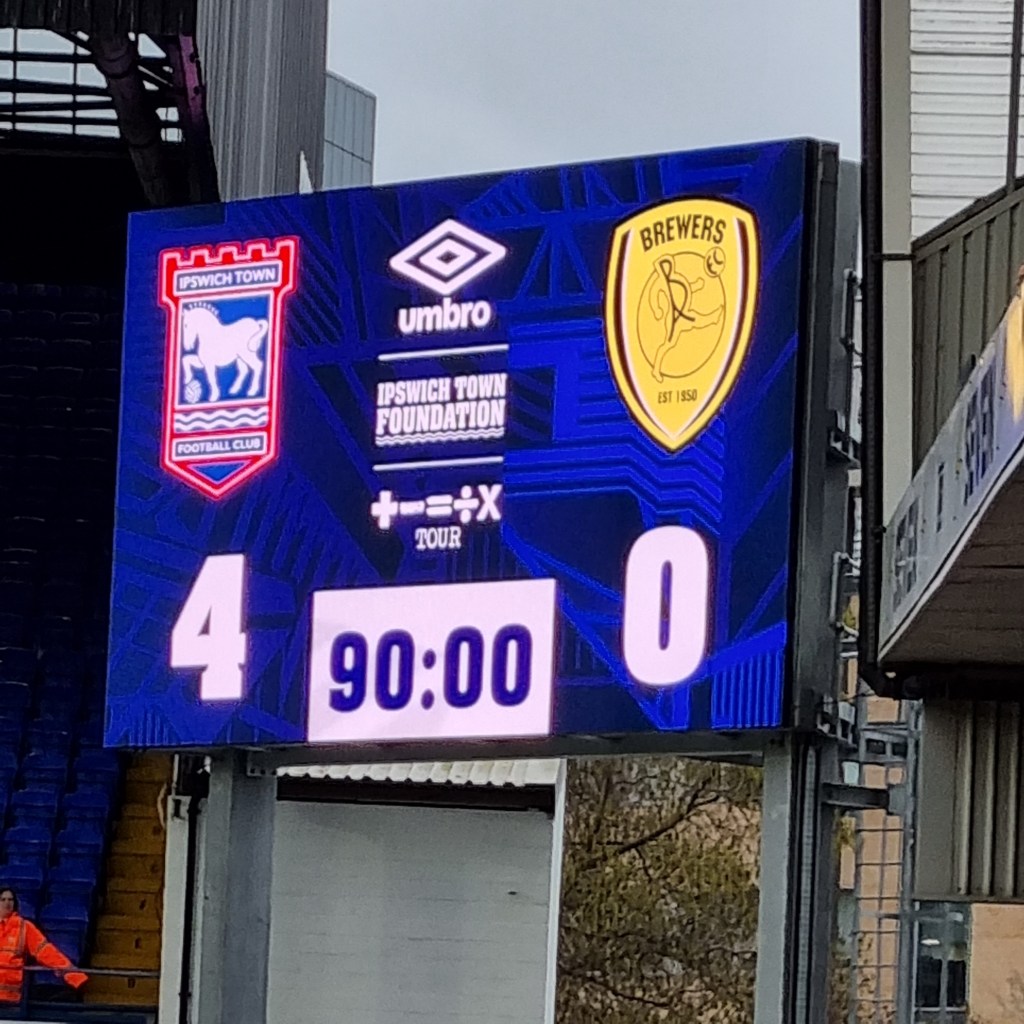
An hour has passed and Ray Reardon is substituted, Christian Walton makes a low diving save and the team in black win three successive corners.   Three Canada Geese fly over in tight formation and from another long throw the ball pings about the Town box like we’re suddenly watching Bagatelle or the Pinball Wizard.  Mr Boyeson indulges himself with a final yellow card for the afternoon as Nathan Broadhead is fouled by Conor Shaughnessy and a pigeon lands on the cross bar of the goal at the Sir Alf Ramsey Stand end of the ground.  The pigeon remains unmoved as Nathan Broadhead sends a curling shot narrowly passed the angle of the post and cross bar with a bit more than twenty minutes still to play.  Two minutes later, and Town lead 4-0 as Leif Davis sets up Conor Chaplin and his shot catches a slight deflection to take it past the goalkeeper.

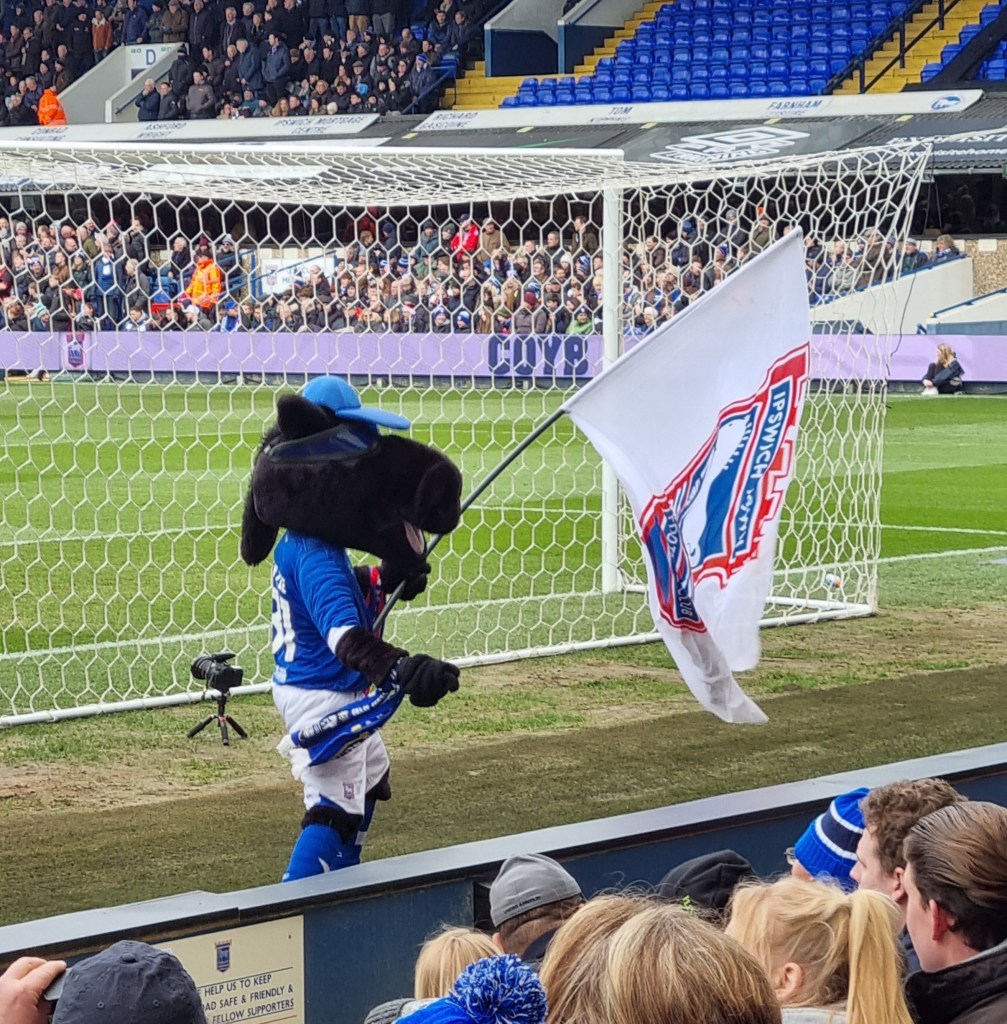
The game is now as good as over and the mass substitutions can begin, not to affect the result, but just so fewer people feel left out.  First to go are Broadhead, Chaplin and Ladapo who have all been excellent.  The clock ticks down further towards going home time and today’s attendance is announced as 25,003, with 147 of that number turning up from Burton-On-Trent to watch a team who based on their boring away kit might have been from anywhere.  The crowd applauds itself and the travellers from Burton, who I like to think blush a little in the face of this show of affection.  On the Clacton supporters’ bus the winner of the ‘guess the crowd’ competition is just forty-five out with an estimate of 24,958.  Ten minutes of normal time remain and Leif Davis requires treatment leading to another opportunity for remedial coaching on the touchline, but it’s too late for that and Burton are left to just guzzle their isotonic drinks and regret their choice of kit. Davis is replaced by Janoi Donacien and the Sir Bobby Robson Stand sing what sounds like “Bluey, Bluey, you’re a cunt” at the cuddly and permanently startled looking Town mascot, striking the only unseemly note of an otherwise pleasant afternoon’s football.  Bluey reacts playfully as if the crowd are merely chanting something like “Bluey, Bluey, you’re a one”.  Perhaps they are and it’s me who is coarse and reliant on sexual swearwords to amuse myself.

Despite the stoppage for the injury to Leif Davis, and both teams making the utmost of available substitutes, the fourth official sensibly calculates that only three minutes of additional time should be played, what’s the point of playing more? It’s been a lot of fun, but no one wants to stay here past five o’clock and the final whistle brings the final joyful release of the afternoon before we all head off into the deepening gloom of a damp, grey Ipswich evening.

Ipswich Town 0 Burnley 0

You have to go back thirteen years to 2010, when Britain had a Labour government and ‘Hot Tub Time Machine’ was on at the cinema to find an FA Cup run for Ipswich Town that wasn’t more than just an initial tie and defeat in a replay.  Admittedly, first round ties were won last year and two years before that, but the fourth round is unchartered territory for many a millennial.  Back when I was a lad, when things were still fab, groovy and magic, in the time before the world seemed to go completely and utterly insane, three consecutive FA Cup victories for Town would have seen us into the quarter finals.  But fate has been a cruel mistress to Ipswich since then and now our FA Cup begins in November and any story of success is by its very nature an epic tale.
Today’s FA Cup opponents are Burnley, the club against whom Ipswich Town recorded their first ever victory in what is now laughably known as the Premier League.  That victory, on a Tuesday night in August 1961, was just sixteen months after Burnley had become  League Champions, but Town won 6-2 and the less than snappy sports headline in the Ipswich Evening Star read “Six goal Ipswich rock mighty Burnley in great game”.  Ipswich and Burnley are the smallest two Towns in England to have ever been home to the football League Champions and when Town were Champions in 1962 Burnley were runners-up, so if you’re feeling sentimental think of us as sort of footballing twins separated at birth; luckily for Town we’re the one that didn’t get taken to live ‘up North’.

With thoughts of football history and past glories illuminating the manuscript of my mind, I park up my smoothly silent Citroen e-C4 and step out across Gippeswyk Park towards Portman Road and the Arb beyond.  It’s a cold, dull day like all the others lately,  but the exercise of the walk warms me up. In Sir Alf Ramsey Way I pause to buy a programme (£2) in the modern cashless manner and from inside his moulded booth the programme seller tells me to enjoy the match. I thank him and realise that there’s something about the little programme sellers’ booths that makes me think they should also sell ice creams.

At the ‘The Arb’, I buy a pint of Mauldon’s Suffolk Pride (£3.90) and the landlord explains that he is doing his best to keep the price down below £4.00, which is good of him.  I retire to the beer garden where an electrician is fitting new heaters to the shelter.  I sit at a table beneath an umbrella, I am alone, but not for long as Mick soon appears apologising for being late before disappearing again only to reappear with his own pint of Suffolk Pride.  We talk of my electric car and trip to Oxford last Saturday, of newspapers and the France 24 news channel and app, doctor’s surgeries and how I find the appearance of a man in a cowboy hat who has come outside  for a smoke a little weird; i expect he’s smoking Marlboros.

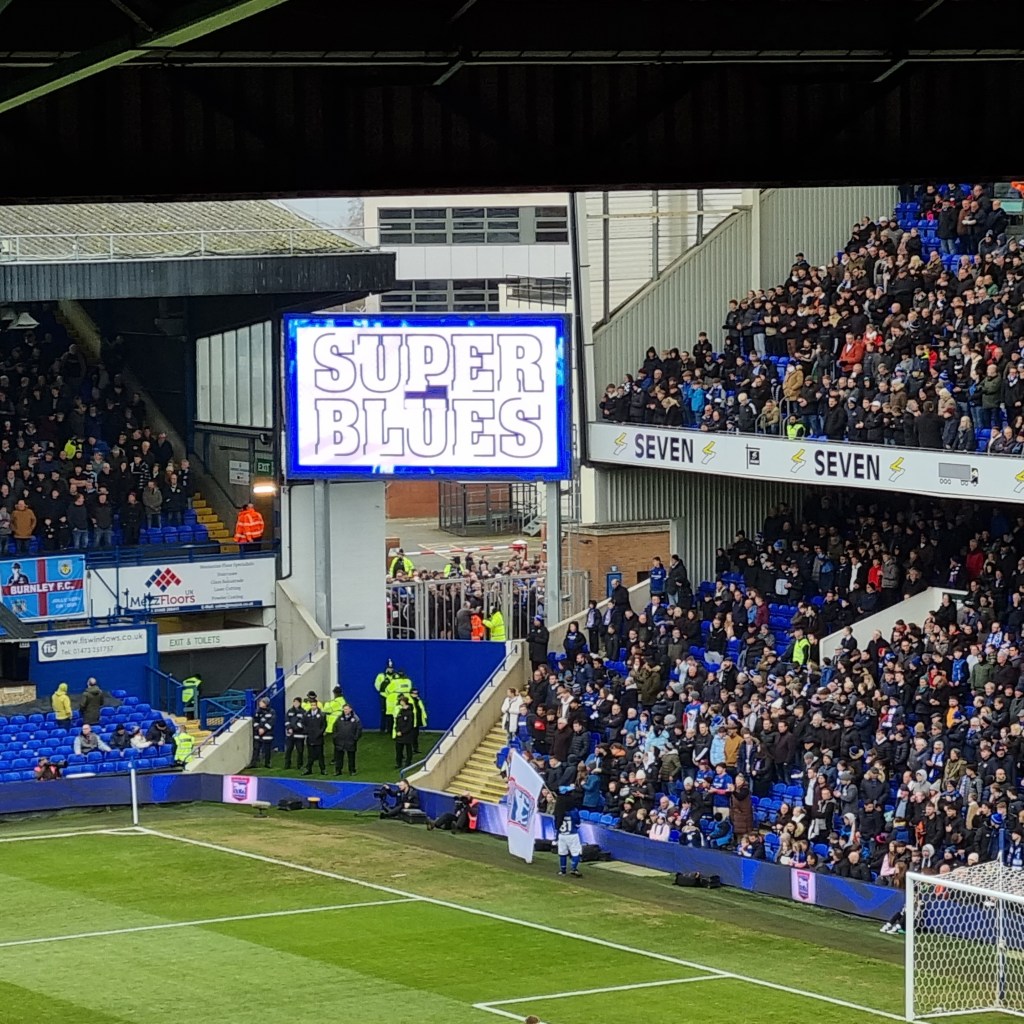
Time passes and before long we have to leave for Portman Road, or otherwise we’d miss the kick-off.  In Sir Alf Ramsey Way we enter by the turnstiles where there is no queue.  A steward with a loud hailer announces the existence of these magical turnstiles and encourages their use, but to little avail. As usual for cup ties, our seats are the ‘posh’ padded ones in Block Y, seemingly designed for people short in leg and tender in buttock.  The teams are already on the pitch as we edge our way to our seats past a homely looking, grey-haired woman and her slightly chubby, bearded male accomplice, perhaps a husband or paramour. We catch the tail end of the “Na-na-nas” from the Beatles “Hey Jude” and the game begins. Town have first go with the ball and kick from left to right towards the stand of Sir Alf Ramsey, architect of that 6-2 win in the late summer of 1961, when supporters still travelled to the match by trolleybus.

Within a minute or so Kayden Jackson is sprinting away down the  right, ball at his feet, he crosses the ball low and hard and George Hirst hits it past the near post from somewhere near the middle of the penalty area, just like he did at Oxford last week.  It’s a very exciting start to the game and helps to temper my disappointment that Burnley are not wearing their traditional claret shirts, but are instead decked out in what has become the ubiquitous and profoundly boring all-black away kit, which every club seems to have.  Burnley’s kit features red trim, as if that could make any difference whatsoever.

Burnley’s Scott Twine stoops to tie a boot lace.  “Come on referee!”  bawls a whiny man behind me. “Why are we stopped to let him tie his laces” he continues, “ I’ve never seen a game stopped for a player to tie his laces, I’ve never seen it before”. The whiney man is absolutely apoplectic and wants everyone to know he’s never seen such a thing before. I can honestly say I’ve never heard anyone so angry, so early in a game about a player tying his boot lace, but I decide not to shout it out.  I did see the game delayed whilst Sam Morsy put on a pair of new boots last week at Oxford, I don’t shout that out either.

“I didn’t get a programme” says the chubby bearded man beside me to the homely, grey-haired woman, “Because of the high demand”.  Something in his voice tells me he was too mean.  Marcus Harness hits the cross bar with a right-footed shot from the centre of the penalty box.  With the ball returned to goalkeeper Vaclav Hladky, Town pass the ball out from the back and Burnley players are quick to close down the Town defenders, causing a ripple of unease amongst some supporters. “Playing from the back, it’s what modern teams do” calls out the whiny bloke again to ensure we all know that he understands ‘modern football’.  I can’t help but chuckle.

Eleven minute have gone and Burnley win the first corner. “Come on Burnli, Come On Burnli” chant the Lancastrians in their deep accent full of short vowels, rolled ‘r’s and lolling ‘l’s.   Jordan Beyer tugs at Sone Aluko’s shirt as Sone tries to break forward, and is booked by referee Tom Nield. “Dirty northern bastard” I say to Mick, because it amuses me to do so.  The noise inside the ground is stirring as both home and away fans get into the spirit of what the FA Cup used to be all about. It feels like 1974.  As Burnley’s Scott Twine writhes on the ground and then gets up and plays on when he doesn’t get a free-kick, the chubby man next to me mansplains to the homely woman that he wasn’t really hurt.  It’s twenty past three and Burnley’s Jay Rodriguez shoots high over the Town cross bar, spurning Burnley’s first chance of a goal.

Town win their first corner. “Come On You Blues” chant several people, even in the west stand.   The booking count is levelled up when inexplicably Marcus Harness fails to stop when running and collides with Ameen Al-Dakhil’s ankles. Town win another corner as something of a hit and hope cross from Kayden Jackson looks like it might dip under the Burnley cross-bar, forcing their extensively named goalkeeper Bailey Peacock-Farrell to tip the ball over.  Another corner follows  and the chubby man next to me tells the homely looking woman that it’s a very exciting game; it’s nice of him because she might not have realised if she was busy knitting or making a shopping list perhaps.  

Only ten minutes until half-time now, and in an outbreak of astounding cheek or wilful absence of self-awareness, Town fans chant “Your support is fucking shit” presumably to the Burnley fans, although singing it to one another would be understandable in the context of many previous matches.  Shocked, I inexplicably imagine that Vaclav Hladky reminds me a bit of Laurie Sivell, probably because he looks quite a bit shorter than all his defenders.  A beautifully flowing Town moves produces another corner to Town and the whiny bloke behind me gets all self-righteous again loudly expounding “We don’t play that way anymore, lumping it forward” as if no one else can possibly have noticed.

It’s been a fine half of football despite the whiny man and by way of celebration the Sir Bobby Robson stand are singing “ Oh when the Town go marching in” at the proper speed, although possibly without quite the  joy of genuine evangelists.  Finally, the fact that no more than a minute of added-on time is to be played seems to confirm that for forty-five minutes at least all has been right with the world – except that we haven’t scored.

With half-time Mick and I use the facilities to disperse excess Suffolk Pride, but the queues for the toilets are so long it’s impossible to find where they end in the cramped confines of the upper stair cases and bars of the west stand. We return to ground level where there is more space and more square footage of urinal. Returning to our seats in time for the re-start, we ease past the homely looking woman and the chubby man and I pause to take a look at who might be the whiny man behind me, I think he is wearing tinted glasses and has a very pink face beneath a hat.

The game resumes at six minutes past four and  Burnley up their game a bit, being a tiny but significant bit quicker and pressing more than in the first half. As a result Vaclav Hladky has to make two excellent saves, but make them he does, and with aplomb, reminding us of why we have a goalkeeper.  But it’s not all Burnley and Town soon win a corner.  “ There are people say we can’t defend…” expounds the whiny bloke, but I’m fed up with him and tune out before he concludes his latest treatise. In the Cobbold Stand the Lancashire hordes start to sing “The Irish Rover”, which seems a little odd, although there were a lot of Irish immigrants to Lancashire in the nineteenth century, but they’d be getting on a bit now. More odd is that the chubby bloke beside me joins in.

Mick asks me what substitutions I think Kieran Mc Kenna will make and I tell him that George Hirst  and Marcus Harness and possibly Sone Aluko are most likely to go off first , and so it proves,  as with an hour gone Freddie Ladapo,  Nathan Broadhead and Conor Chaplin replace them.  Burnley make three substitutions too, although I’m disappointed that neither of their other two players with double-barrelled surnames are in today’s squad. Who’d have thought Burnley would have so many players with double-barrelled surnames?

Ten minutes later and Sam Morsy is shown his usual yellow card for a pretty unexceptional foul, “He collects them doesn’t he?” says Mick. I can’t disagree.  Stadium announcer Stephen Foster announces that today’s attendance is 25,420 of which 1,581 are from Burnley;  he thanks everyone for their ‘tremendous’ support. “You’re not sitting where I am Stephen” I think to myself.  Six minutes after his booking Sam Morsy is replaced by new signing Massimo Luongo, who like Morsy joined Town from Middlesbrough.  With his beard, dark hair and large frame, Luongo even looks a bit like Morsy from up here, and I ponder for a moment on the possible advantages and desirability of bringing on substitutes who look like the player they replace.

“Come On Ipswich, Come On Ipswich” chant the crowd in all parts of the ground as full-time begins to draw ever closer. Kyle Edwards replaces Kayden Jackson who trots off the pitch to a loud ovation; he has been truly excellent today.  “ I know why you play” calls the whiny bloke loudly as if no one else does and everyone sat around him is one of the people who criticises Jackson on social media.  Time is running out,  Town win a corner  but Luke Woolfenden can only head the ball wide. Massimo Luongo is even playing like Sam Morsy, but hasn’t been booked, and indeed he gets fouled by the economically-named Jack Cork, provoking frantic flagging from the linesman and a final yellow card of the afternoon from Mr Nield.  Four minutes of added on time are announced, five are played and the game ends.

It’s been yet another excellent afternoon of football at Portman Road, even though not winning can rarely be anything but a little disappointing.  Best of all however, this felt like a proper FA Cup tie, played in front of a big crowd who have turned up with hope and may be expectation and possibly because it’s the FA Cup.  It’s been a very long time since that happened, not thirteen years, more like thirty.

FC Nantes 2 Olimpiakos 1

The Stade de la Beaujoire in Nantes is a stadium I have long wanted to visit because on the telly it looks a bit different to your run of the mill English footie ground and certainly a cut above the diet of Portman and Layer Roads I grew up on, as lovely as Portman Road still is and the much-lamented Layer Road was.   Having missed out on tickets to see FC Nantes at home to Paris St Germain due to cost and lack of decisiveness, the opportunity to see the Breton club at home in the Europa League to Olimpiakos just five days later was not to be passed up.  To add further to the mix, historically FC Nantes is one of France’s most successful football clubs, with eight league titles and four Coupes de France to their name.  But until Nantes won the Coupe de France this year (1-0 versus Nice) they hadn’t won either of the major French trophies since 2001, which co-incidentally was the last time I was in Brittany.  Nantes’ return to European football and mine to Brittany seems serendipitous therefore.

Tickets for concerts and large sports events across France can usually be bought at the larger supermarkets but having had no luck at a branch of Super U on Monday, that evening my wife Paulene went on-line and acquired a couple of the last few tickets available from the club website.  Feeling flush after a recent cash windfall we also booked a hotel for the night, although we are actually staying at a campsite about an hour and a half’s drive north of Nantes.  Not surprisingly, being on holiday we don’t have a printer with us, but the hotel has kindly printed our tickets off for us.  Our hotel is just a ten or fifteen-minute walk from the Stade de la Beaujoire across a small municipal park.  The stadium and hotel are also conveniently situated at the end of Ligne 1 of the city’s tram network and the twenty-minute trip into town is a bargain at one euro seventy.

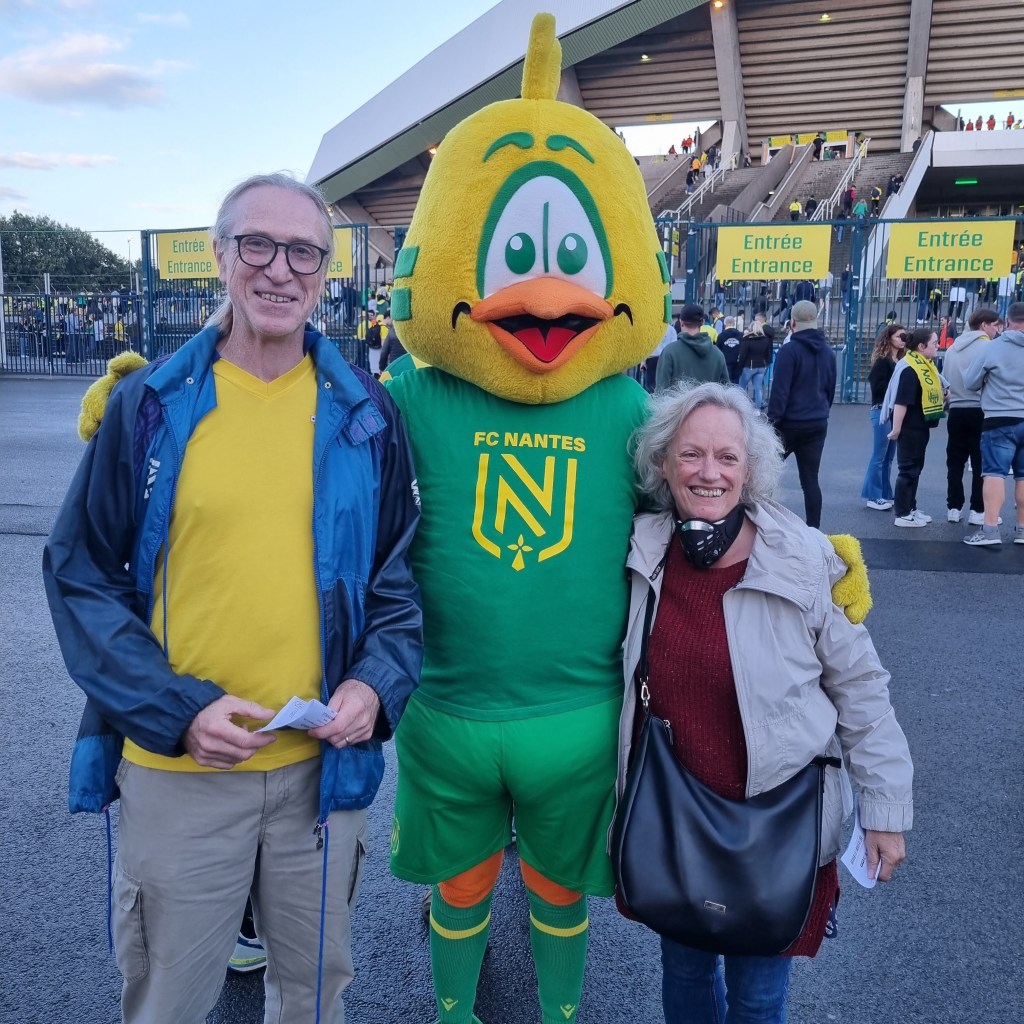
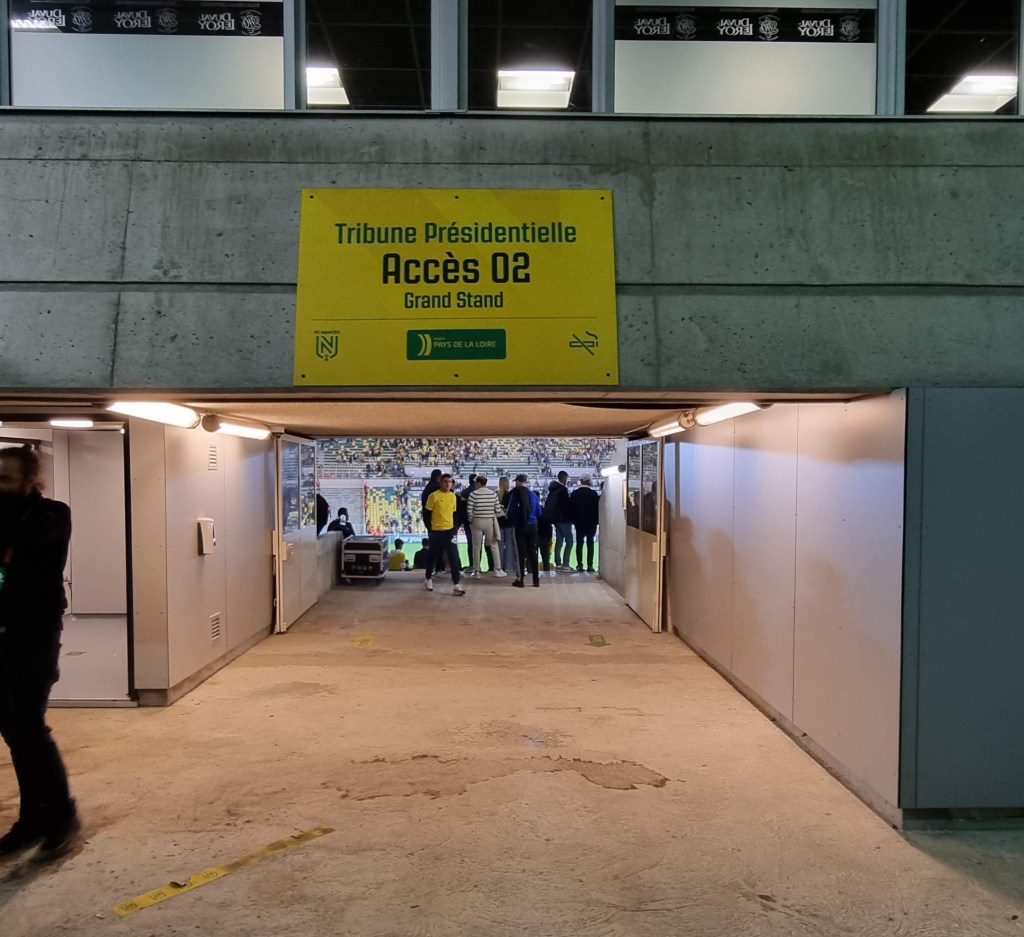
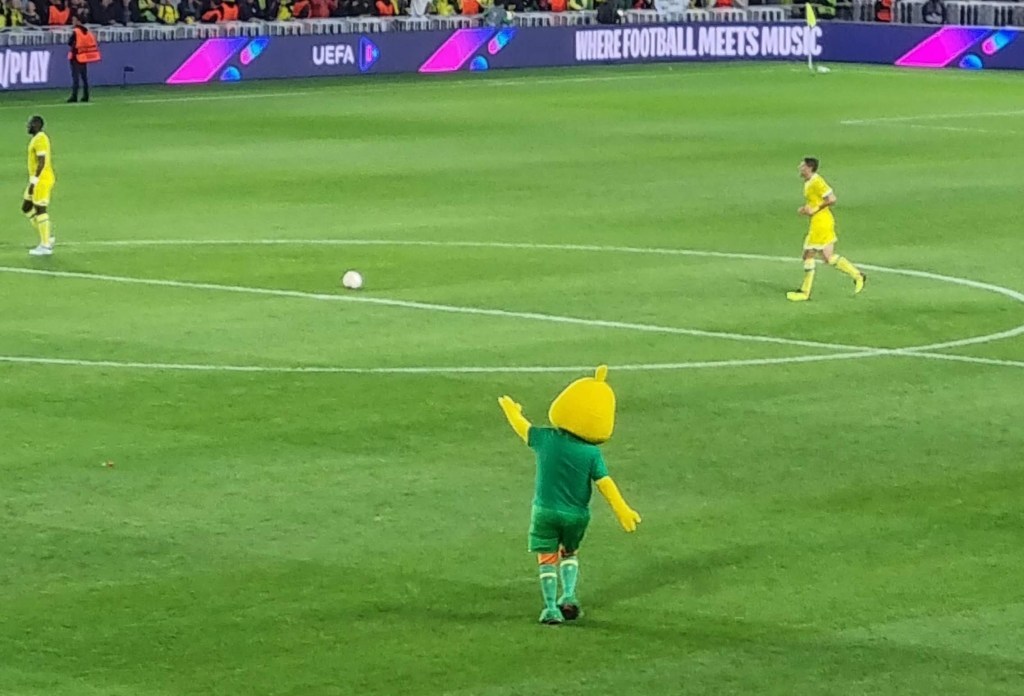
It’s been a warm but cloudy day with an ever-present threat of heavy showers, but thankfully we’ve avoided those and as had happened a week ago at Rennes, I had been in the club shop adding to my collection of petits fanions (pennants) and fridge magnets when the heavens had opened.  Now, at a bit after seven-thirty we queue to be patted down before entering the stadium.  I can’t help feeling that the security guy checking me out has decided I don’t look much of a threat and having tapped me about the arms a bit he looks bored and lets me through; it’s either that or my excited smile made him think I might enjoy a more thorough search a bit too much.  Either way, he wishes me ‘bon match’ and Paulene and I head for Access 02 of the Tribune Presidentielle, but not before we have met Riri the Nantes club mascot.  Nantes play in all yellow and are known as the Canaries, so as an Ipswich Town supporter it requires mental strength to be photographed with their mascot, but overcome with the spirit of liberte, egalite and fraternite I throw myself into the occasion and feel all the better for it.  But I am protected by my yellow 1970’s Town away shirt.

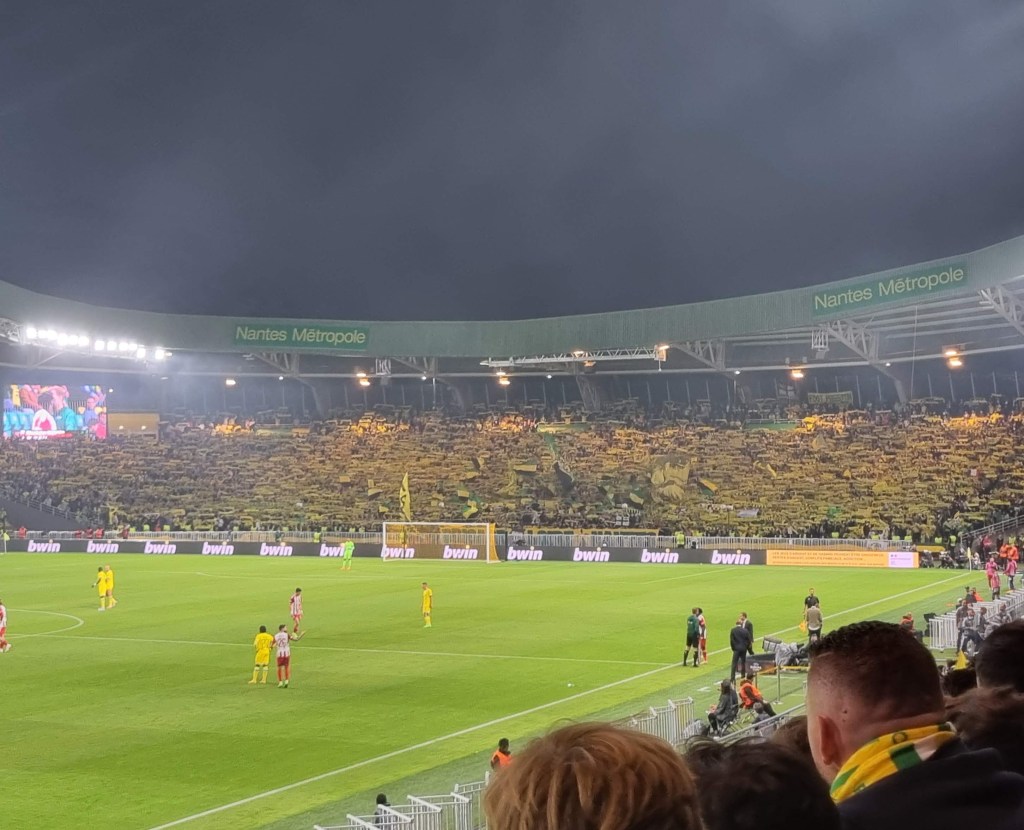
Like most of the bigger stadiums in France, Stade Beaujoire is a genuine piece of architecture, not just a feat of engineering, a box or a collection of individual stands clad in sheet metal.  Set into a gentle slope, its undulating roof arching above the two-tiered lateral stands and the two single tier ends, Beaujoire is an elegant essay in concrete and steel which seems bigger inside than out.  Our seats are at the side of the pitch but behind the goal line, nevertheless the view is excellent, aided by the stadium’s bowl-shaped floor plan.

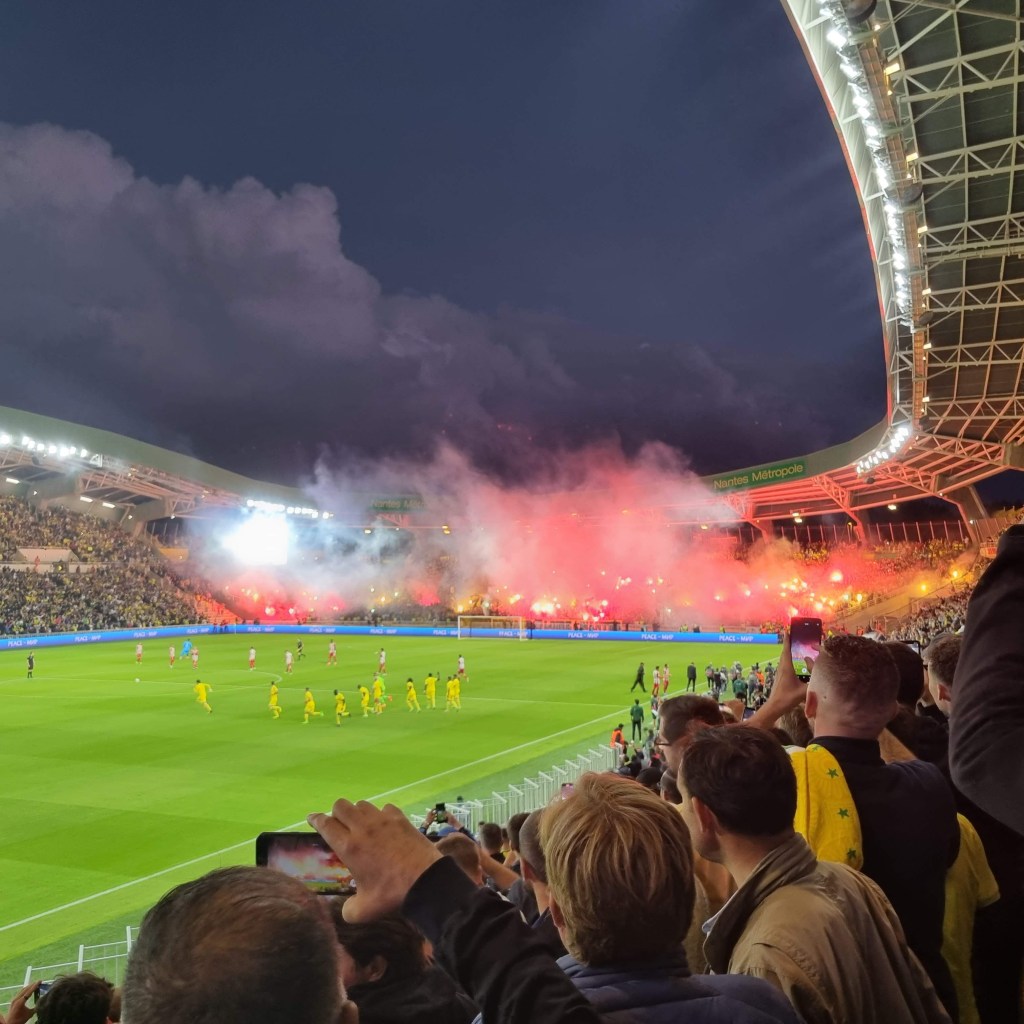
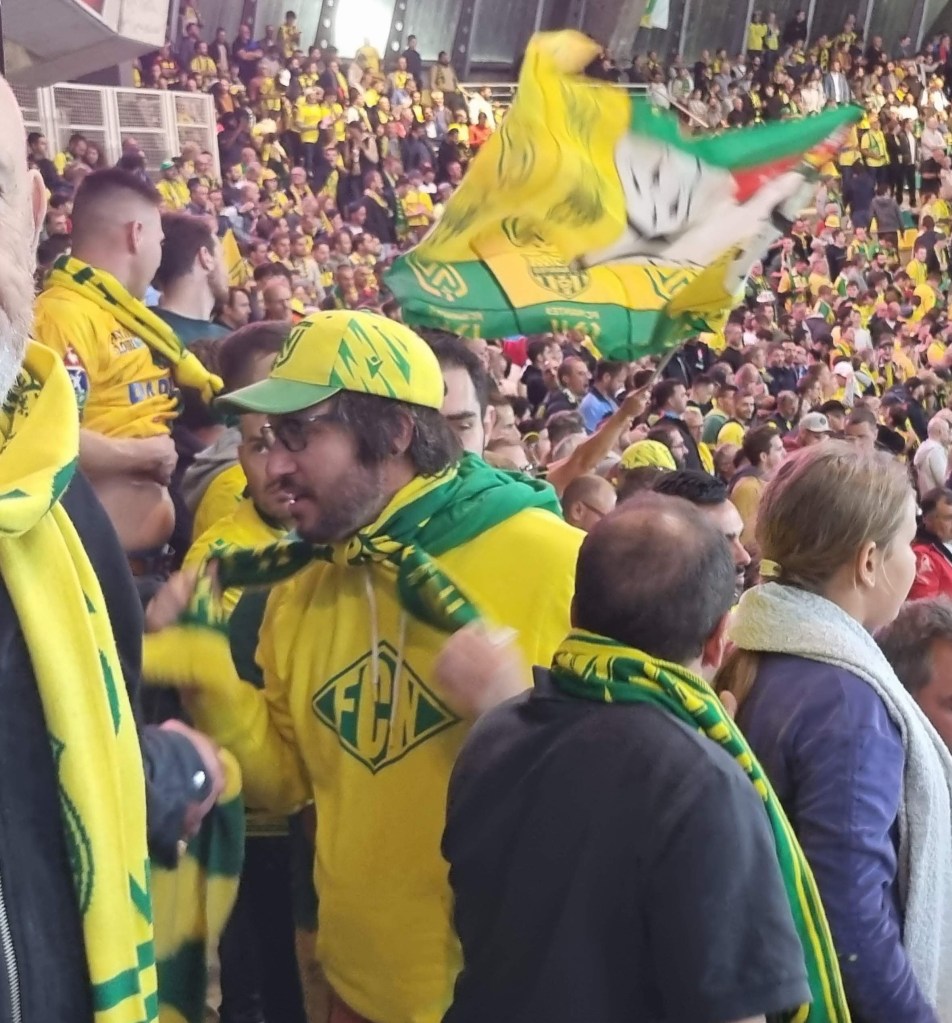
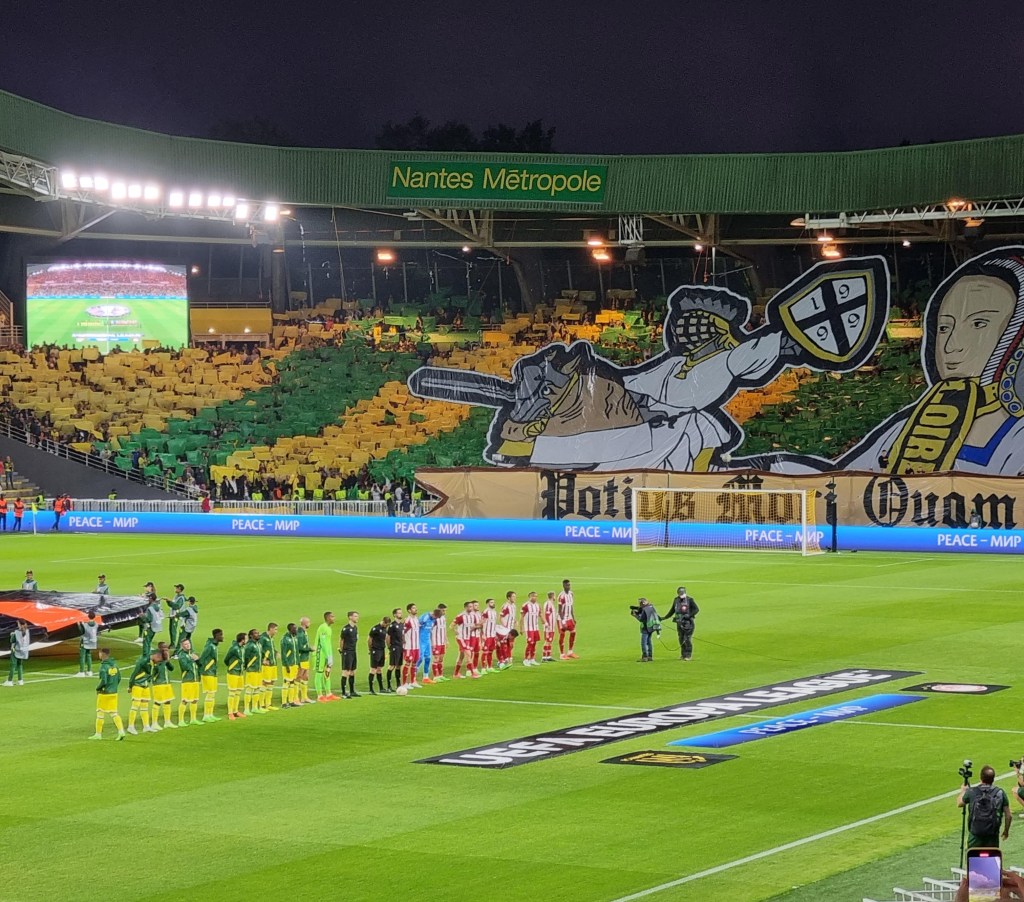
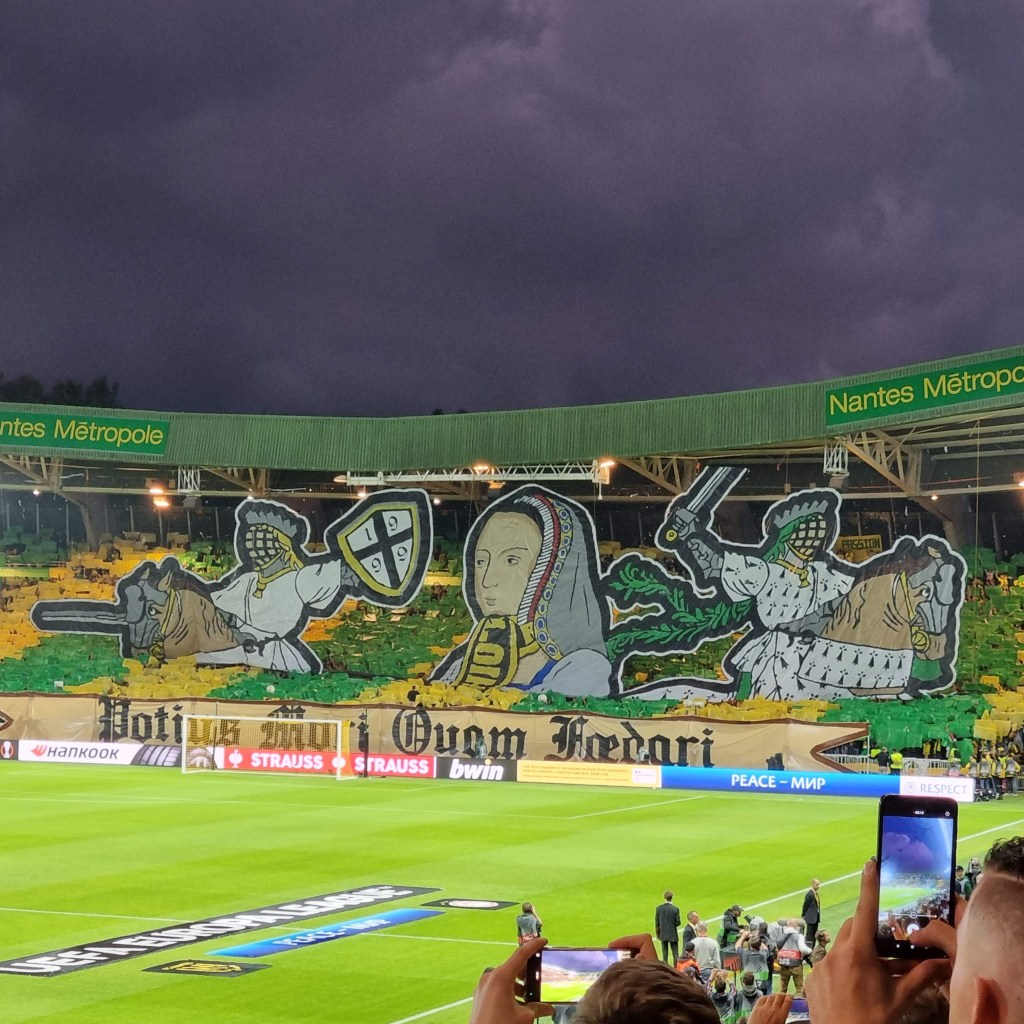
People get to big matches early in France and make use of the many stalls providing food and drink that surround the stadium.  Equally, the stadium is full before the nine o’clock Coupe d’envoi (kick-off) and with good reason because the prelude to the match includes a stirring anthem, which supporters sing whilst twirling their scarves a la Leeds United fans of the 1970’s; I had wondered, given that it is a warm September evening, why the club shop was doing such a roaring trade in scarves.  Most impressive however, and possibly the most impressive thing I have ever seen at a football match is the raising of a huge tifo at the Tribune Loire end of the ground depicting Anne the fifteenth century Duchess of Britanny (a local heroine for resisting Brittany’s annexation by France) wearing a Nantes scarf and flanked by a pair of jousting knights. Beneath the tifo in Gothic script and in Latin it reads “It is better to die than to be disgraced”, which seems to be going a bit far, even for a Europa League fixture.

Less than an hour before kick-off the death of Queen Elizabeth II had been announced and most of the ground observes a minutes’ silence, although at the Tribune Loire end of the stadium there was never any likelihood of this happening given the levels of excitement, as witnessed by the ceaseless noise, flag waving and glow of flares.  I am sure many would say “Bloody French ‘ooligans”, but I don’t.

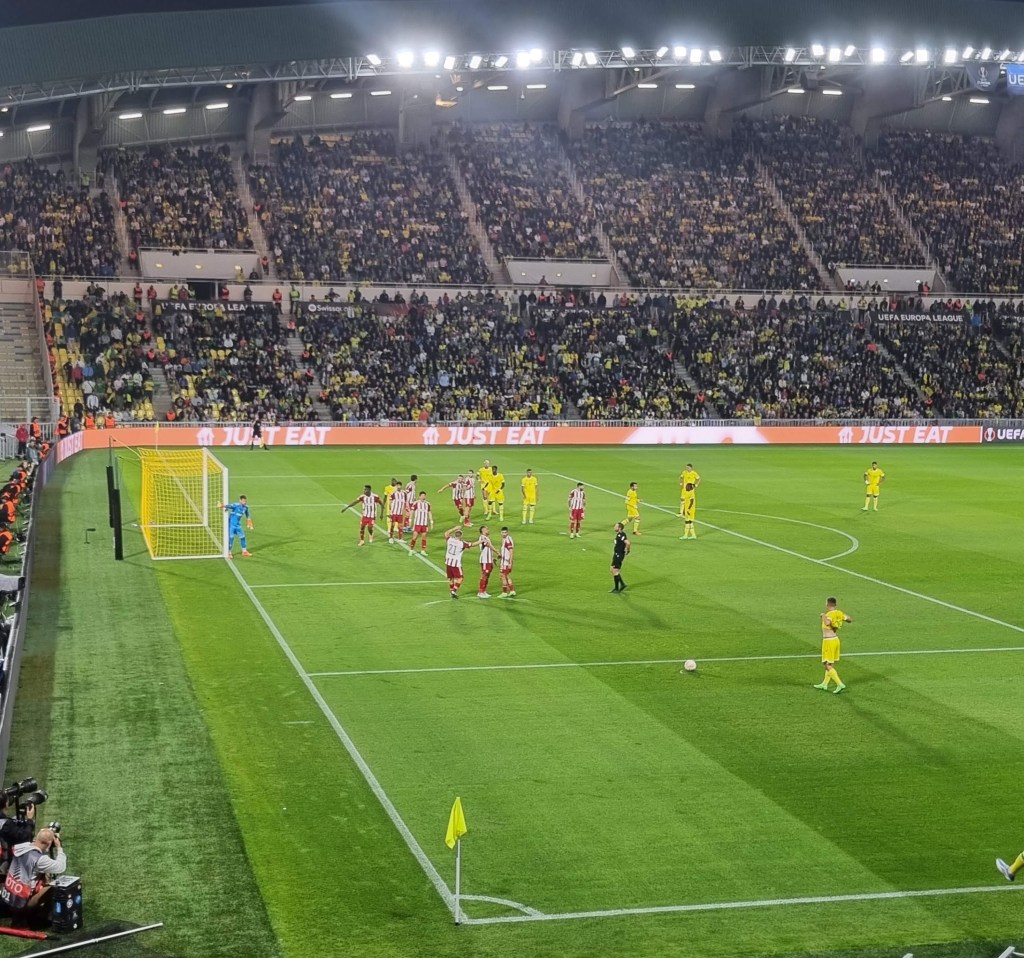
As the match begins it is Nantes who get first go with ball, aiming it at the goal through the drifting smoke at the Tribune Loire end of the stadium. Nantes are in all yellow whilst Olimpiakos wear red and white striped shirts with red shorts and socks. “Lo-lo, lo-lo-lo, lo-lo, Allez les Jaunes” (Come On  Yellows) sings the crowd and then the Tribune Loire calls out “Allez Nantaises” and the Tribune Erdes at the far end of the ground echoes the shout.  Nantes have started at a fast pace and with the first promising looking attack it seems that everyone in the ground but for the couple of hundred Olimpiakos fans, is up on their feet and bawling encouragement.  Everywhere is just noise, it is absolutely thrilling. “Allez, Allez, Allez” rings out to the tune of The Beatles’ Yellow Submarine.

On the field, Nantes are in truth struggling to get through the Greek defence.  In midfield Pedro Chirivalla is busy, but most attacks go through Ludovic Blas and Evann Guessand on the right, although the tactic of getting crosses into the lone forward Mustapha Mohamed isn’t coming close to creating a goal, only corners. Blas is set up twice, only to blast the ball hopelessly high and wide. Whilst the football isn’t always the best, the spectacle however is; but a little over half-way through the first half even the Tribune Loire has started to quieten down just a little. In front of us, a lone drummer with a massive bass drum tries to raise the crowd in the Tribune Erde and Tribune Presidentielle once more; he is wearing a Nantes kit over the top of what looks like silk pyjama bottoms; his face is smeared with green face paint and on his head he is wearing a lurid, long green wig.   Between rhythmic drum beats he claps his hands and sings “Allez Nantes”.  A middle-aged man to our right answers the call with a mad passion which belies his age, but mostly people just clap along almost out of politeness. 

The flame of really noisy support is rekindled however, just before the half-hour Nantes win a free-kick on the right. “Lo-lo, lo-lo-lo, lo-lo, Allez les Jaunes” is the theme once more and although the free-kick comes to nought the momentum is retained and four minutes later Blas’s through ball confounds the Greek defence and Mustapha Mohamed runs on to place the ball coolly and firmly into the far corner of the goal beyond the Olimpiakos goalkeeper Tomas Vaclik.  The roar from the crowd is immense and Nantes lead 1-0.

Only a second Nantes goal can feed the desire of the home crowd, but it is Olimpiakos who now get to have their first shot on goal as a neat passing move ends with an overlap on the right and a shot that goes both high and wide of the Nantes goal from only about 10 metres out.  The be-wigged drummer makes a second tour of the area at the front of the stand, but the first half soon ends, unusually with no additional time being played.

Over half-time Paulene and I stay in our seats whilst many in the crowd drift out to the buvettes for food and drink. We reflect on the first half and agree that this is possibly the most fantastic atmosphere we have ever experienced at a football match and that on tonight’s showing the Nantes supporters are probably even more passionate than those of Marseille or St Etienne.

The game resumes at a minute past ten as the moon rises above the Tribune Oceane opposite. “Na-Na-Na, Na-Na-Nantaises” sings the crowd to the tune of The Beatles’ Hey Jude. Olimpiakos appear either to have been given a stiff talking to at half-time or they have simply decided to attack rather than just defend. Five minutes in and the Greeks win their first corner of the match.  The ball arcs across to the far post and Nantes ‘keeper Alban Lafont moves to punch the ball away but completely misses it, instead the ball strikes defender Samuel Moutassamy and drops feebly and apologetically into the goal net.  It is such a poor goal no one seems to believe it, not even the Olimpiakos players who can barely bring themselves to celebrate, making do with a few mutual pats on the back. Over in the corner of the stadium between the Erdre and Oceane Tribunes the travelling supporters are doing more than enough cheering and dancing for everyone.

The Olimpiakos goal gives them a lift and the balance of play evens out in the second half, but Olimpiakos are also much more combative and to prove the point Panagiotis Retsos is the first player to be booked, for a foul on Nantes’ Ignatius Ganago.  From the resultant free-kick on the right, Ludovic Blas is set up for a third time, but he boots his shot hopelessly high and wide again.  With a third of the match gone Nantes win a corner from which Andrei Girotto flashes a header just wide of the goal. Minutes later Olimpiakos win a corner, but Alban Lafont succeeds this time in punching the ball away.

With twenty minutes left, Nantes make a couple of substitutions and quickly win a corner after a cross from Moses Simon, who has replaced Ganago, is met with a header from the other substitute Moussa Sissoko which Vaclik tips over the cross bar. “Nantes Allez, Nantes Allez, Nantes Allez” sing the crowd to the Triumphal March form Verdi’s Aida as they hold their scarves aloft all around the ground, a spectacle sadly no longer seen in England.  The sense of the crowd willing the team to score is palpable, but Nantes are not significantly threatening the Olimpiakos goal.  When Nicolas Pallois strides forward in the eightieth minute to launch a shot from at least 30 metres, which travels a respectably small distance over the bar, it is as if he had simply got fed up with his team-mates’ patient passing and had decided to take matters into his own hands.

A minute after Pallois’ effort, Nantes at last break speedily down their right and the ball is crossed low before being laid back to the incoming Guessand who strikes a spectacular rising shot into the roof of the goal net.  It looks the perfect goal, the sort worthy of winning any match. The Nantes players celebrate wildly as does the whole stadium, with the exception of one tiny quadrant in the corner where the Greek fans sit.  The scoreboard registers the second Nantes goal, and the players walk back to kick-off again, but the Olimpiakos players are whinging to the referee who has a hand to his ear. We wait.  The referee then draws a square in the air and points to patch of grass level with the Olimpiakos penalty box and the scoreboard confirms that VAR says the goal is annulled for an earlier hors-jeu (offside).

The feeling of disappointment subsides surprisingly quickly and soon we are distracted by some pushing and shoving on the touchline. The ball has gone out of play and runs to the Olimpiakos coach who seems to hold it out for Nicolas Pallois to take, but then turns away; Pallois gives him a little shove for his trouble and then anyone nearby joins in with the melee and those further away catch a tram to come and join in.  The referee possibly cautions Pallois and the Olimpiakos coach, but it’s hard to say for sure.  Sadly, it’s the last real action of the half and all hope is to be squashed into four minutes of time added on or the more poetic sounding time additionelle

Additional time begins, two minutes in and Blas and Oleg Reabciuk are both booked after the former fouls the latter and the latter gets upset.   A minute remains of added time; Nantes again attack down the right, Ludovic Blas crosses the ball and the sizeable figure of Evann Guessand  hurls himself at the ball. Spectacularly, Guessand scores with what is arguably the best type of goal, a diving header.  The rest is near mayhem, with Stade de La Beaujoire erupting into scenes of unbridled joy and pride in the team and being Nantoises.  All around me people are just deliriously happy, whilst some have a look on their faces of vindication, as if to say it’s taken nearly twenty years, but Nantes are back like they knew they would be.

With the final whistle no one wants to leave. I don’t think I have ever been to a game where so few people, if any, have left before the end. The Nantes players gather in front of the Tribune Loire to salute and commune with the Ultras groups who have ceaselessly chanted, sung, shouted and waved their banners and flags throughout the match.  Riri the canary mascot runs across the pitch arms outstretched as if trying to take off and joins in with the players’ celebrations.  We, along with everyone else, wait for the players to break away from their love-in with the ultras and do a lap of honour to the rest of the stadium. As the players head back towards the tunnel we leave, joining the flood tide of happy, smiling people.  This has been a truly fantastic night.

US Concarneau 1 AS Nancy 2

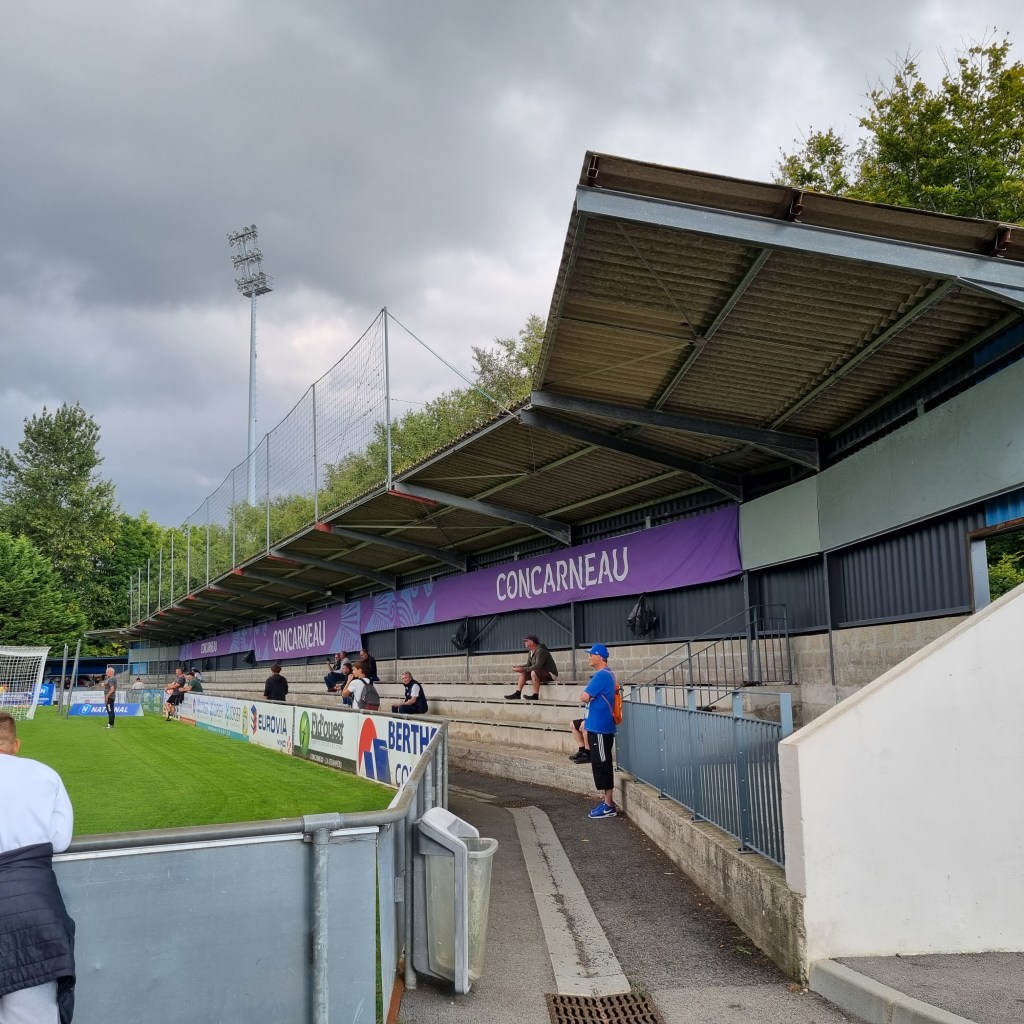
The Breton coastal town of Concarneau is apparently best known as a successful fishing port and for its walled Ville Close, a quaint and historic medieval fortified town transformed into an appalling tourist trap full of the sort of shops or pristine buildings you find in places like Lavenham or Bourton-On-The-Water in England. In its favour however, Concarneau is also home of the Brasserie de Bretagne (Britanny Brewery) and Union Sportive Concarnoise, its local football club, which plays in the third division of French football known as Ligue National.

US Concarneau, as they are commonly called, are relatively recent arrivals in Ligue National and have aspirations to reach Ligue 2; tonight, they face Association Sportive Nancy-Lorraine, more usually known as AS Nancy, a club which has twice won the French FA Cup and spent twenty-five seasons in Ligue 2 and thirty in Ligue 1.  Today however, Concarneau are second from top of Ligue National and Nancy seventeenth, albeit after just three games.

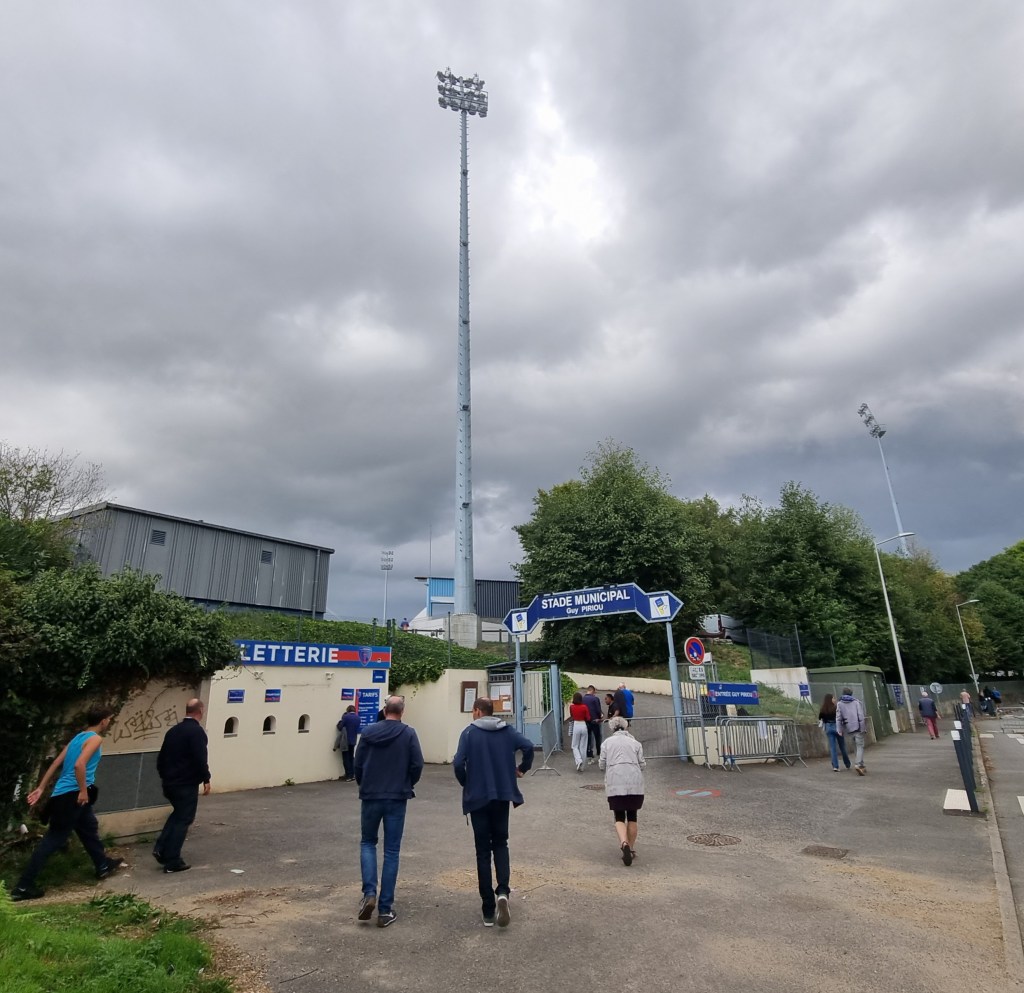
The Stade Guy Piriou where USC play their home games is at the edge of town in that nether world of retail parks, Zones Industrielles and feeder roads inaccessible to pedestrians. I had asked in the Tourist Information Office where is a good place to park and the pretty young woman there had rolled her eyes with a look that told of chaos, but then said we could park in the car park of the LeClerc supermarket which is about 100m from the ground through a tunnel beneath the main road.  After getting a bit of shopping and an evening picnic, which my wife Paulene and I eat in the car, we make for the ground.

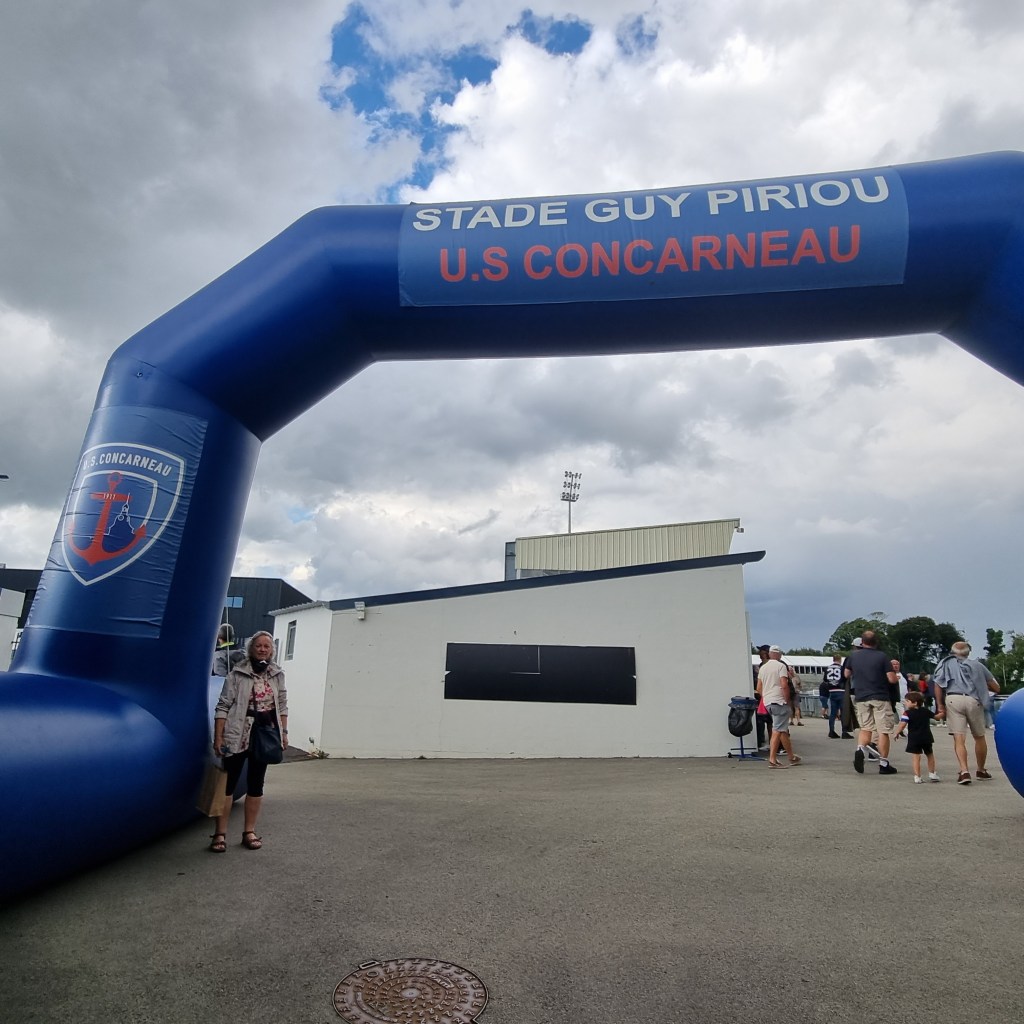
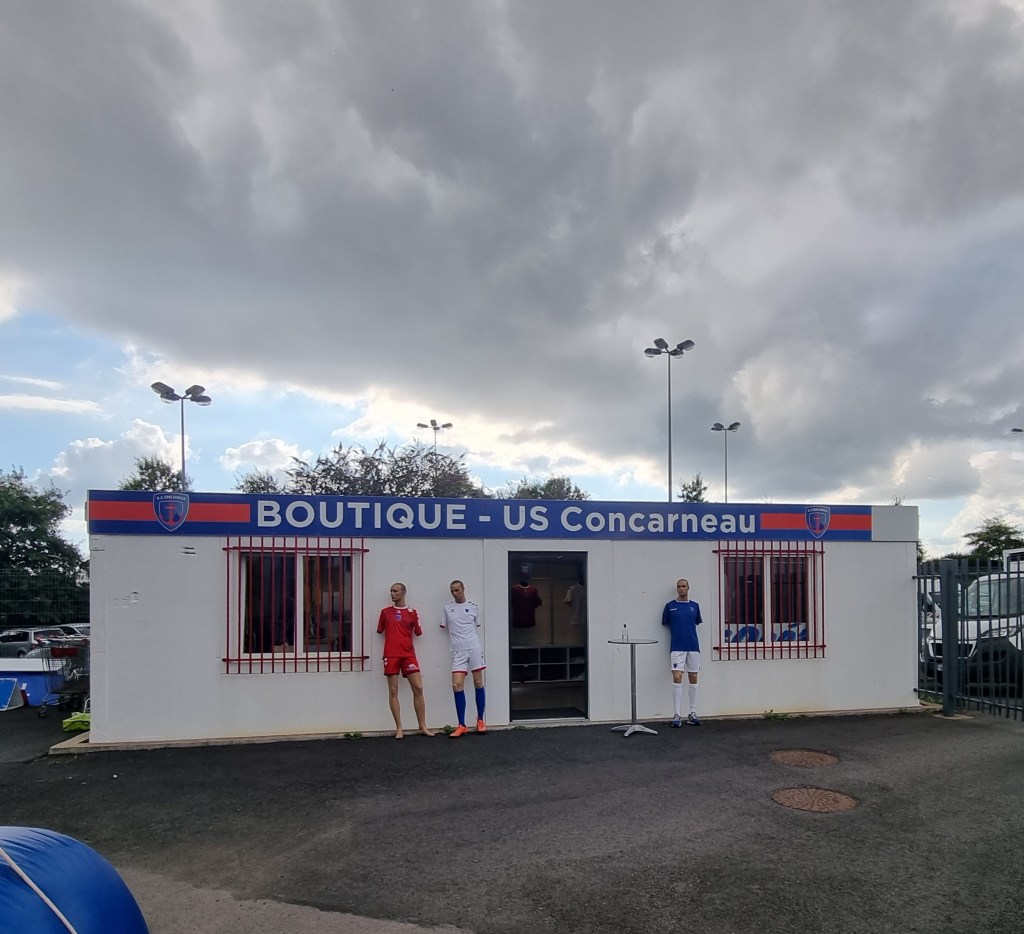
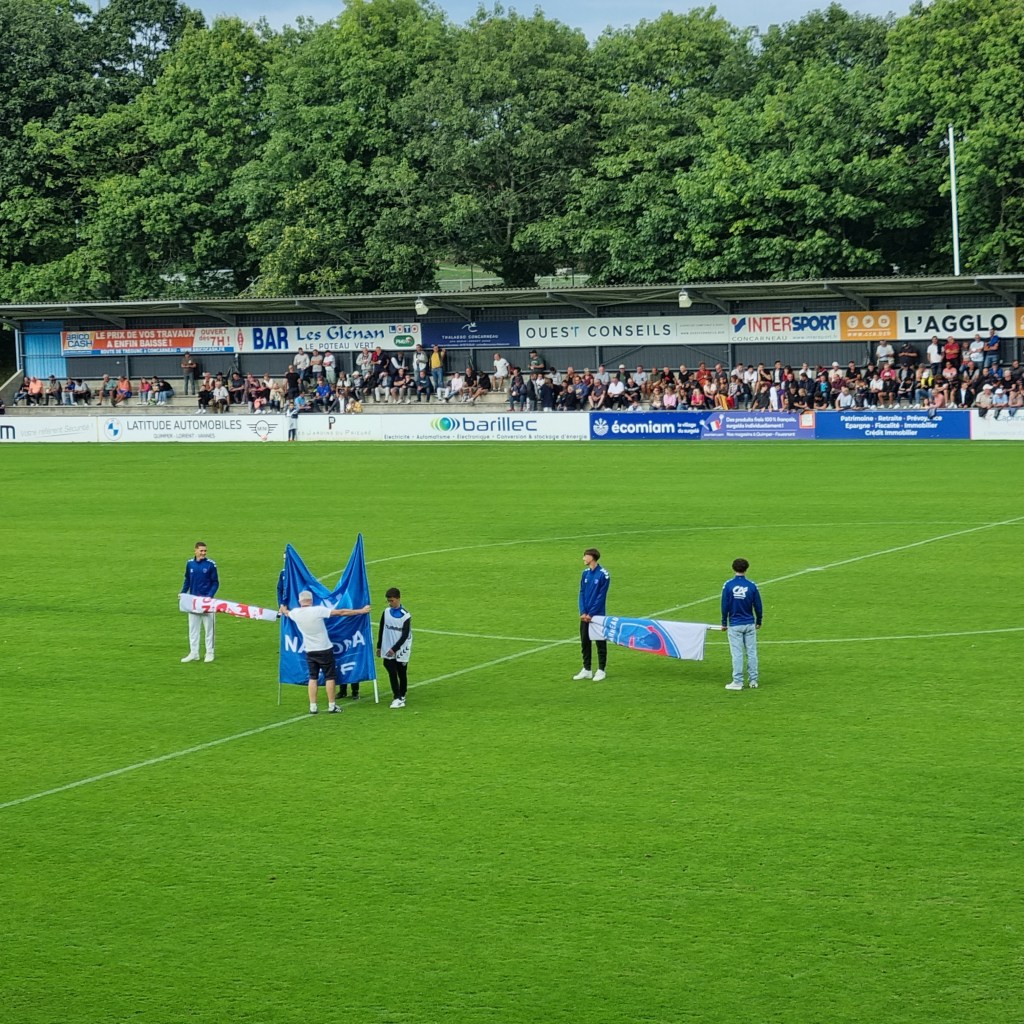
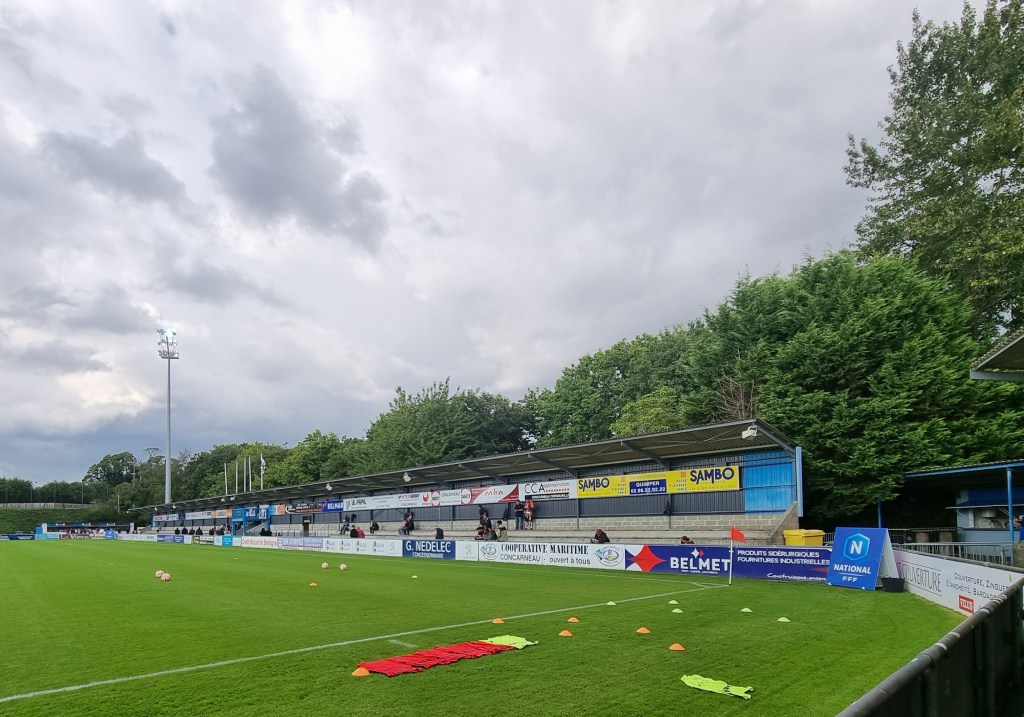
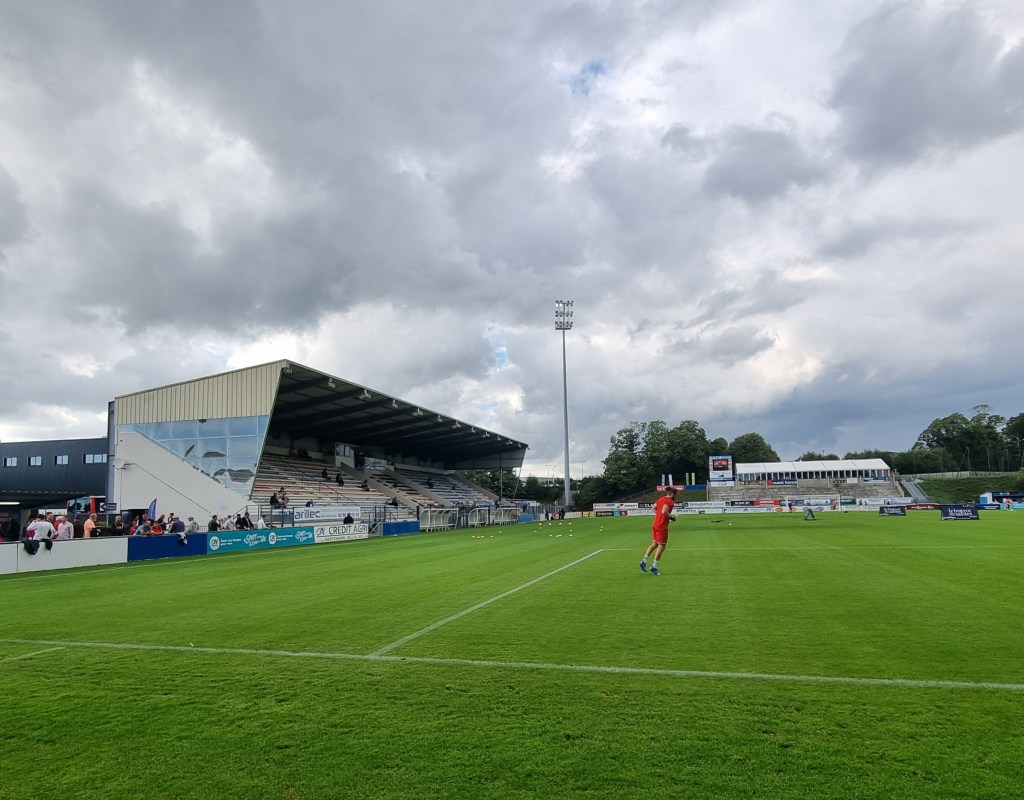
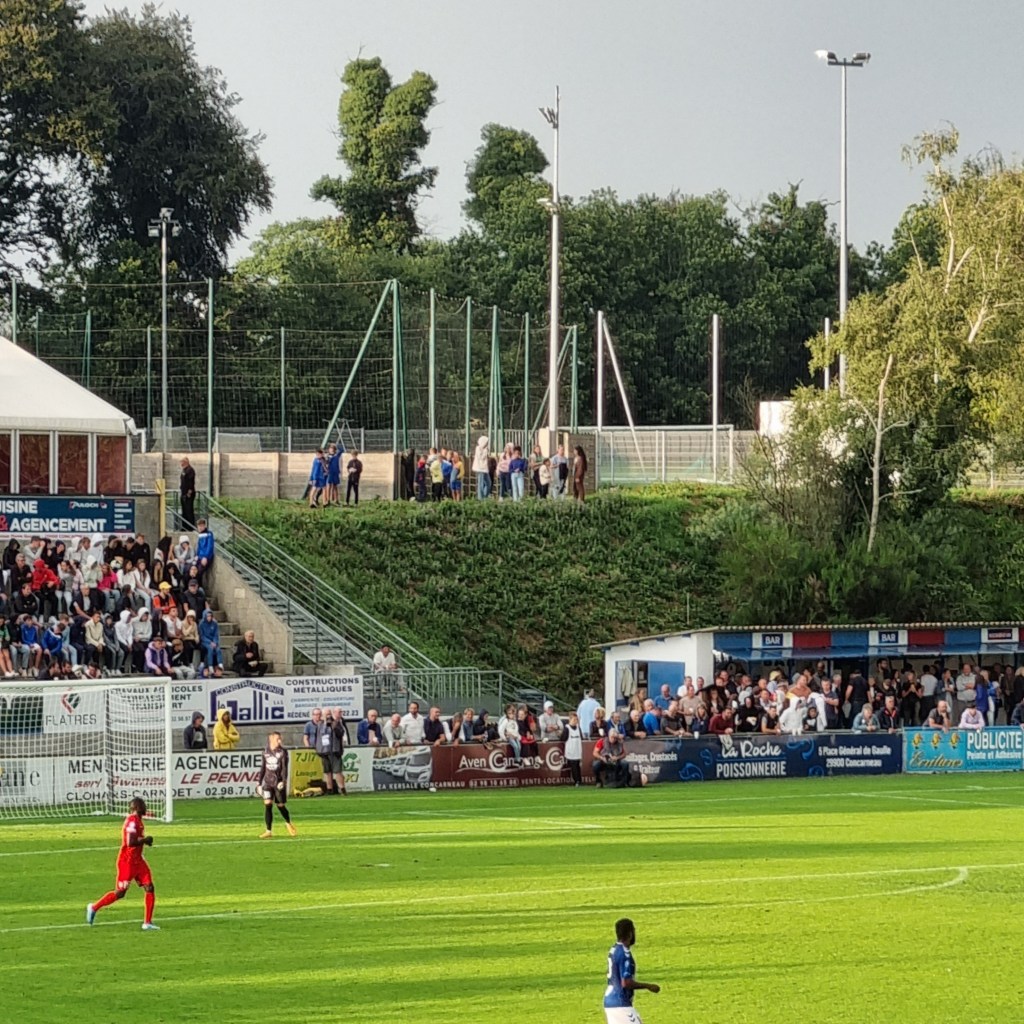
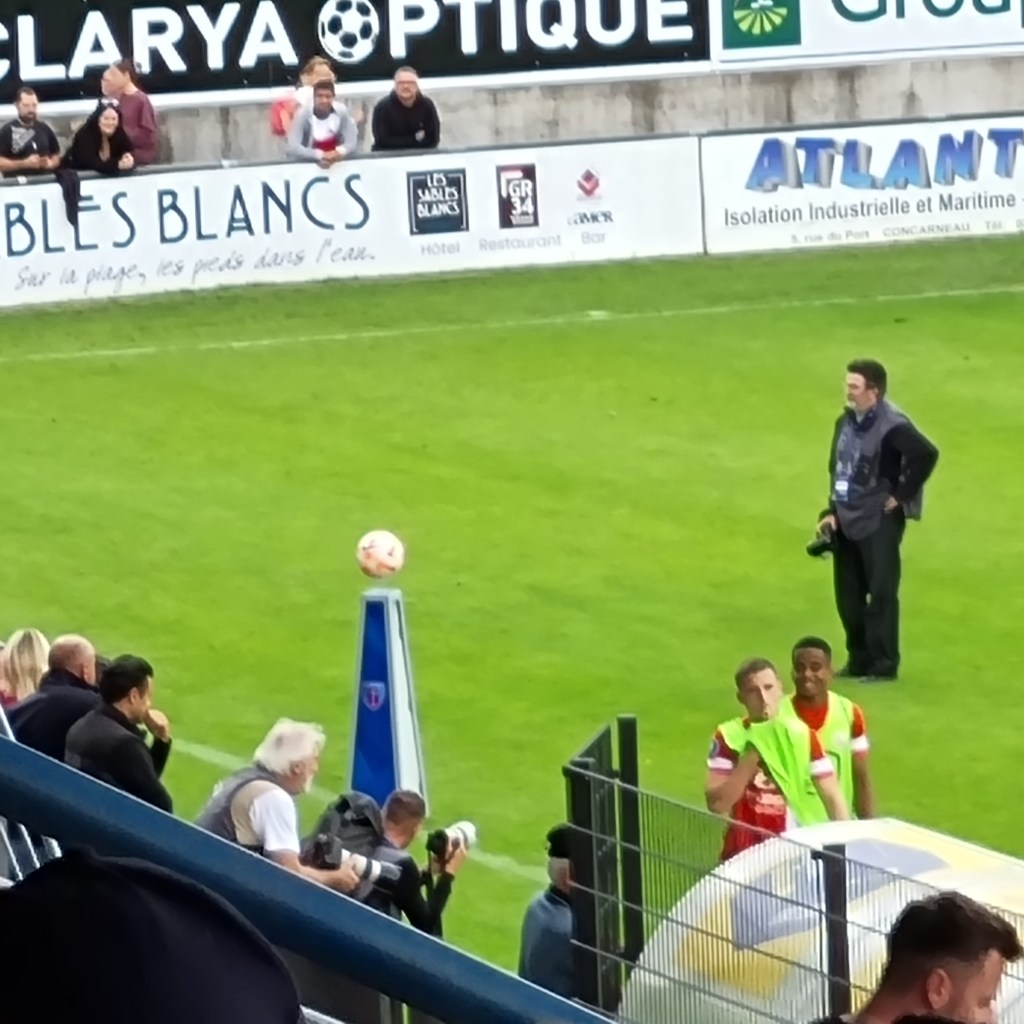
Having had difficulty trying to buy tickets on-line we had visited the ground earlier in the afternoon on arrival at Concarneau.  Although there are guichets open at the entrance to the ground selling tickets, these were shut when we arrived earlier and I had gone directly into the club office where I had selected our seats on someone’s lap-top and stood by his desk as he printed out two tickets for the main stand (12 euros each).  The stadium sits on the top of a small hill and the main entrance delivers us up a slope through an inflatable arch to the corner of the stadium; I don’t know if I’m in a football ground or a bouncy castle, but there is a main stand in front of us and to our left.  Pleasingly there is a club shop where for 5 euros I add to the collection of petit fanions (pennants) that adorn my upstairs toilet at home, and also purchase a mug (9 euros) and acquire a match day programme which, like at every French club that produces a programme, is free.  The ground has three excellent buvettes which remind me of stalls at a fairground; they serve huge sausages piled on top of massive heaps of chips, and the very tasty local ‘Britt’ beer. After visiting what is possibly the smartest and sweetest smelling toilet I have ever encountered in a football ground; it’s all stainless steel and shiny coloured tiles, I change euros into tokens worth a euro each and buy a beer for me (3 euros) and a cola (2 euros) for Paulene, which surprisingly and disappointingly is not Breizh Cola. I then join Paulene in the main stand for the pre-match entertainment of observing everyone else arrive, search for their seats or eat sausage and chips, before watching a fastidious man organise three pairs of youths into holding banners displaying the Ligue National logo and the two club crests.  Off to our left the match ball sits above a plinth in front of the players’ tunnel and appears to be hovering in mid-air.

At half past seven the match kicks off, with Nancy in their all-red kit getting first go with the ball.  Concarneau are in blue shirts and socks with white shorts and the first chant of the evening surprisingly emanates from the main stand; “Allez les bleus, Allez les bleus” confirms that I am not suddenly colour blind. On the far side of the ground, in the long, low, basic but well maintained partly seated, partly terraced stand a knot of supporters sing “Allez, Allez, Allez” to the tune of The Beatles ‘Yellow Submarine’.  

Perhaps because of the backing of the home crowd, USC quickly settle into the game and their number 24 Ambroise Gboho soon threads an excellent diagonal through ball into the path of Antoine Rabillard, who has made an overlapping run, but Rabillard hits his shot straight into the body of Nancy’s goalkeeper. USC’s Amine Boutrah then wins the games’ first corner and Tom Lebeau wins the second. “Allez les bleus, Allez les bleus” sings the home crowd again.  Lebeau crosses the ball and Rabillard heads over the bar. Low, evening sunlight falls across the pitch illuminating the grass vividly where it doesn’t cast a lengthening shadow of the main stand. The sky is gun metal grey in the distance; there have been heavy showers inland throughout the day and a rainbow extends up then fades away beyond the opposite stand.  Behind the left-hand goal, on the steep concrete terrace below the hospitality area people appear to be putting their coats on; it doesn’t seem to be raining but briefly there is a faint rattle on the metal roof of the stand.

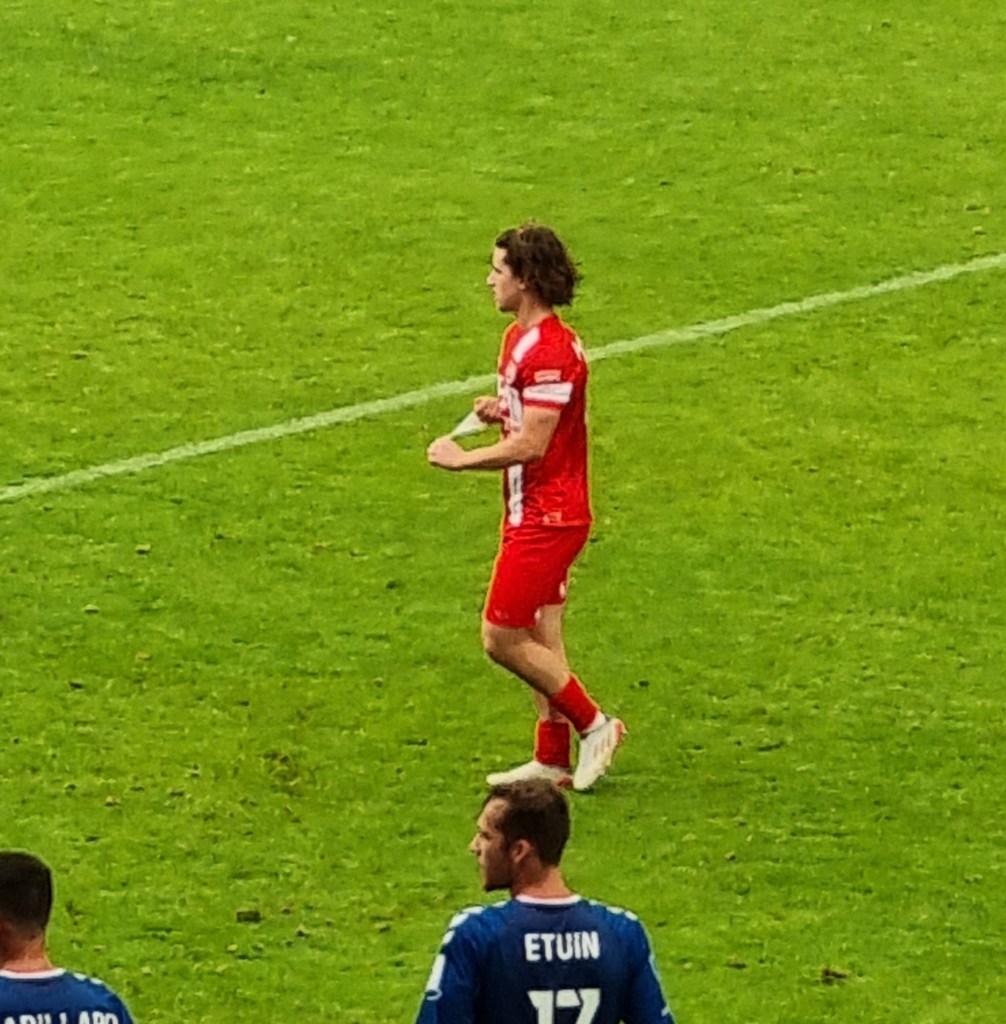
Back on the pitch, Nancy’s defending is effective but becoming more desperate and Lucas Pellegrini is the first player to see the carton jaune (yellow card) of the referee after he knocks over USC’s Amine Boutrah, who I am not surprised to read in the programme is the player of the month for August.  Within sixty-seconds Nancy’s number eight, Lenny Nangis follows the bad example that has been set and is booked for a foul on USC’s Georges Gope Fenepes.  If Lenny Nangis has any defence, it is that he has a great name.  The resultant free-kick is deflected over the cross bar for another corner to Concarneau.  A third Nancy player is booked five minutes later when Baptiste Mouaza fouls Ambroise Gboho. The supporters on the far side of the ground sing the na-na-nas from The Beatles’ “Hey Jude” and then Mouaza provokes a sharp intake of breath as he trips USC’s Gaoussa Traore and we await the consequences. Like a not very good magician the referee holds up his yellow card and then with a distinct absence of sleight of hand replaces it with a red one.  Mouaza hangs around for a bit, seemingly discussing his misfortune with anyone who’ll listen as most of the other players crowd around the referee and the prostrate Gaussa Traore. When the melee clears and Traore has risen from the dead, Mouaza seeks clarification from the referee that he is no longer required on the pitch and his worst fears are confirmed with a wave of the referee’s arm.

  A minute of the first half remains, and USC win another corner; the ball is crossed from the left and having evaded everyone else, falls in front of captain Thibault Sinquin who appears to do little more than absent-mindedly stick out a leg, and thereby scores.  After two minutes of added on time, the teams retreat to the dressing rooms for mi-temps (half-time) with Concarneau in possession of a well-deserved lead, although having failed to score for the first forty-four minutes the eventual goal came as a bit of a surprise. Half-time sees a flood of people towards the buvettes and I get up from my seat to stretch my legs and peer down on them through the scratched Perspex screen at the end of the stand.

The game resumes at 8:32 and although Nancy have some early forays down the flanks it is USC’s Ambroise Gnoho who comes closest to scoring but for an offside flag and Lebeau shoots past the post from all of 30 metres.  With just ten minutes gone of the new half Georges Gape Fenepes,  who might be the first player from New Caledonia I have ever seen, is substituted by Faisal Mannai.  I don’t think it’s Mannai’s fault but within a minute of his appearance a passing move down the left for Nancy ends with the sort of cross commonly known as ‘inviting’, and Lenny Nangis  accepts the invitation, heading firmly into the Concarneau net to unexpectedly equalise.

Despite having lost their lead, Concarneau will surely still go onto win having a man advantage and they continue to press forward with Robillard, Traore and Boutrah always looking the most likely to conjure up a decent chance.  With a third of the match remaining USC win another corner after a flurry of activity around the Nancy goal.  A low cross from the right is just too far ahead of everyone to allow anyone to touch it into the net.  “Merde” says the bloke behind me through gritted teeth as a pass by substitute Faisal Mannai is intercepted by a Nancy player who breaks forward into the Concarneau half.  Nothing comes of it however and Thibault Sinquin in turn breaks forward for USC from his centre half position, but his low cross from inside the penalty area is cleared.

The game is into its last fifteen minutes or normal time and Gaoussa Traore lashes a shot somewhat desperately, which travels high and wide of the Nancy goal.  Nancy substitute Lamine Cisse for Isaak Umbdenstock, but not before Cisse looks confused as to which direction he must run to leave the pitch; after initially running away from the benches he checks and runs back and Umbdenstock runs on.  Concarneau replace Adrien Jouliex with Alec Georgen but are coming no closer to scoring a second goal.

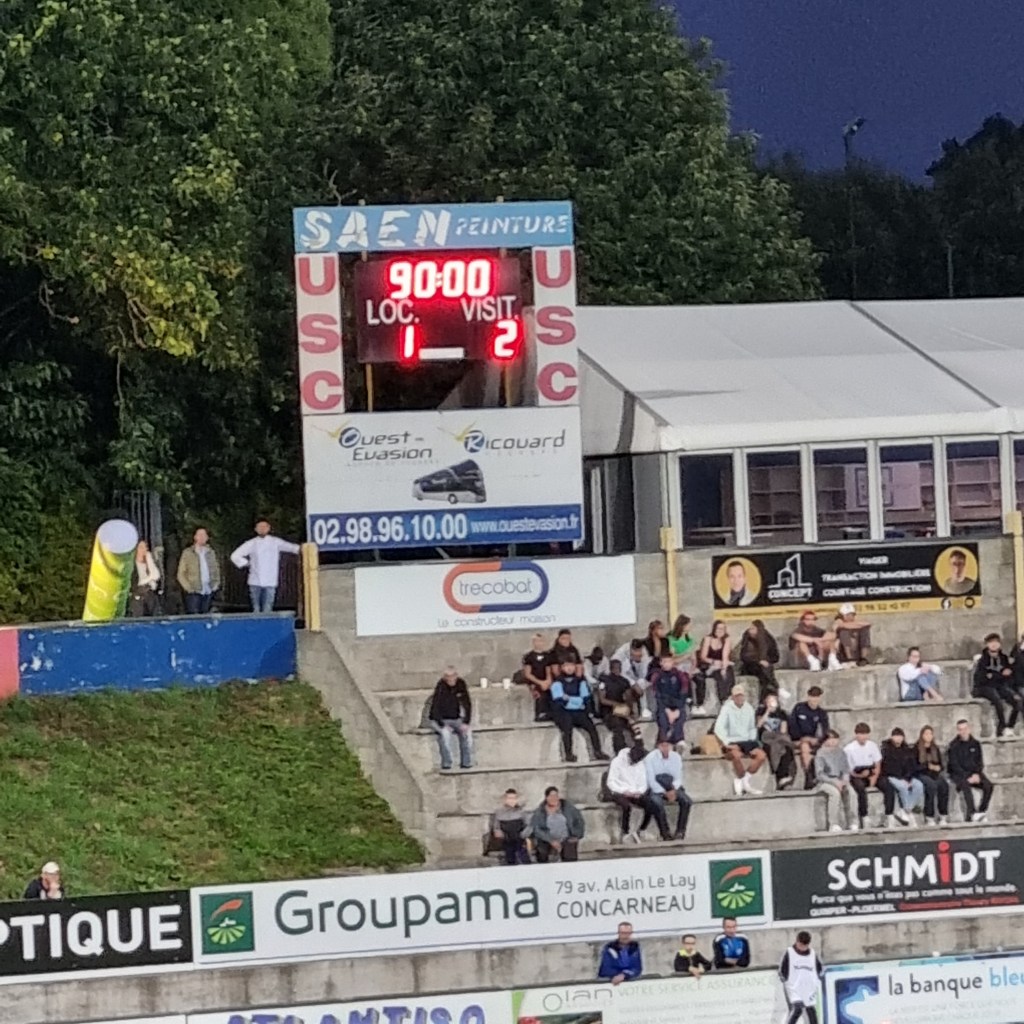
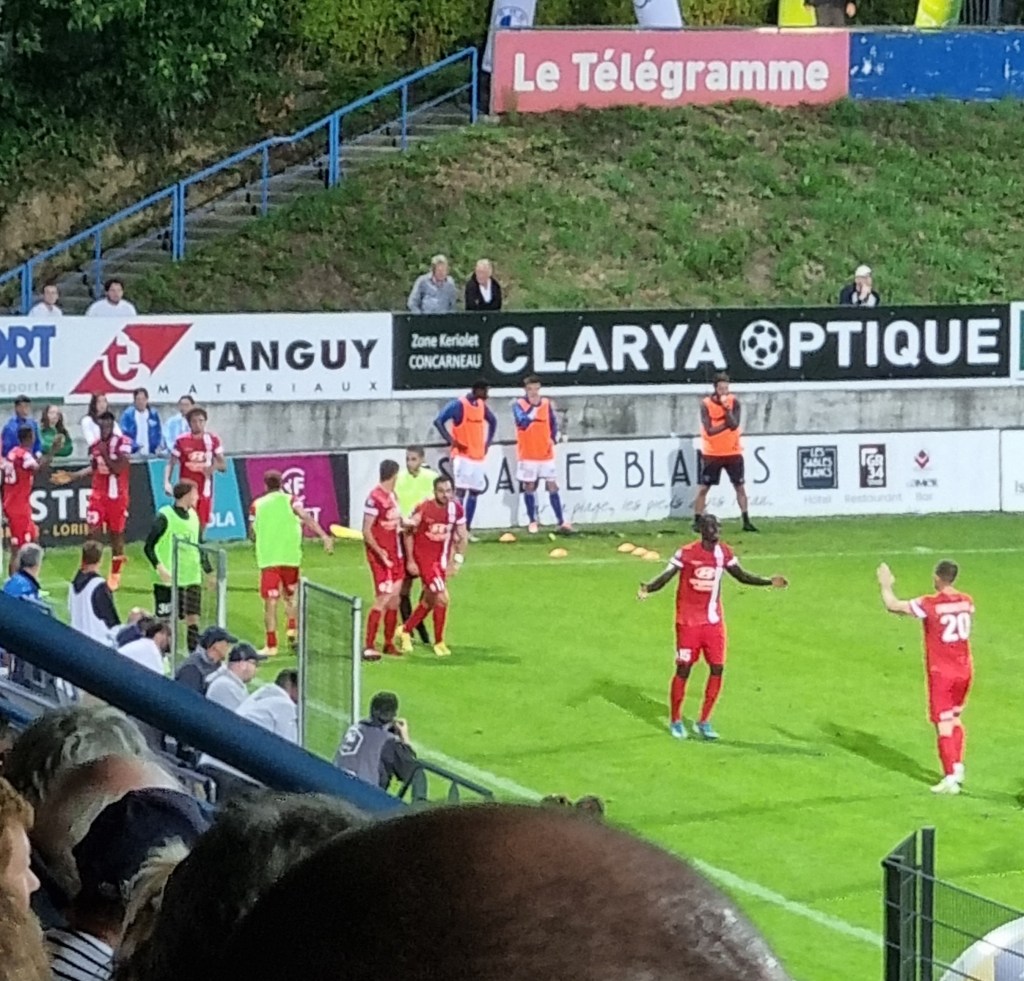
Ten minutes remain of normal time and Nancy win a rare corner;  Diafra Sakho meets the ball on his forehead and Nancy are suddenly winning as the ball bulges the net with the Concarneau goalkeeper and defenders static.  Even now I can’t bring myself to believe that Concarneau won’t equalise,  but as Tom Lebeau is replaced by Pierre Jouan there are just seven minutes left and Nancy are taking every opportunity, and creating more to eke out that time by winning free kicks and staying down on the ground.  When a player goes down ‘injured’ on the far side of the field the slow-moving physio who looks about seventy-five can only trundle across the pitch.  Nancy make use of their penultimate substitution before six minutes of added on time are announced and then make the final one as they control the end of the game, not in terms of active football but in terms of frustrating Concarneau by fragmenting the remaining time into useless moments of nothingness.

Full-time arrives too soon for Concarneau and Nancy will make the 920 kilometre journey back to Alsace with an unexpected win, which in the context of modern football they deserve, but it wasn’t always much fun to watch and many would say they had ‘stolen’ the points.  Nevertheless, Concarneau is a great place to come to watch a match and is reminiscent of an English fourth division ground but with better beer, better food and cheaper admission prices; Paulene and I therefore have had a splendid time.