Ipswich Town 6 Doncaster Rovers 0

Who doesn’t love a match under floodlights?  Not just the floodlights of a mere afternoon match once the clocks have ‘gone back’, but the floodlights of a fully-fledged evening fixture, one that doesn’t begin until it’s dark and when the walk to the match is like being drawn towards a glowing beacon; it’s even better on a rainy night, and tonight is such a night.

Having arrived in town early for work related reasons, I get to park up my trusty Citroen C3 on Anglesea Road and amble down to the Arboretum (now known as the Arbor House) where I sit in the garden to eat a Scotch egg (£4.00) and down a pint of Woodforde’s Kett’s Rebellion (£3.80).  The only other table in the garden that is occupied plays host to three twenty-something blokes, one of whom intermittently calls out “Blue army” as if he’s suffering from some sort of oddly Ipswich-based variant of Tourette’s syndrome. After half an hour Mick arrives, announcing his arrival in French; I treat him to a pint of Kett’s Rebellion, because it’s a beer the taste of which is worth sharing.  Mick requests some dry roast nuts (£1) too,  which don’t come in a packet as we had both expected, but in a cup,  “Ooh, you do them like that” I say to the young woman serving behind the bar, trying not to sound fazed.   Back outside it starts to rain, and we move to a table with an awning whilst Mick and I curse the planet destroying evil of outdoor heaters.  Mick and I talk of making speeches at weddings, of who Kett was, of Angela Merkel and of local government before 1974.  Twenty or so minutes before kick-off we head for Portman Road, Mick walking his black bicycle beside him.

The rain is merely an occasional drizzle and having left Mick to lock up his bike somewhere in Sir Alf Ramsey Way, I am invited to prove that I wasn’t frightened of a ‘sharp scratch’, unlike these scaredy vaccine deniers, who clearly are, and having snapped up a programme (£3.50), I proceed through turnstile number fifty-nine into the hallowed halls of the Sir Alf Ramsey Stand and the gents toilet nearest the players’ tunnel.  Relieved, I join the assembling throng as the two teams enter the field of play. Ever-present Phil who never misses a game is here (of course), and so are Ray’s son and his grandson Harrison, but Ray and Pat from Clacton are absent; it makes me wonder if the Clacton branch of the supporters club aren’t able to get a coach ‘up’ for midweek games, perhaps because the Tendring peninsula is under curfew once the sun goes down.  I will later learn however that the Clacton branch run a coach to all home games, but tonight Pat is unwell. Get well soon Pat from Clacton. Fiona arrives shortly after kick-off; the train was late.
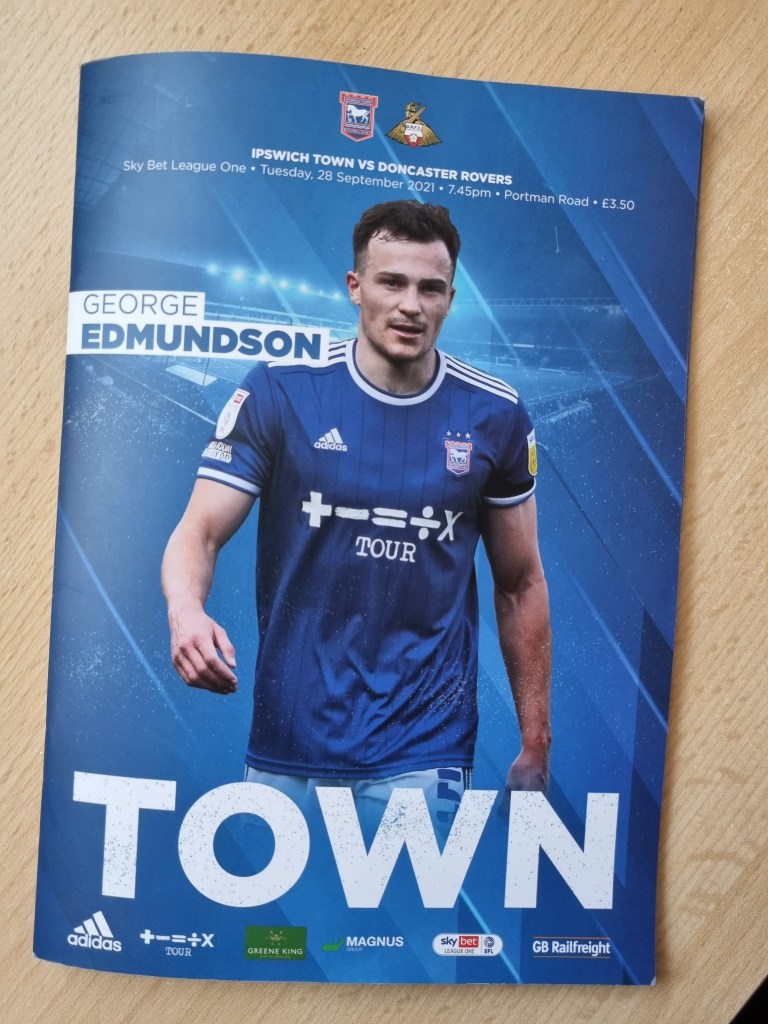
It’s Doncaster Rovers in their red socks, red shorts and red shirts with thin white hoops who get first go with the ball, and although we don’t know it yet, it will prove to be one of their best moments of the game.   Cameron Burgess is an early casualty of hairless referee Carl Brook’s yellow card as he tries to interrupt Doncaster goalkeeper Pontus Dahlberg as he takes a drop kick.  Dahlberg is an unfortunately angular looking man who disproves the theory that Scandinavians are all tall, blonde and good looking, although admittedly he does score very highly on the first two criteria.  Twelve minutes pass and a poor cross field pass from some or other adopted Doncastrian is intercepted by Wes Burns, who charges forward to the by-line and turns in a low cross which the oddly named Macauley Bonne has only to direct into the net.  It’s a good start. Town lead, and Mr Bonne celebrates like a Chantry boy who scores for the Town should.

“Hark now hear the Ipswich sing” chant the ‘Boney M’ supporters’ group from the lower tier of the Sir Bobby Robson stand as they gear-up for Christmas.   “Shall we sing, shall we sing, shall we sing a song for you?” chant the Doncaster Rovers supporters up in the Cobbold Stand as Portman Road once again goes quiet after the goal; presumably someone tells them “No thank you” because that’s the last we hear from them.

With Town a goal up, the excitement subsides, and I ponder what “Built Environment Recruitment” is as referred to on the advertising board for Conrad Consulting.   I like to think that I could maybe phone Conrad up and ask him to send round a couple of terraced houses, an office block and a beach café to drive some petrol tankers.  The game is a bit scrappy, mainly down to Doncaster’s lack of precision, but Sam Morsy is looking good for Town in front of the defence and intermittently Town break down the flanks to put in testing crosses.

A half an hour passes, and Town earn a corner.  There is a lot going on in the penalty area but the kick sails across nearly everyone to a point beyond the far post, where Lee Evans is all alone waiting to stroke the ball into the net. Referee Mr Brook stares hard at the scrum of players in the front of the six-yard box, in the manner of a bald Paddington Bear, but can evidently not discern that any offence has been committed and the goal stands. Two-nil; Fiona confirms that we’ve been here before (versus Wimbledon) and not won. 

Celebrations completed, the game re-starts and Doncaster’s Joe Dodoo becomes the second name to enter to enter the notebook of Mr Brook, possibly because Mr Brook thinks it’s too good a name not get in his collection, but also because he chops down Matt Penney.   Town are now clearly the better team and playing some fine one and two-touch, passing football. Sam Morsy has a powerful shot from 20 metres that goes not too far over Pontus Dahlberg’s cross bar; it’s not the sort of thing we’ve seen for a while.
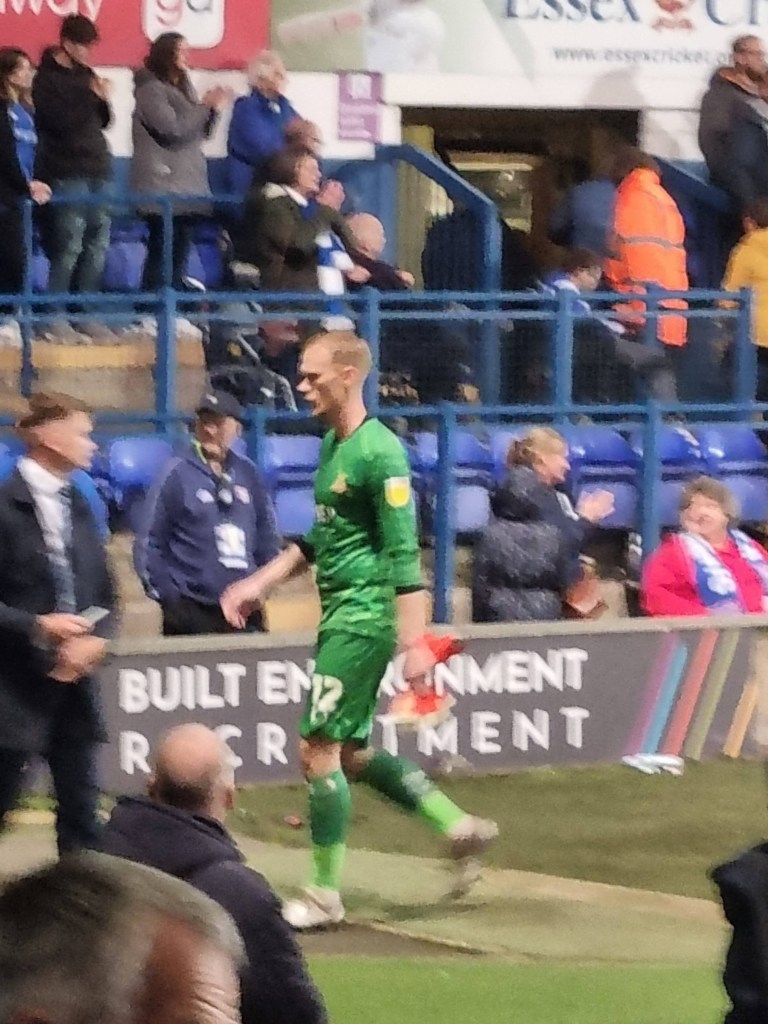
Half-time arrives to appreciative applause and with no Ray to chat to I eat a Nature Valley peanut and chocolate protein bar in silence, although I later speak with ever-present Phil who never misses a game.  Phil tells me that there was no Matchday Special in St Jude’s Tavern this evening and I feel his disappointment.  At the corner of the pitch meanwhile, stadium announcer and former Radio Suffolk presenter Stephen Foster, who was at school with my friend Pete, conducts a Radio Suffolk style interview with former Town hero Jonathan Walters, who is the recipient of warm applause.

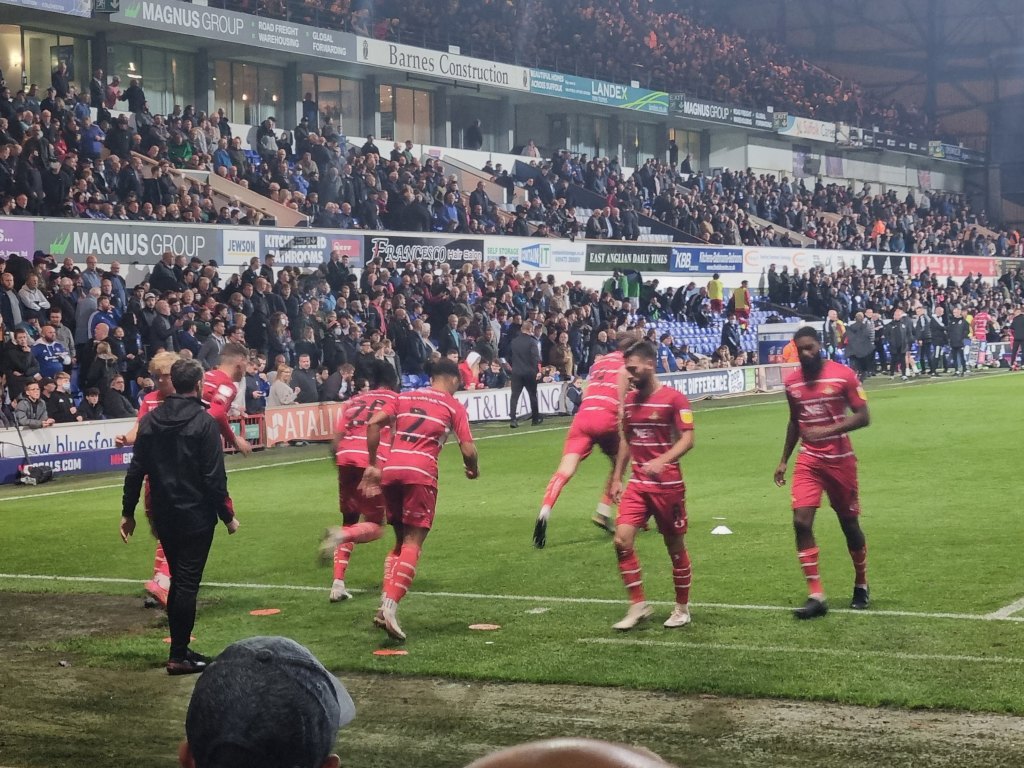
When it begins, the new half brings substitutions for Doncaster as Joseph Owulu and Rodrigo Vilca replace Jordi Hiwula and Danny Gardner. This evening’s attendance is announced as 18,111, of whom 165 are from Doncaster, or are at least sat in the upper tier of the Cobbold Stand pretending to be so.  As Stephen Foster reads out the numbers many in the crowd applaud, seemingly congratulating themselves for having bothered to turn up, odd. It strikes me that Doncaster’s blonde-haired number fourteen Matthew Smith, looks a bit like 1980’s Town midfielder Trevor Putney; I suspect however that he doesn’t really and it’s just his hair, either way he’s changed since he played Dr Who.

“Who the fucking hell are you? sing the more impolite occupants of the Sir Bobby Robson stand to a Doncaster player whose identity I can’t work out either, and then in a moment of uncharacteristic attacking intent, Doncaster’s Tiago Cukur has a shot on goal which Town ‘keeper Vaclav Hladky doesn’t so much save, as just stand on tiptoes to catch.  It’s the last action Vaclav will see for a while as Town suddenly go into goal scoring overdrive. Breaking down the left, Bersant Celina, with open grassland in front of him, gets to a point where he needs to cross, so he checks and loops the ball over into the penalty area where as if by magic Lee Evans appears to head home unchallenged inside the far post. It’s a goal of beautiful simplicity.  Two minutes later and another cross from Bersant Celina on the left is controlled on his chest by the oddly named Macauley Bonne, who then proceeds to volley the ball just inside Dahlberg’s right-hand post; it’s the best goal of the night, or is it?.  Just another two minutes pass, barely time for the Sir Bobby Robson stand to finish a chorus of  “And it’s  I-pswi-ch Town, Ipswich To-wn FC, they’re by far the greatest team, the world has ever seen” followed by “E-i-e-i-e-i-o, Up the football we go” when Wes Burns lays the ball on for Lee Evans to lash high in to the top right hand corner of Dahlberg’s net.  Cracking goal, possibly even more spectacular than the last one.  From 2-0 to 5-0 in not much more than five minutes.  Just four minutes later and the Sir Bobby Robson Stand are singing “Six-nil to the Tractor Boys” and sounding like the Pet Shop Boys, as George Edmundson diverts the flight of a free-kick from Lee Evans in the best possible way.   Ever-present Phil who never misses a game, turns to me and Fiona to tell us that the last time Town scored six was away also against Doncaster Rovers (February 2011); I’ve no idea if he’s right but if anyone should know it should be ever-present Phil who never misses a game.

Ten minutes of normal time remain, and without wanting to seem greedy I’m hoping for a seventh goal, after all, I haven’t seen Town win 7-0 since 1974.  It was Mick Mills who scored Town’s seventh goal that Saturday night forty-seven and a half years ago, and tonight substitute Rekeem Harper tries to emulate him with two minutes left, but his shot travels in a frustratingly straight line and hits a post rather than swerving outrageously around the goalkeeper like Mick’s shot did.  I have no idea how many minutes of added time are added on, but when you’re winning six-nil such details no longer matter; the minutes come and go however without further shots eluding Pontus Dahlberg.  The final whistle produces the sort of love-in not seen at Portman Road since, well I don’t honestly know when.  Relief, elation and an element of disbelief swirl about as I applaud the team from the pitch.  Paul Cook makes a laudably quick exit down the players’ tunnel to allow his team to take the plaudits and hopefully so that he can put the kettle on and may be break open the Custard Creams.

As I hurry up Portman Road and back to my trusty Citroen C3, excited chatter and snippets of throaty chants fill the night air. “I’d have been livid if I hadn’t come tonight” I hear a man say to a friend as they exit the Cobbold Stand, suggesting perhaps that he nearly stayed at home.  “Were we really good or were they just bad?” asks a passing woman from within the crowd; unfortunately, she and whoever she asked the question of are out of earshot before she gets an answer.  If she had asked me, and why wouldn’t she, I think I would have said “A bit of both”.

Driving home I hope that tonight has been a turning point; the night when our new squad of players finally endeared and proved itself to Town supporters; whether it is or not, I shall remember it. It’s been a while since we scored six, or conceded nil at Portman Road though best of all it happened beneath the floodlights and in the rain.

Brightlingsea Regent 1 Merstham 1

Until 1964 I could have journeyed all the way to Brightlingsea by train via Colchester and Wivenhoe, but the treacherous activities of the evil Dr Beeching mean that it is now necessary to leave the train at Colchester and then catch a number 62 bus. My excuse today for not using public transport is that the bus journey alone would take me the best part of an hour and it would also prevent me from stopping off on the way home to buy much needed mushrooms, salad and bananas at Waitrose. Today therefore I am making the 32 kilometre trip by Citroen C3 and saving the planet takes second place to future breakfasts, lunches and a boeuf bourguignon.
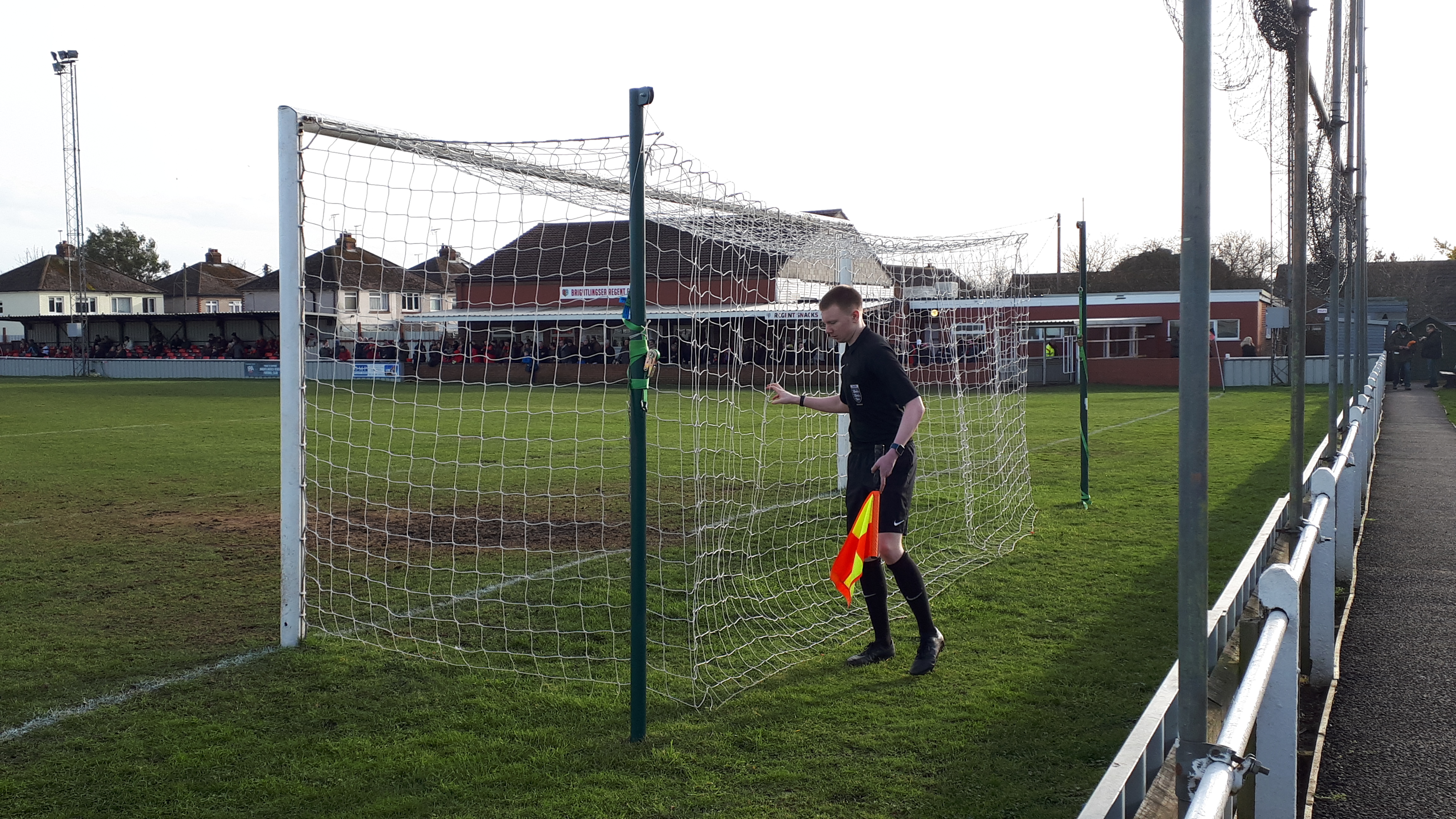
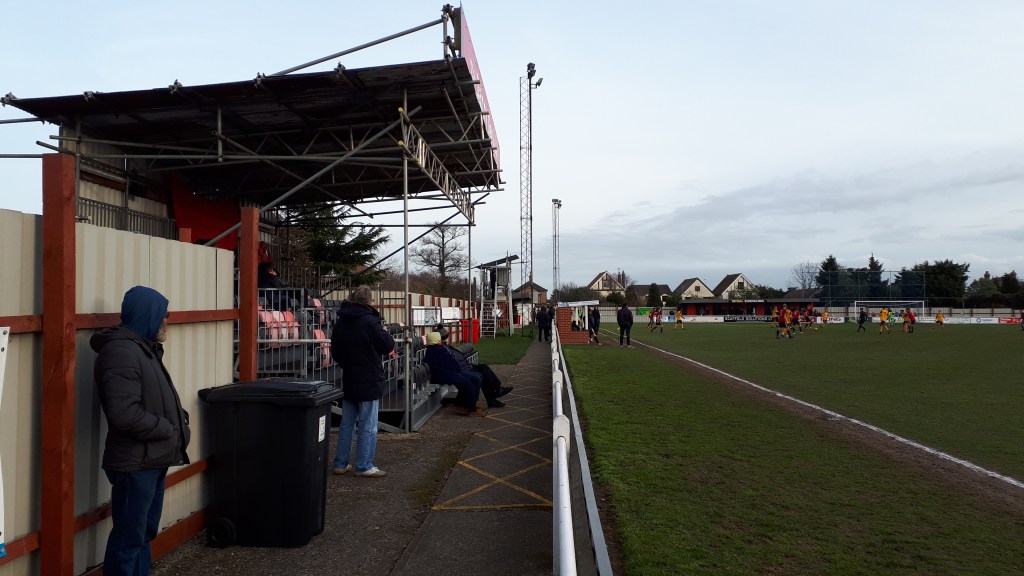
It’s a bright and blowy Saturday afternoon and wispy clouds scud across a pale blue sky. The B1029 twists its way across the flat lands of the Tendring peninsula and down into Brightlingsea from the north, past medieval All Saints Church with its impressive tower, sitting high on a hill outside the town; part place of worship, part lighthouse. Brightlingsea itself arrives as a sprawl of mid-twentieth century houses around a much older central core and a waterfront. I miss a turn, but having gone round the block I find my way. Residential North Road, all pebbledash and net curtains leads to Brightlingsea Regent’s home ground, currently called the Taydal Stadium, but more traditionally referred to as plain old North Road.
I reverse the Citroen into a space at the end of a line of other similarly neatly reversed family saloons. It’s a very short walk to the turnstile where I tender the correct money for entry and a programme (£10 + £2). Just inside and I am assailed by a lady with copper coloured haired selling draw tickets (£1 each); although not a gambling man I can’t help but feel it would be rude not to buy one, so I do. Come half-time ticket No372 will win, I’m sixteen tickets too late; if only I hadn’t missed that turning into Spring Road. It’s not quite twenty to three, so optimistically I think I might have a beer and therefore take a look in the bar; sadly there’s no hand pump, so I don’t bother; I can’t be doing with that cold stuff full of burps. At one end of the room however is a very brightly lit trophy cabinet which shines like a beacon and could easily attract magpies or ward off shipping from the mud banks in the Colne estuary; it has a slightly incongruous appearance in the otherwise very plain surroundings.
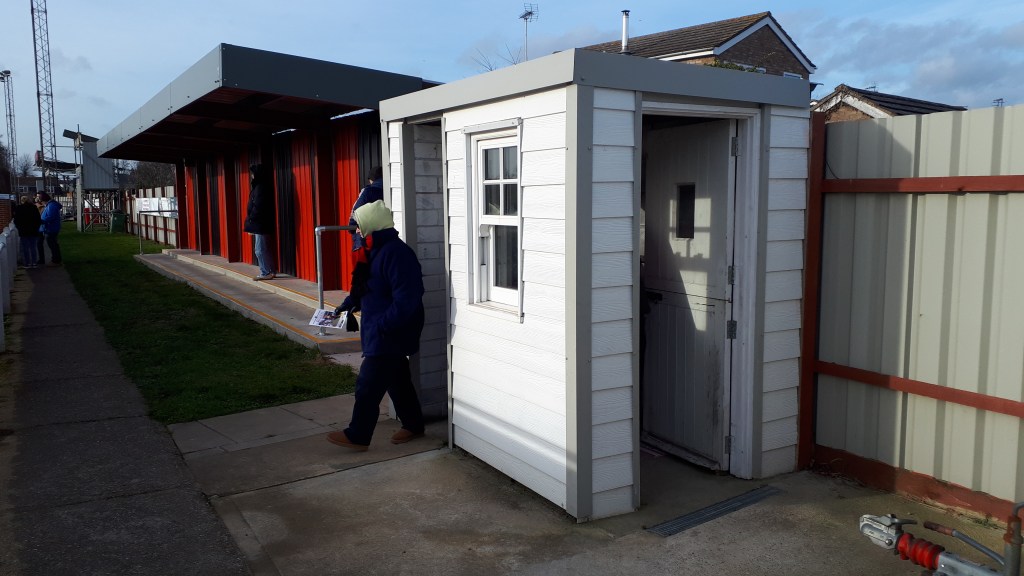
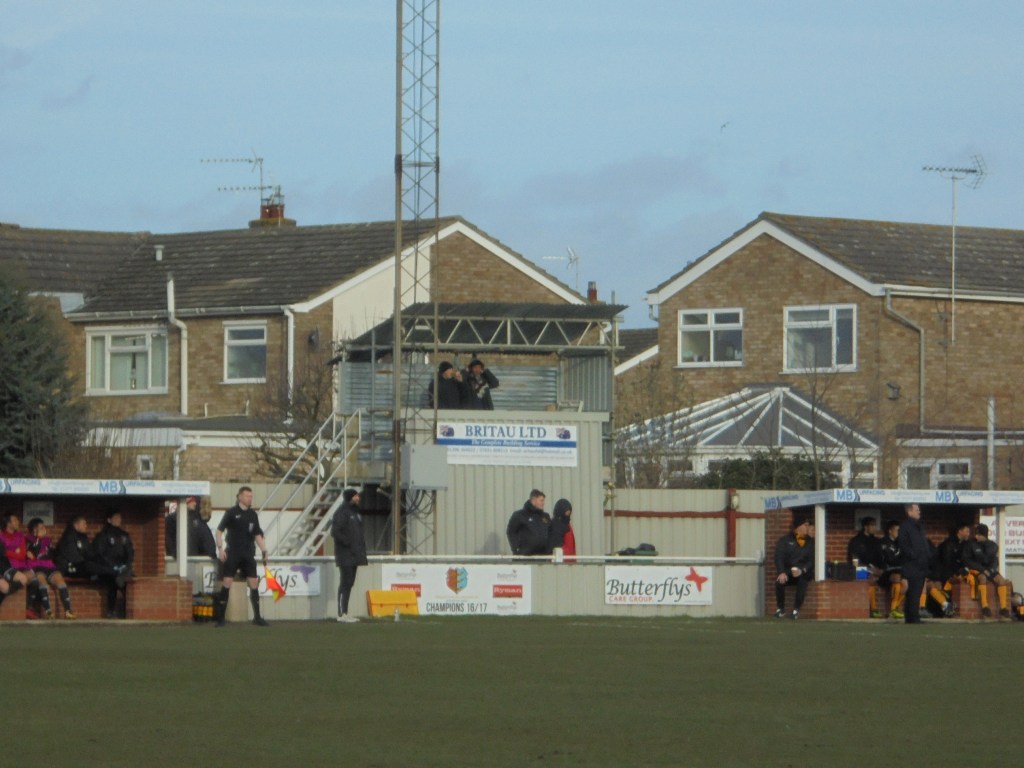
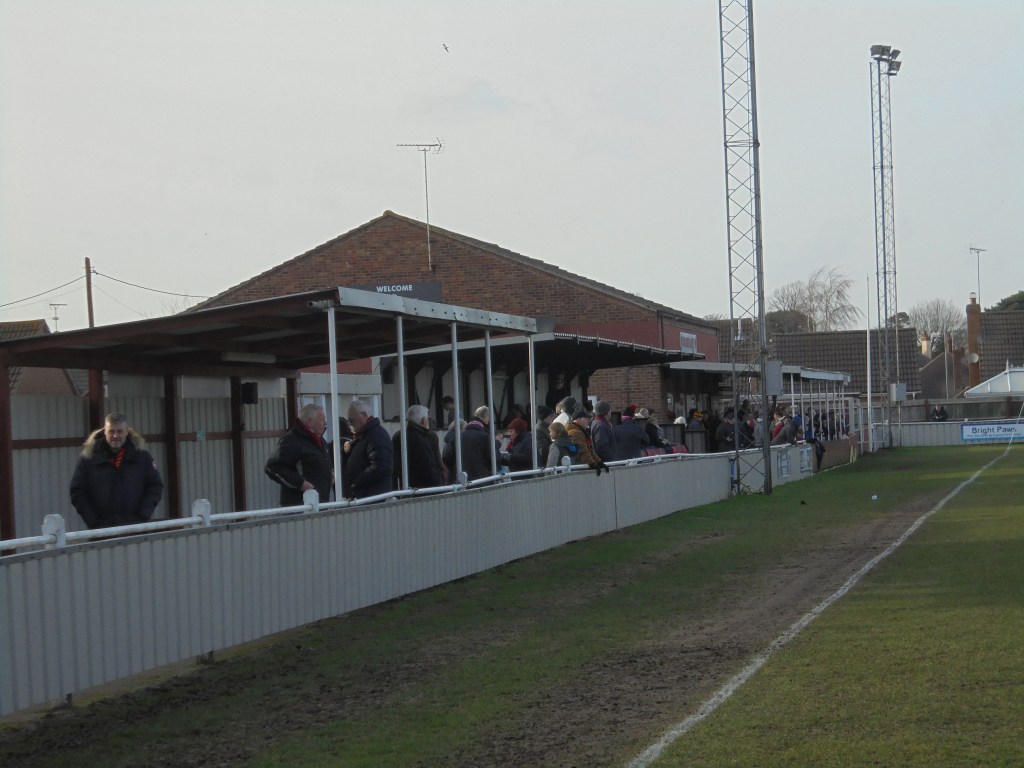
Back outside I seek out the ambience of non-league football. North Road is a hotch-potch of low stands and covered terraces confined within a steel fence backed up against the gardens of dull suburban houses. Beneath the cover outside the clubhouse people are eating chips from small polystyrene trays and drinking beer from plastic cups. The hatch in the club house wall beneath a sign that reads Regent Snacks is doing a steady trade.

Several free range children run about the stands and path around the pitch; today’s match is sponsored by the Brightlingsea Regent Youth Section which no doubt accounts for this. From the public address system, the names of the teams are announced. “First, the Mersham team” says the disembodied voice, mispronouncing the name of the visiting club and annoying at least one of their twenty or thirty supporters who are preparing to choose a goal to stand behind. As I drove to the ground this afternoon even the BBC Radio Essex announcer made the same mistake; I can only attribute this to being in a County where much of the population can’t pronounce the letters ‘th’ as anything other than an ‘f’ or a ‘v’, but ‘Mersfam’ would sound silly.

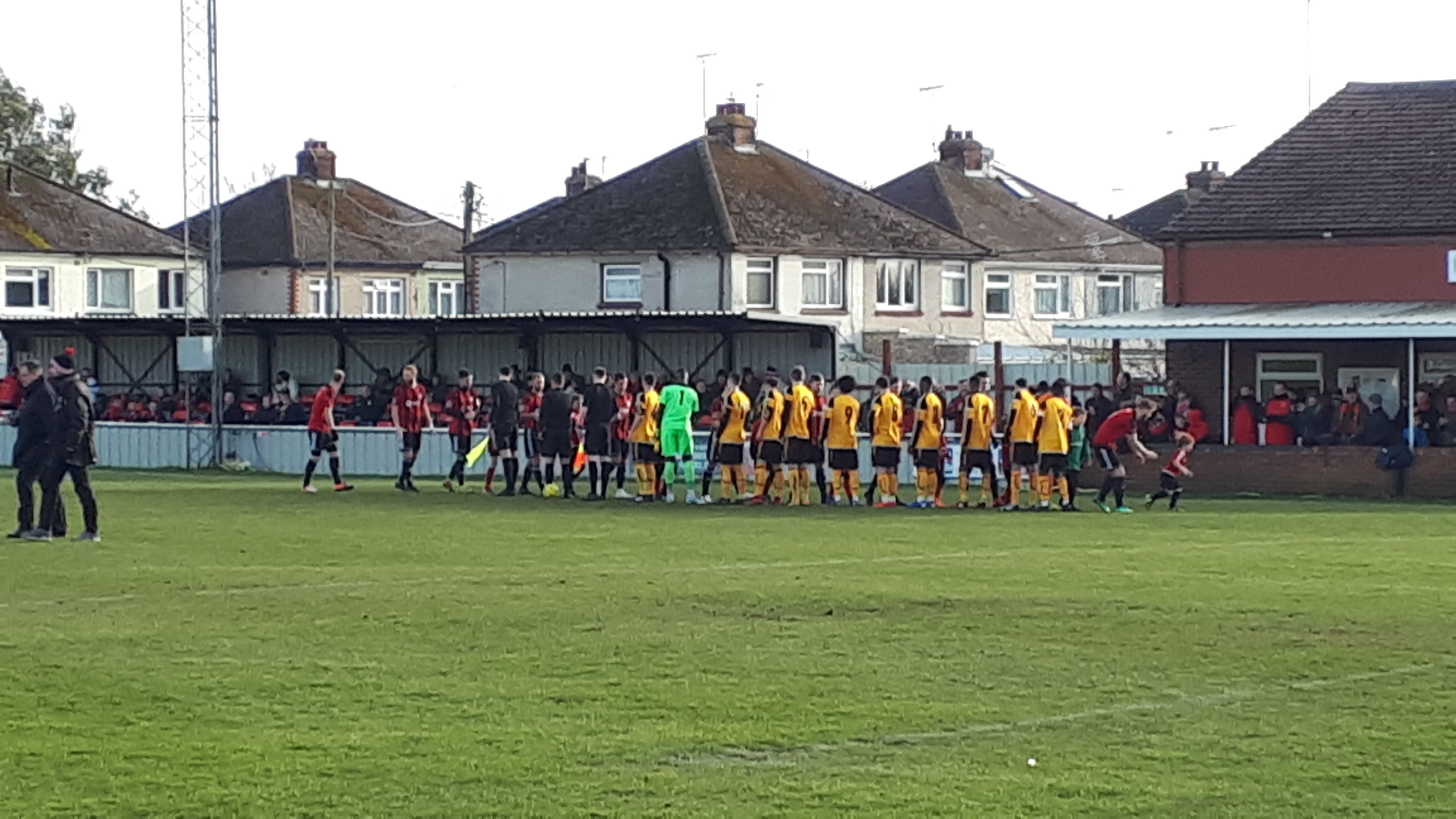
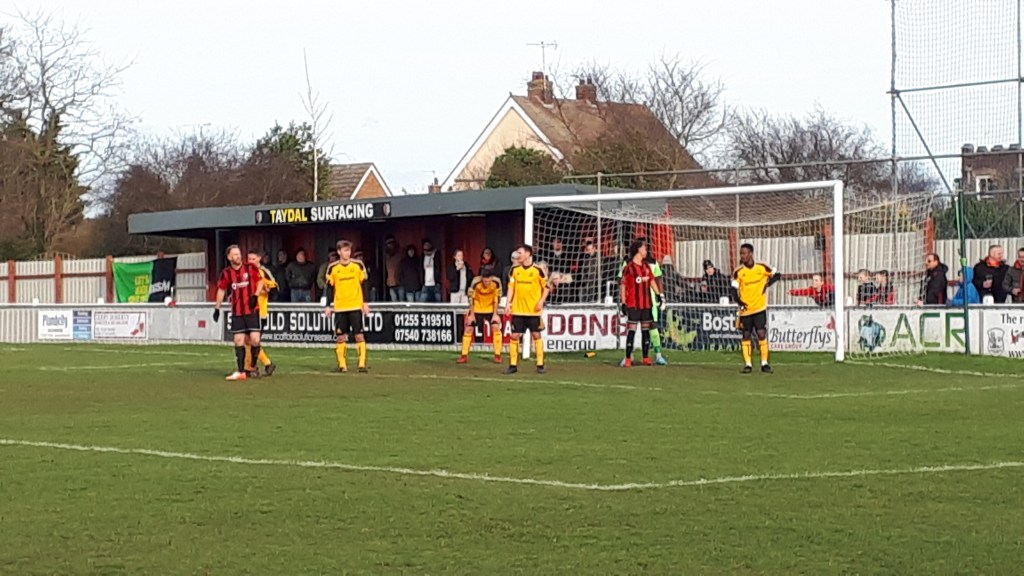
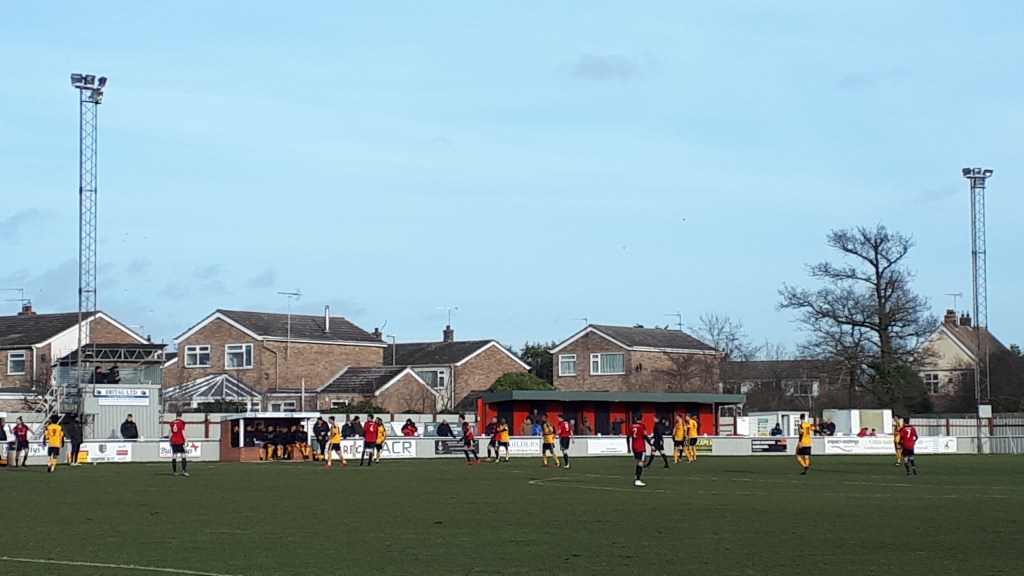
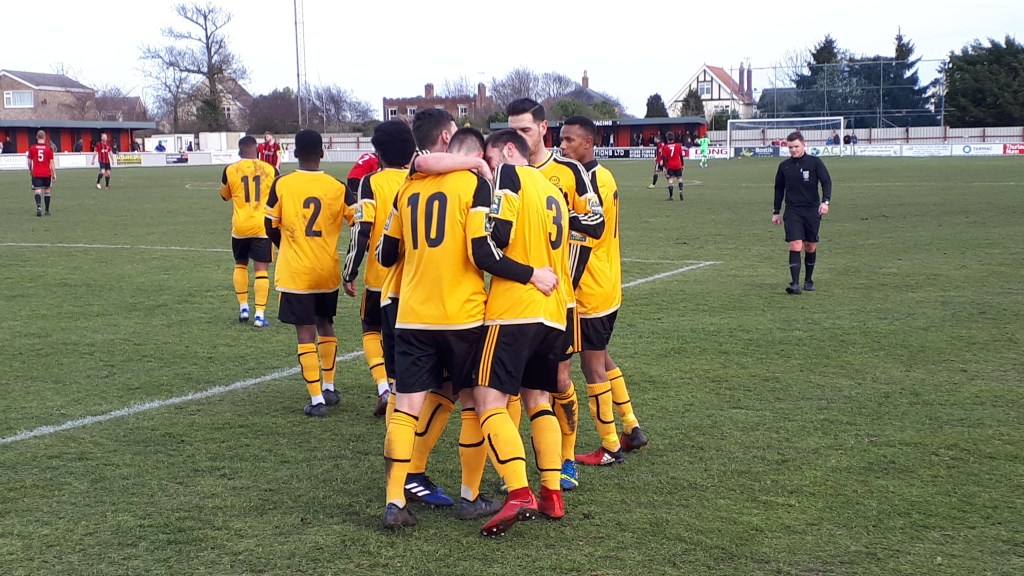
I take a walk around the perimeter of the pitch and then the teams emerge from the corner of the ground by the club house, walking in two neat lines behind the referee Mr Karl Sear and his leggy assistants Leo Del Rosso and Ashley Butler. The standard mass handshaking ensues before Merstham break from a team huddle to kick off towards a row of ugly bungalow roofs which form the backdrop to the goal at the clubhouse end of the ground. Merstham wear yellow shorts and socks with black shorts, whilst Brightlingsea sport a natty kit of black and red striped shirts with black shorts and red socks and kick towards the suburban back gardens of houses on Regent Road, one of which rather unexpectedly and splendidly has crennellations. It’s a colourful sight.
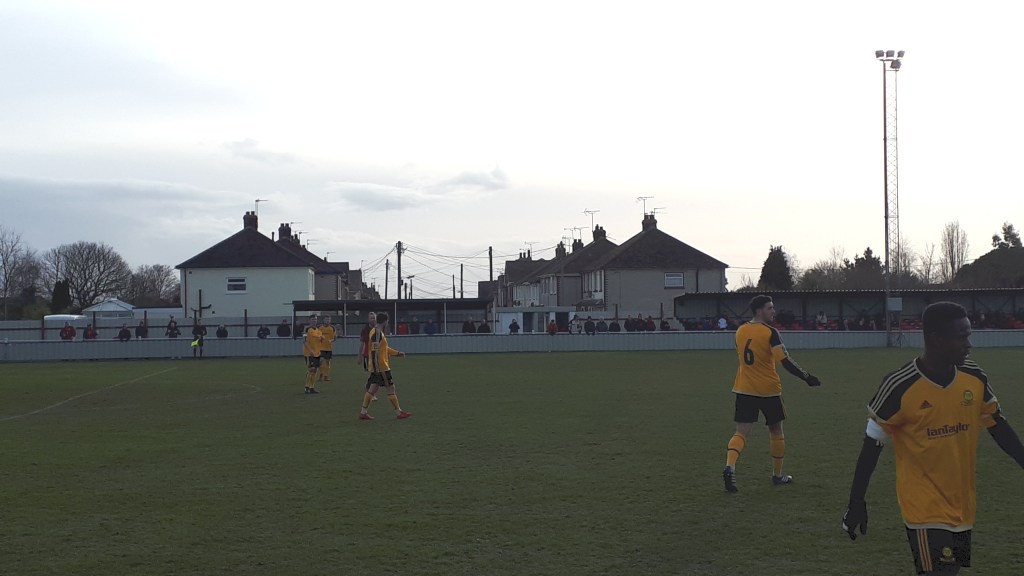
The opening minutes of the game see Merstham, who are third in the excitingly titled Bostik Premier League, but only five points ahead of twelfth placed Brightlingsea, spending as much time in the Brightlingsea half as Brightlingsea, but gradually the game evens out into an inconclusive midfield struggle. Brightlingsea have a shot cleared off the line which the home crowd are convinced was a goal. Fortunately there is no VAR to make shouting “Linesman, you’re useless” a redundant exercise, so somebody shouts it. On the covered shallow terrace behind the Merstham goal the self-styled Brightlingsea Ultras sing “Can you hear the Merstham Sing?” A respectable looking middle-aged woman quite quietly says “No swearing, please” and the Ultras complete their chant singing “I can’t hear (pause), anything, wo-oa, wo-oa-oah”.
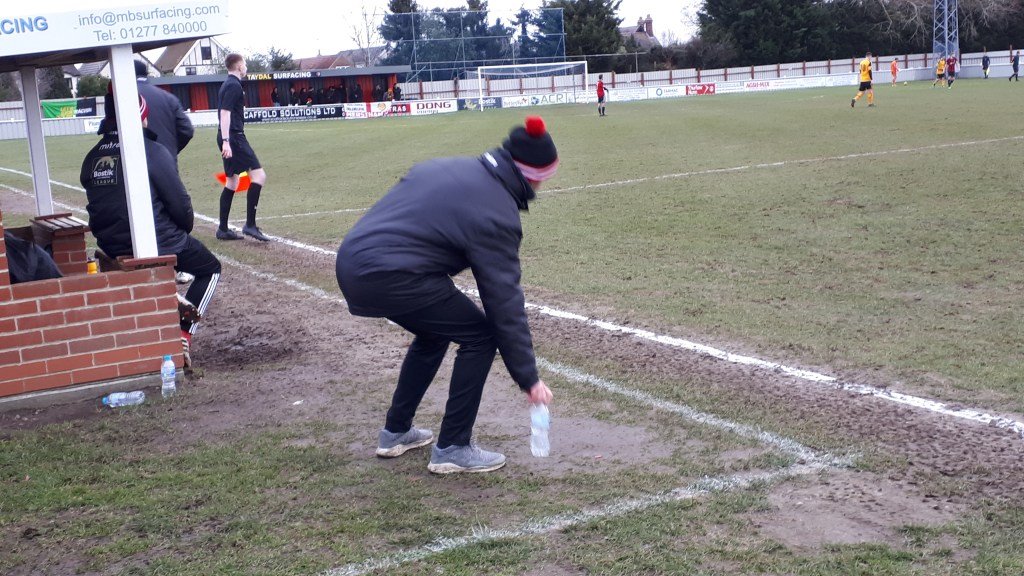
I wander round to the dugouts, interested in what the coaches and managers are doing. The Merstham manager is smartly dressed in a mid-length, navy blue rain coat, shiny black shoes and neatly pressed trousers; he sips from what appears to be a paper cup of coffee, although I guess it could be super-strength cider, but that wouldn’t really fit the pattern established by his wardrobe. The Brightlingsea manager wears a woolly hat, trackie-bottoms and football boots; he glugs from a plastic water bottle which he chucks to the floor when he’s finished. This is the Surrey stockbroker belt versus Tendring. Merstham is on the edge of Reigate, a town 21st out of 401 in a league of average tax bills drawn up by Chartered Accountants Hacker Young for 2011-12.

“Go Manny” shouts the Merstham manager, not just when number eleven Emanuel Ighorea has the ball, but whenever anyone else does too. “Come inside, keep sucking it in” he adds complicating matters. His subsequent plea to “Get the ball” seems sensible if perhaps over simple. On the Brightlingsea bench there is the same concern for their number eleven, Harrison Banner. “Look at Banner, look at Banner!” is the exasperated call, followed by “For fuck’s sake” suggesting that if anyone did look at Banner they forgot to do anything else.

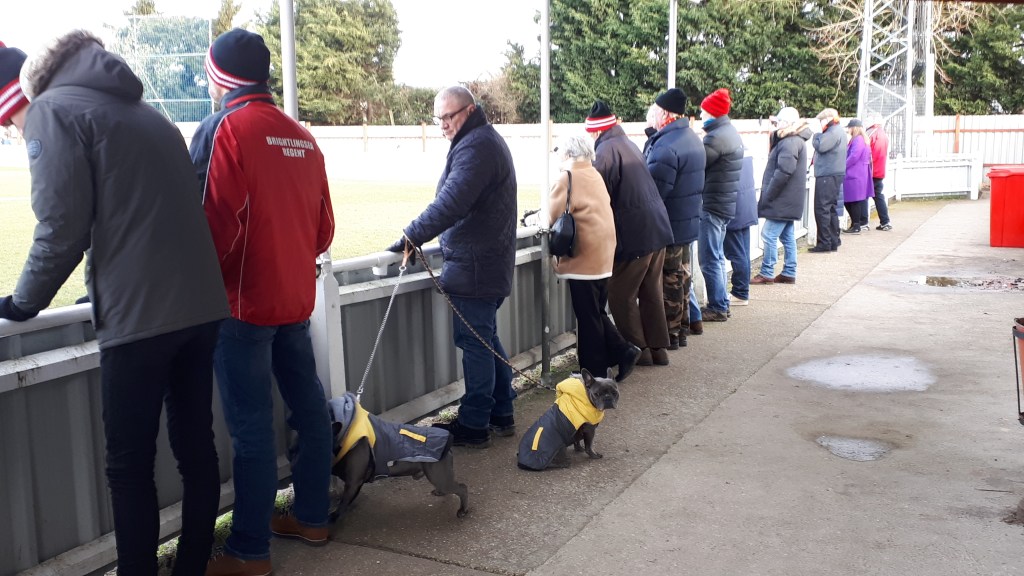
With half-time approaching I move on to behind the goal where the Merstham fans are congregated in a long line. Merstham enjoy a little flourish at the end of the half and all of a sudden number ten Fabio Saralva has the ball with no one much around him, he steps forward to the edge of the Brightlingsea penalty area before launching a shot into the top left hand corner of the Brightlingsea goal; ‘keeper James Bradbrook’s dive is despairing and Merstham lead 1-0 from a very fine looking goal. Understandably the Merstham supporters are thrilled by this event and I can’t deny being impressed somewhat too. I wander round past the players’ tunnel which looks like it might once have accommodated primates at Colchester zoo and wait just a few yards from the tea bar for half-time. The final action of the half sees referee Mr Sear wave his yellow card at Merstham’s number nine Walter Figuiera whom the referee has seemingly ‘had it in for’ all afternoon, to the extent of calling back play for a free-kick to Merstham as he was about to cross the ball. As the players leave the field for their half time cuppa the Merstham fans gather at the players’ tunnel and I add my voice to questions to Mr Sear about his attitude towards Figuiera; he doesn’t answer, confirming his guilt to my mind.

I queue for a cup of tea (£1.50) and consider why tea costs more the further up the football league pyramid one goes. I fish the tea bag from my cup and drop it in the bin next to the table on which the milk and sugar is placed. An elderly man with a flat cap and a stick tries to flick his teabag from his cup to the bin, but his tea bag falls on the ground with a wet splat. “That’s you out of the basketball team” I tell him, he smiles sympathetically. I stand my tea on the brick perimeter wall to allow it to cool. “Haringey are losing again” says an excited voice behind me “Potters Bar are winning at Worthing”. No one responds, but another voice declares that the hot chocolate is lovely. “Best in the league, since they cleaned the machine” says someone else. I look through the programme. It’s an attractive glossy publication and I am reminded why it is so disappointing that some clubs no longer produce one. Where else would it be possible to learn that Regent’s number nine Michael Brothers brings some “top banter” to the dressing room?
At four minutes past four the game resumes and Brightlingsea look to have had the more inspiring half-time team talk, getting forward more consistently than they managed before and they win a couple of corners. “Head it, head the ball” is the considered advice from the stands, as well as a more violent sounding “Attack it!” “Come on you R’s” sing the Ultras. At twenty past four a Brightlingsea corner is cleared but only to a point a few yards outside the penalty area from where it is lobbed high back towards the goal. Necks are craned but only Brightlingsea’s Jake Turner moves his feet and follows the flight of the ball and the two come together about five yards from the goal where he sweeps it unchallenged into the net past a surprised looking Amadou Tangara, the Merstham goalkeeper.
The remainder of the second half is more open than the first with both teams having chances as the sun is engulfed behind hazy cloud and the floodlights come on. Substitutions are made and the PA announcer attempts to induce excitement by lifting the tone of his voice on the final syllable of Clarke Gilbert, as he replaces Michael Brothers; it has no discernible impact. Having equalised, the urgency they had at the start of the half deserts Brightlingsea somewhat, but it remains an entertaining match. There’s a worrying few minutes late on however as Brightlingsea’s number seven Jordan Barnett appears to have some sort of fit after a collision with his own goalkeeper and after several minutes of uncertainty he is stretchered off.
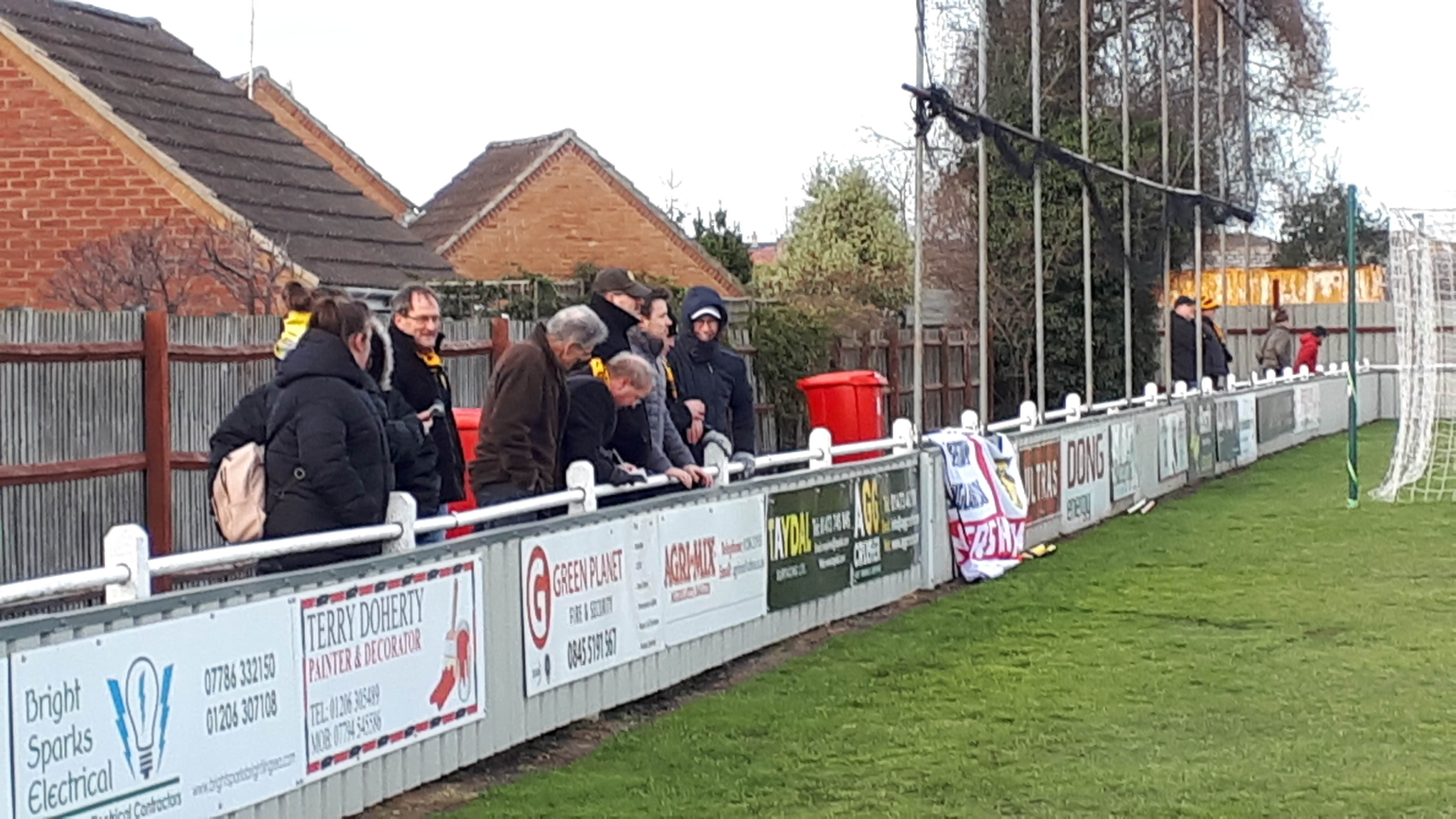
Today’s attendance is announced as 231, and as the sun sinks towards the horizon, the telephone wires across North Road are silhouetted through the descending gloom, looking like a cat’s cradle. I stroll past the Merstham fans assembled behind the goal at the Regent Road end of the ground. “Come on Merstham” they shout. “Who’s that? Mersham?” I ask innocently. Happily, they seem get the joke, I think. I head past the main stand towards the exit and with the final whistle am handily placed for a swift departure.
I make the short walk back to my trusty Citroen reflecting that I have not witnessed a classic match, but it has had its moments and the result is a fair one, which counts for something in this unfair world.  Waitrose awaits.