After six months off-work due to illness, today is my first day back, albeit for a shortened day of just six hours toil. Keen to prove to the world and myself that this really marks a return to normal life, I am going for broke and also making my first away trip of the season, catching one of three supporters’ buses from Portman Road (£21, but half price with my Season Ticket holder’s voucher) to Kingsmeadow (aka the Cherry Red Records Stadium), Kingston, current home of AFC Wimbledon. At the start of the season I drew up a list of six third division football grounds, of which Kingsmeadow was one, that I would be able to visit for the first time following the Town; four of those away fixtures have already passed with me in no fit state to attend, so for someone who is blissfully transported by the sight of unfamiliar arrangements of floodlight pylons, coloured polyurethane seats, corrugated sheet metal and concrete steps tonight is an opportunity not to be missed.
Leaving my office at 3pm I make the short walk to Portman Road and approach the back of the short line of three buses. I am booked on Coach Two, which as logic demands is helpfully parked in front of Coach Three and behind Coach One. I prepare to board but stood by the door and subtly blocking my path is a stern, un-smiling woman with a clipboard and passenger list; “Surname” she says and a subversive voice in my head says “Don’t tell her Pike!”. There was a time not long ago when it was possible to travel on these supporters’ buses anonymously, but times change and football clubs seem to have become ever more controlling and paranoid. In a spirit of mild rebellion and in an attempt to inject the friendly face of humanity I give her my first name also, she eyes me suspiciously as I mount the steps into the bus acknowledging the driver with a nod and muffled greeting as I climb.
The bus is almost full with the usual misfits that travel like this and most pairs of seats are occupied by at least one person; after checking that it is not taken I settle down on the first vacant single seat I come to next to a balding, grey haired and bearded man in a blue polyester football shirt. Within not many minutes the buses set off one by one to make the left turn onto Handford Road and the highways beyond. As the bus slows at the Tesco roundabout at the edge of town I check my watch; we’ve been on the road for ten minutes, it seems like hours. I know I have to take my copy of “Soccer Empire The World Cup and the Future of France” (Laurent Dubois, University of California Press 2010) from my blue cloth bag decorated with the stars of the EU flag (a 2 Euro purchase from the gift shop at the EU Parliament in Brussels )and begin to read to pass the time.
Whilst I learn of Jules Rimet, Guadeloupe and Felix Eboue the buses speed beyond the Suffolk border and on past Colchester with its football ground sitting remote and detached from the town by the A12, past dull Witham and bland Chelmsford towards the M25. The buses bear the name Suffolk Norse on their flanks, it’s a curious moniker for a fleet of coaches, but then I see the vision of us all lined up in pairs side by side down the length of the bus and I see a longship full of Vikings, of Norsemen, albeit Vikings and Norsemen who have lost their oars. The fleet name makes sense; we are a collection of middle aged blokes led by one severe woman setting off to metaphorically rape and pillage a small corner of metropolitan Surrey.
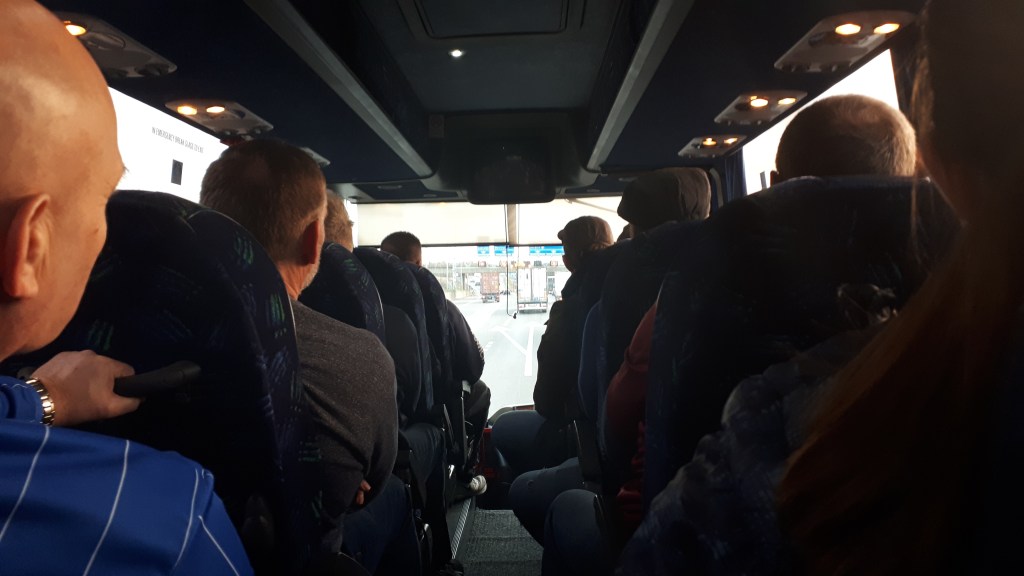
Darkness falls somewhere in Kent and crawling through the endless pre-war Tudorbethan suburbia of Chessington, Tolworth and New Malden, two hours and fifty minutes after leaving Ipswich, we eventually spy the floodlights of Kingsmeadow, which shine like beacons to these weary, but in my case well-read travellers. The buses draw up in front of a parade of suburban shops and I alight as fast as good manners will allow, turning back towards the entrance to the ground where I have arranged to meet a longstanding friend who is known as Jah on account of his love of reggae music. Jah lives nearby in Kingston (Surrey not Jamaica) and has sourced our tickets for tonight’s game. With handshakes and greetings out of the way I buy a match programme (£3) and we head for what is not by any means the nearest public house; however, knowledgeable of my loathing of ‘rubbish beer’ Jah has selected a pub called The Norbiton where he says the beer is ‘decent’. It’s a 15 minute walk through anonymous residential streets to The Norbiton which appears gloriously out of the gloom, light spilling from its tall Edwardian windows and beckoning us in. Inside we meet Jeremy a friend of Jah who already nurses a pint of what looks suspiciously like lager; he buys me a pint of an Espresso Stout the exact name of which I forget, whilst Jah has a pint of Sambrooke Junction Bitter. Jeremy is kindly providing one of our tickets. We talk of our past, our age, of my health, of politics, of women’s football and of Jeremy’s unusually small Toyota IQ car in which we will soon travel back to Kingsmeadow. Jeremy is impressed that I have travelled all the way down from Ipswich for tonight’s game. Part way through our conversation I realise that although I paid for my programme back at the ground and took my change (four fifty pence pieces) I never actually took the programme. Bugger. After Jah treats me to a second pint, this time the Junction Bitter, and has a half himself, it is about twenty-five minutes past seven and time to head for the match. I fold myself into the back of the tiny Toyota whilst Jah, who for a man who is not yet sixty years old is very inflexible, clambers into the front passenger seat. Jeremy tells us that he usually parks the Toyota directly outside the ground, but tonight the kerbs of Kingston Road are tightly packed and no spaces can be found, and kick off is fast approaching. We drive around the block again and praise be, in a side road just opposite the ground we find a couple of metres of tarmac between a Vauxhall and a dropped kerb into which the Toyota will fit.
It’s a matter of yards across the street to Kingsmeadow; we enter through the main entrance beneath a high metal arch that announces the name “Kingsmeadow” and spotting the programme sellers beneath I explain how I didn’t take my programme earlier; he must have realised too as he straightaway hands me one. Around the corner on Jack Goodchild Way we meet a man called Jonathan who incidentally has a Mexican wife, but more importantly the other ‘spare’ ticket and he also hands us each a programme; together we head for the entrance to the main stand. Entering the stadium is like walking into a social club and it is self-evident that this is very much a non-league stadium. There are no turnstiles as such but we form two orderly queues and pass our bar coded tickets beneath a scanner; looking ahead through a short tunnel beneath the stand I can see the players are already on the pitch, it’s like a snatched glimpse into another world through a magic portal. A few steps on and we are into the stand and stood at the side of the pitch; our seats are a little to the left beyond the players tunnel which we cross in front of, in the front row behind a thickly painted blue metal crush barrier.


The illuminated scoreboard in the corner of the ground shows that we have missed the first two minutes of the match but it also confirms that we haven’t missed any goals; no real surprise there. Our seats are within a couple of metres of the pitch and it feels like we are truly part of the game, as indeed the crowd should be. The atmosphere in this small stand is sociable and happy, clearly everyone here is a regular; club officials, coaches and players mingle in the stand and plainly know some of the supporters, this is like being at a non-league match. Behind me a man who shouts to the referee that he’s a muppet sounds just like a man who shouts the same thing at Coggeshall Town.
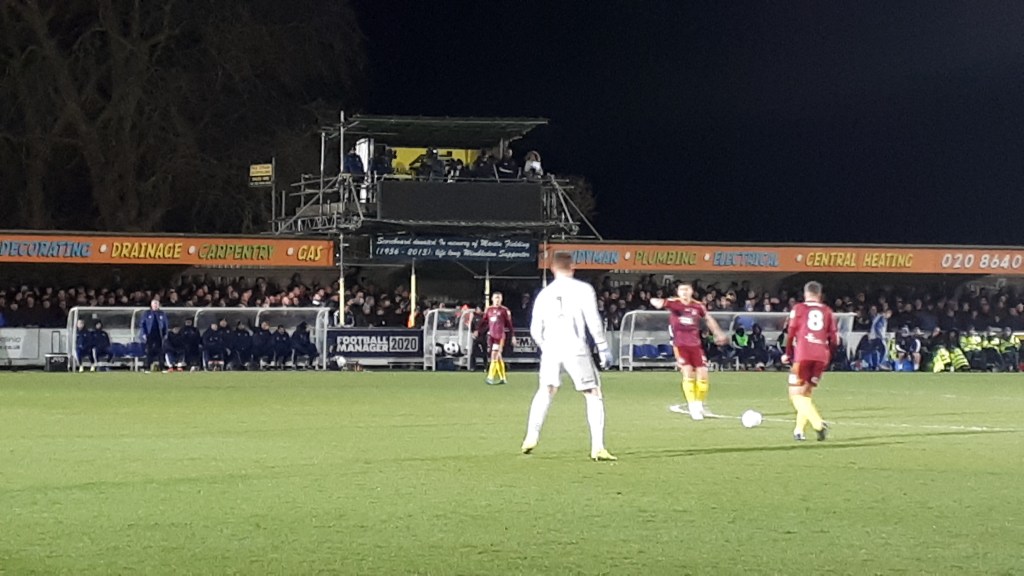
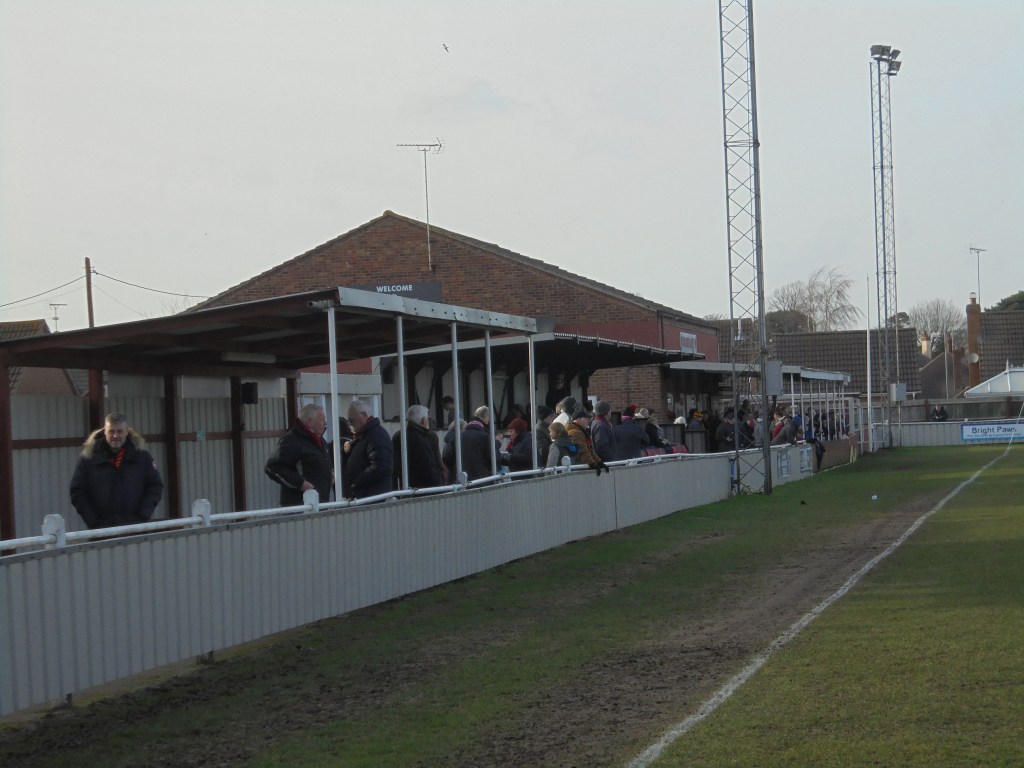
The football is unexceptional. Ipswich, playing in red and blue with pale yellow socks towards the beautifully and exotically named Chemflow Stand, also known less interestingly as the Athletics End, pass the ball about a bit and if this was a competition to see who could pass the most and most accurately they would win, but inaccurate hoofs and hopeful punts play their part in ensuring that incisive moves are kept to the barest minimum. The Wimbledon supporters whose team is in all blue get their kicks where they can and cheer with more enthusiasm than perhaps the players’ abilities deserve. Architecturally Kingsmeadow is a dull little arena, but beneath the floodlights with the backdrop of a few gaunt, grey, leafless trees it springs to life.
Jah and I point and chuckle and guffaw as play after play come to naught. We observe that the referee Mr Craig Hicks has very, very neat hair and Jah mentions the recently aired TV programme Inside Number Nine. I admit to Jah that I have often wondered about referees’ sexuality. Mr Hicks may just be light on his feet as he tiptoes away from a tete-a-tete with an errant player and then flicks his wrist theatrically for a free-kick, after which Jah and I spontaneously raise our arms to mimic his slightly camp wrist action whilst the people behind us probably wonder about our sexuality.
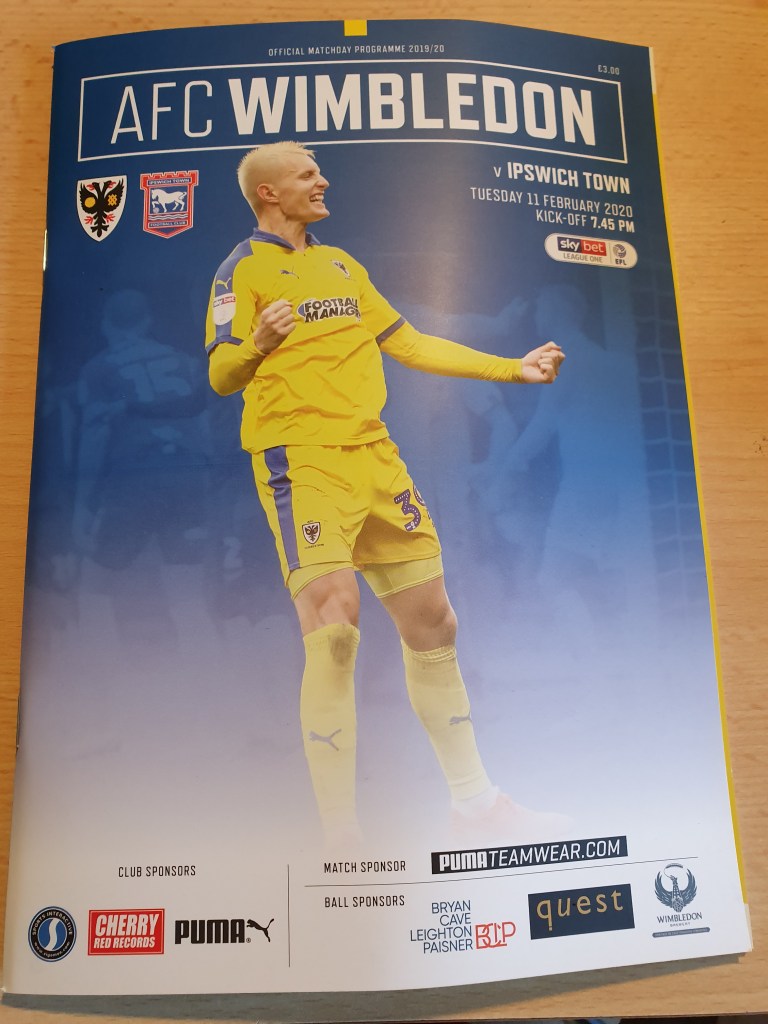
“Go on Piggy” shouts Jeremy at Wimbledon number thirty-nine Joe Pigott and I tell him how much I envy Wimbledon supporters having a player they can call Piggy. Jeremy adds to my jealousy, telling me that they also shout “Feed the Pig”. Joe Pigott is featured on the front of the match programme. Jonathan asks if I was at the 1978 FA Cup final and seems impressed when I tell him I was. There are very few sustained songs or chants coming from either set of supporters and Jah and I lament the loss of the great tunes of Gary Glitter and the Glitter Band which are no longer socially acceptable. When I returned to work this morning I would have very much liked to have sung to my colleagues “Did you miss me when I was away, did you hang my picture on your wall? Did you miss me every single day? I bet you didn’t miss me at all, at all, I bet you didn’t miss me at all. Hello, Hello. It’s good to be back. It’s good to be back.”
Ipswich hit the cross bar in a moment of madness and half-time arrives, and I am in great need of a visit to the small toilet beneath the stand; it’s a cold night and those two pints are trying to get out, but first we must wait for the players to leave the pitch and the blue polythene players’ tunnel to be retracted. This stadium is the antithesis of the theatre of dreams and it’s great because it is full of the inconveniences that reflect real life.
Relieved we return to our seats for the second half. If the first half was unexceptional the second is exceptional for being even more unexceptional. It’s as if the players have become frustrated or bored by their inability to do anything much very successfully and have given up. Weirdly however, it’s not the sort of game that people boo because it retains a kind of competitive tension, either side could score because they are both so inept that either one could just hand victory to the other at any moment. Hope remains but of course our hopes are foolish. The absence of appreciable football does at least let me appreciate the fine oak tree that stands and spreads itself behind the covered terrace opposite in which the Ipswich supporters are stood. Jah and I also enjoy the mask worn by Town’s on-loan number three Josh Earl who inspires a conversation about the TV series “My name is Earl”. When Earl is substituted a man behind us, possibly the “You’re a Muppet ref” man attempts to riff on the problem of a masked player taking off his mask when substituted and then coming back on to the field unrecognised. If anyone laughs, they do so quietly. Meanwhile a small knot of Ipswich supporters try to scuff-up the bonhomie that has existed for most of the match with a chant of “Who the fucking hell are you?” but it is in no way clear to whom they are addressing their song and no one seems to care.
My hands are cold but I remember I have gloves in my pocket and I put them on, but warmer hands don’t make up for the poor standard of football in the second half, nor does a half volley by Town’s Will Keane which is spectacularly kept out of the goal net by Wimbledon goalkeeper Joe Day, a name which is impressive in its economic use of syllables. Keane’s attempt is as close as Ipswich come to scoring and the game ends with Wimbledon pretending to be the attacking team as they win a couple of corners and generally mill about threateningly in the Ipswich penalty area. The final whistle comes as a relief to all and Wimbledon’s supporters, again displaying the pragmatism of the lower leagues, seem happy with claiming a point, realising it’s better than not existing at all.
The evening is over so quickly and I bid Jeremy, Jah and Jonathan good night before heading back to my six-wheeled golden long ship and the voyage home. I’ve had a lovely time and look forward to coming back next season.









 trippingovertheball