On a Saturday afternoon the number 118 bus leaves Ipswich at a quarter to two and arrives outside the former White Horse pub in Framlingham about forty-five minutes later, from where according to Google maps it is a thirteen minute walk up Bridge Street and Market Hill, along Church Street, Castle Street and up Badingham Road to the Badingham Road Sports ground, home of Framlingham Town Football Club. The only problem with this if wanting to watch a football match is that it is necessary to leave at half-time to catch the last bus back to Ipswich at a quarter past four. There are two later buses out of Framlingham, but they will only get you as far as Framsden. With passenger rail services to Fram’ having ceased in 1952, and deciding that unless sleeping in a hedge, stopping over for the weekend in Framsden or Framlingham (the next bus to Ipswich is on Monday morning) is a tad extravagant just to watch a Thurlow Nunn Eastern Counties Premier League game, I have no option today but to get a bigger shoe for my carbon footprint and travel by car.
Even for someone wracked with guilt over his Citroen C3’s carbon emissions, having turned off the A12 it’s a pleasant drive along the B1116, which follows the valley of the River Ore through Hacheston and Parham. Tilled brown fields, grey flints, golden leaves and gaunt trees beneath a broad, bright sky set the scene for our winding, undulating journey. It’s all a bit ‘Akenfield’ out here. In Framlingham I park up near the 12th century castle and we, for today I am with my wife Paulene, pop to the Co-op for a small picnic; we would eat at the football club, but Paulene’s food intolerances won’t allow it. We stop off at the church of St Michael on the way back to the car to look at the display of knitted poppies draped over the south porch for Remembrance day tomorrow and take a look inside at the tombs of the ancient Howard family, feudal lords of the area after Sir Roger; appropriately the local Conservative Club is just over the road too.
It’s a very short drive from Sir Roger Bigod’s castle to Framlingham Sports Club on Badingham Road; like Stowmarket Town , Walsham le Willows and Brantham Athletic, Framlingham Town Football Club is now a part of the local sports club. Back in the 12th century Sir Roger was probably more of a hunting man than a footballer though. The roughly surfaced car park is pretty full, but we find a space and head into the club house for a drink, where we encounter what appears to be a ladies’ sports team all sat down in green trackie-tops having their dinner, and the shutters on the bar are down. Making an about turn we head around the corner to the turnstile entrance to the football ground , a nicely painted and brightly lit walk-through shed. Inside the shed a jolly man with a proper Suffolk accent relieves me of the admission fee (£8 each), which by at least a pound is the most I have ever paid to see an Eastern Counties League game and therefore seems a bit steep; I don’t think I paid more than a fiver when I last came to a match here about eighteen months ago. Financially bruised as I am, it doesn’t deter me however from splashing out on a programme (£1) too. On some days money means nothing to me. The man in the shed tells us that we can get beer or wine at the tea bar now, so the bar only opens later, I then have to remind him that I’ve paid for a programme too and he hands one over.
We walk the few yards to the main stand, briefly stopping to exchange pleasantries with a contented looking lady sat on a chair, basking in the low autumn sun. She always sits here she tells us. The tea bar is in the middle of the small brick stand at the back of the three rows of neat green seats. We both have a tea (£1), I have milk, Paulene doesn’t due to dairy intolerance; coincidentally she’s a bit scared of cows too. Paulene selects a seat in the corner of the stand; it will no doubt get colder later and this looks like a spot that will offer the closest approximation to ‘cosy’ once the sun has gone down. We drink our tea and eat our picnic, which mostly consists of Suffolk ham and crisps; we watch the officials warm up, which is always entertaining. Today’s threesome look refreshingly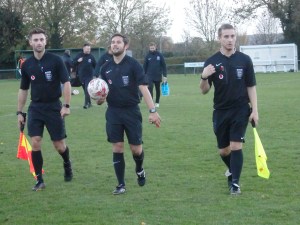 young and unusually trendy; one has a beard, one sports what may be designer stubble whilst the third has one of those tied-up, top-knot haircuts with two partings. I always thought the Football Association had their own barbers who tried to make all referees look like Action Man, but it seems not. They’ll have to keep an eye on the fella with the top-knot; seems a bit of a individualist.
It’s still only about half past two, so like the spend thrift that I am I return to the tea bar for a bottle of Adnam’s Ghostship (£3) to wash down the salty picnic. The lady who serves me pours the beer expertly whilst explaining how it tends to froth up in plastic glasses. I tell her I think she deserves some sort of drum roll as she pours, but hold back with a round of applause when it’s done. Beer in hand I take a stroll round the pitch and wait for the teams to emerge from the dressing room behind the stand. Eventually, to the strains of Nancy Sinatra’s “These boots were made for walking”, an unusual but impressive choice, the teams walk on to the pitch led by the referee Mr Jack Willmore and his assistants Jack Lock and the somewhat theatrical sounding Ayrton Hursey; if I had to make a guess I’d say Ayrton is the one with ‘the hair’.
The ritual handshaking occurs and the teams chase off to their respective halves of the pitch. The Framlingham players then line the centre circle and because it is Remembrance Day tomorrow the Last Post is played over the PA system, but no one seems to have told Norwich United and they ‘knock up’ as usual, as footballers do. Sadly it’s a bit shambolic and had it been filmed would surely make the cut for a possible Channel 5 documentary series entitled “When poignant ceremonies goes wrong”. 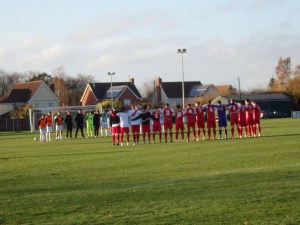 With the Last Post over, it’s time for the minute’s silence, which happily is well observed by everyone and I suspect we all feel much better for it. For future reference, the Last Post should probably follow the silence.
It’s Norwich United, nickname The Planters, who kick-off the match in the direction of Rendham wearing a change kit of red shirts with white sleeves, red shorts and socks whilst Fram’, known informally as ‘The Castlemen’ wear green and white hooped shirts with white shorts and socks. Fram’ play in the direction of the town and the castle, of which one of the decorated Tudor chimneys is just visible from the Rendham end of the ground. The game begins quietly with Fram’ playing neatly and Norwich occasionally bursting forward, but neither side is very effective close to the opposition goal with the important forward passes often being over-hit or too easily intercepted; but it’s nice enough to watch all the same.
The sun sinks ever lower through a wreath of cloud as the half progresses and with the main stand and facilities on the north side of the pitch, most of the sixty-three strong crowd spend a lot of time squinting and holding their hands up to their foreheads as if looking out to sea. Spectators stood by the pitch-side rail cast long shadows behind them on to the metal boundary fence. I stand for a while by the team dugouts on the shaded side of the pitch where it feels rather cold and damp. Behind me is what looks like a small, dilapidated cricket pavilion and rather bizarrely, next to that is what appears to be a boarded up Council house.


The game is being played in a good spirit and although the players whinge and whine about perceived unpunished fouls and faux free-kicks there seems to be a realisation that it’s only a game; a fact that quiet reflection during the minute’s silence should have confirmed beyond all doubt. When Mr Willmore doesn’t give handball as the ball strikes the upper arm of Norwich’s full-back Adam Probert, Fram’s number seven Simon Poacher grasps his head with both hands in over-affected disbelief. Probert laughs, although it’s not clear if he’s laughing at having got away with a handball or at Poacher’s ham-handed histrionics. There are corners and crosses and misses of a sort, but it takes until the fortieth minute for either team to have a really decent looking attempt on goal when Fram’s Max Willet lands a long range shot on the roof of the Norwich goal just as the floodlights come on; a moment of double illumination. When Fram’s number five Anthony Johnson then unnecessarily concedes a corner his goalkeeper Gary Rose can be heard to say frustratedly “I told him to leave it, I told him”. But the corner comes to nothing, so no harm done.
Half-time and the seeping chill of the late autumn afternoon demands another pound’s worth of tea from the tea-bar. The result of the 50-50 draw is announced and it is revealed that the winner is the club chairman. “Money goes to money” says a man next to me in the queue at the tea bar. But the chairman seems down to earth enough, he’s stood in the tea bar and he’s not dressed up in a suit like the Norwich contingent. Teas purchased, Paulene and I huddle in the corner of the stand, the side screen of which, somewhat peculiarly, is double-glazed, which seems a little unnecessary given that it is a necessary feature of all stands that one side is left completely open. I have a flick through the programme. It’s a colourful and glossy little publication, short of text but sporting the best advert I have seen in a programme for some time – “AFS for Your Fumigation Requirements” it reads; I will be sure to give them a call for my next pre-harvest grainstore treatments. There is also an advert for agricultural trailers and, more prosaically, for Framlingham Pizza and Grill, which shows a colourful array of pizzas and fast foods against a back drop of the castle, as if the two are somehow intrinsically linked. Genuinely, I never cease to be impressed by the support of local businesses for their local team, even if they do make me laugh a bit too; all power to their advertising elbows.
At three fifty-six Mr Willmore blows his whistle to begin the second half. Within a short space of time Fram’s number nine Danny Smith runs down the right, crosses the ball and it strikes the arm or hand of the Norwich number six and captain Andy Eastaugh. Mr Willmore awards a penalty. There is a bit of a delay as we wait for the inevitable arguments from the Norwich players to subside. A seasoned Suffolk voice to my left says “If I was the ref that ruddy goalkeeper woulda gone by now”. When the penalty is finally taken, Simon Poacher scores; a rustic cheer erupts from the main stand to which I add my voice. I can’t remain impartial when it’s Suffolk versus a Norwich team, although in truth Norwich United aren’t from Norwich at all, but from Blofield five miles away, as is Poringland where the club began in 1903 as Poringland and District, a name which sounds more like a bus company than a football club.
The game needed a goal and given the first half display a penalty seemed the only way it was likely to happen. Fram’ hadn’t really pushed enough players forward in the first half, but now they are looking strong down the right wing where number eleven Max Willet is getting plenty of the ball; he puts in a couple of crosses but there is no one to get on the end of them. Fram’s number ten comes close however as he twist and turns and shoots forcing the purple clad Norwich goalkeeper Luke Pearson to make the first proper save of the match as he tips the ball over the cross-bar.
Play goes on and darkness descends and I inexplicably notice how many of the players have severe haircuts and resemble those of army conscripts from World War One. The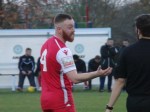 Norwich number four Sam Applegate would seem to have a particularly vicious barber who has given Sam a haircut which makes him look as if he is wearing a skull cap. Fram’s number six James Mayhew becomes the first player to be booked by Mr Willmore. The excitement increases as Fram’ look for a second goal, but also look to hang on to their lead. “Go on Fram’”, “Go on, close ‘em down” “Come on Fram’, play football” are the calls of advice from the main stand.
Norwich have an attack and win a corner. “When was the last time we scored from a corner?” says a Norfolk accent. There’s a slight pause before the terse reply “Last week wasn’t it?” From the corner a Norwich header hits the Fram’ goalkeeper or someone on the goal line provoking predictable calls of handball, but nobody seems very convinced, least of all Mr Willmore.
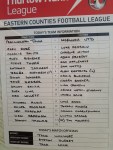 At just before twenty five past four Max Willets chases off down the right for Fram’ once again. He gets into the penalty area, checks, changes pace and gains half a yard on the full-back before crossing the ball and Jake Seaber, whose name doesn’t even appear in the programme, scores a simple tap-in at the far post. The cheer for the second goal is even bigger than for the first and I once again join in; witnessing a Suffolk team called Town score a second goal against a team from Norwich is something I’ve not done in quite a while. Up the Towun!
I wander off around the other side of the ground again to enjoy the final quarter of the game. Under the floodlights the colours of the two teams comes alive and so does the match, but not in a good way. Norwich have applied some pressure without success, but have also had to defend and evidently not to the standard their goalkeeper Luke Pearson expects and he suddenly throws a tantrum, stomping stiff-legged from his goal and bawling incomprehensibly. A short while later there is a fracas near the centre of the pitch, I have no clue what has happened but Fram’s Simon Poacher staggers from a melee looking like he’s been punched in the stomach. A Norwich player is booked and the Fram’ coaches tell the linesman he knows what he saw; something to do with Norwich number five Sam Watts throwing a punch. Mr Willmore consults his assistant with the haircut and Watts is shown the red card; after a short argument he accepts his fate and returns to the dressing room. There’s not long left now, especially as the referee seems keen to finish the game as quickly as he can and within a few minutes as Fram’ goalkeeper launches a kick Mr Willmore calls time.
The crowd of mostly middle-aged and older men are appreciative of what they’ve seen this afternoon. Although Fram’ remain second from bottom in the twenty team Eastern Counties Premier League they’ve beaten a team who were ten places above them and only last season were two divisions above them. For my part it’s been a fun afternoon of goals, beer, medieval architecture and a sending off, I couldn’t ask for more.




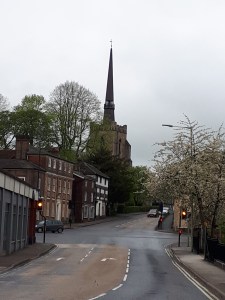 II* listed, but seemingly derelict eighteenth century Lynton House in front of it. The route to Green’s Meadow is along Gipping Way, past the badly spelt Bodywize Gym, Lidl and the predictable queues of shoppers at its checkout tills, who stare out through the plate glass to assuage their boredom; perhaps I should wave.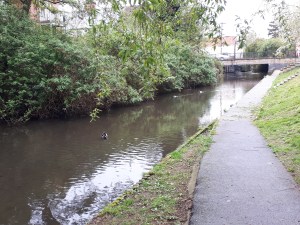
 impressive looking, but the yellow and black signage gives it a certain unity and smartness. Entry to the Greens Meadow ‘stadium’ (£6) on match days is through the ‘turnstiles’ which are close to the half way line. There is no queue and as I walk in the referees and some players are warming up on the pitch, which on such a grey day appears almost luminous, its grass, lush, damp and very green.


 shirts with black shorts and socks, whilst Long Melford wear an Anderlecht or perhaps Fiorentina or Toulouse inspired change kit of all purple or violet, but with black and white hooped socks, as if they forgot to buy the whole ensemble. Melford kick off the match with their backs to the town, playing towards the A14 and the looming concrete bridge which crosses the adjacent railway track and River Gipping.
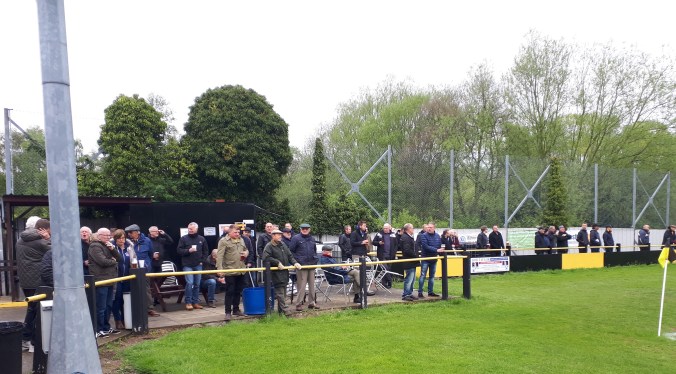 drinking. A few wear flat caps, some fashionably, some less so. “Blimey, it’s like an audition for Peaky Blinders round here” says one bloke; it’s a comment that makes me smile more than anything I anticipate Russell Hall might say. I wander round to behind the dugouts. Stowmarket win a corner and their number five heads the ball directly into the arms of the Melford goalkeeper. One of the Stowmarket coaches clutches his head in anguish as if imitating Edvard Munch’s ‘The Scream’, or having a seizure. The Melford right-back then rather uncharitably passes to the Melford number eleven, simultaneously calling “man-on”. It’s akin to throwing him something boiling hot and yet also very fragile. He might have done better to pass to someone else.
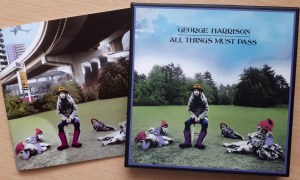 the 30th anniversary edition of George Harrison’s defining triple album “All Things Must Pass”. The concrete bridge is a wonderful backdrop to the corner of the football ground, running as it does above the height of the trees, which surround the ground on two sides. The roar from the traffic is constant and I wonder how polluting it must be down here at pitch level. Do asthmatic players struggle more at Stowmarket?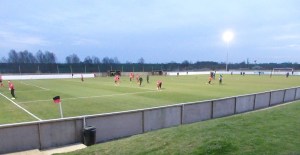
 The Crops is dug into the side of a field that slopes down from West Street towards the winding narrow river. The path from the turnstiles to the club house and changing rooms runs behind and above the low main stand with its four rows of seats, characterful uneven fascia and dark corrugated iron roof.
 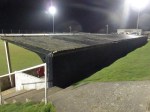 At the front of the stand a large sign reads ‘Chelmsford Plastic Warehouse’; I like to think this is an actual thing, like plastic flowers or the Plastic Ono Band. Either side of the stand a steep-ish grassy slope runs down to the pitch-side. The changing rooms occupy a dark wooden building with steps leading down to onto a corner of the pitch. Dug into the ground behind the goal at the clubhouse end is a long low covered terraced with a corrugated tin roof like a utilitarian municipal tram shelter. You can stand behind this ‘tram shelter’, rest your beer on the roof and get a good view of most of the pitch, though you can’t see the near goal-line or a large part of the goal come to that.
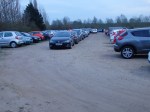 it’s almost completely full but could be fuller if people had smaller cars or didn’t indulge in ‘greed parking’, taking up more space than they need. According to Parking News (genuine trade paper of the parking industry) this has become more prevalent due to increased levels of obesity. Fat bastards. Entry to the ground is a bargain £4 tonight, the admission reduced because over 200 people had already paid to the see the first match on 21st January, which was never completed. The small but colourful and glossy programme costs £1.00.
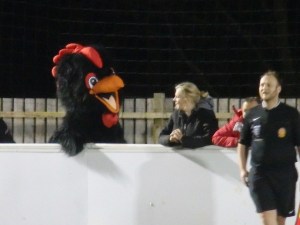 it’s Rocky the Rooster, the Coggeshall mascot.
 trippingovertheball