Ipswich Town 1 Watford 1

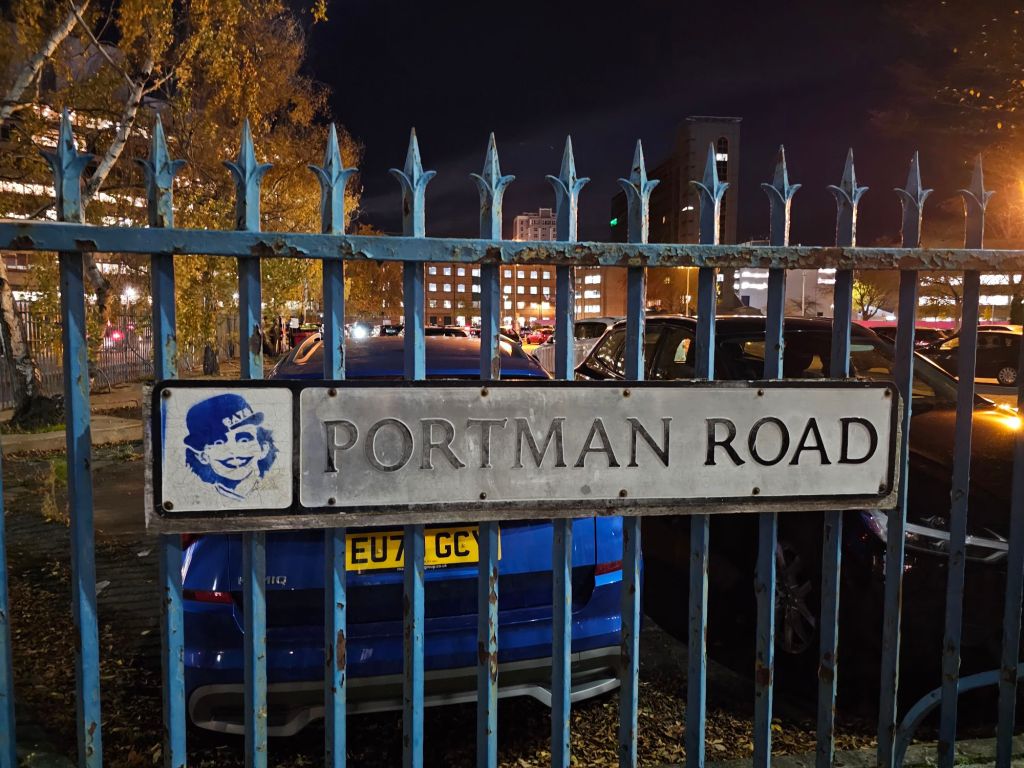
 Leaving off work on a November evening is one of life’s many pleasures, as indeed is leaving off work at any time of day or year but the fading light and swirling russet leaves, like in the opening scene of The Exorcist, somehow add a layer of gloomy beauty that enchants.  Add the prospect of an evening kick-off at Portman Road, and the streets of Ipswich are alive with worried expectation.  Opposite the bus depot I ‘bump into’ Richard, a long-since disillusioned but long-time Town supporter, who now occasionally catches a game when he can but mostly watches local non-league football.  He’s on his way to meet a friend for a pre-match drink but has arrived early, so we have time to stand in the glow of a streetlight and talk of Brightlingsea Regent, Wivenhoe Town, Hackney Wick, SOUL Tower Hamlets and Kings Park Rangers, who sound from Richard’s account of a recent match like hired hitmen.  Richard is concerned that the team that starts tonight’s match will not be the same one that started the match on Saturday.

Leaving Richard to go his own way, I have time to visit the recently installed ‘portal’ on Cornhill, and because I’m not sure what else to do, wave to people in Dublin and New York, some of whom wave back.  Unfortunately, I hadn’t thought ahead and prepared a rude comment about Donald Trump to hold up on a piece of cardboard.  I had wondered what the point of the portal is and still do but think I like it.  It’s good to know I can momentarily make meaningless, mute contact with someone in Lithuania, Poland or Brazil.

At ‘the Arb,’ there are people crowding around the bar umming and ahhing over what they want to eat. Over their heads I order a pint of Mauldon’s Suffolk Pride, and they seem surprised when I am being served, and they are not.  When did people stop understanding the etiquette of pubs and bars?  I add an order of chilli, chips and cheese (£13) and retire to the beer garden with my beer to wait for Gary, Mick and the chilli, chips and cheese.  Gary is first to arrive in his orange puffa jacket and with a pint of Spanish lager.  The chilli, chips and cheese are next, followed by some cutlery, and then Mick who arrives before I finish eating.  Mick has a pint of Suffolk Pride, Gary then has chilli, chips and cheese and Mick has chips and Emmental and he also buys another round of two pints of Suffolk Pride and Spanish lager as we talk of how busy the funeral business is currently, inter-sex sports people, Gary’s favourite places in India, Gary’s quiz team, the sale of Mick’s deceased neighbour’s house, a woman Gary and I knew who reached the final of tv’s Mastermind, whether Quorn comes from Quorn in Leicestershire, re-using Haig Fund poppies, the presence of gender in the Romance languages and  other things that I’ve probably forgotten.  There’s finally still time for me to buy another half of Suffolk Pride for myself and a whisky for Mick, but Gary is too full of chilli, chips, cheese and gassy Spanish lager to consume another drop.

As ever, we are the last to leave for Portman Road; it is twenty-three minutes past seven.  At Portman Road there is no queue into the stand formerly known as Churchman’s and seeing the security staff brandishing their magic wands for detecting weapons, I stick my arms out wide as I approach. The security man smiles broadly, “You’re flying already” he says in a jolly Afro-Caribbean-cum-London accent.  “High as a kite” I tell him, pretending to be, in the words of Marge Simpson ‘whacked out of my gourd’. After venting the spent drug of my choice, Suffolk Pride, I emerge into the stand in time for a minute’s silence for Armistice Day and the last post, something I still find odd in the context of attending a football match. Inevitably, Fiona, the man from Stowmarket (Paul) and ever-present Phil who never misses a game are already here, but Phil’s son Elwood is absent and so is Pat from Clacton, although on the end of the row sits a woman in dark glasses who looks a bit like her.  Of course, in reality, the woman on the end of the row is Pat from Clacton and she’s not in disguise, only shielding her eyes from the glare of the floodlights having recently had cataracts removed.
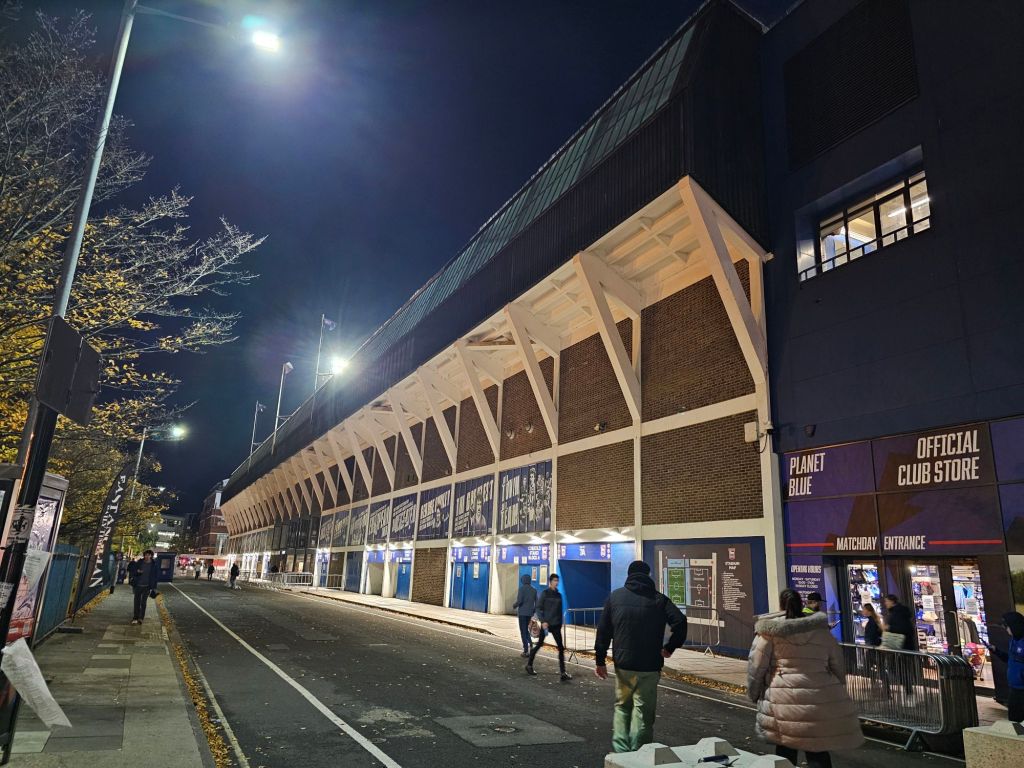
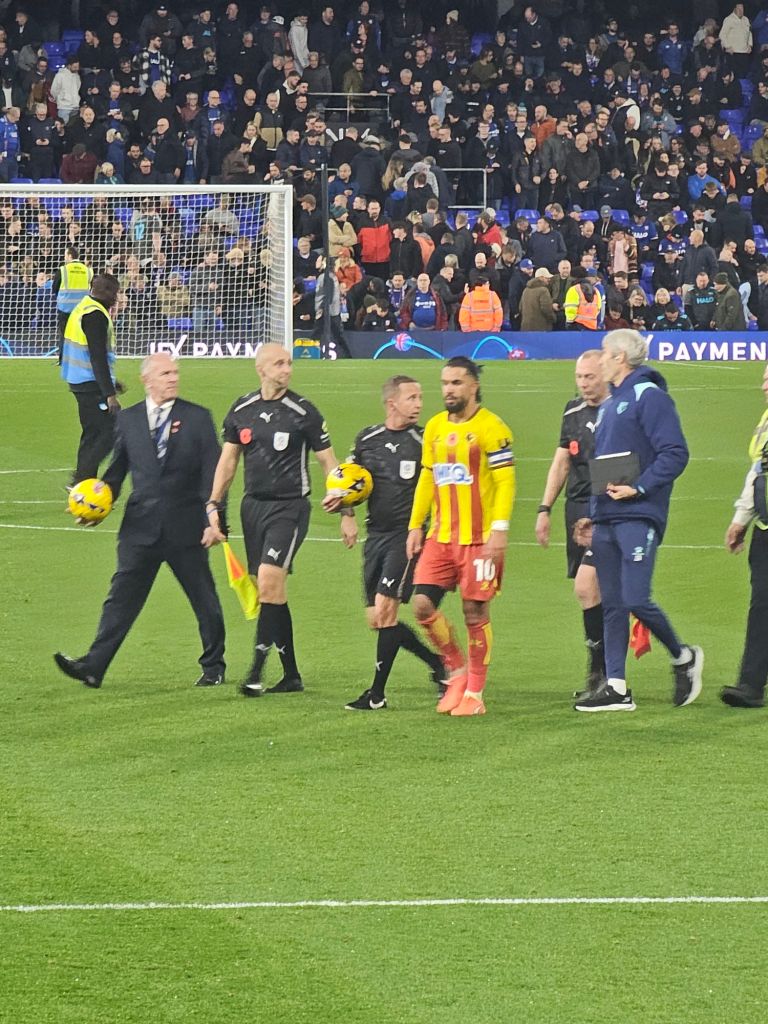
I seem to have missed the announcing of tonight’s team, the ritual of remembrance having taken precedence over the usual pre-match ritual, and with players’ huddles out of the way it’s Ipswich who proceed to get first go with the ball, which they predominantly aim in the direction of the goal in front of me and my fellow ultras.  As usual, Town sport their signature blue and white kit, whilst visiting Watford sport lurid, garish yellow shirts with red stripes and red shorts, colours which remind me of centrifuged blood and the French second division team Le Mans FC.

Ipswich quickly win a corner, so quickly in fact that I forget to chant “Come on You Blues” and the attacking opportunity is hopelessly wasted before I even realise.  I’m still getting to grips with the diminutive height of the referee and the poppies on the players’ shirts as Town win a free-kick and Jaden Philogene places the ball very inexpertly and disappointingly over the Watford crossbar.   A short while later Jens Cajuste shimmies wonderfully between a couple of Watford players on the edge of their penalty area, and the home crowd sing supportively for their team. Watford look tidy, but Ipswich are tidier.

Almost inevitably, despite not being as tidy as Ipswich, it is Watford who score.  The sixteenth minute is Town’s undoing along with a general melting away of any defence on the right-hand side of the pitch, resulting in a low cross and a simple close-range goal from the misleadingly named Louza.  “We’re winning away, we’re winning away, how shit must you be?  We’re winning away” chant the Watford supporters to the tune of the Beach Boys’ Sloop John B in what passes for humour amongst most football crowds.  Meanwhile I snigger because Watford’s number six is called Matthew Pollock, I just can’t help myself when people are named after certain fish.

Happily, Watford won’t be winning for long and after George Hirst heads over the crossbar, central defender Cedric Kipre provides a through ball worthy of any midfield maestro and Jaden Philogene scoops and curls the ball over the prone body of Watford’s Norwegian goalkeeper, and the score is one all.  “We’re no longer winning away, we’re no longer winning away, you’re better than we thought you were, we’re no longer winning away” chant the Watford fans, except of course they don’t.  Instead, the excitable young stadium announcer tells us excitedly and loudly that the goalscorer is “Our” Jaden Philogene, and he then proceeds to bawl “Jaden” and wonderfully allows the crowd to chant “Philogene”, which happens three times, as if we were in the Stade Roudourou or somewhere equally French.  Ever-present Phil who never misses a game turns around wide-eyed, with a look of surprised recognition on his face to celebrate the moment with me. “All hail the excitable young stadium announcer” I think to myself.

There are still the best part of seventy minutes left to record a famous victory, although the tiny referee seems to want to make things as difficult as he can as he takes his time allowing Chuba Akpom back on the pitch after receiving treatment.   The expected goals don’t happen. Watford win a couple of corners. “Event cleaning” say the electronic advertising boards on the Sir Bobby Robson stand before promoting the name of RJ Dean Plasterers, and probably because this is advertising, I think of Pearl & Dean at the cinema; Baba, baba, baba, baba, bababa. There are three minutes of added on time, which is long enough for Watford’s Kwadwo Baah to claim the first booking of the evening. BahBah, BahBah, BahBah, BahBah, BahBahBah.    The Watford supporters complain, perhaps because given the number of fouls that had previously gone unpunished they thought their team had diplomatic immunity, and the Town supporters claim to have forgotten the Watford supporters were here.  “Plus ca change” I think to myself, briefly returning to the Stade Roudourou.

With the half-time whistle I speak to Ray his son Michael and grandson Harrison at the front of the stand.  Strangely, we don’t mention the match, perhaps because we can’t hear ourselves think, let alone speak above the deafening public address system.

The second half brings a booking for George Hirst after ten minutes after he is fouled and no free-kick is given and so he not unreasonably assumes it’s open season; if it is it ends just before he gets to the other bloke.  “Watford, Watford, Watford, Watford” sing the Watford fans to the tune of “Amazing Grace”, which is itself amazing and also rather funny.  Nearly an hour has gone the way of history, and we get to cheer another booking for Watford’s Mark Bola, who is momentarily as popular as Ebola.  The second half has ebbed and flowed a bit but whilst Watford create no chances whatsoever, they still pass the ball very nicely and I think they look quite good, which might help explain an unusual interlude in which Jaden Philogene and Azor Matusiwa almost come to blows and probably would do if Cajuste doesn’t step into keep them apart.

It’s always time for change with about a half an hour left to play and tonight is no exception as Clarke, Azon and Taylor usurp Jaden Philogene, George Hirst and Jens Cajuste.  Pat from Clacton clearly thinks in the same way as Keiran McKenna, but with no substitutes of her own to bring on she just delves into her handbag to pull out the masturbating monkey charm, who reportedly has changed many a game in the past, although I’ve never witnessed it myself. The monkey passes from Pat to Fiona to me and I ask what I’m supposed to do with him. “Rub his head” says Fiona. Relieved, I hand him back to Fiona who hands him back to Pat who puts him back in her handbag.  Victory is now assured.

Time takes us into the last twenty minutes of ‘normal’ time and Watford make a copycat triple substitution as the bloke beside me complains that “There’s no end product” and then says it again.  Moments later there is an ‘end product’ from Ivan Arzon, but what should be a decisive net-rustling header is one that goes unpleasantly wide.  Akpom and Johnson are replaced by Nunez and Greaves.

Eighty-two minutes have joined the persistence of memory and Arzon misses again, this time shooting over the cross bar, and we are told that there are 27,184 of us here tonight, the lowest attendance for a home fixture in over two and half years; since we played Shrewsbury Town and the Shrews brought just 343 supporters with them.  As time begins to run away from us, Watford win a corner and then Ivan Arzom has a header saved by the Watford goalkeeper. Two minutes remain of the original ninety and it’s Town’s turn to have a corner from which the ball lands at the feet of Nunez, clear at the far post and perhaps six yards from it.  Nunez proceeds to display how he may always be tainted by having played for Norwich City and boots the ball hopelessly high and wide of the gaping target.

Seven minutes of added on time are added on and whilst it seems like renewed hope, of course it isn’t , and we even have to defend another couple of Watford corner kicks, although I remain confident that there will be no injury time defeat snatched from the jaws of victory, mainly because we’ve never been winning.  With the final whistle I rise from my seat and promptly depart because I have only eight or nine minutes in which to get the ‘early’ train home.   I console myself with the thought that although we should have won, at least we didn’t lose, although at the railway station I will meet Richard again, who will  describe himself as ‘underwhelmed’, but may be he doesn’t enjoy leaving off work on a November evening as much as I do.

EA Guingamp 2 USL Dunkerque 1

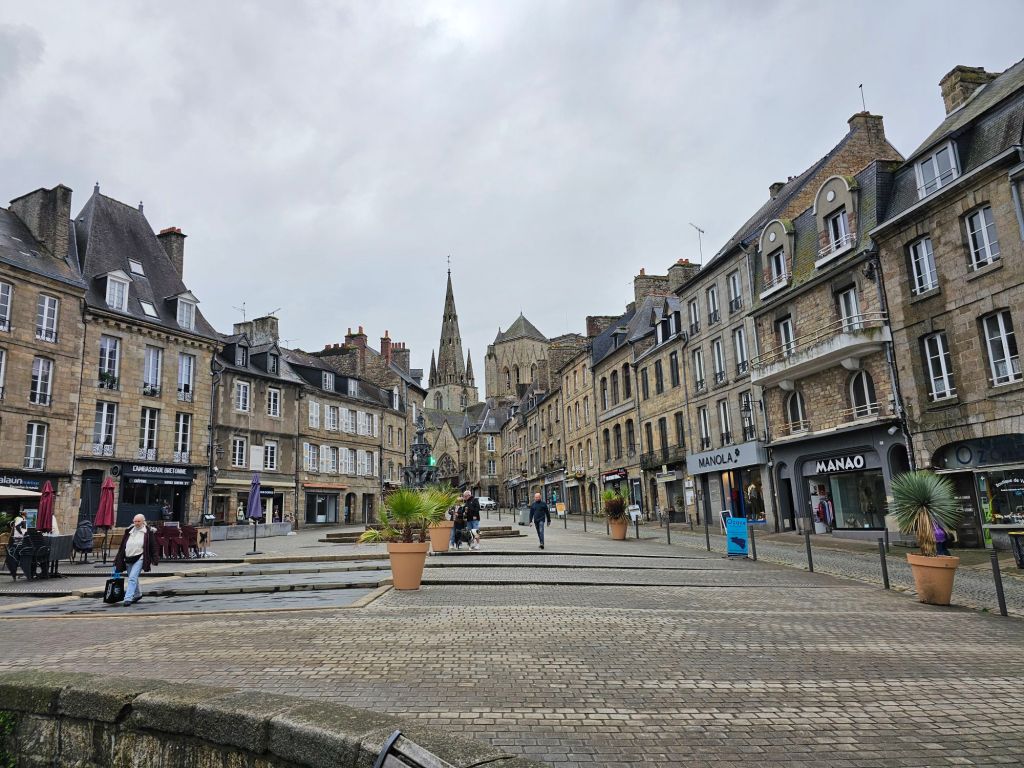
Guingamp (Gwengamp in the local Breton language, and pronounced gangomp) is a small town of only seven or eight thousand people, which sits on a rocky escarpment above the River Trieux in the heavily agricultural north-west corner of France. For thirteen seasons since 1995, this tiny rural town with a population smaller than Beccles, Mildenhall or Woodbridge had a team in the top division of French football, and also won the French FA Cup (the Coupe de France) twice in that time.    But more than that, the name ‘Guingamp’ is just beautiful to the ears, the club plays at the wonderfully named Stade de Roudourou and when Guingamp reached the final of the Coupe de France in Paris, some fans travelled there by tractor.  For these reasons, I am fulfilling an ambition today in making a 160-kilometre pilgrimage from where my wife Paulene and I are staying on holiday in Carnac in the south-west of Brittany.

Our journey is elongated a bit by a stopping off north of the topographically scintillating town of Morlaix, 60 km west of Guingamp to visit the huge six-thousand year old Neolitihic cairn at Barnenez, but we eventually rock up in good time in Guingamp to buy two tickets for the match (26.00 euros each) at the club ‘boutik’ in the town, along with a petit fanion (pennant) and fridge magnet (6.50 euros for the two) for my respective pointless collections.  Disappointingly, the T-shirts showing a representation of the town of Guingamp through its most prominent buildings such as the basilica and hotel de ville is only available in bizarrely small or large sizes, and whilst I’d like a mug that displays the same design, it would probably just sit on a shelf above the petit fanions overlooking the fridge magnet, and with a little thought I could surely spend that 12 euros doing good. More happily, the very pretty shop assistant, whose name, I think, from what it says on our tickets may be Angelique compliments me on my French, although after initial exchanges we mainly speak in English.  

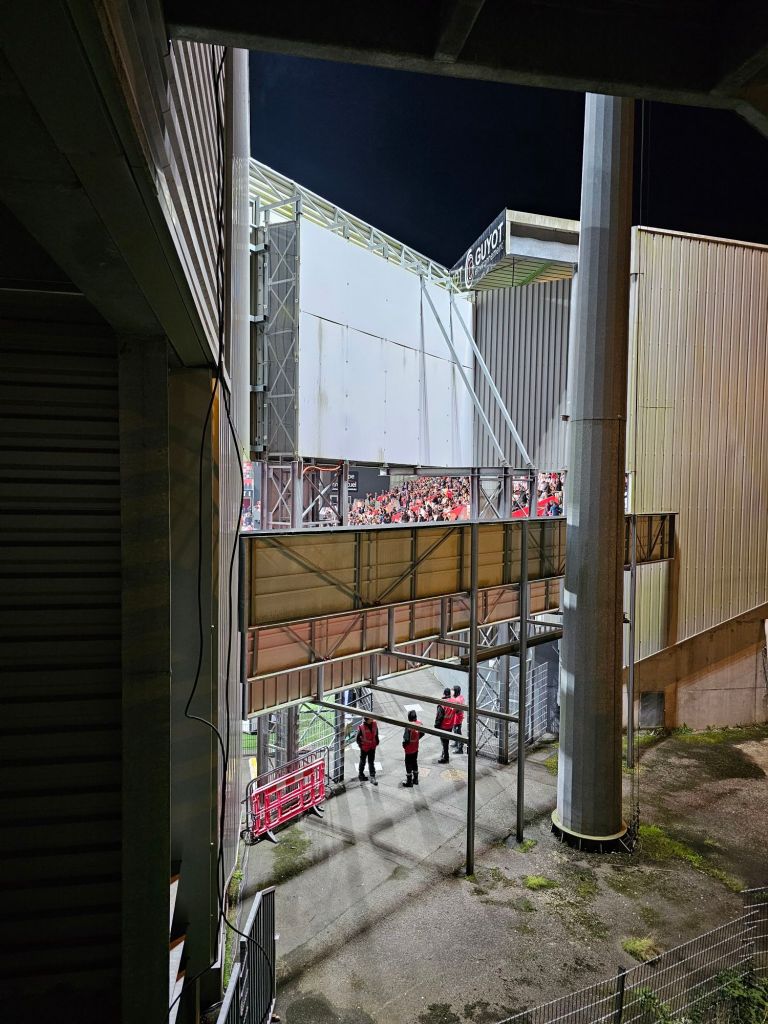
Our hotel room for the night is in a grand nineteenth century house not far from the town centre, but it is a half an hour’s walk from Stade Roudourou and Paulene’s asthma will not stand that once the cold night air surrounds us after 10:30 when the match will probably finish.  Sadly, there is no ‘navette’ (shuttle bus service) to the stadium, but on the advice of the two very helpful ladies in the local Tourist Information Office we make a short car journey across town to the Place St Saveur where we park up our planet saving Citroen e-C4 at no cost. Remarkably nearly all car parking in Guingamp seems to be free.  From the car park, we can see the floodlights of the stadium, and the walk to the Stade Roudourou takes us only a few minutes over the shallow looking, gurgling River Trieux and down a few closed off streets.  The stadium is situated in a residential area which has the appearance of one of the banlieus of a much larger town and is enclosed behind iron fences as if fortified against the outside world, an impression further strengthened by the harsh steel and concrete architecture of the stadium, which is in some ways is at odds with the stone buildings of the town but is perhaps also a modern and cost effective version of them.

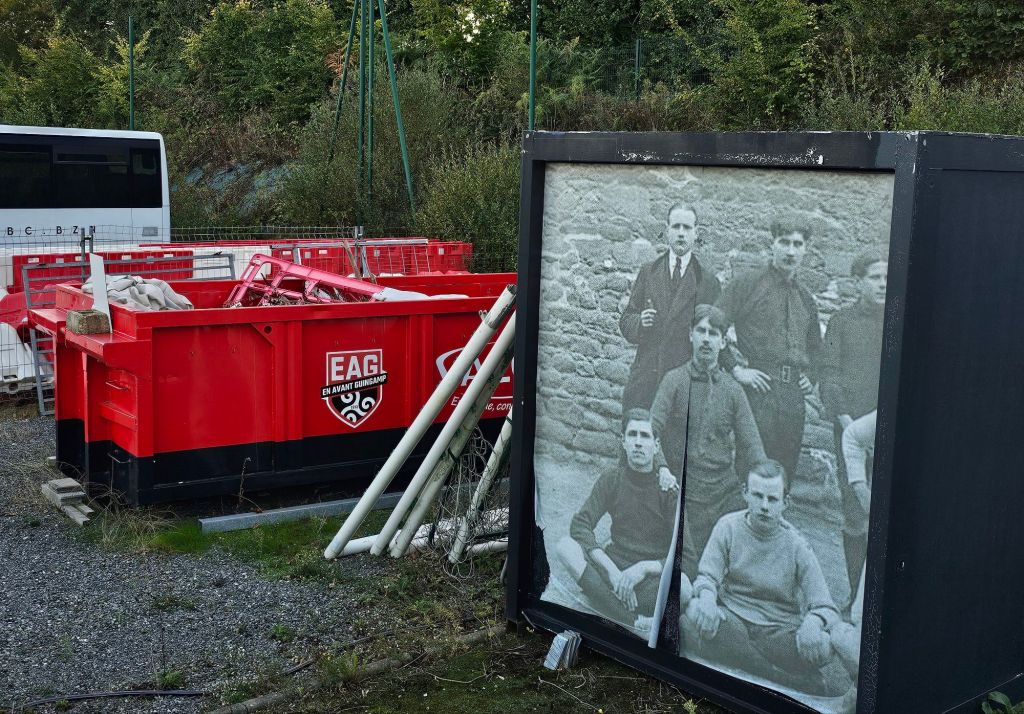
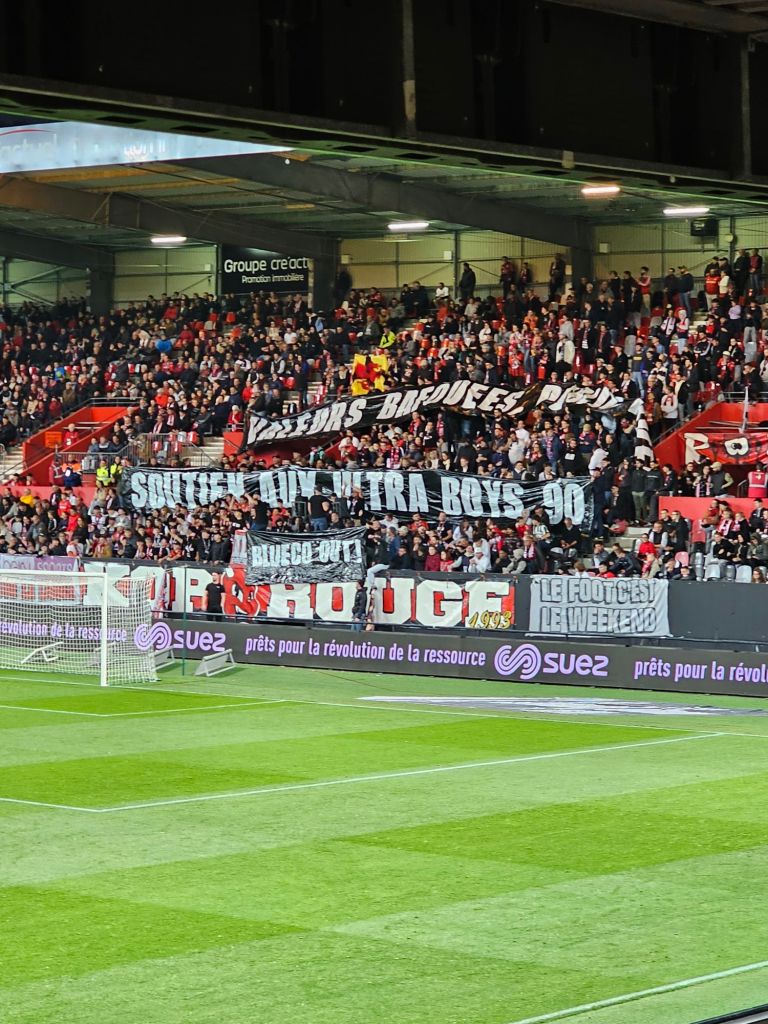
The walk to our seats in the Tribune France Barnums (presumably named after a sponsor) takes us around the back of the main stand (the Tribune Cotes d’Amour) past a small wooden hut from which two middle-aged women are selling club souvenirs.  I ask if they have any T-shirts like the ones I saw in the shop in the town; they don’t, but nevertheless they laugh either at my description of the very large and very small sizes available in the shop in the town, or just at my French, I’m not sure which. Paulene and I walk on past a skip decorated in club colours and the back of the Kop Rouge where the local Ultras will later gather.

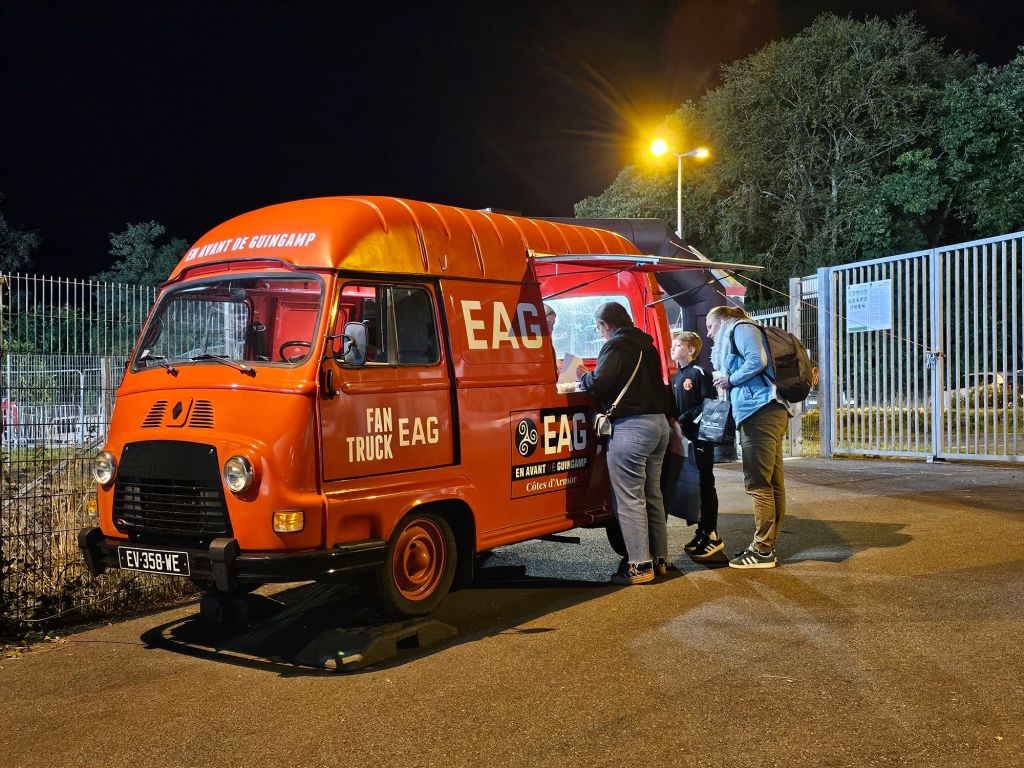
The back of the Tribune Frace Barnums is the least attractive of the four sides of the Stade Roudourou, consisting mostly of sheet metal, but undeterred I make my way in past a smiling member of security staff who frisks me and wishes me ‘Bon match’ under the somewhat glaring eye of another member of security staff whose demeanour suggests she does not approve of such bonhomie.  With our tickets duly validated by barcode technology we walk on towards our seats past a classic Renault Estafette van painted in Guingamp colours, from which Angelique of club ‘boutik’ fame is selling hats and scarves and shirts; she confirms that she has no stock of the cherished T-shirts stashed away in the Estafette.

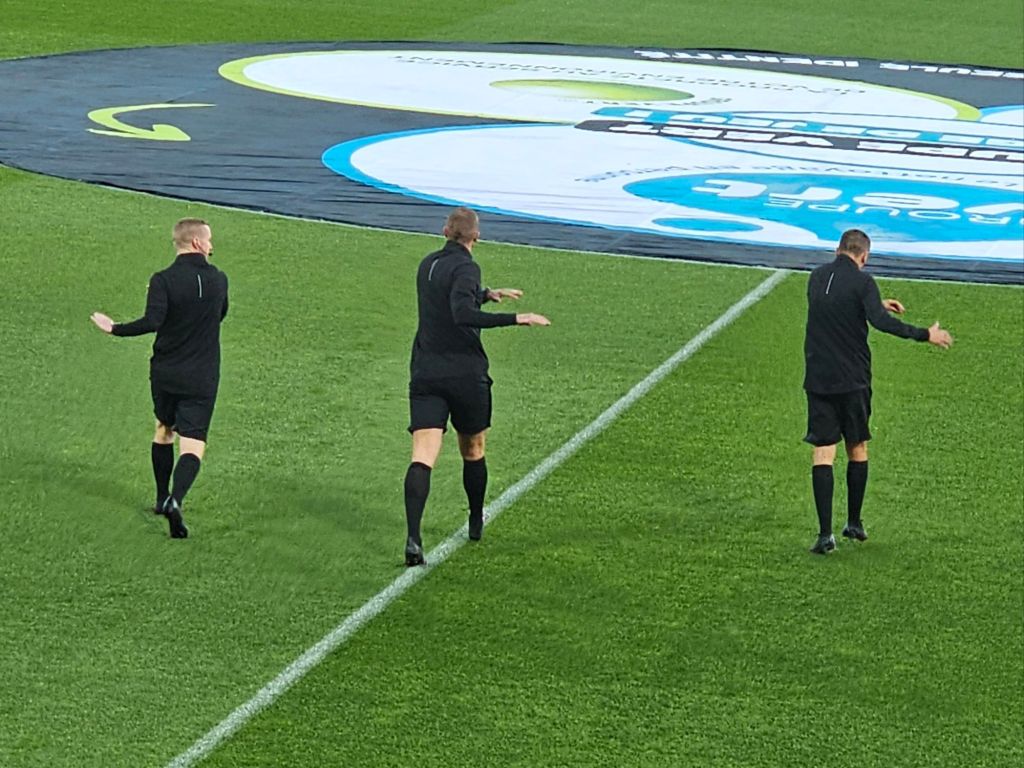
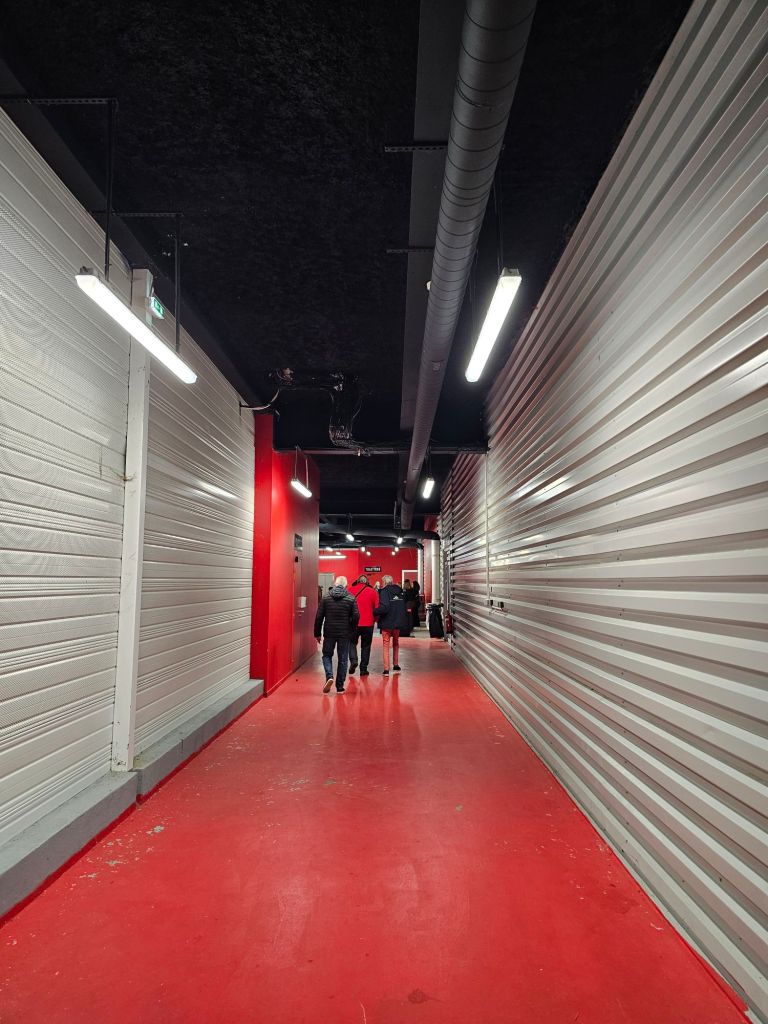
Our entrance to the stand itself, along a corridor, reminds me of the inside of one of carriages on Le Shuttle.  Up an external staircase, I am tempted by the ‘pub Lancelot’, only for two teenage doormen and the smell of sandwiches and nibbles wafting out to disappointingly confirm that it is a room reserved for those paying for hospitality.  Back downstairs I buy a small plastic cup of beer and a similar cup of the local Breizh Cola (8 euros for the two), which Paulene much prefers to the over-hyped American stuff.  We find our seats cosily situated at the back of the lower tier of the stand almost level with the halfway line and next to a galvanised tubular stanchion, which handily ensures people will not be able to edge past us to get to their seats. We pass the time before kick-off making up the life stories of the referee and his assistants, who are warming up in front of us and keeping us amused with their co-ordinated exercises, which with some appropriate music could enable them to pass themselves off as a small all-male dance troupe.   One of the assistants we decide looks slightly ill however,  and has dark shadows under his eyes.  The referee, Monsieur Landry meanwhile, is a tall man with a long body but capable of a neat heel turn, chasse and pirouette.

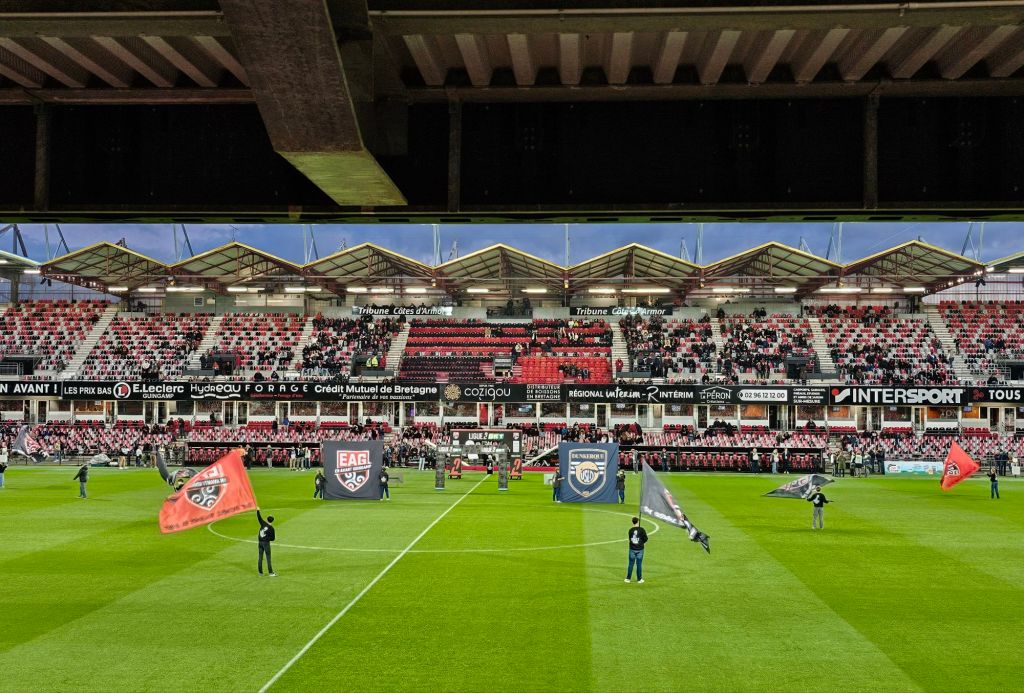
As kick-off (coupe d’envoi) approaches, the stand fills up with people bearing baguettes stuffed with chips, whilst a row or two in front of us a family unpack homemade sandwiches which appear to be of white sliced bread that has had the crusts cut off, which is not something I ever expected to see in France. Meanwhile, the pitch fills up with youths waving banners with varying degrees of enthusiasm but then, when the teams are read out by the stadium announcer  I am shocked, amazed  and I have to admit, disturbed to find that unlike everywhere else I’ve ever been in France, the home supporters do not bellow out the surnames of their players as they appear on the big screen in the corner of the ground; they just clap politely. I can’t quite believe it. Being in Brittany I had also expected bagpipe music as the teams trudged out, but It seems these Bretons aren’t like other French or Breton people at all.  I am a little disappointed; they don’t even have a cuddly mascot.

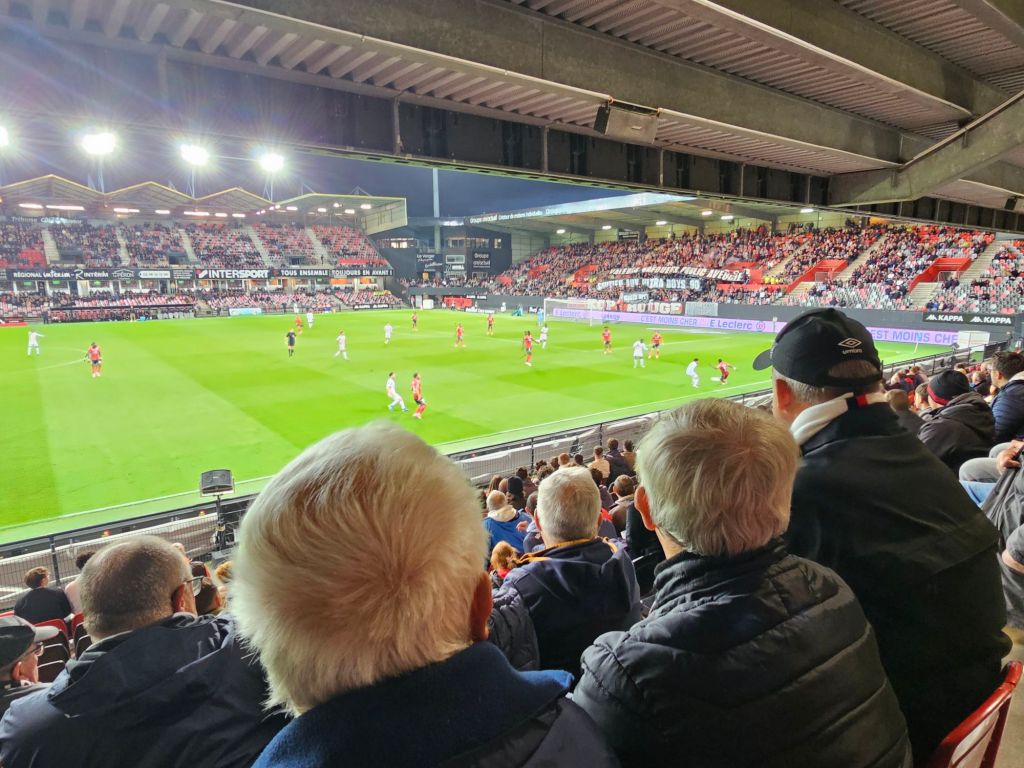
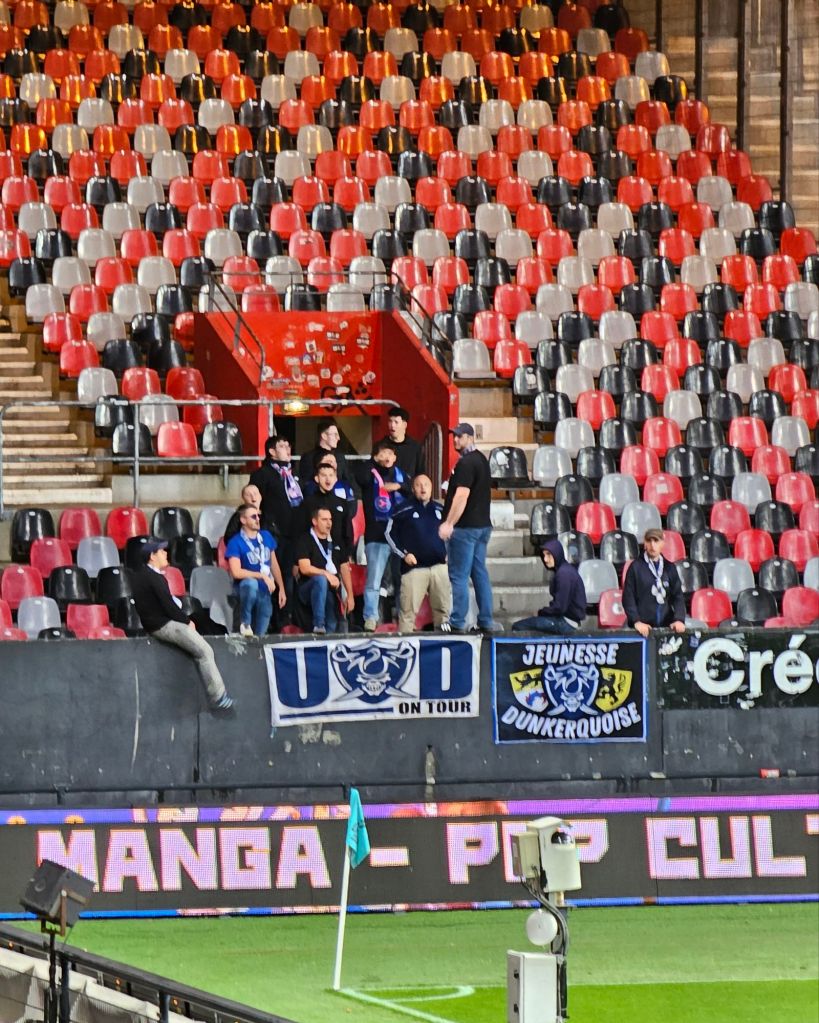
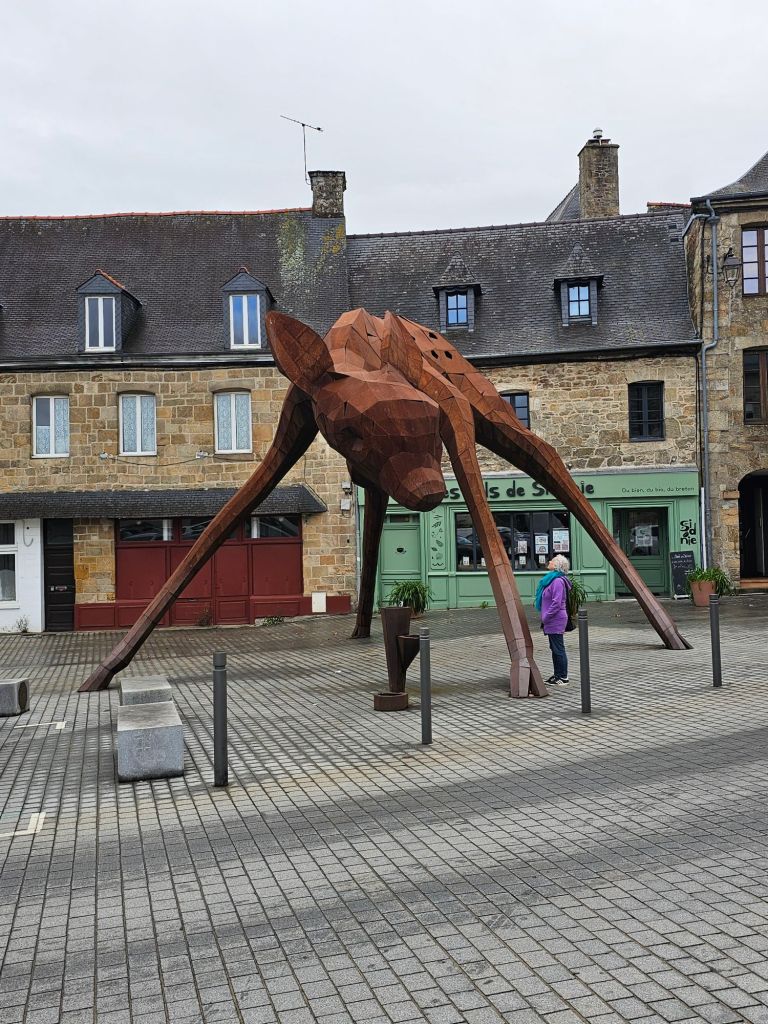
When the match eventually begins at half past eight, it is visiting Dunkerque who get first go with the ball, which they generally kick in the direction of the Kop Rouge and far off Morlaix, whilst Guingamp are aiming just to the north of the town centre with its Basilica, castle ruins and huge metal statue of Bambi. Guingamp sport their handsome signature kit of red and black striped shirts with black shorts whilst Dunkerque wear all white with golden squiggles down the shirt front.  Despite my disappointment before kick-off, the stadium has now come to life, with a flood of chip and beer quaffing latecomers finding their seats and the Kop Rouge now in full voice with chants of “Allez, Allez, Allez, Guingampaises”. I count thirteen Dunkerque supporters, who I could hear chanting before kick-off, but now they are drowned out by the Guingampaise voices and drums.

The opening play from both teams is fast and slick on the well-watered pitch but Guingamp appear slightly more direct and with only four minutes having passed into history a smart through ball and a low cross from the right lead to the ball being placed past the Dunkerque goalkeeper from about six metres out by Freddy Mbemba, who the interweb tells me is on loan to Guingamp from Charleroi in Belgium.  “Buuut” announces the giant screen in the corner in large letters, and when the stadium announcer says “Freddy” the home supporters bellow “Mbemba” and when the announcer says “Freddy” again and the crowd shout “Mbemba” again,  and then wonderfully the same thing happens again.  It feels like a weight has been lifted from my shoulders. “Mbemba!” I shout on cue after the final “Freddy”.

The game continues at pace with Guingamp looking sharper but Dunkerque not appearing to be slouches either.  Standing out for Guingamp, mainly but not entirely because he is two metres tall is their number eight, Kalidou Sidibe, whilst I am also impressed by the tangled mop of hair sprouting from behind the black headband of Guingamp’s number thirty-six, Albin Demouchy who often wins headers and elegantly ‘plays-out’ from the back.  On the electronic boards around the pitch there are advertisements for John Deere tractors and Husqvarna mini tractors as well as the supermarket E Leclerc, who if they had shops in Britain would surely employ the tv sitcom ‘Allo, ‘Allo in their advertising.

After fourteen minutes Dunkerque win their first corner; Guingamp have already had two however and as if to prove that this matters Guingamp’s Amine Hemia soon beats the square but not square enough Dunkerque defence on the right, bears down on goal and scores into the far corner off the goalkeeper’s out-stretched palm, and Guingamp lead two-nil.  “Amine” calls the stadium announcer, “Hemia” bawls the crowd. “Amine” calls the stadium announcer, “Hemia” bawls the crowd. “Amine” calls the stadium announcer, “Hemia” bawls the crowd, and the scoreboard silently but colourfully shouts “Buuut!” as well.

The row of seats in front of us consists mainly of men with grey hair whilst off to our left a younger bearded man looks a bit like Bob Ferris from the 1970’s sitcom The Likely Lads (actor Rodney Bewes).  Behind us there is a gathering of men and women in day-glo tabards; if they’re not orchestrating a “gillets jaune” style protest I guess they must be the first aiders and stewards watching the match. At the front of the stand clouds of smoke billow up from teenage vapers and then dissipate into the night air. I notice that Bob Ferris has quite girlish looking hands.

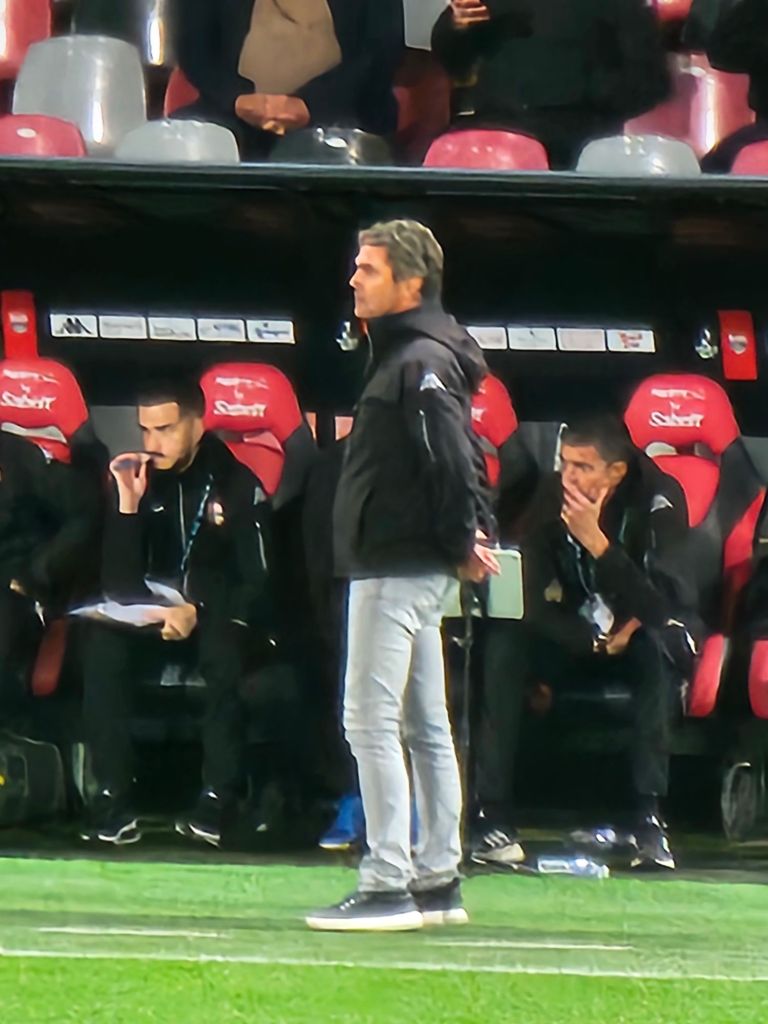
There are now less than ten minutes of the first half remaining; Dunkerque’s number twenty shoots from the edge of the penalty area and the impressively agile and wonderfully named Guingamp goalkeeper Teddy Bartouche tips the shot over the cross bar spectacularly.  Two minutes later and yet another move down the right for Guingamp leaves Louis Mafouta with a seemingly open goal, but with the co-ordination of someone whose foot has ‘gone to sleep’ and who has both arms strapped to his sides, he heads the resulting cross hopelessly and clumsily past the far post.  On the touchline, Guingamp manager Sylvain Ripoll, who incidentally once said ‘Bonjour’ to me and Paulene in the lift of a Paris hotel (the Mercure near Parc des Princes) looks frustrated in his pale trousers and zip-up jacket.

The last action of the half seems likely to be the substitution of the Dunkerque goalkeeper, who unexpectedly and mysteriously has hurt himself but then a quick pass in from the Dunkerque right finds Enzo Bartelli inside the ‘D’ outside the Guingamp penalty box. Almost in slow motion Bartelli gently passes the ball beyond agile Teddy in the Guingamp goal and Dunkerque, as they say on the telly, are “back in the game”, although of course as long as Monsieur Landry hadn’t terminally parped his whistle, they were never out of it.  Five minutes of added on time fail to alter the score any further.

Half-time is the usual melange of children on the pitch, but as before the start, with added flag waving of varying enthusiasm.  The match resumes at twenty-four minutes to ten and the Kop Rouge quickly dive back into endless chants of “Allez, Allez, Allez”.  I soon decide that for a man taller than your average back garden fence panel, Sidibe has quite a delicate touch and then within ten minutes Monsieur Landry airs his yellow card for the first time this evening after Dunkerque’s Inigo Eguaras fouls Mbemba.  

It is Dunkerque who are now selfishly dominating possession, a situation which Guingamp are contributing to by quickly giving the ball back to them whenever they lose it.  On the Kop Rouge, the ultras are swirling their scarves in the style of 1970’s Leeds United fans, whilst the big screen in the corner is showing pictures of real estate as if anyone interested in buying a house would pay more attention to the screen than the match.  As the people in the ground with least interest in buying property in Guingamp, surprise transfer moves notwithstanding, the Dunkerque players fashion an intricate passing move down the left only for Eddy Silvestre to shoot narrowly over the cross bar.  With the game now two-thirds over, Dunkerque blink first and make two substitutions.

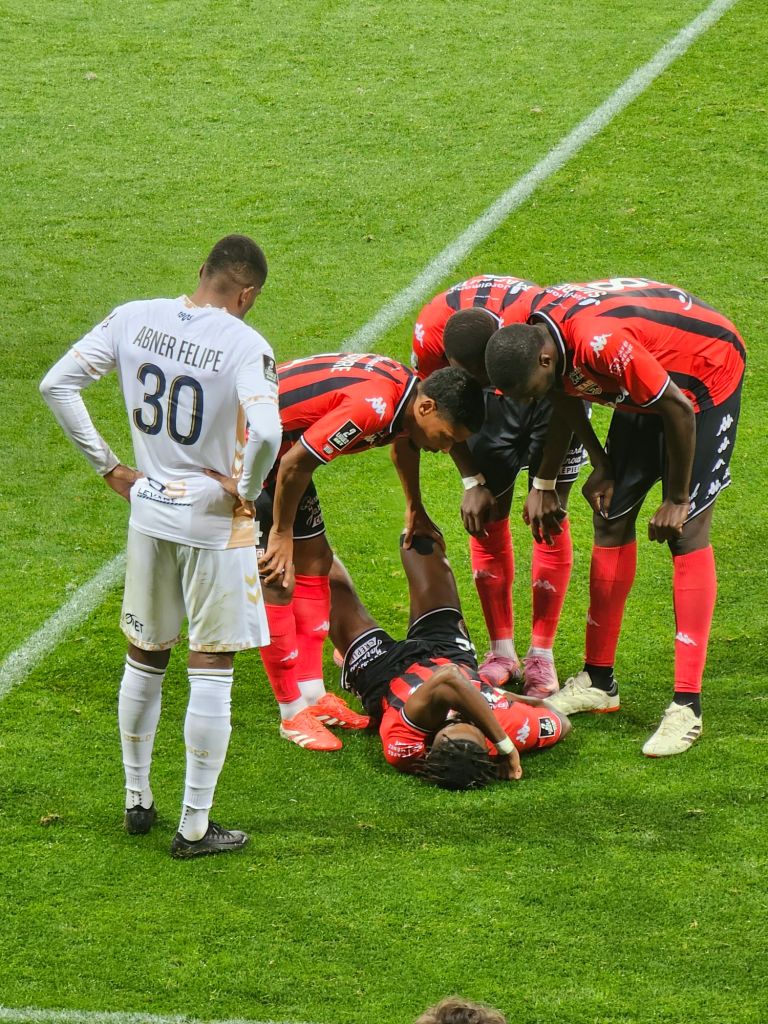
The slick passing of the first half has been replaced with increased niggle and Paulene and I discuss the colour of the shorts worn by Dunkerque’s Brazilian number thirty, Abner.   They look more yellow than other Dunkerque players’ shorts, which Paulene attributes to his frequent falling over on the wet grass, whilst I suggest, a little unpleasantly perhaps, that maybe he ‘forgot to go’ before he left the dressing room. Twenty minutes remain and Eddy Silvestre shoots over the bar again for Dunkerque whilst the Kop Rouge sways with a sea of banners and the towering Kalidou Sidibe is replaced by a man with hair reminiscent of the late Tina Turner, Tanguy Ahile.

Somewhat annoyingly, the final ten minutes of normal time dissolve into something like chaos and nothing like football as players of both teams proceed to fall to the ground with alarming frequency.  If all the players who go down have genuine injuries, both clubs will need to be trawling the job centres of Brittany and Pas de Calais in the morning for additional physiotherapists.  Monsieur Landry, meanwhile, is rushed off his feet, airing his yellow card four more times and showing his red card to someone in the Dunkerque dugout.   Six minutes of added time are not so much played out, as acted out, and the final whistle comes as a blessed relief to all. The result lifts Guingamp to eighth in the Ligue 2 table, a point outside the barrage (play-off) places, whilst Dunkerque slide down to fourth from bottom, one above the relegation places.

Despite the weirdness of the last ten minutes, and the unexpected pre-match disappointments over T-shirts, bagpipes and the reading out of the players’ names, overall, the match has been a good one and everything has worked out fine; well except for the T-shirt and the bagpipes, but you can’t have everything. We therefore make our way back to our planet saving Citroen in good spirits, like all but thirteen of the 6,562 strong crowd, but who knows, they probably enjoyed it too.