Ipswich Town 3 Sheffield Wednesday 1

The words Sheffield and Wednesday when added together conjure several associations in my mind, from the betting scandal of the early 1960’s when three Wednesday players apparently ‘threw’ the game in a 2-0 defeat to Ipswich at Portman Road, to speeding through the streets of Sheffield on a double-decker bus with police outriders after a match during the miners’ strike in 1984 , to dislike because from May 1986 to May 1995 Town never managed to beat them, to a Sheffield Wednesday supporter I met on a course when I worked for Royal Mail, whose idea of conversation was to speculate on whether the barmaid in the pub we were in at the time was wearing a suspender belt and stockings; for the record, he was convinced she was, but this was never confirmed.

Today, Ipswich Town will play Sheffield Wednesday, and I am cautiously optimistic that some degree of Karma will apply, to balance out all those bad associations from the past. After a dull start to the day, it has brightened up and as I wait for the train to Ipswich, I find myself in one of those clear, cold days that characterise winter in Suffolk.  The station platform is well populated and tell-tale club crests on articles of clothing suggest many people are heading for the match just like me.  The train is on time and Gary joins me at the first station stop. We talk of the African Cup of Nations and Gary tells me that he was once at a barbecue with a player who is in the Tanzanian squad and who has two aunts with exactly the same names.  As ever, our journey is crowned by the sighting of a polar bear as the train descends Wherstead into Ipswich; it’s the slightly grubby looking one and for a few moments we wonder if it’s possible to wash and clean a polar bear

Ipswich is busy with football fans and there’s entertainment too as everyone stops to watch a drunken Sheffield Wednesday fan outside the Station Hotel.  Sadly, he’s not a cheery drunk but a stroppy one.  When the traffic lights change Gary and I cross the junction outside the station diagonally, pretending we are in Tokyo where such pedestrian crossings are, I believe common.  I ask Gary if he’s ever thought of going on holiday to Japan; he has but understands it’s expensive and of course air travel for mere pleasure is to be discouraged because of its impact on the environment.   A man walking alongside us asks what we think the score will be today.  With reprehensible pessimism Gary predicts a “boring one-all draw” or worse still a “frustrating one-nil defeat”.  I have no idea what the score will be but retain my optimism by not giving it any thought.   We speed past the programme sellers whose booths look like they might also stock ice creams, and I wonder if the programme price increase to £4 this season has led to much of a reduction in sales. I hope it has because they’re overly glossy and mostly very uninteresting.

I get to the door of ‘the Arb’ first and burst in, eager for a drink.  There are people stood two-deep at the bar but one of them is Mick, who says it’s his turn to buy the round, but then he always does.  He either has a bad memory or is just naturally generous.  But today I convince Mick it’s my turn to buy, although I leave him to order his own felafel Scotch egg.  With a pint each of Mauldon’s Suffolk Pride and a pint of Lager 43 for Gary (£14 something with Camra discount) we retire to the beer garden and find seats in the shelter that backs onto High Street.  Unexpectedly, Mick gives me a Christmas card but explains that he had effectively inherited some, so thought he’d use them.  Along with the card Mick gives me a ‘present’ (unwrapped), which is a programme from Ray Crawford’s testimonial featuring games between Ipswich Town ‘past’ and ‘future’ and the then current Ipswich team and Wolverhampton Wanderers. The programme is a reminder of how plain and straightforward, or perhaps boring things used to be, even as recently as 1969.

Gary buys another round of drinks, which this time comprises just a half a pint of Suffolk Pride for Mick, and by way of a change a pint of Mighty Oak Solstice Porter for me, because tomorrow is the Winter Solstice and being a sucker for megaliths and the like  I like to remember the true meaning of Christmas.  The porter is very tasty indeed but does nothing to take my mind off the rapid emptying out of the beer garden and it’s not yet half past two.   It’s gone twenty to three when we leave for Portman Road and after a downhill stroll, we eventually part ways within earshot of Sir Alf Ramsey’s statue, if only its ears worked. We are agreed that the next game is at home to Oxford United on New Year’s Day, and that I shall try and acquire three tickets together for the FA Cup tie versus Blackpool.

As has been the case for the past few games there are no queues at the turnstile to the Sir Alf Ramsey stand and after quick scan for weaponry by a smiling, bearded man of probable south Asian heritage I step through turnstile 61; I would have used the noted turnstile 62 but there was a bunch of late middle-aged blokes milling around it who didn’t  seem to know what they were doing and I couldn’t be bothered to say “excuse me”.  Moments later, standing in front of the stainless steel urinals decanting  spent Suffolk Pride ( I don’t think the Solstice Porter can have made its way through yet) I hear the excitable young stadium announcer announcing the teams and by the time I’m shuffling past Pat from Clacton and Fiona to my seat I only get to shout  “O’Shea” in the manner of a Frenchman at the Stade des Alpes in Grenoble or Stade Saint-Symphorien in Metz.   Ever-present Phil who never misses a game is of course here too but not his son Elwood or the man from Stowmarket (Paul).   The excitable young stadium announcer is today wearing a Santa hat as he presumably gets even more excited at the prospect of Christmas.

When the game begins, it is Sheffield Wednesday who get first go with the ball which they boot in the general direction of St Matthew’s Baths and the Broomhill Lido whilst sporting a necessary change kit of all-white, which presumably to the chagrin of Wednesday supporters makes them look like a bit like Leeds United.  It’s no wonder their team is bottom of the league table with minus nine points, although the travelling supporters are making the best of a bad job and chant “Wednesday ‘til I die” impressively, even though these lyrics might tragically imply to some that they haven’t got long left and are going to miss Christmas.    Ipswich are naturally wearing our signature blue shirts and white shorts.

Early exchanges are dominated by Fiona’s observation that the Wednesday goalie is very small. “He looks about ten” she says, a little unkindly but it is true he is not the usual giant you expect to see in goal and Wikipedia tells us he is a mere 1.86 metres tall, which is shorter than me. In passing I mention Laurie Sivell, who was probably smaller than most modern 14-year-olds.  Ipswich win an early corner, and I notice that the Wednesday shirts carry the words “Mr Vegas” on the front and I assume this is not some sort of self-promotion by comic actor and professional ‘funny person’ Johnny Vegas, but rather an attempt to part people from their money by gambling with it.  “Football in a library” chant the Wednesday fans to show that they’re no more original than the fans of all other clubs.

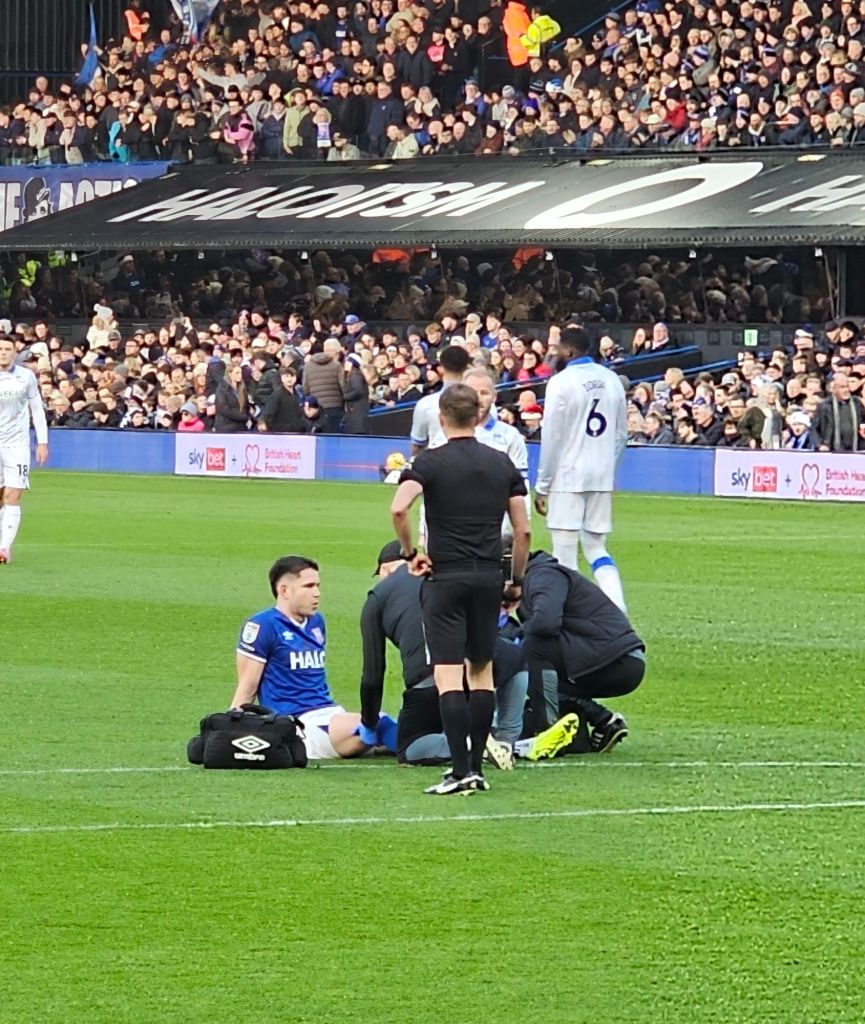
Five minutes wither away and George Hirst heads a Jaden Philogene cross over the top of the Wednesday goal, and I realise that Pat from Clacton is wearing a set of festive antlers whilst Fiona has donned a blue and white Santa hat, as has ever-present Phil. Meanwhile the Wednesday fans sing “I love you Wednesday” to the tune of “Can’t take my eyes off you”, which was originally recorded 1967 by Frankie Valli.  Nine minutes have left us forever and George Hirst retires early for Christmas due to a mystery injury, to be replaced by Ivan Azon and that’s as exciting as the first fifteen minutes get.  The home crowd is characteristically quiet, taciturn even, waiting to be entertained before deigning to offer vocal encouragement.   Wednesday win a corner which is headed very wide.  “Dogshit innit?” says the bloke next to me using the kind of symbolism which in the circumstances Charles Beaudelaire himself might have failed not to use.   Then Dara O’Shea carelessly loses the ball to the Wednesday number nine who is identified on the scoreboard as J Lowe and therefore not to be confused with either J Lo or as Fiona says, John Lowe the darts player.  Lowe’s shot goes past Christian Walton but is spectacularly cleared by a tumbling, falling, reversing Cedric Kipre.

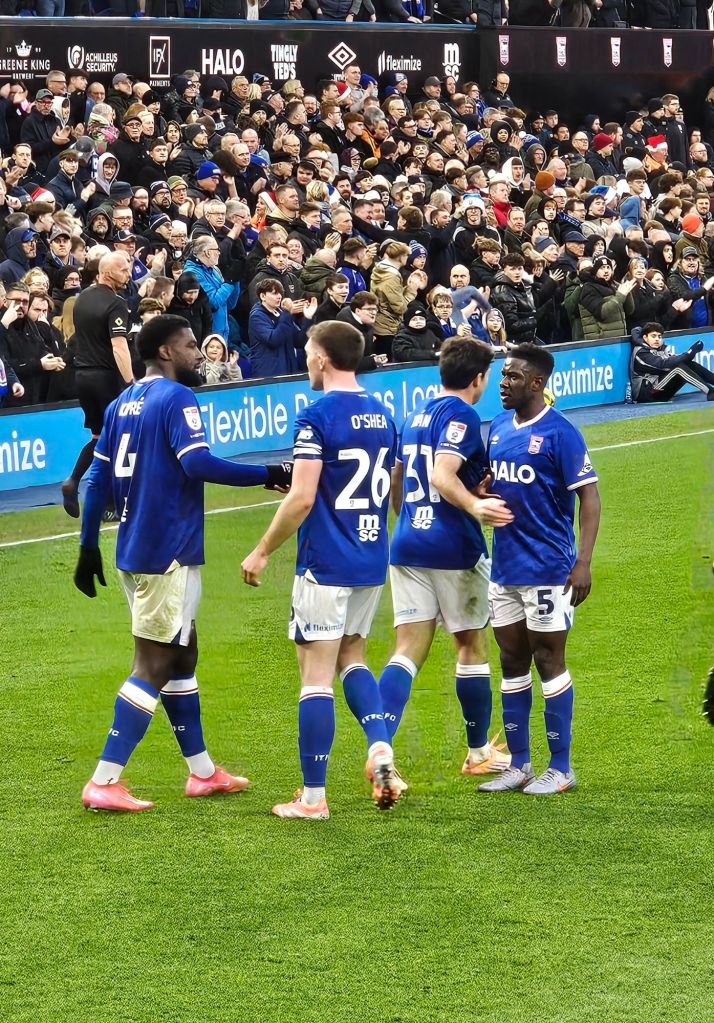
“Shall we sing a song for you?” enquire the Wednesday fans clearly feeling uneasy about the awkward silences but then Ivan Azon stoops to head wide, almost reminding us of what could be before a rare cogent moment has Jens Cajuste breaking forward into the penalty area, shooting at tiny Pierce Charles and Nunez heading unnecessarily wide. A third of the match is consigned to mostly forgettable history but suddenly a less forgettable moment has Philogene kicking overhead against a goal post and Town winning a corner from which Kipre heads against the underside of the cross bar and into the net.

Town lead 1-0 and I’m feeling grateful as Wednesday win a corner and at the front of the stand an obese woman makes her way back to her seat with a bottle of Coke, a packet of crisps and a bar of chocolate.  It’s not quite twenty to four in the afternoon.  Three minutes of added on time are added on and then it’s time to dispose of the remaining spent Suffolk Pride and the first of the spent Solstice Porter. Relieved, I head to the front of the stand to speak with Ray, his son Michael and grandson Harrison and also Dave the steward, who I used to work with at Royal Mail, but who was not on the course with me and the Sheffield Wednesday supporter with the interest in barmaids’ hosiery.

The football resumes at five minutes past four and Pat from Clacton is soon telling me about her new rimless glasses before referee Mr Webb (‘Spider’ to his mates) unveils his yellow card for the first time when Wednesday’s Liam Cooper fouls Ivan Azon.   A minute’s applause follows seven minutes into the half in memory of supporter who died this week and two minutes later Cedric Kipre slashes a shot wide when given his earlier success he might have considered a header, even though the ball was on the ground. The sun has now long set and darkness looms behind each stand.

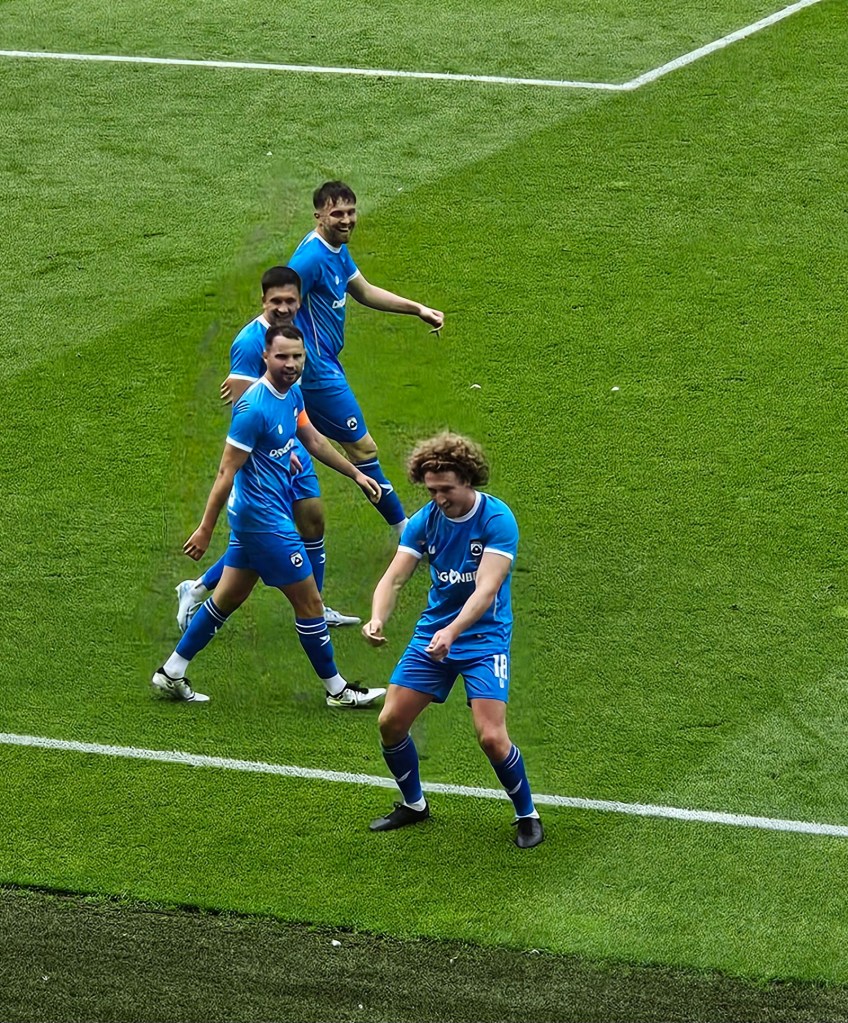
Town look a bit better this half, which shouldn’t be too difficult, and a sweeping move from defence into attack with a striding run from Cajuste and a perfect pass from Nunez allows Philogene to belt the ball past little Pierce Charles who as well as being small for a goalkeeper sounds like his name is back to front.   Town lead 2-0 and there are still thirty minutes left to play. “No points today, Ole, Ole, Ole” I think I hear the Wednesday fans sing and a couple of substitutions for Wednesday result in the appearance of one George Brown, a player who I can only hope joins Fulham to play alongside Harry Wilson in a tribute to the Labour governments of the 1960’s.

Today’s attendance is announced as 28,860 and the excitable young stadium announcer thanks us for “our incredible support” and I wonder if he’s being sarcastic; personally, I’ve just hollered “Come on you Blues” a few times before two first half corners.  A minute later and from a Wednesday corner the ball fortuitously drops to the ground right in front of Cooper, who only has to swing his leg at it to send it low into the far corner of the Town goal and Wednesday have an unexpected goal.  Hope appears for Wednesday who chuck in a few awkward crosses and George Brown waves his arms about to encourage the away supporters. 

But with fifteen minutes left of normal time Town make three substitutions, replacing Cajuste with Taylor, and Eggy and Philogene with McAteer and Clarke, and Town look likely to score again, which with four minutes left they do as Clarke runs at goal, nips around a bumbling defender and flicks and rolls the ball past little Pierce Charles. 

The game looks won and Town nearly score two more but leave them in the pump for when they might really need them.  The Wednesday supporters, as supportive as they have been have seemingly run out of tunes and have even bored themselves with talk of football in libraries.   A staggering nine minutes of added on time are added on for assorted injuries, and stoppages to give remedial coaching.  At last, with the five o’clock chimes of an imaginary clock ringing in my ears the final whistle is blown, and Town are up to third in the league table.  There is applause, probably partly out of relief, and much of the crowd quickly melts away into the night exchanging seasonal good wishes as they go and talk of seeing everyone again in the new year.  The bloke next to me and the bloke next to him shake my hand; the bloke behind me says he reads this blog and my future memories of Sheffield Wednesday take a turn for the better.

Halesworth Town 3 Haverhill Rovers 1

Between March 2017 and April 2019, I watched matches at each one of Suffolk’s then twenty-four senior football clubs and recounted my experiences in this here blog.  Since then, Debenham Leisure Centre and Whitton United have sadly dropped out of senior football but this season the Eastern Counties League First Division North has welcomed two more Suffolk clubs into the fold in the shape of Kings Park Rangers, who are from Great Cornard but seemingly too shy to admit it, and Halesworth Town, who are proudly, clearly from Halesworth. 

Today, with Ipswich Town playing far too far away in deepest Wales to trouble me to even think of getting a ticket, even if I had enough ‘points,’ I am travelling up to Halesworth in part one of my plan to restore my record of having seen all of Suffolk’s senior teams on their home turf.  Fortuitously, today’s fixture is also an all-Suffolk cup-tie against Haverhill Rovers of the Eastern Counties Premier League, and the first time Halesworth Town have ever reached the second round of the FA Vase.   To add to the adventure even more, despite the additional twenty minutes each way that it will take me, I am responsibly reducing congestion on the roads by eschewing making the 88-kilometre journey from my home by planet saving Citroen e-C4 in favour of taking the train (£18.10 return with senior railcard). It also means I can get plastered if I choose to.

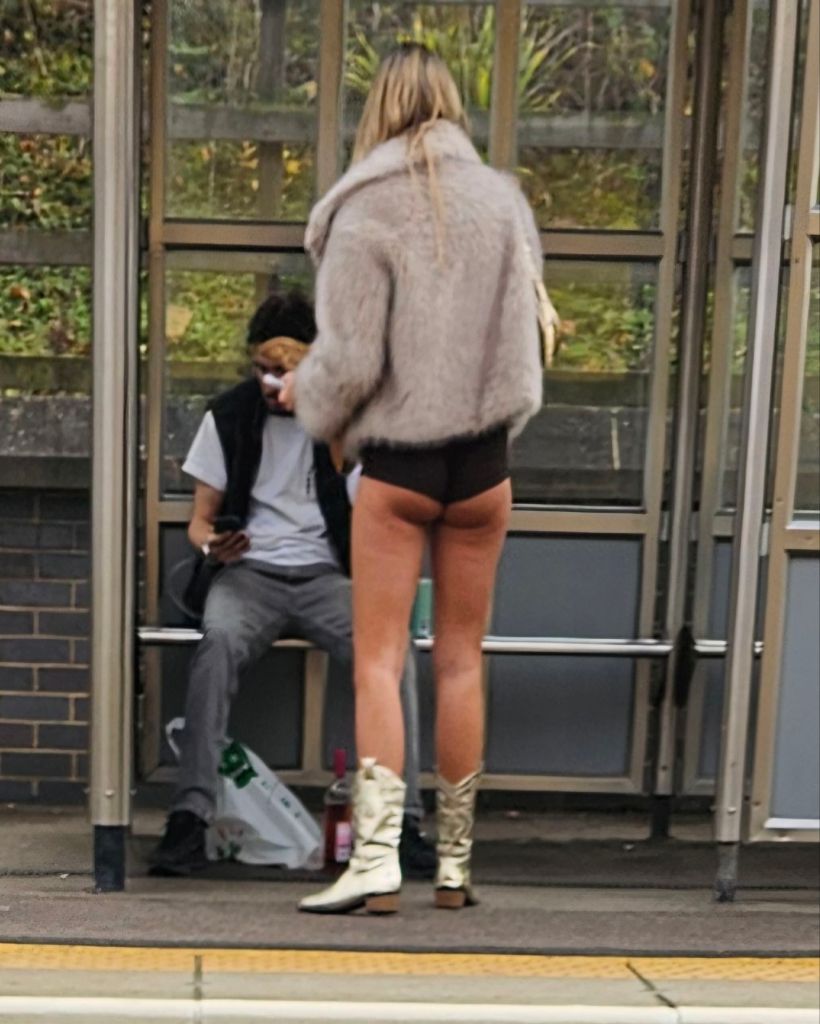
It’s an intermittently cloudy but mild November day as I set off for Halesworth, but I am nevertheless surprised as I wait for the train that one of my fellow travellers appears to have forgotten to put on any trousers or a skirt.  Once on the train, the infinite variety of human life continues to reveal itself as a small man of pensionable age repeats the names of the station stops as they are heard over the public address system; every now and then he delves headfirst into a large carrier bag as if checking on the wellbeing of a small animal or perhaps a baby.  When the woman sitting opposite me goes to the buffet car, she asks me to mind her belongings. I of course agree but tell her she needs to be back before we get to Ipswich.   When she returns, I tell her I had to fight off a couple of people who looked interested in her jacket but otherwise everything has been fine.  Fortunately, she laughs, but the man of east Asian origin next to me looks at me askance and when she begins to struggle to open a bottle of drink, he very quickly offers to help so that she doesn’t have to deal with the looney opposite her again.  The woman soon begins to chew on a large sandwich and a younger man on the other side of the aisle between the seats does the same thing, but takes much bigger bites, happily from a different sandwich, although with every bite he looks like he might lose a finger.

I change trains at Ipswich, boarding the 13:16 to Lowestoft, which departs a good twelve seconds early.  I like the East Suffolk line, to me it feels like a one-hundred- and seventy-year-old umbilical cord connecting the outside world to rural Suffolk with its rustic sounding stations such as Campsea Ashe and Darsham and their Victorian architecture.  Between the stations are Suffolk landscapes of river and marsh, Oak and Broom, sheep and pigs, outwash sands and boulder clay and gaunt, grey, flint church towers.  As the guard checks passengers’ tickets, he helpfully advises those alighting at Halesworth not to use the doors in the front carriage, because the Halesworth station platform is not that long.  There seem to be quite a few of us alighting at Halesworth.

The train arrives on time in Halesworth, where the sun shines from a pale blue autumn sky. A helpful sign points and tells pedestrians that it’s a seven-minute walk to the town centre and a minute’s walk to local bus stops on Norwich Road. Sadly however, no sign points helpfully towards Halesworth Town football ground, although having previously consulted the interweb I happen to know it is very close indeed, perhaps no more than a hefty goal-kick away.   I walk up an alley between the railway lines and Halesworth Police station, a huge four-storey block of a building, which although it probably dates from the1960’s makes me think of a Norman castle keep, built to keep the locals in check.  At the top of the alley, I turn right over a bridge above the railway and then right again down another alley the other side of the tracks, and down to the Ipswich bound railway platform. From here it is no more than 150 metres up Dairy Hill to the football ground, making it a toss-up between Halesworth and Newmarket as to which senior Suffolk football ground is most easily accessible by rail, my money’s on Halesworth.

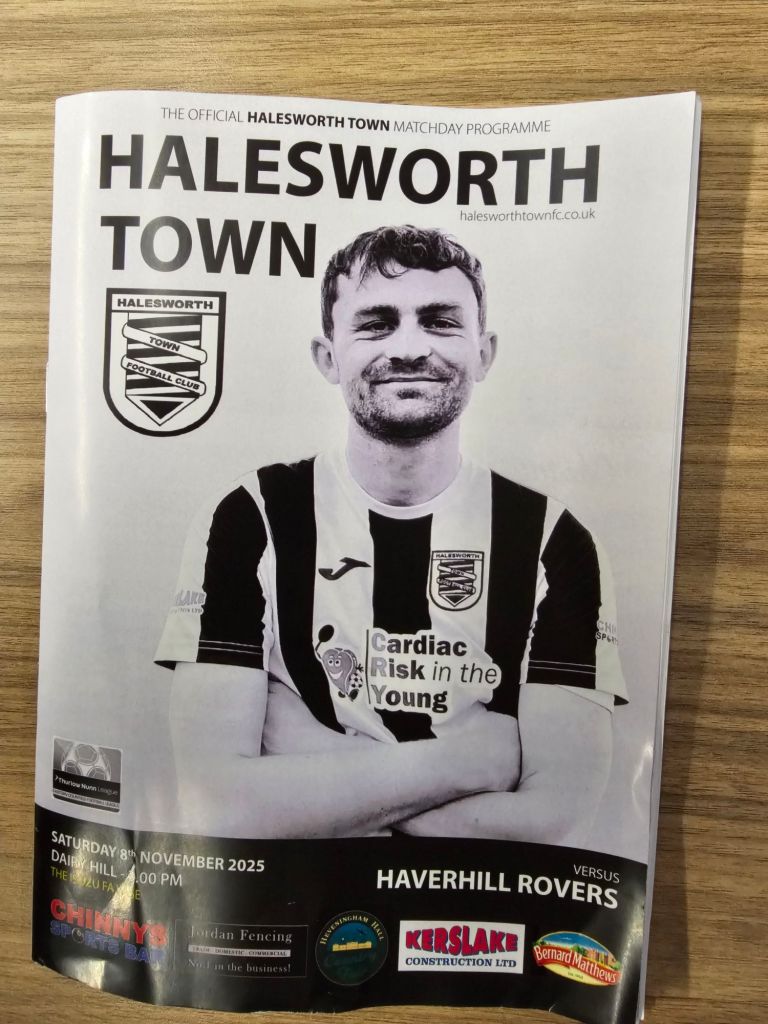
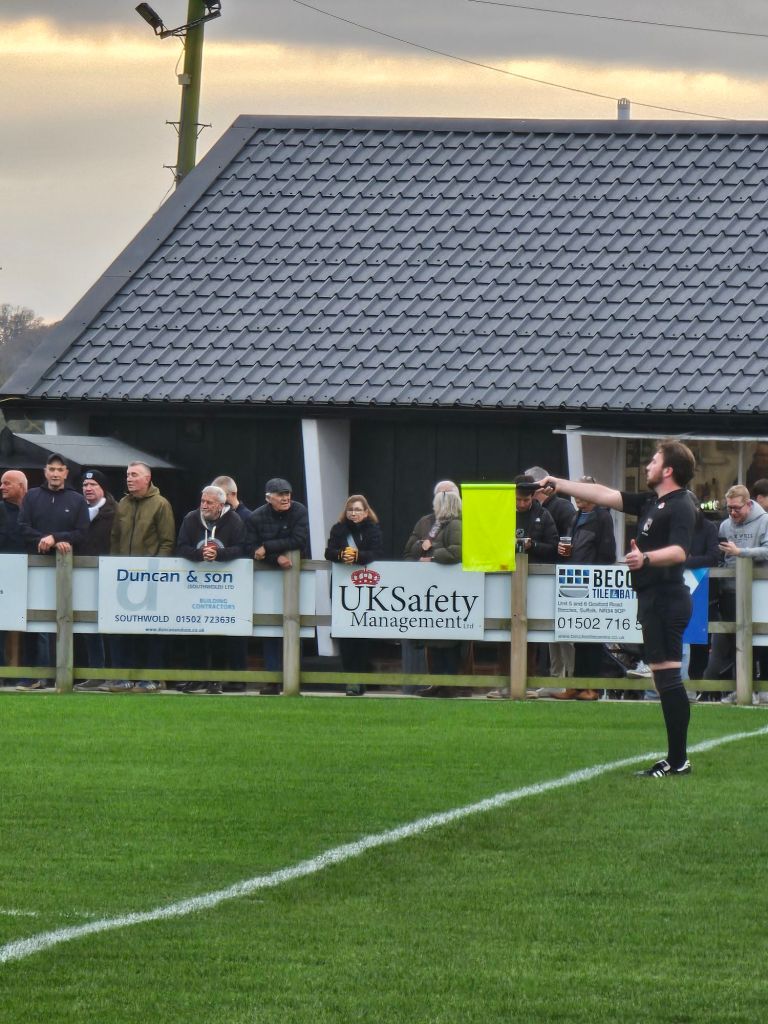
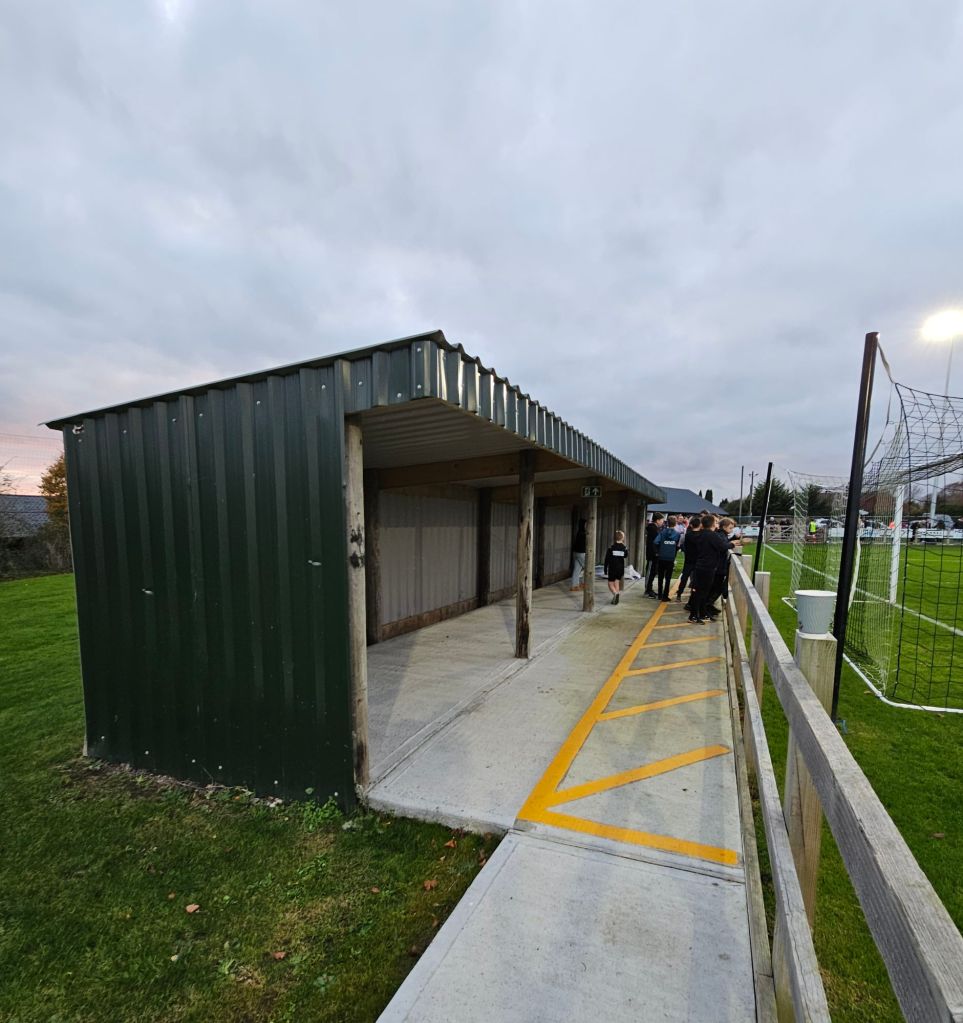
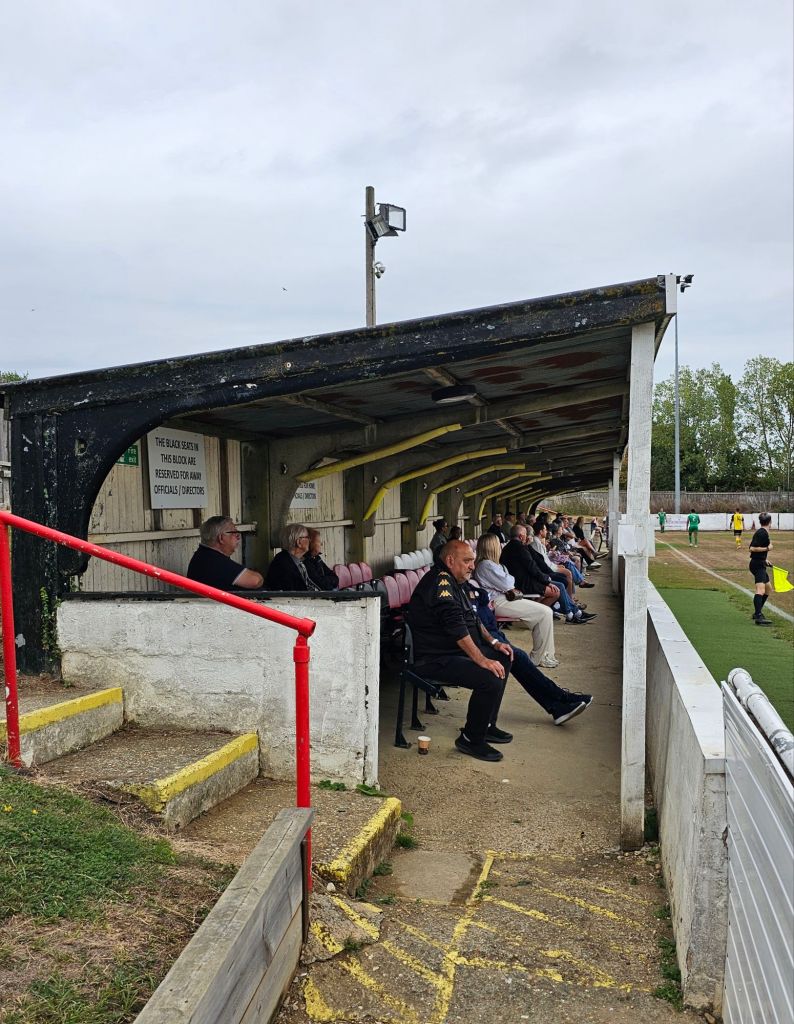
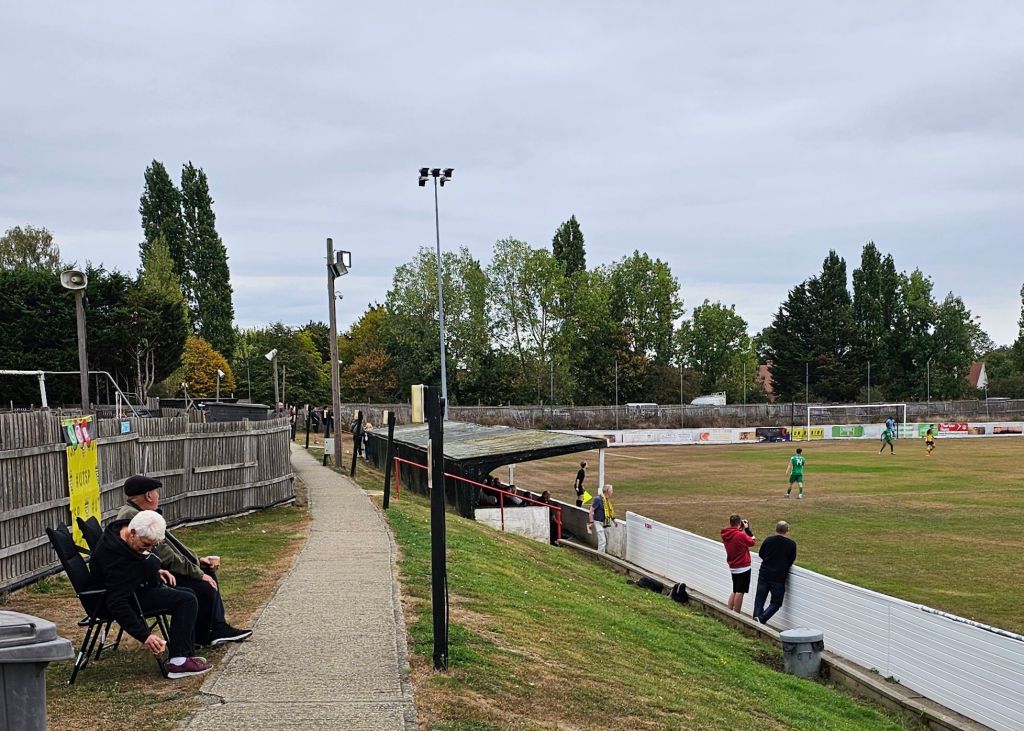
Despite its attractive name, Dairy Hill is just an uninspiring street of modest modern houses; from the top I make my way across the stony club car park and along the back of the club house to the ground entrance.  For a mere seven pounds I gain a programme (£1.00) and entry to the match as an over sixty-five, all that is missing is the click of a turnstile.  The ground itself is underwhelming, but it does boast a decent looking pitch with a smart timber fence all around and a small stand at the end nearest the clubhouse, which according to ground grading rules needs to be big enough to accommodate fifty spectators, although I’m not sure if FA rules say how large or small the spectators need to be.  The height of Halesworth’s stand suggests they should not be significantly taller than about 1.8 metres unless wearing crash helmets.

I head for the club house where the bar offers the usual array of fizzy lagers and cider and a pump which intriguingly bears the name ‘Wainwright’ written in biro on a plain white sticky label.  The barman generously allows me a sampler of the ‘Wainwright’ and seeing as there’s nothing-else I might like I order a pint (£4.60) before heading outside again to visit the food trailer, where a tall man with tattooed arms, who looks like men in food trailers often do serves me chilli, chips and cheese for a modest six pounds, less than half what I paid for much the same thing in an Ipswich pub earlier this week. 

I return to the club house to eat my chips and drink my beer, not being someone who likes to eat or drink standing up.  The club house looks like there might be an older timber building, which has had a new roof and supporting structure placed over the top of it, it smells a little like that too, having a faint musty odour which isn’t uncommon in old village halls and clubhouses.  The black and white interior décor and monochrome photos of old teams on the walls remind me a little of the Long Melford club house before it was re-built.

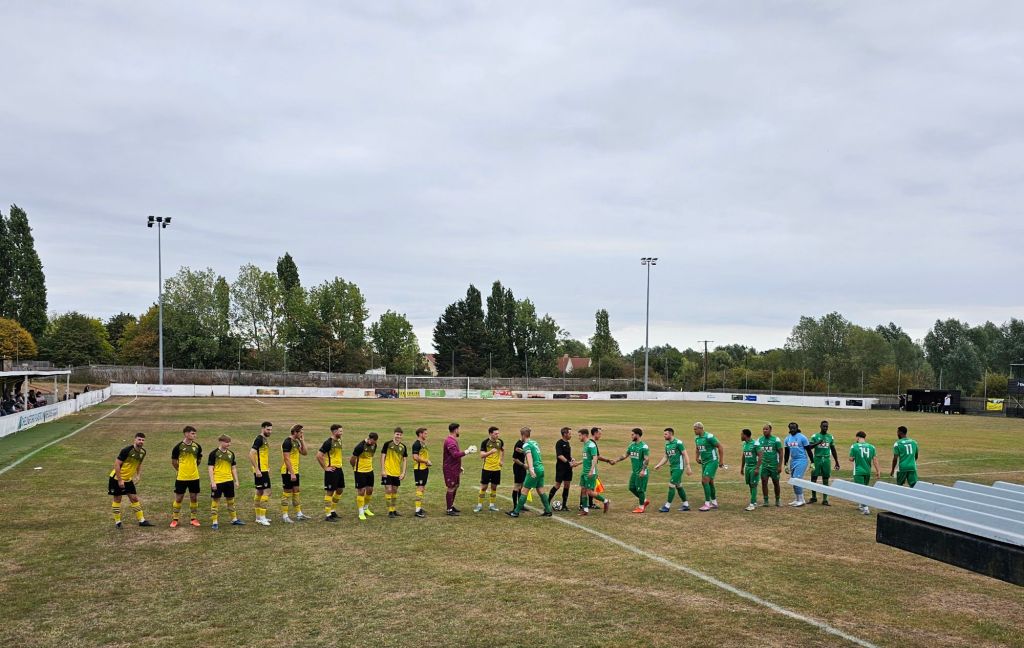
With chips eaten and beer drunk, I wait outside for kick-off, observing the growing crowd and the queue to get in at the gate, before standing closer to where the two teams will line up before the procession on to the pitch to shake hands and then observe the minute’s silence for remembrance day, a silence  which whilst well observed around the pitch plays out to a back ground of chatter from inside the bar and clubhouse, where life continues as usual, oblivious to the  silence outside.

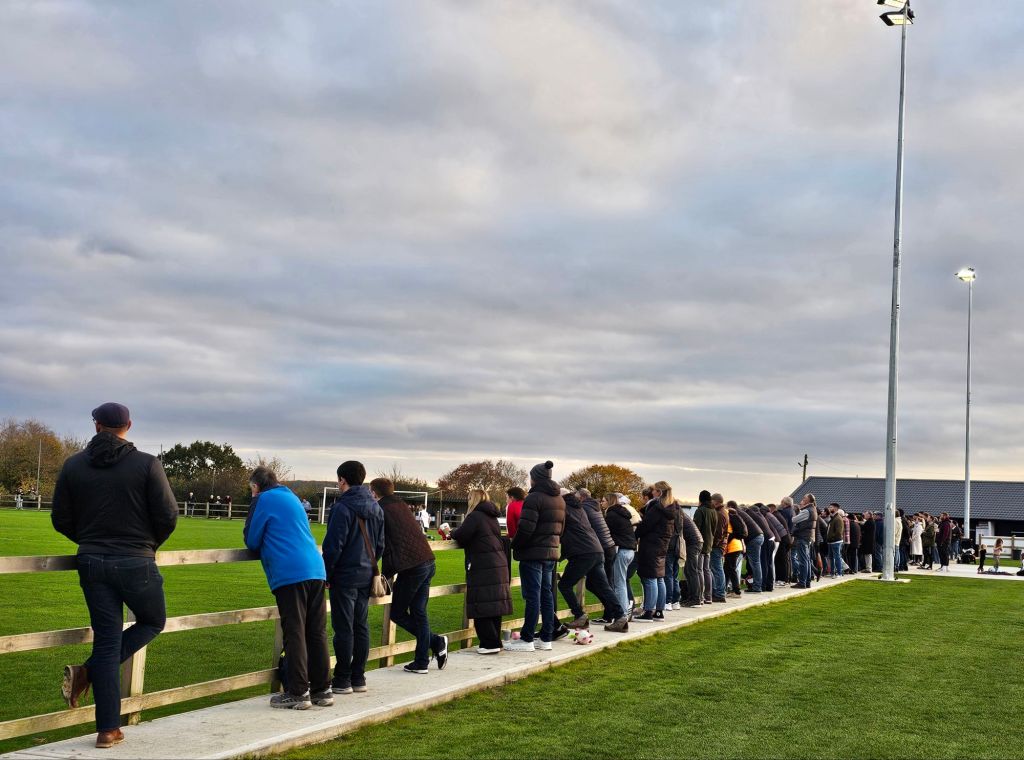
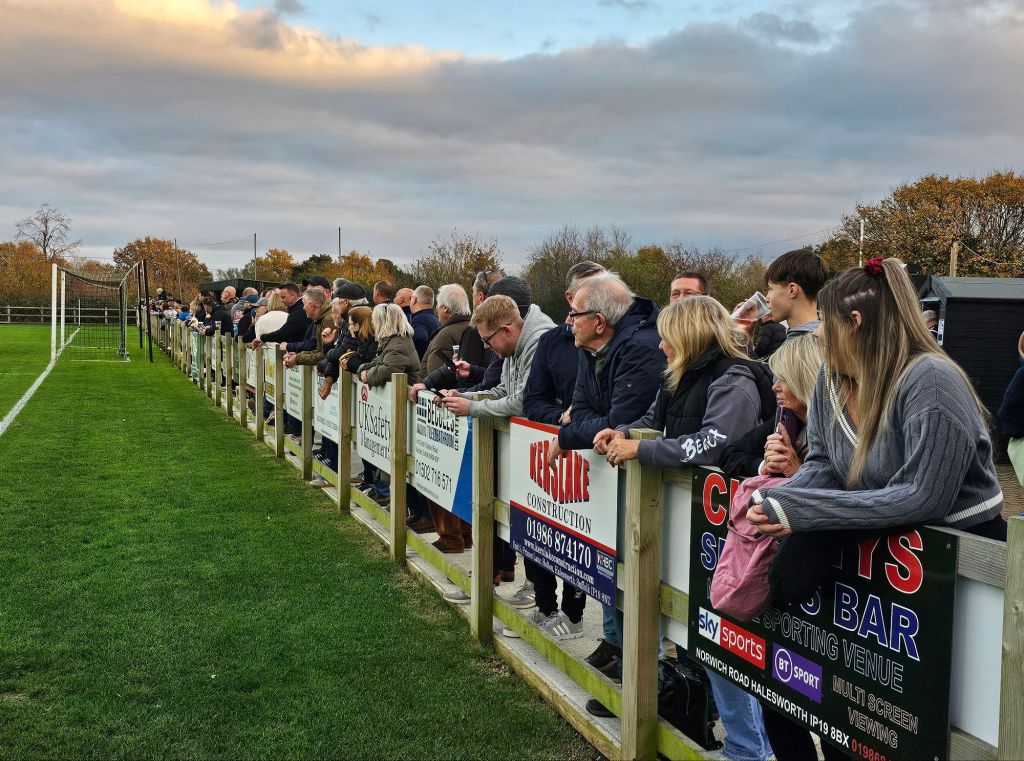
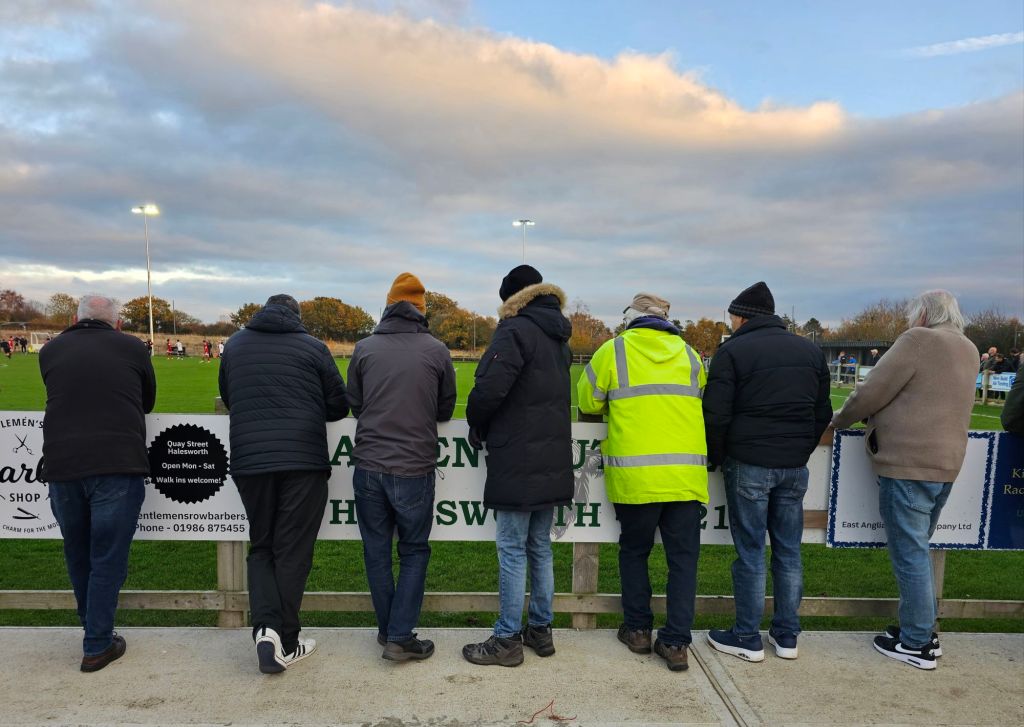
Eventually, it is Haverhill Rovers who begin the game, by getting first go with the ball, which they quickly hoof forward in the general direction of the stand, the railway station and town centre beyond, before it is booted into touch by a Halesworth defender, not unreasonably practicing safety first.  It’s good to see both teams wearing their signature kits, Rovers in a rich shade of all red, whilst Halesworth sport black and white stripes with black shorts. In front of the only stand, a youth bangs the sort of drum I wouldn’t bet against him having been given as a present for his sixth birthday, probably about six years ago.  The bulk of the crowd are lined up behind the post and rail fence along the touchline opposite the dug outs and when Halesworth win the ball they emit an encouraging rustic roar.

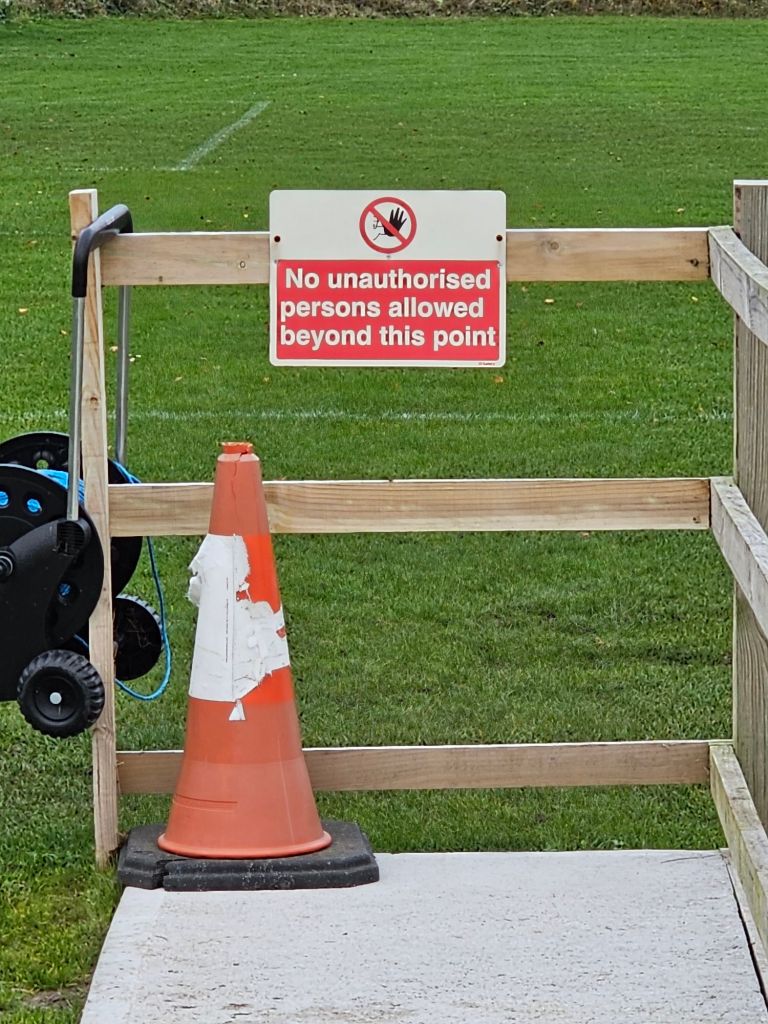
Seven minutes have passed and it’s Rovers who are the team kicking the ball most of the time; their number seven Prince Mutswunguma performs a neat turn and a decent cross which is headed over the Halesworth cross bar.  The pattern of the game is generally one where the long ball is favoured over short passes and two minutes later Mutswunguma blazes the ball high above the Halesworth cross bar.  I stroll along the front of the empty stand between it and the pre-pubescent ultras but remain nervous of hitting my head on the low roof.  I stop close to the corner flag, halted by a sign forbidding further progress and disappointingly preventing me from walking round to watch the game from behind or between the dugouts, where the angst and frequent bad language of the managers and coaches is often as entertaining as the match.   I am nevertheless now in a good position to see Rovers’ desperate claims for a penalty as Mutswunguma tumbles under a challenge from number 6, Ollie Allen and then two more players fall over. “Fucking disgraceful” opines a gruff voice from somewhere, either on the pitch or in the dugouts, but I’m not sure if he means not giving a penalty or having the temerity to appeal for one.

Keen to see the game from as many angles as possible I move again, this time to near the corner flag diagonally opposite the one I have been standing by.  I settle near a man in late middle age who sports a Stranglers t-shirt and beanie hat bearing the name of The Rezillos, the excellent late 1970’s Scottish ‘punk’ band fronted by Faye Fife and Eugene Reynolds.  He is on his mobile phone and seems to be arranging a claim on his motor insurance having hit something when parking his car in the club car park.  In my new position I also benefit from a good view of an increasing number of unsuccessful Halesworth breakaways as the home team gain in confidence from repelling all Rovers’ attempts to score.

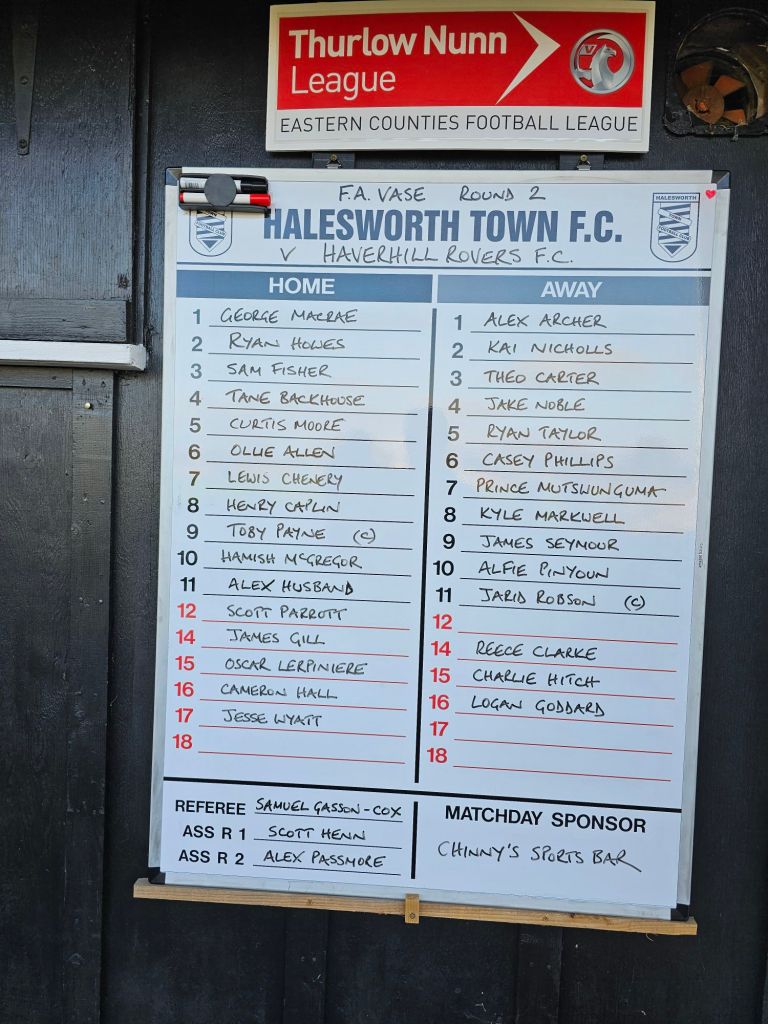
In goal for Halesworth, George Macrae has made a string of fine saves as Rovers win a succession of corners.  Rovers’ best effort is a shot from Kyle Markwell, whose surname gives a clue to the opposition as to how to treat him, that whistles past a post.  A half an hour is lost to history and Halesworth fashion another breakaway as captain Toby Payne receives a diagonal pass out on the left.  “He’s on!  He’s on! Well, he’s not off” shouts a young man to my left with rising excitement as Rovers’ offside trap is sprung. Payne advances into the penalty box, shapes up to shoot but then side foots weakly too close to the goalkeeper Alex Archer, who doesn’t have to stretch far to prevent a goal.  Two minutes later however Halesworth break again down the left and this time the ball is pulled back from the by-line for Lewis Chenery to score easily into the middle of the Rovers’ goal from no more than 8 metres out and it’s 1-0 to Halesworth Town.

The remaining dozen minutes of the half repeat the established pattern of the previous thirty-three, and another Rovers’ corner is headed wide, which I view from back near the clubhouse as I prepare to be ahead of the queues for the toilet and the tea bar when the referee, the extravagantly monikered Mr Gasson-Cox sounds the half-time whistle.  Having invested in a pound’s worth of tea I take-up a position for the second half just to the right of the stand, but not before I overhear a club official talking to the man on the gate and learn that the attendance today is a stonking two-hundred and fifty-eight.    As the new half begins and the light fades, the lovely smell of the turf rises up from the pitch. A woman standing next to me tells me we will see the goals at this end in the second half and I agree, telling her that with the goal being scored at the other end in the first half, it figures that this is the end where the goals will be scored this half.  We talk a little more and after I reveal I have an Ipswich Town season ticket, she admits to being a Norwich City supporter, but sympathetically I tell her someone has to be.

With the start of the second half at three minutes past four Halesworth seem to have lost a little of the confidence they showed by the end of the first half, perhaps because they realise they have to go through another forty-five minutes similar to the first, and indeed they do. But with twenty minutes gone and no further score it is Rovers who first feel the need to make substitutions.  “Who are ya?” chant the pre-pubescent ultras, as well they might as the new players emerge from the dugout.  Five minutes later and Halesworth’s Tane Backhouse is the first player to see the yellow one of Mr Gasson-Cox’s two cards, although as I become increasingly biased in favour of the home team and their superb goalkeeper, I can’t really figure out why.  Two minutes later and I’m cheering as another characteristic break down the right sees Toby Payne run to the edge of the Rovers penalty area, cut across a little towards the middle and then shoot unerringly inside the far post and Halesworth lead 2-0.  “Oh when the Town go marching in” sing the mini ultras, as do a number of people old enough to know better, but understandably carried away by the moment.

Things get no better for Rovers as after  an innocuous looking foul Mr Gasson-Cox nevertheless seems annoyed with Prince Mutswunguma and standing his ground, summons him over before showing him the yellow card.  “Wemberley, Wemberley” sing the Halesworth fans who should know better but are now too happy to care, but as they do so Rovers, perhaps realising their desperate position with only ten minutes left embark on a final push.   It’s twenty to five as George Macrae makes another fine save, this time diving low to his left. “Two-nil down on your big day out” sing the pre-pubescents, not helping the situation with their cruel taunts and Rovers win another corner.  The corner is cleared but moments later the ball is crossed low from the right and Rovers’ number eleven and captain Jarid Robson half volleys it high into the centre of the goal from a narrow angle and the score is a nerve-wracking 2-1.

It’s now eleven minutes to five, the match is a minute into added on time and Rovers are besieging the Halesworth goal like local Saxons or Danes outside the Norman police station.  A cross comes in from the left, and a Rovers head goes up diverting the ball goalwards but once again George Macrae appears, seemingly from nowhere to save the day again by cleanly catching the ball.  “Six more minutes Haverhill” I hear a voice call, perhaps from the Rovers’ dugout, or perhaps it was Mr Gasson-Cox or someone just mucking about. Six minutes seems an awfully long time given that neither I nor the lady next to me can recall anyone really being injured.  Another Rovers corner goes straight to the arms of Macrae but then Halesworth break away again, bearing down on goal on the right and then switching the ball across the edge of the penalty box before number eleven Alex Husband shoots from a narrow angle and the ball strikes a Rovers defender and arcs up over Archer the goalkeeper and into the goal off the far post.  It’s 3-1 to Halesworth! The game is surely won and the knot of Halesworth players hugging by the corner flag and the under12’s ultras who have run along behind us hoping to celebrate with them clearly think so.

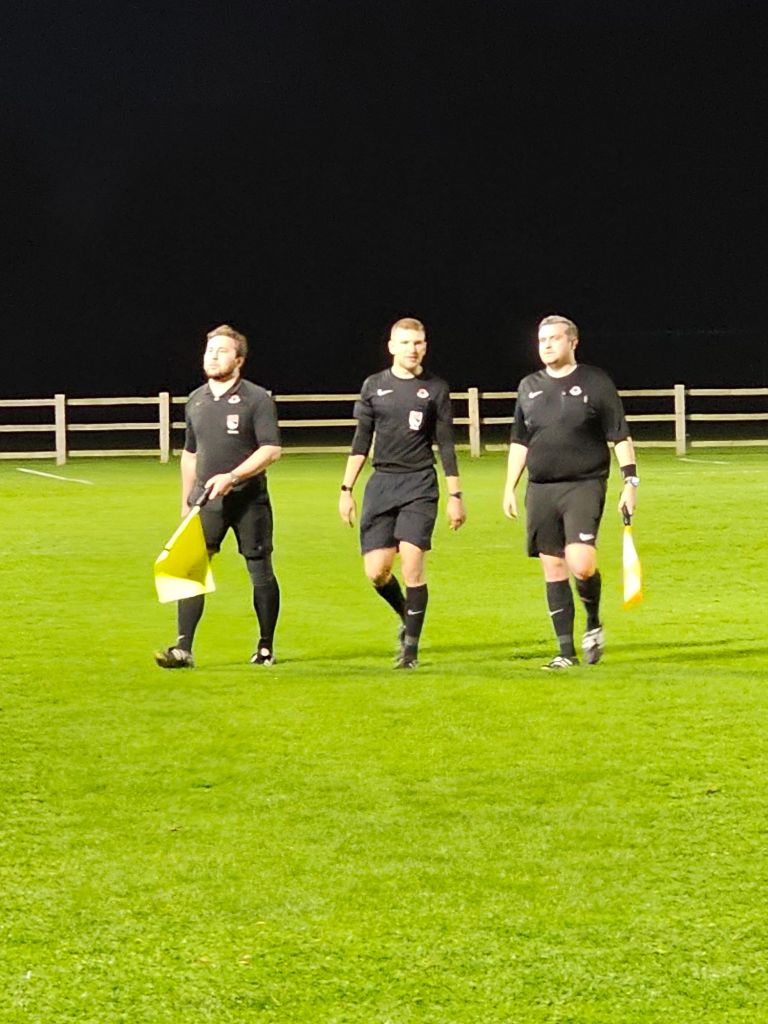
Very soon however, it’s three minutes to five and finally Mr Gasson-Cox parps his whistle for the last time today and Halesworth are into the third round of the FA Vase. Most people wait to cheer and applaud the team as they leave the pitch, but not before they applaud Mr Gasson-Cox the referee and his assistants, which is something you don’t see every day, and then the Haverhill players too.  It’s been a wonderful afternoon, an exciting cup-tie played in front of a large and appreciative crowd, and everyone’s had a lovely time.  As I leave the ground and make my way back across the stony car park and down Dairy Hill to the station I reflect on what a fine little town Halesworth is and how one day I really should return. All hail Halesworth!

FC Lorient 3 AS Monaco 1

At the risk of becoming extremely boring, my wife Paulene and I have now holidayed in Carnac in Brittany for four years running.  There are probably several even more boring reasons for this, one of the less boring however, because it is made up, is that I like to think of myself as being in touch with my Neolithic ancestors on a sort of yearly pilgrimage to see the Neolithic standing stones, cairns and tumuli that abound in Brittany and particularly Carnac, which this year has become a UNESCO World Heritage site as a result.  Another more truthful reason is that it’s only a 40-odd kilometre trip up the E60 and along the N165 to the Stade du Moustoir to see FC Lorient play and FC Lorient’s mascot is a hake.

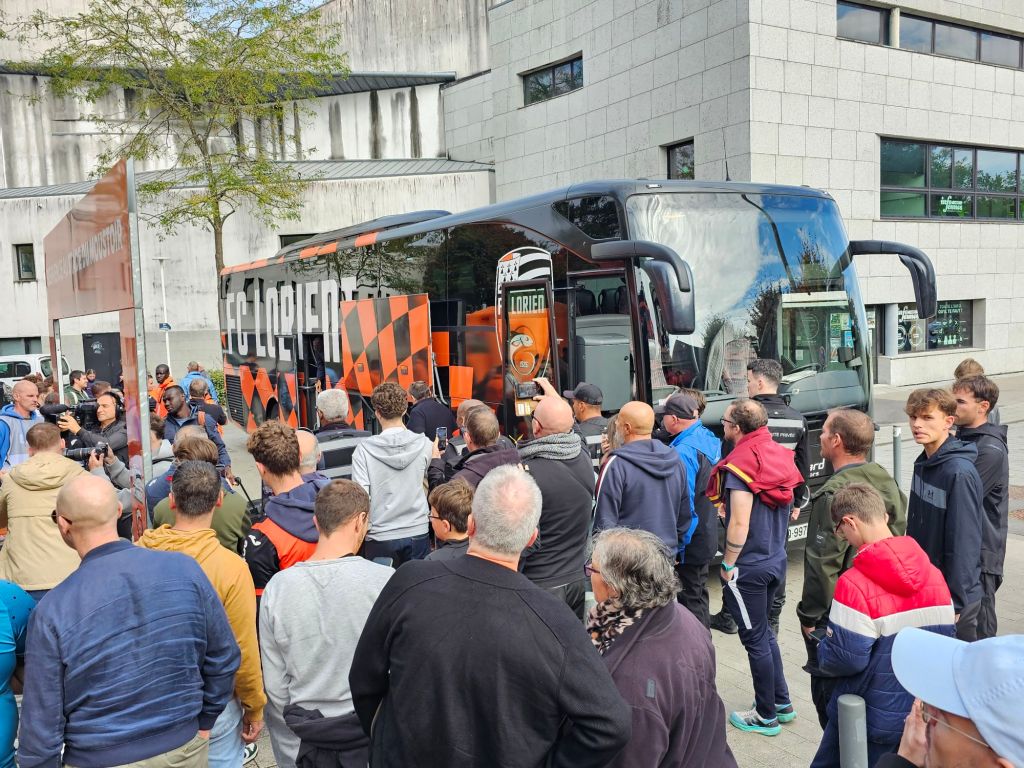
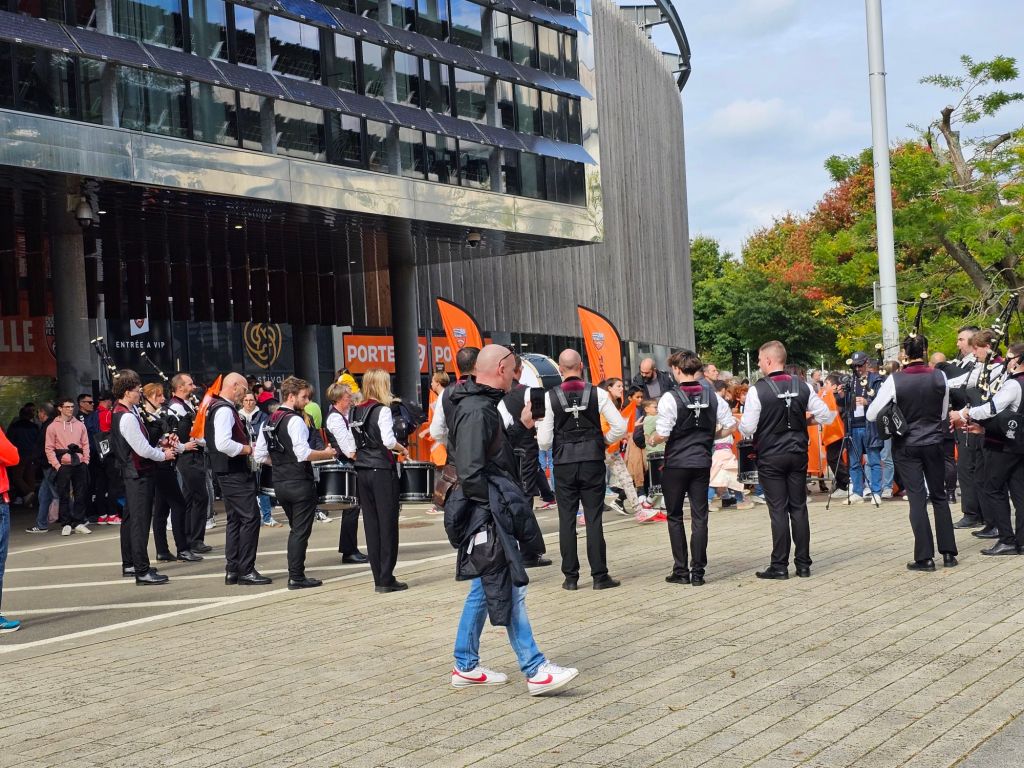
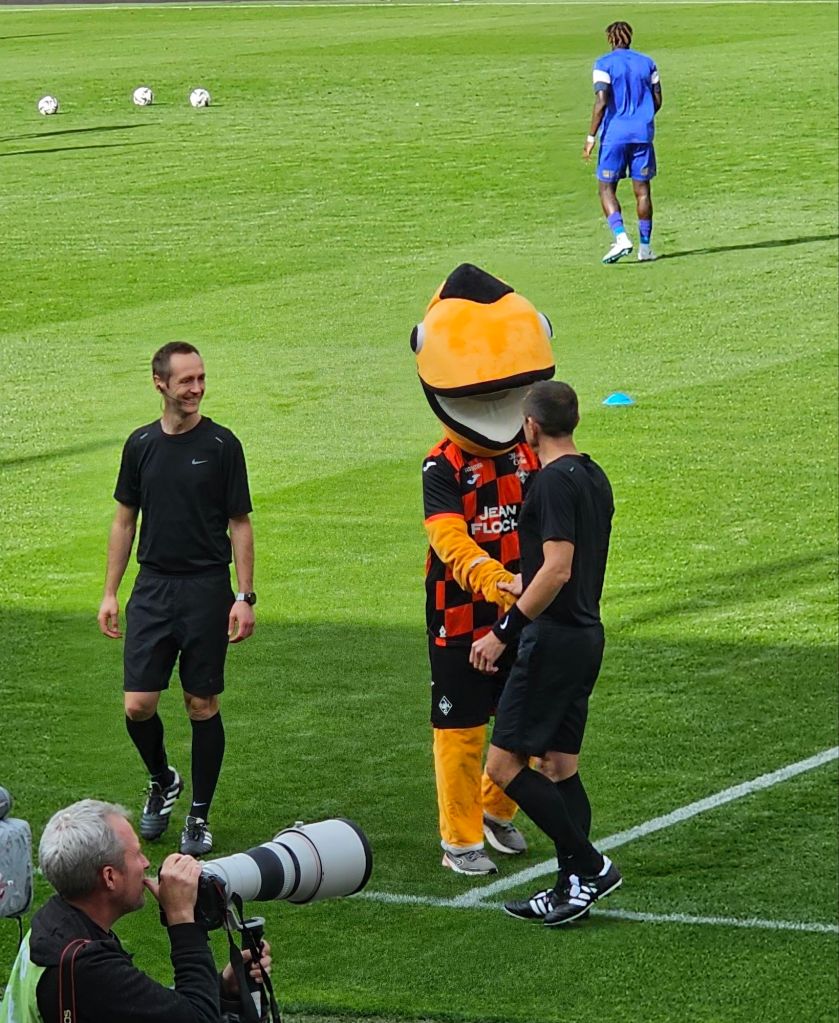
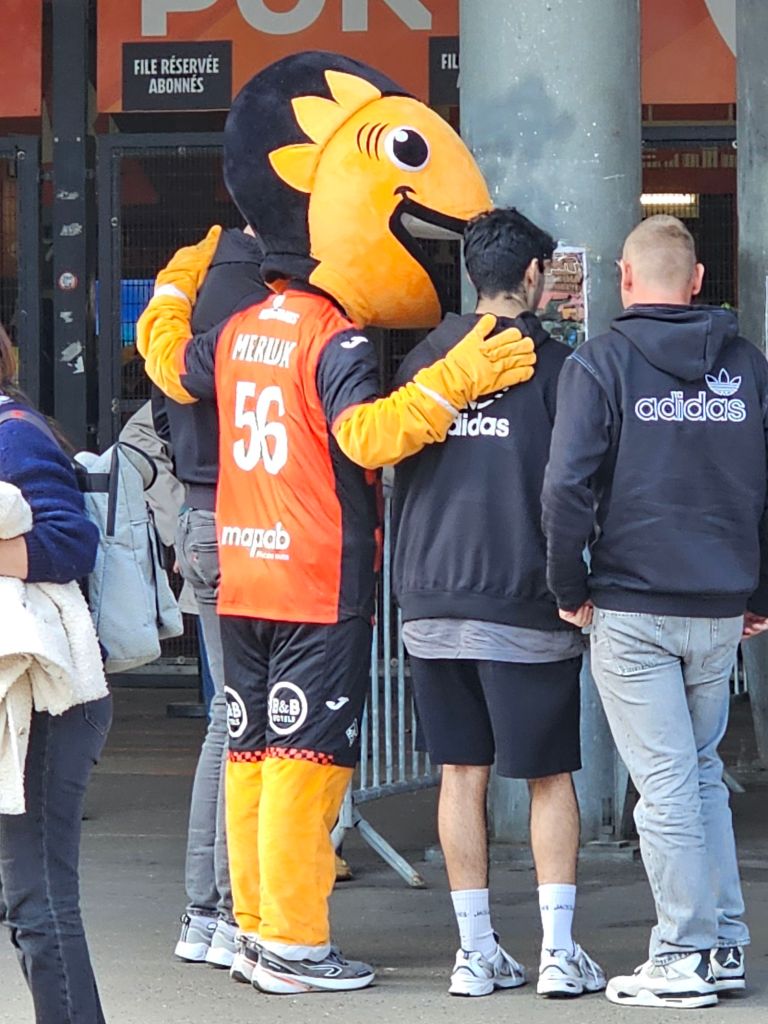
Our holiday is now sadly drawing to a close this year and today is the penultimate day before we must drive home in our planet saving Citroen e-C4.  But today, FC Lorient play AS Monaco in Ligue 1, the French version of the Premier League but with a less self-important title.  The match kicks off at 5 pm and we park up at the underground Place d’Armes car park about four hours beforehand to give time to explore a little of Lorient and at about 3pm see the Lorient team arrive at the Stade du Moustoir amidst bagpipe playing, banner waving and handshakes from Merlux and Mini-Merlux the FC Lorient mascots, (merlu is the French word for a hake).

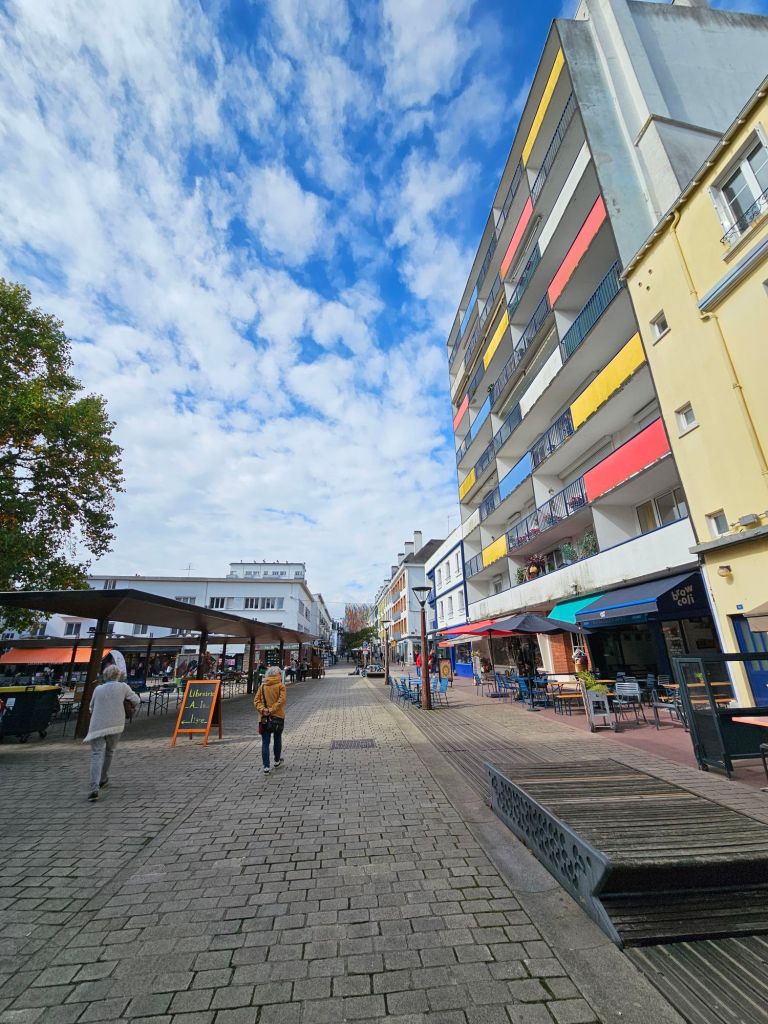
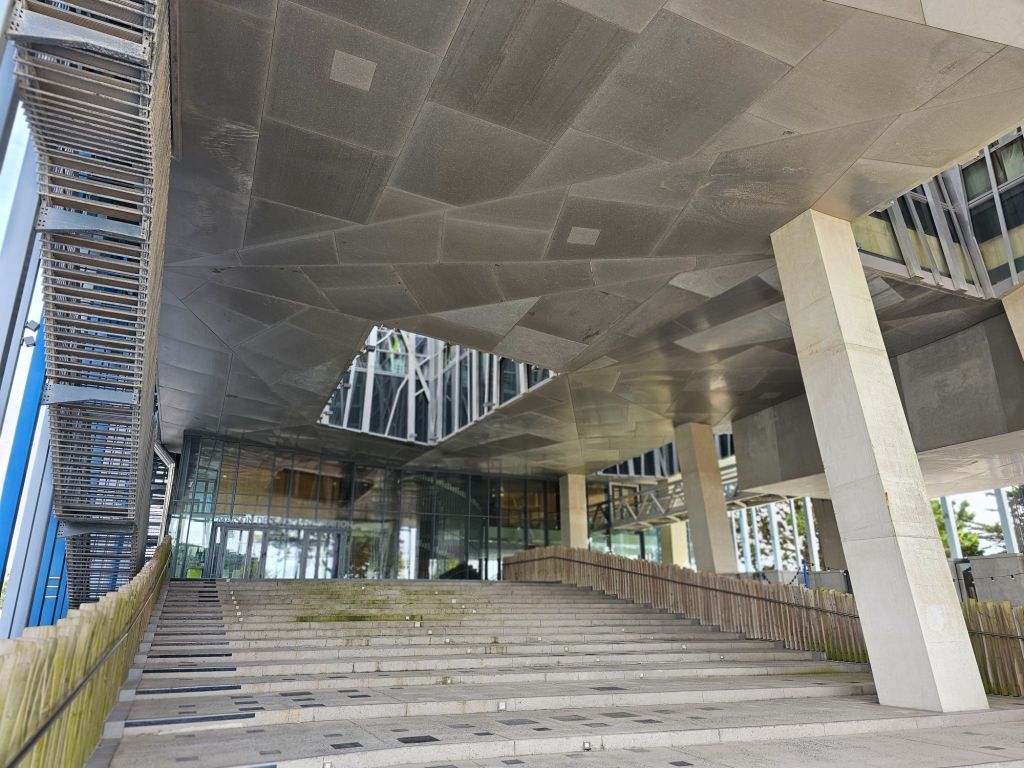
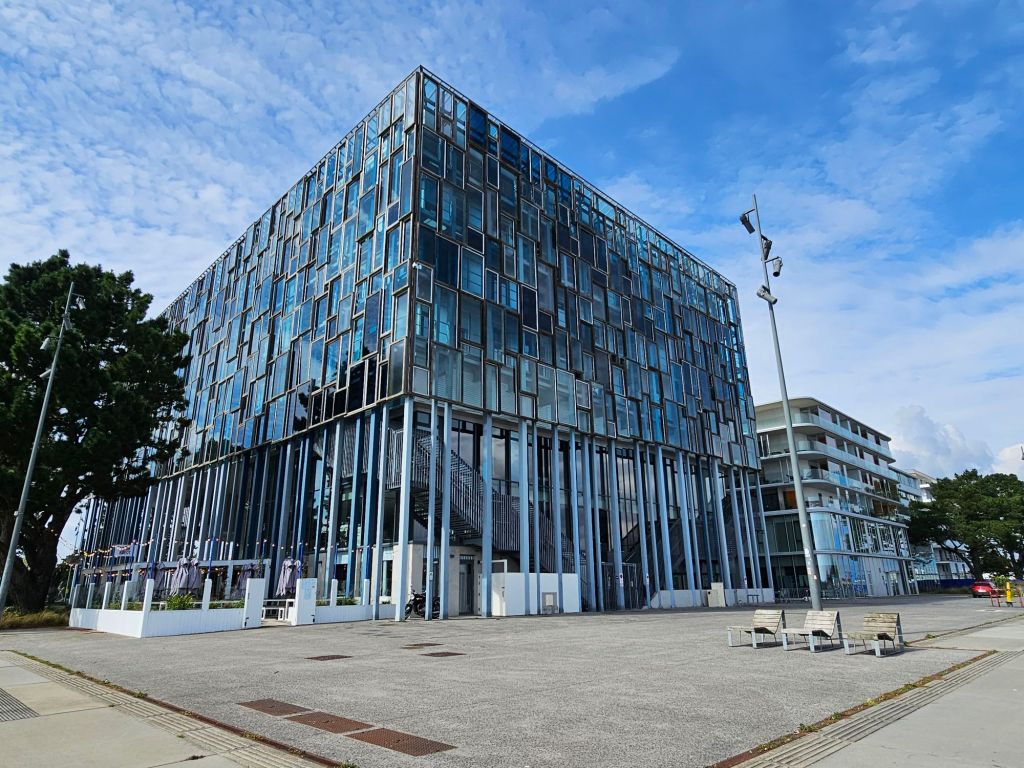
I imagine that to a lot of people Lorient is a dull sort of a place. Ninety-five percent of it was completely flattened by allied bombing in World War Two and therefore it consists almost entirely of buildings erected in the second half of the twentieth century.  But that’s why I like it; it’s not quaint or olde worlde and harking back to some forgotten or imaginary past, architecturally it’s modern and functional and was built with the optimism of the post-war years, the years before some people started to forget what Fascism did and how it started.  Our walk through Lorient is guided by a leaflet we were given in the Office du Tourisme which describes some of the buildings and the art and history of the town.

Around three o’clock we interrupt our walk to be at the Stade du Moustoir for the arrival of the Lorient team off the team bus in their Breton-style, stripey, pre-match shirts.  I make the obligatory visit to the club shop and buy a postcard of the stadium, and whilst Paulene then enters the Tribune d’honneur to find our seats, I make a detour up the road to find Les Halles de Merville, the town market hall, which is featured in the leaflet from the Office du Tourisme and is described as a “concrete and metal ring built in 1964”; it looks like a flying saucer that is no longer flying, perhaps because it is weighed down with fruit, veg, meat and fish.  On my way back from Les Halles I cross the path of a bunch of FC Lorient supporting youths who are making their way to the Stade du Moustoir whilst chanting, banging drums and waving flares.  A few bemused bystanders look on, as do two gendarmes in a dark blue Renault, but these young ultras are largely left to their own devices, as if being on a ‘demo’ is a sort of rite of passage.

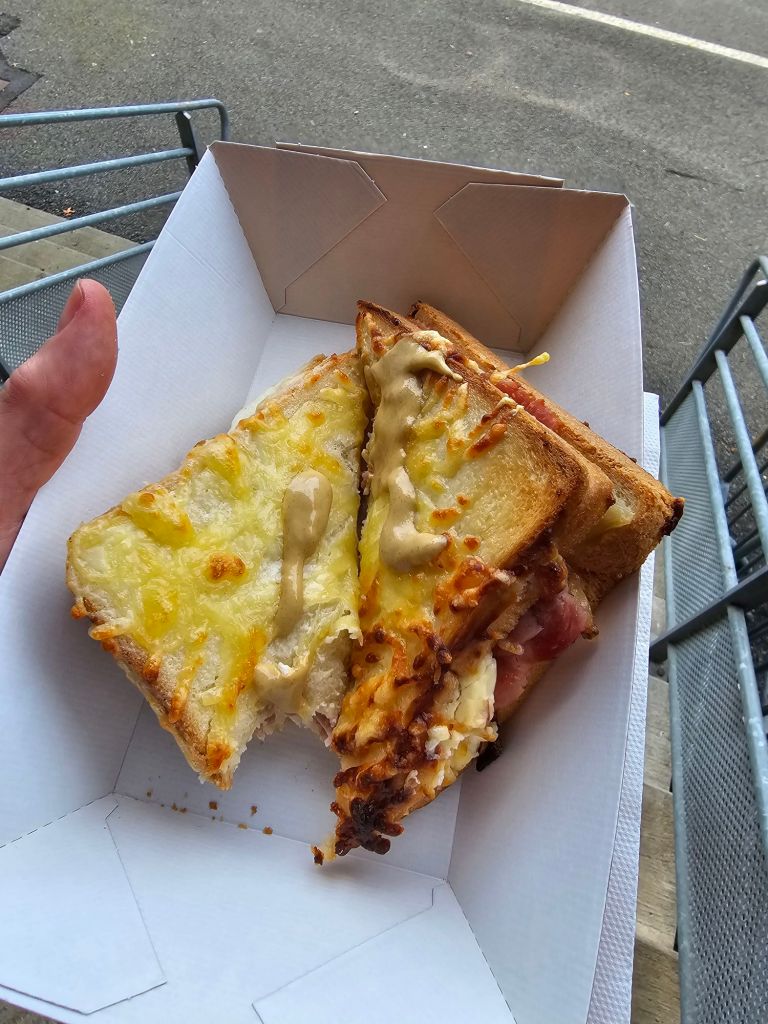
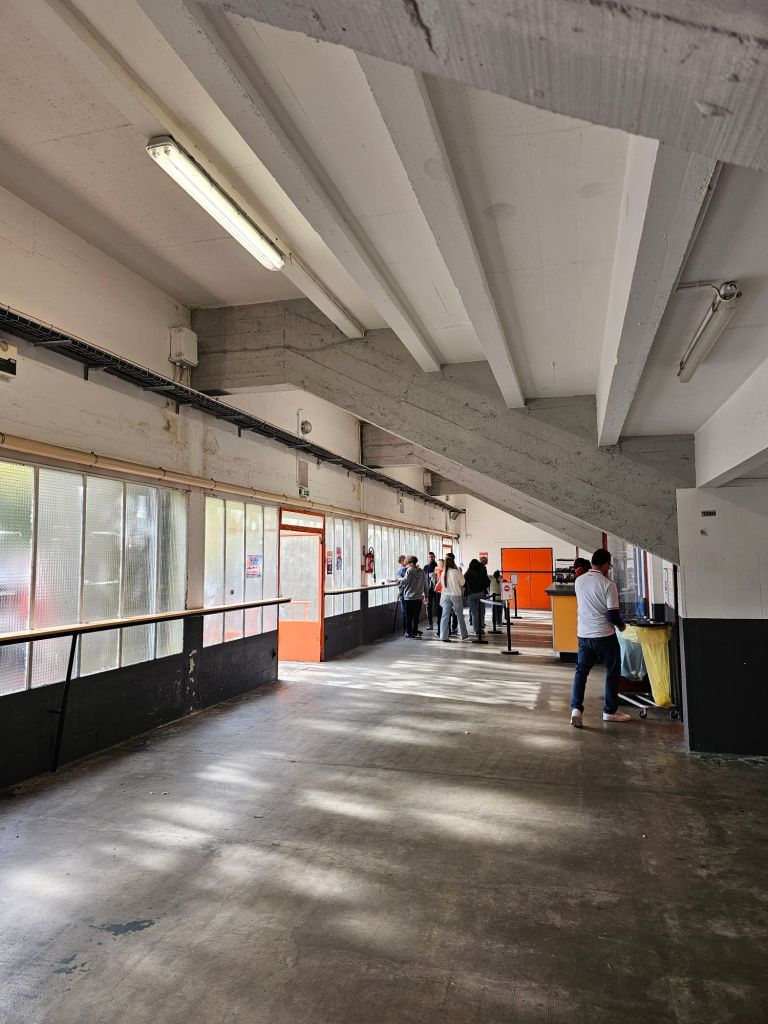
Back at the Stade du Moustoir, I make my way past the security where a man perhaps as old as me pats me down and wishes me ‘bon match’ and another then scans the bar code on my ticket with what looks like a toy ray gun and then says the same.  Our seats are once again in the fabulous Tribune d’honneur, a small, seated, stand of vaulted, shuttered concrete dating from 1959 with metal struts to ensure the cantilever roof remains cantilevered. After locating my seat, I set off to find Breizh Cola for Paulene and beer for myself and to check that it is still possible to walk all the way around the stadium and back to my seat; it is, and this is because the away supporters access their seats over a bridge.  As before, different food counters are serving different types of food and feeling a little hungry at the thought of this I buy a Croque Monsieur (8 euros 50) from the ‘Parisienne’ counter,  thinking that when Paulene reads this it will be the first she knows of it.  I don’t buy Paulene any food because her intolerances to wheat, dairy, and rapeseed oil make it highly unlikely there is anything on offer that she will be able to eat.  Sated with ham, bechamel sauce, melted cheese, toasted bread and a couple of squirts of mustard I return to Paulene with just a re-usable 40cl plastic cup of Breizh Cola (pronounced Brez, not Breej I learn from the young bloke who serves me before he wishes me ‘good match’) and a re-usable 40 cl plastic cup of Breton-brewed Lancelot IPA (10 euros 50 for the two).

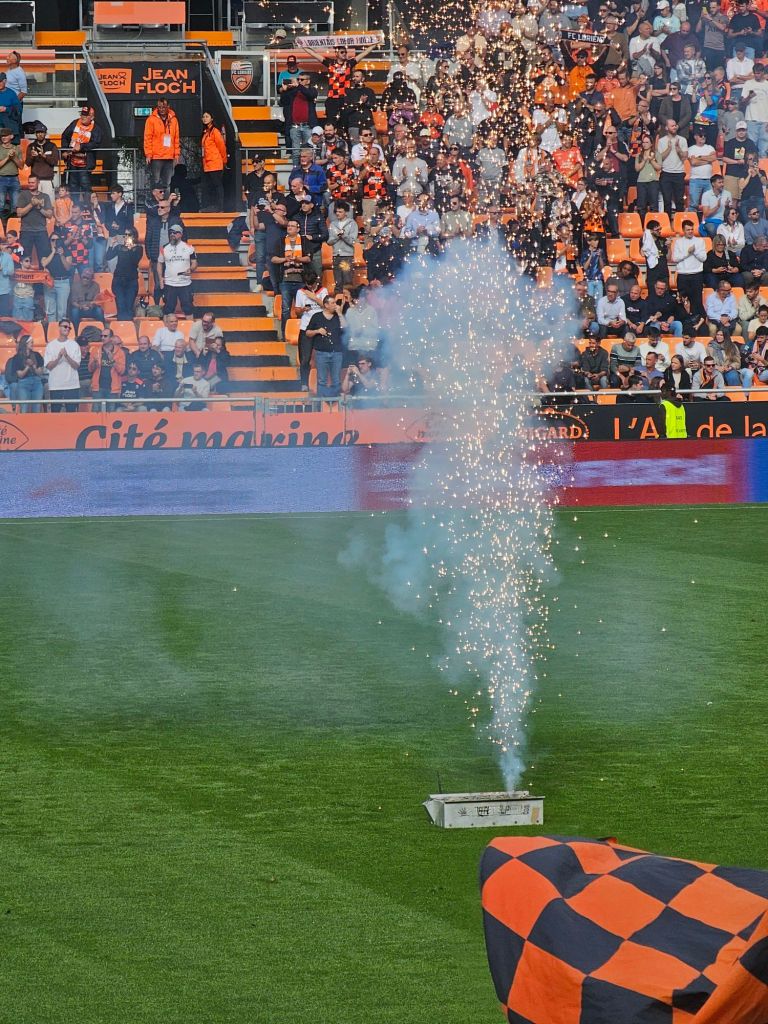
An hour, a half an hour and ten minutes before kick-off (coupe d’envoi in French) a foghorn (corne de brume in French) sounds, a bit like the bell at the end of the interval in the theatre, but appropriately for coastal Lorient, a bit more nautical, and louder.  It adds to the pre-match build-up, which eventually reaches a climax with the Breton anthem on bagpipes with karaoke style words in the Breton language on the big screen in the corner of the stadium, then a second Lorient hymn is played and the bloke next to Paulene joins in, which isn’t a good thing because as Paulene says, his voice sounds out of tune when he’s only speaking,  “Allez Les Merlus” chant the crowd as the teams process on to the pitch, youths wave banners, and a series of not particularly impressive Roman Candle style pyrotechnics ejaculate onto the grass,

Once everything cleared away it is Lorient who get first go with the ball, which they are mainly passing in the direction of the club shop, hotel de ville, docks and Office du Tourisme.  Monaco meanwhile point themselves towards the far-off towns of Quimper and Brest.  This season Lorient sport progressive looking shirts of orange and black check, which leans to one side like italics, and black shorts. Monaco are wearing an away kit of all purple with gold trim, like you might imagine a team of footballing Catholic bishops to wear.

It is a bright, sunny afternoon but the blue Breton sky is ruffled with high white cloud.  Within two minutes Lorient win a corner and two minutes later they get another.  After nine minutes the joyfully monikered referee Monsieur Ruddy Buquet records his first yellow card (carton jaune) of the evening in the shape of no less a player than the Monaco captain Thilo Kehrer who carelessly, even negligently sends Lorient’s Arthur Avom Ebong up into the air with a supposed tackle. Oddly, however, Monaco are dominating possession, although it takes another ten minutes before we see what can reasonably be called a decent shot on goal, and that is from Lorient’s number eleven, the short but enthusiastic Theo Le Bris, whose uncle Regis used to manage Lorient but is now manager at Sunderland.

Monaco’s confusing approach to the fixture is further shown just two minutes later when Vanderson also gets to smell Monsieur Buquet’s yellow card after he fouls Arsene Kouassi, who rolls and rolls and rolls about on the ground and appears to go into spasms before incredibly, getting up and carrying on. Another two minutes dissolve and Lorient’s Mohamed Bamba shoots over the cross bar.   Despite Monaco’s hogging of the ball for much of the game so far almost a third of it is history before they record a proper shot on goal as Takumi Minamino bounces a somewhat weak snap-shot past a post after what had looked a promising series of passes.

Meanwhile, in the Kop Sud there is a sudden outbreak of orange streamers and the chants of “Allez, Allez, Allez” seem inexplicably louder as if brightly coloured crepe paper has unexpected acoustic properties.  The additional orange on an orange background seemingly also causes problems for Lorient goalkeeper Yvon Mvogo who a short while later surprisingly boots the ball out to Minamino who, whilst looking confident and composed only manages to chip the ball over and wide of Mvogo’s goal whilst the Lorient supporters amongst whom I include myself and Paulene all hold our breath as one.

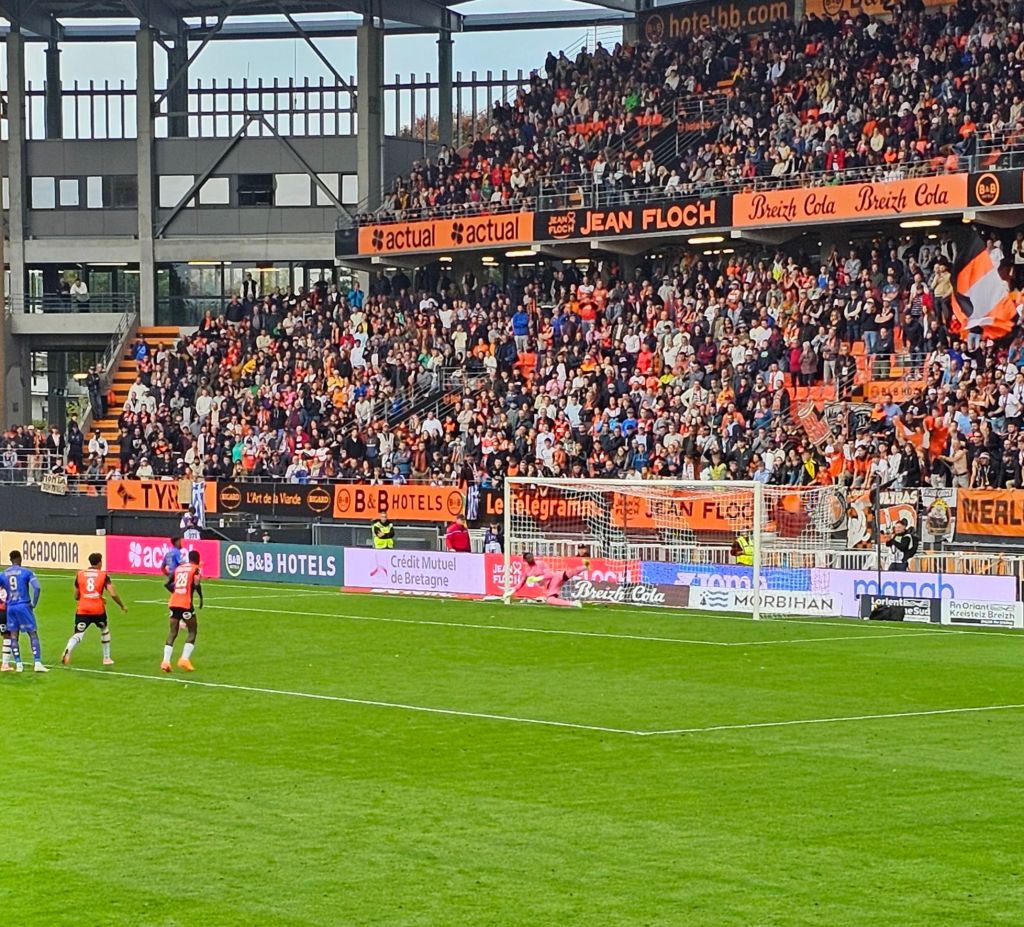
As if a punishment for such profligacy with gifts from fate, a minute later Monsieur Buquet adjudges that Thilo Kehler has fouled Lorient’s Dermane Karim (Dermane to readers of the back of his shirt), and sufficiently badly for him to show him his yellow card for a second time and consequently his red card too. From the subsequent free-kick out on the Lorient left, the ball is crossed in, falls to Mohamed Bamba and he scores from very close range to give Lorient an unexpected lead. “BUT!” announces the electronic scoreboard colourfully as the stadium announcer bellows Mohamed and we all shout “Bamba”, not just once but three times before signing off by shouting his full name just in case anyone was still in doubt about the goalscorer’s identity.

With a one goal lead and an extra player Lorient start to dominate . Bamba is set up well but shoots straight at the Monaco goalkeeper Philipp Kohn and a minute later Kohn is stood in the right place to catch a spectacular overhead kick from Tosin.  Monaco win a late corner to raise spectres of those horrible goals against the run of play and do it again inside the four minutes of added-on time, but the Kop Sud remain buoyant, bouncing up and down in the central terrace (safe-standing area to FFF and UEFA officialdom) and singing “Lorientais, Lorientais, Lorientais” like it was going out of fashion.

Half-time is a time of applause and an invasion of the pitch by players of mostly very youthful appearance, although one has a beard, who try to score “one-on-one” with the goalkeeper. The players in green shirts seem to win out over those in blue, and Merlux and Mini-Merlux look on feigning acute excitement or deep frustration and remorse according to whether players score or they don’t.  The French version of RADA for people dressed as outsized and vaguely cuddly fish seems to be doing a good job.

The proper football resumes at five minutes past six and Monaco have made some half-time⁹ substitutions; their manager or Prince Albert having presumably realised they need someone on the pitch who is the equivalent of two players.  The half starts strangely for Lorient, who appear to be trying to emulate Monaco’s first half display as they have two players, Dermain Karim and Mohamed Bamba booked in quick succession in the early minutes.  The sky has clouded over since the first half and its feeling cooler, so I put on my coat, covering up my orange and black Ipswich Town shirt, which was offering chromatic support to Lorient and badge-based support to Ipswich, both successfully as it turns out because both teams are currently winning.

As sure as night follows day, after half-time at Lorient comes the fifty-sixth minute, which is when the foghorn or ship’s siren sounds again, and the scoreboard entreats us all to make a noise.  This phenomenon is explained by the facts that Lorient is in the departement (like an English County) of Morbihan and in France each departement is numbered, more or less alphabetically, and Morbihan’s number is fifty-six. After the relaxation of half-time, the fifty-sixth minute seems an ideal time to wake everyone up to shout “Allez les Merlus!”  and the encouragement nearly works as the minute ends with Tosin Aiyegun shooting over the cross bar at the far post just as the noise subsides.   Meanwhile, Lorient fans are probably thankful their town is not located in Val d’Oise, (departement number ninety-five) .

With an hour then gone both sides indulge in double substitutions before Lorient’s number five  Bamo Meite sends a spectacularly awful shot from a good 20 metres out high into ‘Agglomeration de Lorient’ stand and a man sat in the row in front of me becomes very excited about a goalmouth scramble which has him bouncing up and down on his seat.  The attendance is then announced with the words “Vous etes 15,561 spectateurs et spectatrices” as the French language politely acknowledges that there are both male and female people watching.

The final twenty minutes arrive pretty much on time, as expected, and Lorient manager Olivier Pantaloni chooses this as the time substitutes the trouble-making Derman Karim from Togo for Pablo Pagis. It’s a  good move from Pantaloni as within five minutes Pagis is suddenly slaloming through the middle of the penalty area before poking the ball beyond the Monaco goalkeeper, and Lorient lead two-nil.  “Pagis” bawls the crowd each time the announcer shouts “Pablo”, and then they finish off the celebration by bawling out his name in full.  The sound of the crowd is wonderful; it matches the goal.

Lorient are dominant. Three shots are blocked in the Monaco penalty area in quick succession, Pagis shoots at the goalkeeper and then from the right hand edge of the penalty area Pagis strokes the ball with his right foot into the top left-hand corner of the Monaco goal as if effortlessly creating a beautiful work of art, as if it was naturally occurring, like a rainbow. “Pablo!”, “Pagis!” rings out again.  Lorient lead three-nil. Monaco are abject.  The bloke in front of me who was excited by the goalmouth scramble is now beside himself with joy. punching the air  and hugging the lad beside him, who I imagine is his son, but you never know.

It’s getting on for seven o’clock now and as the natural light fades shadows of the players begin to be cast onto the pitch by the floodlights from atop their concrete pylons; up beyond the floodlights the blue skies and sunshine have given way to cloud.  The five minutes of added on time are unexpectedly mostly played in the Lorient half and they win a couple of corners.  With the second corner comes a delay and a hiatus of doubt.  Monsieur Buquet consults VAR and awards a penalty, nobody knows what for but Monaco’s Ansu Fati scores anyway, giving his team underserved but more satisfyingly, scant consolation.

With the final whistle the Monaco goal is nothing more than a meaningless footnote to the match, a match that is just the frame for the masterpiece that was Pagis’s two goals.  Paulene and I head off back through the departing crowds to our planet saving Citroen in the Place des Armes car park, along the Quai des Indes.   We will have fish for our dinner, but haddock, not hake.  It’s been yet another fine afternoon in Lorient and although we may not return next year, I don’t want to stay away for too long from my Neolithic ancestors and the Stade du Moustoir.

Stanway Pegasus 0 Haringey Borough 2

Pegasus, Wikipedia tells us was a Greek mythological winged stallion, the offspring of Poseidon and Medusa who sprang from the Medusa’s blood when in an everyday incident for the characters of Greek mythology she had her head chopped off by Perseus.  After time spent carrying lightning bolts for Zeus, being ridden about by Bellophron and then as a constellation of stars, having been killed by Zeus who presumably then had to carry his own lightning bolts, between 1948 and 1963 Pegasus more prosaically became the name of an amateur football team made up of Oxford and Cambridge graduates obviously keen to mix football with their classical education.   Even more prosaically, the name of Pegasus then became that of a youth and then Sunday football team in Colchester and most recently that club has aspired to men’s senior football and for reasons unknown has attached the name Pegasus to Stanway, a suburb of Colchester that some of its residents still think is a village and which already had one senior football team in the shape of Stanway Rovers.

Today, Stanway Pegasus who are now in the snappily titled Thurlow Nunn Eastern Counties League South play Haringey Borough of the only slightly less snappily titled Spartan South Midlands Football League in the first qualifying round of the FA Vase, a competition which, to my shame, I have not witnessed a game in for over ten years.  It is for this reason, and it being the closest game to where I live, that today I choose to ignore the ’Town’ -centric draw of Braintree Town v Yeovil Town in the National League and the charming alliteration of Chelmsford v Chippenham in the National League South, and make my way to ‘The Crops’ in West Street Coggeshall home of Coggeshall Town but where Stanway Pegasus currently play their home games too.

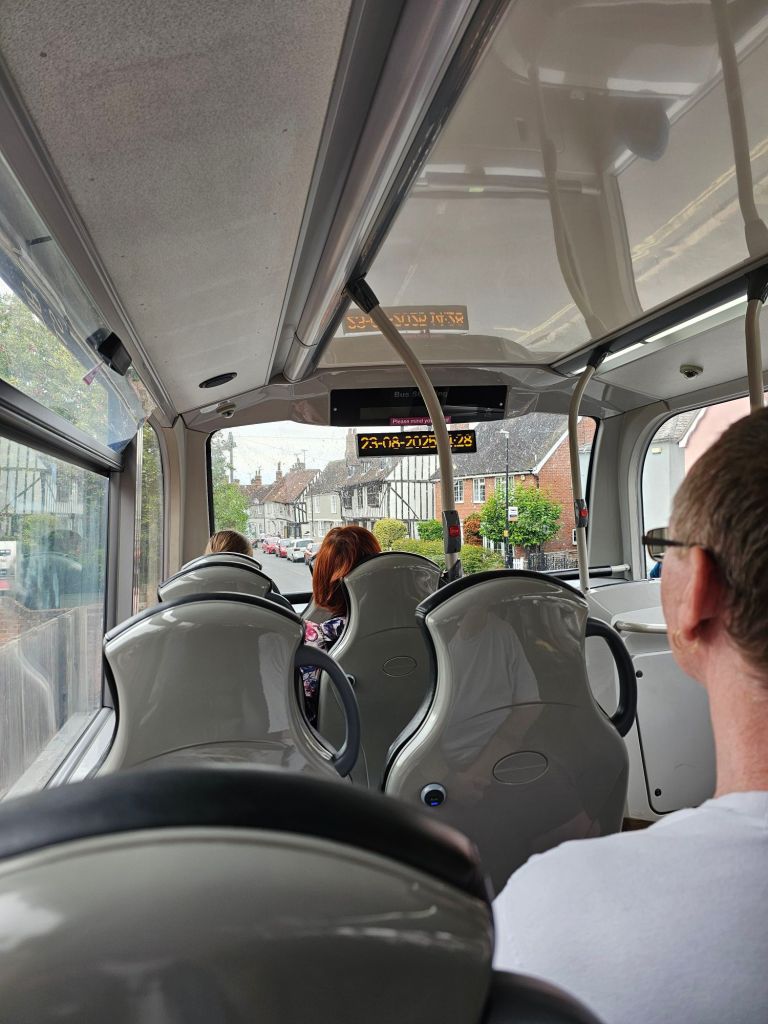
After a morning breathing in noxious fumes from the white gloss paint I am applying to the banisters, skirting boards and miscellaneous surrounding woodwork of a domestic staircase, standing at a bus stop on the A120 under a grey late August sky feels like suddenly being on holiday.  The X20 bus to Stansted Airport via Coggeshall, Braintree and Great Dunmow turns up more or less on time and I cheerily tender the correct fare (£3) in coins to the driver, who wears a peaked cap in the style of the late Sir Francis Chichester.  The driver, who does not speak looks at me inscrutably from beneath the peak of his hat as if weighing up this passenger’s likely back story.  I look back at him in the same way, imagining I too am wearing a hat, before climbing the stairs to the top deck where I sit behind a man sporting short hair and an earring.  Behind us, a girl evidently lacking all sense of self-awareness talks loudly on her mobile phone, broadcasting the other half of the conversation on speaker phone.   Leaving the A120, the bus (fleet number 34423) wends its way through Coggeshall’s narrow medieval streets before I alight at the stop called ‘Nursery’ just a couple of hundred yards away from ‘The Crops’.

Arriving at the turnstile I’m not surprised to find there is no queue but am delighted to see a small pile of glossy programmes, which I had not expected.   I ask if I should pay by cash or card. “Cash if you’ve got it, please” says the turnstile operator “I’ve started to run out”.  This is the first time I have paid on the turnstile at a match since I turned sixty-five, and paying in cash adds something to this auspicious occasion as I tender a five pound note for my concessionary entry fee and a two pound coin for the programme.

Once through the turnstile I head for the bar at the far end of the ground; it is virtually empty,  and not liking the look of the fizzy draught beer on offer I warily request a bottle of Adnams Southwold Bitter (£6) from the fridge. Much to my surprise the beer is merely cool not chilled and therefore very drinkable.  I step outside to await kick-off amongst a good following of Haringey supporters identifiable from their club colours but also as the only people obviously in the throes of enjoying a day out.  Two of them wear pork pie hats and I wonder if they play the saxophone.  Except for an old couple sat in foldable chairs the home supporters are rather anonymous.  In the corner of the pitch by what passes as the players’ tunnel but looks a bit like a stockade stands a plinth on top of which sits the match ball.  The Haringey fans eye the plinth both jealously and with a degree of amusement discussing what design of plinth they might have if they were to have one of their own, they seem keen on something more sculptural. 

“Sing if you’re Haringey, Sing if your happy that way” chant the Haringey fans imaginatively to the tune of the Tom Robinson Band’s 1978 hit “Glad to be gay” as the team emerge from the stockade and the plinth fulfils its job of relieving the referee of having to remember to bring the ball with him from the dressing room.   The match kicks off at five minutes to three with Stanway Pegasus getting first go with the ball and sending it in the direction of the bus stop from whence I arrived and Coggeshall beyond. “You on a promise Ref?” bawls a Haringey supporter “It’s only five to three”.  “That’s close to being abusive, that is” says another Haringeyite.  “No it’s not, it’s just a question” continues the first supporter.  “A very personal one” is the response. “Alright, do you have something nice waiting for you when you get home, Ref?” Comes the re-phrased enquiry.
Pegasus are wearing a kit of yellow shirts with black trim and black shorts, which weirdly are also the colours of Stanway Rovers.  Haringey meanwhile sport a change kit of all over green as their supporters expand on their theme of chants based on ‘new wave’ hits of the late 1970’s and sing the praises of their team’s Matty Young to the tune of “To much too young” by The Specials and then sample the  oeuvre of Sham69 with chants of “Come On, Come On, Come on Haringey Come On, We’re going down the pub”.

Back on the pitch, one of the linesmen is attracting a lot of attention to himself both with his offside decisions and his insistence on explaining them to the players.  As if that isn’t enough, he is very bouncy on his feet and, because he sports a poorly shaped goatee beard and has grey highlights in his swept back hair I am reminded of the match between Arsenal and Liverpool in September1972 when one of the linesmen was injured and Jimmy Hill emerged from the stands to run the line.

At three minutes past three Haringey Borough take the lead with a neat shot into the corner of the goal from somewhere near the edge of the penalty area.  The goal scorer, I think, is the aforementioned Matty Young  who evidently continues to strive to allow people to look back and say he did a lot in his youth.   “We’re the Borough, The Mighty Borough, We always sing away, We sing away, we sing away, we sing away, we sing away” chant the Haringey fans in response to the goal, channelling Tight Fit’s  cheesy cover version of “The Lion Sleeps Tonight” from 1982.

The Jimmy Hill lookalike linesman continues to grab attention as he rules a Haringey player onside and then proceeds to explain that the Pegasus number five had played him onside. “Don’t tell them lino, they can learn for themselves” shouts an exasperated Haringey fan. The Haringey support delve into their ‘new wave’ singles collection once more, impressively getting “We’re Haringey, We’re Haringey” into The Jam’s “Going Underground”.

Haringey are clearly the stronger team, as their higher league status implied before kick-off and the majority of play is at the club house end of the ground, although in a rare breakaway the Pegasus number four , Harry Morton is free in the centre of penalty area, has the ball pulled back to him perfectly, but then contrives to hit a truly, spectacularly terrible shot as high and as wide as anyone not under the influence of mind expanding drugs could imagine; in some circles it might be called ‘a worldy’.   Morton might be excused however for blaming the pitch, very little of which is any shade of green except in a few ‘fairy circles’, and when more than a handful of players are in the penalty area a cloud of dust is kicked up which lingers momentarily over the pitch like a swarm of tiny insects.

I am stood to one side of the suitably bucolic looking main stand and every now and then I receive a whiff of pungent and rather cloying body spray or scent.  At first, I think it must be from the occupants of the stand, but to be honest they don’t look the sort to be familiar with anything more than an occasional dab of Old Spice or bit of talc.  I eventually realise, when he bouncily stops near me to signal another offside, that the culprit is Jimmy Hill, the unique styling of whose hair is challenged, but not matched only by the Pegasus number sixteen, Tom Lewis who has a neat blond bob.

The game is being played in a good spirit with unusually little, if any audible swearing from the players, or the management on the benches.  Pegasus’s number nine Callum Griffith is booked however, just as the first third of the game rolls into the second third when twice in quick succession he fails to give space for a free-kick to be taken.  As thoughts of half-time refreshment begin to form Pegasus win a couple of corners and then almost unexpectedly there is a second goal as a poorly cleared low cross reaches Haringey’s number fourteen who firmly and concisely despatches it into the opposite bottom corner to the first goal, and Haringey lead 2-0.

Due to judicious manoeuvring in the approach to half-time, I am first in the queue at the refreshment hatch where I invest in £1.50’s worth of tea in large paper cup.  I read the half-time ‘results’ as I wait for my tea to cool and then for the teams to re-emerge.  My mood is barely affected by the news that Ipswich are losing at Preston; it’s not a place we often do well at; “a difficult place to go” is probably the accepted wisdom, despite the M6.   At four minutes to four the football resumes and I move to the other end of the main stand expecting most of the action to again take place in the half of the pitch that Haringey are attacking.

The first half was adequately entertaining if not exactly a pulsating cup-tie.  Sadly, the second half does not live up to what we didn’t know at the time was the comparatively high standard of its predecessor.  The Haringey supporters nevertheless continue to enjoy themselves as they repeatedly dip into the back catalogues of Sham69, The Jam and with somewhat less ‘street credibility’, but plenty of irony, Tight Fit.  My highlight of the half is when I realise that Derek Asamoah is playing as number forty-four for Haringey.  He is a player who I probably last saw playing on the telly for Ghana in the African Cup of Nations. I should have really worked out he was playing when the Haringey fans chanted his name in the first half, but I was probably too busy wondering which Buzzcocks, The Clash or The Damned single it was they were singing to.
With the final whistle there is justified applause for everyone’s efforts and I leave The Crops to the sound of the Haringey fans singing “Bus stop in Tottenham, we’re just a bus stop in Tottenham” because wonderfully, as anyone who has travelled the W3 through north London will know, they really are and as far as I’m concerned that’s just as interesting as Greek mythology.

Haverfordwest County 2 Floriana Malta 3

When life does not have us locked into the dull, repetitive cycle of getting up, going to work, going to bed, getting up, going to work, going to bed, getting up, going to work, going to bed, getting up and so on then it occasionally brightens our existence with unexpected events and happy coincidences which almost make the rest of time worth trudging through.

In the late summer or early autumn of 1962 (what is September?), my team Ipswich Town were reigning Football League Champions of England and were in the European Cup, what is now known as the Champions League.  Even back in 1962 there was a bias against teams that weren’t called Madrid or Manchester and despite Ipswich being genuine Champions and not some bunch of also-rans that had limped into third or fourth place in their country’s league, they had to play in a qualifying tie in which they were drawn against Floriana Malta.  Sadly, despite living locally, I was only a couple of months beyond my second birthday and so I didn’t make it to either match of the two-legged tie. That was just my luck, because Ipswich won 14-1 on aggregate and consequently ever since I was old enough to understand this, I have regretted not being about ten years older than I actually am.

But life and football are, as popular culture seems to have it, ‘funny old games’, and sixty-three years on Haverfordwest County, the football club from the town of my birth and therefore another of ‘my teams’ have qualified for the first qualifying round of the European Conference League and have drawn the very same Floriana Malta, proof of a sort that time is round.  All I need now is for Haverfordwest to win 14-1 on aggregate, although being already 2-1 down from the first leg in Valletta, this is going to be a tall order.

The wonder of Google maps tells us that it’s about 425 kilometres from my home to Parc y Scarlets in Llanelli, home of Llanelli rugby club.  The match is to be played in Llanelli because Haverfordwest’s Ogi Bridge Meadow ground does not meet the exacting standards UEFA president Gianni Infantino requires to ensure he doesn’t sully the bright white tennis shoes that the strange, bald-headed Italian thinks match his dark suits.  But my step-son lives in Basingstoke from where it is a mere 274 kilometres to Llanelli, so to reduce travel time on the day of the match my wife Paulene and I arrange an overnight stay with him in the town which claims to be where Jane Austen was born, the price of which is merely that I  have to read a bed-time story to the grandchildren.  Unable to find my stepson’s copy of Northanger Abbey, I read them “Oi Dinosaur.”

It’s a smooth, carefree journey down the M4, except for the occasional pothole and strip of patched tarmac, with just one toilet stop and one stop to top up the battery of our planet saving Citroen e-C4.  Once in Llanelli, a town which used to have its own trolleybuses, from our carefully chosen but affordable hotel where the mattresses on the beds used to be endorsed by no less a comedian than Sir Lenny Henry, it is but a ten-minute walk to Parc Y Scarlets.  Having struggled through the surprisingly busy Llanelli traffic back to the hotel following a brief visit to the beach, it is now only about 45 minutes until kick-off when we set off through the adjacent retail park in the company of seven Maltese men in green t-shirts and several Haverfordwest fans.  The evening is warm and humid, and shorts and T-shirts abound. Parc y Scarlets is a modern, but rather boring looking stadium, all white steel girders and grey corrugated sheet metal, but with a ‘grand’ main entrance reminiscent of an out-of-town 1980’s cinema or a car show room, all in the setting of an expansive car park.

Disappointingly, there are no match programmes on sale this evening; perhaps there is one on-line but probably due to my age I prefer the real world, where everything can be held in my hand or stuffed in a pocket, and not a virtual one.  Craving a memento of the day however, beyond the pay and display ticket acquired from Lanelli beach car park, and wanting something specific to the match, I buy a T-shirt (£20) from a collection of blokes stood behind a trestle table outside the stadium.  Had I bought a club shirt for £45 I could have had a free one, but I don’t need a polyester shirt (who does?) and am a bit sniffy about football shirts that advertise betting companies.

Once inside the stadium, having surprised myself by successfully negotiating the turnstile with tickets that are on my mobile phone, and blushing slightly after being called ‘my lovely’ by the lady turnstile operator, along with Paulene I investigate the food and drink available.  It’s mostly the usual slightly unpleasant stadium fayre and we come away with just a bottle of water without a lid, and a plastic 500ml cup of Felinfoel IPA (£7.40) chilled to a temperature capable of inducing a painful headache, but at least it’s a locally produced beer.

Paulene heads up to the seats whilst I sink the IPA which is not allowed sight of the pitch and which I don’t really enjoy because it is so cold and fizzy. I re-join Paulene just as the Haverfordwest male voice choir, who are stood on the pitch in front of the main stand, deliver a stirring rendition of Cwm Rhondda and it’s not long before they’re exercising their larynx again with the Welsh national anthem (Hen Wlad Fy Nhadau) as the teams file onto the pitch.  The choir are magnificent, but I am ashamed to admit that I do not know the words to the National Anthem and the electric piano accompaniment makes me think of Terry Jones as the nude organist in Monty Python’s Flying Circus, despite this evening’s keyboard player being fully clothed.

When the game begins, Haverfordwest, all in blue, get first go with the ball, sending it in the general direction of our hotel, whilst Floriana Malta, wearing a very fetching outfit of green and white striped shirts with green shorts and socks are kicking roughly in the direction of Swansea. The Floriana supporters are at the far end of the stand and have a massive banner, the Haverfordwest support has a drum which regrettably is just a few rows behind us.

The opening minutes belong to Haverfordwest, who sensibly look keen to delete the one goal deficit from the first leg as soon as possible.  The understandably more sun-tanned Floriana players however, look like they are taking time to acclimatise to west Wales and soon concede a corner, and then another from which the ball is headed back at the far post and at the second attempt an unmarked Greg Walters boots it conclusively into the Floriana goal net.  The match is barely more than ten minutes-old and the aggregate scores are level. I remark to Paulene that I think Walters, as well as being the goal scorer, has the best hair on the pitch, it being reminiscent of former Ipswich and Arsenal player Alan Sunderland, but fluffier.

Haverfordwest continue to dominate and six minutes later score again, this time through the rangy Ben Ahmun, who successfully pursues a ball ‘down the left channel’, cuts into the penalty area and then instinctively launches a spectacular shot inside the far post from an oblique angle. Sixteen minutes gone and two-nil to Haverfordwest already, and with a bit of the right imagination and perhaps a change to the rules, the hoped-for 14-1 aggregate score is looking like a possibility.

Sadly, the second Haverfordwest goal seems to awaken Floriana from their torpor as if they could live with being one goal down, but not two. An attack down the left, a corner and the good fortune of a deflected shot by Carlo Lonardelli quickly sees the aggregate score level at 3-3 and daydreams of exotic destinations awaiting in future rounds quickly melt away to be replaced by penalty shoot-out induced anxiety.

On balance, Haverfordwest remain the better team as half-time looms, but then out of the blue, disaster strikes.  A harmless punt forward is collected by Luc Rees in the Haverfordwest goal, but as he does so the referee adjudges defender Alaric Jones to have fouled Floriana’s gangly Mustapha Jah, a player who seems to find standing up difficult at the best of times.  Not only does the referee award a penalty, but he also sends off Jones, presenting him with a second yellow card to accompany the one he showed him as early as the seventh minute.  From where I’m sat I can’t see how it’s a foul, let alone one worth a second booking and the resultant sending off.   But the penalty is easily scored by Jake Grech and from being ahead on aggregate and dreaming of possible future fixtures in Azerbaijan, Lichtenstein or Moldova, Haverfordwest are now looking like being confined to the principality for another year at least. Six minutes of added on time fail to alter the course of history.  To make matters worse the stadium announcer insists on telling us the score even though we’re here in the stadium with him and he also reads it back to front, as if Haverfordwest are the away team, and he gives added emphasis to Haverfordwest’s score as if they are winning, which of course they are not.

Half-time is a period for quiet reflection before the game resumes. Down to just ten players and losing, Haverfordwest never re-capture the urgency of the first fifteen minutes.  There are a couple of chances, a couple of bursts of potential score altering passing play from Haverfordwest and Ahmun hits a post early in the second half, but mostly it’s a tale of frustrated anticipation and blokes in stripey green shirts falling over. Some of the Haverfordwest supporters don’t do themselves any favours either,  chanting “You dirty Maltese bastards”, which as well as being racist is also inaccurate as of Floriana’s starting eleven, three are Argentinian, two are Brazilian, one is Gambian, one is Tanzanian and one is Serbian.   Then, in the sixty-seventh minute Floriana score again as Charles M’Bombwa (the Tanzanian) lashes the ball high into the net past Luc Rees from an improbably acute angle.  We tell ourselves there’s always hope, but there probably isn’t and things just fall apart a little more with manager Tony Pennock having been sent to the stand even before the third goal, and in time added-on Rhys Abbruzzese is also sent off after being booked for a second time.

After the glory of Cardiff two years ago, the disappointment this evening is palpable, as disappointment always seems to be. With the final whistle, supporters file out quickly, many not lingering to applaud the laudable but ultimately unsuccessful efforts of the Haverfordwest County players.  Paulene and I turn and leave too, and my last memory of the inside of Parc y Scarlets is a glimpse of Sgorio presenter Sioned Dafydd stood in a short red coat on the far side of the pitch.  I don’t think I find Sioned attractive but there is something strangely alluring about her, I suspect it’s because when I see her on Sgorio she mostly speaks Welsh and I have no idea what she’s saying, although I can’t say I feel the same about Dylan Ebenezer.

A short while later back at our hotel, I will meet a Haverfordwest supporter wearing an Ipswich Town shirt, although as he will explain, he does not support Ipswich Town, but he bought the shirt when he went to see Ed Sheeran at Portman Road.  I wonder to myself if anyone ever bought a Tranmere Rovers shirt when going to see Half Man Half Biscuit or a Real Madrid shirt when seeing Julio Iglesias. I will also meet a ‘groundhopper’ from Nottingham, although he doesn’t like the term, and a man who has travelled to the match from Lincolnshire with his son because like me his son was born in Haverfordwest, which all go to prove that although they lost, Haverfordwest playing Floriana Malta in the European Conference league has been a good thing; sadly I can’t always have my teams winning 14-1 on aggregate.