Billericay Town 1 Sheppey United 1

It’s a bright sunny day and I have spent the morning trimming the hedge that sits between my garden and the footpath outside my house and the road beyond. I didn’t know when I started hedging, that today was the day of the fourth qualifying round of the FA Cup, but something inside is nagging at me telling me that I should be seeking out non-league football on a sunny October Saturday when Ipswich Town aren’t playing.  In one of the many breaks from hedge trimming that I need in order to admire my work and drink tea, I therefore discover on the interweb that today is indeed an FA Cup day,  and scanning the fixtures for ‘local’ games I see that Billericay Town will be playing Sheppey United.  

Like seeing Haverfordwest County, which I did back in August, seeing Sheppey United has always been an ambition of mine. My father’s parents lived in Sheerness on the Isle of Sheppey from the 1930’s until they died forty odd years or more ago.  I can recall visiting them and discovering Sheppey United’s ground, which was then somewhere amongst the seeming maze of back alleys between their house in Vincent Gardens and Sheerness High Street. My father always laughed about Sheppey United, and I was a bit disappointed that neither he nor my grandfather ever suggested we go and watch them.   So, today presents an opportunity to fulfil a longstanding wish. To add to the family association, when my grandmother and father were first married, she apparently worked in Billericay, and the story goes that at this time she fell pregnant with twins.  There are no birth or death certificates for the twins however, so it is assumed they miscarried, but the story put about by my uncle was that she was going to name them Billy and Ricky, (as in Billericay) which seems unlikely, a bit ridiculous, and also very tragic all at the same time.  But my uncle did have an odd sense of humour.

Google maps tells me that I am only forty-five kilometres from Billericay Town; a thirty-five-minute drive down the A12 and along the B1007.   I drove that far a fortnight ago to see Garde St Cyr Moreac play OC Vannes in the fourth, and still amateur, round of the Coupe de France, so it only seems fair that I should drive as far to watch an FA Cup game this afternoon.  I ask my wife Paulene if she would like to accompany me, because after all she was with me in Moreac, but her response today is verging on the impolite, and so having had a light lunch of potato crisps and left over pizza I set off alone in my planet saving Citroen e-C4.

It’s an easy drive from my house to Billericay, but I nevertheless set the Satnav to take me to New Lodge, Billericay Town’s home ground.  I listen to BBC Radio Essex in the car in the hope of gleaning pre-match insight, but talk is mostly of Colchester United, Southend United and also Aveley, who like Billericay are playing in the FA Cup today, but at home to current National League leaders Barnet.  I am kept amused meanwhile  by the Satnav, which changes the pronunciation of the last syllable in Billericay from the usual ‘Key’ to ‘kay’.  As the writers of ‘Gavin and Stacey’ and possibly my uncle knew, there is may be something inherently funny about Billericay.

The Satnav in my car unerringly takes me to Billericay Town FC as expected, but had not foreseen that the club car park would be full, and so I switch ‘her’ off and pop down a nearby side road to doubtless annoy someone by parking outside their suburban bungalow.   At the bottom of the road on which I am parked, four blokes are getting out of a pick-up truck. A man stands on his front porch opposite and tells them to turn right then left to get to the ground, I guess they must be from Sheppey.  “Up from Sheppey are you?” I ask. The answer is as expected, and our conversation reveals not only that the bloke I’m talking to is the Sheppey United manager’s son,  but that one of the blokes with him owns a house in the same street in which my grandparents lived.

New Lodge lies down Blunts Wall Road, a bucolic, tree-lined lane which conveniently brings the pedestrian to a bank of four turnstiles at the corner of the ground.  Being the modern tech-savvy bloke that I’m not, I had already purchased my ticket on-line just minutes before I set off from home, responding to the advertised promise on the club website of not having to queue at the turnstiles.  It was a lie, there is no express check in, and so I begin to queue at the first in a row four turnstiles with all the mugs tendering bank cards and even cash.  When I get to the front of the queue, I present my phone to the turnstile operator, who promptly apologises that she can’t let me in here and I must queue at turnstile number four. Luckily, having queued at the first in a row of four turnstiles it’s easy to work out which must be number four, although the turnstiles are not actually numbered.   At least when I begin queuing again I can confirm to the two blokes behind me who also already have their tickets, that they are in the right queue.

Emerging from the turnstile, the pitch and stands of a very neat and well-appointed stadium appear before me, but sadly the same can’t be said of anyone selling programmes.  The only programme today is an electronic one, and when I photograph the QR code and go to look at it, I find only the programmes from four previous matches; although one of them was an FA Cup tie, it was versus Stowmarket Town.   A little down-hearted, I turn my attention back to my surroundings.  The pitch is synthetic and in the tradition of non-league football grounds it appears to slope, in this case from east to west; I had thought that artificial pitches needed to be level, so perhaps it’s the stands that are sloping, or me.  The stands are very smart, painted blue with neat rows of narrow, white roof stanchions fronting the pitch in wonderful repetition on all sides.  The ground seems almost too smart for non-league, and it comes as a relief to spot some flaking white paint on the main stand, even if the metal beneath is shiny not rusty.  The club house is large with two bars that wouldn’t look out of place in a Wetherspoons.  There are further outdoor bars in the southern corners of the ground.
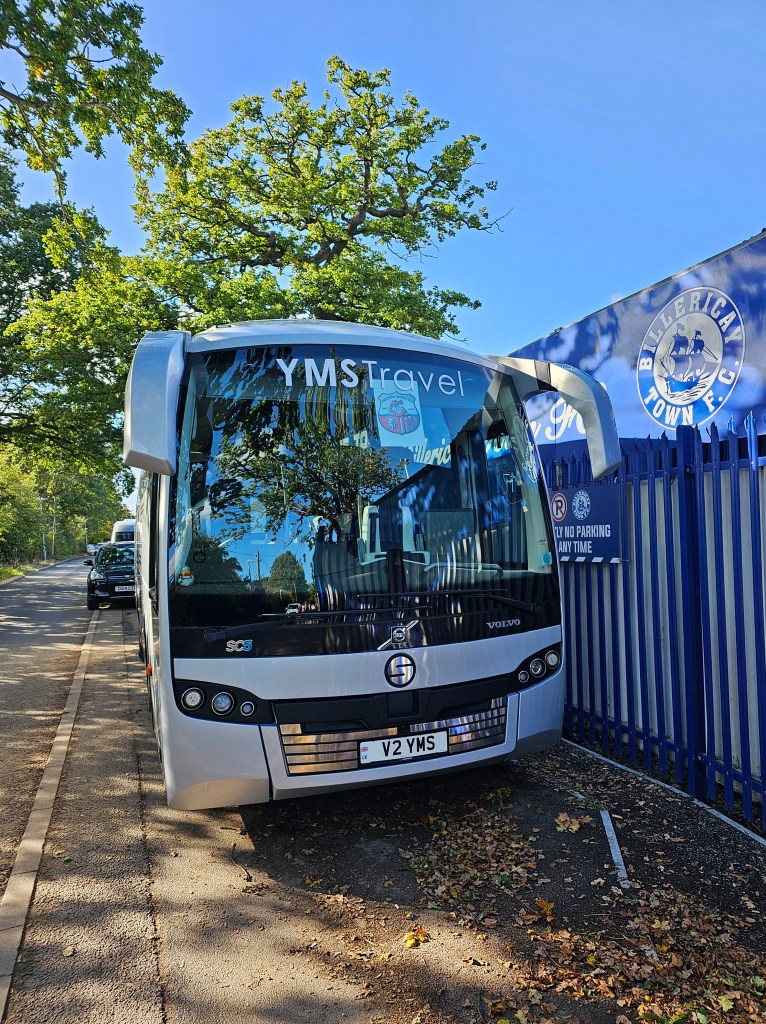
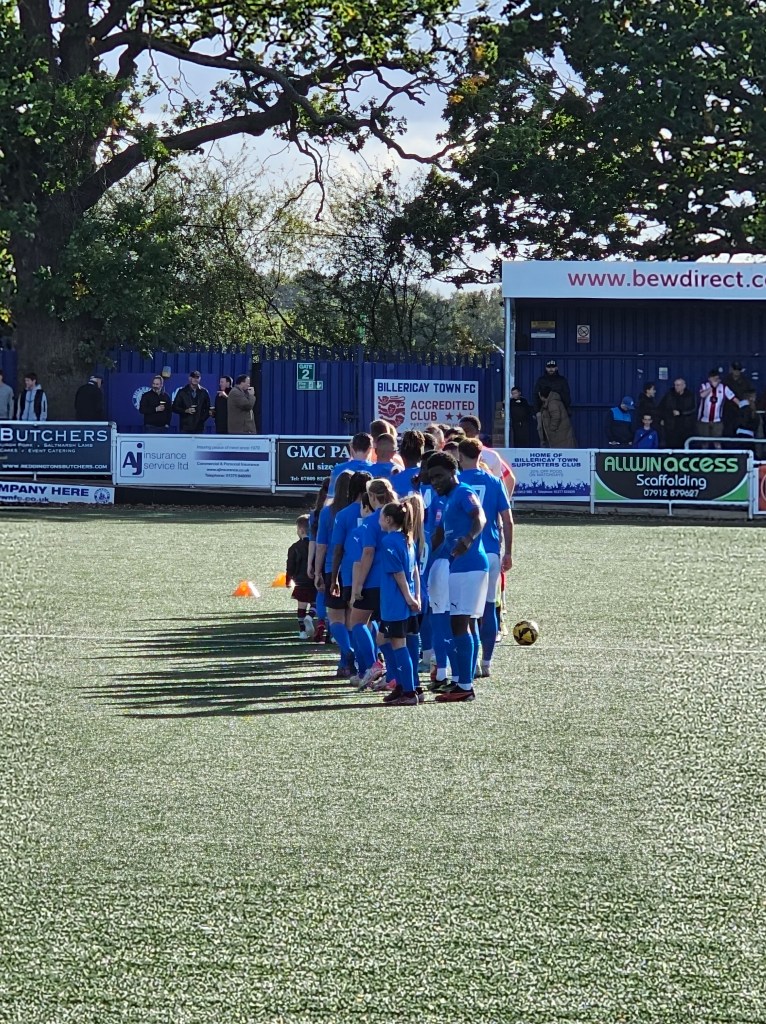
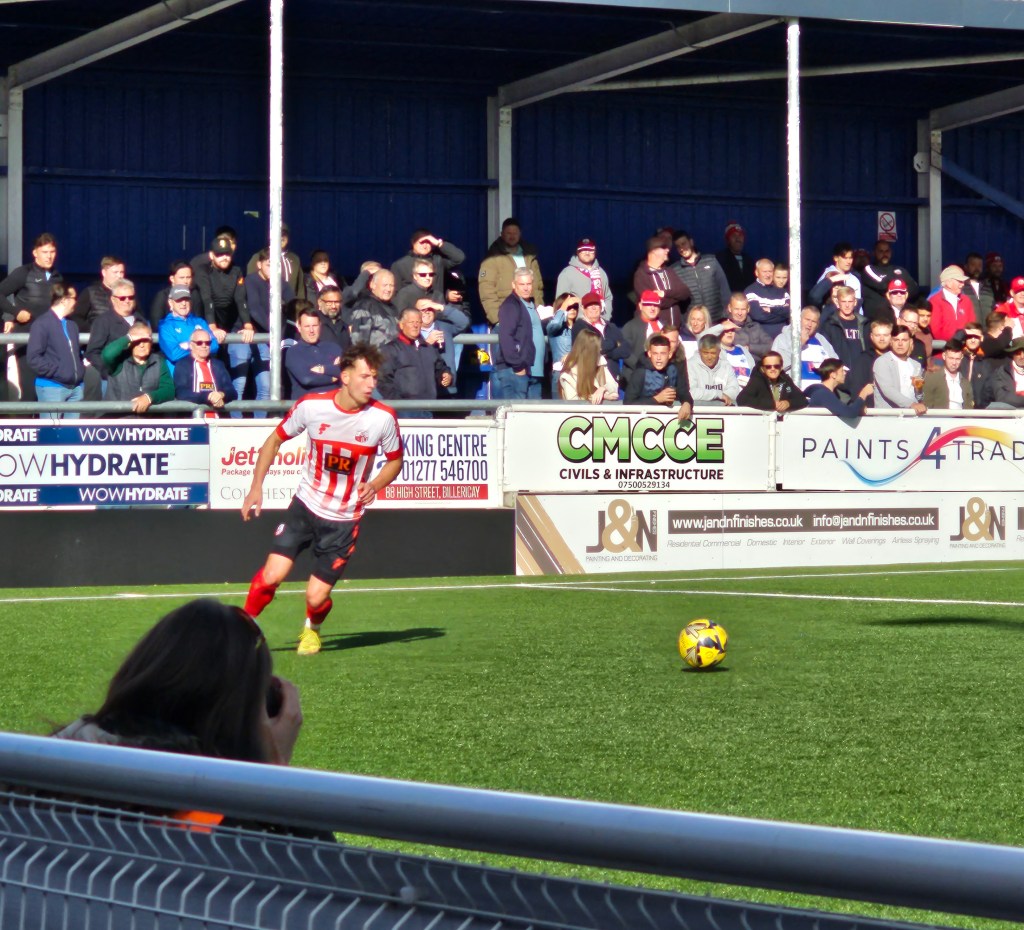
I eventually settle on the terrace where most of the Sheppey fans seem to have gathered. The teams process onto the pitch and the game begins.  It’s Billericay who get first go with the ball and they are kicking towards  the northern end, where I am standing.  Billericay wear blue shirts and white shorts whilst Sheppey are in red and white stripes with black shorts; the scene is a perfect picture.    The opening minutes of the game are dominated by people carrying plastic pints of beer and lager re-locating from the south end of the ground to the north, the end that Billericay are attacking.  Billericay’s number seven has a shot during this time and fortunately it flies over the cross bar, if it had gone in, I fear the walkways around the ground would have been awash with beer.

The sun is shining strongly into the stand and I decide it’s too warm, so when the Billericay Town diaspora is over I go and find a seat in the front row of the stand on the west side of the pitch, which is shaded.  It’s a good view if a little low down and afflicted with the pungent smell of what I think is pine from a close neighbour’s aftershave or may be an open bottle of toilet cleaner.  Despite the main migration having finished, there is nevertheless still a constant flow of mostly blokes with pints from the bars.

As might have been expected, because Billericay Town are in a league a level above Sheppey United, the home team have the ball more of the time than do their visitors.  Despite a lot of possession however they don’t have many shots at the Sheppey goal and Sheppey break down their attacks easily.  It’s only twelve minutes past three and another attack is broken down and Sheppey send the ball off down their right flank from where it is played through to their number nine who quickly sets himself up for a shot and scores.  Sheppey United lead 1-0 and there is an explosion of joy amongst the red and white shirts and scarves off to my left.
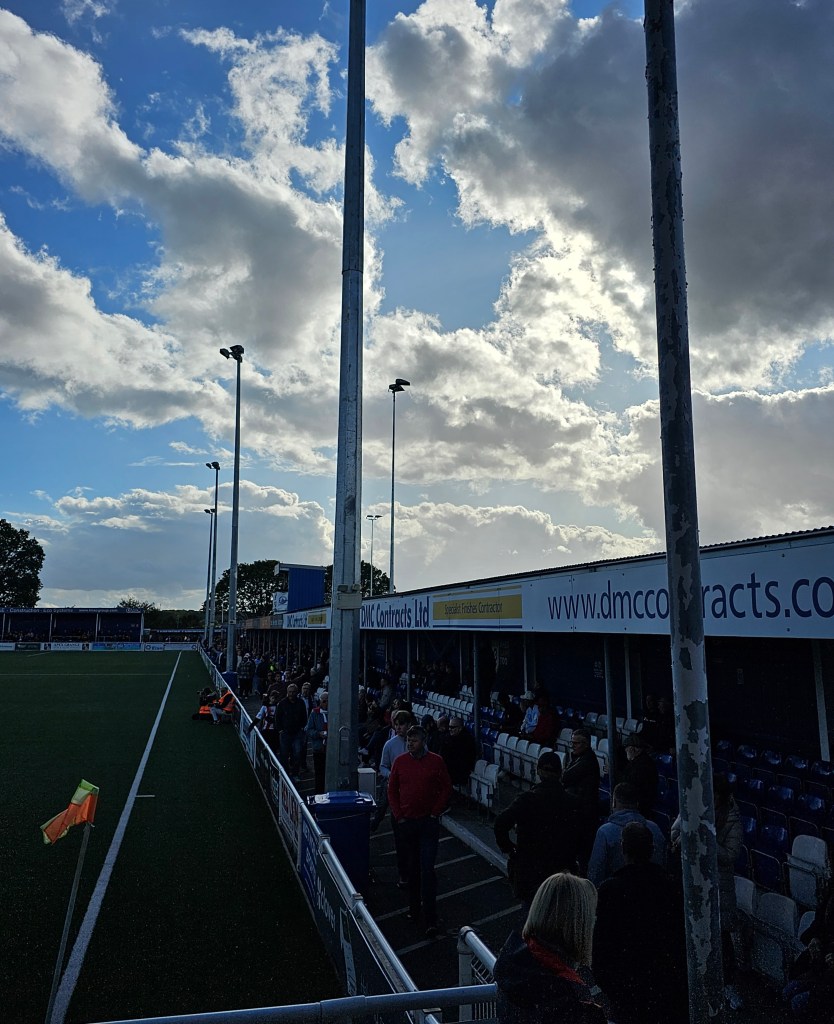
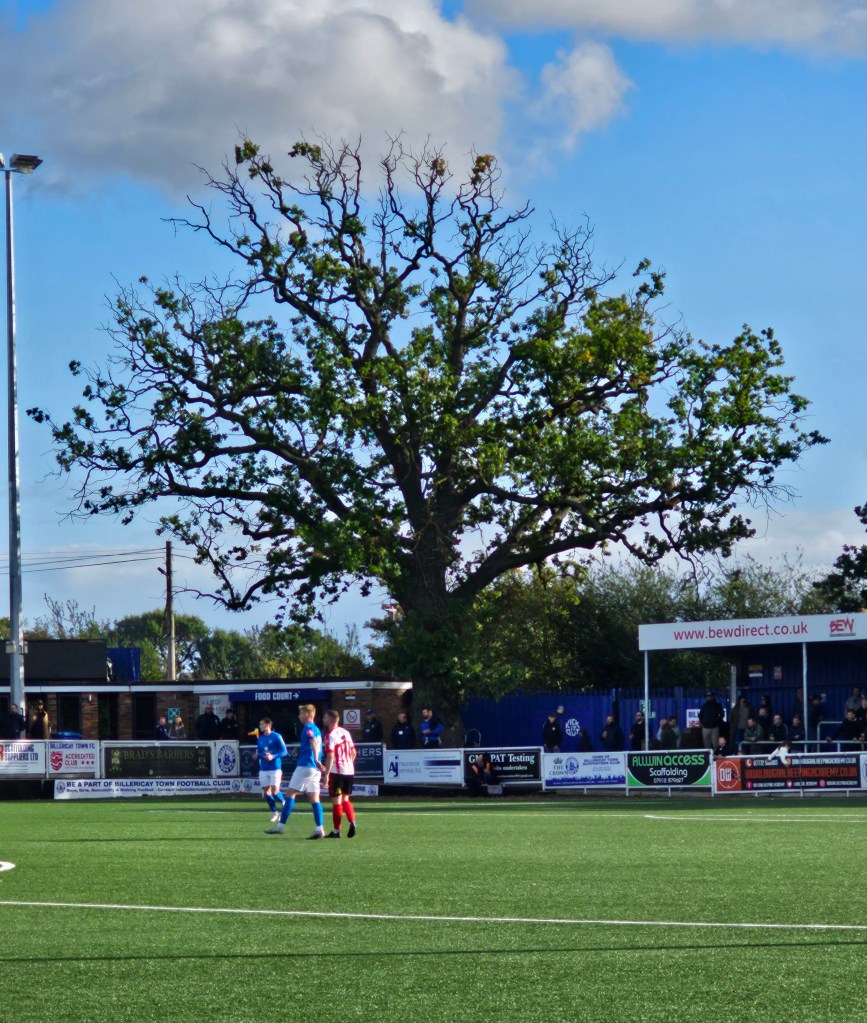
“Everywhere we go…” sing the Sheppey fans and then “No noise for the Essex Boys” which provokes the quickly thought out response “Essex, Essex , Essex” from the boys.   Billericay continue to keep the ball a lot of the time but it’s as if they think that’s all they have to do.   At twenty past three it’s Sheppey who win the first corner, and I notice the row of four Oak trees at the southern end of the ground, one of which is inside the ground, although it doesn’t look as healthy as the others.   It’s a beautiful light blue afternoon with heaped up clouds like cotton wool decorating the sky and puffs of black rubber springing up from the synthetic pitch.

Sheppey’s number eight shoots on goal. “Oh, no-oo” exclaims the bloke next to me a moment before the ball skims just beyond the far post and I hear him sigh with relief.  Sheppey win another corner, and then another but in between Billericay have another extended period of ultimately aimless possession.   It’s not until gone twenty-five to four that Billericay win a corner of their own, but the Sheppey goalkeeper is the first to the ball when is sails into the box.  The sight of groups of home and away fans side by side behind the goal has me reminiscing about the North Stand at Portman Road back in the 1970’s. 

With half-time approaching I decide to make my way to what I think is a tea hut, but is actually another bar, situated in the corner by the turnstiles.    I pause and watch the last action of the half from near the bar as Billericay gain another corner.  The ball is not cleared and to end the archetypal goal mouth scramble the Billericay number 10 jabs the ball into the net from close range and the scores are level.  I’m a bit disappointed.  After a minute’s worth of added on time it’s half-time, and hiding my disappointment that Sheppey are no longer winning I step away to the bar to get a tea (£1.20) and worry that the woman who serves me is eyeing me suspiciously because I seem to be the only person who isn’t buying beer.
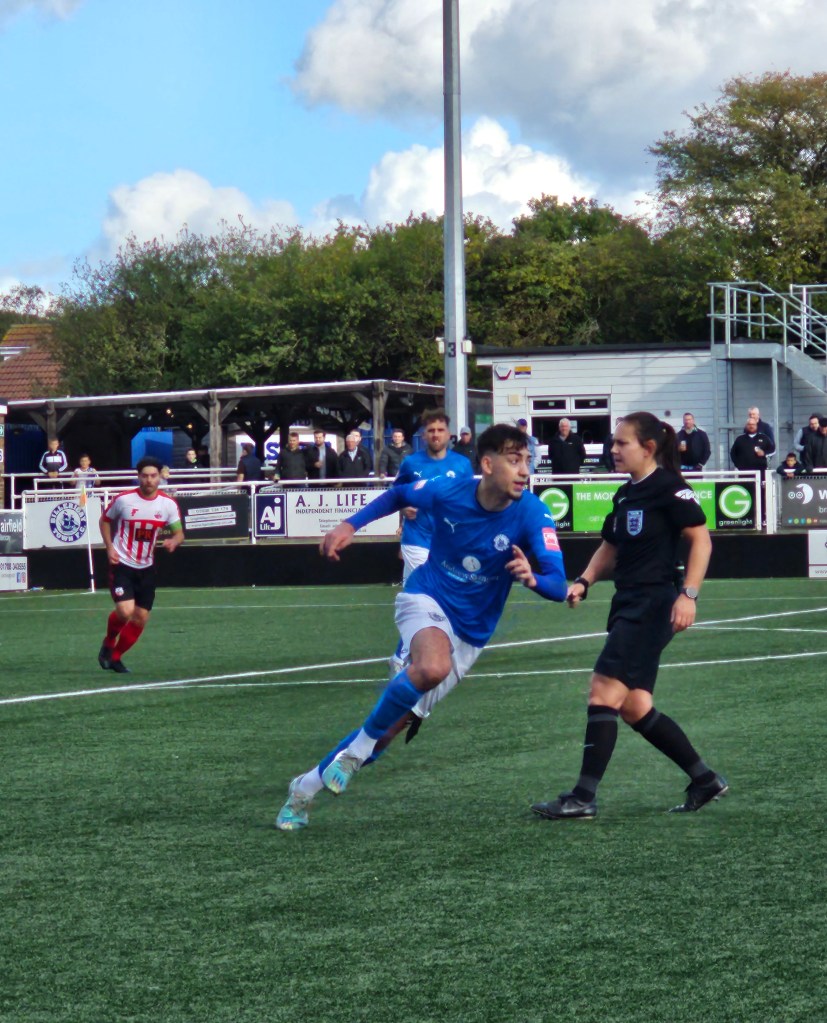
Having previously felt too warm, by the end of the first half I was beginning to feel too cold, so for the second half I return to the terrace that’s in the sun at the north end of the ground, which reminds me of the old ‘Popular’ side at Layer Road, Colchester, but without the rust and with a better rake on the terrace.  The football begins again at six minutes past four.

“Get into ‘em and fuck ‘em up” chant the Billericay fans repeatedly and rather unpleasantly and their team responds with an early shot high into one of the Oak trees.  The afternoon’s attendance is announced as being 1,241 and the announcer thanks everyone for their “fantastic support”.   Billericay have the ball most of the time still and the football is neat and thoughtful, only occasionally punctuated by agricultural clearances from the big blokes at the back.  In front of my terrace fat blokes continue to ferry beers.   It’s nearly twenty-five past four and Billericay win a corner. “Come On You Blues” chant the home crowd from the other end of the ground.  A minute later Sheppey make the game’s first substitution and have a creative spell, which first sees number eleven volley the ball against the Billericay goalkeeper’s chest , before number six is booked and then number seven has a rising shot blocked by the up stretched arms of the Billericay ‘keeper.  Meanwhile, the Sheppey fans chant “Come On Sheppey” and in a quieter moment a pied wagtail flits across the pitch, confused perhaps by the synthetic grass.

Twenty-five to five slips by and Billericay make a substitution.  “Blue Army, Blue Army” chant the home crowd like a scratched record.  “Come on you Ites” chant the Sheppey fans, suddenly remembering their team’s slightly odd nickname; Ites being short for Sheppeyites.   Their team earns a corner and number four heads over the cross bar.   It’s now almost a quarter to five and as Billericay make a double substitution I notice two advertisement boards on opposite sides of the pitch; one for Greenlight Insurance,  the modified car insurance specialists, and the other for Bumps Away Minor Body Repairs; the symmetry appeals to my cliched picture of south east Essex as the home of the boy racer and his souped up Vauxhall Nova.

Only a few minutes of normal time remain but away to my right two young blokes return to their friends with more beer and two polystyrene trays of chips for which a blue recycling bin makes a convenient table. On the pitch, Sheppey’s number seven joins the list of cautioned players and the Sheppey supporters regale the referee with chants of “You don’t know what you’re doing”.   It’s ten to five when I decide to head towards the exit, making my way along the front of the main stand in instalments before resting near where I ended the first half.  With time running out and a midweek replay back in Kent looming, both teams make final desperate efforts to win.  Billericay hit the Sheppey cross bar with a free-kick and then inside the four minutes of time added on Sheppey also have a shot  that unexpectedly strikes the cross bar too.  But then it’s all over and amidst applause, relief, disappointment and appreciation I make my way back out into Blunt’s Wall Road and the short walk back to my planet saving Citroen e- C4.

The lesson learned today is that the FA Cup is still a wonderful thing, which at non-league level in particular still excites and enthuses, because it is all about the glory.   This afternoon’s match has done the old competition proud, and I can now go back to my hedge trimming to reflect on an afternoon well spent, to wonder about  who Billy and Ricky would have supported, and to bask in the self-satisfaction that I have at last seen Sheppey United.   

Further reading: ‘How Steeple Sinderby Wanderers won the FA Cup’ by J L Carr.

FC Lorient 0 Montpellier Herault SC 3

One sunny September afternoon last year, whilst on holiday in Brittany, my wife Paulene and I went to the coastal town of Lorient, to the Stade du Moustoir, to witness the Ligue 1 fixture between FC Lorient  and Breton rivals FC Nantes. It was a fabulous afternoon and before an almost capacity crowd we saw Lorient triumph by three goals to two. Everyone was marvellous, I met the Lorient mascot Merlux the hake, and in a fit of consumer madness powered by a premium bond win that week , I bought a T-shirt, a mug, a fridge magnet, a cuddly hake, and a pennant to adorn my upstairs toilet. I have yearned to return ever since and so has Paulene. Today is the day we fulfil our modest dream.

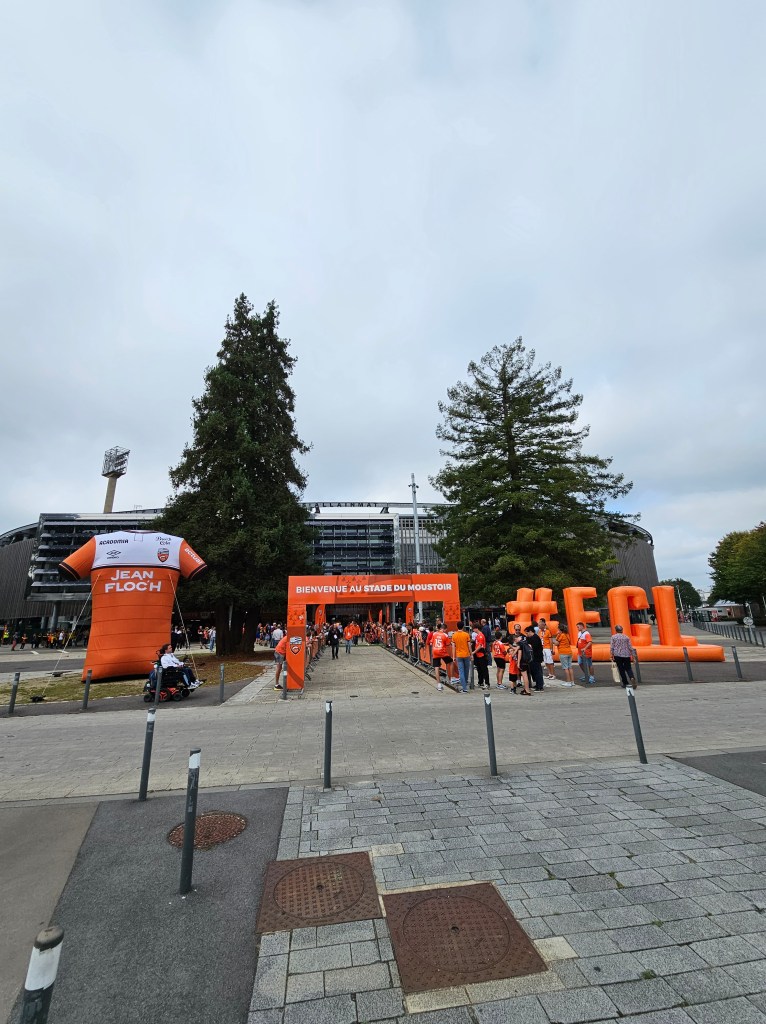
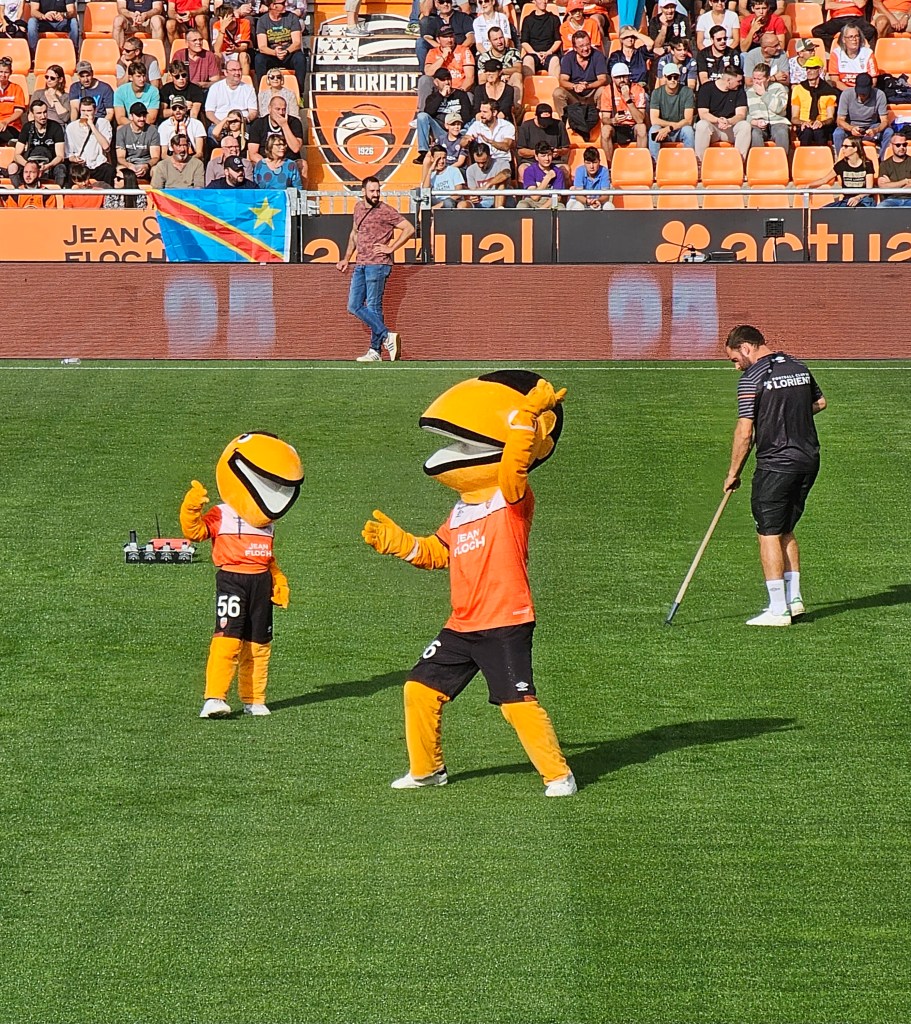
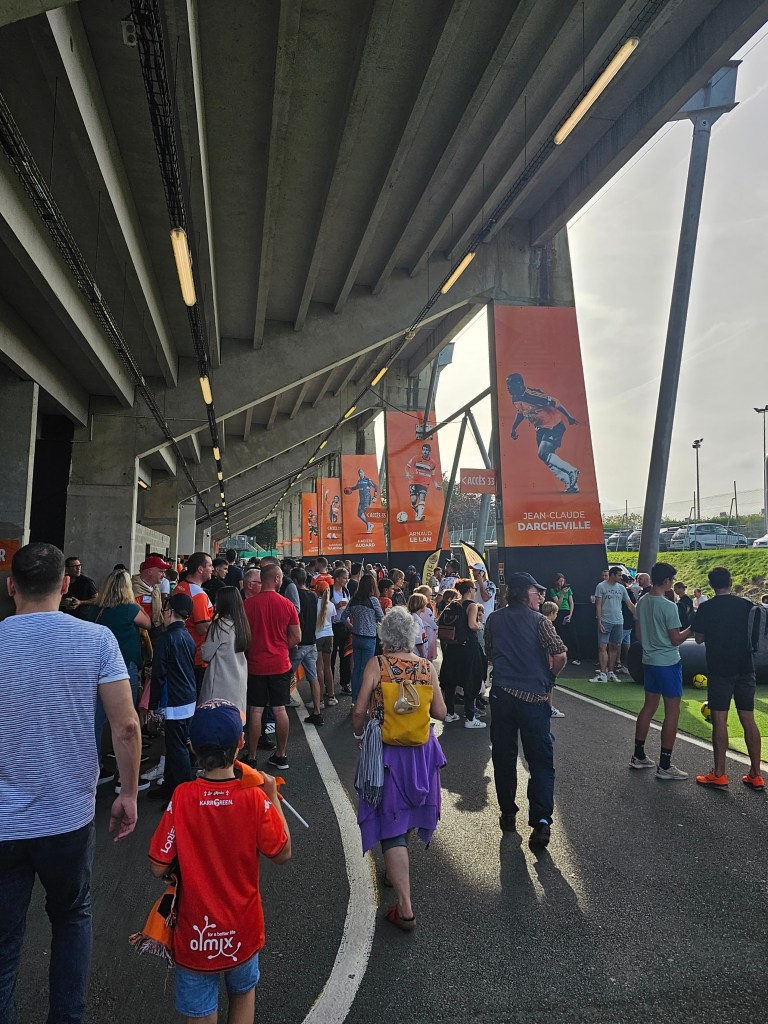
It’s only a thirty-five-minute drive up the E60 and along the N165 through neighbouring Lanester to Lorient from where we are staying, and being old hands we know where we can handily park our planet saving Citroen e-C4, and so set the controls for the heart of the town.  We find a parking spot beneath an avenue of shady limes in the Boulevard Marechal Joffe and walk to the ground, which is superbly central next to the town hall, handy for buses and trains like all football grounds should be.  In Lorient, the town centre car parks are closed on a Sunday match day which sounds daft, but when you think about it is a pretty good idea to encourage people to travel ‘responsibly’, although street parking is free and plentiful.  Yesterday, I received an e-mail from FC Lorient giving me the pre-match lowdown and inviting me along to greet the team as they arrive at the ground, so that’s what we do, joining mostly children and their parents to cheer the players off the bus and enjoy the sound of Fatboy Slim’s “Right Here, Right Now” played on Breton bagpipes.  Merlux the hake mascot (so-called because the binomial name for Hake is Merluccius merlucciusis and the French for Hake is Merlu) is of course present, and he now has an accomplice called Mini Merlux.  The spawning grounds of the Hake are in the Bay of Biscay, the expanse of water which the south coast of Brittany faces.  I had always thought that seafood-based club mascots were restricted to Sammy the Shrimp at Southend United, but I am very pleased to be able to report that this is not true and I’m now keeping a look out for any clubs with fish, crabs, lobsters or assorted shellfish on their crests.

Having greeted the team, who sport natty Breton-style stripey T-shirts making them look as if they should be disembarking from a ship not a bus, there is still over an hour to go until kick-off at five past five.  Keen to know more of Lorient than just the Stade du Moustoir and the route back to our car, we set off to explore a little, heading over the road towards what my instinct and a possible onshore breeze tells me could be the harbour.  My instinct is correct, and Lorient proves to be a town like Ipswich where if you have a yacht you can sail to matches, with a marina within easy walking distance of the stadium.  Arriving for a match under sail has to be even greener than catching the bus, I cannot think why everyone is not doing it.

Wishing to visit the club shop again, have a wander inside the ground and sample the refreshments on offer, we return to the stadium having glimpsed the land on the other side of the water from Lorient. Our seats (20 euros each) are in the fabulous Tribune d’Honneur, now known as the Tribune Credit Mutuel de Bretagne, the smallest and oldest of the four stands, having been built when the ground was first opened in 1959.  The Tribune d’Honneur has a marvellous cantilever roof of beautiful, vaulted and shuttered concrete with shiny steel cables to help hold it up. The back of the stand has a series of narrow, angled concrete columns with angular shuttered concrete arches at the top, and metal framed doors and windows at ground level; behind the stand is an avenue of plane trees which cast a lovely, dappled shade over it.  The stand symbolises the renewal and rebuilding of the early postwar period and is a thing of beauty, way ahead of anything built in Britain at the time. Sadly, with grand proposals to upgrade the stadium to make it better suited to cultural events as well as football, the Tribune d’Honneur is likely to be demolished before we all get much older.

Tripping out on 1950’s concrete, I escort Paulene to the Tavarn Morgana bar beneath the Tribune B & B Hotels where I buy her a glass of the local Breizh Cola (4 euros), which she far prefers to the American rubbish, and a 40ml re-usable plastic glass of Lancelot IPA (6 euros), and pretty good it is too, by several country miles the best beer I’ve ever been served beneath a stand at a professional football club ground.  Paulene now holds my beer whilst I pop into the club shop, accessible from inside the ground but not from without at this stage, to purchase a glorious orange T-shirt (25 euros), the last large size one on the rail, which proudly displays a silhouette of the Lorient skyline with its dockside cranes and submarine dock, beneath the name Lorient.  The great thing about Stade du Moustoir is that it is possible to walk right around it beneath and behind each stand in turn, and that is what we do, taking in the sites and sounds and smells.  Last weekend, Breton team US Concarneau played St Etienne at Stade du Moustoir because their own home ground is not of sufficient standard for matches in Ligue 2; I am very excited to find evidence of the match behind the Tribune Lorient Agglomeration in the shape of the ‘ceremonial’ arch through which the teams would have run onto the pitch, I feel for a moment like Professor Alice Roberts discovering some archaeological wonder.

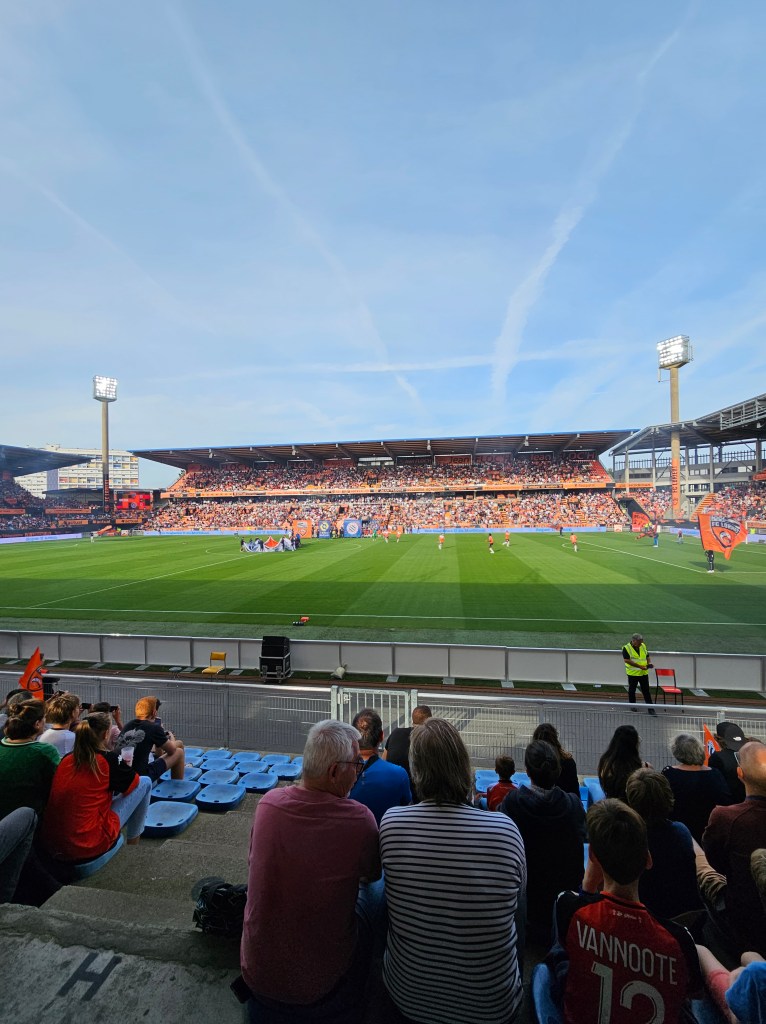
Back in our seats after our tour of the stadium, a ship’s siren or foghorn sounds three times to signal that there are just ten minutes until kick-off,  or coupe d’envoi to the French, and Paulene and I witness the mounting excitement of the build-up with a stirring Breton anthem, pyrotechnics, the Ligue 1 anthem played loudly over the PA system and multiple flag waving as the teams enter the pitch to line up before banners displaying both club crests and the Ligue 1 logo.  When the game eventually begins it feels like a massive anti-climax, just a few blokes tapping a ball about.

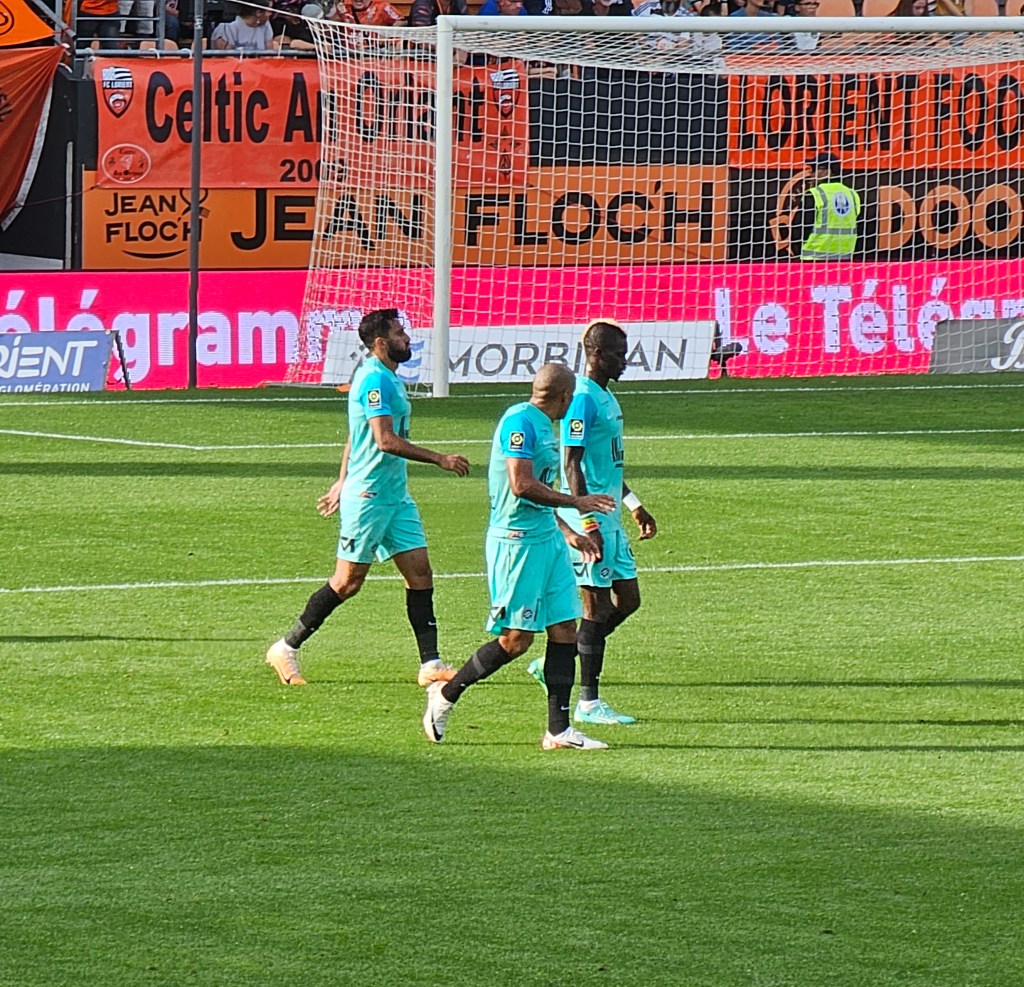
It’s Montpellier who get first go with the ball, attempting to send it mostly towards the most inland of the two goals.  Lorient are wearing their signature home kit of orange shirts, black shorts and white socks but Montpellier whose signature colours are orange and navy blue wear a change kit of all jade with aquamarine sleeves; it’s a bit of an odd or at least unusual ensemble and without the different coloured sleeves it would look washed out and awful.  Normally I would say “if you’re going to wear green, wear green” but I like Montpellier, so I let it go.  Although Montpellier’s Akor Adams heads straight at the Lorient goalkeeper after ten minutes, the first decent shot on goal takes eleven minutes to arrive and it’s Lorient who have it, with Vincent Le Goff sending a shot past the far post from an acute angle after a nippy run and pass from Julian Ponceau.  Three minutes later the first corner of the match goes to Lorient too, but the utterly enormous Isaak Toure sends a glancing header down towards the bottom corner of the Montpellier goal only for goalkeeper Benjamin Lecomte to make a spectacular diving save.  Toure wears a ludicrous number 95 shirt, but at 2.06m tall who’s going to tell him not to.

“Allez Lorientais, Lorientais” sing the home ultras off to our right in the Tribune B&B Hotels, fired by the early action but they just keep on singing and chanting without end, regardless of what happens on the pitch.  The game is settling down to a pattern of Montpellier playing slowly and patiently, frustrating eager Lorient who have occasional bursts of activity, racing forward excitingly only to be stopped by judicious interceptions and well-placed out-stretched boots.  It’s Lorient who first provoke referee Jeremy Stinat into whipping out his yellow card (carton jaune to the locals) however, as Ponceau fouls the wily Teji Savannier, a hugely skilful player who has never run about enough to attract the serious attention of English clubs.  Montpellier’s Wabi Khasri quietly goads a Lorient defender and pleads innocence as only Wabi Khasri can, and as he has done previously for St Etienne and Rennes and probably every club he’s ever played for .

Almost half the first half has gone when Montpellier win their first corner, and the ball is half-volleyed wide, and I am suddenly aware of how comfortable my seat is despite having no back, I think it must encourage good posture.  The bloke sat next to me is leaning forward and living every second of the match in a series of gallic shrugs greeting each free-kick and misplaced pass.  A half an hour has gone and suddenly Montpellier’s patience and quiet approach shatters and number 9 breaks away towards goal; he rounds the Lorient ‘keeper and then squares the ball to present Akor Adams with a simple tap in from a few yards. Montpelier lead 1-0 and seem to have just been biding their time.

The goal prompts Montassar Talbi to add to the tally of booked Lorient players as he drags down Adams and although the home team win another corner, Lorient’s Toure only manages to direct his seemingly unchallenged header straight to the waiting hands and gloves of Comte.  Two minutes of added on time don’t seem enough for Lorient to equalise, and despite some unexpected frantic attacking in which Theo Le Bris boots a shot against the Montpellier cross bar, they’re not.

With half-time there is a flood of parents and children to the back of the stand and some return clutching cardboard cartons of chips or re-usable plastic cups of cola; one or two never return, with forty-five minutes of football on a warm September afternoon evidently being enough.  We watch the stewards watching us and ponder whether one who looks a bit like the late actor Geoffrey Palmer, is wearing a wig or just has an elaborate and extensive comb-over; we decide we’d need to see him walking briskly towards the harbour into an on-shore breeze to truly decide.

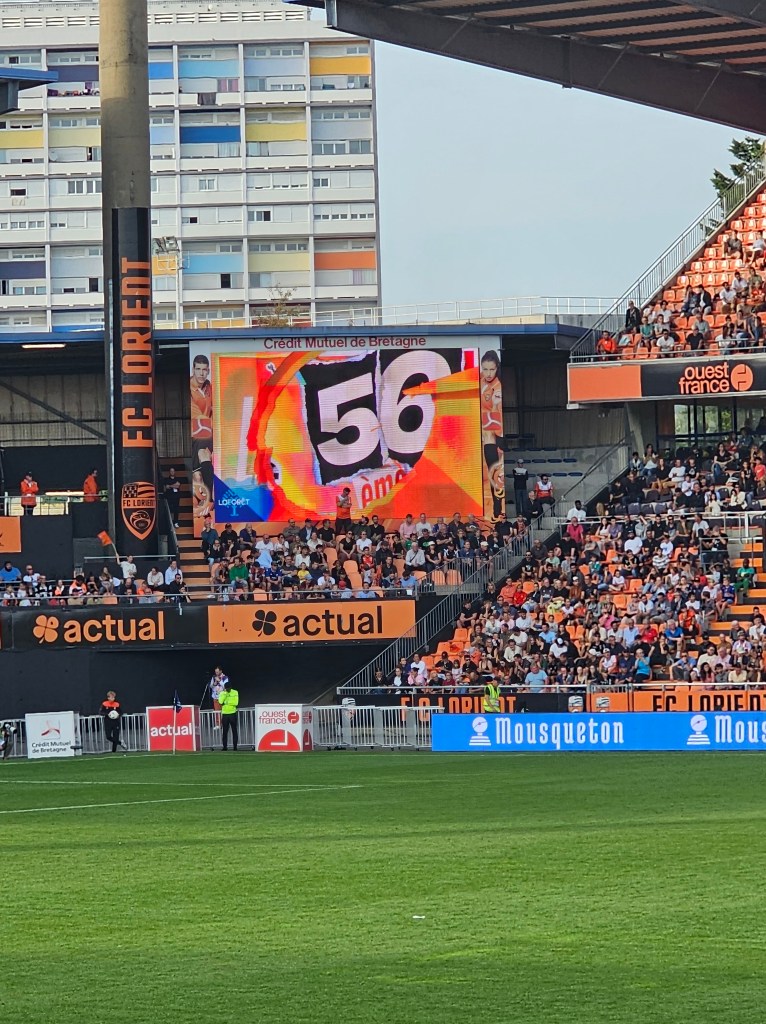
At seven minutes past six the football resumes and very, very conspicuous by his absence is the gigantic number 95 for Lorient, Isaak Toure, who has surprisingly been replaced by Joel Mvuka, a man who according to the app on my mobile phone is a full thirty-three centimetres shorter and thirty-three kilograms lighter than him.  It seems likely it’s a tactical move by Lorient manager Regis Le Bris and Lorient start the half enthusiastically, pushing forward and pinning Montpellier in their own half much of the time.  The fifty sixth minutes arrives and the PA system suddenly lets out an almighty noise and the scoreboard flashes the word “Encouragement” and the number “56” as the crowd is urged to make a noise and encourage the team simply because fifty-six is the number of the Morbihan departement (like an English county) in which Lorient is situated.  The same thing happened at Brest last Saturday night when I was there, but in the 29th minute, the Finisterre departement, where Brest is, being departement number twenty-nine.

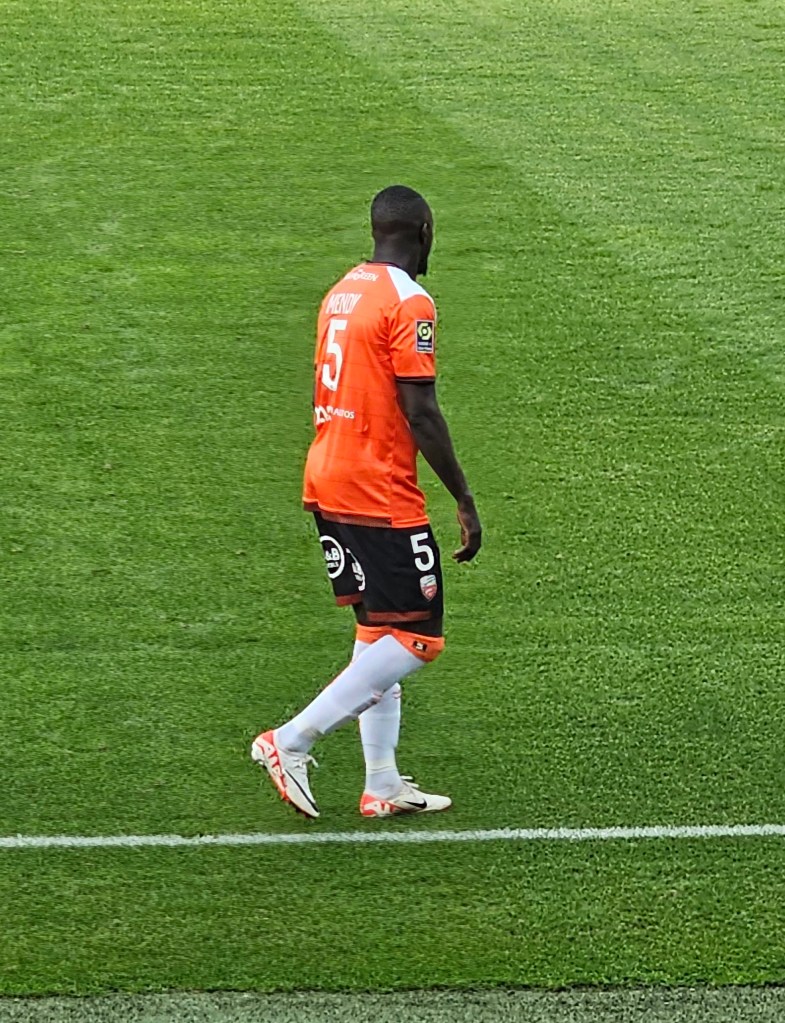
The ultras have been noisily supporting their team from the start, so the fifty-sixth minute hasn’t made much difference to them, but the substitution of Vincent Le Goff with summer signing Benjamin Mendy two minutes later seems to excite the crowd, and Mendy seems like a decent signing for Lorient, even though he hasn’t played a competitive match for almost two years.  Hopefully, the poor treatment he has suffered in those two years will spur him on to repay Lorient for showing the sort of faith in him, which Manchester City apparently didn’t.  Mendy looks a bit larger than when he played for Monaco, but he clearly hasn’t lost his touch.

An hour has gone, and Montpellier pull back a booking with Maxime Esteve finding the sharp end of referee Jeremy Stinat’s pencil for a foul on Mvuka.  The game is still interesting, but neither team is making much of an impression on the other and with twenty-five minutes left there have been six substitutions, four for Lorient and two for Montpellier, who have replaced Wabi Khasri to peals of heartfelt booing from the home crowd.  Lorient win a corner which comes to nothing, and today’s attendance is announced over the PA system as being 13,492, with the scoreboard referring to us as supporters and supportrices.  I like that the French language still acknowledges that there are two sexes, and surmise that the French understand that human existence is all the better for it.   

The bloke sat next to me has been growing increasingly exasperated, groaning a turning away from the pitch as Lorient players dither on the ball or fail to spot the incisive passes.  Monsieur Stinat is not helping matters, but then it’s not really his job to do so, although he does make them a whole lot worse when in the seventy-first minute he awards Montpellier a penalty having seen Mousa Tamari fall to the ground as Igor Silva brushes against him.  It looks a bit harsh, or alternatively soft from my seat in the old Tribune d’Honneur, but after a small delay, in which the Lorient players surround Mr Stinat, presumably in an attempt to send good vibes through his earpiece to the VAR officials, the VAR officials however, confirm that it is a penalty.  Teji Savannier nonchalantly makes it 2-0 to Montpellier.

Lorient are mildly stung into action by the second goal and win a succession of three corners as they once again keep Montpellier in one half of the pitch, although Montpellier don’t ever look too bothered about it.  Lorient desperately make their fifth substitution whilst Montpellier make some substitutions too, but more just because they can, it takes time, and it⁹ breaks up the game.  Teji Savannier is one of the players to be substituted for Montpellier, and he looks like he could do with a bit of a rest.  Lorient make their own penalty claim as Sirine Doucoure falls to the ground alongside Montpellier’s Kiki Kouyate, but instead Mr Stinat awards the free kick to Kouyate.

A minute of normal time remains, plus any added on for administrative reasons.  Out on the right, Joris Chotard looks up and plays an angled pass through and behind the Lorient defence, which only Akor Adams reacts to; he runs on, takes the ball past the Lorient goalkeeper, checks back to dodge a defender and then rolls the ball into the unguarded Lorient goal. The bloke beside me groans in despair. Seven minutes of additional time is announced and almost all of it is played, and Montpellier win 3-0.

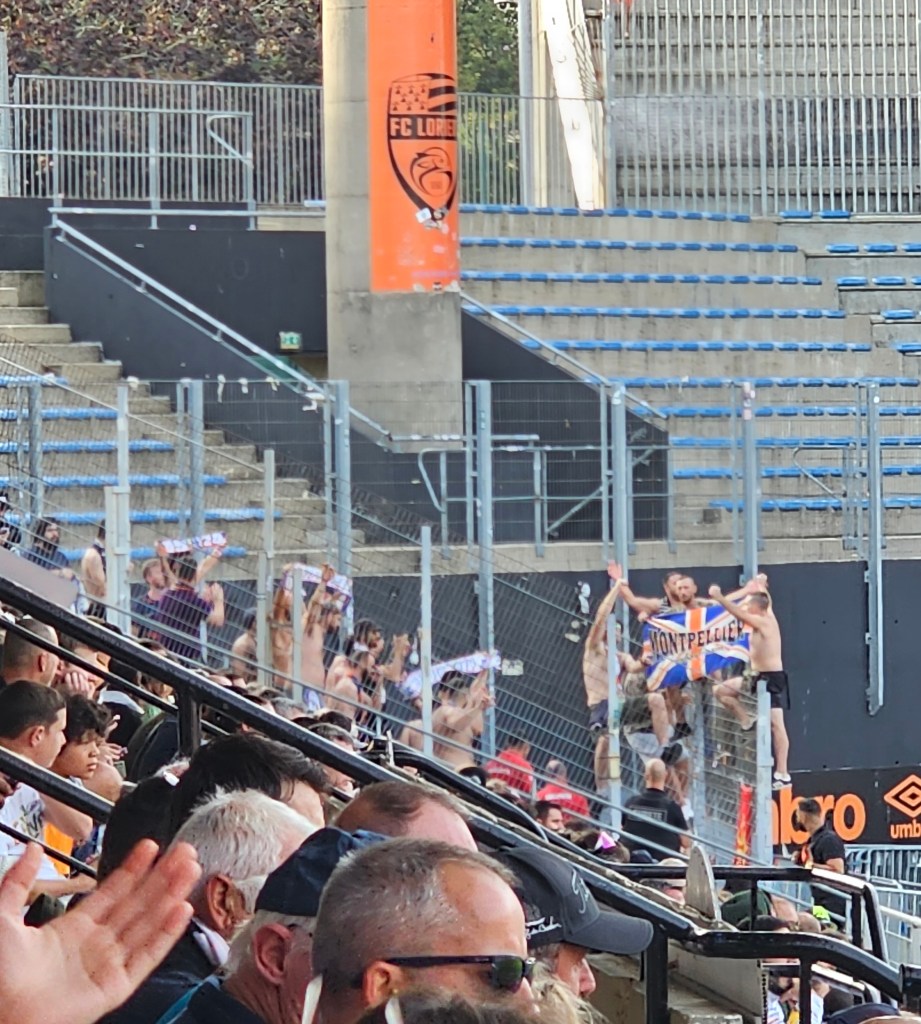
Montpellier deserve their win; they’ve played coolly and economically, and Lorient have not been good enough.   As many of the Montpellier supporters as can, balance themselves on the top of the steel fence that pens them in the corner of the stadium away to my left, most of them aren’t wearing shirts; they hail their conquering team.  At the other end of the ground the Lorient supporters hail their losing team as if they had won.

Once again Paulene and I have had a fab September afternoon at the Stade du Moustoir, it is a truly great place to watch a football match.  There has been so much about our afternoon that we have enjoyed from Lancelot beer and Breizh Cola to shuttered concrete and the last ‘Large’ orange T-shirt in the cub shop, but I think best of all is that Lorient’s club mascot is a Hake.

Ipswich Town 3 Leeds United 2


And so, in the words of what was reputedly Sir Bobby Robson’s favourite song, Ipswich Town face the final curtain of this singularly unsuccessful season in Football League Division Two.  There have been a few regrets, some too painful to mention or admit to, but we’ve seen the season through, we’ve  laughed and cried and not really succeeded in doing what we had to do; there have been a lot of doubts and we’ve had more than our fair share of losing.   I can’t imagine anyone would own up to it being their way of doing anything, unless they set out to get relegated.  It is with a sense of blithe resignation therefore that I set off for Portman Road beneath cloudy grey skies into the teeth of a cold northerly breeze.   It’s not even ten o’clock yet and I curse Sky Sports and their dictat on reality, which is that if something doesn’t happen on subscription television, it doesn’t really happen.  There are supporters of both Ipswich Town and Leeds United at the railway station and sadly, Chelsea.  The train is three minutes late although the electronic display claims it is on time; another example of the truth being what we are told it is.  The train is busy with Bank Holidaying passengers; middle-aged women dressed up to the nines cackle excitedly, one wears a semi-transparent wide brimmed-hat like a gossamer sombrero.  Legs apart blokes stand by the sliding doors and drink cheap lager from shiny blue cans.  An invisible cloud of acrid body spray creates a tickling sensation in my nose, it spreads and transforms itself into a stabbing pain in what feels like the root of a tooth, I reminisce about hay-fever.

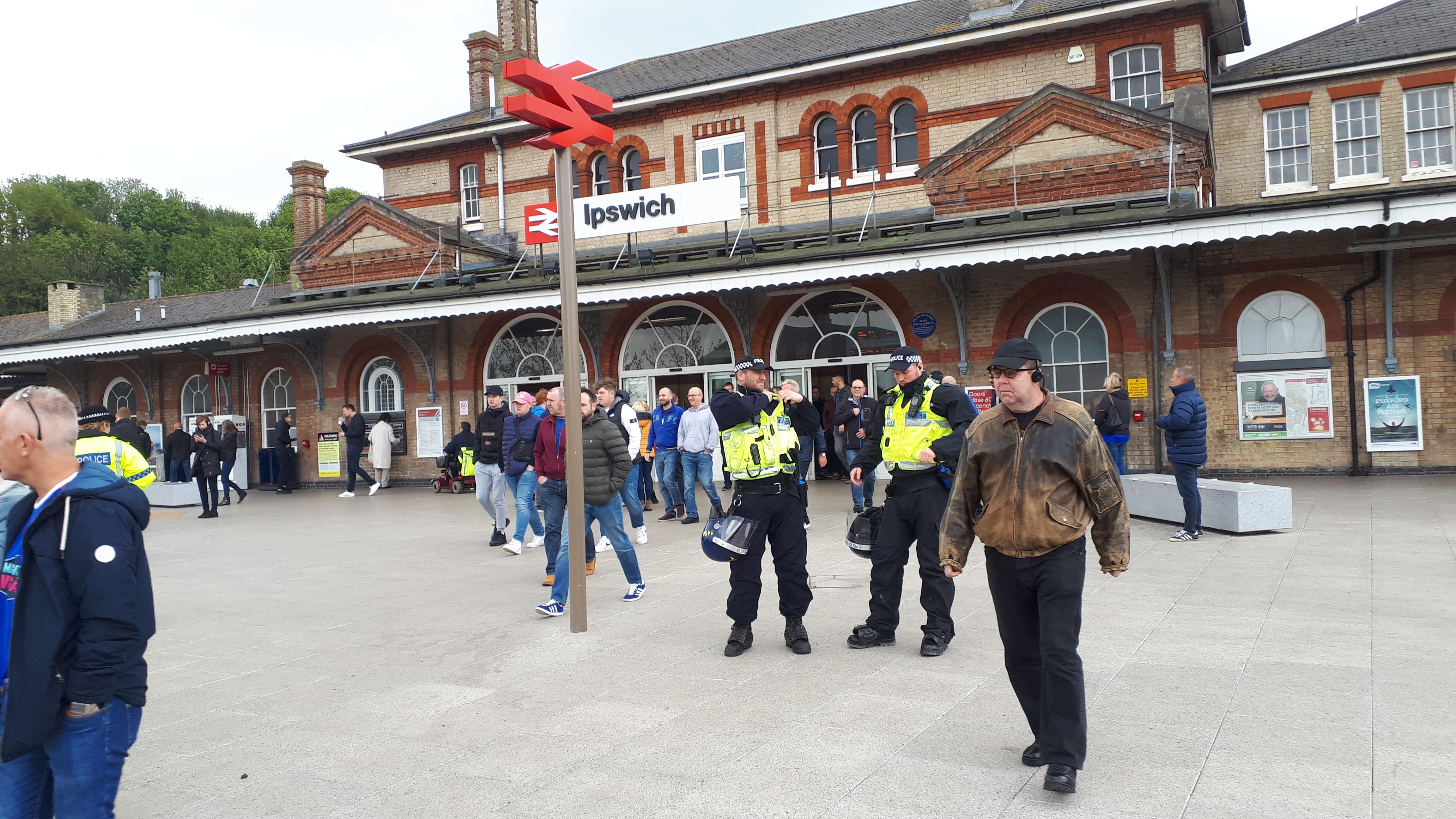
In Ipswich a state of emergency has been declared and would-be passengers vie for space in the railway station booking hall with a platoon of police, all hand-cuffs and hi-vis. On the station ‘plaza’ more police; fashionable police in baseball hats with riot-helmets swinging casually from their utility belts.  Opposite in the garden of the Station Hotel the marauding Yorkshire hordes enjoy some drinks and a barbecue, the smell of charcoal smoke wafts across the river. I head for St Jude’s Tavern taking a detour along Constantine Road past the Corporation bus garage because Portman Road is closed. The Leeds United team bus sweeps by, it’s blacked out windows hiding its precious cargo from the gaze of the common people; a BMW waits where parking has been suspended; it’s always a BMW.  At the corner of Portman Road early diners wrestle with paper napkins of meat-based, bun encased lunches, jealously guarding their sauce and onions. I buy a programme, a souvenir of the end of a sixty-two-year-long era.

St Jude’s Tavern has been open five minutes, but already a bevy of fifty-something drinkers crowd around the bar.  “We’re all going on a League One tour” chants one before expressing his excitement at the prospect of an away match against Southend United.  I turn to the barmaid “It doesn’t get much better than a day out it Southend, does it” I say with a hint of sarcasm.  She looks confused, so I ask for a pint of the Match Day Special which is St Jude’s Elderflower Bitter (£2.50).  It doesn’t taste too good. “It’s the elderflowers” she tells me and swaps it for a pint of Nethergate Venture at no extra charge.  It makes me think of the ‘French’ John Cleese in ‘Monty Python and the Holy Grail’. I talk to one of the regulars about his replacement knee and elderflower cordial before Mick arrives; he buys me a pint of Elgood’s Plum Porter (£3.60), which is characteristically kind and generous of him.  Mick and I discuss his current affliction with bursitis (Housemaid’s Knee) and I wince at the size of the bump on his leg.

Time passes quickly and I am soon drawn down Portman Road by the beaming blue face of Sir Bobby Robson peering between the bright green foliage of the trees beyond Handford Road.  I enter the ground from Constantine Road past the array of planet-destroying, over-sized, show-off cars owned by the players and through the little used turnstile number 60. “It’s a quiet little number having this turnstile, isn’t it” I say to the young woman enclosed in her brick and mesh cubicle, she smiles nicely and doesn’t disagree.  I stroll to my seat via the WC facilities beneath the stand where I hear the recorded stadium safety announcement; “If you hear this sound  – wooooh, wooooh…” says the disembodied female voice with a faintly Irish accent.  I imagine a woman from Donegal called Sheila who is capable of creating the strange whooping sound with her natural voice, like some sort of gainfully employed banshee.

Emerging up the steps from beneath the stand my eyes are met by a long blue and white banner at the Sir Bobby Robson stand end of the ground.  “There is a light that never goes out” it reads.  I like the music of The Smiths and Morrissey as much as the next miserabilist, but wonder at the relevance of this random snatched lyric and also if Morrissey will be pursuing a royalty.  The lyrics of the Smiths are an odd choice if looking for uplifting words, and I would like to see the banner that announces “Heaven knows I’m miserable now”.  Recovering my joie de vivre I see in my mind’s eye a banner at Carrow Road which reads “Ha ya got a loight boy?” and wonder what other lyrics from popular song are suitable to ‘celebrate’ relegation. I decide that “Wiping the dirt from his hands as he walks from the grave, no one was saved” sums up my feelings nicely and I imagine makes Morrissey jealous that it isn’t one of his lyrics.

As ever, ever-present Phil who never misses a game and Pat from Clacton are here today, but far fewer of the seats about us are vacant and I marvel at the increased level of support the club has garnered from becoming the plucky underdogs.  Town kick-off towards us in their traditional blue and white shirts, befouled by the hideous logo of a firm of on-line shysters.  Leeds United are also the lackeys of an on-line betting company, but with a nicer logo and they wear yellow shirts and socks with blue shorts, looking like Newmarket Town, but with more expensive and exotic haircuts and tattoos.

Having had first kick, Town quickly lose the ball to their opponents and struggle to get it back.  “Marching on together, We’re gonna see you win” sing the Leeds support presumptuously from the top tier of the Cobbold stand.  Below them in front of the executive boxes a couple of rows of Leeds fans sit with flags spread out on the seats in front of them, they look like they’re all together in a giant bed.  If they were Norwich supporters they would be.

Eleven minutes pass and I’m a little bored already,   Ipswich are sadly not doing much but chasing Leeds players and the ball. For a few moments Leeds play the ball around across their penalty area like a French or Brazilian team, confident in their ability to pass and control the ball, Town captain Luke Chambers looks on, mouth agape.  The Leeds United goalkeeper Kiko Casilla appears to be somewhat bandy-legged; I ponder the likelihood of anyone from sunny Spain suffering with rickets.

A smattering of Leeds fans swing their scarves about their heads like slingshots, recalling the Gelderd Road end of Leeds’ ground in the 1970’s whilst the Town fans in the Sir Bobby Robson Stand sing “Que Sera Sera, whatever will be will be, we’re going to Shrewsbury” which is a worthwhile boast because the Shropshire town is a one of the Football League’s loveliest, up there with Oxford and our very own Ipswich.  It is the nineteenth minute of the game and Town win a corner, bucking the trend of Leeds dominance. Andre Dozzell’s kick fails to travel beyond the Leeds defender at the near post however.  A conversation ensues behind me the final words of which are “We need a new team, mate”.  On the touchline Leeds manager Marcelo Bielsa adopts his customary squatting pose.  The Argentine is sometimes considered to be an eccentric character and his moving to Leeds having managed Lazio and Marseille rather proves the point; he was a legendary figure at Marseille, adored by the Ultras and I am proud to say I saw him sit on a cup of coffee at the Velodrome, which may be why he is choosing to squat today.

The game is not living up to expectations and to pass the time the Sir Bobby Robson Stand goad the Leeds support by singing “Top of the League and you fucked it up” which is a bit rich from supporters of a team that has been bottom of the league virtually all season.  Compared with our own team’s performance this season Leeds United are world beaters. “One Mick McCarthy” sing the Yorkshiremen in response, which is fair enough, but easy to say given that he’s only ever bored them until they cried with his attritional, joyless football as manager of the opposition.

I’ve been watching this game for almost half an hour and all of a sudden a couple of passes send our angular on-loan German Collin Quaner through on goal with just Casilla to beat; Casilla comes out of his penalty area and runs straight at Quaner who pushes the ball beyond him and hurdles the Spaniard’s lunging frame before crashing to the turf.  The lower tier of the Sir Alf Ramsey Stand bay for blood but referee Mr Gavin Ward proffers only a yellow card in the direction of Casilla, possibly because he couldn’t conceive of the current Ipswich Town team of having a goal scoring opportunity, let alone being denied one.  But the resultant free-kick proves Mr Ward wrong as the ball sails high into the six yard box and no one is able to send it decisively in any direction, so it drops to the ground and Town’s Flynn Downes is nearest and able to hook it into the goal net.  Ironically, it’s the sort of goal that owes a lot to the methods of Mick McCarthy.

“We’re winning a game, we’re winning a game, how shit must you be, we’re winning a game” sing the Town fans, once more invoking the sound of ‘Sloop John B’.  Surfing on a wave of a single Beach Boys tune the Sir Bobby Robson Stand ill-advisedly seek to push home their perceived advantage. “Premier League, you’re having a laugh, Premier League, you’re having a laugh” they chant to the tune of Tom Hark.  If only they’d stopped to think about the probable response.  “Championship, you’re having a laugh” is the inevitable short-vowelled response.  A battle of wits, it’s not.

Happiness reigns until the final minute of the half when Myles Kenlock omits to prevent Luke Ayling, who incidentally sports the day’s daintiest coiffure, from crossing the ball and Pole Mateusz Klich is allowed a free shot at goal, from which he scores Leeds’ equalising goal.  It’s disappointing of course and a little ‘out of the blue’ but not really unexpected.  What I have come to enjoy most about this season is how little it now hurts when the opposition score; I have perhaps achieved some kind of state of grace.

The half-time break allows time to relieve myself of more surplus liquid, consume a Panda brand liquorice stick and gawp up at the half-time scores on the TV screen beneath the stand.  Once again the statistics shown on the TV screen are inaccurate, with neither team apparently having had a player booked.  If that stat is wrong, and it blatantly is, I cannot trust the others.  Thwarted again in my search for truth I climb back up the steps into the stand and talk with Ray, a reassuringly honest man.  I tell him that next Saturday I shall be watching Dijon FCO v RC Strasbourg at the Stade Gaston-Gerard; Ray tells me that he’s heard good things of Dijon, “they’re mustard” he says without any trace of embarrassment.  In fact Dijon face relegation, so even Ray lied, albeit in the name of ‘comedy’.

The second half begins at thirty-four minutes past one, and before twenty-five to two the Towen are winning; Collin Quaner passing to Andre Dozzell in the sort of space usually only seen between Ipswich defenders.  Dozzell scores with aplomb; it’s the first time Towen have scored as many as two goals at home since New Year’s Day.   Leeds are quick and inventive but lack accuracy, although they still get chances they contrive to waste them. “That’s a ruddy good save” says the old boy behind me appreciatively, but with an odd hint of grudging reluctance as Bartosz Bialkowski dives to his left to tip a shot away for a corner.  “One Bobby Robson, There’s only one Bobby Robson” sing the overly nostalgic and sentimental supporters in the stand that bears the dead man’s name.  The Leeds supporters are not similarly moved to mention Don Revie OBE, despite the marvellous picture of the man in the match programme in which he looks a bit like Grouty (Peter Vaughan) in the TV sit-com ‘Porridge’.  It’s easily the best thing in the programme.

All is going well and I dare to dream of seeing Town win.  But I should know better by now.  Ayling of the hair crosses the ball; the weirdly named Kemar Roofe hits the cross-bar with a close range shot and the ball seemingly just bounces off Stuart Dallas and into the net.  There is a suspicion amongst Town fans that Ayling’s pony tail was offside and that Dallas handled the ball into the net, and to make the point ever-present Phil is off his seat and waving his arms in anger and frustration, but referee Mr Ward pays no heed; if he only knew how many consecutive Town games Phil has seen he might be more sympathetic. Heartless, ignorant git.  

As the Towen kick-off the game once again a long line of riot police string themselves out along the front of the lower tier of the Sir Alf Ramsey Stand and the disabled enclosure, sitting themselves down on the cold concrete floor.  To a man, woman and child, the occupants of the stand are bemused.  “Do you think they’ll get piles?” asks the old dear behind me, laughing.  Ever-present Phil may be disgruntled but he’s never been known to lead a pitch invasion, neither has Pat from Clacton nor Ray, nor the old boy behind me, despite his occasional vitriolic tone.  Ray’s grandson Harrison has got a pretty nifty new wheelchair so he’s not likely to throw it onto the pitch in a fit of pique, even if we helped him pick it up.  Perhaps Police Intelligence (ha-ha) has identified me; I do have previous after all, having fallen foul of the stewards on separate occasions for banging a tambourine, sitting in the seat behind my allotted one and taking photographs; I might be considered dangerous, I like to think so, but really, as my own Smith’s inspired banner might say “ I’m not the man you think I am”.

With my mind racing Town’s defence lose concentration too and after a corner to Leeds Kemar Roofe drops to the ground after contact, of a sort, with Town captain Luke Chambers, who appears to have tried to tickle him.   Mr Ward is decisive and doesn’t stop to think twice, or perhaps even once as he awards Leeds a penalty and sends Chambers off, which is a pity because it’s his name that features on the front of the match programme and he was also voted the supporters player of the year.  Mr Ward should really do some research before refereeing his next match; today he is just making social faux pas after social faux pas.    I doubt we’ll ask him back after this.

The ticklish Kemar Roofe dusts himself off before stepping up to take the penalty.  What happens next is probably the funniest most blissful thing I have seen at a game since Robert Ullathorne’s back pass at Portman Road in April 1996, as Roofe appears to cross himself and then deftly kicks his own leg away from under him and sends the ball high and wide, appropriately towards the roof of the stand; I can’t swear to ever seeing the ball land, perhaps it hasn’t.  If Charlie Chaplin or Buster Keaton had taken the penalty they couldn’t have bettered Roofe’s effort for pure slap-stick. I’d like to see it again in flickering black and white, slightly speeded up. If goals that go in are followed by Tom Hark or Chelsea Dagger over the public address system, moments like this deserve the Looney Tunes music and the scoreboard proclaiming “That’s All Folks!”

I feel satiated, enough has gone on this early afternoon to tide me over until next season.  It might be disappointing not to win having twice had the lead, but this is 2019 in Ipswich, it’s good enough.  But no, for the first time this season at Portman Road fate has something good in store and in the final minute of normal time Casilla and a Leeds defender both jump for a cross at once and succeed in knocking it on to Collin Quaner who has time and space to simply kick the ball into an open goal for another moment of high comedy and delirium.

The game ends and the season ends and at last Ipswich have a decent win in front of the Portman Road crowd.  But I can’t help but feel a little sorry for Leeds; I grew up hating them like everyone else but they are part of the landscape of my football following life and I like them to be there looming large.   I hope they get promoted if that’s what they want; although they should be careful what they wish for.

So Town have been relegated and will be a third division club next season, but it’s been rather fun getting here and Portman Road is a far nicer place to come now than it was last season. I just hope it’s as good or better come Christmas.  Relegation isn’t so different to promotion really; we will still just end up playing a load of different teams to the ones we played this year.  As a fan of the Smiths might print on a large banner  “What difference does it make?” Norwich may have been promoted and we have been relegated, but let’s see who wins more games next season.

FC Sete 0 Stade Bordelais 1

The town of Sète is a fabulous seaport, fishing port and resort in Languedoc, it nestles by the sea where a rocky outcrop meets a saltwater lake. It has trawlers and its own network of canals and narrow streets, which give it the character of a cross between Venice, Naples and Lowestoft with a bit of North Africa thrown in thanks to its ferry links to Morocco. It has a population according to Wikipedia of about forty three thousand. Of all the places I have ever been I think Sète is one of my favourite towns anywhere.

FC Sète were early members of the French professional football league, winning the title in both 1934 and 1939 and the Coupe de France (French FA Cup) in 1930 and 1934, being the first club to win ‘the double’ in France. After 1960 the club declined and then, having been in Ligue 2 as recently as 2006, were relegated to the regional leagues in 2009 due to financial problems. But promotion to the second amateur tier (CFA2) in 2013 was followed by promotion to the top amateur tier in 2015. The club remains at the amateur, fourth level of French league football, which is now known as League National 2 and is divided imto four regionally based leagues with sixteen clubs in each.

So far this season Sète have won just one of their four games but are undefeated; their opponents today are Stade Bordelais from Bordeaux20170909_173047.jpg near the Atlantic coast, some 380 kilometres away by road; they have won one and lost two of their four games so far. Kick-off is at six pm and we arrive about a half an hour beforehand, parking in the spacious gravel topped car park at the side of the Stade Louis Michel, although other spectators prefer to park in the road outside. Entry to the stadium costs €6 and we buy our tickets from the aptly porthole-shaped guichets 20170909_173102.jpgoutside the one gate into the ground. Just inside the gate a cardboard box propped on a chair provides a supply of the free eight-page, A4 sized programme ‘La Journal des Verts et Blancs’. Also today there is a separate team photo and fixture list on offer.
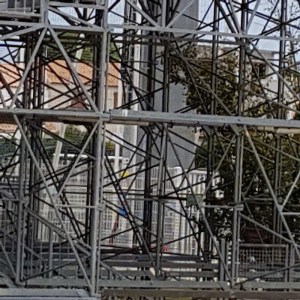
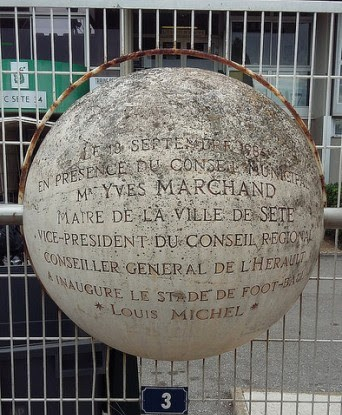
The Stade Louis  Michel was opened in 1990, but its pre-fabricated concrete panels somehow make it look older, but in a good way; 20170909_173348.jpgthe brutal angular concrete of the main stand, the Tribune Presidentielle, could be from the 1960’s or 1970’s, channeling the inspiration perhaps of Auguste Perret or even Le Corbusier. The concrete panels on the back of the stand are lightly decorated and sit above wide windows; a pair of curving staircases run up to the first floor around the main entrance, 20170909_175009.jpgabove which is a fret-cut dolphin, the symbol of the town and the club. The stand runs perhaps half the length of the pitch either side of the halfway line and holds about twelve hundred spectators, as well as club offices and changing rooms. Opposite the main stand a large bank of open, 20170909_173643.jpg‘temporary’ seating runs the length of the pitch, it is built up on an intricate lattice IMG_20170909_223051_287.jpgof steel supports. Behind both goals are well tended grass banks; there is a scoreboard at the end that backs onto the carpark.
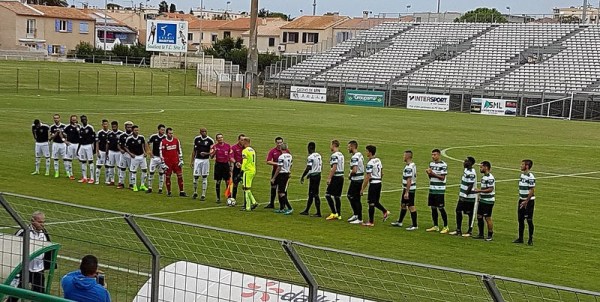
There is now not long to wait until kick-off and the teams line up; 20170909_175652.jpgSète in green and white hooped shirts with black shorts and socks, Stade Bordelais with black shirts with white shorts and socks. There is a ‘ceremonial’ kick-off before the real one, taken by a youmg woman with a green and white scarf draped around her shoulders.  Eventually, referree Monsieur Guillaume Janin gives the signal for the game to start in earnest.
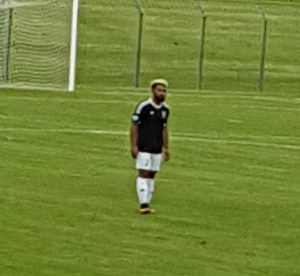
Its a grey, overcast afternoon, but not a cold one and the game quickly settles down with both teams enjoying attacking bursts in turn. The visiting team perhaps look slightly more accomplished, a bit more knowing, particularly at the back where their number four is the only player to have a tattooed forearm. He has long, lank hair and a beard and looks like he might have ridden into town on a Harley-Davidson rather than travelled over from Bordeaux with the rest of the team. The Bordelais number two is a 20170913_130330.jpgman mountain with a wide shock of bleached hair on the top of his head, and thighs the size of other men’s waists.

There’s not much of a crowd here today, three or four hundred perhaps and I count just eleven people on each of the grassy banks behind the goals and about the same number looking lost amongst the expanse of empty seats opposite. A few spectators stand and peer through the metal fence below the main stand, but most are up in the plastic, backless seats where we sit in the company of greyhaired men, idle players, club volunteers, wags and their children. A man in front of us wearing double denim reminds me of a petit Yosser Hughes, not that Yosser Hughes ever wore double denim.

The first real scoring opportunity falls to Stade Bordelais after seventeen minutes as a ball over the top of the Sète defence puts their number nine through on goal with just the goalkeeper between him and glory.  But he must have been dazzled by the dayglo yellow kit of the bald and bearded goalkeeper, who makes a startling, even dazzling save from close range.

It’s only a quarter past six, but the floodlights are coming on; every now and then there is a metallic rattle and rush behind us as a passenger or freight train speeds by on the track between Montpellier and Perpignan, which is just the other side of the road behind the Tribune Presidentialle. Sète win their first corner of the match and I am surprised to hear rythmic clapping rise from the ‘posh’ seats at the centre of the stand, but Sete has no Ultras so someone has to get behind the team; it’s a lesson that would be well learned by many club owners and officials in England.

It’s now half-past six and a ball forward is headed down to the feet of the Bordelais number ten; he feints one way and then the other to shake off the defender and shoots past the luminous Sète goalkeeper to give the away team the lead. Before the game resumes the Stade Bordelais goalkeeper is given timeout by the referree to throw a ball back to a bunch of children who have been playing their own game on the grassy slope behind his goal.

It’s six-thirty seven by the scoreboard clock and Sète win another corner to elicit more rythmic clapping from the centre of the stand; sadly it doesn’t produce an equalising goal only spiky, bitter shouts of disappointment. In the final minute of the half Séte’ s number five is booked for a trip, which leads to a Stade Bordelais free-kick within striking distance of the goal, but the opportunity is spurned.

I can’t deny I’ve been looking forward to half-time as I nimbly nip down the stairs to the buvette, 20170909_173408.jpgFC Sete.jpgwhich is close by at the corner of the stand where we are sat. The reason for my eagerness is that Sète is the home of the tielle, a small, spicy, calamari and tomato pie, with a bread like case. I love a tielle, and I love that they are specific to Sete, and are served at the football ground as a half-time snack. I only wish there were English clubs that served local delicacies. Middlesbrough has its parmo, but I can’t think of any others. Do Southend United serve jellied eels or plates of winkles? Do West Ham United serve pie and mash? Do Newcastle United serve stotties? Did the McDonald’s in Anfield’s Kop serve lobscouse in a bun? I need to know. Sadly, I don’t think my town Ipswich even has a local dish. Many English clubs don’t even serve a local beer; Greene King doesn’t count because it is a national chain with all the blandness that entails.
Having eaten my tielle (€3) with relish, by which I don’t mean some sort of pickle, but rather enthusiasm, I wash it down with a small beer (€2) and I treat my wife to a bottle of cold water (€1).

Reflecting my sense of tielle induced well-being, sunshine floods the stadium some time after the start of the second half. I look out across the pitch to the backdrop of the tree covered rocky outcrop that is Mont St Clair and all is right with the world, except that Sete are still losing; they substitute their number ten for number fifteen, but their opponents counter ny swapping thier number eleven for a thirteen.

Sète don’t look particularly like scoring, despite the change in personnel, and Stade Bordelais almost double their woe as a corner kick is headed firmly but deftly against the far post from an unlikely distance by a player whose shirt number I didn’t quite catch. The Stade Bordelais number nine is very quick and slaloms between two or three Sète players before being outnumbered. Sète’s eight becomes a fourteen. There are twenty minutes left and a free-kick to Sète is saved at full stretch by the Stade Bordelais goalkeeper. Sète’s eleven is replaced by their thirteen, a player and father of a little girl who calls and waves to him as he warms up in front of the stand, and he waves back. But undaunted by familial pleasantness Stade Bordelais replace their number seven by number fourteen. Stade Bordelais’ number nine breaks free down the left; he gets behind the Sète defence and delivers a low cross which is perfectly placed to meet the incoming run of the number ten who, from a position near the penalty spot, embarrasses himself with a shot which misses the goal in two directions. Two minutes later ten’s failure is compounded as his time under the unforgiving glare of the floodlights is terminated and he is replaced by twelve. There are still ten minutes left, but the final act of any note sees Sète’s number nine head the ball past the post from a corner. Stade Bordelais’ defenders hold firm to win the game. No one is a match for their huge full-back, their very own, very mobile rocky outcrop.

It’s not been the best game I’ve ever seen, but it’s been an oddly calm, measured one. Was anyone booked? I don’t recall. Stade Bordelais have won with greater guile and knowledge and strength, but Sète will always have their tielle, although they’ve run out of them in the buvette today.

20170909_173156.jpg