Holland 2  Dussindale & Hellesdon Rovers 1

Holland-On-Sea, Wikipedia tells us, is a suburb of Clacton-On-Sea and was known as Little Holland until the early twentieth century; it also has a football club called Holland FC.  What Wikipedia doesn’t tell us however is that Holland is just a 30 minute, thirty-eight-and-a-half-kilometre drive from my house, although Google maps does.  Stanway Rovers, Halstead Town, Coggeshall Town, Cornard United, Wivenhoe Town and Hadleigh United football clubs are all playing at home today and are probably all closer to home, but none of them are “On-Sea” and I’ve been to all of their home grounds in the last twelve years, which isn’t true of Holland FC’s Dulwich Road, where I am given to understand that the pitch, as if by some freakish movement of tectonic plates, has moved through ninety degrees in that time, throwing up a metal fence all around itself and a smart new clubhouse.  Therefore, with the promise of sea air and the prospect of a geologically formed football ground, it is on a warm but cloudy Saturday afternoon in early September that I set off in my planet saving Citroen eC4 for Holland-On-Sea.  I had contemplated catching the train to Clacton and making the half hour walk to Dulwich Road, but with only one train an hour I wouldn’t have got home until seven o’clock, and I have a wife whose heart I risk breaking if I stay out too long.

It’s an uneventful journey down the A133 and I arrive in relaxed mood in the Holland FC car park, where I have a wide choice of parking spaces; I draw up next to a modest silver-coloured family saloon, which had turned into the pebbly, beach-like car park shortly before my I and my Citroen did.  It’s not half past two yet , so I decide to take a look at the sea before entering the ground; the cliff top and sandy beach below are only 200 metres away across the grassy expanse of the Eastcliff Recreation Ground and Marine Parade.  From the cliff top, Clacton Pier is visible through the haze at the end of the beach, and out to sea sit the ranks of wind turbines that I like to think made the electricity that powered my car and brought me here.  A West Indian man of pensionable age and riding a low-slung tricycle asks me if I’m local and if I know where the Kings Cliff Hotel is.  I tell him I’m not and I don’t know where the hotel is, but I do know he is heading towards Kings Parade.  I think to myself that the ‘King’ in King’s Parade fame was probably either King Edward the Seventh or some egotistical Tendring District councillor with the surname King.

I walk back inland to the football ground up Lyndhurst Road, a typically suburban, tree-lined street of inter-war bungalows, all of which are almost frighteningly neat and well maintained. Just past a public toilet is a hedge which is teeming with bees and butterflies, mostly Red Admirals.  I am not sure I’ve ever seen so many butterflies in one place, but start to worry that wealthy local MP Nigel Farage might be having them specially bred so that he can pull their wings off or place them in his reptile-like mouth before washing them down with a pint of beer.  But then again, I don’t suppose he ever comes here; he probably gets his butterflies in Florida.

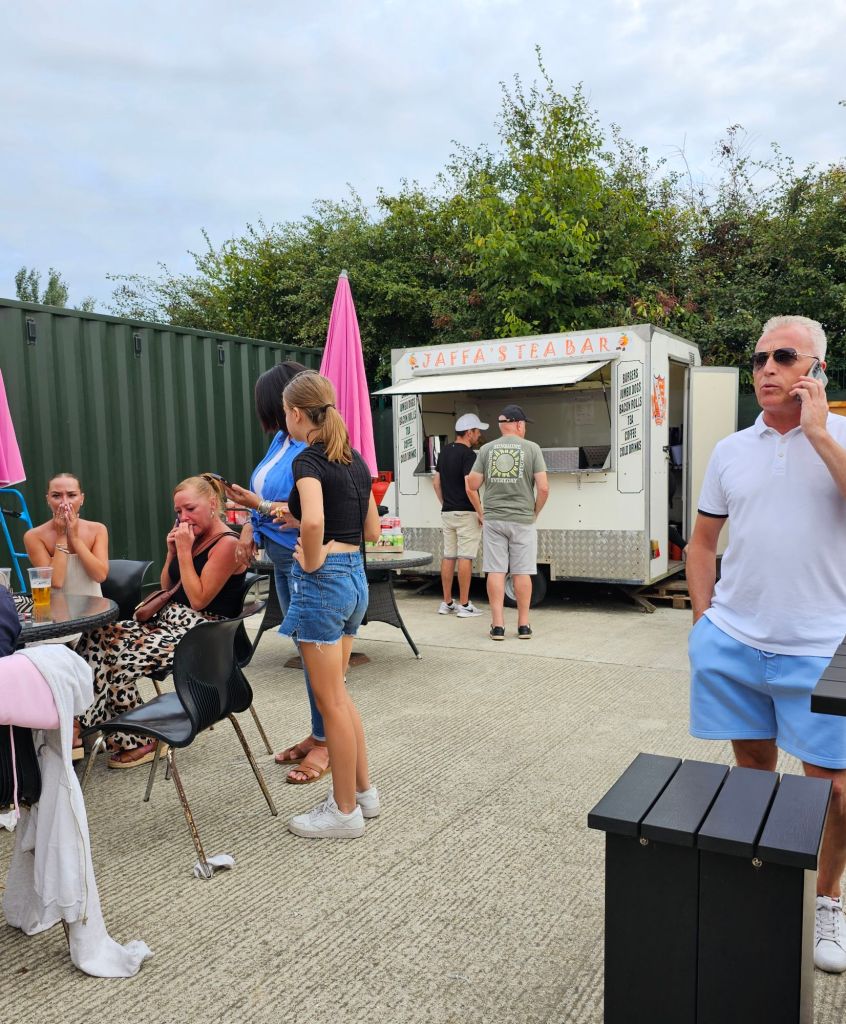
Back at the football ground, the friendly, cheery but visibly overweight man at the gate tells me that the concessionary entry fee of £5.00 applies to over sixties; I tender a twenty-pound note and receive fifteen pounds change.  After I ask if there is a programme today, I am told that the club does produce a match programme, but hasn’t done so today, which to me seems a bit lazy of them.  With the two pounds I saved at the gate by being old, I buy £1.50’s worth of tea from Jaffa’s Tea Bar.  I don’t know who Jaffa is, but his or her (it was a woman who served me) tea is pretty good, even if it is just a tea bag in a paper cup with some added water and milk.    I suspect however that the name of the tea bar is derived from the club nickname, “The Jaffas” and so the apostrophe is in the wrong place, this is Essex after all.  I wander inside the clubhouse which, although bright and new and with a display of trophies on one wall, seems a little soulless due to its grey floor, plain walls and vaulted ceiling; the only pumps on the bar are for Stella Artois, San Miguel and Carlsberg. I am pleased I bought tea and enjoy the irony that in Farage’s constituency all the ‘beers’ are, nominally at least, foreign brands.  Most of the drinkers are sat outside at an array of tables and look like they are settled in for the afternoon. 

“Are you sat here for the music?” I ask two old boys sat on stackable chairs in a covered area outside the home dressing room,  through the window of which can be heard the typical, pumped-up, high volume musical selection of the millennial footballer.  “Is that what it is?” Says one of the old boys.  I wonder to myself if Stanley Matthews, Len Shackleton and Tommy Lawton would get themselves ready for kick-off by cranking up the volume on the latest 78’s from Glenn Miller,  Al Bowlly and Bing Crosby.  With the music turned off we can hear the team talk. “It’s a long journey from Norwich or wherever they come from” says the coach encouragingly to the Holland players.

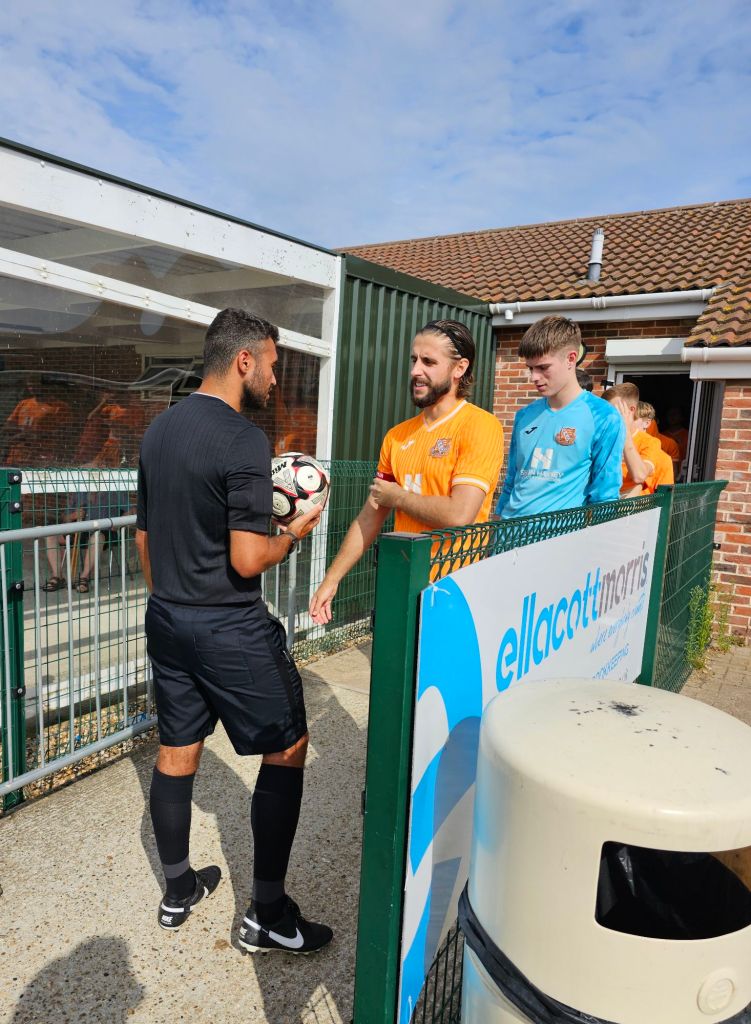
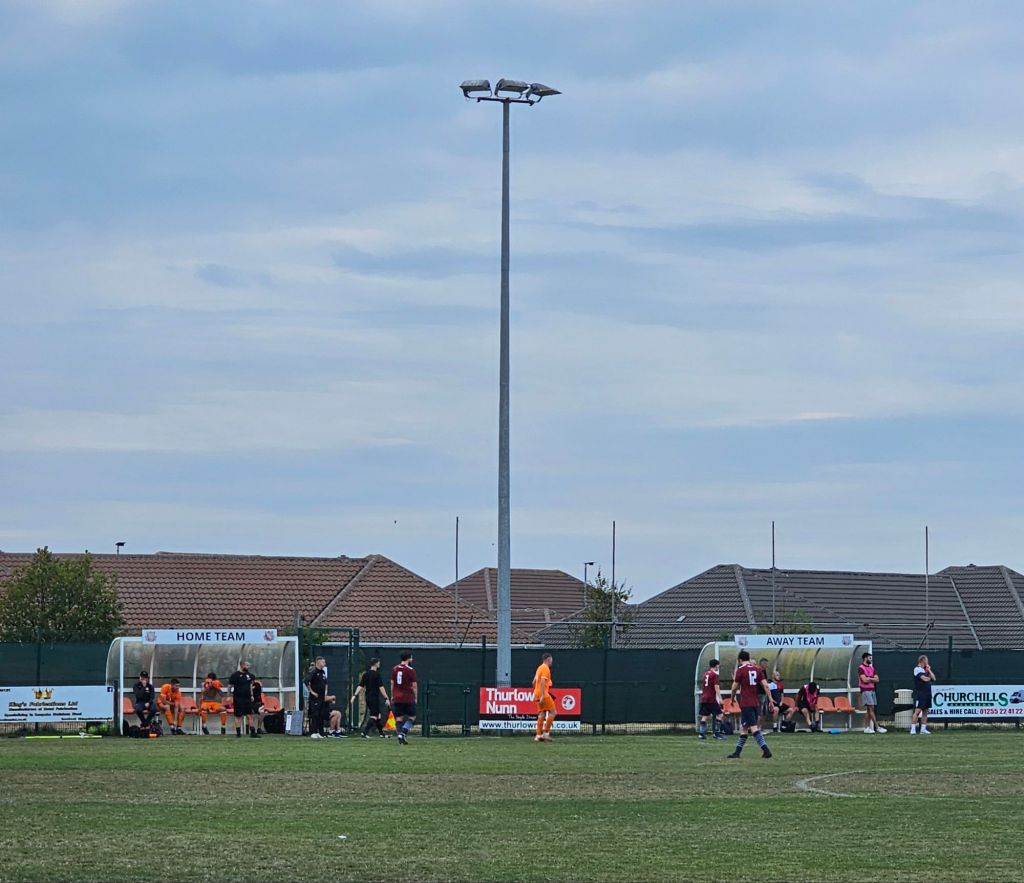
It’s not long before the teams are lining up to parade onto the pitch with the players of today’s opponents Dussindale and Hellesdon Rovers, looking suitably jet lagged.  Dussindale and Hellesdon are two suburban areas on opposite sides of Norwich, but their clubs amalgamated a few years ago and have made it into the snappily titled Thurlow Nunn Eastern Counties League First Division North and now play in Horsford, which is at least next to Hellesdon and close to Norwich airport, which is handy for away games.   After all the usual handshaking and hand-gripping malarkey, it is Dussindale and Hellesdon who kick-off towards the sea in burgundy shirts and navy-blue shorts. It’s a tasteful, if slightly dull kit and doesn’t compare with Holland’s vivid all orange ensemble.  Wikipedia tells us that the nickname of Holland FC is The Tangerines, no doubt due to the colour of their kit, but Holland’s own website refers to them as The Jaffas, although it doesn’t appear to have been updated since last May.  I wonder if there has perhaps been a referendum during the close season on what type of orange best represents the club, with members choosing to reject Satsumas, Mandarins, Clementines, Navels, Cara Caras and Easy peelers.   

The early exchanges on the pitch are typically noisy with the ball frequently flying high into the afternoon sky as an optimistic through pass for someone to chase is booted away.  “Go wide, hit the channel, good chap” bawls the Rovers’ goalkeeper revealing a hint of a Norwich accent as the ball sails in to touch.  Holland have the classic two big blokes at the back, numbers 5 and 12.  Number 12 has the sort of build which, if this were a professional game, would no doubt leave him open to chants from opposing supporters of “You fat bastard”, but he is a ‘rock’ at the back for Holland. 

I walk round the pitch to stand between the team dugouts. Holland win two early corners.  More Norfolk accents are detected on the away team bench.  Holland seem to lack club volunteers, with there being no programme today and no team sheet posted on a wall anywhere either.  The on-pitch commentary from the players however reveals that the Rovers number three is called Eggy and the number four Martin; other players have names too.

A poor back pass lets in the Holland number eleven,  who crosses in a low ball which a Rovers centre-back clears over the cross bar for corner.  It’s the first real opportunity, even if it was entirely manufactured by one team for the other.  The game is full of endeavour, but no one is capable of providing a pass that will lead to a goal. It’s a game of just shouts at the moment.  “Get out”, “First and second ball”, “What we talked about”, “Jump early”, “Ref that was blatant”, the usual anxious nonsense that the players hear every week and must get sick of.  On the Rovers’ bench the coaches are simply willing their team to do better; “Get the ball” urges one, going back to basics.  Then Rovers break down the right; number eleven scampering into the penalty area and crossing the ball low to where somebody should be to tap it in but isn’t.

“That’s the first chance of the game, and it’s to us” says a Rovers coach moments before the Holland number nine heads the ball against the Rovers cross bar from what looked like inside the six-yard box.  Fortunately, he can’t hear the cursing on the Holland bench.  It was the sort of incident that explains why the Rovers number five displays a constantly slightly worried look on his face, in contrast however to the number four playing in front of him, who is calmness personified and always has unhurried time on the ball. “Go on Matt, Dylan” shouts another coach, and I think of a parallel world where a film director working with Jack Nicholson and Charlton Heston might say “Go On, Jack, Charlton.”

 “It’s a great run again” says a Holland coach sounding like a radio commentator as Holland move forward again down the right.   The pattern of the first half has now been established and Holland are the dominant team, but with Rovers are a constant threat on the break. In midfield for Holland, number eight has a beard, and hair swept back with an alice band; it makes him look a bit like a bargain basement Alessandro Pirlo, which would explain why he is captain.  “Keep on side” shouts someone as Rovers’ number eleven breaks forward again, but he’s too late, the linesman’s flag is raised, if only that advice had been shouted sooner.

Unusually, in the final twenty minutes of the first half there are three substitutions, with Holland’s number three, who has been looking physically uncomfortable, being usurped by number seventeen, who is soon having a shot on goal well saved.  For Rovers, numbers seven and eight leave the pitch to be replaced with numbers fourteen and fifteen, like the start of a mathematical puzzle.  Just as unusual is the smell of deep-frying fish and chips that is wafting around when at half past three in the afternoon people should surely be having no more than an afternoon cup of tea and a biscuit.

The thought of tea sends me further round the pitch, back towards Jaffa’s tea bar and when I pass behind the linesmen he warns “Nothing silly” as opposing players chase another hopeful punt forward for Rovers.  The ball is soon returned to the other end of the pitch however, where Holland’s number nine shoots weakly at the goalkeeper as he redirects a square pass.  But the disappointment is short-lived as number ten finds himself in much the same position, but crucially manages to shoot past the goalkeeper and high into the net to give Holland a more or less deserved lead.

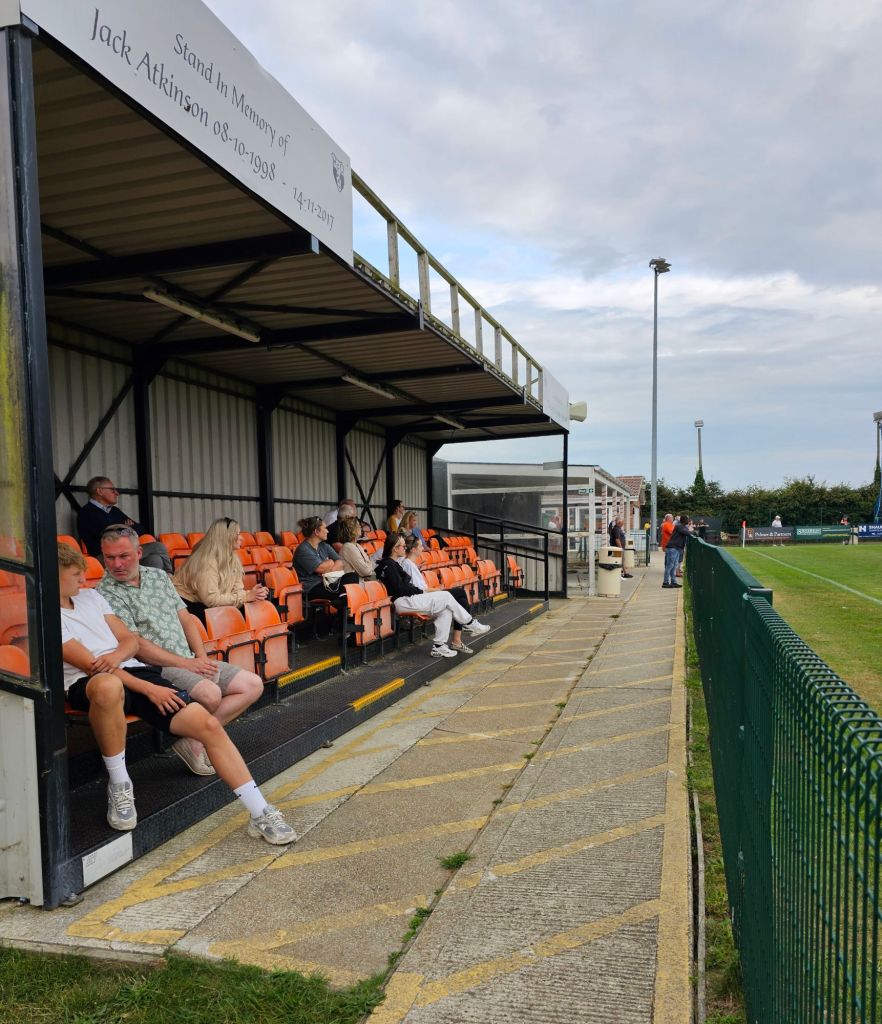
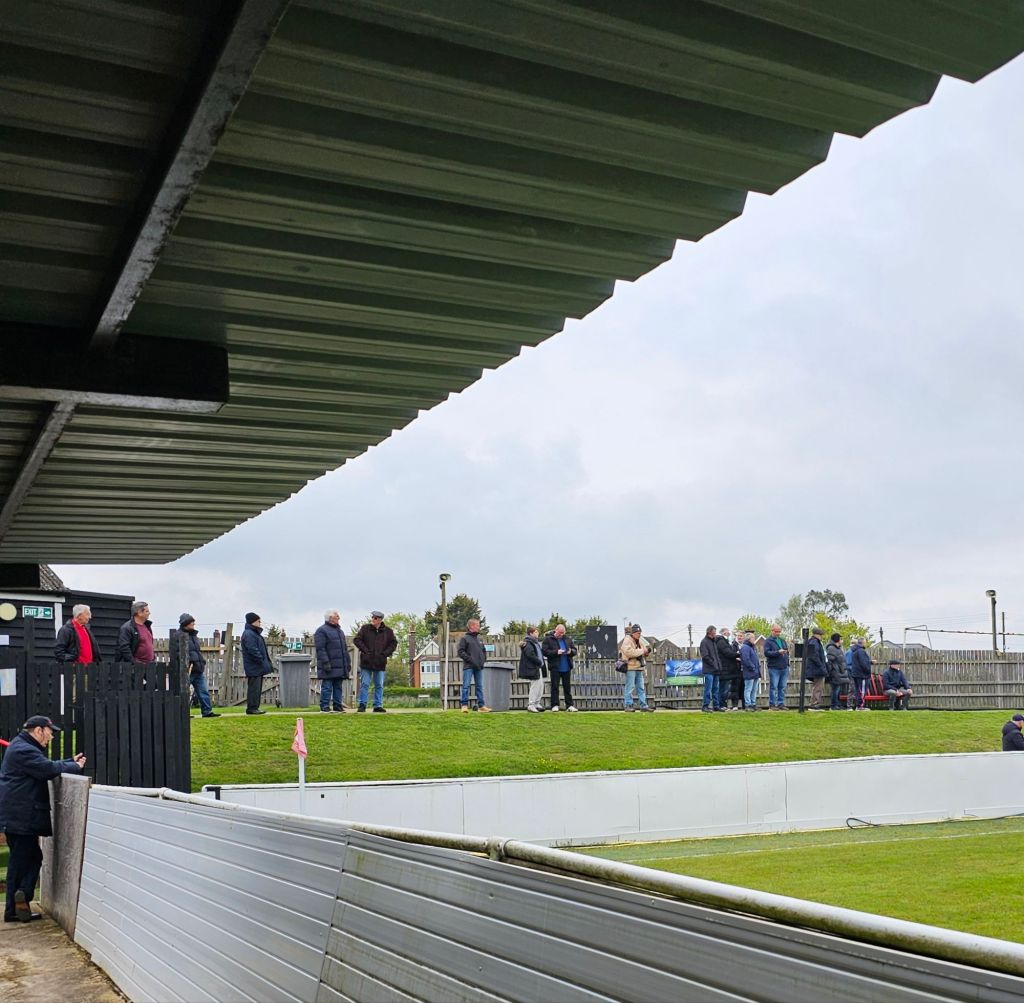
 Half-time arrives soon afterwards and teas and beers taste better than they would have if Holland had not scored, although I don’t think everyone sat drinking outside the bar noticed the goal or any of the first-half come to that.  For the second-half I decide to take up a seat in the main and only stand, selecting a spot in the middle of the second row where I can easily see most of the pitch above the metal mesh fence.   From here I can also see the sea of hipped bungalow roofs with ugly concrete tiles and the white UPVC conservatories that squat beyond the surrounding boundary fence and off into the distance.  A seagull stands and squawks from on top of a ridge tile.

The football resumes at two minutes past three and Rovers are soon seeing more of the ball than previously; they’re not playing so deep into their own half, but like Holland before the half-time break, they’re not creating many chances to score.  Suddenly, out of the blue, it all gets a bit too much for Rovers’ number nine who bawls in frustration “Fuckin’ell, fuckin’ play!”.  Moments later, as if to say “Alright, alright, keep your hair on”, his team-mates fashion a corner kick and then number fourteen becomes the first player to be booked as he fouls Holland’s number eleven.   In contrast to the increased excitement on the pitch the afternoon now feels quite still; the sky has clouded over and it’s cooler than it was. 

Despite both number nine and ten having decent shots on goal for Rovers, Holland are holding on fairly comfortably, but it must nevertheless come as a relief to them when around half past four  Rovers’ number five swings a foot to clear the ball and misses it, letting Holland’s number eight take it to the edge of the box, check inside and send a gently curling shot beyond the goalkeeper and inside the far post. Holland lead 2-0.

It’s the sort of a goal that commentators tell us will ‘wrap the game up’ and ‘put it to bed’; it’s just what Holland have been waiting for.  Two minutes later and it hasn’t, as Rover’s number ten has a shot parried by the Holland goalkeeper and number nine sweeps the rebound into the goal.  The score is 2-1 and anxiety takes hold.  It’s been a game of very few fouls, but someone cries “Late every time” when there is an accidental collision of boot and ankle, and I begin to wonder if all referees shouldn’t also be primary school teachers.

It is seven minutes to five when the game ends, and before returning to my trusty planet saving Citroen for the drive home, I pause to applaud and reflect on what has been a very good game. As I say to one of the old boys as he gathers up his sticks to toddle off home, we’ve had a decent five pounds worth of entertainment.   But shuddering slightly, I nevertheless can’t help wondering how all these people voted at the last general election.

Coggeshall Town 0 Great Wakering Rovers 3

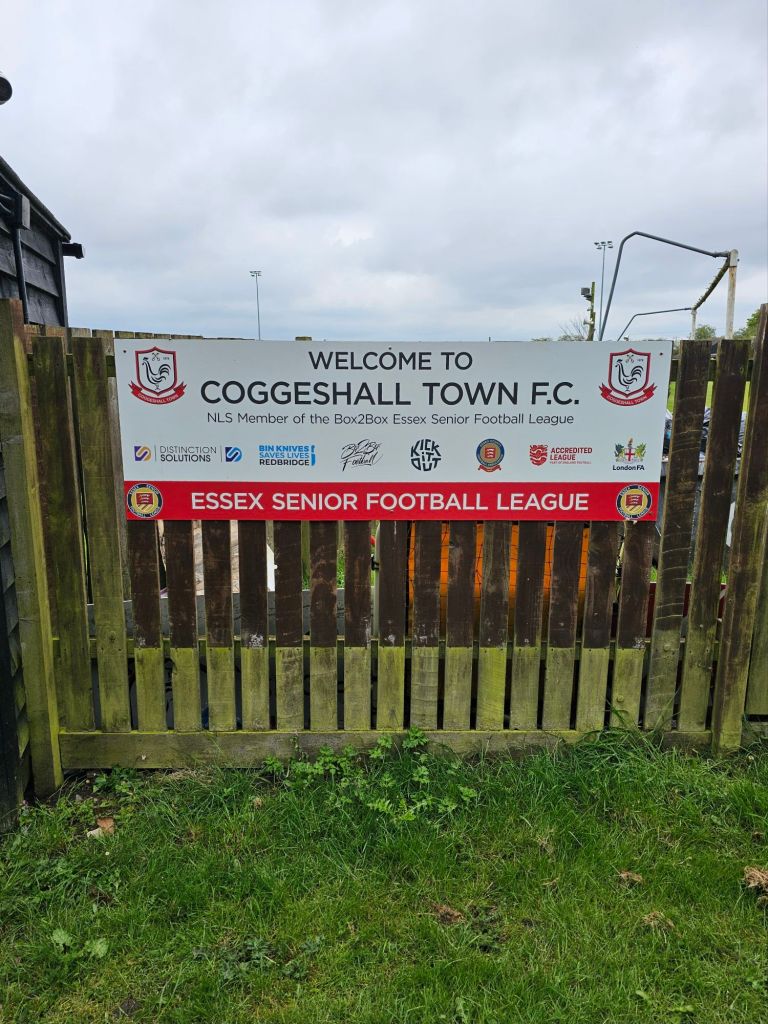
The 22nd April 2019 was the last time I visited ‘The Crops’, or ‘West Street’ as it is now more prosaically known, to watch Coggeshall Town play. ‘Coggy’ were then enjoying the end of a successful first season in the Isthmian League after successive promotions from the Eastern Counties Leagues. The pages of this very blog recorded that the day was unseasonably warm, and on the day before “…the mercury hit 23 degrees in my back garden”, with the prospect of it getting even warmer.  Five years on, almost to the day, and it’s grey, wet, and cold and Coggeshall Town languish at the foot of the Essex Senior League, about to experience a second successive relegation, creating an unwelcome symmetry with their earlier promotions.  Weirdly, this reminds me of a Rorschach test, when it should be the other way round.

Since I first watched Coggeshall Town in late 2016, I have been meaning to travel to a game there by bus, because it seems like the responsible thing to do.  Today, with the prospect of raindrops on misted up bus windows, it is the perfect opportunity to make that tick on my non-existent bucket list.  To add to the attraction, this will be the first time I have ever seen a match in the Essex Senior League and today’s opponents are Great Wakering Rovers who, in a fortnight’s time, will contest the final of the FA Vase against Romford at Wembley.   So, I will get to see a cup final team without having the expense and bother of getting to London.  A man needs to know his limitations.

  There is a bus stop just round the corner from my house and whilst the laminated timetable hanging limply from the bus stop pole only tells me what times the buses are from Monday to Friday, the wonder of the interweb has filled in the gaps for me and at 14:18 I hail the pale grey double-decker, which is almost a minute early if the timetable and my phone are to be believed. The fare, which I pay by tapping my bank card in the modern way, is £2.00 for the 8-kilometre journey along the A120 between pale green fields of cereal and bright yellow ones of oil seed rape.   As I pay my bus fare and tear off my bus ticket, which is almost a foot long, I muse that the bus driver looks a bit like Danny Cowley, the Colchester United manager.  But Col’ U are at home to Crewe Alexandra today, so they’d miss him if he was moonlighting on the buses.  The journey takes barely ten minutes and as I alight, I make a point of getting a better look at the driver as I turn to thank him; it’s not Danny Cowley after all.  As the bus pulls away, I note that it has fleet number 33713, which seems a very big number when there are so few buses in rural Essex.

It’s a short walk from the “Nursery” bus stop on West Street to the home of Coggeshall Town, although the footpath runs out part way along and I have to cross the road and then cross back again opposite the entrance.  Luckily for me, I’m one of the Tufty generation.  Nothing much seems to have changed since my last visit here in 2019, although it’s a different bloke on the turnstile and the programme is sadly no longer one you can hold in your hand or stuff in your pocket, being out there somewhere in the ether of ‘on-line’. Entry is by cash only; eight quid.
Once through the turnstile I make my way along the concrete path to the clubhouse, with every intention of buying a glass of beer, taking advantage of the freedom given to me by my ticket to ride on public transport.  But disappointingly, it turns out that the only ‘beer’ available are bottles of something called Peroni, a brand name which always makes me think of infections of the stomach lining.  As I advise the barman that “I won’t bother”, another club volunteer places three printed team sheets on the bar and says that’s all there is as they’ve run out of paper and the printer needs a new cartridge.  I leave the team sheets for the regulars to fight over, and head outside to the tea bar to invest in £1.50 worth of tea to sip and warm my hands on as I await kick-off. There are tea bags a-plenty, and milk and little plastic spoons.

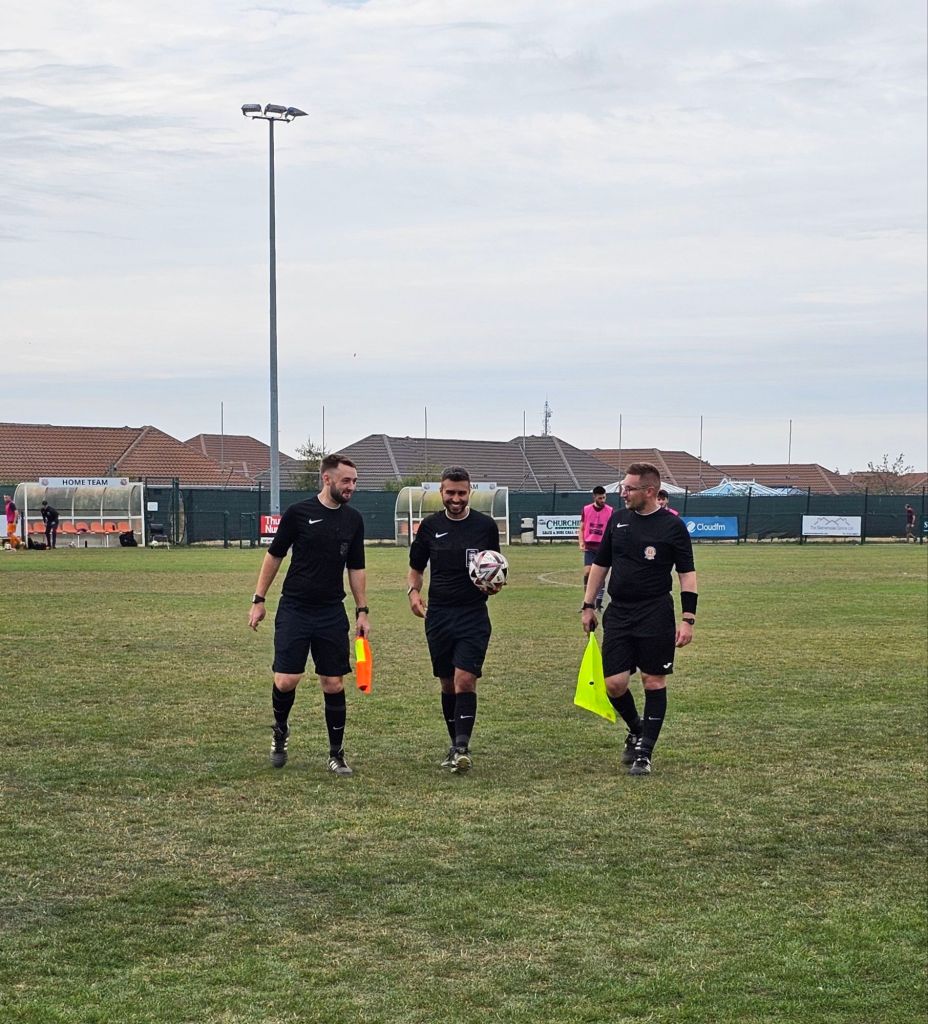
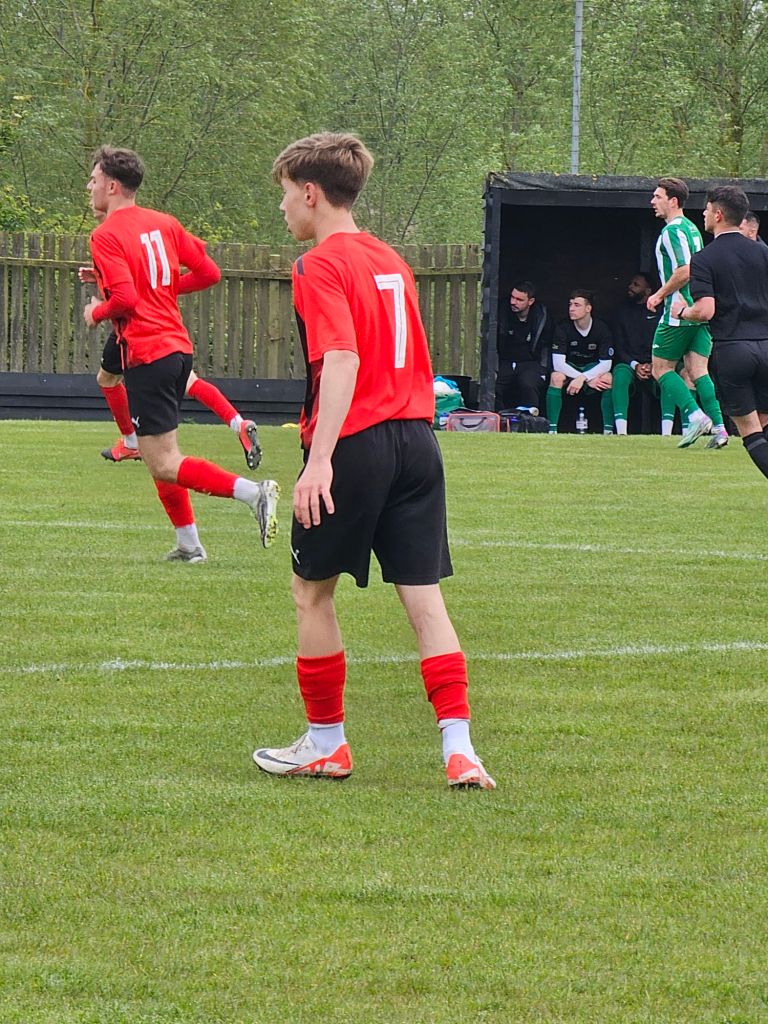
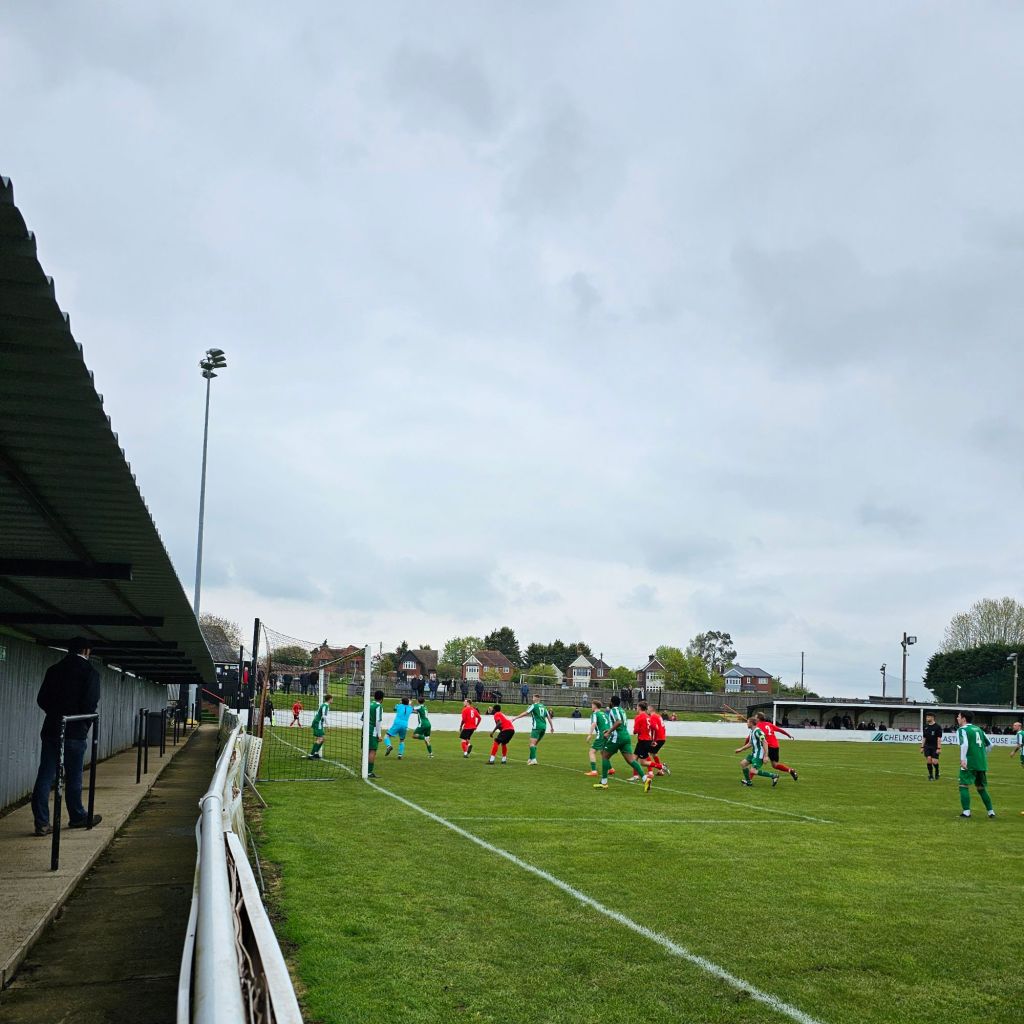
It’s not long before the teams are on the pitch and it’s Great Wakering Rovers who get first go with the ball , hoping to put it in the goal at the clubhouse and Braintree end of the ground.  The Rovers wear green and white striped shirts with green shorts, whilst Coggeshall sport red and black striped shirts with black shorts; two fine kits seen from the front, but spoilt by being solid green and solid red from the back;  although this does make it easier to read the players numbers, it isn’t as important when, refreshingly,  they only number one to eleven and not one to infinity.   I stand briefly above the grass bank on the north side of the pitch before going down into the low seated stand where talk seems to be more of cricket rather than football.  “Reggie!” shouts the Coggeshall goalkeeper randomly and my attention is drawn further to him because his yellow kit is almost luminous on this grey afternoon and he appears to be wearing huge black gauntlets, a bit like the sort a plumber might wear if sticking his hand down a toilet  “Good to see Callum start” says someone in the crowd off to my right.

Behind the Coggeshall goal, a collection of what I can only hope are Great Wakering’s most fanatical supporters are dressed as Superman, a man on a very small inflatable horse, a bottle, ‘Del Boy’ and a girl, and although the girl costume isn’t up to much, I am pretty confident that the girl really is one.  They have a drum and chant Ole, Ole Ole, and then Alley, Alley, Alley-O.  The Coggeshall goalkeeper bawls “Red, red, red, red!”  madly, like someone insane but in possession of some knowledge of public transport who has been asked what colour London buses are.   It’s five past three and a Great Wakering shot hits the Coggeshall cross bar.  Three minutes later, and suddenly the Great Wakering number ten, Ben Search, a player who had previously been notable for whinging, shoving and annoying Coggeshall players is through on goal and scores.

Given Coggeshall’s situation at the foot of the league table, it’s the sort of start I had expected them to make, but their play when not trying to score a goal is neat enough.    Unfortunately, almost every attempt to get the ball into the Great Wakering penalty area is overhit or intercepted.  Of note however is the tidy number seven for Coggeshall, Lester Ward, who is the size of Lester Piggott, and looks so young that I expect him to be substituted before the end of the match so he can go and do his paper round. Number nine Nathan Dennis is  admirable for his distinctly unathletic build  and number four Theo Duffin looks like his socks are too small. 

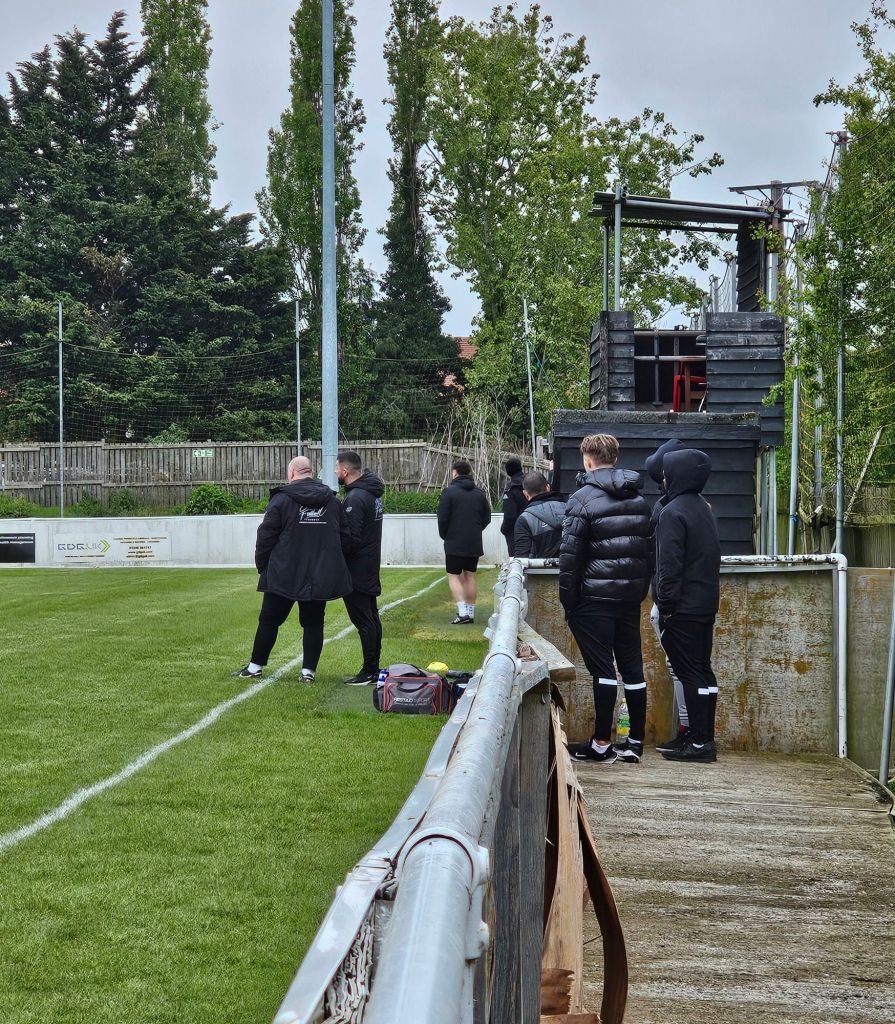
With almost twenty minutes gone Coggeshall’s number ten Reggie Gregory at last  forces a decent save from the Great Wakering goal keeper to earn a corner and then another before a run of offside decisions at the other end of the pitch provides some entertainment of a different kind.  The assorted coaches who populate the Great Wakering bench and technical area evidently know that their view from five or ten yards forward of the Coggeshall back line is the best place from which to judge offside decisions and the linesman on the far side would be better off sat with them.  “Get back in your dugout” shouts a Coggeshall supporter struggling in vain for a witty put down to answer the Great Wakering crew’s protests.

As the game settles back into mediocrity I admire the view beyond the dugouts, the trees and the valley of the River Blackwater, which could have been the subject of a landscape by Monet if only he’d been a follower of the Essex Senior league.  My reverie is broken by the shouts of the Coggeshall ‘keeper. “Reggie, more, Reggie more” he calls obscurely, followed by “Work Reggie” and then “Finn, Finn, Get In”, which I like best because it rhymes.  Not to be outdone, although in truth he is, the Great Wakering ‘keeper then chips in with shouts of “Up, Up!”

As the half rolls on towards the inevitable cups of tea, the linesman receives more advice from supporters behind him before Coggeshall somehow fashion what is the easiest opportunity to score of the whole match,  and then miss it as the ball is hit over an open goal from close range.  It was “easier to score” says a bloke a few seats along from me incredulously, although the meagre evidence we have suggests that in fact it wasn’t .

Before half-time finally arrives, the Rovers supporters sing one of those electro-pop songs of the early 1980’s in which the lyrics are mostly “De, de, de-de-de, de de” followed by somebody’s name, which today sounds like Harry Palmer, but is probably Harry Talbot because he’s the only bloke called Harry in the Rovers’ team.   Talbot acknowledges this accolade by getting booked and then in a more positive way by having a shot saved to earn a corner, which is the final act of the half.

In the break I invest in yet another £1.50’s worth of tea and for a change (no pun intended) pay for it using coins of the realm, which until this afternoon had sat for many months at home on my bedside table.  The match resumes at almost exactly one minute past four and I soon notice that there are some substitutes now on the pitch, with Great Wakering having introduced a balding number sixteen, who is soon side footing a shot directly at the Coggeshall goalkeeper after a low cross.  A minute later the name of Coggeshall’s number five, Demi Nicolauo joins that of Harry Talbot in the referee’s note book and a few minutes after that another substitute, number fifteen for Great Wakering, breaks forward unopposed down the right before carefully placing his shot hopelessly wide of the far post from a good 20 metres out.

The second half is mostly being dominated by Great Wakering, but amongst some crowd members the suggestion is that it’s not always by fair means. “Ref, watch that number four for Christ’s sake –  Every time”  advises one home fan near to me.  Just before half-past four the score becomes 2-0 to Great Wakering as their Harry Talbot scores from close range and inspires Superman, the man on the inflatable horse, the girl and friends to launch into a rendition of Depeche Mode’s “I just can’t get enough”.  My hands are feeling cold now and I don the fingerless gloves that my wife knitted me the winter before last and which I keep in the pockets of my coat.

“Stay solid, Compact” is the counsel of the Great Wakering goalkeeper as his team seek to see out the final fifteen minutes of the league season, but in time Coggeshall breakaway with number nine Nathan Dennis, although unfortunately, despite a decent run he can only shoot wide, possibly because his shorts are too tight.  “We go again” calls the Coggeshall goalkeeper encouragingly before having to make a couple of decent saves to keep his teams deficit down to two goals.  At just gone twenty-five to five however, the score becomes nil-three as a low cross from Harry Talbot reaches the far side of the goal where number 14 Jack Nolde is stood all alone, and barring calamities cannot miss, he doesn’t.

The game is now won, and lost, but the visiting team’s goalkeeper is taking no chances and advises “Don’t take your foot off, don’t take your foot off” before saying the same thing again for a third time, just in case.  It’s hard to tell whether feet are taken off or whether fate just plays out that way, but Coggeshall win a corner and well into injury time substitute Arthur Massingham shoots over the cross bar.  Either way,  it’s all to no avail, and after five minutes of additional time the game ends, Great Wakering have won comfortably, and it seems that Coggeshall have ended their season in much the same way as they played the rest of it.

There is applause for both teams as Coggeshall Town leave the pitch and Great Wakering Rovers form a huddle before going to commune behind the goal with the man on the inflatable horse, Superman and the girl.  I have only been to a couple of non-league matches this season, but they are still life affirming despite occasional stupidity  on the pitch,  and as I walk back to the bus stop I hope I shall get to a few more next season, it only remains to hope that there will be beer.

Ipswich Town 2 Sunderland 1

I don’t know much about Slumberland mattresses and it’s surprisingly difficult to find much out about them on the interweb, there isn’t even anything about them on the fount of all knowledge that is Wikipedia.  What I do know however, is that Slumberland sounds a lot like Sunderland,  the town (probably now a city) at the mouth of the River Wear whose football team won the FA Cup in 1937 and 1973, lost a Milk Cup final to Norwich City in 1985 and are forever sleeping giants, having seemingly worn themselves out by winning what people now call the Premier League, six times between 1892 and 1936.  Today, Ipswich Town play slumbering Sunderland in the Second Division and I will be at Portman Road to witness this fixture for the 19th time since 1976.

When I woke up this morning and drew back the curtains on another day, my wife suggested I close them again because outside was grey and miserable. I didn’t however, but instead put my mind to how I was going to fill the additional two and a half hours before kick-off this evening, the match having been chosen for broadcast by loathsome Sky TV with a ridiculous kick-off time of 5.30pm.  If the modern football-watching equivalent of the proletariat could be bothered to draw up a Charter for the running of football, it would surely demand that all games only kick-off at 3pm on Saturdays or between 7.30 and 8pm on weekdays. Come the revolution.
I spend a morning replacing an outside light, failing to find a bulb that fits an indoor light and filling-in a hole in my garden that looks like it was dug by a rat.  Fortunately, I am pretty sure a combination of some peppermint oil and the local cats has now sent the rat packing, or to an early grave.  After a lunch of baked Coley and chips and an espresso coffee I set off for the match.  Engineering works on the railway mean that trains have been replaced by buses today, and refusing to pay a train fare to travel by bus (why are they allowed to charge the same?) I take the wheel of my planet-saving Citroen e-C4 and agree to give Gary a lift too, in order to keep his petrol-burning, carbon monoxide emitting Suzuki Swift off the road.  Our journey is a smooth one, punctuated on arrival in the outskirts of Ipswich by a stop to lend two season tickets to Aimee, an attractive mother of two whose daughter is in a girl’s football team, which has won its way through to a national competition.  The promise is that the team will get to wave to the crowd from the pitch at half-time, but Aimee now tells me that because the game is on Sky TV this may not happen, which seems like a good reason to smash-up your satellite dish, or perhaps your neighbours’, and post it back to Rupert Murdoch with no postage.
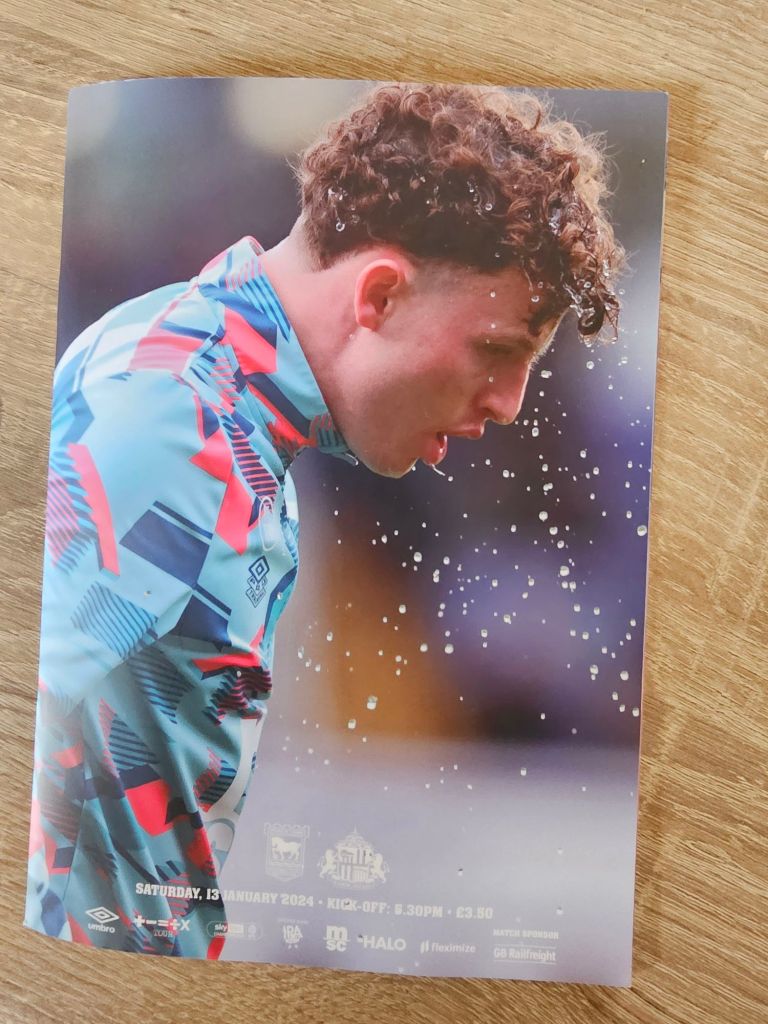
Having parked up the trusty, clean-air loving Citroen, Gary and I wander across Gippeswyk Park towards Portman Road and ‘the Arb’ beyond, pausing only for Gary to kindly buy me a programme by way of ‘payment in kind’ for his lift.  Uniquely, the front cover of the programme looks like an advert for hair shampoo featuring Nathan Broadhead. At ‘the Arb’ I order a pint of Lager 43 for Gary and a pint of Mauldon’s Suffolk Pride for myself, whilst a loud man sat at a table with other drinkers complains at length that Gary has not closed the door, although oddly, at no time does he say “Please would you close the door”. Gary has a hearing aid,  doesn’t hear the man and didn’t realise the door hadn’t shut.

In the beer garden, we join Mick who is already half-way through a pint of Suffolk Pride. We talk of the African Cup of Nations, how Gary knows someone whose nephew plays for Tanzania (and Wealdstone), and how it is a busy time of year for undertakers. Mick gives me a belated Christmas present, an Ipswich Town hat bearing the logo of TXU Energy, the club sponsors during the glorious relegation season of 2001-2002.  It’s not even two o’clock and many drinkers are already leaving for Portman Road. We collectively scoff at such behaviour and Gary boldly buys another round of drinks, the same as before, but Mick has a Jameson’s whisky. We discuss how my pint of Suffolk Pride is a bit of a short measure, but like people not prepared to stand up to the way televised football invariably inconveniences the people who actually go to football matches, we decide to let it pass this time.

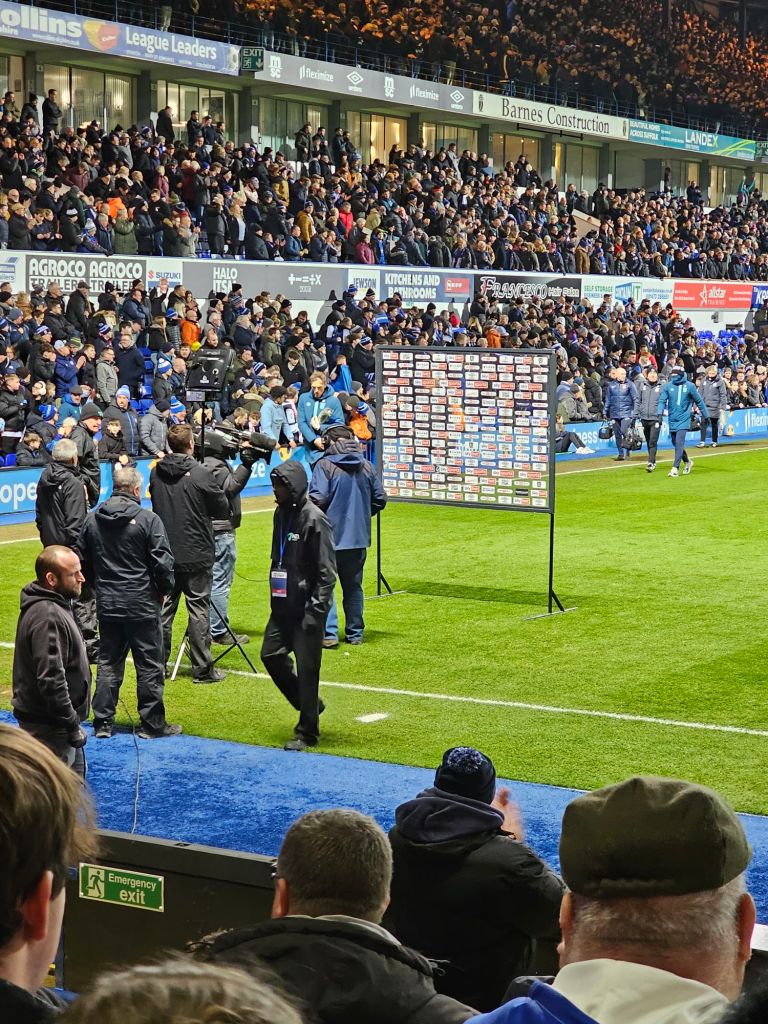
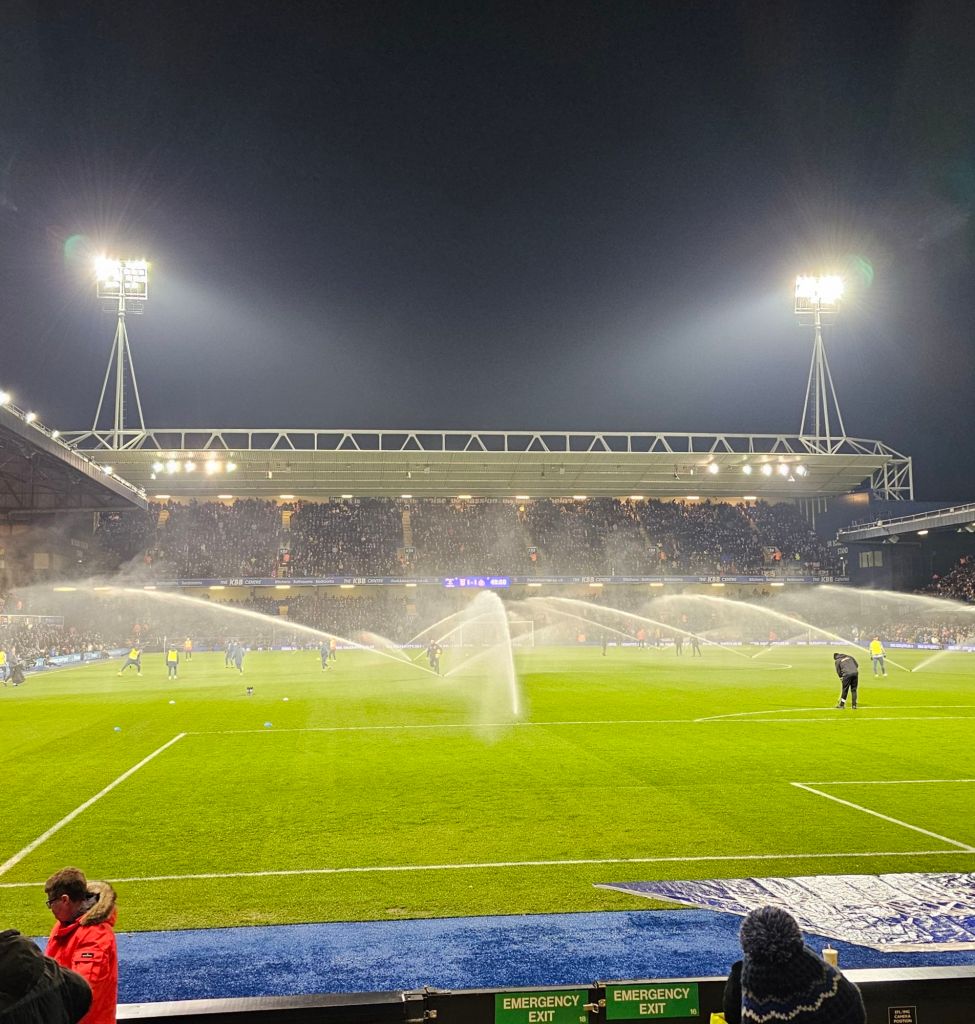
At around 5:15 we leave for Portman Road, we are the last football supporters to leave the pub and can’t stop being surprised at how the throng of people treading the well worn path is much reduced today.  Perhaps supporters have had enough having spent all afternoon in the pub, or maybe they are in the thrall of Sky TV and the leaping flames that will greet the players as they parade onto the pitch. We part ways near the statue of Sir Alf; at the back of his stand there are no queues and as I enter the meaning-laden turnstile 62 I ask the steward “Have you been waiting for me?”, I’m not sure why.

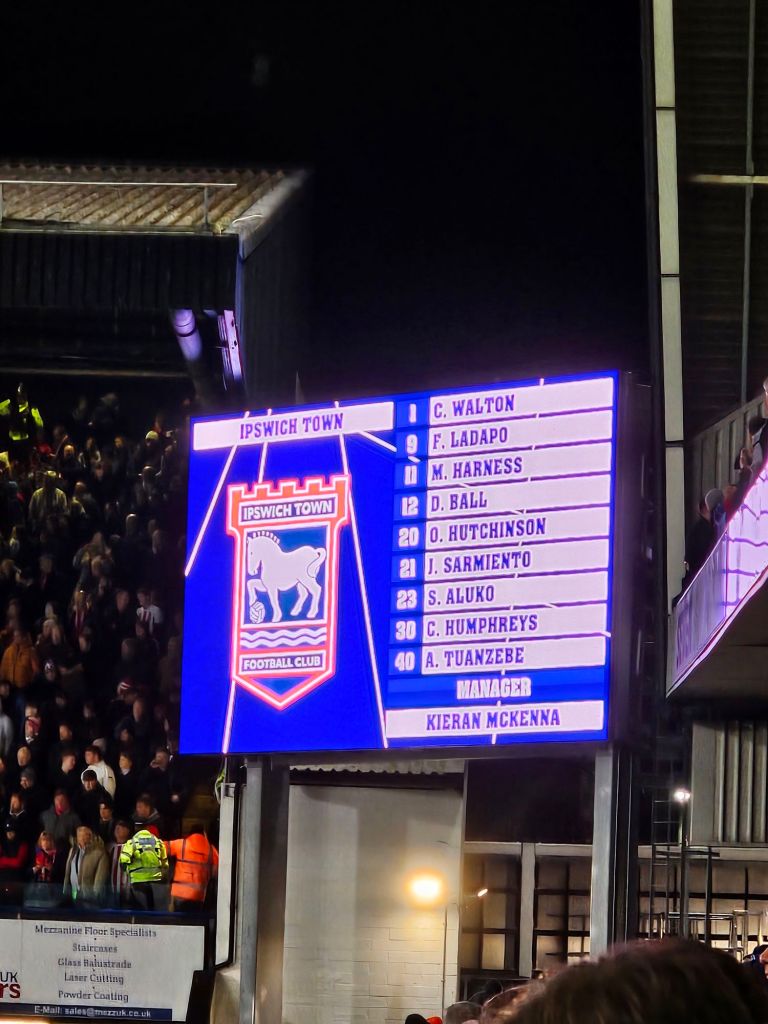
Up in the stand, Pat from Clacton, Fiona and ever-present Phil who never misses a game and his son Elwood are all here, but the man from Stowmarket (Paul) is missing; I’m surprised (again).  I have missed the leaping flames that now seem to be de rigeur before televised games, but I’m in time for Murphy the stadium announcer’s reading out of the teams.  Wondrously, his performance is much better today and he gets through the first seven or eight names pretty much in sync with the names appearing on the scoreboard, but he can’t help gabbling Conor Chaplin far too quickly and all is suddenly lost and my bawling of players names as if I’m French becomes a hopeless, pointless struggle like trying to look cool in a Norwich City shirt.

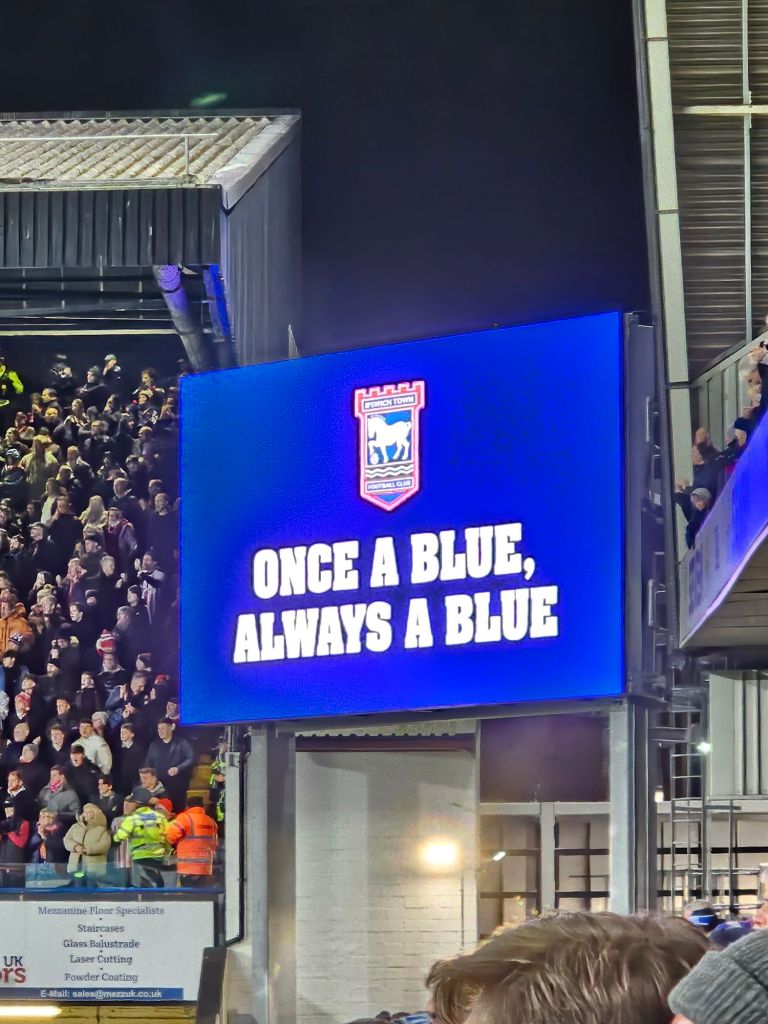
Before kick-off there is a minutes applause for all the Ipswich Town supporters and a former player who have died in the last year, because apparently this fixture is the club’s dedicated ‘Memorial Match Day’ for the season.  It’s an odd idea and I don’t like it very much; it strikes me as mawkish. Sadly, people die but life, and that includes football, is for the living. Also, if people didn’t die we would need much bigger football stadiums, but I suppose they could always watch on Sky TV.
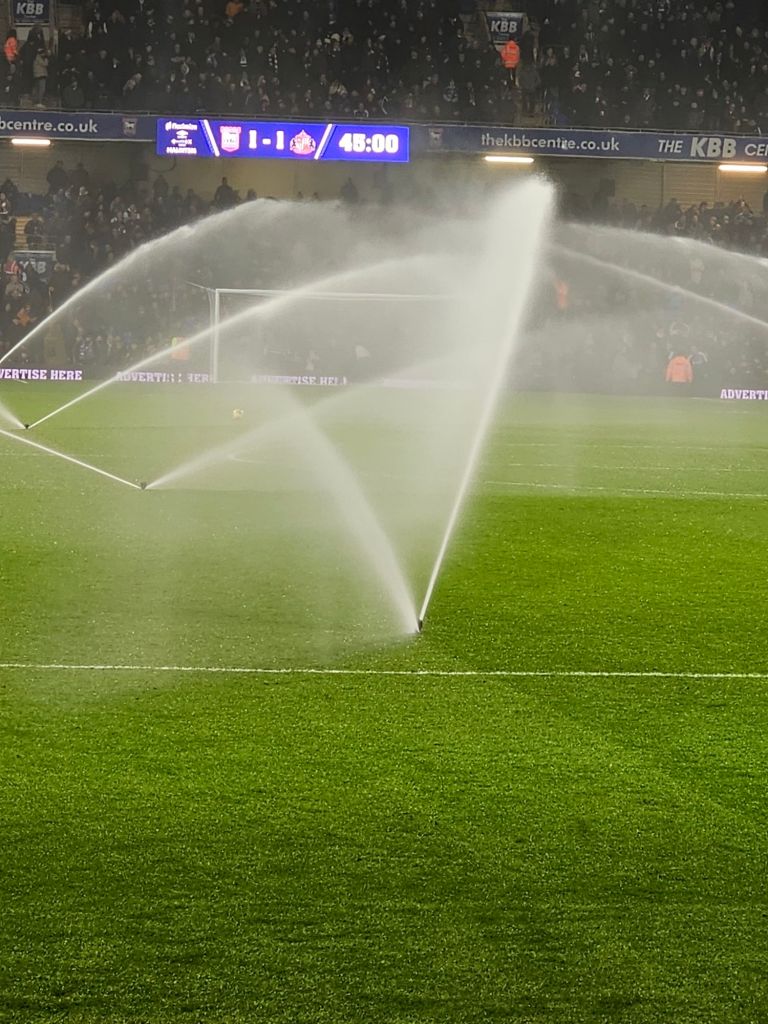
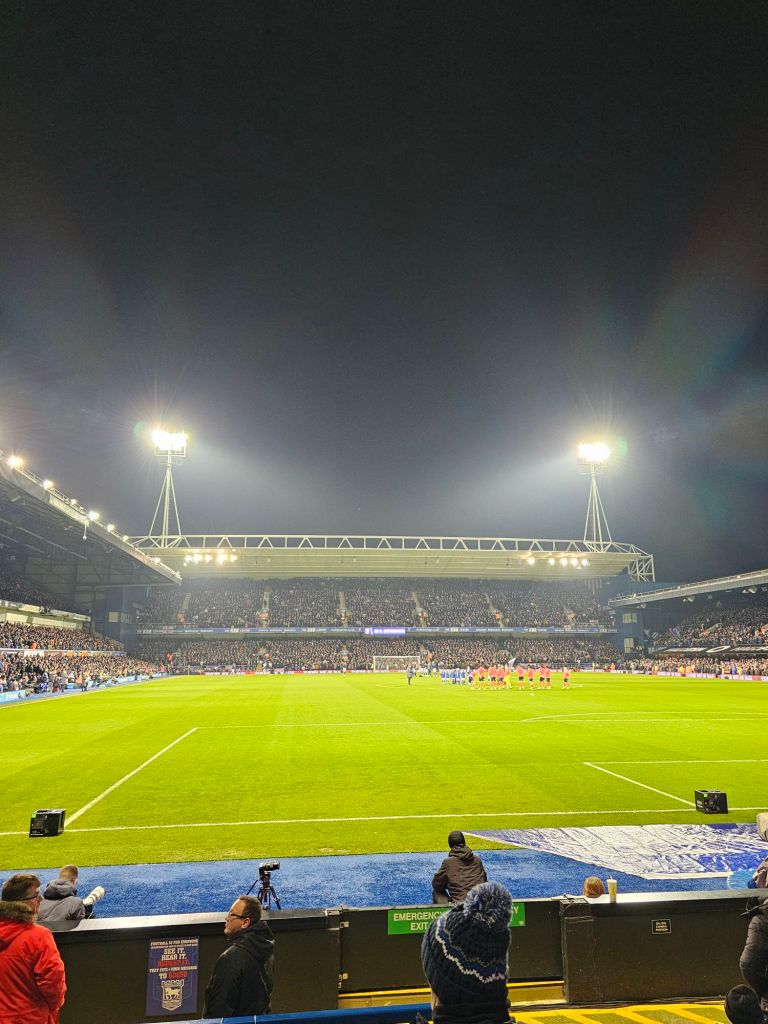
At last, after a decent burst of The Beatles’ ‘Hey Jude’,  the game begins, and Sunderland get first go with the ball, aiming it more or less in the direction of the hospice on Anglesea Road.  Pleasingly, Sunderland are sporting their handsome signature kit of red and white striped shirts with black shorts, and look like Exeter City, which I‘m hoping is a portent for another six-nil home victory; we haven’t had one for a while now.  Town are also in their natural habitat of blue shirts and white shorts.  Portman Road is full of noise today and I suspect an afternoon in the pub is something to do with it.  “Addy, Addy, Addy-O” sing the Town fans in the Sir Bobby Robson stand.  Sunderland win the games’ first free-kick to groans from the home crowd and their number 21, Alex Pritchard, who is allegedly 3cm taller than Conor Chaplin, but doesn’t look it, has the first shot on goal; it goes over the cross-bar.  I’m finding it difficult to read the black squad numbers of the Sunderland players against the red and white stripes of their shirts.  Harry Clarke loses the ball by the corner flag and some Sunderland player or other advances towards the goal unopposed. “Firkin ‘ell” I mutter to myself under my breath so that Pat from Clacton won’t hear, but fortunately the ball is soon cleared. 

Only seven minutes have passed and the Sunderland fans sing “Doo Doo Doo, football in a library”.  A low Wes Burns cross skids across the face of the  goal but Kayden Jackson cannot quite get to it to apply the merest ⁹⁸touch needed to direct it into the goal.  Eleven minutes have gone and the Sunderland fans sing “Doo doo doo, Football in a library” and then “Shall we sing, shall we sing , shall we sing a song for you”.  Nobody responds, but I am tempted to ask if they know ‘I had too much to dream last night’ by the Electric Prunes, but I’m not sure that vocally they could re-create the reverb on the electric guitars which is an essential part of the record.   The seat on my left is vacant and so is the one next to that.

Darkness encloses the ground like a shroud.  Pat from Clacton asks the bloke behind her not to swear. “Your support, your support, your support is fucking shit” sing the Sunderland fans,  perhaps because it doesn’t  contain enough swear words.  “Football in a library, doo- doo-doo” continue the Sunderlandites, clearly now attempting a world record for the number of times they can diss another club’s support in the first half of a televised match.  It’s the nineteenth minute and a succession of short passes finally play Kayden Jackson into a position where he rolls the ball past a post.  The Sunderland number five Dan Ballard falls extravagantly under a challenge from Kayden Jackson.  Ballard is an outside toilet of a man, Jackson a waif by comparison. Referee Mr Allison awards a free-kick to Sunderland. “Weed” I bawl at Ballard, “Pathetic man”. He scuffs the ball into touch, no doubt unsettled by my calling him out.   Five minutes later and Harry Clarke is the first player to see Mr Allsion’s yellow card; the match is pretty good,  but home fans agree that the refereeing isn’t.  A minute passes and Vaclav Hladky makes a fine save at the expense of a corner to Sunderland and then they score as a large gap appears to one side of the goal and Jack Clark has too much to aim at to miss.  “Clarke, Clarke will tear you apart again” Sing the Sunderland fans to the dreary, similarly titled 1980 tune by the ironically named Joy Division.

The Sunderland supporters are very loud indeed, perhaps because shipyards of old were noisy places, although I don’t suppose the Datsun car factory and call centres compare.  Harry Clarke gets forward and a low hard cross earns a corner. “Come On You Blues” I bellow to a background of abject silence from all around me.  The corner comes to nought.  A third of the match has gone forever. “Football in a library, doo-doo-doo” sing the Sunderland fans now completely at ease with the complicated lyrics. Two minutes later and more Town passing involving Conor Chaplin peaks with a through ball for Kayden Jackson, which he sweeps past the Sunderland goalkeeper into the corner of the goal net and the score is one -all.  “I didn’t even expect that” says the bloke behind me as if at other times he always knows what is about to happen. “When the Blues go marching in” sings the Sir Bobby Robson stand at a funereal pace, perhaps because it’s the Memorial Match Day.

There are five minutes until half-time and more passes culminate in a Kayden Jackson shot wide of the goal.  “Football in  a library, doo-doo-doo” sing the Sunderland fans showing signs of addiction before the ball bounces about alarmingly in the Town penalty area and Murphy announces two minutes of additional time, which pass without incident. Half-time is spent at the front of the stand with Ray his grandson Harrison and son Michael. We agree it’s been a good half, but we appear to lack the confidence of previous games and Kayden Jackson would have done better in the days of two up front and needs Trevor Whymark to play off.

The football resumes at twenty-three minutes to seven and within a minute a Leif Davis shot forces a not very elegant save from the Sunderland keeper.   Sunderland win a free-kick from which they thoughtfully shoot directly over the bar and then Town work the ball from one end to the other with a succession of short passes. “Champagne football” says the bloke behind me, although really it’s Suffolk football.  George Edmundson puts his hand on the shoulder of Sunderland’s number seventeen who collapses in a heap and Mr Allison brandishes his yellow card, before celebrating the passing of an hour by doing the same at Wes Burns.  “We forgot, we forgot, we forgot that you were here” chant the Sunderland fans, but I’ve forgotten why.

“Handball” calls the home crowd as one at the north end of the ground, making that glorious unified sound of appeal, but of course Mr Allison’s ears are closed to it.   On sixty-five minutes Sunderland make a substitution with Adil Aouchiche replacing Abdoullah Ba, I recall seeing Aouchiche playing in French Ligue 1 for both St Etienne, where I thought he was quite good, and Lorient and can’t imagine why a player would leave such lovely places for Sunderland.  Within a minute Sunderland force a defensive howler as Town’s neat passing at the back goes awry and Aouchiche is presented with an open goal which thankfully he screws wide of the goal with a shot off the outside edge of his right foot. He follows this up by being nutmegged by George Edmundson .

It’s time for Town to make mass substitutions and Wes Burns, Kayden Jackson and new loan signing Lewis Travis whose name makes me think of Malcolm McDowell in ‘If’, depart to be replaced by Omari Hutchison, Dominic Ball and on-loan Jeremy Sarmiento from Ecuador via Brighton and Hove.  Town have started to dominate the game now and we even win a free-kick to ironic cheers from the crowd. “You go to a football match, you gotta expect to hear foul language.  It’s fucking ignorant, that’s what it is” blurts the bloke behind me philosophically.

There are less than twenty minutes to play; Town win a corner.  It’s too late to get ‘monkey’ out says Pat from Clacton referring to her lucky masturbating monkey charm from Cambodia.  “When does he he usually appear” I ask her. “Sixty-nine minutes” she tells me. “He’s obsessed” I tell her.  A low cross and a shot for Town follows as pressure builds on Sunderland.  Another corner follows for Town and a free- kick.  Leif Davis crosses the ball, Conor Chaplin finds space, runs towards more and heads the ball firmly into the Sunderland goal and Town lead two-one before an exultant home crowd.  After not scoring against QPR and Stoke some had doubts, but not anymore. “Ralph Woodhouse contact the nearest steward” announces Murphy over the PA system.  “Conor Chaplin Baby, Conor Chaplin O-o-oh” sing the Sir Bobby Robson Stand to the tune of the Christmas number one record from 1981.  “About fucking time” says the bloke behind me.

Not long to go now. Murphy announces the crowd as 29,291 with 1,965 away supporters. “Thank you for your continued support” says Murphy, perhaps worried that we might all stop coming to games at a moment’s notice.  If I do, it’ll be his fault. “One Bobby Robson, there’s only one Bobby Robson” sing some home supporters confusingly, seemingly unaware Bobby died in 2009.  Town are still dominating and appear to almost score again, but instead it looks like Luke Woolfenden misses an open goal.  “We want a striker” chant the Sunderland fans, when from where I’m sitting a couple defenders and a midfielder wouldn’t go amiss either, although handily they already have a referee.

At last additional time turns up and after five minutes of it the game ends and Town win.  It’s been an excellent match with the added joy of coming back from a goal down and returning to second place in the league table having been temporarily usurped before kick-off.  With no trains running, a road closure on my usual route out of town and having to drop Gary off, it will be nine o’clock before I get home. I shall sleep well tonight with or without a Slumberland mattress.