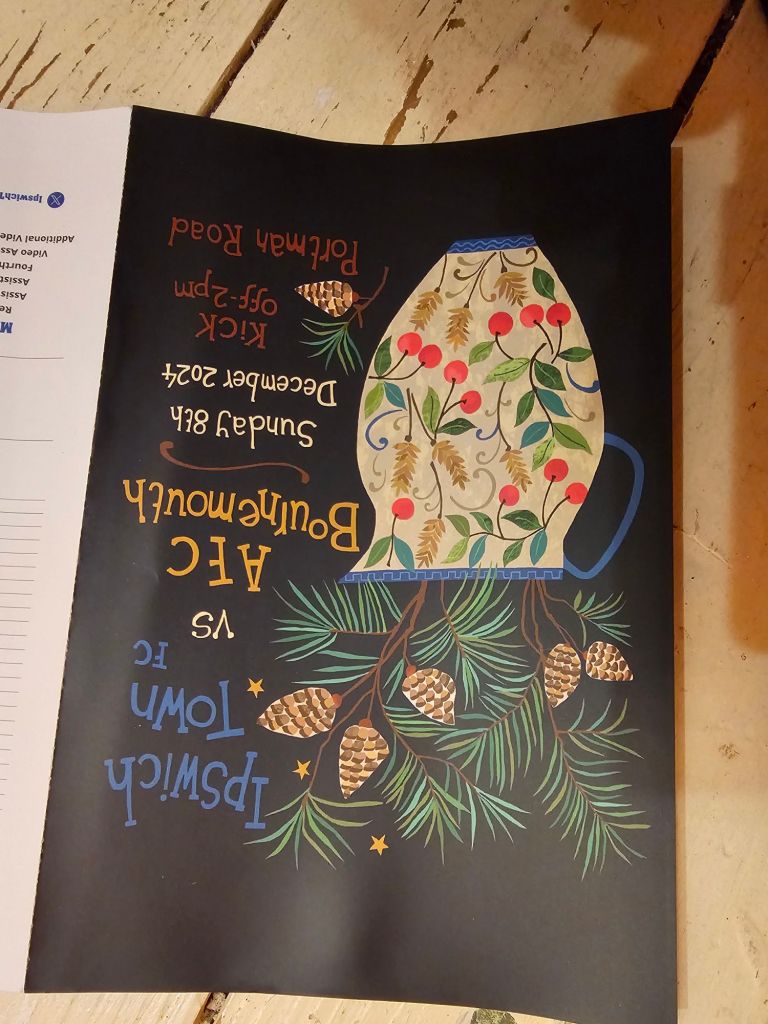
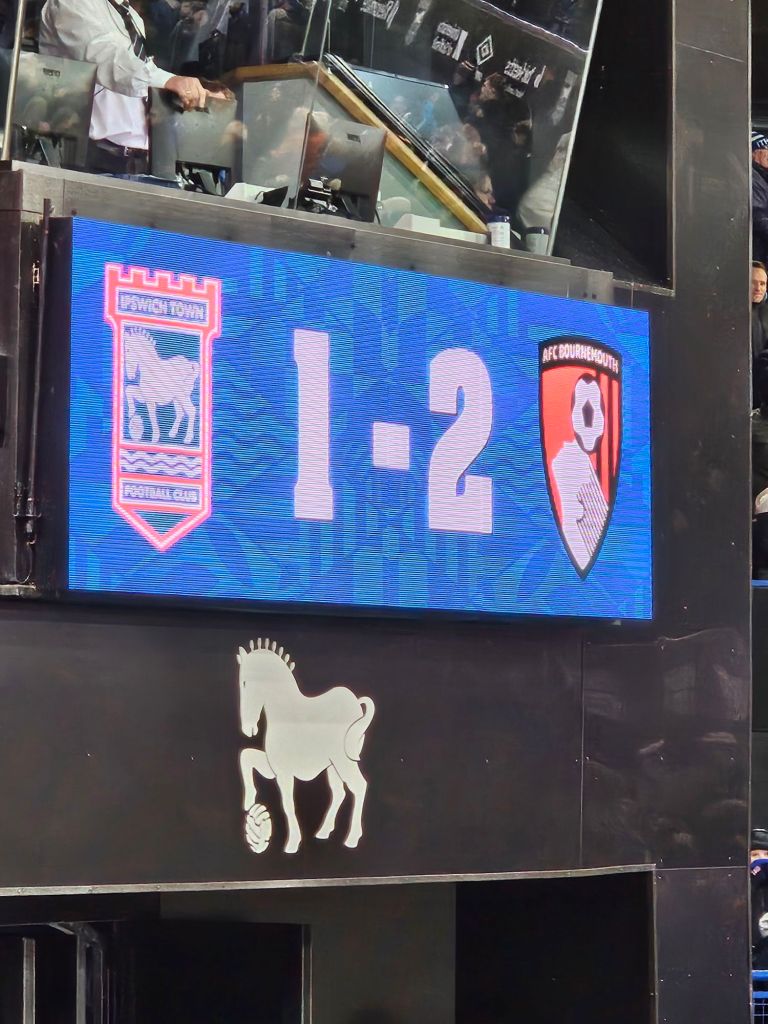
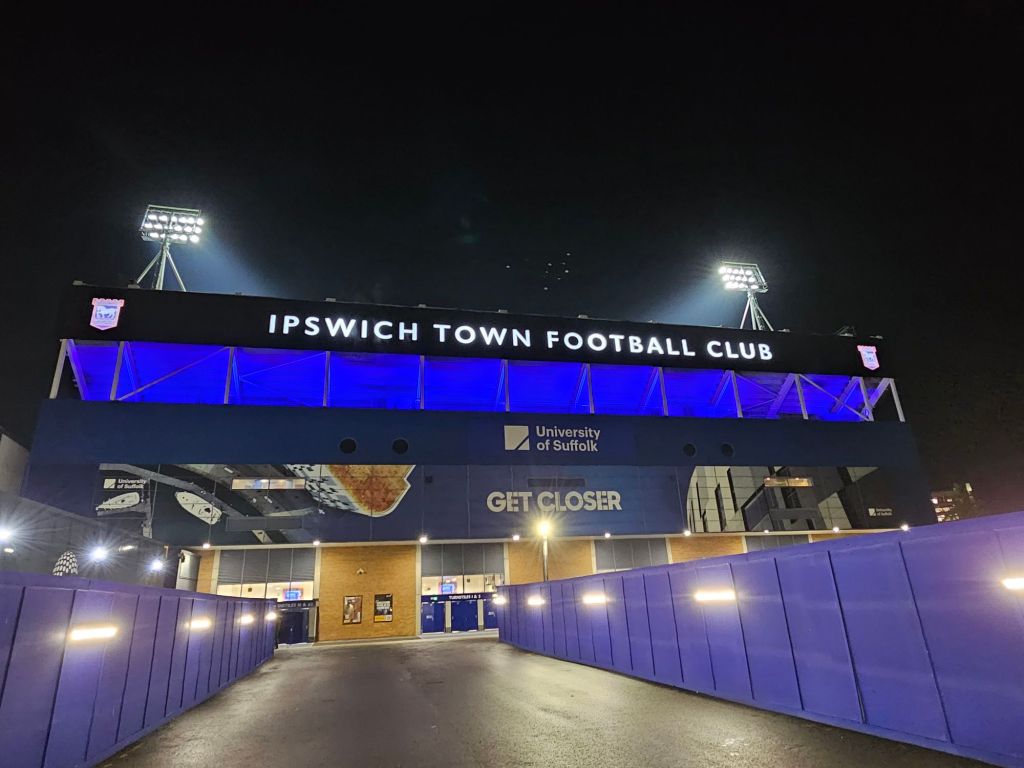
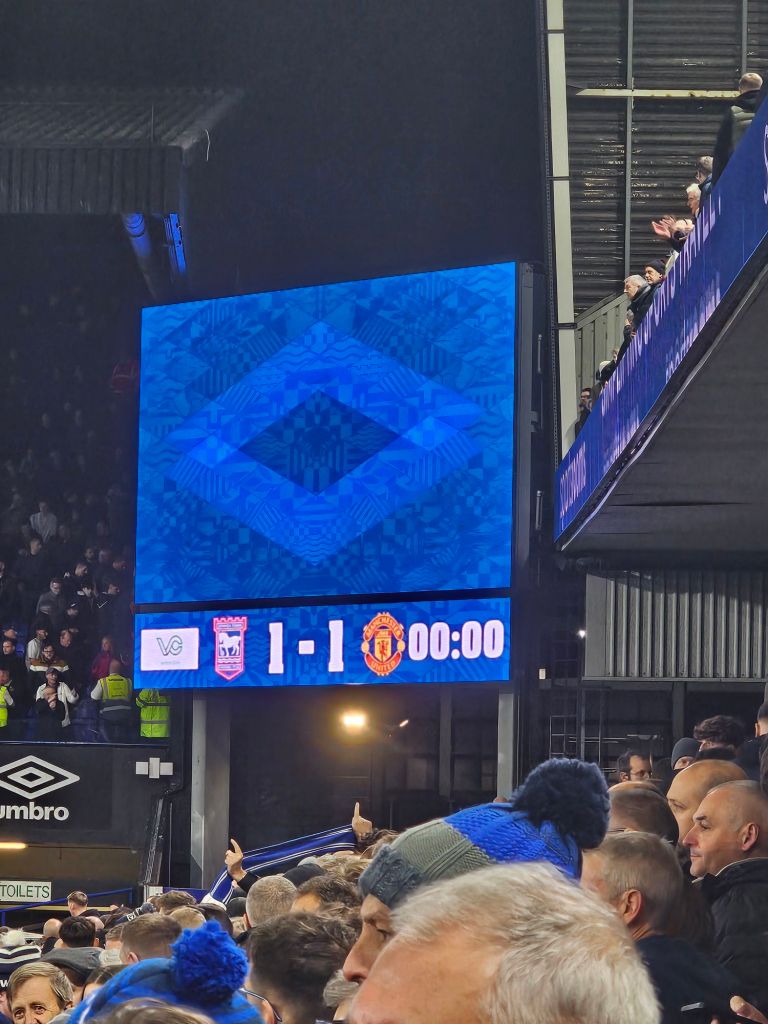
Ipswich Town 1 Manchester United 1

When I was young, so much younger than today I would often travel to Layer Road, Colchester on a Friday night to see the U’s engage with the likes of Torquay United, Darlington or Aldershot, and then on Saturday afternoon I would watch Ipswich Town in the First Division.  The days of ‘Col U’ playing on a Friday evening are sadly gone, as is Layer Road, but this weekend I had the opportunity to see two games in two days once again, taking my pick from an extensive menu of local non-league matches on Saturday afternoon and then catching the Town on Sunday afternoon with a wholly unwelcome four-thirty kick-off.  As it turned out, I didn’t bother,  but stayed indoors and courtesy of a ‘Firestick’ watched Paris FC play Annecy in French Ligue 2, and then Ligue 1 RC Lens play Marseille on the telly. I sometimes think I have lost my joie de vivre.

Today is Sunday and it is blowing a gale as I waste away a whole morning and much of an afternoon waiting to go to Portman Road. I tried drilling some holes in a wall to put up some shelves, but I think the party wall in my house must be made of granite and all the time I’ve been wondering if the trains are going to be disrupted, some have been cancelled already.  Mick has been in touch to see what time I might be at the Arb’ but the Sunday train times either get me there earlier than I’d like or with not enough time for a couple of drinks.  I should be able to sue Sky TV and the Premier League for the inconvenience.  The pre-match tension is palpable.

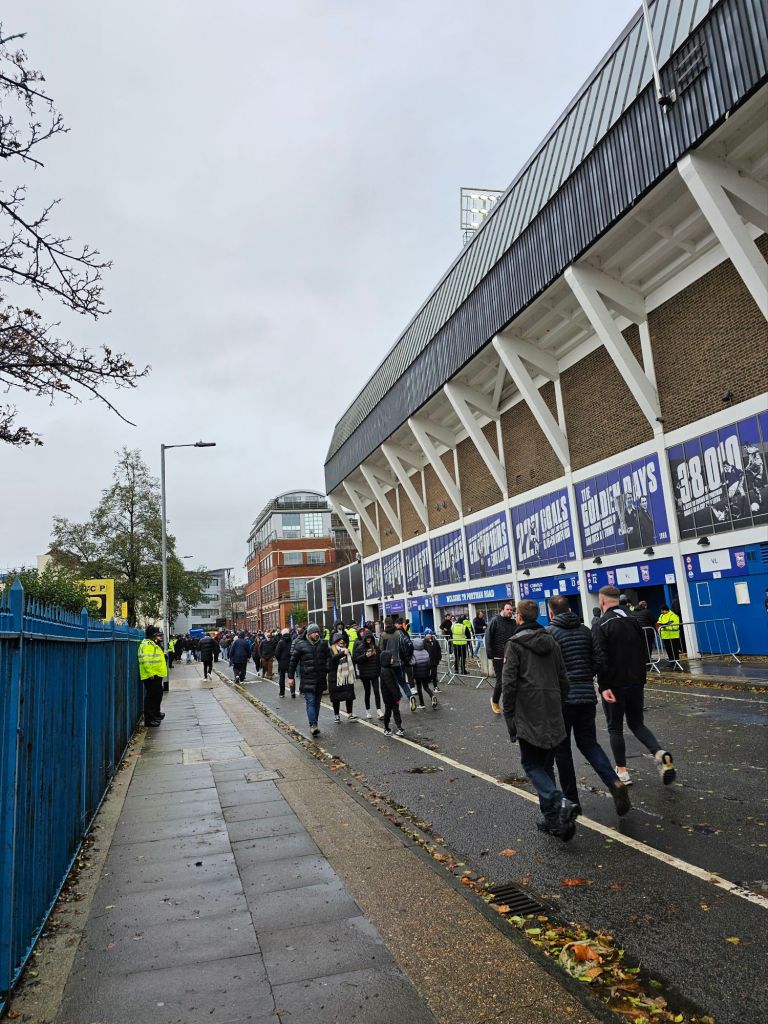
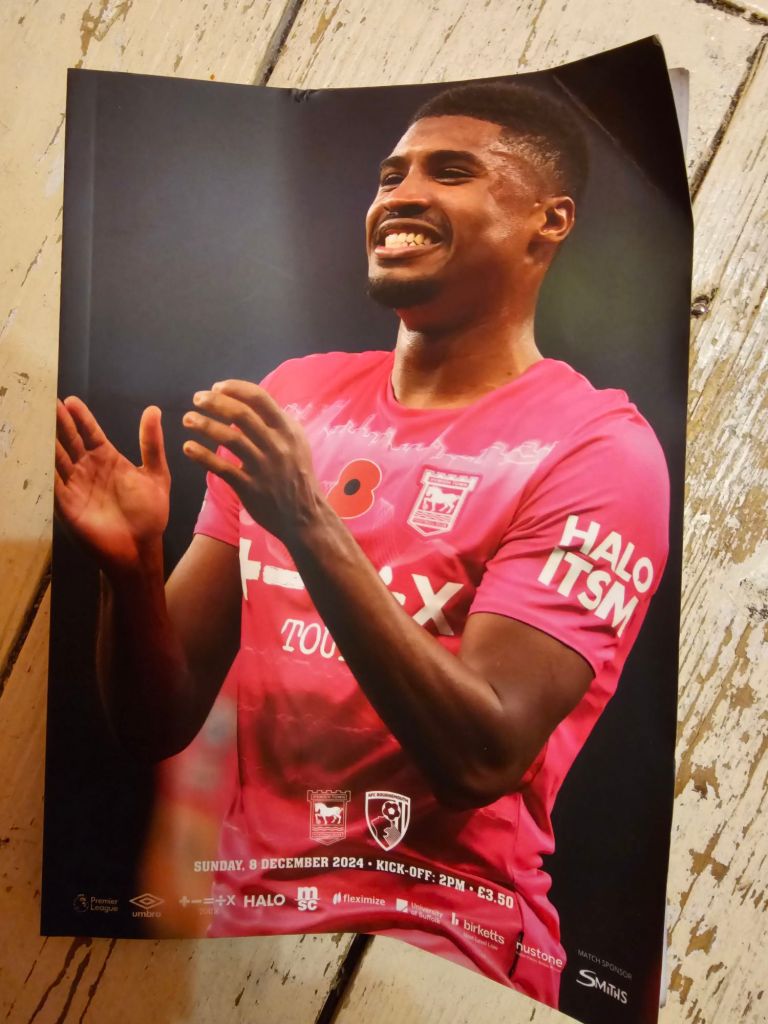
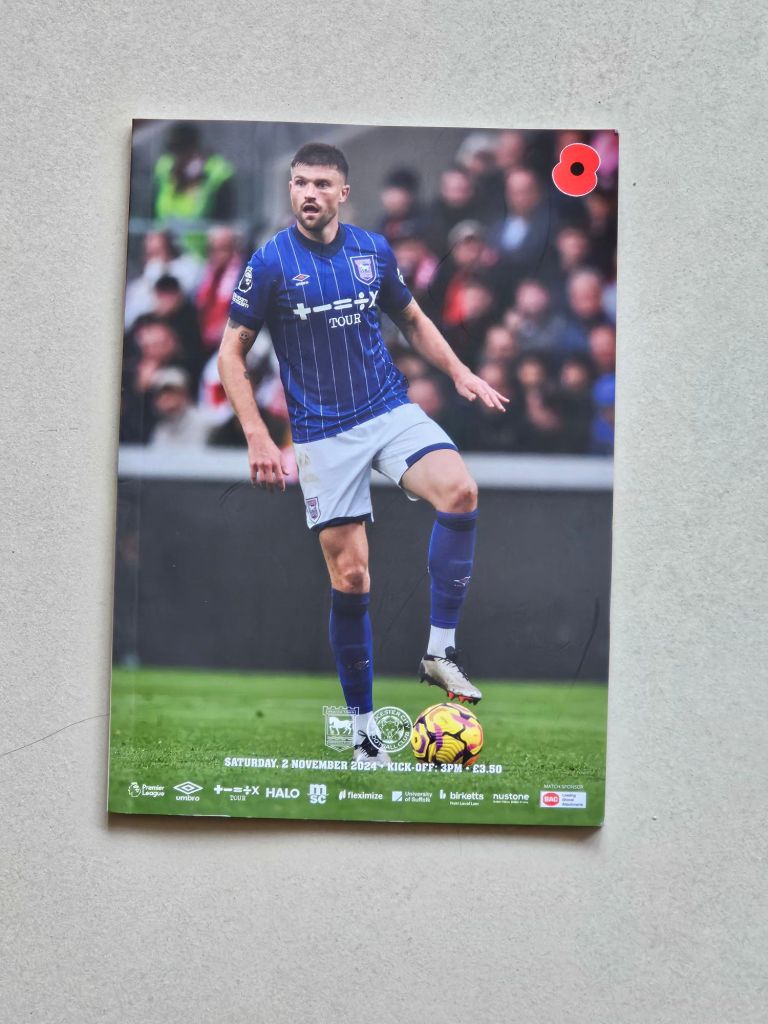
In time, I decide that it would be best for everyone if I simply spent a bit longer at the pub before the game and so after a train journey on which Manchester United supporters sing ‘Eric Cantona’  endlessly to the tune of The Twelve Days of Christmas and on which I don’t see a single polar bear, I buy a programme in Portman Road and finally arrive at the Arb’ to purchase a pint of Mauldon’s Suffolk Pride (£4.14 with CAMRA discount).  Mick has already texted me to say he is ‘on the bench in the beer garden’ and that is where I join him to discuss Gary’s absence, houses of multiple occupation, local non-league football, how Mick has been seeing ‘someone’ (a woman), newspapers,  religion, today’s Town team and what time we go to bed; Mick is a bit of ‘night owl’ it seems, and if I didn’t get up at twenty past six each morning I think I’d quite like to be able to watch Newsnight too.

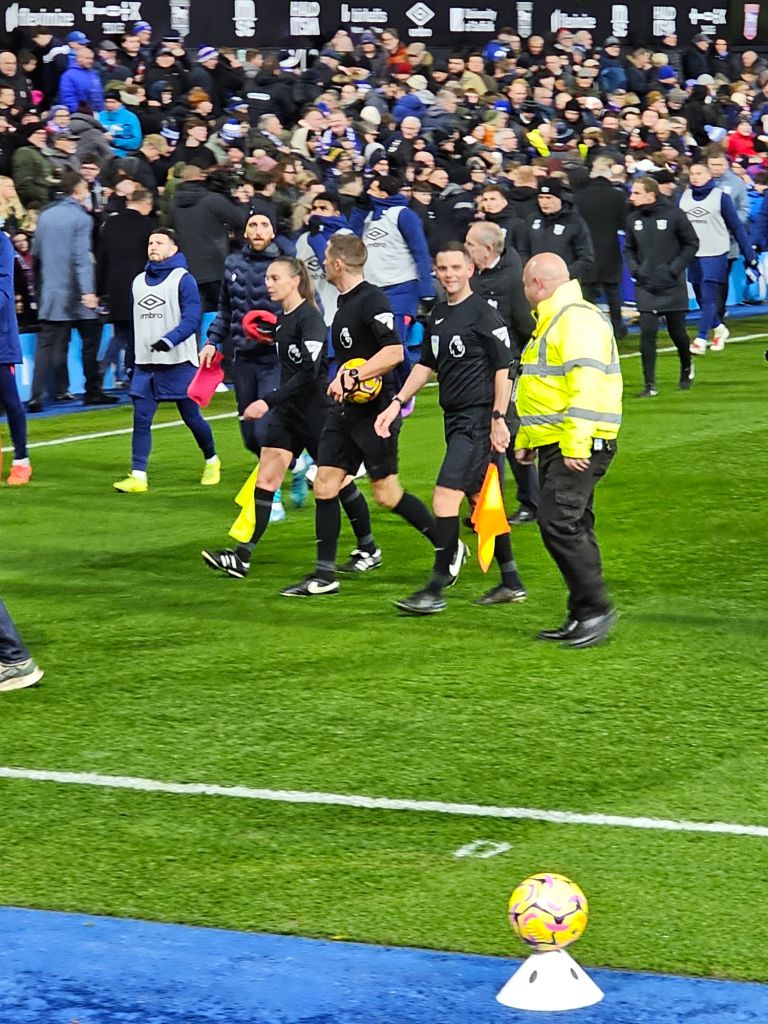
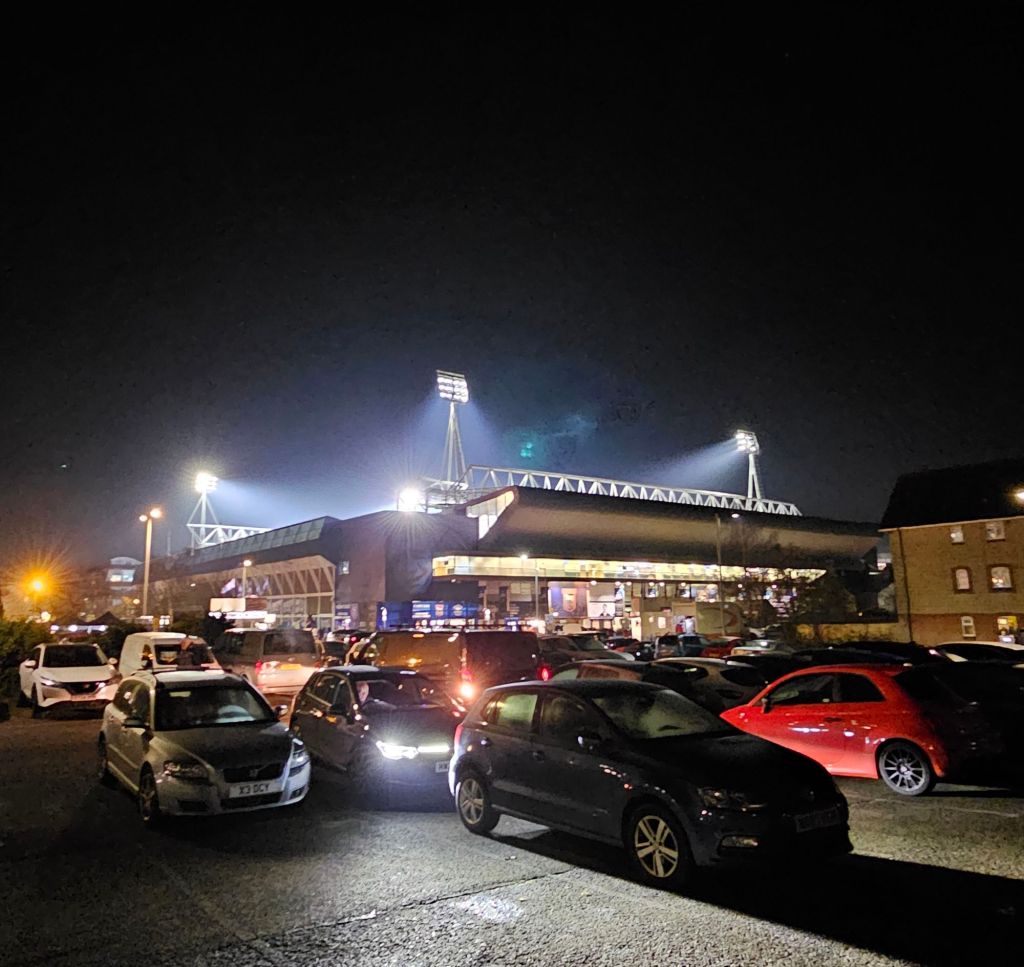
A good hour and twenty minutes drift by in a sea of words and more Suffolk Pride, and we realise that everyone else in the pub beer garden seems to have left, so we do too not wishing to miss the kick-off, although happy to forego the leaping flames and tiresome, over-excited young stadium announcer with his elongated vowels and slightly cheap-looking suit.   There are no queues to get into what used to be Churchman’s and I arrive at my seat as ever to find ever-present Phil who never misses a game, his son Elwood, Pat from Clacton, Fiona and the man from Stowmarket (Paul) already here.  There’s a lot of noise as the two teams process onto the pitch and I don’t know why, but I can’t help feeling rather bemused, so much so that I suddenly notice Pat from Clacton looking at me a bit quizzically because the over-excited young stadium announcer is reading out the Town team and I’m not bawling out the players’ surnames in the manner of a Frenchman.  It’s been so long since Town were last at home that I’ve forgotten what to do and I’m lost in idle reverie. Returning to Earth, I try to make amends but find that the over-excited young stadium announcer is not in -sync with the score board and I therefore have no idea which surname comes next; it’s like a bad dream in which Murphy has returned but years younger and taller, and in a shiny suit

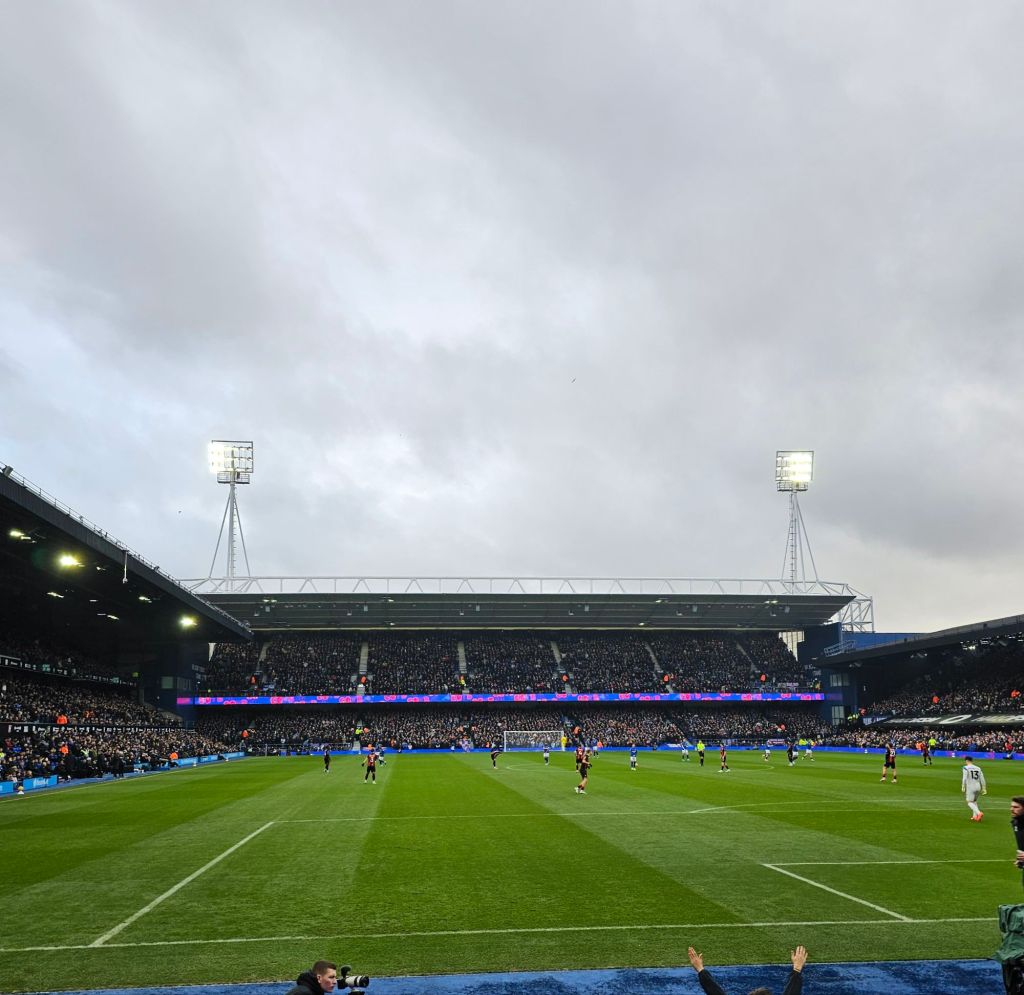
Kick-off comes as a relief with Town getting first go with the ball and aiming it in the direction of me and my fellow ultras. Town are of course in blue and white whilst Manchester United are in red shirts and black shorts, a bit like Stade Rennais,  but messily the shirts are two shades of red and the shorts have red flashes on them.  The relief is short-lived as within eighty seconds Manchester’s number 16 skips past a Town player, puts in a somewhat limp looking low cross and their number ten nips in to tap the ball past Aro Muric, who looks as if he was expecting to simply casually pick the ball up.   My hopes that VAR will have spotted some invisible infringement in the run up to the goal are dashed, largely because there simply wasn’t enough time for anything to have happened. 

The game resumes over a minute after the goal was scored and we all feel a bit shocked. The current Manchester United team is widely believed to be pretty useless I believe and here we are losing already. I thought we were going to win two-nil and had told Mick as much.  Five minutes are almost gone however, as Town win a corner.  Eleven minutes disappear and Sam Szmodics has a decent shot that the goalkeeper saves and in terms of attacking intent at least, Town have drawn level.

“United, United, United, United” chant the Mancunians and their friends from London and the Home Counties up in the Cobbold Stand, separating each ‘United’ with three quick claps.   A little slow to catch on, the Blue Action group belatedly shout “Shit, just like people did in the 1970’s, but usually before the visitors had stopped shouting ‘United’.  The football is quite good though. Lots of passing is going on and Ipswich are probably doing more of it than Manchester.  The half is half over and finding himself next to Sam Morsy, the Manchester number seventeen falls to the ground and rolls over and over and over and over to both the anger and amusement of the home crowd.  “Get up, ya great pussy” I tell him loudly.  “That’s Garnacho” says the bloke in front of me. “Yer what?” I ask him. “That’s Garnacho” he says again.  A bit confused being unfamiliar with the names of any footballers unless they play for Ipswich Town I say “So it’s not Pussy then.”  “He’s a funny looking bleeder” says the bloke behind me of the aforementioned Garnacho and the bloke next to me momentarily reflects on how children don’t get called ‘little bleeders’ nowadays, and sadly I think he’s right.  Amusingly, to me anyway,  ‘ya little bleeder’ was probably the polite version of ‘ya little bugger’ which is how my grandfather affectionately knew me.

Another Town corner unexpectedly inspires a warm booming chant of “Come On You Blues” and Liam Delap earns a free-kick on the edge of the penalty area as United’s captain Jonny Evans looks bothered; having only this week watched a version on the telly, I think of Evans The Death, the undertaker in   Dylan Thomas’s  ‘Under Milk Wood’.  The free-kick is neatly taken, but goes straight to the goalkeeper Andre Onana for whom I am amazed the United supporters do not sing KC and the Sunshine Band’s ‘Baby Give It Up’. Sensing my disappointment when Town don’t score, Pat from Clacton tells me that she’s already had her dinner today – a Marks & Spencer roast turkey ready meal.  “It’s not even Christmas yet” I tell her and Town win another corner from which a shot is blocked after the ball had been headed back across goal.  United breakaway up field,  but Sam Morsy slides across to sweep the ball out for a throw with the sort of tackle that takes the Manchester player as ‘collateral damage’ and which the home crowd loves, especially against a rather ‘poncey’ team like this one seems  to be.

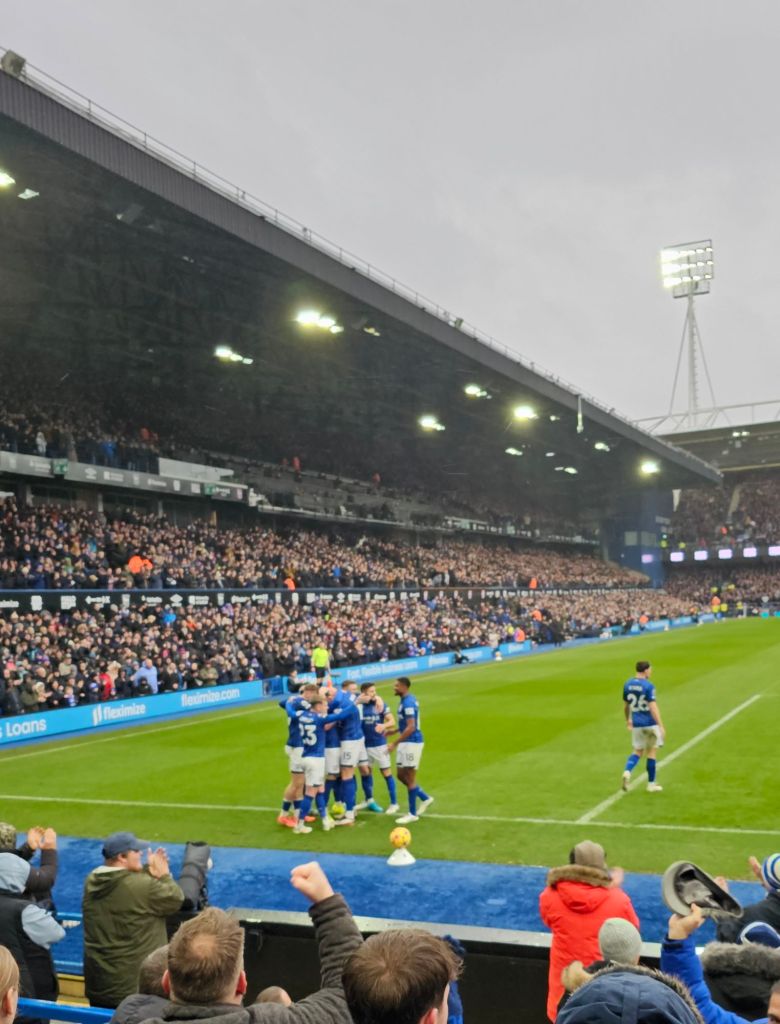
With five minutes until half-time,Town produce the move of the match, tearing the Manchester defence apart as Leif Davis chases a raking long pass, checks inside and plays in Liam Delap who has a whole goal to aim at , but somehow Onana gets a hand or an arm or a shoulder in the way of the goal bound ball.  Within sixty seconds, another move opens up a view of goal for Jens Cajuste, but he shoots over.  The momentum is with Ipswich however and Omari Hutchinson claims the equaliser very soon afterwards with a shooting star of a shot from outside the penalty area which loops gently off a Manchester head on its rapid journey into the top right hand corner of the goal net, at last beyond the reach of Onana.  Three minutes of added on time follow without incident and we are relieved not to be losing anymore, but also feeling like we could be winning.

With half-time I dispose of excess Suffolk Pride and then speak with Ray, to whom it seems I haven’t spoken in months.  We speak of car parks and Kemi Badenoch, whose surname Ray pronounces as Bad Enoch, which for those like us who remember Mr Powell seems worryingly appropriate.  On the way back to my seat I congratulate ever-present Phil who never misses a game on having recently completed his quest to see a game at every one of the ninety-two League grounds in England and Wales.  I tell him I got to around seventy-eight grounds about fifteen years ago but have never managed to get any further.  I don’t tell him it’s a metaphor for my entire life.

The football resumes at twenty-four minutes to six when people without a subscription to Sky Sports TV are watching Countryfile and eating buttered teacakes. I notice the moving advertisement for Aspall cider which reads “made in Suffolk since 1728” , words that fosters images in my romantic mind of misty orchards, wooden vats and apple presses, horses, carts and crusted rustic characters, and then the illuminated display says “now available in a can”.

“Come On Ipswich, Come on Ipswich” we chant a good three or four times because Manchester are keeping the ball more than we’d like.  The encouragement works and Town get the ball,  Wes Burns whips in a low cross and Onana saves brilliantly again from Liam Delap and Town have another corner.  Manchester break again and Jens Cajuste chases back to make a perfect tackle inside the Town penalty area and now Manchester have a corner.   Not an hour has been played and Manchester are making substitutions as Evans the Death and some bloke who is so good he only has one name goes off and some other blokes I’ve not heard of come on.  Up in the Cobbold Stand the away supporters sing songs about Roy Keane and Eric Cantona, perhaps because like me they don’t know who their current players are either.

Then Ipswich make substitutions; Sam Szmodics and Jens Cajuste departing and Jack Taylor and Jack Clarke arriving. “For me, Burns ain’t done nothing” says the bloke behind me clearly thinking he should have been substituted but perhaps not having noticed his pass to Omari Hutchinson for the goal, that cross for Liam Delap, or his defensive play.  Twenty-three minutes are left and Manchester have another corner before a couple more substitutions; a bloke called Zirkzee comes on. “Sounds like a cleaning product” say the bloke behind me.  This early afternoon and early evening’s attendance is announced by the over-excitable young stadium announcer in the shiny suit as being 30,017 with a very nicely rounded 3,000 of that number being here to sing about Eric Cantona.

Manchester United are mostly the team with the ball in the second half, but despite some grace and speed and long accurate passes they aren’t threatening the Town goal much, they just look like they could if they thought about it a bit more.  Perhaps they just have too much confidence and and self-love for their own good.  The good thing is it means Town look more likely to score,  but as Pat from Clacton says to Fiona “You can feel the tension” .  Eventually, the bloke behind me gets his wish as Wes Burns is replaced by Conor Chaplin, and the match rolls on into the final ten minutes of normal time. Ali Al-Hamadi shoots and Onana saves, again. Conor Chaplin shoots, but pretty much straight at Onana.

Only four minutes of added on time are added on and I can’t decide if that’s a good thing or a bad thing. Do we need more time to score or less time so we don’t concede?  “Oh when the Town go marching in, Oh when the Town go marching in“ drone the home crowd mournfully as if they’ll be following a coffin when it happens. Manchester United win a corner and the ball is booted clear to create maximum distance between it and the Town goal and then the match ends.  Fiona and Pat from Clacton are quickly away, but not before Fiona says “See you next Tuesday”- it’s when Town play Crystal Palace.

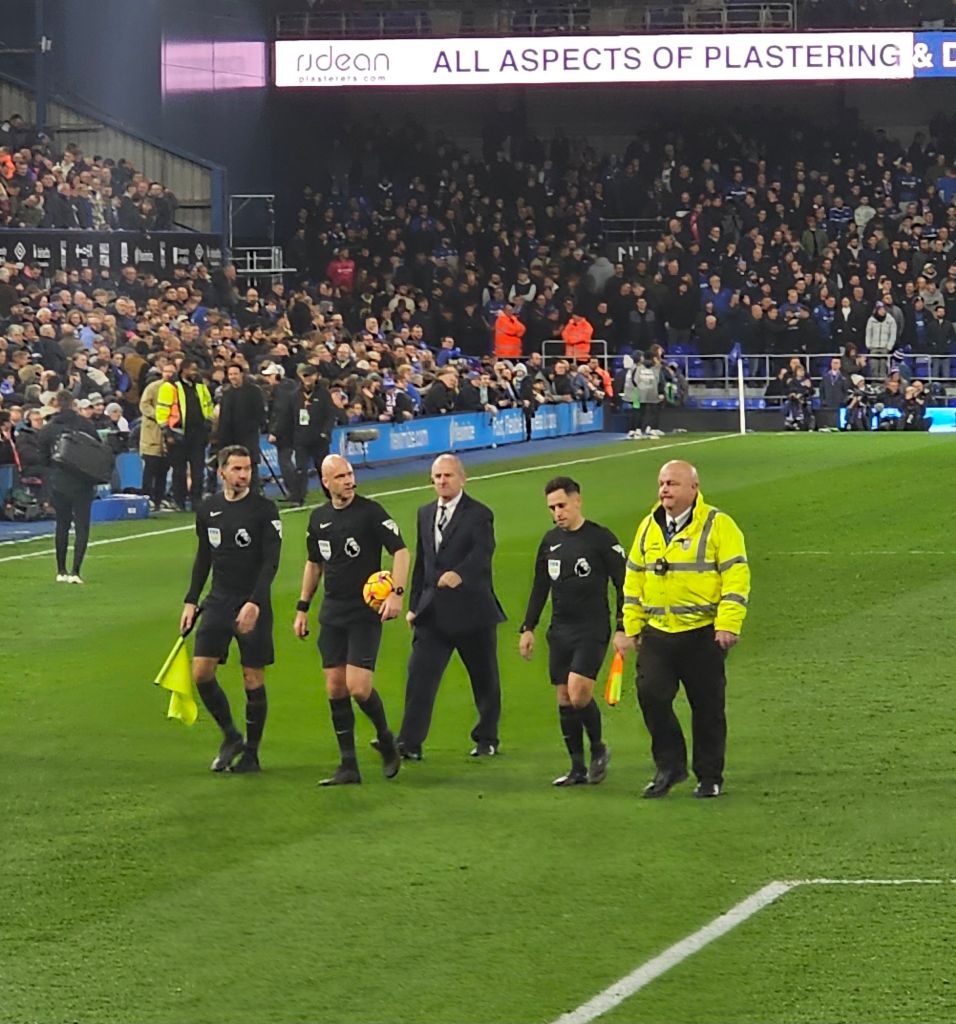
It’s been another fine game, perhaps not as exciting as some of the others this season, but despite not dictating enough of the play in the second half there is no doubt Town can claim they deserved to win more than Manchester did, and Onana is clearly Manchester’s ‘Man of the Match’, although they probably won’t admit it.   Leaving Portman Road for the railway station I think back to the first time I ever saw Town play Manchester United, in December 1971.  That game ended in a draw too, a goalless one, and Best, Law and Charlton were all rubbish.

Ipswich Town 1 Leicester City 1

Suddenly it’s November and my back garden is strewn with yellow fig leaves, which might be odd if it wasn’t for the presence of the increasingly naked fig tree just beyond the back of my house.  The fig leaves are a reliable indicator of what time of year it is and usually, so is a list of the number of football matches I’ve seen since the start of the football season. By November of last season, I had seen Ipswich Town play six games at Portman Road, and I’d missed two because I was away in France watching Lorient and Stade Brestois instead.  By November of the 2022-23 season, I’d seen Town play eight matches at Portman Road and that was without seeing any Town games at all during the whole of September because I away again.   This season I’ve missed just one home match, but I’ve only seen Town three times. I’m beginning to think I’m not getting value for money from this Premier League malarkey. 

Leaden skies and spits of rain accompany me on my walk to the railway station where I stand far up the platform away from the hoi polloi, in a spot where I know the second carriage with a pointy front end will stop.  Another man with grey hair has been pacing up and down the platform and gets into the same carriage once the doors eventually open, which they don’t for a good thirty seconds.  He looks a bit nerdy, like a possible contestant on Only Connect.  Gary joins me at the next station stop and we talk of someone he knows who is over seventy and still works in order to pay off his mortgage.  Sliding down the hill into Ipswich we see two of the four polar bears and Gary muses on how many other football supporters travelling to games this weekend across Europe have seen polar bears on their journey to the match.  I tell him how an article in the Guardian referred to the ‘Polar Express’.

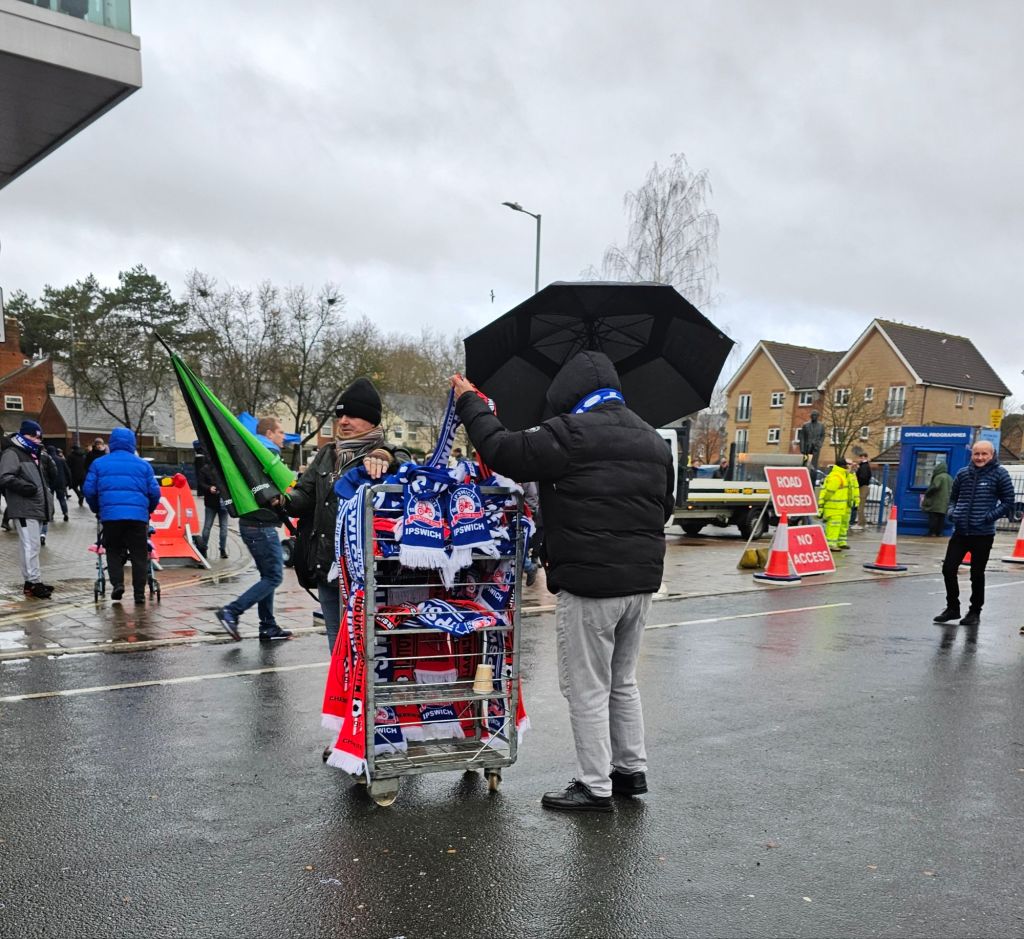
The ‘plaza’ in front of Ipswich station doesn’t seem quite as busy as usual, but the Leicester supporters in the car park-cum-beer garden of the Station Hotel are plentiful. We stop and buy from a pretty, smiling young programme seller who is working the blue, mobile, metal desk at the end of Portman Road this week.  The turnstiles aren’t yet open, and we have to weave between static Leicester supporters.  A bunch of people surround a large white banner that reads “Premier League stop exploiting our loyalty” and pose for photos.  “They’re Leicester fans” says Gary. “Well, they won’t be Ipswich” I reply cynically, obliquely expressing my belief that the revolution will not begin in Ipswich or be televised on Look East or About Anglia.

Reaching ‘the Arb’, we order a pint of Mauldon’s Suffolk Pride and a pint of Lager 43, for which Gary kindly pays. In the beer garden we find Mick half-way through a pint of Suffolk Pride already because he’s been here since a quarter past one having forgotten what time we agreed to meet up.   I tell him he’s getting old and Mick soon remarks upon the gaberdine raincoat I am wearing, which I tell him my father wore when he was in the Royal Navy, and it is older than I am.  This provokes Mick into telling us how as a child he grew up wearing the cast-off gaberdine raincoats of Ken Bruce, the radio broadcaster.  Mick’s aunt, who lived in Scotland, was friends with the mother of the juvenile Ken and she would send the coats that Ken had grown out of down for little Mick to wear.  This in turn leads to mention of former Prime Minister Harold Wilson’s Gannex raincoats and Keir Starmer’s tickets to see Taylor Swift, before Mick stuns us both with his surprising admission that although he despises the woman, he really fancies Kemi Badenoch.

After Mick’s confession I need a drink and head inside to buy another round, but am disappointed to find that the Suffolk Pride is now ‘off’ and I have to have Mauldon’s Special Bitter instead.  Time moves on as it always seems to and not much after twenty-five to three after Gary has suggested we just stay at the pub all afternoon, we depart for Portman Road, Mick locking his bicycle to one of the stands close to where the olde West Gate to the town once stood.  We go our separate ways near Sir Alf’s statue, and I walk down Portman Road alongside a small man with long hair wearing a replica home shirt, who introduces himself as Matt and predicts a 3-2 win for Town.  I tell him I think we’ll win 2-0.  The queues at the back of ‘Churchmans’ are quite long again and that at turnstile 62 seems the longest, but I can’t not join it and by the time I get to my seat everyone is stood silently, hopefully contemplating the futility and stupidity of war, even though it is a full nine days before ‘Armistice Day’.  Even the seagulls atop the cross bar of the Sir Bobby Robson stand appear to be standing to attention. As usual however, I find it slightly weird how professional football now attaches itself to Remembrance, it never used to.  Is it just what is now called ‘virtue signalling’?   I’ve come to watch a football match, and I only really wanted to remember the fabulous Trevor Whymark today.  I will remember those killed by wars on 11th November.

The game soon kicks off, Leicester getting first go with the ball, aiming in the direction of Alderman Road and the canal and wearing all white, although just ‘white’ isn’t good enough for football kits anymore and the programme tells us on page 31 that the colour of the kit is actually ‘light ice blue’.  Town are thankfully in the usual plain old blue and white.   A little surprisingly, at the referee’s whistle Leicester play the ball back from the centre spot and hoof it forward like in days of yore.  Then, to home fans amusement an early back pass goes beyond the Leicester goalkeeper towards his own goal, but unfortunately it is easily recovered.  “We’ve only just got in the ground too” says Pat from Clacton “they were searching everyone’s bags”.

The afternoon is wonderfully grey, with the floodlights and illuminated adverts somehow making it look even greyer because of the contrast. “Hark now hear the Ipswich sing, The Norwich ran away” chant the Sir Bobby Robson standers getting prematurely excited with the season of Advent just 30 days away.  Leicester create a couple of early chances attacking Town from wide positions. Eight minutes are lost, and Muric makes a flying save at the expense of the game’s first corner kick. “Come On Leicester” chant people who might once have parked their cars over the grave of King Richard III or bought a swede from Gary Lineker’s father.

It’s the fifteenth minute and Aro Muric makes another necessary save at the expense of a corner, this time keeping out a shot from Facundo Buonanotte, whose first name is derived from the Latin word for ‘eloquent’, which is unusual for a footballer.  So far, but for Sam Szmodics heading an Omari Hutchinson cross over the goal and Conor Chaplin shooting past a post, Leicester have been the better team, without being very good; it’s a bit like a Second Division match as if both teams are re-living old times.   Leicester’s Wout Faes clashes with Leif Davis which displeases the home crowd. “Fuck off, you fluffy-haired cunt” shouts someone from behind, and I think of Alan Brazil, probably Town’s only fluffy-haired player as long as I continue  to forget about Kevin Beattie’s and Trevor Whymark’s perms.

An eighteenth minute shot from Conor Chaplin earns Town a corner and at last I get the opportunity to bellow “Come On You Blues” repeatedly until the kick is taken.  “Do-do-do, football in a library” chant the Leicesterites revealing either that they rarely visit libraries, which is believable, or that the libraries of Leicester are quite unlike those in other places.  The game is changing and Town win two corners in quick succession and again I bellow “Come On You Blues”, possibly until I’m blue in the face.  The eloquent Facundo Buonanotte is booked by referee Tim Robinson, inevitably for dissent, although in this case by kicking the ball away his action has spoken louder than any words.

With the game a third over, Town win more corners and Dara O’Shea heads wide.” On a plate that” says the bloke behind me.  Conor Chaplin shoots wide again and then spectacularly past the top corner after a run across the edge of the penalty area.  “I-pswich Town, I-pswich Town FC, They’re by far the greatest team the world has ever seen” chant the Sir Bobby standers to the tune of the Irish Rover, and if Ipswich and Leicester City were the only two teams in the world it would currently be true.  The last notable action before two minutes of added on time sees Ben Johnson hit a rasping shot towards the top corner of the goal, but the Leicester goalkeeper was perfectly situated to simply and rather nonchalantly pluck it from the air.

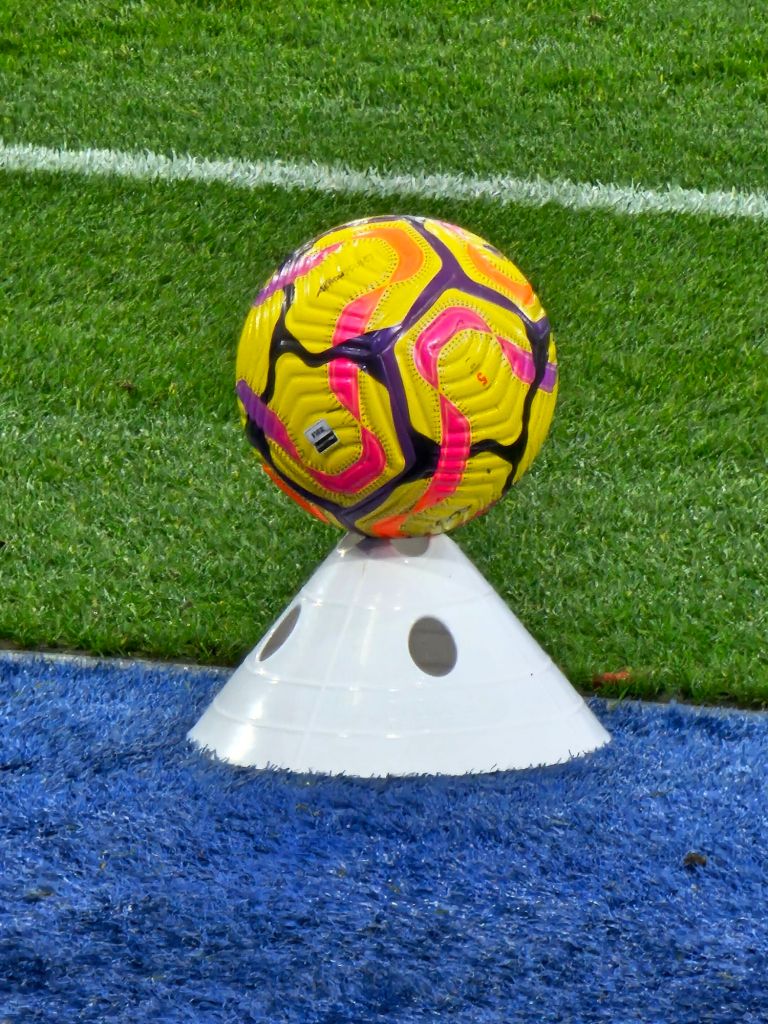
The Town are worth the applause they receive as they trot off for their half-time tea, or oranges, or whatever it is they consume and the man from Stowmarket (Paul) and I agree that once the Town got going, they were much the better team; we just need to score. Ray is not here today, so instead of talking to him I eat a Nature Valley cereal bar and consider the design of the Premier League football which, with its oddly molded surfaces looks like something that if somewhat smaller I imagine might be sold in an Ann Summers store, but wouldn’t appear in the window display.

The football resumes at five past four and happily in the same vein as before the players went away and then came back again. For a while it even sounds as if the Leicester fans are singing “I’m Ipswich ‘til I die” before they start on about Jamie Vardy. “Jamie Vardy has won more than you” they chant to the tune of Sloop John B, but they can’t possibly know what I’ve won and to be honest I neither know nor care what Jamie Vardy has won, except perhaps Rebecca Vardy’s hand in marriage, and to be honest that doesn’t seem like something to boast about.  “Small town in Norwich, you’re just a small town in Norwich” they continue, revealing that they will probably get lost on the way home.

Moments later and a diagonal cross field ball from Sam Morsy is volleyed beautifully, sumptuously, gloriously, magnificently and above all successfully into the Leicester goal by Leif Davis to give Town the lead they so richly deserve.  After Wes Burns’ goal versus Coventry last season, this could well be one of the best goals seen at Portman Road this century.  I text my wife to get her to put a bottle of Cremant in the fridge.  It feels like we can only go on to score more goals and win because it’s plain to see Town are better than Leicester.  But then referee Tim Robinson books Aro Muric for time wasting as he kicks the ball back to Cameron Burgess after it has gone out for a goal-kick and it’s time for Conor Chaplin to go down to receive treatment and everyone else to get some remedial coaching on the touchline. I think people call it “game management”, but there’s still half an hour to go.
“Champions of Europe, you weren’t even born” chant the geographically ignorant and ill-read Leicester fans jealously, realising that three League Cups do not equal a European trophy. Furthermore, Fiona, Pat from Clacton, the man from Stowmarket and I were all born when Town won the UEFA Cup, and three of us were there to see it.  Such is the Leicester fans’ brazen lack of familiarity with facts that I’m beginning to wonder if Donald Trump isn’t a Leicester fan.

In the seats around me there’s a debate about who has played well.  “To be fair” says the bloke behind me “they‘ve all played well” and he’s  right, as he often is. Leicester blink first and make substitutions and four minutes later Jack Clarke and George Hirst replace Sam Szmodics and the glorious Liam Delap, possibly Town’s best centre forward since Paul Mariner.  Then suddenly everything goes wrong, as if touched by the hand of some malevolent, unseen force, or the referee.  Conor Chaplin is blatantly pole-axed by a Leicester player in the Leicester penalty area and no penalty is given, a clear and obvious error that VAR fails to point out, raising the possibility that we now need a VAR to assist the VAR.  Moments later Kalvin Phillips catches a Leicester player with a dangling foot as he checks his run and referee Robinson books him for a second time, and he’s off.

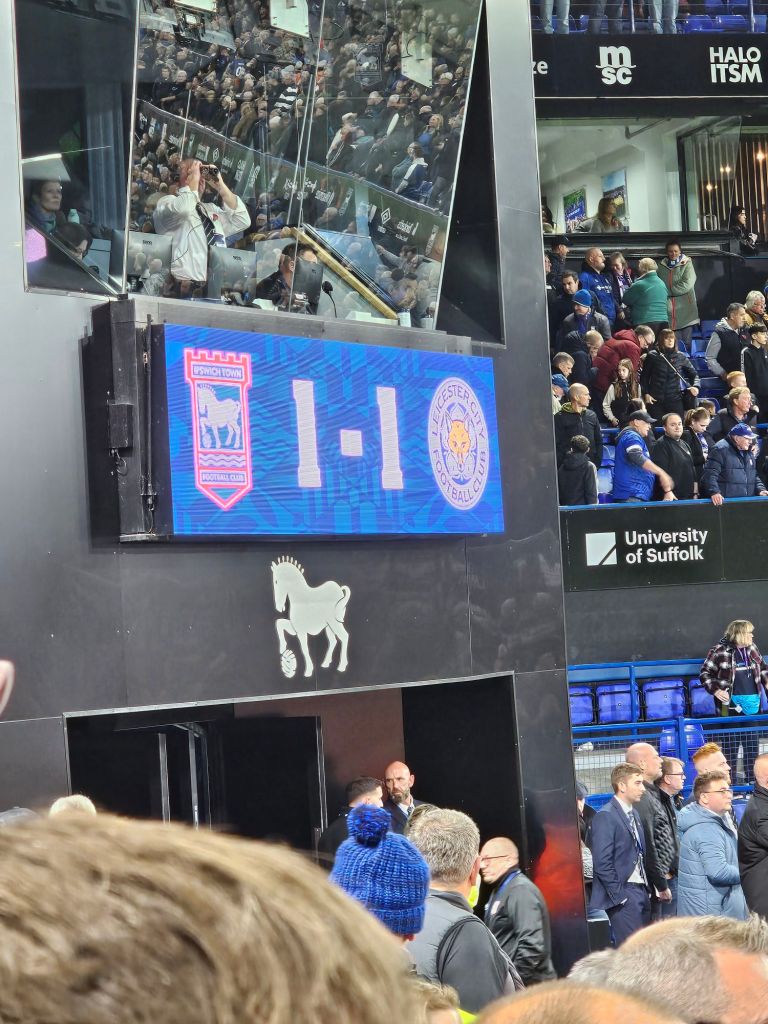
Hereafter the Town are just hanging on.  It doesn’t matter about the ‘incredible support’ of 29.874 (2,991 with little experience or knowledge of libraries and the geography of East Anglia).  It seems too late for Pat to bring on the masturbating monkey charm from the depths of her handbag. All around is cursing and swearing about VAR and the referee. “Blue Army, Blue Army” chant the crowd, ready to storm FA Headquarters and string up the Premier League ‘grandees’, perhaps.  Trying to reduce the tension I confirm that Pat from Clacton is looking forward to her usual, baked potato for her tea when she gets in. Leicester win two corners, Cameron Burgess clears a goal bound shot from substitute Jordan Ayew with an outstretched leg.  There will be eight minutes of added on time, more than was added to all the matches played at Portman Road throughout the whole of the 1970’s. Half-way through the added epoch Leicester score through substitute Jordan Ayew and that’s it. Town haven’t won.  I guess we now know how Southampton fans felt back in September when Sam Morsy scored.  But who wants to feel like a Southampton fan?  My wife texts me to say the Crémant is on the top shelf and she can’t reach it, I tell her not to worry.

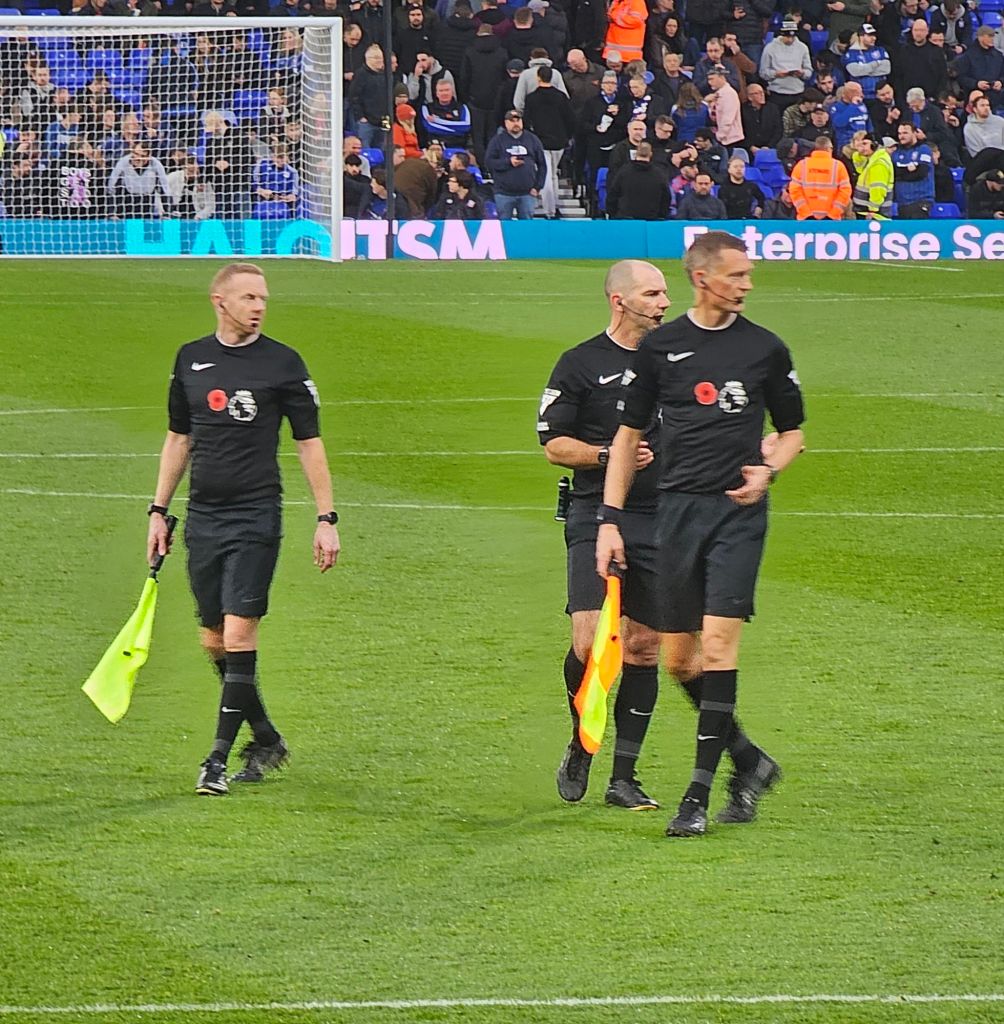
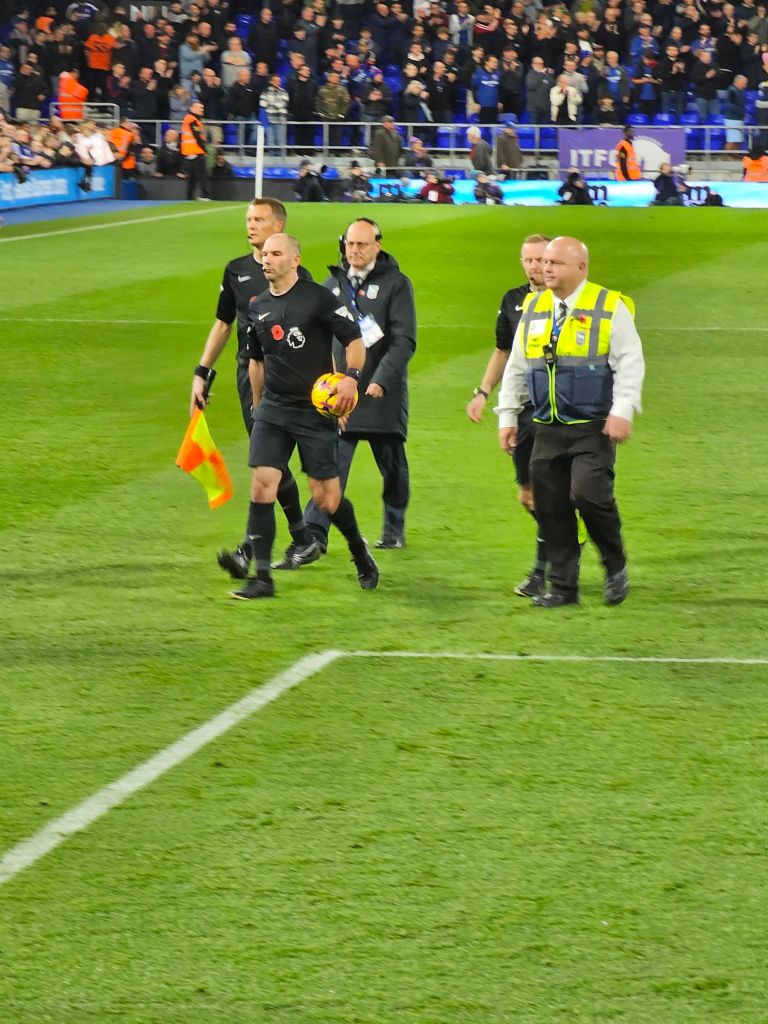
With the final whistle I applaud the Town team but can’t be bothered to boo the referee Tim Robinson, an aloof and arrogant looking man whose hair is too short and who suspiciously has the same surname as a garrulous,  overweight  boy I remember from primary school, who was a Leicester City fan and was always getting into fights. 

Feeling like I’ve been in a fight myself I head home and on the train, reflecting on how VAR seems to create the conditions for a belief in an unseen, but all-seeing big brother which promises on-field justice, but because it doesn’t share and explain all that it sees gives the impression rightly or wrongly that it sees what it wants to see, a possibility made more real by the corporate, heavily branded, money-loving nature of the Premier League with its need to suckle the big clubs and their global reach, whilst the smaller clubs are all just interchangeable parts. From such fertile soil conspiracy theories sprout.

The Premier League continues to short change me but I’m no doubt in the wrong demographic so no one cares. Tomorrow I shall wear my black T-shirt that bears the slogan “FC IT… where’s the pub”.

FC Megalithes 2 Riantec OC 1

The small town of Carnac on the coast of Brittany is famed for its sprawling, ritual landscape of neolithic, megalithic alignments, menhirs and dolmens, but less so for its football clubs.  It is unlikely therefore that many people outside the local football fraternity of the Morbihan departement (County), noticed the merger in 2023 of two or maybe three local clubs to create what its name suggests is a giant ritualistic rock of a football club, FC Megalithes, which possibly prefers to kick-off games in the direction of the mid-winter sunrise.

The website for the French equivalent of the local County Football Association helpfully lists associated clubs and their fixtures and having arrived in Carnac the day before and settled in, my wife Paulene and I have dusted off our autumn almanac and are seeking entertainment on what is a sunny September Sunday afternoon.  The website tells us that FC Megalithes are at home to Riantec OC, playing their second league match of the season in the Ligue Bretagne de Football, District Morbihan, District 1 Poule B.  If Ligue 1, where the likes of Paris St Germain and Olympique Marseille hang out is level one of French football, we think this is about level ten of may be twelve or thirteen.  Riantec is a village a bit more than 30 kilometres away near the much larger town of Lorient, albeit this side of the estuary of the River Blavet; Wikipedia tells us that in 2017 Riantec had a population of about 5,600.

The football association website states that kick off is at 3.30 pm, and believing the match will be played at the main sports ground in Carnac, we set off at about ten to three from our ‘hut’ in a nearby camp site to make the 3.3 kilometre journey in our planet saving electric Citroen eC4.  As is often the case with local municipal sports grounds in France, there is plenty of free parking, but worryingly perhaps, as we roll up almost all of it is unoccupied,  and walking through the stone gateway of the Stade it is evident that there is no one else here except some youths playing an impromptu game of ‘three and in’ behind the albeit impressive, but lonely looking and very empty main stand.  The pitch is freshly marked out, but there aren’t even any goals up.  Clearly in the wrong place, we consult the interweb again and discover, courtesy of our very own administrative error, that we should be at Parc des Sports Kermouroux, about 7 kilometres away in St Philibert.

It is an easy trip across town to St Philibert, despite some 30 kilometre per hour maximum speed zones and a couple of red lights, and whilst we arrive after three-thirty we can see from the road outside that the players are only just lining up to shake hands and accept the applause of a crowd of what must be about a hundred people.  As we step through a side gate, we can even hear some Ultra-style chanting, although that seems to be from the players of the B team whose match had kicked off at one-thirty and has since ended.

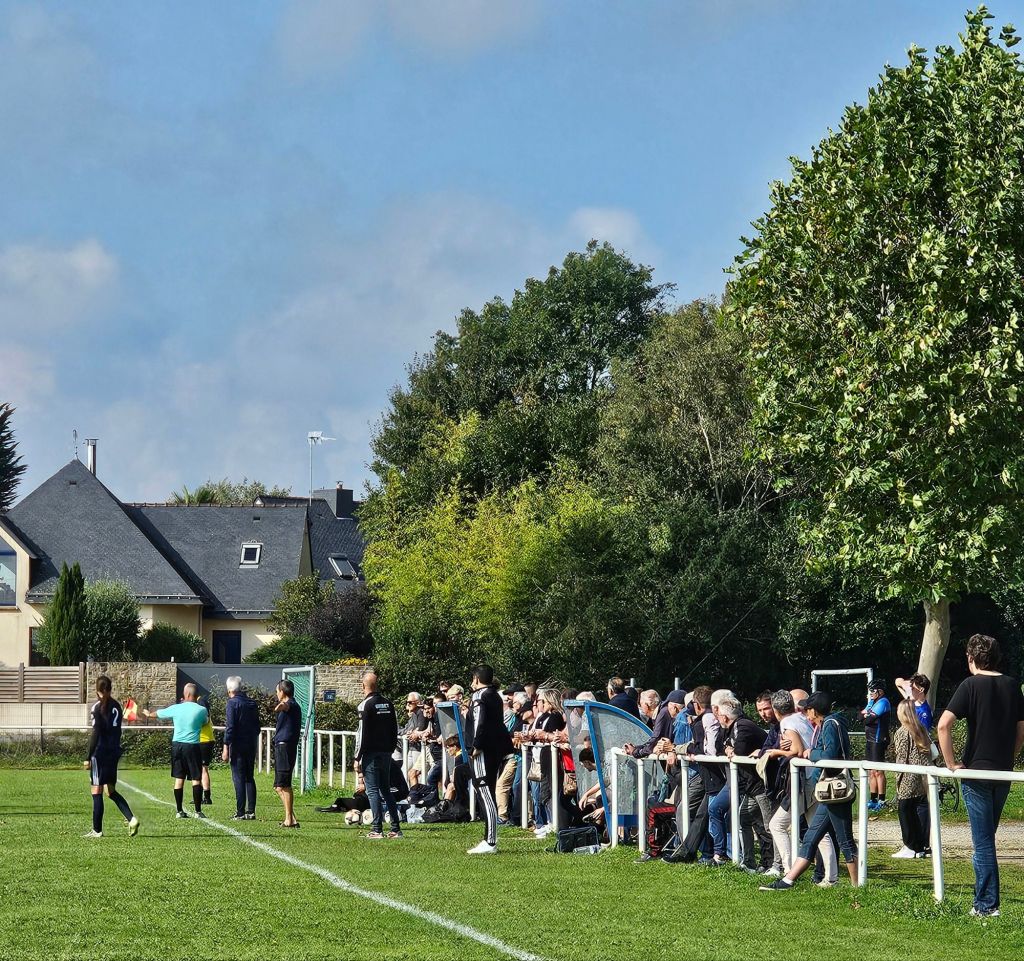
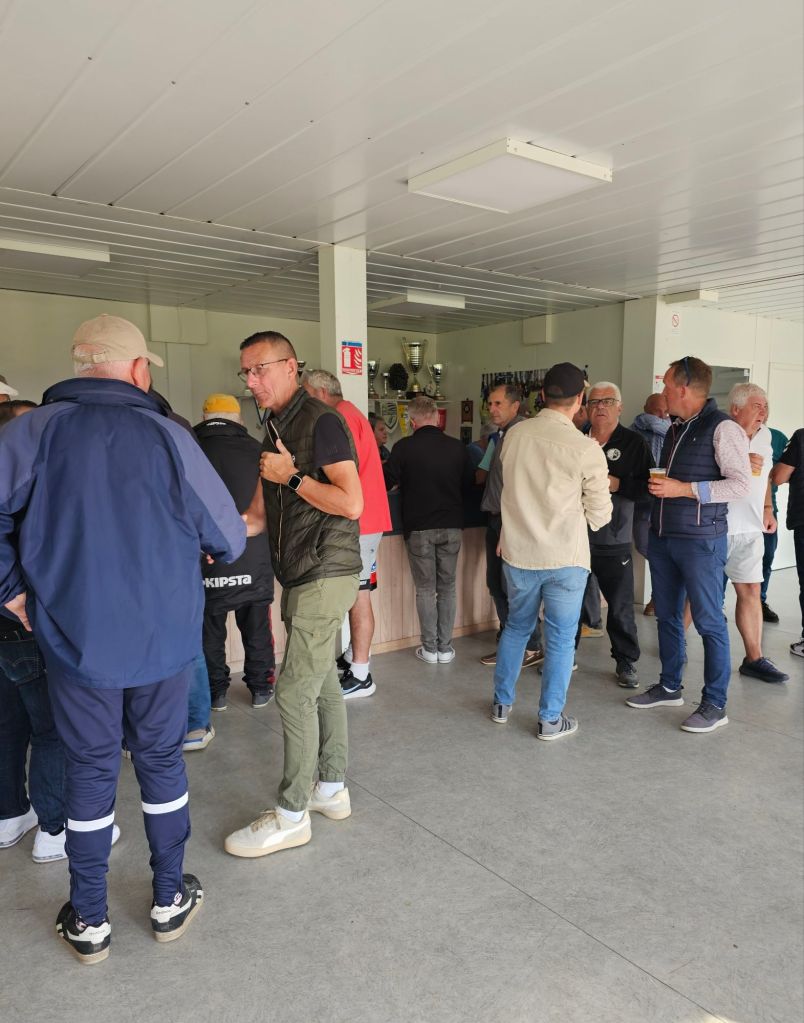
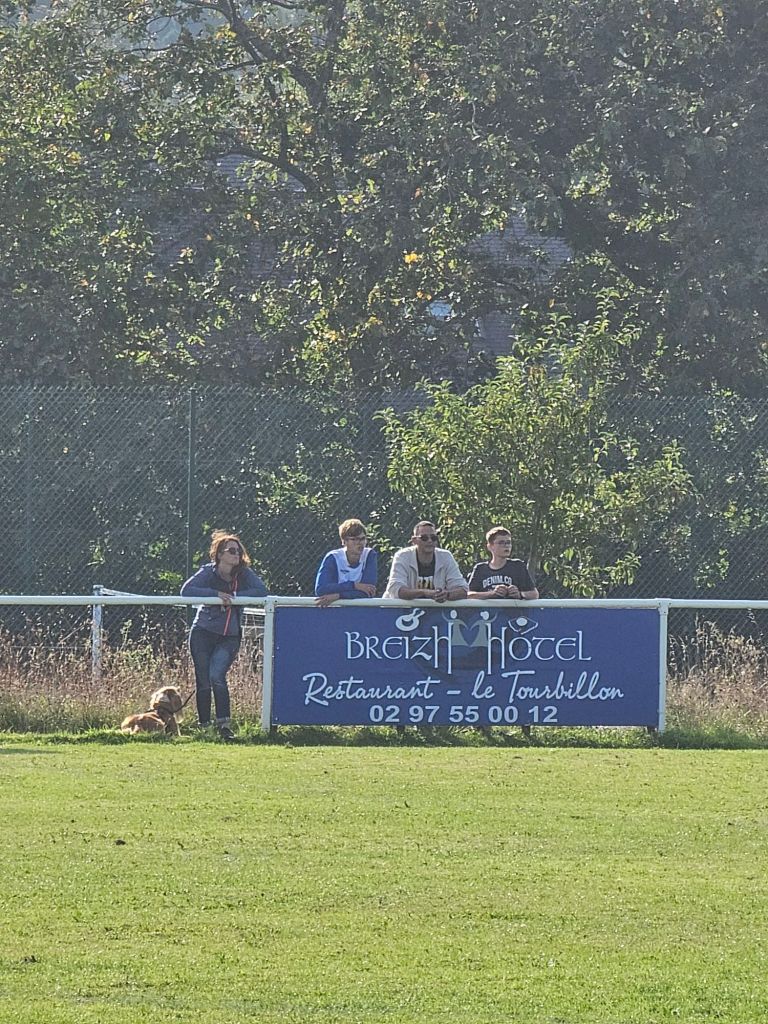
The Parc des Sports Kermouroux has no stands or floodlights, just a neat white rail all around the pitch, a couple of dugouts and a clubhouse.  The site is surrounded by houses, but on the far side of the pitch is also a playground and what looks like judiciously mowed, planted wildlife area.  The majority of the crowd lean on the rail in front of the clubhouse, inside which a couple of middle-aged women are doing a good trade in beer.  Wine and coffee are also available. 

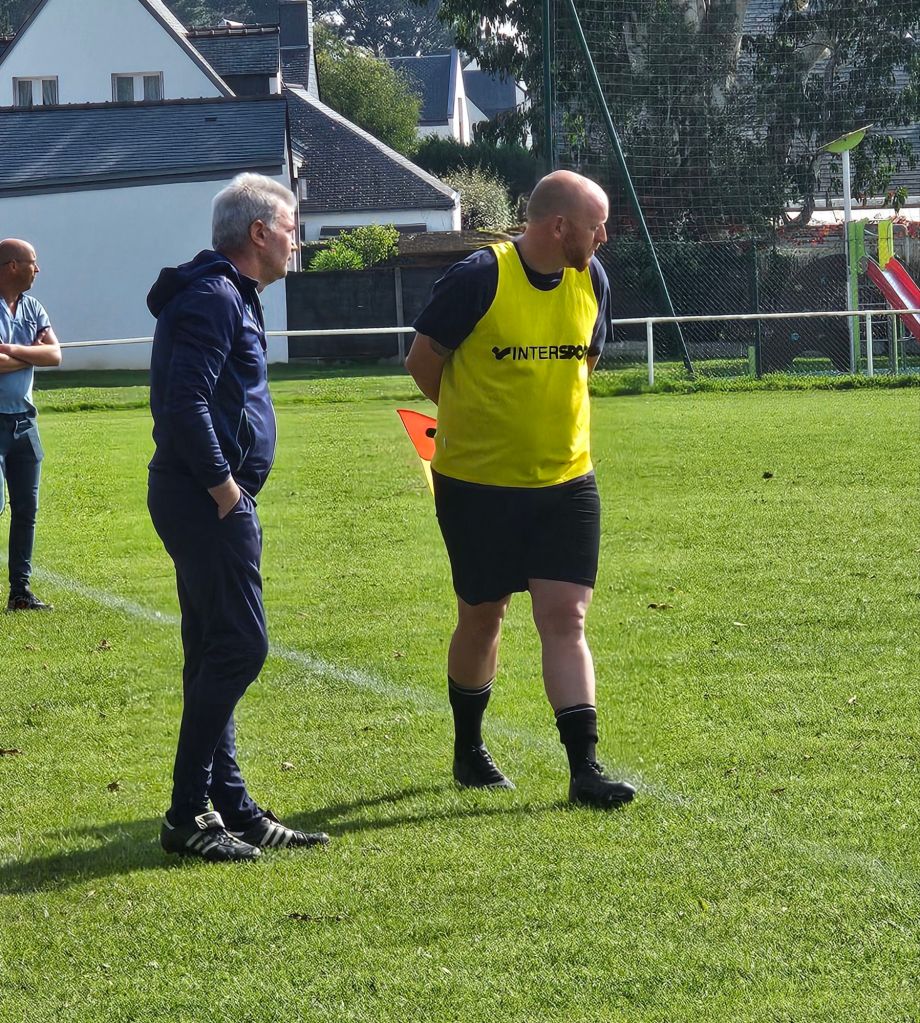
We miss the actual kick off, or coupe d’envoi as the French call it, as we find a decent spot against the rail, but we are paying attention when at eighteen minutes to four the Megalithes’ number nine bustles his way through the Riantec defence, checks and turns a couple of times and then boots the ball beyond the Riantec goalkeeper and into the goal.   Two minutes later he repeats the dose, running beyond the back four and a sluggish linesman to score from about six yards out.    The linesman doesn’t really seem to have grasped what his role is yet, but to be fair to him it does look like he didn’t expect to be linesman when he turned up, as he is wearing a day-glo yellow tabard rather than the standard officials’ uniform that the referee and the other linesman are wearing. As for the teams and their apparel, Megalithes are smart all in navy blue with white trim, whilst Riantec are less so in a messy looking combination of baggy white shirts and with streaks on,  and black shorts.

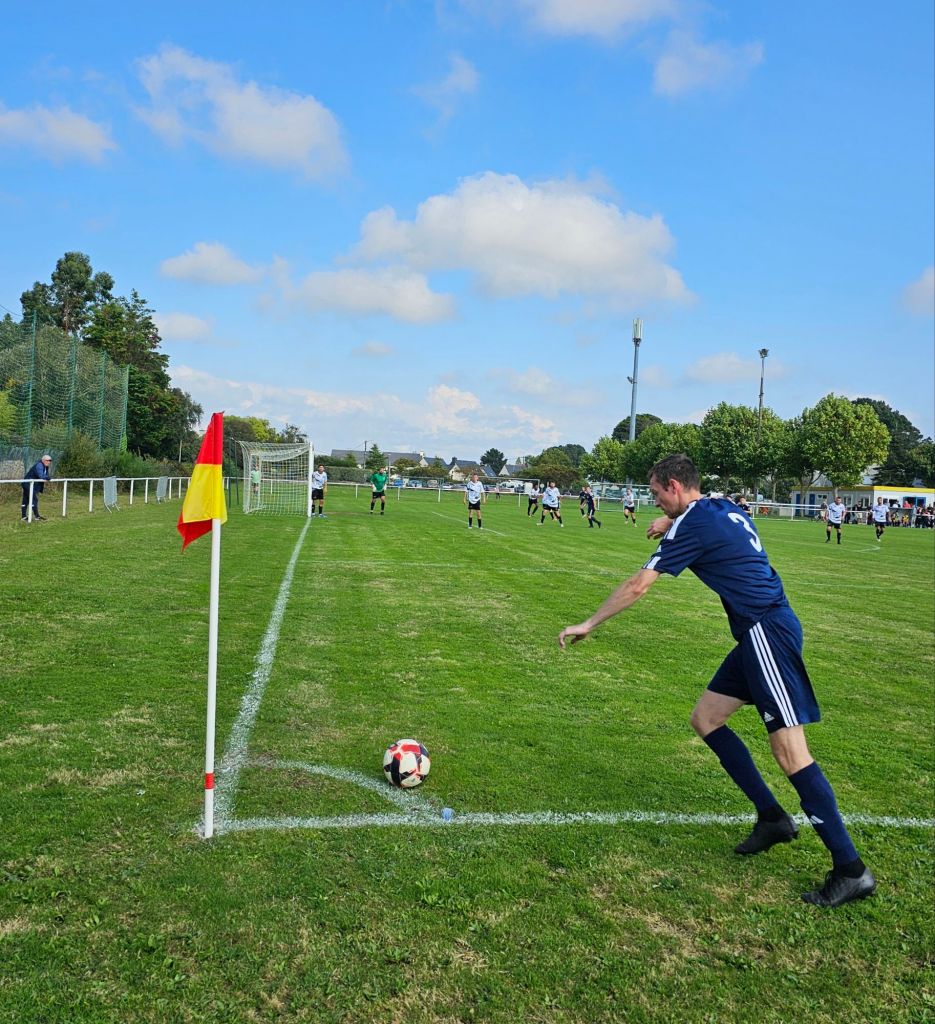
After two goals in the first five minutes, the arrival of the first corner of the match at seven minutes to four leaves everyone somewhat non-plussed.  This is even more the case when a minute later a punt forward for Riantec is met with another hopeful punt-cum-shot from their number ten and the ball sails into the top corner of the Megalithes’ net to make the score 2-1, against the run of play.  Although the goal adds to the excitement and sense of jeopardy, which I believe is what football matches are all about, I can’t help but feel a bit disappointed because Megalithes are by far the better team.

Megalithes continue to dominate the match and pass the ball well but seem unwilling to score again, although their number nine keeps threatening to nip behind the Riantec defence just as he did twice before, but he never quite manages to get his shot into the net.  Without more goals to concentrate players’ minds on keeping up to date with the score, a combination of fouls and outlandish acting creeps into the game, with more than one player letting out blood curdling screams as he collapses to the ground as if the subject of some sort of unexpected, attempted human sacrifice.

The gnarled looking, but neatly coiffured, grey-haired referee is totally in control of the shenanigans, looking down deeply unimpressed at the writhing players, whilst politely but firmly dealing with the perpetrators of genuine fouls. “S’il-vous plait Monsieur” he says politely but wearily as he beckons over the perpetrator of a foul to instruct him as to his future conduct.  In the first instance Rianec’s number eight is merely spoken to, but then Carnac’s number ten, a lithe youth with curly hair a la Adrien Rabiot, is booked after being summoned with the ominous words “Numero dix, s’il vous plait”

Half-time comes as a relief after the frustration of FC Megalithes not scoring the goals they deserve and all that falling about and screaming.  I head for the club house as the players make for the dressing rooms and am quickly acquiring two cups of coffee (one euro each), which are served from a filter coffee machine; none of your instant muck here. Paulene and I find a better position by the rail as almost everyone else heads indoors for more beer, and we nick their ‘spots’.

It is nineteen minutes to four when play resumes and within moments Megalithes number nine is centring a low cross, which number three easily and mournfully taps wide of the goal having arrived in position perfectly on time and completely unseen by the opposition.  The second half is twelve minutes old when Megalithes’ number nine elicits a fine save from the Riantec ‘keeper at the expense of a corner and then the scenario repeats itself.  Megalithes continue to dominate the second half as they had the first and the mystery of how they fail to score more goals continues every bit as mysteriously as the question of why the neolithic locals erected all these megaliths in the first place.

It is a quarter past five when Riantec win a corner and I can’t help thinking to myself that this is the first corner the away team has won, and it has taken them almost an hour and a quarter to do so.  Normal service is resumed however just two minutes later as Megalithes’ number twelve beats the offside ‘trap’, takes the ball around the Riantec goalkeeper and then places it precisely into the side netting of the goal.  A minute later Megalithes number two, a beautifully skilful player, repeats the process, taking the ball around the goalkeeper, but doing so without the necessary speed to get the ball into the goal before two defenders get back and combine to clear the goal bound ball.

Finally, and fittingly, in the final minute of the game, Megalithes place the ball in the Riantec goal to make the score justifiably, although sadly only temporarily 3-1, as almost inevitably the linesman raises his flag to declare it hors-jeu, offside, which it rather blatantly was.

The final whistle brings relief to both teams as the home side finally confirm their narrow win, and the away team gain respite from the footballing lesson they have been given.  The sun has now begun to sink low in the sky and a cool breeze has spoiled what was an almost balmy autumn afternoon for a while.  Pleasingly, the better team has won and whilst not winning by as many goals as they should have, a decent hour and a half’s entertainment has been provided by everyone involved. There is a palpable warmth and feeling of community amongst the crowd and as ever as we leave the ground and head happily  for our Citroen to make the short drive back to Carnac, our experience of French amateur football has been a pleasant and uplifting one.  Vive le Foot!

Holland 2  Dussindale & Hellesdon Rovers 1

Holland-On-Sea, Wikipedia tells us, is a suburb of Clacton-On-Sea and was known as Little Holland until the early twentieth century; it also has a football club called Holland FC.  What Wikipedia doesn’t tell us however is that Holland is just a 30 minute, thirty-eight-and-a-half-kilometre drive from my house, although Google maps does.  Stanway Rovers, Halstead Town, Coggeshall Town, Cornard United, Wivenhoe Town and Hadleigh United football clubs are all playing at home today and are probably all closer to home, but none of them are “On-Sea” and I’ve been to all of their home grounds in the last twelve years, which isn’t true of Holland FC’s Dulwich Road, where I am given to understand that the pitch, as if by some freakish movement of tectonic plates, has moved through ninety degrees in that time, throwing up a metal fence all around itself and a smart new clubhouse.  Therefore, with the promise of sea air and the prospect of a geologically formed football ground, it is on a warm but cloudy Saturday afternoon in early September that I set off in my planet saving Citroen eC4 for Holland-On-Sea.  I had contemplated catching the train to Clacton and making the half hour walk to Dulwich Road, but with only one train an hour I wouldn’t have got home until seven o’clock, and I have a wife whose heart I risk breaking if I stay out too long.

It’s an uneventful journey down the A133 and I arrive in relaxed mood in the Holland FC car park, where I have a wide choice of parking spaces; I draw up next to a modest silver-coloured family saloon, which had turned into the pebbly, beach-like car park shortly before my I and my Citroen did.  It’s not half past two yet , so I decide to take a look at the sea before entering the ground; the cliff top and sandy beach below are only 200 metres away across the grassy expanse of the Eastcliff Recreation Ground and Marine Parade.  From the cliff top, Clacton Pier is visible through the haze at the end of the beach, and out to sea sit the ranks of wind turbines that I like to think made the electricity that powered my car and brought me here.  A West Indian man of pensionable age and riding a low-slung tricycle asks me if I’m local and if I know where the Kings Cliff Hotel is.  I tell him I’m not and I don’t know where the hotel is, but I do know he is heading towards Kings Parade.  I think to myself that the ‘King’ in King’s Parade fame was probably either King Edward the Seventh or some egotistical Tendring District councillor with the surname King.

I walk back inland to the football ground up Lyndhurst Road, a typically suburban, tree-lined street of inter-war bungalows, all of which are almost frighteningly neat and well maintained. Just past a public toilet is a hedge which is teeming with bees and butterflies, mostly Red Admirals.  I am not sure I’ve ever seen so many butterflies in one place, but start to worry that wealthy local MP Nigel Farage might be having them specially bred so that he can pull their wings off or place them in his reptile-like mouth before washing them down with a pint of beer.  But then again, I don’t suppose he ever comes here; he probably gets his butterflies in Florida.

Back at the football ground, the friendly, cheery but visibly overweight man at the gate tells me that the concessionary entry fee of £5.00 applies to over sixties; I tender a twenty-pound note and receive fifteen pounds change.  After I ask if there is a programme today, I am told that the club does produce a match programme, but hasn’t done so today, which to me seems a bit lazy of them.  With the two pounds I saved at the gate by being old, I buy £1.50’s worth of tea from Jaffa’s Tea Bar.  I don’t know who Jaffa is, but his or her (it was a woman who served me) tea is pretty good, even if it is just a tea bag in a paper cup with some added water and milk.    I suspect however that the name of the tea bar is derived from the club nickname, “The Jaffas” and so the apostrophe is in the wrong place, this is Essex after all.  I wander inside the clubhouse which, although bright and new and with a display of trophies on one wall, seems a little soulless due to its grey floor, plain walls and vaulted ceiling; the only pumps on the bar are for Stella Artois, San Miguel and Carlsberg. I am pleased I bought tea and enjoy the irony that in Farage’s constituency all the ‘beers’ are, nominally at least, foreign brands.  Most of the drinkers are sat outside at an array of tables and look like they are settled in for the afternoon. 

“Are you sat here for the music?” I ask two old boys sat on stackable chairs in a covered area outside the home dressing room,  through the window of which can be heard the typical, pumped-up, high volume musical selection of the millennial footballer.  “Is that what it is?” Says one of the old boys.  I wonder to myself if Stanley Matthews, Len Shackleton and Tommy Lawton would get themselves ready for kick-off by cranking up the volume on the latest 78’s from Glenn Miller,  Al Bowlly and Bing Crosby.  With the music turned off we can hear the team talk. “It’s a long journey from Norwich or wherever they come from” says the coach encouragingly to the Holland players.

It’s not long before the teams are lining up to parade onto the pitch with the players of today’s opponents Dussindale and Hellesdon Rovers, looking suitably jet lagged.  Dussindale and Hellesdon are two suburban areas on opposite sides of Norwich, but their clubs amalgamated a few years ago and have made it into the snappily titled Thurlow Nunn Eastern Counties League First Division North and now play in Horsford, which is at least next to Hellesdon and close to Norwich airport, which is handy for away games.   After all the usual handshaking and hand-gripping malarkey, it is Dussindale and Hellesdon who kick-off towards the sea in burgundy shirts and navy-blue shorts. It’s a tasteful, if slightly dull kit and doesn’t compare with Holland’s vivid all orange ensemble.  Wikipedia tells us that the nickname of Holland FC is The Tangerines, no doubt due to the colour of their kit, but Holland’s own website refers to them as The Jaffas, although it doesn’t appear to have been updated since last May.  I wonder if there has perhaps been a referendum during the close season on what type of orange best represents the club, with members choosing to reject Satsumas, Mandarins, Clementines, Navels, Cara Caras and Easy peelers.   

The early exchanges on the pitch are typically noisy with the ball frequently flying high into the afternoon sky as an optimistic through pass for someone to chase is booted away.  “Go wide, hit the channel, good chap” bawls the Rovers’ goalkeeper revealing a hint of a Norwich accent as the ball sails in to touch.  Holland have the classic two big blokes at the back, numbers 5 and 12.  Number 12 has the sort of build which, if this were a professional game, would no doubt leave him open to chants from opposing supporters of “You fat bastard”, but he is a ‘rock’ at the back for Holland. 

I walk round the pitch to stand between the team dugouts. Holland win two early corners.  More Norfolk accents are detected on the away team bench.  Holland seem to lack club volunteers, with there being no programme today and no team sheet posted on a wall anywhere either.  The on-pitch commentary from the players however reveals that the Rovers number three is called Eggy and the number four Martin; other players have names too.

A poor back pass lets in the Holland number eleven,  who crosses in a low ball which a Rovers centre-back clears over the cross bar for corner.  It’s the first real opportunity, even if it was entirely manufactured by one team for the other.  The game is full of endeavour, but no one is capable of providing a pass that will lead to a goal. It’s a game of just shouts at the moment.  “Get out”, “First and second ball”, “What we talked about”, “Jump early”, “Ref that was blatant”, the usual anxious nonsense that the players hear every week and must get sick of.  On the Rovers’ bench the coaches are simply willing their team to do better; “Get the ball” urges one, going back to basics.  Then Rovers break down the right; number eleven scampering into the penalty area and crossing the ball low to where somebody should be to tap it in but isn’t.

“That’s the first chance of the game, and it’s to us” says a Rovers coach moments before the Holland number nine heads the ball against the Rovers cross bar from what looked like inside the six-yard box.  Fortunately, he can’t hear the cursing on the Holland bench.  It was the sort of incident that explains why the Rovers number five displays a constantly slightly worried look on his face, in contrast however to the number four playing in front of him, who is calmness personified and always has unhurried time on the ball. “Go on Matt, Dylan” shouts another coach, and I think of a parallel world where a film director working with Jack Nicholson and Charlton Heston might say “Go On, Jack, Charlton.”

 “It’s a great run again” says a Holland coach sounding like a radio commentator as Holland move forward again down the right.   The pattern of the first half has now been established and Holland are the dominant team, but with Rovers are a constant threat on the break. In midfield for Holland, number eight has a beard, and hair swept back with an alice band; it makes him look a bit like a bargain basement Alessandro Pirlo, which would explain why he is captain.  “Keep on side” shouts someone as Rovers’ number eleven breaks forward again, but he’s too late, the linesman’s flag is raised, if only that advice had been shouted sooner.

Unusually, in the final twenty minutes of the first half there are three substitutions, with Holland’s number three, who has been looking physically uncomfortable, being usurped by number seventeen, who is soon having a shot on goal well saved.  For Rovers, numbers seven and eight leave the pitch to be replaced with numbers fourteen and fifteen, like the start of a mathematical puzzle.  Just as unusual is the smell of deep-frying fish and chips that is wafting around when at half past three in the afternoon people should surely be having no more than an afternoon cup of tea and a biscuit.

The thought of tea sends me further round the pitch, back towards Jaffa’s tea bar and when I pass behind the linesmen he warns “Nothing silly” as opposing players chase another hopeful punt forward for Rovers.  The ball is soon returned to the other end of the pitch however, where Holland’s number nine shoots weakly at the goalkeeper as he redirects a square pass.  But the disappointment is short-lived as number ten finds himself in much the same position, but crucially manages to shoot past the goalkeeper and high into the net to give Holland a more or less deserved lead.

 Half-time arrives soon afterwards and teas and beers taste better than they would have if Holland had not scored, although I don’t think everyone sat drinking outside the bar noticed the goal or any of the first-half come to that.  For the second-half I decide to take up a seat in the main and only stand, selecting a spot in the middle of the second row where I can easily see most of the pitch above the metal mesh fence.   From here I can also see the sea of hipped bungalow roofs with ugly concrete tiles and the white UPVC conservatories that squat beyond the surrounding boundary fence and off into the distance.  A seagull stands and squawks from on top of a ridge tile.

The football resumes at two minutes past three and Rovers are soon seeing more of the ball than previously; they’re not playing so deep into their own half, but like Holland before the half-time break, they’re not creating many chances to score.  Suddenly, out of the blue, it all gets a bit too much for Rovers’ number nine who bawls in frustration “Fuckin’ell, fuckin’ play!”.  Moments later, as if to say “Alright, alright, keep your hair on”, his team-mates fashion a corner kick and then number fourteen becomes the first player to be booked as he fouls Holland’s number eleven.   In contrast to the increased excitement on the pitch the afternoon now feels quite still; the sky has clouded over and it’s cooler than it was. 

Despite both number nine and ten having decent shots on goal for Rovers, Holland are holding on fairly comfortably, but it must nevertheless come as a relief to them when around half past four  Rovers’ number five swings a foot to clear the ball and misses it, letting Holland’s number eight take it to the edge of the box, check inside and send a gently curling shot beyond the goalkeeper and inside the far post. Holland lead 2-0.

It’s the sort of a goal that commentators tell us will ‘wrap the game up’ and ‘put it to bed’; it’s just what Holland have been waiting for.  Two minutes later and it hasn’t, as Rover’s number ten has a shot parried by the Holland goalkeeper and number nine sweeps the rebound into the goal.  The score is 2-1 and anxiety takes hold.  It’s been a game of very few fouls, but someone cries “Late every time” when there is an accidental collision of boot and ankle, and I begin to wonder if all referees shouldn’t also be primary school teachers.

It is seven minutes to five when the game ends, and before returning to my trusty planet saving Citroen for the drive home, I pause to applaud and reflect on what has been a very good game. As I say to one of the old boys as he gathers up his sticks to toddle off home, we’ve had a decent five pounds worth of entertainment.   But shuddering slightly, I nevertheless can’t help wondering how all these people voted at the last general election.

Coggeshall Town 0 Great Wakering Rovers 3

The 22nd April 2019 was the last time I visited ‘The Crops’, or ‘West Street’ as it is now more prosaically known, to watch Coggeshall Town play. ‘Coggy’ were then enjoying the end of a successful first season in the Isthmian League after successive promotions from the Eastern Counties Leagues. The pages of this very blog recorded that the day was unseasonably warm, and on the day before “…the mercury hit 23 degrees in my back garden”, with the prospect of it getting even warmer.  Five years on, almost to the day, and it’s grey, wet, and cold and Coggeshall Town languish at the foot of the Essex Senior League, about to experience a second successive relegation, creating an unwelcome symmetry with their earlier promotions.  Weirdly, this reminds me of a Rorschach test, when it should be the other way round.

Since I first watched Coggeshall Town in late 2016, I have been meaning to travel to a game there by bus, because it seems like the responsible thing to do.  Today, with the prospect of raindrops on misted up bus windows, it is the perfect opportunity to make that tick on my non-existent bucket list.  To add to the attraction, this will be the first time I have ever seen a match in the Essex Senior League and today’s opponents are Great Wakering Rovers who, in a fortnight’s time, will contest the final of the FA Vase against Romford at Wembley.   So, I will get to see a cup final team without having the expense and bother of getting to London.  A man needs to know his limitations.

  There is a bus stop just round the corner from my house and whilst the laminated timetable hanging limply from the bus stop pole only tells me what times the buses are from Monday to Friday, the wonder of the interweb has filled in the gaps for me and at 14:18 I hail the pale grey double-decker, which is almost a minute early if the timetable and my phone are to be believed. The fare, which I pay by tapping my bank card in the modern way, is £2.00 for the 8-kilometre journey along the A120 between pale green fields of cereal and bright yellow ones of oil seed rape.   As I pay my bus fare and tear off my bus ticket, which is almost a foot long, I muse that the bus driver looks a bit like Danny Cowley, the Colchester United manager.  But Col’ U are at home to Crewe Alexandra today, so they’d miss him if he was moonlighting on the buses.  The journey takes barely ten minutes and as I alight, I make a point of getting a better look at the driver as I turn to thank him; it’s not Danny Cowley after all.  As the bus pulls away, I note that it has fleet number 33713, which seems a very big number when there are so few buses in rural Essex.

It’s a short walk from the “Nursery” bus stop on West Street to the home of Coggeshall Town, although the footpath runs out part way along and I have to cross the road and then cross back again opposite the entrance.  Luckily for me, I’m one of the Tufty generation.  Nothing much seems to have changed since my last visit here in 2019, although it’s a different bloke on the turnstile and the programme is sadly no longer one you can hold in your hand or stuff in your pocket, being out there somewhere in the ether of ‘on-line’. Entry is by cash only; eight quid.

Once through the turnstile I make my way along the concrete path to the clubhouse, with every intention of buying a glass of beer, taking advantage of the freedom given to me by my ticket to ride on public transport.  But disappointingly, it turns out that the only ‘beer’ available are bottles of something called Peroni, a brand name which always makes me think of infections of the stomach lining.  As I advise the barman that “I won’t bother”, another club volunteer places three printed team sheets on the bar and says that’s all there is as they’ve run out of paper and the printer needs a new cartridge.  I leave the team sheets for the regulars to fight over, and head outside to the tea bar to invest in £1.50 worth of tea to sip and warm my hands on as I await kick-off. There are tea bags a-plenty, and milk and little plastic spoons.

It’s not long before the teams are on the pitch and it’s Great Wakering Rovers who get first go with the ball , hoping to put it in the goal at the clubhouse and Braintree end of the ground.  The Rovers wear green and white striped shirts with green shorts, whilst Coggeshall sport red and black striped shirts with black shorts; two fine kits seen from the front, but spoilt by being solid green and solid red from the back;  although this does make it easier to read the players numbers, it isn’t as important when, refreshingly,  they only number one to eleven and not one to infinity.   I stand briefly above the grass bank on the north side of the pitch before going down into the low seated stand where talk seems to be more of cricket rather than football.  “Reggie!” shouts the Coggeshall goalkeeper randomly and my attention is drawn further to him because his yellow kit is almost luminous on this grey afternoon and he appears to be wearing huge black gauntlets, a bit like the sort a plumber might wear if sticking his hand down a toilet  “Good to see Callum start” says someone in the crowd off to my right.

Behind the Coggeshall goal, a collection of what I can only hope are Great Wakering’s most fanatical supporters are dressed as Superman, a man on a very small inflatable horse, a bottle, ‘Del Boy’ and a girl, and although the girl costume isn’t up to much, I am pretty confident that the girl really is one.  They have a drum and chant Ole, Ole Ole, and then Alley, Alley, Alley-O.  The Coggeshall goalkeeper bawls “Red, red, red, red!”  madly, like someone insane but in possession of some knowledge of public transport who has been asked what colour London buses are.   It’s five past three and a Great Wakering shot hits the Coggeshall cross bar.  Three minutes later, and suddenly the Great Wakering number ten, Ben Search, a player who had previously been notable for whinging, shoving and annoying Coggeshall players is through on goal and scores.

Given Coggeshall’s situation at the foot of the league table, it’s the sort of start I had expected them to make, but their play when not trying to score a goal is neat enough.    Unfortunately, almost every attempt to get the ball into the Great Wakering penalty area is overhit or intercepted.  Of note however is the tidy number seven for Coggeshall, Lester Ward, who is the size of Lester Piggott, and looks so young that I expect him to be substituted before the end of the match so he can go and do his paper round. Number nine Nathan Dennis is  admirable for his distinctly unathletic build  and number four Theo Duffin looks like his socks are too small. 

With almost twenty minutes gone Coggeshall’s number ten Reggie Gregory at last  forces a decent save from the Great Wakering goal keeper to earn a corner and then another before a run of offside decisions at the other end of the pitch provides some entertainment of a different kind.  The assorted coaches who populate the Great Wakering bench and technical area evidently know that their view from five or ten yards forward of the Coggeshall back line is the best place from which to judge offside decisions and the linesman on the far side would be better off sat with them.  “Get back in your dugout” shouts a Coggeshall supporter struggling in vain for a witty put down to answer the Great Wakering crew’s protests.

As the game settles back into mediocrity I admire the view beyond the dugouts, the trees and the valley of the River Blackwater, which could have been the subject of a landscape by Monet if only he’d been a follower of the Essex Senior league.  My reverie is broken by the shouts of the Coggeshall ‘keeper. “Reggie, more, Reggie more” he calls obscurely, followed by “Work Reggie” and then “Finn, Finn, Get In”, which I like best because it rhymes.  Not to be outdone, although in truth he is, the Great Wakering ‘keeper then chips in with shouts of “Up, Up!”

As the half rolls on towards the inevitable cups of tea, the linesman receives more advice from supporters behind him before Coggeshall somehow fashion what is the easiest opportunity to score of the whole match,  and then miss it as the ball is hit over an open goal from close range.  It was “easier to score” says a bloke a few seats along from me incredulously, although the meagre evidence we have suggests that in fact it wasn’t .

Before half-time finally arrives, the Rovers supporters sing one of those electro-pop songs of the early 1980’s in which the lyrics are mostly “De, de, de-de-de, de de” followed by somebody’s name, which today sounds like Harry Palmer, but is probably Harry Talbot because he’s the only bloke called Harry in the Rovers’ team.   Talbot acknowledges this accolade by getting booked and then in a more positive way by having a shot saved to earn a corner, which is the final act of the half.

In the break I invest in yet another £1.50’s worth of tea and for a change (no pun intended) pay for it using coins of the realm, which until this afternoon had sat for many months at home on my bedside table.  The match resumes at almost exactly one minute past four and I soon notice that there are some substitutes now on the pitch, with Great Wakering having introduced a balding number sixteen, who is soon side footing a shot directly at the Coggeshall goalkeeper after a low cross.  A minute later the name of Coggeshall’s number five, Demi Nicolauo joins that of Harry Talbot in the referee’s note book and a few minutes after that another substitute, number fifteen for Great Wakering, breaks forward unopposed down the right before carefully placing his shot hopelessly wide of the far post from a good 20 metres out.

The second half is mostly being dominated by Great Wakering, but amongst some crowd members the suggestion is that it’s not always by fair means. “Ref, watch that number four for Christ’s sake –  Every time”  advises one home fan near to me.  Just before half-past four the score becomes 2-0 to Great Wakering as their Harry Talbot scores from close range and inspires Superman, the man on the inflatable horse, the girl and friends to launch into a rendition of Depeche Mode’s “I just can’t get enough”.  My hands are feeling cold now and I don the fingerless gloves that my wife knitted me the winter before last and which I keep in the pockets of my coat.

“Stay solid, Compact” is the counsel of the Great Wakering goalkeeper as his team seek to see out the final fifteen minutes of the league season, but in time Coggeshall breakaway with number nine Nathan Dennis, although unfortunately, despite a decent run he can only shoot wide, possibly because his shorts are too tight.  “We go again” calls the Coggeshall goalkeeper encouragingly before having to make a couple of decent saves to keep his teams deficit down to two goals.  At just gone twenty-five to five however, the score becomes nil-three as a low cross from Harry Talbot reaches the far side of the goal where number 14 Jack Nolde is stood all alone, and barring calamities cannot miss, he doesn’t.

The game is now won, and lost, but the visiting team’s goalkeeper is taking no chances and advises “Don’t take your foot off, don’t take your foot off” before saying the same thing again for a third time, just in case.  It’s hard to tell whether feet are taken off or whether fate just plays out that way, but Coggeshall win a corner and well into injury time substitute Arthur Massingham shoots over the cross bar.  Either way,  it’s all to no avail, and after five minutes of additional time the game ends, Great Wakering have won comfortably, and it seems that Coggeshall have ended their season in much the same way as they played the rest of it.

There is applause for both teams as Coggeshall Town leave the pitch and Great Wakering Rovers form a huddle before going to commune behind the goal with the man on the inflatable horse, Superman and the girl.  I have only been to a couple of non-league matches this season, but they are still life affirming despite occasional stupidity  on the pitch,  and as I walk back to the bus stop I hope I shall get to a few more next season, it only remains to hope that there will be beer.