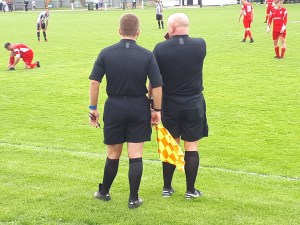
Little Oakley 1 Barking 1

The village of Little Oakley in Essex, Wikipedia tells us, had a population in 2011 of 1,171 and is on the outskirts of Harwich.  More precisely, Google maps tells us that Little Oakley is a four kilometre, fifty-eight minute walk from Harwich International railway station.  Now, I reckon I could walk 4 kilometres in less than 58 minutes, but I am nevertheless of a lazy disposition and therefore, today I have opted to drive the thirty-six kilometres from my house to the Memorial Ground, home of Little Oakley FC in my planet saving Citroen e-C4,  rather than enjoy a travel melange of rail, bus and walking, which would take me between one and  half and two and a half hours depending on connections.  Today at the Memorial Ground, Little Oakley FC are playing Barking in the Essex Senior League, the ninth level of English league football.

It’s a beautiful, bright, clear, winter’s day and but for a Luton van pulling out in front of me from a lay-by on the A120, I have a relaxed, trouble-free journey, played out to a soundtrack of the Saturday afternoon pre-match football coverage on BBC Radio Essex, featuring amongst others, the dulcet tones of Glenn Pennyfather and Danny Cowley.  My Citroen’s SatNav doesn’t seem to know about the Memorial Ground, so my journey ends with an abrupt left hand turn when suddenly from the B1414 I see the street sign for Lodge Road, which I remember from looking at a map is adjacent to the Memorial Ground.  I park up at the side of the narrow approach road, beneath an avenue of trees with a deep ditch on one side and wooden fence on the other on which several signs plead with drivers not to park too close to it.  I make the short walk to the clubhouse enjoying the sound of birdsong whilst inhaling the smell of hot cooking oil, probably chip fat.
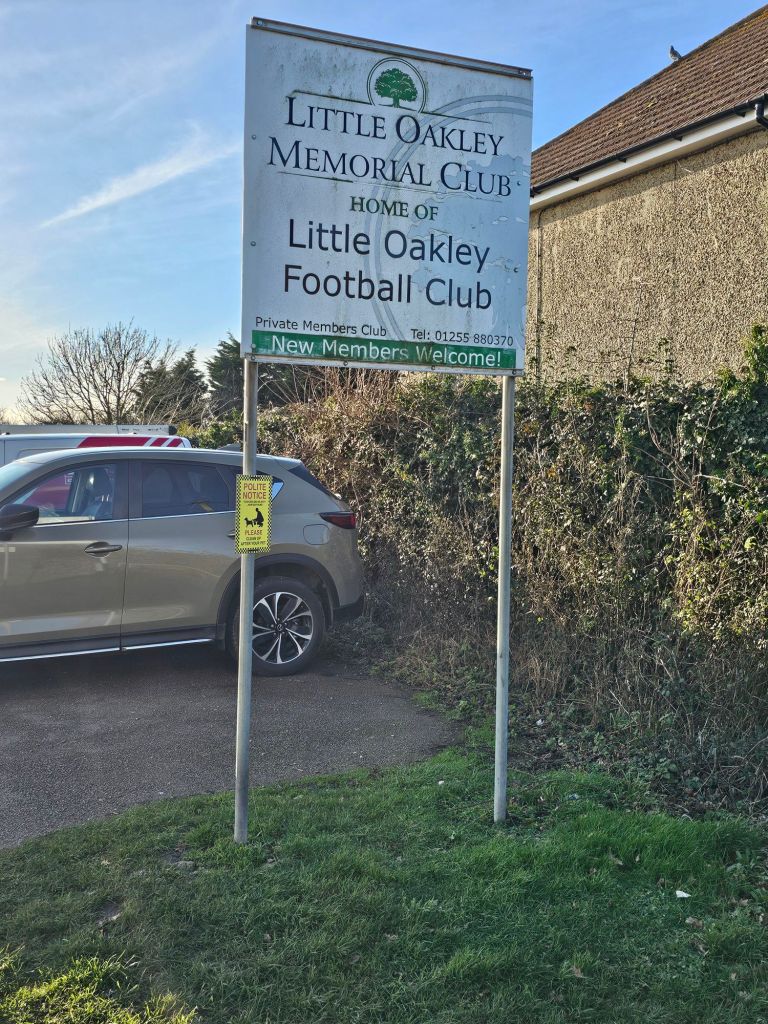
The clubhouse is welcoming and populated with happy pre-match drinkers.  I buy a bottle of Adnams’ almost non-alcoholic ‘Ghostship’ (£3.20) and the bar maid asks if I’d like a glass, I would. I stand and look up at one of three TV screens showing Sky TV.  From a hatch, behind which is the clubhouse kitchen, a middle-aged woman looks out glumly. “Fed up?” I ask her.  “Bored” she says “It was busy, and now it’s quiet”.  This lady seems responsible for fulfilling the whole crowd’s need for food and hot drink on her own but it will soon be kick-off, so for now she’s not needed.

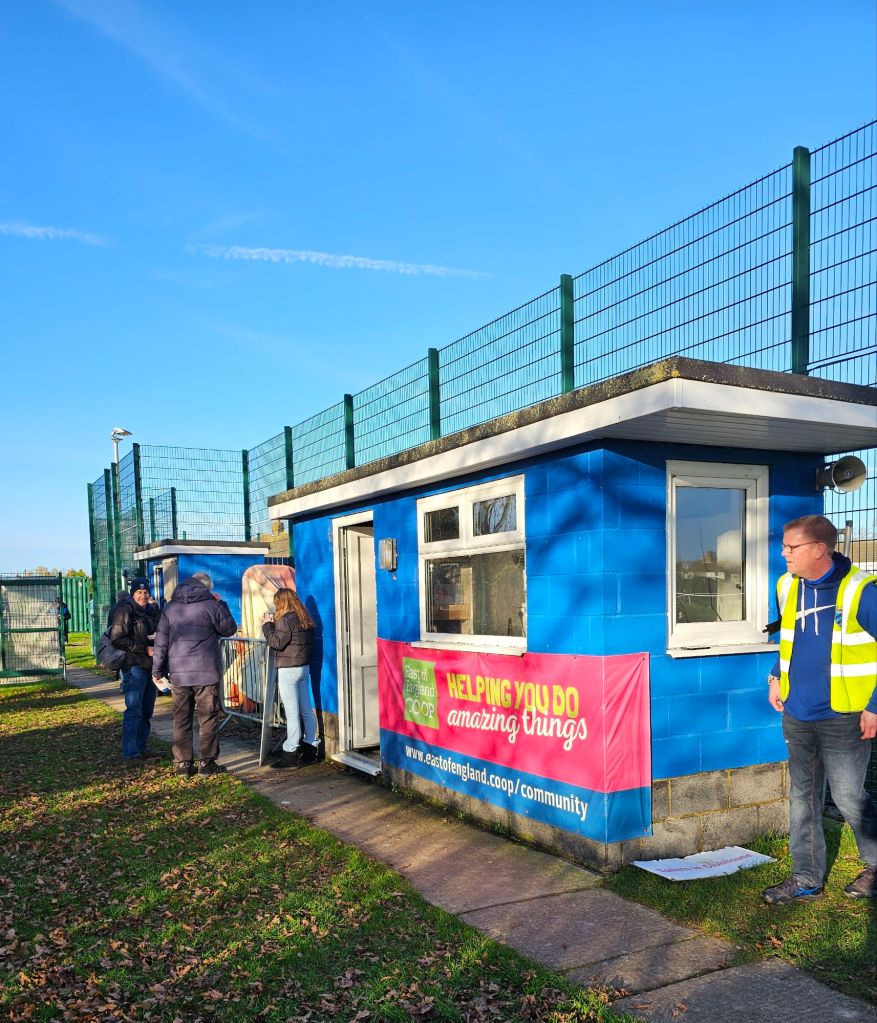
I sink my low alcohol beer as quickly as I can without burping and head outdoors where a man with a loud, deep voice directs me to turn left beyond the shipping container at the far end of the car park.  A short, friendly man emerges from a hut, a bit like municipal car park attendants used to in the far off days before ‘Pay and Display’, and asks if I’m a concession.  I ask how old you have to be to be a concession; it turns out it’s sixty-five and he apologises when I tell him I’m only sixty-four. But it does mean I’m about six months further from the grave than I would have been if I’d been a concession, even if I will be three quid poorer for it.  Having handed over my £8.00 in cash, I ask if there is a programme and am surprised to find that there is. “Here you are, if you’d like something to read” says the man, handing me six colourful sheets of A4 paper stapled together in the top left-hand corner.  Best of all the programme is free, as if a little bit of France has been re-located to the top right-hand corner of rural Essex.

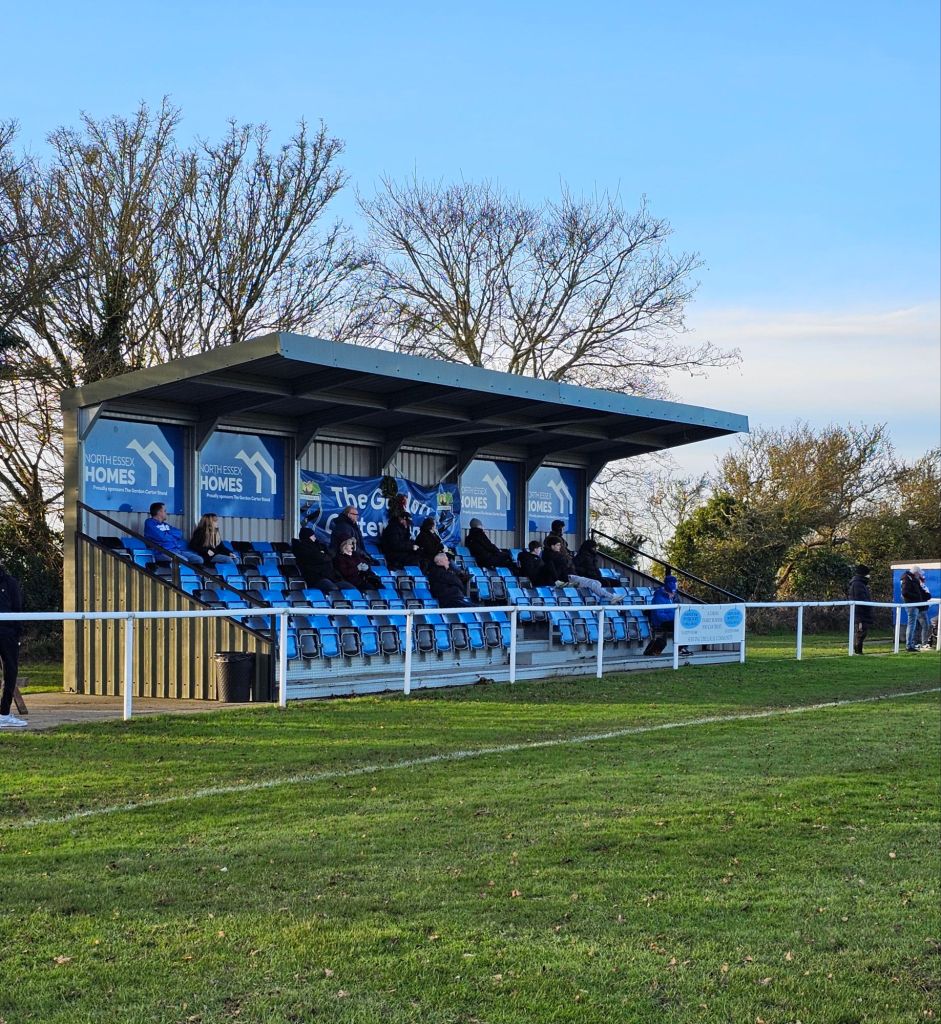
Pap-rock plays over the public address system as I take stock of the ground, which has two small pre-fabricated metal terraces behind one goal and another pre-fabricated metal stand with seats overlooking the far half of the pitch; it looks as if there wasn’t room behind the dugouts for the stand to be level with the half way line.  The ground backs onto a hedge and a couple of Oak trees on one side and onto the gardens of a row of semi-detached houses on the other.  At the far end there is just a playing field and a trio of teenagers have leaned their bikes against the rail around the pitch. I can also see from here that the clubhouse appears to have a partly corrugated metal roof; I bet it rattles when it rains.

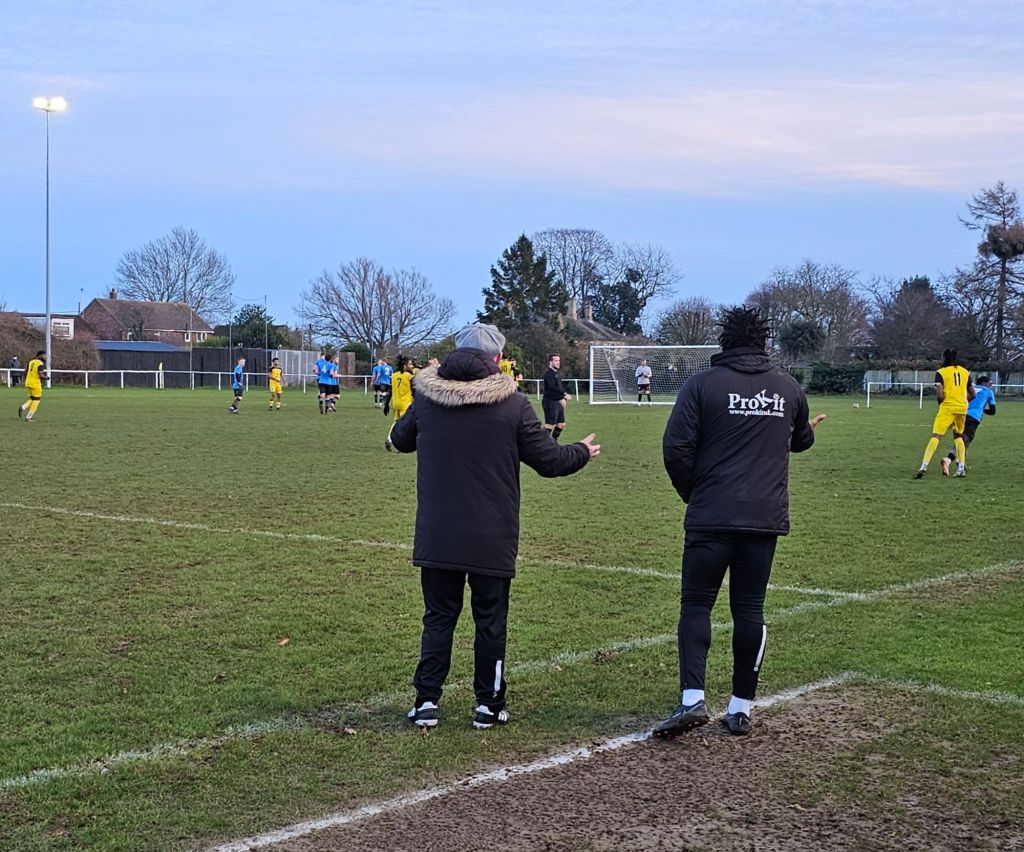
The pap-rock gives way to Jeff Beck’s ‘Hi-Ho Silver Lining’ and the two teams amble onto the pitch; if there is any shaking of hands or other gestures of sportsmanship I miss them. I stand close to the home team dugout and next to me a man talking into his mobile phone says “We got two meal deals at the Co-op before we came out, so we ‘ad them”.  In the ‘technical area’ in front of the dugout, a track-suited man calls out to the home players “Ave a look, ‘ave a look, just be aware of the fuckin’ double bluff”.  I have no idea what he means, and decide not to ask him.

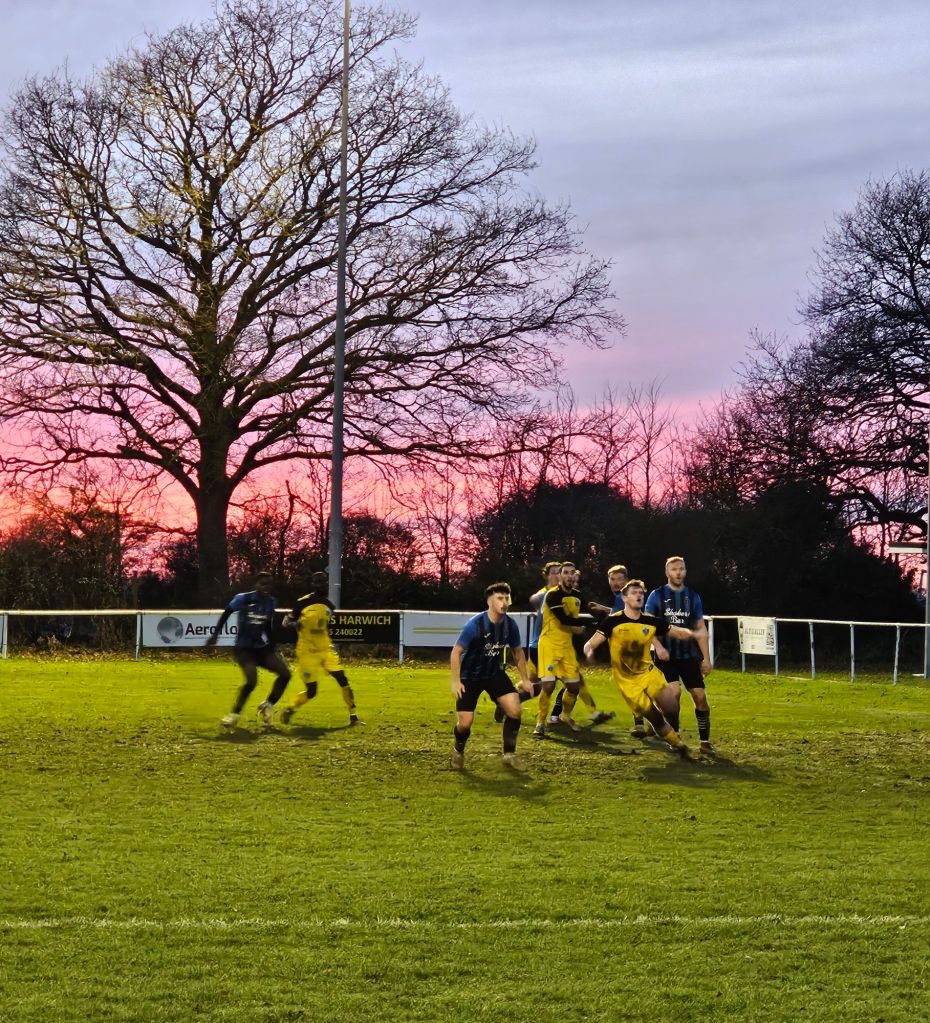
The match begins, and Barking get first go with the ball, their second touch being a hefty hoof out to the left wing.  Little Oakley, known as ‘The Acorns’ are wearing blue and black striped shirts with black shorts, a bit like a destitute man’s Inter Milan and are defending the empty, featureless end of the ground with marshes, Hamford Water and the North Sea a kilometre or two beyond.  Barking are all in yellow, with black sleeves, and they defend the clubhouse and Ramsey end of the ground, with the River Stour and Suffolk beyond that.   Barking win an early corner with some clever play by their number seven Michele Maccari. “Why’s that big guy on the edge? ‘e’s got a massive head on him” asks a lad sat behind me of his two friends, who I think could all be Little Oakley players who are not playing today. The ‘guy on the edge’ is stood at the edge of the penalty box and whilst he is quite tall, I must admit I can’t really see that his head is any bigger than anyone else’s.
“Barking, Barking give us a song” chants a bloke tamely, somewhere off to my right.  “If you all ‘ate Dagenham clap your ‘ands” comes the response from three or four other voices.  Unfortunately, Little Oakley has no such choir. It’s just gone a quarter past three and despite Barking probably playing, or at least attempting to play the more attractive and neater football, it is Little Oakley who have the first decent shot on goal, as number ten, Daniel Rowe spectacularly volleys the ball against the foot of a goalpost creating a pleasing metallic pinging sound. Recovering from the momentary excitement, I notice that between the semi-detached houses on the far side of the ground and across the water inbetween, I can see two dockside cranes at the Port of Felixstowe, beyond which and unbeknown to me, Felixstowe & Walton Football Club are on their way to drawing nil-nil with Haringey Borough in the Isthmian League.

Barking make claims for a penalty as one of their number tumbles between two Oakley defenders and at this point the referee seems to lose any affection the visitors might have once had for him. “You’re a joke ref” calls a man from behind a camera with a tele-photo lens, “Absolute clown ref”.  It’s nearly twenty-five past three and all of a sudden Barking take the lead; a clever, arcing cross being headed in at the near post by number six and captain Fahad Nyanja.

As the game is about to resume, an Acorns’ player calls out “We keep going, we fucking keep going”.  It is stating the obvious and I for one would feel a bit short-changed if this early in the game they’d all along been secretly playing ‘next goal wins’ .  As unnecessary as it should be, these apparent words of encouragement nevertheless almost work but in an unexpected way, as a low cross from the Oakley number seven, Idris Namisi is diverted against a goal post by Barking number four Sam Edwards.  Idris Namisi seems a popular player amongst the home crowd, and I can’t help but like him too, even if it’s probably because his first name is the same as that of the dragon who lived in the firebox of Ivor the Engine.

Oakley’s number ten, Rowe claims the honour of being the first player to be booked as he pulls back a Barking player and I agree with the old boy stood next to me, whose grandson is the Oakley number eleven, Luke Hipkin, when he says it was a needless, stupid foul.   The old boy asks me if I’m from Harwich and I tell him I grew up in Shotley just over the river from here. “Not far away, then “. He says. ”Not if you’ve got a boat” I reply.  Back on the pitch, the Oakley players are arguing amongst themselves. 

The half ends with Rowe being put through on goal for Oakley with just the Barking keeper to beat, but his shot is saved and Idris the popular dragon blazes the rebound high and wide.   I check my phone and Ipswich are losing 0-3 at Liverpool, which makes me glad I’m here and not on Merseyside.   With the half-time whistle I make for the club house to drain off excess low alcohol Ghostship and invest in one pound fifty’s worth of tea, because under a clear sky it’s beginning to get cold as the sun sinks in the west.  The middle-aged woman in the kitchen is being cheerfully rushed off her feet serving tea, frying chips, griddling burgers and taking cash and card payments. I can’t help but think it’s a pity the players and managers of both teams can’t just get on with what they’re meant to be doing with as little complaint. I haven’t heard her say ‘fuck’ once.

I take my tea outside into the softening, late, winter afternoon sunlight and the match resumes at two minutes past four; I stand by the Barking dugout. “Get ‘old of the fucker” barks the Barking manager  a seemingly irascible  man sporting a stylish grey cap and white goatee beard, who sounds like Ray Winstone and mostly never says ‘fuck’ or ‘fuckin’ in a sentence unless he can say it half a dozen times.  Mostly, his exasperation seems to be directed at his own Barking team who, I can only guess, aren’t playing so much like the Spanish national team, as may be he told them to.

Time goes on and Barking’s number eleven Ugonna Emineke is booked for time wasting as he delays taking a throw-in because there is a rumpus happening in the penalty area and he’s waiting for it to subside.  Unfortunately for Emineke, the referee only had eyes for him and hadn’t noticed the pushing and shoving in the penalty  area, although before the throw is eventually taken he has to go and sort it out and speak to his assistant about it. Then, with twenty minutes of the half gone Oakley equalise, Idris Namisi nipping in to poke a cross over the goal line from close range.

As it has progressed, the game has become increasingly fractious, with a number of Acorns players being quite aggressive, whilst Barking players have acted out fouls where none has been made, sometimes squealing and moaning for additional effect.  All this has been against a  background of some of the most  liberal use of the word ‘fuck’ I have ever heard and I wonder what people do during the week to make them so angry on a Saturday.

Things don’t improve when at twenty-seven minutes to five Emineke is sent off for a ‘professional’ (or, as this is only the Essex Senior League perhaps ‘semi-professional’) foul, and The Acorns are awarded a penalty, which the balding and bearded Darren Mills takes and Daniel Purdue saves, diving excellently to his right.  “How many more fucking chances do we get?” moans The Acorns’ number three Adie Cant.  “Calm the fuck down” shouts the coach “Fuckin’ ‘ell”. It’s as if Peter Cook and Dudley Moore’s Derek and Clive had had an afternoon out at the football.

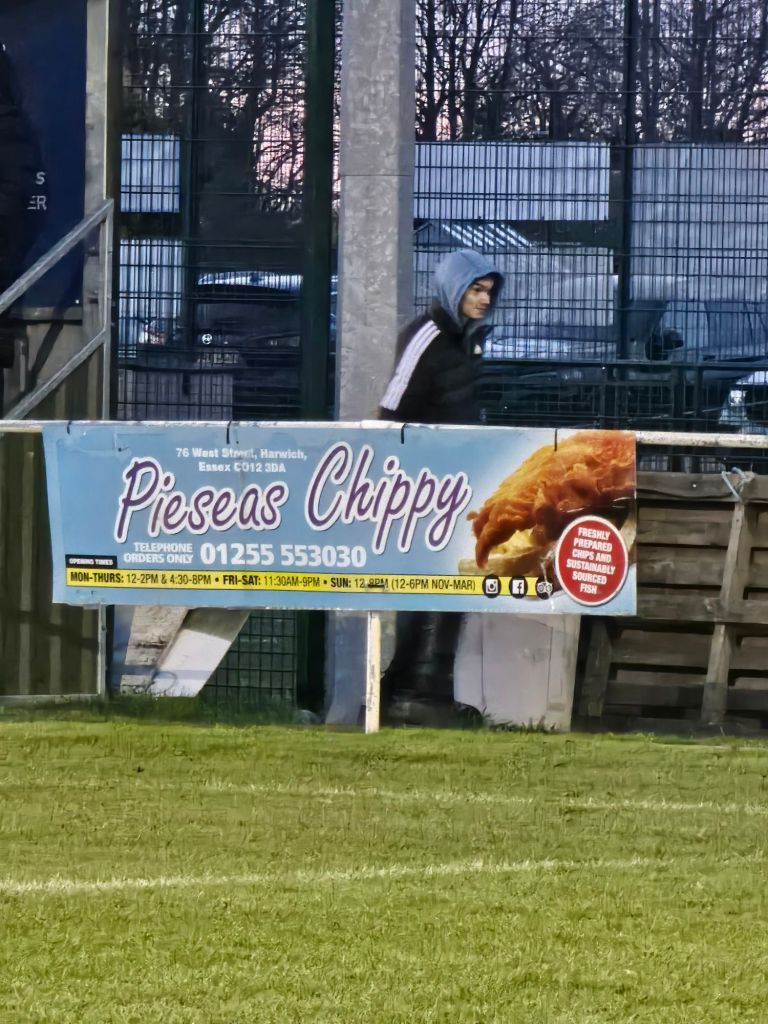
With the aftermath of the penalty, the worst of the afternoon’s fractiousness is over and much  of the final twenty minutes plays out against the back-drop of a glorious, blood red sunset,   A friendly man wearing a day-glo gilet bearing the words ‘LO Media Officer’ on the back, talks to me briefly and asks if I’m a ground hopper, “Not really” I tell him, “ I usually watch Ipswich”,  although I don’t let on that for forty years I’ve kept a list of every game I’ve ever been to.  He’s soon photographing the main stand against the sunset however, and the match plays out shifting freely from end to end,  but with neither side looking much like scoring the winning goal. Meanwhile, I wonder at the name of a local fish and chip shop, Pieseas Chippy, which is advertised at the pitch side.
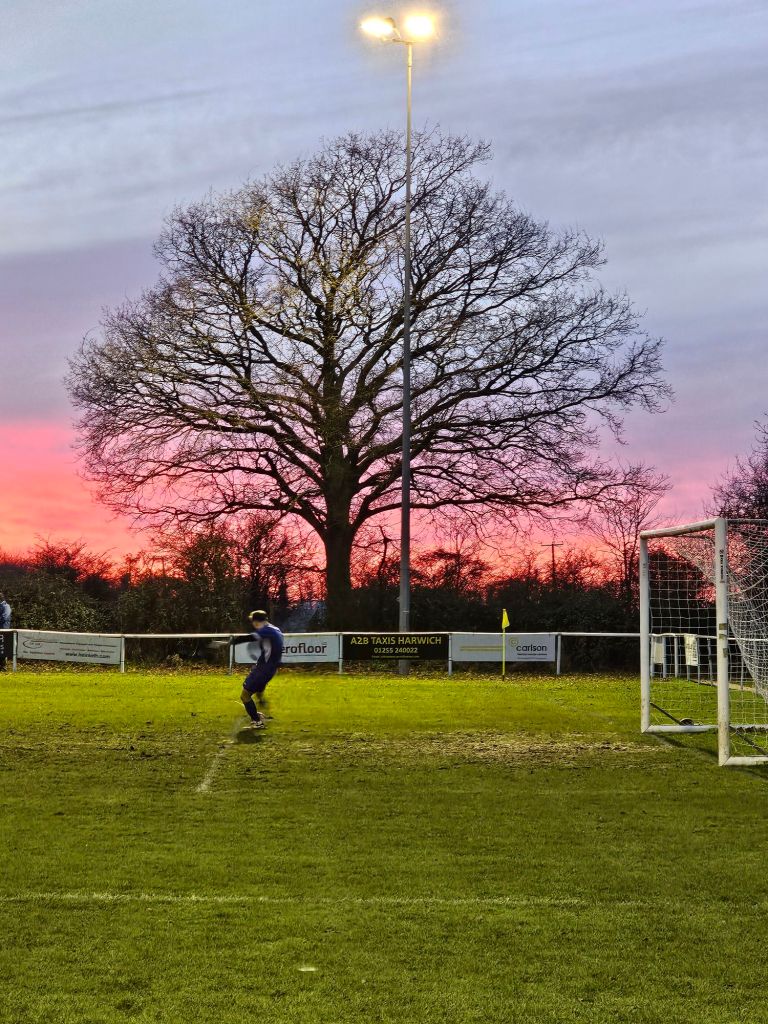
The final whistle blows at eight minutes to five and an appreciative crowd applaud the efforts of both teams in a match which whilst mostly not a thing of beauty, apart from the sunset, has been entertaining and hard fought.  I think a draw is a fair result although home fans might not agree, and as I head for my car I hear a man muttering to himself about the ‘village team’ holding the team from the city (Wikipedia tells us that in 2011 Barking had a population of 59,011) as if the moral victory belongs to Little Oakley.  Perhaps it does, but even if it doesn’t it’s been a lovely afternoon out.

Ipswich Town 1 Cheltenham Town 1

In the final scenes of Lindsay Anderson’s 1968 film ‘If’, the central character Mick Travis, played by Malcolm McDowell, and his nameless girlfriend launch a machine gun attack on the parents, teachers and governors at a school speech day.  The scene was filmed at Cheltenham College and it’s one of my favourite scenes in one of my favourite films; Wikipedia tells us that ‘If’ won the Palme d’Or at Cannes in 1969 and in 1999 the British Film Institute ranked it as the 12th greatest British film of all time.  As if that association with such a great film is not enough kudos for Cheltenham, it also has a football team that has never lost to Ipswich Town. Today Ipswich Town and Cheltenham Town meet at Portman Road for only the second time in recorded history.  I don’t know it yet, but later today I’m going to feel like Mick Travis.

In north Essex it has been a stupendously dull morning, both still and depressingly grey, like November days should be. It’s only when I approach Ipswich that a diffuse yellow light begins to filter through the grimness and then bright sunshine bursts from a clear blue sky like a metaphor for the end of the working week and the arrival of Saturday, heralding a match at Portman Road.  Before the game I visit my mother and we reminisce about all manner of things from years ago and she tells me how her grandfather, Sam Scarff, an agricultural labourer from Needham Market, enrolled with a friend for evening classes, joined the police and rose to the rank of inspector in the Met’ before retiring to become a game-keeper in Shotley; his friend became a police commissioner, and I thought social mobility was a 1960’s thing.

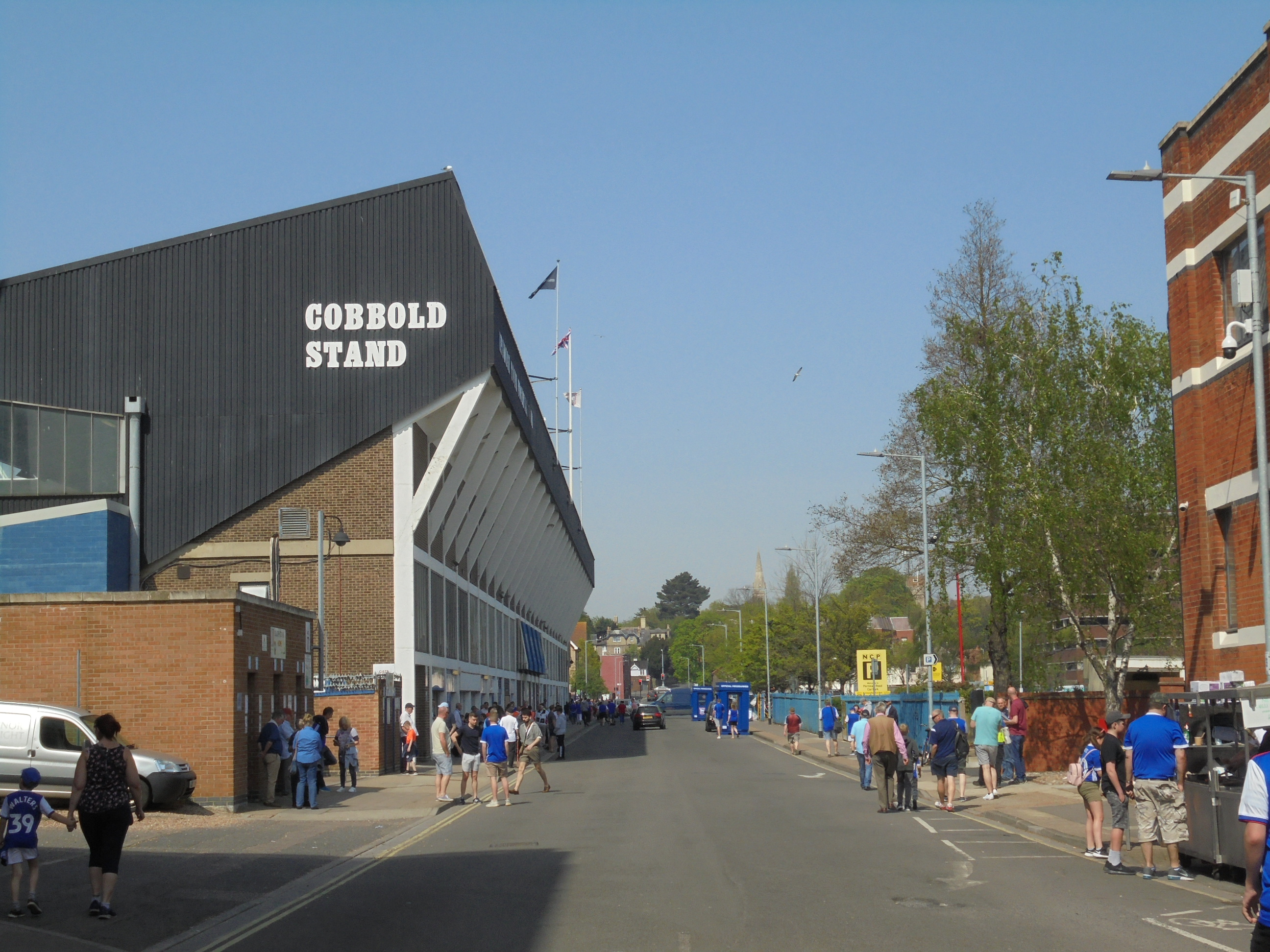
Leaving my mother with her memories, I drive across town and park up on Chantry. The streets are busy with people in football-supporting attire. I walk across the wet grass of Gippeswyk Park and marvel at how lush and green the turf now is compared to how dried up, brown and withered it was on the first day of the football season three months ago.  In Sir Alf Ramsey way I attempt to buy a programme (£3.50) in the modern cashless manner, but the technology isn’t working today.  I laugh and hand over a five pound note to the somewhat miserable and overweight looking youth in the programme booth.  The Arbor House, formerly known as The Arboretum, is busy with pre-match drinkers, but I am served quite quickly and order a pint of Nethergate Complete Howler (£4.00). I head for the garden where Mick is already sat at a table with a pint of a dark beer from the Grain brewery which he’s not very keen on, I take a sip and agree that it’s not exactly moreish, but then the Grain brewery is located in Norfolk, albeit with an IP postcode.  Before long Roly joins us and proceeds to dominate the conversation, mainly because he seems to have the ability to talk without drawing breath, which means a polite person like me can’t get a word in edgeways, not that I have much to say.  We, by which I mean mostly Roly, talk of local council chief executives, Roly’s five-year-old daughter Lottie, primary schools on the Essex Suffolk border and the performances of Town player Dom Ball.  Between twenty-five and twenty to three we leave via the back gate of the beer garden and head for Portman Road.  I bid Mick and Roly farewell by the turnstiles to the Magnus Stand, formerly known as the West Stand.  We speak briefly of when we will next meet; it will be for the five o’clock kick off v Buxton in the FA Cup on Sunday 26th November.   I won’t be going to the mid-week game versus Portsmouth as I am boycotting the Papa John’s EFL Trophy, not because I have anything against oily, takeaway pizza, but because I think the competition has been debased by the inclusion of Evil Premier League under-21 teams.  I am particularly looking forward to not going to Wembley should Town make it to the final, when I will blow a metaphorical raspberry to all those people who believe that anyone boycotting the competition will automatically abandon their principles if Town get to the final.  Such beliefs help explain why we have a Tory government.

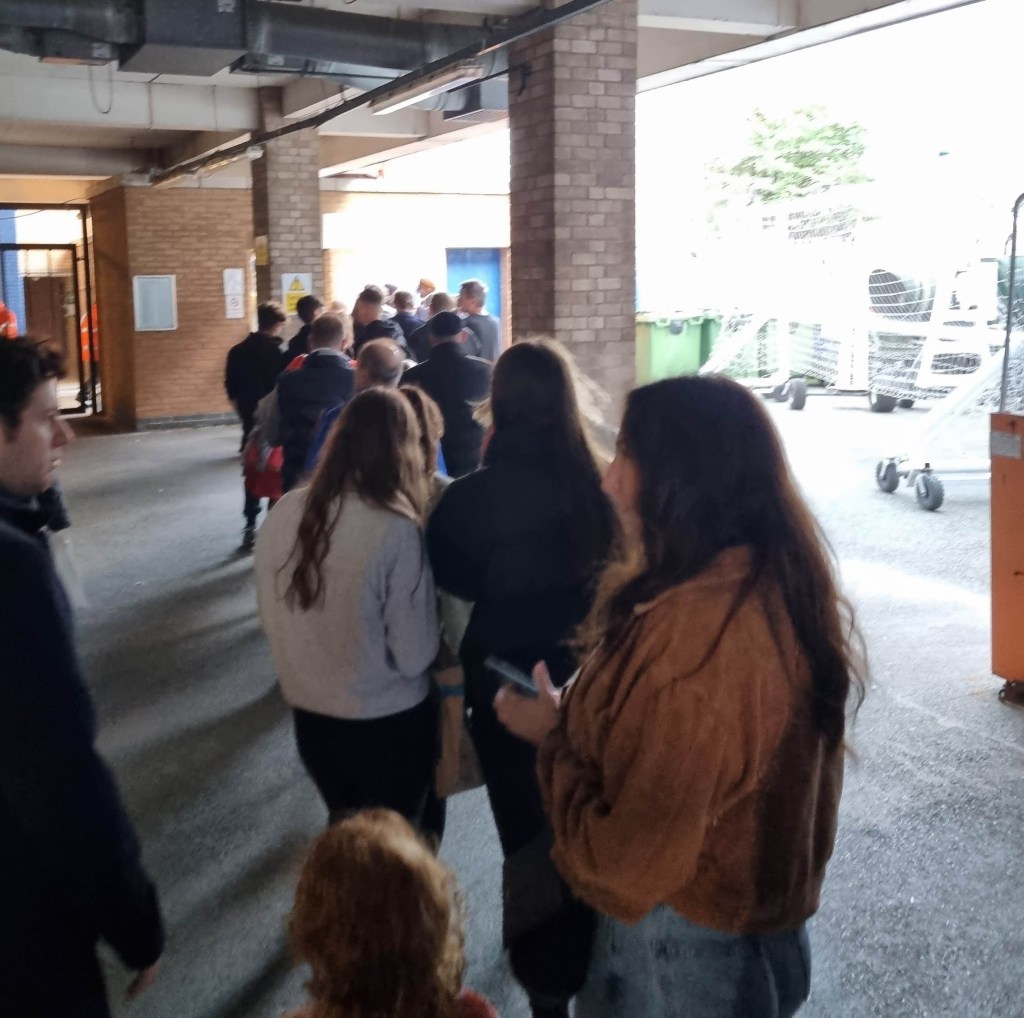
Most unusually, today there is a queue at the turnstiles for the Sir Alf Ramsey Stand which are accessed from Constantine Road, but quite soon an extra turnstile opens up (No61) and a cheerful man presents bar codes to a screen and I pass through the portal to another world.  That pint of beer has already found its way to the exit and from the gents beneath the stand I hear stadium announcer Stephen Foster reading the team line-ups from the scoreboard in his best local radio DJ voice.  I arrive at my seat just as a minute’s silence begins for Armistice day, although that was actually yesterday.  Oddly, the Football Association have decided not to cancel the fixtures today as they did when they felt they couldn’t trust football crowds to observe a minute’s silence for the death of Queen Elizabeth back in September.  The minute’s silence is of course observed perfectly. Stephen Foster reads from Laurence Binyon’s 1914 poem ‘For the Fallen’ and the last post is played exquisitely, even if it does slightly spoil the solemnity and dignity of the moment to then be told by Stephen Foster that Jon Holden who played it is a member of the Co-op East of England Brass Band.  It’s probably just me, but I can’t help sniggering a little at any mention of the Co-op.

After a fly-past by a couple of Army helicopters, and a brief burst of ‘Hey Jude’, the game begins with Town getting first go with the ball and kicking towards me , Pat from Clacton, ever-present Phil who never misses a game, Fiona and the man from Stowmarket.  Town are thankfully back to wearing their blue shirts and white shorts after the all-black aberration against Derby, whilst Cheltenham Town are wearing red shirts and shorts with their ruddiness off-set by white socks and a white pin-stripe on their shirt fronts.  Quickly, Portman Road sounds in good voice as the altered version of ‘Mary’s Boy Child’ in which she eternally fights Norwich on Boxing Day rings around the ground.  On the touchline, Town manager Kieran McKenna is looking stylish, if a little drab in a black jacket and trousers with a plain jumper, which I at first think is beige but then think is grey; perhaps it’s taupe?

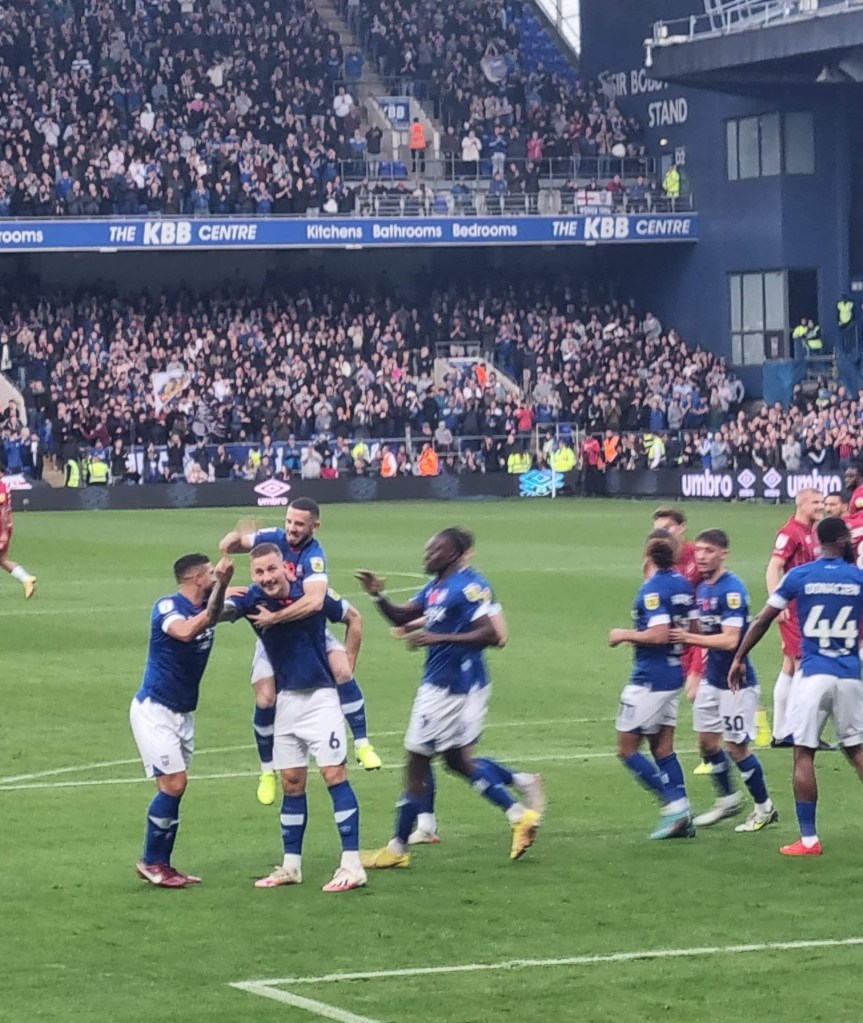
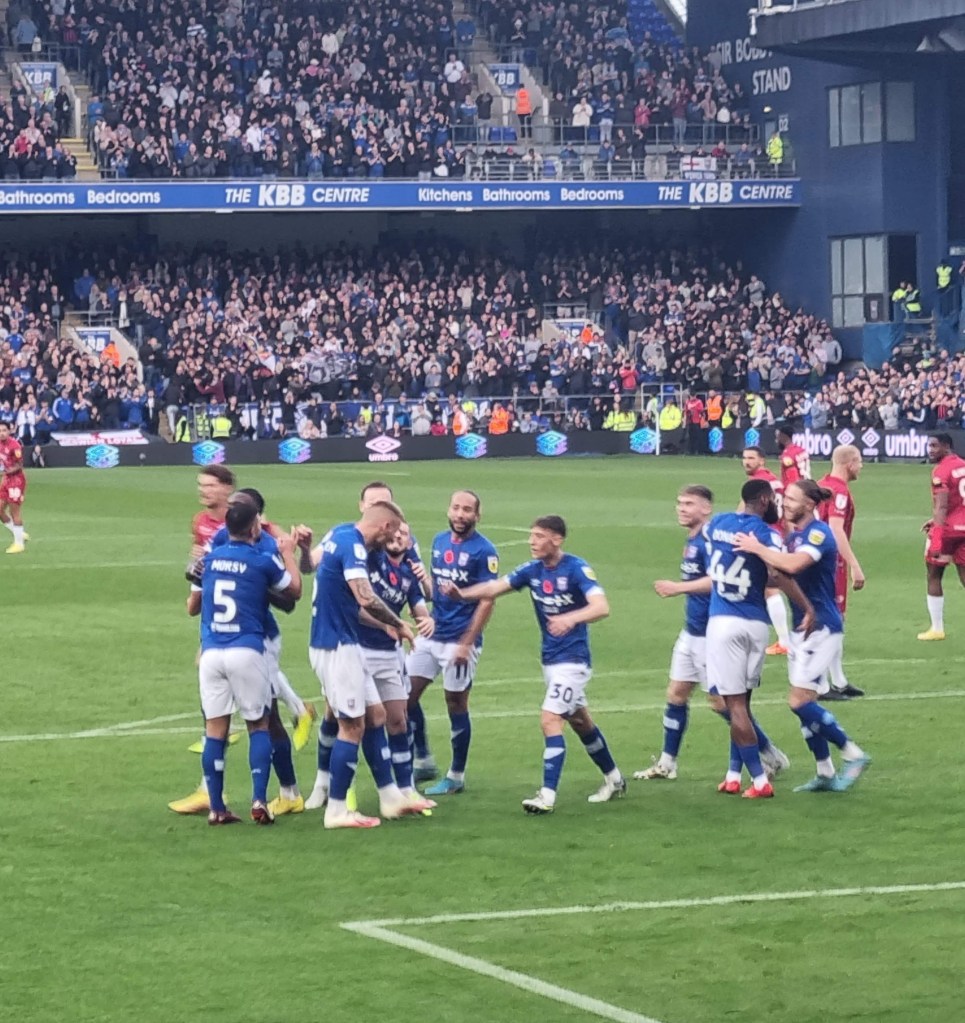
From the start Ipswich dominate and it feels as if everyone, from the supporters to the players really wants to win this match. We all remember the life-denying, spirit crushing goalless draw against Cheltenham from last season and that’s our inspiration to see Town give these upstarts, better known for their poncey Regency spa a sound thrashing.   Crosses rain into the Cheltenham penalty area and although one from Conor Chaplin goes a bit off course and strikes Wes Burns in the throat Sam Morsy soon has the first shot on goal and then from a corner Luke Woolfenden hooks the ball into the goal from close range and Town lead 1-0.  Woolfenden runs off sucking his thumb with the ball up his jumper and ever-present Phil mentions something about the birth of wolf cubs; I suggest he has simply discovered the joy of sucking his thumb. 

More corners and crosses follow and I chant “Come On You Blues” and so does Phil, but no one else does.  “Two of you singing, there’s only two of you singing” announces Pat from Clacton, sort of singing herself, which is ironic.  Janoi Donacien strides forward into a rare bit of space and pulls the ball back to Marcus Harness; the Cheltenham defence is rent open like a tin of corned beef on which the key has broken half-way round and it’s been necessary to open both ends with a tin-opener to get the meat out. Harness must score, but somehow the ball strikes the under-side of the cross bar as if deflected away from the goal net by some invisible force…either that or Harness made a hash of it.
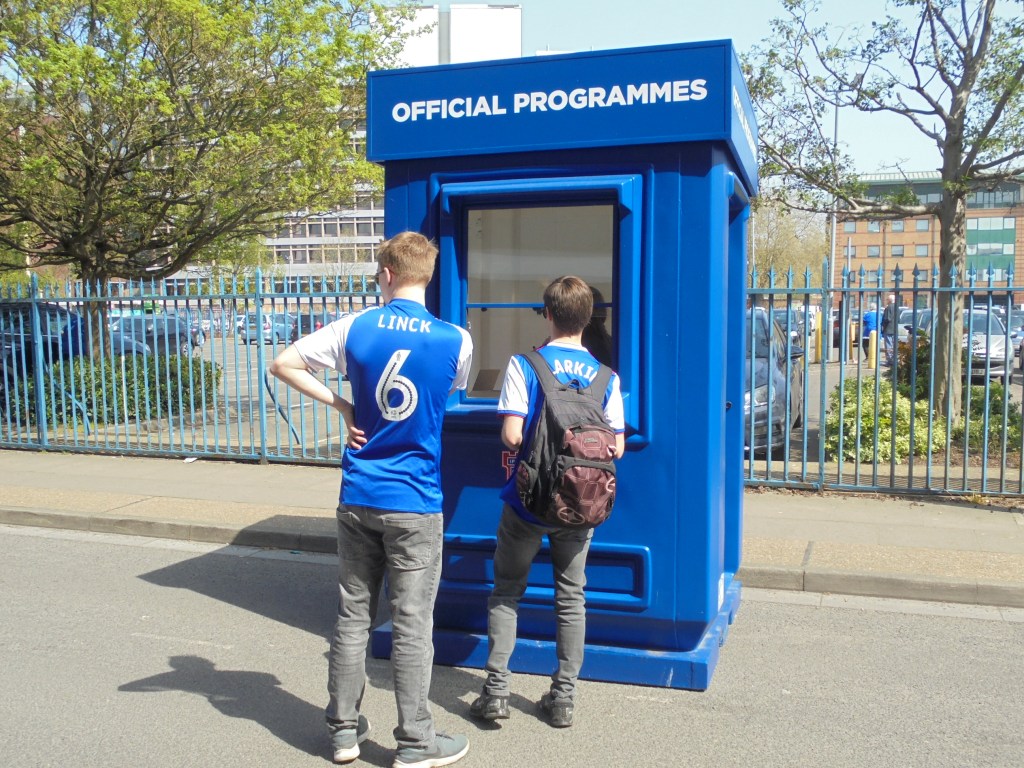
There are more corners to Ipswich, loads of them, and Phil and I keep chanting “Come On You Blues” vainly hoping someone will join in with us. We change to the simpler “Come on Ipswich, Come on Ipswich” but the occupants of the Sir Alf Ramsey stand aren’t moved.  I think to myself that I might as well be singing in French and so I do “Allez les Bleus, Allez les Bleus” I chant; Fiona says I’ve gone too far. On the pitch Janoi Donacien is hurt and is replaced by Kane Vincent-Young and the ball skims off the top of Cheltenham number six Lewis Freestone’s head as if he was a man who had applied too much brylcreem to his hair.  Another cross and Leif Davis precisely places a carefully controlled header over the Cheltenham cross bar.  Within a minute, Cheltenham equalise as Ryan Broom sweeps forward and shoots at Christian Walton, who somehow cannot stop the ball squirming around, or under,or through him into the goal.  It might have been the brylcreem on the ball.  It will prove to be Cheltenham’s only real shot of the game and up in the Cobbold stand a knot of about twenty excited youths jump around and wave their arms about like bookies on a race course, or idiots trying to fly.
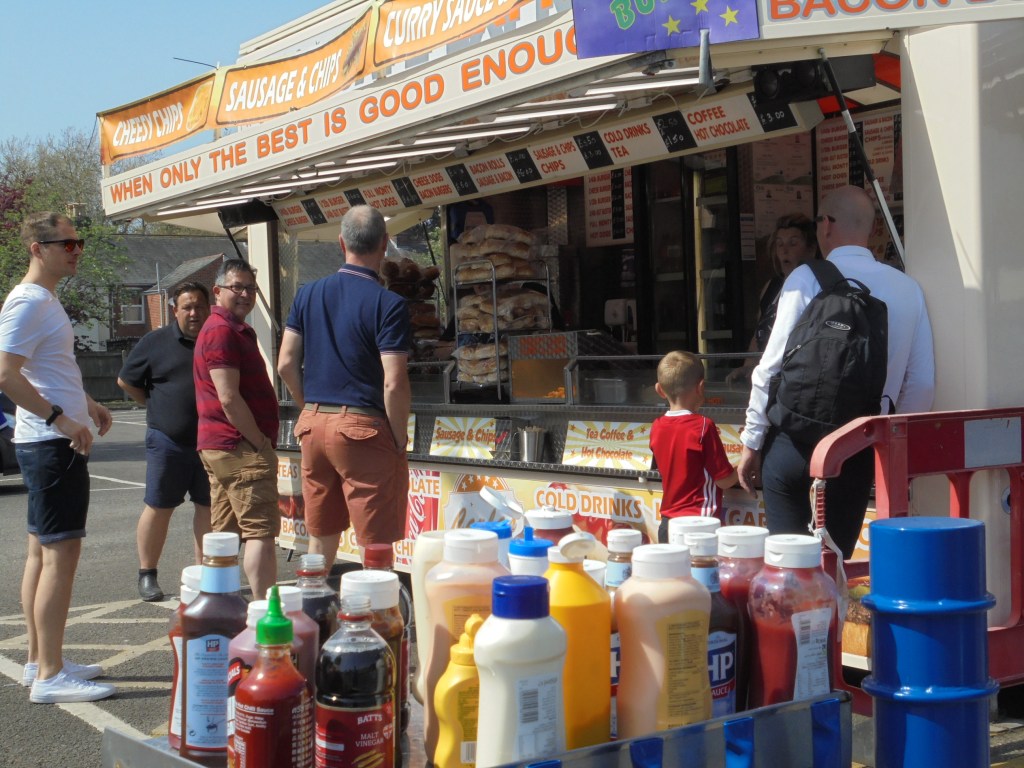
Disappointing as that equaliser is, Town press on, although not quite as well as before.  When the Cheltenham goalkeeper parries a low Marcus Harness cross out to Cameron Humphreys, somehow the ball comes straight back to him.  Two minutes of added on time are announced very noisily by Stephen Foster, as if he’d turned the PA system up to eleven. “Speak Up” says Pat from Clacton.   I applaud Town off the field with the half-time whistle and go and talk with Ray, his son Michael and grandson Harrison.  I ask Harrison if he has got the new Robyn Hitchcock album ‘Shufflemania’ yet, he says he may get it for Christmas as he looks at his dad.

The match resumes at six minutes past four and a chorus of ‘Blue and White Army’ briefly rolls around the stands, not exactly like thunder. On the stroke of the 53rd minute the crowd rises for a minute’s applause in memory of Supporters’ Club Chairman Martin Swallow who died at the end of October.  A lone seagull floats above the pitch; no doubt someone would think it poignant. 

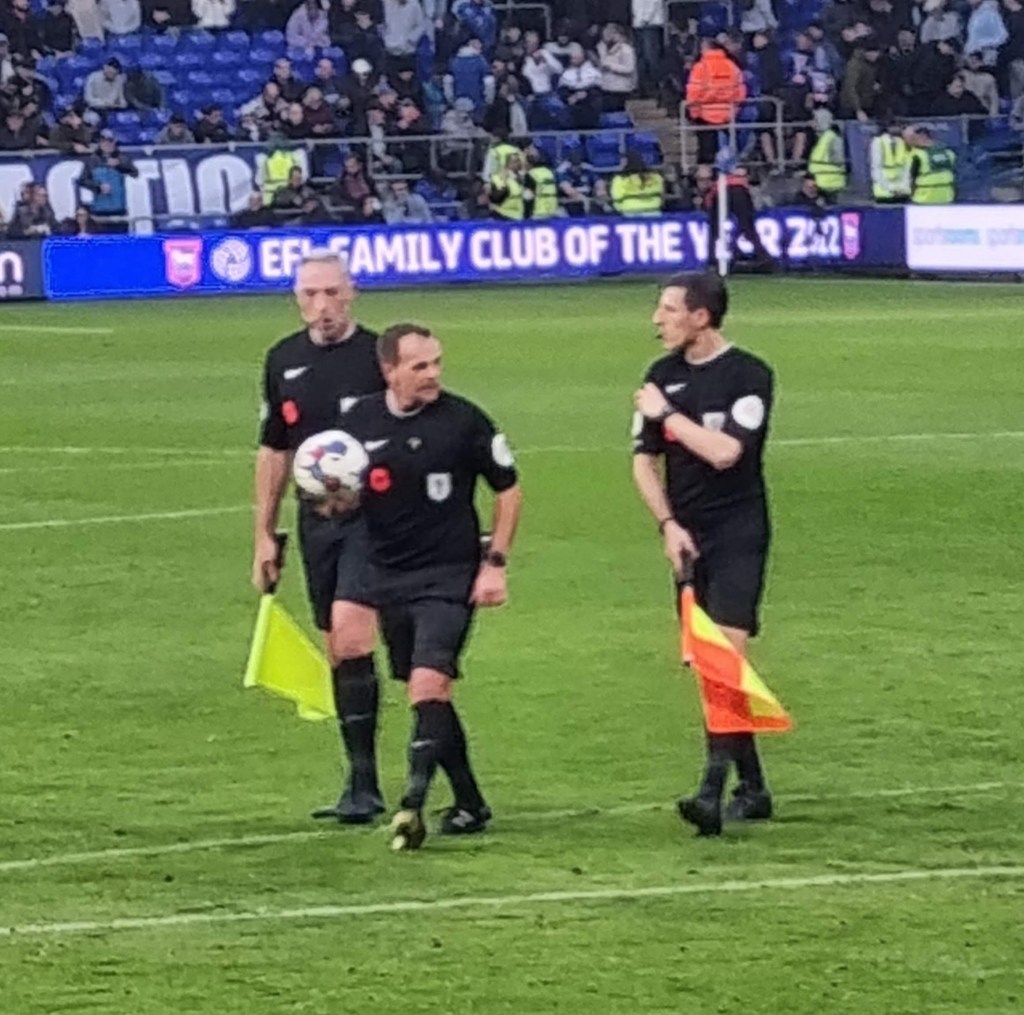
With Cheltenham confined to their half of the pitch due to constant Ipswich possession, this is the sort of game where every moment lost through a Cheltenham player sitting on the grass or receiving treatment is going to be attributed to time-wasting, and so it proves. Referee Mr Eltringham, a man with ‘ten to two’ feet, books the Cheltenham goalkeeper as a warning shot to his team-mates in this regard and in all fairness, they do not break the game up as much as they did in the goalless game last season, but it’s not enough to stop the bloke behind me from saying “He’s gotta be one of the worst fuckin’ refs we’ve ‘ad down here”.   When Cheltenham players do receive treatment their physio runs on with a huge bag and what looks like a small surf board; with a blonde wig and high cut one piece swim suit he could have doubled for Pamela Anderson in Baywatch. 

“Over and in” says Pat from Clacton in the time-honoured fashion, but it never happens. Marcus Harness heads carefully past the post in the same way Leif Davis headed over the bar in the first half, Wes Burns and Marcus Harness are replaced by Kayden Jackson and Kyle Edwards, but it makes little difference.  Chances come and inevitably go as if there is no possible way to get a ball across the line between the two goalposts.  The crowd is announced as 25,400 including 175 from Cheltenham; it’s the smallest away following at any Ipswich match this season; so more credit to those who did bother.  “Here for Cheltenham, you’re only here for the Cheltenham” they sing which I guess they are, and on the Clacton supporters coach Chris wins the prize with his guess of 25,444; Pat is disappointed that so few pet animals have been attributed guesses this week.

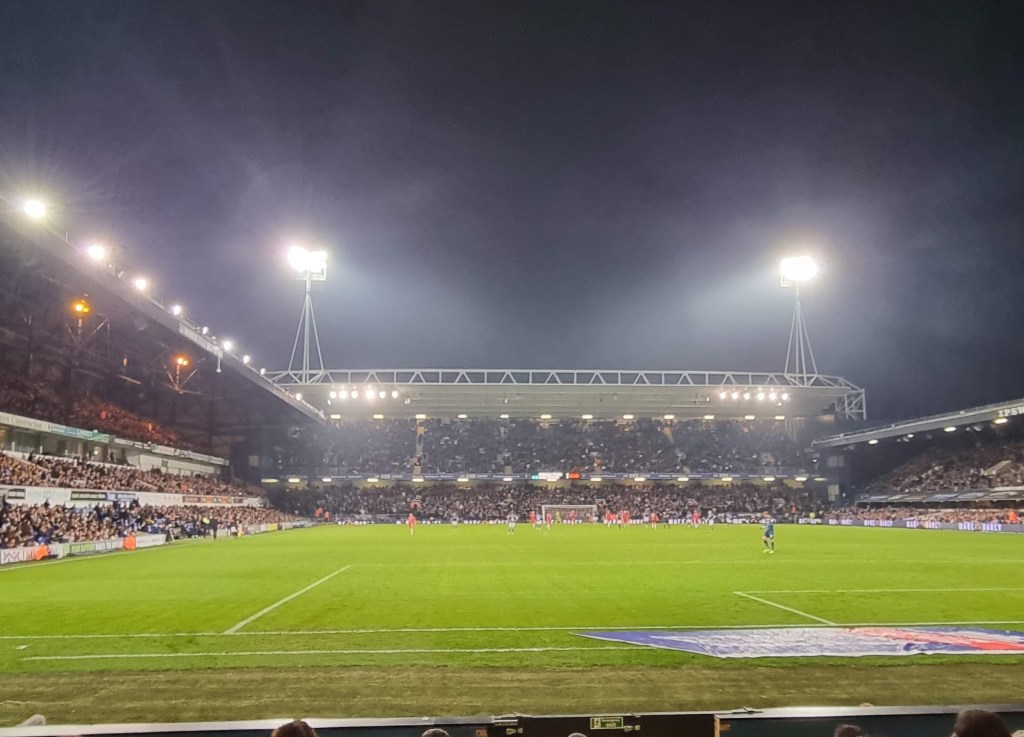
With time slipping away, the gloom of the late autumn evening descends along with a seasonal mist which softly shrouds the floodlights. “There’s nothing wrong with you, there’s nothing wrong with you” chant the North Stand appropriating some Verdi opera as another Cheltenham player takes a breather by sitting on the turf.  The final minute arrives and Panutche Camara replaces Conor Chaplin. There will be at least seven minutes of additional time, which is time enough for Camara to strike a shot against the inside of a goal post; again, the ball of course stays out of the goal rather than deflecting into it. All too soon the final whistle is blown and for a second time this year Cheltenham Town have clung on to a point at Portman Road with resolute defending and huge dollops of luck.  With defending like this and the ball having such an aversion to crossing their goal line, it seems odd that Cheltenham Town have ever lost any match.

“Frustrating” says the man from Stowmarket as he edges past me to the exit “Yes, but we’ve seen it all before, just a few weeks ago” I reply, re-living the pain of the match versus Lincoln.  But my comment hides my disappointment and beneath my reasonable exterior irrational thoughts and questions swirl in a maelstrom of post-match angst and anger; how can Ipswich Town be so much better than the opposition but still not beat them? Is Ipswich Town somehow cursed?  Where is there a high roof from which a sniper could shoot freely and indiscriminately?

Ipswich Town 1 Nostalgia 1

On a damp May evening three years ago, I recall thinking to myself that it feels like 1978 and Ipswich Town have won the FA Cup all over again.  With my Portsmouth supporting wife Paulene, I had gone to see the Wolsey Theatre’s production of ‘Our Blue Heaven’, the music-backed play that celebrated the fortieth anniversary of Town’s FA Cup win. I can honestly say it was the most enjoyable Ipswich Town related evening I had had in nearly twenty years, since that season in the sun at the start of the third millennium when Town did things like beating Liverpool and Manchester City at their own grounds, having finally managed the previous May, to win a play-off semi-final and victoriously tread the turf at the old Wembley stadium for the last time. 

Fast forward to October 9th 2021, and in the spirit of celebration of Town’s winning the UEFA Cup forty years and five months before, which the club itself has seen fit to mark with the sale of a wallet, luxury boxed badge, and travel mug, the New Wolsey Theatre is staging the final performance of its production ‘Never Lost at Home’, the story of the 1980-81 season, but mainly the winning of the UEFA Cup, something no ordinarily lovable, small town football club will probably ever do again.  Not keen on spending an evening in an enclosed space with about 400 other people, most of whom will probably not be wearing a face mask, I have opted to cough up the £20 to watch the two- and a-bit hour performance on-line from the safety of my living room.

Forty and a bit years ago in May of 1981, I had just finished my final exam at the University of Sussex and I was now just wasting my time, until the lease on my shared student house was up, by playing football, going on pub crawls, walking on the Downs, visiting friends at the other end of the country and taking days out in an aged, bright orange, Dutch registered, left-hand drive Fiat 600 which my friend Chris (mainly known as ‘Jah’ due to his love of Reggae) had borrowed from a woman on his Social Anthropology course.  A lack of available cash and the demands of academia had sadly meant that in Town’s run to the final of the 1981 UEFA Cup final, I had only seen two home games, those against Aris Salonika and FC Koln.  Of the other games, I mostly remember the nervous anticipation of waiting for the result on the radio or television news.  The away matches I recall most are those at St Etienne and Koln.  I remember learning that Town were a goal down in St Etienne and was very chuffed to hear they had equalised as I headed off to the Student Union bar that March evening.  When I discovered Town had won 4-1, I could hardly believe it, and indeed it was a performance that has gone down in history as one of the best-ever by a British club in Europe and possibly Ipswich Town’s greatest performance ever.  As for the game in Koln, I remember that my friend Stephen went to the game on a supporters’ coach from Shotley and I remember seeing Terry Butcher’s winning goal on television, having been fearful that the one goal lead from the first leg would not be enough.

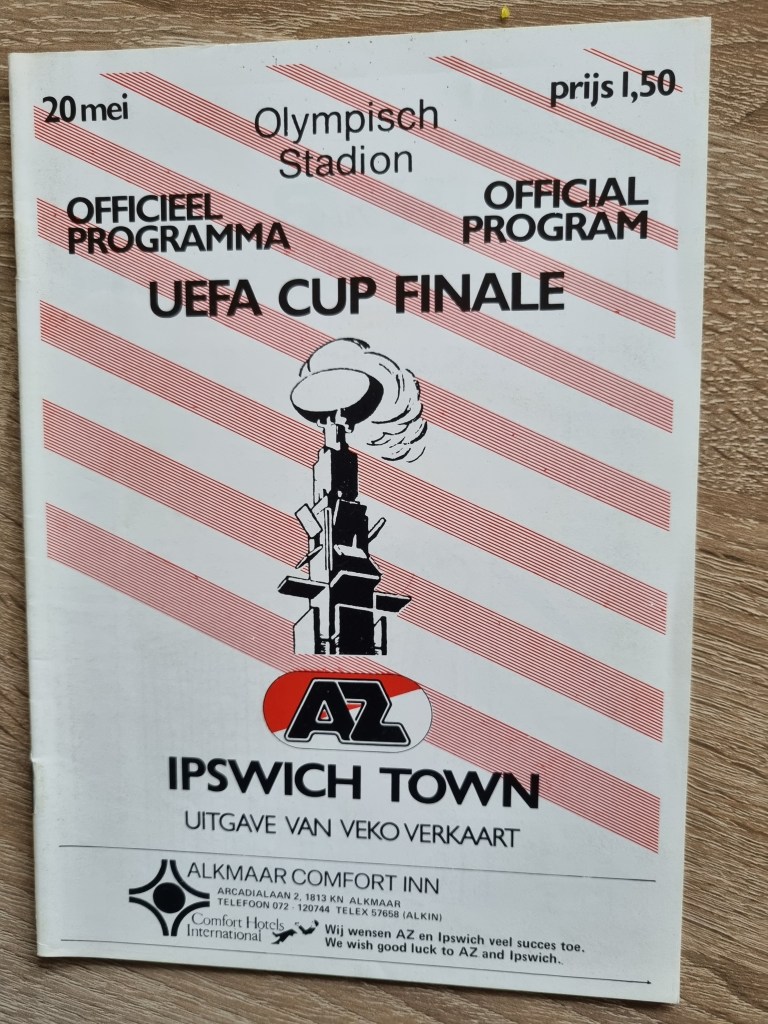
On the morning of 20th May 1981 my sister dropped me and my father off at Ipswich railway station where we caught a chartered train to Parkeston Quay and a chartered ferry to the Hook of Holland before boarding a chartered coach to Amsterdam.  Everyone travelled with the Ipswich Town Supporters Club and Anglia Tours back then, and I still have the pennant to prove it.  I wouldn’t enter Holland again for another 35 years, until I drove through a small corner of it on my way to Dusseldorf for a pre-season game in 2016, but I recall it being very neat.  In Amsterdam my father and I spent the time before the game in a small bar where we drank Amstel, a beer rarely seen in Britain back then, thankfully.  My father had encountered it before in foreign ports when in the Royal Navy and had warned me that it was gnats’; he was right, but it was all there was, they didn’t have any Tolly Cobbold Original.    Amsterdam was beautifully warm that May evening, which was just as well because terraces of the Olympic Stadium were open to the elements, which given that it was built for the 1928 Olympics isn’t that surprising; stadium builders weren’t always big on rooves back then.  In 1987 the Dutch government designated the Olympic Stadium as a National Monument, obviously because Town won the UEFA Cup there, but also because of the fine brick architecture by Jan Wils, an exponent of the Amsterdamse School.  It’s good to know that there is a corner of the Dutch capital that will forever be imbued with the memory of the presence of 7,500 Town fans.

My memory of the match that night in Amsterdam is one of anxiety and tension, despite taking an early lead that put us 4-0 up on aggregate and then gaining a second away goal.  AZ 67 Alkmaar were a bloody good team, but happily not quite good enough, despite Town being visibly knackered at the end of a colossal sixty-six game season. Forty years is a long time, and I’m not sure now what I remember from being there and what I remember from having seen various tv clips since.  I think I remember being frustrated that in the second half we couldn’t keep the ball away from Alkmaar, but I know I do recall wishing away the last twenty minutes of the game, and constantly checking my watch; willing Alkmaar not to score again and the Town defence to hold firm.  I remember nothing of the journey home, although I think my father might have invested in the luxury of a two-berth cabin in the hope of a couple of hours of sleep.

Tonight, “Never Lost at Home” picks up the story of the fictional Coombes family who followed Town to Wembley in “Our Blue Heaven”, and the story very much has the feel of being a sequel, which of course it is.  This time the tale begins with the family vowing to have someone at every game for what promises to be the greatest season in the club’s history as it vies to win an unprecedented treble.  Once again, the story is set against the background of the events of the times, in particular the high rates of unemployment resulting from the Thatcher government’s monetarist policies and indeed Scott loses his job to create some jeopardy in the story as it inevitably hinders his ability to get to games. Once again also, the story and the season unfold to a soundtrack of popular tunes of the time, although just like in ‘Our Blue Heaven’ it doesn’t, because several of the songs are from as much a four years later, which rankles somewhat because songs such as Tears for Fears ‘Everybody wants to rule the world’ (1985) were actually the soundtrack to avoiding relegation, not seeking glory.

Despite the failure to use the actual music of 1980 and 1981 (what a pity we never played Rapid Vienna or IK Start), rather than just generic 1980’s hits, there is nevertheless an authentic feeling of nostalgia for a time and a place.  I can’t fully explain why, but I had tears in my eyes in the first part of this production.  It might have been because I was reminded of how awful some of the music of the 1980’s was; I always hated ‘Eye of The Tiger’ (1982) and have consequently never seen any of the ‘Rocky’ films, but more likely I was mourning my lost youth and my lost football team, both of which seemed to go missing at much the same time.

 One major departure from the mostly repeated formula of “Our Blue Heaven” is the introduction in “Never Lost at Home” of one of the players as a recurring character, that player being the now legendary Arnold Muhren.  The choice of Arnold was, if not inspired, then obvious, because perhaps more than any other player, even his fellow Dutchman Frans Thijssen, Arnold somehow personifies that 1980-81 team, despite having actually joined Town three years before in September of 1978.  Again, the story employs a little artistic license as it almost implies that Arnold and Frans joined for the 80-81 season, but that is easily forgiven and does add to the mythology of that remarkable season.  I can only think that in casting actor Dan Bottomley as Arnold Muhren, one of the main considerations must have been his legs, because these have the same straight up and down shape of Arnold’s.  Not for Arnold the meaty thighs of Mick Mills or Paul Mariner; Arnold was a sinewy thoroughbred, built for the measured pass, the clever change of pace and direction in a single stride, the sort of footballer who simply danced through midfield and no longer exists in a game where speed, strength and bulk has usurped grace and subtlety.

The greatest triumph of ‘Never Lost at Home’, as it was of ‘Our Blue Heaven’, is the performance of Peter Peverley as Bobby Robson.   Not only does Peverley, with his gently hoarse County Durham accent, and perfectly observed Robson-esque mannerisms create a wholly believable vision of the Town manager, but he also delivers the great man’s words as he sends his team out in search of glory.  So stirring and convincing are Peverley’s words it might be an idea if the current Town management employed him to give Paul Cook’s team talks.

Oddly perhaps, ‘Never Lost at Home’ tails off towards the end, in contrast to the prequel which had something of a grand finale as the stories of the characters all came together on 6th May with a birth, a marriage and the Cup Final itself.  This time the characters don’t have their own stories to be resolved other than what happens to them as they travel across Europe in the rounds leading up to the final. We all know the ending, and although Town ultimately win the UEFA Cup, sadly mine and a lot of people’s memories of 1980-81 are probably tinged with a feeling of ‘what should have been’ with the loss of the FA Cup semi-final to the hugely inferior Manchester City and the loss of the ever-elusive League Championship to Aston Villa, a team we beat no less than three times over the course of the season.  But as one of the characters in the play points out, we had already won the Cup and the League before, so if it was to be only one out of three, best that it was the UEFA Cup.   Reassuringly however, it’s good to know that we only lost out in the Cup and the League because none of the characters in the play could get to the Cup semi-final or the penultimate League game of the season at Middlesbrough.

In truth, ‘Never Lost at Home’ wasn’t quite as good as ‘My Blue Heaven’, although my seeing it through the television screen rather than in the flesh is doubtless a factor in that. The story doesn’t have the drama of its predecessor and by drifting further into 1980’s the music is not so much ‘not as good’, as ‘worse’. Nevertheless, it was still massively enjoyable all the same, bringing back those memories of what genuinely was a marvelous time to be a Town supporter and which seems even more so given all that’s happened since. I can only hope that both ‘Our Blue Heaven’ and ‘Never Lost at Home’ are both resurrected in ten years time, not only to celebrate the fiftieth anniversaries of the FA Cup and UEFA Cup wins, but also their own 10th anniversaries; or perhaps we could have a musical about going to a musical about winning the FA Cup and UEFA Cup; I’d watch it.

Ipswich Town 0 Swansea City 1


Despite being fortunate enough to grow up and go to school in Suffolk, I was born in Haverfordwest in Pembrokeshire, Wales, where I lived until I was a few months old and my parents moved to my mother’s home village of Shotley  and took me and my sister with them, like the good parents that they were.  The nearest Football League club to Haverfordwest is Swansea City, (still Swansea Town when I was born) and there is an argument that says I might follow their fortunes, but I don’t.  The dual nationality comes in handy when Wales do well in the rugby and I like leeks,  cheese on toast, Ivor the Engine, Sgorio  and daffodils; but that’s as Welsh as I am see.  I wouldn’t normally mention it but today Town play Swansea City, and I’ve written this first paragraph in a Welsh accent. 

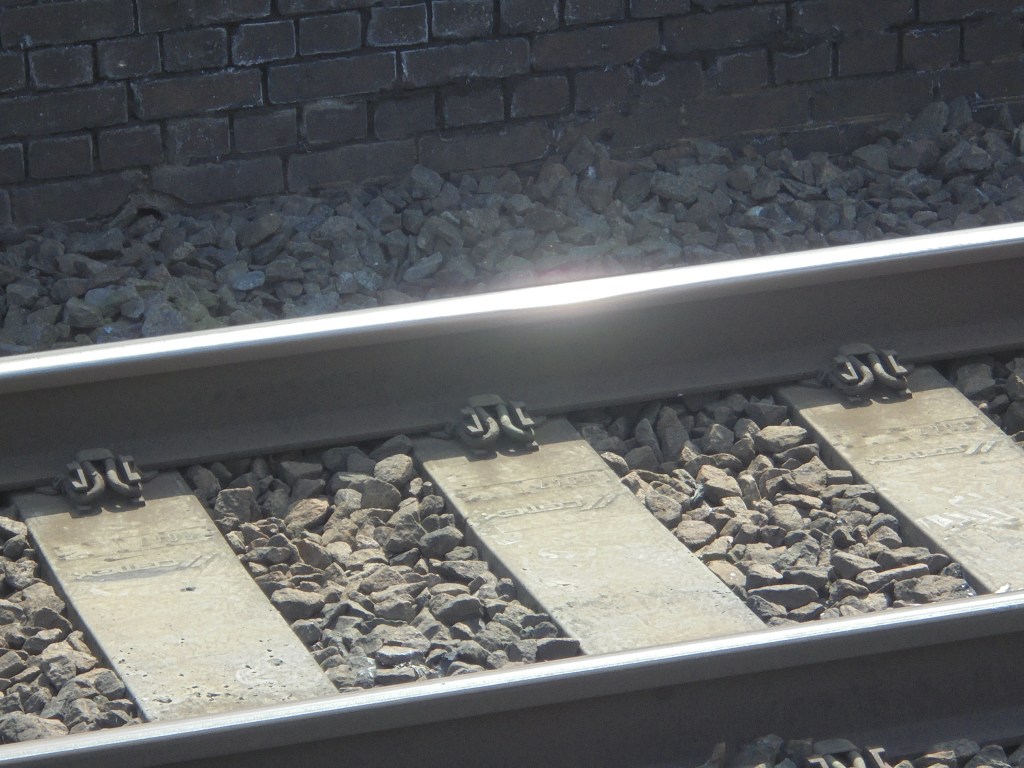
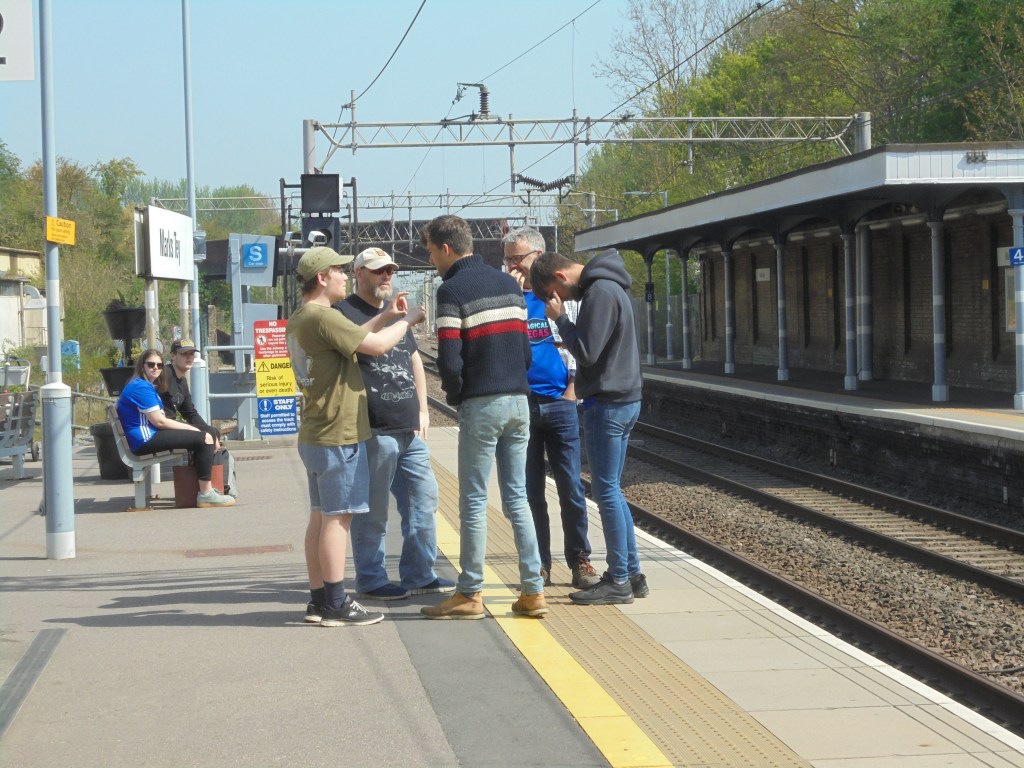
At the railway station it’s another gloriously warm, cloudless day and sunlight glints off the tracks.  The only travellers are all bound for Ipswich and the match; the train is on time.  The carriage is sparsely populated and I share it with a hard looking woman and two young children, a girl and a boy.  As the train arrives into Colchester she scolds them in a harsh voice that sounds like a man’s. “Drake, McKenna get away from the door”.  I can’t help but derive amusement from the names of children nowadays, it’s my age.  The children seem almost to roll their eyes as she speaks.  Pleasingly they leave the train at Colchester and twenty five minutes later I arrive peacefully in Ipswich.

Ipswich is best under a blue sky and everything is beautiful as I walk up Princes Street and past the peeling paint of Portman Road with its ragged club flag to St Jude’s Tavern, which is dingy and the customers are reassuringly as old and ugly as ever. I order a pint of the Match Day Special (£2.50)  Nethergate Venture.  At the bar I meet Kev’ who I know from my days with Wivenhoe Town.  Kev’ is wearing a dark flat cap which in the gloom of St Jude’s looks like a beret.  I am wearing my “Allez les bleus” T-shirt today and tell him I thought the French had come to take me “home” to where I imagine I belong  –  that’s France, not Wales.   I sit with the regular old gits who assemble here on match days.  I talk to one of them (Phil) about statues of footballers and tell him that even Carlisle United has one, although I can’t remember who it is a statue of. Phil suggests it’s not a footballer but one of the Hairy Bikers because he knows one of them is from Cumbria.  I tell him the Hairy Biker he’s thinking of is from Barrow In Furness, where the nuclear submarines come from.  I drain my glass and fetch a pint of Butcomb Gold (£3.60), which seems livelier than the Venture even though I can’t help thinking Butcomb might be a West Country word for anus.

With the big hand heading up the clock face towards the figure eight, the pub empties and carried on a gentle human tide I soon find myself back in Portman Road.  A selection of people are hawking copies of the Turnstile Blue fanzine where Portman Road meets Sir Alf Ramsey Way and I buy one (£1);  it’s issue 20 and it’s much like the previous nineteen in its tone, but it’s nice when things are familiar.  Unusually there are queues to get into the Sir Alf Ramsey Stand; not because of weight of numbers but because not all the turnstiles are open.  Nevertheless, despite my desire to be French I like a good queue to get in the ground; it carries a faint hint of the ‘big match’ atmosphere, which is the best 17,247 people can really hope for in a 30,000 seat stadium.  I enter turnstile number seven and wish the bespectacled female operator a happy Easter as she returns my freshly scanned season ticket card to me.  She looks up, surprised as if she’d forgotten about the resurrection.

Bladder drained, I occupy a seat near ever-present Phil who never misses a game and just along from Pat from Clacton.  Pat is fed up because a large man in a red hat is sat directly in front of her today and she’s only short; whichever way she looks a big red head is in her field of vision.  We sit and wait for the teams to appear from the tunnel.   

Town have been officially relegated for over a week now and today’s match is amongst the most pointless they have ever played, childishly I live in the hope that  they will therefore treat it as a bit of fun, a bit like testimonial games  are supposed to be.  Would anyone be bothered if the two teams each agreed to play a 2-3-5 formation?   I am not optimistic for this however as professional football tends to take itself much too seriously, like many of the fans, as the drivel that appears on social media testifies.   The teams are announced and my hopes of football for fun are dashed. 

The flags of tiny mascots and larger furry mascots sway to an amplified soundtrack of swirling music giving an undeserved aura of grandeur to the two teams as they walk out for this meaningless encounter, but I stand and applaud nevertheless, swept up with the lie that this match is bigger than really it is. As the game begins the noise level simmers down and a degree of reality returns. Town are hopefully aiming at the goal just to the left of me, ever-present Phil and Pat from Clacton; they inevitably wear blue and white shirts adorned with the unwelcome red adidas stripes and that nasty sponsors’ logo. In crisp white shorts and black shorts Swansea look like Germany, they are the Teutonic Taffies.

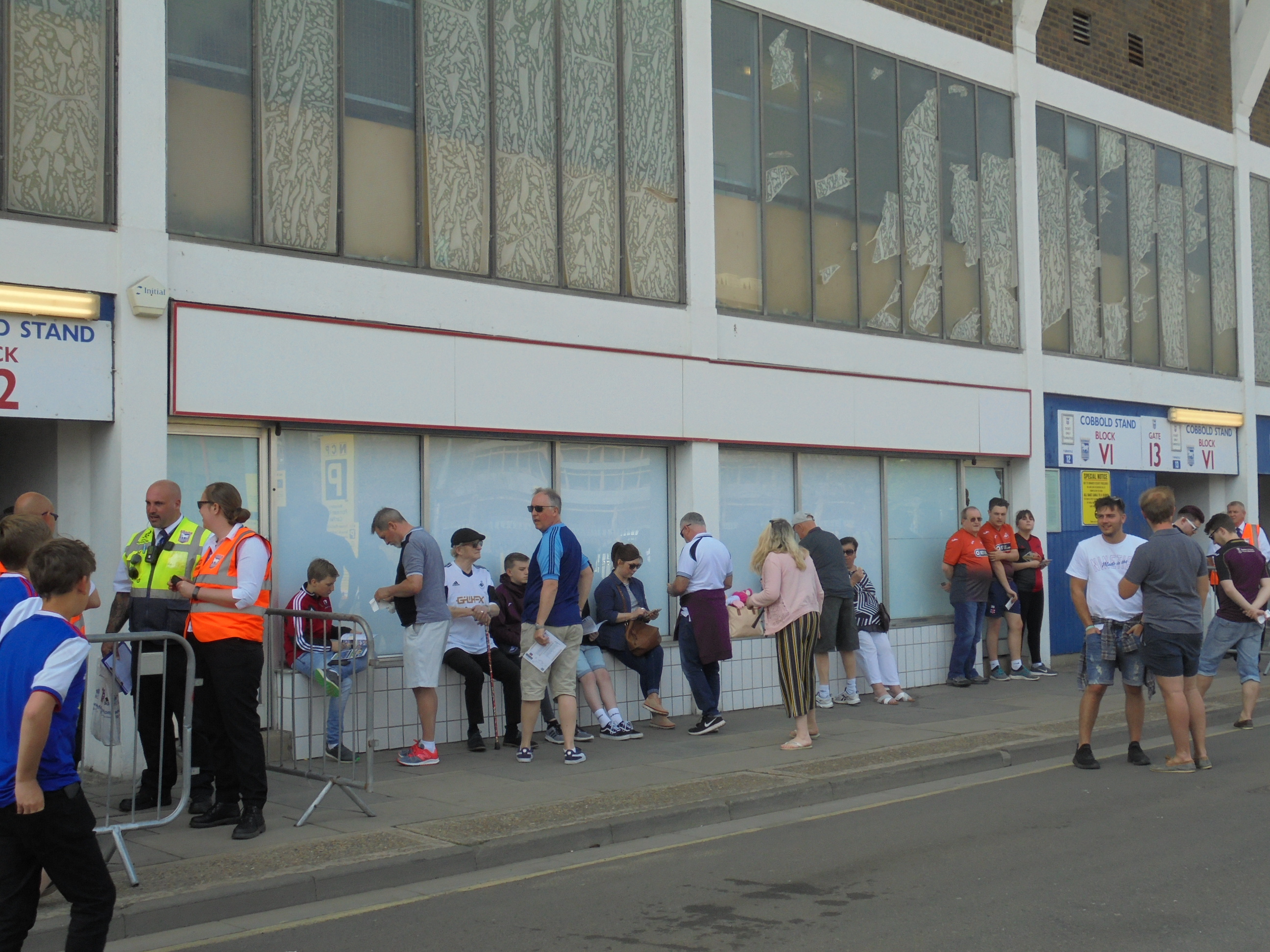
“One Dylan Thomas, There’s only one Dylan Thomas” sing the male voice choir from Swansea from the top corner of the Cobbold Stand, or perhaps they don’t. A serious looking steward collects blue and white balloons that have drifted from the stand, thereby  suppressing someone’s expression of joy; no doubt the balloons had strayed dangerously close to the pitch. I like to think that as part of the club’s Community programme the balloons will later be released at the birthday parties of deprived children. Next to me Pat from Clacton continues to glower at the big red hat on the big head of the big man sitting in front of her. On the touchline Paul Lambert is celebrating Easter with a new jumper, a grey one, an infinite number of shades lighter than his usual black one, and people still accuse Scots of being dour.

On the pitch referee Mr Darren England, which seems a good name for a football referee, makes himself unpopular with the home support by seemingly giving fouls against Ipswich players and not Swansea ones.  “You’re not fit to referee Subbuteo, you tiny little bugger” bawls an incensed voice from somewhere behind me, failing to notice that being tiny is actually one of the main requirements of being a Subbuteo referee along with being made from brittle plastic and glued into a circular base.   The game is rather boring and Swansea are hogging the ball; like every other club that has been to Portman Road this season, they have the better players. into the Swansea penalty area and wins a corner. Will Keane misses a header and scuffs the ball against a post, the ball bounces about like it’s made of rubber bands before Trevoh Chalobah sends it flying past the other post into the stand.  Sixty seconds later, give or take, another corner is won and Toto N’siala heads Alan Judge’s kick solidly over the cross bar. The supporters behind the goal are getting almost as much possession of the ball as Andre Dozzell.  Pat and I are breathless at the sudden burst of attacking football from Town and are glad for the rest that half-time soon brings.

I use the facilities beneath the stand, eat a Panda brand liquorice stick and catch up on the half-time scores.  A young man in a shirt and tie and smart trousers compliments me on my ‘Allez les Bleus’ T-shirt, “Cool T-shirt” he says brightly. He’s not wrong.  The match stats on the TV screen above the concourse are blatantly wrong however, claiming Ipswich have had eight shots to Swansea’s six; it’s as if the stats are being reported by Donald Trump or the Brexit campaign.  I return to the stand to talk to Ray who confesses to being underwhelmed by the first half.

At six minutes past four the game resumes.  I laugh when Gwion Edwards stretches to head the ball by the touchline then tumbles out of sight over the perimeter wall; “well for me” to quote Mick Channon, it’s the best move of the match so far.  Happily, Gwion quickly bounces back up and plays on, but that’s the sort of entertainment end of season games need.  Minutes later Dean Gerken makes a  quite spectacular low,  diving, ‘finger-tip save’ from a Daniel James shot before the very tiny, thirty-four year old Wayne Routledge, whose shorts almost reach his calves, runs the ball over the goal line and is met with jeers and guffaws from the appreciative crowd in the Sir Alf Ramsey Stand.   But Wayne has a friend in fate today and within a few minutes a shot rebounds off Town’s right hand post and straight onto the turf in front of Wayne who is quick enough not to miss an open goal and Swansea are winning.

The attendance is announced as 17,247 with 557 of those being from Swansea; Collin Quaner and Kayden Jackson replace Andre Dozzell and Will Keane.  Wayne Routledge is replaced by Nathan Dyer.  “I can’t believe we’re losing again” says Pat from Clacton.  I make a sympathetic humming noise in reply, I couldn’t think of any proper words to say.   Behind Pat sit two large middle aged women. “We don’t really get the sun here, do we” says one obviously engrossed in the game, before adding “Coronation Street’s on tonight”.

Town struggle to equalise and Pat and I are a little despondent, “I don’t really enjoy coming here anymore” she says “It’s not like it used to be”.  We are Ipswich’s spoilt generation who remember the 1970’s and early 1980’s.  But Pat is already planning to renew her season ticket and might get one for her young niece too.   Of course, I am going to renew mine as well, as will ever-present Phil who never misses game; I’m looking forward to the big discount when the other 13, 996 sign up.  Pat takes a photograph using the 20x zoom lens on her compact Sony camera and picks out her brother stood in the North Stand, it’s one of the most impressive things I’ve seen all afternoon. 

Time drifts by under a hazy blue sky and at last the stadium clock turns nine minutes to five.  It’s been a disappointing hour and a half of football and to add insult to injury we are forced to sit through six minutes of time added on; as if relegation wasn’t bad enough we are now all in detention.  Hopes are raised with a last minute corner and Dean Gerken leaves his goal to join in the penalty area melee at the far end; I stand up and lurch forward as if to join him too, but realise just  in time that that sort of commitment is generally frowned upon nowadays.  Little Alan Judge’s corner kick is poorly judged and sails away over everyone’s heads anyway.  Finally Mr Darren England makes a belated and vain bid for popularity by blowing the final whistle.

Normally the team does a lap of honour or appreciation around the pitch after the last game of the season, but because the last game of this season will be against Leeds United, that lap is occurring today.  Having been relegated, the Town players don’t want thousands of oafish Yorkshireman flicking v’s at the them and screaming at  them from the Cobbold Stand to “Fuck Off” as they wander round clutching assorted  babies and toddlers and waving nicely.   The players re-emerge from the tunnel without delay and I slavishly applaud as they drift by beyond a wall of stewards; within a couple of minutes I go home for my tea.

Harwich & Parkeston 2 Benfleet 1

My mother was born and grew up in Shotley at the mouth of the River Stour. As a child she hardly ever went to Ipswich, and Saturday afternoon shopping would mean a boat trip with her mum across the estuary to Harwich and to Dovercourt. Her father was a mild-mannered man, but if someone did manage to annoy him he would not tell them to “Go to hell” but instead to “Go to Harwich”, by which I think he meant to go and jump in the river rather than any slur on the gateway to the Continent. My childhood memories from thirty odd years later were of going to Harwich by car, an ice cream cornet outside the town hall, Dovercourt Woolworth’s and having shrimps for tea.
With these fond family memories in mind I guide my Citroen C3 along the winding, undulating B1352 from Manningtree to Harwich, through Mistley, Bradfield, Wrabness and Ramsey. My wife Paulene and I have been to Ipswich to visit some of the historic buildings open to the public for the Heritage Open Days, but were a bit miffed to find two of the three buildings we wanted to view, which were advertised as open in the leaflet, were shut and only open next weekend. But arriving in Harwich our fortunes have improved, it is warm and it’s not raining, even if it is a bit cloudy and the Royal Oak

ground is open for this afternoon’s fixture in the tortuously titled Thurlow Nunn Eastern Counties First Division South. We park up in the car park at the side of the stadium and cross the lane to the turnstile by the main stand. Entry costs £4 each and the-grey haired man operating the turnstile helpfully verbalises the mental arithmetic of £4 plus £430684736148_a5cac6de7b_o making a total of £8 and the addition of the glossy and groovily typefaced, 16 page programme “Black and White” (£1) making a total of £9. A few steps inside the ground an old boy in a flat cap relieves me of the final tenth of the ten pound note I proffered at the turnstile, in exchange for a strip of draw tickets (Nos 61 to 65).
The Royal Oak Ground , where Harwich & Parkeston have played since 1898 stretches out before us , a green panorama, the broad pitch sloping away across its width, down towards Harwich town itself. Beyond the far side of the pitch a terrace of 1950’s houses, one with a hideous loft extension overlook the pitch. To the left behind one goal a steep but shallow concrete stand with a rusting tin roof and faded red steel stanchions, a sort of truncated barn backing on to Main Road, where the Royal Oak pub stands, and which leads into Dovercourt High Street; to the right and set back some way beyond the other goal, the changing rooms in a building with gabled dormer windows and a small clock on the roof, like a 1980’s pastiche of a village cricket pavilion. Behind us the main stand is short in length but disproportionately tall with a steep, corrugated, pitched roof; a typical football stand from the 1950’s, sadly its top half is now closed off.

This slideshow requires JavaScript.

It’s about twenty past two and the Harwich team are appearing from the changing rooms to warm up; we walk to that end of the ground to perhaps catch a word with their coach Michael, who we know from our previous mutual involvement at Wivenhoe Town.

This slideshow requires JavaScript.

Appropriately, page five of the programme has a small feature on Michael, from which we learn amongst other things that he drives a Citroen C4, his favourite food is curry and his favourite holiday resort is Acapulco. There is a photo of Michael stood with arms folded and looking quite butch, if a little overweight. After the game Michael will tell me that he likes to read this Blog whilst sat on the toilet.
“Well he should have some fresh milk, I put some in there on Tuesday, er no Thursday” we hear a man in a white shirt and black and white striped tie say to another man. At the corner of the ground a man with a Scottish accent asks us if we are from Benfleet, because, he explains, he didn’t recognise us. We tell him we are not but, are partly here to see Michael the coach, but also to just enjoy a Saturday afternoon at ‘the football’. Whilst Paulene watches the warm up, the Scottish man tells me how the club owns the ground and is debt-free. Harwich & Parkeston are playing at a lower level than they once did, but I am told that the club trustees saw that the need to simply keep the club alive was more important than trying to compete unsustainably in a higher league. The Scottish man bemoans the rise of ‘village teams’ into the semi-professional ranks, which he feels has fragmented local football and he’d like to see a league of clubs just from the main East Anglian towns. It’s a somewhat Stalinist approach, but I can see the attraction. The population of Harwich is about 18,000.
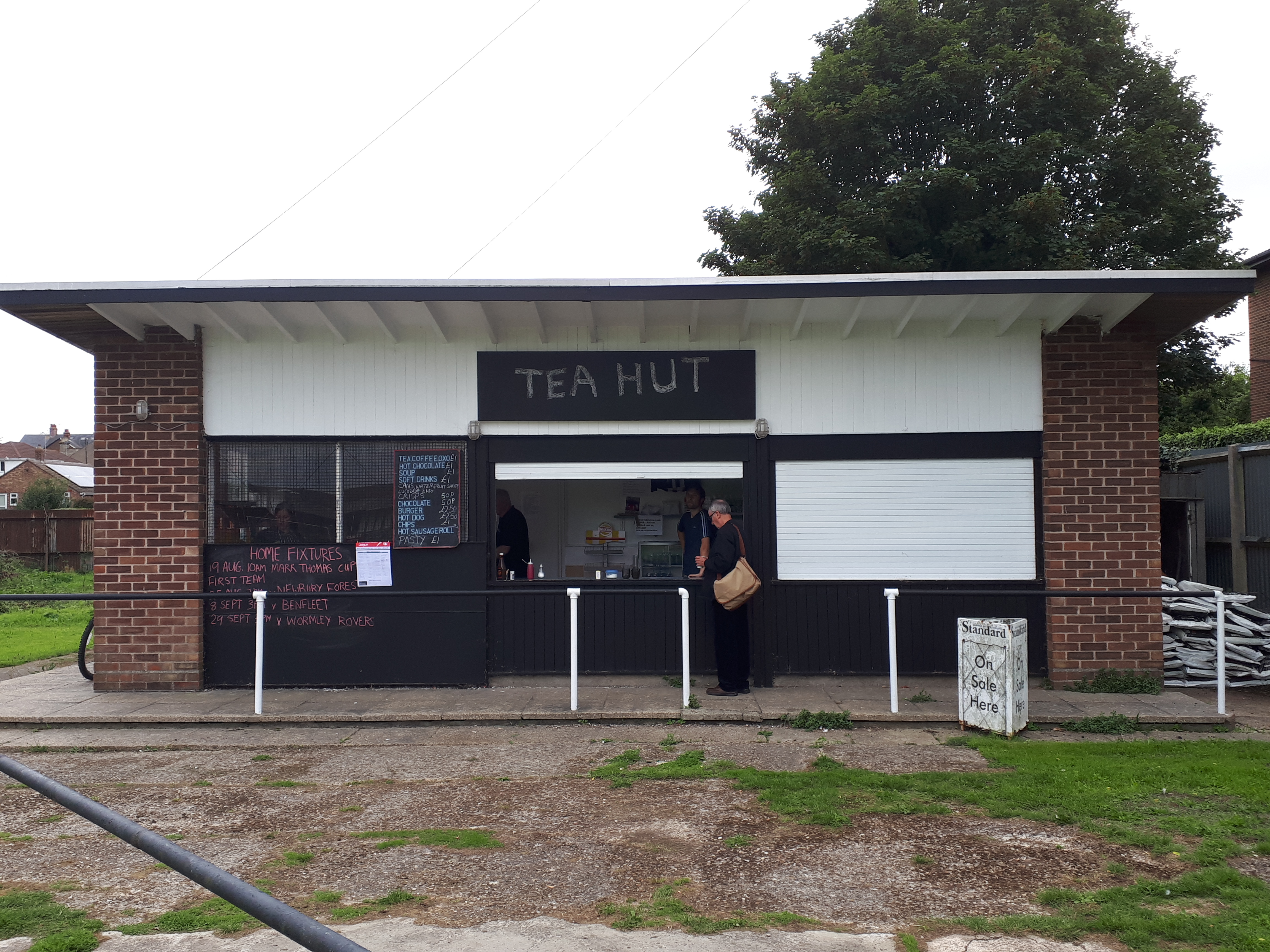
Kick-off is approaching and I buy two teas (£1 each) from the tea hut, a neat brick30685788148_87460e7c1e_o building probably dating from the 1950’s or 1960’s, which wouldn’t look out of place on a seafront esplanade. In the tea hut a woman is incredulous that an official has come from Norwich to referee a match in Harwich, she thought the point of the league re-structure was to cut travelling costs. “You can bet your arse that in Yarmouth they’ve got a referee from London” she says, and she’s probably right, although I’m not sure Ladbrokes would be interested in her or anyone else’s bottom as a wager. “There’s not many here today” she adds.
42747605380_9cc3b7bca7_oAs the game begins we take up a spot at a Yogi Bear–style picnic table in the corner of the ground by the bar and backing onto Main Road. Harwich kick off towards us, the River Stour and Shotley beyond. Harwich are wearing black and white striped shirts with black shorts and socks, completing a hat-trick of clubs along with Newcastle United and Grimsby Town that span the length of the east coast and wear black and white stripes. Benfleet are in a rather boring all red kit, although their home kit is a much more interesting light blue shirt with dark blue shorts.
From kick-off the ball is almost instantly hoofed into touch and early action sees the Benfleet number five take out both the Harwich number nine and one of his own team mates with a lunging tackle. The free-kick produces nothing of note but at least the tackle made me laugh. The football is scrappy but the passes that do get strung together are mostly strung together by Harwich or ‘The Shrimpers’ as they are known, a nickname which no doubt has to do with what I had for tea as a child. The neighbouring picnic tables are occupied too and on one of them some young women, possibly ‘wags’, talk about an away game they went to recently. “There was no bar” one of them says “Just a bottle of Blossom Hill in the fridge”. At another table a middle aged woman calls out “Come on ‘arridge”.
Despite Harwich’s dominance, at about twenty past three they almost fall behind as the centre-half misses the ball and Benfleet’s number nine Ben Foord is gifted a clear run at goal; he runs, looks up and shoots, but the Harwich ‘keeper Sam Felgate makes a fine diving save to his left. Stung by that near miss Harwich soon produce the best move of the match so far as number three Jake Kioussis overlaps into the penalty area, but loses his composure and blazes the ball high over the goal and onto the vegetation covered bank in the corner of the ground. Distraught at his failure to do better, Jake appears to try and garrotte himself in the netting behind the goal. Michael the Harwich coach leaves his post in front of the dug-outs to fetch the ball. The entertainment is improving and Benfleet win a corner but hit the ball straight to an unopposed Sam Felgate.
Just before half past three The Shrimpers take the lead as Sean Gunn dinks the ball into the net from close range as three Benfleet defenders look on admiringly; it’s what Harwich deserve in what has so far been quite a one-sided game. Paulene and I decide to get a different perspective on the match and wander further round behind the goal

enjoying the cascade of greenery in the corner of the stand and an abandoned roller. Non-league football just wouldn’t be the same without the atmosphere of decay and the implied memories of better days long ago; the Royal Oak has that beautiful faded glory in spades.
All of sudden a bit of ill-temper erupts on the pitch and the Benfleet number four squares up to the Harwich number two and shoves him backwards, not just once but three times. A melee ensues and Michael is on the pitch to help break it up. The referee Mr Harvey looks uncertain about what has happened and he consults his version of the VAR, the linesman Mr Arnot. 30686126038_1dc5f53e29_oUnusually both linesman are called Arnot, although if they are related the relationship looks like grandfather and grandson, with one being stocky and totally bald and the other lanky and very youthful. The referee consults Mr Arnot senior, who talks to Mr Harvey with his hand over his mouth, like players do on the telly. I’m not certain why he does this; even if Mr Arnot has a strange paranoia about lip-readers what can he possibly be saying that is such a big secret? The result is a free-kick to Benfleet and bookings for both players, although I’ve seen players sent off for shoving before. A short while later the match breaks down again into confrontation as Benfleet’s number five tackles horizontally at knee height and a Shrimper hits the turf clutching a leg. This time Mr Harvey sorts it out on his own, but again appears lenient as he doesn’t even show a yellow card. Happily, half-time soon arrives and everyone can go for a lie down.
Paulene and I continue our wander around the ground and I picture how the bank42747580570_69889cf102_o behind the dug- outs was perhaps once a grassy ‘terrace’. Beneath the vegetation a path can be discerned which runs up to a large pair of metal gates onto Main Road, I feel like some sort of football archaeologist, and as I look across at the terrace of 1950’s houses that overlook the ground I am struck with a sense of deja-vous. The layout of the Royal Oak with the houses on one side, the rickety main stand opposite and the club house up the corner is a lot like that of the Stade Municipal in Balaruc-les -Bains in southern France, where Paulene and I watched a Coupe de France (French FA Cup) game last September (see the archive section of this blog for an account of our visit and the match) . I buy two more teas (£2) and am served at the tea hut by the Scottish man who is helping out with the half-time rush. Paulene and I take a look in the club house where a display on the wall recalls Harwich & Parkeston’s appearance in the 1953 FA Amateur Cup final before a crowd of 100,000; The Shrimpers lost 6-0 to Pegasus (a combined Oxford & Cambridge University team) and it was probably Pegasus that drew the crowd rather than The Shrimpers, but it’s still an impressive piece of history nonetheless.
The game begins again and Benfleet are playing a bit better, although Harwich still get opportunities to score again. But at just gone twenty past four the Harwich defence recreates the error they made an hour ago. Harwich’s number five mis-reads the flight of the ball and fails to play it back to the goalkeeper who is a long way off his goal line; they are both left helpless as Benfleet’s number ten Rob Lacey nips in to lob the ball over Sam Felgate and into the goal to equalise. Quickly some of the Harwich players turn on one another to apportion blame. One of them stands with arms outstretched and says “If are going to make mistakes…” but sadly I don’t catch the end of the sentence. For a little while Benfleet are the better team and they seem to have broken up the link between the Harwich midfield and forwards. Benfleet’s blond-haired number six Martin Lacey has moved to left back and snuffed out the Harwich attacks down this flank; added to which his haircut has a hint of the 1960’s Mod about it.
Benfleet now look the more likely team to score again and we walk round behind the goal that they are attacking. We arrive in time to see the game again erupt into an unseemly mess as a Harwich player scrambles about on the ground and then a scrum of pushing and shoving and angry faces develops from seemingly nothing. Michael again appears to break things up. I don’t have a clue what happened or who was involved and sadly it seems neither does referee Mr Harvey who once again consults the human VAR Mr Arnot senior. The decision from Mr Harvey is to send off Harwich’s number five Ben Hammond and Benfleet’s number two Lewis Hunt and to book Harwich’s number four Shaun Kioussis and Benfleet substitute, number twenty Stephan Adeyemi , who hasn’t even come on to the pitch yet. Lewis Hunt and his team mates, manager and coaches protest his innocence and he certainly didn’t appear to be involved in the ruckus. Lewis heads for the dressing room and walks past us, I ask him what happened. He didn’t know but said he didn’t do anything, he tried to separate people and got hit in the mouth and then stepped away. He seems like a really nice bloke, which is what the Benfleet team were telling Mr Harvey. During the mayhem the Harwich ‘keeper takes to time to relax and have a lie down, adopting the pose of a gentleman-player in one of those photographs of a Victorian football team.
The break in play seems to have affected Benfleet more than Harwich, possibly because of the sense of injustice that Lewis Hunt has been wrongly sent off; perhaps whoever was guilty, and someone was, should have owned up and said “Send me off Ref, Lewis is innocent”. Never before has my wearing of my Albert Camus philosophy football T-shirt been so poignant, with its slogan “All that I know most surely know about morality and obligations I owe to football”. Benfleet have lost concentration and at a bit past four thirty The Shrimpers number eleven Sean Gunn breaks through the middle and places a low shot wide of Florent Gislette in the Benfleet goal. Understandably after all that has happened the Harwich team celebrate somewhat.
The final fifteen minutes play out without too much sense that there will be any more goals, although Shrimpers substitute Nicky Palmer sends a shot out towards the North Sea when nicely set up by number ten Michael Hammond, who had passed up on a chance to have a shot of his own. Hammond also becomes the eighth player to be booked before Mr Harvey eventually closes proceedings and the crowd of 160 give appreciative applause for what has been a thoroughly entertaining afternoon of football and brawling, but mostly football.
Paulene and I retire to the bar for a pint of Greene King Abbot Ale (easily Greene King’s best beer) and a Bacardi with Soda (£5.25) and a chance to reflect on a very enjoyable (and cheap) afternoon. We might have been disappointed not to sample the Heritage of Ipswich earlier today, but the sporting heritage of Harwich and Parkestone’s Royal Oak ground has more than made up for it. We’ll be back.

This slideshow requires JavaScript.