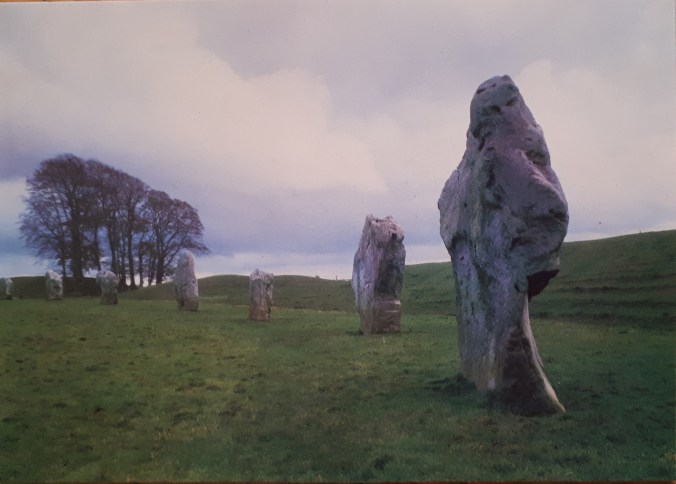
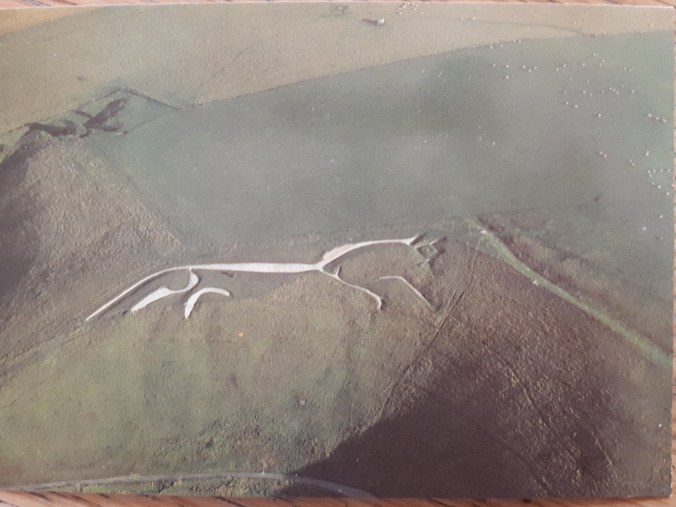
Swindon is by far the largest town in Wiltshire and is also home to the only Football League team in the county. I like Swindon. Despite being a long way from the coast, there is something a bit like Ipswich about it, particularly with its relationship to the county in which it is situated. Salisbury and Bury St Edmunds have their cathedrals, but whilst historically the locals there were poncing about singing psalms and reciting canticles Ipswich and Swindon folk were getting their hands dirty making stuff, or at least they were until the forces of international capitalism did for them. Like Ipswich, Swindon is one of those rare, unpretentiously provincial towns that’s a decent size, is a respectable distance from London but isn’t ‘Up North’; it’s like Northampton, Shrewsbury, Newport and, if you don’t count Staffordshire as ‘Up North’, Burton On Trent. Added to that it’s got a Magic Roundabout, is only 20 kilometres or so from groovy places like Avebury stone circle (bigger and therefore better than Stone Henge) , Silbury Hill and the Uffington white horse hill figure, and is home of the hard to pigeon-hole band XTC, although sadly they split up about fifteen years ago. More recently, Swindon Town is the team supported by Kerry and Kurtan Mucklowe in the wonderful BBC comedy series “This Country”. Swindon also still has its own local brewery, Arkell’s, which has been fulfilling the town’s beer needs since 1843.

I first saw Ipswich Town play at the County Ground, Swindon in December 1987. Fresh from having failed to return to the First Division at the first attempt the previous season, Town played newly promoted Swindon Town and lost 4-2 after initially coming back to equalise from 2-0 down at half-time. Mark Brennan and David Lowe scored for Town and Ian Cranson also scored, but for Swindon, with a spectacular header. I didn’t remember any of that, I had to look it up, but having had my memory jogged I do recall that the game also saw the debut for Town of the least successful of our Dutch imports, the less than legendary Ulrich Wilson, on loan from FC Twente. Since then Swindon has mostly been a lovely day out, with four wins in our last four visits, although we’ve not been round theirs now since the turn of the century, which is another reason why I would have been looking forward to today’s fixture.

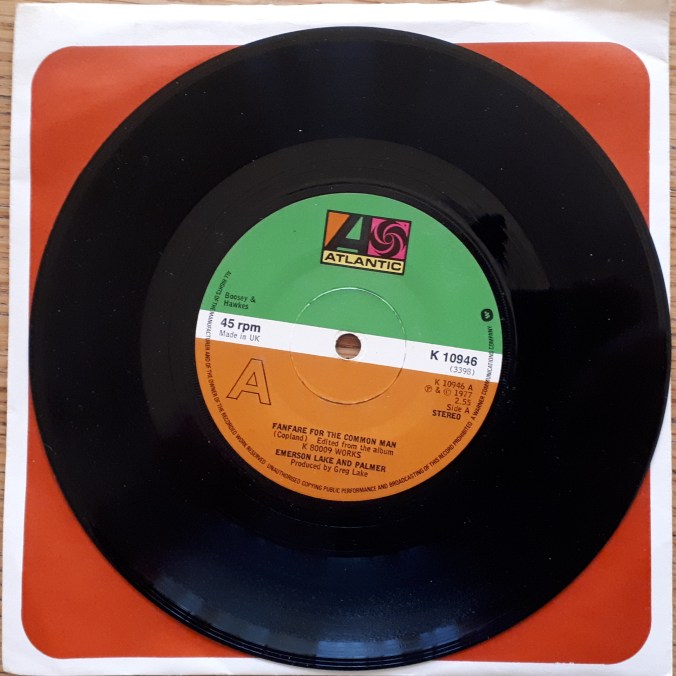
Spared a 3 hour, 275 kilometre trip along the motorways of southern England I nevertheless still rock-up late at the on-switch of my retro-style Bush radio, which is already primed in a state of preparedness being perpetually tuned-in to BBC Radio Suffolk. It’s as if I’ve only just pushed through the turnstile after hurriedly finishing my last pre-match pint of Arkell’s 3B, as at almost 3 o’clock I am greeted with the news that alongside Brenner Woolley today is former Town player Ian Atkins. Despite his having played over ninety games for Town, some as captain, I always think of Atkins as one of the most inelegant players I’ve ever seen play for Town; he’d get in today’s team mind. As Brenner Woolley sets the scene and tells us that Swindon are wearing red shirts, white shorts and red socks I can hear Emerson, Lake and Palmer’s rip-off of Aaron Copland’s ‘Fanfare for the Common Man’ blaring out from the County Ground’s public address system. With the common man still absent from its stands and concourses I wonder to myself to whom Swindon Town are playing this little burst of populist Prog-Rock. I’m as partial to a bit of Prog-Rock as the next grammar school boy born in the 1950’s or early 60’s, but as grand entry music for the players at a football match I would place ‘Fanfare for the Common Man’ somewhere up close to “The boys are back in Town” in the league table of all-time naffness. Give me “Entry of the Gladiators” or the Toreador song from Bizet’s Carmen every time.
“It’s Teddy Bishop, going to be kicking off” announces Brenner and the game begins. Somewhat inevitably Brenner’s commentary for now is obsessed with Town’s having failed to score a goal in over ten hours. “Goals change games” says Ian revealing his Birmingham accent. Well duh. The game begins well for Town as you would hope against a team who have already been relegated after only forty-four games and have conceded eighty-four goals. “Dozzell’s had a very good start at the moment” says Ian cautiously. “Town on top at the moment” says Brenner with the same note of caution borne from bitter experience as Town win the game’s first corner. “Swindon….they’re letting Northampton play” adds Ian, already confused about which game he’s watching.
Inevitably, there is something of an end of season feel to the game, what with it being the end of the season and Brenner is soon indulging in playful commentator-speak. “ …bit of a school-boy error, Dobra” says the BBC man triumphantly. Ian meanwhile soon reveals the contents of his own locker of sayings to fall-back on when your vocabulary has otherwise been exhausted. Ian’s stock phrase is “to be fair”, which, to be fair, seems innocuous enough but it’s also largely unnecessary. “…leaving the space to attack, to be fair” is Ian’s first use of the phrase and he follows this up with “… this is where they had a little bit of a problem against Northampton, to be fair”.
Meanwhile, Brenner entertains us as he always does. “Payne, who’s sprung to life in the last few moments” says Brenner summoning, in my mind at least, a vision of some sort of resurrection, before he then says “It’s Norwood with his pink boots who’s been penalised” leading me to wonder if the referee has awarded a free-kick against Norwood because of the colour of his boots; I wouldn’t be wholly against the idea. The game moves on and Brenner is soon tempting fate as he loves to do, telling us that “Swindon have never doubled Ipswich in a league season”. It’s the sixteenth minute and fate is nearly tempted; “Pitman inside the area” says Brenner with rising excitement “…puts it past the post”. Brenner confides that he was convinced Brett Pitman was going to score, and having heard his agitated commentary of the incident, it’s hard not to believe him.
Ipswich win a second corner; it comes to nothing. “Dobra up on all fours, now ready to continue” says Brenner making it sound as if Town’s number 36 does actually scamper about the pitch as if he were a quadruped. Nearly a quarter of the game has passed; “Town under pressure” is the latest assessment from Brenner. Ian’s view is that Town are giving the ball away because they’re not strong enough to hold off challenges from Swindon players.
With the game into its second quarter Brenner starts feeling oddly compelled to say things: “Jaiyesimi actually did very little against Ipswich a few weeks ago, it has to be said.” “Swindon the better side at the moment in this game, it has to be said”. “Still Camp not had a save to make, it has to be said”. It’s as if we’ve now reached a point in the game where Brenner can no longer carry on unless he gets these things off his chest. It’s either that or he now feels that his audience has been listening long enough to be able to stand these harsh truths without bursting into tears. I feel myself welling -up a little but pull through.
Five minutes later and things look up. “Saved by Camp; are Ipswich Town ever going to score another goal?” asks Brenner after an “Almighty chance for Town” sees Camp divert a shot from Teddy Bishop, who is through with just the goalkeeper between him and glory. As Brenner has told us in previous games “Paul Cook, screaming his heart out”, which as any cardiologist will tell you is not advisable. Shaken perhaps by hearing a grown man scream, Brenner seems to panic and when Swindon’s Christopher Missilou under hits a ball he tells us that “The Frenchman didn’t have enough air on that pass”. It’s an odd description of what you’d normally expect a commentator of Brenner ‘s experience to call a ‘hospital pass’, added to which Missilou is Congolese, not French.
Armando Dobra shoots wide. “Dobra’s head is in his hands” says Brenner with such conviction that I half expect him to confirm that yes, Dobra’s head has actually come off and is in his hands. A James Norwood shot is saved by Lee camp and Mark McGuinness heads the ensuing corner kick over the cross-bar. It’s evident that Town are continuing to attack and Brenner is in positive mood. “Kane Vincent-Young over-hits that cross, but quite a lot” says Brenner trying to play down the full-back’s error. The same player then has a header saved by Camp “ I thought he was going to score there, Young” says Brenner, deceiving himself once again. Ian assesses Vincent Young’s forays forward, “…like a wing-back, to be fair”.
With Town sounding like they are creating chances, the mystery remains why they have not scored and Ian enlightens us by telling us that what Town are missing is “someone of real presence in the box who can upset defenders”. It’s an analysis that suggests to me that over the summer we should sign either a sort of Joan Rivers character capable of reducing defenders to tears or just put a ‘big bloke up front’.
“It’s now eleven hours without a goal” announces Brenner polishing the glass on his stop watch, but his words soon lose their meaning as “ Bishop goes down inside the box, the referee says penalty” and I somehow imagine the referee Mr Johnson turning in the direction of Brenner up in the stand and mouthing the word “penalty” to him . “Please James, do not miss this opportunity” implores Brenner. Norwood scores, “…the goal-drought is over” confirms Brenner. “He deserves his goal at the moment” adds Ian introducing the slightly tantalising possibility that he might not deserve his goal later on and suggesting possibly that Ian believes undeserving players should have their goals taken away from them. There then follows some blokey banter about Paul Cook having said he would do a lap of honour if Town scored. “Typical scally” says Ian “saying they’re going to do something and not doing it”. I will admit to being a little surprised by Ian’s comments and can only think he is unaware of the risk of becoming the subject of a Liverpudlian version of a fatwa.
The first half ends with a chance for Gwion Edwards to double Town’s goal tally. “ Edwards shoots!” says Brenner excitedly “ …and the flag’s up” he continues with well-practised resignation. Brenner asks Ian what he made of the first half. “A bit like a practice game” says Ian honestly. “They’ve had chances that the players have missed” he adds un-controversially. Ian’s advice for the second half, which sounds a bit like an extract from an instruction manual for something purchased in an Ann Summers shop is “Rather than just sit on it, go and enjoy it”
Half-time is the familiar blur of kettle, tea and Nature Valley peanut and chocolate protein bar. For the second-half I am joined by my wife Paulene who, as I listen to the wireless through my earpiece will be watching the Ligue 1 game between Paris St Germain and Racing Club de Lens on the telly. As I re-join the broadcast from BBC Radio Suffolk Brenner ‘advertises’ his forthcoming commentaries and explains that he will once again be with Ian for Tuesday’s match at Shrewsbury. “ Is that basically because Mills’ car doesn’t go to the other side of Colchester?” asks Ian, evidently still in banter mode and also daring to take Mick Mills’ name in vain.

As far as I can make out from the commentary the second half is much like the first. “Comes to Downes” calls out Brenner with rising excitement “…who skies it”. Ian begins to add “ at this level” to the end of most of his explanations of what Town need to be doing. Nearly an hour has passed since kick-off. “…gives it back to Norwood, Norwood prods it in, Ipswich now lead Swindon 2-0” exclaims Brenner. “He’s tucked that ball away well” adds Ian, whose analysis has otherwise increasingly come to depend on the phrase “bodies in the box”.
Troy Parrott replaces Teddy Bishop. “He looks like a nice little footballer” says Ian of Teddy, when asked for his opinion of the departing player’s contribution. But it quickly transpires that Ian doesn’t really think there is a place for nice little footballers “at this level.” Brenner meanwhile advises us that it’s a case of “Town getting the job done, for what it’s worth”. More substitutions follow. “Harrop and Bennetts both coming on to play a bit more football” is Brenner’s reassuring statement before they replace Edwards and Dobra. As a rule it’s best when the substitutes come on to play football rather than just paint over the white lines or do a bit of weeding. Ian’s assessment of Edwards and Dobra is that they have “Been lively, without ever having any end product”; I believe it’s what seasoned commentators and sports hacks call ‘flattering to deceive’.
Less than twenty minutes of the basic ninety minutes remain. “Goodness me” says Brenner channelling Peter Sellers, almost. “Terrible goal-keeping from David Cornell” exclaims Brenner and Brett Pitman scores. I had sort of hoped Pitman would score, I liked him as a player at Town; my impression is that managers don’t think he runs about enough; perhaps he doesn’t , but he still scores goals, which is what forwards are supposed to do. “A Sunday league howler – no disrespect to the Sunday league by the way” says Ian of Cornell’s error and for some reason affording a respect to the Sunday league that he previously hadn’t afforded Scousers or Mick Mills.
A couple more minutes pass. “Surely a penalty, it’s a penalty” cries Brenner unable to contain his excitement as Troy Parrott is fouled. James Norwood steps up to claim his hat-trick. “Forward he comes, he’s missed it, unbelievable” says Brenner of a situation which in reality is all too believable. The only good thing to come of the incident is Ian’s lugubrious West Midland’s pronunciation of Parrott.
“Kenlock’s had a decent game” says Ian generously. “Town holding on for a win” says Brenner and meanwhile Neymar puts Paris St Germain one-nil up at the Parc des Princes. News arrives on BBC Radio Suffolk of scores in other matches; Peterborough United have pulled back to trail two-three having been three-nil down. “Well, some excitement there in that game” says Brenner with a hint of jealousy. Perhaps losing his enthusiasm Brenner mis-pronounces the surname of Swindon’s Tom Broadbent, so it sounds like Broadband. Flynn Downes is booked for a foul. “That’s like a booking for the team” explains Ian, but strangely he doesn’t say “to be fair”.
The final minutes of the game drift away. “Typical end of season game” says Ian. There is still occasional excitement. “Fabulous defending from Woolfenden” says Brenner one minute, and then “lovely little ball to Parrott in the area!” says Brenner expectantly the next. “ …ball up in the air, Parrott goes after it” continues Brenner and I imagine a blur of brightly coloured feathers taking flight. The first half ends in Paris. “You’d like to think they can see this one out, you’d like to think” says Brenner half-repeating himself for no apparent reason. Time added on runs out. “There is the full-time whistle, at the ninth time of asking Paul Cook get his first away win” concludes Brenner.
Mentally exhausted, I switch off the radio and prepare to turn my attention to the game in Paris. Later, I will journey down to the south of France courtesy of FFF tv to watch FC Sete, who have scored just twenty-eight goals in thirty-one games (a goals per game record even worse than Ipswich’s) beat Orleans 1-0 and secure their place in the French third division. Finally, this evening, to complete my virtual tour of some of my favourite places I will tune in to watch Lille versus Nice in French Ligue 1, it’s something I wouldn’t have been able to do driving back along the M4.

 to see the tie with Clermontaise, who are from the town of Clermont l’Herault, some thirty kilometres to the north west.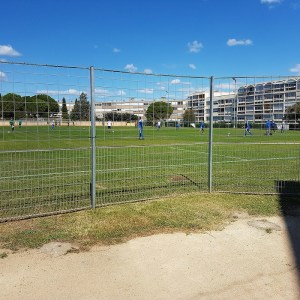
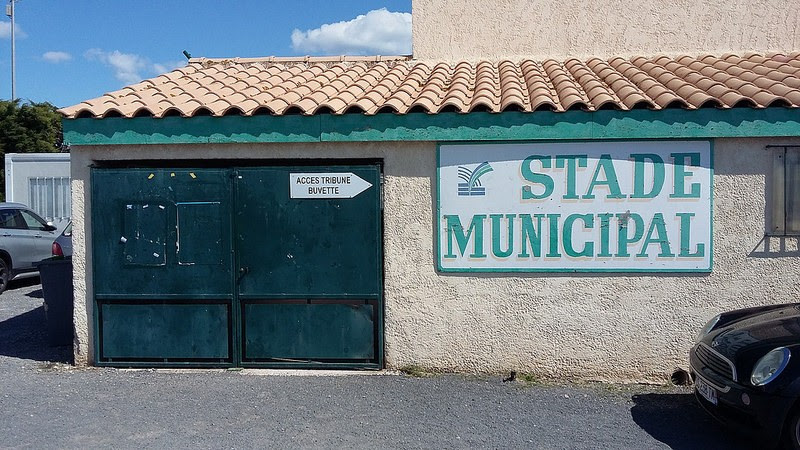
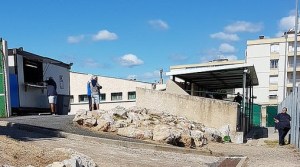
 It looks like the original roof has been replaced with new metal sheeting on another metal frame, which obscures the row of the pitch from the front row of seats. We enter the stadium through a wide opening in the back wall and find ourselves in the players tunnel; it’s an entrance that is closed soon afterwards, but it’s not quite two -thirty yet and the game doesn’t kick off until three. A wonky sign points roughly in the direction of the buvette,
 which is a portakabin style structure with a counter even more wonky than the sign. To the other side of the stand is a dark room with high-up shelves of trophies on two walls and a bar counter;


 and the teams line up on the pitch. Balaruc wear an unattractive all-black kit with green trim, which displays no team badge or sponsor’s names. Clermontaise and Balaruc are in the same regional league (Poule A of the Languedoc-Rousillon section of the Occitanie region’s Division Honneur 2 – the seventh level of French football), but Clermontaise look much smarter and ‘professional’ in their all blue kit with badge. The McDonald’s golden arch logo is on the Clermontaise shorts; they can’t have read the poster on the table in the trophy room.
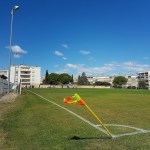 at the Mediterranean end of the ground. A bloke in a t-shirt and trakkie bottoms is called on to sort them out and once he has done so the game carries on. Early on Clermontaise look the better team, but it might just be because they’re wearing a nicer kit. Just before twenty past three it looks like they have scored, but I can’t tell if it was offside or the shot was missed. There are flattened practice goals either side of the real one and from my rock it’s hard to tell which is which.
 There are a number of people, mostly men in their sixties and seventies, sat at windows and balconies looking down on the game. I envy them their home comforts, it has to be better than perching like a lizard on a rock in the sun. Dissatisfied with my view sat on the rock, I watch the remainder of the first half standing up.
 It proves to be a good choice and our enjoyment of the second half is much increased by our new location, which is shaded, out of the wind and high enough to see over the fence, with the added bonus of atmosphere as the stand is full; spectating nirvana.
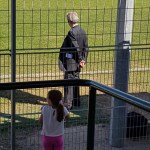 Monsieur Gerard Blanchet busy in front of us. Clermontaise’s number twelve confirms his presence by boldly attempting a shot from a thirty metre free kick; of course he misses, but not embarrassingly so. The Balaruc bookings continue and five blatantly kicks the Clermontaise twelve as he dribbles past him and three knocks over his opposite number as they run side by side. All afternoon tbere is a pleasing symmetry with many of the fouls and bookings as players with the same shirt number go for each other.
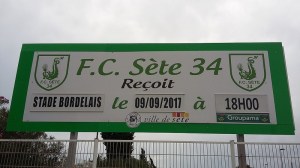 near the Atlantic coast, some 380 kilometres away by road; they have won one and lost two of their four games so far. Kick-off is at six pm and we arrive about a half an hour beforehand, parking in the spacious gravel topped car park at the side of the Stade Louis Michel, although other spectators prefer to park in the road outside. Entry to the stadium costs €6 and we buy our tickets from the aptly porthole-shaped guichets
 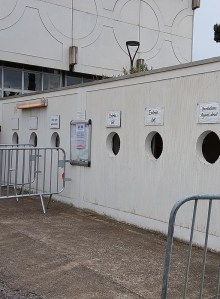 outside the one gate into the ground. Just inside the gate a cardboard box propped on a chair provides a supply of the free eight-page, A4 sized programme ‘La Journal des Verts et Blancs’. Also today there is a separate team photo and fixture list on offer.
 the brutal angular concrete of the main stand, the Tribune Presidentielle, could be from the 1960’s or 1970’s, channeling the inspiration perhaps of Auguste Perret or even Le Corbusier. The concrete panels on the back of the stand are lightly decorated and sit above wide windows; a pair of curving staircases run up to the first floor around the main entrance,
  above which is a fret-cut dolphin, the symbol of the town and the club. The stand runs perhaps half the length of the pitch either side of the halfway line and holds about twelve hundred spectators, as well as club offices and changing rooms. Opposite the main stand a large bank of open,
  ‘temporary’ seating runs the length of the pitch, it is built up on an intricate lattice
 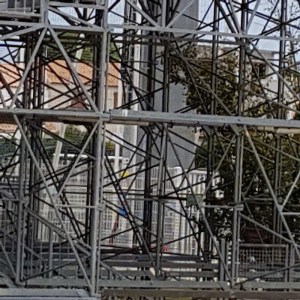 of steel supports. Behind both goals are well tended grass banks; there is a scoreboard at the end that backs onto the carpark.
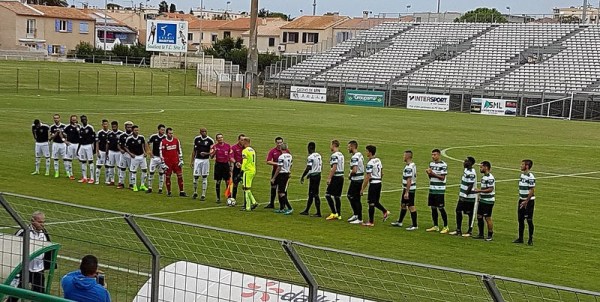 Sète in green and white hooped shirts with black shorts and socks, Stade Bordelais with black shirts with white shorts and socks. There is a ‘ceremonial’ kick-off before the real one, taken by a youmg woman with a green and white scarf draped around her shoulders. Eventually, referree Monsieur Guillaume Janin gives the signal for the game to start in earnest.
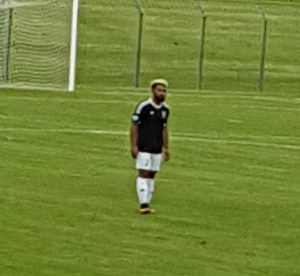 man mountain with a wide shock of bleached hair on the top of his head, and thighs the size of other men’s waists.
 which is close by at the corner of the stand where we are sat. The reason for my eagerness is that Sète is the home of the tielle, a small, spicy, calamari and tomato pie, with a bread like case. I love a tielle, and I love that they are specific to Sete, and are served at the football ground as a half-time snack. I only wish there were English clubs that served local delicacies. Middlesbrough has its parmo, but I can’t think of any others. Do Southend United serve jellied eels or plates of winkles? Do West Ham United serve pie and mash? Do Newcastle United serve stotties? Did the McDonald’s in Anfield’s Kop serve lobscouse in a bun? I need to know. Sadly, I don’t think my town Ipswich even has a local dish. Many English clubs don’t even serve a local beer; Greene King doesn’t count because it is a national chain with all the blandness that entails.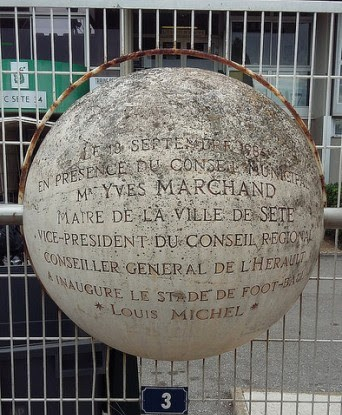
 trippingovertheball