Ipswich Town 1 Fulham 3

I have been at work all day today, since before eight o’clock; not working at home as I usually am, but in ‘the office’, experiencing first-hand the sounds and smells of my fellow human beings and colleagues.  It’s been a long day, but now at nearly five o’clock I can release myself from the yoke of gainful employment and look forward to knocking off early tomorrow afternoon because I have clocked up an unseemly amount of flexi-time.  But I strive to live more in the moment, and before tomorrow afternoon’s idleness comes the hopeful pleasure of League Cup football at Portman Road, as second division Ipswich Town confront first division Fulham.

 It was almost exactly fifty years ago to the day that I first saw Ipswich Town play Fulham, and uncannily, or more probably just by mere coincidence, it was also in a League Cup tie, albeit a replay.  Like today, Ipswich were riding the crest of a wave, enjoying a season in which we would go onto beat Southampton 7-0 and win both legs of the Texaco Cup final against Norwich City, and in which we had already despatched Real Madrid and Lazio from the UEFA Cup and the then mighty Leeds United from the League Cup. Town were the only domestic club to beat Leeds United in the 1973-74 season before late February when Stoke City inflicted upon them their first League defeat of the season, and how everyone cheered, because everyone hated Leeds United back then; even Leeds United hated Leeds United back then.  Fulham would be the first second division team I ever saw. Town won 2-1 that night, but as I recall, and as the scoreline hints, it wasn’t an easy win.  My father was in the Royal Navy back then and was able to get his hands on the complimentary tickets to the director’s box that the club provided for the captain of HMS Ganges at Shotley.   We had those seats in the directors’ box for that match and as Town struggled to get the better of Fulham, I remember drawing disapproving glances from people who must have been Fulham officials as I shouted out “Come on Town, you can beat this lot, they’re only second division”. Tonight, fifty years on, the tables are turned.

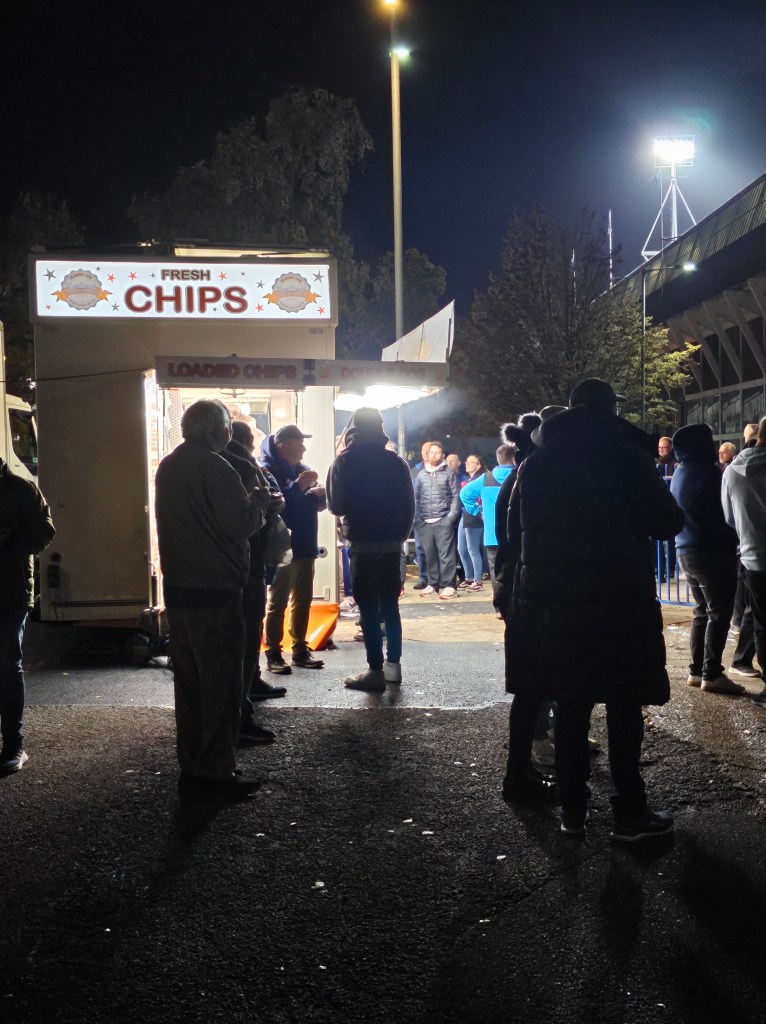
It’s not much past six o’clock when I enter ‘the Arb’ and order a pint of Wolf Brewery Howler (£3.70 with Camra discount).  After a delay to look at a menu, I also order chips with chicken and chilli (£8) before retiring to the beer garden in which there only four other people, two young blokes, and a large woman who swigs beer from a bottle; she is with a smaller man who has a glass of fruit juice; they are  a drinks-based version of Jack Spratt and his wife.  Later, the man and woman will leave to be replaced by two couples and another man on his own.  Not unexpectedly for the first night of November, it’s not warm, and it’s breezy too.  I drink my beer and eat my food and try to read the programme (£3) that I had bought earlier in the club shop. But the light is dim, and I find it hard to read the small typeface.  I cannot find any mention of the match of fifty years ago in the programme, only the less specific reminiscences of  Simon Milton, who before becoming famed in the writings of Dave Allard of the Ipswich Evening Star as “the former paintsprayer and van driver from Thetford”, lived with his parents in Fulham.  I buy another beer, this time a pint of Nethergate Compete Howler (£3.87 with the Camra discount).  The two blokes beside me talk about television programmes they have seen.  One of them has seen a programme about prison inmates and says “One of them was a serial kidnapper and torturer, so he kidnapped people and tortured them.”  They ramble on to discuss cold hands and wearing hats and thermals, and a television character who had a “New York twinge” to his accent.

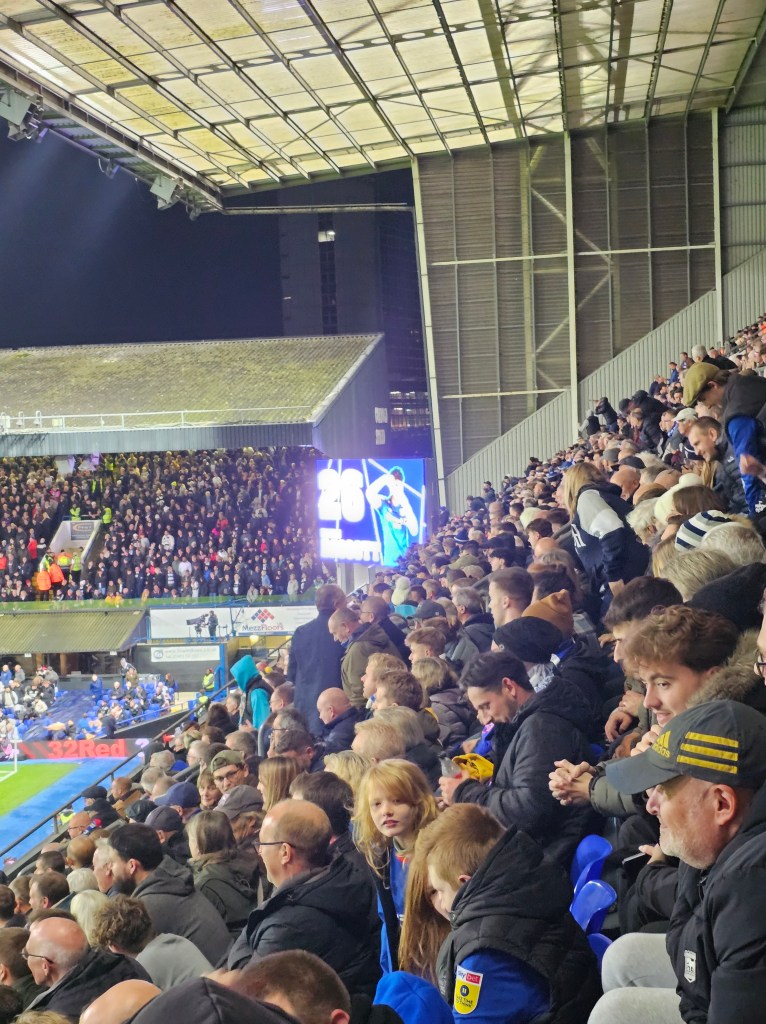
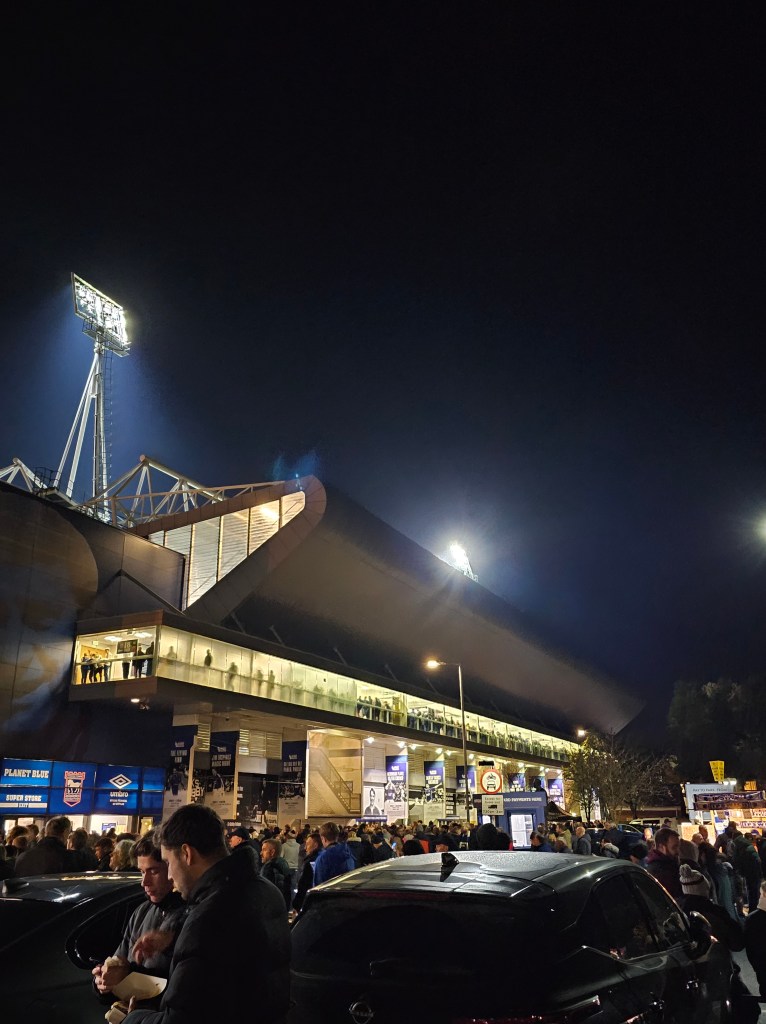
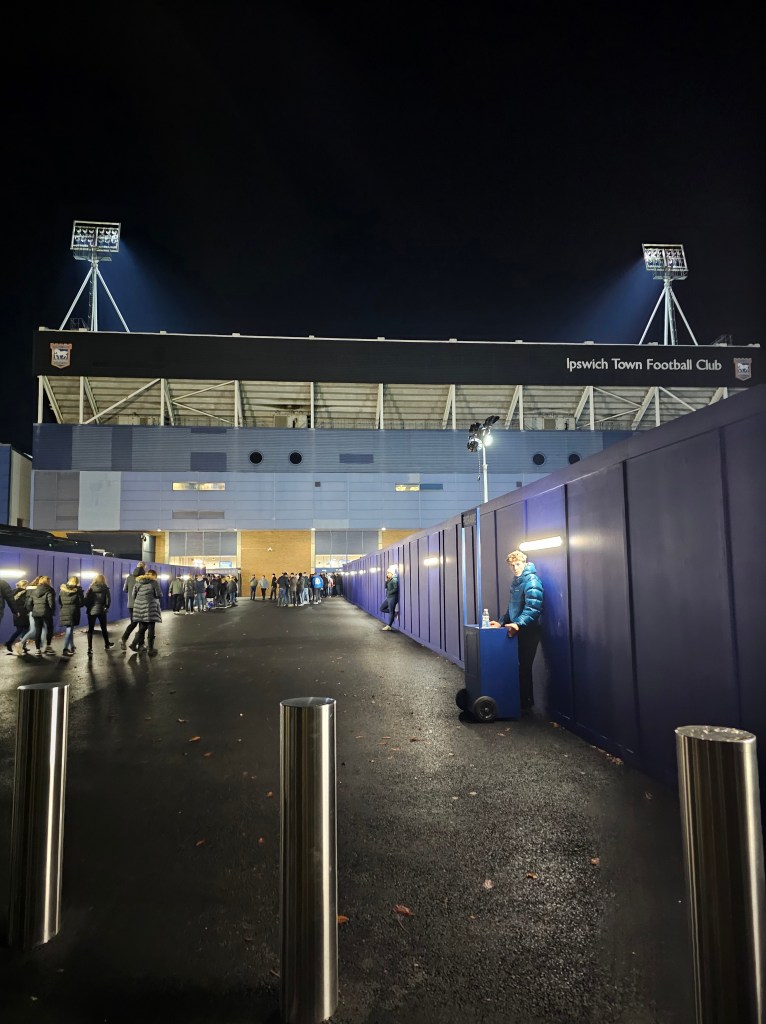
With no Mick with me tonight, because he has to attend his daughter-in-law’s birthday celebration, I sup up my beer and leave for Portman Road a bit earlier than usual.  Portman Road is busy and my path along it is regularly blocked at ninety degrees by queues for the Cobbold Stand. The mass of people at the back of the Sir Alf Ramsey Stands is so dense that I don’t even attempt to negotiate it and instead walk around the old Churchman’s building and approach from Russell Road, which is much easier, although I still have to queue for a few minutes to get to my beloved turnstile 62.  I feel a sense of achievement as I successfully pass through the turnstile using the QR code on the e-mail on my mobile phone, and to think, I failed my Physics ‘O’ level. Tonight, by way of a change, but mainly because the flat rate ticket price of £20 is an opportunity to sit somewhere ‘better’ than the cheap seats where I usually sit, I have purchased a seat in the upper tier of the Sir Alf Ramsey stand.  Thinking of the Sir Alf Ramsey stand as Sir Alf’s face, if my usual seat is somewhere on his chin or at the corner of his mouth, tonight I am up on his left cheek, at the corner of his eye, where in the days before Kieran McKenna the seats were probably always damp with Sir Alf’s tears.

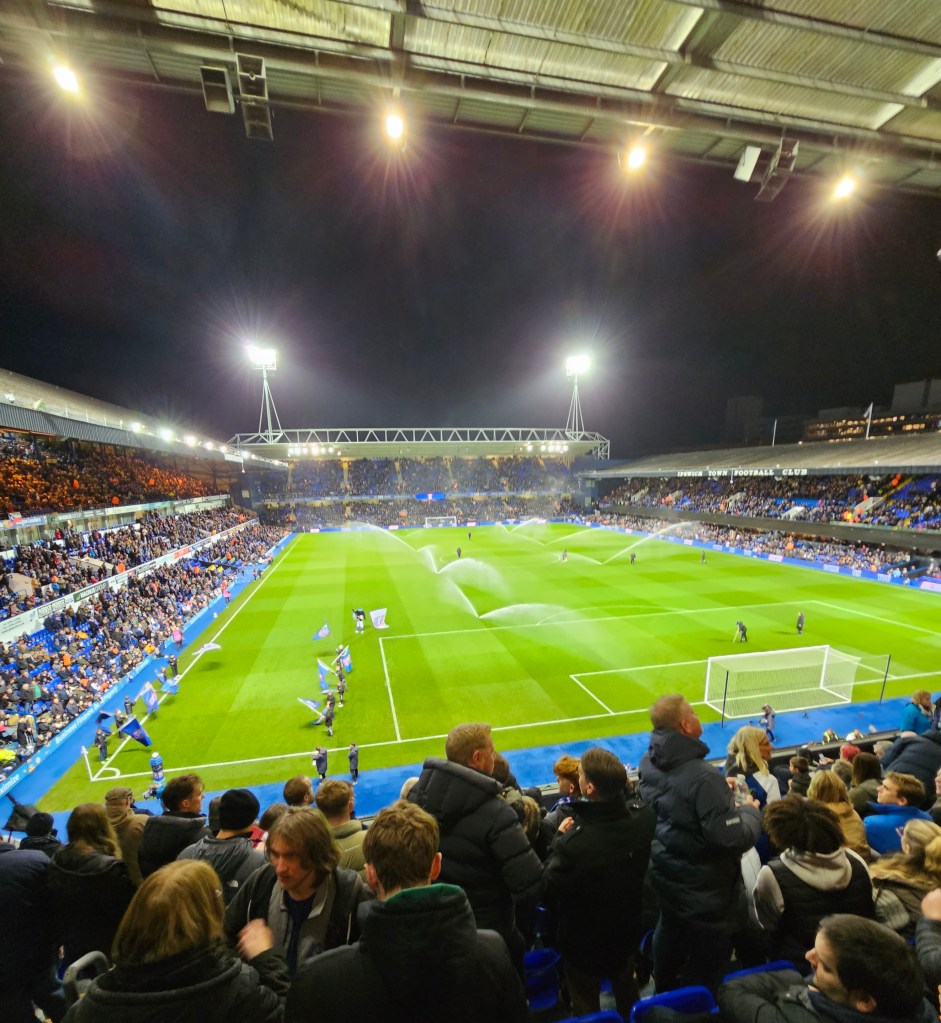
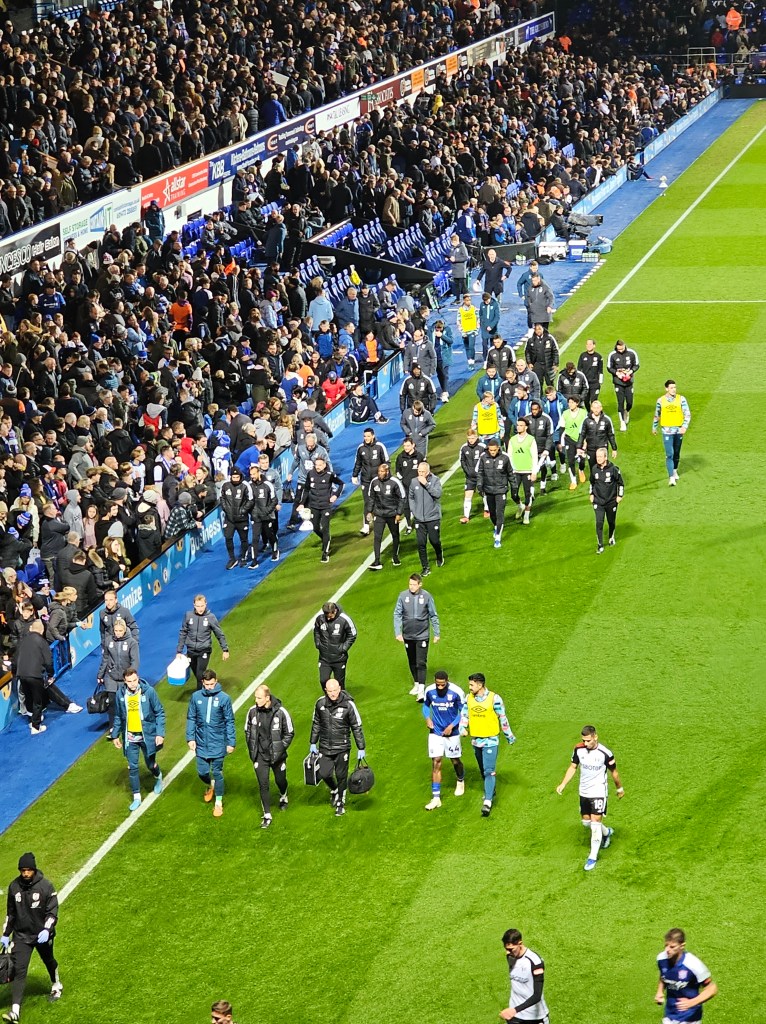
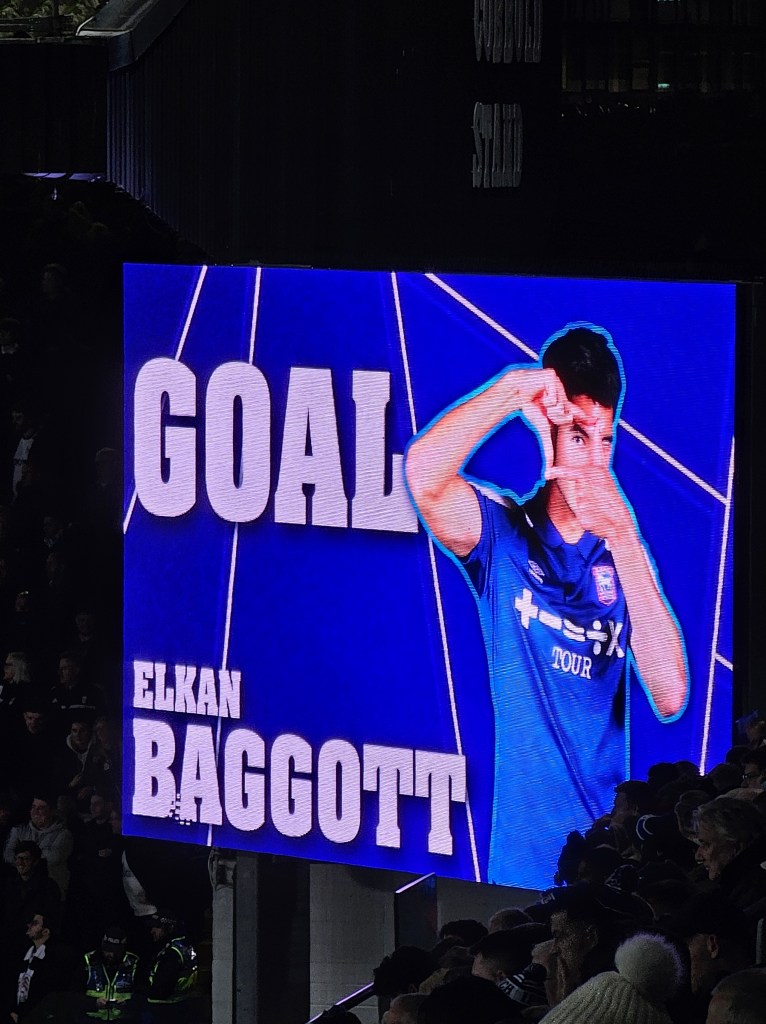
I am in good time to see the teams parade onto the pitch tonight and hear stadium announcer Murphy attempt to enthuse the crowd with mention more than once of “being under the floodlights tonight”. Murphy proceeds to make a complete hash of reading out the teams, hurrying through the names like they’re a shopping list, failing to synchronise with the big screen as the faces of the players appear on it and failing to pause at all between first and second names so that the crowd can bawl out the surnames as if we were French. I do the best that I can to shout out those surnames, to the amusement of the two young men next to me, but Dom Ball is a step too far and in the mouth of Murphy sounds like Doughball.   Murphy then reads out Elkan Baggott’s name and number twice; if he read a bit more slowly, perhaps he wouldn’t make so many mistakes.  “Murphy, you’re bloody useless” I call out and the blokes beside me laugh again.
The game begins and Fulham get first go with the ball, kicking it to their best of their ability in the direction of the Sir Bobby Robson Stand, Handford Road and Akenham and Barham far beyond.  Ipswich are wearing their traditional blue shirts and socks and white shorts and it’s pleasing to see that Fulham are also wearing their signature kit of white shirts and black shorts, just like they did back in 1973, although this year they have black sleeves also.  “Super Fulham, Super Fulham FC” sing the visiting supporters up in the Cobbold stand.  The opening action on the pitch is muddled and uncertain. It’s as if the teams know not everyone has taken their seats yet, so they’re waiting a bit until we’re all in before beginning in earnest. The seats behind me and in front of me are empty.  In the dullness of the early minutes, I notice how the bottom tier of the Cobbold Stand is painted matt black, like the interior of a 1980’s theme pub.  The Ipswich supporters in the other end of the Cobbold Stand and the Sir Bobby Robson stand are singing, but sound like they’re in the next room.  “Go on!” says the bloke next to me suddenly as a Town player gets the ball, and several in the crowd clap in time to the Sir Bobby Robson stand supporters singing “Addy, addy, addy-O”.  The row in front of me is being  filled with small children and their parents along with three teenage girls with very long straight hair, lots of make-up and hands grasping polystyrene containers full of chips.

Nine minutes have gone and as Fulham push forward Ipswich suddenly seem to have no left-back. Fulham exploit the oversight and the fulsomely named Bobby Decordova-Reid provides the wide pass that allows Harold Wilson time to take off his Gannex raincoat and light his pipe before taking the ball around Christian Walton and rolling it into an unguarded goal net. Fulham lead one-nil, which wasn’t expected. “Que sera sera, Whatever will be will be, We’re going to Wemb-er-ley” sing the Fulham fans joyously, and the two blokes next to me laugh.

“Here for the Fulham, You’re only here for the Fulham” sing the Fulham fans partly gloating and partly realising that they can’t see many empty seats, but more probably ironically acknowledging that no one other than a Fulham supporter would normally go anywhere to see Fulham.  Twelve minutes have gone forever, and referee Mr Lewis Smith awards the first free-kick of the game, to Fulham.  I notice that the name on the shirt of the Fulham number three is Bassey, and I wonder if he’s known as Shirley.  Ipswich now lose their right-back somewhere and in the aftermath Janoi Donacien deflects a Fulham shot onto the Town cross-bar.

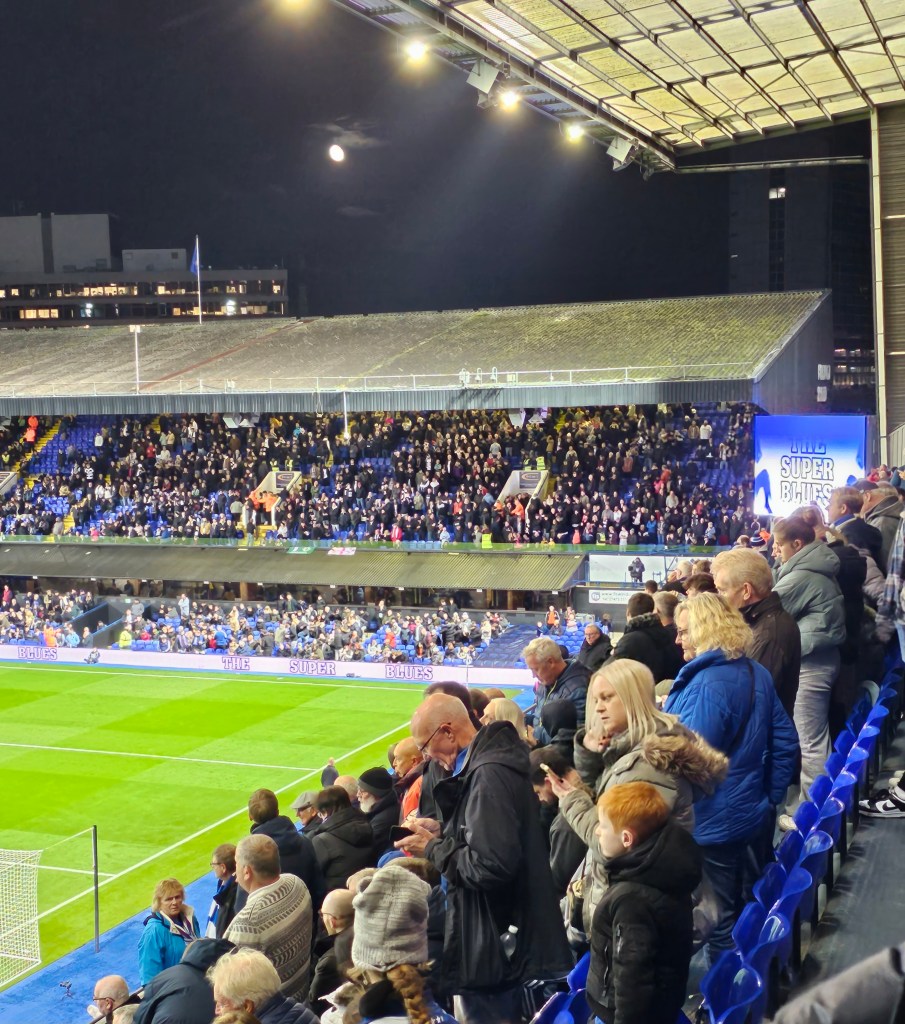
Ipswich haven’t done much so far by way of creating goals of their own, but Kayden Jackson has a shot deflected past the post for a corner after Fulham generously give the ball away. “Come On You Blues” I chant four times making the blokes beside me laugh, but no one else up here makes a sound.  Janoi Donacien heads over the crossbar.  “We’re on our way” sing the Sir Bobby Robson Stand alluding to hoped-for promotion, which seems an odd thing to sing at a League Cup tie. These millennials eh?   From where I am sitting, I can see the top of the roof of the West Stand and forty years of accumulated lichens and grime; the stand looks quite old-fashioned and industrial from here, I rather like it.    
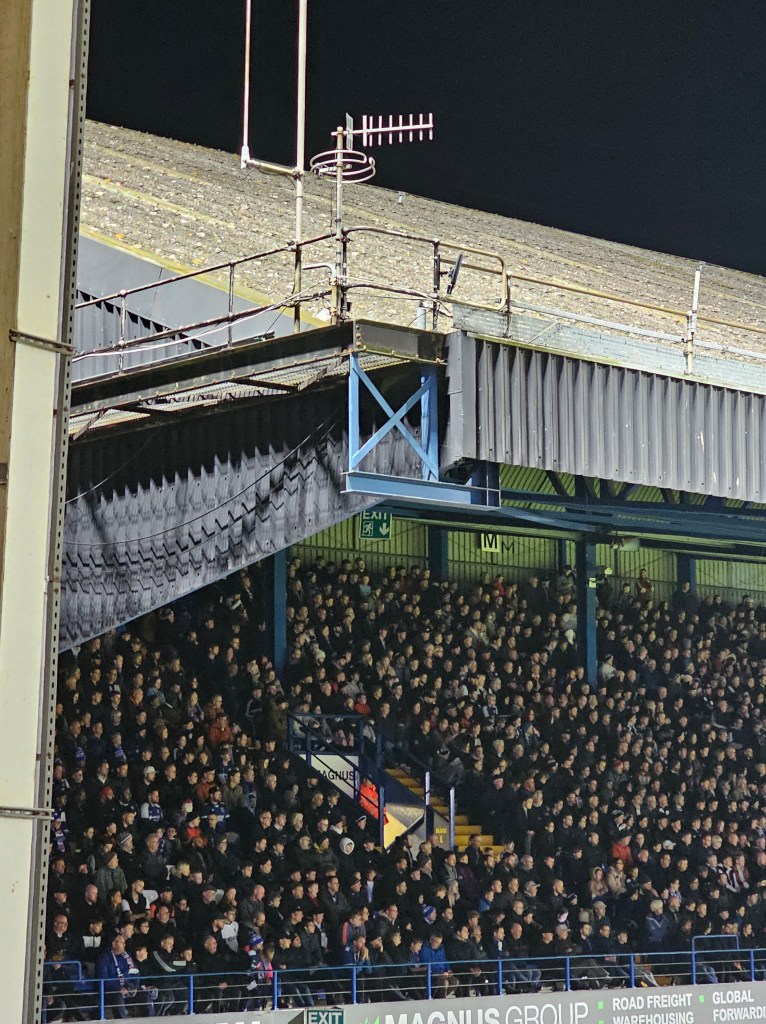
Back on the pitch, and Town’s passing isn’t always reaching its intended recipients, there is a degree to which these players don’t look as though they have played very much together before tonight.  “What’s going on here boys?” calls a bloke behind me, whilst another just says “Fucking shit”.  The Fulham fans meanwhile enjoy themselves with a snippet of opera to which they sing the words “Is this a library?”  and indeed, the Ipswich crowd is doing what it does best, keeping quiet in adversity.  Sone Aluko  draws some appreciation however, with a fine cross-field pass to Kayden Jackson and Mr Lewis then gives a  free-kick to Fulham, the bloke behind me exclaims “ That’s bloody bollocks that is”.  

  As the game enters its middle third, Mr Lewis suddenly remembers his yellow cards and books Marcus Harness, Fulham’s Sasa Lukic and Town’s Jack Taylor, although none of them had done anything particularly heinous.  If it was an attempt by Mr Lewis to get the crowd to sing about him it worked, and he is treated to numerous renditions of “Who’s the wanker in the black?”   which many a Welsh chapel or colliery choir would surely be proud of.   The young blokes beside me laugh, twice.

Half-time draws ever closer and both sets of fans have gone quiet, it’s that kind of a game.  Four minutes until half-time and the Fulham fans blink first and blurt out a song of encouragement, albeit just “Come on Fulham, Come of Fulham” which sounds more forlorn and desperate than it does inspiring, as if the words “Oh for God’s sake” have somehow been edited out. Just a minute before the first half is due to expire, and following a corner, Christian Walton has to make a save from a shot by Shirley Bassey.  Three minutes of added on time are announced by Murphy, although I doubt he’s got it right, and Town have the ball for a brief period. “Now we go, now we break” says a bloke behind me, but he’s wrong, and we don’t.  Half-time comes as a relief when it arrives and so I go downstairs to drain off some surplus ‘Howler’ and ‘Complete Howler’.

Having returned to my seat, there’s not much to enjoy about half-time. Murphy interviews some local boxer and makes an arse of himself by speaking like a boxing bout compere, but when that’s over I enjoy the fountain-like pitch sprinklers and the odd names of what I assume are children attending their first matches tonight; I hope Jonah doesn’t live up to his name and wonder about the origins of Beau and Guinea.  If I have a dull moment before the Swansea City game I think I might write to the club claiming I shall be attending my first match and that my name is Kermit or Beaker. I always liked the Muppets.

At nine minutes to nine, according to my mobile phone, the football resumes. Five minutes in and Fulham lead two-nil as a well angled cross from the Fulham right is tucked into the Ipswich goal from about seven metres out by a Brazilian called Rodrigo Muniz. If there is anything wrong with the Ipswich Town squad at the moment it is that we don’t have enough foreign players. As World Cups repeatedly show, teams of players who aren’t from Britain are invariably better than ones who are from Britain.  Impressively the Fulham starting eleven fields just a Welshman and a Scot as the only representatives of the British Isles.  “Who are ya, Who are ya?” chant the Fulham fans inquisitively, as if to say “you can’t be anyone special because you’re losing to us”, which is a fair point.

Whilst Town came back from two-nil down to beat First Division Wolverhampton Wanderers in the previous round of the League Cup, what has happened so far tonight does not suggest such a comeback will happen again this evening and indeed Fulham continue to pass the ball amongst themselves most of the time and Ipswich don’t.  Much of the remainder of the game belongs to the Fulham supporters whose chanting is as close to witty as football chants ever get.  “We love you Fulham” whilst not witty sounds heartfelt, but the singing of the Internationale with words altered to speak of shoving “your blue flag up your arse” is amusing both because it is directed at Britain’s greatest poseur football club Chelsea, and because it resurrects memories of Fulham’s most famous fictional fan, Citizen ‘Wolfie’ Smith.

“One of ya!” bawls a bloke behind me as Kayden Jackson and Sone Aluko both go for the ball at once and both miss it, and then the increasingly creative Fulham fans begin to sing about their former, but now deceased owner Mohamed Al-Fayed, although I guess they could be singing about his son Dodi.  I have no idea what they’re singing, but I imagine it’s fun. With time running down, Town bring on Elkan Baggott, a young man who apparently has nearly as many Instagram followers as the club itself.  With their team comfortably two goals up the Fulham supporters surpass themselves with the surreal chant of “Shit Leyton Orient, you’re just a shit Leyton Orient” to the Latin strains of Guatanamera. The young blokes beside me laugh, and so do I at what I think might be the first genuinely funny football chant I have ever heard.

There are twenty-one minutes of normal time remaining as George Hirst and Omari Hutchinson step forward onto the pitch charged with the task of pulling back two goals, and Freddie Ladapo and Janoi Donacien sink back into what look like knock-off sports car seats where the dugouts used to be.  “Blue and White Army” chant the home crowd, digging deep for some optimism and Murphy announces tonight’s attendance “here at Portman Road”, just in case we wondered where we were, as 28,221 including 1,685 Fulham followers. 

“We can still do this” people are surely thinking to themselves drawing on the spirit of Escape to Victory, but then Fulham break down the right and Tom Cairney scores from about 12 metres out shooting at and through Christian Walton.  A legion of faithless, soulless, part-time Town supporters get up and leave, the clatter of their tipping up seats sounding like sarcastic applause to the imaginative ear.   The game is lost it seems, but hope springs eternal, and consolation and a large two-fingers to the receding backs of all those who have just left the stadium comes just two minutes later as Town win a free-kick and Elkan Baggott stoops to head the ball into the Fulham goal and Town once again trail by only two goals, not three.  The last ten minutes of the match runs down with barely renewed hope, but the home chants suggest we don’t care anyway because “E-i, E-i, E-i-o, Up the Football League We Go”, and apparently that’s more important than getting to the next round of the sort of trophy Norwich City were once capable of winning.  We only came out tonight for a laugh, or the blokes next to me did, and they leave early too.

The last minutes of the game are some of Town’s best, but Fulham don’t look likely to give up the ghost just yet and Hallowe’en was last night anyway.  A stonking eight minutes of time added on give us incurable romantics another dollop of hope, but whilst Omari Hutchinson, Dominic Ball and Kayden Jackson all manage shots on goal, none of them realises the prize and Town’s League Cup run is over yet again.

Ultimately, it has been a disappointing evening.  It’s not been a great match; it was okay, but Fulham were too good for Town’s second- best team, who never really did much, but we knew it had to end at some time or other.  At least we can’t lose at home to Birmingham City in the next round like we did in 1973.
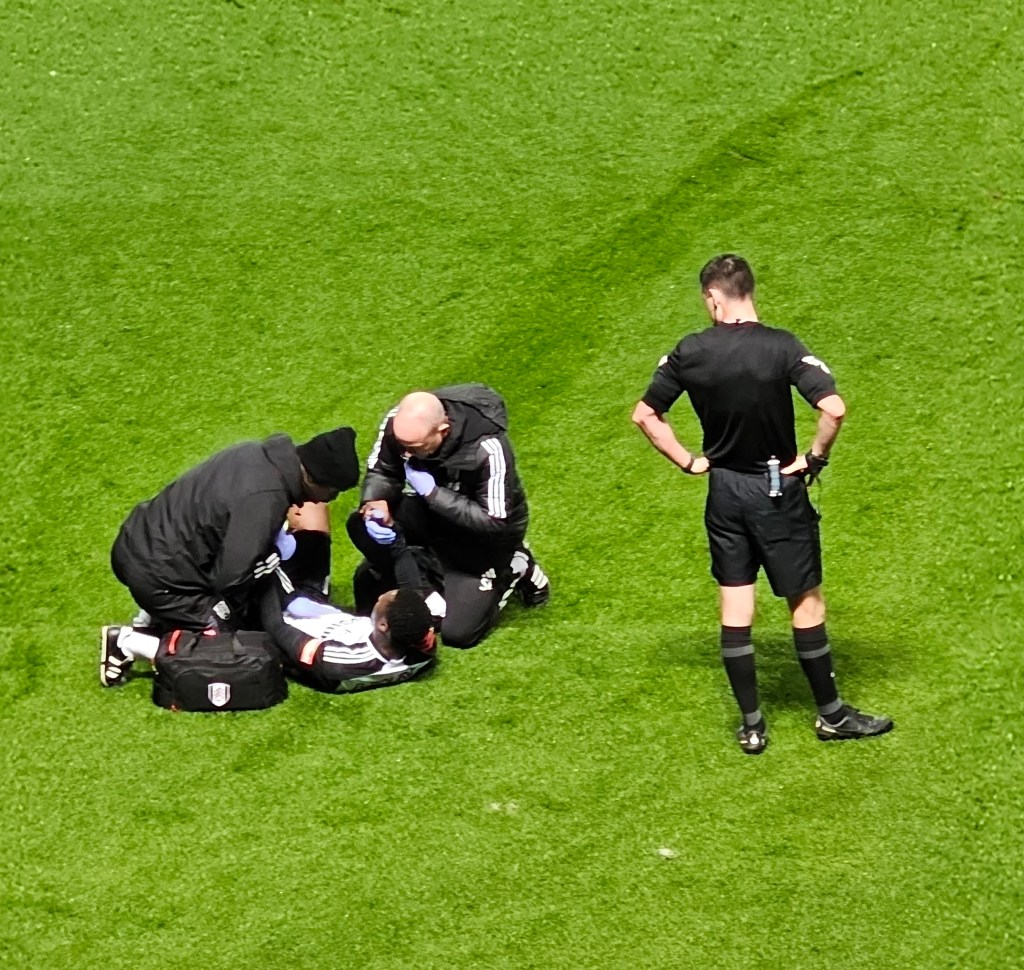
Ipswich Town 1 Nostalgia 1

On a damp May evening three years ago, I recall thinking to myself that it feels like 1978 and Ipswich Town have won the FA Cup all over again.  With my Portsmouth supporting wife Paulene, I had gone to see the Wolsey Theatre’s production of ‘Our Blue Heaven’, the music-backed play that celebrated the fortieth anniversary of Town’s FA Cup win. I can honestly say it was the most enjoyable Ipswich Town related evening I had had in nearly twenty years, since that season in the sun at the start of the third millennium when Town did things like beating Liverpool and Manchester City at their own grounds, having finally managed the previous May, to win a play-off semi-final and victoriously tread the turf at the old Wembley stadium for the last time. 

Fast forward to October 9th 2021, and in the spirit of celebration of Town’s winning the UEFA Cup forty years and five months before, which the club itself has seen fit to mark with the sale of a wallet, luxury boxed badge, and travel mug, the New Wolsey Theatre is staging the final performance of its production ‘Never Lost at Home’, the story of the 1980-81 season, but mainly the winning of the UEFA Cup, something no ordinarily lovable, small town football club will probably ever do again.  Not keen on spending an evening in an enclosed space with about 400 other people, most of whom will probably not be wearing a face mask, I have opted to cough up the £20 to watch the two- and a-bit hour performance on-line from the safety of my living room.

Forty and a bit years ago in May of 1981, I had just finished my final exam at the University of Sussex and I was now just wasting my time, until the lease on my shared student house was up, by playing football, going on pub crawls, walking on the Downs, visiting friends at the other end of the country and taking days out in an aged, bright orange, Dutch registered, left-hand drive Fiat 600 which my friend Chris (mainly known as ‘Jah’ due to his love of Reggae) had borrowed from a woman on his Social Anthropology course.  A lack of available cash and the demands of academia had sadly meant that in Town’s run to the final of the 1981 UEFA Cup final, I had only seen two home games, those against Aris Salonika and FC Koln.  Of the other games, I mostly remember the nervous anticipation of waiting for the result on the radio or television news.  The away matches I recall most are those at St Etienne and Koln.  I remember learning that Town were a goal down in St Etienne and was very chuffed to hear they had equalised as I headed off to the Student Union bar that March evening.  When I discovered Town had won 4-1, I could hardly believe it, and indeed it was a performance that has gone down in history as one of the best-ever by a British club in Europe and possibly Ipswich Town’s greatest performance ever.  As for the game in Koln, I remember that my friend Stephen went to the game on a supporters’ coach from Shotley and I remember seeing Terry Butcher’s winning goal on television, having been fearful that the one goal lead from the first leg would not be enough.

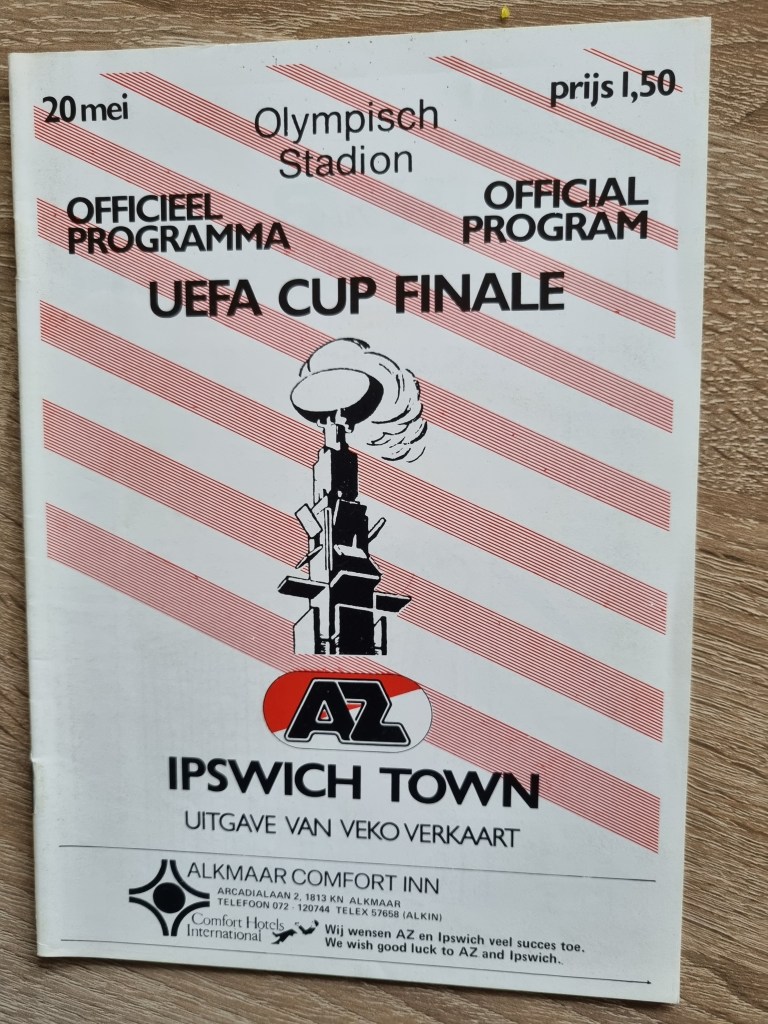
On the morning of 20th May 1981 my sister dropped me and my father off at Ipswich railway station where we caught a chartered train to Parkeston Quay and a chartered ferry to the Hook of Holland before boarding a chartered coach to Amsterdam.  Everyone travelled with the Ipswich Town Supporters Club and Anglia Tours back then, and I still have the pennant to prove it.  I wouldn’t enter Holland again for another 35 years, until I drove through a small corner of it on my way to Dusseldorf for a pre-season game in 2016, but I recall it being very neat.  In Amsterdam my father and I spent the time before the game in a small bar where we drank Amstel, a beer rarely seen in Britain back then, thankfully.  My father had encountered it before in foreign ports when in the Royal Navy and had warned me that it was gnats’; he was right, but it was all there was, they didn’t have any Tolly Cobbold Original.    Amsterdam was beautifully warm that May evening, which was just as well because terraces of the Olympic Stadium were open to the elements, which given that it was built for the 1928 Olympics isn’t that surprising; stadium builders weren’t always big on rooves back then.  In 1987 the Dutch government designated the Olympic Stadium as a National Monument, obviously because Town won the UEFA Cup there, but also because of the fine brick architecture by Jan Wils, an exponent of the Amsterdamse School.  It’s good to know that there is a corner of the Dutch capital that will forever be imbued with the memory of the presence of 7,500 Town fans.

My memory of the match that night in Amsterdam is one of anxiety and tension, despite taking an early lead that put us 4-0 up on aggregate and then gaining a second away goal.  AZ 67 Alkmaar were a bloody good team, but happily not quite good enough, despite Town being visibly knackered at the end of a colossal sixty-six game season. Forty years is a long time, and I’m not sure now what I remember from being there and what I remember from having seen various tv clips since.  I think I remember being frustrated that in the second half we couldn’t keep the ball away from Alkmaar, but I know I do recall wishing away the last twenty minutes of the game, and constantly checking my watch; willing Alkmaar not to score again and the Town defence to hold firm.  I remember nothing of the journey home, although I think my father might have invested in the luxury of a two-berth cabin in the hope of a couple of hours of sleep.

Tonight, “Never Lost at Home” picks up the story of the fictional Coombes family who followed Town to Wembley in “Our Blue Heaven”, and the story very much has the feel of being a sequel, which of course it is.  This time the tale begins with the family vowing to have someone at every game for what promises to be the greatest season in the club’s history as it vies to win an unprecedented treble.  Once again, the story is set against the background of the events of the times, in particular the high rates of unemployment resulting from the Thatcher government’s monetarist policies and indeed Scott loses his job to create some jeopardy in the story as it inevitably hinders his ability to get to games. Once again also, the story and the season unfold to a soundtrack of popular tunes of the time, although just like in ‘Our Blue Heaven’ it doesn’t, because several of the songs are from as much a four years later, which rankles somewhat because songs such as Tears for Fears ‘Everybody wants to rule the world’ (1985) were actually the soundtrack to avoiding relegation, not seeking glory.

Despite the failure to use the actual music of 1980 and 1981 (what a pity we never played Rapid Vienna or IK Start), rather than just generic 1980’s hits, there is nevertheless an authentic feeling of nostalgia for a time and a place.  I can’t fully explain why, but I had tears in my eyes in the first part of this production.  It might have been because I was reminded of how awful some of the music of the 1980’s was; I always hated ‘Eye of The Tiger’ (1982) and have consequently never seen any of the ‘Rocky’ films, but more likely I was mourning my lost youth and my lost football team, both of which seemed to go missing at much the same time.

 One major departure from the mostly repeated formula of “Our Blue Heaven” is the introduction in “Never Lost at Home” of one of the players as a recurring character, that player being the now legendary Arnold Muhren.  The choice of Arnold was, if not inspired, then obvious, because perhaps more than any other player, even his fellow Dutchman Frans Thijssen, Arnold somehow personifies that 1980-81 team, despite having actually joined Town three years before in September of 1978.  Again, the story employs a little artistic license as it almost implies that Arnold and Frans joined for the 80-81 season, but that is easily forgiven and does add to the mythology of that remarkable season.  I can only think that in casting actor Dan Bottomley as Arnold Muhren, one of the main considerations must have been his legs, because these have the same straight up and down shape of Arnold’s.  Not for Arnold the meaty thighs of Mick Mills or Paul Mariner; Arnold was a sinewy thoroughbred, built for the measured pass, the clever change of pace and direction in a single stride, the sort of footballer who simply danced through midfield and no longer exists in a game where speed, strength and bulk has usurped grace and subtlety.

The greatest triumph of ‘Never Lost at Home’, as it was of ‘Our Blue Heaven’, is the performance of Peter Peverley as Bobby Robson.   Not only does Peverley, with his gently hoarse County Durham accent, and perfectly observed Robson-esque mannerisms create a wholly believable vision of the Town manager, but he also delivers the great man’s words as he sends his team out in search of glory.  So stirring and convincing are Peverley’s words it might be an idea if the current Town management employed him to give Paul Cook’s team talks.

Oddly perhaps, ‘Never Lost at Home’ tails off towards the end, in contrast to the prequel which had something of a grand finale as the stories of the characters all came together on 6th May with a birth, a marriage and the Cup Final itself.  This time the characters don’t have their own stories to be resolved other than what happens to them as they travel across Europe in the rounds leading up to the final. We all know the ending, and although Town ultimately win the UEFA Cup, sadly mine and a lot of people’s memories of 1980-81 are probably tinged with a feeling of ‘what should have been’ with the loss of the FA Cup semi-final to the hugely inferior Manchester City and the loss of the ever-elusive League Championship to Aston Villa, a team we beat no less than three times over the course of the season.  But as one of the characters in the play points out, we had already won the Cup and the League before, so if it was to be only one out of three, best that it was the UEFA Cup.   Reassuringly however, it’s good to know that we only lost out in the Cup and the League because none of the characters in the play could get to the Cup semi-final or the penultimate League game of the season at Middlesbrough.

In truth, ‘Never Lost at Home’ wasn’t quite as good as ‘My Blue Heaven’, although my seeing it through the television screen rather than in the flesh is doubtless a factor in that. The story doesn’t have the drama of its predecessor and by drifting further into 1980’s the music is not so much ‘not as good’, as ‘worse’. Nevertheless, it was still massively enjoyable all the same, bringing back those memories of what genuinely was a marvelous time to be a Town supporter and which seems even more so given all that’s happened since. I can only hope that both ‘Our Blue Heaven’ and ‘Never Lost at Home’ are both resurrected in ten years time, not only to celebrate the fiftieth anniversaries of the FA Cup and UEFA Cup wins, but also their own 10th anniversaries; or perhaps we could have a musical about going to a musical about winning the FA Cup and UEFA Cup; I’d watch it.

Plymouth Argyle 1 Ipswich Town 2

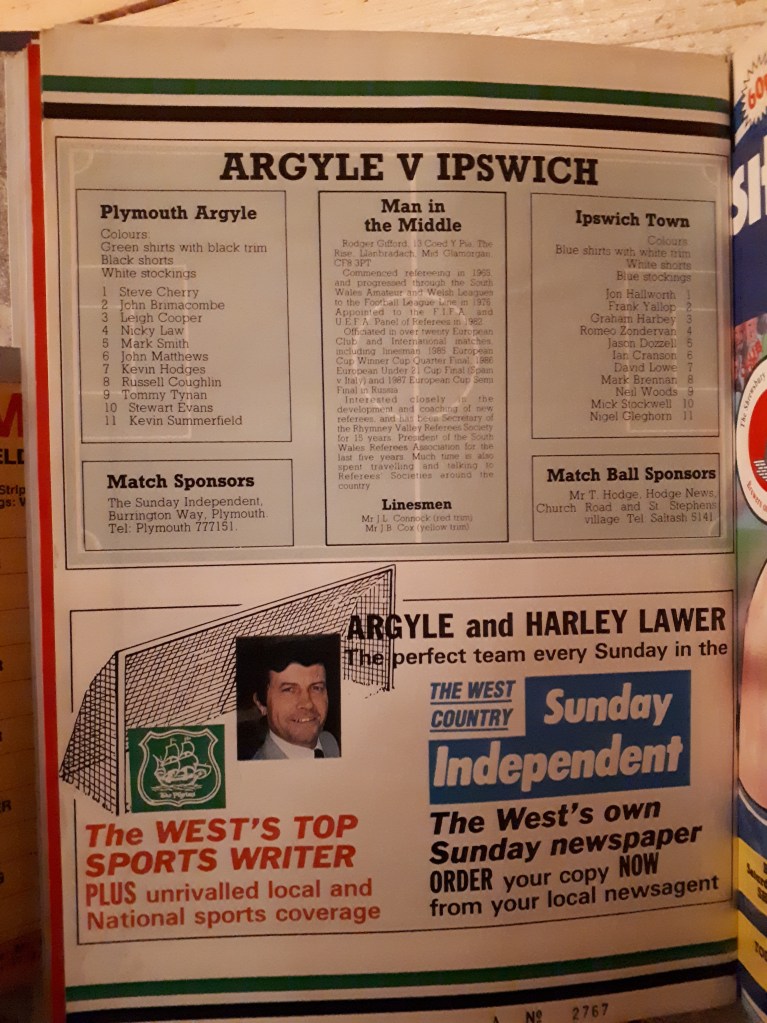
I am a little ashamed to admit it, but I have only ever been to Home Park, the sensibly named home of Plymouth Argyle, twice.  The first occasion was in August 1987 for an evening fixture, when after a seemingly interminable coach journey from Portman Road I witnessed a goalless draw.   Then, at the start of 2005 I returned, this time by car, to enjoy a 2-1 victory courtesy of Darren Currie as Town went top of the league but, as ever, ultimately failed to achieve promotion.  My memories of Plymouth therefore are on the whole not disagreeable, although if the city has memories of me they might not all be as positive. My very first visit to the city of Plymouth was in the summer of 1966 when on a family holiday. My father was in the Royal Navy and serving on HMS Tiger at the time and the ship happened to be in Plymouth dockyard; he took us aboard and I vomited on the wardroom carpet.  Given that the eleven thousand ton cruiser was in harbour I can’t blame sea sickness, it was more a surfeit of free peanuts from what I remember.

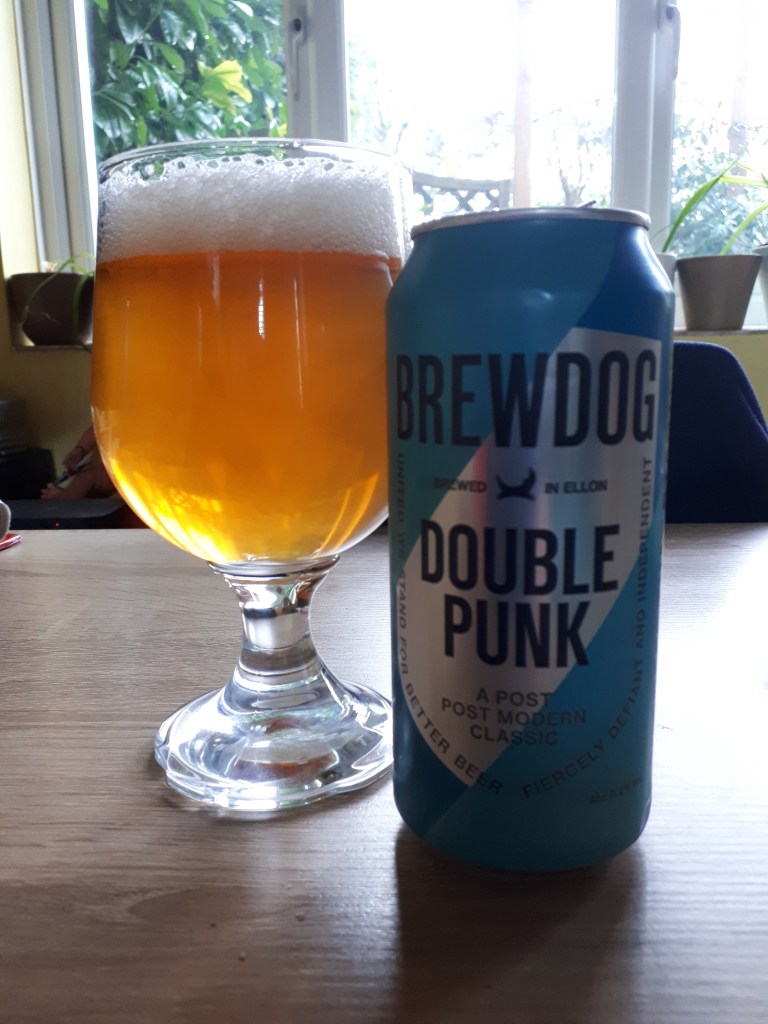
Today, I have not eaten any peanuts but for a pre-match snack enjoy a handful of Nairn’s ‘naturally nutritious’ rough oatcakes with some Cheddar and Port Salut cheese. My pre-match ‘pint’ is a 440 ml can of Brewdog Double Punk, today’s offering from my beer advent calendar; a different beer every day until Christmas.  Feeling sociable, perhaps because the beer has alcohol by volume of 8.2%, and having half an eye on Troyes v Paris FC in French Ligue 2, which my wife Paulene is watching on tv using an Amazon Firestick, I settle down on the two-seater blue leather sofa in the living room.  With a plastic earpiece in place I tune into Radio Suffolk on my Sony 310 transistor radio in time to hear the tail end of a pre-match summary of this afternoon’s encounter between Stowmarket Town and Eynesbury in the FA Vase.  My attention is grabbed by the fact that former Ipswich Town starlet and Bermudan international Reggie Lambe is appearing for Stowmarket.  Reggie Lambe has always retained a high profile in my football memory, possibly not because of his on-field exploits so much as the fact that he sounds like he could also be a cuddly character from an undiscovered episode of Watch with Mother.

The reportage from Home Park begins with a replay of commentary from 2008 in which commentator Brenner Woolley became very excited about two goals from Owen Garvan and one from Kevin Lisbie; as well he might.  After reference to the 976 kilometre round trip from Ipswich, although Brenner archaically quotes the distance in miles, we are introduced to the glorious West Country burr of this afternoon’s co-commentator Marcus Stewart; in the week that David Prowse died it seems a fitting tribute.  Brenner sarcastically speaks of the receding sound of the ‘loudest PA system in the country’ as Town’s goalkeeper, who he refers to as “Dai” Cornell, leads the Town team on to the pitch.  Marcus Stewart meanwhile says that it is time for everyone to “get onside and support the club and get behind the club”.  I will admit that I did not know that as well as being closer to the opponent’s goal line than both the ball and the second-last opponent, it is also possible to be offside by not being behind the club.

Very quickly Marcus tells us that he is going to put his “head on the block” as he predicts that there will be goals in this game.  I can’t help feeling that he is sounding hopeful when he suggests that if he is wrong it might be the last time he is asked to ‘appear’ on Radio Suffolk.  The opening minutes of the game sound entertaining as Brenner relays to us that there is “Good play from Town”, that Home Park is “sunny but blowy” and that “Woolfenden seems to have had a haircut”.   “Wrong decision” says Marcus in the assertive style of tv’s Kirtan Mucklowe as an Argyle player picks the wrong pass.  The commentary briefly takes the form of a conversation “Very open, Marcus” says Brenner. “End to end” replies Marcus, who a short while later provides some interesting tactical analysis about full-backs having more time on the ball when playing against a 4-3-3 formation, and being able to push forward.    Brenner meanwhile talks up the promise of goals for Town against Plymouth. “Only Swindon and Burton have conceded more goals” he says.  It’s a fact that shows Brenner has been assiduous in his research again, but personally I just love to hear the names of un-related English provincial towns in the same sentence; it makes me think of railway lines and town halls, local papers and building societies.

The thirteenth minute passes and seemingly out of not very much Plymouth score through Luke Jephcott.  “Good finish in terms of build-up play” says Marcus a little confusingly “ Plymouth again pinging the ball around” he adds.  Disappointed that what had sounded like a reasonable start to the game has taken the familiar wrong turn I take a mouthful of my beer, which because of its alcoholic strength has lived beyond it’s original ‘pre-match pint’ billing.  “Mmmm” I say to Paulene “This is a very fruity beer”.  What sort of fruit?” she asks.  Caught off guard by this question I make up something   “Oh, just a generic sort of fruit” I say, but she demands more detail. “Pineapple, banana?” She asks. “Yes” I reply “and apple, pear, mango, raspberry, kiwi fruit, lychee”.  “What about grapes, cherries and star fruit?” asks Paulene. “Yes”, I say “and strawberry, tomato, orange”.  “Melon, plum, papaya?” asks Paulene, “Yeah, and cranberry, blackberry, damson, even a hint of brazil nut.” 

Our listing of the world’s fruits is interrupted as I hear Brenner say “any fixture at the moment seems to be tricky for Ipswich” before mentioning “mitigating factors”.   Then all of a sudden Kayden Jackson is through on goal. “No excuses, should be 1-1” says Brenner as Kayden is tackled “We’ll be looking back on that through very painful eyes” continues Brenner, all too easily imagining the scenario in which Town fail to score and adding un-diagnosed medical problems to the mix for good measure.  “Just as he cocked his leg to take the shot – good defending” adds Marcus trying to describe what happened, but making Jackson sound a bit like a dog beneath a lamp post.

Despite the current score line I remain optimistic.  “Ward invited to come forward” says Brenner of Town’s left-back , creating an image in my head of Plymouth players ushering Ward along or handing him little cards with RSVP on the bottom.   Brenner soon engages Marcus in conversation again, “Jephcott’s a strong boy isn’t he Marcus?”  “Like a little bulldog” replies Marcus clearly still trying to develop his canine analogies.  Despite a lull in play around half past three which forces Brenner into telling us that there is very little happening, the consensus between the two commentators seems to be that it’s an entertaining game.  “ Town don’t look like a team short on confidence” says Brenner before unleashing a combination of stats upon the listeners about how many wins Town have had in the past five games (one) and how many points they’ve taken from the past ten games (nine).   The criticism remains implied, but Brenner is careful to explain that this is a “…very young Ipswich Town side” and “needs must at the moment”.

Half-time arrives at fourteen minutes to four and Marcus repeats that “There is goals in this game” which he has found “thoroughly entertaining”.  It’s left to Brenner to encourage me to return for the second half, “This game could be anything.  There could be a comeback for Ipswich Town, or it could be 3-0 to Plymouth”.  As insightful summaries go it fits well into either of the “Hedging one’s bets” or the “Why the hell are you asking me?” categories.

I enjoy a half-time of putting the kettle on, shutting and locking the garage door, drawing the blinds and closing the curtains.  Troyes have beaten Paris FC 2-1 with Paris having a spectacular volleyed ‘goal’ in the seventh minute of time added-on disallowed for dangerous play (jeu dangereux).  Troyes replace Paris FC at the top of Ligue 2 on goal difference and Paulene re-tunes the Amazon Firestick for the Ligue 1 game at Parc Roazhon between Stade Rennais and Racing Club de Lens.  I reflect that Home Park is only 402 kilometres from Rennes by sea and road, which is almost 90 kilometres closer than it is to Portman Road. 

Carelessly, I miss the re-start at Home Park and re-join the game just as little Alan Judge makes a “suicidal pass”, which almost gives Luke Jephcott a second goal.  Brenner moves on to speak of Newport County, Cheltenham Town and Exeter City all doing well in the fourth division this season and the prospect of further trips west next season,  clearly suggesting he has already given up on hopes of Town being promoted. “Cambridge would be a nice short trip” he adds, adopting the outlook of the Radio Suffolk accountant.

It doesn’t sound like Town are having many shots on goal ,but the game remains open and Brenner is moved to tell us that “ There is still no way of knowing what the full-time score will be”, which is frankly somewhat obvious unless he has access to some sort of Old Mother Woolley figure who has a crystal ball.  “Strong young lads” says Brenner of Jephcott and McGuinness, introducing an unexpected frisson of homo-eroticism as the game enters its final 25 minutes.  Jack Lankester and Brett McGavin are replaced by the weirdly named Keanan Bennetts,  and Oliver Hawkins.

It’s the seventieth minute and I am told that Plymouth’s Danny Mayor has “kicked the feet away” from Town’s Armando Dobra, a player who is Albanian and whose name incidentally rhymes with Enver Hoxha the former Communist leader of Albania.  Mayor is booked for a second time in the match and is therefore sent off.  Quickly following on, former Town player Frank Nouble is booked also, but only for the first time; “Getting a yellow card for verbals” says Brenner , incorrectly using the word ‘verbals’, which actually refers to different forms of verbs rather than bad language; we should expect the BBC’s broadcasters to know this sort of thing.  Marcus or Brenner, I’m not sure which, now tells us that against ten men we are going to have a lot of the ball, we just have to do something with it.   Seconds later, Paulene cheers as over in France Lens take the lead through eighteen year old Arnaud Kalimuendo Muinga and then in what is turning out to be a very busy three minutes Town take those words about doing something with the ball to heart and equalise. “Nolan shoots, he scores says Brenner succinctly.  “A great volley” confirms Marcus.  Within a minute I am hearing Brenner say “Hawkins chests it down and Jackson scores” and Town lead 2-1.  “Yay” I shout from my reclining position on the blue leather sofa.  This is the most fun I’ve had since last February.

To add to my enjoyment Brenner tells me that the 1800 Plymouth fans who have been allowed into the ground are “really aggravated” and in the background I hear them bawling and moaning in a real life version of people in supporters groups on the interweb.  The final fifteen minutes and injury time pass in a parade of observations from Brenner and Marcus.  “ … keep playing forward like they ‘ave been doing” is Marcus’s recipe for success as he turns up his West Countryness a notch . “ Ill-discipline from Watts” says Brenner revelling in another booking for a Plymouth player. “Fans getting disgruntled” adds Marcus picking up Brenner’s theme before sounding a note of caution with “Dangerous times now”.   Marcus’s voice is becoming increasingly gravelly, as if he’s been chain smoking Woodbines and slugging whisky all afternoon; he sounds like a Somerset Jimmy Durante.

It is evident that Plymouth are succeeding in getting back into the game. “Decent effort on goal from Hardy” says Brenner before ramping up the tension and pessimism with “This‘ll be a massive disappointment if Town draw this one”.   He carries on in similar vein by validating those listeners surprised that Town aren’t losing with “Town ahead; if you lost faith earlier in the game and thought here we go again”.   It doesn’t get any better; “Plymouth close – over the bar” and “Not pleasant viewing at the moment” before Brenner perhaps tries to lighten the mood with “Two players with similar pinkie-orange footwear on the far side” as full-time approaches.  The pretty-much statutory four minutes of additional time will be added.  The four minutes pass and Town win.

I am elated. After foolishly depressing myself by reading the ‘opinions’ of people on social media in the wake of two recent defeats and a draw, I am now ecstatic that Town have won and this afternoon I feel like I have travelled to Plymouth and back, played the match and wilfully thrown up on the wardroom carpet of every warship in Plymouth harbour.

Perhaps Town will lose again next Saturday, perhaps they won’t, but that’s what football teams do, they win, they lose and they draw and the margins between those three outcomes are small.  This season Ipswich Town have won more than we have lost, today we won, life is sweet.