I woke up this morning and without moving my leaden carcass squinted at the bedside clock. It was nine minutes past seven. I rolled over and soon descended back into a drowsy, drifting sleep. After what I thought was about twenty minutes I awoke and looked at the clock again. It was seven minutes past eight and l lay there thinking I should get up, whilst also becoming depressed at the thought that this is Easter Monday and I will have to go back to work tomorrow. I guess that with still a whole day of the four-day Easter break in front of me and a trip to Portman Road too, such thoughts must mark me down as a pessimist. I don’t think so though, I think I just don’t like having to work for a living.
Outside it is sunny, but it’s also breezy, so everything in the garden is moving and jiggling about, like I’m watching a Roobarb and Custard cartoon. My internal dialogue adopts the breathless voice of the late Richard Briers and I think of a young Felicity Kendal before wondering what people from the time before television thought of in idle moments. I get up, shower, eat breakfast, drink coffee and probably make my wife Paulene suspicious by performing a range of domestic tasks including ‘hoovering’ and ironing, before we enjoy a comforting late lunch of bangers and mash.
As a I step outside to walk to the railway station, it is spitting with rain; Paulene was watching men in lycra cycling around San Sebastien on the telly as I bade her farewell, and she gave me strict instructions that Ipswich Town must win today because they are playing Southampton and Paulene is a Pompey person, a former joint owner no less, before the rest of them sold out to Walt Disney. The train is on time but it’s an uneventful train journey, there aren’t many other passengers on board, although a young blonde woman asks me to look after her bag when she goes to the loo. I tell her “Don’t be long, I’m getting off in Ipswich.” But she’s back in her seat even before we glide on past one of the Wherstead Polar Bears, who appears to be hiding from the small handful of people who have paid to see him, or her.
In Ipswich, I exit the train and cross the railway tracks by the old footbridge because it has fewer steps than the new one. The streets are busy with policemen in baseball hats and day-glo gilets standing in pairs and watching. As ever, I stop in Portman Road to buy a programme (£3.50) from one of the ice cream booths, the vendor looks very young and is possibly very careless too as the screens on both her mobile phone and card reader terminal thing are cracked. “Did you drop them both?” I ask her, but don’t catch the reply; I’m beginning to worry about my hearing.
Approaching ‘the Arb’ however, I can hear the distinctive burble of pub conversation and the chink of glasses. Inside, ‘the Arb’ is heaving with people gathered around the bar, although most of them aren’t buying the drinks, but just waiting for them as if worried that theirs will be forgotten or slyly stolen. Next time I buy three drinks or more at once, I’m going to ask for a tray and reduce congestion at the bar; I urge everyone to do the same. But today it is academic as I am on my own; Mick still convalesces from the operation on his foot, whilst Gary has travelled by car with his brother. After acquiring a pint of Mauldon’s Suffolk Pride (£3.78 with Camra discount) I retire to the beer garden where there are no unoccupied tables except for one which would seem to be designed for standing at, so that’s what I do as I flick through my programme. Nearby, at a metal table a Mick Channon era Southampton shirt stretches across a beer belly and has me thinking about the first time I saw Ipswich play Southampton. It was during the three-day week, on a Saturday evening in February 1974 and Ipswich won 7-0. Southampton would go on to be relegated from what people now call the Premier League, along with Manchester United, and Norwich. The Seventies weren’t all bad.
Not getting a seat and having to queue at the bar felt like conceding early goals, but I’m back in the game with a second pint of Suffolk Pride, for which I don’t have to queue, and a seat at a Yogi-Bear style picnic table as the Johnny-Come Lately’s to Portman Road, who possibly weren’t alive in 1974, leave early for kick-off and a chance to be on the telly. By ten past five I’m on my own as a Town fan in the pub garden, or in the pub itself for that matter, so feeling lonely I drain my glass and head for Portman Road too.


I arrive at turnstile 62 early and have to queue, but I’m seemingly in the company of people who are unusually proficient in the wielding of bar codes and after a succession of green lights I’m soon bidding good evening to Pat from Clacton, Fiona and the man from Stowmarket (Paul), as I settle in a couple of rows behind ever-present Phil who never misses a game and his son Elwood. The teams parade onto the pitch and I feel the warmth of the pyrotechnics on my face, a mildly spectacular if not poetic expression of professional football’s double-standards. Murphy the stadium announcer does his stuff and for a second game in succession reads out the Town players’ names as they appear on the scoreboard, and we all pretend to be in France as we bawl out their surnames together. By ‘all’ I mean ever-present Phil and me. It’s taken him a while, (eighteen matches excluding the one he missed) but to mis-quote Rex Harrison (Henry Higgins) in the film My Fair Lady, like Eliza Doolittle “By George he’s got it!” I should really write to congratulate him.
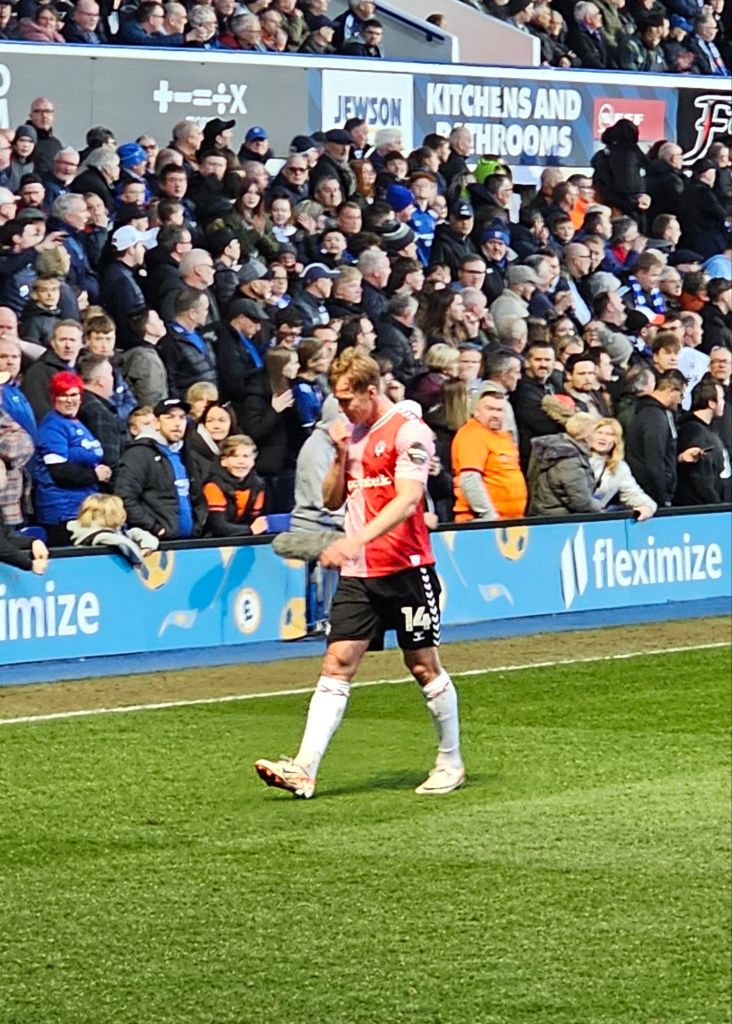
At twenty-eight minutes to six the match begins very noisily. It’s Southampton that get first go with the ball, aiming it roughly in the direction of the telephone exchange and London Road Baptist church whilst wearing an un-Southampton-like kit of what looks like red and pink halved shirts with black shorts, “Are they in red and pink?” says a text from my wife, who I am guessing is no longer watching blokes in lycra on bicycles. In fact, the pink turns out to be an optical illusion created by very thin red and white stripes. Town of course are in their signature blue and white.
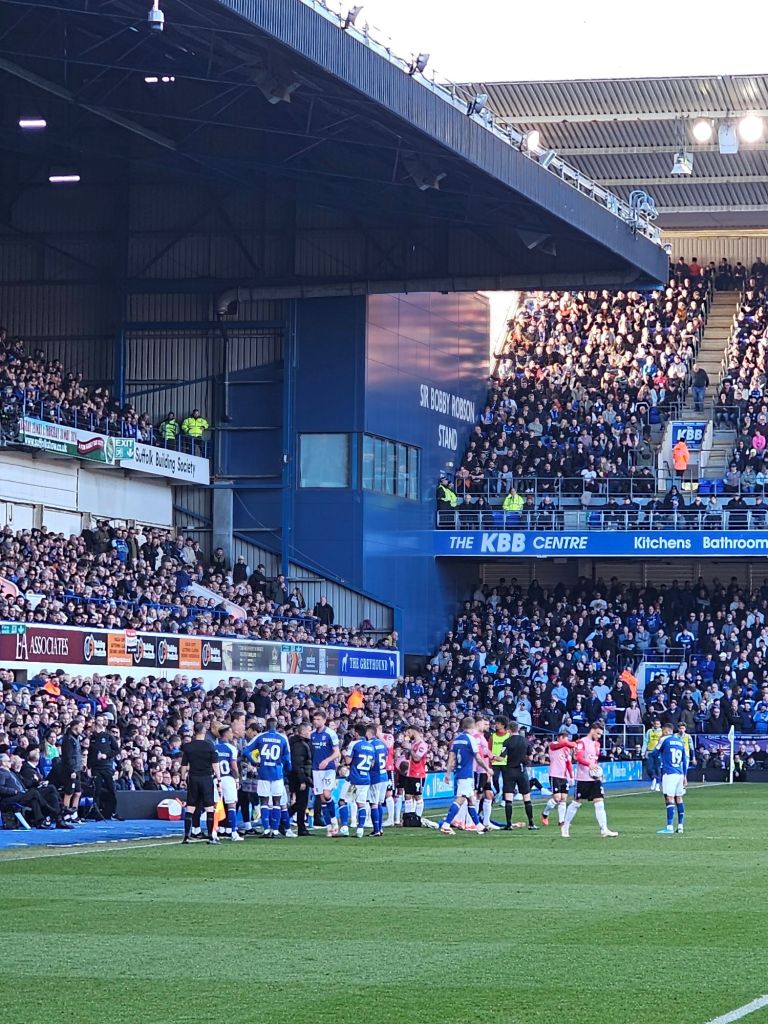
The visiting supporters are in good voice, probably as loud as any away fans this season as they launch into “When the Saints go marching in”, although I still prefer Louis Armstrong’s version from 1938. “E-I, E-I, E-I, O, Up the Football League we go” sing supporters of both teams being equally optimistic, but with eight minutes gone Southampton are selfishly keeping the ball to themselves to the extent that I momentarily lose interest and count the number of seagulls on the girder that holds up the roof of the Sir Bobby Robson Stand; there are eight of them. A minute later and the Southampton fans start to sing “Your support is fucking shit” but strangely their chant gets drowned out by the noise as Leif Davis sweeps the ball wide of the goal for the game’s first missed chance.
Four minutes later and the ball is briefly becalmed in midfield before Sam Morsy plays it wide to Leif Davis, who takes one touch before it hits the back of the Southampton goal net. From my seat, almost directly in line with Davis’s shot, I feel as though I must have momentarily blinked; one second the ball was at his feet, then it hit the net. I guess the Southampton goalkeeper feels much the same way, but just a little less cheerfully so, although he had an even better view than I did; except for the hitting the net bit, that is.
I will admit the early goal was unexpected; I had been prepared to wait a while against one of the teams capable of packing out their goal mouth with parachutes stuffed full of cash. I sit back to enjoy the spectacle and unfortunately so do the Town players as a low cross from in front of the Cobbold Stand is tapped home from close range and Southampton equalise with what can only be described as indecent haste. There seems to be some debate as to the validity of the goal in the Sir Bobby Robson Stand, where the conclusion is quickly reached through the medium of song that “Linesman, linesman, you’re a cunt”. The miracle of television however, will later confirm that it was a valid goal, although it won’t mention the status of the linesman.
Things soon get worse as a Southampton player falls over and the referee Mr Michael Salisbury heaps the blame on Sam Morsy, whom he books. “Sing when you’re winning” chant the Southampton fans, which is a bit odd given that Town were barely winning for long enough for anyone to clear their throats, let alone start singing. They proceed to follow it up by letting Conor Chaplin know that like the linesman earlier, they think his GP is actually a gynaecologist, and all because long ago he played for Pompey.
The first half is now half over as one bloke in pink passes to another, who runs half the length of the pitch and passes to another who strokes the ball beyond Vaclav Hladky and Town are losing. “Top o’ the league, you’re avin’ a laugh” sing the Southampton fans to the tune of Tom Hark before turning the knife with chants of “Football in a library, doo, doo, doo”. We are no match for their untamed wit, but I gain some solace from a Southampton free-kick hopelessly launched into touch as the occupants of the Cobbold stand shield their eyes from the slowly setting sun.
Southampton are keeping the ball to themselves still, and they’re still winning, and a Conor Chaplin shot goes straight to the visiting goalkeeper before the clock turns six and it’s time for a drinks break as Keiffer Moore is attended to for what looks like a bad back. Within five minutes Ali Al-Hamadi has replaced him. Kayden Jackson gets to chase a ball into the penalty area, but stupidly opts to fall over and look around expectantly for a penalty, when if he’d carried on somebody might really have kicked him. “We need to start waking up” says the bloke behind me as a low cross travels the full width of the Town goalmouth.
After seven minutes of added on time, a Southampton corner and fulsome roars of “Come On You Reds” . It’s half-time and, as I tell Dave the steward , we can but hope for a better second half. I predict we will win 5-2 because that’s what we did in February of 1982, and when it’s not doing something different, history repeats itself. I speak to Ray, his son Michael and his grandson Harrison and offer them Marks & Spencer mint choccy speckled eggs because it’s Easter. Ray doesn’t seem as cheerful as usual and bemoans that Axel Tuanzebe is really a centre-half playing at full-back, and although he can be a bit unreliable at times he’d rather see Harry Clarke.


Back in my seat, I share some speckled eggs with Fiona and Pat from Clacton and at twenty to seven the football resumes. “Shit referee, shit referee, shit referee” sing the Sir Bobby Standers to no particular tune that I know of, as Mr Salisbury picks up where he left off and doesn’t award Town a free-kick. Southampton win a corner. “Come on You Reds” we hear. Southampton win a free-kick. Vaclav Hladky makes a fine flying save. Southampton win a corner. “Come On You Reds” again. Not fifteen minutes of the half have gone and I look up at the scoreboard, it still reads 2-1 to Southampton, but it feels like we’re losing by more. Southampton win another corner.
The game is two-thirds over and it’s the traditional time for mass substitutions. Kayden Jackson, Axel Tuanzebe and Massimo Luongo are replaced by Nathan Broadhead, Harry Clarke and Jack Taylor. Murphy announces this evening’s attendance as 29,393 with 1,969 from the place my wife calls Scumton. “Here for the Scummers, You’re only here for the Scummers” chant the Scummers to the traditional Hampshire tune of Guantanamera, and some people applaud. I can’t work out if they’re applauding themselves, each other, Murphy, the singing or just life itself.
Six minutes later and it looks like Ali Al-Hamadi must score, but his shot strikes a goal post, although from where I’m sitting it looks like he’s shot horribly wide as the ball rebounds back at an angle. “Blue and White Army, Blue and White Army, Blue and White Army, Blue and White Army” chant the Sir Bobby Robson Standers, and then possibly again, but I’m not counting. The substitutions have made a difference and just to prove it Jack Taylor plays a first time pass to Nathan Broadhead who from just inside the Southampton penalty area turns and scores, shooting beyond goalkeeper Bazunu, who interestingly also used to play for Pompey, just like Conor Chaplin, who Fiona and I both decide must, for the sake of the Southampton fans, now score the winning goal.
Southampton are no longer dominating possession, and Town only have to win a throw-in for the home crowd to roar them on. “Come On Ipswich! Come On Ipswich!”. The stands are moving with waving, punching arms and fists and wide-open, shouting mouths, and probably some spittle too. Pat from Clacton tells Fiona and me she’s been ill during the week; I ask her if she brought the lurgi back from Norfolk where she was playing whist in Great Yarmouth the week before. She won £95.00, she tells us.
“Oh when the Town go marching in” bawl the far end of the ground gloatingly, as if only the supporters of the team in the ascendency are allowed to sing black spirituals. Ali Al-Hamadi runs at goal and Conor Chaplin shoots wide with fifteen minutes left of normal time before Southampton substitute Che Adams, whose parents I like to think were, and hopefully still are, both Marxists, with Sam Edozie. Five minutes later and Southampton make a double substitution bringing on the lanky and totally bald Will Smallbone, who sounds like a character from a novel by Charles Dickens (born in Pompey) and looks like the popular perception of what an alien looks like, which is a remarkable coincidence because the other Southampton substitute is called Rothwell, which is how people who lisp pronounce Roswell.
Five minutes of normal time remain and as ever Leif Davis runs down the left, but this time he will be through on goal if defender James Bree doesn’t foul him and get sent off. Bree makes the long walk of shame to the dressing room last as long as he can, doing his best not to look ashamed or remorseful and as Nathan Broadhead lines up to eventually shoot the ‘Bree-kick’ into the defensive wall, I count fifteen seagulls on the roof of the Sir Bobby Robson Stand; squawks have spread .
After Conor Chaplin is substituted for Jeremy Sarmiento, who of course is on loan from Brighton (the Seagulls), in the final minute of normal time I put my notepad and pencil away in my coat pocket knowing that if Town score now I might throw them up in the air and never find them again. Seven minutes of added time is more than enough for Town to score again and somehow I think they will, perhaps because it seems they always do, and it seems like everyone else feels the same.
The final minute of added on time inevitably arrives on time and equally inevitably Sam Morsy finds Leif Davis on the left. Davis plays the ball into Jeremy Sarmiento, who ‘skilfully’ meets it with his left foot as he stumbles forward, falls, and stabs it with his right into the corner of the goal as he gets up again. The roar from the crowd is the biggest I’ve heard at Portman Road since Jim Magilton slalomed through the Bolton defence to score in the play-off semi-final twenty-four years ago. Men, women, children are hugging each other in scenes of reckless abandon, not the sort of thing that happens in puritan Suffolk at all. Like in a dream there’s barely time for the game to re-start before it ends, and yet again Town have won.
One day I might wake up and not find myself in another dream, but I hope not.