Today is the day of my favourite round of the FA Cup. Whilst supporters of professional clubs may enjoy the third round when the ‘big’ clubs deign to take part, or the first round when the not quite so big clubs join in, I love the very first day. For a start, it is still summer and the days remain long and warm, but what I love about it more is not that any particular clubs take part, or even that it is the beginning, what I like is its name, the extra-preliminary round. Before the first round there are four qualifying rounds; before the first one of those there is a preliminary round, but the FA clearly don’t think that goes far enough and rather than have six qualifying rounds, they decide to have both a preliminary round and an extra-preliminary round. This seems to me to embody the FA’s attitude to grass roots football clubs as a bit of a nuisance that must be culled before the competition can begin properly. This is the FA ‘putting it’ to these little clubs that they are nothing. It’s no wonder that only 800 odd clubs enter the FA Cup, the FA would never cope with what happens in France where over 7,000 clubs enter their equivalent competition, the Coupe de France, but then, France is a republic.
Today I am travelling to Woodbridge by train (£3.15 return from Ipswich with a Goldcard) to watch Woodbridge Town, newly promoted to the Thurlow Nunn Eastern Counties Premier League, play Clapton of the Essex Senior league, a club with a distinguished history and where the fabled Walter Tull began his football career. On the first part of my journey to Ipswich I sit next to two women discussing a man called Amos and what he does when he is in Uganda. When I change trains I sit at a table where a girl in red socks and white T-shirt is quick to tell me that she is innocent of having made the neat arrangement of two empty Lucozade bottles and three crisp packets that sit on the table. I tell her it’s okay, I will avert my gaze and look out of the window. British Transport police are looking for an obese person with OCD who is recovering from illness. Two West Bromwich Albion supporters on their way to Norwich sit across the gangway from me, we chat a little and I wish them luck, telling them that I am expecting at least four or five goals from their team; pleasingly they will oblige. I also recoil from the hideous sight of a tall, well-spoken young man in a Norwich City shirt; he has ‘Cooper’ ‘21’ on his shirt back; his name and IQ I surmise, or possibly the number of members of his family with whom he has had a sexual relationship.
The three carriage 13:18 to Lowestoft leaves Ipswich on time and slowly roars its way through marshalling yards and past Hadleigh Road industrial estate with its mighty disused gas holder that sits in a nest of buddleia. Beyond the River Gipping the view of Ipswich from the bridges over Bramford Lane and Norwich Road is a joy with its cluster of modernist blocks and the floodlights of Portman Road looming up beyond low streets of red roofs, which haven’t changed much in eighty years, in many cases much longer. This is a lovely train journey, albeit a noisy one thanks to the diesel engine and old-fashioned clickety-clack of the rails. The train arrives at 13:32 and Woodbridge seems busy; a group of women, all teetering heels, tanned legs, tight dresses, make-up, flowers and fascinators await a taxi; on their way to a wedding, I hope. Woodbridge station is a homely looking building, but I waste no time in setting off up the hill towards Notcutt’s Park, which is a good twenty-minute walk away.


Woodbridge is clearly a well-heeled town, there are large houses, some with naked statuary in the garden and the lamp posts are adorned with somewhat twee hanging baskets, overflowing with summer flowers. I pass by the Cherry Tree pub but do just that, pass by, it looks busy and full of Saturday lunchtime diners. Further up the hill is the local Ford motor dealership where in 1970 my father traded in his maroon 1962 Ford Cortina 1200 for an almost new (ex-demonstrator), beige Ford Cortina 1600 Super, which he always maintained was the best car he ever owned.


Further on, the path leaves the roadside, ascending an embankment and becoming a leafy bower

before emerging again into the full light by the Duke of York ‘country’ pub, which is really a ‘family diner’ masquerading as a pub and part of the Vintage Inns chain whose “…rustic buildings offer a country style dining experience…” .


I have been walking for almost fifteen minutes and fearful that the Woodbridge Town clubhouse might only serve insipid Greene King IPA I call in for a pint of Adnams Southwold Bitter (£3.90). At the bar a youngish man orders food. “The menu says you have those kofte things” he says. “Yes” says the bar maid. “I’ll er, have some of them, er please” says the man, showing what sophisticated diners the English have become thanks to the country style dining experience and its ilk.
Refreshed by Adnams Southwold Bitter I press on with the final short leg of my walk to the match through a modern estate of red brick houses, which all look like they are

trying to be nineteenth century Suffolk farmhouses; I imagine their occupants having Ploughman’s lunches for every meal. At the end of a winding road of executive homes is Woodbridge Town Football Club. I follow a man with a carrier bag of empty bottles which he tips into the recycling bin outside before proceeding through the turnstile.


I pay my entry fee (£6.00) receiving a yellow and white ticket in exchange and purchase a programme (£1.00), which annoyingly I will later lose in mysterious circumstances (did it fall from my pocket, or did I leave it in the bar?), it was a glossy publication which I rather liked. After a cursory look across the pitch, where players of both teams are limbering up, I enter the bar and a youth wearing a thick grey anorak as if he’s in in 1990’s indie band serves me with a pint of Adnams Ghostship (£3.50). I feel foolish for worrying about Greene King IPA now and my faith in football club bars is restored, for now. The barman doesn’t look old enough to serve alcohol, but he later takes the anorak off revealing tattoos suggesting he is indeed over eighteen. But maybe he serially lies about his age, has been driving since he was thirteen and had this been a century ago he would already have spent a couple of years in the trenches of northern France. I sink the Ghostship and wander outside into the sun where the crowd is gathering. There are just two stands at Notcutt’s Park, one a covered, shallow metal terrace and the other, which is directly next to it, a brick structure with half a dozen rows of bench seats; I pick a spot in the seated stand and read my programme, which I have not yet lost. After a short while I am surprised to look up and see the two teams and the officials all lined up on the pitch, shaking hands like Baptists on a Sunday morning.
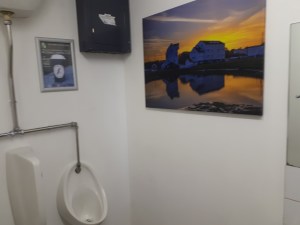
The game begins with Clapton in all blue with yellow socks and sleeves kicking off in the direction of whatever lies northeast of Woodbridge; Ufford probably. Woodbridge Town wear black and white stripes with black shorts and socks, hence their nickname ‘The Woodpeckers’, not that woodpeckers wear football kits and of course not all woodpeckers are black and white; a fact highlighted by the most laudable poster above

the urinals in the toilet urging spectators to buy a re-usable drinks cup and become a ‘green’ woodpecker. All clubs should be doing something
similar.
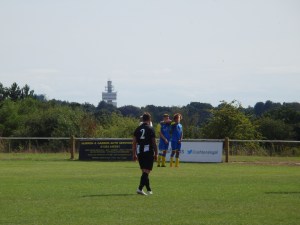
Woodbridge play towards the junction with the A12, Martlesham and the tower of BT’s research laboratories which is visible in the distance.
The first foul of the game, after just a few seconds, draws a shout from the crowd “That’s about time ref”. Woodbridge look much the better of the two teams in the opening minutes; perhaps they should with former Ipswich Town and Sunderland player Carlos Edwards in their team; they pass the ball whilst Clapton just run about after them. But Woodbridge don’t create any chances to score and when it looks like they might, a Clapton player always manages to be in the way. Woodbridge have the first proper shot of the game, which flies over the Clapton cross bar in the seventh minute. Woodbridge are playing well, but then again they’re not; and Clapton are struggling, but then in a way they’re not because their goalkeeper has not had a save to make. Some of the crowd amuse themselves with shouts and cat calls. “VAR. That was a penalty!” is heard as a Woodbridge player tumbles in the box, and then “Eh, absolute shite ref” as play is waved on. I decide to take a wander, and alone at the corner of the ground I get to play the ball back to the Clapton full-back Lanre Vigo when it goes out for a throw. There is a pause in the action as the somewhat portly referee Mr James Beal speaks to two complaining Woodbridge players. ”Get on with it Porky” is the shout from the crowd; you can’t beat humour at the expense of fat people. I get to touch the ball back to Lanre Vigo again, this time a header, no one congratulates me and although it does knock my glasses off I thought ’I done well’.
Considering that as someone who paid to get in I am getting too many touches of the ball and am therefore bound to embarrass myself (if the flying glasses haven’t already done so) I walk round to the dug outs on the opposite side of the pitch to the stands. Here the Clapton manager and his coach are providing a constant commentary of the game as they live every touch of the ball by their players. “Why do you put it there?” shouts the manager to his goalkeeper Jack Francis “I keep telling you mate, I don’t want it in the centre I want it here”. There are a number of players who receive constant encouragement and instruction, the names Jerome, Warren, Gio and Dylan feature prominently. Number five Dylan Ebongo is a ‘big lad’ who rivals and outstrips the referee for the space he takes up on the pitch, but as is so often the case with players that spectators accuse of having eaten all the pastry based foods, he can play a bit and Dylan is a rock in the Clapton defence.
It’s about twenty five past three and against the run of play Clapton have a corner; at the near post the ball is flicked on, the young Woodbridge goalkeeper Alfie Stronge flaps a bit and the ball meets the goal net in the lovely way that footballs do; it’s 1-0 to Clapton. “Who scored?” asks the happy and surprised Clapton manager of his neatly coiffured number seven Ryan Reed, but he doesn’t seem to know, or I at least I can’t work out what he says.
“Take heart from that” shouts the Clapton manager to his team as if none of them expects not to lose. Despite his constant imploring and helpful encouragement to his players the Clapton manager seems quite pessimistic in private moments when speaking to his coach or simply verbalising his thoughts, or perhaps he’s just realistic. “We’re our own worst enemy”, “We could be in trouble here”, “Now we’ve got trouble” are a few of his comments as the Woodpeckers press, along with his admirably honest assessment that his team has actually done nothing and Woodbridge have had all the play. Despite being a goal up however, ten minutes before half-time there is a falling out between the manager and his number ten Jerome Mortell. Jerome is threatened with being substituted, but his response is simply “Go on then” and within a minute he is stomping his way round to the dressing room, leaving the pitch with the words “I’ve had enough of this shit”. Clapton had only Jacod Dingli on the bench today, and now he’s on the pitch, but at least they’re still winning and very soon they are almost two-nil up as another corner against the run of play sees a header thud against the woodwork of the Woodbridge goal.

Across the pitch a tall man, immaculately dressed in a dark suit stands out amongst the general scruffiness of the usual football crowd, I believe this is Vince McBean the current owner of Clapton FC and a controversial figure after he allegedly attempted to liquidate the charity that administers Clapton’s Old Spotted Dog ground. From where I stand he looks like an undertaker.
Half-time and I’m one of the first at the bar for another pint of Ghostship (still £3.50) which I follow up with a visit to the toilet where I admire the juxtaposition of a large print of a sunset over the Woodbridge’s tide mill with the urinals; it makes me think of Marcel Duchamp’s ‘Fountain’.
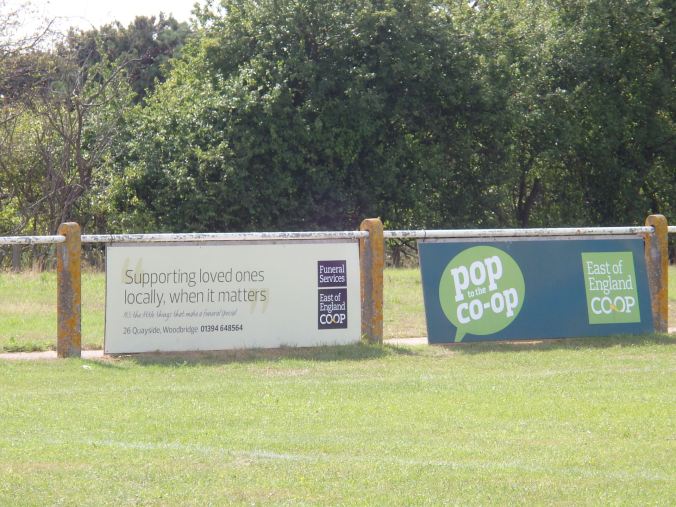
But there is little time to consider twentieth century art, the players are on the pitch and Woodbridge line-up as Clapton huddle. I return to stand between the dugouts where the entertainment is richest, although I do take a moment to enjoy the Co-op’s side by side, edge of pitch advertisements, one solemnly telling us how their funeral service is “Supporting loved ones locally when it matters” (and presumably telling non-local loved ones to clear off) and the other in a lighter frame of mind urging us to ‘Pop to the Co-op’.
The second half begins and before not very long Ryan Reed intercepts a poor pass and breaks forward, he rides a tackle and is through on goal, he shoots, Alfie Stronge saves but the ball rebounds to Ryan who strikes it confidently and with force inside the far post from a tight angle. It’s 2-0 to Clapton.
The Clapton manager stresses the importance to his players, particularly to big Dylan at the centre of the defence, of holding onto the 2-0 lead in the next ten minutes, which he says will break Woodbridge’s hearts if they can do it. They do and the game seems to settle down with Woodbridge still dominating possession, but mostly over-hitting all their forward passes and crosses. Substitutions are made by Woodbridge and approaching the last fifteen minutes it looks like Clapton will hold on. The Woodbridge manager who incidentally is probably bigger than both the referee and Clapton’s Dylan seems calm, despite his frequent frustration at those over hit passes; is he resigned to a defeat?
Woodbridge for all their inadequacy in terms of shots, are still dominating however, and the ball is spending most of its time on the Clapton half of the field. A Clapton player is nearly always the last man to touch the ball inside their own penalty area, but then just after twenty five to five the ball runs loose and Woodbridge’s number seven Callum Sinclair lashes it on the half volley in to the top corner of the Clapton goal to halve Clapton’s lead and give Woodbridge hope.
I came to this game as a neutral but the enthusiasm of the Clapton manager and coach and the fact that they turned up with just one substitute and seemingly a team that must be coached through every kick has me wanting them to hang on for the win. There is also a bit of me that wants rough, deprived, inner city Clapton to triumph over wealthy, privileged Woodbridge, although of course I know in reality that those distinctions don’t actually have any relevance in the context of these two football clubs.
Woodbridge earn a corner, it’s late in the game and goalkeeper Alfie Stronge comes up to add his presence and he heads narrowly over the Clapton cross bar. The Clapton manager berates his players for trying to pass the ball when clearly a hoof is required. That has been a recurring theme, but I find it reassuring that players want to play the game ‘beautifully’, because that’s what makes it so good to watch, and play, whether it comes off or not. The game is into time added-on and a half-hearted challenge, which causes a slight stumble but no trip, sees Mr Neal award a free-kick just outside the penalty area, in range for a well taken direct shot. The Clapton coach is apoplectic and winds himself up by imagining that it’s as if the referee wants Woodbridge to equalise; the manager is not happy about it but is more sanguine, realising preumably that whatever will be, will be on the way to Wemb-er-ley. Woodbridge’s number five Liam Scopes steps up to scoop a shot over the wall and into the top left hand corner of the Clapton goal. Woodbridge have tied the match and the Clapton coach is sent off by Mr Neal for simply getting carried away with himself.
There is no time for anything more to happen and I am only sorry that with the time now almost five o’clock I must leave and hot foot it back to the railway station to catch the 17:18 back to Ipswich. It’s been a lovely afternoon in the August sun and a thoroughly entertaining game, which has been a credit to both clubs. I am tempted to try and make it to the replay. I’ve had a great time, but in about twenty-five minutes I will realise I no longer have my programme.


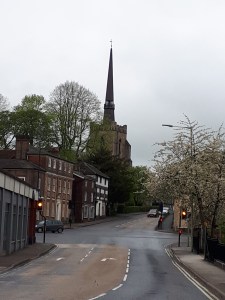 II* listed, but seemingly derelict eighteenth century Lynton House in front of it. The route to Green’s Meadow is along Gipping Way, past the badly spelt Bodywize Gym, Lidl and the predictable queues of shoppers at its checkout tills, who stare out through the plate glass to assuage their boredom; perhaps I should wave.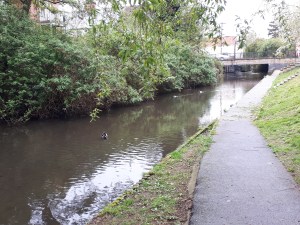
 impressive looking, but the yellow and black signage gives it a certain unity and smartness. Entry to the Greens Meadow ‘stadium’ (£6) on match days is through the ‘turnstiles’ which are close to the half way line. There is no queue and as I walk in the referees and some players are warming up on the pitch, which on such a grey day appears almost luminous, its grass, lush, damp and very green.


 shirts with black shorts and socks, whilst Long Melford wear an Anderlecht or perhaps Fiorentina or Toulouse inspired change kit of all purple or violet, but with black and white hooped socks, as if they forgot to buy the whole ensemble. Melford kick off the match with their backs to the town, playing towards the A14 and the looming concrete bridge which crosses the adjacent railway track and River Gipping.
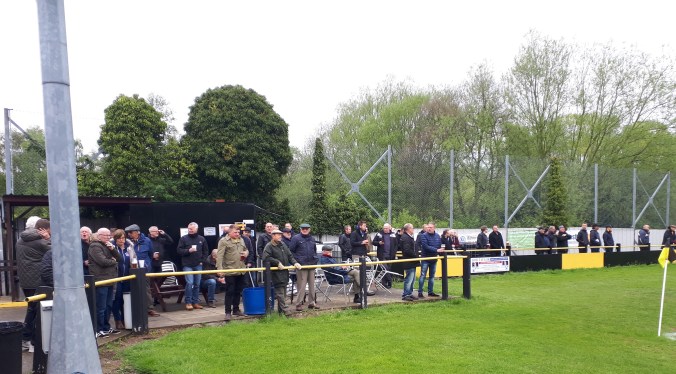 drinking. A few wear flat caps, some fashionably, some less so. “Blimey, it’s like an audition for Peaky Blinders round here” says one bloke; it’s a comment that makes me smile more than anything I anticipate Russell Hall might say. I wander round to behind the dugouts. Stowmarket win a corner and their number five heads the ball directly into the arms of the Melford goalkeeper. One of the Stowmarket coaches clutches his head in anguish as if imitating Edvard Munch’s ‘The Scream’, or having a seizure. The Melford right-back then rather uncharitably passes to the Melford number eleven, simultaneously calling “man-on”. It’s akin to throwing him something boiling hot and yet also very fragile. He might have done better to pass to someone else.
 the 30th anniversary edition of George Harrison’s defining triple album “All Things Must Pass”. The concrete bridge is a wonderful backdrop to the corner of the football ground, running as it does above the height of the trees, which surround the ground on two sides. The roar from the traffic is constant and I wonder how polluting it must be down here at pitch level. Do asthmatic players struggle more at Stowmarket?
 thing of beauty, a red brick building in the Jacobean style and dating from 1846, it is Grade 2 listed. Happily, although it was closed in 1967 it re-opened just four years later. Tearing myself away from the loveliness of the railway station, it is a numbingly simple and direct walk to Bloomfields, the home of Needham Market Town Football Club. Across, the station forecourt, sadly dominated by parked cars, past the wonderfully named Rampant Horse pub where Calvors beer and lager brewed locally in Coddenham is served, across the main road, down the side of the Swan Hotel and on up the side of the valley, leaving the timber framed buildings of central Needham and reaching the football ground through an estate of 1960’s bungalows. The route is so simple and direct it is as if the railway station and the football ground are the two most important things in Needham Market and as Gary remarks, the path between is akin to Wembley Way.


 trippingovertheball