Ipswich Town 0 Barrow 0

When I first became interested in football at the tender age of ten, Barrow were in Division Four and had been in the Football League since 1921, when they were elected as original members of Division Three North.  In my Observer’s Book of Football, the one that has a picture of Bobby Charlton on the dust jacket, it states “Honours have always been elusive for Barrow” and it goes on to say that Barrow had just “one season of triumph”, in 1967 when they finished third in Division Four. Sadly for Barrow, by the time I first saw them play, at Layer Road, Colchester in 1990, they had been replaced in the Football League by Hereford United and were not yet half way through a forty-eight year stint in non-league football.  Thirty years on and today, through the wonder of the 2nd round of the FA Cup, Ipswich Town and Barrow meet for the first time ever. I’ve been looking forward to today’s game to some extent since 1971, but more tangibly since the Cup draw was made, and in reality since Idris El Mizouni’s cracking goal ensured Oldham Athletic wouldn’t be making an unexpected run to Wembley.

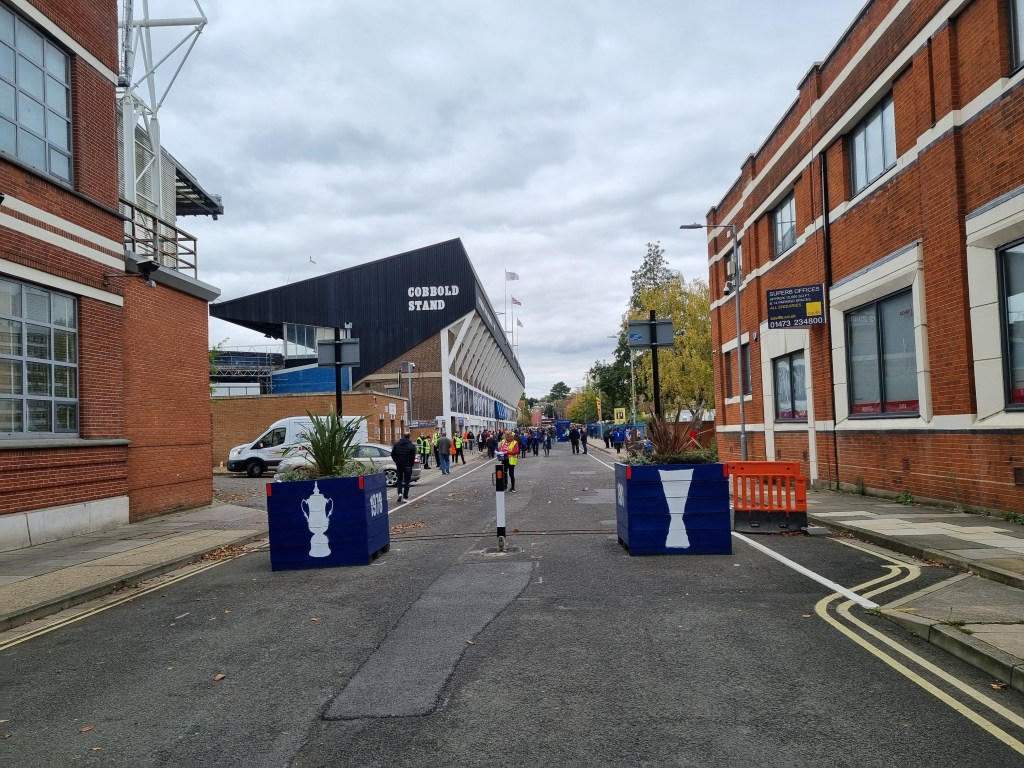
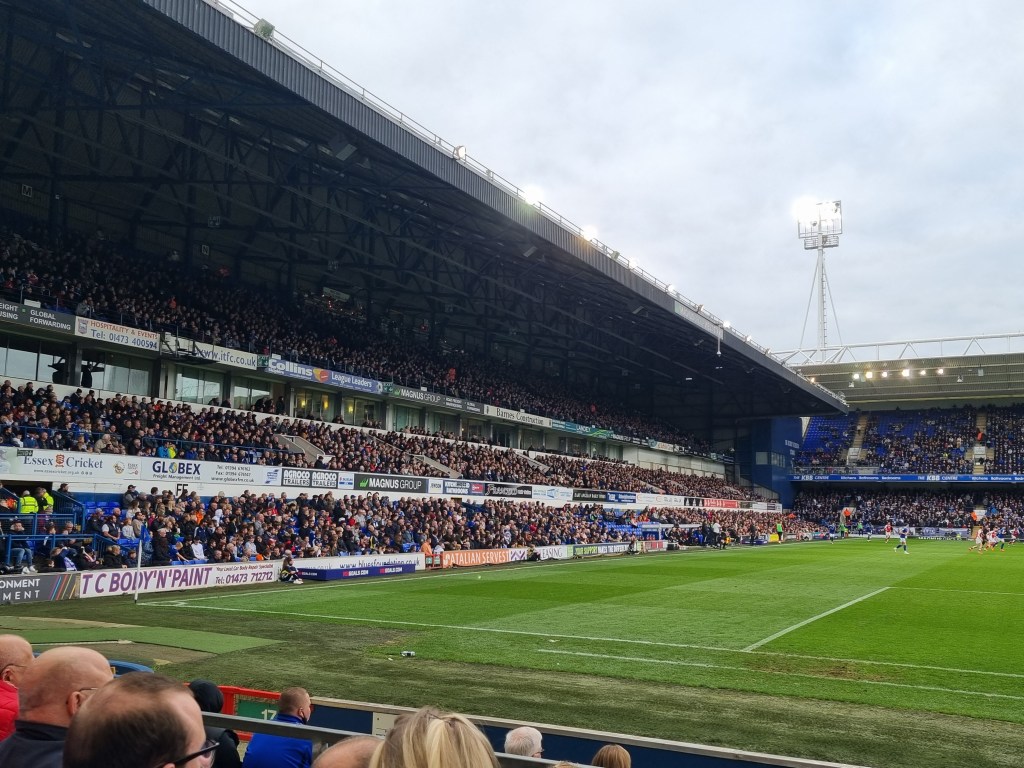
As befits an FA Cup Day, the sun is shining gloriously, although with little impact on the outdoor temperature as I stroll across Gippeswyk Park and up Portman Road beneath clear azure skies.     Portman Road is notable this afternoon for the atypical absence from the car park behind Sir Alf Ramsey’s statue of some of the usual vendors of chips and other grease-based foods sold inside spongy ‘bread’ products.  There is also a corresponding shortage of human beings in Portman Road today compared to other match days, and whilst you might infer from this that people only come for the grease-based foods, the sadder truth is that the FA Cup simply doesn’t attract football fans like it once did.  I can recall paying full-price to watch Town play fourth division Halifax Town and Hartlepool United in the company of about 24,000 other souls back in the late 1970’s, and now find it hard to understand why with reduced ticket prices the lure of Cup glory against such Northern exotics is no longer an attraction.  In this age of instant gratification and tv reality game shows, Cup football should be more popular than ever with its promise of advancement to the next round and the jeopardy of defeat and expulsion from the competition after just ninety minutes; Death or Glory as The Clash sang just a year after Town lifted the FA Cup. The tyranny of Sky tv and the Premier League is clearly to blame.

Having purchased a match day programme (£2), I head on to what was The Arboretum pub back in the days when 24,000 turned up to see Hartlepool United and Halifax Town at Portman Road,  but is now The Arbor House.  With a pint of Mauldon’s Suffolk Pride (£3.80) in my cold right hand I sit and wait for Mick in the garden.  Mick soon arrives with a pint of Mauldon’s Molecatcher, a packet of Fairfields Farm cheese and onion crisps and a cup of dry-roasted peanuts.  Mick explains that Molecatcher is brewed to the same recipe as Suffolk Pride but is less alcoholic; I can’t really see the advantage of that at the moment, but our conversation explores various avenues from last night’s Have I Got News For You tv programme to nuns before it is time to walk down the hill past Ipswich Museum to Portman Road.

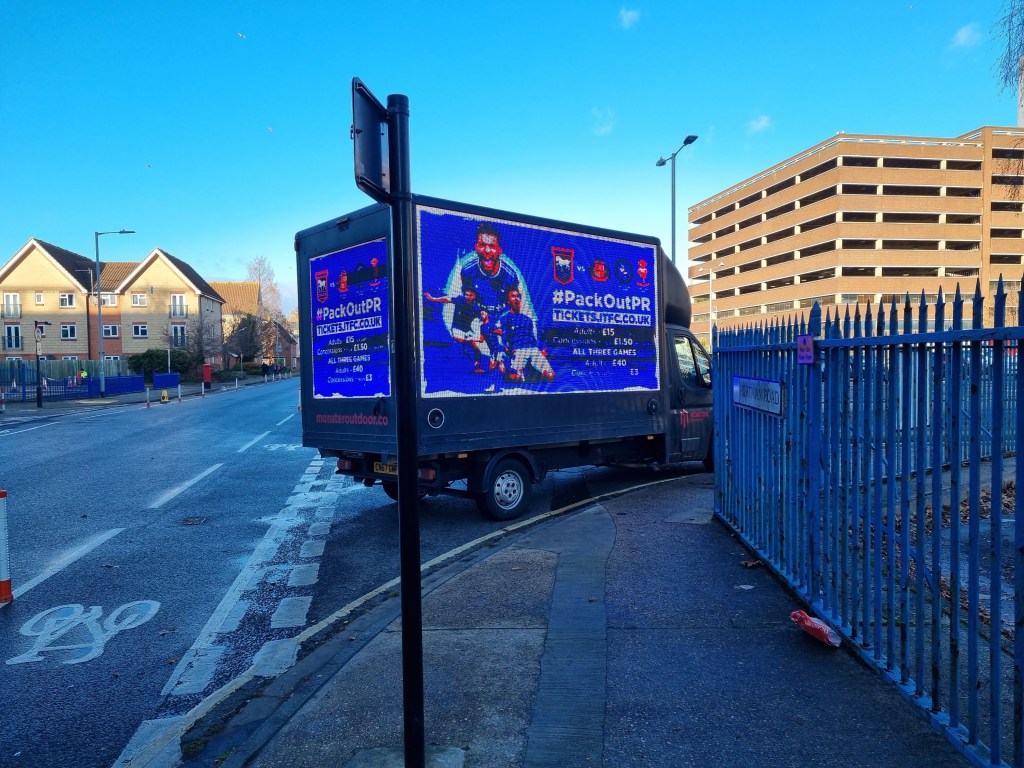
Today, taking advantage of the reduced flat rate ticket price (£10 for adults and £5 for concessions plus £1.50 each for the pleasure of buying them, which goes to a parasitic organisation called Seatgeek) we are in the top tier of what was the West Stand, but is now the Magnus Group Stand. We are in Block Y where the seats are brown in colour, not because of any sort of unpleasant staining but merely because I imagine brown looked ‘classy’ in 1982 when the top tier was opened; the seats are also padded.  I bought our tickets soon after they went on sale and we benefit from being close to the stairway or vomitorium, and just two seats in from the gangway, so only two old men must rise from their seats for us to access ours.  With everyone in their winter coats it’s a tight squeeze nevertheless.

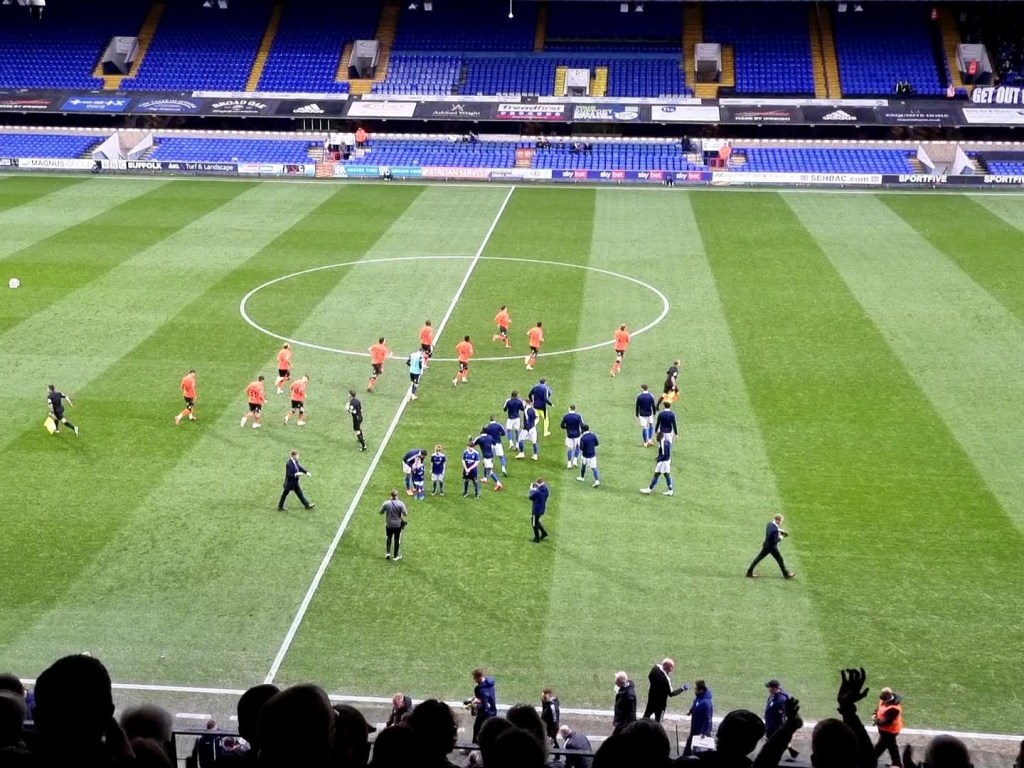
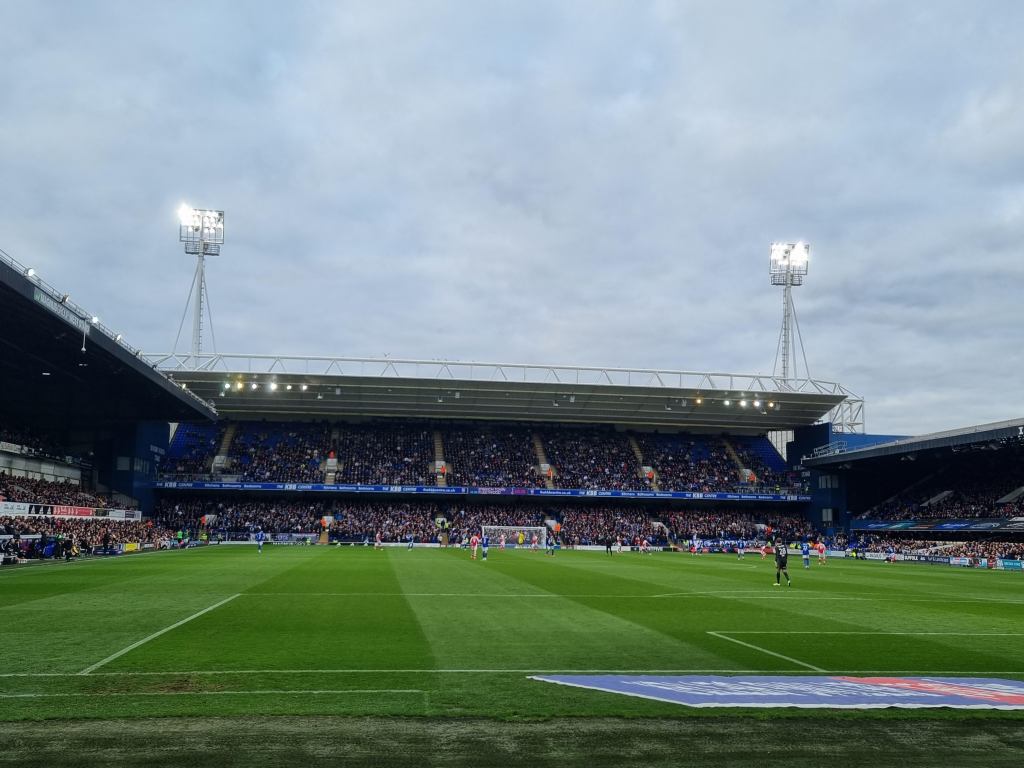
The teams appear to an introduction from stadium announcer Stephen Foster worthy of the occasion and with knees taken and duly applauded the game begins;  a strong Town team getting first go with the ball and kicking towards the Sir Alf Ramsey stand, formerly plain old Churchman’s.  Town are wearing their traditional blue shirts and socks and white shorts whilst Barrow are in an unexpectedly stylish pale pink shirt and socks with black shorts, vaguely reminiscent of Sicily’s Palermo or the now defunct Evian Thonon Gaillard, briefly of French Ligue 1.   The largely empty stadium is filled with a sense of expectation as the game starts and the murmur of a nascent chant can be detected from the Sir Bobby Robson stand.  Within a minute of kick-off however silence reigns.

From the start Town look as hesitant and short of ideas as their supporters are of rousing supportive chants. It is Barrow who show the first serious attacking intent as several players in pink break forward “They’re all offside, nine of ‘em; except him” says a man with a loud and annoying voice a couple of rows behind me as Barrow’s number eleven Josh Kay bears down on goal beneath the shade of the Magnus Group Stand.  The same voice is all too audible a short while later as Barrow break forward again. “Toto, Toto, leave him alone Toto” he calls as Toto Nsiala tracks a Barrow player into the Town penalty area and makes a tackle before he can fashion a shot on goal.  Had Toto Nsiala followed the spectator’s advice it is likely Barrow would have scored or at least had a shot on target. It’s not a good start by Town or their supporters.  But as a consolation the low winter sun is reflecting a sparkling yellow light back off the windows of the Guardian Royal Exchange office block on Civic Drive, so although the football isn’t, the backdrop is gently inspiring.
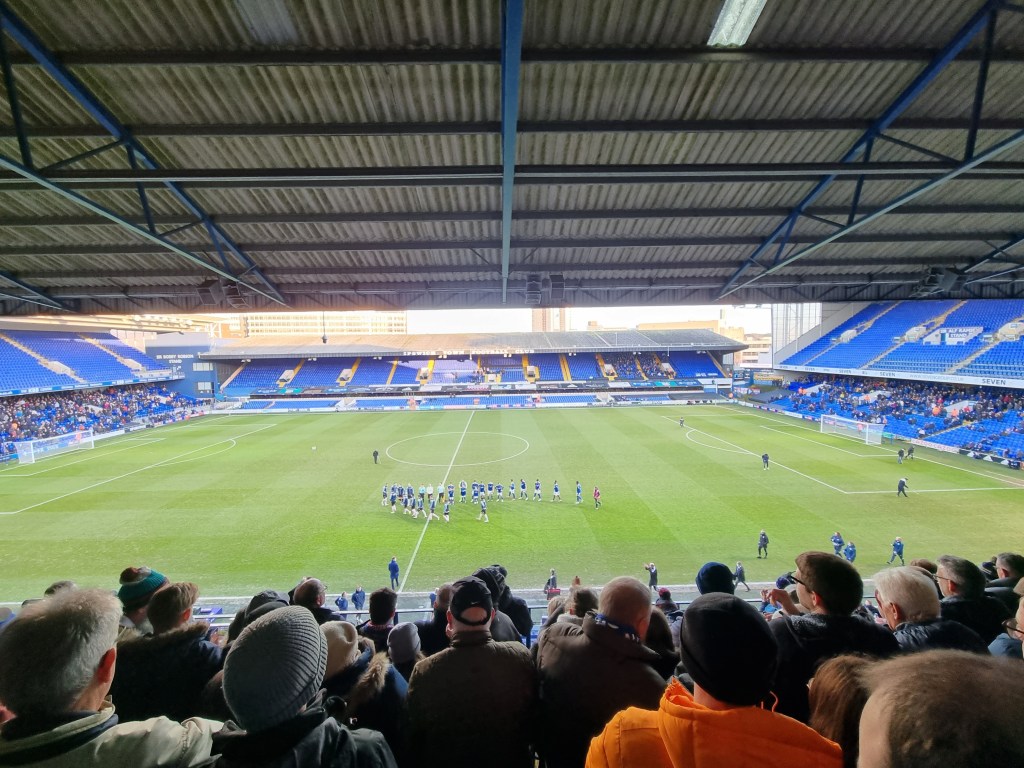
Over twenty minutes pass and Barrow earn two free-kicks in quick succession in the Town half and then win the game’s first corner.  Barrow come close to scoring twice as one free header hits a post and then one from Mark Ellis is saved by Christian Walton.  Barrow’s Josh Kay shoots and his shot is tipped over the bar by Christian Walton. “Come on Lambert, sort it out” bawls the ruddy-faced old boy sat in the seat next but one from mine.   Nobody reacts in the seats around me; I fear some of my fellow supporters might have died. I turn to Mick and dare him to shout “Robson Out”.

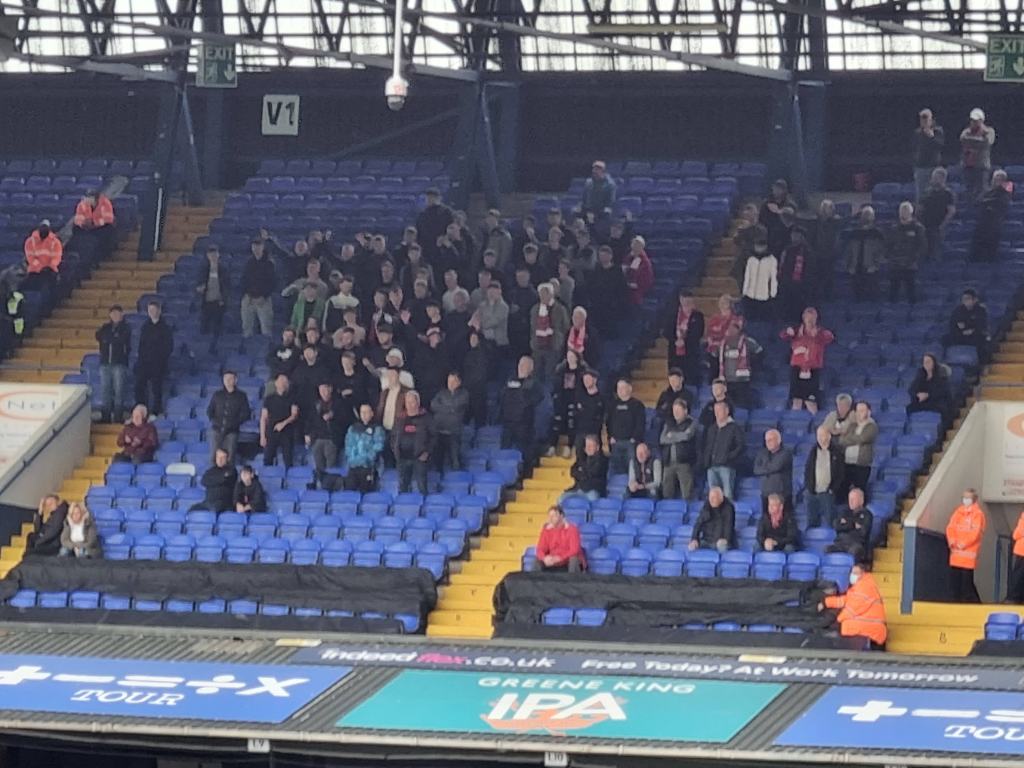
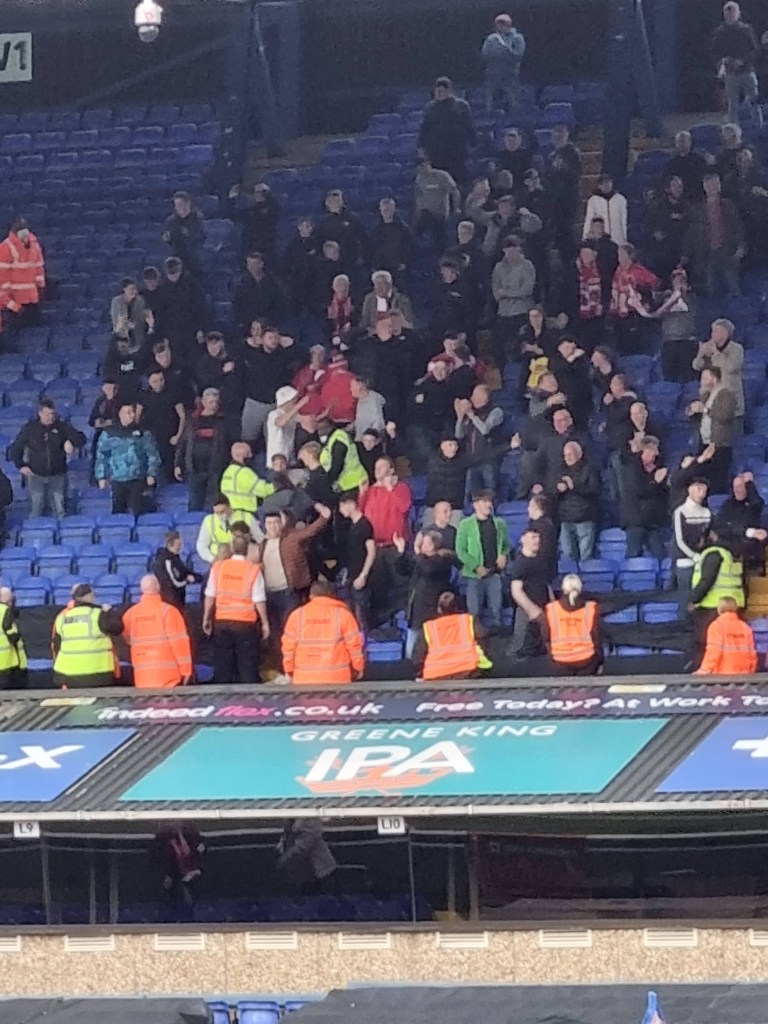
 It takes Town over half an hour to have a shot on goal worthy of the name as Scott Fraser eventually launches a shot over the cross-bar from outside the penalty box.  I remark to Mick that with the number eleven on the back of his shirt and his short brown hair, from this distance Fraser sometimes makes me think of Mick Lambert.  “I can’t think what Mick Lambert looks like” says Mick. “Well I expect he looks a bit different now” I respond.   Idris El-Mizouni is booked for a foul, a little harshly in my opinion and I wonder to myself whether referee Mr Sam Purkiss is a closet French nationalist in the thrall of Marine Le Pen.  As half-time approaches a rare moment of hope sees Conor Chaplin break away and from a low cross earn a second corner for Town, and then the oddly named Macauley Bonne strides forward to unleash an appallingly bad shot which results in a throw-in to Barrow. “What the fuck, what the fuck, what the fuckin’ ‘ell was that?” sing the Barrovians up in the Cobbold stand in the time honoured fashion. “Good question” mutters the old boy next to me to himself.

Half-time comes as a welcome relief and whilst Mick gains further relief using the facilities, I remain in the stand alongside the two old boys. The match resumes at three minutes past four as dusk descends to shroud Suffolk’s County town in chilly December darkness.

Half-time has brought change and Joe Pigott has replaced Idris El-Mizouni who hadn’t looked sure where he was meant to be playing, with Sam Morsy seemingly competing with him for the ball in midfield.  Within three minutes Joe Pigott has found space and strikes a post with a firm shot.  Pigott’s presence continues to make a difference as he seeks space behind the Barrow defence and controls and lays the ball off in a manner which the oddly named Macauley Bonne has so far appeared incapable of doing.  Things are looking up and the Sir Bobby Robson stand feels moved to sing a song which has quite a lot of words, few of which I am able to decipher, but then Kay scoops a shot over the bar for Barrow when it was certainly no more difficult to get his shot on target.

This is a much better half for Town and I sense a glimmer of optimism amongst the Town followers in the meagre crowd of 6,425, of whom a respectable 205 are from Barrow.  The mood hasn’t affected the loud man behind me however, who continues to provide a mainly sarcastic commentary, which sounds both smug and moronic in its delivery.  He clearly doesn’t like Toto Nsiala and bewilderingly urges him to chip the ball over Christian Walton as Toto turns it back towards goal, before saying “He was tempted”.  This man has the sort of voice that would make a more violent person than myself want to punch him in the throat.

Town now dominate possession and whilst still a little slow on the ball they are getting players down both flanks to put in crosses, an approach that is helped by bringing on the exciting Sone Aluko.  The Town  support has corresponding moments of enthusiasm and sing another song with plenty of hard to fathom words, but a simple chorus of “Addy, Addy, Addy – O”, which is the sort of thing heard sung by children in one of those black and white films from the early 1960’s such as A Taste Of Honey, and I half want to see Rita Tushingham and Dora Bryan warming up on the touchline.

As the match winds down into its final fifteen minutes the support wanes, and as we enter six minutes of normal time the ground is once again silent.  As ever, there is a late flurry of goal attempts as the realisation dawns on the players that their failure to score a goal can only result in an evening in Barrow-In-Furness.   Corners are won but no booming chants of “Come of You Blues” or  intimidatingly repetitive calls of “ Ipswich, Ipswich, Ipswich” materialise from the stands;  even the score board seems apathetic as each corner kick is met, not with an entreaty to shout support for the team, but instead a message about how the Ipswich Mortgage Centre “corners all your home improvement and mortgage needs”.    The old boys beside me leave with a couple of minutes to go.  Sam Morsy shoots over the cross bar from close range and substitute Cameron Humphreys heads against it , but Town don’t score and the breath saved by not shouting in support of the Town is expended in a chorus of sadly predictable boos and jeers.

Later this evening I will learn that the Town manager has been sacked and briefly I wonder to myself if the old boy sat next but one to me had been right; Paul Lambert had never actually left the club he’d just shaved the top of his head and swopped his Scottish accent for a Scouse one, but after nearly a season’s worth of games he’d finally been found out.   It’s certainly never dull being a Town fan, well except for the actual games that is. Try stopping me going through it all again in a fortnight’s time though. No, please, try.
Ipswich Town 0 Rotherham United 2

After lock down, 20 months of working at home, following on directly from six months off work due to illness, I have adapted to a centrally heated life spent mostly indoors.  The thought therefore of venturing out on a cold late November evening to sit and watch a football match that your team is probably odds-on to lose isn’t that appealing.  But I have a season ticket, so I’ve already paid to go, and I can’t bear to miss out, added to which I consider myself to be the heir to Edward Ebenezer Jeremiah Brown; I’m a football supporter of Ipswich Town.  My drive into town is nevertheless made without enthusiasm, but by the time I’ve walked from my car to The Arboretum (now the Arbor House) pub, the still night air, the glow of the streetlights and the promise of a pint of Mauldon’s Suffolk Pride (£3.80) have altered my mood, and after a light dinner of Scotch egg (£4.50) with chips (£4.00) in the company of Mick, who incidentally has falafel Scotch egg (£4.00) with halloumi chips (£4 .00), I am once again ready to do or die for the Town.

The walk through the streets of Ipswich to Portman Road is always one of the best parts of any match day, it’s when the glorious sense of anticipation is all there is, and nothing has yet gone wrong to ruin the day.  Today the sensation is heightened because it’s an evening game and the floodlights shine a bright halo into the night sky and the crowd seems drawn to it like moths to flame.  In over an hour Mick and I have not talked about the match but crossing Civic Drive I ask if he thinks we’ll win. Mick is as ever hopeful, but not optimistic, the same as me.  Rotherham United are the form team in the division; a win will put them top of the league and Town have failed to score in three of three of our last four games, and just to trowel on the portents of doom a little more Town have beaten Rotherham United just once in our last seven attempts.

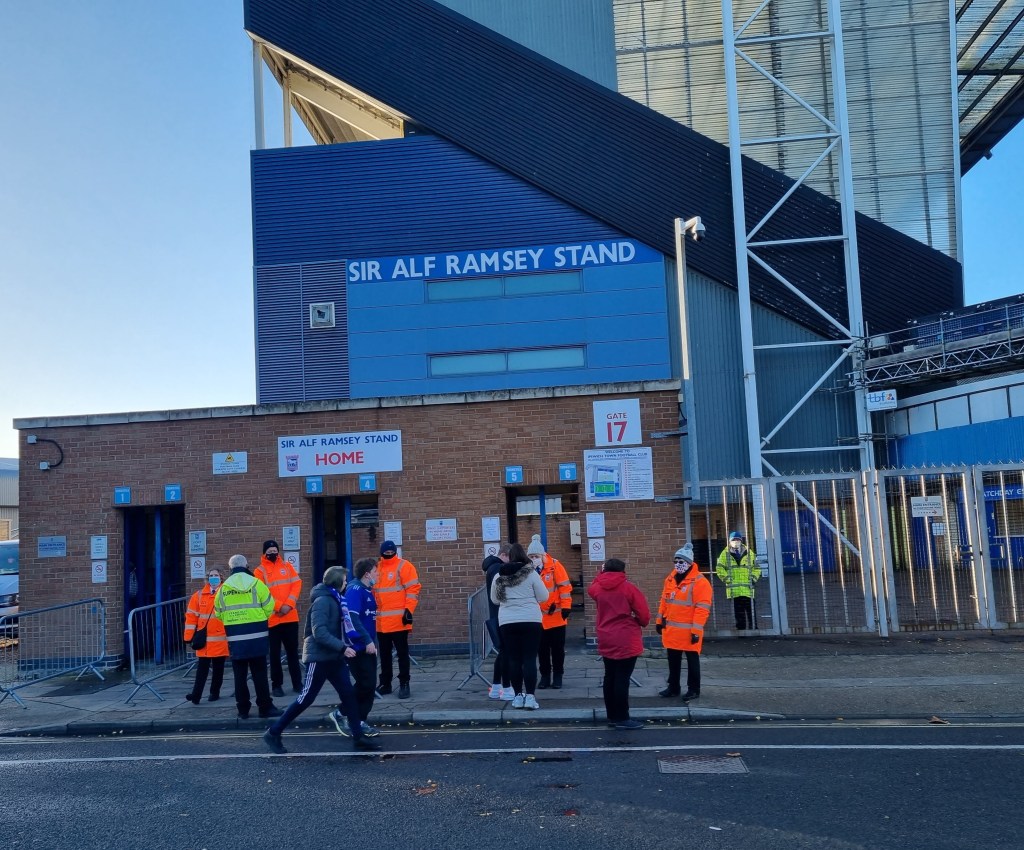
Resigned to our fate, Mick and I part in Sir Alf Ramsey Way; Mick to the decent seats in what used to be the West Stand, whilst I head via turnstile number 60 to join the groundlings in the bottom tier of what was Churchman’s, purchasing a programme (£3.50) along the way.  I shuffle to my seat past Pat from Clacton and Fiona before the teams are even on the pitch, I’m early.  Ever-present Phil who never misses a game is here and so are Ray, his grandson Harrison and Harrison’s dad.  Also here, sat behind Ray and his progeny, are four or five blokes of various ages all sat in a row; three of them wear dark-framed glasses and sport matching haircuts which are short at the back and sides with a tangled mop above; they look like the same bloke seen four or five years apart, but appearing all at once, as if the BBC tv’s documentary Child of Our Time had been presented by Dr Who not Robert Winston.

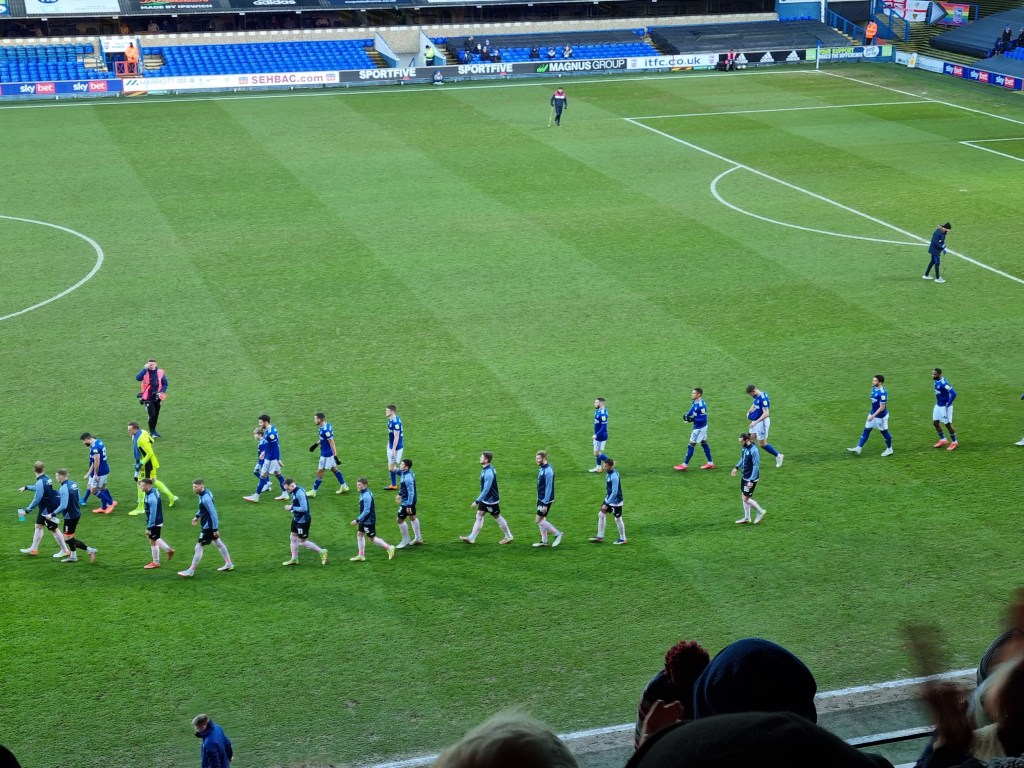
With the teams on the pitch and knees taken and applauded the game begins with Rotherham all in black, like the baddies always are, aiming the ball towards the goal at the Sir Bobby Robson Stand end of the ground.   The cheerful man who sits to my left remarks on how cold it is, “Feels like someone’s left the fridge door open” he says.  I wonder how big his fridge must be.  From the beginning the crowd is quiet, as it often is at Portman Road; the home support huffily adopting the attitude of “well, we’re not going to shout until you give us something to shout about”.  Rotherham are solid and their supporters shout and sing as if to celebrate that, as if it’s the essence of life itself, maybe it is in Rotherham.    Rotherham have a shot blocked, and Christian Walton makes a fine flying save from Rotherham’s Jamie Lindsay, but the game is even, in a cagey, no one is taking any chances kind of a way.  Scott Fraser shoots from outside the penalty area but misses the goal.

Twenty-three minutes pass and then the Rotherham number eight, Ben Wiles, decides to run at the centre of the Ipswich defence.  I don’t know if it’s the effect of the cold night air, but what we had thought was beginning to gel, shatters and Wiles runs on unmolested to the edge of the penalty area before launching an impressive shot into the top right corner of the Town goal, with the predictable outcome that Rotherham take the lead.  I’d just been thinking to myself that we’d not conceded an early goal so perhaps we might now have the confidence to impose a little of our will onto the game. C’est la vie, as they don’t often have cause to say at Paris St Germain.

The blokes a few rows in front of me are lairy, shouting and showing off to one another in the manner of people who have had too much to drink, or are what they would probably call “wankers”.  Rotherham have more shots blocked, Ipswich don’t but Bersant Celina gets caught offside, which sort of shows willing.  Rotherham have shots on goal, which miss the target; with the exception of a blocked attempt by Scott Fraser, Ipswich don’t have any shots. “Come on Ipswich, Come on Ipswich” chant a few hundred Town fans for a few seconds before trailing off in a manner that sounds like they’re embarrassed at the sound of their own voices, or their mum has given them a stern look.   Rotherham United’s Jamie Lindsay and Michael Ihiekwe make their mark on the game by being booked by referee Mr Gavin Ward, not that anyone else is going to book them, they wouldn’t attract many to the Ipswich Regent.  In time added on Town win a corner courtesy of the extravagantly monikered Ramani Edmonds-Green. “Come On You Blues, Come On You Blues” I chant, sounding in my head like a lonely, ghostly echo of Churchman’s forty years ago.

Half-time arrives and I make the short journey to the very front of the stand to talk to Ray.  “I think they should bring Celina on” says Ray ironically; he’s not a fan of the Dijonnaise loanee.  Nor is Ray a fan of the blokes behind him, the lairy ones with the identical haircuts and glasses; they’re getting on his nerves a bit.  Our conversation lurches from the disappointment and annoyance of tonight to our extreme dissatisfaction with the current Prime Minister and the sitting Member of Parliament for Ipswich, Tom Hunt, who we concur is a both a lackey and a twit.  Unhappy in a political and footballing context, but happy to have spoken to Ray, I return to my seat for the second half.  Before play resumes, I have time for a brief look at my programme, the cover of which features Christian Walton glaring out suspiciously at us; page 66 refers to next week’s FA Cup tie with Barrow FC, who it describes, amusingly to my mind, as “the Cumbrian outfit”.  If you enter “Cumbrian outfit” in the search engine on your phone or personal computer it will tell you where best to go for fancy dress costumes in Workington.

Both teams take it in turns to foul one another when the game re-starts, and Scott Fraser sends a free-kick over the Rotherham cross bar. Almost an hour has passed since the match began and  Rotherham’s ‘tricky’ Frederik Ladapo combines with their most prosaically-named player, Michael Smith, to outwit the entire Town defence and run the ball across the face of the Town goal and beyond the far post where Shane (I imagine his parents were fans of Westerns or Alan Ladd) Ferguson clogs the ball into the roof of the net to remove all doubt that Rotherham United might not ascend to the top of the third division  tonight.

The remainder of the match dissolves into a mess of forlorn hope and disappointment for Ipswich.  The lairy blokes in glasses in front of me who had annoyed Ray in the first half show their true colours and become abusive towards the Town players.  “You’re all shit” shouts one of them, confirming his unsuitability as a summariser on Match of the Day.  But it’s an outburst that amuses the blokes behind me. “Ha ha” one of them chuckles, “Look at old Harry Potter down there”. 

Desperately, Town replace Bailey Clements and Lee Evans with Matthew Penney and Kyle Edwards and Joe Pigott makes a rare appearance in place of Conor Chaplin, but nothing changes. Michael Smith has a chance to make the score 3-0, but heads over the crossbar.  The Portman Road crowd occasionally remember that they should try to encourage their team but mostly they don’t bother, apparently content to watch the game as they would just another episode of a box set on Netflix.

Rotherham United are just too good for Town, their solidity and organisation more than enough to suppress any flair we think we might possess. The last ten minutes are run down by Rotherham as they make three substitutions of their own; my curiosity and attention only being pricked and grabbed by the unusual surname of Daniel Barlaser, who is booked by Mr Ward the referee, and the name of substitute Mickel Miller, whose surname matches the nickname of Rotherham United, The Millers, and whose first name suggests his parents or the registrar couldn’t spell Michael; I once had a girlfriend whose middle name was Jannette because her father couldn’t spell Jeanette.

In common with everyone else in the ground I am prepared for the boos that accompany the final whistle, although happily tonight they don’t convey the vitriol that some results provoked in previous seasons.  Sadly, after two consecutive defeats and a run of league games in which the Town haven’t scored, the optimism and bullishness of a few weeks ago has all too quickly evaporated for some people.  Whatever, it’s only a game, and so far on balance I’m enjoying this season; the frustration, the disappointment, the strangled hope are, after everything, what football is all about, most of the time.

Ipswich Town 1 Oldham Athletic 1

One of the many wonderful things about supporting a football team that is in the third division is that the FA Cup begins at the beginning of November.  None of this inexorable waiting about for Advent, Christmas and then New Year to come and go. No siree, the joy of knockout football comes early to the meek who do more than just inherit the Earth, they get to chase the glory that is knockout competition football.  Of course, we have already missed out on six rounds of extra-preliminary, preliminary, and qualifying rounds, but we can’t have everything and being meek we wouldn’t want it.

Today, the transparent plastic tub that serves as the 21st century’s replacement for the Football Association’s velvet bag has paired Ipswich Town with fourth division Oldham Athletic.  This is a pairing to rival some of the worst failures ever, like a race between a Ford Edsel and a Sinclair C5, or a competition between the Enron bank and ITV digital.   Ipswich Town and Oldham Athletic, I have been told, are the least successful clubs in English professional football in the past twenty years, being the only two who have either not been promoted or not made it to any sort of match at the new Wembley Stadium.  The good thing is that this has saved us supporters a considerable amount of money on grossly over-priced tickets, match day programmes and catering, for which we should be grateful.

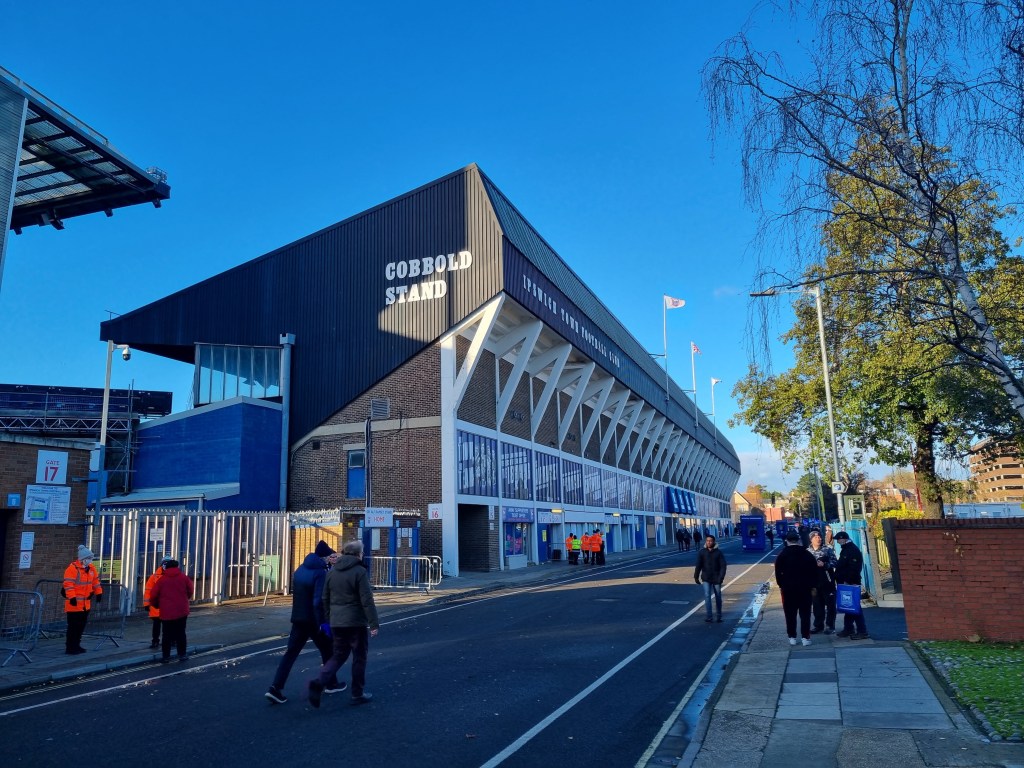
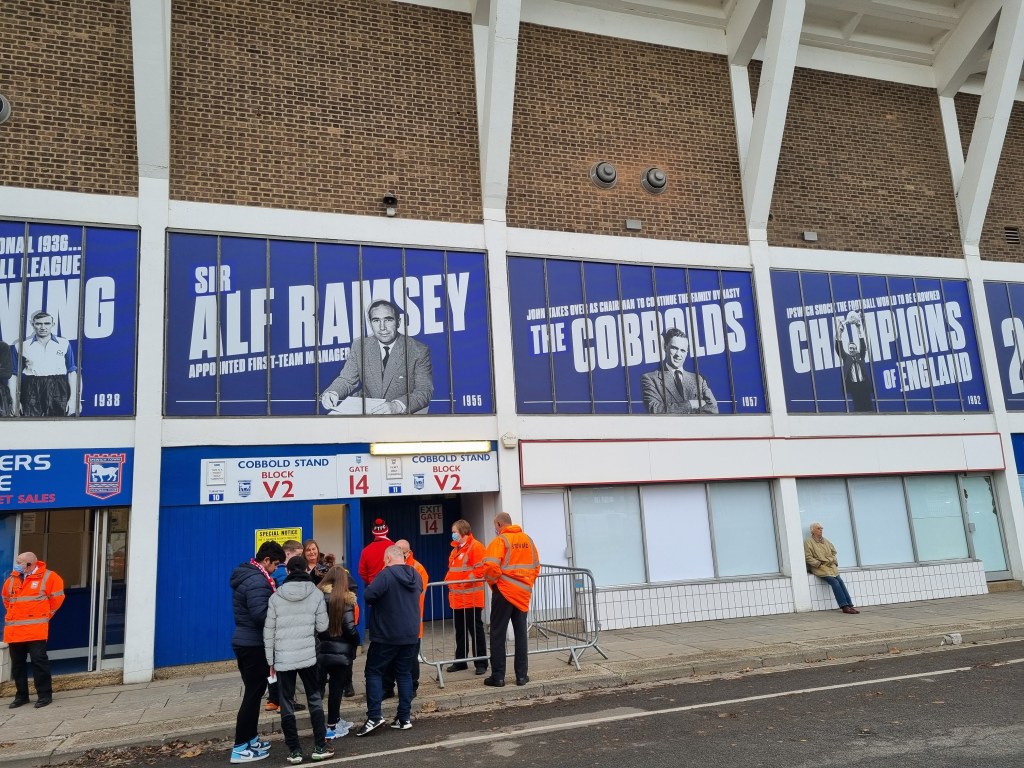
It’s a blustery, cloudy day and fallen leaves scuttle along the footpath as I make my way through Gippeswyk Park; the autumnal scene reminds me of some of the opening sequences of the film The Exorcist. Portman Road is very quiet, stewards in huge fluorescent orange coats, and sniffer dogs easily out number supporters outside the away fans’ entrance.  The display on the windows at the back of the Cobbold Stand tell of former FA Cup glories and the day in March 1975 when a record crowd of 38,010 filled Portman Road to see the sixth-round tie versus Leeds United. I look at my watch, it’s a quarter to two; I had already been inside the ground nearly twenty minutes by now on that day forty-six and a half years ago. I buy a programme for a knockdown price (£2.00), and  confirm to myself that I prefer this 32 page programme to the usual 68 page one, even though it costs more per page; I live in hope of an eight or twelve page edition for less than a pound.

At the Arboretum pub (currently known as the Arbour House), I choose a pint of Nethergate Augustinian Amber Ale (£3.80).  The bar is unusually full, so my pint and I decant to the safety of the beer garden, which is reassuringly more like a backyard with tables and chairs. I text Mick to tell him “Je suis dans le jardin”.  It’s not long before he joins me with a pint of beer and a cup of dry roasted peanuts.  We talk of Ipswich Town, of property development and pension funds, catching the TGV to Marseille, the buildings of Le Corbusier, the colour theory of Wassily Kandinsky and the Bauhaus, and electric cars.  A little after twenty-five to three we leave for Portman Road, bidding the barmaid goodbye as Mick places our empty glasses and the cup that no longer contains peanuts on the bar.

Our tickets today (£10 for me, £5 for Mick plus £1.50 each unavoidable donation to some parasitic organisation called Seatgeek) are for Block Y of what is now known as the Magnus Group Stand, but used to be the plain old West Stand, named simply after the compass point rather than a commercial concern called West that had paid for the privilege.  Flight upon flight of stairs take us to the dimly lit upper tier of the stand where we edge past a line of sour-faced males of indeterminate age, but over fifty, to our seats.  My guess is there won’t be much banging of drums, lighting of flares or even vocal encouragement from these people, who look more like Jesuit priests than football supporters.

Although Remembrance Sunday isn’t until next week, and there will be a minute’s silence before the game versus Oxford United next Saturday, bizarrely we have another pre-match minute’s silence today.  Stadium announcer Stephen Foster tells us it is because we are in the ‘Remembrance period’ but it feels like football just likes minutes silences.  As ever the silence is strangely followed by applause, and then the game begins.  For the first forty-five minutes Town will be mostly trying to send the ball in the direction of the goal in front of the Sir Alf Ramsey stand (previously known as Churchman’s end) where in the lower tier I can make out ever-present Phil who never misses a game and Pat from Clacton.  Later, Mick will ask me if “the lady from Essex” still comes to the games, and I will point her out to him, locating her using gangways and rows of seats like co-ordinates in a game of Battleships.   Mick spots her and Pat from Clacton is sunk. Oldham Athletic are wearing a fetching ensemble of orange shirts and black shorts with orange socks; it’s a kit that stirs memories of Town’s fifth round tie away at Bristol Rovers in the snow of February 1978; or it would if, as is the modern fashion, Oldham’s shirts didn’t look like they’d had something spilled down the front of them.

Town start the game well with Oldham’s interestingly named Dylan Fage conceding a corner within the first minute before the oddly named Macauley Bonne heads a cross directly at goalkeeper Jayson Leutwiler.  Within eight minutes Town lead as the oddly named Macauley Bonne’s cross sees Wes Burns do an impression of the shopkeeper in Mr Benn as suddenly, as if by magic he appears to score from very close range.  This is just the start we need; we will now surely go on to win by three or four goals to nil because Oldham Athletic are third from bottom of the fourth division and Town won 4-1 at Wycombe Wanderers on Tuesday, what more convincing evidence predicting our inevitable victory could there be?  Indeed, Town continue to look the better team as the oddly named Macauley Bonne and Wes Burns both have shots blocked, but then the shots become fewer to be replaced by scores of passes back and forwards across the pitch.

Bersant Celina tries a little flick pass with the outside of his right foot, which doesn’t succeed. “You’ve got to earn the right to do that sort of thing” announces the joyless sounding man beside me to the World, presumably unaware that he is talking rubbish; you just need to get it right.  Oldham break forward and are a pass away from a shot on goal on a couple of occasions. “We’re leaving the door open” continues the joyless man, seemingly happy to be miserable.

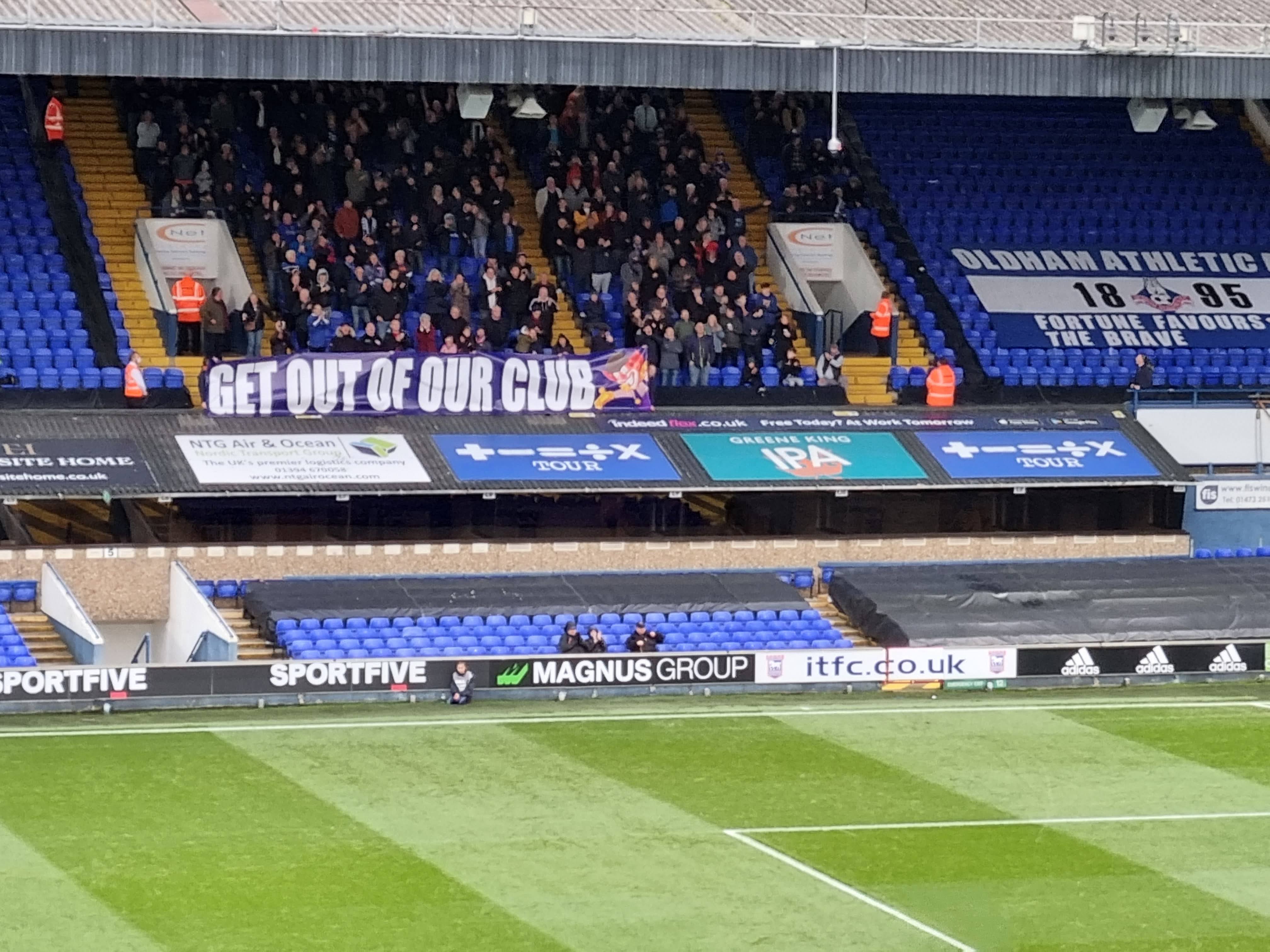
Despite the 1-0 lead, the Portman Road crowd, which will later be announced as consisting of 437 Oldham supporters within a paltry total of 8,845, is quiet.  Where are the other 29,165 who were here in 1975?  A good number are probably no longer alive, I guess.  “Your support, your support, your support is fucking shit”  chant the Oldham supporters in the Cobbold stand with predictable coarseness.  I feel like telling them that’s because some of us are dead.  Despite high hopes the FA Cup seems to have lost a little of its sparkle and it’s only twenty -five past three.  I realise that over the Cobbold Stand and across the roof tops beyond I can see the top of the Buttermarket shopping centre.  It’s the twenty seventh minute and Oldham’s number nine, the optimistic sounding Hallam Hope heads the ball just wide of the Town goal. 

Seven more unremarkable minutes pass and the sometimes not very controlled Sam Morsy is booked by referee Mr Hair, who it is to be hoped will one day referee in the Bundesliga.  Stupidly, having dropped to the ground under a challenge, Morsy grabs hold of the ball as if to award himself a free-kick.  Rightfully, Herr Hair books him for hand ball and the pointlessness of the incident mirrors the drifting aimlessness of the Town performance and its quiet backdrop; this isn’t what Cup football is meant to be like. 

After a couple of further failed goal attempts from Oldham, with four minutes left until half-time they score. Latics’ number ten, Davis Keillor-Dunn, who sounds like he could have been friends with Lytton Strachey and Virginia Woolf, sends a fine shot into the corner of the Town goal from about 20 metres after Toto Nsiala initially fails to deal with a ball that had been booted forward.  “How shit must you be we’re drawing 1-1” sing the Oldham supporters to the tune of Sloop John B, coincidentally showing the majestic timelessness of the Beach Boys’ 1966 album, Pet Sounds.

With half-time fast approaching Kane Vincent-Young tugs an Oldham shirt to concede a free-kick. “Stupid boy” says a man who sounds even more joyless than the man next to me but nothing like Captain Mainwaring in Dad’s Army.  I suggest to Mick that players should have their hands bound with tape to prevent them from pulling each other’s shirts; ever reasonable and practical Mick suggests they simply wear mittens.  Following a corner to Oldham, the half ends and with the exception of one man, the occupants of Row J rise and then descend the stairs to use the toilets and the catering,  or to just stand about.

As Mick and I wait for the queue to the toilet to shorten we talk of exorcism, the disappointment of the first half, the architectural splendour of the Corporation tram shed and power station in Constantine Road, and how my wife Paulene has a degree in theology.  I decide I can wait until after the game for a pee and whilst Mick joins the queue and disappears into the toilet, I am impressed by the long hair of a man standing a few metres away from me,  but die a little inside when I read in the programme that when he grows up one of today’s mascots wants to be a policeman.  More happily, the other two mascots want to be a footballer and a superhero.

Back in our seats the second half begins with the unusual replacement of both Ipswich full-backs as Janoi Donacien and Steve Penney replace Kane Vincent-Young and Cameron Burgess.  It’s a change that brings almost immediate results as a mittenless Janoi Donacien tugs an orange shirt and Herr Hair awards a penalty to Oldham.  The otherwise impressive Dylan Bahamboula steps up for Oldham to see his penalty kick saved by Christian Walton and a sudden roar fills Portman Road which belies the small number of people present.  For a few minutes the home crowd is energised and it physically feels as if we care as much we think do.  Wes Burns dashes down the wing, urged on by the crowd, but the sudden excitement is evidently too much and he propels his cross way beyond the far post and away for a goal kick.   “How much more waking up do we need?” asks the joyless soul next to me.

To an extent Town’s performance in the second half is better than that of the first.  The full-backs now on the pitch are an improvement on those they replaced and Oldham produce fewer decent chances to score.   When Connor Chaplin replaces the ineffective Kyle Edwards the link between Morsy and the front players is strengthened and another dimension is added to our attacking play, but somehow it’s still not enough.  As I tell Mick, all our players look like they got home at four o’clock this morning.

As Town’s failure to score grows roots and blossoms, the Oldham supporters gain in confidence. “Come on Oldham, Come on Oldham” they chant, giving a clue to the home fans as to what they might be doing, but we don’t twig.  The upshot with ten minutes to go is a reprise of that old favourite “Your support, your support, your support is fucking shit” and who can argue, it’s no longer 1975.  Despite Oldham encouraging Town with a misplaced pass out of defence, we are unable to capitalise and the Oldham supporters are the only ones singing as they ask “Shall we sing, shall we sing, shall we sing a song for you?” Predictably no one dares break our vow of silence to answer their question.

As the game enters its final minutes Sone Aluko replaces our best player, Wes Burns, and Rekeem Harper replaces Lee Evans.  Encouragingly Oldham replace their best player, Dylan Bahamboula with Harry Vaughan, but nothing works and five minutes of added on time only raises hopes, but does not fulfil them.

The final whistle is blown by Herr Hair and the crowd get up from their seats showing the same level of emotion that they might if they were all on a bus and it had just reached their stop, turning away from the pitch and averting their gaze like you would if trying to avoid eye contact with a drunk.  It has been a very disappointing afternoon of FA Cup football,  and has failed on every level to live up to what the competition is supposed to be about. 

On the bright side, at least we are still in the draw for the Second Round and until we lose, the promise of glory still remains.  It’s not every year we do as well as this.

Ipswich Town 2 Fleetwood Town 1

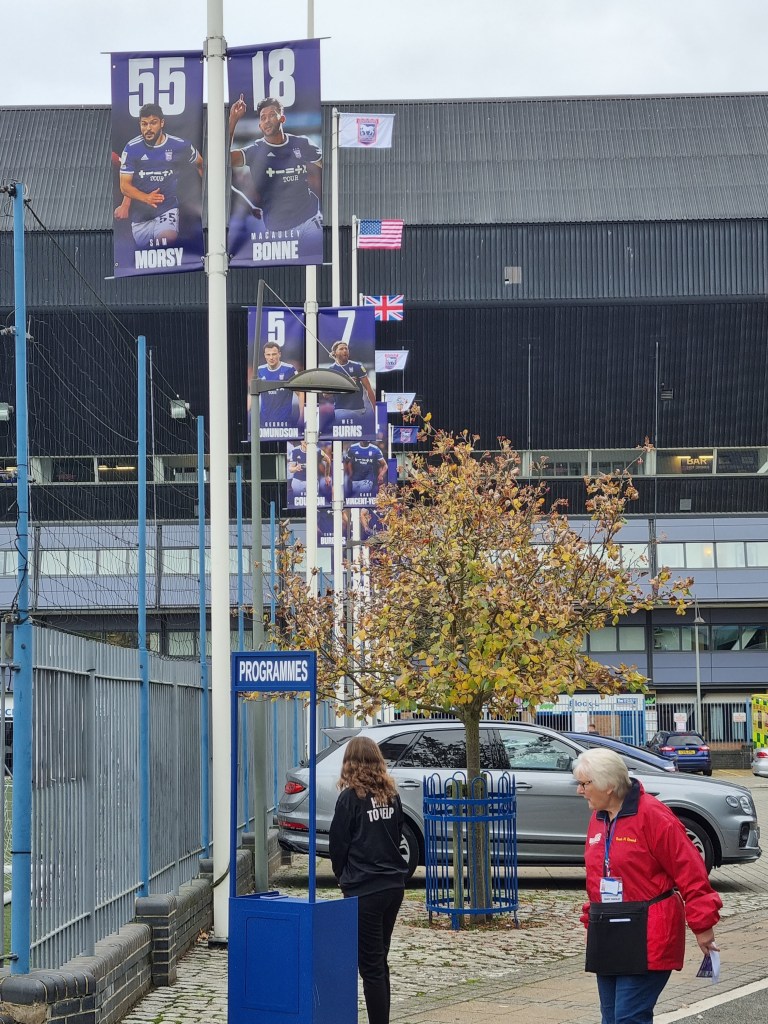
It’s a cool, almost cold, still, grey autumn day.  As I walk down through Gippeswyk Park a leaden pillow of cloud hangs over the town and Portman Road.  I march on through the gathering crowds, past people perched on car park railings folding foamy bread, heavy with sauce-laden sausage into their gaping mouths.  I stop only briefly to buy a programme (£3.50) and to put a coin in a collection box for an NHS charity, although I thought that’s what we paid our taxes for; I guess we’re being asked to make up the shortfall for the very wealthy and those companies like Amazon who could pay more, but choose not to because how else is their owner expected to be the richest man in the world and launch ageing actors who once played fictional astronauts into space.

At the Arbor House (formerly the Arboretum), Mick is already sat at a table enjoying a pint of Mauldon’s Suffolk Pride. I toy with the thought of copying him but opt for a pint of Mauldon’s Phantom (£3.90), it occurs to me that the beer seems to increase in price by 10 pence every time I come here.  I join Mick to discuss how we’ve passed our respective weeks and other assorted issues of our times, including driving a hearse on the M25, cycling in Belgium, the Kray twins and East Suffolk County Council police houses. At twenty minutes to three we depart for Portman Road, as do the three people sat at an adjacent table, we follow them down High Street.

Mick and I bid our adieus near the turnstiles close to the corner of Sir Alf Ramsey Way and Constantine Road, Mick’s seat is in the upper tier of what is now called the Magnus Group stand; I’m in the cheap seats at the bottom of the Sir Alf Ramsey Stand.  Having vouched for my being double-jabbed I enter the ground through turnstile sixty-one, which I select over turnstiles fifty-nine and sixty because 1961 was when we won the Second Division for the first time.  I make my way through the undercroft of the stand having put on my face mask, although few others have the decency to do likewise, and Ipswich has the country’s highest Covid infection rates.

The teams are walking out on to the pitch as I shuffle past Pat from Clacton and Fiona to my seat.  “We were getting worried about you” says Pat as I sit down, and in dipping my head my glasses fly off.  “You’ve every reason to be” I reply.  The Beatles ‘Hey Jude’ plays and people join in with the na-na-nas. The floodlights are already on and with knees taken and applauded, at a minute past three the game begins. Town are attempting to put the ball in the goal just in front of me, Pat from Clacton, Fiona, ever-present Phil who never misses a game and his son Elwood.  In their red shirts with white sleeves Fleetwood look like a bargain basement Arsenal, and it’s good to see a team not change their kit unnecessarily just because they’re playing away from home; both teams are even wearing white shorts!

Just a minute of the game has passed and already the Sir Bobby Robson stand are singing “Hark now hear the Ipswich sing, the Norwich ran away, and we will fight for evermore because of Boxing Day” as if to reiterate the often made point that Christmas seems to get earlier every year.  Town win a corner. “Come on you Blues” I bellow hopefully. “Is that Martin?” says Phil, turning round to Pat to ask a question to which he already knows the answer.

It’s early, the game is still settling down and the crowd are getting accustomed to what they are seeing before them. The referee Sam Allison is black; a voice behind me says “Uriah Rennie, innit”, a comment which unfortunately is unthinkingly racist, although I have no doubt it was not intended as such, but at least it does highlight the scarcity of black football referees despite there being a lot of black footballers.

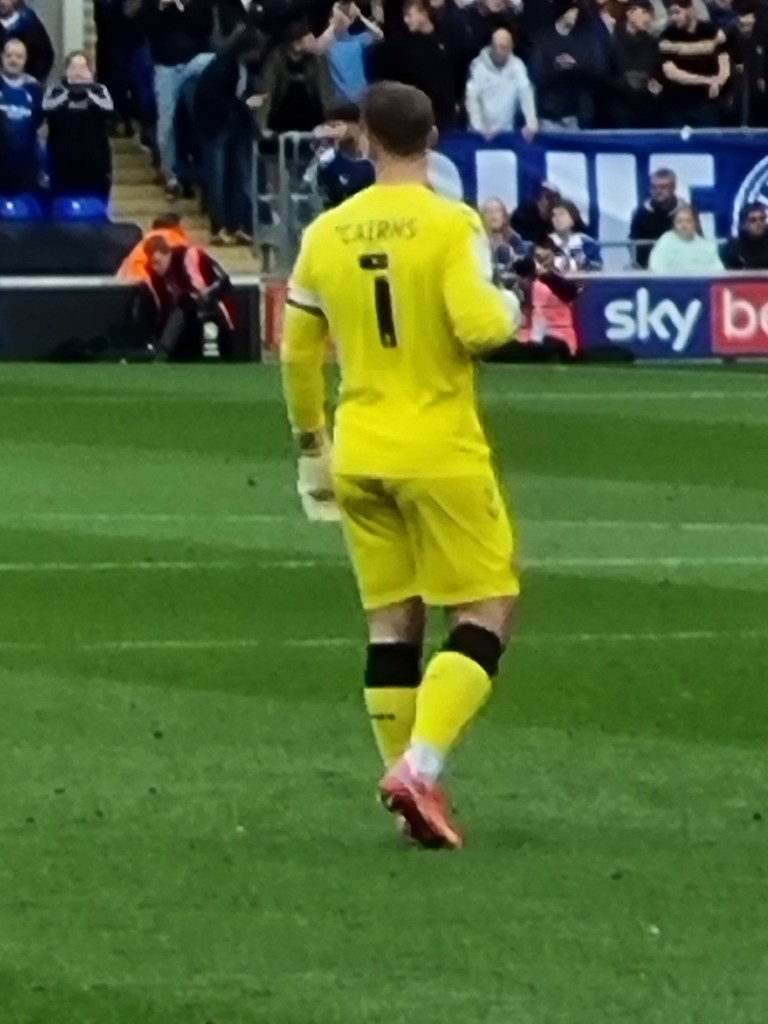
Ten minutes pass and it looks as if Fleetwood almost score; Gerard Garner appearing from my low down, distant view to beat three players before having a shot blocked.  Four minutes later and Town have a goal disallowed as the oddly named Macauley Bonne heads in a free-kick, but is considered by the assistant referee to be have been offside. Another five minutes later and Bonne directs a free header at the Fleetwood goalkeeper Alex Cairns, a large man who has made the double fashion faux-pas of wearing dark pants beneath his yellow shorts and displaying a distinct VPL.  Cairns is however one of the few footballers to share a surname with the name of a northern Australian city.  

The game has settled into a somewhat disappointing pattern of Town passing the ball about quite a bit, but not having any decent attempts at scoring a goal.  It’s nearly half past three and Paul Cook is gesticulating wildly from the touch line like someone directing traffic having dropped a few amphetamines.  Janoi Donacien wins Town a corner.  “Come On You Blues! Come On You Blues!” tumbles from the Sir Bobby Robson stand and a handful of people in the Sir Alf Ramsey stand join in, including me. Toto Nsiala heads the corner kick over the cross bar from a position so close to the goal that it looked easier to score. 

 It’s gone half-past three and after Fleetwood’s James Hill fouls Conor Chaplin, his name becomes the first to enter Mr Allison’s notebook.  I like to think of Mr Allison amusing himself childishly by stroking his chin as if in deep thought and then writing down Hill’s first name as Jimmy.  Ten minutes until half-time and Sone Aluko has Town’s first decent shot at goal, but it goes past the post. Finally, as the half peters out Sam Morsy becomes embroiled in a contretemps with Fleetwood’s Jay Matete, as they literally wrestle each other for the ball; Morsy is clearly at fault and Matete is awarded a free-kick.  A bit like the weather, the half has been rather dull.

My half-time snack of a Nature Valley chocolate and peanut protein bar is the highlight of the afternoon since leaving the pub and Ray offers the opinion that Town haven’t done very much so far as he stops by to chat on his way to use the facilities beneath the stand.

The game resumes at four minutes past four and the lower tier of the Sir Bobby Robson are soon singing “You’re fucking shit, You’re fucking shit, You’re fucking shit you’re fucking shit, You’re fucking shit,” which strikes me as being not very polite.  From the comments of the man next to me I think their “song” is directed at the Fleetwood goalkeeper Alex Cairns, and I can only think that they too have spotted that you can see his pants through his yellow shorts, although I think it would probably have been more helpful to sing “Don’t wear dark pants, Don’t wear dark pants,  Don’t wear dark pants with yellow shorts, Don’t wear dark pants.”  

Cairns’ misdemeanor is soon punished however and with just four minutes played of the new half, Conor Chaplin turns outside the penalty area and sends a firm shot into the corner of the goal with, as the man next to me says, the goalkeeper “stranded”.  Clearly getting nostalgic for former glories, the Sir Bobby Robson stand erupt into a chorus of “1-0 to the Tractor Boys” to the tune of Village People’s 1979 hit ‘Go West’.  Feeling elated by taking the lead I risk sensory overload as I breathe in the smell of the damp turf. This afternoon’s attendance is announced as 20,099 with 133 of that number being from Fleetwood.  Pat from Clacton thinks she might have won the guess the crowd competition on the Clacton supporters’ coach and passes me the sheet containing everyone’s guesses.  Sadly, I have to break the news that her guess of 20,069 is not closer than someone else’s guess of 20,103, although to be fair to Pat her number looks a lot more like 20,099 than 20,103 does and she got five of the digits right; there has to be a field of experimental maths where what the numbers look like matters.

Back on the pitch and Wes Burns replaces Sone Aluko who is wiping his nose and has presumably either suddenly developed a heavy cold or has a nosebleed.    Meanwhile, back in the Sir Alf Ramsey Stand Pat from Clacton tells us that she will be having a Marks & Spencer prawn salad for tea. 

It’s nearly half past four and Christian Walton makes a save from Ged Garner who had been allowed to dribble far too close to the goal.  From the resultant corner the ball is hit into the crowd where a man over the other side of the gangway from me calmly stands up and heads it back onto the pitch.  The last time I did that I tell Fiona and Pat from Clacton, my glasses flew off (Woodbridge Town, September 2018, FA Cup extra-preliminary round v Clapton).

Fleetwood’s Jay Matete is booked for a foul on Sam Morsy and meanwhile I count twenty-one seagulls on the cross girder above the roof of the Sir Bobby Robson stand. Fifteen minutes of normal time remain and Town miss two chances in quick succession as first the oddly named Macauley Bonne has a shot saved by the bloke in the dark underpants and then Conor Chaplin sends a shot above the crossbar.  Attempting to create a diversion, Fleetwood replace Ged Garner with someone called Paddy Lane; it’s Penny’s brother I tell Fiona, although of course I do know that Penny Lane is really a street in Liverpool, and Paddy Lane is round the back of the Roman Catholic cathedral.

Town miss another opportunity as Wes Burns billows the net with a shot to make half the ground think he had scored, only to realise the ball had gone behind the post. Sam Morsy is eventually booked for persistent fouling with Mr Allison offering a fine mime, pointing in different directions to indicate that Morsy had committed fouls here, there, and everywhere.  Whilst Morsy receives his punishment from Mr Allison I am struck by the long shins of Fleetwood’s number nine, Callum Morton, a youth who the app on my phone says is English, although his stroppy demeanour, ginger hair and surname shared with a Greenock football club imply he is Scottish.  I have a premonition that he will score, which is based on the fact that he looks like he has the capacity to annoy.

Something happens across the other side of the Sir Alf Ramsey stand and from up in the Cobbold stand comes a chorus of “We forgot, We forgot, We forgot that you were here” and I think to myself “Who said that?”.  Back on the grass and Fleetwood’s Johnson fouls Celina and is booked before Fleetwood string together an alarming number of passes prior to Town eventually clearing the ball. Less than ten minutes of normal time remain, and Lee Evans concedes a free-kick.  The Liverpudlian back street crosses the ball and the annoying youth with long shins heads the ball into the Town goal from unfeasibly close range.  What had felt like a comfortable one-nil lead isn’t any longer,j but as I said to Fiona, we hadn’t conceded a goal for almost two whole games, so it was unlikely we’d hold on much longer.  We would probably have conceded sooner or later even if we had to score it ourselves.

To the credit of the Town supporters, we don’t become over-anxious and we even raise a few chants of “Come on Ipswich, Come On Ipswich” and indulge in some rhythmic clapping.  On the pitch, Town remain patient, passing the ball back and forth waiting to prise an opening rather than just hitting and hoping or ‘getting it in the mixer’.  In the eighty-eighth minute a deep cross from Lee Evans is headed across the goal by the oddly named Macauley Bonne, it’s a decent chance; and then the game enters five minutes of added on time.  A draw wouldn’t be unexpected, but hope remains that we can win; this is a team that has scored twenty-eight times in thirteen games, an average of more than two goals a game, so we’re due another one.

It’s the ninety third minute; Fiona has had to leave early to catch a train because she’s going out this evening.  The excellent Janoi Donacien runs all the way to the goal line to knock back a deep, cross field ball; his flicked pass falls to Bersant Celina who sweeps it imperiously past the man in the dark underpants to give Town victory.  It’s the best ending to a match at Portman Road in years, possibly since Pablo Counago scored almost directly from the kick-off after Coventry had equalised in 2010.  Town did manage a near last minute win against Shrewsbury last November, but that doesn’t count because last season only happened on ifollow.

What started as a grey, dull, cold day has ended in a blaze of glory, the embers of which will glow all week long and at least until we lose again, which hopefully won’t be for ages; and just to add a barely needed coat of varnish, Norwich have lost 7-0 too.  Some days are definitely better than others.

Ipswich Town 1 Nostalgia 1

On a damp May evening three years ago, I recall thinking to myself that it feels like 1978 and Ipswich Town have won the FA Cup all over again.  With my Portsmouth supporting wife Paulene, I had gone to see the Wolsey Theatre’s production of ‘Our Blue Heaven’, the music-backed play that celebrated the fortieth anniversary of Town’s FA Cup win. I can honestly say it was the most enjoyable Ipswich Town related evening I had had in nearly twenty years, since that season in the sun at the start of the third millennium when Town did things like beating Liverpool and Manchester City at their own grounds, having finally managed the previous May, to win a play-off semi-final and victoriously tread the turf at the old Wembley stadium for the last time. 

Fast forward to October 9th 2021, and in the spirit of celebration of Town’s winning the UEFA Cup forty years and five months before, which the club itself has seen fit to mark with the sale of a wallet, luxury boxed badge, and travel mug, the New Wolsey Theatre is staging the final performance of its production ‘Never Lost at Home’, the story of the 1980-81 season, but mainly the winning of the UEFA Cup, something no ordinarily lovable, small town football club will probably ever do again.  Not keen on spending an evening in an enclosed space with about 400 other people, most of whom will probably not be wearing a face mask, I have opted to cough up the £20 to watch the two- and a-bit hour performance on-line from the safety of my living room.

Forty and a bit years ago in May of 1981, I had just finished my final exam at the University of Sussex and I was now just wasting my time, until the lease on my shared student house was up, by playing football, going on pub crawls, walking on the Downs, visiting friends at the other end of the country and taking days out in an aged, bright orange, Dutch registered, left-hand drive Fiat 600 which my friend Chris (mainly known as ‘Jah’ due to his love of Reggae) had borrowed from a woman on his Social Anthropology course.  A lack of available cash and the demands of academia had sadly meant that in Town’s run to the final of the 1981 UEFA Cup final, I had only seen two home games, those against Aris Salonika and FC Koln.  Of the other games, I mostly remember the nervous anticipation of waiting for the result on the radio or television news.  The away matches I recall most are those at St Etienne and Koln.  I remember learning that Town were a goal down in St Etienne and was very chuffed to hear they had equalised as I headed off to the Student Union bar that March evening.  When I discovered Town had won 4-1, I could hardly believe it, and indeed it was a performance that has gone down in history as one of the best-ever by a British club in Europe and possibly Ipswich Town’s greatest performance ever.  As for the game in Koln, I remember that my friend Stephen went to the game on a supporters’ coach from Shotley and I remember seeing Terry Butcher’s winning goal on television, having been fearful that the one goal lead from the first leg would not be enough.

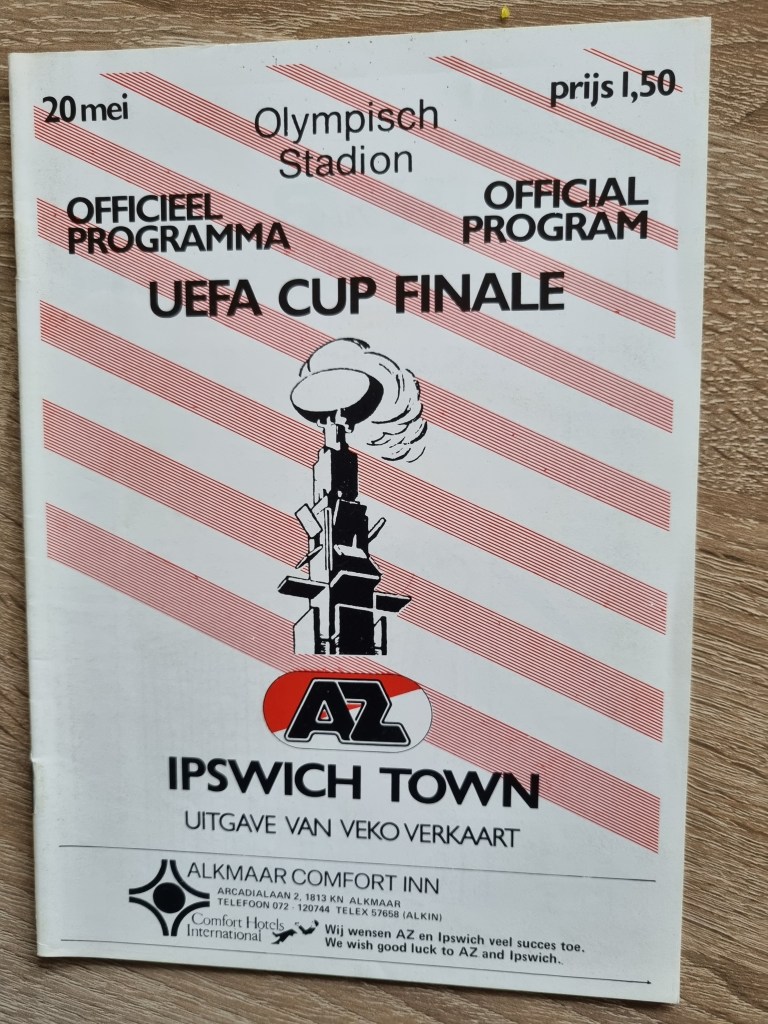
On the morning of 20th May 1981 my sister dropped me and my father off at Ipswich railway station where we caught a chartered train to Parkeston Quay and a chartered ferry to the Hook of Holland before boarding a chartered coach to Amsterdam.  Everyone travelled with the Ipswich Town Supporters Club and Anglia Tours back then, and I still have the pennant to prove it.  I wouldn’t enter Holland again for another 35 years, until I drove through a small corner of it on my way to Dusseldorf for a pre-season game in 2016, but I recall it being very neat.  In Amsterdam my father and I spent the time before the game in a small bar where we drank Amstel, a beer rarely seen in Britain back then, thankfully.  My father had encountered it before in foreign ports when in the Royal Navy and had warned me that it was gnats’; he was right, but it was all there was, they didn’t have any Tolly Cobbold Original.    Amsterdam was beautifully warm that May evening, which was just as well because terraces of the Olympic Stadium were open to the elements, which given that it was built for the 1928 Olympics isn’t that surprising; stadium builders weren’t always big on rooves back then.  In 1987 the Dutch government designated the Olympic Stadium as a National Monument, obviously because Town won the UEFA Cup there, but also because of the fine brick architecture by Jan Wils, an exponent of the Amsterdamse School.  It’s good to know that there is a corner of the Dutch capital that will forever be imbued with the memory of the presence of 7,500 Town fans.

My memory of the match that night in Amsterdam is one of anxiety and tension, despite taking an early lead that put us 4-0 up on aggregate and then gaining a second away goal.  AZ 67 Alkmaar were a bloody good team, but happily not quite good enough, despite Town being visibly knackered at the end of a colossal sixty-six game season. Forty years is a long time, and I’m not sure now what I remember from being there and what I remember from having seen various tv clips since.  I think I remember being frustrated that in the second half we couldn’t keep the ball away from Alkmaar, but I know I do recall wishing away the last twenty minutes of the game, and constantly checking my watch; willing Alkmaar not to score again and the Town defence to hold firm.  I remember nothing of the journey home, although I think my father might have invested in the luxury of a two-berth cabin in the hope of a couple of hours of sleep.

Tonight, “Never Lost at Home” picks up the story of the fictional Coombes family who followed Town to Wembley in “Our Blue Heaven”, and the story very much has the feel of being a sequel, which of course it is.  This time the tale begins with the family vowing to have someone at every game for what promises to be the greatest season in the club’s history as it vies to win an unprecedented treble.  Once again, the story is set against the background of the events of the times, in particular the high rates of unemployment resulting from the Thatcher government’s monetarist policies and indeed Scott loses his job to create some jeopardy in the story as it inevitably hinders his ability to get to games. Once again also, the story and the season unfold to a soundtrack of popular tunes of the time, although just like in ‘Our Blue Heaven’ it doesn’t, because several of the songs are from as much a four years later, which rankles somewhat because songs such as Tears for Fears ‘Everybody wants to rule the world’ (1985) were actually the soundtrack to avoiding relegation, not seeking glory.

Despite the failure to use the actual music of 1980 and 1981 (what a pity we never played Rapid Vienna or IK Start), rather than just generic 1980’s hits, there is nevertheless an authentic feeling of nostalgia for a time and a place.  I can’t fully explain why, but I had tears in my eyes in the first part of this production.  It might have been because I was reminded of how awful some of the music of the 1980’s was; I always hated ‘Eye of The Tiger’ (1982) and have consequently never seen any of the ‘Rocky’ films, but more likely I was mourning my lost youth and my lost football team, both of which seemed to go missing at much the same time.

 One major departure from the mostly repeated formula of “Our Blue Heaven” is the introduction in “Never Lost at Home” of one of the players as a recurring character, that player being the now legendary Arnold Muhren.  The choice of Arnold was, if not inspired, then obvious, because perhaps more than any other player, even his fellow Dutchman Frans Thijssen, Arnold somehow personifies that 1980-81 team, despite having actually joined Town three years before in September of 1978.  Again, the story employs a little artistic license as it almost implies that Arnold and Frans joined for the 80-81 season, but that is easily forgiven and does add to the mythology of that remarkable season.  I can only think that in casting actor Dan Bottomley as Arnold Muhren, one of the main considerations must have been his legs, because these have the same straight up and down shape of Arnold’s.  Not for Arnold the meaty thighs of Mick Mills or Paul Mariner; Arnold was a sinewy thoroughbred, built for the measured pass, the clever change of pace and direction in a single stride, the sort of footballer who simply danced through midfield and no longer exists in a game where speed, strength and bulk has usurped grace and subtlety.

The greatest triumph of ‘Never Lost at Home’, as it was of ‘Our Blue Heaven’, is the performance of Peter Peverley as Bobby Robson.   Not only does Peverley, with his gently hoarse County Durham accent, and perfectly observed Robson-esque mannerisms create a wholly believable vision of the Town manager, but he also delivers the great man’s words as he sends his team out in search of glory.  So stirring and convincing are Peverley’s words it might be an idea if the current Town management employed him to give Paul Cook’s team talks.

Oddly perhaps, ‘Never Lost at Home’ tails off towards the end, in contrast to the prequel which had something of a grand finale as the stories of the characters all came together on 6th May with a birth, a marriage and the Cup Final itself.  This time the characters don’t have their own stories to be resolved other than what happens to them as they travel across Europe in the rounds leading up to the final. We all know the ending, and although Town ultimately win the UEFA Cup, sadly mine and a lot of people’s memories of 1980-81 are probably tinged with a feeling of ‘what should have been’ with the loss of the FA Cup semi-final to the hugely inferior Manchester City and the loss of the ever-elusive League Championship to Aston Villa, a team we beat no less than three times over the course of the season.  But as one of the characters in the play points out, we had already won the Cup and the League before, so if it was to be only one out of three, best that it was the UEFA Cup.   Reassuringly however, it’s good to know that we only lost out in the Cup and the League because none of the characters in the play could get to the Cup semi-final or the penultimate League game of the season at Middlesbrough.

In truth, ‘Never Lost at Home’ wasn’t quite as good as ‘My Blue Heaven’, although my seeing it through the television screen rather than in the flesh is doubtless a factor in that. The story doesn’t have the drama of its predecessor and by drifting further into 1980’s the music is not so much ‘not as good’, as ‘worse’. Nevertheless, it was still massively enjoyable all the same, bringing back those memories of what genuinely was a marvelous time to be a Town supporter and which seems even more so given all that’s happened since. I can only hope that both ‘Our Blue Heaven’ and ‘Never Lost at Home’ are both resurrected in ten years time, not only to celebrate the fiftieth anniversaries of the FA Cup and UEFA Cup wins, but also their own 10th anniversaries; or perhaps we could have a musical about going to a musical about winning the FA Cup and UEFA Cup; I’d watch it.