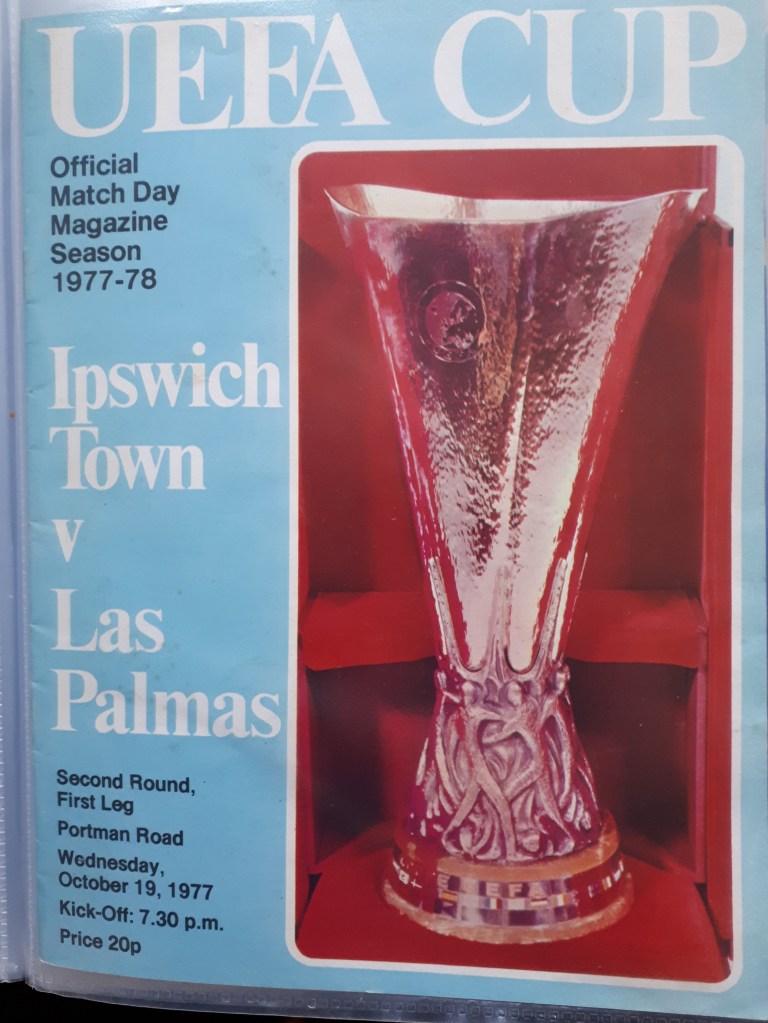
Ipswich Town 1 Nostalgia 1

On a damp May evening three years ago, I recall thinking to myself that it feels like 1978 and Ipswich Town have won the FA Cup all over again.  With my Portsmouth supporting wife Paulene, I had gone to see the Wolsey Theatre’s production of ‘Our Blue Heaven’, the music-backed play that celebrated the fortieth anniversary of Town’s FA Cup win. I can honestly say it was the most enjoyable Ipswich Town related evening I had had in nearly twenty years, since that season in the sun at the start of the third millennium when Town did things like beating Liverpool and Manchester City at their own grounds, having finally managed the previous May, to win a play-off semi-final and victoriously tread the turf at the old Wembley stadium for the last time. 

Fast forward to October 9th 2021, and in the spirit of celebration of Town’s winning the UEFA Cup forty years and five months before, which the club itself has seen fit to mark with the sale of a wallet, luxury boxed badge, and travel mug, the New Wolsey Theatre is staging the final performance of its production ‘Never Lost at Home’, the story of the 1980-81 season, but mainly the winning of the UEFA Cup, something no ordinarily lovable, small town football club will probably ever do again.  Not keen on spending an evening in an enclosed space with about 400 other people, most of whom will probably not be wearing a face mask, I have opted to cough up the £20 to watch the two- and a-bit hour performance on-line from the safety of my living room.

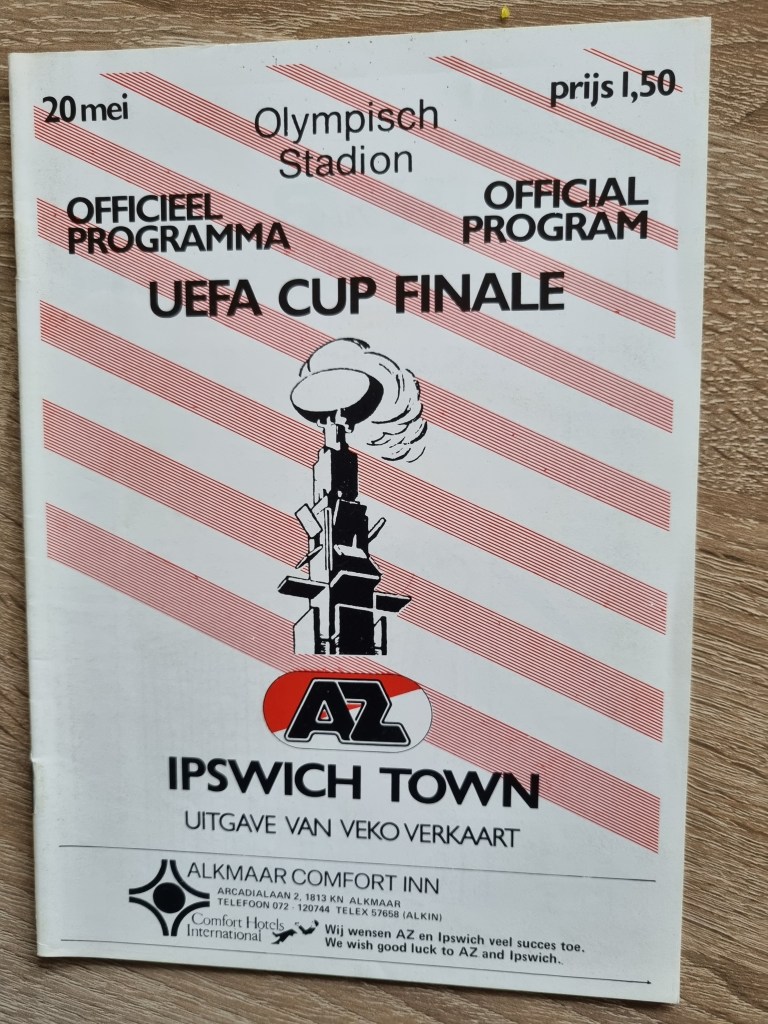
Forty and a bit years ago in May of 1981, I had just finished my final exam at the University of Sussex and I was now just wasting my time, until the lease on my shared student house was up, by playing football, going on pub crawls, walking on the Downs, visiting friends at the other end of the country and taking days out in an aged, bright orange, Dutch registered, left-hand drive Fiat 600 which my friend Chris (mainly known as ‘Jah’ due to his love of Reggae) had borrowed from a woman on his Social Anthropology course.  A lack of available cash and the demands of academia had sadly meant that in Town’s run to the final of the 1981 UEFA Cup final, I had only seen two home games, those against Aris Salonika and FC Koln.  Of the other games, I mostly remember the nervous anticipation of waiting for the result on the radio or television news.  The away matches I recall most are those at St Etienne and Koln.  I remember learning that Town were a goal down in St Etienne and was very chuffed to hear they had equalised as I headed off to the Student Union bar that March evening.  When I discovered Town had won 4-1, I could hardly believe it, and indeed it was a performance that has gone down in history as one of the best-ever by a British club in Europe and possibly Ipswich Town’s greatest performance ever.  As for the game in Koln, I remember that my friend Stephen went to the game on a supporters’ coach from Shotley and I remember seeing Terry Butcher’s winning goal on television, having been fearful that the one goal lead from the first leg would not be enough.

On the morning of 20th May 1981 my sister dropped me and my father off at Ipswich railway station where we caught a chartered train to Parkeston Quay and a chartered ferry to the Hook of Holland before boarding a chartered coach to Amsterdam.  Everyone travelled with the Ipswich Town Supporters Club and Anglia Tours back then, and I still have the pennant to prove it.  I wouldn’t enter Holland again for another 35 years, until I drove through a small corner of it on my way to Dusseldorf for a pre-season game in 2016, but I recall it being very neat.  In Amsterdam my father and I spent the time before the game in a small bar where we drank Amstel, a beer rarely seen in Britain back then, thankfully.  My father had encountered it before in foreign ports when in the Royal Navy and had warned me that it was gnats’; he was right, but it was all there was, they didn’t have any Tolly Cobbold Original.    Amsterdam was beautifully warm that May evening, which was just as well because terraces of the Olympic Stadium were open to the elements, which given that it was built for the 1928 Olympics isn’t that surprising; stadium builders weren’t always big on rooves back then.  In 1987 the Dutch government designated the Olympic Stadium as a National Monument, obviously because Town won the UEFA Cup there, but also because of the fine brick architecture by Jan Wils, an exponent of the Amsterdamse School.  It’s good to know that there is a corner of the Dutch capital that will forever be imbued with the memory of the presence of 7,500 Town fans.

My memory of the match that night in Amsterdam is one of anxiety and tension, despite taking an early lead that put us 4-0 up on aggregate and then gaining a second away goal.  AZ 67 Alkmaar were a bloody good team, but happily not quite good enough, despite Town being visibly knackered at the end of a colossal sixty-six game season. Forty years is a long time, and I’m not sure now what I remember from being there and what I remember from having seen various tv clips since.  I think I remember being frustrated that in the second half we couldn’t keep the ball away from Alkmaar, but I know I do recall wishing away the last twenty minutes of the game, and constantly checking my watch; willing Alkmaar not to score again and the Town defence to hold firm.  I remember nothing of the journey home, although I think my father might have invested in the luxury of a two-berth cabin in the hope of a couple of hours of sleep.

Tonight, “Never Lost at Home” picks up the story of the fictional Coombes family who followed Town to Wembley in “Our Blue Heaven”, and the story very much has the feel of being a sequel, which of course it is.  This time the tale begins with the family vowing to have someone at every game for what promises to be the greatest season in the club’s history as it vies to win an unprecedented treble.  Once again, the story is set against the background of the events of the times, in particular the high rates of unemployment resulting from the Thatcher government’s monetarist policies and indeed Scott loses his job to create some jeopardy in the story as it inevitably hinders his ability to get to games. Once again also, the story and the season unfold to a soundtrack of popular tunes of the time, although just like in ‘Our Blue Heaven’ it doesn’t, because several of the songs are from as much a four years later, which rankles somewhat because songs such as Tears for Fears ‘Everybody wants to rule the world’ (1985) were actually the soundtrack to avoiding relegation, not seeking glory.

Despite the failure to use the actual music of 1980 and 1981 (what a pity we never played Rapid Vienna or IK Start), rather than just generic 1980’s hits, there is nevertheless an authentic feeling of nostalgia for a time and a place.  I can’t fully explain why, but I had tears in my eyes in the first part of this production.  It might have been because I was reminded of how awful some of the music of the 1980’s was; I always hated ‘Eye of The Tiger’ (1982) and have consequently never seen any of the ‘Rocky’ films, but more likely I was mourning my lost youth and my lost football team, both of which seemed to go missing at much the same time.

 One major departure from the mostly repeated formula of “Our Blue Heaven” is the introduction in “Never Lost at Home” of one of the players as a recurring character, that player being the now legendary Arnold Muhren.  The choice of Arnold was, if not inspired, then obvious, because perhaps more than any other player, even his fellow Dutchman Frans Thijssen, Arnold somehow personifies that 1980-81 team, despite having actually joined Town three years before in September of 1978.  Again, the story employs a little artistic license as it almost implies that Arnold and Frans joined for the 80-81 season, but that is easily forgiven and does add to the mythology of that remarkable season.  I can only think that in casting actor Dan Bottomley as Arnold Muhren, one of the main considerations must have been his legs, because these have the same straight up and down shape of Arnold’s.  Not for Arnold the meaty thighs of Mick Mills or Paul Mariner; Arnold was a sinewy thoroughbred, built for the measured pass, the clever change of pace and direction in a single stride, the sort of footballer who simply danced through midfield and no longer exists in a game where speed, strength and bulk has usurped grace and subtlety.
The greatest triumph of ‘Never Lost at Home’, as it was of ‘Our Blue Heaven’, is the performance of Peter Peverley as Bobby Robson.   Not only does Peverley, with his gently hoarse County Durham accent, and perfectly observed Robson-esque mannerisms create a wholly believable vision of the Town manager, but he also delivers the great man’s words as he sends his team out in search of glory.  So stirring and convincing are Peverley’s words it might be an idea if the current Town management employed him to give Paul Cook’s team talks.

Oddly perhaps, ‘Never Lost at Home’ tails off towards the end, in contrast to the prequel which had something of a grand finale as the stories of the characters all came together on 6th May with a birth, a marriage and the Cup Final itself.  This time the characters don’t have their own stories to be resolved other than what happens to them as they travel across Europe in the rounds leading up to the final. We all know the ending, and although Town ultimately win the UEFA Cup, sadly mine and a lot of people’s memories of 1980-81 are probably tinged with a feeling of ‘what should have been’ with the loss of the FA Cup semi-final to the hugely inferior Manchester City and the loss of the ever-elusive League Championship to Aston Villa, a team we beat no less than three times over the course of the season.  But as one of the characters in the play points out, we had already won the Cup and the League before, so if it was to be only one out of three, best that it was the UEFA Cup.   Reassuringly however, it’s good to know that we only lost out in the Cup and the League because none of the characters in the play could get to the Cup semi-final or the penultimate League game of the season at Middlesbrough.

In truth, ‘Never Lost at Home’ wasn’t quite as good as ‘My Blue Heaven’, although my seeing it through the television screen rather than in the flesh is doubtless a factor in that. The story doesn’t have the drama of its predecessor and by drifting further into 1980’s the music is not so much ‘not as good’, as ‘worse’. Nevertheless, it was still massively enjoyable all the same, bringing back those memories of what genuinely was a marvelous time to be a Town supporter and which seems even more so given all that’s happened since. I can only hope that both ‘Our Blue Heaven’ and ‘Never Lost at Home’ are both resurrected in ten years time, not only to celebrate the fiftieth anniversaries of the FA Cup and UEFA Cup wins, but also their own 10th anniversaries; or perhaps we could have a musical about going to a musical about winning the FA Cup and UEFA Cup; I’d watch it.

Ipswich Town 5 ABBA 5

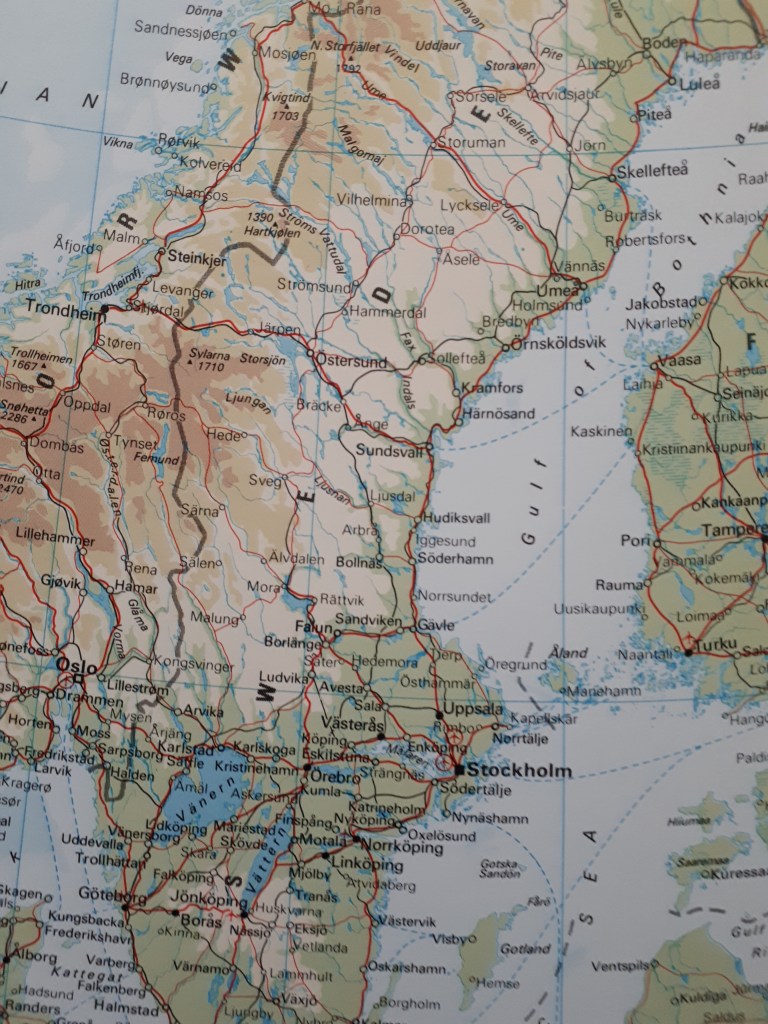
The football season is over save for the silly play-offs, and now it’s the height of Spring,  and with little else to occupy him a young man’s fancy lightly turns to thoughts of the Eurovision Song Contest;  or maybe not.  But last week’s transmission of the bizarre, annual , musical  television ritual extravaganza was inevitably accompanied by the airing of a clip show on BBC4 of past performances by the competition’s only notable success, Abba.  I have never bought, stolen, borrowed or owned an Abba record, tape, download or CD, but I will admit to being unable to suppress a smile when I hear one played.    Equally, I couldn’t resist watching that clip show and felt rewarded when it brought back memories of a road trip I made in the summer of 1995, which took me and my then girlfriend via Parkeston Quay, DFDS Seaways ferry, Gothenburg, Stockholm, Uppsala and Sundsvall to Pitea in northern Sweden, where we stayed with my girlfriend’s pen friend and her husband.  It was a very long drive for which the soundtrack for several stages of the journey came courtesy of a CD of Abba Gold belonging to my girlfriend.

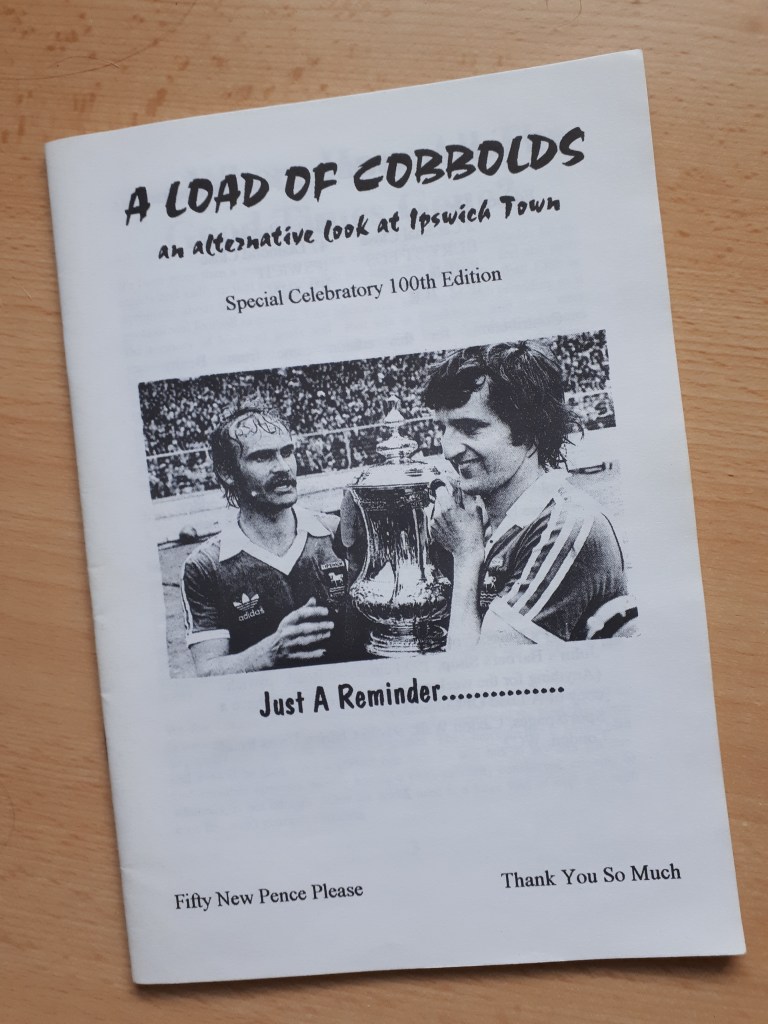
The experience of listening to Abba on that road trip has stayed with me and it led to an article in the erstwhile Ipswich Town fanzine A Load of Cobbolds.  Now, in the spirit of nostalgia inspired by the fortieth anniversary of Ipswich Town’s UEFA Cup win and  in the absence of anything better to do I have reproduced that article below, updating it to modern times where necessary:

When you’re an eleven or twelve year-old football and pop music loom large as pre-pubescent priorities.   I bought my first record (Happy Christmas (War Is Over) by John Lennon & Yoko Ono) in 1971,  the same year that I started watching Ipswich Town, and I  soon began to feel that footie and pop music were somehow inextricably linked. The late Sixties and early Seventies was a time when it was easy to confuse footballers with pop stars and my two worlds satisfyingly collided.  The fashion for any bloke who aspired to being hip and trendy was an enormous thatch of hair coupled with equally vast sideburns.  Squeezed into a pair of bollock-hugging, crushed-velvet flairs and sporting a deafeningly loud shirt,  Ian Collard or Rod Belfitt might have been members of The Hollies, or Kevin Beattie a member of Nazareth.

The similarities in the appearance of pop stars and footballers subsided a bit as the Seventies wore on and sadly, sartorially Punk Rock never seemed to catch on with any footballers at all.  There were however still some startling lookalikes within the ranks of the PFA, I thought.  It could have just been my addled perception, but I always felt that Arsenal’s Frank Stapleton and Shakin’ Stevens were the same bloke.  Moving on into the 1980’s the separation at birth of Oldham Athletic’s Andy Ritchie and Jimmy Somerville was ‘well documented’ at the time, but less well-known is the fact that Roy Keane and Sinead O’Connor were also twins.

More amazing than these superficial similarities, which admittedly are largely the invention of my fevered imagination, is the very precise correlation between the success of one particular football club during the 1970’s and early 1980’s and a particular pop group.  Both were at their peak between 1973 and 1982. The football club of course was Ipswich Town and the pop group was Abba.

If you take time to trawl through the collected works of the famous Swedish songsters, as Dave Allard might have called them, you will not only enjoy a richly rewarding aural experience, but you will soon reach the conclusion that the fact that Town and Abba were both at the peak of their powers over precisely the same period of time is no coincidence.   Listen carefully to the lyrics and you will be able to trace the history of the Town’s success through that glorious era.  You will find that listening to Abba Gold (Greatest Hits) is as close to a religious experience as you can hope to get;  something akin to an Ipswich Town Dreamtime, harking back to an epoch when Portman Road was inhabited by ancestral figures of heroic proportions who possessed supernatural powers.   In the film Muriel’s Wedding the eponymous Muriel says that Abba’s songs are better than real life.  Now, as we sit in the murky depths of the third division and look back at Town’s glorious past you too will believe this is true.

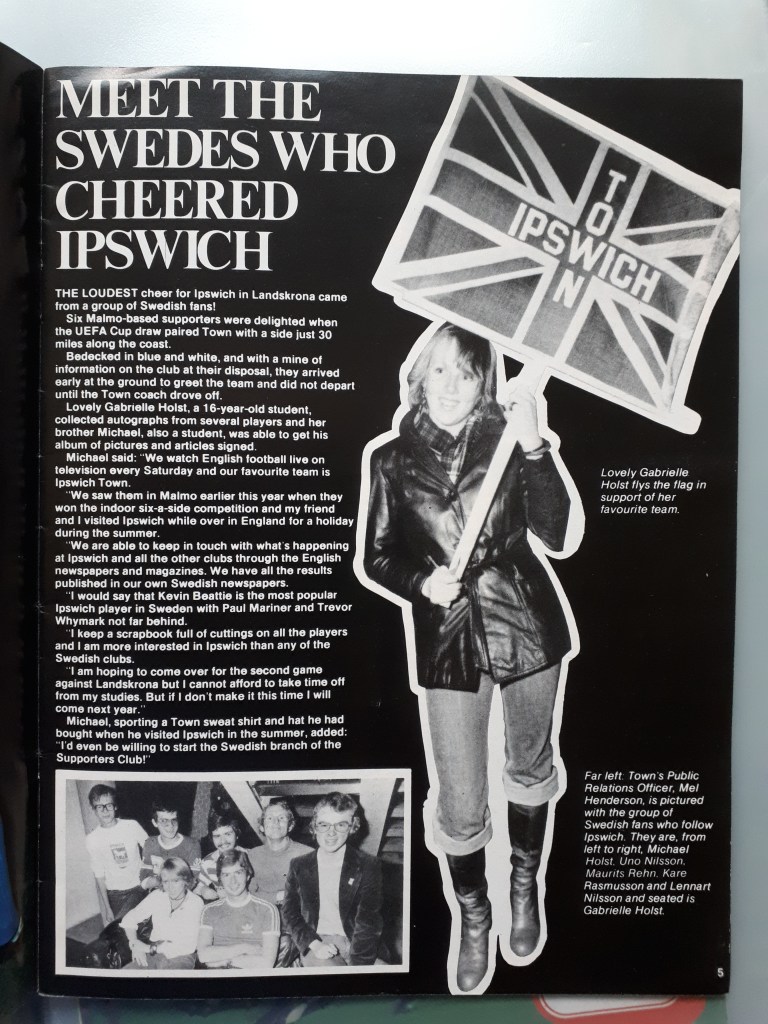
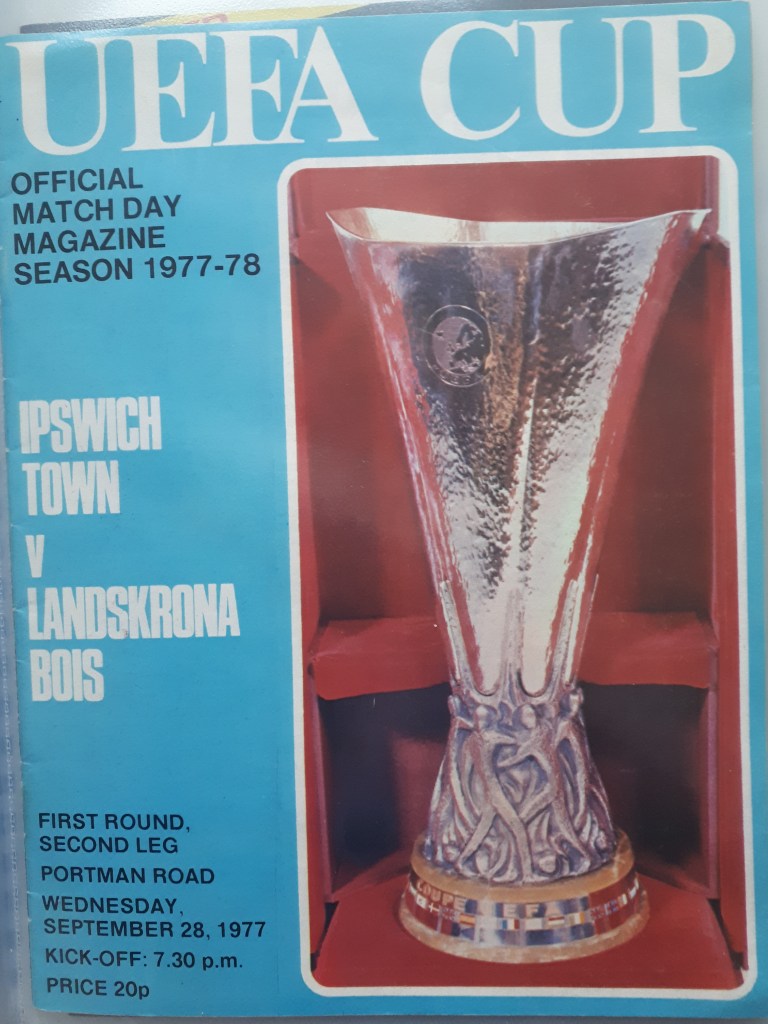
As you might expect from Europe’s foremost supergroup many of the songs make reference to Town’s European campaigns of that era in the UEFA and European Cup Winners’ cups.  It is likely that it was through Town’s exploits on the continent that the talented Swedes first became Town supporters, although we were actually only drawn against Swedish opposition  once when in 1977 we met Landskrona Bois and most inconveniently The Stranglers played the Ipswich Gaumont on the very same night as the home leg.  Naturally, I missed The Stranglers concert and sadly never got a second opportunity to see them.    There is clearly a reference to Town’s UEFA Cup triumph over Lazio in the title of the number one hit ‘Mamma Mia!’, a song which also contains a lyric that suggests one of Abba had perhaps had a brief flirtation with a Town player or supporter and may explain the uncanny connection between Abba and the mighty Blues;

“Yes, I’ve been broken hearted, Blue since the day we parted.”

The moving ballad ‘Fernando’ is sung to an imaginary Spanish fan and recalls those sultry September and cooler autumn evenings when we entertained Iberian opposition from Real Madrid, Las Palmas and Barcelona.

“There was something in the air that night, the stars were bright, Fernando….

Though we never thought that we could lose, there’s no regrets. If I had to do the same again I would, my friend Fernando”

That last line referred to the fact that Town were twice drawn to play Barcelona, whilst the line  before that refers to our having lost both ties despite being confident after winning the first leg.  Another song, ‘Super Trouper’, whilst still referencing games played under floodlight, perhaps because of the lack of daylight hours in Sweden during the English football season, refers to an individual player and employs little-known Swedish rhyming slang in a thinly disguised paean to goalkeeper Paul Cooper.

“Super Trouper lights are gonna find me shining like the sun, Smiling having fun feeling like a number one”

In the 1978 Abba hit “Take a chance on me”   the subtle Swedish Blues fans reveal the little known story of how Frans Thijssen successfully pleaded with Bobby Robson to let him join his compatriot Arnold Muhren at Portman Road and to try his luck in English football. 

Honey I’m still free, take a chance on me. If you need me let me know and I’ll be around. Gonna do my very best and it ain’t no lie, if you put me to the test, if you let me try”.

Although those days were such wonderful times for Town, not every song described a happy or uplifting event.  There were sad days too at Portman Road back in the Seventies and hard decisions had to be made for the good of the team.  The 1977 ‘Number One’ hit ‘Knowing Me, Knowing You’ was about the departure of former Portman Road favourite David Johnson, the one-time ‘King of Portman Road’, who left Town to join rivals Liverpool.  In the song, the reflective Scouser looks back on the good times he has had at Portman Road since his move to Town from Everton four years earlier.

  “Memories, good days, bad days, they’ll be with me, always”

David appreciates however that his recent form has not been good and in the circumstances a move is the best thing for everyone.

  “Knowing me, knowing you, there is nothing we can do, we just have to face it this time we’re through; Breaking up is never easy I know but I had to go, Knowing me, knowing you it’s the best I could do”.

Back in the Seventies, money wasn’t the driving force in football that it is today.  Nevertheless, the spending power of clubs such as Manchester United, who were able to make expensive signings virtually every season despite being rubbish, rankled with Bobby Robson and he longed to be able to make big signings for Town.  Abba’s “Money, Money, Money” was a song about his frustration. 

“In my dreams I have a plan, if I got me a wealthy man…  “

”All the things I could do if I had a little money…”

“Money, money, money, always sunny in a rich man’s world”

Both ‘Knowing Me, Knowing You’ and ‘Money, Money, Money’ showed something of the downside of those glory years and as we look back on those days from the fag-end of the first quarter of the miserable twenty-first century a melancholy aura pervades our memories, in part because ultimately Town failed to win the League Championship that we deserved, but perhaps also because even at the time we knew it all had to end one day, and when Bobby Robson left to manage England in 1982 we secretly knew it had.  Abba knew it too and two of their hits put these feelings in to sharp perspective.  The haunting melody of ‘Winner takes it all’ explores the pain that looking back on the good times would bring; it begins:

 “I don’t want to talk about things we’ve gone through, though it’s hurting me now it’s history”

Abba’s last big hit ‘Thank you for the music’ is sung from the perspective of our legendary club captain Mick Mills who reminisces, having regretfully left Town for Southampton, about the joy and beauty of those days between 1973 and 1982.  If you’ve listened to the slightly dull monotone of Mick’s summaries as he sits alongside commentator Brenner Woolley on BBC Radio Suffolk, you will appreciate the opening lines to this song; 

“I’m nothing special in fact I’m a bit of a bore, If I tell a joke, you’ve probably heard it before…”

But Mick’s talent was as full-back and captain of the greatest Ipswich Town side ever and this was the ‘music’ referred to in the title of this most moving of Abba songs.  This was a song from the heart of ‘Mr Ipswich Town’, Mick Mills, and it is truly uncanny how Mick with his blond locks and luxurious facial hair even looks like a bit like a composite of Bjorn Ulvaeus and Benny Anderson the song’s composers.  This song is the ultimate celebration of those ten seasons at the top in which Mick thanks fate for the glorious hand he was dealt.

“I’ve been so lucky, I am the girl with golden hair

I want to sing it out to everybody

What a joy, what a life, what a chance

So I say Thank You for the music

The songs I’m singing

Thank you for the joy they’re bringing…”

The songs of Abba define and encapsulate a golden period in the story of the twentieth century and the time before Thatcherism and neo-liberalism destroyed your innocence.  Abba’s songs, their success and the glory of Ipswich Town, the nicest professional football club the world had ever known did not happen together by coincidence.  The proof is in the lyrics of the songs, and shows that cosmic forces were at work.  Those of us who lived through the 1970’s were truly blessed to have experienced the music of Abba as it happened, but we are doubly blessed to have been Ipswich Town supporters too.

Thank you for the music Bobby Robson and Mick and all the lads who played for us between 1973 and 1982 , and thank you for the music Agnetha Faltskog, Benny Anderson, Bjorn Ulvaeus and Anni-Frid Lyngstad.