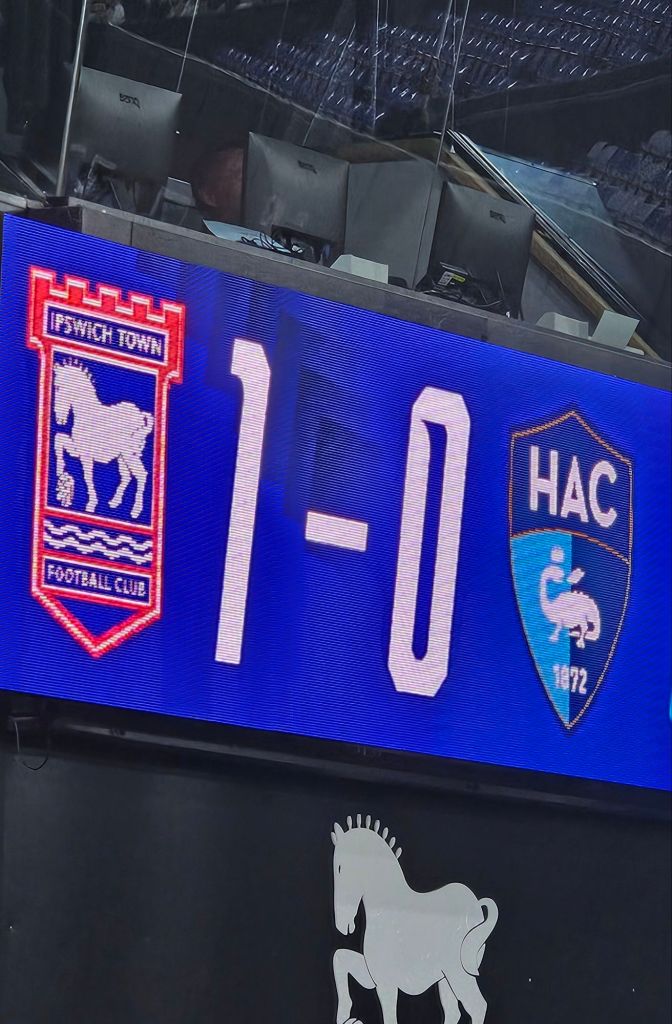
Ipswich Town 1 Havre AC 0

According to the Chargemap app on my mobile phone, the 495 kilometre trip from my house to Stade Oceane in Le Havre, home of Ligue 1 football team Havre AC, would currently take seven hours and twenty-five minutes including two stops totalling fifty minutes to re-charge my planet saving Citroen e-C4.  This is a trip I made only last month and is one I would recommend, provided you have the cash to pay for the motorway tolls and the fare for le shuttle.   Le Havre is a fascinating port city and on account of its being re-built in concrete by Auguste Perret after the RAF flattened it, it is now a UNESCO World Heritage site.  Disappointingly however, Havre AC were not at home when I visited last month, so I made do with a trip to the Museum of Modern Art to see Ai Wei Wei’s Lego interpretation of Monet’s Water Lillies, several beers in the excellent bars of le brasserie L’Havrais biere, and wandering amongst some of my favourite buildings.  But the world and time are nothing if not round and a month later Havre AC have come to see me, playing a friendly versus Ipswich Town at Portman Road.

Unusually, my wife Paulene is coming to the match tonight, attracted by the promise of French footballers, although having grown up in Portsmouth she was, and as far as I know still is, always wary of French sailors. Our journey this evening is by planet saving Citroen e-C4 and we pick-up Gary on the way before parking very conveniently just around the corner from the Arb’.    Gary is sporting the very latest replica Ipswich Town away shirt this evening, and gets the drinks in first; a pint of Estrella for him, a small glass of dry rose for Paulene and a pint of Nethergate Stour Valley for me.    A woman in the bar compliments Paulene on her earrings before we retire to the garden and a table in the shade to talk of relatives and friends and other stuff, and Gary is impressed by my Havre AC T-shirt.  In due course, I buy another round of drinks the same as before, but I opt for a pint of the weaker Nethergate Voyager this time and am disappointed that it tastes a little like the pipes have been cleaned but not rinsed very well afterwards, as in fact  did the Stour Valley.

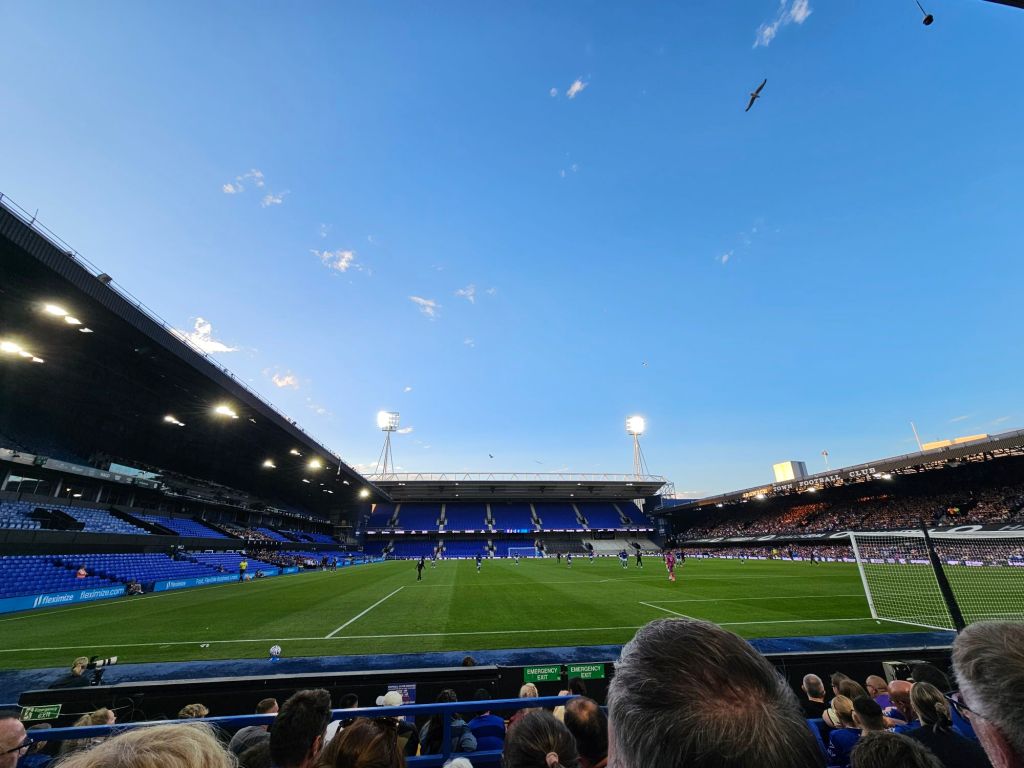
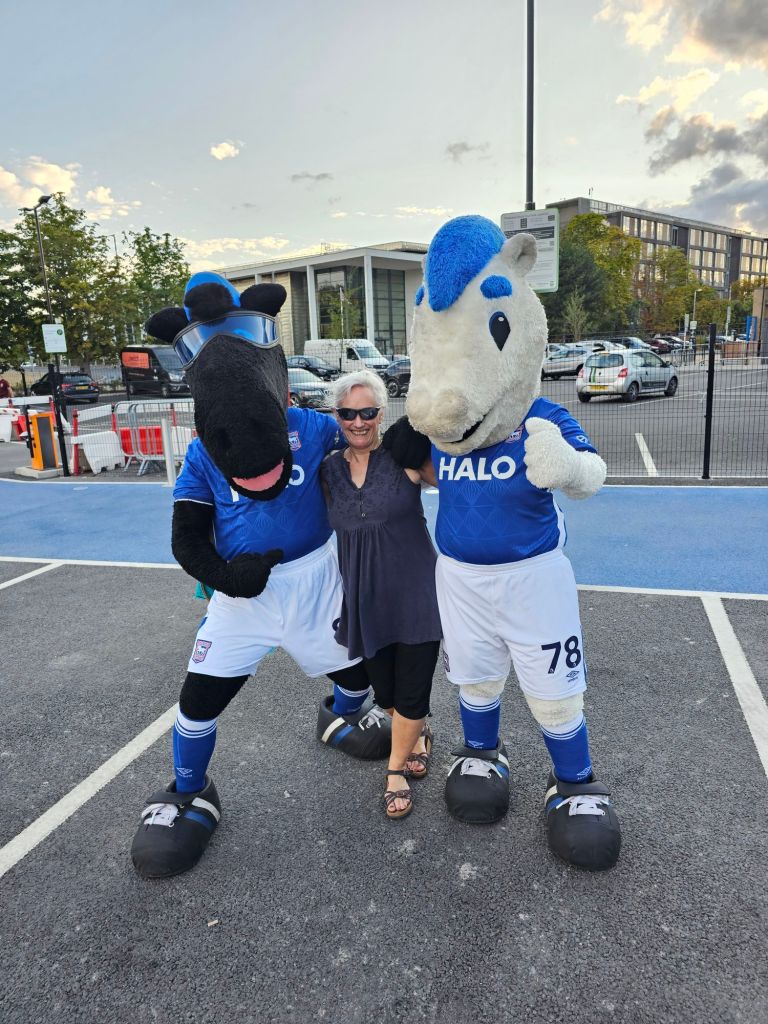
It’s about twenty past seven when we head for Portman Road and thankfully an easy downhill walk, because once again it is a very, very warm evening.  There are long queues for the Cobbold stand in Portman Road, but what I notice first is that there are no programmes on sale again, which vexes me greatly; even in the days of Marcus Evans there were always programmes for pre-season friendlies, weren’t there?   But my spirits lift slightly when I find there are no queues for the Sir Alf Ramsey stand and this gives me time to photograph Paulene with Town mascots Bluey and Crazee who are hanging around in the car park with a small man in spectacles.  I tell Bluey and Crazee that Paulene has been photographed with an army of mascots, including  Bouba the elephant in Monaco, Ri-Ri the Canary in Nantes, Auguste the lion in Reims, Merlux the Hake in Lorient, Erminig the ermine in Rennes, a very dodgy, moth-eaten looking Leopard in Rouen, but sadly not Sali the salamander in Le Havre.   Bluey and Crazee unfortunately do not reply, and I commiserate with them that they do not speak.

Having been checked for scrap metal and explosives, I am ushered by a lady steward towards turnstile 61, but I tell her that I have to use turnstile 62, although I don’t know really know why and tonight’s match is only a pre-season friendly. “You never know” she says, and I think to myself “You never know what?” but like Bluey and Crazee I can’t say it. After venting excess spent Stour Valley and Voyager I meet up again with Paulene and Gary at our seats, which until we sit on them are an oasis of blue plastic amongst a sea of parents and children, many in last season’s replica kits.  None of them are at all familiar and I look in vain for Pat from Clacton, Fiona, ever-present Phil who never misses a game, his son Elwood and the man from Stowmarket (Paul).  I feel rather uncomfortable, like a walrus stranded amongst roosting penguins on a stoney beach somewhere in the South Atlantic.  They seem to be giving off a lot of heat too because it is incredibly warm.
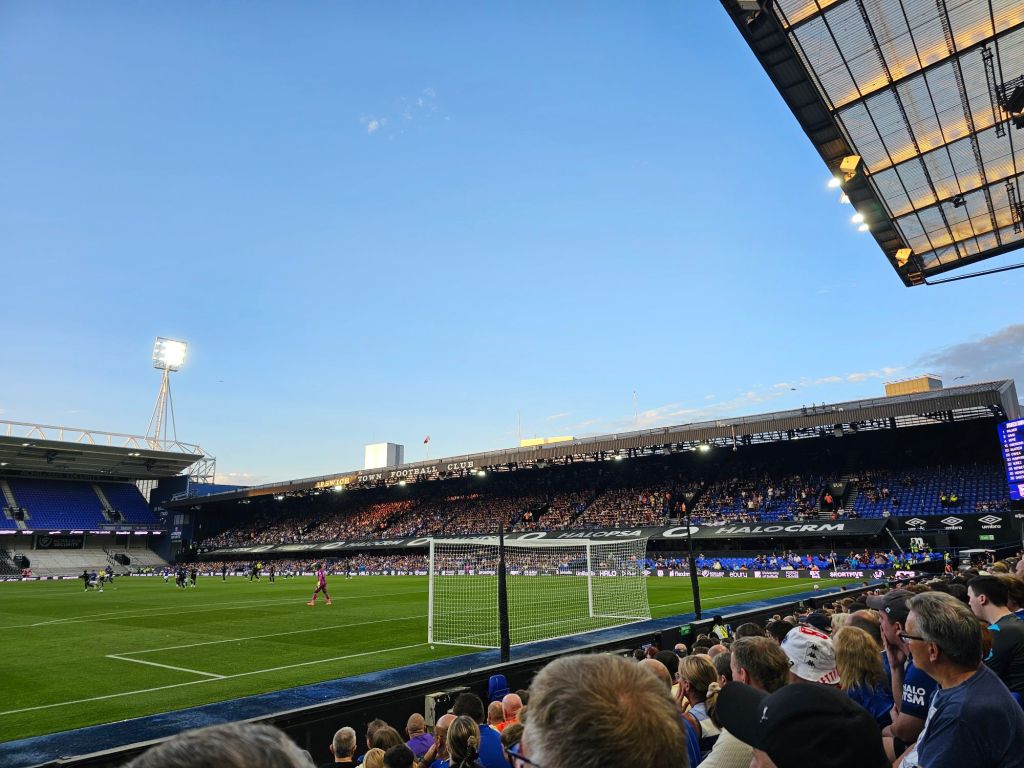
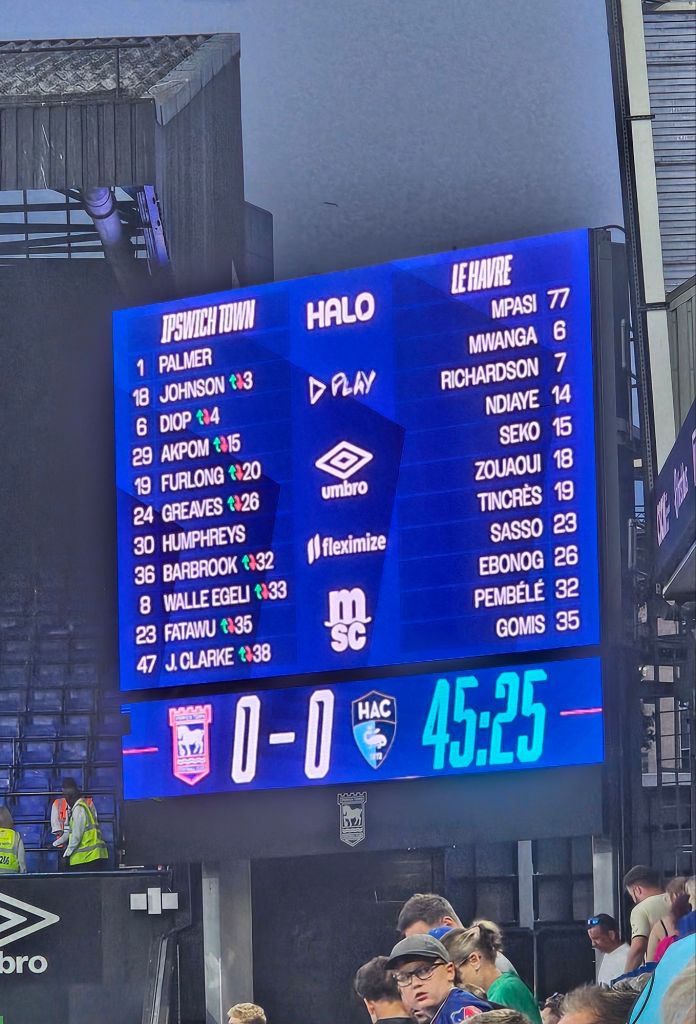
Eventually, the football begins with Town in their natural blue and white getting first go with the ball and kicking it towards the goal just off to our right.  Havre are most disappointingly in all black rather than their signature pale blue and dark blue halved shirts and dark blue shorts, although a look on their website suggests they have no away kit, at least, perhaps not one they think anyone would want to purchase a replica of.  Havre don’t know it, but they are of course kicking towards Cumberland Towers, a concrete building which is unlikely to earn Ipswich UNESCO World Heritage site status, but which I like because it looks a bit like a very big match box stood on its end.

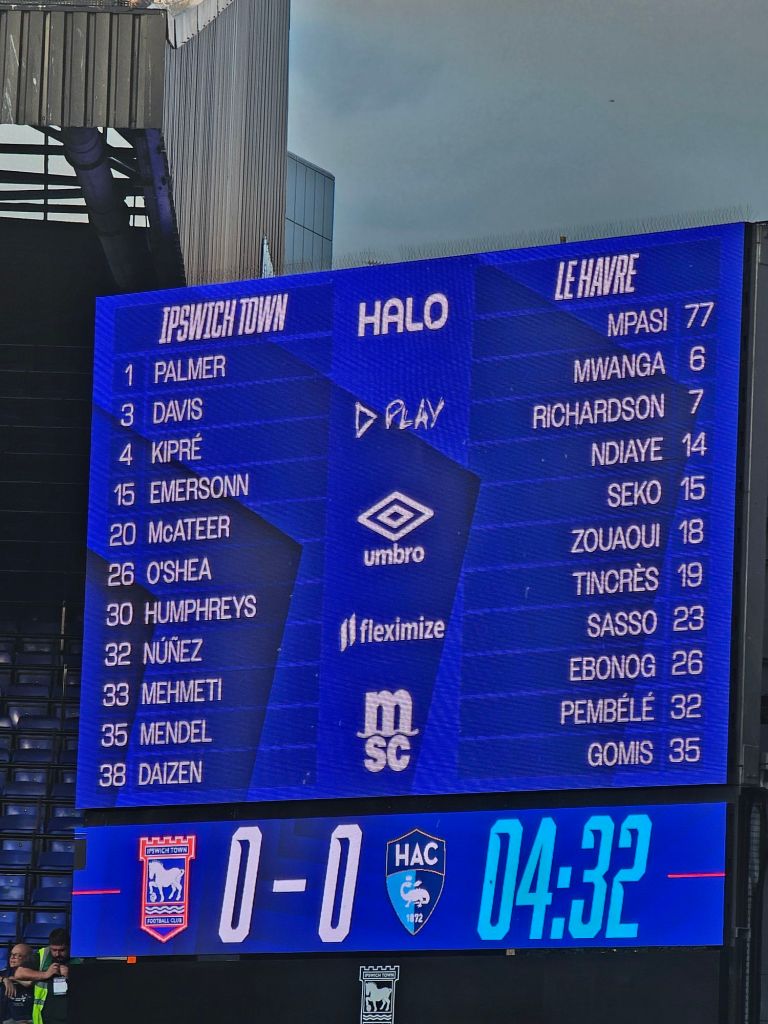
In terms of football, the first half is awful, but this is at least consistent with most pre-season games.  We amuse ourselves by working out which players are which on both sides.  Gary asks who Mendel is and is more amused than he should be when I tell him that he is Mendelssohn’s father. This is probably the highlight of the half but only if I ignore the fact that Town’s new Japanese signing Daizen Maeda looks about sixty-five and nearly ready for his pension, but this is solely due to the strange silvery colour of his hair. Otherwise, all I recall are the numerous seagulls swooping overhead (have Le Havre brought their own?) and that Havre have a player whose surname is Pembele, which because it rhymes Dembele sets me off thinking about an imaginary team whose names all sound a bit like those of other, far superior players, like Zinedine Sedan, Bobby Carlton or Lionel Nessi.

The welcome relief of half-time is spent talking to Harrison, who Gary has never met before, although Paulene has. Harrison’s grandfather Ray is watching the match from his Heath Road hospital bed, from where he at least might have access to drugs.  I will visit Ray a day or two later and he will tell me that he missed the first fifteen minutes because Town TV is not very good.  I reassure him that in fact he missed absolutely nothing at all.

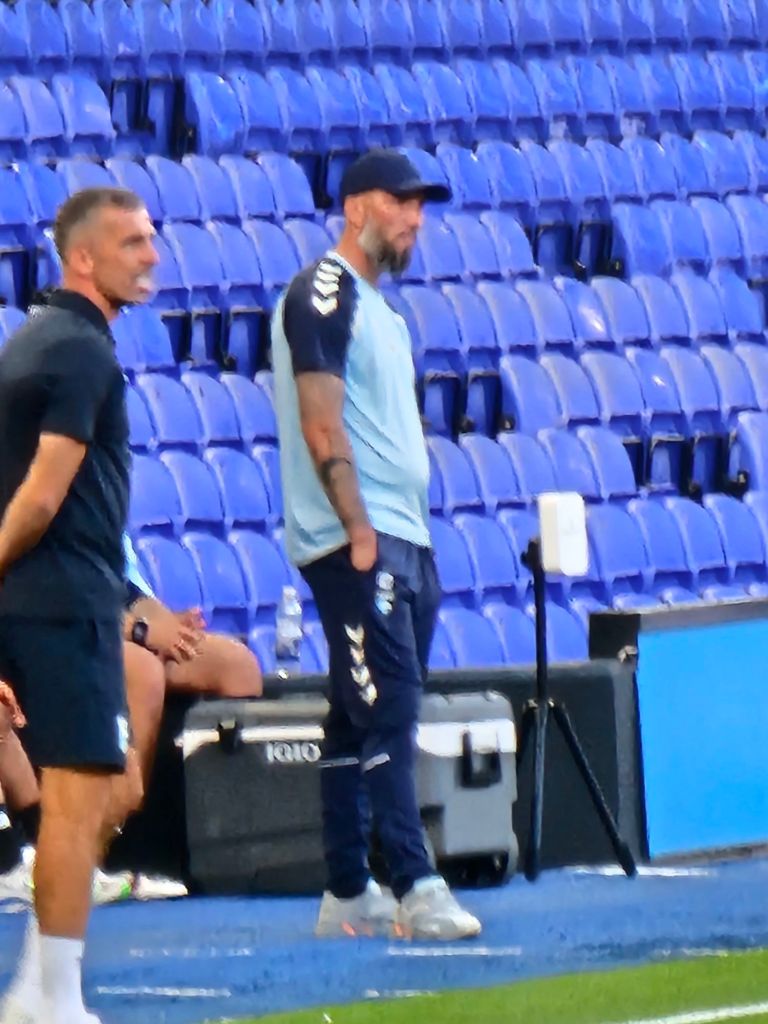
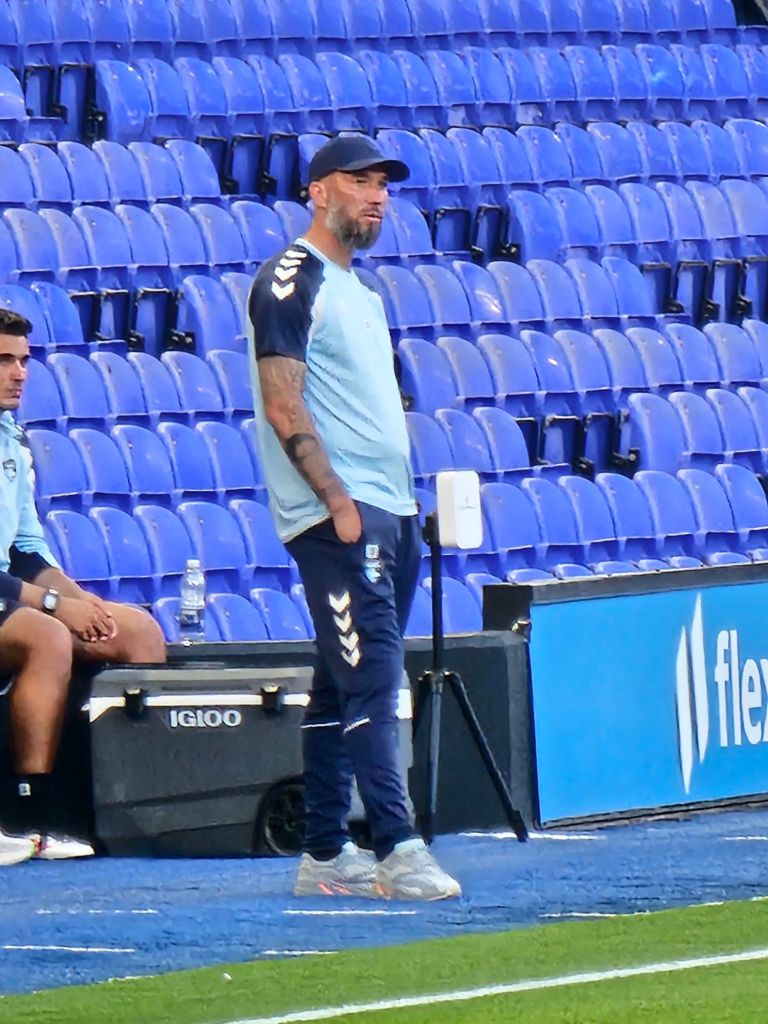
The match resumes at nine minutes to nine, predictably with a new Ipswich team.  As happened in last week’s pre-season game versus Osasuna the more or less wholesale substitution of the team seems to do the trick and thirteen minutes later a Town goal is being celebrated as Chuba Akpom directs a free header into the Havre net after some startlingly bad defending from the Norman team and Town lead one-nil.  On the touchline, the seldom smiling Havre manager Didier Digard, who incidentally played three games on loan for last week’s opponents Osasuna about ten years ago, is grim faced, looking as if he’s already deciding who to hit first when they all get back in the dressing room in half an hour’s time. Havre soon begun substitutions of their own, bringing on the players with the evening’s two most pleasurable surnames, Yanis Zouaoui and Hakim Dongopandji.

Twenty minutes of the second half have upped and left, and Jack Clarke has an early tilt at the worst shot of the season award as he shoots spectacularly wide and high.  A minute later George Hirst is brought on to see if he can do better.  Twelve minutes later, Havre produce what might be their only shot of the game, from substitute wide player Enzo Koffi, and the waning of interest in the stands begins to manifest itself with depressing calls of “Blue Army” from both adult males and small children. It’s something that doesn’t happen during ‘proper’ games and is another compelling argument for not attending pre-season friendlies.

The match nears its uninteresting conclusion and over the public address system we are told that collectively we number 6,669.  It’s probably close to a capacity crowd for the limited areas of the stadium that are open, but I remain disappointed that I have not seen or heard a single French person in the crowd this evening, or smelled a Gauloise or even a faint whiff of garlic.  I hope that we get to see RC Lens, Paris St Germain or Olympique Marseille at Portman Road before too long.
FC Megalithes 2 Riantec OC 1

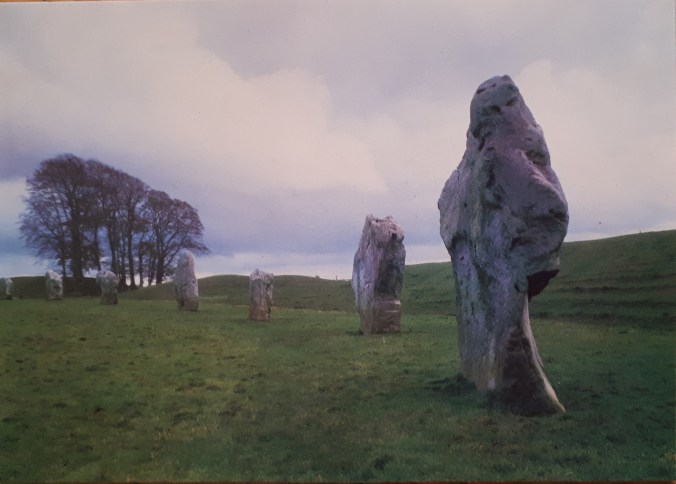
The small town of Carnac on the coast of Brittany is famed for its sprawling, ritual landscape of neolithic, megalithic alignments, menhirs and dolmens, but less so for its football clubs.  It is unlikely therefore that many people outside the local football fraternity of the Morbihan departement (County), noticed the merger in 2023 of two or maybe three local clubs to create what its name suggests is a giant ritualistic rock of a football club, FC Megalithes, which possibly prefers to kick-off games in the direction of the mid-winter sunrise.

The website for the French equivalent of the local County Football Association helpfully lists associated clubs and their fixtures and having arrived in Carnac the day before and settled in, my wife Paulene and I have dusted off our autumn almanac and are seeking entertainment on what is a sunny September Sunday afternoon.  The website tells us that FC Megalithes are at home to Riantec OC, playing their second league match of the season in the Ligue Bretagne de Football, District Morbihan, District 1 Poule B.  If Ligue 1, where the likes of Paris St Germain and Olympique Marseille hang out is level one of French football, we think this is about level ten of may be twelve or thirteen.  Riantec is a village a bit more than 30 kilometres away near the much larger town of Lorient, albeit this side of the estuary of the River Blavet; Wikipedia tells us that in 2017 Riantec had a population of about 5,600.

The football association website states that kick off is at 3.30 pm, and believing the match will be played at the main sports ground in Carnac, we set off at about ten to three from our ‘hut’ in a nearby camp site to make the 3.3 kilometre journey in our planet saving electric Citroen eC4.  As is often the case with local municipal sports grounds in France, there is plenty of free parking, but worryingly perhaps, as we roll up almost all of it is unoccupied,  and walking through the stone gateway of the Stade it is evident that there is no one else here except some youths playing an impromptu game of ‘three and in’ behind the albeit impressive, but lonely looking and very empty main stand.  The pitch is freshly marked out, but there aren’t even any goals up.  Clearly in the wrong place, we consult the interweb again and discover, courtesy of our very own administrative error, that we should be at Parc des Sports Kermouroux, about 7 kilometres away in St Philibert.

It is an easy trip across town to St Philibert, despite some 30 kilometre per hour maximum speed zones and a couple of red lights, and whilst we arrive after three-thirty we can see from the road outside that the players are only just lining up to shake hands and accept the applause of a crowd of what must be about a hundred people.  As we step through a side gate, we can even hear some Ultra-style chanting, although that seems to be from the players of the B team whose match had kicked off at one-thirty and has since ended.

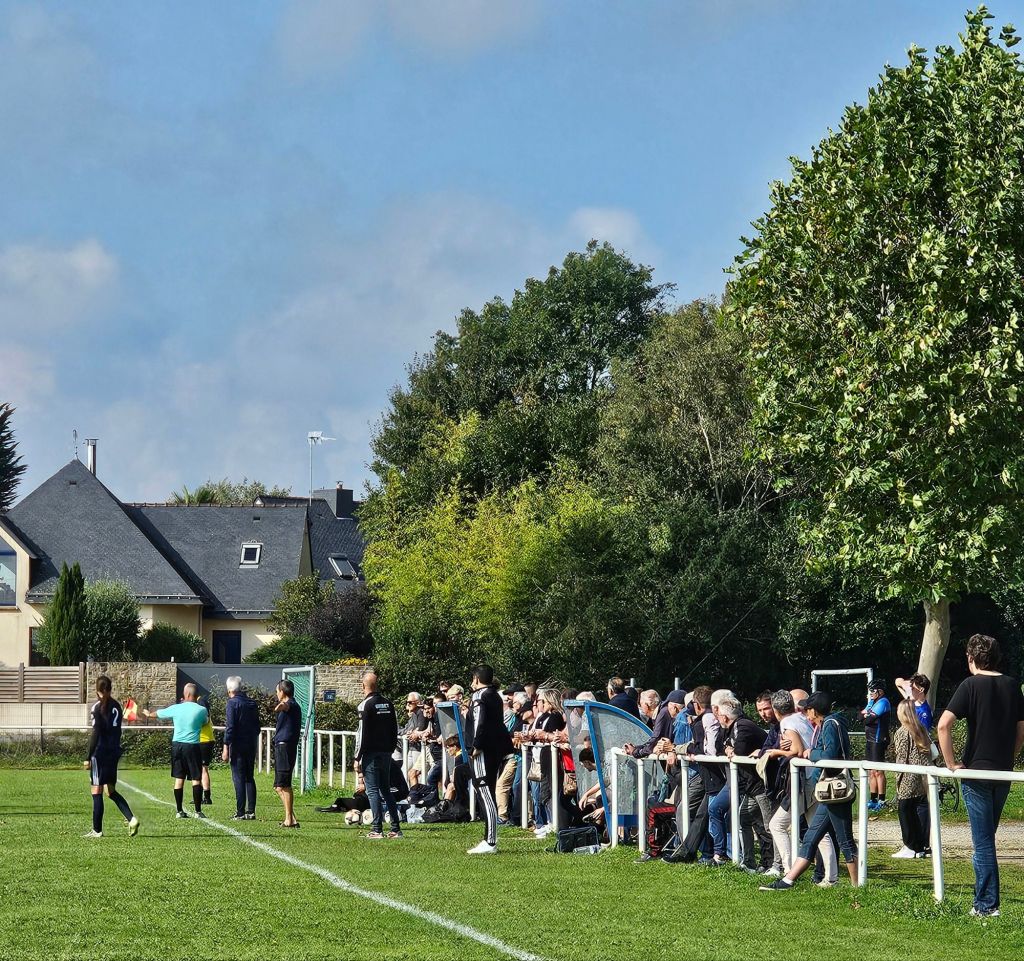
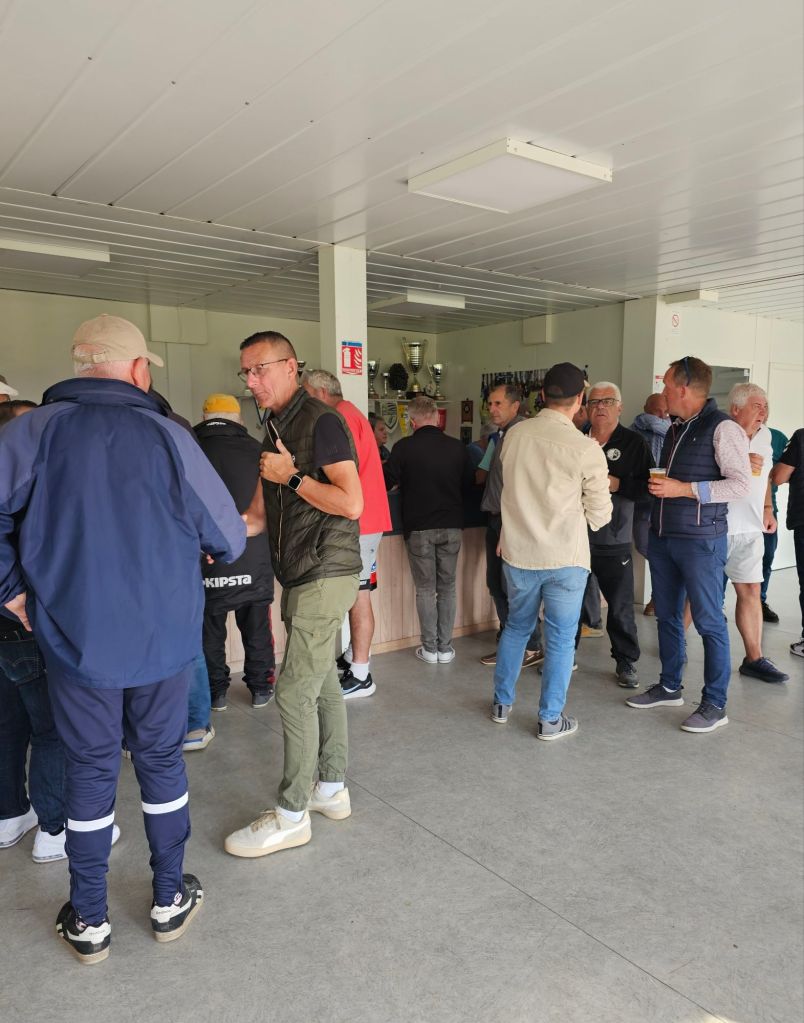
The Parc des Sports Kermouroux has no stands or floodlights, just a neat white rail all around the pitch, a couple of dugouts and a clubhouse.  The site is surrounded by houses, but on the far side of the pitch is also a playground and what looks like judiciously mowed, planted wildlife area.  The majority of the crowd lean on the rail in front of the clubhouse, inside which a couple of middle-aged women are doing a good trade in beer.  Wine and coffee are also available. 

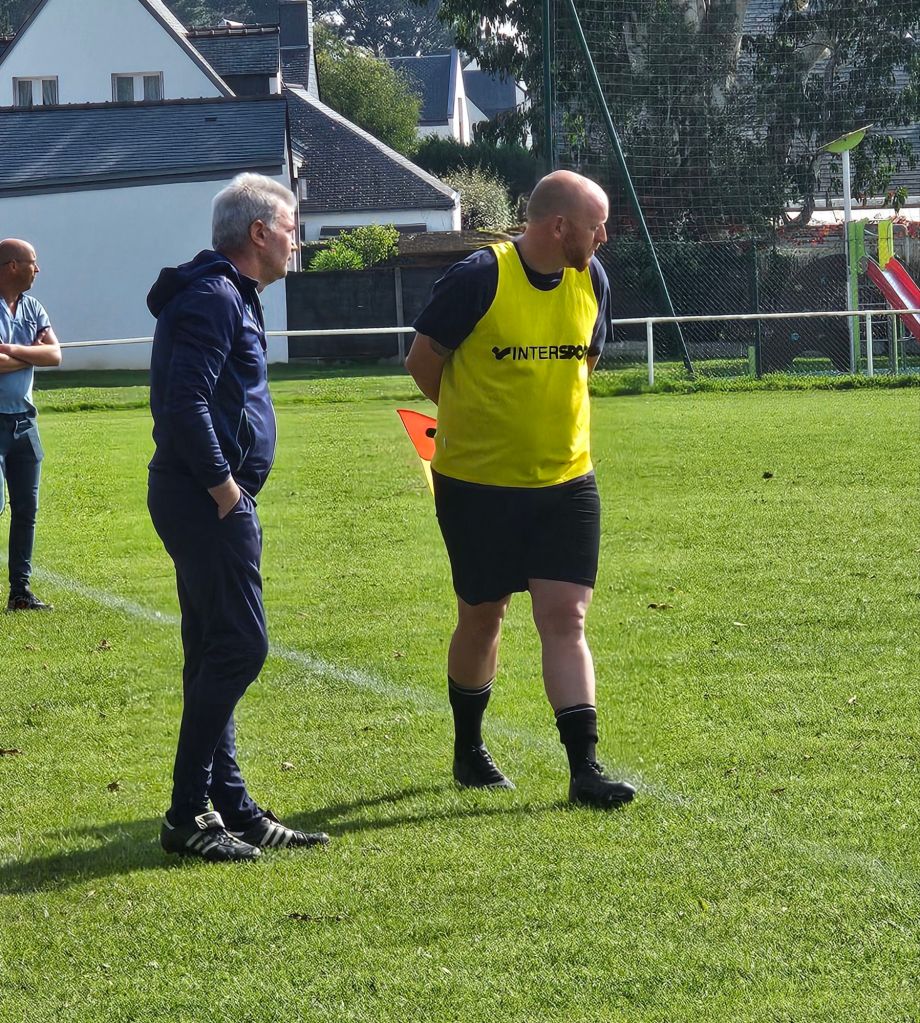
We miss the actual kick off, or coupe d’envoi as the French call it, as we find a decent spot against the rail, but we are paying attention when at eighteen minutes to four the Megalithes’ number nine bustles his way through the Riantec defence, checks and turns a couple of times and then boots the ball beyond the Riantec goalkeeper and into the goal.   Two minutes later he repeats the dose, running beyond the back four and a sluggish linesman to score from about six yards out.    The linesman doesn’t really seem to have grasped what his role is yet, but to be fair to him it does look like he didn’t expect to be linesman when he turned up, as he is wearing a day-glo yellow tabard rather than the standard officials’ uniform that the referee and the other linesman are wearing. As for the teams and their apparel, Megalithes are smart all in navy blue with white trim, whilst Riantec are less so in a messy looking combination of baggy white shirts and with streaks on,  and black shorts.

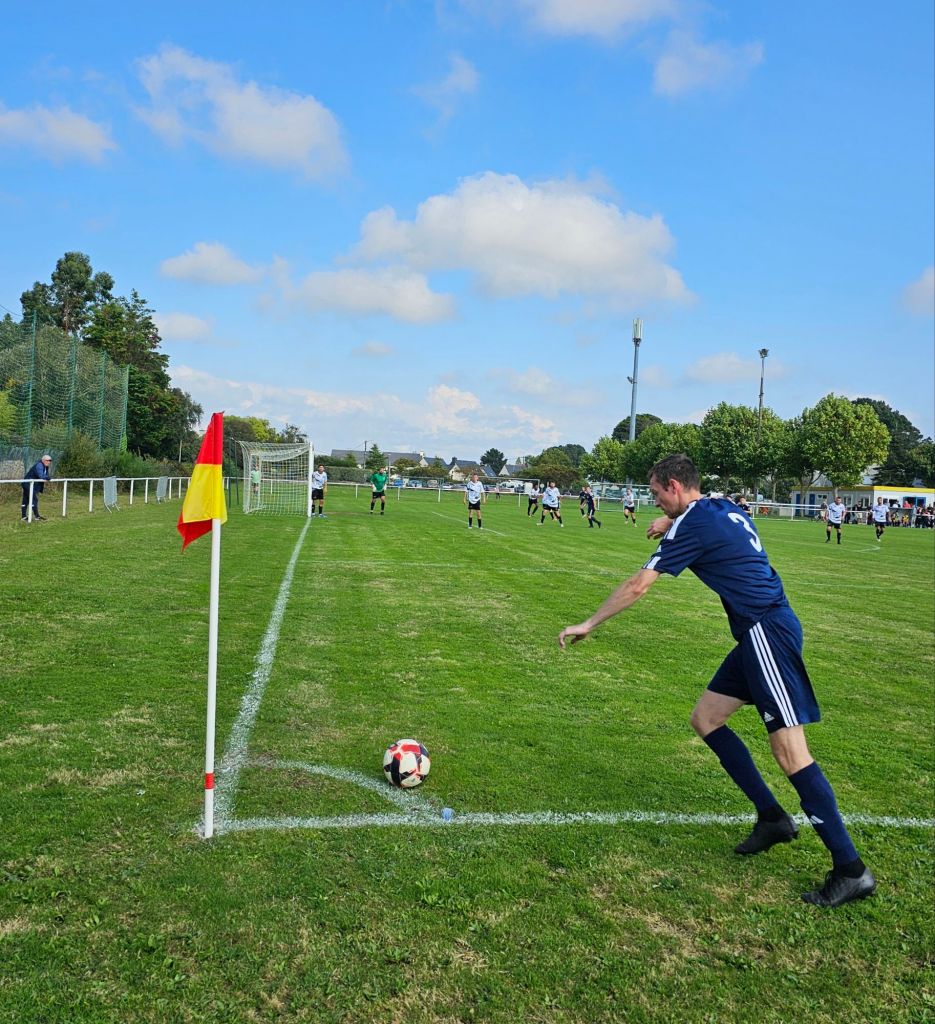
After two goals in the first five minutes, the arrival of the first corner of the match at seven minutes to four leaves everyone somewhat non-plussed.  This is even more the case when a minute later a punt forward for Riantec is met with another hopeful punt-cum-shot from their number ten and the ball sails into the top corner of the Megalithes’ net to make the score 2-1, against the run of play.  Although the goal adds to the excitement and sense of jeopardy, which I believe is what football matches are all about, I can’t help but feel a bit disappointed because Megalithes are by far the better team.

Megalithes continue to dominate the match and pass the ball well but seem unwilling to score again, although their number nine keeps threatening to nip behind the Riantec defence just as he did twice before, but he never quite manages to get his shot into the net.  Without more goals to concentrate players’ minds on keeping up to date with the score, a combination of fouls and outlandish acting creeps into the game, with more than one player letting out blood curdling screams as he collapses to the ground as if the subject of some sort of unexpected, attempted human sacrifice.

The gnarled looking, but neatly coiffured, grey-haired referee is totally in control of the shenanigans, looking down deeply unimpressed at the writhing players, whilst politely but firmly dealing with the perpetrators of genuine fouls. “S’il-vous plait Monsieur” he says politely but wearily as he beckons over the perpetrator of a foul to instruct him as to his future conduct.  In the first instance Rianec’s number eight is merely spoken to, but then Carnac’s number ten, a lithe youth with curly hair a la Adrien Rabiot, is booked after being summoned with the ominous words “Numero dix, s’il vous plait”

Half-time comes as a relief after the frustration of FC Megalithes not scoring the goals they deserve and all that falling about and screaming.  I head for the club house as the players make for the dressing rooms and am quickly acquiring two cups of coffee (one euro each), which are served from a filter coffee machine; none of your instant muck here. Paulene and I find a better position by the rail as almost everyone else heads indoors for more beer, and we nick their ‘spots’.
It is nineteen minutes to four when play resumes and within moments Megalithes number nine is centring a low cross, which number three easily and mournfully taps wide of the goal having arrived in position perfectly on time and completely unseen by the opposition.  The second half is twelve minutes old when Megalithes’ number nine elicits a fine save from the Riantec ‘keeper at the expense of a corner and then the scenario repeats itself.  Megalithes continue to dominate the second half as they had the first and the mystery of how they fail to score more goals continues every bit as mysteriously as the question of why the neolithic locals erected all these megaliths in the first place.

It is a quarter past five when Riantec win a corner and I can’t help thinking to myself that this is the first corner the away team has won, and it has taken them almost an hour and a quarter to do so.  Normal service is resumed however just two minutes later as Megalithes’ number twelve beats the offside ‘trap’, takes the ball around the Riantec goalkeeper and then places it precisely into the side netting of the goal.  A minute later Megalithes number two, a beautifully skilful player, repeats the process, taking the ball around the goalkeeper, but doing so without the necessary speed to get the ball into the goal before two defenders get back and combine to clear the goal bound ball.

Finally, and fittingly, in the final minute of the game, Megalithes place the ball in the Riantec goal to make the score justifiably, although sadly only temporarily 3-1, as almost inevitably the linesman raises his flag to declare it hors-jeu, offside, which it rather blatantly was.

The final whistle brings relief to both teams as the home side finally confirm their narrow win, and the away team gain respite from the footballing lesson they have been given.  The sun has now begun to sink low in the sky and a cool breeze has spoiled what was an almost balmy autumn afternoon for a while.  Pleasingly, the better team has won and whilst not winning by as many goals as they should have, a decent hour and a half’s entertainment has been provided by everyone involved. There is a palpable warmth and feeling of community amongst the crowd and as ever as we leave the ground and head happily  for our Citroen to make the short drive back to Carnac, our experience of French amateur football has been a pleasant and uplifting one.  Vive le Foot!

FC Nantes 2 Olimpiakos 1

The Stade de la Beaujoire in Nantes is a stadium I have long wanted to visit because on the telly it looks a bit different to your run of the mill English footie ground and certainly a cut above the diet of Portman and Layer Roads I grew up on, as lovely as Portman Road still is and the much-lamented Layer Road was.   Having missed out on tickets to see FC Nantes at home to Paris St Germain due to cost and lack of decisiveness, the opportunity to see the Breton club at home in the Europa League to Olimpiakos just five days later was not to be passed up.  To add further to the mix, historically FC Nantes is one of France’s most successful football clubs, with eight league titles and four Coupes de France to their name.  But until Nantes won the Coupe de France this year (1-0 versus Nice) they hadn’t won either of the major French trophies since 2001, which co-incidentally was the last time I was in Brittany.  Nantes’ return to European football and mine to Brittany seems serendipitous therefore.

Tickets for concerts and large sports events across France can usually be bought at the larger supermarkets but having had no luck at a branch of Super U on Monday, that evening my wife Paulene went on-line and acquired a couple of the last few tickets available from the club website.  Feeling flush after a recent cash windfall we also booked a hotel for the night, although we are actually staying at a campsite about an hour and a half’s drive north of Nantes.  Not surprisingly, being on holiday we don’t have a printer with us, but the hotel has kindly printed our tickets off for us.  Our hotel is just a ten or fifteen-minute walk from the Stade de la Beaujoire across a small municipal park.  The stadium and hotel are also conveniently situated at the end of Ligne 1 of the city’s tram network and the twenty-minute trip into town is a bargain at one euro seventy.

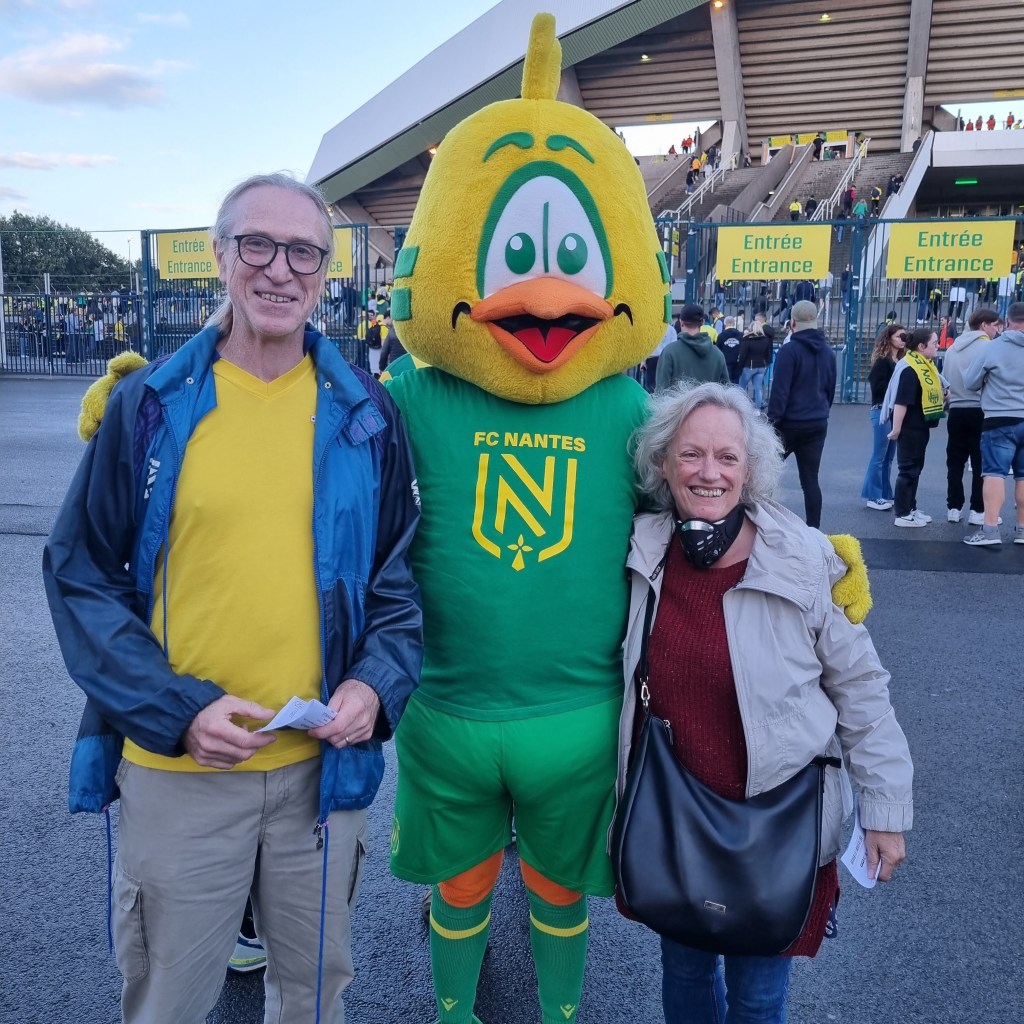
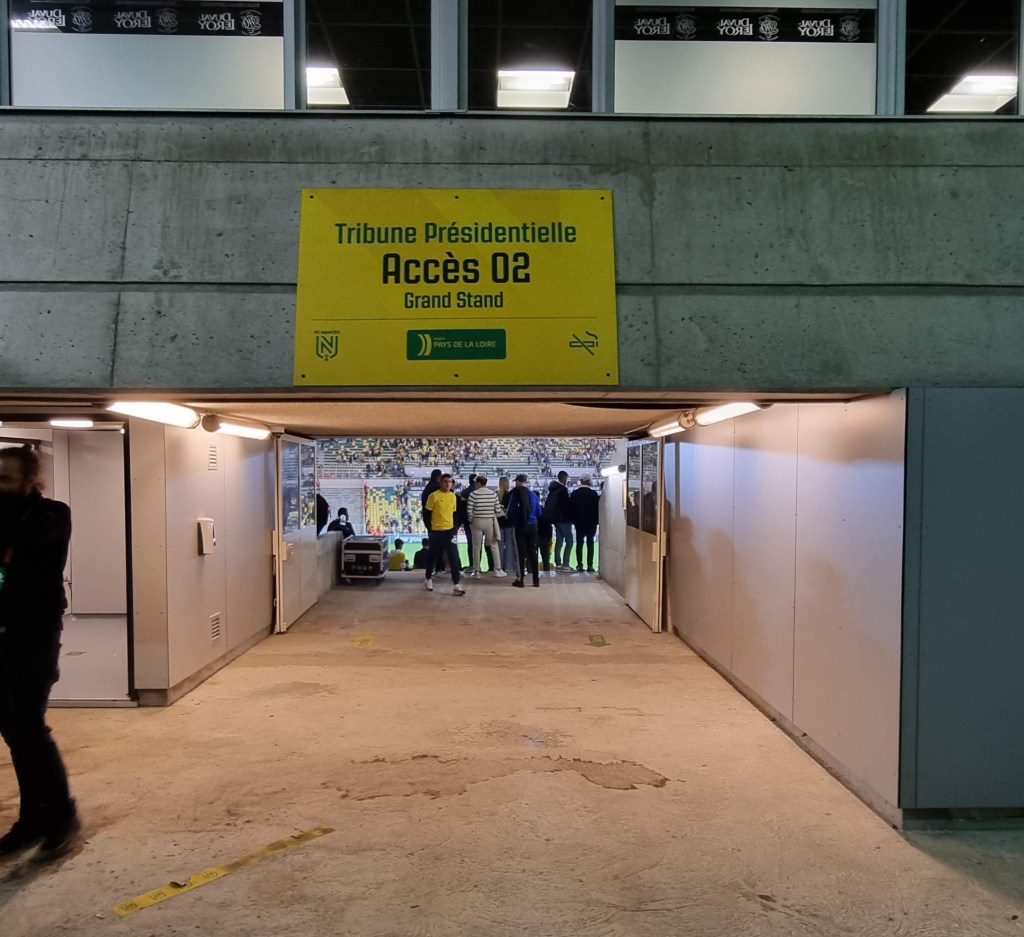
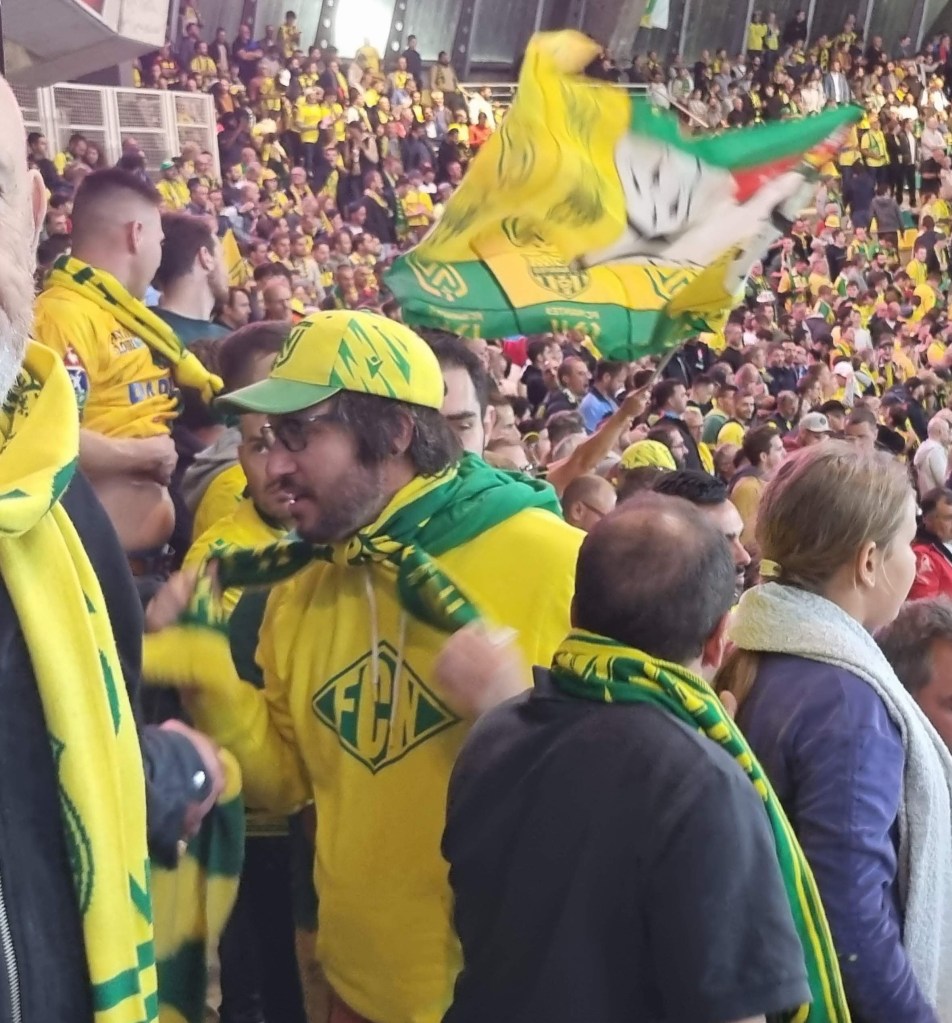
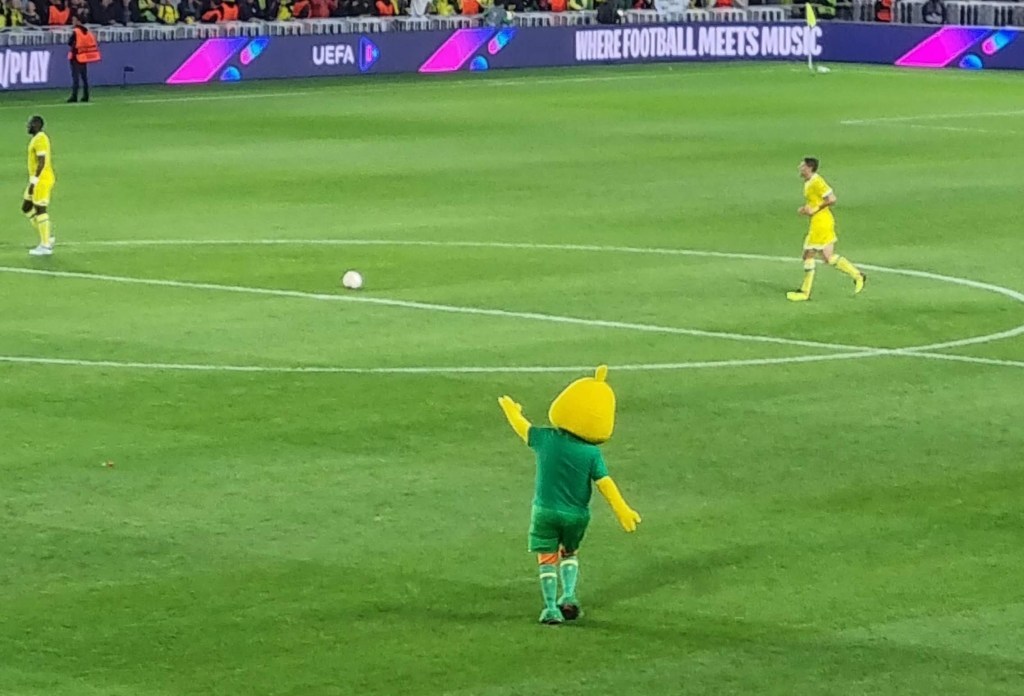
It’s been a warm but cloudy day with an ever-present threat of heavy showers, but thankfully we’ve avoided those and as had happened a week ago at Rennes, I had been in the club shop adding to my collection of petits fanions (pennants) and fridge magnets when the heavens had opened.  Now, at a bit after seven-thirty we queue to be patted down before entering the stadium.  I can’t help feeling that the security guy checking me out has decided I don’t look much of a threat and having tapped me about the arms a bit he looks bored and lets me through; it’s either that or my excited smile made him think I might enjoy a more thorough search a bit too much.  Either way, he wishes me ‘bon match’ and Paulene and I head for Access 02 of the Tribune Presidentielle, but not before we have met Riri the Nantes club mascot.  Nantes play in all yellow and are known as the Canaries, so as an Ipswich Town supporter it requires mental strength to be photographed with their mascot, but overcome with the spirit of liberte, egalite and fraternite I throw myself into the occasion and feel all the better for it.  But I am protected by my yellow 1970’s Town away shirt.

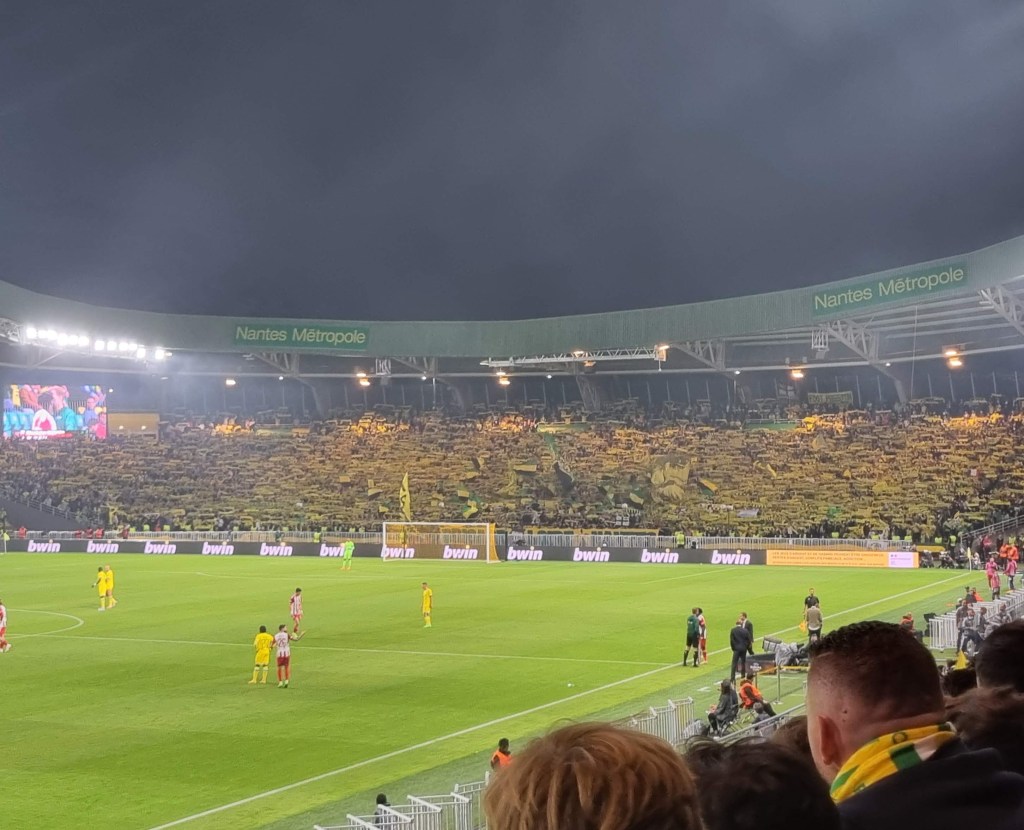
Like most of the bigger stadiums in France, Stade Beaujoire is a genuine piece of architecture, not just a feat of engineering, a box or a collection of individual stands clad in sheet metal.  Set into a gentle slope, its undulating roof arching above the two-tiered lateral stands and the two single tier ends, Beaujoire is an elegant essay in concrete and steel which seems bigger inside than out.  Our seats are at the side of the pitch but behind the goal line, nevertheless the view is excellent, aided by the stadium’s bowl-shaped floor plan.

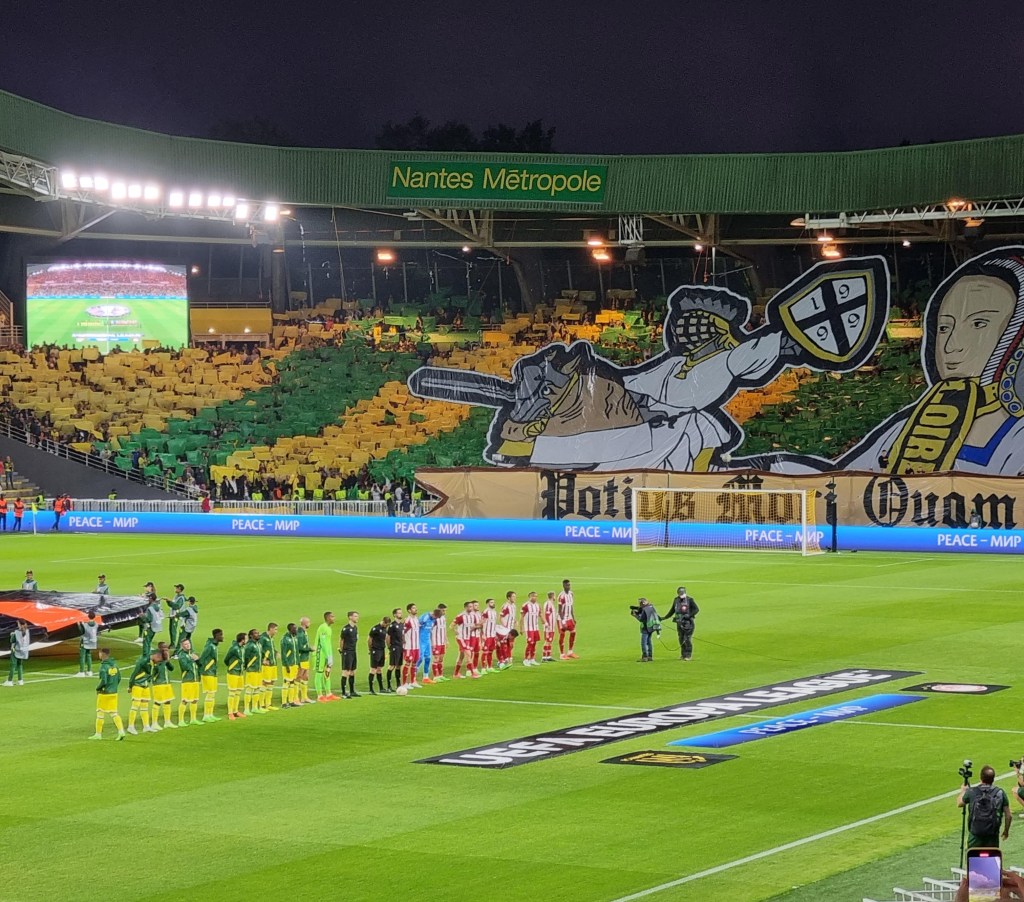
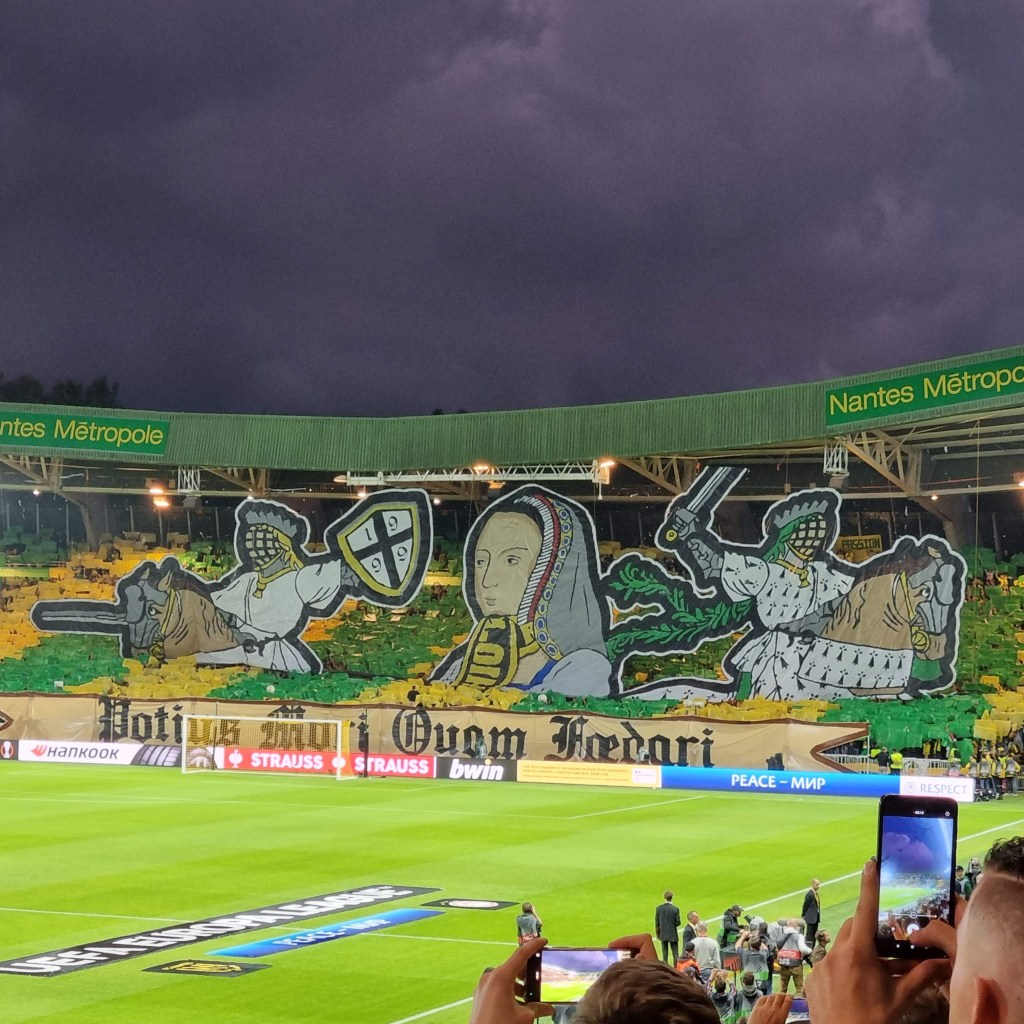
People get to big matches early in France and make use of the many stalls providing food and drink that surround the stadium.  Equally, the stadium is full before the nine o’clock Coupe d’envoi (kick-off) and with good reason because the prelude to the match includes a stirring anthem, which supporters sing whilst twirling their scarves a la Leeds United fans of the 1970’s; I had wondered, given that it is a warm September evening, why the club shop was doing such a roaring trade in scarves.  Most impressive however, and possibly the most impressive thing I have ever seen at a football match is the raising of a huge tifo at the Tribune Loire end of the ground depicting Anne the fifteenth century Duchess of Britanny (a local heroine for resisting Brittany’s annexation by France) wearing a Nantes scarf and flanked by a pair of jousting knights. Beneath the tifo in Gothic script and in Latin it reads “It is better to die than to be disgraced”, which seems to be going a bit far, even for a Europa League fixture.

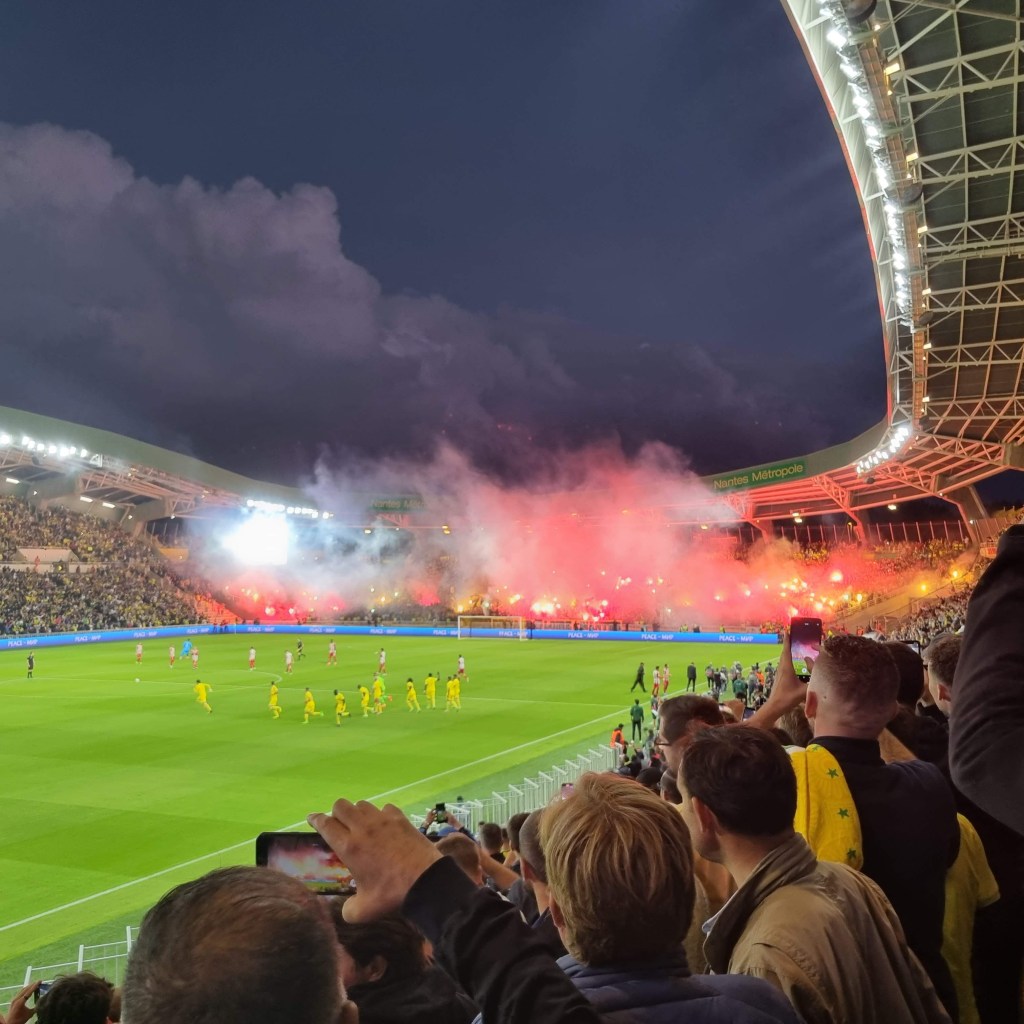
Less than an hour before kick-off the death of Queen Elizabeth II had been announced and most of the ground observes a minutes’ silence, although at the Tribune Loire end of the stadium there was never any likelihood of this happening given the levels of excitement, as witnessed by the ceaseless noise, flag waving and glow of flares.  I am sure many would say “Bloody French ‘ooligans”, but I don’t.

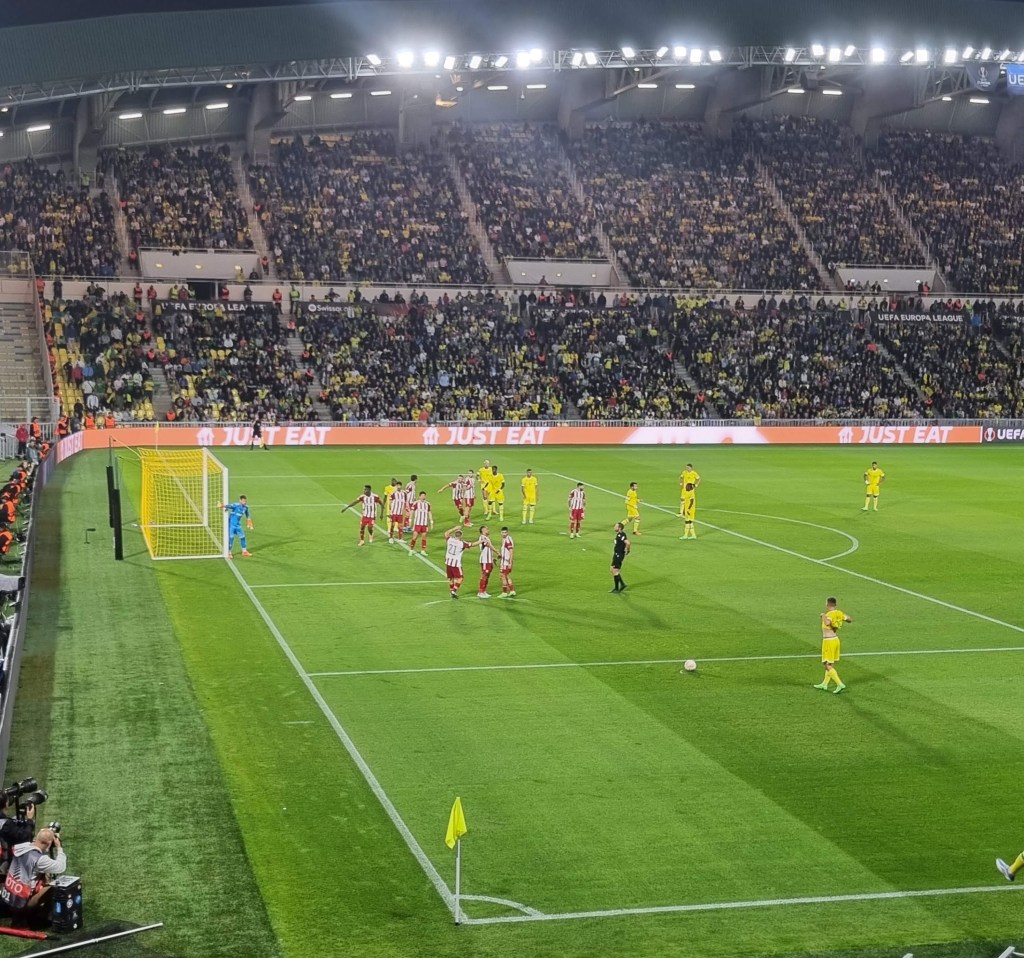
As the match begins it is Nantes who get first go with ball, aiming it at the goal through the drifting smoke at the Tribune Loire end of the stadium. Nantes are in all yellow whilst Olimpiakos wear red and white striped shirts with red shorts and socks. “Lo-lo, lo-lo-lo, lo-lo, Allez les Jaunes” (Come On  Yellows) sings the crowd and then the Tribune Loire calls out “Allez Nantaises” and the Tribune Erdes at the far end of the ground echoes the shout.  Nantes have started at a fast pace and with the first promising looking attack it seems that everyone in the ground but for the couple of hundred Olimpiakos fans, is up on their feet and bawling encouragement.  Everywhere is just noise, it is absolutely thrilling. “Allez, Allez, Allez” rings out to the tune of The Beatles’ Yellow Submarine.

On the field, Nantes are in truth struggling to get through the Greek defence.  In midfield Pedro Chirivalla is busy, but most attacks go through Ludovic Blas and Evann Guessand on the right, although the tactic of getting crosses into the lone forward Mustapha Mohamed isn’t coming close to creating a goal, only corners. Blas is set up twice, only to blast the ball hopelessly high and wide. Whilst the football isn’t always the best, the spectacle however is; but a little over half-way through the first half even the Tribune Loire has started to quieten down just a little. In front of us, a lone drummer with a massive bass drum tries to raise the crowd in the Tribune Erde and Tribune Presidentielle once more; he is wearing a Nantes kit over the top of what looks like silk pyjama bottoms; his face is smeared with green face paint and on his head he is wearing a lurid, long green wig.   Between rhythmic drum beats he claps his hands and sings “Allez Nantes”.  A middle-aged man to our right answers the call with a mad passion which belies his age, but mostly people just clap along almost out of politeness. 

The flame of really noisy support is rekindled however, just before the half-hour Nantes win a free-kick on the right. “Lo-lo, lo-lo-lo, lo-lo, Allez les Jaunes” is the theme once more and although the free-kick comes to nought the momentum is retained and four minutes later Blas’s through ball confounds the Greek defence and Mustapha Mohamed runs on to place the ball coolly and firmly into the far corner of the goal beyond the Olimpiakos goalkeeper Tomas Vaclik.  The roar from the crowd is immense and Nantes lead 1-0.

Only a second Nantes goal can feed the desire of the home crowd, but it is Olimpiakos who now get to have their first shot on goal as a neat passing move ends with an overlap on the right and a shot that goes both high and wide of the Nantes goal from only about 10 metres out.  The be-wigged drummer makes a second tour of the area at the front of the stand, but the first half soon ends, unusually with no additional time being played.

Over half-time Paulene and I stay in our seats whilst many in the crowd drift out to the buvettes for food and drink. We reflect on the first half and agree that this is possibly the most fantastic atmosphere we have ever experienced at a football match and that on tonight’s showing the Nantes supporters are probably even more passionate than those of Marseille or St Etienne.

The game resumes at a minute past ten as the moon rises above the Tribune Oceane opposite. “Na-Na-Na, Na-Na-Nantaises” sings the crowd to the tune of The Beatles’ Hey Jude. Olimpiakos appear either to have been given a stiff talking to at half-time or they have simply decided to attack rather than just defend. Five minutes in and the Greeks win their first corner of the match.  The ball arcs across to the far post and Nantes ‘keeper Alban Lafont moves to punch the ball away but completely misses it, instead the ball strikes defender Samuel Moutassamy and drops feebly and apologetically into the goal net.  It is such a poor goal no one seems to believe it, not even the Olimpiakos players who can barely bring themselves to celebrate, making do with a few mutual pats on the back. Over in the corner of the stadium between the Erdre and Oceane Tribunes the travelling supporters are doing more than enough cheering and dancing for everyone.

The Olimpiakos goal gives them a lift and the balance of play evens out in the second half, but Olimpiakos are also much more combative and to prove the point Panagiotis Retsos is the first player to be booked, for a foul on Nantes’ Ignatius Ganago.  From the resultant free-kick on the right, Ludovic Blas is set up for a third time, but he boots his shot hopelessly high and wide again.  With a third of the match gone Nantes win a corner from which Andrei Girotto flashes a header just wide of the goal. Minutes later Olimpiakos win a corner, but Alban Lafont succeeds this time in punching the ball away.

With twenty minutes left, Nantes make a couple of substitutions and quickly win a corner after a cross from Moses Simon, who has replaced Ganago, is met with a header from the other substitute Moussa Sissoko which Vaclik tips over the cross bar. “Nantes Allez, Nantes Allez, Nantes Allez” sing the crowd to the Triumphal March form Verdi’s Aida as they hold their scarves aloft all around the ground, a spectacle sadly no longer seen in England.  The sense of the crowd willing the team to score is palpable, but Nantes are not significantly threatening the Olimpiakos goal.  When Nicolas Pallois strides forward in the eightieth minute to launch a shot from at least 30 metres, which travels a respectably small distance over the bar, it is as if he had simply got fed up with his team-mates’ patient passing and had decided to take matters into his own hands.

A minute after Pallois’ effort, Nantes at last break speedily down their right and the ball is crossed low before being laid back to the incoming Guessand who strikes a spectacular rising shot into the roof of the goal net.  It looks the perfect goal, the sort worthy of winning any match. The Nantes players celebrate wildly as does the whole stadium, with the exception of one tiny quadrant in the corner where the Greek fans sit.  The scoreboard registers the second Nantes goal, and the players walk back to kick-off again, but the Olimpiakos players are whinging to the referee who has a hand to his ear. We wait.  The referee then draws a square in the air and points to patch of grass level with the Olimpiakos penalty box and the scoreboard confirms that VAR says the goal is annulled for an earlier hors-jeu (offside).

The feeling of disappointment subsides surprisingly quickly and soon we are distracted by some pushing and shoving on the touchline. The ball has gone out of play and runs to the Olimpiakos coach who seems to hold it out for Nicolas Pallois to take, but then turns away; Pallois gives him a little shove for his trouble and then anyone nearby joins in with the melee and those further away catch a tram to come and join in.  The referee possibly cautions Pallois and the Olimpiakos coach, but it’s hard to say for sure.  Sadly, it’s the last real action of the half and all hope is to be squashed into four minutes of time added on or the more poetic sounding time additionelle

Additional time begins, two minutes in and Blas and Oleg Reabciuk are both booked after the former fouls the latter and the latter gets upset.   A minute remains of added time; Nantes again attack down the right, Ludovic Blas crosses the ball and the sizeable figure of Evann Guessand  hurls himself at the ball. Spectacularly, Guessand scores with what is arguably the best type of goal, a diving header.  The rest is near mayhem, with Stade de La Beaujoire erupting into scenes of unbridled joy and pride in the team and being Nantoises.  All around me people are just deliriously happy, whilst some have a look on their faces of vindication, as if to say it’s taken nearly twenty years, but Nantes are back like they knew they would be.

With the final whistle no one wants to leave. I don’t think I have ever been to a game where so few people, if any, have left before the end. The Nantes players gather in front of the Tribune Loire to salute and commune with the Ultras groups who have ceaselessly chanted, sung, shouted and waved their banners and flags throughout the match.  Riri the canary mascot runs across the pitch arms outstretched as if trying to take off and joins in with the players’ celebrations.  We, along with everyone else, wait for the players to break away from their love-in with the ultras and do a lap of honour to the rest of the stadium. As the players head back towards the tunnel we leave, joining the flood tide of happy, smiling people.  This has been a truly fantastic night.

Ipswich Town 0 Rotherham United 2

After lock down, 20 months of working at home, following on directly from six months off work due to illness, I have adapted to a centrally heated life spent mostly indoors.  The thought therefore of venturing out on a cold late November evening to sit and watch a football match that your team is probably odds-on to lose isn’t that appealing.  But I have a season ticket, so I’ve already paid to go, and I can’t bear to miss out, added to which I consider myself to be the heir to Edward Ebenezer Jeremiah Brown; I’m a football supporter of Ipswich Town.  My drive into town is nevertheless made without enthusiasm, but by the time I’ve walked from my car to The Arboretum (now the Arbor House) pub, the still night air, the glow of the streetlights and the promise of a pint of Mauldon’s Suffolk Pride (£3.80) have altered my mood, and after a light dinner of Scotch egg (£4.50) with chips (£4.00) in the company of Mick, who incidentally has falafel Scotch egg (£4.00) with halloumi chips (£4 .00), I am once again ready to do or die for the Town.

The walk through the streets of Ipswich to Portman Road is always one of the best parts of any match day, it’s when the glorious sense of anticipation is all there is, and nothing has yet gone wrong to ruin the day.  Today the sensation is heightened because it’s an evening game and the floodlights shine a bright halo into the night sky and the crowd seems drawn to it like moths to flame.  In over an hour Mick and I have not talked about the match but crossing Civic Drive I ask if he thinks we’ll win. Mick is as ever hopeful, but not optimistic, the same as me.  Rotherham United are the form team in the division; a win will put them top of the league and Town have failed to score in three of three of our last four games, and just to trowel on the portents of doom a little more Town have beaten Rotherham United just once in our last seven attempts.

Resigned to our fate, Mick and I part in Sir Alf Ramsey Way; Mick to the decent seats in what used to be the West Stand, whilst I head via turnstile number 60 to join the groundlings in the bottom tier of what was Churchman’s, purchasing a programme (£3.50) along the way.  I shuffle to my seat past Pat from Clacton and Fiona before the teams are even on the pitch, I’m early.  Ever-present Phil who never misses a game is here and so are Ray, his grandson Harrison and Harrison’s dad.  Also here, sat behind Ray and his progeny, are four or five blokes of various ages all sat in a row; three of them wear dark-framed glasses and sport matching haircuts which are short at the back and sides with a tangled mop above; they look like the same bloke seen four or five years apart, but appearing all at once, as if the BBC tv’s documentary Child of Our Time had been presented by Dr Who not Robert Winston.

With the teams on the pitch and knees taken and applauded the game begins with Rotherham all in black, like the baddies always are, aiming the ball towards the goal at the Sir Bobby Robson Stand end of the ground.   The cheerful man who sits to my left remarks on how cold it is, “Feels like someone’s left the fridge door open” he says.  I wonder how big his fridge must be.  From the beginning the crowd is quiet, as it often is at Portman Road; the home support huffily adopting the attitude of “well, we’re not going to shout until you give us something to shout about”.  Rotherham are solid and their supporters shout and sing as if to celebrate that, as if it’s the essence of life itself, maybe it is in Rotherham.    Rotherham have a shot blocked, and Christian Walton makes a fine flying save from Rotherham’s Jamie Lindsay, but the game is even, in a cagey, no one is taking any chances kind of a way.  Scott Fraser shoots from outside the penalty area but misses the goal.

Twenty-three minutes pass and then the Rotherham number eight, Ben Wiles, decides to run at the centre of the Ipswich defence.  I don’t know if it’s the effect of the cold night air, but what we had thought was beginning to gel, shatters and Wiles runs on unmolested to the edge of the penalty area before launching an impressive shot into the top right corner of the Town goal, with the predictable outcome that Rotherham take the lead.  I’d just been thinking to myself that we’d not conceded an early goal so perhaps we might now have the confidence to impose a little of our will onto the game. C’est la vie, as they don’t often have cause to say at Paris St Germain.

The blokes a few rows in front of me are lairy, shouting and showing off to one another in the manner of people who have had too much to drink, or are what they would probably call “wankers”.  Rotherham have more shots blocked, Ipswich don’t but Bersant Celina gets caught offside, which sort of shows willing.  Rotherham have shots on goal, which miss the target; with the exception of a blocked attempt by Scott Fraser, Ipswich don’t have any shots. “Come on Ipswich, Come on Ipswich” chant a few hundred Town fans for a few seconds before trailing off in a manner that sounds like they’re embarrassed at the sound of their own voices, or their mum has given them a stern look.   Rotherham United’s Jamie Lindsay and Michael Ihiekwe make their mark on the game by being booked by referee Mr Gavin Ward, not that anyone else is going to book them, they wouldn’t attract many to the Ipswich Regent.  In time added on Town win a corner courtesy of the extravagantly monikered Ramani Edmonds-Green. “Come On You Blues, Come On You Blues” I chant, sounding in my head like a lonely, ghostly echo of Churchman’s forty years ago.

Half-time arrives and I make the short journey to the very front of the stand to talk to Ray.  “I think they should bring Celina on” says Ray ironically; he’s not a fan of the Dijonnaise loanee.  Nor is Ray a fan of the blokes behind him, the lairy ones with the identical haircuts and glasses; they’re getting on his nerves a bit.  Our conversation lurches from the disappointment and annoyance of tonight to our extreme dissatisfaction with the current Prime Minister and the sitting Member of Parliament for Ipswich, Tom Hunt, who we concur is a both a lackey and a twit.  Unhappy in a political and footballing context, but happy to have spoken to Ray, I return to my seat for the second half.  Before play resumes, I have time for a brief look at my programme, the cover of which features Christian Walton glaring out suspiciously at us; page 66 refers to next week’s FA Cup tie with Barrow FC, who it describes, amusingly to my mind, as “the Cumbrian outfit”.  If you enter “Cumbrian outfit” in the search engine on your phone or personal computer it will tell you where best to go for fancy dress costumes in Workington.

Both teams take it in turns to foul one another when the game re-starts, and Scott Fraser sends a free-kick over the Rotherham cross bar. Almost an hour has passed since the match began and  Rotherham’s ‘tricky’ Frederik Ladapo combines with their most prosaically-named player, Michael Smith, to outwit the entire Town defence and run the ball across the face of the Town goal and beyond the far post where Shane (I imagine his parents were fans of Westerns or Alan Ladd) Ferguson clogs the ball into the roof of the net to remove all doubt that Rotherham United might not ascend to the top of the third division  tonight.

The remainder of the match dissolves into a mess of forlorn hope and disappointment for Ipswich.  The lairy blokes in glasses in front of me who had annoyed Ray in the first half show their true colours and become abusive towards the Town players.  “You’re all shit” shouts one of them, confirming his unsuitability as a summariser on Match of the Day.  But it’s an outburst that amuses the blokes behind me. “Ha ha” one of them chuckles, “Look at old Harry Potter down there”. 

Desperately, Town replace Bailey Clements and Lee Evans with Matthew Penney and Kyle Edwards and Joe Pigott makes a rare appearance in place of Conor Chaplin, but nothing changes. Michael Smith has a chance to make the score 3-0, but heads over the crossbar.  The Portman Road crowd occasionally remember that they should try to encourage their team but mostly they don’t bother, apparently content to watch the game as they would just another episode of a box set on Netflix.

Rotherham United are just too good for Town, their solidity and organisation more than enough to suppress any flair we think we might possess. The last ten minutes are run down by Rotherham as they make three substitutions of their own; my curiosity and attention only being pricked and grabbed by the unusual surname of Daniel Barlaser, who is booked by Mr Ward the referee, and the name of substitute Mickel Miller, whose surname matches the nickname of Rotherham United, The Millers, and whose first name suggests his parents or the registrar couldn’t spell Michael; I once had a girlfriend whose middle name was Jannette because her father couldn’t spell Jeanette.

In common with everyone else in the ground I am prepared for the boos that accompany the final whistle, although happily tonight they don’t convey the vitriol that some results provoked in previous seasons.  Sadly, after two consecutive defeats and a run of league games in which the Town haven’t scored, the optimism and bullishness of a few weeks ago has all too quickly evaporated for some people.  Whatever, it’s only a game, and so far on balance I’m enjoying this season; the frustration, the disappointment, the strangled hope are, after everything, what football is all about, most of the time.

Swindon Town 1 Ipswich Town 2

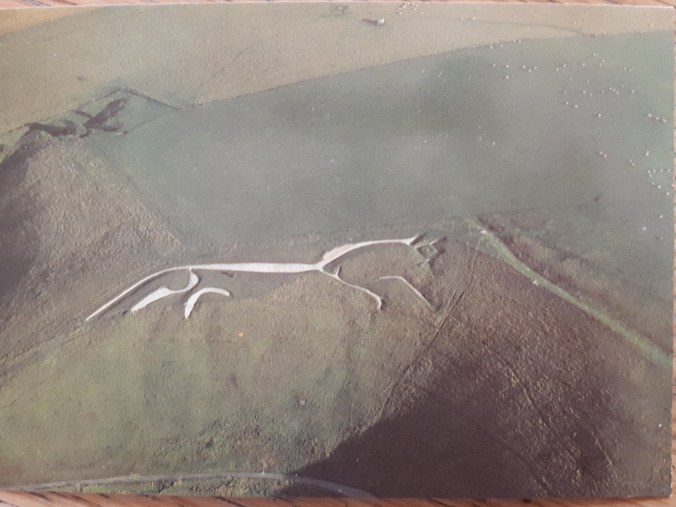
 Swindon is by far the largest town in Wiltshire and is also home to the only Football League team in the county.  I like Swindon.  Despite being a long way from the coast, there is something a bit like Ipswich about it, particularly with its relationship to the county in which it is situated. Salisbury and Bury St Edmunds have their cathedrals, but whilst historically the locals there were poncing about singing psalms and reciting canticles Ipswich and Swindon folk were getting their hands dirty making stuff, or at least they were until the forces of international capitalism did for them.  Like Ipswich, Swindon is one of those rare, unpretentiously provincial towns that’s a decent size, is a respectable distance from London but isn’t ‘Up North’;  it’s like Northampton, Shrewsbury, Newport and, if you don’t count Staffordshire as ‘Up North’, Burton On Trent.    Added to that it’s got a Magic Roundabout, is only 20 kilometres or so from groovy places like Avebury stone circle (bigger and therefore better than Stone Henge) , Silbury Hill  and the Uffington white horse hill figure, and is home of the hard to pigeon-hole band XTC, although sadly they split up about fifteen years ago.  More recently, Swindon Town is the team supported by Kerry and Kurtan Mucklowe in the wonderful BBC comedy series “This Country”.  Swindon also still has its own local brewery, Arkell’s, which has been fulfilling the town’s beer needs since 1843.

I first saw Ipswich Town play at the County Ground, Swindon in December 1987.  Fresh from having failed to return to the First Division at the first attempt the previous season, Town played newly promoted Swindon Town and lost 4-2 after initially coming back to equalise from 2-0 down at half-time.  Mark Brennan and David Lowe scored for Town and Ian Cranson also scored, but for Swindon, with a spectacular header.   I didn’t remember any of that, I had to look it up, but having had my memory jogged I do recall that the game also saw the debut for Town of the least successful of our Dutch imports, the less than  legendary Ulrich Wilson, on loan from FC Twente.  Since then Swindon has mostly been a lovely day out, with four wins in our last four visits, although we’ve not been round theirs now since the turn of the century, which is another reason why I would have been looking forward to today’s fixture.

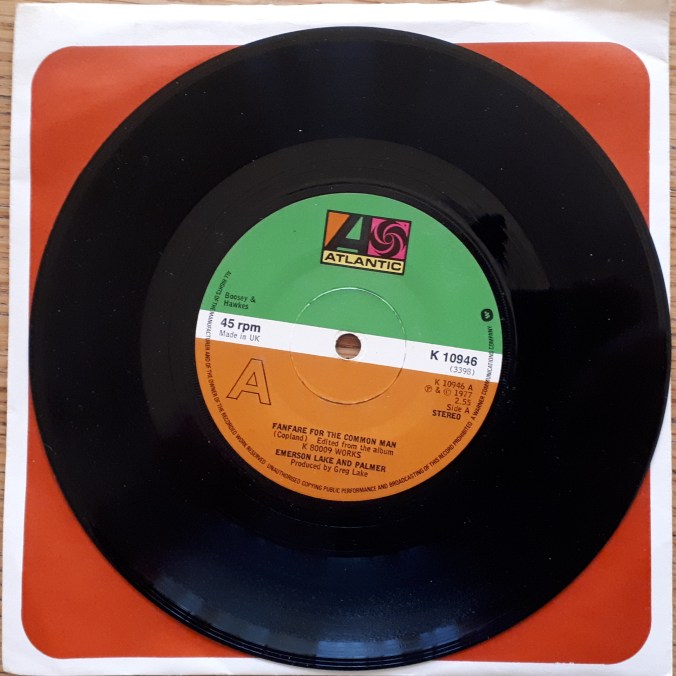
Spared a 3 hour, 275 kilometre trip along the motorways of southern England I nevertheless still rock-up late at the on-switch of my retro-style Bush radio, which is already primed in a state of preparedness being perpetually tuned-in to BBC Radio Suffolk.   It’s as if I’ve only just pushed through the turnstile after hurriedly finishing my last pre-match pint of Arkell’s 3B, as at almost 3 o’clock I am greeted with the news that alongside Brenner Woolley today is former Town player Ian Atkins. Despite his having played over ninety games for Town, some as captain, I always think of Atkins as one of the most inelegant players I’ve ever seen play for Town; he’d get in today’s team mind.  As Brenner Woolley sets the scene and tells us that Swindon are wearing red shirts, white shorts and red socks I can hear Emerson, Lake and Palmer’s  rip-off of Aaron Copland’s ‘Fanfare for the Common Man’ blaring out from the County Ground’s public address system.  With the common man still absent from its stands and concourses I wonder to myself to whom Swindon Town are playing this little burst of populist Prog-Rock.  I’m as partial to a bit of Prog-Rock as the next grammar school boy born in the 1950’s or early 60’s, but as grand entry music for the players at a football match I would place ‘Fanfare for the Common Man’ somewhere up close to “The boys are back in Town” in the league table of all-time naffness.  Give me “Entry of the Gladiators” or the Toreador song from Bizet’s Carmen every time.

How embarrassing

“It’s Teddy Bishop, going to be kicking off” announces Brenner and the game begins.  Somewhat inevitably Brenner’s commentary for now is obsessed with Town’s having failed to score a goal in over ten hours.  “Goals change games” says Ian revealing his  Birmingham accent. Well duh.  The game begins well for Town as you would hope against a team who have already been relegated after only forty-four games and have conceded eighty-four goals.  “Dozzell’s had a very good start at the moment” says Ian cautiously.  “Town on top at the moment” says Brenner with the same note of caution borne from bitter experience as Town win the game’s first corner.  “Swindon….they’re letting Northampton play”  adds Ian, already confused about which game he’s watching.

Inevitably, there is something of an end of season feel to the game, what with it being the end of the season and Brenner is soon indulging in playful commentator-speak. “ …bit of a school-boy error, Dobra” says the BBC man triumphantly.  Ian meanwhile soon reveals the contents of his own locker of sayings to fall-back on when your vocabulary has otherwise been exhausted.  Ian’s stock phrase is “to be fair”, which, to be fair, seems innocuous enough but it’s also largely unnecessary. “…leaving the space to attack, to be fair” is Ian’s first use of the phrase and he follows this up with “… this is where they had a little bit of a problem against Northampton, to be fair”.

Meanwhile, Brenner entertains us as he always does. “Payne, who’s sprung to life in the last few moments” says Brenner summoning, in my mind at least, a vision of some sort of resurrection,  before he then says “It’s Norwood with his pink boots who’s been penalised” leading me to wonder if the referee has awarded a free-kick against Norwood because of the colour of his boots; I wouldn’t be wholly against the  idea.  The game moves on and Brenner is soon tempting fate as he loves to do, telling us that “Swindon have never doubled Ipswich in a league season”.  It’s the sixteenth minute and fate is nearly tempted; “Pitman inside the area” says Brenner with rising excitement “…puts it past the post”.  Brenner confides that he was convinced Brett Pitman was going to score, and having heard his agitated commentary of the incident, it’s hard not to believe him.

Ipswich win a second corner; it comes to nothing.  “Dobra up on all fours, now ready to continue” says Brenner making it sound as if Town’s number 36 does actually scamper about the pitch as if he were a quadruped.  Nearly a quarter of the game has passed; “Town under pressure” is the latest assessment from Brenner.  Ian’s view is that Town are giving the ball away because they’re not strong enough to hold off challenges from Swindon players.

With the game into its second quarter Brenner starts feeling oddly compelled to say things:  “Jaiyesimi actually did very little against Ipswich a few weeks ago, it has to be said.” “Swindon the better side at the moment in this game, it has to be said”.  “Still Camp not had a save to make, it has to be said”.  It’s as if we’ve now reached a point in the game where Brenner can no longer carry on unless he gets these things off  his chest. It’s either that or he now feels that his audience has been listening long enough to be able to stand these harsh truths without bursting into tears.  I feel myself welling -up a little but pull through.

Five minutes later and things look up.  “Saved by Camp; are Ipswich Town ever going to score another goal?” asks Brenner after an “Almighty chance for Town” sees Camp divert a shot from Teddy Bishop, who is through with just the goalkeeper between him and glory.   As Brenner has told us in previous games “Paul Cook, screaming his heart out”, which as any cardiologist will tell you is not advisable. Shaken perhaps by hearing a grown man scream, Brenner seems to panic and when Swindon’s Christopher Missilou under hits a ball he tells us that “The Frenchman didn’t have enough air on that pass”.  It’s an odd description of what you’d normally expect a commentator of Brenner ‘s experience to call a ‘hospital pass’, added to which Missilou is Congolese, not French.

Armando Dobra shoots wide. “Dobra’s head is in his hands” says Brenner with such conviction that I half expect him to confirm that yes, Dobra’s head has actually come off and is in his hands.  A James Norwood shot is saved by Lee camp and Mark McGuinness heads the ensuing corner kick over the cross-bar.  It’s evident that Town are continuing to attack and Brenner is in positive mood. “Kane Vincent-Young over-hits that cross, but quite a lot” says Brenner trying to play down the full-back’s error. The same player then has a header saved by Camp “ I thought he was going to score there, Young” says Brenner, deceiving himself once again.  Ian assesses Vincent Young’s forays forward, “…like a wing-back, to be fair”.

With Town sounding like they are creating chances, the mystery remains why they have not scored and Ian enlightens us by telling us that what Town are missing is “someone of real presence in the box who can upset defenders”.  It’s an analysis that suggests to me that over the summer we should sign either a sort of Joan Rivers character capable of reducing defenders to tears or just put a ‘big bloke up front’.

“It’s now eleven hours without a goal” announces Brenner polishing the glass on his stop watch, but his words soon lose their meaning as “ Bishop goes down inside the box, the referee says penalty” and I somehow imagine the referee Mr Johnson turning in the direction of Brenner up in the stand and mouthing the word “penalty” to him .   “Please James, do not miss this opportunity” implores Brenner.  Norwood scores, “…the goal-drought is over” confirms Brenner.  “He deserves his goal at the moment” adds Ian introducing the slightly tantalising possibility that he might not deserve his goal later on and suggesting possibly that Ian believes undeserving players should have their goals taken away from them.  There then follows some blokey banter about Paul Cook having said he would do a lap of honour if Town scored. “Typical scally” says Ian “saying they’re going to do something and not doing it”.  I will admit to being a little surprised by Ian’s comments and can only think he is unaware of the risk of becoming the subject of a Liverpudlian version of a fatwa.

The first half ends with a chance for Gwion Edwards to double Town’s goal tally. “ Edwards shoots!” says Brenner excitedly “ …and the flag’s up” he continues with well-practised resignation.  Brenner asks Ian what he made of the first half. “A bit like a practice game” says Ian honestly.  “They’ve had chances that the players have missed” he adds un-controversially.  Ian’s advice for the second half, which sounds a bit like an extract from an instruction manual for something purchased in an Ann Summers shop is  “Rather than just sit on it, go and enjoy it”

Half-time is the familiar blur of kettle, tea and Nature Valley peanut and chocolate protein bar.  For the second-half I am joined by my wife Paulene who, as I listen to the wireless through my earpiece will be watching the Ligue 1 game between Paris St Germain and Racing Club de Lens on the telly.  As I re-join the broadcast from BBC Radio Suffolk Brenner ‘advertises’ his forthcoming commentaries and explains that he will once again be with Ian for Tuesday’s match at Shrewsbury. “ Is that basically because Mills’ car doesn’t go to the other side of Colchester?” asks Ian, evidently still in banter mode and also daring to take Mick Mills’ name in vain.

As far as I can make out from the commentary the second half is much like the first. “Comes to Downes” calls out Brenner with rising excitement “…who skies it”.  Ian begins to add “ at this level” to the end of most of his explanations of what Town need to be doing. Nearly an hour has passed since kick-off.  “…gives it back to Norwood, Norwood prods it in, Ipswich now lead Swindon 2-0” exclaims Brenner. “He’s tucked that ball away well” adds Ian, whose analysis has otherwise increasingly come to depend on the phrase “bodies in the box”.

Troy Parrott replaces Teddy Bishop. “He looks like a nice little footballer” says Ian of Teddy, when asked for his opinion of the departing player’s contribution.  But it quickly transpires that Ian doesn’t really think there is a place for nice little footballers “at this level.” Brenner meanwhile advises us that it’s a case of “Town getting the job done, for what it’s worth”.  More substitutions follow. “Harrop and Bennetts both coming on to play a bit more football” is Brenner’s reassuring statement before they replace Edwards and Dobra.  As a rule it’s best when the substitutes come on to play football rather than just paint over the white lines or do a  bit of weeding.  Ian’s assessment of Edwards and Dobra is that they have “Been lively, without ever having any end product”; I believe it’s what seasoned commentators and sports hacks call ‘flattering to deceive’.

Less than twenty minutes of the basic ninety minutes remain. “Goodness me” says Brenner channelling Peter Sellers, almost. “Terrible goal-keeping from David Cornell” exclaims Brenner and Brett Pitman scores.  I had sort of hoped Pitman would score, I liked him as a player at Town; my impression is that managers don’t think he runs about enough; perhaps he doesn’t , but he still scores goals, which is what forwards are supposed to do.  “A Sunday league howler – no disrespect to the Sunday league by the way” says Ian of Cornell’s error and for some reason affording a respect to the Sunday league that he previously hadn’t afforded Scousers or Mick Mills.

A couple more minutes pass. “Surely a penalty, it’s a penalty” cries Brenner unable to contain his excitement as Troy Parrott is fouled.    James Norwood steps up to claim his hat-trick.  “Forward he comes, he’s missed it, unbelievable” says Brenner of a situation which in reality is all too believable.   The only good thing to come of the incident is Ian’s lugubrious West Midland’s pronunciation of Parrott.

“Kenlock’s had a decent game” says Ian generously. “Town holding on for a win” says Brenner and meanwhile Neymar puts Paris St Germain one-nil up at the Parc des Princes.  News arrives on BBC Radio Suffolk of scores in other matches; Peterborough United have pulled back to trail two-three having been three-nil down. “Well, some excitement there in that game” says Brenner with a hint of jealousy.   Perhaps losing his enthusiasm Brenner mis-pronounces the surname of Swindon’s Tom Broadbent, so it sounds like Broadband. Flynn Downes is booked for a foul. “That’s like a booking for the team” explains Ian, but strangely he doesn’t say “to be fair”.

The final minutes of the game drift away. “Typical end of season game” says Ian. There is still occasional excitement. “Fabulous defending from Woolfenden” says Brenner one minute, and then “lovely little ball to Parrott in the area!” says Brenner expectantly the next.  “ …ball up in the air, Parrott goes after it” continues Brenner and I imagine a blur of brightly coloured feathers taking flight.  The first half ends in Paris.  “You’d like to think they can see this one out, you’d like to think” says Brenner half-repeating himself for no apparent reason.  Time added on runs out. “There is the full-time whistle, at the ninth time of asking Paul Cook get his first away win” concludes Brenner.

Mentally exhausted, I switch off the radio and prepare to turn my attention to the game in Paris.  Later, I will journey down to the south of France courtesy of FFF tv to watch FC Sete, who have scored just twenty-eight goals in thirty-one games (a goals per game record even worse than  Ipswich’s)  beat  Orleans 1-0 and secure their place in the French third division.  Finally, this evening, to complete my  virtual tour of some of my favourite places I will tune in to watch Lille versus Nice in French Ligue 1, it’s something I wouldn’t have been able to do driving back along the M4.