Had today’s fixture in the Thurlow Nunn Eastern Counties League Division One South been played at pretty much any time between April 1860 and January 1st 1962 I could have travelled to it by train. However, thanks to the evil Dr Beeching I am making the twenty minute journey to Rosemary Lane Halstead by Citroen C3. It’s not an unpleasant twenty minute drive on a bright, September afternoon along the winding and undulating rural roads of north Essex, through Earl’s Colne with its three pubs and finally down the hill of Halstead’s High Street and over the River Colne, but I can’t help thinking I would have arrived happier if I hadn’t been personally responsible for the burning of fossil fuel and release of carbon monoxide and other noxious gases. If I was Donald Trump I don’t suppose I would give a shit, but he is an ignoramus. There is a bus service via Colchester (Hedingham Omnibus route 88) but I’m 58, so time isn’t on my side.


In Rosemary Lane I reverse between two marks of Ford Fiesta and scrunch across the shingle, Halstead Town’s own beach, to the turnstile where I pay £6 for entry and £1 for a programme. An impatient youth wants to push past me and I tell him to hang on ten seconds until I have my change. Although the car park is full there doesn’t seem to be
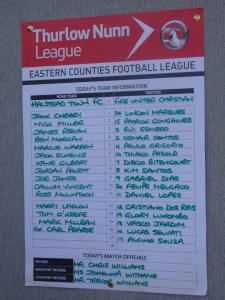
any one much here yet, it’s only twenty-five past two. A man stands at the end of the main stand and copies down names from today’s team sheet, the tea and food bar isn’t open so I take a look inside the club house. A cluster of drinkers stand at the bar and some sit at tables. I consider buying a drink, but there’s no real ale on offer and I can still taste the cup of tea I had before leaving home, so it’s not like I’m thirsty and I never have any real desire for a glass of artificially carbonated beer. I return outside and ‘do’ a circuit of the pitch to the soundtrack of some awful, sub-disco, bland pop playing over the public address system.
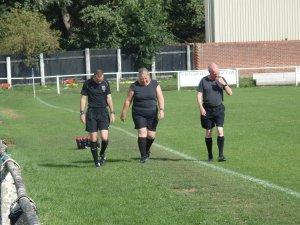
The referee and assistants are warming up; I noticed from the team sheet that the referee and one of his assistants share the surname Williams, and whilst they do stretches against the rail around the pitch I impudently ask if they are related. They are not, but the referee confirms that Messers Arnot, who officiated at the game I saw last week in Harwich are father and son, although they looked like grandfather and grandson to me. Unusually, but less so than in the not too distant past, the other assistant to the referee is a woman, Ms Withams. They form a contrasting threesome, the referee typically neat and fastidious looking, his male assistant older and almost frail in appearance and his female assistant a somewhat full-figured woman.
Halstead Town football ground, known for now as the Milbank Stadium, has only one stand, it is plain, a little dark and very utilitarian, but to a football fan it is a thing of beauty, arguably the finest stand in the Eastern Counties League after Great Yarmouth’s, which is a Listed Building. May be Heritage England should be listing buildings like this one; its corrugated pitched roof and steel stanchions are redolent of the 1950’s and it was indeed erected in 1950; its plain, post-war utility makes it a sort of football prefab. Most Football League clubs have already demolished their stands like this; it may be small but it’s perfectly formed.
Time ticks away, more spectators arrive, I choose a seat in the main stand and in due

course the teams appear in the tunnel at the centre of the stand, beneath a metal cage. The programme tells me that Halstead are top of the league having played seven games, but suffered their first defeat of the season in midweek at home to nearby Coggeshall United, not to be confused with Coggeshall Town. Fire United languish in sixteenth place in the nineteen team league having played only four games, they lost the first three but won 4-0 in midweek.
Fire United Christian Football Club (fortunately they don’t use an acronym) are one of a small number of oddities amongst teams in the non-league football pyramid in that they don’t represent a town or geographical location, but rather people who share a common faith and who largely have a Brazilian background. Founded by a Christian ministry in only 2012, the club has progressed quickly into senior football and is made up of mainly Brazilian ex-pats living and working in London. Whilst they are a new club, interestingly Fire United’s Christian foundation echoes the earliest days of organised football in Britain in which many clubs including the likes of Fulham, Everton, Liverpool, Tottenham and Swindon Town all had their nineteenth century roots in local churches. For Fire United’s sake I hope they don’t end up like them.
The teams line up and the announcer receives a round of applause for his thoroughly plausible pronunciations of the Brazilian/Portuguese names of the Fire United team; but perhaps he was ‘speaking in tongues’ (see Acts of the Apostles 19:6). The Halstead Town chairman resplendent in shorts and T-shirt, no show-off club ties and blazers here, makes a presentation to a player (Nick Miller) making his 100th appearance for the club and then referee Mr Chris Williams begins the game. Fire United, wearing a kit of two
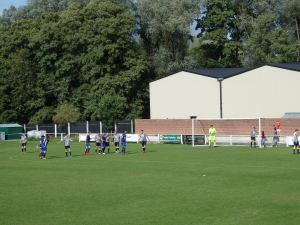
shades of blue kick-off, playing towards the River Colne and small industrial units between the ground and the river. Halstead Town wear black shorts and socks with black and white striped shirts from which they derive their nickname “The Humbugs”, which as nicknames go is one of the very best. More teams should make reference to sweets and confectionary in their nicknames instead of birds and animals. Halstead are playing in the rough direction of the redundant Holy Trinity Church, a Grade II* Listed Building of the 1840’s designed by George Gilbert Scott (architect of the Midland Hotel at St Pancras Station) in the Gothic Revival style and well worth a look if you like such things.
Early on, ⁹Halstead look eager and have the ball at their feet more than Fire United do. It is a Fire United player who commits the first foul and the one after that and their number seven, Diego Bitencourt is the first player to be spoken to by Mr Williams. Bitencourt is a balding, wiry man, greying at the temples and he looks like he could be any age between thirty and fifty; he can play a bit though. Despite Halstead’s early dominance, it is Fire United who earn the first corner and from then on they don’t look back and win a procession of corner kicks as they begin to dominate the match themselves. The Fire United number four Paulo Grigorio fails to make the best of a few headers from corners but it is his team’s play between the penalty areas that is most impressive. Unfortunately, this team of Brazilians are conforming to the stereotype that I thought had lazily earned them the nickname of the Samba Boys. But they do genuinely play a languid, smooth style of passing game. On the left, number eleven Daniel Lopes is quick and dribbles with both feet, and in the middle and everywhere else number twenty Felipe Melgaco flits and energetically dances about with the ball. At the back number three Rui Semedo is in the mould of OGC Nice’s Dante or Olympique Lyon’s Marcelo as he is unafraid to stop and look up, to stand with the ball at his feet, then nicking and dinking it away from on-rushing forwards before passing it again. It seems that even your average group of working or church-going Brazilians can just form a team and quickly make the ranks of English senior football, so superior is their understanding of the game to ours. Latin American rhythm versus boiled sweets.
Halstead have disappeared from the game largely and when in the twenty third minute Fire United take the lead it is thoroughly deserved, although it is an own-goal from Halstead’s number six Jack Schelvis, who diverts a cross after the Halstead defence give the ball away. Having taken the lead, Fire United fail however to build on their advantage. The game is punctuated by injuries; Paul Grigorio goes down and requires
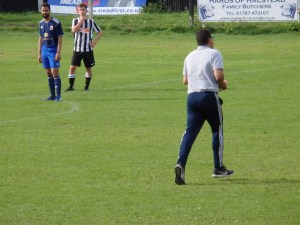
treatment; the trainer a large man in grey tracky bottoms and polo shirt runs on holding just a can of spray; miraculously it’s enough and Grigorio is soon back on his feet. As half-time draws near Fire United are comfortable, so much so that like Holland in the 1974 World Cup final they perhaps take things a little for granted. A nascent move down the right is stopped and played all the way back to the goalkeeper for no particular reason. Square passes are played between the Fire United defenders and Halstead close them down; the goalkeeper Lincoln Marques scuffs his clearance into touch. Halstead string a few short passes together from the throw and get into the penalty area, Fire United haven’t picked everyone up; a shot is blocked and runs to Joe Jones who has space to send a low shot beneath Marques and give Halstead a barely deserved equaliser with possibly their first shot on target. Within moments it’s half-time.
I wander down to the clubhouse behind the stand. There is an orderly queue for beer at the bar and two giant TV screens flash images brightly but silently on the walls. There is a print of a painting of the ground back in the 1950’s when the railway line still ran behind the end that doesn’t back on to the river, the painting is entitled “Playing to the whistle” proving that football and puns have never been strangers to one another. When I last came here there were some marvellous old photos of long dead Halstead Town teams on the walls but they seem to have gone, which is a shame. Just inside the door to the clubhouse an area is divided off from the main room and a small sign announces that this is the hospitality area. A long table is covered with plates of sandwiches, sausage rolls, cakes and biscuits, some wrapped in silver foil. It looks like a child’s birthday party minus the balloons and a cake. Rows of stackable chairs surround the table, upon which committee members and life members sit with paper plates on their laps. I head outside to the tea bar and invest in a pounds worth of tea.


From the very start of the second half Halstead Town are quicker and more energetic than before and they soon impose themselves on the game through sheer effort. Marques makes good saves from both Jones and Vincent and Jones heads wide when unchallenged. Pavett produces a hard low shot for which Marques throws himself down to his left to push away around the goal post. Fire United bring on a substitute, number eighteen Vasco Jardim, who is large in girth and rivals Humbugs’ number four Ben Morgan and goalkeeper Jack Cherry as the stoutest player on the pitch. Jardim has short legs and amuses several people in the crowd when he falls over spectacularly to claim a free-kick, but is the booked by Mr Williams.
It looks increasingly like Halstead will score again, it is just a question of when, but Fire

United still create one or two opportunities of their own on the break. I wander around a bit to take in some different views that form the back drop to this game. The fourteenth century church of St Andrew is visible at the top of the hill and behind what is now the Halstead goal, where the railway track once ran a hedge row follows the line of the old embankment; berry laden bushes billowing out in a line like steam from a ghostly locomotive. As the sun begins to

sink in the west, the shadows of trees envelope one corner of the ground in dappled shade.
I return to the main stand. Fire United’s Daniel Lopes shoots over an empty goal as Gabriel Dias and Jack Cherry collide, and after receiving treatment from the coach’s spray can, Dias is then substituted for number nineteen Glory Lukombo. “ What a great name” says a bloke behind me and I can’t disagree. The Mr Williams holding a flag has to defend not giving an offside decision against Halstead and seems to be talking to himself as he runs back up the line. Then Halstead score. Number eight Jordan Pavett chips a perfect pass over the Fire United defence onto which Callum Vincent runs before placing the ball beyond Marques with what could accurately be called aplomb. Purely on their second half performance Halstead probably deserve it, but as a naturally lazy person I am slightly disappointed that effort and hard work has seemingly won out over strolling about stylishly.
It’s not long before Mr Williams blows his whistle for the final time and with it an appreciative crowd of ninety-three make their respective ways back into the clubhouse or out into the car park and down Rosemary Lane. I and a few others wait a short while to applaud Fire United from the field, before I head back to my Citroen and the journey home.
 the San Siro of west Suffolk shared by both Haverhill Rovers and Haverhill Borough football clubs as the Stadio Giuseppe Meazza is shared by Inter Milan and AC Milan. But this being England the two Haverhill’s don’t actually play on the same pitch, Rovers play on a grass one on one side of the sports centre and Borough play on a ‘plastic’ 3G pitch at 90 degrees to it.

 ultimately slightly dull programme costs a further £1.00. Boldly, the front cover features a colourised photo of what looks like quite a nasty two-footed tackle by a bearded Haverhill player. Just inside the turnstile to the left is the tea hut; it’s neat and new and its black weather boarding gives the appearance of a traditional ‘shed’, the type of
 structure that all non-league grounds should have. Its open door is welcoming and I venture inside and invest in £2.50’s worth of bacon roll and £1.20’s worth of tea, served to me by a pleasant young woman who is appreciative of the change I offer her in payment. As I turn to leave I recognise a group of Ipswich Town supporters sat at a table drinking tea; they are at a loose end because International matches have resulted in a blank weekend for the Town and they have chosen Haverhill to get their weekly football fix.
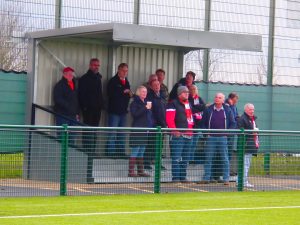 of the team in second place having won eighteen of the nineteen games they have played. But the Felixstowe fans aren’t a rowdy bunch, although they add a splash of colour with their red and white scarves. I use the toilet facilities, which are round the corner by Haverhill Rovers’ pitch. Returning into the green cage that surrounds the 3G artificial pitch I detect that my hands and fingers smell as if the soap dispensers in the toilet were filled with washing up liquid; odd.


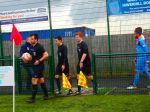 I drain my paper cup and the game begins again, and Haverhill have more of the ball than before, but no more shots on goal than in the first half. Several times Haverhill break away down the left flank, but nothing more than that, and when they do shoot it troubles the high metal fencing more than the Felixstowe goalkeeper. I take up a seat at the back of the metal stand a bit further along from the shoe box. The floodlights are on and reflect off the bald pate of the man sat in front of
 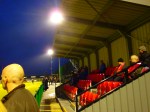 me, fortunately the lenses in my glass are ‘reactalight’. Unusually all the spectator accommodation is on just one side of the ground and it’s not possible to walk all around the pitch, which is a bit disappointing as I can’t stand behind the dugout and listen to the managers cursing and swearing at their players, the linesmen and the referee. Bad language is an essential part of the game despite the Eastern Counties league’s entreaties in the programme to “Keep it down for the kids”. Substitutions take place. On the opposite side of the pitch the linesman is busy.
  His shock of orange hair is quite stunning and matches the autumn colours of the leaves on the trees behind him; as the light fades he almost glows beneath the beams of the floodlights. The other linesman is a slight figure with a thin beard, he looks like he’s feeling the cold and guiltily slips a hand into the pocket of his shorts when play is at the other end of the pitch.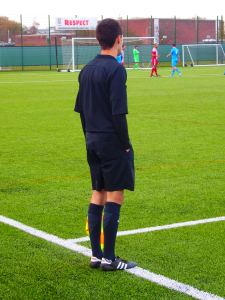
 trippingovertheball