Kings Park Rangers 2 Stanway Pegasus 0

The snappily titled Thurlow Nunn Eastern Counties League Division One South has in the last year been shorn of two Suffolk clubs in the shape of Whitton United and Debenham Leisure Centre, who voluntarily dropped into the Suffolk and Ipswich League.  But as if by magic, two replacements have immediately filled the gaps left, one in the shape of the venerable Halesworth Town (founded 1887) and the other in the form of the altogether less venerable King’s Park Rangers,  who sprang suddenly from the Essex and Suffolk Border League after a brief two-season gestation, a bit like The Alien did from John Hurt’s stomach.

It is the final chapter of my two-part quest to be able to boast idly that I have seen every senior team in Suffolk play a home game.  Today I am making the brief 19.2-kilometre road trip across the border from Essex to Backhouse Lane, Little Cornard where I hope to see King’s Park Rangers play another team of recent graduates from the Border League, Stanway Pegasus.  If I was a younger man for whom the concept of time on this planet running out was less of an immediate concern, I might have caught the train to Colchester, or from Marks Tey to Bures, and then the number 44 bus to Great Cornard, but in truth I couldn’t really be bothered with the palaver, and in any case I have an electric car, so I am doing my bit to save the planet and reduce global warming.  It is therefore a little after two o’clock when I set off from my front drive towards Sudbury.

Being in Little Cornard, it is no surprise that Backhouse Lane is the longstanding home of Cornard United, but more intriguing is why is it now also the home of Kings Park Rangers, who are they, why are they, and where is Kings Park?   These questions have been niggling me all week in my idle moments, and fancifully I had postulated that they are perhaps a team from Kings Park, Suffolk County, Long Island, New York,  a team of South African ex-pats who have named their club after Kings Park Stadium in Durban, or even that they are an incel’s bitter and twisted response to the existence of Queens Park Rangers.  Eventually, there was nothing for it but to consult the interweb and hope I could find some information that was believable and not merely ‘content’ designed to enrage, influence or peddle consumer goods.   It turns out, so it seems, that Kings Park Rangers are a sort of works team for Kings Park Fulfilment Ltd of Pebmarsh, Essex, a company that works for Amazon, aiding Jeff Bezos’s bid for world domination.  According to ‘Suffolk News’, the club was set up in 2023 by “former Cornard resident” Josh Pollard “…as a way of connecting his family- including famous cousin Olly Murs – and work colleagues through their shared love of football.”  I can’t decide if this is philanthropy, megalomania or just weird but it probably makes Kings Park Rangers a Pebmarsh team, an Essex team, that just plays in Suffolk.

Looking out from the drizzle flecked windows of my planet saving Citroen e-C4 it’s a miserable, depressingly grey November day, the aftermath of an even more depressingly miserable, wet, November day, the day before.  The only thing to raise one’s spirits a little is the fact that today the moisture in the air is just occasional fine drizzle, not the persistent rain and occasional monsoon that hit yesterday.  Nevertheless, there’s no denying that the dripping trees, puddles, mud and soggy leaves are all rather glorious in their own way and provide a characterful backdrop to the twisting, turning, undulating B1508 as it makes its way along the north bank of the River Stour from Bures towards Sudbury.

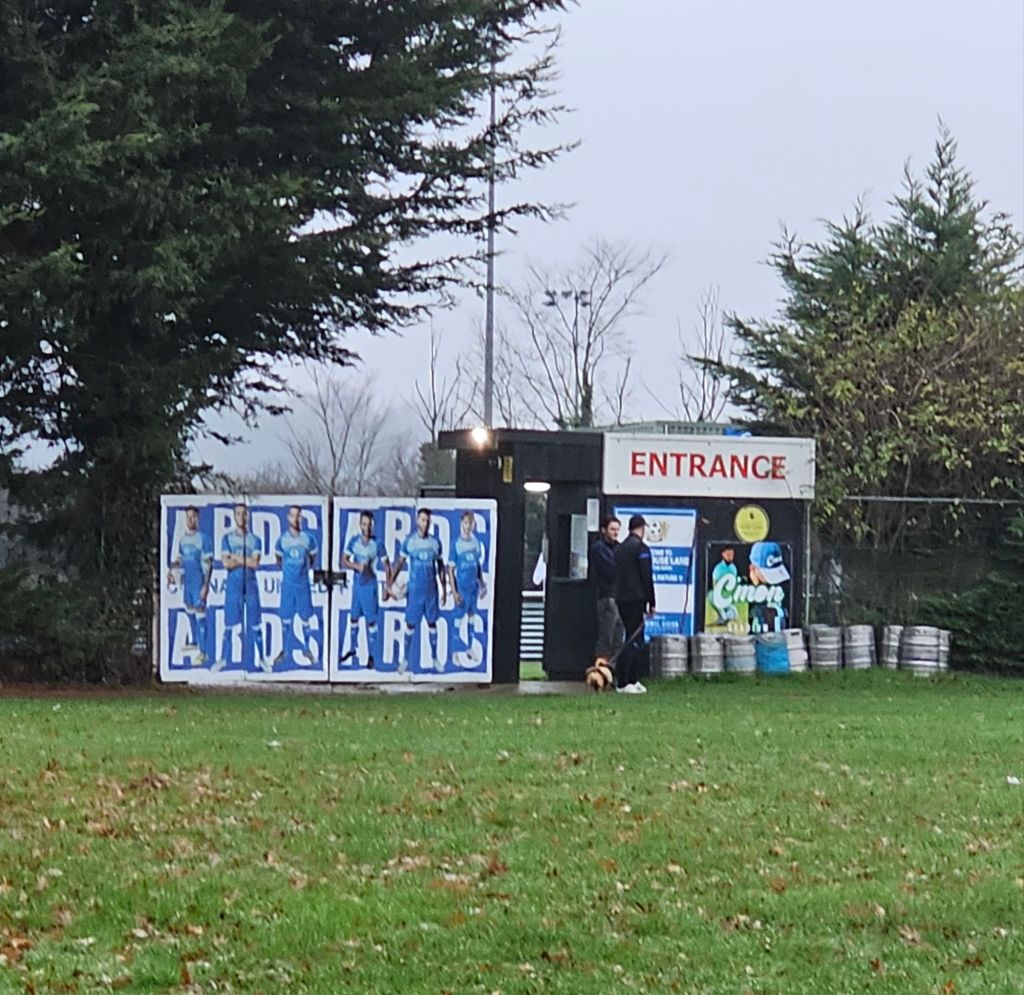
Suddenly, out of the gloom I reach Great Cornard and quickly identify the need to brake and turn right into Backhouse Lane, a very narrow road which in places has a deep water-filled ditch on one side; it is not wide enough for two cars to pass.  Fortunately, I meet only one car coming in the opposite direction and that is at one of the few passing places.  I am therefore soon parking up my planet saving Citroen in the mostly full car park, next to a white Ford Transit van.  The entrance to the football ground is off to my right, through the mist and back towards the B1508 along a concrete path strewn with fallen, brown leaves that have the consistency of wet papier mache.  Two men stand talking each other by the entrance, which seems to marked by a collection of beer kegs, and as I approach they end their conversation and one of them nips into the turnstile booth.  When I last came to Cornard, back in January 2019, the ‘turnstile’ was just a wooden hut but at some time in the intervening six years and ten months this has been replaced by a very neat structure that looks something like a cross between a very small domestic conservatory and one of the old toll booths at the Dartford tunnel.  I tender my £5 concessionary entry fee by means of my bank card.  There is no printed programme, but the window of the toll booth displays a QR code for a programme which is free.  Pretending to be completely familiar with QR codes I point my mobile phone at it, because I think I know that is what you do.  I have succeeded in accessing on-line programmes in the past, but not today, but at least I will have a nice photo of a QR code.  The young man at the turnstile then strangely tells me that there are plenty of people in the club house, perhaps he thinks I look lonely.

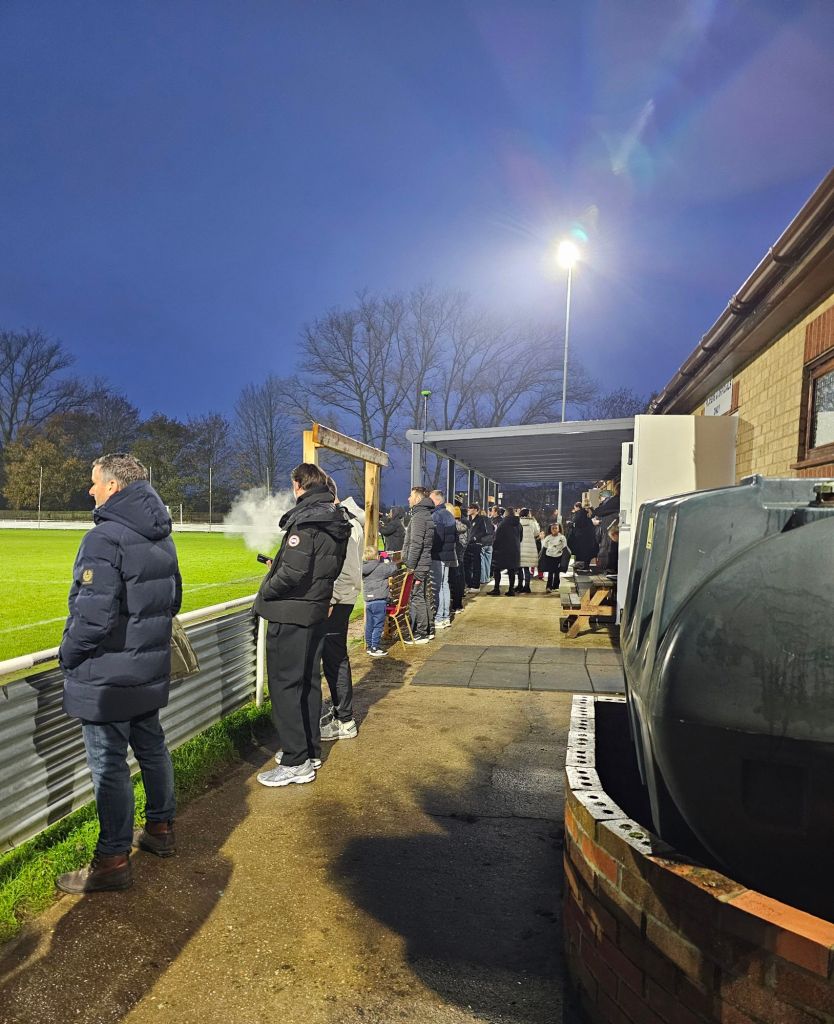
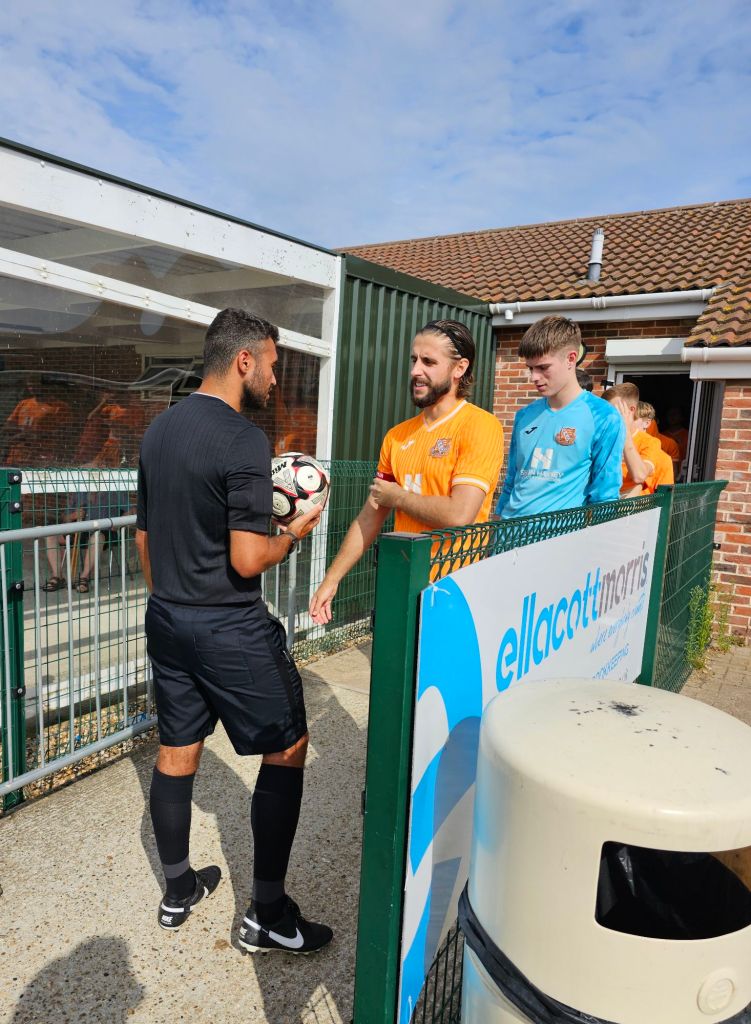
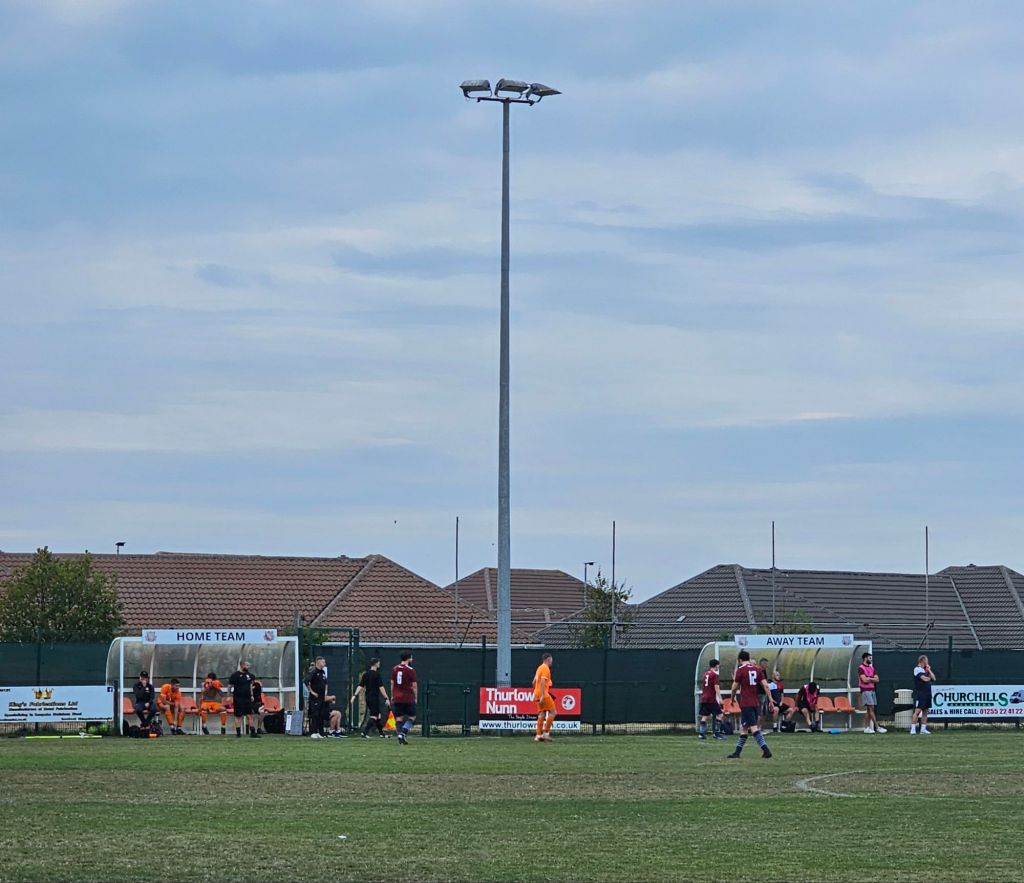
There are indeed plenty of people in the clubhouse as the young man in the toll booth said, but I only talk to the barman who, when I ask if there is a bitter available, tells me there isn’t the call for it nowadays but helpfully adds that a pub nearby wins awards for its beer.  Sadly, there’s no danger of that here and I settle for a bottle of alcohol-free St Austell Brewery Proper Job (£4.90).  The barman apologises for not letting me have the bottle to pour the beer myself and explains that whilst he doesn’t think I look like I would cause any trouble, he’s not allowed to.  Avoiding eye-contact with anyone else in the bar, I worry a little for my safety and take my beer outside where I watch the players, the referee and his assistants warm up, and a player in a track suit top walks a small brown dog. I notice that the two dugouts are almost at opposite ends of the pitch, when I was here in 2019, they were next to one another.

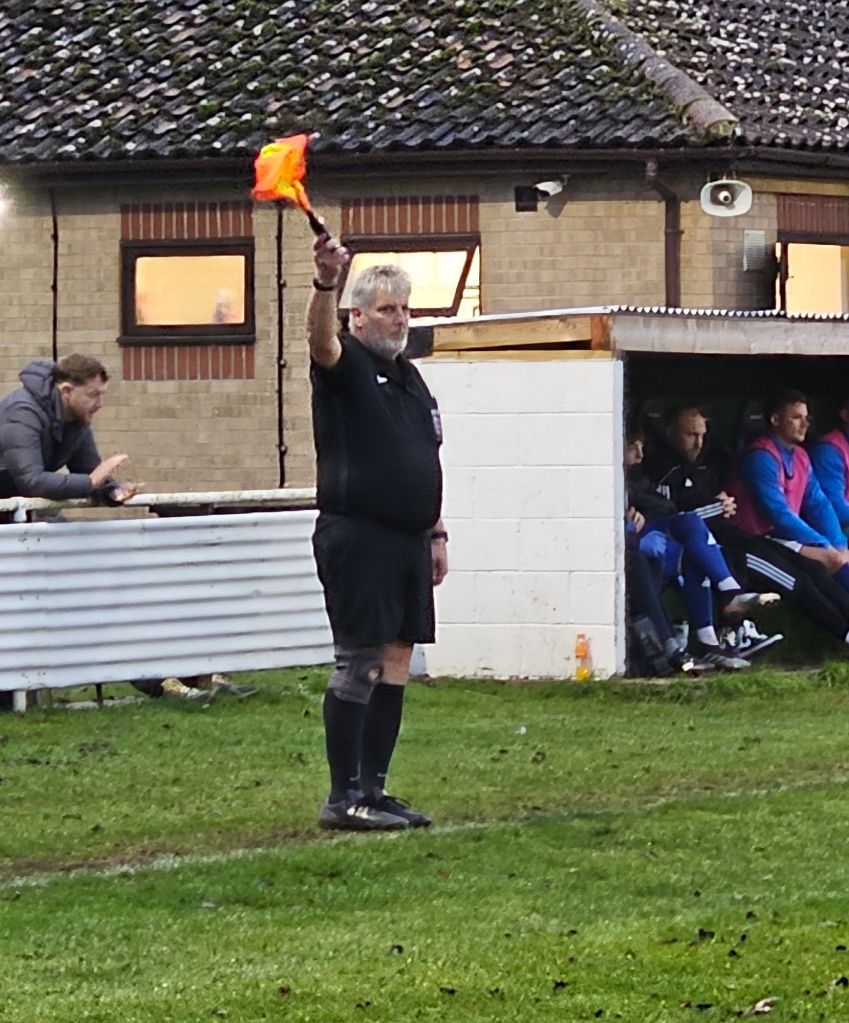
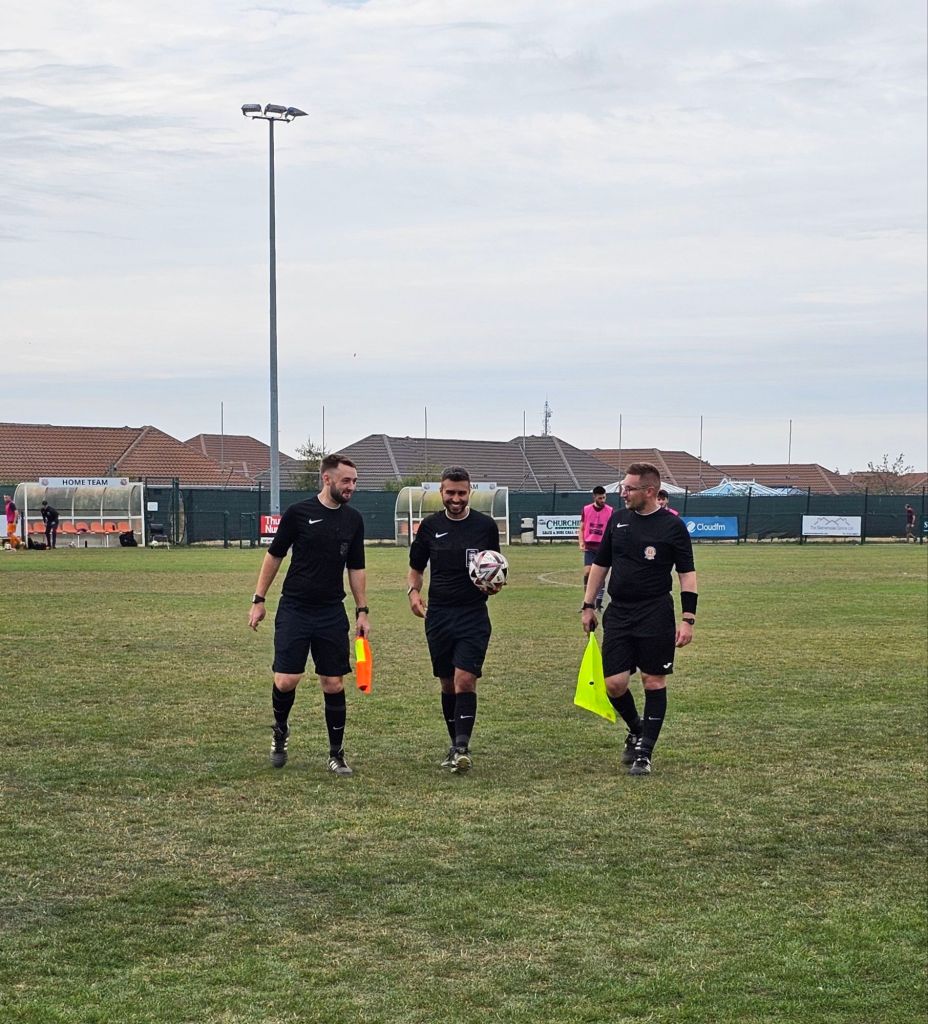
 The referee is a young man with impossibly short hair who looks very keen and serious as he turns and sprints along the touchline and then does the same again. His assistants, two much older men, follow him for all of a few seconds, by which time he is almost out of sight.  “Five minutes.  Do your stretches”, says the referee and one of the assistants a portly, grey-haired man wearing an open knee support stretches down to his knee once or twice and the expression on his face says “that’ll do”.

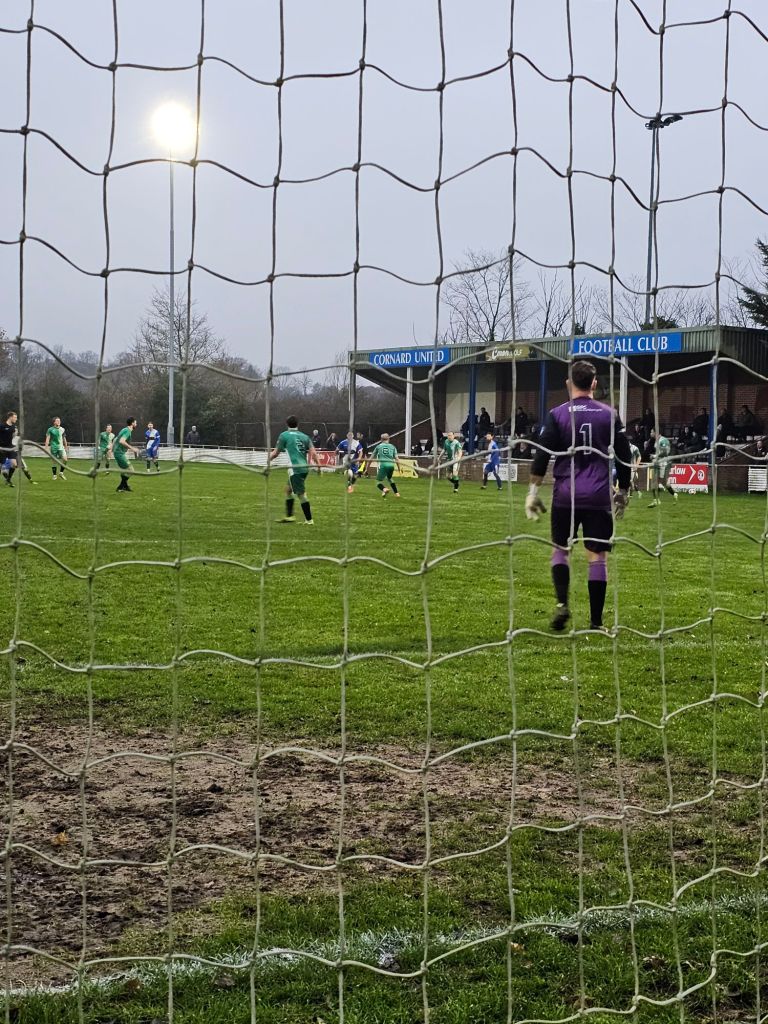
The game begins at a minute past three and it’s Kings Park who get first go with ball, which they rapidly boot towards Sudbury and the Thomas Gainsborough school, which is just over the fence from the ground.  Kings Park sport an all-blue kit with a wide, white, slightly blurry diagonal stripe across the front, and I think to myself what kit would I choose if I was inventing my own football club, probably not this one.   Stanway Pegasus meanwhile are in all-green with a blurry white stripe down their left side and black socks, like an unhappy man’s Plymouth Argyle.
The most notable thing about this game from the start is the shouting on the pitch and from the dugouts. “You gotta work”, “Chase”, come the early, more polite commands extolling effort over skill.  “Away” shouts the Kings Park goalkeeper and for some reason I think of the Teletubbies. Kings Park win an early corner.  “Seconds, seconds” is another shout, appropriately twice. On the pitch, both teams seem wound up already and the Pegasus number nine screams at the referee’s assistant as he strides towards him intimidatingly over the trivial matter of a throw in.  “Mental” he says to himself after being told to calm down by referee Mr Glasson-Cox, who coincidentally also refereed the match I saw at Halesworth last week.

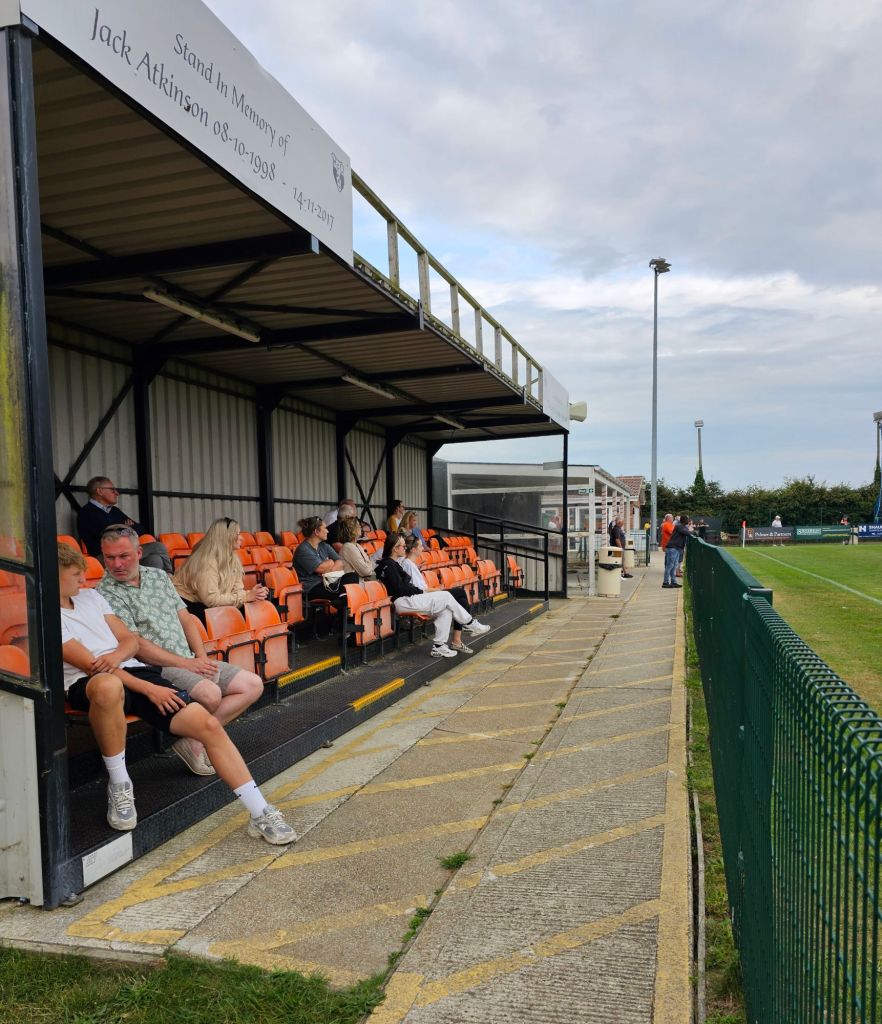
The half is half over. “Fuckin’ ‘ell ref” says someone about possibly anything but soon the initial intensity of the match seems to have thankfully subsided a bit.  I move into the main stand, a utilitarian, boxy looking structure but with a bit more character than most of the prefabricated metal stands erected nowadays.   In a quiet moment I reflect upon the referee’s assistant stood in front of me, a wiry man with a large beard, which he looks as if he might have grown having been told by his doctor that he needs to put on a bit of weight.  Between me and the referee’s assistant raindrops cling to the white painted rail around the pitch.   The slightly calmer mood continues into a short delay in which the referee speaks to his assistant on the far side, the portly, grey-haired one with the dodgy knee who it seems has noticed that following a goal mouth scramble the goal at the Sudbury end of the ground, which is on wheels, has moved a little.  Mr Gasson-Cox takes a look and gives the goal a little shove.

After the calm, there follows a short storm as Kings Park’s number eight and captain Noah Collard scythes down an unidentified Pegasus player who proceeds to writhe on the ground screaming.  Once the Pegasus player has cried wolf for long enough Collard becomes the first player to see Mr Gasson-Cox’s yellow card, but discussion in the crowd is more about the girlish screaming than the booking.  “Does he have to go off with the screaming?” asks a spectator not unreasonably.   But as if to quickly even things up, a Pegasus player also gets to view the yellow card before half-time, although there is no further screaming from either side and the half ends goalless.

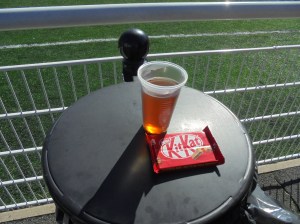
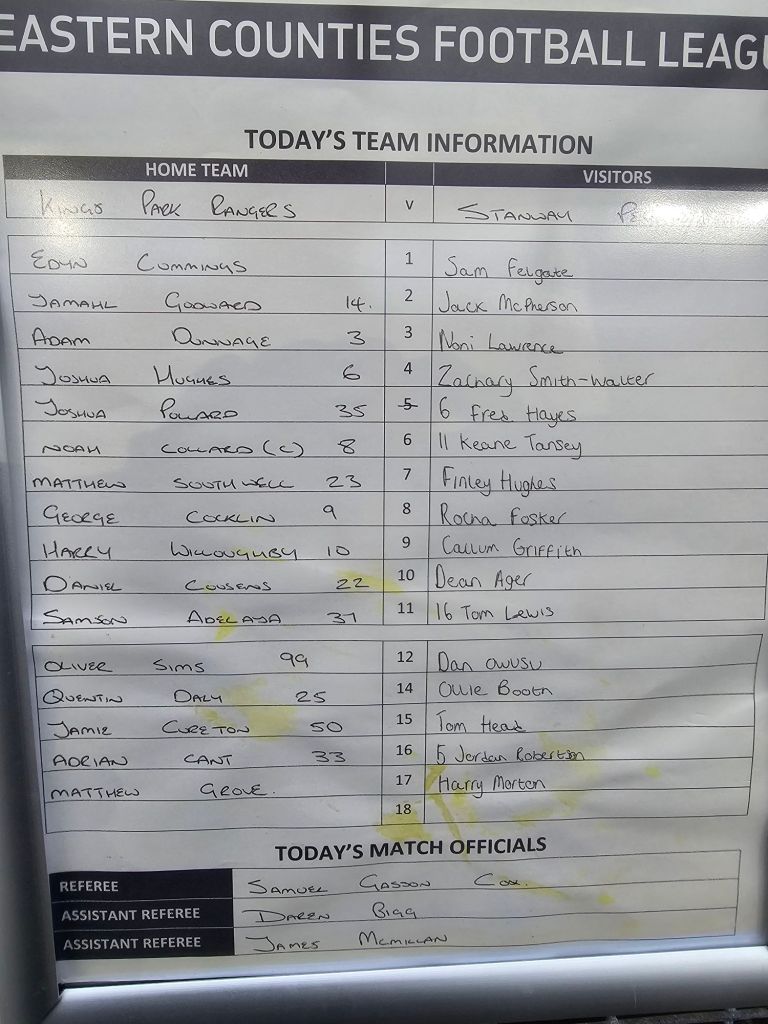
With half-time I drain-off some of the Proper Job and eat a Polish Grzeski chocolate bar from the World food aisle in Sainsbury’s.  I peer through the window of the club house where a man and a woman, presumably club officials from Stanway Pegasus, and two men in large black coats featuring the crest of the Suffolk County Football Association drink tea with an array of what look like shop bought sausage rolls and homemade bread pudding wrapped in tin foil laid out before them.  Only the man from Stanway Pegasus seems to be eating anything.  I wonder to myself where the Battenburg and Swiss Roll are.  Outside, next to the window I look at today’s team sheet, which looks like whoever wrote it might have been eating an orange at the same time.  Beyond the club house the small brown dog is being walked by a different man, possibly a player, who is evidently not playing today; I hear him say he doesn’t know the dog’s name.  “Come on you” he says.  Two other small dogs are present in the crowd today too, one in a coat and one not. 

At three minutes past four the match resumes and the Kings Park coach is immediately barking instructions to Georgie, Zammo and Hughsie as if his very existence depended on it, whilst also sounding like the games teacher from tv’s Grange Hill, but only because he said ‘Zammo’.   His shouting works however and six minutes later a ball from left to right finds number twenty-two Daniel Cousens inside the penalty area.  Cousens calmly places the ball wide of the Pegasus goalkeeper, and Kings Park lead one-nil.

Ten minutes later and Kings Park lead two-nil when a low cross from the right travels across the face of the goal, past the flailing limbs of a couple of Pegasus players until it reaches Kings Park number ten Harry Willoughby, who bundles it into the goal from close range before running off madly.  “Whatever ‘appens, don’t let ‘em fucking score again” bawls a rough voice, presumably of a Pegasus supporter. 

It’s getting on for half past four and the game seems over. Pegasus don’t offer much else but for a goal mouth scramble which leaves the Pegasus coach feeling hard done by and asking rhetorically “ ‘ow’s your luck?”  and then asking it again.  For Kings Park the goalscorer Willoughby is substituted for the 50-year-old former Norwich City, Colchester United, Reading, Queens Park Rangers, Swindon Town, Shrewsbury Town, Bristol Rovers, Leyton Orient, Bournemouth, Barnsley and umpteen other clubs’ player Jamie Cureton. As Willoughby heads for the changing room, he emits a sort of howl.

Back on the pitch, Pegasus number five Jordan Robertson is booked after Kings Park’s number ninety-nine Oliver Sims is not given offside, and Robertson seemingly exorcises his disappointment by hacking Sims down.  “Fucking embarrassing” says the Pegasus coach, but only about the presumed offside. Time runs down, on into the ninetieth minute.  Pegasus can’t decide whether to just boot the ball forward as quickly as possible or pass it. “Just kick the fuckin’ thing” shouts an elderly spectator summarising a century and a half of tactics from the country that apparently invented the game.  “Darren, time” shouts a player. “Darren, man on” shouts the same player a moment later. The final action sees another booking for Kings Park. “Fuck me, it’s getting boring now” say the Pegasus coach and happily at 16:52 Mr Gasson-Cox, who I think has had a good game calls time.

I wait as the players leave the field to no applause, just the blokey clasping of fists with a few spectators and shouts from inside the changing rooms.  It’s been a good game in terms of the ability shown, but it’s not been a particularly enjoyable one. There’s been too much trying to pressure the referee, too much needless swearing and too much of a sense of needing to win above all else. I think I’ll just try to remember the afternoon for the miserable weather, the soggy leaves and the small dogs.

Holland 2  Dussindale & Hellesdon Rovers 1

Holland-On-Sea, Wikipedia tells us, is a suburb of Clacton-On-Sea and was known as Little Holland until the early twentieth century; it also has a football club called Holland FC.  What Wikipedia doesn’t tell us however is that Holland is just a 30 minute, thirty-eight-and-a-half-kilometre drive from my house, although Google maps does.  Stanway Rovers, Halstead Town, Coggeshall Town, Cornard United, Wivenhoe Town and Hadleigh United football clubs are all playing at home today and are probably all closer to home, but none of them are “On-Sea” and I’ve been to all of their home grounds in the last twelve years, which isn’t true of Holland FC’s Dulwich Road, where I am given to understand that the pitch, as if by some freakish movement of tectonic plates, has moved through ninety degrees in that time, throwing up a metal fence all around itself and a smart new clubhouse.  Therefore, with the promise of sea air and the prospect of a geologically formed football ground, it is on a warm but cloudy Saturday afternoon in early September that I set off in my planet saving Citroen eC4 for Holland-On-Sea.  I had contemplated catching the train to Clacton and making the half hour walk to Dulwich Road, but with only one train an hour I wouldn’t have got home until seven o’clock, and I have a wife whose heart I risk breaking if I stay out too long.

It’s an uneventful journey down the A133 and I arrive in relaxed mood in the Holland FC car park, where I have a wide choice of parking spaces; I draw up next to a modest silver-coloured family saloon, which had turned into the pebbly, beach-like car park shortly before my I and my Citroen did.  It’s not half past two yet , so I decide to take a look at the sea before entering the ground; the cliff top and sandy beach below are only 200 metres away across the grassy expanse of the Eastcliff Recreation Ground and Marine Parade.  From the cliff top, Clacton Pier is visible through the haze at the end of the beach, and out to sea sit the ranks of wind turbines that I like to think made the electricity that powered my car and brought me here.  A West Indian man of pensionable age and riding a low-slung tricycle asks me if I’m local and if I know where the Kings Cliff Hotel is.  I tell him I’m not and I don’t know where the hotel is, but I do know he is heading towards Kings Parade.  I think to myself that the ‘King’ in King’s Parade fame was probably either King Edward the Seventh or some egotistical Tendring District councillor with the surname King.

I walk back inland to the football ground up Lyndhurst Road, a typically suburban, tree-lined street of inter-war bungalows, all of which are almost frighteningly neat and well maintained. Just past a public toilet is a hedge which is teeming with bees and butterflies, mostly Red Admirals.  I am not sure I’ve ever seen so many butterflies in one place, but start to worry that wealthy local MP Nigel Farage might be having them specially bred so that he can pull their wings off or place them in his reptile-like mouth before washing them down with a pint of beer.  But then again, I don’t suppose he ever comes here; he probably gets his butterflies in Florida.

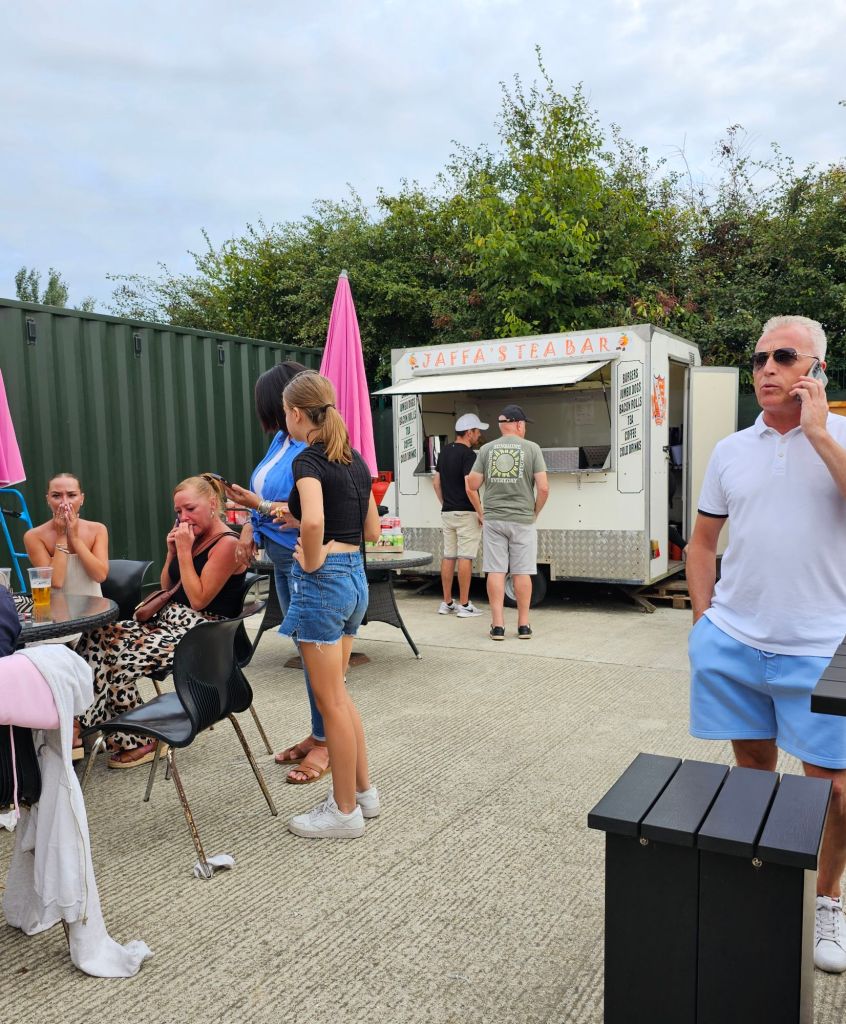
Back at the football ground, the friendly, cheery but visibly overweight man at the gate tells me that the concessionary entry fee of £5.00 applies to over sixties; I tender a twenty-pound note and receive fifteen pounds change.  After I ask if there is a programme today, I am told that the club does produce a match programme, but hasn’t done so today, which to me seems a bit lazy of them.  With the two pounds I saved at the gate by being old, I buy £1.50’s worth of tea from Jaffa’s Tea Bar.  I don’t know who Jaffa is, but his or her (it was a woman who served me) tea is pretty good, even if it is just a tea bag in a paper cup with some added water and milk.    I suspect however that the name of the tea bar is derived from the club nickname, “The Jaffas” and so the apostrophe is in the wrong place, this is Essex after all.  I wander inside the clubhouse which, although bright and new and with a display of trophies on one wall, seems a little soulless due to its grey floor, plain walls and vaulted ceiling; the only pumps on the bar are for Stella Artois, San Miguel and Carlsberg. I am pleased I bought tea and enjoy the irony that in Farage’s constituency all the ‘beers’ are, nominally at least, foreign brands.  Most of the drinkers are sat outside at an array of tables and look like they are settled in for the afternoon. 

“Are you sat here for the music?” I ask two old boys sat on stackable chairs in a covered area outside the home dressing room,  through the window of which can be heard the typical, pumped-up, high volume musical selection of the millennial footballer.  “Is that what it is?” Says one of the old boys.  I wonder to myself if Stanley Matthews, Len Shackleton and Tommy Lawton would get themselves ready for kick-off by cranking up the volume on the latest 78’s from Glenn Miller,  Al Bowlly and Bing Crosby.  With the music turned off we can hear the team talk. “It’s a long journey from Norwich or wherever they come from” says the coach encouragingly to the Holland players.

It’s not long before the teams are lining up to parade onto the pitch with the players of today’s opponents Dussindale and Hellesdon Rovers, looking suitably jet lagged.  Dussindale and Hellesdon are two suburban areas on opposite sides of Norwich, but their clubs amalgamated a few years ago and have made it into the snappily titled Thurlow Nunn Eastern Counties League First Division North and now play in Horsford, which is at least next to Hellesdon and close to Norwich airport, which is handy for away games.   After all the usual handshaking and hand-gripping malarkey, it is Dussindale and Hellesdon who kick-off towards the sea in burgundy shirts and navy-blue shorts. It’s a tasteful, if slightly dull kit and doesn’t compare with Holland’s vivid all orange ensemble.  Wikipedia tells us that the nickname of Holland FC is The Tangerines, no doubt due to the colour of their kit, but Holland’s own website refers to them as The Jaffas, although it doesn’t appear to have been updated since last May.  I wonder if there has perhaps been a referendum during the close season on what type of orange best represents the club, with members choosing to reject Satsumas, Mandarins, Clementines, Navels, Cara Caras and Easy peelers.   

The early exchanges on the pitch are typically noisy with the ball frequently flying high into the afternoon sky as an optimistic through pass for someone to chase is booted away.  “Go wide, hit the channel, good chap” bawls the Rovers’ goalkeeper revealing a hint of a Norwich accent as the ball sails in to touch.  Holland have the classic two big blokes at the back, numbers 5 and 12.  Number 12 has the sort of build which, if this were a professional game, would no doubt leave him open to chants from opposing supporters of “You fat bastard”, but he is a ‘rock’ at the back for Holland. 

I walk round the pitch to stand between the team dugouts. Holland win two early corners.  More Norfolk accents are detected on the away team bench.  Holland seem to lack club volunteers, with there being no programme today and no team sheet posted on a wall anywhere either.  The on-pitch commentary from the players however reveals that the Rovers number three is called Eggy and the number four Martin; other players have names too.

A poor back pass lets in the Holland number eleven,  who crosses in a low ball which a Rovers centre-back clears over the cross bar for corner.  It’s the first real opportunity, even if it was entirely manufactured by one team for the other.  The game is full of endeavour, but no one is capable of providing a pass that will lead to a goal. It’s a game of just shouts at the moment.  “Get out”, “First and second ball”, “What we talked about”, “Jump early”, “Ref that was blatant”, the usual anxious nonsense that the players hear every week and must get sick of.  On the Rovers’ bench the coaches are simply willing their team to do better; “Get the ball” urges one, going back to basics.  Then Rovers break down the right; number eleven scampering into the penalty area and crossing the ball low to where somebody should be to tap it in but isn’t.

“That’s the first chance of the game, and it’s to us” says a Rovers coach moments before the Holland number nine heads the ball against the Rovers cross bar from what looked like inside the six-yard box.  Fortunately, he can’t hear the cursing on the Holland bench.  It was the sort of incident that explains why the Rovers number five displays a constantly slightly worried look on his face, in contrast however to the number four playing in front of him, who is calmness personified and always has unhurried time on the ball. “Go on Matt, Dylan” shouts another coach, and I think of a parallel world where a film director working with Jack Nicholson and Charlton Heston might say “Go On, Jack, Charlton.”

 “It’s a great run again” says a Holland coach sounding like a radio commentator as Holland move forward again down the right.   The pattern of the first half has now been established and Holland are the dominant team, but with Rovers are a constant threat on the break. In midfield for Holland, number eight has a beard, and hair swept back with an alice band; it makes him look a bit like a bargain basement Alessandro Pirlo, which would explain why he is captain.  “Keep on side” shouts someone as Rovers’ number eleven breaks forward again, but he’s too late, the linesman’s flag is raised, if only that advice had been shouted sooner.

Unusually, in the final twenty minutes of the first half there are three substitutions, with Holland’s number three, who has been looking physically uncomfortable, being usurped by number seventeen, who is soon having a shot on goal well saved.  For Rovers, numbers seven and eight leave the pitch to be replaced with numbers fourteen and fifteen, like the start of a mathematical puzzle.  Just as unusual is the smell of deep-frying fish and chips that is wafting around when at half past three in the afternoon people should surely be having no more than an afternoon cup of tea and a biscuit.

The thought of tea sends me further round the pitch, back towards Jaffa’s tea bar and when I pass behind the linesmen he warns “Nothing silly” as opposing players chase another hopeful punt forward for Rovers.  The ball is soon returned to the other end of the pitch however, where Holland’s number nine shoots weakly at the goalkeeper as he redirects a square pass.  But the disappointment is short-lived as number ten finds himself in much the same position, but crucially manages to shoot past the goalkeeper and high into the net to give Holland a more or less deserved lead.

 Half-time arrives soon afterwards and teas and beers taste better than they would have if Holland had not scored, although I don’t think everyone sat drinking outside the bar noticed the goal or any of the first-half come to that.  For the second-half I decide to take up a seat in the main and only stand, selecting a spot in the middle of the second row where I can easily see most of the pitch above the metal mesh fence.   From here I can also see the sea of hipped bungalow roofs with ugly concrete tiles and the white UPVC conservatories that squat beyond the surrounding boundary fence and off into the distance.  A seagull stands and squawks from on top of a ridge tile.

The football resumes at two minutes past three and Rovers are soon seeing more of the ball than previously; they’re not playing so deep into their own half, but like Holland before the half-time break, they’re not creating many chances to score.  Suddenly, out of the blue, it all gets a bit too much for Rovers’ number nine who bawls in frustration “Fuckin’ell, fuckin’ play!”.  Moments later, as if to say “Alright, alright, keep your hair on”, his team-mates fashion a corner kick and then number fourteen becomes the first player to be booked as he fouls Holland’s number eleven.   In contrast to the increased excitement on the pitch the afternoon now feels quite still; the sky has clouded over and it’s cooler than it was. 

Despite both number nine and ten having decent shots on goal for Rovers, Holland are holding on fairly comfortably, but it must nevertheless come as a relief to them when around half past four  Rovers’ number five swings a foot to clear the ball and misses it, letting Holland’s number eight take it to the edge of the box, check inside and send a gently curling shot beyond the goalkeeper and inside the far post. Holland lead 2-0.

It’s the sort of a goal that commentators tell us will ‘wrap the game up’ and ‘put it to bed’; it’s just what Holland have been waiting for.  Two minutes later and it hasn’t, as Rover’s number ten has a shot parried by the Holland goalkeeper and number nine sweeps the rebound into the goal.  The score is 2-1 and anxiety takes hold.  It’s been a game of very few fouls, but someone cries “Late every time” when there is an accidental collision of boot and ankle, and I begin to wonder if all referees shouldn’t also be primary school teachers.

It is seven minutes to five when the game ends, and before returning to my trusty planet saving Citroen for the drive home, I pause to applaud and reflect on what has been a very good game. As I say to one of the old boys as he gathers up his sticks to toddle off home, we’ve had a decent five pounds worth of entertainment.   But shuddering slightly, I nevertheless can’t help wondering how all these people voted at the last general election.

Meudon AS 0 St Ouen L’Aumone AS 2

Today is the last day of September, my wife Paulene and are staying in Meudon on the edge of Paris, and having enjoyed both professional Ligue 1 and Ligue 2 football in the past week and a bit, watching both Paris FC and Paris St Germain, this afternoon we are getting down with the French equivalent of ‘non-league’. Not much more than ten minutes away by car at the Stade Georges Millandy in Meudon Le Foret (twenty minutes by bus service No 289) is a Coupe de France fourth round tie between Meudon AS of the Ile de Paris regional league Division 3 and St Ouen L’Aumone AS of the Ile de Paris regional league Division 1. These leagues are the 6th and 8th levels of the French football league ladder, although probably not directly comparable to those levels in the English non-league ‘pyramid’.
The parking at the local community sports centre, where the match is to take place is full, so we park our trusty Citroen C3 around the corner in Rue Georges Millandy between large blocks of modern apartments. We are not sure exactly where we are going, but the Federation Football Francais (FFF, the French Football Association) website says this is the where the match is taking place and having walked through a corridor in a sports hall we find ourselves next to an artificial football pitch. There is no turnstile and watching this match is free. A bunch of blokes in tracksuits sit outside a portacabin eating baguettes and drinking coffee. In my exquisite school boy French I ask if this is this is where the Coupe de France game is taking place at 2.30; I am relieved to learn that it is, and flattered that the man I speak to recognises the Ipswich Town crest on my T-shirt. I explain that I am a fan and not from the club itself, but we both quickly make the connection that Ipswich’s Under 18 player Idris El Mazouni is from Meudon. I will later discover that I have been talking to Idris’s dad.
The Stade Georges Millandy is not a stadium as we might understand it in Britain, because it has no stands; it’s just a 3G synthetic pitch with dugouts and a metal fence, overlooked by five or six large, shiny white apartment blocks.

This slideshow requires JavaScript.

It wouldn’t make the grade for the Thurlow Nunn Eastern Counties League, although in truth the playing facilities are better than at most clubs in that league. It seems quite new, is in good condition and is the sort of installation that a town the size of Ipswich should probably have at least ten of. Given that these pitches are not cheap to install it is doubly impressive that the surface extends beyond the actual pitch to the area around it, with a mini pitch and goals in the space behind one goal. A game (possibly Under 15s) is

just finishing with a penalty shoot-out and I return to the portacabin, which is a sort of club house and buvette, to get two cups of green tea and a Kit-Kat (all 1 euro each); the tea is poured from a huge pot. On one wall is a large array of trophies won by all age groups within the club.

Paulene and I wander around the pitch as we drink our tea and I scoff a Kit-Kat trying to remember why Nestle products were boycotted and if they still should be; too late now, I have become complicit in their multi-national nastiness. It is a beautiful, bright sunny

45013661531_f3c54472c1_o

afternoon beneath a clear blue sky and the gaze of those shiny apartment blocks, which cast no shadows on one another or the pitch; this has to be how Le Corbusier imagined La Ville Radieuse.

A man in a loosely belted gabardine raincoat appears; if he was wearing a trilby hat he could have stepped from a 1940’s film. He sports a bright arm band which adds to the look, but in a slightly sinister manner; he is however the délègue principal, the FFF official who

43201967200_10152fe2e5_o

will oversee this afternoon’s game from the side lines. Out of the blue one of the spectators walks up to me and shakes my hand. In due course the two teams emerge from their respective changing rooms and walk through the metal gate onto the pitch before lining up side by side, then in a line before shaking hands. Introductions between the referee and players and délègue principal are made all-round, before the game kicks off about five minutes late (it was advertised as a 14:30 kick–off) with St Ouen having first go with the ball, aiming at the goal in front of the buvette. Meudon kick in the general direction of far off Stade Charlety and the 13th Arrondissement. St Ouen wear an all-green kit, whilst Meudon are all in red; neither club has its club crest on its shirts but instead bear the logo of the FFF with its cockerel.

St Ouen quickly win a free-kick as their tricky number nine goes down under a challenge; he gets up to send a neat free-kick over the red wall of Meudon, but into the arms of the very young looking Meudon goalkeeper, who strangely is one of the smallest players on the pitch, a sort of French Laurie Sivell. It is also St Ouen who have the second serious goal attempt, again a free-kick, but this time firmly hit from a wide position by their number ten. Once again the goalkeeper, whose blond hair may not be its original

30077406907_10dcb243ea_o(1)

colour, saves, batting the ball away for the first of five corners that St Ouen will win this half. Most of these corners are either poorly taken or all the St Ouen players are waiting for the ball in the wrong places.
Meudon are very competitive and the game is played at a fast pace with the emphasis on passing rather than just getting the ball forward by the fastest route. Meudon come close to scoring a bit before three o’clock as their huge number eleven breaks through on the left. The St Ouen goalkeeper, who incidentally reminds me of St Etienne ‘keeper Stephane Ruffier on account of his designer stubble and very short dark hair, and is possibly the second smallest on the pitch, dives at his feet. The ball rebounds to the Meudon number seven whose goal-bound shot is headed away at improbably close range.
Meudon seem to be growing in confidence and their number ten does a few feints and jinks over the ball like a footballing Michael Jackson (Bubbles’ friend, not the one who played for Tranmere and Shrewsbury) might have done. There are a few jeers and within the next twenty seconds his ankles are swept away from beneath him by the St Ouen number three as he goes to dribble down the right touchline. It’s one of those situations that some people would try to excuse by saying that number ten had been ‘disrespectful’, but that’s just a modern buzzword, a sort of false political correctness and it is tosh; I blame Eastenders. Football is a game of skill, and dumping someone on their bum shows little ‘respect’ itself. Referee Monsieur Charly Legendre doesn’t see fit to book anyone either way.
The coaches on the side lines are animated, “Parlez –vous” one calls urging his players to talk to one another. The St Ouen coach, a portly man in his fifties sports a fine mullet and

43201968530_160c2105a2_o

has the look of Maradona about him. The Meudon coach becomes involved in a prolonged discussion with the linesman Mefa Bakayoko about an offside or a free-kick which has been and gone and so no longer matters. On the field, the St Ouen number ten sends a free-kick solidly over the cross bar whilst Meudon’s number six comes as close as anyone else with a long range shot that goes wide. St Ouen’s number nine is proving industrious and creates a couple of shots for himself, one of which is well saved and Meudon replace their number three with substitute number thirteen. Half-time arrives and Paulene and I look back on a good but slightly frustrating forty-five minutes, which was too tight to be really entertaining. I head for the buvette to get a bottle of water (1 euro).
During the half-time break we stand about and as a man walks by he shouts “Ipswich!”. We could do with that sort of enthusiasm at Portman Road. As I stand I enjoy the

44294420204_39f8378ac4_o

contents of the many balconies that overlook the pitch from the surrounding apartments. Bikes, mattresses, plants and drying clothes decorate the bright white buildings and on one corner is a tricolour, perhaps left over from the summer’s World Cup win. As the afternoon wears on more people seem to arrive to watch the game and by the end I estimate that at least one-hundred people are here.
The délègue principal oversees the away team leaving their dressing room by a side door to the sports centre building and heads back to the pitch still wearing his gabardine raincoat, although it’s a warm afternoon; he is perhaps the anti-thesis of the banker in The Beatles’ Penny Lane and also feels as if he’s in a play, or a British TV sitcom. The bearded referee begins the game again and St Ouen soon win their sixth and seventh corners of the game, although in between their number eleven also shoots over the cross bar. At about four o’clock the St Ouen number eleven breaks forward through the middle, stretching the Meudon defence before playing a through ball to number ten who slips the ball inside the near post past the ‘blonde’ goalkeeper; St Ouen lead 1-0.
They may be losing and disappointed to be doing so, but Meudon still pose a threat and a good run and cross from number eleven meets the thigh of number seven just a few yards out, but he can’t direct the ball past the goal keeper. The first booking of the game goes to Meudon’s number two and the game enters a tetchy stage where it seems it could flare up at any moment. As at most French football matches I have seen where this happens however, there are only outbreaks of animated discussion between the players, but the referee stands back and let’s this carry on. It’s a civilised approach which may reflect the character of a country that has produced far more philosophers than England has produced ‘World Class’ footballers.
St Ouen are buoyed by their goal and their bearded number three controls a ball beautifully on his chest before advancing down the flank. The lads watching near us jeer at his skill and nickname him Fekir, and they’re right to do so because he does vaguely resemble the French international. But Meudon are not beaten yet and the large number eleven strides past a couple of St Ouen players before playing a through ball to number twelve who either wasn’t paying attention or the pass wasn’t as good as it looked. Paulene and I belatedly realise that the number twelve has replaced the number seven, who we had thought was Meudon’s best player.
St Ouen almost score a second goal as their number nine diverts a cross from ‘Fekir’ the wrong side of the post from close range, but the game is becoming more scrappy and there are more fouls. The Meudon number ten spends more time than most not being upright. St Ouen win an eighth corner and as a passage of play ends Monsieur Legendre calls over Meudon’s number nine and ‘Fekir’ and books them for a mystery offence that neither Paulene or I saw. It is now gone half past four and we are witnessing time added on as St Ouen’s number eight runs down the right and then pulls the ball back across the penalty area for substitute number fourteen to side foot beyond the small, blond goalkeeper into the far corner of the goal. St Ouen L’Aumone AS is the name that will go into the draw for the 5th round of the Coupe de France.
It’s been a reasonable game although not an exciting one in terms of goalmouth action. We turn to leave and Paulene notices a man with an Ipswich Town crest on his coat; I speak to him and it turns out he is the father of a second player from Meudon AS who is now in Ipswich Town’s Under 18 squad, Lounes Fodil.

44294397894_dca5642a04_o

Lounes’s dad, who is called Mustapha (apologies if the spelling is wrong) is a lovely bloke and is genuinely pleased to meet us and invites us for a coffee in the buvette. Our conversation probably isn’t the best as neither our French nor Mustapha’s English are fully fluent, but Mustapha gets across his philosophy of football; it’s a game of skill and intelligence not brute strength. He’s been to Portman Road and has noticed the glum atmosphere, which he attributes to the dull football. Whilst we are at the buvette some of the players come in for post-match drinks and snacks, one of them (I think it might have been the big number eleven or the captain) tells me Lounes is a good player. I tell him that’s good news because Ipswich Town really needs some good players; before he leaves he shakes my hand. The man who I first spoke to when we arrived comes to the bar counter and gets out his mobile phone before showing us a montage of clips of Idris El Mizouni playing for the Under 18’s, this is when I discover that this is Idris’s dad.
After a good half an hour or more we have to leave and walk from the ground with Mustapha who leaves us his phone number and invites us round to eat; sadly Paulene’s food intolerances and allergies will make that too complicated. We thank Mustapha and say how good it has been to meet him. Hopefully we will see him again.

This slideshow requires JavaScript.

Gallia Club Uchaud 1 FAC Carcassonne 0

I am on holiday and travelling with my wife down through France to Marseillan Plage in the Hérault département.  Careful research has turned up the good news that we can take in a football match en route. The match is a league game between Uchaud and Carcassonne in the Languedoc – Roussillon section of the Occitanie region’s Division Honneur; the sixth level of French football.

It is now about half past one and we have stopped at an ‘aire’ on the A9 motorway just a few miles from Nimes; with a half hour stop for lunch we will still make it to the Stade Municipal in Uchaud with time to take in the ambience before kick off at 3pm. As we lay out our lunch on a concrete picnic table, a lady about our own age asks if she can share the table with us; being nice people, and in the interests of the entente cordiale, we agree and she joins us with her daughter, who is mentally handicapped. Through a winning combination of our useless French and her slightly less useless English we converse. She is a lovely, friendly ladywith a kind, smiling face and with her daughter Gladys ( a name that sounds much better in French; Gladeece not Gladiss) is on her way from their home in Grenoble for a week’s holiday at Grau du Roi, at a centre that provides holidays for handicapped people and their carers. Gladys, a pretty, joyful young woman, who today wears a large pink flower in her dark hair, is now twenty-nine years old and her mother has brought her up and looked after her on her own all that time. From Monday to Wednesday Gladys now lives in a home, but for the remainder of the week with her mum.  Having eaten lunch, we say goodbye wishing each other bons vacances; we feel a mixture of sadness and humility but also great happiness to have met Gladys and her mum as we set off back onto the motorway towards Nimes and then Uchaud.

Uchaud is a very small town about 8 miles south west of Nimes on the D113, which was the main road between Nimes and Montpellier before the A7 motorway was built. The D113 follows the route of the old Roma road, the Via Domitia. Uchaud is typical of such French towns, appearing to be just two rows of mostly slightly scruffy two and three-storey buildings either side of the road, although in truth it does spread out a little beyond.  According to Wikipedia, in 2014 Uchaud had a population of 4,230.

Just past the very centre of the town we turn off to the left down the Rue Jean Moulin which takes us over the motorway; to the right we see a set of floodlights and then we turn right down the Chemin des Poissoniers. Easing our Citroen C3 between a pair of concrete posts scarred by generations of other Citroens, Renaults, Peugeots and probably Simcas that were less expertly driven, we enter the unsurfaced car park of the Stade Municipal and come to rest beneath the welcome shade of a plane tree. It’s about twenty-five to three.

The Stade Municipal is not much more than a football pitch bounded by a high chain-linked fence. There is a changing room block and buvette (refreshment stall or buffet) at one end of the ground  and a tiny, open, metal ‘grandstand’ which has a capacity of about a dozen people. Otherwise there are just a couple of large rocks and two benches on which to sit and watch the match. The floodlights we saw belong to the neighbouring rugby club. On the opposite side of the ground by the half-way line are the dugouts, including a one-man dugout for the délègue principal, who oversees the whole staging of the match; today’s délègue principal is Monsieur Alain Mistral. He is the only person wearing a suit, although he has taken his jacket off because of the heat. Along this side of the ground runs a low grassy bank with a few young trees on top; a row of rhododendrons punctuate the side of the ground where the benches, rocks and grandstand are, although sadly by now most of their deep red blooms have died off. Such decorative plants are sadly lacking at most English football grounds.

It is free to watch games at this level in France and the players are amateurs playing for the love of the game, so there is no turnstile and we just pass through a metal gate and head for the buvette. The teams are already on the pitch and we ask two gentlemen of retirement age which is which. Uchaud are in all green whilst Carcassonne wear red and blue stripes with blue shorts in the style of Barcelona or, seeing as this is France, Stade Malherbe de Caen. Perhaps confused by my ‘Allez les Bleus’ t-shirt, the gentlemen ask who we are supporting; it seems rude not to support the home team, but I explain that back in England my team is Ipswich (‘les bleus’ of my t-shirt), and my wife adds that she follows Portsmouth; the Frenchmen are Marseilles fans. At the buvette we buy two filter coffees (one euro each); there’s none of your instant rubbish here. We walk about a bit and explore before eventually settling down on one of the rocks in time for kick off, which is slightly delayed because one of the assistant referees seems to be having a bit of trouble inspecting the goal net at the buvette end of the ground. But eventually we hear an electronic beep which signifies that the referee  (Monsieur Boris Gil) has synchronised his watch with his assistants (Monsieurs Laurent Mazauric and Anthony Chaptal) and the game begins.

Carcassonne kick off defending the town and motorway end of the ground and kicking in the general direction of the Camargue and Mediterranean Sea. I am quickly struck by the total absence of any tattooed forearms on any of the twenty-two players, something that is completely unthinkable in England. There are plenty of the ubiquitous beards, but not one tattoo, although the Uchaud number eleven, who bears a passing resemblance to the former Bastia and Lille full-back Julien Palmieri, does wear a bandage on his left forearm.  Could it be a tattoo that went horribly wrong? Does he have a tattoo but covers it up because no one else has one? Do tattoos remain the preserve of convicts in southern France?OLYMPUS DIGITAL CAMERA

The pace of the game is quick, which is surprising given that it is a warm afternoon with a temperature of a good 25 or 26 degrees, but nevertheless it takes more then five minutes for the first shot on goal, from Uchaud, and then another ten minutes before the next OLYMPUS DIGITAL CAMERAone, from Carcassonne; both shots are from angles, across the face of goal. Uchaud have an uncharacteristically solid, English looking centre half at number four, whilst as well as having a Julien Palmieri lookalike at number eleven, their number six bears a disturbing resemblance to former French international and alleged sex-tape starlet Matthieu Valbuena.

The match is quite absorbing even though there are very few attempts on goal, but we still find time to notice that the badge on the shirt of the assistant referee appears to be OLYMPUS DIGITAL CAMERAattached with velcro; his shirt, shorts and socks all look brand new as if this is their first outing; he’s like an outsized boy on his first day at school. Carcassonne look the slightly more accomplished team and have more forays forward, but Uchaud are well organised and in Palmieri (who the rest of the team call Kevin), Valbuena and their captain they have three players who stand out for their skill and good positional sense; their goalkeeper contributes too with his constant calls of “parlez vous” (talk) and “garde” (keep it) as well as the odd catch from a cross. Carcassonne finish the half with a flourish winning the game’s first corner and then seeing their number three place a free-kick carefully over the angle of post and crossbar, before their dreadlocked number eleven runs in behind the Uchaud defence only to hit a low shot beyond the far post.

Half – time, or mi – temps as the French would have it brings a return to the buvette for a bottle of water (one euro) and a wander to the far side of the ground to view the second half from a different perspective. There are plenty of people stretched out on the grassy bank and it brings to mind a football spectating version of Georges Seurat’s painting “Un dimanche après – midi à l’Ile de la Grande Jatte” (a Sunday afternoon at the island of Grand Jatte). There are no advertising hoardings, no programme and no team sheets to amuse us today so we have to talk. Of course, being a conversation with my wife I dont recall anything she says to me, although we do wonder how many people are here watching the game and decide there are at least 120, not including the people who have parked their cars right next to the fence and are watching from behind the wheel.

As the second half begins we too sit down on the grassy bank, but despite the warmth of the day the grass feels a bit damp and it seems likely that the bank has benefited from some ‘fall-out’ from the watering of the pitch, which is in pretty good condition given that the summers in these parts are on the hotter side of scorching. We don’t move however before the Uchaud goalkeeper misses a punch and has to rely on one of his full-backs to clear the ball for a corner. Carcassonne’s number two then has a yellow card waved at him by Monsiour Gil for roughly tackling Uchaud’s number ten and captain.

Now watching the game from behind the goal, the second half is slower than the first and not quite as good as some of the players start to rely a little more on breaking the game up, some by appealing for fouls, others by committing them. With twenty minutes to go there is a very quick drinks break, soon followed by Uchaud’s first corner, which is won by their young substitute wearing the number thirteen shirt. Heading into the final ten minutes Carcassone’s number seven is booked and not that suprisingly because he has been consistently overplaying the “who, me ref?” role for some time, whilst also provoking a series of complaints from the Uchaud players and coaches.

Despite Carcassonne’s less than always sporting approach, my wife and I agree that they look a little more likely to score because they seem just a little bit sharper. Seconds later the Uchaud number thirteen turns and lofts a diagonal cross to the corner of the Carcassonne penalty area where Uchaud’s number two controls and shoots across the alice – band wearing goalkeeper towards the far post. The Carcassonne number six runs back and attempts to clear his opponent’s shot off the line, but both he and the ball merely combine to bulge the net as Uchaud take the lead to the cheers and applause of the crowd. Carcassonne do not now seriously look like scoring an equaliser and only succeed in using up a bit more of the ink in Monsiour Gil’s biro or the lead in his pencil, as their number nine becomes the third player to be cautioned.

With the final whistle, there is a very small ripple of applause, which quickly dissipates and the crowd depart whilst we safely negotiate the perilous posts at the entrance to the the car park and are once again on our way south. It’s been an entertaining afternoon in the sun, in surroundings reminiscent of step six of the English non league, but with football of a slightly better standard and better coffee.

This slideshow requires JavaScript.


Colchester United 2 Mansfield Town 0

As I stepped off the train at Colchester station the voice over the public address system was announcing the imminent departure of a train to Harwich Town. Something about the way he said “Harwich Town” made him sound like Michael Caine.  I tried to peer in through the window of the Customer Service office as I drifted past, hoping to pick him out, but I couldn’t.  In any case, it’s 2017 and everyone wears glasses like Harry Palmer nowadays, except me.

Leaving the station, it was still light as I walked to the Bricklayers Arms where a barrel of Adnams Old Ale was waiting for me to request the drawing of a pint, and in time another (£3.65 each). My thirst quenched by the dark liquid and my mind entertained by a book, the evening had closed in by the time I caught the bus to the Weston Homes Out in the Middle of Nowhere Community Stadium (£2.50 return).  Tonight the opposition would be Mansfield Town, close rivals of Colchester in the Division Four league table, with 52 points, one more than the U’s.

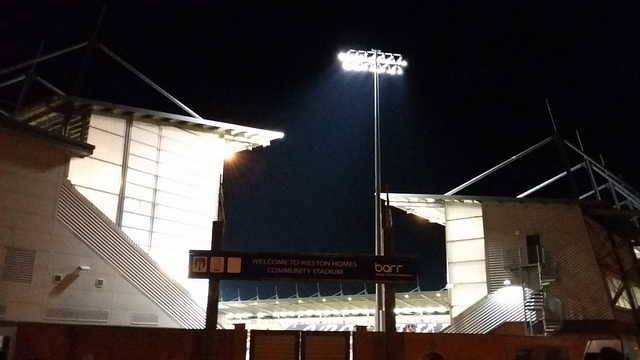
I sat with a former work colleague on the bus, we met at the bus stop. “Hello Martin” he said. “Hello Martin” I said. It sounded silly, but what can you do, we are both called Martin. Martin (that’s him, not me, I don’t like to refer to myself in the third person, only weirdos do that) has a season ticket and had one back at Layer Road. I ask how long he’d been a season ticket holder but he couldn’t say, so too long probably. Alighting from the bus I said goodbye because I wanted to stop and queue for a programme. Outside the ground there is a sense of anticipation created by this short queue and the cheery bonhomie of the programme seller. Programme (£3.00) in hand,I now pause for a moment and take in the beauty that is the glare of the floodlights huddling over the tops of the stands 33478017515_e15e34aa2f_zand the warm glow of spitting hot fat and cones of chips that emanates from a shiny white burger van.
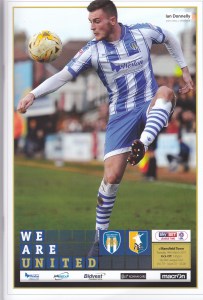
It’s 7.30 now and the tannoy gets us in the mood by playing Love Will Tear Us Apart and I have a few minutes to look at the programme before kick-off. Admirably, Col U’s programme IMG_20170317_0002always features local non-league teams and tonight there is a piece on Halstead Town; IMG_20170317_0001it is hilarious. Halstead goalkeeper Luke Banner has swallowed a lexicon of footballspeak and cliché “…you never know” he is quoted as saying “If we take one game at a time and keep picking up wins and points then who knows what can happen”. Wise words Luke. Whatever you do you don’t want to be one of those clubs that plays several games at once and loses them all; that’s a recipe for disaster if you ask me. I don’t blame Luke for the banality of his comments though, I blame the reporter on the Gazette who he was apparently talking to.

The game begins and Mansfield Town are kicking towards the goal right in front of me. “Mansfield, they’re non-league” shouts a familiar voice from the back of the stand whose understanding of promotion and relegation is clearly still strained. He says the same thing another four times before half-time. The game carries on. Briggs the Colchester left back carelessly scythes a clearance onto the roof of his own goal. The empty north stand looks on sullenly, 32634760104_740916ac06_oa blue void at one end of the sparsely populated stadium barely creating echoes; it must miss that joyous throng of Portsmouth fans that occupied it at the weekend.

The game is end to end, although probably more Colchester end than Mansfield. Mansfield’s number 10 shoots over the bar from all of 7 yards but atones, in my eyes anyway, by dancing around and over the ball a bit later in the manner of John Travolta, I bet he looks good on the dancefloor I think to myself getting Mansfield and Sheffield muddled up. Meanwhile the Mansfield supporters are a stoic bunch. We’ve not heard a peep out of them. I imagine a collection of dour characters drawn from the pen of DH Lawrence. Meanwhile again, the Colchester ‘lads’ (I can’t imagine them being lasses) break into a chorus of “Oh Colchester is won-der-ful, Oh Colchester is wonderful, It’s full of tits, fanny and United, Oh Colchester is won-der-ful.” So, once we’ve kicked racism out of football we should probably get right on to sexism. No wonder you don’t see many black women at football.

Twenty minutes pass and Colchester score, a low shot from Brennan Dickenson cutting in from the left. Soon after, Mansfield’s No 2 misses the ball completely about five yards from goal; but yes, it was a difficult angle. Still not a murmur from the Mansfieldians in the stands. Eight more minutes pass and Dickenson passes the ball into the box and after a neat turn the ball is sent into the corner of the Mansfield net by Sammy Szmodics, a man whose name is somewhat notable for its S’s and M’s; his goal make us smile.

Colchester are cock-a-hoop, Mansfield are mithered and losing 0-2. The scoreboard advertises a tribute to Robbie Williams; he’s not dead too is he? Half-time comes and I buy a tea for a pound; “Tetley, it begins with the tea”33321899142_18a137fb0c_o it says on the paper cup, but that sort of play on words doesn’t impress me; I should hope it bloody does begin with the tea, although we all know it really began with the motivation of profit. That’s why a few crushed up dried leaves and some hot water costs a quid. I am going to smash capitalism one day you know; it’ll probably be between May and August when there’s no football.

Mansfield’s number 10 continued to please once the game re-started as he shot hopelessly wide of the far post when practically stood in the Colchester penalty area on his own. The the U’s support howled with derision as well they might. The second half became a bit dull after that with Mansfield hogging the ball without really looking like scoring. In a particularly dull period of play I blew on my tea and enjoyed watching the game through a fog as the condensation very slowly cleared from my glasses. Then I did the same again. “Stand up if you love the U’s” sang the sexist Colchester fans in a moment when they weren’t thinking about lady-parts.

Then a Colchester player stayed down on the pitch after a challenge, apparently hurt; only now did the Mansfield supporters stir as they subjected the injured U to a tirade of abuse. I could see fists being shaken and fancied I heard the sort of incomprehensible angry ramblings uttered by Tom Bell in the early 1980’s BBC adaptation of DH Lawrence’s Sons & Lovers. The sudden burst of life from Mansfield didn’t go un-noticed by the U’s fans “keep the noise down over there would you please” quipped one.

The ball and players moved about as if governed by Brownian motion and it was inevitable that someone would get booked. Mansfield’s number 2 was the referee’s first choice and having been shown the yellow card he hung his head and swung his right leg stiffly as if miming “Aw shucks” and in the realisation that he would get a clip round the ear from his Ma when he got home. The score board advertised Comedy Nights the first Thursday of every month and right on queue a free-kick ended with the Mansfield No 10, who amusingly is called Matt Green, like the paint, missing the goal hopelessly once again.

Mansfield were getting nowhere fast despite restricting Colchester to breakaway attacks. Change was needed thought their manager the un-loved Steve Evans and up went the number board to withdraw Number 18. But ever the prankster it was our old friend Matt Green who started to walk off; may be it was his eyesight that had been letting him down all evening. With his dancing skills and comic timing he would have been a star in Variety, but we’ll probably need a new Bruce Forsyth before too long.

Another injury to a U’s players provoked the Mansfield support again, “Cheat, cheat, cheat” they howled. Injured opposition players seemed to be the only thing that really floated their boat. To be fair to them though, what with their rough mining heritage they probably have a fixation about soft southern jessies and if they see someone go down with all four limbs still attached to his torso they just see red.

The game was now petering out; Eddie the Eagle looked on, arms folded and Colchester just had to see out the last few minutes. When Sammy Szmodics got word he was to be substituted he made his way to the far side of the pitch first, so he had farther to walk and then stopped to shake the referee by the hand as he went off. That use of precious goal scoring time was practically enough to win the U’s the game and in the moment it took referee Mr Kinesley to blow his whistle for the last time, it was possible for most of the 2,526 in attendance to be up and on their way home.