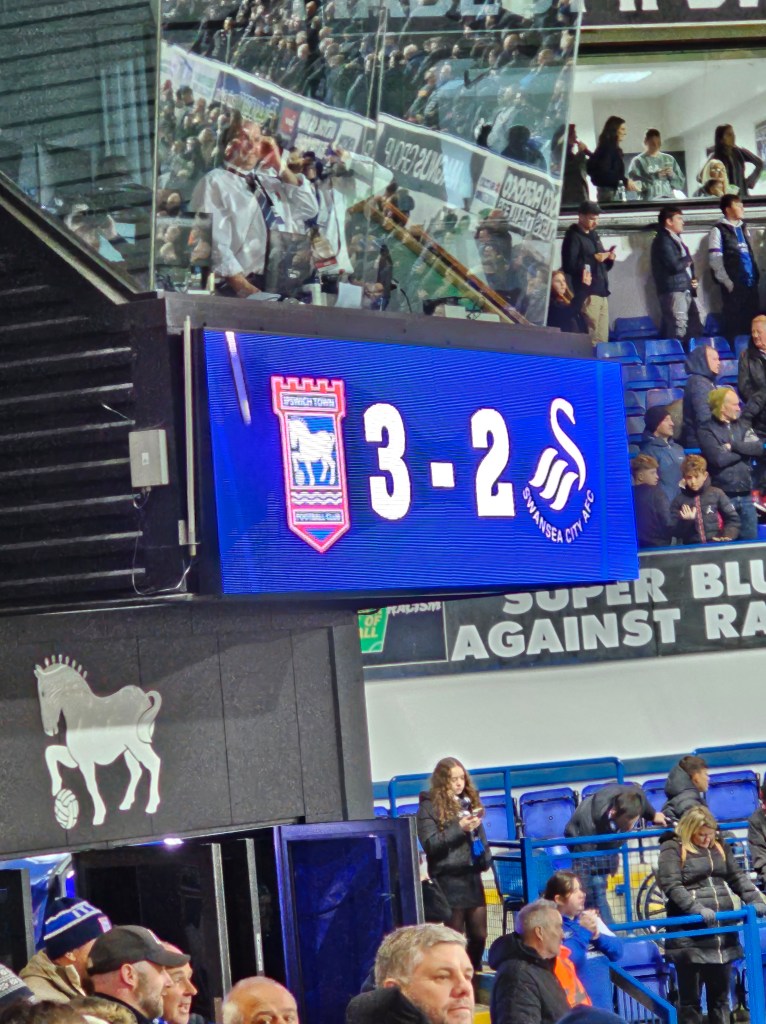
Ipswich Town 3 Swansea City 2

This morning at about half past one I suddenly awoke from what had been a deep sleep, and as I tried to return to my dreams my mind began to race and I was thinking of the first time I saw Ipswich Town play Swansea City, almost exactly forty-two years ago, on 7th November 1981.  Swansea, enjoying a very good start to their first ever season in what some people now call the Premier League, went on to win by three goals to two.  I was only twenty-one years old, and recall being royally pissed off at what I think was the Town’s first home defeat of the season.  The following March, I drove down to the Vetch Field, Swansea with my friend Tim in his 1968 Morris Minor 1000, and despite the best efforts of referee Clive Thomas, who awarded the home team a highly dubious penalty, we witnessed Town exact revenge as we won by two goals to one.  We stayed the night in Swansea, and spent an evening crawling the city’s pubs. Sadly, all I really recall, apart from correctly pronouncing Cymru Cenedlaethol on the side of a bus,  is playing pool in a pub and leaning down to look along my cue and seeing beyond it and the cue ball and the cushion and up the dress of a young woman sat on the other side of the bar, opposite the pool table. I was a shy, single, young man so I probably blushed, but shamefully I cannot deny that the sight of this young woman’s red pants has stayed with me ever since.  In their early twenties my grandfathers and my father had all been tasked with killing Germans, but I just had to cope with the freedom they helped win.

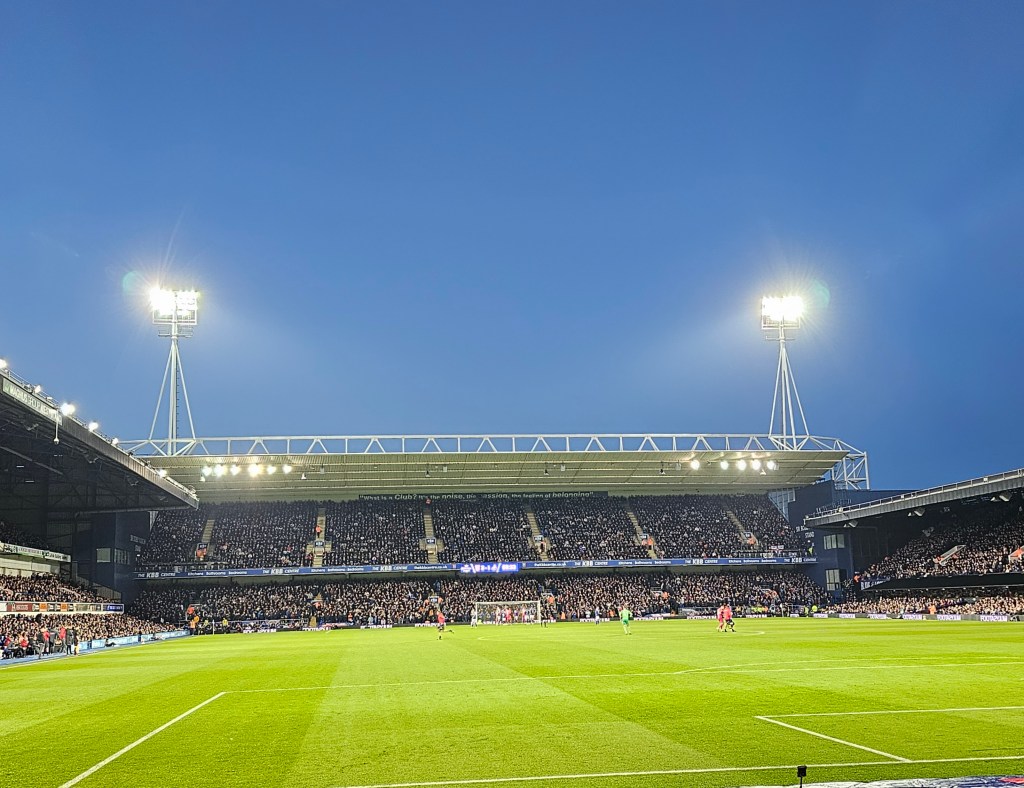
Since that guilty, intoxicated evening in South Wales, I have seen Swansea City a further fourteen times, but only half of those matches have been against Ipswich Town. The other seven matches were at Manchester City (one), Portsmouth (one) and Colchester (five), and Swansea didn’t win any of them.  In all the intervening years I have never seen another Welsh woman’s pants and even though Ipswich are once again playing Swansea City, I do not expect to do so today as I step from my front door beneath a clear blue sky and head for the railway station.  I have been looking forward to today’s game after no home match for three weeks, and in an early morning trip to the shops even bought two packets of Welsh cakes by way of celebration; I ate a couple for breakfast. I was born in Wales see, albeit in Haverfordwest.

The train is on time and not particularly busy.  At the first stop I am joined by Gary who is wearing a bright orange jacket over his Ipswich Town home shirt. We talk of whether we are sat in a carriage or a car, when Gary is likely to retire, the sort of people who ‘go postal’, and on which train journeys to watch football matches it might be possible to see a Polar Bear from the train window; surprisingly Swansea to Ipswich is one of them.  It seems unlikely there are trains to Svalbard, but hopefully there is football even if only with seal skins for goalposts.  Arriving in Ipswich, my exit from the station is annoyingly delayed by being unable to display my e-ticket on my phone, I eventually manage to create a glimpse of it for a split second and fortunately the ticket collector seems happy with that.  I will later learn of an “update”.

Gary and I stroll up Princes Street and Portman Road towards ‘the Arb’, pausing only so that I may buy a programme (£3.50) from one of the blue booths, the appearance of which tempts me to ask for a choc ice as well, but luckily I resist. At ‘the Arb’, Mick is already stood at the bar about to order a pint of Mauldon’s Suffolk Pride.  Now aware of our arrival, Mick generously buys two pints of Suffolk Pride, and a pint of Lager 43 for Gary, who to my knowledge never has drunk proper beer.  We repair to the beer garden to talk of the horrible Suella Braverman, the ‘A Load of Cobbolds’ fanzine, the Covid enquiry and the lies of Boris Johnson, and last night’s Ligue 1 encounter between Montpellier Herault SC and OGC Nice, which despite being an open, attacking match, ended goalless. I return to the bar to buy myself a further pint of Suffolk Pride, a Jameson whisky for Mick and a half of Lager 43 for Gary (£10.40 including Camra discount). We continue our conversation, which unusually does not involve reference to death or illness today, although we do talk of remembrance poppies and Mick recalls how his father was responsible for distributing them in the Orford area and how in the days when the ‘stems’ were made of wire the poppies first had to be assembled.  At about twenty-five to three we depart for Portman Road.
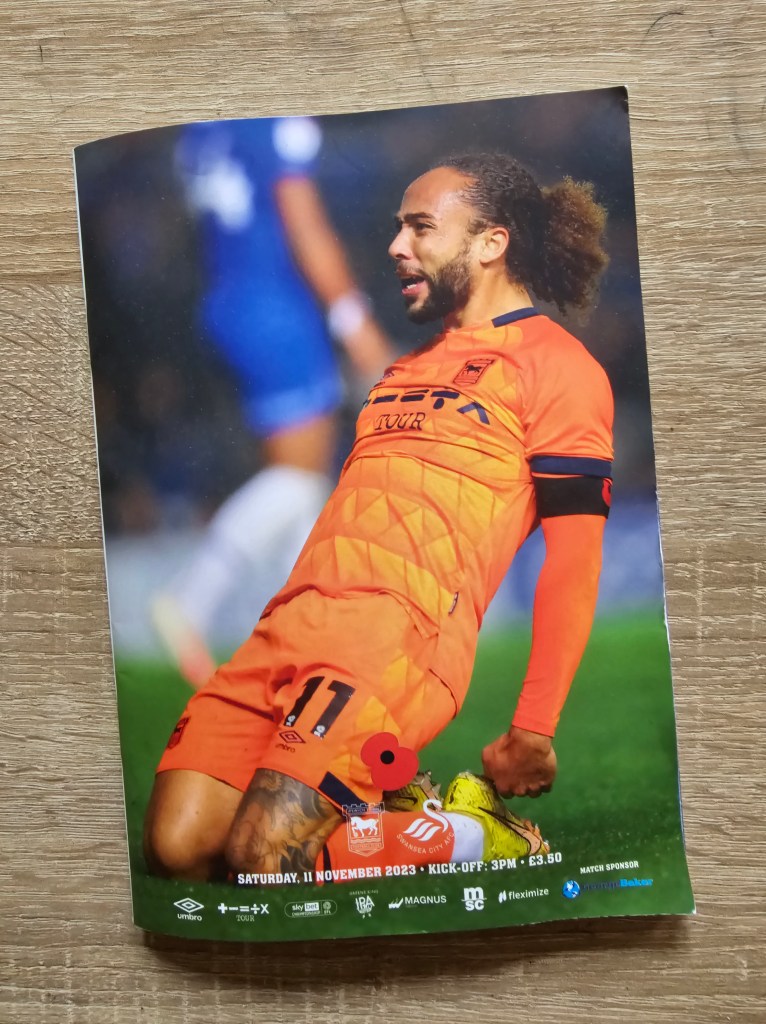
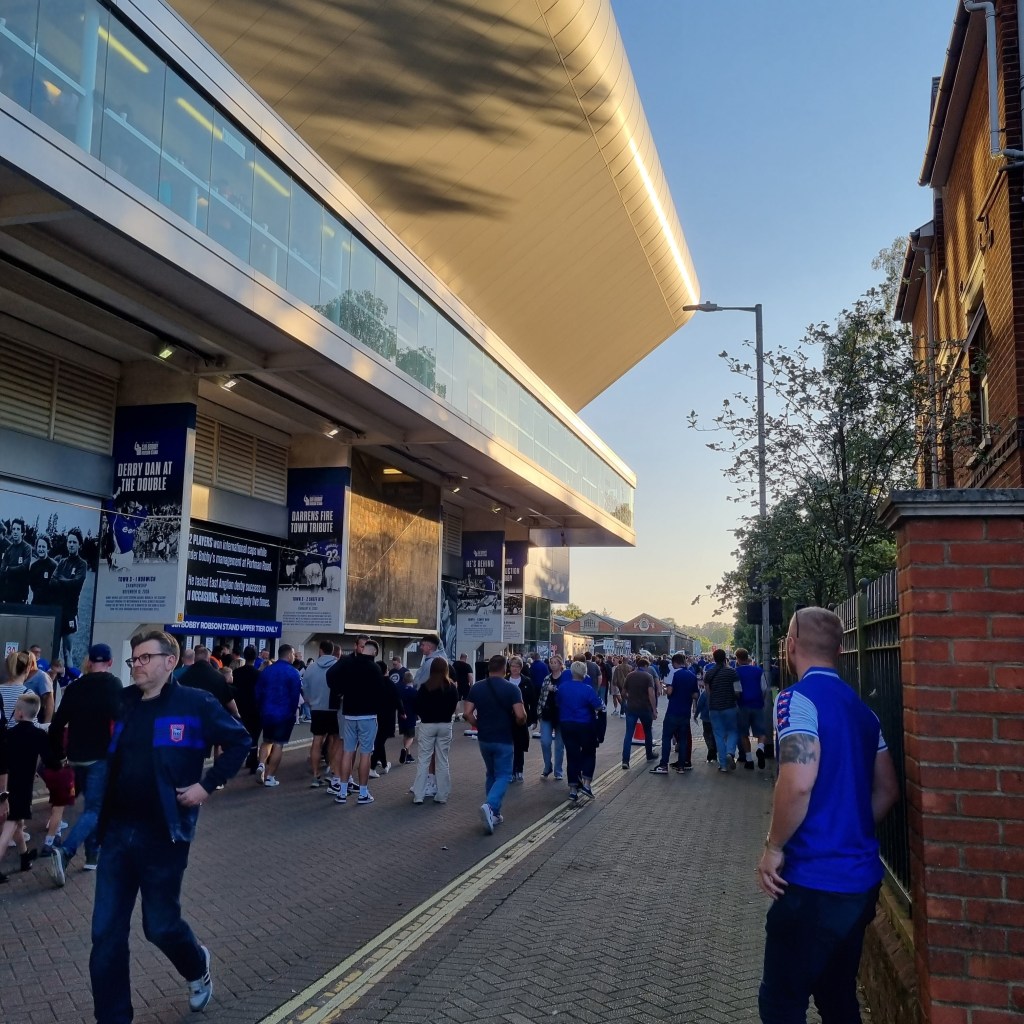
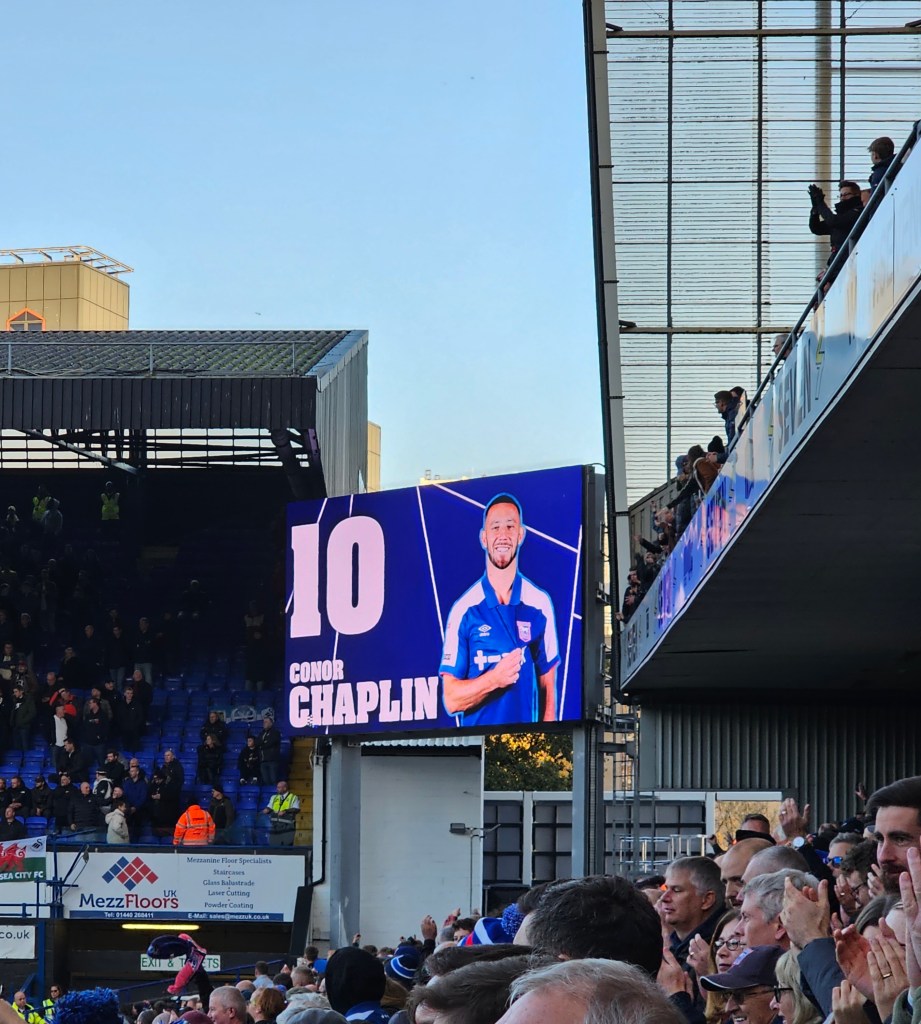
The queues at the back of the Sir Alf Ramsey stand are shorter today and seem to be being managed by stewards.  I go to queue at the illustrious turnstile 62 but am ushered towards a side gate where my season ticket is scanned by a woman using a hand-held device which looks like one of those things you use to find hidden electrical wiring in walls. I arrive at my seat moments before the two teams parade onto the pitch. Naturally, the man from Stowmarket, Fiona, Pat from Clacton, ever-present Phil who never misses a game and his young son Elwood are all already here, although it’s Pat’s first game in a while as she’s been in Mauritius to attend a wedding.  Ever-present Phil and I attempt to bawl out our players’ surnames in the French style as stadium announcer Murphy reads out the line-up, but as ever Murphy is in far too much of a hurry and has finished before the players’ faces have stopped appearing on the large screen; he really is useless, bring back Steven ‘Foz’ Foster I say.

After a minute’s silence and the last post and occupation of the centre circle by various personnel from the armed forces, things never seen or heard at football matches until comparatively recently, the game begins, with Ipswich in traditional blue shirts and white shorts getting first go with the ball,  and sending it mostly in my general direction.  Swansea City are today wearing an un-necessary away kit of reddish shirts, shorts and socks.  Unfortunately, the reddish colour of their kit reminds me of the young Welsh woman’s pants from 1981, so I try to imagine them all with just one leg each and no heads, to make them look like a team of Lyons Maid Raspberry Mivvis.
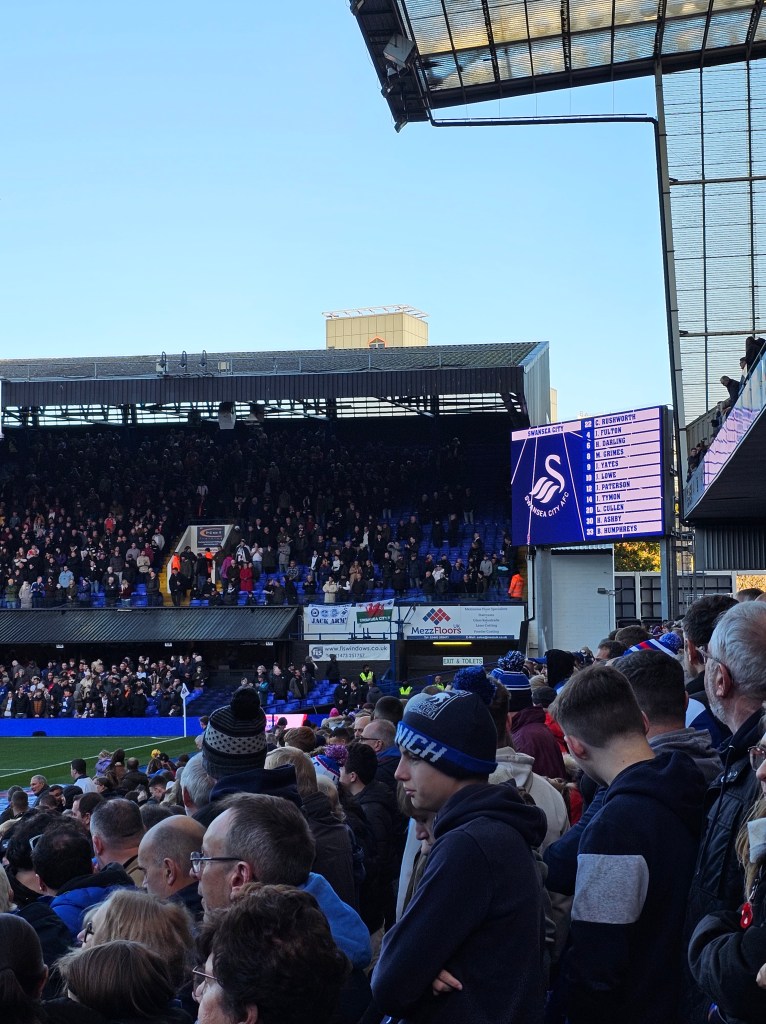
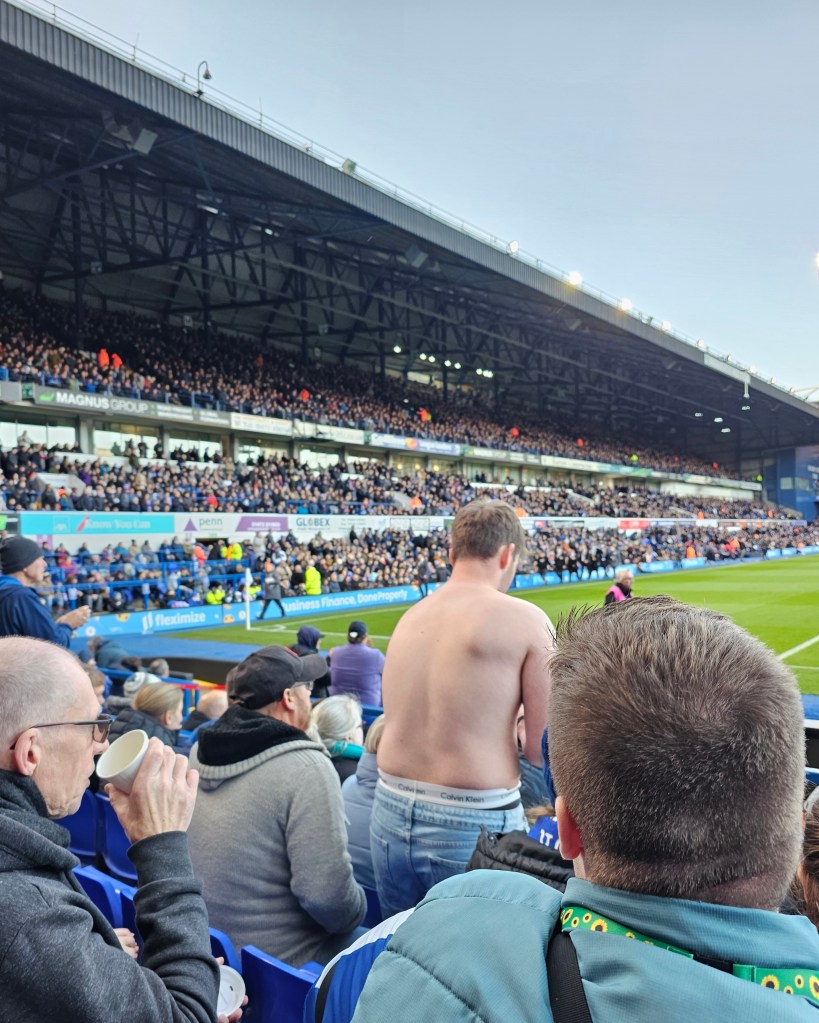
“I do, but I don’t” says the bloke behind me about I’ve no idea what, and after three minutes Town win the game’s first corner. A couple of rows in front of me a young man is topless and the waist band of his Calvin Klein pants is visible to all.  Suddenly I can smell meat and gravy and assume that someone nearby has bought a pie; it’s either that or the Army personnel in the centre circle were from the catering corp.  “Blue and White Army” chant the section of the crowd up in the corner of the Cobbold Stand before a wider congregation strikes up with a chorus of “We’ve got super Kieran Mckenna, He knows exactly what we need…”.   The Swansea goalkeeper, whose name, Carl Rushworth, would be ideal in a match with ‘rush goalies’ is all in orange, so looks like a Wall’s Solero Exotic.  “Ipswich Town, Ipswich Town FC, By far the greatest team the world has ever seen” chant some of the crowd and there’s every chance I sang the very same at the Vetch Field back in 1981.

Seven minutes are almost up and rather disappointingly Swansea City score, a dinked cross from inside the penalty area being nodded into the corner of the goal by their number four, a bloke called Jay Fulton. “Who are ya?” chant the Swansea fans having presumably forgotten where they are and being too idle to look at their match programmes or tickets.  “One-nil to the sheep shaggers” they continue, in more revelatory mood, and suddenly I don’t feel quite so bad about having once accidentally glimpsed a young Welsh woman’s pants in a public bar.

Town win another corner. “Come On You Blues” I shout and from a low cross, a shot goes curling over the cross bar. “Der, der, der, Football in a library” chant the Swansea fans imaginatively, getting in as much gloating as possible whilst they still can.   Omari Hutchinson shoots straight at Rushworth and for the third time in the last few minutes a Town player is flagged offside, raising doubts about the parentage of the linesman with the chequered flag.

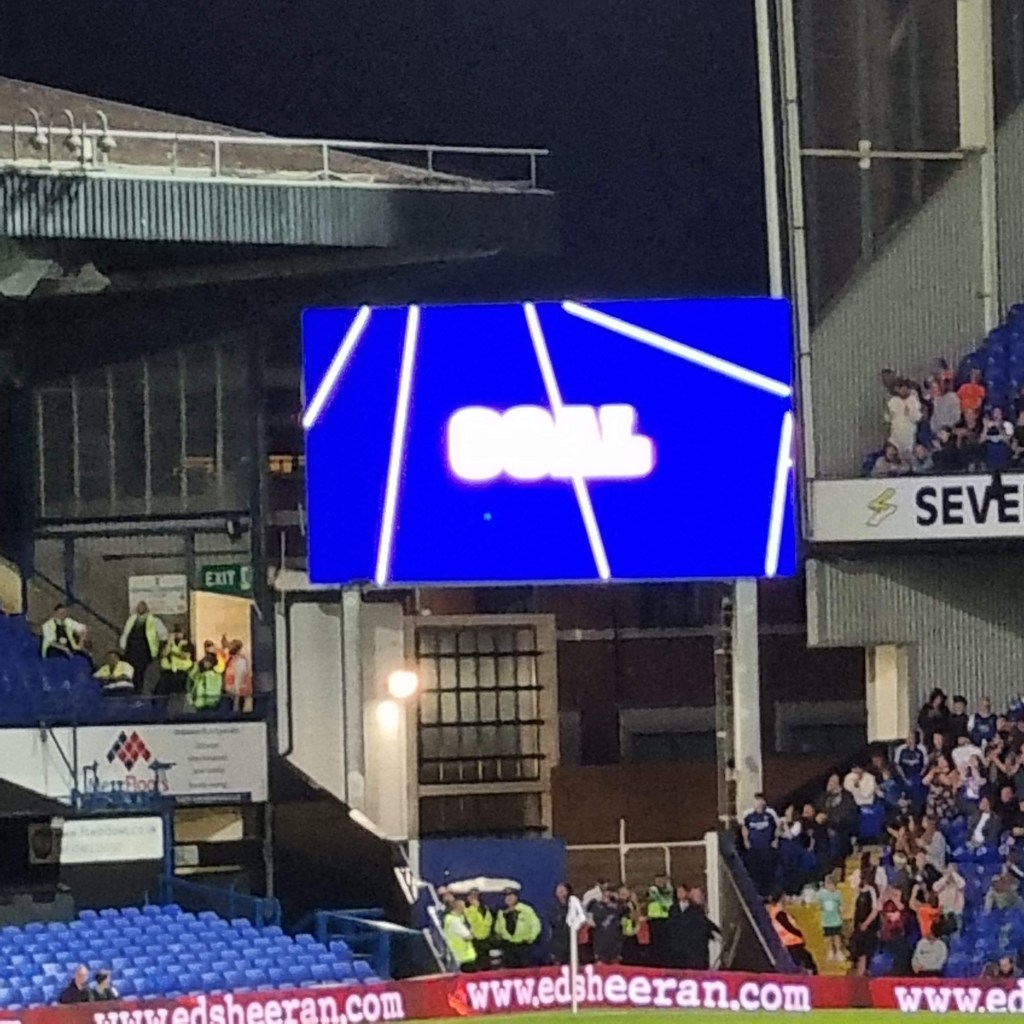
Town are giving Swansea a hard time, but all of a sudden the world is restored to its axis in truly spectacular fashion as Jack Taylor strikes a magnificent 20-odd metre shot against the inside of Rushworth’s left-hand post and the ball hurtles and spins into the back of the net.  Quel but! (What a goal!) as they didn’t get to shout in Montpellier last night.  From my position in the cheap seats, I have a thrilling head-on view of the ball as it speeds towards the goal.  All the best goals strike the wood work as they go in; that final split-second diversion adding a thump of confirmation to the event, like having your passport stamped or hearing the pop of a Champagne cork.  As Fiona observes, today’s goal is the polar opposite of Taylor’s goal at Rotherham earlier in the week, which spun in off his leg from close range, almost without his knowing it.

Ipswich Town are now almost unstoppable. Conor Chaplin shoots over the bar and Omari Hutchinson has a shot saved despite having seemingly dribbled around Rushworth.  “Hark now hear the Ipswich sing, the Norwich ran away” sing the Sir Bobby Robson stand getting all festive and nostalgic at the same time, and just five minutes after Taylor’s goal, George Hirst heads the ball down and Conor Chaplin spins on his right foot and hooks the ball inside the near post with his left from a few metres out. The Town lead two-one.  Presumably, the Swansea fans up in the Cobbold stand now answer their earlier question “Oh, it’s you lot” .

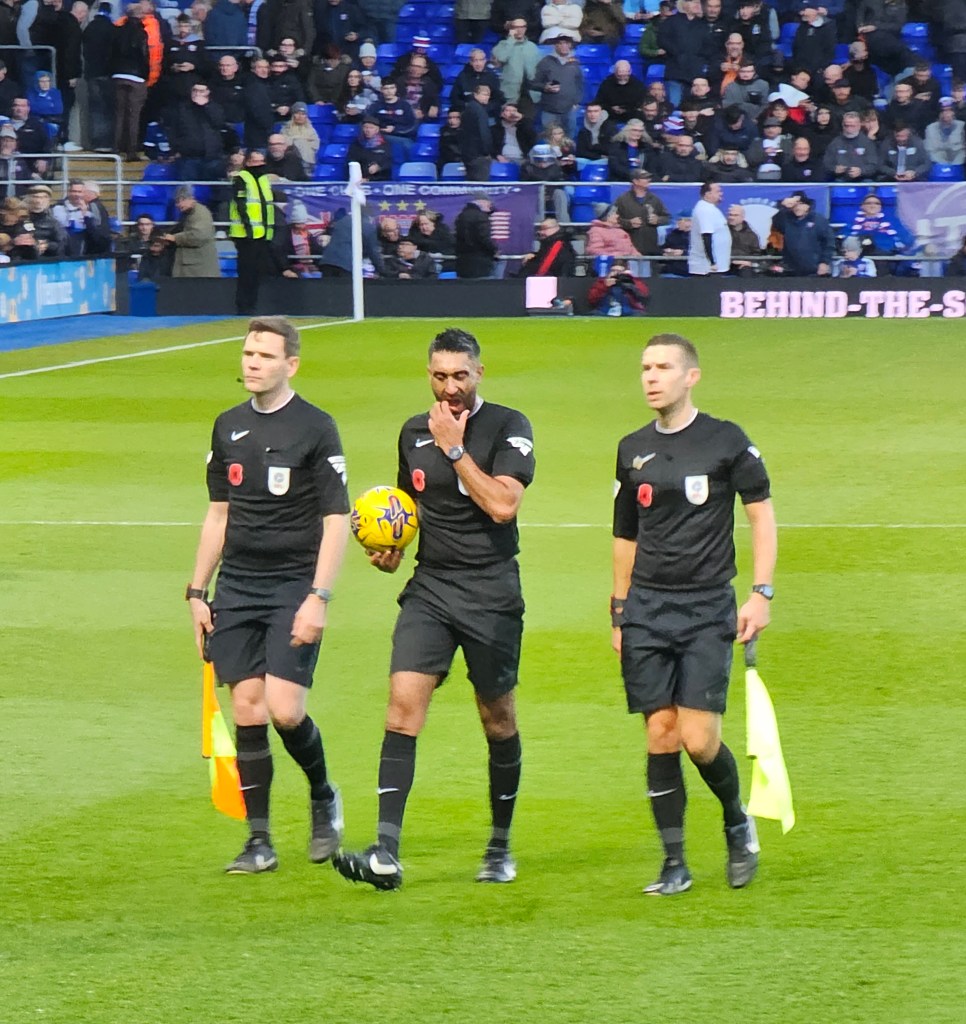
Town now just need some more goals to confirm their superiority, but instead there is a bit of a melee with players either squaring up to, pushing away or pulling apart their team-mates and opponents, perhaps depending on how zen they are feeling today.  Conor Chaplin and Swansea’s Liam Cullen are booked by referee Mr Sunny Singh Gill, presumably as the instigators.  In the stands there is almost the burst of a song, but then it all goes quiet, with even the away fans feeling too crushed by the turn around in scoreline to sing “Two-one, and you still don’t sing”.   If there was a corner of the ground occupied by fans of a musical and literary bent, now would be the time for them to sing “ We all agree,  Britten is better than Thomas”.

With ten minutes of the first half left Omari Hutchinson breaks down the right, but his low cross is just an overly long stud’s length away from being diverted into the goal by Nathan Broadhead.  A couple of minutes later the blokes behind me clear off to the bar, whilst Mr Singh seems to take far too long to allow Conor Chaplin back onto the field after receiving treatment, perhaps he has been influenced by Suella Braverman and sees receiving treatment as a ‘lifestyle choice’.

In the final ‘normal’ minute of the half Sam Morsy gives George Hirst the chance to score, but Hirst’s shot is saved and as we progress into four minutes of additional time Jack Taylor surges into the box and might or might not be tripped and Portman Road reverberates to the sound of the question “Who’s the wanker in the black?  Encouragingly, I don’t hear any references to Gunga Din, Gandhi or corner shops, although Mr Singh is roundly booed as he leaves the pitch.

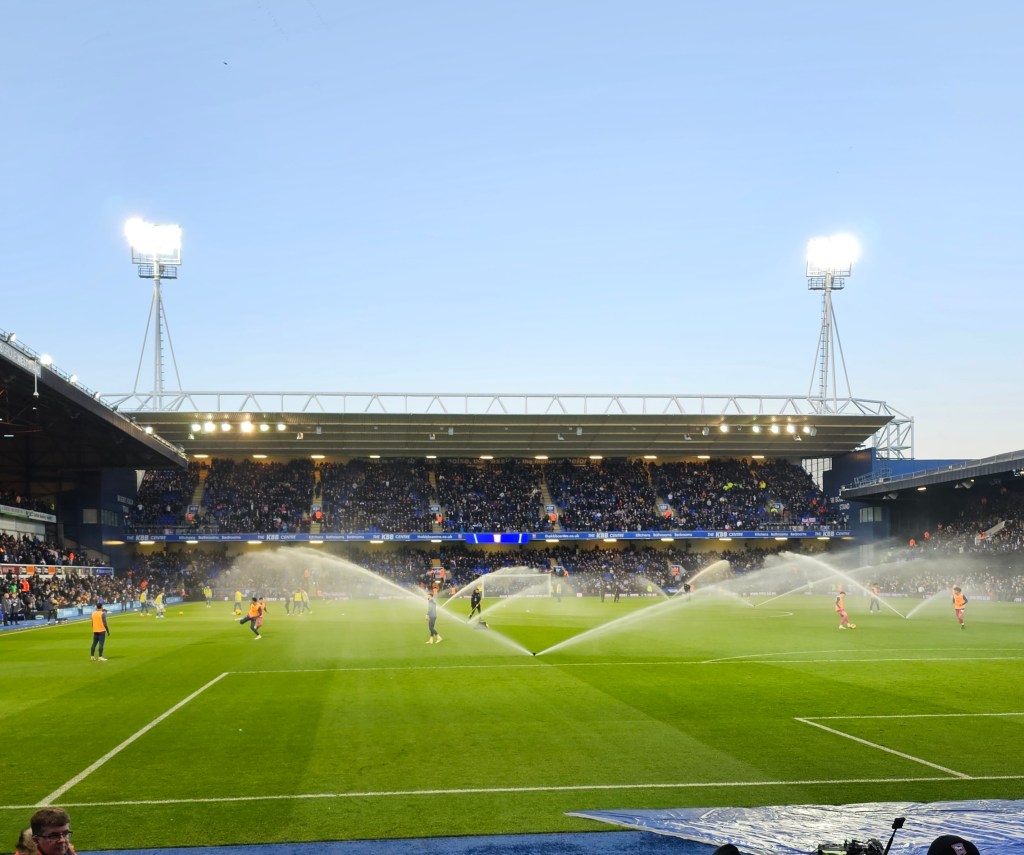
The half-time break brings a chat with the man from Stowmarket who Pat from Clacton later discovers is called Paul.  I syphon off some spent Suffolk Pride and enjoy the almost theatrical display by the pitch sprinklers before the football resumes at ten past four and Town set about getting the goals that they should have and almost did, but ultimately didn’t score in the first half. Immediately things are different as the seat next to me, which was empty in the first half, is occupied by a woman with obviously dyed hair, who might be the mother of one or more of the blokes sat behind me.  Ipswich quickly win a corner after some argument, and predictably once the kick is taken a free-kick is then awarded to Swansea.

Mr Singh further endears himself to the crowd as Leif Davis is cynically shoved into the advert hoardings as he tries to run past a Swansea defender, but no yellow card is shown.  Seven minutes into the half however all is forgiven, for a while any way, as Mr Singh awards Town a penalty.  No one sat near me has any idea why,  but we’re not too bothered, particularly when George Hirst steps up to score and Town lead three-one.  There is a feeling of contentment around me and it seems like we will be happy if the score stays like this, although further Town goals will not be turned away.

The action on field follows the pattern of a team closing the game down and Swansea enjoy more possession but to little effect. There are however occasional moments of anxiety. Swansea break forward, but Leif Davis calmly first looks for the offside flag, and then realising it isn’t coming makes a perfectly timed sliding tackle inside the penalty area. Five minutes on and the first substitutions are made for Town as Marcus Harness and Wes Burns replace Omari Hutchinson and Nathan Broadhead.  Pat from Clacton shares with us how much she loves Marcus Harness’s ‘lovely blue eyes’ and can’t hold back from telling her that even I had noticed those too.  Harness immediately intercepts a Swansea pass and draws appreciative applause.

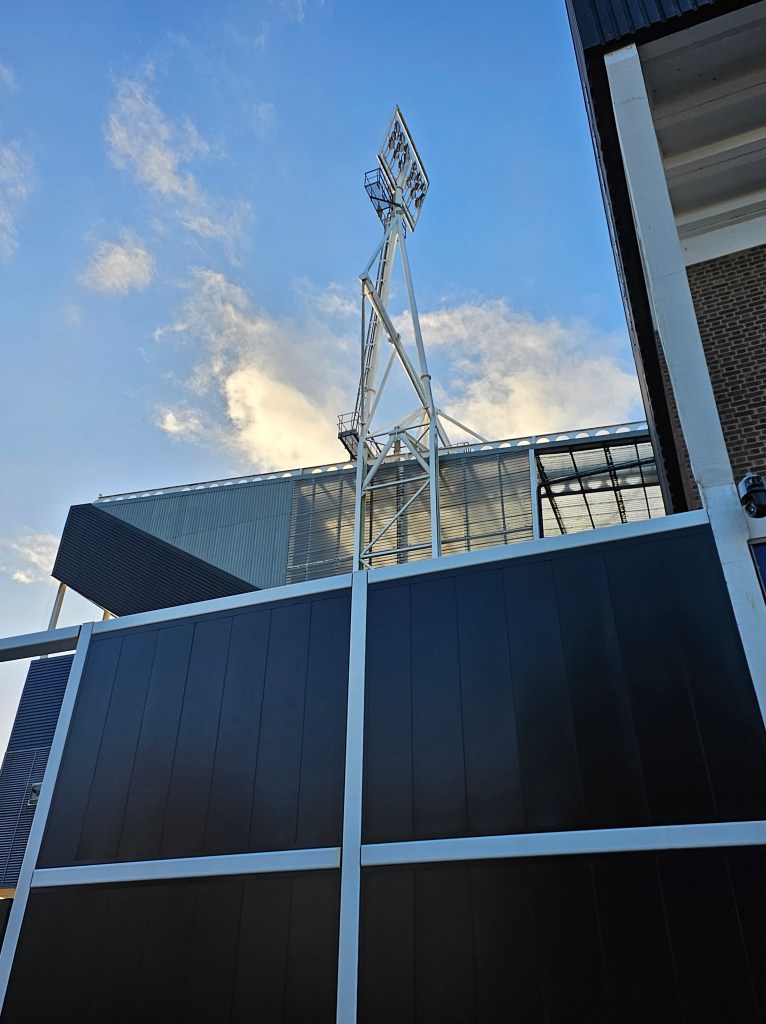
There are twenty-five minutes of normal time remaining as Town win a corner and the sky darkens behind the floodlights as one of the first early winter evenings descends and I can feel the chill of the air as I breathe in. “Carrow Road is falling down” chant Town fans in the furthest top corner of the Cobbold stand, but where I’m sat no one can understand what else they’re singing or whether it’s witty, abusive or stupid.  Four minutes later and Mr Singh stops his charm offensive as he sends off Swansea’s Liam Cullen, we think following a second yellow card after a foul on Leif Davis. “Cheerio, Cheerio, Cheerio” sing the Town fans sympathetically.

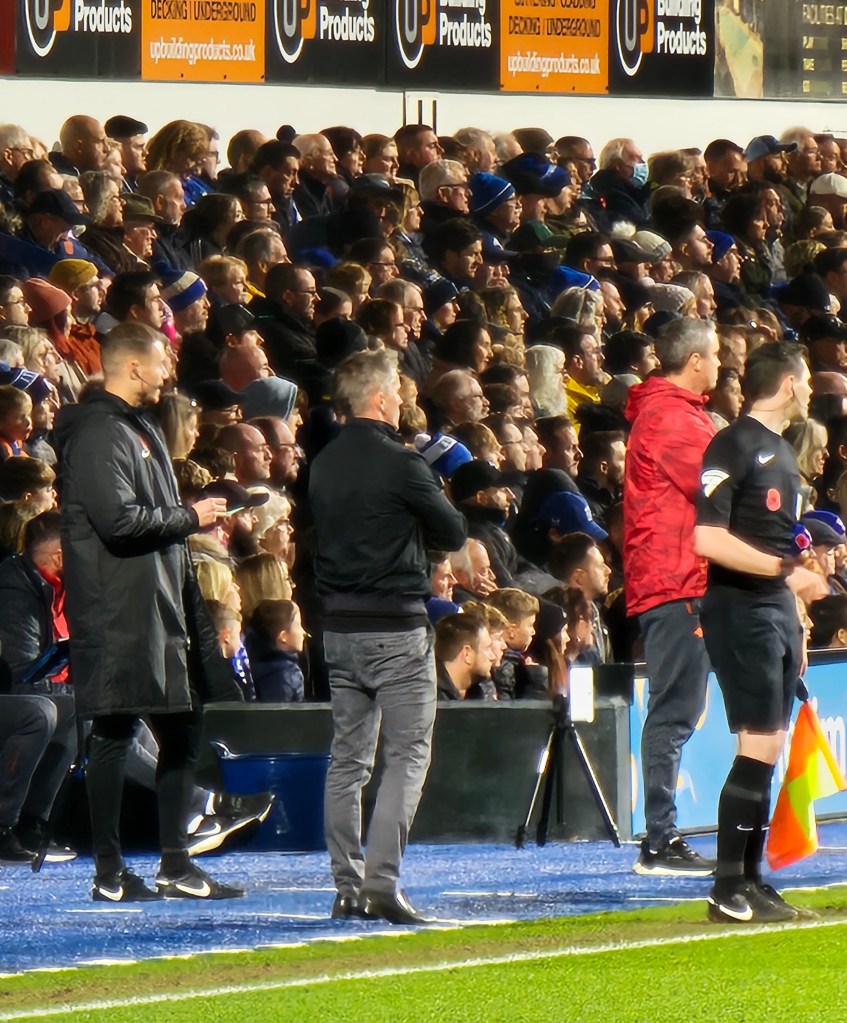
Surely the three points are now safe with only ten men to play against, and the optimism in the stands   is expressed in chants of “Ole Ole Ole” from those Town fans who just won’t let the memories of holidays on the Costas fade away.  Would that Keiran McKenna, as wonderful as he is, was as colourful, as he stands in the technical area in his dull grey trousers and black car coat.  If promotion to the First Division is achieved, I’m hopeful that the budget will then stretch to a stylist for Kieran.  Town win another corner and the attendance is announced by Murphy as 28,929 with 634 from Swansea, although to be fair to the Welsh it is a very long way from Ipswich; four-hundred and forty-three kilometres in fact.  “Thank you once more for your incredible support” says Murphy, stretching the definition of incredible.

The final ten minutes of normal time see Marcus Harness booked by Mr Singh; the bloke behind me asks “ Is he dead?” of the player Harness fouled. Town win a corner and Mr Singh walks patiently over to the dug outs to raise his yellow card towards someone on the Swansea bench.  Freddie Ladapo replaces George Hirst. Swansea win a rare corner and we are told that there will be a minimum of nine minutes of additional time, which in percentage terms when added to the four in the first half is greater than the Camra discount on beer at ’the Arb’. 

I am thinking that added on time is just something to be endured, until the right-hand side of the Town defence gets a puncture and Jamahl Lowe rather embarrassingly skips past Luke Woolfenden and around the excellent Vaclav Hladky to make the score three-two from very close range.  Pat from Clacton is suddenly nervous, and Hladky makes a late challenge for the title of Man of the Match, even though it has already been awarded to Jack Taylor.  But Town survive and victory is ours yet again, and it’s been yet another rollicking match; Kieran Mckenna and his team continuing to make up for  fifteen years of mediocrity and worse, in fifteen months.

It’s gone five o’clock as Pat from Clacton and Fiona hurry away to buses and trains, but I stay for a short while to applaud, although the game has finished so late that I can’t linger long either, as my train leaves at nineteen minutes past.  When I eventually head into the cold, damp evening I wonder if this afternoon’s match will live in my memory like my trip to Swansea of forty years ago, I hope so.

Ipswich Town 2 Bristol Rovers 0

When the draw for what used to be called the League Cup was made, I was quite pleased to find that Ipswich had drawn Bristol Rovers; this was because Bristol Rovers were the only one of Town’s third division opponents I didn’t see last season.  I’m not sure why that mattered, it’s not as if I keep notes on each team, although in an odd way, through this blog, I suppose I do. Oh dear.
Despite my earlier happiness at the draw, it has taken me until the night before the game to get round to buying a ticket because despite the grotty weather, in my head it’s still summer, and summer is for dreaming and for World Cups, oh, and occasionally for European Conference League qualifying games.   Football is mostly something for autumn, winter and spring.  As usual for League Cup matches, because all the seats cost a tenner I choose not to sit in my season ticket seat, but to explore one of the twenty-nine and half thousand odd other viewpoints.   Usually, I head for the best view and the padded seats of Block Y, and there are still single seats available, but craving company I texted my friend Gary to see if he is going; he is, and gives me his seat number which he tells me is close to where he usually sits in what used to be called the West Stand.  I buy the seat next to Gary which turns out to be uncomfortably  close to the corner of the ground; but it’s okay as I had warned Gary that I would blame him if the seat wasn’t very good, and now I can.  To think, I could have been in Block Y.   I also texted my friend Mick to see if he is going to the game, but he tells me that he has “no interest in the League (Carabao) Cup”, which I thought was a bit haughty of him.

Having parked up my planet-saving Citroen e-C4 in a street between Norwich Road and Anglesea Road, it’s a short walk to the Arb on High Street where I obtain a pint of Mauldon’s Suffolk Pride (£3.60 with Camra 10% discount). The bar is not very busy, and I tell the barman that I had expected it to be busier, but he tells me most people are in the beer garden.  He’s correct, most people are, but there are still free tables and I can only see one bloke in an Ipswich Town shirt.  I settle down to drink my unexpectedly cloudy pint, and read Issue 26 of the Turnstile Blue fanzine, a small pile of which were in the corridor between the bar and the gents.  I read an article which, in the context of the ‘fuss’ surrounding the death of the old queen, attempts to debunk the apparently mythical status afforded to former Town chairmen John and Patrick Cobbold.  The basis of the argument seems to be that they were incredibly wealthy and posh, and ‘Mr John’ drank and swore a lot.  I don’t read much more because the penetrating voice of a man possibly in his late twenties, who is with the bloke in an Ipswich shirt, and the mild but loud Ipswich accent of a woman probably in her forties are preventing me from concentrating.  After half an hour of slow supping and covering my ears, I leave for Portman Road.

Arriving in Sir Alf Ramsey Way shortly after seven-thirty, I buy a programme (£2.00) in the modern cashless manner and am then surprised to see long queues at the turnstiles.  Tonight, in the spirit of saving the planet by not using unnecessary pieces of paper, my ticket is on my mobile phone and my inner Luddite wonders if technology is the reason for the slow progress into the stadium.  Moments before reaching the turnstile, my finger slips on my phone screen  and I accidentally delete the e-mail that includes my ticket, but fortunately I know I can still find it if  I look through all my e-mails and that’s what I do.  Happily, the QR code on my e-mail also works and I pass through the turnstile just in time to drain off some Suffolk Pride and make it to my seat before the names of the Ipswich team have all been announced.  I try to call out the surnames of Town players in the manner of a French football crowd, but the ‘new’ stadium announcer Mark Murphy says Dom Ball instead of Dominic Ball and ruins things completely.

The match kicks off at fourteen minutes to eight according to the digital clock on the scoreboard. Town get first go with ball, kicking it mostly towards Sir Alf Ramsey’s stand, and are wearing the traditional blue and white kit, which this season has broad white stripes down the sleeves that from some angles make the whole sleeve look white.  Kits have to be imbued with meaning nowadays and we are told that the design is inspired by the kit worn by the promotion winning team of 2000.  When the sleeves look all white, I am reminded of our Premier League winning side of 1962.  Bristol Rovers for their part wear black shorts and white socks to cover their loins, buttocks and calves and grey shirts over their torsos.  I do not know if the Rovers shirts are imbued with meaning or not, but I like to think they are inspired by a foggy day in the Bristol Channel or specks of ghostly coal dust blown across from the South Wales pits or Cardiff docks.  Gary and I speculate as to whether we have already seen this season’s dullest kit worn by an away team at Portman Road and recall how Manchester United once wore a grey and black kit at Southampton and changed at half-time when already three or four goals down, supposedly because the players couldn’t see each other against the background of the crowd.  It seems probable from the half-time score that they couldn’t see the Southampton players either.

Town dominate possession and after just twelve minutes take the lead. A passing move down the right ends with Jack Taylor passing a ball from Kayden Jackson into the Bristol goal net.  That was easy.  I haven’t really tuned myself into the game yet however, and rather than leaping up and punching the air in a display of forgotten youthful exuberance like I would normally, I just slowly raise my bottom off my seat and applaud politely in a semi-stooped position.  Gary’s reaction is similarly sluggish. For these supporters it still feels like pre-season, the overture, or to employ a war-themed comparison popular with football pundits, like 1939, the phoney war.  Elsewhere in the stadium people are more attuned to the programme as they beat drums and chant “Blue and White Army.”

Town continue to dominate possession and occasionally come close to scoring a goal, but not close enough.  I haven’t seen Gary since July 1st, so we talk as much as we concentrate on the game.   Gary asks me what is the worst football ground I’ve ever been to. I tell him I think it was Oxford United’s Manor Ground.  He asks what the best ground was. I tell him possibly The Velodrome in Marseille, although the Allianz Riviera in Nice is pretty good when full.  Having been unexpectedly put on the spot I forget to mention the Stade Felix Boleart in Lens and the Stade Geoffrey Guichard in St Etienne.

Bristol Rovers only occasionally approach the Town goal and their first shot just creeps and bobs and bounces its way across the turf into the arms of the Town goalkeeper, the interestingly monikered Cieran Slicker. It takes a good twenty minutes or more for Rovers to have another shot and this time Grant Ward’s much more powerful shot is parried away by Slicker for what amounts to a pretty good save. It’s a moment which results in my hearing the faint call of “Come On Rovers” carried over the pitch on the warm evening air from the one hundred and twenty-three Bristolians in  the far corner of the stadium.  Otherwise, the first half of the game leaves no lasting impression on me and after a minute of time added on it’s time for Gary to nip to use the facilities whilst I stand up and try to manipulate my neck, which has grown achy and stiff from having my head turned towards the Sir Alf Ramsey stand for most of the previous forty-six minutes.

 Once Gary has returned, the ‘new’ stadium announcer Mark Murphy appears on the pitch wearing what looks like the same suit that replaced announcer Stephen Foster used to wear.  Murphy tells us he is going to talk to a Town legend and with the artificially excited intonation and words-all-rolled-into-one pronunciation of a former local radio DJ, he announces “Johnny Warks here” and Gary and I look at each other wondering who the hell Johnny Warksear is.  Johnny Wark appears on the big screen and all that’s missing are the subtitles when he speaks.

The game resumes at ten minutes to nine and my hopes of spending the second half just looking straight ahead take a dive as Bristol start quite well.  “Wo-o-o-oh, That’s the way we like it” or something like that sing the Sir Bobby Robson Stand to the tune of what seems to be an original composition or a song I don’t know.  Rovers are gifted a corner as Lee Evans passes the ball back to a place where Cieran Slicker isn’t standing.  But then Ipswich win a couple of corners of their own to redress the balance, before on-loan Omari Hutchinson is the first player to be booked after not so much a bad tackle as an inept one.  “Ole, Ole, Ole” sing the Sir Bobby Robson stand and the drums up in the corner of the stand by the club shop beat; inside the shop stuff must be bouncing off the shelves.  In the seat in front of me a bloke with not much hair has a pair of sunglasses perched on top of his head.    There’s a holiday feel to the crowd tonight with adults and children wearing T-shirts and shorts, looking as if they’ve been at the beach all day.  I half expect to see someome eating candy floss or wearing a ‘kiss me quick’ hat. On the pitch, the second half is reflecting the cheery mood with carefree attacking football and as result Cieran Slicker makes a spectacular save with his feet.

Substitutions arrive on sixty-six minutes with Cameron Humphryes and Sone Aluko taking a bow. Shots rain in on the Bristol goal and a corner is won.  “Oooh Sone Aluko” sing the Sir Bobby Robson Stand to the tune of the White Stripes’ Seven Nation Army.  Marcus Harness half-volleys the ball from close range, but too weakly to bother the Rovers’ goalkeeper.  As more substitutes warm up on the touchline in front of us I say the name of George Hirst to Gary.  “I know what you’re going to say” says Gary “He has a haircut that looks like his mum cut it using a pudding bowl”.  Gary knows me too well and is almost exactly right, but I’d say she used a side plate or small frying pan giving his hair the appearance of a little hat or beret.  I struggle so much to accept George’s haircut that if it had been up to me I wouldn’t have signed him, so it’s probably as well that it wasn’t.

In the seventy-third minute George and Conor Chaplin and Harry Clarke get to make the transition from bench to pitch, but the only immediate result is that Javani Brown shoots wide of the Town goal for Bristol. Within a minute of that however, a sweet passing move down the left sees the ball relayed across the penalty area for Sone Aluko, who seems to be existing in his own isolated moment of time and space, which allows him to then pass the ball into the far corner of the Bristol goal, and Town lead 2-0. Gary tells me how his mother recently received a new copy of the local telephone directory and that there were three people in it with his surname; they were Gary, his mother and his uncle who died several years ago, but it wouldn’t surprise me if BT was a hotbed of spiritualists.

All that remains is for Murphy to announce the crowd as being 15,047 with 123 of that number being from Bristol, and for people to applaud themselves, each other, and more acceptably the travelling Bristolians.  Bristol is a long way from Ipswich on a Wednesday night, although logically no further than at any other time of day or week.  Five minutes of time are added on to ensure we get our money’s worth and when that expires we rise as one to applaud and then seep out into the night.  It’s been a decent little game, a bit low key like a pre-season match, but it’s good to see a match where none of the players appear to think winning matters more than life itself.  Bristol Rovers played their part and should have scored at least once, but on the plus side they will now have time on their hands in the middle of the week to think about what their away kit should look like next season.   As for Ipswich,  we are on our way to Wembley, my stepson and his family live in the RG24 postcode area so if I get the urge I might march on to Basingstoke, or Reading.

Ipswich Town 0 Newport County 1

The first and second rounds of the Football League Cup are always an early season treat, a chance to play an interesting ‘lower league’ club and maybe visit a ground never visited before, in fact that was almost guaranteed back in the days of two-legged ties.  Added to that, summer isn’t over (if it has ever started) and a hot and sticky road trip precedes a balmy evening of lengthening shadows beneath a maturing, setting sun. Early season evening games are blissful, beautiful occasions and I fondly remember visits to Torquay, Exeter, Scunthorpe, Darlington, Brentford, Stockport, Bolton and Wigan.   Sadly, Ipswich Town are now one of those lower league teams, and a decade or more of abject failure has transformed cup ties from nights of wonder and joy into painful experiences to be endured like a trip to the dentist or having your car MoT’d.

Tonight, our opponents are ‘little Newport County’, a phoenix club resurrected from the one that went bust in 1988, following relegation from the fourth division.  I recall seeing the original County play out a magnificently awful goalless draw at Layer Road, Colchester in that fabulously terrible relegation season, but I also recall their glorious 2-3 European Cup Winners Cup quarter final defeat to Carl Zeiss Jena at the same time as Town were cruising past St Etienne on our way to winning the UEFA Cup.  Again, like on Saturday when Morecambe played their first ever third division game at Portman Road sixty years after Town played our first ever top division game, it is somehow fitting that Newport and Town should meet forty years after both clubs’ finest moments in European competition. I visited Newport’s old Somerton Park ground back in 1988 and could only think how their opponents from the German Democratic Republic must have been glad to get back behind the ’iron curtain’, doubtless with renewed faith that Communism was far superior to Capitalism and produced much better football stadiums, which of course it is and did, if you do it right.  Communism is a bit like sex, a great idea but best only conducted between consenting adults.

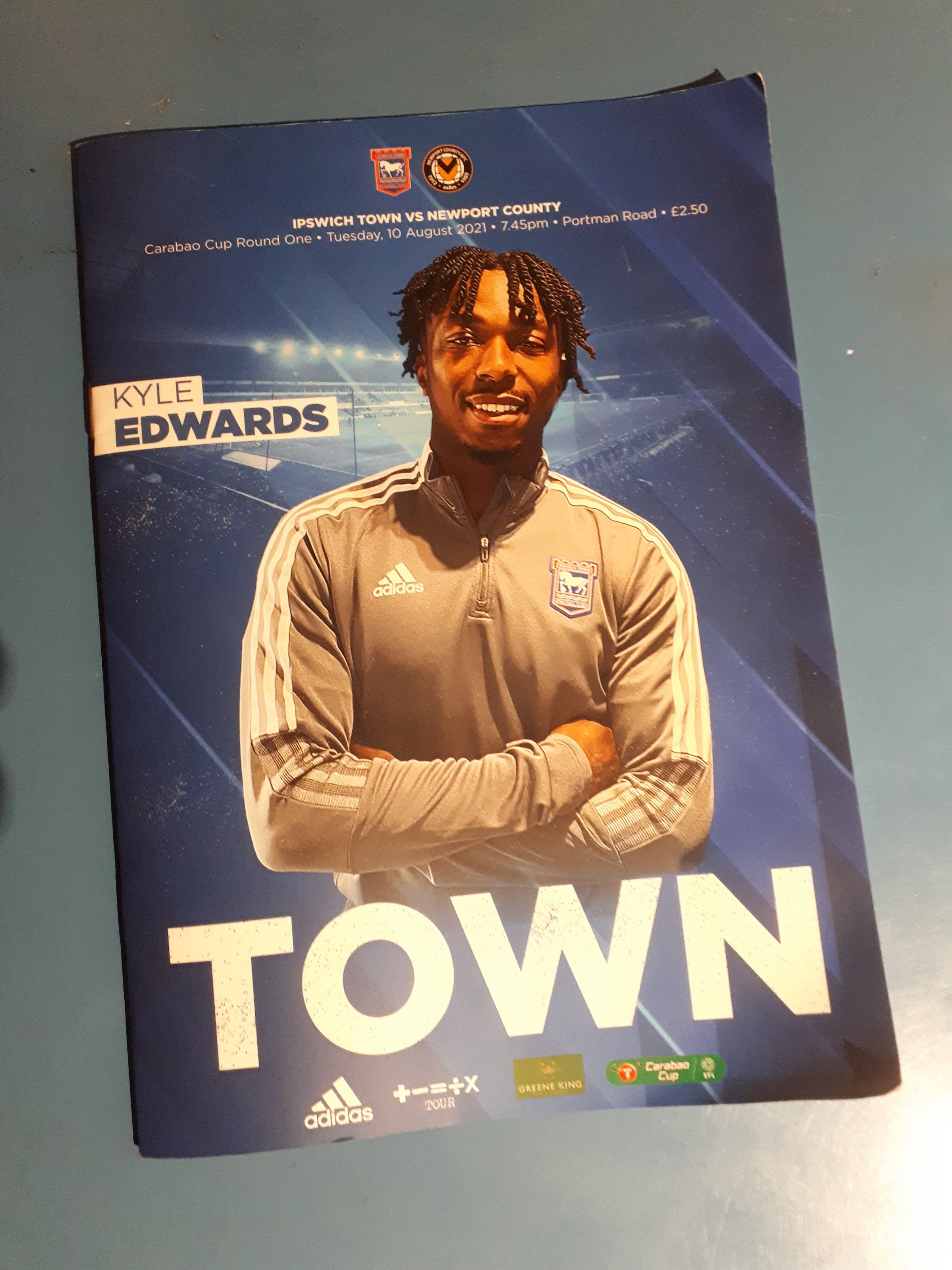
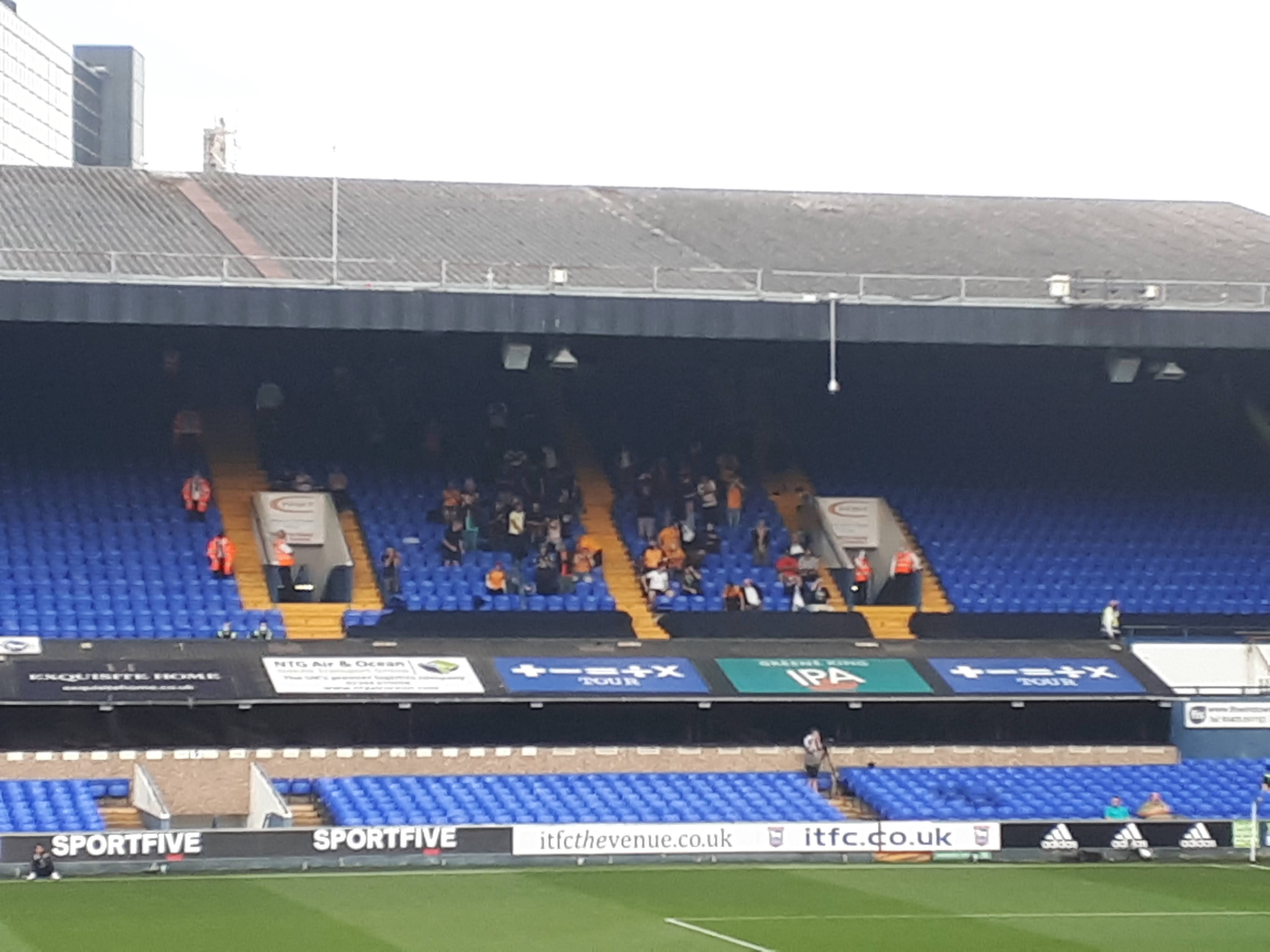
Shamefully arriving by car and not public transport because of continuing Covid induced paranoia, I park-up in West End Road car park at a little after 7 pm; the tariff is £1.00 until 8.00pm, after which it is free.  Stepping from my trusty, air-conditioned Citroen C3 the warmth of the evening air hits me unexpectedly and stirs pleasant memories of going to night matches in more exotic locations such as Beziers, Nice, Marseille and Montpellier whilst on holiday in the south of France.  Musing that the stadium catering at Portman Road probably doesn’t serve espresso coffee or cheese and ham baguettes, I stroll to the ground where there are queues at the guichets (look it up). I buy a programme (£2.50) from a booth in which the gently smiling young female programme seller seems rather heavily made-up for the occasion, but then it’s nice that she’s made the effort.  Drinking in the pre-match ambience I pass by the back of the Sir Bobby Robson stand and enter Portman Road, which is strangely quiet.  I realise later that this is because the only people occupying the Cobbold Stand tonight are the 131 from Newport, many of whom will have travelled on the six-wheeled charabanc of Watt’s Coaches, which idles by the Portman Road bus stop; I ask one of the drivers how long the journey took; “Five and a half hours” he tells me stretching out his vowel sounds with his rich, lilting and somewhat tired sounding South Walean accent, which oozes Rarebit and Eisteddfods.

Returning to Sir Alf Ramsey Way the queues for turnstiles 43 to 47 are lengthening and beginning to snake, so I head for turnstile 49 where there’s hardly anyone ahead of me at all.  Inside the ground a line of Heras fencing separates the fanzone from those of us who have passed through the turnstiles. The back of the stand is a noisy place as a disco inside a shipping container seems to be operating from a corner of the fanzone, predictably no one is dancing, and I wonder what the point of it is.   Fearing that my hearing is being damaged I head for my seat which tonight is in Block H, so lettered I will discover because at the end of the match it’s difficult to get out of, like the prisoner cell block.

As I stand and flick through my programme, kick-off comes ever closer and the PA system which successfully scrambles any spoken word delivers a medley of tunes associated with the Town.  I enjoy the anthemic Edward Ebenezer Jeremiah Brown from the 1970’s, but cringe at the dire Singin’ the Blues of the George Burley era, which sounds as if it is performed by Vic Reeves and Suzi Quattro, and the surreal and corny Sweet Caroline.  My only pleasure is from a childish giggle provoked by the name of a Newport substitute, Evan Ovendale. 

Finally, my torture by music is ended when the teams come onto the pitch, and I’m pleased to report are warmly applauded as they ‘take the knee’.  The match kicks off; Newport pointing in the direction of the Sir Bobby Robson stand in their traditional amber shirts and black shorts and getting first go with the ball.  Barely two minutes pass and an Armando Dobra shot strikes Newport’s right hand goal post. Within a further two minutes Newport lead.  One of Town’s many debutants, Sone Aluko needlessly concedes a free kick, from which a low cross is diverted into the net via the heel of Timmy Abraham, who rather wonderfully sounds like he should be, and indeed he is, the little brother of the Chelsea player, Tammy Abraham.

At least we probably still have 90 minutes to score a couple of goals of our own. But inevitably, given Town’s recent record in cup competitions, I have a nagging sensation that some writing is already being daubed on a wall somewhere.  Meanwhile, Armando Dobra has a shot saved and the oddly named Macauley Bonne heads over the Newport cross bar.   When Newport are awarded the game’s first corner, the Sir Bobby Robson stand chant “Who the fuckin’ ‘ell are you” to the taker, displaying a boastfulness of their own ignorance that is fitting in a town that voted for Brexit.

Town may be losing, but the game is nevertheless an entertaining one and despite the mostly empty stands the spectacle is enhanced by the fading daylight. With 21 minutes gone Sone Aluko claims the glory as the first player to be booked by the strangely competent referee Mr Neil Hair, or Herr Hair as he would be known if this were the Bundesliga.  Quite suddenly at about ten past eight I notice that all sunlight has gone and the ground is totally in the shade of whatever the Pioneer stand is now called.  The oddly named Macauley Bonne strikes the outside of Newport’s left-hand post with a shot and some childish banter ensues between him and the Newport goalkeeper Nick Townsend, with Bonne clutching his stomach to indicate that that Townsend is not merely big-boned; you can take the boy out of Chantry High School but you can’t …etcetera.

Five minutes of the half remain, and Town produce a delightful passing move, sending the ball from Luke Woolfenden to Idris El-Mizouni (whose father incidentally drank a post-match coffee with me when AS Meudon played St Ouen L’Aumone in the Coupe de France in 2018) to Sone Aluko to Armando Dobra, whose cross is headed over by the oddly named Macauley Bonne.  There is still time for Newport’s short and dumpy, but wonderfully named and impressively numbered (he’s No 56) Aneurin Livermore to be booked, for Idris El-Mizouni to have a free kick saved, and for him to provide a deliciously whipped-in cross for the oddly named Macauley Bonne to head over the bar yet again.

Half-time brings relief from the claustrophobia of the oldest part of the stadium, as those around me leave to get refreshment; people genuinely were smaller in the 1950’s when the old West Stand was built, possibly because there was no stadium catering back then.  Tonight, I am seemingly surrounded by youths in their late teens and early twenties who are all about 2metres tall.  Two of them return with trays of chips and the game begins again.

My seat is closer to “Churchman’s” than the Bobby Robson Stand and perhaps that’s why I notice for the first time this evening that Tomas Holy is a vision in cerise, he’s quite a sight.  Five minutes pass and the oddly named Macauley Bonne heads a looping cross into the goal, the giants all around me stand as one, but I had already spotted the offside flag.  “You fat bastard” chant the North Standers, presumably at goalkeeper Townsend and not to the oddly named Macauley Bonne.

Tonight’s attendance of 6,154 is announced and a good proportion of that number applaud themselves like performing seals do after catching a fish thrown at them from a bucket.  Town’s Scott Fraser replaces Sone Aluko who looks like he knows he’s had a poor game.  “He’s weird in ‘e? He’s got funny little legs in ’e?” I hear a voice behind me say.  I think the voice is talking about Newport’s left-back Aaron Lewis, who indeed does have funny little legs; he also has hair like Grayson Perry; he’s not a bad footballer mind, and I like to think he might also be able to knock up some decent ceramics or tapestries.

Over an hour of the match has passed and a fine shot from Armando Dobra brings an equally fine flying save from the fat bastard in the Newport goal; James Norwood and Kayden Jackson replace Louie Barry and the oddly named Macauley Bonne.  Newport mount a rare attack down the right and Town’s Corrie Ndaba, whose first name reminds me of the episode in series nine of The Simpsons in which Lisa becomes addicted to ringing the ‘Corey hotline’, spectacularly and miraculously slices the ball into the arms of Tomas Holy who is stood behind him.

With the match in the final twenty minutes Newport players twice clear the ball off their own goal line in the space of a few seconds and James Norwood heads a decent cross from Bailey Clements over the bar in a manner which I had thought was the preserve of the oddly named Macauley Bonne.  Just a short while later Norwood begins to limp and then leaves the field of play to be replaced by no one at all because we’ve used all our substitutes.  The bloke next to me doesn’t notice for a further few minutes that we are down to ten men and when he does, he thinks we’ve had someone sent off; “What happened?” he asks; and I thought I was guilty of not paying attention.

Newport’s shaven headed forty-two-year-old, Kevin Ellison is substituted and hobbles off, clearly attempting to eke out the remaining time in a way which doesn’t involve football being played. “Get off you old git” I bawl at him despite being almost twenty years his senior. I’m not sure what came over me, although these West Standers seem rather dull and need livening up.  Unfortunately, Ellison and his team win the day with their time-wasting ways and despite five minutes of added on time Ipswich fail to score, and so once again leave the League Cup at the earliest opportunity, leaving Newport County and the likes of Forest Green Rovers, Barrow and Oldham Athletic to seek the sort of glory we can only dream of.

Despite the result it’s been an enjoyable match, with some fine performances from young players, particularly Bailey Clements, Idris El-Mizouni and Cameron Humphreys. As I stand helplessly waiting to get out of the slowly clearing stand, I applaud Newport and their intrepid supporters and reassure myself by believing that although the score reads as another Cup defeat I have simply witnessed the birth pangs of a Grand Projet that will one day see us reach the next round.

Swindon Town 1 Ipswich Town 2

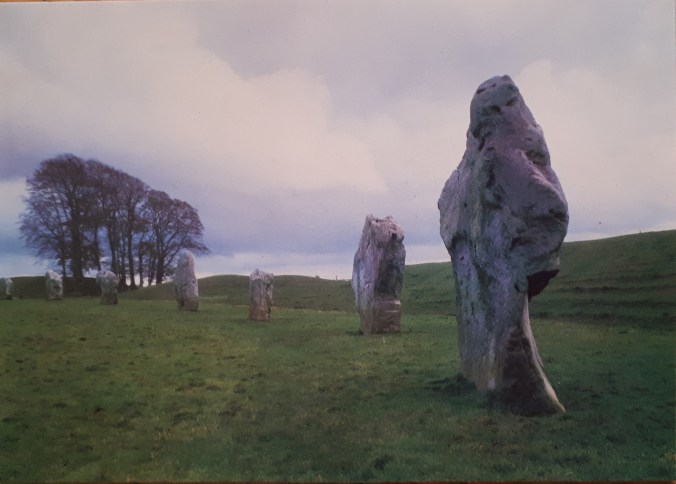
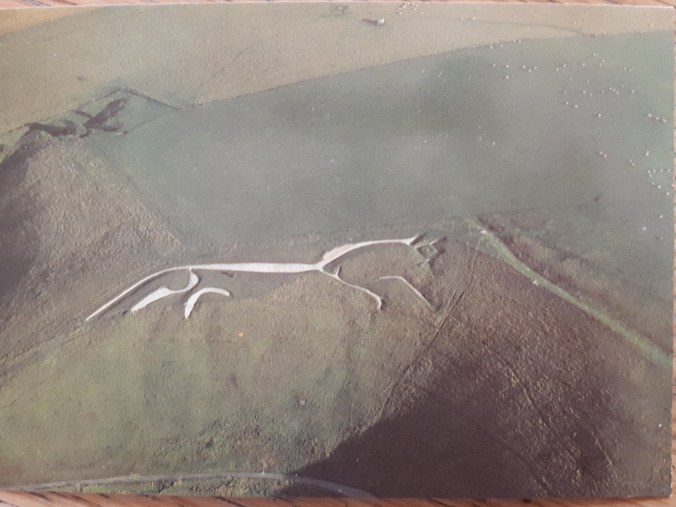
 Swindon is by far the largest town in Wiltshire and is also home to the only Football League team in the county.  I like Swindon.  Despite being a long way from the coast, there is something a bit like Ipswich about it, particularly with its relationship to the county in which it is situated. Salisbury and Bury St Edmunds have their cathedrals, but whilst historically the locals there were poncing about singing psalms and reciting canticles Ipswich and Swindon folk were getting their hands dirty making stuff, or at least they were until the forces of international capitalism did for them.  Like Ipswich, Swindon is one of those rare, unpretentiously provincial towns that’s a decent size, is a respectable distance from London but isn’t ‘Up North’;  it’s like Northampton, Shrewsbury, Newport and, if you don’t count Staffordshire as ‘Up North’, Burton On Trent.    Added to that it’s got a Magic Roundabout, is only 20 kilometres or so from groovy places like Avebury stone circle (bigger and therefore better than Stone Henge) , Silbury Hill  and the Uffington white horse hill figure, and is home of the hard to pigeon-hole band XTC, although sadly they split up about fifteen years ago.  More recently, Swindon Town is the team supported by Kerry and Kurtan Mucklowe in the wonderful BBC comedy series “This Country”.  Swindon also still has its own local brewery, Arkell’s, which has been fulfilling the town’s beer needs since 1843.

I first saw Ipswich Town play at the County Ground, Swindon in December 1987.  Fresh from having failed to return to the First Division at the first attempt the previous season, Town played newly promoted Swindon Town and lost 4-2 after initially coming back to equalise from 2-0 down at half-time.  Mark Brennan and David Lowe scored for Town and Ian Cranson also scored, but for Swindon, with a spectacular header.   I didn’t remember any of that, I had to look it up, but having had my memory jogged I do recall that the game also saw the debut for Town of the least successful of our Dutch imports, the less than  legendary Ulrich Wilson, on loan from FC Twente.  Since then Swindon has mostly been a lovely day out, with four wins in our last four visits, although we’ve not been round theirs now since the turn of the century, which is another reason why I would have been looking forward to today’s fixture.

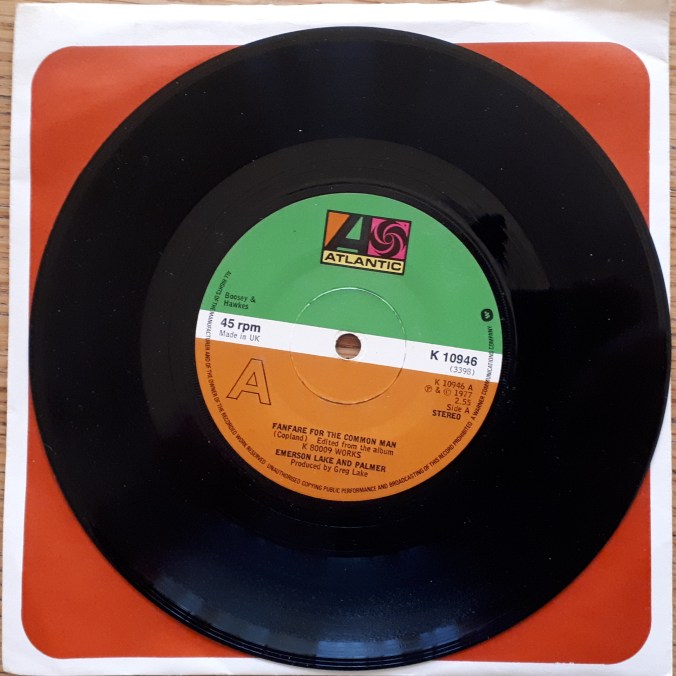
Spared a 3 hour, 275 kilometre trip along the motorways of southern England I nevertheless still rock-up late at the on-switch of my retro-style Bush radio, which is already primed in a state of preparedness being perpetually tuned-in to BBC Radio Suffolk.   It’s as if I’ve only just pushed through the turnstile after hurriedly finishing my last pre-match pint of Arkell’s 3B, as at almost 3 o’clock I am greeted with the news that alongside Brenner Woolley today is former Town player Ian Atkins. Despite his having played over ninety games for Town, some as captain, I always think of Atkins as one of the most inelegant players I’ve ever seen play for Town; he’d get in today’s team mind.  As Brenner Woolley sets the scene and tells us that Swindon are wearing red shirts, white shorts and red socks I can hear Emerson, Lake and Palmer’s  rip-off of Aaron Copland’s ‘Fanfare for the Common Man’ blaring out from the County Ground’s public address system.  With the common man still absent from its stands and concourses I wonder to myself to whom Swindon Town are playing this little burst of populist Prog-Rock.  I’m as partial to a bit of Prog-Rock as the next grammar school boy born in the 1950’s or early 60’s, but as grand entry music for the players at a football match I would place ‘Fanfare for the Common Man’ somewhere up close to “The boys are back in Town” in the league table of all-time naffness.  Give me “Entry of the Gladiators” or the Toreador song from Bizet’s Carmen every time.

How embarrassing

“It’s Teddy Bishop, going to be kicking off” announces Brenner and the game begins.  Somewhat inevitably Brenner’s commentary for now is obsessed with Town’s having failed to score a goal in over ten hours.  “Goals change games” says Ian revealing his  Birmingham accent. Well duh.  The game begins well for Town as you would hope against a team who have already been relegated after only forty-four games and have conceded eighty-four goals.  “Dozzell’s had a very good start at the moment” says Ian cautiously.  “Town on top at the moment” says Brenner with the same note of caution borne from bitter experience as Town win the game’s first corner.  “Swindon….they’re letting Northampton play”  adds Ian, already confused about which game he’s watching.

Inevitably, there is something of an end of season feel to the game, what with it being the end of the season and Brenner is soon indulging in playful commentator-speak. “ …bit of a school-boy error, Dobra” says the BBC man triumphantly.  Ian meanwhile soon reveals the contents of his own locker of sayings to fall-back on when your vocabulary has otherwise been exhausted.  Ian’s stock phrase is “to be fair”, which, to be fair, seems innocuous enough but it’s also largely unnecessary. “…leaving the space to attack, to be fair” is Ian’s first use of the phrase and he follows this up with “… this is where they had a little bit of a problem against Northampton, to be fair”.

Meanwhile, Brenner entertains us as he always does. “Payne, who’s sprung to life in the last few moments” says Brenner summoning, in my mind at least, a vision of some sort of resurrection,  before he then says “It’s Norwood with his pink boots who’s been penalised” leading me to wonder if the referee has awarded a free-kick against Norwood because of the colour of his boots; I wouldn’t be wholly against the  idea.  The game moves on and Brenner is soon tempting fate as he loves to do, telling us that “Swindon have never doubled Ipswich in a league season”.  It’s the sixteenth minute and fate is nearly tempted; “Pitman inside the area” says Brenner with rising excitement “…puts it past the post”.  Brenner confides that he was convinced Brett Pitman was going to score, and having heard his agitated commentary of the incident, it’s hard not to believe him.

Ipswich win a second corner; it comes to nothing.  “Dobra up on all fours, now ready to continue” says Brenner making it sound as if Town’s number 36 does actually scamper about the pitch as if he were a quadruped.  Nearly a quarter of the game has passed; “Town under pressure” is the latest assessment from Brenner.  Ian’s view is that Town are giving the ball away because they’re not strong enough to hold off challenges from Swindon players.

With the game into its second quarter Brenner starts feeling oddly compelled to say things:  “Jaiyesimi actually did very little against Ipswich a few weeks ago, it has to be said.” “Swindon the better side at the moment in this game, it has to be said”.  “Still Camp not had a save to make, it has to be said”.  It’s as if we’ve now reached a point in the game where Brenner can no longer carry on unless he gets these things off  his chest. It’s either that or he now feels that his audience has been listening long enough to be able to stand these harsh truths without bursting into tears.  I feel myself welling -up a little but pull through.

Five minutes later and things look up.  “Saved by Camp; are Ipswich Town ever going to score another goal?” asks Brenner after an “Almighty chance for Town” sees Camp divert a shot from Teddy Bishop, who is through with just the goalkeeper between him and glory.   As Brenner has told us in previous games “Paul Cook, screaming his heart out”, which as any cardiologist will tell you is not advisable. Shaken perhaps by hearing a grown man scream, Brenner seems to panic and when Swindon’s Christopher Missilou under hits a ball he tells us that “The Frenchman didn’t have enough air on that pass”.  It’s an odd description of what you’d normally expect a commentator of Brenner ‘s experience to call a ‘hospital pass’, added to which Missilou is Congolese, not French.

Armando Dobra shoots wide. “Dobra’s head is in his hands” says Brenner with such conviction that I half expect him to confirm that yes, Dobra’s head has actually come off and is in his hands.  A James Norwood shot is saved by Lee camp and Mark McGuinness heads the ensuing corner kick over the cross-bar.  It’s evident that Town are continuing to attack and Brenner is in positive mood. “Kane Vincent-Young over-hits that cross, but quite a lot” says Brenner trying to play down the full-back’s error. The same player then has a header saved by Camp “ I thought he was going to score there, Young” says Brenner, deceiving himself once again.  Ian assesses Vincent Young’s forays forward, “…like a wing-back, to be fair”.

With Town sounding like they are creating chances, the mystery remains why they have not scored and Ian enlightens us by telling us that what Town are missing is “someone of real presence in the box who can upset defenders”.  It’s an analysis that suggests to me that over the summer we should sign either a sort of Joan Rivers character capable of reducing defenders to tears or just put a ‘big bloke up front’.

“It’s now eleven hours without a goal” announces Brenner polishing the glass on his stop watch, but his words soon lose their meaning as “ Bishop goes down inside the box, the referee says penalty” and I somehow imagine the referee Mr Johnson turning in the direction of Brenner up in the stand and mouthing the word “penalty” to him .   “Please James, do not miss this opportunity” implores Brenner.  Norwood scores, “…the goal-drought is over” confirms Brenner.  “He deserves his goal at the moment” adds Ian introducing the slightly tantalising possibility that he might not deserve his goal later on and suggesting possibly that Ian believes undeserving players should have their goals taken away from them.  There then follows some blokey banter about Paul Cook having said he would do a lap of honour if Town scored. “Typical scally” says Ian “saying they’re going to do something and not doing it”.  I will admit to being a little surprised by Ian’s comments and can only think he is unaware of the risk of becoming the subject of a Liverpudlian version of a fatwa.

The first half ends with a chance for Gwion Edwards to double Town’s goal tally. “ Edwards shoots!” says Brenner excitedly “ …and the flag’s up” he continues with well-practised resignation.  Brenner asks Ian what he made of the first half. “A bit like a practice game” says Ian honestly.  “They’ve had chances that the players have missed” he adds un-controversially.  Ian’s advice for the second half, which sounds a bit like an extract from an instruction manual for something purchased in an Ann Summers shop is  “Rather than just sit on it, go and enjoy it”

Half-time is the familiar blur of kettle, tea and Nature Valley peanut and chocolate protein bar.  For the second-half I am joined by my wife Paulene who, as I listen to the wireless through my earpiece will be watching the Ligue 1 game between Paris St Germain and Racing Club de Lens on the telly.  As I re-join the broadcast from BBC Radio Suffolk Brenner ‘advertises’ his forthcoming commentaries and explains that he will once again be with Ian for Tuesday’s match at Shrewsbury. “ Is that basically because Mills’ car doesn’t go to the other side of Colchester?” asks Ian, evidently still in banter mode and also daring to take Mick Mills’ name in vain.

As far as I can make out from the commentary the second half is much like the first. “Comes to Downes” calls out Brenner with rising excitement “…who skies it”.  Ian begins to add “ at this level” to the end of most of his explanations of what Town need to be doing. Nearly an hour has passed since kick-off.  “…gives it back to Norwood, Norwood prods it in, Ipswich now lead Swindon 2-0” exclaims Brenner. “He’s tucked that ball away well” adds Ian, whose analysis has otherwise increasingly come to depend on the phrase “bodies in the box”.

Troy Parrott replaces Teddy Bishop. “He looks like a nice little footballer” says Ian of Teddy, when asked for his opinion of the departing player’s contribution.  But it quickly transpires that Ian doesn’t really think there is a place for nice little footballers “at this level.” Brenner meanwhile advises us that it’s a case of “Town getting the job done, for what it’s worth”.  More substitutions follow. “Harrop and Bennetts both coming on to play a bit more football” is Brenner’s reassuring statement before they replace Edwards and Dobra.  As a rule it’s best when the substitutes come on to play football rather than just paint over the white lines or do a  bit of weeding.  Ian’s assessment of Edwards and Dobra is that they have “Been lively, without ever having any end product”; I believe it’s what seasoned commentators and sports hacks call ‘flattering to deceive’.

Less than twenty minutes of the basic ninety minutes remain. “Goodness me” says Brenner channelling Peter Sellers, almost. “Terrible goal-keeping from David Cornell” exclaims Brenner and Brett Pitman scores.  I had sort of hoped Pitman would score, I liked him as a player at Town; my impression is that managers don’t think he runs about enough; perhaps he doesn’t , but he still scores goals, which is what forwards are supposed to do.  “A Sunday league howler – no disrespect to the Sunday league by the way” says Ian of Cornell’s error and for some reason affording a respect to the Sunday league that he previously hadn’t afforded Scousers or Mick Mills.

A couple more minutes pass. “Surely a penalty, it’s a penalty” cries Brenner unable to contain his excitement as Troy Parrott is fouled.    James Norwood steps up to claim his hat-trick.  “Forward he comes, he’s missed it, unbelievable” says Brenner of a situation which in reality is all too believable.   The only good thing to come of the incident is Ian’s lugubrious West Midland’s pronunciation of Parrott.

“Kenlock’s had a decent game” says Ian generously. “Town holding on for a win” says Brenner and meanwhile Neymar puts Paris St Germain one-nil up at the Parc des Princes.  News arrives on BBC Radio Suffolk of scores in other matches; Peterborough United have pulled back to trail two-three having been three-nil down. “Well, some excitement there in that game” says Brenner with a hint of jealousy.   Perhaps losing his enthusiasm Brenner mis-pronounces the surname of Swindon’s Tom Broadbent, so it sounds like Broadband. Flynn Downes is booked for a foul. “That’s like a booking for the team” explains Ian, but strangely he doesn’t say “to be fair”.

The final minutes of the game drift away. “Typical end of season game” says Ian. There is still occasional excitement. “Fabulous defending from Woolfenden” says Brenner one minute, and then “lovely little ball to Parrott in the area!” says Brenner expectantly the next.  “ …ball up in the air, Parrott goes after it” continues Brenner and I imagine a blur of brightly coloured feathers taking flight.  The first half ends in Paris.  “You’d like to think they can see this one out, you’d like to think” says Brenner half-repeating himself for no apparent reason.  Time added on runs out. “There is the full-time whistle, at the ninth time of asking Paul Cook get his first away win” concludes Brenner.

Mentally exhausted, I switch off the radio and prepare to turn my attention to the game in Paris.  Later, I will journey down to the south of France courtesy of FFF tv to watch FC Sete, who have scored just twenty-eight goals in thirty-one games (a goals per game record even worse than  Ipswich’s)  beat  Orleans 1-0 and secure their place in the French third division.  Finally, this evening, to complete my  virtual tour of some of my favourite places I will tune in to watch Lille versus Nice in French Ligue 1, it’s something I wouldn’t have been able to do driving back along the M4.

Coupe de France on Telly 5 Going to a Live Match 0

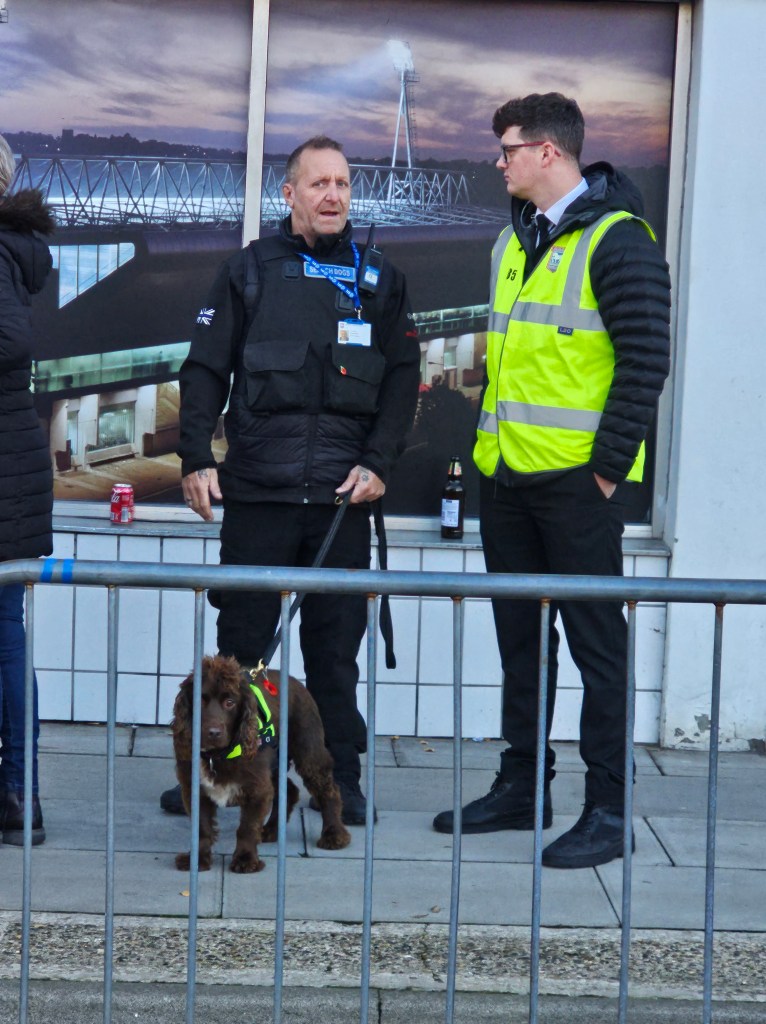
The world of football has stopped spinning on its axis, leather no longer strikes leather or skin or wood or nylon netting, whistles no longer blow, crowds no longer chant, turnstiles no longer click, the stink of frying onions no longer pervades the streets, people no longer gawp at the blacked-out windows of team buses, floodlights no longer shine, nobody leaps like a salmon, referees no longer brandish yellow cards, sniffer dogs no longer sniff for non-existent pyrotechnics, over-zealous stewards no longer hassle carefree supporters,  pre-match pints are no longer downed, blades of football pitch grass remain spittle free and no one listens to the results on their car radio.  Saturday has died, along with the occasional Tuesday and Wednesday evening.

Having spent most of this season experiencing dead Saturdays, unable to go to football because of illness and my subsequent convalescence, it’s somewhat odd that now no one can go to football because of the Covid-19.  Social media is awash with reminiscences of past games and goals as bewildered football fans search for something to fill the void in their lives.  I have few memories of this season to look back on having only seen eight games, but I may be fortunate that at least I have plenty of recent experience of coping without going to a match.  When Ipswich travelled to Tranmere Rovers for example, I could not go and so sought solace in my living room. I now find myself reminiscing about that January day when I watched live football on TV, cue eerie sounds and a wavy effect in your mind’s eye.

After a frosty start to the 18th of January the sun has risen as high as it will get in the clear pale blue sky. It’s beautiful, but it’s cold.  It is Saturday. Football. Ipswich Town are away in Birkenhead; I haven’t gone, I can’t, but according to the ‘little book’ that I keep I have been to Prenton Park, home of Tranmere Rovers, nine times before, the last time being a 2-0 win in March 2000. I’ve paid my dues, I’ve done my time; I’m staying home unless I go to a local game. Coggeshall Town and Stanway Rovers and Colchester United are my nearest clubs and they are all at home.  I won’t be going to Colchester as a protest at the withdrawal of the shuttle bus to the ground, the only thing that made the far out of town location at Cuckoo Farm in any way viable; we should be cutting carbon emissions to save the planet after all and I bet Greta Thunberg isn’t a Col U fan.  I find it hard to get enthused about bank-rolled teams such as Coggeshall Town, and Stanway Rovers has never managed to capture my imagination, probably because of its hyper-boring suburban location; all net curtains and open-plan living.

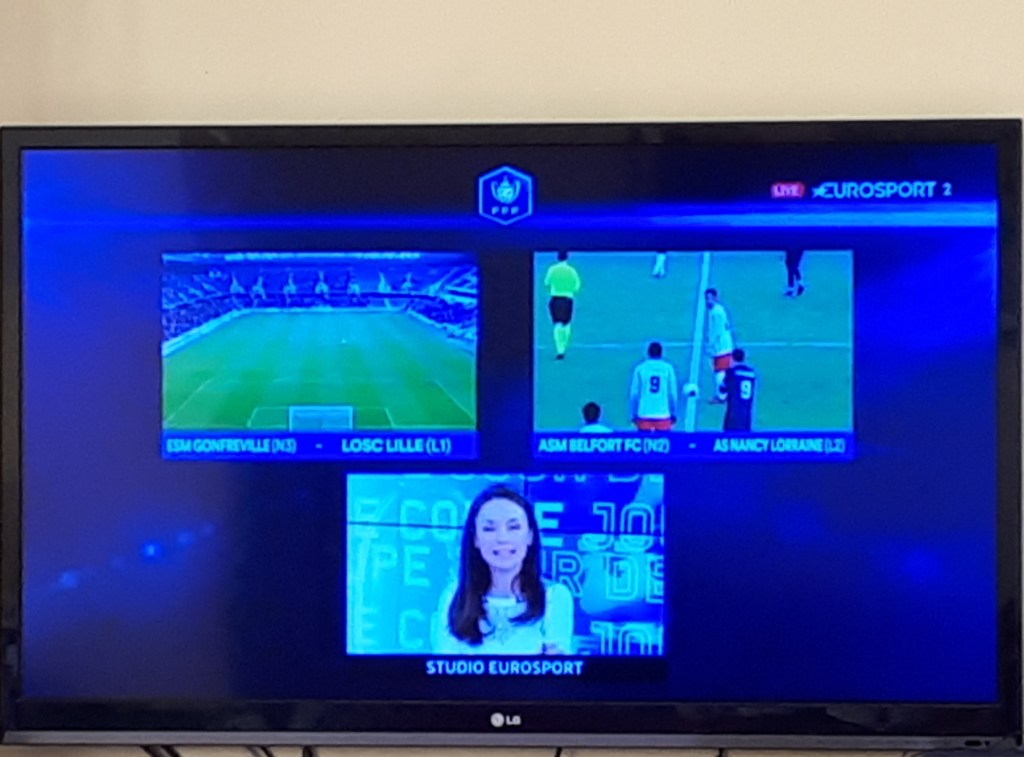
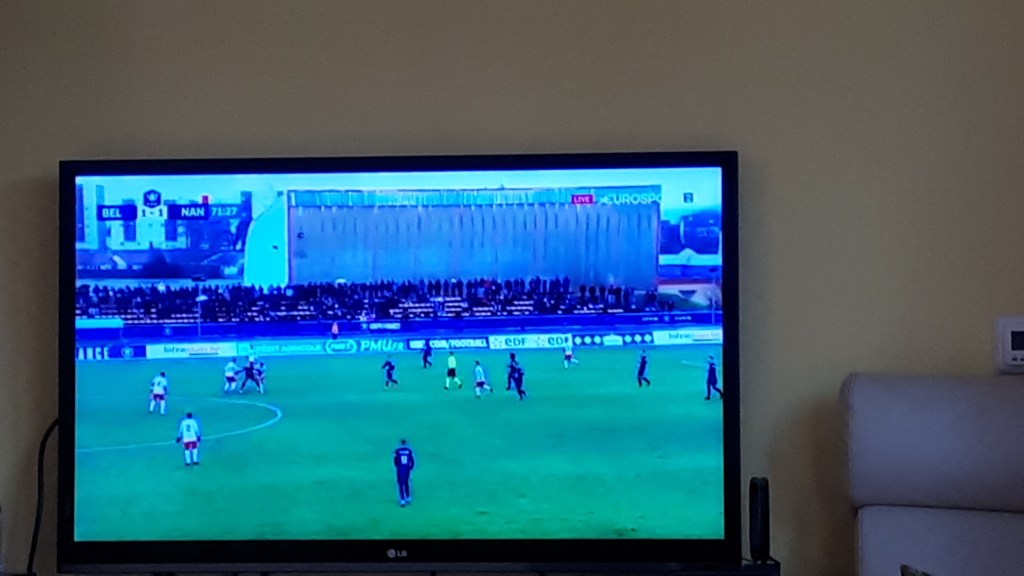
Ideally, even in preference to Birkenhead, I would be in France, where today is the round of the last thirty-two teams in the Coupe de France, the French equivalent of the FA Cup.  Three Coupe de France games kick off at noon English time, which after 11.30 is normally my least favourite time for a football match to start; all games should of course start at either 3 o’clock or at some time between 7.30 pm and 8.00 pm.  The three 12 o’clock games are Nice v Red Star, Prix-les Mézières v Limonest and Epinal v Saint Pierroise, and after a bit of interrogation of the ‘interweb’ I discover that all three games are live on ‘Jour de Coupe’ (Cup Day) on the French speaking Eurosport 2 channel, which is available to watch on the roast beef-eating side of the English Channel through the magic of the Amazon Firestick.   At 2 o’clock English time a further two games kick off with Gonfreville playing LOSC Lille and Belfort playing AS Nancy Lorraine.

The programme is presented by the personable Gaëlle Millon who certainly earns her money on Coupe de France weekends as she presents the matches at lunchtime, in the afternoon and on into the early evening with a 5 o’clock kick-off and then the later evening match at 8 o’clock.  It doesn’t stop on Saturday evening for notre Gaëlle either, as on Sunday she will then present the afternoon games and an evening match and then possibly another evening game on Monday too.  Gaëlle is perched on a high chair or stool behind a small desk in a studio which is probably in the headquarters of Eurosport in the Paris suburb if Issy-les-Moulineaux, which incidentally is only a fifteen minute walk from Parc des Princes, home of Paris Saint Germain.

I miss the starts of the games because I am making a cup of tea, but no one has scored so I am not overly bothered.  The coverage is of the ‘Multiplex’ variety so all three games are being covered and the broadcast flits between them according to where it seems most likely something interesting is going to happen. But in reality the coverage concentrates, to begin with at least, on OGC Nice v Red Star because on aggregate these two clubs have the best cup records of those playing today, Red Star with five wins and Nice with three, although Nice haven’t won the Cup since 1997 and Red Star not since 1942.  Nice, managed by Patrick Vieira dominate the game, but I am pleased and then foolishly optimistic when Red Star hold out for ten, fifteen, twenty, and then twenty-five minutes.  In the twenty-seventh minute however, Danilo scores for Nice and with indecent haste Ignatius Gonago scores a second, a mere two minutes later.  After that second goal the result is a foregone conclusion; despite doing well in Ligue National, the French third division, Red Star are something of a Gallic Ipswich Town and rarely manage to score more than one goal a game.

I lose interest in the Nice game as a result of that second goal and begin to only pay attention to the TV when the Multiplex coverage switches to the games at Stade de la Poterie in Prix-les Mézières and Stade de La Colombiere in Epinal.  The game at Prix-les Mézières is between two clubs in the fifth tier of French football, the National 3.  Prix-les Mézières is effectively a suburb of Charleville Mézières the principal town in the Ardennes département which borders Belgium and is about 330 kilometres and a three hour drive from Calais.  Epinal is further south and east and is the principal town in the Vosges département. Epinal football club is in the fourth tier of the French leagues (National 2), whilst their opponents are in the first level of the Regional leagues which is the sixth tier.

Sadly the coverage rarely switches to the ‘lesser’ two games. I miss the Epinal goal which wins the match and Limonest concede the only goal of the match at Prix-les Mézières after fifty two minutes.  The Stade de la Poterie and Stade de la Colombiere are typical of French grounds outside the elite of most Ligue 1 and Ligue 2 stadia, which are the only venues to host fully professional football. The grounds or Stades are owned by the local authorities and whilst they all have a decent main stand or ‘tribune,’ the other three sides of the ground often have no cover at all and sometimes no terrace.  Poterie and Colombiere possess some of the charm of the English non-league, with spectators stood on grassy banks, a terrace of houses forming a cosy back drop, and traffic passing by with panoramas of streets and landscapes beyond. With more to see than just football, TV coverage from non-league is so much more interesting to watch because if the football is rubbish at least there is still something to see.

In the 92nd minute of the game in Nice Yanis Hamache scores for Red Star and for ninety seconds or so I hope against hope for another Red Star goal, extra time and the lottery of penalties.  But hope is all I get and Nice win the day, although Yanis Hamache gets a second moment of glory as he is interviewed on TV; the money he spent on a weird haircut wasn’t wasted.   On Twitter @RedStarFC tweet “Focus desormais sur le championnat,” which is pretty much French for “now we can concentrate on the League.” 

After a brief return to Gaëlle in the studio in suburban Paris, coverage of the three noon kick-offs quickly switches to the two ties which are beginning at two o’clock in Belfort and Le Havre.  The Belfort game sees ASM Belfort of National 2 play AS Nancy Lorraine of Ligue 2, whilst in Le Havre, ESM Gonfreville also of National 2 play LOSC Lille, runners-up in Ligue 1 in the 2018-19 season.   Whilst Belfort’s stadium, the Stade Serzian is another typical French municipal stadium with a single cantilever stand on one side, a running track and views of suburbia all around, Gonfreville, which is effectively an industrial suburb of Le Havre, are borrowing the modern and totally enclosed Stade Océane, the home of Ligue 2 Havre AC.  Stade Océane, which looks as much like a giant, bright blue rubber dinghy as a football stadium, has made

recent successful TV appearances in the Women’s World Cup and today the attendance is bigger than Le Havre usually sees for its Ligue 2 matches. The magic of the cup clearly translates into French.

Most of the coverage of the latter two games centres on Le Havre, but it is in Belfort where the action begins and continues as after just seven minutes the wonderfully named Enzo Grasso puts Belfort ahead.  Disappointingly for the romance of the Cup, which pretty much means ‘giant-killing’, Nancy’s Malaly Dembele equalises a bit less than twenty minutes later.   Sadly, I miss the goal, partly because I had become distracted by my mobile phone and partly because the live coverage at the time of the goal was in Le Havre so there was no over-excited commentator to alert me to it by bawling “ Quel but!” (What a goal!). Meanwhile in Le Havre there are no goals at all, only the intriguing sub-plot of how Lille manager Christophe Galtier’s hair seems to have grown darker whilst his beard has become more grey. It could just be my imagination however, and according to my wife it is, but then, she always had a bit of ‘a thing’ for Monsieur Galtier, I think it’s because he’s from Marseille.

Half-time takes us back to Gaëlle in Issy-les Moulineaux to re-cap on what has gone before and  chat with ‘experts’ perched on stools like performing animals. The second halves begin and all the decent action remains in Belfort whilst the live coverage is in Le Havre.  With just ten minutes of the second forty-five played, karma gets even with Malaly Dembele of Nancy for scoring that romance-crushing equaliser and he is sent off.  I don’t know why Malaly is sent off because once again I have become distracted and miss the action, this time because I’m catching up on what’s happening in Birkenhead, which is nothing.  Having learnt my lesson, I put down my phone and concentrate on the games on the telly.  Lille are making hard work of getting past Gonfreville, a club three levels below them and I begin to notice the perimeter advertising; the usual multi-nationals are there such as Nike and Volkswagen but less expected in a country known for its love of haute cuisine is KFC, but some welcome novelty is present in the form of EDF the French electricity company and the French bakers Pasquier, whose industrially processed bread products can also be found in British supermarkets. My reverie is broken as coverage switches to Belfort in time to catch a Nancy player blowing his nose on his shirt. He might have got away with if he was playing for Norwich, whose kit is the colour of snot, but Nancy are playing in white shirts today.  

Back to Le Havre and with sixty-nine minutes played Loic Remy at long last gives Lille the lead, but the replays of the goal are not over before there is also a goal at Belfort where hopes of a ‘giant-killing’ are restored by Thomas Regnier and the TV screen divides in two to show two goals being scored at once, the excitement in my living room is now palpable.  Five minutes elapse and Belfort are awarded a penalty which gives the programme director time to ensure that the main action is being beamed from Stade Serzian and Thomas Regnier scores again to give Belfort a 3-1 lead with just twelve minutes left to play of normal time.  This is great, so good I almost fail to notice that in the Coupe de France teams do not carry their usual sponsor’s names on their shirts, but instead all the away teams display the logo of PMU (Pari Mutuel Urbain) a horse racing promoter and betting organisation, whilst home teams advertise the symbol of the Credit Agricole bank.  As if that’s not enough all players display the name of the Intermarche supermarket chain across their shoulders and club crests are replaced by the badge of the FFF (Federation Française de Football), the French football association. My mind begins to drift to thoughts of Vincent (Samuel L Jackson) in Pulp Fiction and his ‘Quarter Pounder/Royale’ conversation with Jules (John Travolta); “It’s the little differences…”.  But injury time, as it used to be known, has started and with two minutes of it gone Victor Osimhan brings some late excitement to my TV screen as he confirms Lille’s ‘safe passage’ through to the round of sixteen with Lille’s second goal, but Belfort still have six whole minutes left to play. 

In Le Havre the game ends and the victorious Lille players line up to applaud the Gonfreville team from the pitch; what with the late goal, the mass sporting gesture not to mention the ‘giant-killing’ I feel rather moved by it all and emit a small cheer when the game in Belfort finally ends with no further goals.  Back with Gaëlle in the studio I remember to check the half-time score in Birkenhead, I wish I hadn’t.

Happy times, perhaps not quite as good as the real thing, but looking back from this shut-in, locked down world I feel quite privileged to have had them. Please appreciate the moment and make the most of it. In the words of Country, Pop and Novelty songwriter Ray Stevens “Everything is beautiful in its own way”. Oh, and there was a happy ending in Birkenhead after all.