I had hoped that I might be able to acquire an extra ticket for today’s game, which I would have given to my friend of forty years or more, Jah, who is a Newcastle United fan. Predictably perhaps, the slender avenues of opportunity were few and they proved to be culs-des-sacs. I’m not a member, and having a season ticket continuously for over forty years counts for nothing; I was resigned to my fate. There are now, no doubt some who having read the above are apoplectic with rage that I should consider buying a ticket for someone supporting the opposition team. To them I say “Grow up, it’s only a game” and “Yah boo, sucks”.
It’s the Winter Solstice today, a grey day, like most days lately, but the train is on time and I see a polar bear through the window as we descend into Ipswich through Wherstead, which is better than seeing one inside the carriage. Gary is not with me again today; after going to previous matches with his brother and then having hurt his chest, which made him unable to make the hike up to the Arb, he has now awoken to find a toenail hanging off and so once again cannot make the trek to the pub. Alone, but in the company of hundreds of other people sporting blue and white favours, I make my way to Portman Road to buy a programme (£3.50) from one of the booths that I hope will one day also sell ice creams, and observe the gathering crowd. The Bobby Robson statue sports a “half and half” scarf, which controversially suggests he was what people younger than me call a “plastic fan”, when in fact he’s probably made of bronze. People are having their photographs taken with the statue and I think of two songs by the Kinks, ‘Plastic Man’ and ‘People take pictures of each other’
At the Arb, I am mercifully served quickly and take my pint of Mauldon’s Suffolk Pride (£4.14 with Camra discount) into the beer garden where I sit at one of the tables in the shelter, opposite a couple who are probably in their forties and seem pleased that this part of the shelter has the benefit of two electric heaters, even if it’s not going to help save the planet. I am a minute or two early; I’d arranged to meet Mick at 13:45 and an exchange of text reveals he is only now leaving home, so I read the programme I bought earlier and reflect on how the pieces by the manager , CEO and captain are just like every other piece by a manager, CEO or captain I have ever read before , but then, what is there to say? Today’s front cover, which isn’t the front cover (it’s inside the back page) is by a designer called James Hobson, who if his picture is to be believed, wears 3D glasses possibly as a fashion accessory, or possibly when working or just when having his photo taken. Either way, I decide that I like his design, which is reminiscent of some of the more graphically adventurous programmes of the early 1970’s, of which Ipswich Town’s was sadly not one.
In due course, Mick arrives and we talk of my wife, our siblings, Mick’s recently deceased neighbour, the smoke detectors in the flat in Felixstowe where Mick’s paramour lives, Christmas, how sentimental people are nowadays, and Gary’s absence. At some stage I obtain a further pint of Suffolk Pride for me and a Jameson whisky for Mick (£8.80 with Camra discount) and we talk until a quarter to three, by which time we are alone in the beer garden and this makes us wonder why everyone is so keen to not just turn up as the game is about to begin. After the easy downhill walk to Portman Road, we part at the junction of Sir Alf Ramsey Way and I make it to my seat in time to bawl out the surnames of three of the Town team as the excitable, although today very serious sounding young announcer reads the team line-up to us. Naturally, Pat from Clacton, Fiona, the man from Stowmarket (Paul), ever-present Phil who never misses a game, and his son Elwood are already here.


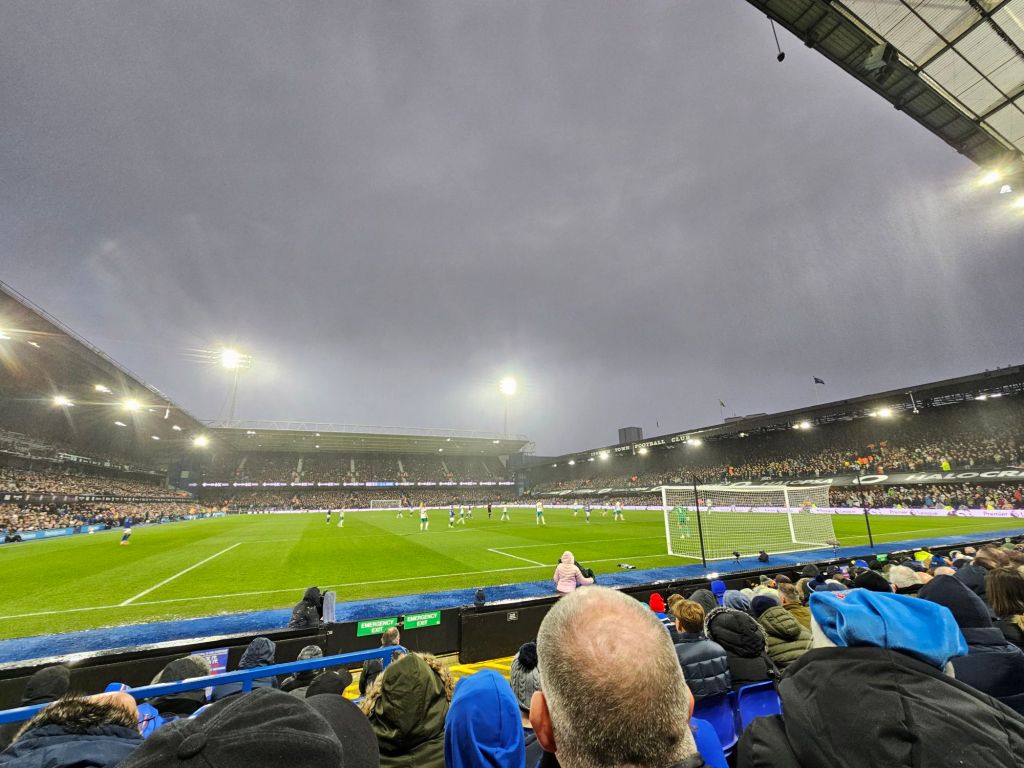
Ipswich get first go with the ball this afternoon, but you wouldn’t know it, because no sooner has the game begun than Newcastle are one-nil up as a long ball forward, a cross, a very poor clearance and a bouncing shot puncture all our hopes of the sort of straightforward home win we crave. There is a long wait of over a minute for VAR to dismiss the possibility of offside and predictably it does so. “ Newcassul, Newcassul, Newcassul” sing the Geordies in the Cobbold stand and then “Haork, noww heeya …” with their accents coming across far clearer than the words they’re singing, in a way that is unmatched by supporters anywhere else in England. The Town fans fall silent but then a brief chorus or three of “Come On You blues” rings out, before fading feebly into the gloom as darkening drizzle sweeps across the pitch and Newcastle dominate play, seemingly at times just through being bigger blokes. Fifteen minutes up and it should be two-nil as Anthony Gordon heads down and the ball bounces over the Town bar. Ipswich are incapable of holding onto the ball for more than a couple of passes, being brushed off the ball by these bigger boys; it’s like watching Under 15s play Under 13s.
The worst of it is that whilst Town are of course in blue and white, Newcastle have not turned up as Newcastle United in their famous black and white stripes, black shorts and stockings; no, they’re in some weird, needless arrangement of white shirts with green sleeves and green shorts, the colour of the Saudi Arabian flag. “He’s good that thirty-nine” says the bloke behind me. “He’s always available” . “It’s Graham Harbey, isn’t it?” says the bloke next to him. Twenty minutes gone and Jens Cajuste conjures Town’s first shot on goal, one that flies above the cross bar and hits a woman a few rows away. Sam Morsy makes a saving tackle and is serenaded; I hope he likes Oasis. “We’ve been a bit more involved, the last five minutes” says the bloke behind me and the drizzle has become rain and has begun sweeping in beneath the roof of the Sir Alf Ramsey Stand. My trousers are flecked with spots of rain.
It’s the thirty second minute, Newcastle have the ball, just passing it about around the Town penalty area, then they’re two-nil up. A bloke with the unpromising name of Jacob Murphy just fires the ball into the roof of the goal net. Apparently he used to play for Norwich City, and Wikipedia tells us he is a nephew of former Town bench-warmer Tommy Parkin. The goal happened so quickly it feels like Newcastle have scored without even bothering to have had a shot. Hurt, but not beaten I chant “We’re going to win 3-2”, to the tune of Blue Moon, the 1934 song by Rodgers and Hart, but I feel as if I’m being ignored. I tell Fiona that I recall Town beating Newcastle 5-4 back in March of 1975 “I remember it was a wet afternoon like this….” I tell her wistfully. I also recall Town losing 0-3 to Newcastle the following August, but I don’t mention that.
The bloke sitting beside me and the blokes behind me leave for the bar, being two-nil down is evidently more than they can bear without the crutch of alcohol, they may need help. “Bruno, Bruno” chant the Newcastle fans, and then “There’s only one Bobby Robson”, although in truth there is either no Bobby Robson anymore or there are several of them, all of whom remain, so far, unknown to us. There are ten minutes until half-time and Conor Chaplin takes his usual sit down on the turf to allow everyone a few moments of remedial coaching on the touchline and to put in their orders for half-time refreshments.
With play resumed and half-time fast approaching, Muric makes a flying save from a shot by someone metaphorically draped in the Saudi flag. The approach of half-time is then slowed down as four minutes of added on time are announced and Sam Szmodics replicates Jens Cajuste’s earlier shot over the cross bar, meaning Town have at least now had two attempts at scoring. But seeing a goal not scored at the far end, Muric then seemingly decides to try and create one at his own end as he suggests belief in the infallibility of Jens Cajuste by passing to him when there is a Newcastle player directly next to him. Sadly, Jens is not infallible, and an outstretched leg robs him of the ball which runs to Alexander Isak who has the embarrassing task of scoring from a just a few yards out. Now trailing three-nil, Town win their first corner of the game and I chant “Come On You Blues” with decreasing enthusiasm as hope is sucked from me by the aura of gloom all around. Inevitably the bigger boys get the ball away.
Half-time is a relief as I get to jettison excess Suffolk Pride, look at the half-time scores and eat a Nature Valley Crunchy Oats & Honey bar. It is six minutes past four when the match resumes with Ali Al-Hamadi having appeared in place of Omari Hutchinson; within four minutes a busy Al-Hamadi has a shot blocked. A glowing advert for Hawk Express Cabs makes its way along the front of the North Stand offering a number to call for anyone lacking the mental strength needed for Premier League football and seeking a means of escape. Fortunately, none of the Town players’ shorts look large enough to conceal a mobile phone inside, except perhaps Jack Clarke’s, but he’s only a substitute today.
The situation nearly worsens as Bruno hits a post with a header in the fifty-first minute, but this is a mere stay of execution as three minutes later Isak completes a hat-tick of goals, unexpectedly stabbing the ball into the net past Muric as Town defenders flounder all around him. “Damage limitation now” says the bloke behind me, although I’m feeling that the damage is already done. Over in the Cobbold stand, the away fans go all folksie and start singing the Blaydon Races and Fiona says “ I can’t hear you singing we’re going to win 5-4” . Perhaps because we’re not going to.
Town substitutions are made in the sixty-second minute as Cajuste and Chaplin wish good luck to Phillips and Taylor. A minute later Wes Burns gets down the wing and puts in a deep cross, or is a shot? Either way it evades the far post, but is worth a round of applause before Newcastle make their own substitutions and Sam Morsy is booked. “Is it worth getting Monkey out? “ asks Pat from Clacton, hoping to revive the Town via the mystical properties of a key ring from Vietnam featuring a masturbating monkey. “He’ll have his work cut out” I tell her “it’ll exhaust him”. But it’s Newcastle who win a corner and when it’s passed, I ask Pat what she’s having for her tea. The answer is a baked potato with chicken in sticky sauce from Marks & Spencer. Fiona doesn’t know what she’s having for her tea yet, and I don’t either.
Twenty minutes left until we can go home and Town win a second corner of the game, Leif Davis holds the ball above his head before he takes it to indicate that it’s one which a Newcastle player will boot clear. Six minutes on and Al-Hamadi is booked before Town’s final substitutions bid a farewell until next time to Szmodics and Wes Burns, and “Hello” to Ben Johnson and Nathan Broadhead, who is soon having a shot saved by the diving Newcastle goalkeeper, which possibly makes Nathan our man of the match in an attacking sense. Today’s attendance is announced as 29,774 with 2,991 being potential extras for TV series such as ‘Vera’, ‘Spender’, ‘Our friends in the North’, When the Boat Comes In’ and ‘The Likely Lads’.
“Na Na, NaNa, Na Na” sing the Newcastle fans to the tune of the 1969 hit “Na Na, Hey Hey, Kiss Him Goodbye”, just as Bob Ferris and Terry Collier might have done at the time had they been real people. Less than ten minutes of normal time remain and Al-Hamadi shoots high and wide and the advert for the Hot Sausage Company makes an appearance between the tiers on the front of the Sir Bobby Robson stand, but the power of advertising is waning because of a mass exodus from the stands as people believe that missing the final whistle will help them deny they were ever here.
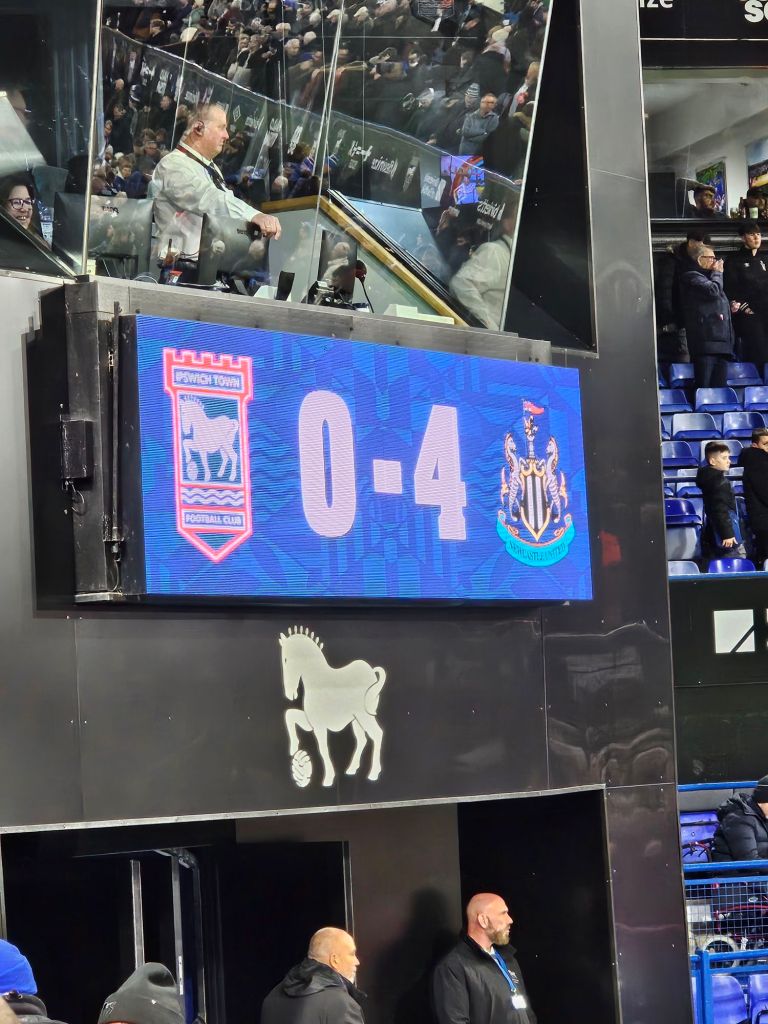
Before we all finally slope off into the night, four minutes of added on time produce another goal for Newcastle, for a short while anyway, but this time VAR is the Town supporters’ friend as the messy goal line event is deemed to have been an offside incident. This is a rare good thing on an afternoon of mostly bad things, and I may cherish the memory of it for some time. My friend Jah will later send me a message to say that he was glad he wasn’t at the match because despite Newcastle being “imperious” (pfft) it’s not nice being present at the death of hope. What he doesn’t know is that I’ve witnessed the death of hope dozens of times at Portman Road and it’s not dead yet.

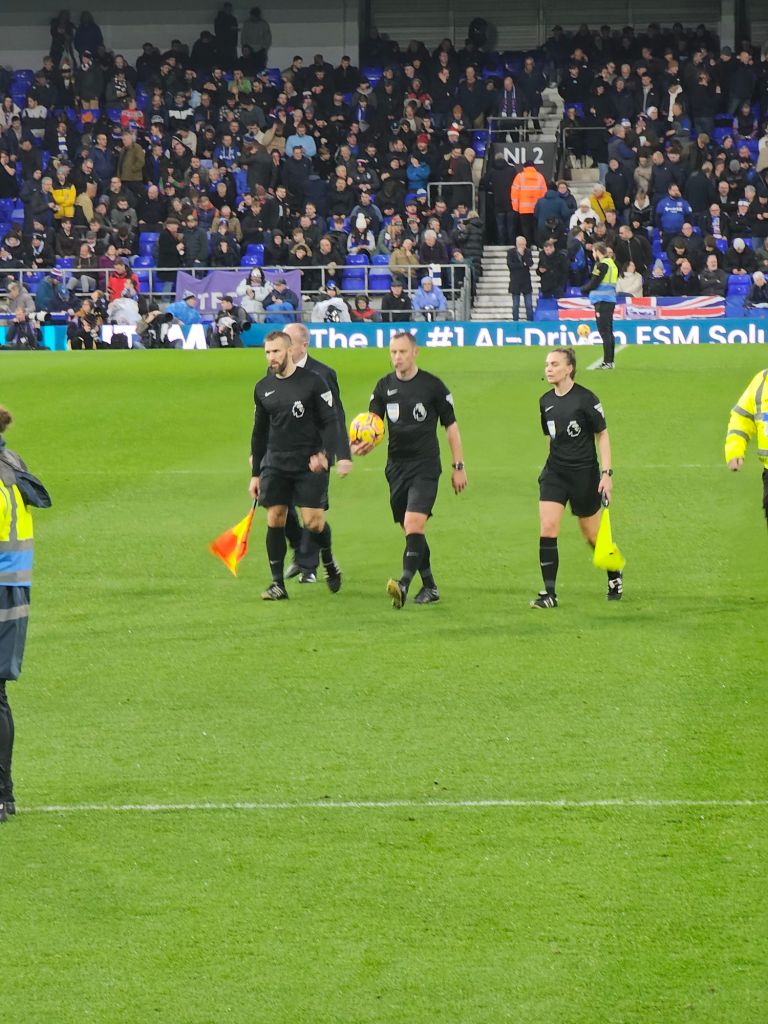


 making a total of £8 and the addition of the glossy and groovily typefaced, 16 page programme “Black and White” (£1) making a total of £9. A few steps inside the ground an old boy in a flat cap relieves me of the final tenth of the ten pound note I proffered at the turnstile, in exchange for a strip of draw tickets (Nos 61 to 65).
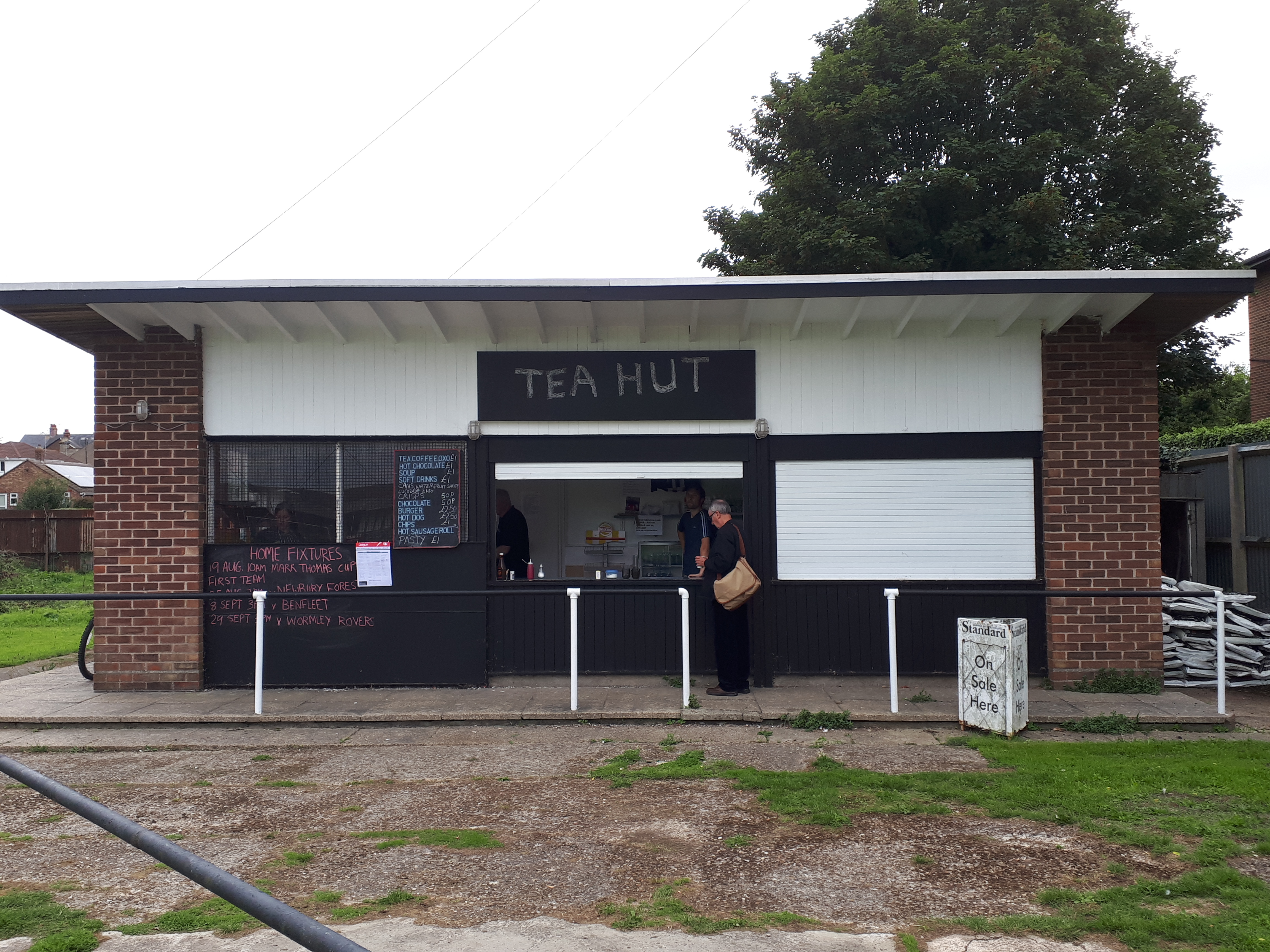 building probably dating from the 1950’s or 1960’s, which wouldn’t look out of place on a seafront esplanade. In the tea hut a woman is incredulous that an official has come from Norwich to referee a match in Harwich, she thought the point of the league re-structure was to cut travelling costs. “You can bet your arse that in Yarmouth they’ve got a referee from London” she says, and she’s probably right, although I’m not sure Ladbrokes would be interested in her or anyone else’s bottom as a wager. “There’s not many here today” she adds.
 As the game begins we take up a spot at a Yogi Bear–style picnic table in the corner of the ground by the bar and backing onto Main Road. Harwich kick off towards us, the River Stour and Shotley beyond. Harwich are wearing black and white striped shirts with black shorts and socks, completing a hat-trick of clubs along with Newcastle United and Grimsby Town that span the length of the east coast and wear black and white stripes. Benfleet are in a rather boring all red kit, although their home kit is a much more interesting light blue shirt with dark blue shorts.


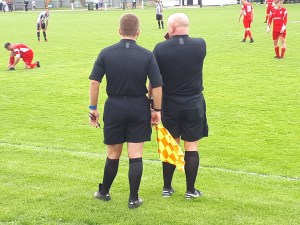 Unusually both linesman are called Arnot, although if they are related the relationship looks like grandfather and grandson, with one being stocky and totally bald and the other lanky and very youthful. The referee consults Mr Arnot senior, who talks to Mr Harvey with his hand over his mouth, like players do on the telly. I’m not certain why he does this; even if Mr Arnot has a strange paranoia about lip-readers what can he possibly be saying that is such a big secret? The result is a free-kick to Benfleet and bookings for both players, although I’ve seen players sent off for shoving before. A short while later the match breaks down again into confrontation as Benfleet’s number five tackles horizontally at knee height and a Shrimper hits the turf clutching a leg. This time Mr Harvey sorts it out on his own, but again appears lenient as he doesn’t even show a yellow card. Happily, half-time soon arrives and everyone can go for a lie down.
 behind the dug- outs was perhaps once a grassy ‘terrace’. Beneath the vegetation a path can be discerned which runs up to a large pair of metal gates onto Main Road, I feel like some sort of football archaeologist, and as I look across at the terrace of 1950’s houses that overlook the ground I am struck with a sense of deja-vous. The layout of the Royal Oak with the houses on one side, the rickety main stand opposite and the club house up the corner is a lot like that of the Stade Municipal in Balaruc-les -Bains in southern France, where Paulene and I watched a Coupe de France (French FA Cup) game last September (see the archive section of this blog for an account of our visit and the match) . I buy two more teas (£2) and am served at the tea hut by the Scottish man who is helping out with the half-time rush. Paulene and I take a look in the club house where a display on the wall recalls Harwich & Parkeston’s appearance in the 1953 FA Amateur Cup final before a crowd of 100,000; The Shrimpers lost 6-0 to Pegasus (a combined Oxford & Cambridge University team) and it was probably Pegasus that drew the crowd rather than The Shrimpers, but it’s still an impressive piece of history nonetheless.
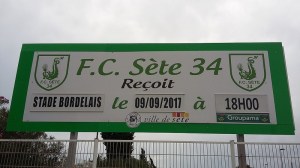 near the Atlantic coast, some 380 kilometres away by road; they have won one and lost two of their four games so far. Kick-off is at six pm and we arrive about a half an hour beforehand, parking in the spacious gravel topped car park at the side of the Stade Louis Michel, although other spectators prefer to park in the road outside. Entry to the stadium costs €6 and we buy our tickets from the aptly porthole-shaped guichets
 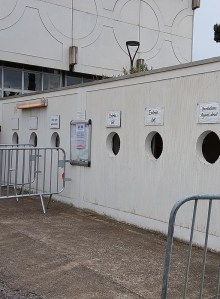 outside the one gate into the ground. Just inside the gate a cardboard box propped on a chair provides a supply of the free eight-page, A4 sized programme ‘La Journal des Verts et Blancs’. Also today there is a separate team photo and fixture list on offer.
 the brutal angular concrete of the main stand, the Tribune Presidentielle, could be from the 1960’s or 1970’s, channeling the inspiration perhaps of Auguste Perret or even Le Corbusier. The concrete panels on the back of the stand are lightly decorated and sit above wide windows; a pair of curving staircases run up to the first floor around the main entrance,
  above which is a fret-cut dolphin, the symbol of the town and the club. The stand runs perhaps half the length of the pitch either side of the halfway line and holds about twelve hundred spectators, as well as club offices and changing rooms. Opposite the main stand a large bank of open,
  ‘temporary’ seating runs the length of the pitch, it is built up on an intricate lattice
 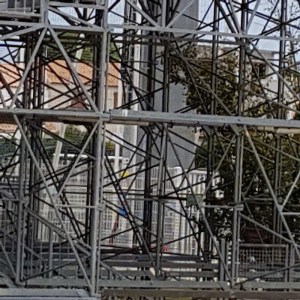 of steel supports. Behind both goals are well tended grass banks; there is a scoreboard at the end that backs onto the carpark.
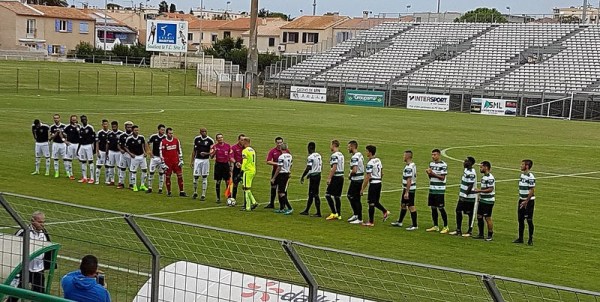 Sète in green and white hooped shirts with black shorts and socks, Stade Bordelais with black shirts with white shorts and socks. There is a ‘ceremonial’ kick-off before the real one, taken by a youmg woman with a green and white scarf draped around her shoulders. Eventually, referree Monsieur Guillaume Janin gives the signal for the game to start in earnest.
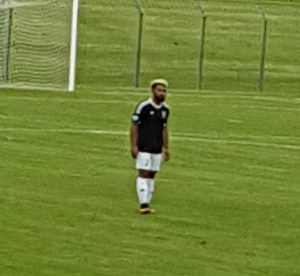 man mountain with a wide shock of bleached hair on the top of his head, and thighs the size of other men’s waists.
 which is close by at the corner of the stand where we are sat. The reason for my eagerness is that Sète is the home of the tielle, a small, spicy, calamari and tomato pie, with a bread like case. I love a tielle, and I love that they are specific to Sete, and are served at the football ground as a half-time snack. I only wish there were English clubs that served local delicacies. Middlesbrough has its parmo, but I can’t think of any others. Do Southend United serve jellied eels or plates of winkles? Do West Ham United serve pie and mash? Do Newcastle United serve stotties? Did the McDonald’s in Anfield’s Kop serve lobscouse in a bun? I need to know. Sadly, I don’t think my town Ipswich even has a local dish. Many English clubs don’t even serve a local beer; Greene King doesn’t count because it is a national chain with all the blandness that entails.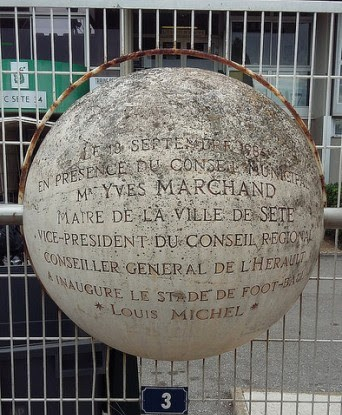
 From the railway station the three of us stroll up Portman Road towards the St Jude’s Tavern. It’s about 1:30 and Portman Road is much busier than usual at this time on a match day. Zero the sniffer dog is out and about and so are plenty of strangers in black and white striped shirts. It’s somehow appropriate that the Newcastle United kit should be monochrome because all their greatest moments were back in the days of black and white film.
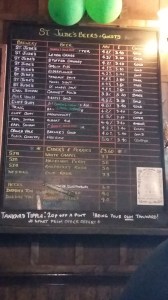 there is only time to sample two before we have to head back round the corner and down the hill to Portman Road. The streets behind the stands are thronged with folk going to the match, hurrying along to their allotted turnstile; it’s like a real life version of LS Lowry’s ‘Going to the match’, or it would be if it wasn’t for the modern obesity epidemic. It will be a big gate today with the club having given season ticket holders the chance to buy up to four additional seats for a tenner each; added to which of course it is a Bank Holiday, it is ‘Sir Bobby Robson day’ (I feel like there should be a cheer after I type that) and the visitors are Newcastle United, the best supported team in the division. The ‘perfect storm’ is avoided however, as Ipswich have been rubbish this season and so there is no local ‘feel good factor’ and consequently the official attendance is over 4,500 short of capacity at 25,684.
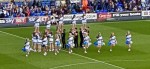 as a dozen or more girls in white shorts and tops and a few boys in tracky bottoms jump and throw themselves about in honour of Sir Bobby in time to some energetic music, including an up-tempo version of Sir Bobby’s favourite ‘My Way’.
 chant “You’re not singing anymore” to the 1,900 odd Newcastle fans who, it has to be said, aren’t singing anymore. Meanwhile 225 kilometres to the northwest, Notts County equalised not long after half-time and the Pompey party next to me is for the time being on hold.
 trippingovertheball