Today is the last day of September, my wife Paulene and are staying in Meudon on the edge of Paris, and having enjoyed both professional Ligue 1 and Ligue 2 football in the past week and a bit, watching both Paris FC and Paris St Germain, this afternoon we are getting down with the French equivalent of ‘non-league’. Not much more than ten minutes away by car at the Stade Georges Millandy in Meudon Le Foret (twenty minutes by bus service No 289) is a Coupe de France fourth round tie between Meudon AS of the Ile de Paris regional league Division 3 and St Ouen L’Aumone AS of the Ile de Paris regional league Division 1. These leagues are the 6th and 8th levels of the French football league ladder, although probably not directly comparable to those levels in the English non-league ‘pyramid’.
The parking at the local community sports centre, where the match is to take place is full, so we park our trusty Citroen C3 around the corner in Rue Georges Millandy between large blocks of modern apartments. We are not sure exactly where we are going, but the Federation Football Francais (FFF, the French Football Association) website says this is the where the match is taking place and having walked through a corridor in a sports hall we find ourselves next to an artificial football pitch. There is no turnstile and watching this match is free. A bunch of blokes in tracksuits sit outside a portacabin eating baguettes and drinking coffee. In my exquisite school boy French I ask if this is this is where the Coupe de France game is taking place at 2.30; I am relieved to learn that it is, and flattered that the man I speak to recognises the Ipswich Town crest on my T-shirt. I explain that I am a fan and not from the club itself, but we both quickly make the connection that Ipswich’s Under 18 player Idris El Mazouni is from Meudon. I will later discover that I have been talking to Idris’s dad.
The Stade Georges Millandy is not a stadium as we might understand it in Britain, because it has no stands; it’s just a 3G synthetic pitch with dugouts and a metal fence, overlooked by five or six large, shiny white apartment blocks.
It wouldn’t make the grade for the Thurlow Nunn Eastern Counties League, although in truth the playing facilities are better than at most clubs in that league. It seems quite new, is in good condition and is the sort of installation that a town the size of Ipswich should probably have at least ten of. Given that these pitches are not cheap to install it is doubly impressive that the surface extends beyond the actual pitch to the area around it, with a mini pitch and goals in the space behind one goal. A game (possibly Under 15s) is


just finishing with a penalty shoot-out and I return to the portacabin, which is a sort of club house and buvette, to get two cups of green tea and a Kit-Kat (all 1 euro each); the tea is poured from a huge pot. On one wall is a large array of trophies won by all age groups within the club.


Paulene and I wander around the pitch as we drink our tea and I scoff a Kit-Kat trying to remember why Nestle products were boycotted and if they still should be; too late now, I have become complicit in their multi-national nastiness. It is a beautiful, bright sunny

afternoon beneath a clear blue sky and the gaze of those shiny apartment blocks, which cast no shadows on one another or the pitch; this has to be how Le Corbusier imagined La Ville Radieuse.
A man in a loosely belted gabardine raincoat appears; if he was wearing a trilby hat he could have stepped from a 1940’s film. He sports a bright arm band which adds to the look, but in a slightly sinister manner; he is however the délègue principal, the FFF official who
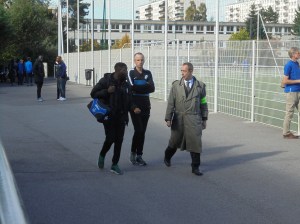
will oversee this afternoon’s game from the side lines. Out of the blue one of the spectators walks up to me and shakes my hand. In due course the two teams emerge from their respective changing rooms and walk through the metal gate onto the pitch before lining up side by side, then in a line before shaking hands. Introductions between the referee and players and délègue principal are made all-round, before the game kicks off about five minutes late (it was advertised as a 14:30 kick–off) with St Ouen having first go with the ball, aiming at the goal in front of the buvette. Meudon kick in the general direction of far off Stade Charlety and the 13th Arrondissement. St Ouen wear an all-green kit, whilst Meudon are all in red; neither club has its club crest on its shirts but instead bear the logo of the FFF with its cockerel.


St Ouen quickly win a free-kick as their tricky number nine goes down under a challenge; he gets up to send a neat free-kick over the red wall of Meudon, but into the arms of the very young looking Meudon goalkeeper, who strangely is one of the smallest players on the pitch, a sort of French Laurie Sivell. It is also St Ouen who have the second serious goal attempt, again a free-kick, but this time firmly hit from a wide position by their number ten. Once again the goalkeeper, whose blond hair may not be its original
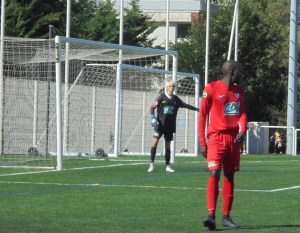
colour, saves, batting the ball away for the first of five corners that St Ouen will win this half. Most of these corners are either poorly taken or all the St Ouen players are waiting for the ball in the wrong places.
Meudon are very competitive and the game is played at a fast pace with the emphasis on passing rather than just getting the ball forward by the fastest route. Meudon come close to scoring a bit before three o’clock as their huge number eleven breaks through on the left. The St Ouen goalkeeper, who incidentally reminds me of St Etienne ‘keeper Stephane Ruffier on account of his designer stubble and very short dark hair, and is possibly the second smallest on the pitch, dives at his feet. The ball rebounds to the Meudon number seven whose goal-bound shot is headed away at improbably close range.
Meudon seem to be growing in confidence and their number ten does a few feints and jinks over the ball like a footballing Michael Jackson (Bubbles’ friend, not the one who played for Tranmere and Shrewsbury) might have done. There are a few jeers and within the next twenty seconds his ankles are swept away from beneath him by the St Ouen number three as he goes to dribble down the right touchline. It’s one of those situations that some people would try to excuse by saying that number ten had been ‘disrespectful’, but that’s just a modern buzzword, a sort of false political correctness and it is tosh; I blame Eastenders. Football is a game of skill, and dumping someone on their bum shows little ‘respect’ itself. Referee Monsieur Charly Legendre doesn’t see fit to book anyone either way.
The coaches on the side lines are animated, “Parlez –vous” one calls urging his players to talk to one another. The St Ouen coach, a portly man in his fifties sports a fine mullet and
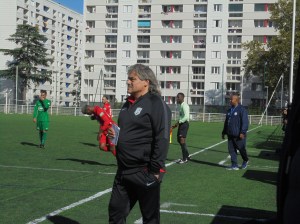
has the look of Maradona about him. The Meudon coach becomes involved in a prolonged discussion with the linesman Mefa Bakayoko about an offside or a free-kick which has been and gone and so no longer matters. On the field, the St Ouen number ten sends a free-kick solidly over the cross bar whilst Meudon’s number six comes as close as anyone else with a long range shot that goes wide. St Ouen’s number nine is proving industrious and creates a couple of shots for himself, one of which is well saved and Meudon replace their number three with substitute number thirteen. Half-time arrives and Paulene and I look back on a good but slightly frustrating forty-five minutes, which was too tight to be really entertaining. I head for the buvette to get a bottle of water (1 euro).
During the half-time break we stand about and as a man walks by he shouts “Ipswich!”. We could do with that sort of enthusiasm at Portman Road. As I stand I enjoy the
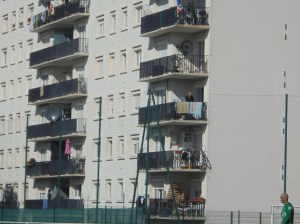
contents of the many balconies that overlook the pitch from the surrounding apartments. Bikes, mattresses, plants and drying clothes decorate the bright white buildings and on one corner is a tricolour, perhaps left over from the summer’s World Cup win. As the afternoon wears on more people seem to arrive to watch the game and by the end I estimate that at least one-hundred people are here.
The délègue principal oversees the away team leaving their dressing room by a side door to the sports centre building and heads back to the pitch still wearing his gabardine raincoat, although it’s a warm afternoon; he is perhaps the anti-thesis of the banker in The Beatles’ Penny Lane and also feels as if he’s in a play, or a British TV sitcom. The bearded referee begins the game again and St Ouen soon win their sixth and seventh corners of the game, although in between their number eleven also shoots over the cross bar. At about four o’clock the St Ouen number eleven breaks forward through the middle, stretching the Meudon defence before playing a through ball to number ten who slips the ball inside the near post past the ‘blonde’ goalkeeper; St Ouen lead 1-0.
They may be losing and disappointed to be doing so, but Meudon still pose a threat and a good run and cross from number eleven meets the thigh of number seven just a few yards out, but he can’t direct the ball past the goal keeper. The first booking of the game goes to Meudon’s number two and the game enters a tetchy stage where it seems it could flare up at any moment. As at most French football matches I have seen where this happens however, there are only outbreaks of animated discussion between the players, but the referee stands back and let’s this carry on. It’s a civilised approach which may reflect the character of a country that has produced far more philosophers than England has produced ‘World Class’ footballers.
St Ouen are buoyed by their goal and their bearded number three controls a ball beautifully on his chest before advancing down the flank. The lads watching near us jeer at his skill and nickname him Fekir, and they’re right to do so because he does vaguely resemble the French international. But Meudon are not beaten yet and the large number eleven strides past a couple of St Ouen players before playing a through ball to number twelve who either wasn’t paying attention or the pass wasn’t as good as it looked. Paulene and I belatedly realise that the number twelve has replaced the number seven, who we had thought was Meudon’s best player.
St Ouen almost score a second goal as their number nine diverts a cross from ‘Fekir’ the wrong side of the post from close range, but the game is becoming more scrappy and there are more fouls. The Meudon number ten spends more time than most not being upright. St Ouen win an eighth corner and as a passage of play ends Monsieur Legendre calls over Meudon’s number nine and ‘Fekir’ and books them for a mystery offence that neither Paulene or I saw. It is now gone half past four and we are witnessing time added on as St Ouen’s number eight runs down the right and then pulls the ball back across the penalty area for substitute number fourteen to side foot beyond the small, blond goalkeeper into the far corner of the goal. St Ouen L’Aumone AS is the name that will go into the draw for the 5th round of the Coupe de France.
It’s been a reasonable game although not an exciting one in terms of goalmouth action. We turn to leave and Paulene notices a man with an Ipswich Town crest on his coat; I speak to him and it turns out he is the father of a second player from Meudon AS who is now in Ipswich Town’s Under 18 squad, Lounes Fodil.
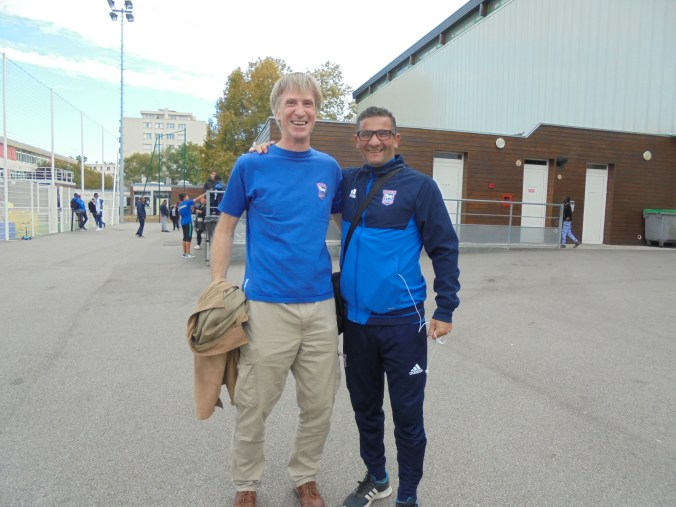
Lounes’s dad, who is called Mustapha (apologies if the spelling is wrong) is a lovely bloke and is genuinely pleased to meet us and invites us for a coffee in the buvette. Our conversation probably isn’t the best as neither our French nor Mustapha’s English are fully fluent, but Mustapha gets across his philosophy of football; it’s a game of skill and intelligence not brute strength. He’s been to Portman Road and has noticed the glum atmosphere, which he attributes to the dull football. Whilst we are at the buvette some of the players come in for post-match drinks and snacks, one of them (I think it might have been the big number eleven or the captain) tells me Lounes is a good player. I tell him that’s good news because Ipswich Town really needs some good players; before he leaves he shakes my hand. The man who I first spoke to when we arrived comes to the bar counter and gets out his mobile phone before showing us a montage of clips of Idris El Mizouni playing for the Under 18’s, this is when I discover that this is Idris’s dad.
After a good half an hour or more we have to leave and walk from the ground with Mustapha who leaves us his phone number and invites us round to eat; sadly Paulene’s food intolerances and allergies will make that too complicated. We thank Mustapha and say how good it has been to meet him. Hopefully we will see him again.


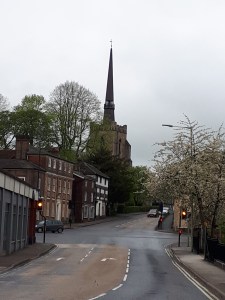 II* listed, but seemingly derelict eighteenth century Lynton House in front of it. The route to Green’s Meadow is along Gipping Way, past the badly spelt Bodywize Gym, Lidl and the predictable queues of shoppers at its checkout tills, who stare out through the plate glass to assuage their boredom; perhaps I should wave.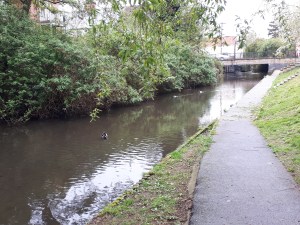
 impressive looking, but the yellow and black signage gives it a certain unity and smartness. Entry to the Greens Meadow ‘stadium’ (£6) on match days is through the ‘turnstiles’ which are close to the half way line. There is no queue and as I walk in the referees and some players are warming up on the pitch, which on such a grey day appears almost luminous, its grass, lush, damp and very green.


 shirts with black shorts and socks, whilst Long Melford wear an Anderlecht or perhaps Fiorentina or Toulouse inspired change kit of all purple or violet, but with black and white hooped socks, as if they forgot to buy the whole ensemble. Melford kick off the match with their backs to the town, playing towards the A14 and the looming concrete bridge which crosses the adjacent railway track and River Gipping.
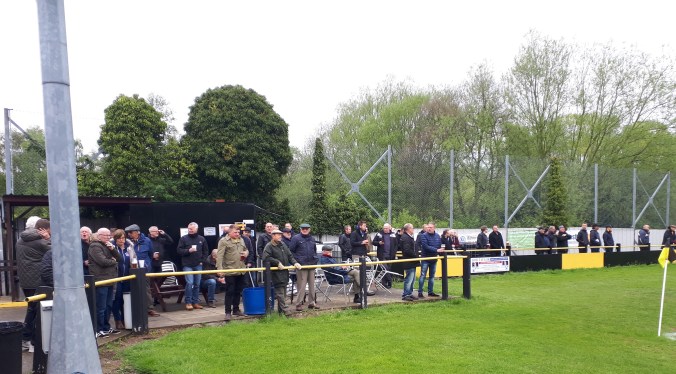 drinking. A few wear flat caps, some fashionably, some less so. “Blimey, it’s like an audition for Peaky Blinders round here” says one bloke; it’s a comment that makes me smile more than anything I anticipate Russell Hall might say. I wander round to behind the dugouts. Stowmarket win a corner and their number five heads the ball directly into the arms of the Melford goalkeeper. One of the Stowmarket coaches clutches his head in anguish as if imitating Edvard Munch’s ‘The Scream’, or having a seizure. The Melford right-back then rather uncharitably passes to the Melford number eleven, simultaneously calling “man-on”. It’s akin to throwing him something boiling hot and yet also very fragile. He might have done better to pass to someone else.
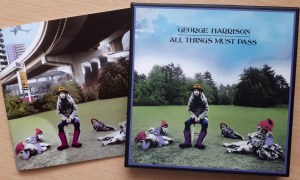 the 30th anniversary edition of George Harrison’s defining triple album “All Things Must Pass”. The concrete bridge is a wonderful backdrop to the corner of the football ground, running as it does above the height of the trees, which surround the ground on two sides. The roar from the traffic is constant and I wonder how polluting it must be down here at pitch level. Do asthmatic players struggle more at Stowmarket?
 trippingovertheball