The train journey from Ipswich to Newmarket (£10.50 return with a Goldcard) takes 58 minutes to cover a distance of about 65 kilometres. That may seem a little slow, but the train does stop at Needham Market, Stowmarket, Elmswell, Thurston , Bury St Edmunds and Kennet before arriving in the town that is the centre of the British horse racing industry, home to about 21,000 people and 3,500 horses.

Despite a little mist it’s a bright February day beneath a cloudless blue sky, the unseasonal warmth has resulted in blossom appearing on some trees. I am in good time for the 13.20 train to Cambridge which is already waiting on platform 4B; I board through the sliding doors. I immediately feel as though I have inadvertently stepped into someone’s dining room. At the table to my right a family of four has their picnic lunch spread out before them; sandwiches and baking foil everywhere. They look up at me as if to say “Don’t you knock before you enter a room?”, but they can’t say it because their mouths are full of sandwich; their jaws churning like tumble driers. I pause to decide if I want to sit at the table opposite them; I don’t think I do, they’ve stared me out; I turn left. There are plenty of empty seats and I find another vacant table.
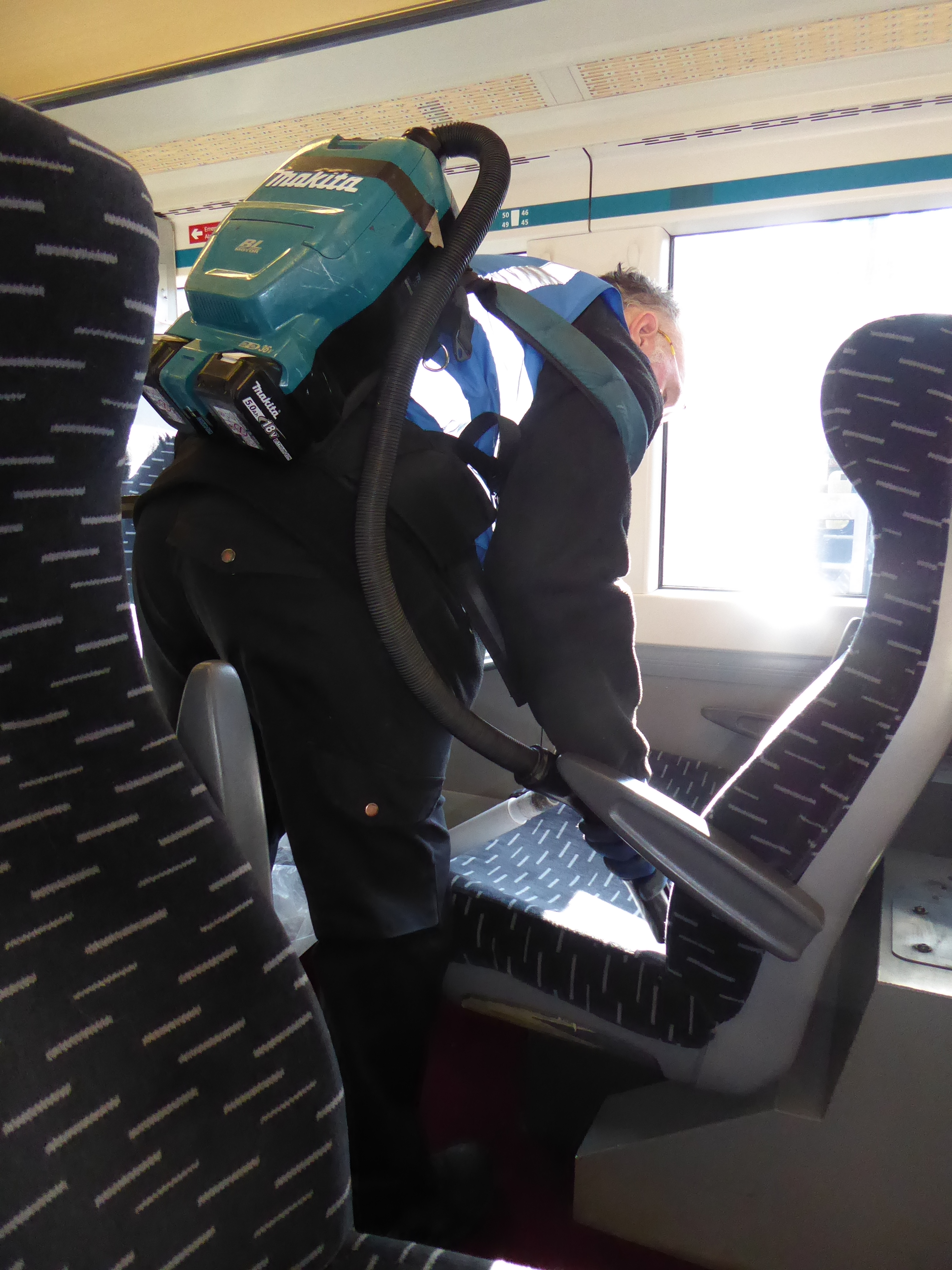
Behind me I hear a sound like a vacuum cleaner; it is a vacuum cleaner and it is strapped to the back of a man in a blue tabard; he looks like a one man tribute to Bill Murray and Dan Akroyd (Ghostbusters). I am impressed that the train is being cleaned between journeys; on his back above the vacuum cleaner it says “Presentation Team”, which sounds much nicer than plain old ‘cleaner’.
I sit and enjoy the architecture of the Victorian station platform briefly before the train departs, on time. Soon out of Ipswich the train speeds through the rolling Suffolk countryside of isolated farmhouses and medieval church towers. A warm but slightly condescending female voice announces the station stops. The floodlights of Bloomfields the home of Needham Market FC can be seen if you know where to look and the track passes next to Stowmarket Town’s Green Meadow. Munton’s of Stowmarket announce on a large sign that they are “passionate about malt”. There are misty silhouettes of church and cathedral towers in Bury St Edmunds and a black cat crosses the Ipswich bound track; at Thurston there are chimneys like candy twists and at Kennet a metal silo that looks like a painting by Charles Sheeler. The landscape changes towards Newmarket; rows of pine trees and broader, flatter downland; the chalk beneath pokes through where the soil is tilled and forms white cliffs in railway cuttings. Surprisingly, the final approach to Newmarket is through a long tunnel.
The train is still on-time as it arrives in Newmarket, this is as far west as it’s possible to go without not being in Suffolk anymore, but Newmarket station is a massive disappointment. There is no sense of arrival here, it’s no more than a platform and a couple of metal bus shelters. It is hard to believe that such a wealthy, internationally known town as Newmarket should have a railway station which is, to be blunt, so crap. Apparently the original Victorian station was demolished in 1981 despite being a listed building.
Putting the squalor of British public transport behind me I make the short walk down Green Road over The Avenue and up Granary Road where I turn right through a kissing gate and across the railway line into Cricket Field Lane, the home of Newmarket Town. I am somewhat amazed that it is still possible to walk across the railway track as increasingly the population is treated like idiots incapable of working out how not to suffer grievous injury or death from stepping out in front of moving trains. However, a poll conducted in 2016 did reveal that 52% of people who voted were stupid.
There is no queue to get into what I imagine Bloorie.com pay to have called the Bloorie.com Stadium. Two men have squeezed themselves into the blue metal-clad turnstile booth; I ask for “one and a programme” and hold out a twenty pound note. The smaller and older of the two men pauses, I wonder if perhaps he hasn’t got enough change, but no, he has; he eventually asks for £8 (£7 entrance +£1 programme); he was just adding up. His mind had “gone blank for a moment” he tells me. As the smaller man hands me my change the larger man invites me to buy two strips of tickets for the club 50/50 draw, which he explains will see half the money collected becoming prize money and the other half going to the club. I tell him I understand and buy two strips (£2); there didn’t seem to be an option to buy just one. My investment will come to nothing; I’ll have to write it off as a charitable contribution.
Inside the ‘stadium’ I head for the tea bar where I purchase a bacon roll (£2.50) and a cup of tea (£1.00). As I wait for my bacon roll I watch the teams and referees warm up on the sun-lit synthetic pitch, which looks extremely neat even if it is accompanied by a rash of prohibiting signage; this is its first season. My bacon roll is ready and I sit in the stand to eat it and to avoid having to juggle a paper plate, napkin, bacon roll and cup of tea. The bacon is crispy. Bland, forgettable, 21st century pop music plays over the public address system. Today, Newmarket Town who are ninth in the Thurlow Nunn Eastern Counties Premier league with thirty-seven points from twenty six games played face Thetford Town who are fifteenth with eight fewer points from the same number of matches played.
In time everyone disappears back inside the dressing rooms only to re-emerge as the three o’clock kick-off approaches. The referee’s assistants are first to appear, posing in the doorway, before the away team and then the Newmarket team each form a queue and at the referee’s signal march onto the pitch to line up in front of the main stand as if for inspection and to greet one another with multiple handshakes. Meanwhile, a short man in a blue cap uses a radio mike to introduce the match and announce the teams, and in a possible homage to John Motson he adds all sorts of extraneous detail, such as the fact that Newmarket’s Jacob Partridge is expecting his first child later this year; he’s not showing.
Thetford Town begin the game kicking towards the miserable little railway station whilst Newmarket Town play in the direction of a row of pollarded trees and the Gallops which are visible far off in the distance.
Thetford wear all claret with odd looking sky blue rings round their shoulders, whilst Newmarket sport yellow shirts with blue shorts and blue and yellow hooped socks. I particularly like Newmarket’s socks and it is no wonder that there is an advertisement for a supplier of sock tape on the fence at the side if the pitch. Electrical tape is good enough for most, but hooped socks deserve something special.
The game begins with the ball being played back to Thetford’s number five Jonathan Carver who hoofs it forward unceremoniously. The Newmarket goalkeeper Will Viner boots it back and it’s Carver who heads it back again, fifteen love. The most difficult thing in football sometimes is knowing what to do with the ball from the kick-off. Happily the game settles down into a more entertaining series of passes and moves. Newmarket are the first to ‘get the ball down’ but soon Thetford get the idea too; it would be a shame not to make use of the flat, true surface of the synthetic pitch over which the ball almost seems to whisper as it rolls. Newmarket earn the game’s first corner but Thetford claim the first booking as Newmarket’s Jack Whiting is clattered to the floor. “Ref, he’s fucking injured” cries Newmarket’s goalkeeper Alex Archer helpfully as the game at first carries on. When referee Mr Brian O’Sullivan (not a relative of deceased racing commentator Peter O’Sullevan) awards a free-kick to Thetford’s number nine Volter Rocha, Archer who is very ‘gobby’ for a man dressed from head to toe in salmon pink calls out “ He fuckin’ slipped” .

At the other end the more soberly dressed (all grey) Thetford ‘keeper is equally vocal but restricts his advice to his own team. “Win it, win it” he shouts and “Left shoulder Steedy; Elliott, left shoulder” . Meanwhile from the touchline the advice is a more positive sounding “In the hole”. Just before twenty past three Thetford hit a post and five minutes later the impressive Volter Rocha hits a shot onto the cross-bar and the equally impressive number two Sam Bond heads in the re-bound to give Thetford the lead to cheers from the main stand.
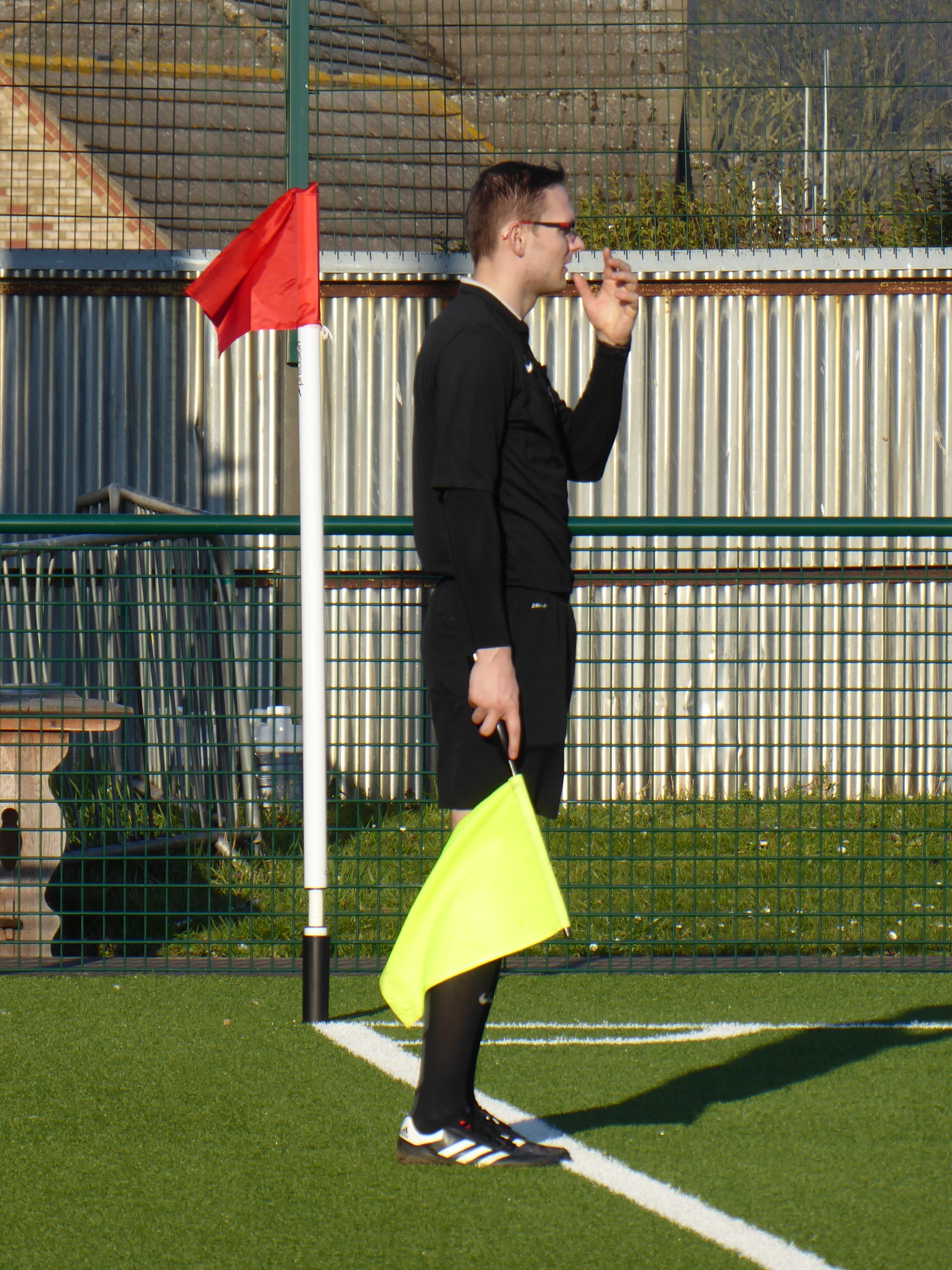
In front of me a group of lads watch keenly. “Go on boy wonder” says one as Newmarket’s Jack Whiting pushes forward. “ That number nine rolled his ankle” says another “ Well he looks okay” is the reply. “Yeah, but he has rolled his ankle”. Half-time is approaching and the bespectacled linesman whose glasses make him look a little like Kevin Costner’s character in the film JFK stifles a yawn.
With the referee’s whistle I head for the bar. I check on the half-time scores; Ipswich are winning away from home; excellent! I order a half of Lacon’s Pale Ale (£1.70) to cautiously celebrate a job half done. The beer is much too cold and fizzy but it has that fashionable, light, hoppy flavour. Once the rush has died down I ask the barman what has happened at Newmarket that the place now looks so much better than it did when I was last here, probably in 2014 or 2015. Back then it looked like the National Trust might want to preserve it as an example of a slightly shabby Step Five football ground from the 1980’s. He tells me that they sold the land behind the clubhouse for housing, which funded the synthetic pitch which is now hired out every night; this week Cambridge United have used it every day for their soccer school. Meanwhile the club’s guests and visiting officials enjoy plates of sandwiches and fancy-cakes in a room to the side of the bar. I look at the programme, a glossy publication full of adverts, but with potted club histories, league tables, results and fixtures too, so a useful programme all the same; and it’s good to see which local companies help support the club. I very much like that Tattersalls advertise their sales calendar and wonder how many of the crowd here today will be looking to buy a filly or may be a two year old at the next sale.
The second half begins promptly at four o’clock, which is good because I don’t want to miss my train at eight minutes past five. “Come on Jockeys” shouts a large man from close to the smoking area “Come on Jocks” echoes another man. The first action of the half sees the Newmarket goalkeeper slice the ball high over the clubhouse and out of the ground. “There goes another thirty quid” says someone. I wander round to watch from between the dugouts.
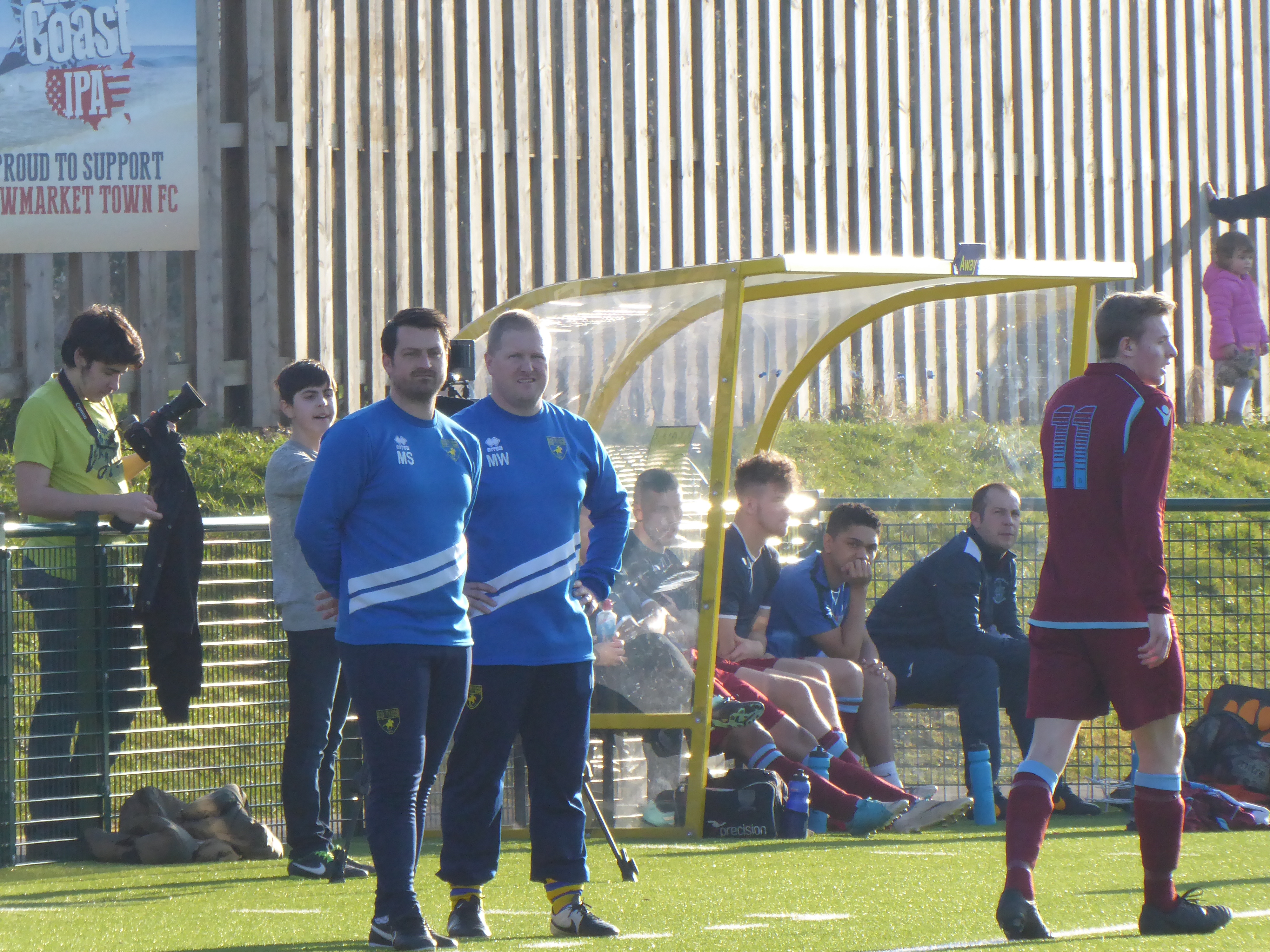
The two Newmarket coaches kitted out in matching blue tracksuits stand conspiratorially together. “Come and fuckin’ get it” shouts one of them at the ‘keeper after Thetford put in a cross. “ He was behind him” shouts the ‘keeper in his own defence. “Fuck off” replies the coach.

Thetford look like they might score again and their good play belies their relatively low position in the league table; perhaps they need to play on a synthetic surface every week. The afternoon wears on and the sun sinks lower in the sky casting long shadows of the trees behind the Thetford goal down the length of the pitch. Spectators enjoying the warmth of the sunshine have to shield their eyes, but it’s very cool in the shade. Substitutions are made and the man in the blue cap announces them as best he can. “Number 17 is coming on” he tells us “… but I haven’t got a number seventeen on my teamsheet”. Whoever number 17 is he’s got a powerful shot and he soon elicits a spectacular save from Newmarket’s Archer who because of his pink kit really does ‘leap like a salmon’.
Up in the stand Thetford supporters are encouraging their team. “On your bike ‘arry, skin ‘im son” is the advice to the alliteratively named number eleven Harry Hutt. But Thetford fail to score again and as the game enters its last ten minutes Newmarket begin to keep the ball a bit more to themselves. At five thirty-six an angled free-kick into the Thetford penalty area is met with a deft, flicked header from substitute and player manager, Michael Shinn. The ball enters the top left hand corner of the goal as great goals often do. Shinn may have one of fuller figures on the pitch today but his is a fine goal and Shinn is a fine name for a footballer, although not quite as good as that of the Newmarket number two Blake Kicks, whose surname is worthy of the Happy Families card game; up alongside Mr Bun the baker, Mr Bones the butcher and Mr Pots the painter, meet Mr Kicks the footballer.
Thetford make a final substitution, but don’t hold up the numbers to show who it is and the man in the blue cap announces “Looks like we’ve given up on the boards, so I haven’t a clue who’s come on”. A little while later as the final whistle blows and the man in the blue cap goes to remind us all of the final score, his microphone stops working . The final score is one-all, perhaps my least favourite score line, especially when the opposition equalises in injury time as I learn Wigan Athletic have done in their game against Ipswich.
With the sun now setting behind me I head back towards the turnstile and Cricket Field Road and reflect on what has been an entertaining match. I like the synthetic pitch and that it doesn’t smell weirdly of rubber like others I’ve seen, in fact I don’t think it smelt at all. This has to be the way forward for clubs like Newmarket Town, along with hooped socks. Upwards and onwards, as I said to the barman.
 trippingovertheball