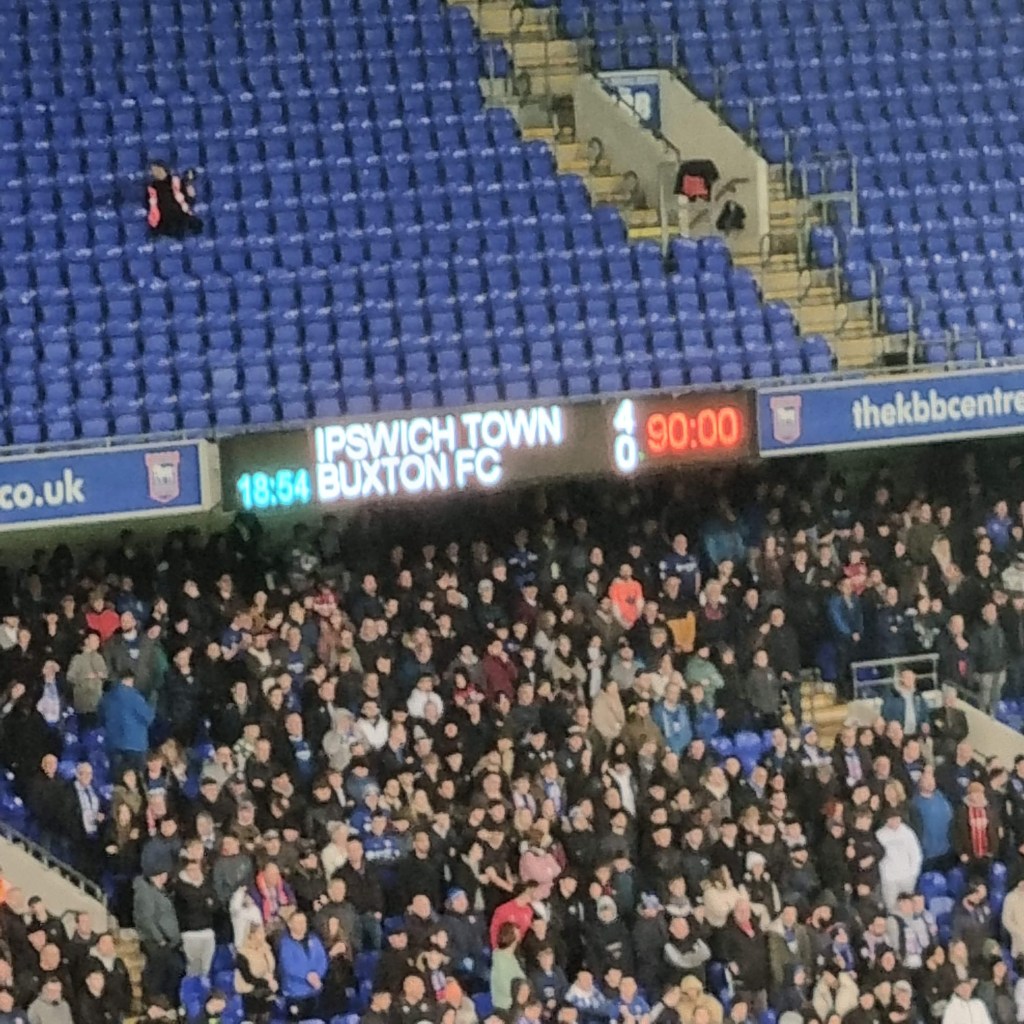
Ipswich Town 4 Buxton 0

Once upon a time, five o’clock on a Sunday afternoon in November in suburban England would have been the time to be thinking about sitting down to eat toasted teacakes or buttered crumpets with a pot of tea and perhaps a slice of Battenburg or Dundee cake.  In our modern times of course, anything goes, and we are free from the strictures of Sunday tea and can now watch football whenever we want, or whenever someone in China, Canada, Bolivia, Cuba, Cyprus, Guadeloupe, Israel, Latvia, Nicaragua, St Kitts and Nevis, Switzerland, Thailand, US Virgin Islands, Uruguay or Vietnam, to name just a few, wants to show it on the telly in their far-off Ipswich Town supporting country.  Today therefore, for the benefit of viewers of TV channels such as Star+, ESPN Play Caribbean, Nova Sport 1, Bilibili and Astro SuperSport, I am pleased to attend my first ever 5 o’clock kick-off football match and  forego my usual relaxing Sunday evening at home in which I try and savour the final few hours of the weekend before the drudgery of another working week. 

The TV viewers of Brunei and Ecuador etcetera are as discerning as you or I and naturally would not watch any old rubbish, which is why today’s match is special; today Ipswich Town play Buxton in the second round of the FA Cup.  Buxton F.C. are in the National League North, the sixth tier of the league pyramid, although oddly the game is not being shown in Egypt.   Sixth ‘tierness’ is a status Buxton share with the likes of Banbury United, Blyth Spartans, Bradford Park Avenue and other clubs many of which don’t begin with the letter ‘B’, like Spennymoor Town.  I recall visiting Buxton on a family holiday to the Peak District in 1976, and then again in 1986 when I was best man at a friend’s wedding there; I spent the night in a caravan that looked like it had travelled forward in time from the 1950’s; of course it had done, but just a day at a time. 

Today might be a special match day in some ways, what with the impending thrill of knock-out cup football and the kick-off time being moved for the benefit of unknown Venezuelan and Costa Rican couch potatoes, but mostly it’s not, and after parking up my trusty Citroen C3, I am soon crossing the threshold of the Arbor House (formerly The Arboretum) like I do before every match. Today, I purchase a pint of Woodforde’s Norfolk Nog (£4.10) which makes me feel slightly traitorous, but I soon recover before joining Mick in the pub garden.  Being a damp, dreary day there is just one other drinker in the garden and he soon departs leaving us to talk about our beers, (Mick is drinking Mauldon’s Moletrap) buying an electric car, the world from a Marxist perspective, this year’s local government pay deal and the reality of cities like Cambridge, Oxford and Brighton away from the colleges and the candy floss. After a further single malt whisky for Mick and a half of Woodforde’s Hiberno (£6.80) for me, which leads to a discussion about whether Hibernia was the Roman name for Scotland or Ireland (it was Ireland), we head off into the quiet of a Sunday evening in Ipswich.  I remark how it’s so quiet that it doesn’t feel like we’re going to a football match;  more like we’re going to evensong, which leads Mick to confess to having been an altar boy at Orford church in the far off days before he hit the hippie trail to Morocco. It’s not until we get to Civic Drive that we see anyone else who is obviously heading for the match. If LS Lowry had been from Ipswich and gone out with his easel on a night like this he’d have had to have painted something else.  But behind the Sir Bobby Robson stand, a long queue snakes along the back of the stand towards the turnstiles beyond.  Mick and I are wise however to the propensity some people have for joining the first queue they see,  and we walk on further towards the corporation bus depot.  At the last turnstile (No58), we attach ourselves to a queue of about five other people and are soon stepping out across the artificial grass towards the entrance to the palatial Block Y of the Magnus west stand.

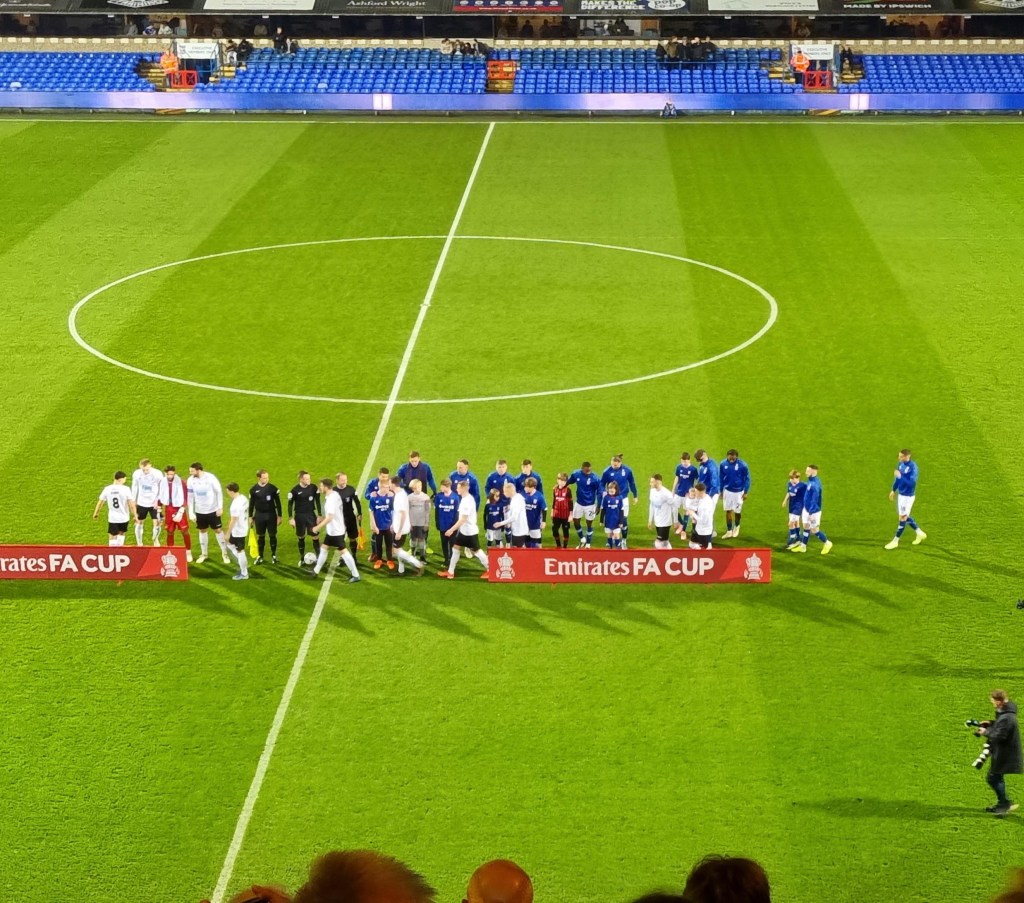
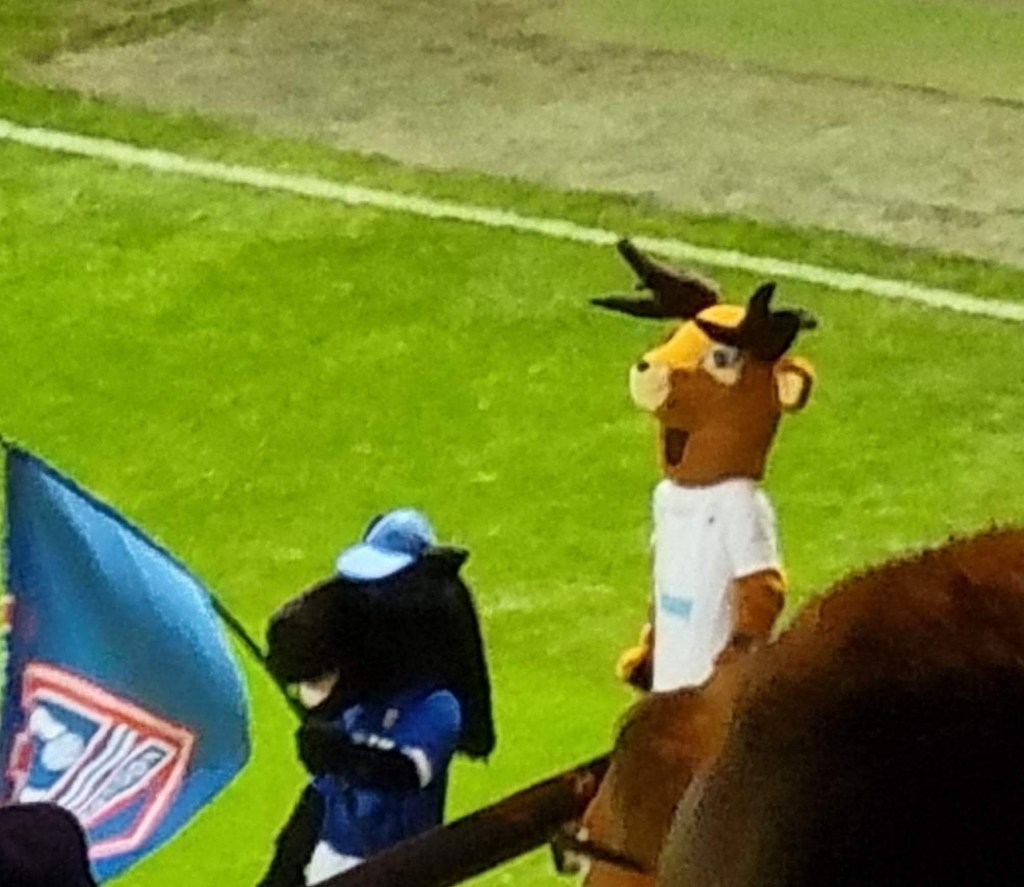
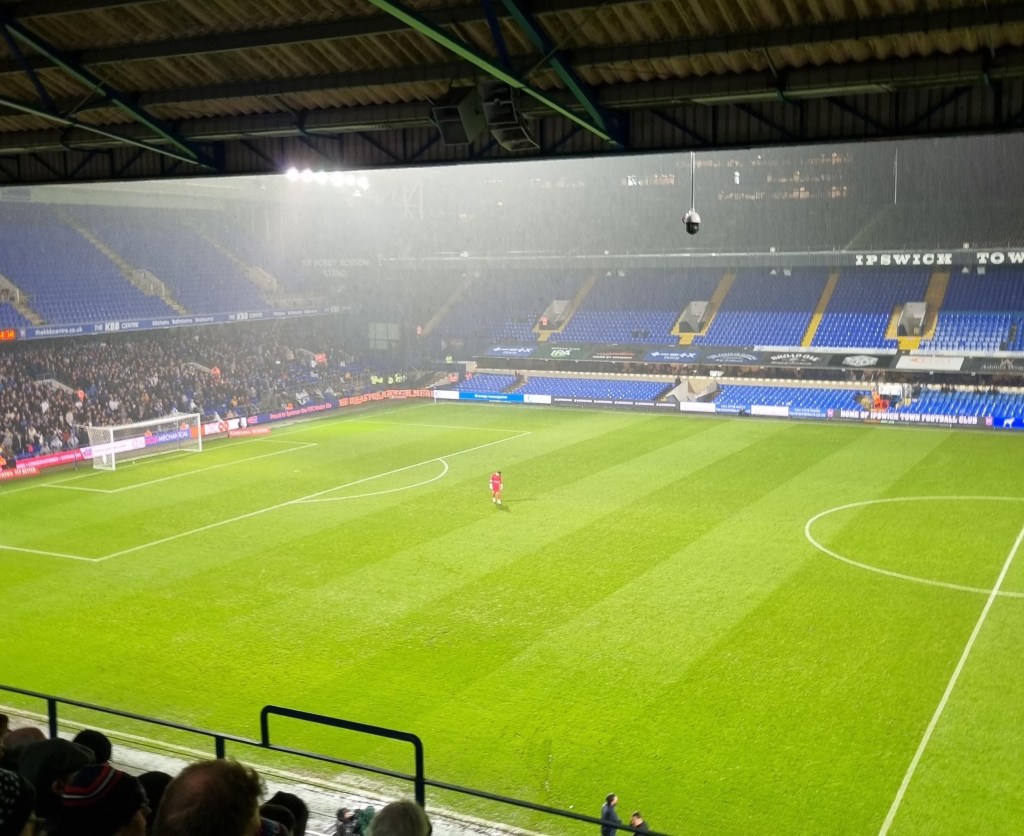
We take our seats just as the teams are walking onto the pitch past Crazee the mascot and a mysterious reindeer; we stand to applaud and stay on our feet as there is a minute’s applause for the recently deceased David Johnson, arguably Town’s third best-ever centre-forward after Paul Mariner and Ray Crawford.   We will later learn that there are fewer than 10,000 of us in Portman Road this evening, but there is nevertheless a frisson of excitement around the ground as a fine drizzle starts to fall and the game begins with Town kicking off towards what was Churchman’s when David Johnson last played here. Buxton are wearing a kit of white shirts and dark blue shorts giving them the air of a poor man’s Tottenham Hotspur, and oddly they have no players of colour.

The opening minutes are dull as Town accelerate slowly through several gears like a very large articulated lorry before finding their desired passing rhythm.  The fragile enthusiasm of the home crowd quickly dissipates and it’s open season for the Buxton fans to begin singing “We’ve got more fans than you” before gaining in confidence with a chorus of “Your support is fucking shit” and then asking the ultimate, damning question “Is this a library?”.   Naively perhaps, I didn’t expect the followers of non-league Buxton to sing the same tired, unimaginative old songs as followers of Football League teams and it sets me to wondering if the folk that occupy the end of the upper tier of the Cobbold Stand aren’t actually just the same people every fortnight but wearing different colour replica shirts.  Thoughts like this can make you question the very nature of reality.

Although Buxton might be dominating the singing with their off the shelf wit, on the pitch their team are barely getting sight of the ball, let alone a touch.  Such is Town’s superiority in keeping the ball that the Buxton fans are reduced to cheering enthusiastically when they win a throw-in.  When Buxton do win the ball Ipswich invariably win it straight back.  But nevertheless, the first fifteen minutes or so are a bit dull.  Mick yawns.  The bloke behind me starts to pray audibly that something will happen. “Here we go” he says optimistically whenever a Town player takes the ball forward more than a couple of paces.   Patient passing football to draw the opposition onto you and create spaces to move into is all very well, but this is the FA Cup for which the watch words are surely “Up and at ’em”.

“Shall we sing, shall we sing , shall we sing a song for you?” ask the Buxtonians through the medium of Cwm Rhondda, which seems appropriate if this is evensong. Sufficiently goaded by the Buxtonians up in the Cobbold stand, a few of the occupants of the Sir Bobby Robson stand summon a limp rendition of “Come On You Blues” before a more lively burst of rhythmic clapping  emerges and even a few extroverts around me in the Magnus west stand  join in .  The first half is half over, but Town are now into their passing stride and are putting in crosses and looking likely to score.  “Addy, Addy, Addy-O” chants what used to be the North Stand.  “Come on ref” moans the woolly-hatted geriatric next to me for some reason I haven’t spotted. Beyond the dark sloping roof of the Magnus Stand the fine steady drizzle looks like steam.  The first Buxton player is booked and then referee Mr Ross Joyce gets into his stride too and records the name of Town’s first Welsh Scandinavian Geordie, Leif Davis in his little notebook too.   It looks like a second Buxton player has got away with a foul on Kyle Edwards but it’s as if Mr Joyce is thinking to himself, “No, I think I will book him after all” and shows a slightly belated yellow card.

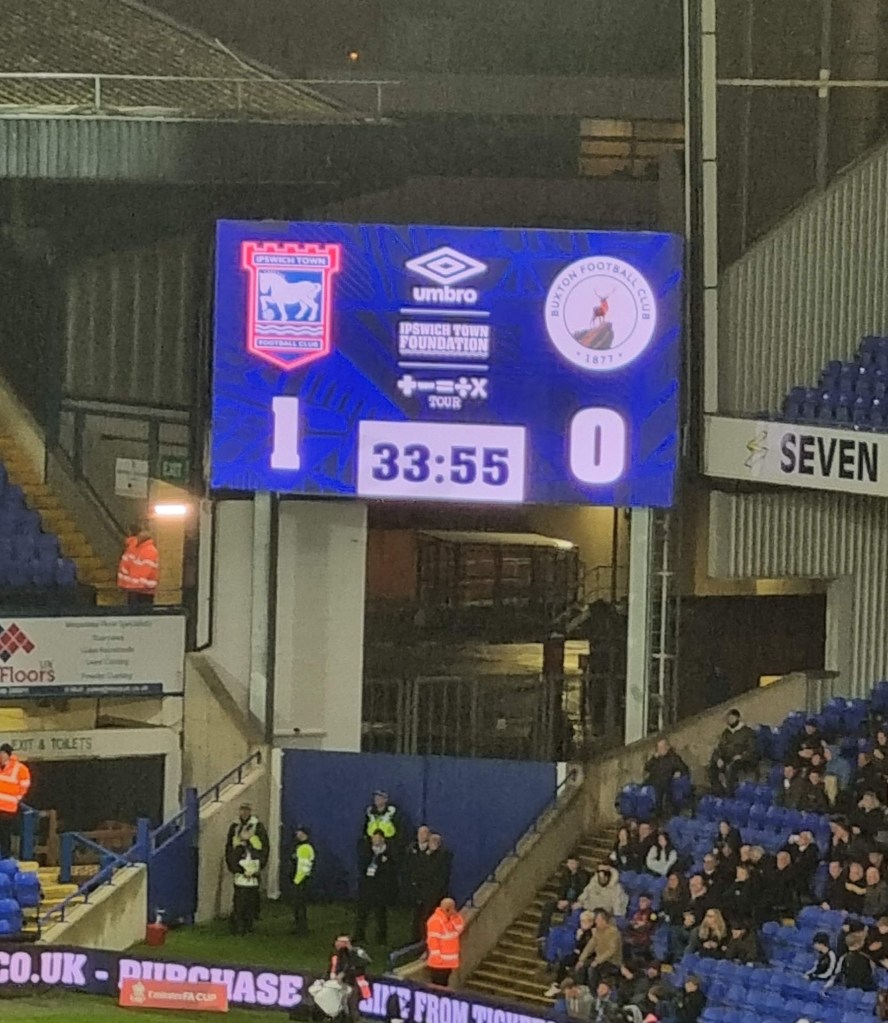
The last third of the half begins and the game has blossomed into something quite enjoyable as Town dominate and create chances but still haven’t scored. But then Wes Burns speeds off down the right , crosses the ball low to Conor Chaplin who skips to one side and sends a darting angled shot into the bottom right hand corner of the Buxton goal from about 12 metres out; it’s a trademark Conor Chaplin goal. Four minutes later Kyle Edwards races into the penalty area, ball at his feet and Buxton players flailing around him before releasing a low cross, which Gassan Ahadme turns into a goal from very close range.

This is how things should be and I can only wonder why 9,000 voices aren’t singing “Wemb-er-ley, Wemb-er-ley, we’re the famous Ipswich town and we’re going to Wemb-er-ley”, but they’re not. With the half-time whistle I descend into the bowels of the stand to drain off some Woodforde’s beer whist Mick queues for a vegan pie which he is impressed to find comes with a wooden spork.


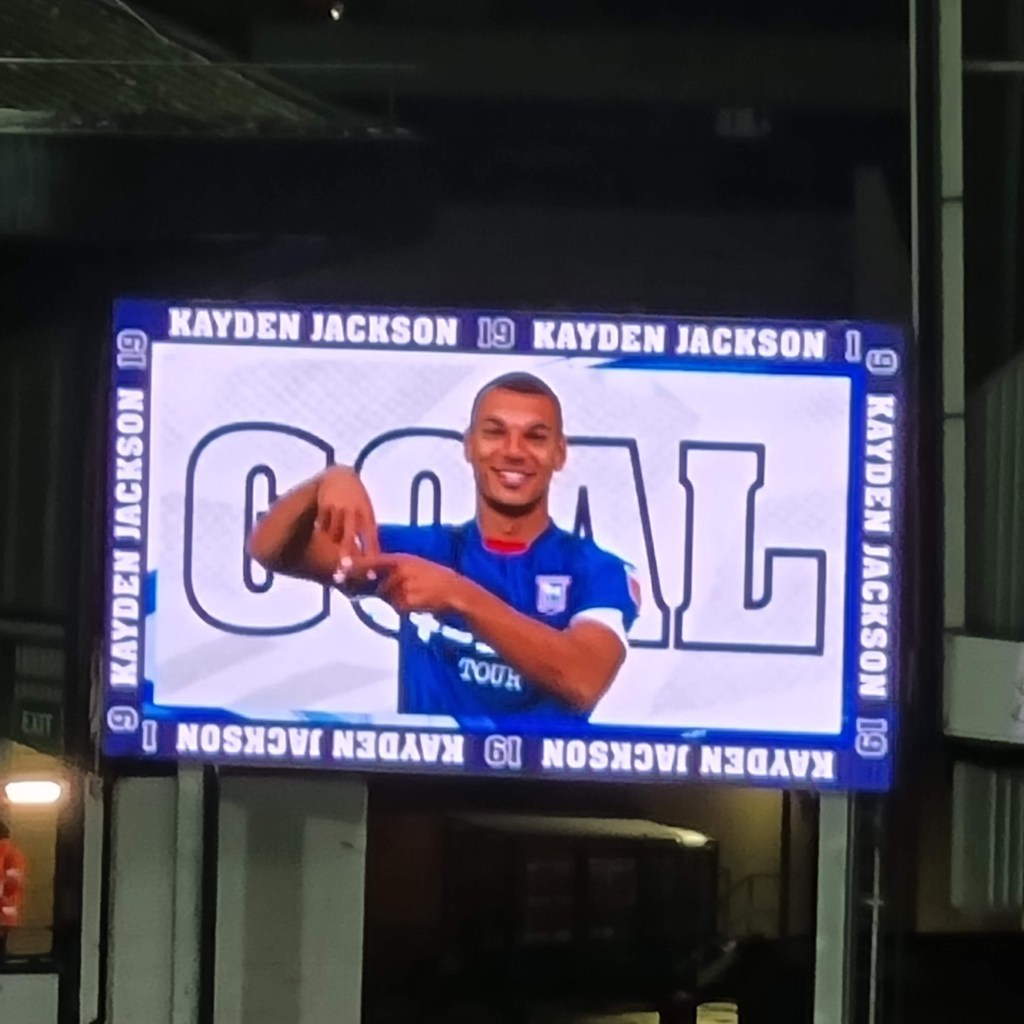
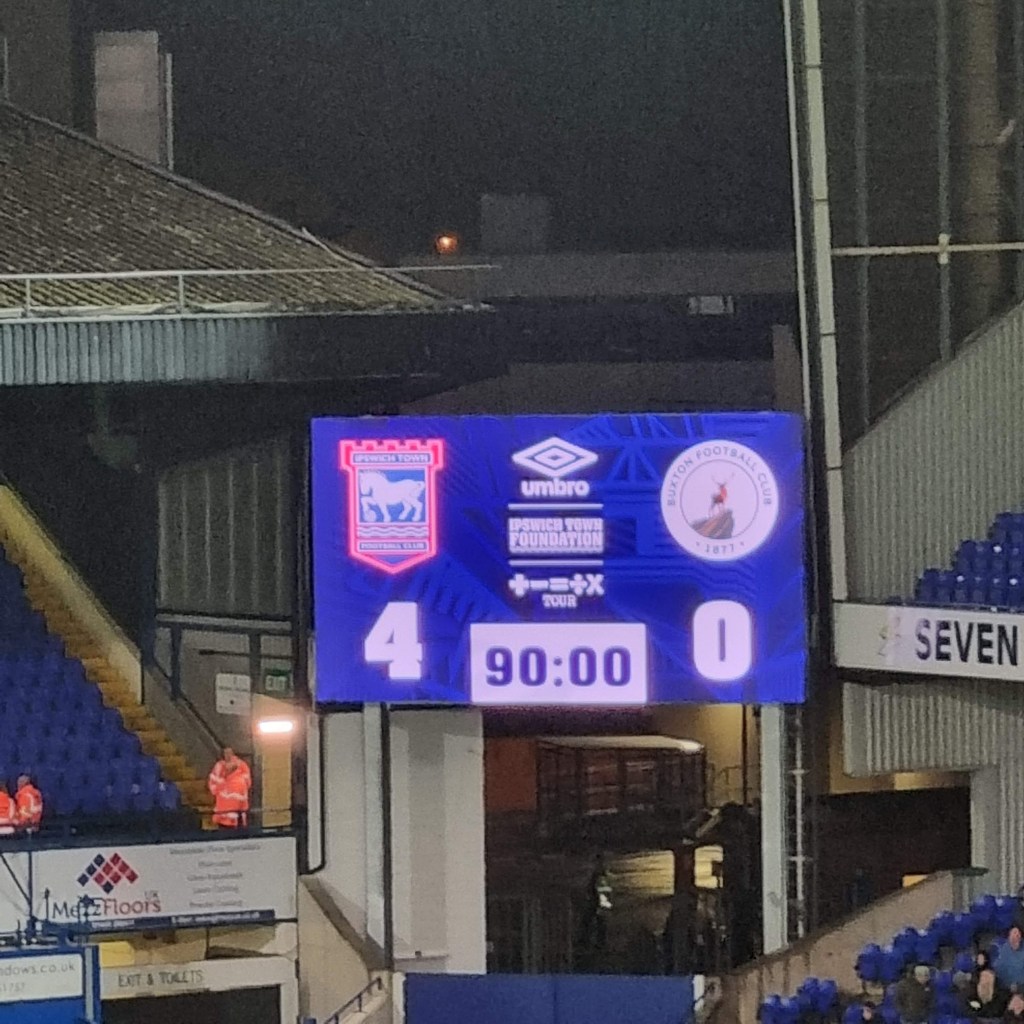
The second half is a breeze. Sam Morsy earns his customary booking to help keep the third division title race alive for Plymouth and Sheffield Wednesday and a pair of young players get their opportunity to play as Leif Davis and Cameron Humphreys are substituted for Tawanda Chirewa and Albie Armin. The drizzle persists.  Buxton bring on a substitute with the memorable name of Harry Bunn and Town add two more goals, another typical, but more spectacular strike from Conor Chaplin and a less characteristic one-on-one shot into the corner from Kayden Jackson, but a fine goal nonetheless.  Four-nil is the perfect score for this match, reflecting Town’s complete domination and superiority but not causing unwarranted and undeserved humiliation for Buxton.

With the final whistle Mick and I stay briefly to applaud before making the long way down to the ground and out into the damp, drizzly night.  “Well worth a fiver wasn’t it”, I tell Mick who agrees, but feels guilty that his seat was half the price of mine.  I tell him it’s not his fault I’m so young and he asks me when I will get my pension. “Four more years” I tell him, stupidly channelling Richard Nixon. But at least Town are into the third round of the Cup and TV viewers all over the planet know it. “Wemb-er-ley! Wemb-er-ley!” they must be singing.
Ipswich Town 0 Oxford United 0

My paternal grandfather was born and grew up in the village of Cuxham, Oxfordshire, which is a bit more than 20 kilometres southeast of Oxford.  I have been told that as a boy his education was regularly interrupted by his grandfather, an itinerant clock mender with a reputation for being locked out of his house by his wife and who spent more than one night in police cells as a result of drunkenness. I might be wrong, but from what I can make out it seems my great-great grandfather would take him out of school so that he had someone on hand to get him home after a heavy session at the pub.  During World War One my grandfather was in the Royal Marines, and I believe in 1916 was on HMS Iron Duke at the battle of Jutland.   Happily, my grandfather was not one of those who died that we might live, and indeed he lived that my father might live and serve on HMS Locust on D-day. Happily again, my father also lived, and grew old, and consequently I am here to write this. My own service record is less impressive, having merely been in the cub scouts and then the sailor section of my school Combined Cadet Force; an utter waste of time for me and the teachers who dressed up as Naval officers on a Thursday afternoon, but nevertheless satisfyingly redolent of Lindsay Anderson’s film ‘If’.   Appropriately perhaps, I have no progeny to whom I can relay my story of living through what is generally regarded as peacetime; peace, who’s interested in that? As Reg in Monty Python’s Life of Brian almost said.

 I remember watching the 1970 FA Cup final on television with my grandfather, by which time he had been living on the Isle of Sheppey in Kent for well over thirty years.  But despite having an appreciation of ITV’s World of Sport, being a big fan of cricket, as well as an avid reader of the Racing Post, as far as I know my grandfather never watched Oxford United or Headington United, as they were known until he was older than I am now.  Today, Oxford United play Ipswich Town at Portman Road for the twelfth time in my lifetime, and with the exception of last season’s goalless draw, which no supporter witnessed first-hand due to the Covid lockdown, I have seen every one of those fixtures, although the only one I remember particularly well is Town’s 3-2 victory in April 1986, a win which ultimately proved insufficient to relegate Oxford United instead of Town from what is now called the Premier League.

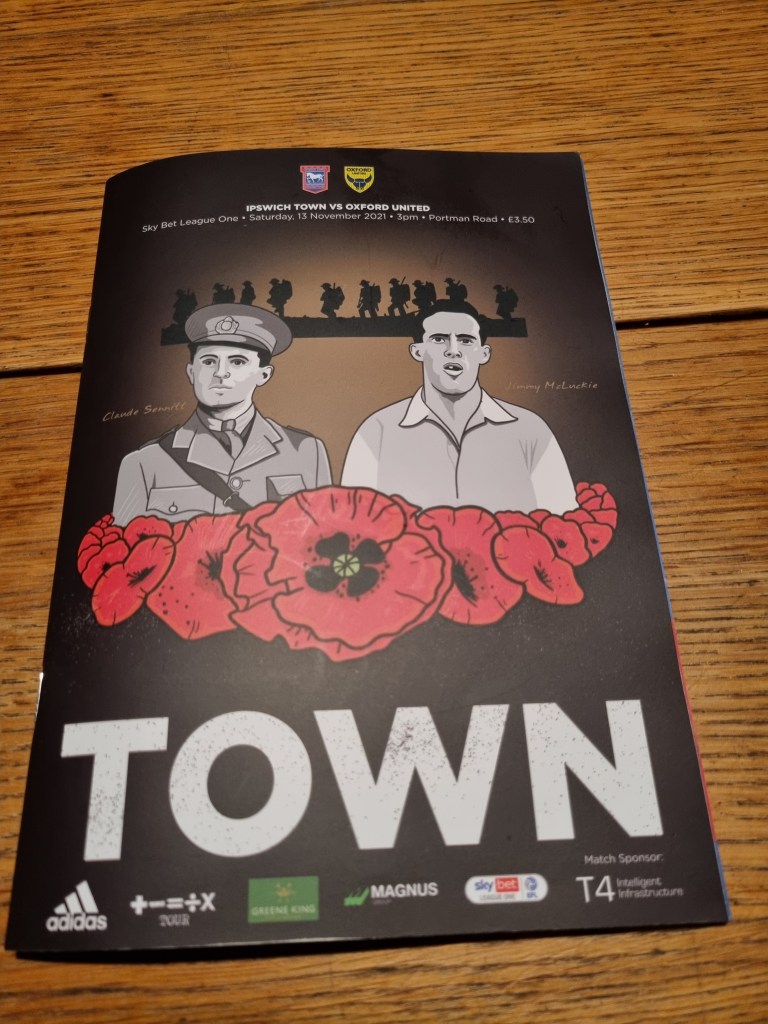
Today is a grey autumn Saturday, illuminated only by the colour of the leaves on the trees turning in different stages from greens to shades of gold, yellow and russet.  After parking my trustee Citroen C3, I follow my usual pre-match routine of Gippeswyk Park, Portman Road, where I buy a programme (£3.50), and The Arboretum pub (now called the Arbor House), which is unusually busy with diners and drinkers, only one of whom is wearing a mask.  I obtain a pint of Mauldon’s Suffolk Pride (£3.80) and exit to the beer garden and the hoped-for safety of fresh air.  Mick soon arrives with his own pint of Suffolk Pride and a cup of dry-roasted peanuts; we talk of COP26, Covid booster vaccinations, Russia, Ukraine and Belarus, Indian partition, Morocco, Algeria and the Paris massacre of 1961, the ethics of holidaying in the third world and Mick’s desire to listen to ‘The Girl From Ipanema’, on the beach at Ipanema. At just after twenty to three we head for Portman Road.

With Covid vaccination credentials confirmed, I enter the Sir Alf Ramsey stand through turnstile number 60 thanking the operator as she allows me through this portal to another world.  I arrive on the lower tier of the stand with the teams already on the pitch, Pat from Clacton tells me she and Fiona were getting worried about me. Stadium announcer, former Radio Suffolk presenter and ex-classmate of my friend Pete, Stephen Foster tells us that in honour of the dead of two World Wars there will be a minute’s silence when the referee blows his whistle.  The players link arms around the centre circle, the referee does not blow his whistle, and a lone bugler pays the last post, after which there is a ripple of applause, which doesn’t happen at the Cenotaph, and I am left a little confused, still waiting for the minute’s silence.  I recall however that we did have a silence last Saturday before the FA Cup game with Oldham Athletic and there was also one before the game at Wycombe Wanderers; there may even have been one before the EFL Cup tie versus Colchester United, but I boycotted that match because of the inclusion of Premier League Under 21 teams in the competition.  I even had my own two-minute silence when working at home on Armistice Day itself and there will be another on Remembrance Sunday.

With the normal sounds of Portman Road restored in the form of The Beatles’ Hey Jude, which the Oxford fans sing along too as well, the knee is taken and the game begins; Oxford United getting first go with the ball and hoping to point it mostly at the goal at the Sir Bobby Robson stand end of the ground.   Despite there being no clash of colours, Oxford are wearing an all black kit, possibly as a symbol of remembrance, or possibly just because their usual yellow and blue kit is in the wash.  Within 60 seconds Bersant Celina concedes the first free-kick of the match and it takes more than a minute for Town to get possession of the ball.  “Yellows, Yellows” shout the Oxford supporters reminding their team what colour shirts they should be wearing, and shaming whoever does their laundry. Town soon win a corner as the oddly named Macauley Bonne has a low cross blocked by Oxford’s Jordan Thornily who sounds prickly.  From the corner kick the same Town player sends a stooping header against the right-hand post of the Oxford goal.  After the glancing header and the diving header, the stooping is possibly the next best.

Oxford are looking rather good, better than Town and in the sixth minute Christian Walton is forced to make a spectacular flying save to repel a shot from Sykes who, being a fan of 1970’s BBC sitcoms, I should like to see in a front three with players called Jacques and Guyler. “They seem good at dipping the ball” says a voice behind me, “They are” says the voice in the seat next to him before a third voice makes an obscure and slightly surreal reference to oxtail soup which I don’t think anyone understands and which kills the “conversation”.

It takes thirteen minutes for the assembled Oxford supporters to ask through the medium of song “Is this a library?” which provokes a man a few rows back to shout in a distinctly middle-class voice “As if you’re used to this many working-class people in your libraries?” It’s an odd thing to shout out at a football match and betrays a curious perception of just who follows Oxford United.  In truth, to someone from Oxford’s Blackbird Leys estate the song was probably an honest enquiry.

Oxford are the better team, although unusually Town’s defence is playing alright, but after almost twenty minutes it is once again Town who come closest to scoring as a Bersant Celina shot strikes that right hand post again, leading to suspicions that the goal has been put in the wrong place and should be ten centimetres to the east. It’s an event that leads to two corners in quick succession for Town. In the Cobbold stand meanwhile the Oxford fans reveal their upper middle class, academic sensibilities that the bloke had alluded to in his library comment, with a lovely chorus of “Sit-down if you shag your mum” to the tune of Village People’s ‘Go West’.  It’s a perfect example of what Paul Weller was on about when, in The Jam’s 1979 hit ‘Eton Rifles’ he wrote the line “We were no match for their untamed wit”.

I’m not feeling good about what I‘m seeing and given past games feel sure that Town will concede a goal soon. “Tell you what,” says the bloke behind me “They’re a decent team”. “Well-drilled” says his friend introducing an appropriately military metaphor. Maintaining the theme, the Sir Bobby Robson begin to chant “Blue Army, Blue Army” but it soon fades into the grey of the afternoon as Oxford continue to dominate.  “Just not with it as a team” continues the bloke behind me, thoughtfully. “Bloody prats need to wake up” adds his accomplice cutting to the chase.

There are twelve minutes until half-time and spits of rain travel on the wind across the pitch towards the Cobbold Stand.  Five minutes until half-time and Oxford’s Cameron Brannagan is booked by referee Mr Scott Oldham for trampling George Edmundson.  Brannagan waves his right arm up and down in protest and on the Oxford bench manager Karl Robinson, a man who often seems stupidly angry with the World, has evidently reacted badly to one of Mr Oldham’s decisions and is also cautioned. “Sit down shut up, Sit down shut up” chant the Sir Bobby Robson stand to the irascible Scouser to the ‘tune’ of the Portsmouth guildhall clock chimes, and for once it’s good advice.

Although Oxford aren’t creating very many good chances, I’m still hoping for nothing more than Town making it to half-time on level terms.  “Can you hear the Ipswich sing? I can’t hear a fucking thing” chant the Oxford fans, annoyingly answering their own question but getting the answer right nevertheless and confirming that it hasn’t been a satisfactory half for Ipswich.  “Sing when we’re winning, We don’t even sing when we’re winning” responds Pat from Clacton with a sotto voce rendition of Guantanamera, for which the new lyrics only just about scan.  A minute of added on time is announced and before it’s over ever-present Phil who never misses a game has left his seat and headed for the facilities beneath the stand.  It’s an astonishing display of both confidence and pessimism that nothing of any importance to the result will happen in the next forty seconds, but it turns out to be well-placed, despite possibly casting a shadow of doubt over the validity of the epithet “ever-present”.

Half-time produces the usual Nature Valley chocolate and peanut protein bar from my coat pocket, which I eat before going to speak with Ray, his son and grandson Harrison.  Ray is impressed by Oxford United, describing them as ‘honest’, which I think is football speak for hardworking but not prodigiously talented.

The football returns and from the start Town begin to play better and Oxford seem happier to sit back, perhaps hoping to ‘hit us on the break’.  Despite being quicker to the ball and having more possession than before, Town nevertheless don’t create the string of unmissable chances I had hoped to see from the team who have so far scored in every league game this season.  Kyle Edwards looks ‘dangerous’ but isn’t, Wes Burns looks tired, the oddly named Macauley Bonne is ineffective and Bursant Celina is either unable to measure a pass or is hallucinating.

When Oxford’s Cameron Brannagan goes down clutching a limb, his club’s female physio sprints across the pitch to him, her blond ponytail bobbing in the breeze. “I’d like to be a physio” says Pat from Clacton. “Ooh, just let me rub that for you” she continues, going all “Carry On”.   From afar Pat thinks the physio looks glamorous, so she zooms in on her with her camera and says in fact she’s a bit severe looking; women can be so harsh on one another sometimes. Meanwhile, I notice that George Edmundson appears to have a large varicose vein on the back of his left thigh.  The Sir Bobby Robson Stand chant something that goes “Addy-addy, addy-o, I.T.F.C” to no particular tune and then “Come On You Blues” as they connect with the improving vibe of the second-half, and full-back Bailey Clements, making his League debut, shoots wide of the far post.

Stephen Foster announces today’s attendance as 21,322, of whom 922 are a combination of professors, dons, Masters of colleges, undergraduates, assorted intellectuals and residents of the Blackbird Leys estate. “Yellows, Yellows” they chant once more in unison as their team win a sixty-sixth minute corner. Play ebbs and flows and a stonking clearance from an Oxford boot rattles the fascia of what is currently known as the Magnus Group stand. Twenty minutes remain and Wes Burns is replaced by Sone Aluko, and then Conor Chaplin usurps Kyle Edwards. It’s a change that had he asked me, I would have advised Paul Cook to make at or soon after half-time, but he didn’t ask me.

Oxford United win a succession of corners in the closing stages as they break forward with a final push for glory. Conor Chaplin shoots beyond the far post for Town and Sam Morsy receives his customary booking. Waves of drizzle sweep across the pitch, illuminated beneath the floodlight beams and the Oxford team take it in turns to fall down and stay down on the pitch clutching bodily parts.  Writhing on the wet grass may be a way to save time in the shower after the game but it’s more likely that the players are just wasting time, a tactic that fits with the joyless impression Karl Robinson creates with his angry Scouser routine.

As referee Mr Oldham stops the game for the perceived injuries, he incurs the wrath of the home support who tell him that he doesn’t know what he is doing.  It’s a shame that football isn’t more like Aussie Rules Football, a sport in which injuries are treated as the game carries on, and in which players are so tough, they only submit to treatment if they are actually missing a limb or coughing up blood.

The ninetieth minute sees Bailey Clements cautioned and the addition of five more minutes. The ball runs out at the Sir Bobby Robson Stand end and the supporters within the stand await the corner kick, only for Mr Oldham, with perfect comic timing, to award a goal kick. “Lino, lino you’re a cunt” chant the gynaecologists in the Sir Bobby Robson Stand and the match atmosphere either steps up a gear or descends into unpleasantness depending on your point of view.  “Oxford United, Oxford United FC, They’re the finest football team the World has ever seen” sing the professors and Blackbird Leys boys culturally appropriating the Irish folk song The Wild Rover. “Boring, Boring Oxford” chant the Ipswich supporters and the game ends.

Pat, Fiona, Phil and Elwood are quickly away and I’m left on my own; they will not chant “Boring Boring Oxford” as those that are left will. Leaving the pitch the Oxford players look slightly bemused by the anger of some Ipswich fans and it is true that they did try to win the match, but then they didn’t.   I contemplate what I have witnessed this afternoon and wonder what my grandfather and his grandfather would have made of it.  I don’t think they’d have been too bothered, as long as it had been an entertaining game and they could have a pint afterwards. That’s intellectuals for you.

Postscript:Ever- present Phil who nevermisses a game is keen for readers to know that he didn’t miss the end of the first half, he stood at the top of the stairs until the whistle blew.

FC Sete 0 Stade Bordelais 1

The town of Sète is a fabulous seaport, fishing port and resort in Languedoc, it nestles by the sea where a rocky outcrop meets a saltwater lake. It has trawlers and its own network of canals and narrow streets, which give it the character of a cross between Venice, Naples and Lowestoft with a bit of North Africa thrown in thanks to its ferry links to Morocco. It has a population according to Wikipedia of about forty three thousand. Of all the places I have ever been I think Sète is one of my favourite towns anywhere.

FC Sète were early members of the French professional football league, winning the title in both 1934 and 1939 and the Coupe de France (French FA Cup) in 1930 and 1934, being the first club to win ‘the double’ in France. After 1960 the club declined and then, having been in Ligue 2 as recently as 2006, were relegated to the regional leagues in 2009 due to financial problems. But promotion to the second amateur tier (CFA2) in 2013 was followed by promotion to the top amateur tier in 2015. The club remains at the amateur, fourth level of French league football, which is now known as League National 2 and is divided imto four regionally based leagues with sixteen clubs in each.

So far this season Sète have won just one of their four games but are undefeated; their opponents today are Stade Bordelais from Bordeaux20170909_173047.jpg near the Atlantic coast, some 380 kilometres away by road; they have won one and lost two of their four games so far. Kick-off is at six pm and we arrive about a half an hour beforehand, parking in the spacious gravel topped car park at the side of the Stade Louis Michel, although other spectators prefer to park in the road outside. Entry to the stadium costs €6 and we buy our tickets from the aptly porthole-shaped guichets 20170909_173102.jpgoutside the one gate into the ground. Just inside the gate a cardboard box propped on a chair provides a supply of the free eight-page, A4 sized programme ‘La Journal des Verts et Blancs’. Also today there is a separate team photo and fixture list on offer.
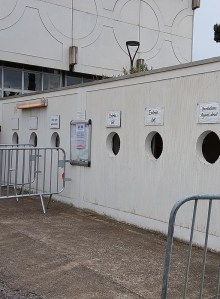
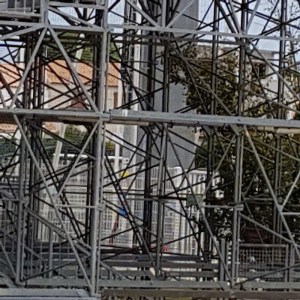
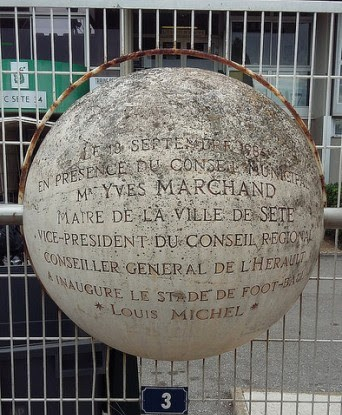
The Stade Louis  Michel was opened in 1990, but its pre-fabricated concrete panels somehow make it look older, but in a good way; 20170909_173348.jpgthe brutal angular concrete of the main stand, the Tribune Presidentielle, could be from the 1960’s or 1970’s, channeling the inspiration perhaps of Auguste Perret or even Le Corbusier. The concrete panels on the back of the stand are lightly decorated and sit above wide windows; a pair of curving staircases run up to the first floor around the main entrance, 20170909_175009.jpgabove which is a fret-cut dolphin, the symbol of the town and the club. The stand runs perhaps half the length of the pitch either side of the halfway line and holds about twelve hundred spectators, as well as club offices and changing rooms. Opposite the main stand a large bank of open, 20170909_173643.jpg‘temporary’ seating runs the length of the pitch, it is built up on an intricate lattice IMG_20170909_223051_287.jpgof steel supports. Behind both goals are well tended grass banks; there is a scoreboard at the end that backs onto the carpark.
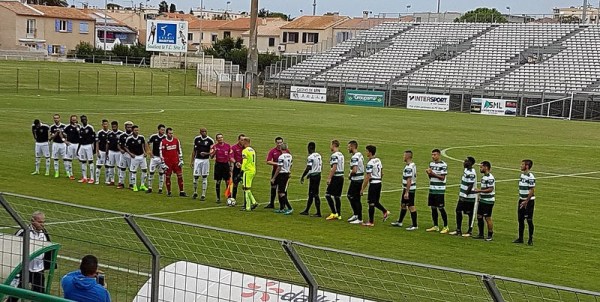
There is now not long to wait until kick-off and the teams line up; 20170909_175652.jpgSète in green and white hooped shirts with black shorts and socks, Stade Bordelais with black shirts with white shorts and socks. There is a ‘ceremonial’ kick-off before the real one, taken by a youmg woman with a green and white scarf draped around her shoulders.  Eventually, referree Monsieur Guillaume Janin gives the signal for the game to start in earnest.
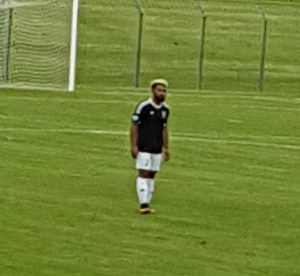
Its a grey, overcast afternoon, but not a cold one and the game quickly settles down with both teams enjoying attacking bursts in turn. The visiting team perhaps look slightly more accomplished, a bit more knowing, particularly at the back where their number four is the only player to have a tattooed forearm. He has long, lank hair and a beard and looks like he might have ridden into town on a Harley-Davidson rather than travelled over from Bordeaux with the rest of the team. The Bordelais number two is a 20170913_130330.jpgman mountain with a wide shock of bleached hair on the top of his head, and thighs the size of other men’s waists.

There’s not much of a crowd here today, three or four hundred perhaps and I count just eleven people on each of the grassy banks behind the goals and about the same number looking lost amongst the expanse of empty seats opposite. A few spectators stand and peer through the metal fence below the main stand, but most are up in the plastic, backless seats where we sit in the company of greyhaired men, idle players, club volunteers, wags and their children. A man in front of us wearing double denim reminds me of a petit Yosser Hughes, not that Yosser Hughes ever wore double denim.

The first real scoring opportunity falls to Stade Bordelais after seventeen minutes as a ball over the top of the Sète defence puts their number nine through on goal with just the goalkeeper between him and glory.  But he must have been dazzled by the dayglo yellow kit of the bald and bearded goalkeeper, who makes a startling, even dazzling save from close range.

It’s only a quarter past six, but the floodlights are coming on; every now and then there is a metallic rattle and rush behind us as a passenger or freight train speeds by on the track between Montpellier and Perpignan, which is just the other side of the road behind the Tribune Presidentialle. Sète win their first corner of the match and I am surprised to hear rythmic clapping rise from the ‘posh’ seats at the centre of the stand, but Sete has no Ultras so someone has to get behind the team; it’s a lesson that would be well learned by many club owners and officials in England.

It’s now half-past six and a ball forward is headed down to the feet of the Bordelais number ten; he feints one way and then the other to shake off the defender and shoots past the luminous Sète goalkeeper to give the away team the lead. Before the game resumes the Stade Bordelais goalkeeper is given timeout by the referree to throw a ball back to a bunch of children who have been playing their own game on the grassy slope behind his goal.

It’s six-thirty seven by the scoreboard clock and Sète win another corner to elicit more rythmic clapping from the centre of the stand; sadly it doesn’t produce an equalising goal only spiky, bitter shouts of disappointment. In the final minute of the half Séte’ s number five is booked for a trip, which leads to a Stade Bordelais free-kick within striking distance of the goal, but the opportunity is spurned.

I can’t deny I’ve been looking forward to half-time as I nimbly nip down the stairs to the buvette, 20170909_173408.jpgFC Sete.jpgwhich is close by at the corner of the stand where we are sat. The reason for my eagerness is that Sète is the home of the tielle, a small, spicy, calamari and tomato pie, with a bread like case. I love a tielle, and I love that they are specific to Sete, and are served at the football ground as a half-time snack. I only wish there were English clubs that served local delicacies. Middlesbrough has its parmo, but I can’t think of any others. Do Southend United serve jellied eels or plates of winkles? Do West Ham United serve pie and mash? Do Newcastle United serve stotties? Did the McDonald’s in Anfield’s Kop serve lobscouse in a bun? I need to know. Sadly, I don’t think my town Ipswich even has a local dish. Many English clubs don’t even serve a local beer; Greene King doesn’t count because it is a national chain with all the blandness that entails.
Having eaten my tielle (€3) with relish, by which I don’t mean some sort of pickle, but rather enthusiasm, I wash it down with a small beer (€2) and I treat my wife to a bottle of cold water (€1).

Reflecting my sense of tielle induced well-being, sunshine floods the stadium some time after the start of the second half. I look out across the pitch to the backdrop of the tree covered rocky outcrop that is Mont St Clair and all is right with the world, except that Sete are still losing; they substitute their number ten for number fifteen, but their opponents counter ny swapping thier number eleven for a thirteen.

Sète don’t look particularly like scoring, despite the change in personnel, and Stade Bordelais almost double their woe as a corner kick is headed firmly but deftly against the far post from an unlikely distance by a player whose shirt number I didn’t quite catch. The Stade Bordelais number nine is very quick and slaloms between two or three Sète players before being outnumbered. Sète’s eight becomes a fourteen. There are twenty minutes left and a free-kick to Sète is saved at full stretch by the Stade Bordelais goalkeeper. Sète’s eleven is replaced by their thirteen, a player and father of a little girl who calls and waves to him as he warms up in front of the stand, and he waves back. But undaunted by familial pleasantness Stade Bordelais replace their number seven by number fourteen. Stade Bordelais’ number nine breaks free down the left; he gets behind the Sète defence and delivers a low cross which is perfectly placed to meet the incoming run of the number ten who, from a position near the penalty spot, embarrasses himself with a shot which misses the goal in two directions. Two minutes later ten’s failure is compounded as his time under the unforgiving glare of the floodlights is terminated and he is replaced by twelve. There are still ten minutes left, but the final act of any note sees Sète’s number nine head the ball past the post from a corner. Stade Bordelais’ defenders hold firm to win the game. No one is a match for their huge full-back, their very own, very mobile rocky outcrop.

It’s not been the best game I’ve ever seen, but it’s been an oddly calm, measured one. Was anyone booked? I don’t recall. Stade Bordelais have won with greater guile and knowledge and strength, but Sète will always have their tielle, although they’ve run out of them in the buvette today.

20170909_173156.jpg