FC Megalithes 2 Riantec OC 1

The small town of Carnac on the coast of Brittany is famed for its sprawling, ritual landscape of neolithic, megalithic alignments, menhirs and dolmens, but less so for its football clubs.  It is unlikely therefore that many people outside the local football fraternity of the Morbihan departement (County), noticed the merger in 2023 of two or maybe three local clubs to create what its name suggests is a giant ritualistic rock of a football club, FC Megalithes, which possibly prefers to kick-off games in the direction of the mid-winter sunrise.

The website for the French equivalent of the local County Football Association helpfully lists associated clubs and their fixtures and having arrived in Carnac the day before and settled in, my wife Paulene and I have dusted off our autumn almanac and are seeking entertainment on what is a sunny September Sunday afternoon.  The website tells us that FC Megalithes are at home to Riantec OC, playing their second league match of the season in the Ligue Bretagne de Football, District Morbihan, District 1 Poule B.  If Ligue 1, where the likes of Paris St Germain and Olympique Marseille hang out is level one of French football, we think this is about level ten of may be twelve or thirteen.  Riantec is a village a bit more than 30 kilometres away near the much larger town of Lorient, albeit this side of the estuary of the River Blavet; Wikipedia tells us that in 2017 Riantec had a population of about 5,600.

The football association website states that kick off is at 3.30 pm, and believing the match will be played at the main sports ground in Carnac, we set off at about ten to three from our ‘hut’ in a nearby camp site to make the 3.3 kilometre journey in our planet saving electric Citroen eC4.  As is often the case with local municipal sports grounds in France, there is plenty of free parking, but worryingly perhaps, as we roll up almost all of it is unoccupied,  and walking through the stone gateway of the Stade it is evident that there is no one else here except some youths playing an impromptu game of ‘three and in’ behind the albeit impressive, but lonely looking and very empty main stand.  The pitch is freshly marked out, but there aren’t even any goals up.  Clearly in the wrong place, we consult the interweb again and discover, courtesy of our very own administrative error, that we should be at Parc des Sports Kermouroux, about 7 kilometres away in St Philibert.

It is an easy trip across town to St Philibert, despite some 30 kilometre per hour maximum speed zones and a couple of red lights, and whilst we arrive after three-thirty we can see from the road outside that the players are only just lining up to shake hands and accept the applause of a crowd of what must be about a hundred people.  As we step through a side gate, we can even hear some Ultra-style chanting, although that seems to be from the players of the B team whose match had kicked off at one-thirty and has since ended.

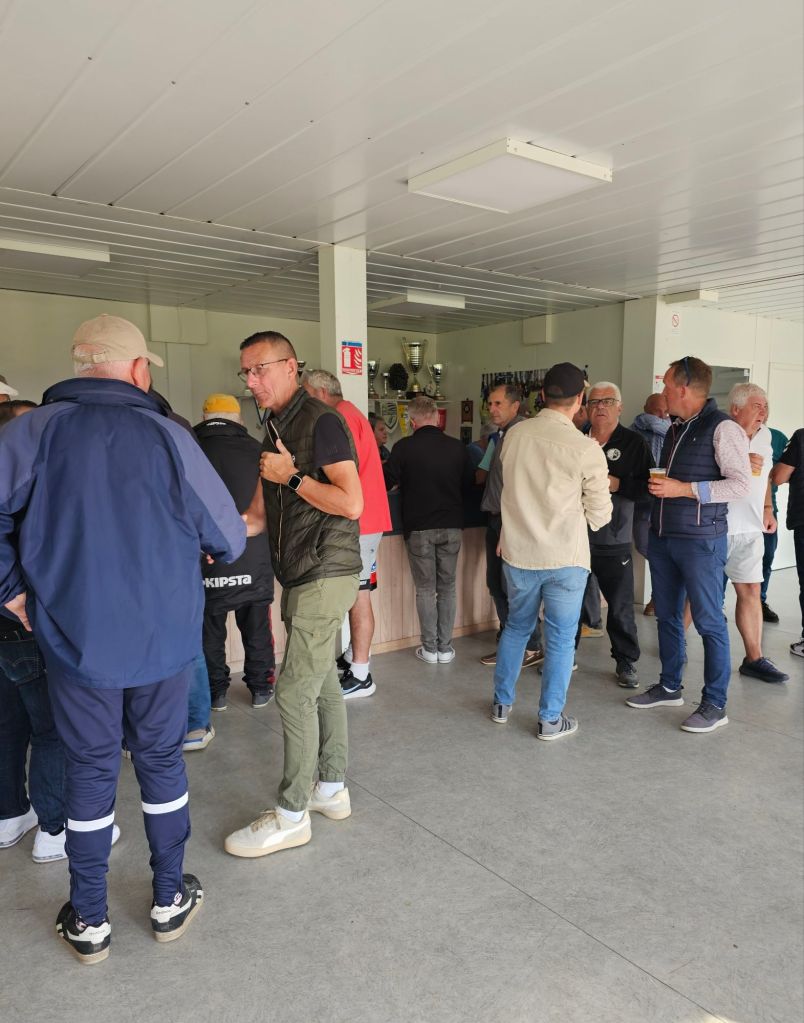
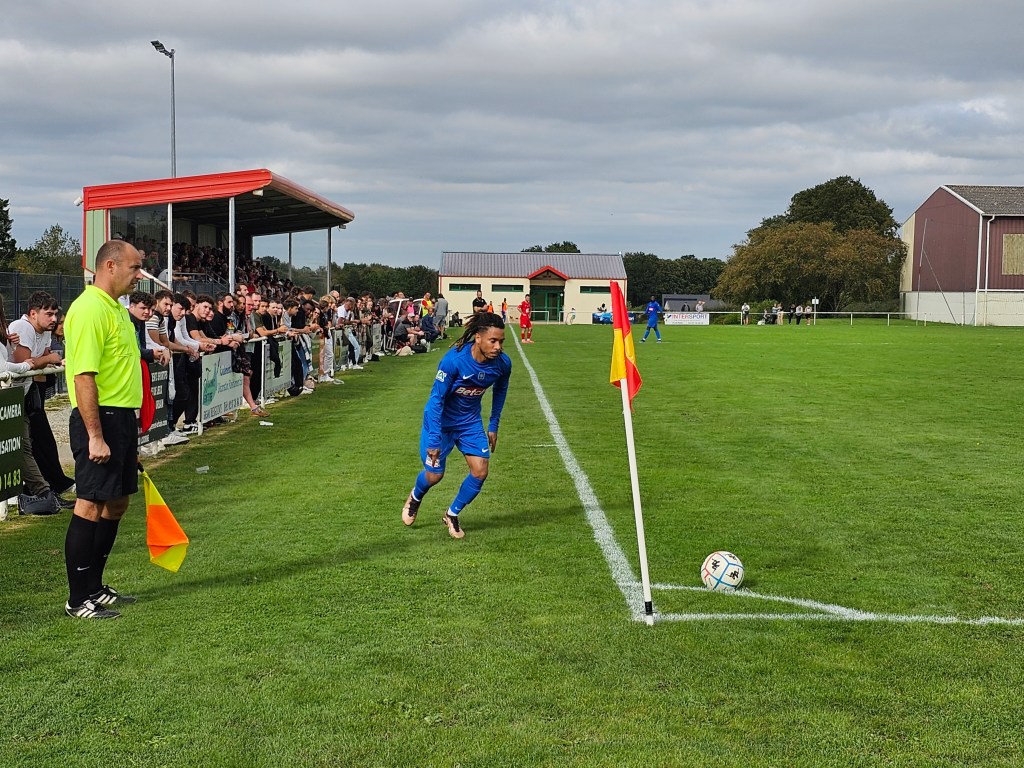
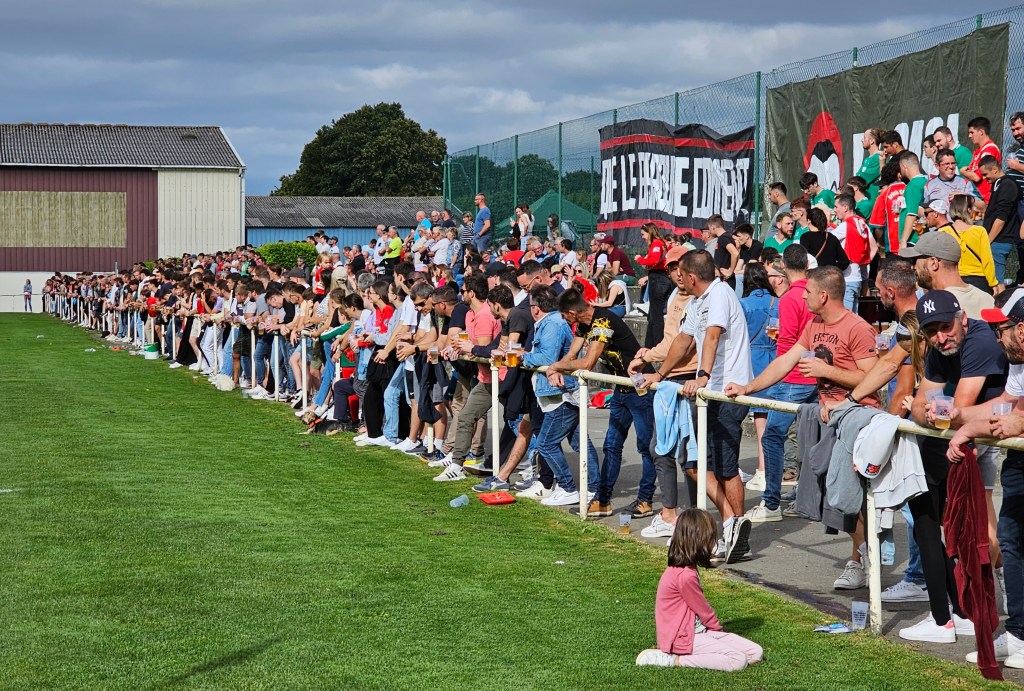
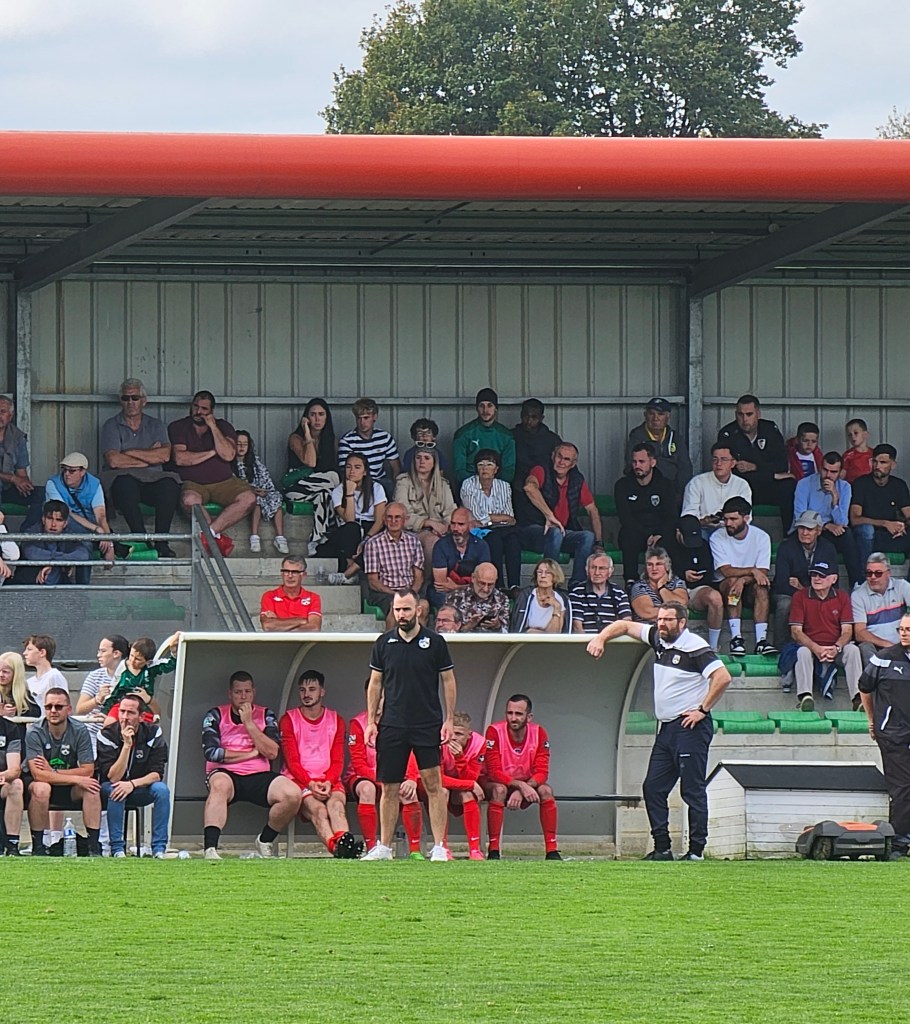
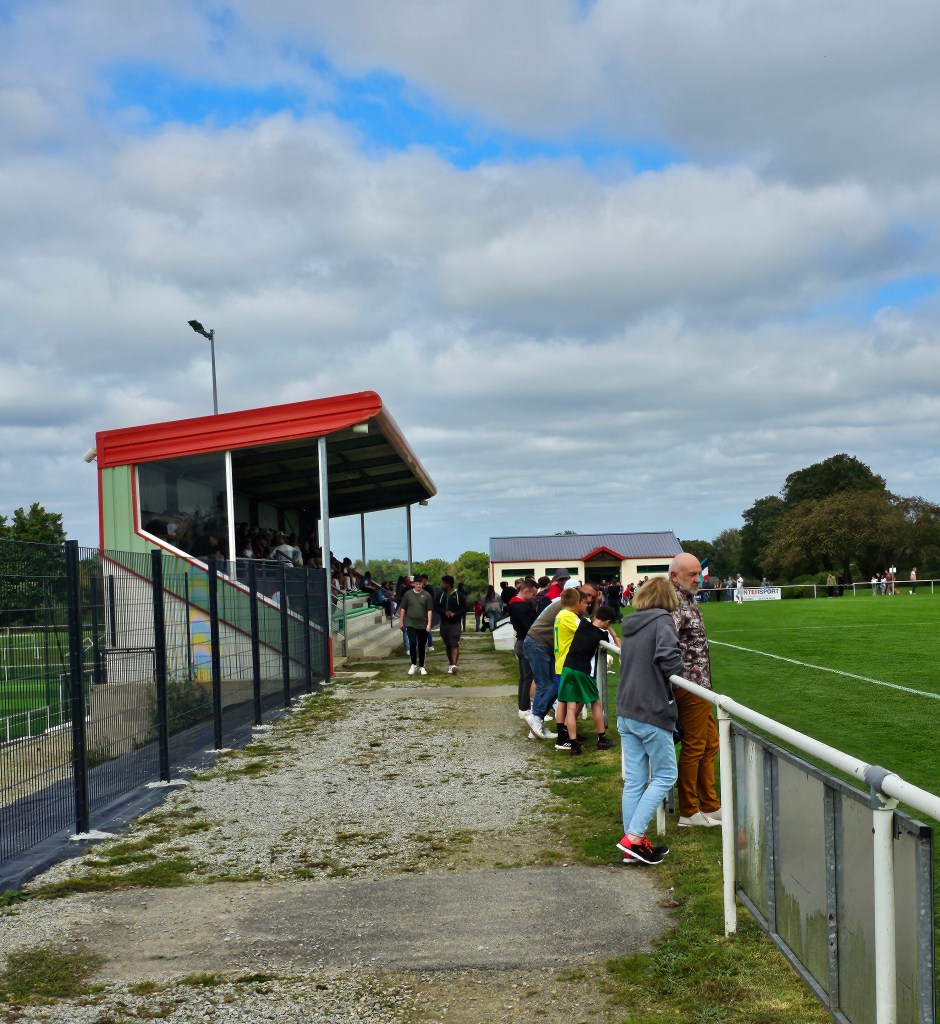
The Parc des Sports Kermouroux has no stands or floodlights, just a neat white rail all around the pitch, a couple of dugouts and a clubhouse.  The site is surrounded by houses, but on the far side of the pitch is also a playground and what looks like judiciously mowed, planted wildlife area.  The majority of the crowd lean on the rail in front of the clubhouse, inside which a couple of middle-aged women are doing a good trade in beer.  Wine and coffee are also available. 
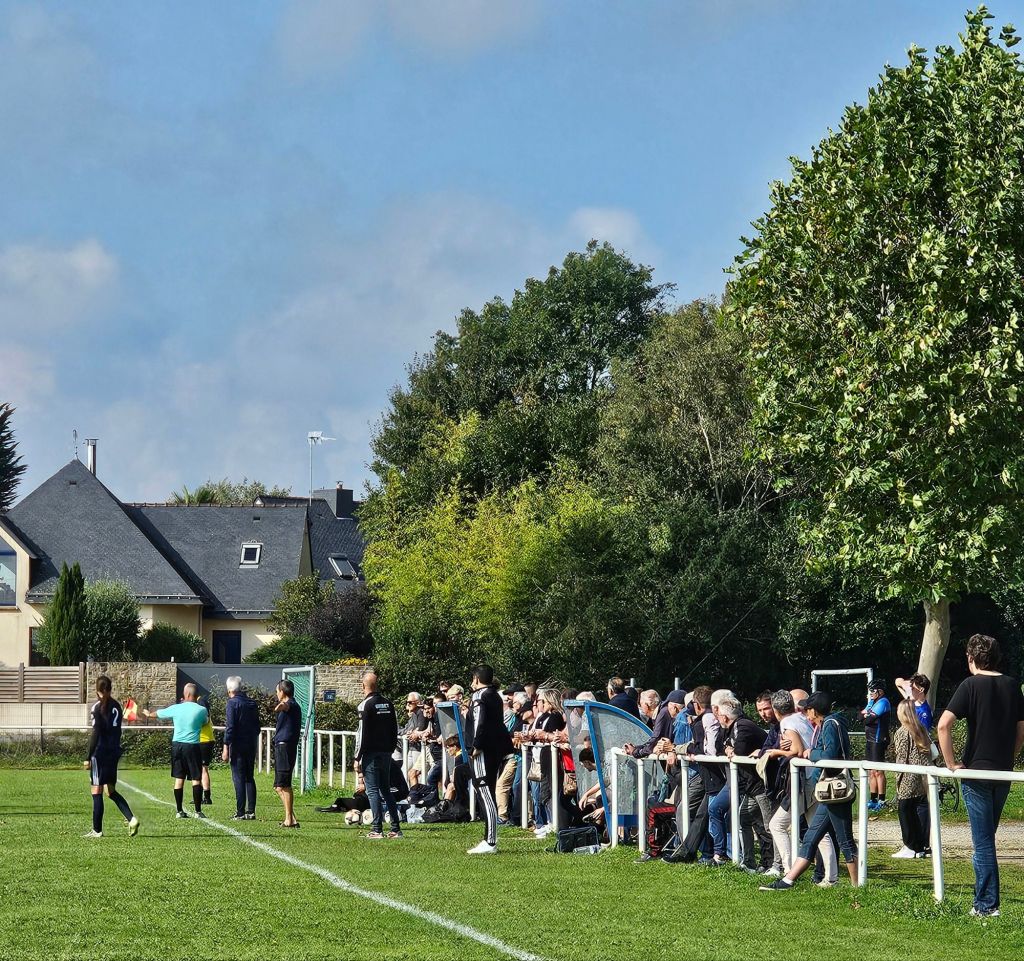
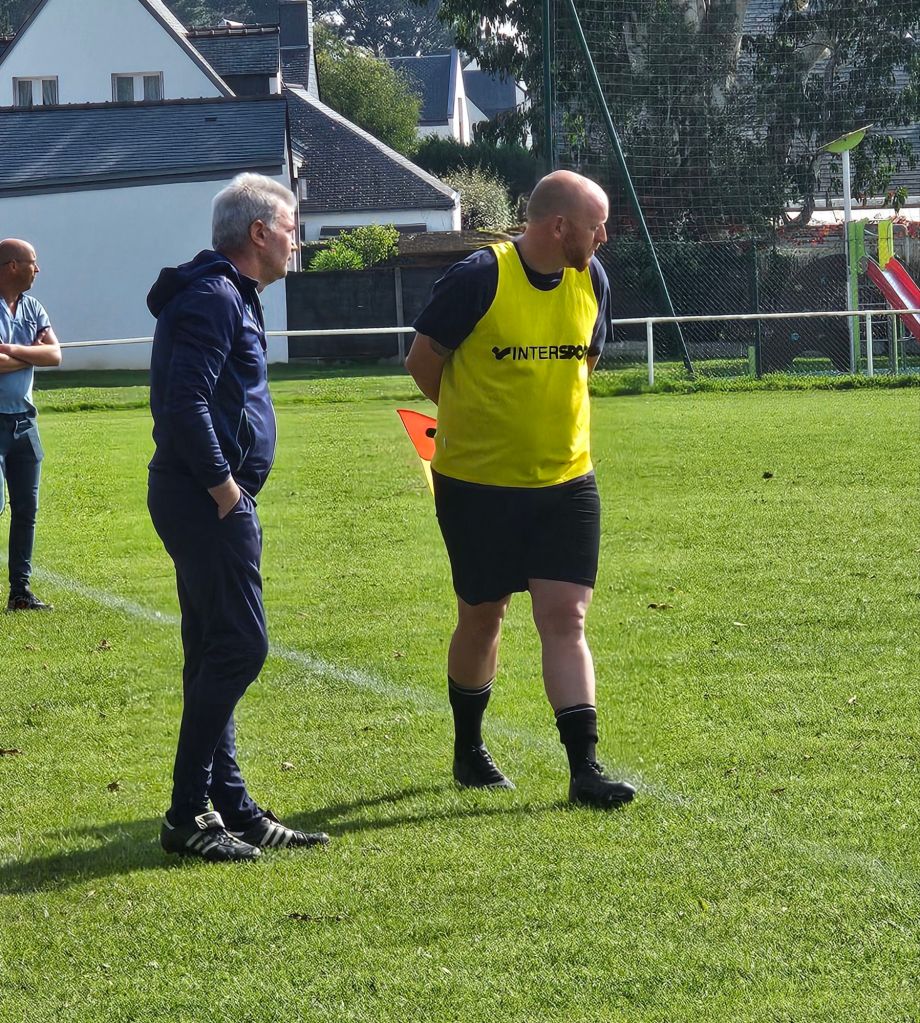
We miss the actual kick off, or coupe d’envoi as the French call it, as we find a decent spot against the rail, but we are paying attention when at eighteen minutes to four the Megalithes’ number nine bustles his way through the Riantec defence, checks and turns a couple of times and then boots the ball beyond the Riantec goalkeeper and into the goal.   Two minutes later he repeats the dose, running beyond the back four and a sluggish linesman to score from about six yards out.    The linesman doesn’t really seem to have grasped what his role is yet, but to be fair to him it does look like he didn’t expect to be linesman when he turned up, as he is wearing a day-glo yellow tabard rather than the standard officials’ uniform that the referee and the other linesman are wearing. As for the teams and their apparel, Megalithes are smart all in navy blue with white trim, whilst Riantec are less so in a messy looking combination of baggy white shirts and with streaks on,  and black shorts.

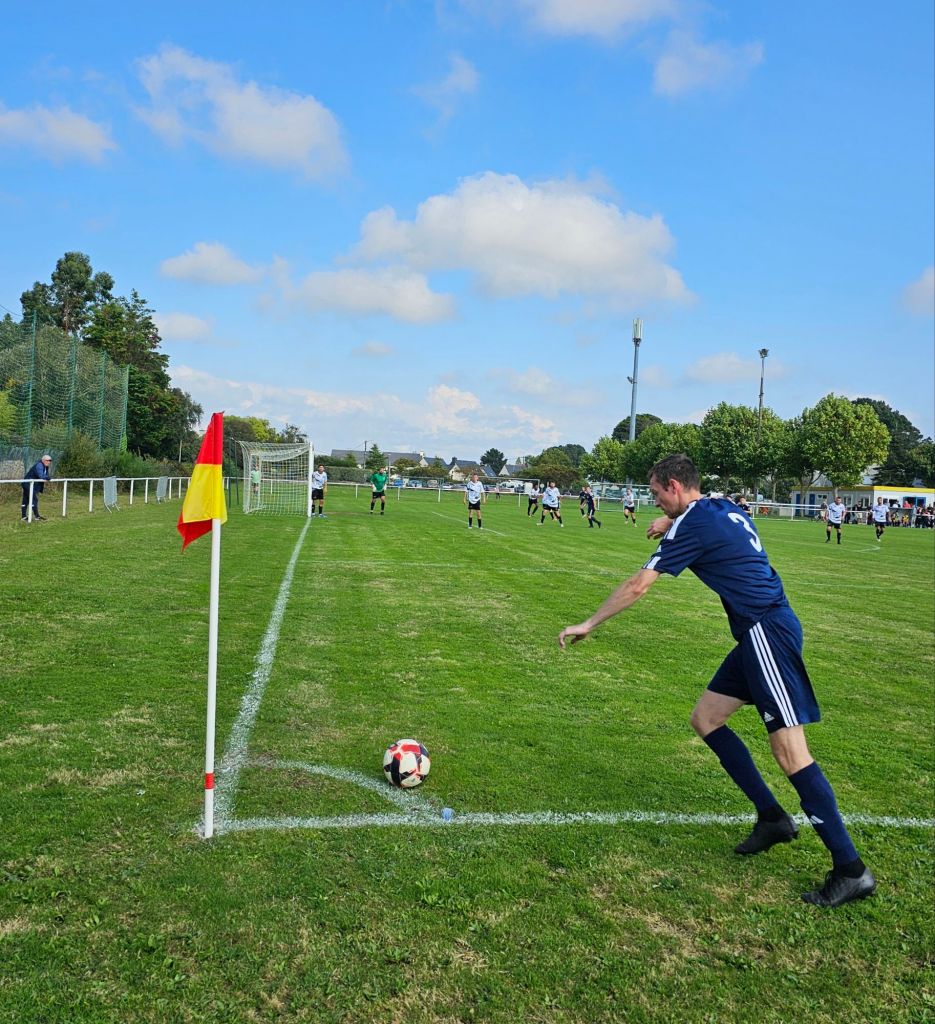
After two goals in the first five minutes, the arrival of the first corner of the match at seven minutes to four leaves everyone somewhat non-plussed.  This is even more the case when a minute later a punt forward for Riantec is met with another hopeful punt-cum-shot from their number ten and the ball sails into the top corner of the Megalithes’ net to make the score 2-1, against the run of play.  Although the goal adds to the excitement and sense of jeopardy, which I believe is what football matches are all about, I can’t help but feel a bit disappointed because Megalithes are by far the better team.

Megalithes continue to dominate the match and pass the ball well but seem unwilling to score again, although their number nine keeps threatening to nip behind the Riantec defence just as he did twice before, but he never quite manages to get his shot into the net.  Without more goals to concentrate players’ minds on keeping up to date with the score, a combination of fouls and outlandish acting creeps into the game, with more than one player letting out blood curdling screams as he collapses to the ground as if the subject of some sort of unexpected, attempted human sacrifice.

The gnarled looking, but neatly coiffured, grey-haired referee is totally in control of the shenanigans, looking down deeply unimpressed at the writhing players, whilst politely but firmly dealing with the perpetrators of genuine fouls. “S’il-vous plait Monsieur” he says politely but wearily as he beckons over the perpetrator of a foul to instruct him as to his future conduct.  In the first instance Rianec’s number eight is merely spoken to, but then Carnac’s number ten, a lithe youth with curly hair a la Adrien Rabiot, is booked after being summoned with the ominous words “Numero dix, s’il vous plait”

Half-time comes as a relief after the frustration of FC Megalithes not scoring the goals they deserve and all that falling about and screaming.  I head for the club house as the players make for the dressing rooms and am quickly acquiring two cups of coffee (one euro each), which are served from a filter coffee machine; none of your instant muck here. Paulene and I find a better position by the rail as almost everyone else heads indoors for more beer, and we nick their ‘spots’.

It is nineteen minutes to four when play resumes and within moments Megalithes number nine is centring a low cross, which number three easily and mournfully taps wide of the goal having arrived in position perfectly on time and completely unseen by the opposition.  The second half is twelve minutes old when Megalithes’ number nine elicits a fine save from the Riantec ‘keeper at the expense of a corner and then the scenario repeats itself.  Megalithes continue to dominate the second half as they had the first and the mystery of how they fail to score more goals continues every bit as mysteriously as the question of why the neolithic locals erected all these megaliths in the first place.

It is a quarter past five when Riantec win a corner and I can’t help thinking to myself that this is the first corner the away team has won, and it has taken them almost an hour and a quarter to do so.  Normal service is resumed however just two minutes later as Megalithes’ number twelve beats the offside ‘trap’, takes the ball around the Riantec goalkeeper and then places it precisely into the side netting of the goal.  A minute later Megalithes number two, a beautifully skilful player, repeats the process, taking the ball around the goalkeeper, but doing so without the necessary speed to get the ball into the goal before two defenders get back and combine to clear the goal bound ball.

Finally, and fittingly, in the final minute of the game, Megalithes place the ball in the Riantec goal to make the score justifiably, although sadly only temporarily 3-1, as almost inevitably the linesman raises his flag to declare it hors-jeu, offside, which it rather blatantly was.

The final whistle brings relief to both teams as the home side finally confirm their narrow win, and the away team gain respite from the footballing lesson they have been given.  The sun has now begun to sink low in the sky and a cool breeze has spoiled what was an almost balmy autumn afternoon for a while.  Pleasingly, the better team has won and whilst not winning by as many goals as they should have, a decent hour and a half’s entertainment has been provided by everyone involved. There is a palpable warmth and feeling of community amongst the crowd and as ever as we leave the ground and head happily  for our Citroen to make the short drive back to Carnac, our experience of French amateur football has been a pleasant and uplifting one.  Vive le Foot!

Garde St Cyr Moreac 1 Vannes OC 3

Whilst the disadvantage of spending two and a half weeks in France during late September is that I am missing three Ipswich Town home games, this is offset to some extent by having tickets for two Ligue 1 matches, and is then offset quite a bit more by having the opportunity to see a game in the fourth round of the Coupe de France, a knockout cup competition every bit as much fun as England’s FA Cup and possibly even better on account of it not having been won for the last two years by the all-conquering pet team of some dodgy middle eastern emirate.

Having discovered that the weekend of 1st October was ‘cup weekend’, I struggled a little bit at first to discover the fourth-round draw, and then a little bit of further work was involved to find out which home teams were a reasonable distance from where I am staying in Carnac.  Unhappily for me, as I trawled through the fixtures it seemed that most games are being played on Sunday 1st October, when my wife Paulene and I shall be watching Lorient play Montpellier, and of the Saturday games most are in the area around Brest, which is a good two-hour drive away.  But then the fixture list on the footbretagne website came up with the rather grand sounding name of Garde St Cyr Moreac and Google maps quickly confirmed that Moreac is just 33 kilometres north of relatively nearby Vannes, and about the same distance from where my wife Paulene and I are staying as Framlingham or Leiston is from our house back in blighty, and I’ve driven to watch them before, more than once.  Moreac of the third tier of the regional league (Step8 – the same as Ipswich Wanderers, Stowmarket Town and Felixstowe in England) would be at home to Vannes OC of Ligue National 3 (Step5).

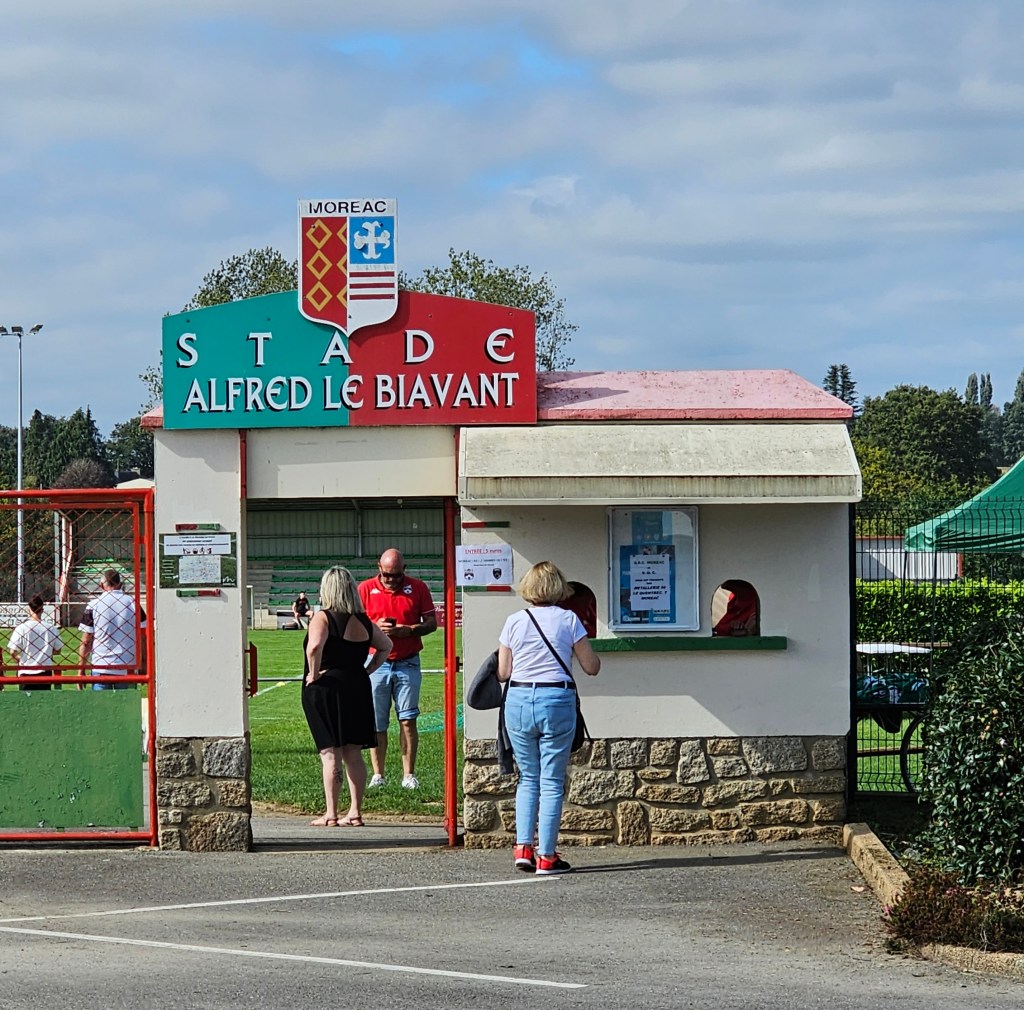
The drive to Moreac takes a little under an hour and the roads are quiet because it’s lunchtime. The countryside changes as we travel in land from the flatness and long straight road just in from the coast, to the greener, rolling countryside where the road twists and turns and rises and falls through valleys populated by grazing cattle and not much else, it feels miles from anywhere, not unlike Framlingham and Leiston.  At Locmine we pass a huge factory belonging to the Jean Floc’h company, a major producer of meat products in France, although being France the sign outside refers to charcuterie and not pies.  Jean Floc’h is nevertheless a massive purveyor of processed food.  Moreac is just a few kilometres beyond Locmine and is an attractive village built around the focal point of the large church of St Cyr, from which the football club takes its name.  Wikipedia tells us that in 2020, Moreac had a population of 3,703. The Stade Alfred le Biavant, home of the football club, is just a street or two away from the centre of the village and has a large, surfaced car park where Paulene and I rock up in our planet saving Citroen e-C4 with a bit more than an hour to go before kick-off at 3 pm.

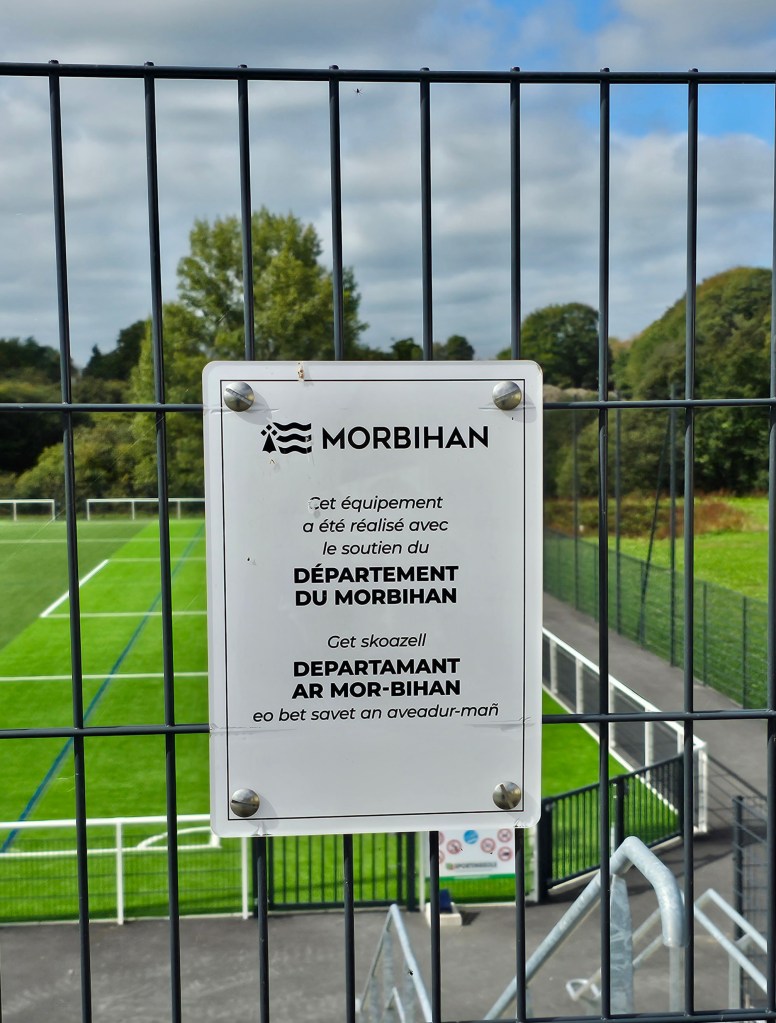
The entrance to the stadium has an elegant if small gate, and a guichet from which a middle-aged lady is selling tickets; today entry costs 5 euros for me but is free for Paulene and indeed all women, which is nice.   Even better, I get a little green ticket too as a souvenir.  The stadium has one small stand with seats on the far side and opposite that a very small bank of terracing, just two steps high but very steep; it’s a bit like a sea wall.  The  site also contains a huge sports hall, which looks like it could double as a barn to house some of the animals destined for the Jean Floc’h factory, a changing room block, a bar with glazed walls overlooking the pitch, a second full size grass pitch and a very smart plastic pitch, on the fence to which is a sign which tells us it was built with money from the local Morbihan Council. France, unlike the UK, is a country which despite problems with pensions seems to a large degree to be still run for the benefit of its general population.  Adding interest, in the corner between the sport shall and the car park is the village cemetery.

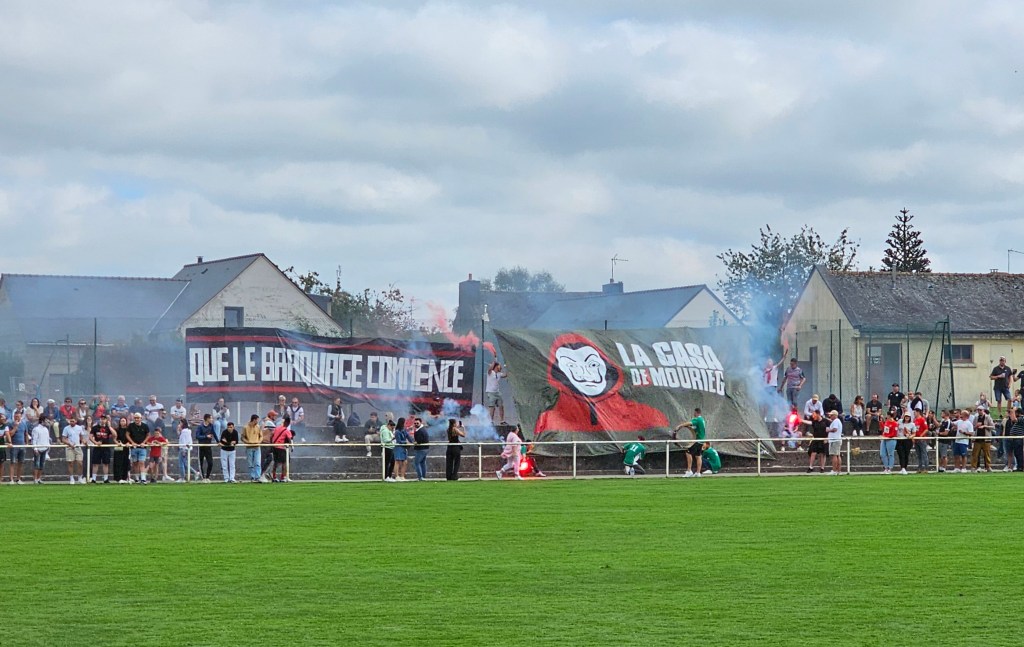
With time to spare until kick off, we watch the teams warm up and I take the opportunity to invest 2 euros in a small glass of Lancelot beer, considerately served in a re-usable plastic ‘glass’; why don’t all football clubs  do that?   The crowds are now streaming in and it feels like the whole village is turning out, a man in a club tracksuit top greets friends and neighbours and kisses on cheeks are being exchanged everywhere, although the younger men tend to only shake hands.  The French seem much more sociable and comfortable with each other than the English. A bunch of blokes in their twenties wearing faded green football shirts appear to be the Moreac ultras, and they parade along the path leading from the gate to the pitch following a bloke banging a drum, and holding aloft red distress flares.  If this happened in England they’d probably be arrested, but here no one bats an eyelid, although one or two people take photos for posterity.

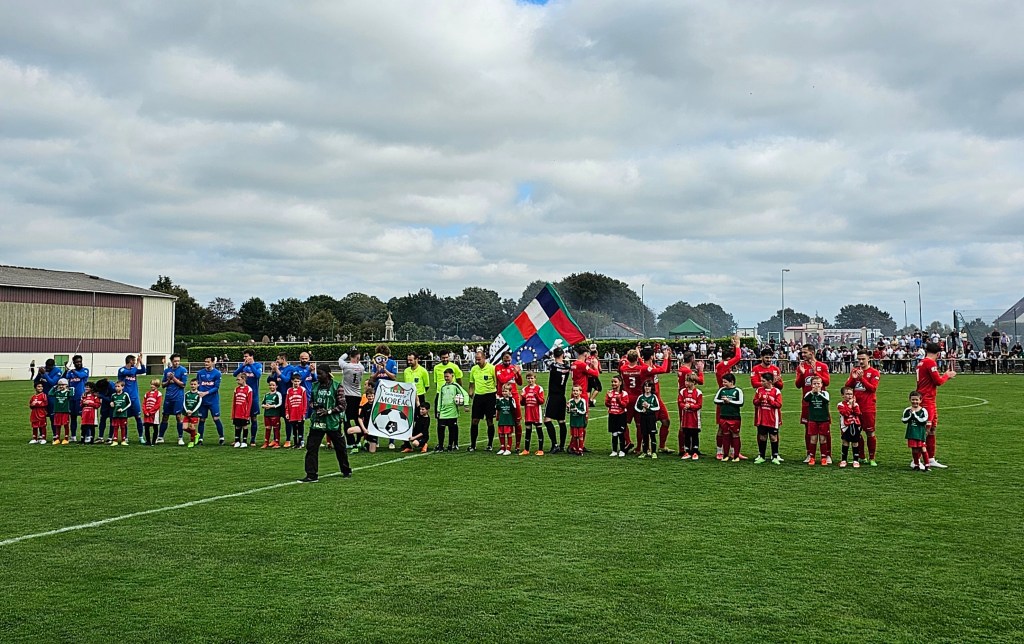
As three o’clock approaches the public address system gets tested with a few bursts of sound of gradually improving quality.  Eventually the ubiquitous 1983 rock anthem ‘Jump’ by Van Halen is played, but it ends abruptly as it’s still not quite time yet, although the teams can be seen lining up behind the referees at the door of the dressing room block in the corner of the ground.  The referee eventually gives the nod, and the teams parade on to the pitch attended by several small children as proud parents point mobile phone cameras at the event and Van Halen get to do an encore in full.  Over on the terrace the ultras light more flares, chant enthusiastically and unfurl a tifo which declares ‘La casa de Mourieg’ and displays a picture of what looks like a pale faced Salvador Dali in a red hoodie.  Mourieg is the Breton name for Moreac but casa is Spanish for house, so I it’s not clear to me what they’re trying to convey, although of course Dali was Spanish, perhaps they’re just being surreal like him. (Postscript, the next day, driving out of Lorient after seeing Lorient lose at home to Montpellier in Ligue 1, we passed a pizza restaurant in Lanester called Casa del Pizza which had the same Salvador Dali face for its logo. The surrealness continues)

At exactly three o’clock the game kicks off with Vannes getting first go with the ball, kicking it towards the sports hall and dressing room end of the ground. Moreac are all in red and Vannes all in blue; this reduction of team colours to blue and red is normal in the early rounds of the Coupe de France as is two common shirt sponsors in all games; today the Credit Agricole logo adorns the red shirts and Betclic the blue. Pleasingly both teams are numbered 1 to 11 and no one is wearing anything silly like a number 98.

The gulf of three divisions is soon apparent as Vannes begin to dominate possession.  Moreac manage to win a free kick wide on the right early on but Vannes earn a corner.  “Aux Armes” chant the ultras, and incidentally “Aux Armes et caetera” was the title of Serge Gainsbourg’s thirteenth studio album, but he didn’t then sing “Nous sommes les Moreacois, Et nous allons gagner, Allez GSC” (“ We are the Moreacois, and we will win, Go GSC”.)  Sadly, the chant will prove overly optimistic and Vannes score their first goal after just eleven minutes, their No9 being left in enough space in the middle of the penalty area to steer a half volley in off a post.  “Allez Moreac, Allez Moreac” sing a group of children undeterred by the early goal.

Vannes continue to dominate, but Moreac have the occasional foray forward, usually on the basis of a free-kick.  Twenty-two minutes gone and the Moreac goalkeeper has to make a decent diving save to keep out a low shot.  “La la  la, la la, la, la la, la la,  Allez GSC” sing the ultras celebrating small victories.  Three minutes later and Vannes’ number eleven doubles his team’s lead as he is left all alone on the left and he passes the ball across the goal into the far corner of the net.  It might be a matter of how many goals Vannes can get.  

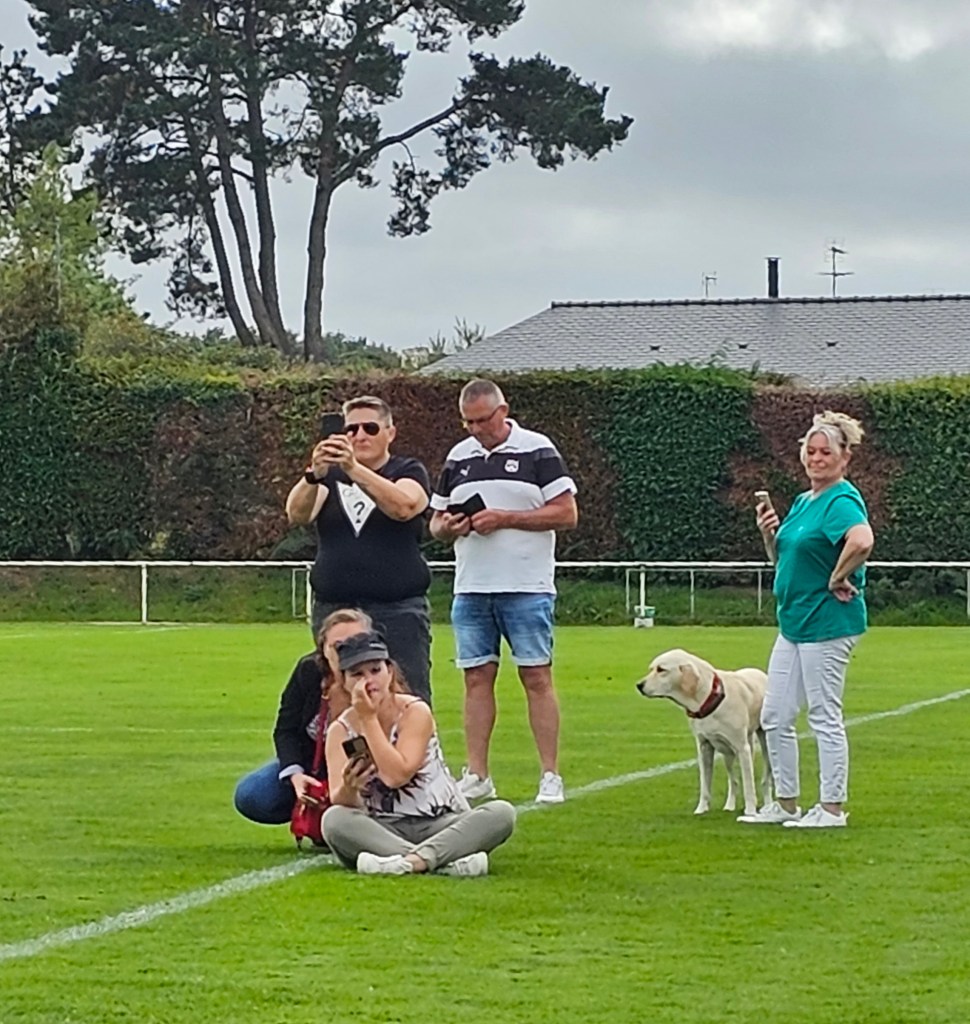
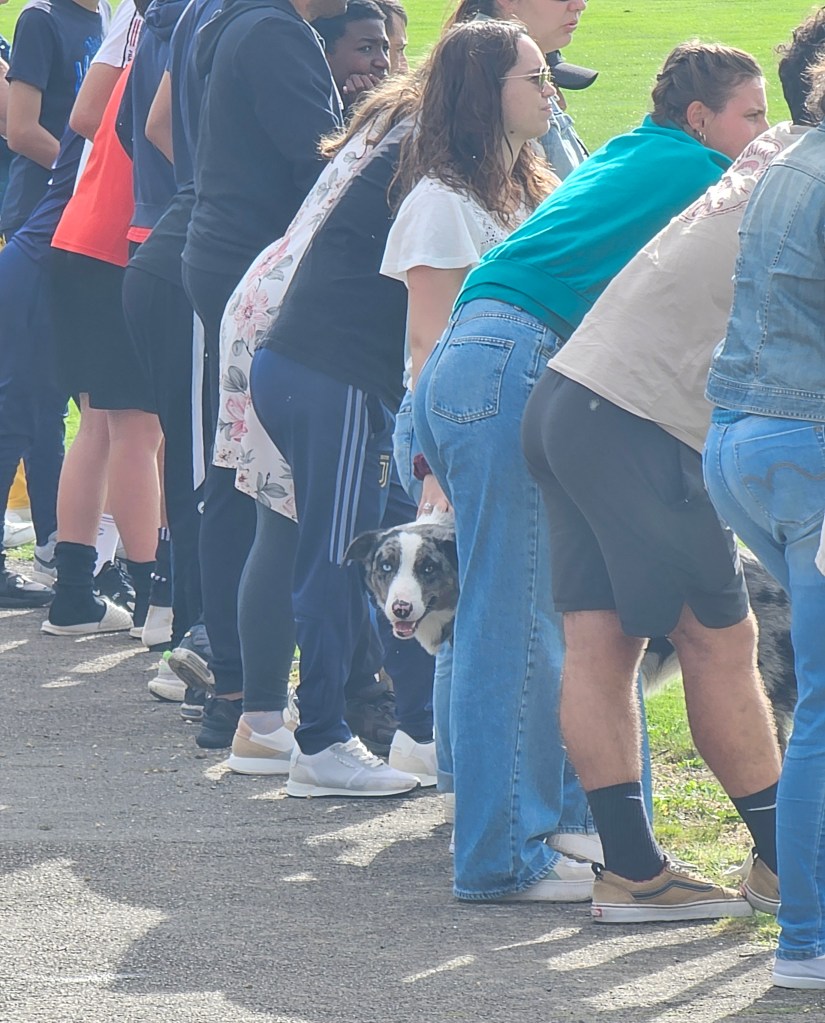
The home crowd, which seems to make up a good ninety per cent of those here don’t’ show their inevitable disappointment and their attention is still gripped, although that doesn’t go for all the dogs in attendance. A Labrador has a lie down, albeit almost on the pitch whilst a mongrel looks the wrong way. Only a sort of Yorkshire Terrier is concentrating on play, and when any player comes near he strains at his leash and yaps ferociously.  As for the away support, I’ve only seen a couple of the sort of grizzled old fanatics who tend to follow amateur teams away from home.

With almost a third of the game gone and lost to history, Moreac have their first shot on goal as their number 10 cleverly beats a man and then shoots optimistically from twenty-five metres out.  The prevailing, uneven balance is restored soon after however, as the Vannes number nine has a shot well saved and then shoots over from very close range. It’s enough to make the Stade Alfred Le Biavant as quiet as it has been all afternoon.  It doesn’t get any louder as the Vannes number seven has a shot deflected onto the top of the Moreac bar.  The lull is filled by Paulene revealing to me that she is always fascinated by young women at football matches on their own, as a smartly and alluringly (she has an off the shoulder top) dressed girl watches the game briefly a few metres away from us, before walking on towards the main stand.  I suggest that perhaps she’s just a lonesome WAG.

Fortunately, football is never entirely predictable and three minutes before half time Moreac attack down the right.  Surprisingly, the Vannes defence is drawn across the penalty area leaving Moreac’s number seven free to run onto a wide expanse of grass into which the ball is played.  The Vannes goalkeeper saves seven’s first shot, but can only parry it, and the number seven then strikes home the rebound.  It’s just a short run to the ultras for number seven and his teammates who form an impromptu human mound of celebration.  The game restarts. but it’s the last kick of the half.

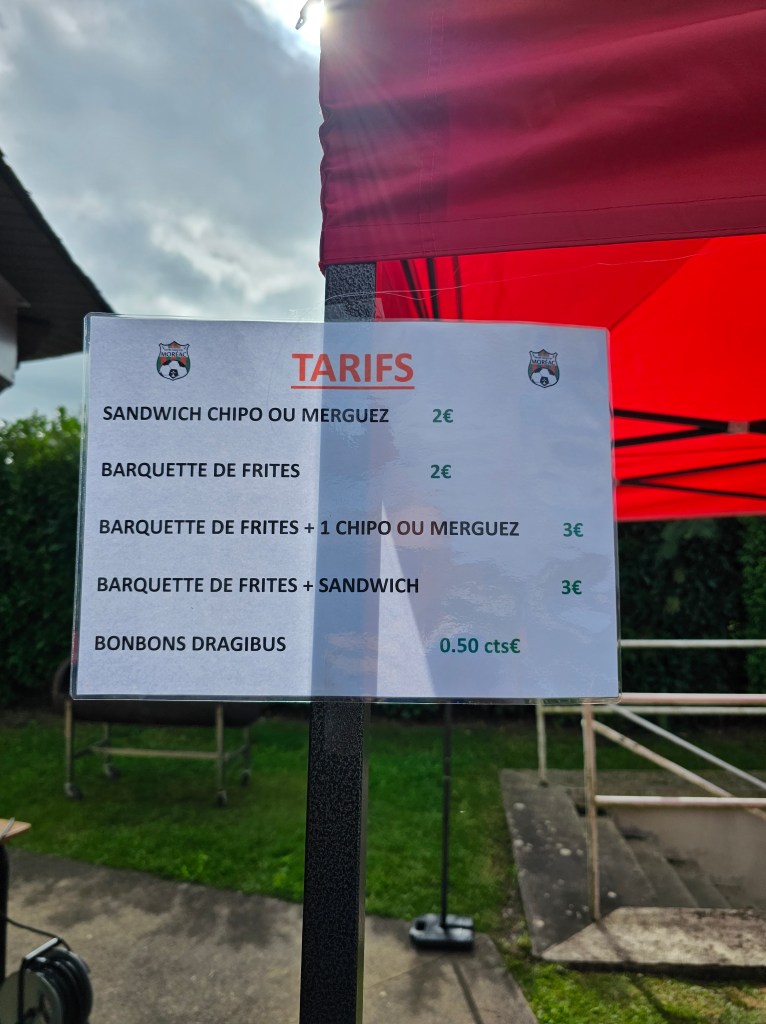
During the first half, we have watched as a barbecue has smoked away in the corner of the ground and now there is a human tide flowing towards it, attracted presumably by the promise of a mid-afternoon snack of a lamb and beef sausage (Merguez) and a chip butty for 3 euros. 

The match begins again promptly at four o’clock and the familiar pattern of Vannes passing the ball about too quickly and smartly for Moreac continues.  It is Vannes however who have the honour of being the first to have a player booked as their number seven hauls an opponent to the ground.  But Vannes press forward still. Numbers eight, eleven and nine combine cleverly but nine shoots over the goal again, then number ten does the same.  My attention is taken by the number eight, a tall creative midfielder who passes the ball well and makes me think of both France’s Adrien Rabiot and Arsenal’s Graeme Rix, although that it is entirely down to his mop of curly hair.

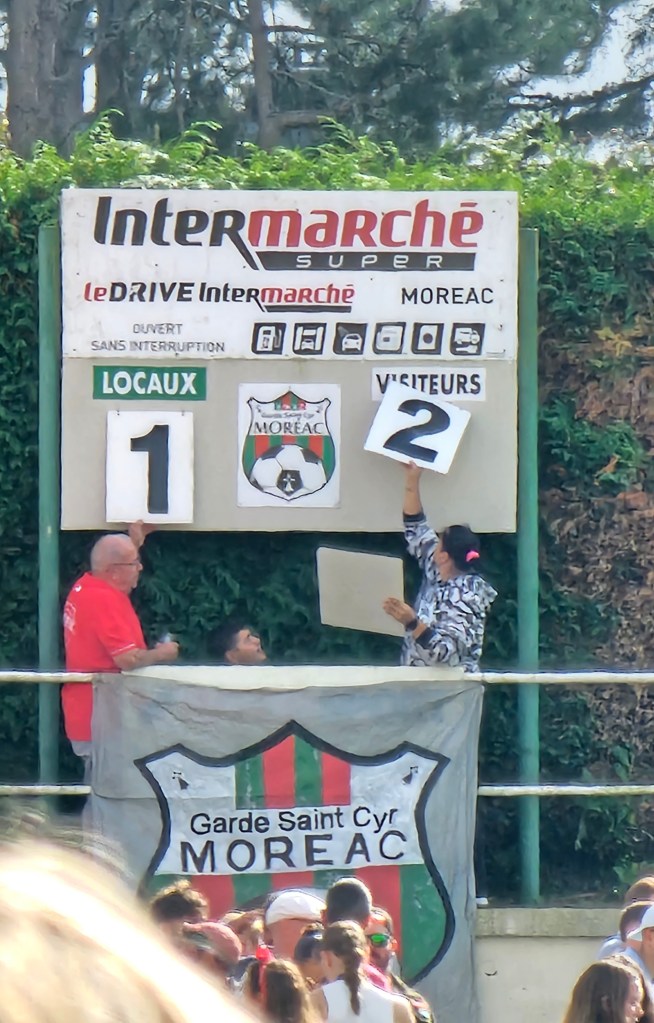
At a quarter past four Vannes score again, this time number ten tidies up as the ball runs loose and wellies it into the net from about 10 metres.  I watch as the number two on the scoreboard is unhooked and replaced with a three.  Moreac had had some hope at half-time thanks to their unexpected goal, but the game has settled down now, and the score will remain unaltered, despite a series of substitutions by both teams.  The substitutions are overseen by the Delegue Principal, a sort of fourth official in overall charge of the fixture, but in a shiny blue suit; he has his own designated seat at pitch side midway between the two team benches. From a distance he is unfortunate enough to look a bit like Norman Tebbitt, but it’s probably just because he’s bald.

I see out the game by wandering around and enjoying it from different angles from both sides of the ground and behind both goals.  Clouds and sunshine swap about altering the mood of the backdrop of trees, fields, houses and headstones.  Number three for Moreac evens up the score for bookings but there’s never any malice in the game.  The worst that happens is that the ultras take a dislike to the Vannes number ten who I think they perceive is a diver, so they boo him whenever he gets the ball.  With the final whistle, the ultras release a final salvo of flares and the victorious losers of GSC Moreac gather in front of them to give and receive appreciative applause.  It’s been a decent match on a  warm afternoon of late summer sun mixed with early autumn clouds and breezes and everyone has had a lovely time.  Just like in England, local football in France is a wonderful thing, there really is no need for professional football or the Premier League.